




Abstract
In this study, the factors affecting the success of university students were analyzed by logistic regression analysis. In the study, success variable was defined according to the survey information applied to 360 university students studying in School of Physical Education and Sport in Çukurova University and Kahramanmaraş Sütçü İmam University in Turkey, in 2017–2018 academic year. The relationship between the answers to the Likert-type scale questions affecting success variables and the course success was estimated by logistic regression analysis. According to the results of the research, because independent variables such as mother’s education status, age, and class were statistically insignificant, they were not included in the multivariate model. According to the findings, variables such as gender, the university they studied, the way they chose their department, and father’s education are seen as important in the growth of students’ academic success. In addition to this, the variables such as counseling about their profession, support of department’s instructors, and communication with instructor have been found to be considerably effective on success. It was observed that the way they chose their department (willingly–compulsorily) was the most effective factor, and father’s education was the second effective factor. As a result, the success levels of the students were found to differ according to the sociodemographic characteristics and their relations with the instructors. On the contrary, as the instructors’ guidance, support, and communication skills are effective contributors on student’s success, it has been concluded that instructors should take these factors into account.
Keywords
Introduction
The learning process is one of the most important activities in the life of child. The learning process is connected with the achievement, and achievement influences the life satisfaction of children as well as all humans (Kubiatko et al., 2018). Academic achievement affects the lives of the students to the full extent (Koç et al., 2018); for this reason, educational institutions all around the world consider it an important target to improve the students’ academic success. Academic achievement is of great importance not merely to determine the extent the students have learnt in an educational program but rather to figure out whether the students will attend the schools they want. The results of country-wide exams the students take, and their careers and job opportunities after school are affected by academic achievement (E. Şahin et al., 2018). Increasing the academic achievement of students and ensuring their professional development in educational institutions are among the primary objectives of the education system. Teachers are among the greatest contributors to the success of students and to the sufficiency of adequate professional development. Teachers have great importance for the future of their society, and they are indisputably the most indispensable element of the education system. For this reason, it is necessary to focus on the education of teachers. Examining the negative factors that affect teacher candidates to be educated as qualified and finding solutions in that sense would make individuals in the future to become a teacher, more productive for themselves, for their students, and for their societies (Çelen & Bulut, 2015). The personal qualities of the teacher, the adequacy of the learning activities as a leader, the monitoring of the learning process, the adequacy in evaluation and teaching, the resume, relations with students and other individuals affect his or her success in classroom (Güçlü, 2002). Also, a number of teachers, instructors, coaches, and mentors lack required specialized education in the subjects (Kayalar & Güler, 2017) as well as technical skills for comprehending the necessities of particular topics. As a result, this produces negative impacts on student learning and achievement (Opoku-Asare & Siaw, 2015). Instructors can necessarily estimate some ways that their students will vary in and can include flexible options to support a range of learners in any class, as student variability turns out to be systematic and predictable. By incorporating flexible paths into the classroom, teachers can address variability by providing proactive support and building scaffolding, taking into account the different characteristics of students (Caprara et al., 2011; Rao & Meo, 2016). Erdoğdu (2006) stated that academic achievement refers to behavioral changes in all areas of the program, other than the individual’s affective and psychomotor development. Academic achievement is described as an important concept that affects the whole living of the individual. Individuals develop emotional reactions such as happiness, trust, and personal satisfaction in the face of success, and sadness, frustration, and depression in the face of failure. Moreover, individuals with high academic achievement are less likely to demonstrate antisocial behavior than those with low academic success. Each student has a different way of processing information and different paces of working. They have different backgrounds and bring different knowledge and experiences to the classroom environment. They show various approaches to completing tasks such as interacting and communicating in school environment, and processing information (Rao & Meo, 2016). There are many variables that influence the student’s success on the course. These variables, also called “learning variables,” are almost entirely related to physiological, psychological, and social situations and conditions. Learning variables affect the student’s “learning situation,” and hence the level of success positively or negatively (Uluğ, 2000). School success is also significantly influenced by many “non-cognitive factors,” including success motivation, parents’ educational status, socioeconomic characteristics, inadequate school and educational conditions, characteristics of general environment, and quality of the university (Özgüven, 1974). Therefore, identification of these factors that are essential for success is seen as important in the growth of young people’s success. Among the primary goals of the universities are increasing the academic achievement of the students and the development of the professional development of the students. There are many individual, environmental, and institutional factors that affect the academic achievement of students. This study aims to determine the factors that affect individual and academic achievement. Among the factors that affect the academic achievement of the students are the communication and the human relations of the instructors with students’ counseling levels. In addition, culture of the institution, management mentality, and institutional physical environment and equipment have a decisive influence on the academic achievement of the student. If factors affecting success are known, the causes leading to failure can be controlled, and an accurate classification can be made according to the qualifications of the students. In the definition of professional development, common points are emphasized with different opinions. Stone (2014) defines professional development as all of the planned–unplanned, official–unofficial improvement effort and practices of the individual in terms of self-development. In this context, a model to be used for predicting the student’s success in education is very important in providing objective information about student’s success future, swift and accurate determination of students who want to be educated in different departments of the universities, determining the students who are at risk in terms of academic achievement, and guide them with accurate counseling to the students and educators who give counseling on this matter.
There are very few studies investigating the factors that affect the success of students in the sports school of physical education (Moen & Standal, 2016; E. Şahin et al., 2018). The students in Turkey who want to attend the Department of Physical Education and Sports are required to take a certain score on the General Entrance Exam for Higher education. Also, they should qualify Special Sports Talent Exam. To develop sports skills, they take practical courses as well as theoretic courses intensively. The purpose of this study is to investigate the variables affecting the course success of the students studying in universities’ school of physical education and sport departments, and their impacts were determined by logistic regression method.
Materials and Methods
Participants
This research is designed to determine the factors affecting the success status of the students studying at university by using logistic regression analysis method. In total, 360 university students studying in School of Physical Education and Sport at Çukurova University and Kahramanmaraş Sütçü İmam University in Turkey, in 2017–2018 academic year, form the sample of the study. Their ages ranged from 18 to 30.
Data Collection Tools
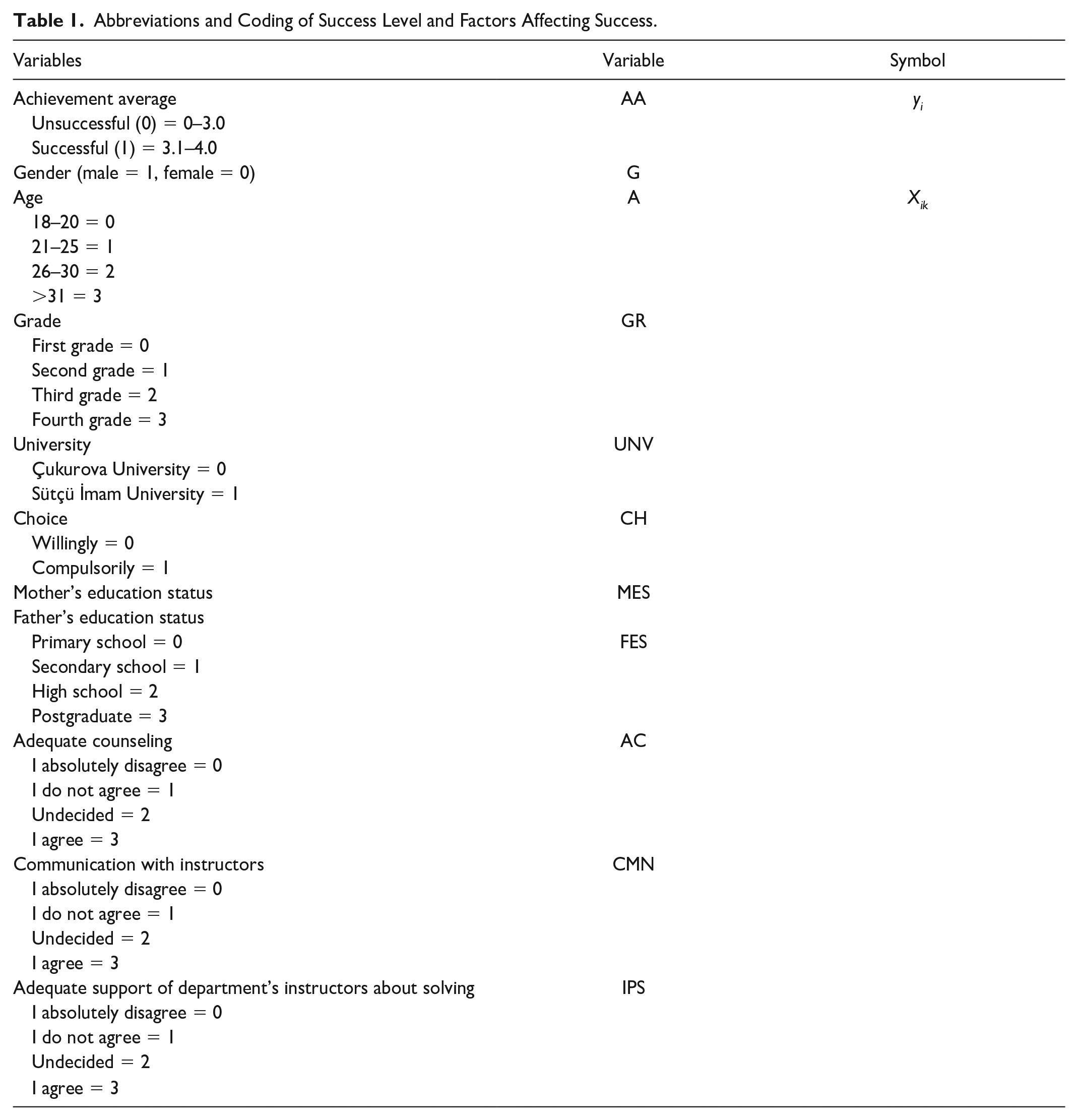
When the success level was evaluated in this research, the success average of the students was taken into consideration. In this data set, success averages (SA) is used as a dependent variable, and gender (G), age (A), grade (G), university (UNV), whether or not he or she chose their department (CH), mother’s education status (MES), father’s education status (FES), “adequate counseling they receive on their working fields about the profession (AC),” adequate support of department’s instructors about solving extracurricular problems (IPS), and communication with instructors (CMN) are used as independent variables (see Table 1).
Abbreviations and Coding of Success Level and Factors Affecting Success.
Statistical Analysis
The aim of using logistic regression analysis is the same with other model techniques, that is, by using the least number of variables, creating a model which accurately defines the relationship between result variable and independent variable, coherent and biologically significant (Roberts et al., 1987). Logistic regression analysis is an alternative to awareness analysis and contingency table in the case of various assumptions, such as not having normal distribution and not having mutual covariance.
Logistic model

The above equation can be demonstrated with

This equation is called as “logistic function.”
Estimation of parameters
Maximum likelihood method is commonly used for parameter estimation in logistic regression. To apply this method, first, maximum likelihood function should be formed. This function gives the possibility of data observed as a function of unknown parameters. The contribution of (xi, yi) pair can be defined with equal

As the observations are assumed to be independent of each other, the likelihood function is obtained by multiplying the terms in Equation with n observations (Chatfield & Collins, 1992). According to this, likelihood function is written as follows:

Significance test of logistic regression coefficients
Using the likelihood function, the comparison of the observed values with the predicted values is done by the following expression:

The statement in the parenthesis indicates the likelihood ratio (Gibbons & Hedeker, 1996). If the log is to be written in likelihood function type, the expression,

would be obtained. Here,
To determine the importance of an independent variable, the D values of these situations in which independent variable is present or not are compared in equation. The change in D due to the presence or absence of the independent variable is defined as follows:

Interpretation of coefficients
In the logistic regression, the “odds” and “odds ratio” are used to interpret the coefficients. Odds ratio Ω is the correlation of odds value calculated for x = 1 to odds value calculated for x = 0. According to this, odds ratio can be written as follows:

According to this, if the independent variable in the logistic regression is binary and it is coded as 0, 1, odds ratio (Scott & Wild, 1990) is as follows:

Determination of goodness of fit
In determination of model goodness of fit, Hosmer–Lemeshow’s

where m represents risk group.
Results
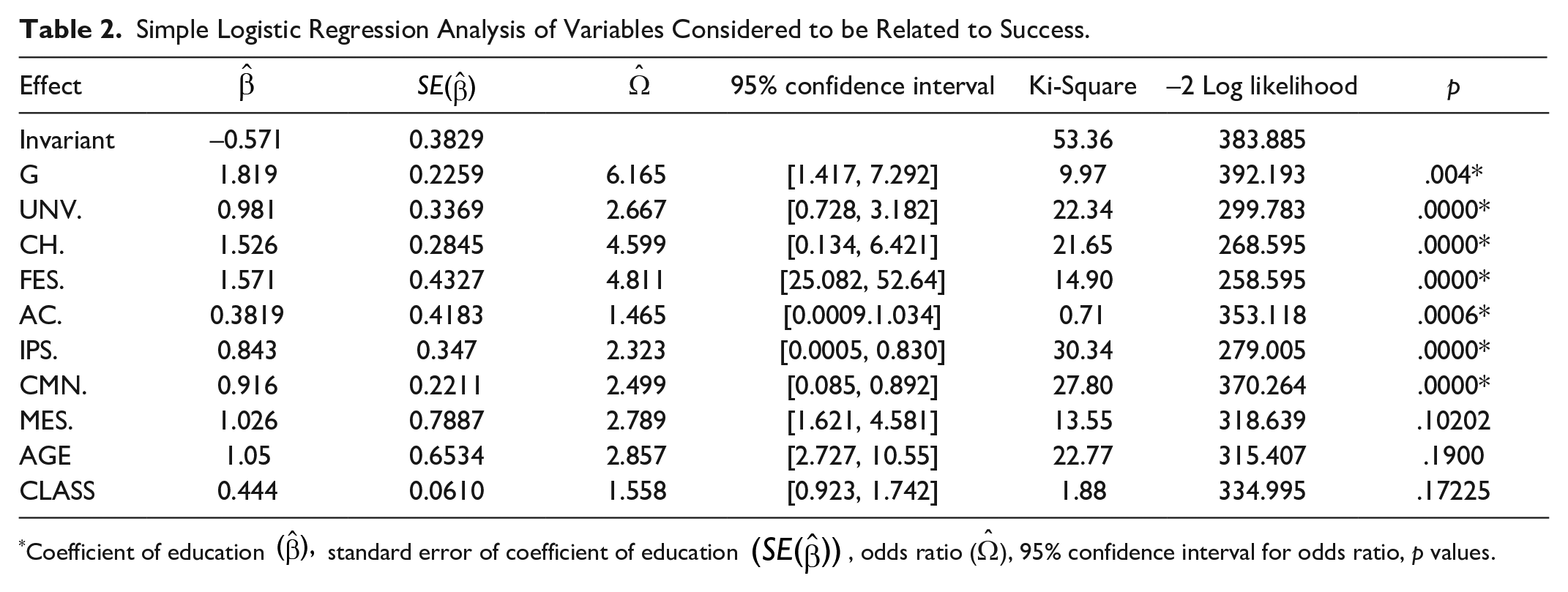
The results of simple univariate logistic regression analysis for each of the candidate variables are given in Table 2 to determine the variables to be included in the multivariate logistic regression model.
Simple Logistic Regression Analysis of Variables Considered to be Related to Success.
Coefficient of education
As it can be observed in Table 2, because variables such as mother’s education status, age, and class were found to be statistically insignificant (p > .10), they will not be included in the multivariate model. Results of multiple logistic regression analysis were given in Table 3.
Multiple Logistic Regression Analysis.

α = .01 is statistically significant on level of error.
Any logistic regression model estimation from the “last model” in Table 3 can be written as follows:

Goodness of Fit of the Model
Logit estimator for every subject was created by obtaining P(xi) and 1 – P(xi) values in decimal risk groups (n/t = 360/10 = 36). The observed and expected frequencies for the decimal risk groups are given in Table 4.
Observed and Expected Frequencies for Decimal Risk Groups With Fixed Number of Subjects.

According to equation below,

is obtained, and because it is
When Table 3 is examined, variables such as gender, the university they studied, the way they chose their department (willingly–compulsorily), father’s education, adequate counseling they receive on their working fields about the profession (Q5), adequate support of department’s instructors about solving extracurricular problems (Q6), and communication with instructors (Q23) are found to be effective on success. It was observed that choosing
Discussion
When the literature is examined, evidence obtained should take into account different factors such as sociodemographic characteristics, communication with the instructor, motivational factors, and attitudes that academic performance is a complex event. New strategies will be developed to increase the success of students at the university level, which in turn can help improve their academic achievement. In this study, the variables affecting the course success of the students studying in universities’ school of physical education and sport departments are investigated, and their impacts were determined by logistic regression method. Among the variables, it is found that parents’ educational status has positive effects. These effects have been described below. As a result of the research, because independent variables such as mother’s education status, age, and class were statistically insignificant (p > .05), they were not included in the multivariate model. It is determined that the variables such as students’ gender, the university they studied, the way they chose their department (willingly–compulsorily), father’s education, adequate counseling they receive on their working fields about the profession (Q5), adequate support of department’s instructors about solving extracurricular problems (Q6), and communication with instructors (Q23) are found to be effective on success.
According to the results of logistic regression analysis, it can be stated that the male students’ chance of success was 1.427 times more than the female students’ chance of success. Previous investigation of gender differences in academic performance generally suggests that female students tend to have higher academic achievement than male students across different education levels (Büyüköztürk & Denizkulu, 2002; Richardson et al., 2012; Sheard, 2009; Voyer & Voyer, 2014). The reason why the findings of the present study contradict with the former studies is that because the social media is used extensively at a time when the communication age is peaked, it strengthens the student–teacher relationships; makes the education process more creative, active, entertaining, and collaborative; develops the researching, questioning, decision-making, and problem-solving skills; and positively affects the academic achievement of students (Bal & Biçen, 2017). And in the contemporary studies, it was determined that male students use social media more than female students for education and information purposes, and this situation increases the academic achievement of male students (Aydın, 2016; Balcı & Ayhan, 2007; Göksel, 2018).
It can be stated that among the two universities included in the study, the chance of success of students in Sütçü İmam University is 2.680 times more than the chance of success of students at Çukurova University. It can be thought that the different rules and regulations of the universities are one of the reasons for the difference in academic achievement of students.
It can be stated that the likelihood of success in the coaching and teaching departments of school of physical education and sport, in the condition of choosing (willingly), is 53.88 times higher than the likelihood of failure. This is because being professional in the field they aim or desire, possessing adequate qualification can be seen as an enormous factor in terms of motivation. Schools of physical education and sport are accepting students with talent test to their departments. The first choice of students is teaching department and their second choice is coaching department. One of the most important reasons for this is the ability to be appointed as a teacher after graduating from the teaching profession, and at the same time being able to obtain a coaching certificate in the field they specialize. For this reason, the participating students prefer the coaching department if they are not accepted to teaching department. Because of this obligation, it can be interpreted as the reason why the department preference emerges as an important factor affecting the success status. In the literature, there are studies pointing out that teacher candidates’ occupation choices are shaped mainly based on three main categories of factors and these are (a) altruist reasons (based on self-devotion): desire to serve people and being useful to society, serving the country, and so on; (b) internal reasons: loving the profession, loving children, loving and caring people, considering yourself to be skillful, and so on; and (c) exterior reasons: job guarantee, long vacation, social security, assignment conditions, and so on (Boz & Boz, 2008; Saban, 2003). The findings of another study conducted by Papanastasiou and Papanastasiou (1998) in Cyprus showed that the strongest preference reason was the swift assignment after graduation, an external factor.
Similarly, it was concluded that, if the father’s education is high, the likelihood of success is 12.04 times higher than the likelihood of failure. There are studies in the literature, which come through to the result that the education levels of the parents of successful students are higher than the education levels of the parents of the unsuccessful students (Elmacıoglu, 2003; Özer & Anıl, 2011; Özkan & Yıldırım, 2013; Taningco & Pachon, 2008; Turmo, 2004). In their studies, Bodovski et al. (2017), Cheng and Kaplowitz (2016), Cameron and Heckman (2001), and Carneiro and Heckman (2003) pointed out that parental education is the long-term determinant of academic success, and such policies which influence this factor must be established to raise academic achievement. As a result of the researches, it was found that the students whose father has master’s degree are 14% more likely to go to higher education than the students whose father has only primary school education (Polat, 2008). Arslantaş et al. (2012) concluded that the academic achievement scores of the students whose parents were university graduates were higher than the other groups. Turpçu (2014), in his study about analyzing failure reasons of high school students, found that parents’ education level is an important factor on student’s success. As the education levels of parents increase, they can provide more academic success to their children and the confidence of students increases in terms of being successful. For this reason, regulating education environments in schools which would academically guide families with lower education level and their children while considering this effect may increase the achievement of students.
When the other results of the study are examined, it can be stated that the chance of success of students who take guidance is 4.046 times more than those who do not, chance of success of students who receive support from their instructors is 1.675 times more than those who do not, and the chance of success of students who communicate with their instructors is 3.052 times more than those who do not.
On the contrary, variables such as adequate counseling they receive on their working fields about the profession, adequate support of department’s instructors about solving extracurricular problems, and communication with instructors are factors to be considered by educators because they are effective, controllable variables on students’ success. For this reason, more effort is needed to create a school atmosphere based on mutual trust, communication, and support, and counseling of the instructors at the time of the need of the students in the institutions that educate physical education teachers. The open communication environment in universities (allowing students to communicate with management and faculty members without hesitation) is mentioned in many studies as factors that influence students’ success. Young and Shaw (1999) found that teacher’s interest in students’ learning and his or her effort for students’ progress, effective communication, and positive atmosphere in classroom environment are correlated with teacher effectiveness. In accordance with this result, Bain (2004) and Kayalar and Kayalar (2017) argued that teacher effectiveness is directly associated with student achievements. The results of the study by Al-Busaidi et al. (2016) suggest that the main characteristics of an effective university instructor include showing respect to the students as people, recognizing their identity, listening to their concerns and wishes, and giving support to the students when needed. Akessa (2015) argues that instructors are of a great role in creating positive or negative attitude to accomplishments and achievements of the students. Memduhoğlu and Tanhan (2013) in their study on organizational factors, which are characteristics, such as family, environment, group of friends, socioeconomic situation, opportunities for university, motivation, and choice of profession, affecting the academic achievement of university students, have come to the conclusion that there are five basic structures (factors), which are professional qualifications and practices, managerial services and practices, communication, personal responsibility, and physical environment and hardware. Batman and Yiğit (2016) in their study about instructors, on determining the factors of academic achievement of teacher candidates, have shown that two subdimensional factors (basic factor) affect the success of students, which are “Personal Characteristics and Motivation” and “Learning Environment and Factors Related to the Instructor” (communication with students, counseling given to students, etc.).
Accordingly, these results can be expanded further by acknowledging that instructors have a direct influence on the development of student success and conducting studies toward transforming their institutions into learning organizations through analyzing effective educational leadership behavior of instructors. In addition, conducting meta-analysis studies on an international scale regarding the factors affecting the academic achievement of students is significant to obtain broader results from the present findings and emphasize the importance of instructors in achieving academic success.
Conclusion
As a result, to obtain more reliable and more valid results in statistical terms, to put forth the effects of the factors affecting the success transparently, and to control the risk factors that cause failure, similar study on a larger sample by collecting data from different universities’ school of physical education and sport students is important in terms of shedding light on studies about student success estimation. In addition, evaluation results of educators are thought to be helpful to inform instructors about strengths and weaknesses. Particularly, graduate programs of university instructors should be targeting adequate counseling of instructors and their communication skills. More matched samples between two different faculty and universities should be included in future research for reaching more definite conclusions. This research has some limitations. First, the results of this study show that there is a need for more researches that combine social and psychological variables in explaining students’ academic achievement. Second, it was carried out on a limited number of students in the physical education and sport departments of two public universities located in the Mediterranean region of Turkey. Future research should examine the academic achievement of students at different grade levels, as well as in different departments.
Footnotes
Declaration of Conflicting Interests
The author(s) declared no potential conflicts of interest with respect to the research, authorship, and/or publication of this article.
Funding
The author(s) received no financial support for the research, authorship, and/or publication of this article.
