




Abstract
The study aims to explore the impacts of an online training scheme developed for higher education learners that integrates self-regulated learning (SRL) writing strategies into screencast feedback in line with the cyclical model of SRL (i.e., forethought, performance, and reflection on performance phases). During each phase, cognitive, metacognitive, affective and socio-interactional SRL writing strategies were introduced through screencast feedback given to the learners’ writing assignments. The participants were undergraduate English Language Teaching (ELT) students at two state universities (n = 135) in Turkey. Following a mixed-method research design, previous to and after the 6-week training sessions, both quantitative and qualitative data was gathered and analyzed statistically. The results regarding the learners’ reported use of SRL writing strategies indicate a significant increase in the use of SRL writing strategy after the training. Also, the learners’ opinions on receiving screencast feedback and on the SRL training were considerably positive. The findings are meant to contribute to both online education and teacher education pedagogy.
Introduction
School closures due to the Covid-19 pandemic brought surmounting challenges at higher education level to both learners and educators. These include issues about the accessibility to and the use of technology and infrastructure, managing optimum motivational and attitudinal states, and inefficient online teaching and learning-teaching approaches and methods. (e.g., Chen et al., 2020; Drane et al., 2020; Dwivedi et al., 2020; Khan et al., 2021). From teachers’ front, recent research shows that teachers from different regions struggle adapting to this new model of instructional practices due to lack of training and experience in online pedagogy (Adnan & Anwar, 2020; Bao, 2020; Khan et al., 2021). For learners, however, continuous lack of social interaction, lack of sense of belonging to school environment, lack of timely feedback and teacher contact have been among the frequently reported challenges in addition to technological difficulties faced (Adnan & Anwar, 2020; Chen et al., 2020; Drane et al., 2020; Popa et al., 2020).
In the context of foreign or second language (F/SL) learning, learners and teachers have been experiencing other challenges as well. Language learning is more than acquisition of knowledge that could be framed in educational programs and delivered to learners gradually. Rather, it is mostly skill development, which requires educational programs and applications to engage learners in real world situations where they can develop the skills required for lifelong learning. Such a skill building process necessitates continuous motivation and engagement of learners; motivating and challenging tasks and materials; timely and efficient monitoring; and effective and constructive assessment and feedback practices (Fredricks et al., 2004; Gellin, 2003). In virtual language learning environments, it is even more difficult to ensure that learners are supported sufficiently in terms of these aspects (Chen et al., 2020; Popa et al., 2020).
Perceived as one of the most challenging tasks by learners, writing is a complex process that requires meeting predefined standards and criteria (McCutchen, 2011; Seker, 2018). In order to complete a writing task, learners go through a multi-layered process where they need to employ cognitive and meta-cognitive strategies, trigger their existing knowledge and accumulate sufficient relevant information on the content, use various resources in their environment to bridge any deficiencies while focusing on sustaining motivation and concentration levels (Hidi & Boscolo, 2006; MacArthur, 2014; Wang, 2014). Furthermore, learners should be equipped with both sufficient knowledge not only on formal aspects of writing such as composing processes, formatting styles, or genre (Matsuda, 2012; MacArthur, 2014) and socio-cultural knowledge and linguistic and metacognitive skills to meet the structural, lexical, discoursal, or stylistic standards of the target language (Hamman, 2005; Harris & Graham, 2009; Sasaki et al., 2018; Teng & Zhang, 2016).
Despite the additional complexities faced during writing processes in F/SL contexts, the substantial role that writing plays in the learners’ personal, academic, professional, and social development in addition to their language improvement has stimulated researchers and educators to challenge the difficulties encountered. Through writing experiences in F/SL, learners can improve their language skills while developing critical thinking skills, learning effective communication in F/SL contexts, and increasing their knowledge on the content areas (Bruning & Horn, 2000). However, the transition from face-to-face classes to a completely online environment has exacerbated the challenges and the complexities faced in F/SL writing education contexts (Bailey & Lee, 2020). According to Xu (2021), insufficient online teaching experience has been among the main challenges for F/SL writing teachers whereas lack of online learning strategies and sustaining learning motivation have been the main obstacles for learners.
In this respect, cumulative research on F/SL writing recommends equipping learners with effective strategies, skills, and knowledge to cope with the new challenges faced in online learning environments in addition to increasing learner motivation and engagement (Bai & Guo, 2018; Hamman, 2005; Khan et al., 2021; Kummitha et al., 2021; MacArthur, 2014; Xu, 2021; Zimmerman & Kitsantas, 2007). However, in spite of the frequently mentioned need for SRL strategy in writing, research on F/SL writing has paid insufficient attention to the effective instructional recommendations for teachers (Bai & Guo, 2018; Xu, 2021). Therefore, there is a growing need to provide F/SL teachers with practical and effective models and tools to assist them training learners to gain online learning strategies (Bailey & Lee, 2020; Khan et al., 2021; Xu, 2021). As an attempt to provide an alternative tool for teachers, SRL online strategy training scheme has been developed. The present study, in this respect, aims to find out the effects of the SRL online strategy training scheme, developed to equip learners with SRL strategies for academic writing courses, on higher education learners’ reported strategy use. The training has been designed to introduce SRL strategies implicitly and to provide learners with tips and suggestions on how to use them through screencast feedback videos shot for writing assignments in an online course during COVID 19 pandemic. The study also explores the participant learners’ opinions about screencast feedback and SRL writing strategy training. Based on the aim of the study, the following specific research questions are sought:
(1) What are the higher education learners’ levels of self-reported SRL writing strategy use previous to the SRL writing strategy training?
(2) Does SRL training delivered through screencast feedback affect the higher education learners’ levels of self-reported SRL writing strategy use?
(3) What are the participant learners’ opinions on SRL writing strategy training?
(4) What are the participant learners’ opinions on receiving feedback through screencast feedback?
Literature Review
Feedback in Writing
In the context of writing instruction, effective feedback plays a crucial pedagogical role. It is regarded as a means of effective communication between learners and the teacher, as a result of which expected standards and learner responses are set (Parr & Timperley, 2010). Providing quality and timely feedback is accepted to positively correlate with learner engagement and motivation (Bahrouni & Tuzlukova, 2019; Li & Barnard, 2011; Strijbos et al., 2010), however, it is frequently suggested that teachers decide on the scope and the type of the feedback that best suits their learners’ needs and learning styles (Hyland & Hyland, 2006; Parr & Timperley, 2010).
There has been an increasing recognition of the use of technology for teachers’ pedagogic processes such as providing feedback in a context where technology-enhanced modes of delivery have gained significance (Orlando, 2016). One of the most recent modes of technology-enhanced feedback is screencast feedback, which is defined as “a video capture of events that happen in a portion of a monitor along with voice narration” (Orlando, 2016). The use of screencast feedback has been investigated in different contexts so far focusing on the students’ attitudes, preferences, and whether it leads to more successful revisions. For instance, Ali (2016) investigated the perceptions of university students toward a writing course including screencast feedback at a university in Egypt. The results of the study revealed that learners responded positively to screencast feedback because they found it clear, personal, supportive, and engaging. Similarly, Henderson and Phillips (2015) studied the attitudes of a sample consisting of 126 graduate and undergraduate learners toward video-based assessment feedback on their assignments. The researchers found out that the learners valued this type of feedback more compared to text-based feedback and stated that it was individualized, motivating, and unambiguous.
Another research focus for screencast feedback is its comparison and contrast with other types of feedback such as audio-feedback. The results of the studies reported more successful revisions (Cavaleri et al., 2019) completed in a shorter period of time with more global changes made (Cunningham, 2019). In a more recent study, Cheng and Li (2020) compared screencast feedback with text-only feedback in an online TESOL class. Learners in the screencast feedback group benefited more from teacher feedback and they also stated that they preferred screencast feedback as they found it more detailed and more personal. However, to the best of our knowledge, no previous study in the literature has focused on the provision of strategy training through screencast feedback.
Self-Regulated Learning Strategies
In the context of educational psychology, SRL is regarded as a process where learners exhibit, monitor, and regulate their cognitive, emotional, and behavioral efforts while strategically orchestrating and executing appropriate strategies and evaluating the outcomes. During this process, self-regulated learners manifest cognitive, meta-cognitive, affective, and socio-cultural strategies (Oxford, 2017; Rose et al., 2018; Zumbrunn et al., 2011). These strategies are indicated to be operated in three cyclical phases: forethought, performance, and evaluation (Ramdass & Zimmerman, 2011; Zimmerman, 2004; Zumbrunn et al., 2011). The forethought phase is the first step and involves planning, setting clear learning goals, organizing resources, and selecting appropriate strategies, and self-motivation. In the performance step, learners implement strategies, monitor the execution processes, alter strategies when necessary, and sustain motivation and concentration. The third step, the evaluation phase, is mainly geared toward evaluation of the learning outcomes, reflecting, and planning for future learning. When learners effectively implement self-regulation strategies, they have the necessary cognitive, behavioral, affective, and social features to become active, autonomous, and constructive learners. Learners successfully employing SRL strategies are also reported to have enhanced academic achievement; improved study skills; set clear realistic learning goals based on their learning progress and outcomes; organize a more supportive learning environment; comfortably seek help from others; maintain their motivation and concentration for longer periods; implement multiple strategies to complete a task and monitor and assess their progress better (de Bruin et al., 2011; Elstad & Turmo, 2010).
In the context of F/SL learning, research has revealed that self-regulated language learning (SRLL) strategy use is significantly and positively correlated with language achievement (e.g., Andrade & Evans, 2013; Hu & Gao, 2018; Seker, 2016) and leads to higher performance in language skills (Andrade & Evans, 2013; Oxford, 2017). Specifically, when learners use SRL writing strategies effectively, they display higher levels of L2 performance with an increased quality in their L2 production as a result of planning and conducting their writing tasks more effectively (e.g., Bai & Guo, 2021; De Silva & Graham, 2015; Han & Hiver, 2018; Limpo & Alves, 2013; Sun & Wang, 2020; Xu, 2021).The quasi-experimental study conducted by Wilby (2020), for instance, investigated the relationships between writing task motivation, self-regulation, and writing scores of students at postgraduate level. Having completed an intense month-long EAP course, the participants’ writing scores and reported strategy use and self-efficacy beliefs were investigated. The results of the study indicate that the learners’ writing scores were significantly correlated with SRL strategies such as mastery goals, performance approach goals, and utility value. Furthermore, the participant learners’ self-efficacy levels were found to have increased significantly while showing strong inter-relationship with self-regulation (Wilby, 2020).
Self-regulated learning strategies in writing
Similar positive correlations between the use of SRL strategies and achievement have also been reported for F/SL writing performance. Teng and Zhang (2016), for example, conducted a cross-sectional study with Chinese university students to explore the predictive role of SRL strategy use in writing in English. The findings of the study showed that four dimensions of SRL strategies, that is, cognition, meta-cognition, motivation, and social behavior, predicted writing test scores. In an English medium of instruction (EMI) context, Hu and Gao (2018) conducted a study in Hong Kong with secondary school students in which they investigated self-regulated strategic processes of high achievers and underachievers. The results indicated that high achievers utilized more SRL strategies (e.g., reorganizing, evaluating, reviewing, memorizing, imitating, adopting, etc.) while only two strategies (i.e., imitating and reorganizing) were identified with the underachievers’ group.
As the studies focusing on SRL strategy use frequently indicate positive influence on learners’ academic success, SRL instruction is frequently recommended (e.g., Bai & Guo, 2021; Bai & Wang, 2021; Dörnyei & Ryan, 2015; Ekholm et al., 2015; Graham et al., 2013; Kobayashi & Rinnert, 2013; Labuhn et al., 2010; Sasaki et al., 2018) and alternative methods and instructional suggestions for integrating SRL into writing classes have been shared. In the study conducted by MacArthur (2014), for instance, a curriculum for college level writing classes was developed integrating the instruction of SRLL strategies such as goal setting and task management. The results of their longitudinal study indicated that the overall quality of the learners’ writing was positively affected by SRLL strategy instruction. Sasaki et al. (2018), on the other hand, conducted a longitudinal study with Japanese students and explored the development of three L2 writing strategies: global planning, local planning, and L1-to-L2 translation as a result of SRL instruction. Based on the analyses of the qualitative and quantitative data, it was found that the instruction of some of the strategies was influential on the learners’ writing performance. However, it was also evident that the development and the use of strategies showed variations based on individual and environmental factors while retention of strategy use depended on subsequent SRL instruction and learner involvement in SRL strategy use. While tailoring SRL instructional practices based on learners’ language proficiency levels, their motivational levels and readiness to adopt strategies can affect learners’ acquisition of strategies; contextual factors have a significant influence on SRL instructional practices and learner engagement. Therefore, researchers and educators state that some important factors such as learner characteristics (Csizér & Tankó, 2017; Han & Hiver, 2018) and contextual factors (The Douglas Fir Group, 2016) should be considered in the planning and the implementation of SRL strategy instruction. In line with this suggestion, screencast feedback was chosen as the most appropriate way of providing SRL strategy instruction.
In addition to the aforementioned important factors, the abrupt transition into online education has brought new challenges in virtual learning environments, which require learners to be equipped with necessary SRL strategies (Bai & Guo, 2018; Xu, 2021). At this point, teachers need practical and effective instructional models and tools for training learners to gain online learning strategies. As an attempt to provide an alternative tool for teachers, SRL writing strategy training scheme has been developed for higher education. The present study, in this respect, aims to find out the effects of the SRL online strategy training scheme, developed to equip learners with SRL strategies for academic writing courses on higher education learners’ reported strategy use while exploring their opinions on such a training experience.
Methodology
Context and Participants
The study took place in the English Language Teaching (ELT) departments of two state universities in Turkey. The participants were the second-year students taking the “Critical Reading and Writing” course, which is offered as a 14-week compulsory course. The courses at these two ELT departments were delivered by the two researchers as the course instructors. As a part of this course, learners are expected to write different types of essays; namely, argumentative essay, research-integrated essay, etc. The course instructors followed the same process writing approach through which learners were supposed to write multiple drafts and receive feedback for each submitted draft until the expected standards are met. Prior to this study, the learners in both groups took a two-semester writing course at their universities, which conveyed studying English sentence structures, formal, and informal email writing, and formal paragraph writing. Having completed their two-semester writing courses successfully, the learners were able to enroll in Critical Reading and Writing course. The English proficiency level of the participants was B2, which was determined by the departments’ proficiency exams conducted at the beginning of the semester. The demographic information of the participants is displayed in Table 1.
Demographic Information of the Participants.
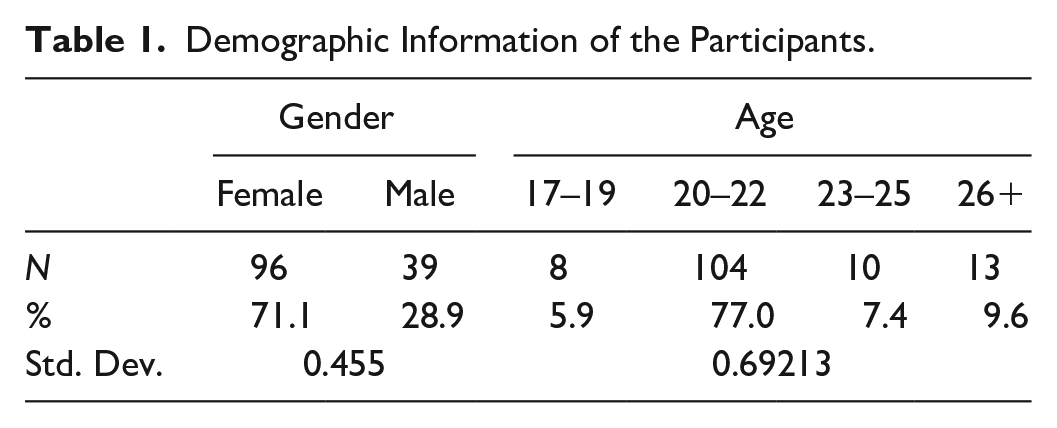
The participants, who are all native speakers of Turkish, are prospective teachers studying ELT. They were asked to participate on a voluntary basis. Out of 148 total learners registered to these courses, 135 of them agreed to participate and signed informed consent forms. Ethical approval for this study was waived by the Research Ethics Committee of one of the universities (Date and Number 2020/14-6). The majority of the participants are female, and their ages varied between 20 and 22 (71.1% and 77%, respectively). The researchers were their course instructors who are also native speakers of Turkish with a PhD in ELT.
Data Collection Tools and Procedure
Following an extensive review of the studies conducted on SRL in F/SL writing contexts and the conceptualizations of SRL presented in the field of educational research, the Self-Regulation Scale in Writing developed by Kanlapan, and Velasco (2009) was chosen as the data collection tool for the study. The rationale for choosing this scale is that (a) the scale has the dimensions in line with the three cyclical phases: forethought, performance, and evaluation (Zimmerman, 2004) adapted for strategy training conducted during feedback sessions; (b) the dimensions are represented by a wide range of items (n = 115); (c) the majority of the items are appropriate for the context of the participants in the study. After the items were identified, the accuracy and the clarity of the items were revised by the researchers. The items which were not relevant to the phases covered in the SRL training or the ones that could be confusing/vague for or not applicable to the context of the participants were excluded from the scale (n = 48). Upon the modifications made, two other educational researchers, an expert in statistics and an expert in educational assessment, revised the survey. Moreover, an educational statistician’s opinion was sought to confirm the consistency of the dimensions determined and the final version of the survey to the training program and also the appropriateness of the methods for research design and data analyses. Upon his recommendations, the items related to the “Attributing Causations” (n = 8) were eliminated from the survey used in the study as they would not be covered in the feedback sessions.
After the revisions and the alterations suggested were completed, the survey at this stage had two parts. The first part had questions related to learners’ demographic information: age, gender, their universities and grades. The second part included six dimensions with a total of 59 items in a 5-point Likert Scale format, anchored by “always” (1), “often” (2), “sometimes” (3), “rarely” (4), and “never” (5). The six dimensions included items related to Goal Setting Strategies (n = 10), Time Management Strategies (n = 8), Performance Strategies (n = 11), Attention Control Strategies (n = 10), Evaluation Strategies (n = 13), and Reflections for Future Adaptations (n = 7). The participants were asked to indicate their agreement to each item by choosing the number corresponding to their frequency of use of the strategy in each statement. For example, in response to Item 36 (under Evaluation Strategy dimension) “I evaluate my written outputs after every session,” the participants could circle “1” if they often used this strategy, “2” if they sometimes used it or “5” in case they never applied the strategy. Then, the survey was transformed into Google Forms and the participants were asked to complete it online. A total of 135 higher education learners completed the survey previous to and following the six-week SRL training they received through screencast feedback.
The SRL training scheme via screencast feedback
The writing courses were delivered by the two researchers synchronously through the online course management (OCM) systems of these two universities due to Covid-19 pandemic. OCM systems are the software programs provided by the universities to deliver online education. They consisted tools and resources to integrate and utilize variety of teaching and learning technologies such as communication tools (e.g., online chat, email, messages, etc.); resources (e.g., digital documents or links); instructional tools (e.g., course materials, notes, etc.); assessment tools (online quizzes, exams, etc.); or administrative tools (e.g., tracking attendance, calendar, etc.). Through these tools, the courses and SRL training were delivered.
The registered ELT learners (N = 135) were evaluated over three research-integrated argumentative writing assignments within the scope of the key competences of the course. Research-integrated argumentative writing tasks are considered to be cognitively demanding as they require learners to use both lower-level and higher-level writing skills (Wilson et al., 2016), and thus, it is thought to require implementation of more writing strategies.
To give video feedback to the learners’ assignments, annotating and screen sharing functions of Zoom and Microsoft Teams were used. These tools allowed the course instructors to record their comments and to provide longer and more detailed feedback. The instructors used the talking head option so that the learners could see the teachers’ face and their written document and hear the oral comments simultaneously. Prior to the recordings, the instructors read the student essays they sent through email to get familiar with the content of their writing and took notes to use during screencast video feedback. Afterward, they used the Track Changes function of Microsoft Word and the comment balloons. They also utilized the annotation tools while sharing their screen to highlight particular aspects of the essays and giving oral comments. These comments served the purpose of integrating SRL training to the screencast feedback given to the participant learners. Depending on the achievements and weaknesses present in the assignments, the instructors provided the learners with relevant tips and suggestions to introduce and to assist implementations of SRL writing strategies.
In line with the cyclical model of SRL (i.e., forethought, performance, and reflection on performance phases) (Zimmerman, 2004), the training included three main phases: pre-writing, writing, and post-writing. Under each phase, the learners were introduced cognitive, metacognitive, affective, and socio-interactional SRL strategies to improve their writing skills through screencast feedback. However, rather than providing feedback on every aspect at one single feedback session, the instructors focused and commented on the strategies relevant to one of the phases in the cyclical model (for the strategies at each phase see Appendix B). Accordingly, the first screencast feedback sessions for the learners’ first writing assignment were geared toward the pre-writing stage in the forethought phase, and thus, included tips and suggestions relevant to strategies for goal setting and adopting necessary strategies. During their second assignment, the feedback delivered focused on the performance phase by introducing and suggesting using monitoring, attention control, and time management SRL strategies. The final feedback sessions, however, aimed at aiding learners to use the strategies for the post-writing stage in the reflection phase that covered the writing strategies implemented to edit and evaluate their written products and to reflect on the strategies to be adapted in their future assignments. Each phase was communicated in a 2-week period through screencast feedback videos (See Appendix B for further details). Feedback videos were between 9 and 14 minutes with the sizes from 18 to 38 MB. The videos were recorded and saved to the researchers’ Drive accounts or computers. The feedback videos or the links in the drive accounts were then shared with the learners so that they could access the videos in their convenience. A total of 401 essays have been annotated during screencast feedback sessions, recorded, and then shared with the participant learners via emails or drive links. The learners were asked to watch the recordings, improve their writing assignments and write the second draft using the suggested strategies and the recommendations within the following week.
Following the training, online interviews were conducted with the volunteering participant learners in order to find out their opinions on the SRL training they received as well as on the mode of feedback delivered. As a result, semi-structured online interviews were conducted with 48 learners. The questions were prepared by the researchers in line with the training and the scope of the study (see Appendix A).
The volunteer learners were interviewed through Zoom and these interviews were recorded by the researchers. The interviews were held in English. The recordings were transcribed verbatim and analyzed through inductive content analysis conducted by the two researchers. Since the interview data yielded a large set, the analysis of the qualitative data comprised three main phases. In the first phase, in order to identify the emerging themes, the data was segmented and classified broadly based on the relevancy to the strategies in the cynical model of SRL in order to condense the data by eliminating less pertinent verbal reports (Cooksey et al., 2007). Having determined the emergent themes, the next phase involved detailed re-readings to generate the categories for the emerging themes. These steps were conducted by the two researchers separately. The final step involved first comparing and merging the emerging categories while organizing the classified themes under each category and condensing the recurrent ones. Cohen’s kappa inter-coder reliability test was used to identify the degree of agreement between the themes elicited by the two researchers. The obtained agreement value indicated high reliability (.87) (Cohen, 1988). This thematic coding approach, which was in line with the related research question, was supplemented with data including representative quotes (Mason, 2002).
Findings
The internal consistency of the survey used is 0.870, which indicates high reliability (Tabachnick & Fidell, 2012). In order to explore learners’ reported strategy use frequencies, the survey was analyzed descriptively (Table 2). Accordingly, the Mean scores between 1 and 2 are considered to indicate very frequent use, scores between 2 and 3 are accounted for frequent use whereas scores between 3 and 3.5 indicate the participants sometimes used the mentioned strategy. Mean scores between 3.5 and 5 suggested that the strategy stated is rarely or never used.
Descriptive Results of Pre- and Post-Implementations of the SRL Writing Scale.

The results of the descriptive analyses show that the participants reported to be using goal setting, performance, attention control, evaluation, and reflection strategies frequently (M = 2.05, 2.08, 2.38, 2.75, and 2.58, respectively) while using the strategies for time management sometimes (M = 3.11). After the training they received through screencast feedback, the frequency of reported implementation of the strategies in the scale was between “often” and “always.” The results from the Mean scores indicate differences for the strategies in Goal Setting, Time Management, and Reflections for Future Adaptation.
In order to find out whether these differences are statistically significant, further analyses were conducted. Initially, Kolmogorov–Smirnova and Shapiro–Wilk normality tests were run to see whether the data set was normally distributed and to decide on the tests to run to explore the differences between pre-training and post-training self-reported strategy use of the learners. Tabachnick and & Fidell (2012) explain the weakness of each of these tests and advice to conduct both and to evaluate the normality result by comparing the results obtained from both of the tests. The results showed that the data is not normally distributed (between 0.00 and 0.02; p < .05). As a result, Wilcoxon Signed Ranks Test as a non-parametric test was conducted for each dimension separately and the pre-/post-training results were given in Table 3 below.
The Differences Between Pre and Post-Training Results for Each Dimension.

p < .05.
As can be seen in Table 3 above, the findings indicate that there are statistically significant differences for Goal Setting, Time Management, Performance, Evaluation and Reflections for Future strategies (p = .01 < 0.30; p = .00 < .03; p = .00 < .03; p = .00 < .007, and p = .00 < .001, respectively). Considering the results of the analyses, it can be stated that the participants reported to have applied goal setting, time management, performance, evaluation strategies and reflections for future strategy adaptations more frequently. However, the strategies reported for attention control did not display any significant differences.
In the semi-structured online interviews conducted, the participants’ opinions on the training and the screencast video feedback were elicited. The emerging frequent themes regarding the participant learners’ opinions on the SRL training they received were directed toward “becoming aware of the strategies,” “benefiting from the training,” “being motivated/encouraged to use the strategies,” and “learning how to employ the strategies” (N = 104). As for the opinions on the mode of feedback, several themes emerged: “more intimate,” “easier,” “clearer,” and “more motivating” (N = 111) (Table 4).
Themes Regarding the Participants’ Opinions on SRL and Screencast Feedback.

Goal setting was one of the most frequently mentioned strategy dimensions and the learners repeatedly expressed how they benefited from the training in terms of setting goals and planning. As expressed by a participant learner, “I have become more organized because now I plan and prepare an outline for my research. I can plan how to do my assignment better now.”(L22). The learners also stated that the training process was helpful in becoming aware of and implementing strategies to monitor and evaluate their writing performances, as put by other learners; “I exchanged my writing with my friend, and we gave each other feedback. Then we worked on our assignments again before we submitted them. I think this will help me get higher grades.” (L17); “I learned what to do exactly to edit my writing. Previously, I would read my writing before handing it to the teacher and could hardly find anything to change.” (L9).
“Reflections for future strategy adaptation” was another frequently mentioned dimension in the interviews. The learners stated that the clear tips and the suggestions they received helped them realize that these strategies could be implemented to improve their writing performances (e.g., “I watch the videos again and again and take notes of the strategies you mention.”(L12); “Before, I would just start to write and then submit it. Now, I have learned that it needs a process and lots of things to do.” (L19); “These will help my future assignments. I knew some of them, but I learned some, too. I will use them to prepare assignments for other courses.” (L6). Most of the participant learners (88.5%) stated that they became aware of SRL writing strategies, acknowledged the positive contribution of the training they received (82.8%), and that they would use those strategies in the future.
When the learners were asked to express their opinions about receiving feedback through screencast videos, the majority stated very positive comments. They indicated that they found this mode of feedback to be “more intimate,” as one of the frequent themes (e.g., “I felt that the teacher cared about us.” (L23); “I felt that the teacher paid attention to everything I did.” (L13); “I think this type of feedback is more intimate” (L4); “The feedback was individualized, and I felt like I was valuable.” (L11); “I felt like I was chatting with you [the instructor].” (L32).
While stressing that it was an intimate way of receiving feedback (97.1%), the participants also stated some other advantages of screencasting; namely, its practicality (88.5%) and clarity (85.7%) regarding the problems with their writing assignments and what was expected from them (e.g., ”Everything is clearly explained. I was like following a recipe, very easy. And if you miss something, you can always watch the video again.” (L17).
Another important theme emerging from the interviews regarding screencast feedback was “being motivating.” A good number of learners felt that becoming aware of the strategies they could use in their writing tasks made them more motivated for future writing tasks, as the participants stated, “I decided to do more research after your feedback because I think I learned a lot about it.” (L19); “I learned new websites and new techniques to search online that I want to use for my future assignments.” (L12); “I really benefited a lot. Why shouldn’t I use them later too? I am sure they will help me get better grades.” (L10).
On the other hand, when the learners were asked to express their preferred mode of feedback, they all favored face-to-face feedback if possible (e.g., “I always prefer face to face feedback because I can ask questions to you. But in the video, I cannot do that.” (L4); “I did not have any technical problems [in receiving screencast feedback]. But the best is to get face to face feedback. But now, we cannot, so I think this [screencast feedback] is my second best.” (L17)
However, the learners felt that receiving screencast feedback videos was much more beneficial for them than receiving just written feedback (e.g., “I prefer video feedback instead of just written comments.” (L20); “From the video, I could see your reactions and emotions. When you said, for example, ‘it is ok, but. . .’, I knew it wasn’t ok at all from your voice. I could not have realized this from some written notes on my paper.” (L22). Overall, the participant learners’ views on the use of screencasting as a form of feedback were quite positive.
Discussion
The present study aimed to explore the impact of an online training scheme developed for higher education learners that integrates SRL writing strategies into screencast feedback in line with the cyclical model of SRL (i.e., forethought, performance, and reflection on performance phases). During each phase, the learners were provided with cognitive, metacognitive, affective, and socio-interactional SRL strategies that they could employ in pre-writing, writing, and post-writing stages of their writing assignments. The study also investigated the participant learners’ opinions both on the SRL writing training they received and screencast videos as a mode of feedback were investigated.
In regards with the first and the second research questions of the study, the findings revealed that the learners’ initial frequency of SRL writing strategy use varied between “often” and “sometimes.” They reported to be using goal setting, attention control, performance, evaluation, and reflections on future adaptation of strategies quite often while time management strategies were reported to have moderate use. However, following the students’ 6-week SRL writing strategy training through screencast feedback videos, the results of the analyses indicated significant differences. Accordingly, the participant learners’ reported use of goal setting, performance, evaluation, and reflections on future adaptation of strategies showed statistically significant increase whereas no significant difference was found in the reported use of attention control strategies. This finding was also supported by the learners’ opinions obtained during the interviews, which correspond to the third research question of the study. They indicated that the training helped them be aware of the various strategies they could employ in their writing tasks and encouraged them to apply some of the strategies successfully. They also expressed their willingness and motivations to use SRL writing strategies in their future studies. In line with the findings of this study, research highlights the significance of increasing learners’ motivation in writing by providing personalized effective feedback during online learning (Bai & Guo, 2021; Xu, 2021). The finding of the present study is also corroborated by the results of the study conducted by Xu (2021), which showed that teachers’ expanded online tutorials and feedback provided learners a comfortable space to review online feedback they receive, and thus enhanced their use of SRL writing strategies by motivating them to engage more deeply in their writing practices. As a result, it is stated that teachers’ feedback plays a modeling role for learners and assists them in becoming self-regulated learners leading to better performance and higher motivation to learn and to be self-regulated Xu (2021).
Another of the factors affecting the participant learners’ eagerness to adopt the strategies could be attributed to the personalized way of receiving the training based on their work as, during the interviews, all of the participants indicated that they benefited highly from the personalized constructive feedback they received. Similarly, studies in the field also highlight the importance of tailoring SRL instructional practices depending on the situational factors as learners’ acquisition of strategies are influenced by contextual factors and learner characteristics (Csizér & Tankó, 2017; Han & Hiver, 2018; Sasaki et al., 2018; The Douglas Fir Group, 2016). The study conducted by Bai and Guo (2021), for instance, revealed that accounting for individual differences in the context of English writing positively influences learners’ motivation and SRL strategy use.
As the last research question, the study also aimed to reveal the participants’ opinions on the mode of feedback they received, that is, screencast feedback. They preferred to receive screencast feedback in their online education since it is “more intimate,” “easier,” “clearer,” and “more motivating.” Since intimacy and social interaction are highly valued in the Turkish culture (Mercan et al., 2012; Şişman & Turan, 2004), it is not surprising that Turkish higher education learners do not prefer written feedback but favor close social interaction and being engaged in feedback activities including social involvement (Ozdamar-Keskin et al., 2015). Similarly, when they were asked for their favorite mode of feedback, they all stated that they would rather have face-to-face feedback during which they could discuss, ask questions for further explanations and clarifications. Yet, during this compulsory online education period, they stated that screencast is the best option to receive their feedback. The participants also indicated that they had no technical problems in receiving or responding to the feedback and that it was a very efficient and convenient mode in terms of timing, clarity, and accessibility. This finding is especially important in highlighting the efficiency of screencast feedback, which does not require learners to access synchronously. Recent research findings frequently indicate the difficulties that learners have during synchronous online education because of internet connectivity problems, high cost, or other challenges in accessing digital technologies (e.g., Adnan &Anwar, 2020; Bashir et al., 2021; Khan et al., 2021). The results of the present study, however, may suggest that screencast feedback mode could help learners to eliminate many technical challenges faced during online synchronous education by enabling them to review their feedback videos when they have connection, time, and suitable atmosphere.
Conclusion
As Dowden et al. (2013) state, feedback is at the heart of teaching and is a powerful tool in classroom pedagogy. In addition to being an assessment tool, feedback could also contribute to the development of social relationships, formative information accumulation thanks to exchanged ideas and shared responsibilities (Dowden et al., 2013). This mode of SRL training could be an effective way of equipping learners with effective strategies, skills, and knowledge in online educational contexts. As online education has become the major mode of education and seems to remain so, it is more important than ever to equip learners with necessary strategies to help them cope with the challenges in virtual learning environments. Screencast feedback videos could serve an effective and a convenient online teaching practice to integrate SRL strategy training for goal setting, planning, self-motivation, attention control, flexible use of learning strategies, self-monitoring, appropriate help seeking, and self-evaluation.
Considering the abrupt transition into online education, the need for practical and effective models and tools to assist F/SL teachers in training learners to gain online learning strategies has been frequently emphasized in recent research (Bai & Guo, 2018; Bailey & Lee, 2020; Khan et al., 2021; Xu, 2021). The present study, in this respect, is meant to contribute to the limited literature in the research field of F/SL online writing instruction by providing instructional recommendations for teachers to promote SRL writing strategy use in virtual settings. As Bai and Wang (2021) emphasize, it is necessary to provide more strategy-based instructions to equip learners with strategies and skills to achieve sustaining effects on students’ English writing. The findings of the study indicate that using screencast feedback in online writing courses at higher education level could provide a viable venue for integrating skills and strategies. On the other hand, for more effective implementations, professional development workshops could be held for teachers in order to provide in depth understanding of SRL strategies, their role in learning, alternative tools and modes of implementations along with adaptable instructional recommendations.
The present findings are limited to self-report data gathered from higher education ELT learners in Turkish state universities. Therefore, further research is required to explore the longitudinal impacts of screencast feedback on learners’ F/SL online writing performance. Furthermore, as different contextual influences may yield different results, research in different contexts and with larger sample sizes could contribute to better understanding the impacts of screencast feedback on learners’ SRL writing strategy use. Last but not least, further qualitative and quantitative research is needed to explore the mediating role of screencast feedback between SRL writing strategy use and F/SL writing performance.
Supplemental Material
sj-docx-1-sgo-10.1177_21582440211064895 – Supplemental material for Improving Language Learners’ Use of Self-Regulated Writing Strategies Through Screencast Feedback
Supplemental material, sj-docx-1-sgo-10.1177_21582440211064895 for Improving Language Learners’ Use of Self-Regulated Writing Strategies Through Screencast Feedback by Banu Inan-Karagul and Meral Seker in SAGE Open
Supplemental Material
sj-docx-2-sgo-10.1177_21582440211064895 – Supplemental material for Improving Language Learners’ Use of Self-Regulated Writing Strategies Through Screencast Feedback
Supplemental material, sj-docx-2-sgo-10.1177_21582440211064895 for Improving Language Learners’ Use of Self-Regulated Writing Strategies Through Screencast Feedback by Banu Inan-Karagul and Meral Seker in SAGE Open
Footnotes
Appendix A
Declaration of Conflicting Interests
The author(s) declared no potential conflicts of interest with respect to the research, authorship, and/or publication of this article.
Funding
The author(s) received no financial support for the research, authorship, and/or publication of this article.

Supplemental Material
Supplemental material for this article is available online.
References
Supplementary Material
Please find the following supplemental material available below.
For Open Access articles published under a Creative Commons License, all supplemental material carries the same license as the article it is associated with.
For non-Open Access articles published, all supplemental material carries a non-exclusive license, and permission requests for re-use of supplemental material or any part of supplemental material shall be sent directly to the copyright owner as specified in the copyright notice associated with the article.
