




Abstract
This study examined the relationships between achievement goals, motivation instability, and learning persistence in asynchronous distance classes by focusing on mastery goals and performance-avoidance goals. A longitudinal online survey was conducted among university students in Japan at two time points. The first survey had 171 respondents. Out of them, 91 responded to the second survey. The data of the 91 students were analyzed. The results of partial correlation analysis indicated that mastery goals were negatively related to motivation instability and lack of persistence, while performance-avoidance goals were positively related to lack of persistence and unrelated to motivation instability. Mediation analysis indicated that the negative indirect effect of mastery goals on lack of persistence via motivation instability was found, and that the direct effect of mastery goals on lack of persistence was not found. The results highlight the vital role that mastery goals play in learning during asynchronous distance classes.
Plain Language Summary
This study investigated the relationships between achievement goals, motivation instability, and learning persistence among Japanese university students in asynchronous distance classes. A longitudinal online survey was conducted among university students in Japan at two time points. The results indicated that mastery goals facilitated learning persistence by suppressing motivation instability. In other words, learners who hold mastery goals seem to be able to focus and engage in learning to understand class material because their attention is focused on expanding their abilities, rather than comparing themselves to others. Such learners, therefore, have smaller fluctuations in motivation during learning and can engage in learning consistently and persistently. We believe that our study makes a significant contribution to the literature because while past studies have only explored the relationship between achievement goals and motivation levels with regard to the achievement goal theory, the present study demonstrated that achievement goals, particularly mastery goals, are associated with motivation instability. This finding is of great significance as it paves the way to expand achievement goal theory to demonstrate this new role of achievement goals in learning.
Keywords
Many universities have introduced distance learning classes owing to the COVID-19 pandemic (Taguchi, 2020). Such classes are largely divided into synchronous and asynchronous formats. An example of a university-level synchronous distance class is a class held in real-time on a set schedule using a video conferencing platform (e.g., Teams, Zoom). In these classes, students can listen to the lecture, engage in question-and-answer sessions with the instructor, and participate in pair or group work with classmates. Meanwhile, for asynchronous distance classes, class videos and materials are uploaded to a learning management platform (e.g., Manaba) and students are asked to learn independently whenever they please. The extent to which students can persist in their learning is an important factor in academic achievement, particularly for asynchronous distance classes in which students must learn on their own from a computer or smartphone. Therefore, in this study, the process of facilitating learning persistence in asynchronous distance classes was explored with a focus on achievement goals and motivation instability. Detailed study of the process and characteristics of online learning is vital as opportunities for online learning are likely to increase in the future.
Achievement Goals and Motivation
Several past studies have demonstrated the importance of motivation in learning (e.g., Deci & Ryan, 2002; Wentzel & Miele, 2016). Motivation has been shown to influence learning effort and persistence, and is believed to play an important role in facilitating learning in distance classes as well. For example, Shimada and Miwa (2020) reported that motivation was a factor in the continuity of learning in online settings. Their research proposed methods to increase learners’ motivation in online learning from the perspectives of rewards, expectations, and autonomy.
Achievement goal theory is well-known and explains motivational processes in learning (Dweck, 1986). According to this theory, humans are assumed to be competence-seeking beings and are said to be driven to action by the pursuit of this competence (Hyde & Durik, 2005). Early research on the theory divided achievement goals into “learning goals” (correspond to mastery goals of this study)—those seeking to increase one’s abilities, and “performance goals”— those seeking to obtain favorable judgment and avoid the unfavorable judgment of one’s abilities (Dweck & Leggett, 1988). However, more recent studies have attempted to add a distinction between approach and avoidance in performance goals and to divide them into “performance-approach goals” and “performance-avoidance goals” (e.g., Elliot & Church, 1997; Mitsunami, 2010).
There has been a lot of research on achievement goals. For example, Hulleman et al. (2010) reviewed 243 achievement goal studies and conducted a meta-analysis. The results showed that mastery and performance-approach goals were positively associated with performance outcomes and interest in learning. These positive associations were stronger for mastery goals than for performance-approach goals. However, performance-avoidance goals were negatively associated with performance outcomes and interests. Wigfield and Cambria (2010) also review achievement goal studies, noting in particular that mastery goals promote active learning engagement and performance-avoidance goals inhibit learning engagement.
Past studies have explored the relationships between these three achievement goals (mastery, performance-approach, and performance-avoidance) and learning persistence. Wolters (2004) found that learning persistence was positively associated with mastery goals and negatively associated with performance-avoidance goals, but not associated with performance-approach goals. Meanwhile, Elliot et al. (1999) demonstrated that mastery goals and performance-approach goals were positively associated with persistence. The discrepancy in the association between performance goals and persistence in these studies is presumed to be a result of differences in the measurement of persistence. In the study by Elliot et al. (1999), persistence included aspects of effort self-regulation and effort management, while the study by Wolters (2004) did not include these aspects as components of persistence. In other words, it can be concluded that the performance-approach goals in Elliot et al. (1999) were primarily associated with the self-regulation component of persistence. Like Wolters (2004), persistence in the present study did not incorporate a self-regulation component. Therefore, among the three achievement goals, mastery goals and performance-avoidance goals are expected to play a significant role in the learning persistence in this study.
Another important question to consider is what kind of process lies behind the associations of mastery goals and performance-avoidance goals with learning persistence. These associations are likely mediated by motivation. As mentioned above, achievement goals are predictors of motivation. For example, Elliot and Church (1997), Elliot and Murayama (2008), and Church et al. (2001) demonstrated that mastery goals had a positive effect on intrinsic motivation, while performance-avoidance goals had a negative effect on intrinsic motivation. Intrinsic motivation in turn has been shown to promote behavioral persistence (e.g., Pelletier et al., 2001). Accordingly, Wolters’ (2004) findings suggest that mastery goals facilitated learning persistence by increasing motivation, while performance-avoidance goals inhibited learning persistence by decreasing motivation. Although these studies of achievement goals did not investigate online classes, it can be assumed that achievement goals will impact learning persistence via motivation in online class settings as well.
Motivation Instability as a Mediation Variable
In recent years, attention has been shifted toward “motivation instability” as a factor distinct from motivation level (high or low). Motivation instability is defined as the extent of fluctuation in motivation during a set period of time (Okada et al., 2013). Several past studies have explored the concept of motivation instability. For example, Okada et al. (2015) revealed a positive association between motivation instability and procrastination among university students. In other words, learners with unstable motivation tend to procrastinate in submitting their assignments. Umemoto and Inagaki (2021) found that deep-processing strategies may be used more effectively when motivation instability is low. These studies suggest that high fluctuations in motivation may impede learning. The present study was conducted with motivation instability positioned as a mediation variable between achievement goals and learning persistence.
Motivation instability can elucidate the learning process from a new angle distinct from the motivation level, which has been examined in past studies. Umemoto and Inagaki (2019) demonstrated that motivation regulation strategies, in which individuals regulate motivation while learning on their own, were more strongly associated with motivation instability than motivation level. Past studies indicate that motivation regulation strategies are associated with proactive learning and high performance (e.g., Kim et al., 2018), and these associations are believed to be mediated by both motivation level and motivation instability. Therefore, by focusing on motivation instability, the learning process can be studied from a vantage point not seen in past research. Moreover, past motivation research has primarily considered learning support from the perspective of increasing motivation levels (for a review of motivation interventions, see Lazowski & Hulleman, 2016). Thus, focusing on motivation instability will enable learning support from the perspective of minimizing fluctuations in motivation as well. Motivation is more likely to fluctuate in distance learning classes in which students are not surrounded by instructors or classmates but are forced to tackle learning by themselves using a laptop or smartphone. One study of synchronous distance classes by Umemoto and Inagaki (2022) found that learning anxiety, sleepiness, and fatigue during class were associated with motivation instability. However, motivation instability in asynchronous distance classes is yet to be explored. Thus, studying ways to reduce fluctuations in motivation in asynchronous distance classes is likely to provide important evidence for facilitating effective asynchronous online learning.
Purpose of This Study
This study explores the relationships between achievement goals, motivation instability, and learning persistence in asynchronous distance classes. First, as an important predictor of motivation, achievement goals are expected to influence motivation instability. Mastery goals are predicted to have a negative association with motivation instability. Mastery goals have been shown to have a positive association with intrinsic motivation and proactive learning behavior and to promote autonomous learning (e.g., Wolters, 2004). Moreover, learners who hold mastery goals are expected to be able to focus on learning because they direct their attention to mastering learning tasks, rather than comparing themselves to others (Ames & Archer, 1988). Therefore, mastery goals are expected to facilitate low motivation instability and stable learning. Meanwhile, performance-avoidance goals are predicted to have a positive association with motivation instability. Performance-avoidance goals have been shown to direct attention to the possibility of failure which leads to learning anxiety (Elliot & McGregor, 1999). Therefore, learners who hold performance-avoidance goals are expected to have difficulty focusing on learning itself. In other words, performance-avoidance goals are expected to lead to high motivation instability and unstable learning.
Second, lower motivation instability is expected to facilitate learning persistence. Previous research has demonstrated a positive association between motivation instability and procrastination (Okada et al., 2015) and suggests that greater fluctuations in motivation may impede learning. Learners with high motivation instability are likely to engage in learning when their motivation is somewhat high but will be unable to concentrate on learning and quit altogether when their motivation drops. Therefore, learners with high motivation instability are expected to have difficulty engaging in learning persistently. In contrast, learners with low motivation instability are expected to be able to focus and engage in learning consistently, leading to persistent learning.
Accordingly, we hypothesized that mastery goals are expected to facilitate learning persistence by suppressing motivation instability, while performance-avoidance goals are expected to suppress learning persistence by promoting motivation instability. This hypothesis was tested in the present study using a longitudinal survey and mediation analysis. The analysis model is shown in Figure 1. This study will provide evidence for support methods that can facilitate learning persistence in asynchronous distance classes. Moreover, focusing on motivation instability will help in identifying, from a new perspective, the process by which learning persistence is facilitated.

Mediation analysis model used in this study.
Method
Participant and Survey Procedure
We conducted two longitudinal online surveys for students from a university in the Kansai region in Japan. To recruit a wide range of students and avoid bias, six asynchronous distance classes were targeted. In these classes, weekly lesson videos were uploaded according to a timetable, and students were required to submit their assignments by the due date for each lesson. The authors recruited participants by briefly introducing the study and explaining ethical considerations in lesson videos. They emphasized that participation in the survey is completely voluntary. By explaining the ethical considerations, the researchers aimed to reduce participant response bias. A Google Forms link on the survey page was posted in the learning management system, and students wishing to participate in the study voluntarily opened the link and responded to the survey.
In this study, a priori power analysis by G*power 3 (Faul et al., 2007) was performed to determine the necessary sample size. Since the study results are based on associations between variables, a power analysis was performed using correlation coefficients. The parameters were the following; α error prob was .05, power was 0.80, and the correlation coefficient was .30 (medium effect size). As a result of the analysis, the required sample size was 84. Since not all students who participated in the first survey would also participate in the second survey, it was determined that a sample of 84 or more was needed for the first survey. The first survey had 171 respondents. The second survey was conducted approximately one month after the first survey, and 91 of the 171 students responded. We analyzed the data of the 91 students (18 first graders, 45 second graders, 19 third graders, and 9 fourth graders). All students were Japanese and belonged to the Faculty of Foreign Studies.
Participants were given information regarding the research study after which they provided written informed consent for participation. The participants were informed that there were no negative consequences for withdrawing from the study at any point. There was no reward for participation. The survey was anonymous. Moreover, instructions such as “There are no correct or incorrect answers” and “If you do not want to answer any question, there is no need to do so” were explicitly stated at the top of the questionnaire web page. Prior to conducting the study, a third-party psychologist reviewed the study to ensure it was ethically sound. This study was conducted according to the code of ethics and conduct of the Japanese Psychological Association.
Contents of the Survey
Through the questionnaire, participants were asked to provide information regarding their learning in asynchronous distance classes. For all the following scales, participants were asked to give their answers on a 5-point scale from “1: Does not apply at all” to “5: Applies very well.”
First Survey
The scale developed by Elliot and Murayama (2008) was used to measure achievement goals. This scale was developed for university students and its reliability and validity were confirmed in previous studies. An example item of a mastery goal (three items) is “My aim is to completely master the material presented in this class” whereas an example item of a performance-avoidance goal (three items) is “My aim is to avoid doing worse than other students.”
The scale developed by Okada et al. (2015) was modified and used to measure motivation instability. This scale was developed for university students and its reliability and validity have been confirmed in previous studies. The scale was developed to measure motivation instability in general university learning. Therefore, the scale items were revised according to the context of asynchronous distance class learning (five items). An example item is “My motivation for learning is extremely changeable when learning in this class.”
Second Survey
To measure learning persistence, Shimoyama’s (1985) Lack of Persistence Scale was modified and used. This scale has also been used for university students in previous studies and its reliability has been confirmed (e.g., Kera & Nakaya, 2016). The scale was developed to measure the general tendency of lack of persistence in learning. Therefore, the scale items were revised according to the context of asynchronous distance class learning (five items). An example item is “When I am learning in this class, I get bored quickly.”
Results
Structure of the Scale
First, because the items from the original scale were modified, confirmatory factor analysis assuming a one-factor structure was performed for motivation instability. Missing data were processed using full information maximum likelihood (FIML) estimation. The goodness of fit results were χ2 = 7.37, df = 5, Comparative Fit Index (CFI) = 0.99, and Standardized Root Mean Square Residual (SRMR) = 0.03. Factor loading absolute values were 0.63 or above.
Next, because the items from the original scale were modified, confirmatory factor analysis assuming a one-factor structure was also performed for lack of persistence. Missing data were processed using FIML estimation. Goodness of fit results were χ2 = 28.71, df = 5, CFI = 0.89, SRMR = 0.07. Factor loading absolute values were 0.58 or above.
The α coefficients for each scale were sufficiently high, and scale scores were calculated using the mean of each item. The mean, standard deviation (SD), α coefficient, and sample size for each variable are shown in Table 1.
Variables’ Mean, Standard Deviation, Alpha Coefficient, and the Number of People Analyzed.

Correlation Analysis and Partial Correlation Analysis
A correlation analysis was performed to examine the relationships between variables (Table 2). In this study, relationships between variables were determined based on confidence intervals. That is, if the confidence interval (CI) does not contain zero, then the variables are considered to be related. The results demonstrated that mastery goals were negatively correlated with motivation instability and lack of persistence. A positive correlation was observed between motivation instability and lack of persistence, as well as between mastery goals and performance-avoidance goals.
Results of Correlation Analysis.

Note. Numbers in parentheses indicate 95% confidence intervals.
A partial correlation analysis was used to investigate the relationship between achievement goals with motivation instability and lack of persistence. When controlling for performance-avoidance goals, mastery goals were found to have a negative association with motivation instability and lack of persistence (pr = −.37, [95% CI: −.54, −.17], N = 89; pr = −.31, [95% CI: −.50, −.12], N = 88, respectively). When controlling for mastery goals, performance-avoidance goals were found to have a positive association with a lack of persistence (pr = .22, [95% CI: .01, .41], N = 88). However, no association was observed between performance-avoidance goals and motivation instability (pr = .11, [95% CI: −.10, .32], N = 89). Accordingly, a mediation analysis was performed using mastery goals alone and not performance-avoidance goals.
Path Analysis and Mediation Analysis
The association between mastery goals and lack of persistence mediated by motivation instability was examined. First, a direct association between mastery goals and lack of persistence was examined through Structural Equation Modeling (SEM) with path analysis (saturated model). Performance-avoidance goals were entered into the analysis model as a control variable. The maximum likelihood method was used to estimate parameters. Missing data were processed using full information maximum likelihood estimation. Analysis results demonstrated a negative path from mastery goals to lack of persistence (b = −0.39 [95% CI: −0.63, −0.15], SE = 0.12, β = −.33).
Next, as shown in Figure 1, SEM with path analysis (saturated model) was performed with paths from mastery goals to motivation instability, motivation instability to lack of persistence, and mastery goals to lack of persistence. Performance-avoidance goals were entered into the analysis model as a control variable. The maximum likelihood method was used to estimate parameters. Missing data were processed using FIML estimation. Analysis results demonstrated a negative path from mastery goals to motivation instability, but a positive path from motivation instability to lack of persistence (Table 3). Meanwhile, the direct path from mastery goals to lack of persistence was not found.
Results of Path Analysis.
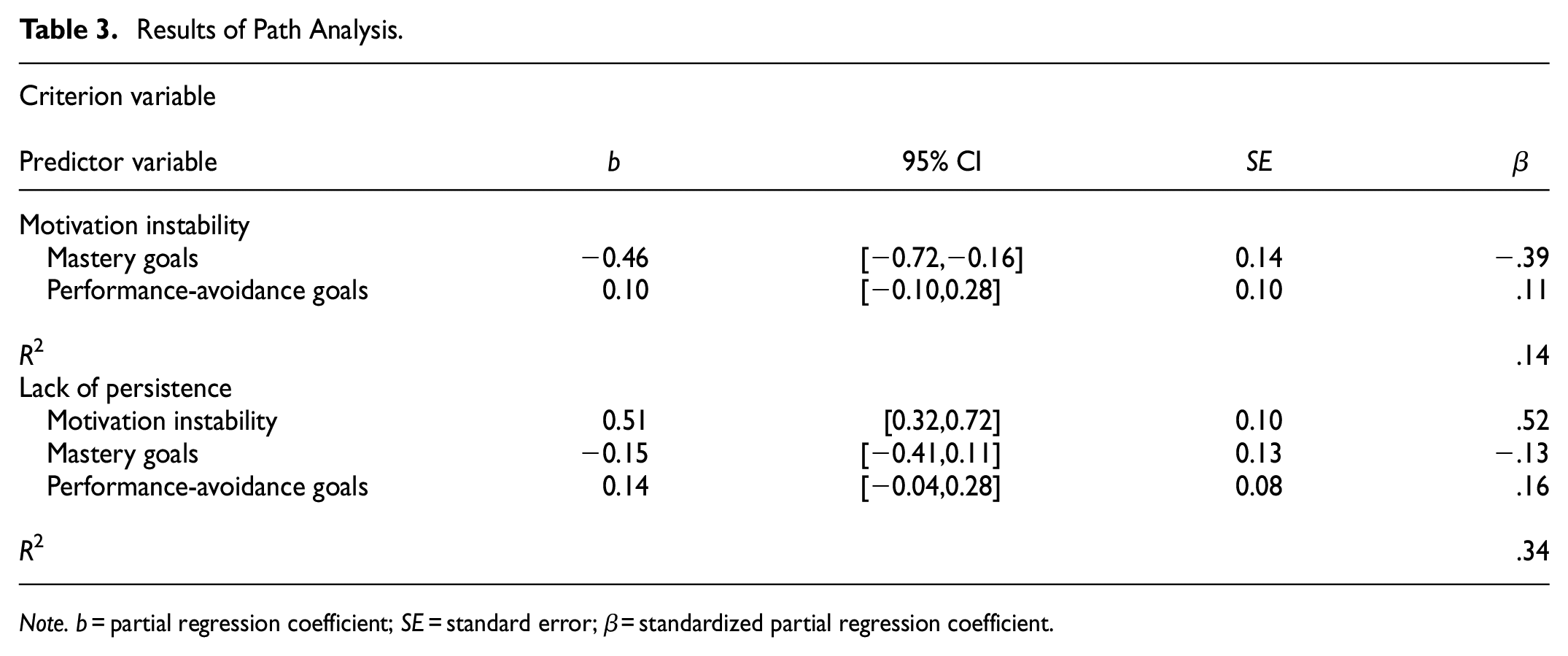
Note. b = partial regression coefficient; SE = standard error; β = standardized partial regression coefficient.
Lastly, a mediation analysis with bootstrapping (1,000 bootstraps) was performed to examine the indirect effect of mastery goals on lack of persistence via motivation instability. The results demonstrated an indirect effect (b = −0.24 [95% CI: −0.41, −0.08], SE = 0.08, β = −.20).
Discussion
Relationships Between Achievement Goals, Motivation Instability, and Learning Persistence
This study investigated the relationships between achievement goals, motivation instability, and learning persistence among Japanese university students in asynchronous distance classes. The mediation analysis demonstrated that the relationship between mastery goals and lack of persistence was mediated by motivation instability. This finding supported the study hypothesis. Learners who hold mastery goals seem to be able to focus and engage in learning to understand class material because their attention is focused on expanding their abilities, rather than comparing themselves to others. Such learners, therefore, had smaller fluctuations in motivation during learning and can engage in learning consistently and persistently. This facilitatory effect of mastery goals on learning was consistent with the results of previous studies (e.g., Church et al., 2001; Wolters, 2004). Although the indirect effect was found, mastery goals did not have a direct effect on persistence. This implied that the relationship between mastery goals and persistence was mediated completely by motivation instability. This is a crucial finding revealed by focusing on motivation instability as a mediator. Corresponding with the results of previous studies, this demonstrates that mastery-oriented achievement goals not only increase motivation levels, but they also suppress fluctuations in motivation. The present study successfully highlighted the vital role that mastery goals played in learning during asynchronous distance classes from a perspective that differs from past research.
The partial correlation analysis demonstrated a positive correlation between performance-avoidance goals and lack of persistence. These results were similar to those of Wolters (2004). In short, this means that goals that aim to avoid negative evaluation of one’s abilities are unlikely to lead to proactive learning. This was consistent with Elliot et al.’s (1999) finding that performance-avoidance goals hinder the use of effective learning strategies. Simultaneously, no association was found between performance-avoidance goals and motivation instability. This indicates that performance-avoidance achievement goals impacted motivation levels, but were largely uninvolved in motivation instability. In other words, the process behind the association between performance-avoidance goals and persistence differed from the process behind the association between mastery goals and persistence.
Achievement goal theory suggests that learners’ achievement goals lead to motivation. However, past studies have only explored the relationship between achievement goals and motivation levels. The present study demonstrated that achievement goals, particularly mastery goals, were negatively associated with motivation instability. This finding is of great significance as it paves the way to expand achievement goal theory to demonstrate this new role of achievement goals in learning.
The positive association between motivation instability and lack of persistence suggested that suppressing fluctuations in motivation is an important part of facilitating persistence in asynchronous distance classes. The results of the present study suggested that emphasizing mastery goals among learners is one method of minimizing motivation instability. Furthermore, Umemoto and Inagaki (2022) report that fatigue, sleepiness, and learning anxiety during class facilitate motivation instability in synchronous distance classes. Working with learners to reduce learning anxiety, fatigue, and sleepiness is likely to lead to stable motivation and persistent learning in asynchronous distance classes as well. It is integral to add to the perspective of “increasing” motivation seen in previous motivation research and consider in-class academic support from the new perspective of “stabilizing” motivation as well.
Future Challenges
One important future challenge is to carefully examine the validity, reproducibility, and generalizability of the results obtained in this study. For example, it is necessary to verify whether the results are similarly applicable to in-person classes and synchronous distance classes. Additionally, to avoid recruitment bias and target a wide range of students, the survey was conducted in six classes, but the results of this research are based on the data of students studying under the same faculty at one university. Therefore, it is necessary to conduct research targeting students from various departments and universities while paying attention to recruitment bias. Next, it is also important to determine the causal relationships between mastery goals, motivation instability, and learning persistence. A random assignment experiment controlling for factors believed to be related to motivation instability or learning persistence (e.g., personality) would be one way to do so. Lastly, it is necessary to identify factors besides mastery goals that facilitate learning persistence and suppress motivation instability in asynchronous distance classes. It will then be important to use the findings of these studies to develop and carry out interventions by designing classes that inhibit fluctuations in motivation and verify their effectiveness.
Footnotes
Acknowledgements
We thank the university students for their participation.
Declaration of Conflicting Interests
The author(s) declared no potential conflicts of interest with respect to the research, authorship, and/or publication of this article.
Funding
The author(s) disclosed receipt of the following financial support for the research, authorship, and/or publication of this article: This article was supported by Japan Society for the Promotion of Science (grant number: 19K14398).

Data Availability Statement
The data analyzed during the current study are available from the corresponding author on reasonable request.