




Abstract
Writing self-efficacy and writing self-regulated learning (SRL) strategies are pivotal factors influencing writing proficiency from a social cognitive perspective. This study used a mixed-methods design to investigate the relationships between these factors among English majors in the context of English as a foreign language (EFL) in China. The study was conducted in two stages. In Stage One, quantitative data were collected via cluster sampling from 73 sophomore English majors at a key university in Beijing. Participants completed two self-report questionnaires assessing writing self-efficacy and writing SRL strategies as well as a timed writing proficiency test. Stage Two involved qualitative data collection, where four students spanning both the low- and high-proficiency groups were purposefully selected for think-aloud protocols and retrospective semistructured interviews. The results revealed significant positive correlations among writing self-efficacy, writing SRL strategies and writing proficiency. Notably, there were substantial differences in writing self-efficacy and writing SRL strategy use between high- and low-proficiency writers, particularly in the use of English writing self-efficacy and environmental SRL strategies. These differences were driven primarily by learners’ interest in English. Moreover, writing self-efficacy accounted for 24% and writing SRL strategies accounted for 9.9% of the variance in writing proficiency. Qualitative findings reveal the perceptions and underlying mechanisms driving these results. Implications for language instructors and EFL learners are discussed.
Plain Language Summary
Why was the study done? Writing self-efficacy and writing self-regulated learning (SRL) strategies are crucial factors that influence writing proficiency. This study aimed to explore the relationships between these factors and writing proficiency among Chinese English majors in the EFL (English as a Foreign Language) context. What did the researchers do? The researchers conducted a mixed-methods study in two stages. In Stage One, they collected quantitative data from 73 English major students at a key university in Beijing using questionnaires on writing self-efficacy and writing SRL strategies, along with a timed writing proficiency test. In Stage Two, they selected four students from both high and low proficiency groups for think-aloud protocols and retrospective semi-structured interviews to gain deeper insights into their experiences. What did the researchers find? The study found significant positive correlations between writing self-efficacy, writing SRL strategies, and writing proficiency. Students with higher proficiency exhibited greater writing self-efficacy and used more effective SRL strategies. That was because successful writers have a strong interest in learning English. Writing self-efficacy accounted for 24% of the variance in writing proficiency, and writing SRL strategies explained an additional 9.9%. What do the findings mean? These findings suggest that enhancing writing self-efficacy and writing SRL strategies can improve writing proficiency in EFL learners. The results emphasize the need to focus on both psychological (self-efficacy) and strategic (SRL strategies) aspects of writing based on writers’ proficiency levels.
Keywords
Introduction
Writing is crucial because it serves as a medium for personal expression, social influence, learning enhancement, and improved reading comprehension (Graham et al., 2013). For English as a foreign language (EFL) learners, writing is considered the most challenging skill (Phuket & Othman, 2015). However, no comprehensive model has fully explained writing development (Hyland, 2019), as it is a complex and multifaceted process shaped by both cognitive factors and contextual influences. It requires balancing individual writing skills with social interactions within the environment (Graham et al., 2013). This view aligns with the social cognitive theory (SCT) perspective, which views writing as not only a cognitive process (Flower & Hayes, 1981) but also a social activity influenced by the interactions among environmental, behavioral, and personal factors (Bandura, 1997). It is thus unsurprising that two constructs derived from SCT, self-efficacy and self-regulated learning (SRL) strategies, have been identified as strong predictors of writing proficiency (Meier et al., 1984; Zimmerman & Risemberg, 1997). Self-efficacy refers to “beliefs in one’s capabilities to organize and execute the courses of action required to produce given attainments” (Bandura, 1997, p. 3). In contrast, SRL strategies refer to the strategies used in the process of continuous reflection, judgment, and adaptation to learning (Zimmerman & Risemberg, 1997). Although the roles of writing self-efficacy and SRL strategies have been widely documented, there is insufficient evidence concerning English majors in the Chinese EFL context. Additionally, the homogeneity of the quantitative research design has overlooked qualitative data that could provide deeper insights into the writers’ perspectives and help clarify the underlying mechanisms.
In the Chinese EFL context, which is characterized by an exam-oriented and product-focused approach, writing self-efficacy and SRL strategies may be influenced in ways that are not fully captured by current research (C. Wang & Sun, 2020). Chinese EFL learners often lack intrinsic motivation, driven instead by external goals such as passing exams, which can hinder their writing proficiency (J. H. Y. Wang & Guthrie, 2004). However, English majors, owing to their extensive exposure and specialized training, are likely to demonstrate greater writing self-efficacy and to use more SRL strategies. Assessing this group may yield more accurate data. Previous studies have predominantly relied on quantitative measures, which may fail to depict the mechanisms and writers’ perceptions. Researchers have called for the incorporation of qualitative data, such as interviews and think-aloud protocols, to explore underlying mechanisms and enhance data triangulation (L. S. Teng et al., 2020; Yao et al., 2023).
Within this context, the present study employs a mixed-methods approach to investigate two key relationships among Chinese English majors: that between writing self-efficacy and writing proficiency and that between writing SRL strategies and writing proficiency. A range of instruments is used, including two questionnaires for writing self-efficacy and SRL strategies, a timed writing proficiency test, think-aloud protocols, and semistructured interviews. This study aims to (1) examine correlations among writing self-efficacy, SRL strategies, and writing proficiency; (2) identify differences in writing self-efficacy and SRL strategies between learners with low and high proficiency; and (3) investigate the extent to which writing self-efficacy and SRL strategies predict writing proficiency. This research seeks to provide empirical evidence supporting SCT and SRL theories in the Chinese EFL context and offer practical insights on enhancing writing self-efficacy and SRL strategies for language instructors and EFL learners.
Literature Review
Writing Self-Efficacy
The Construct of Writing Self-Efficacy
Writing self-efficacy evolved from the self-efficacy theories of the 1980s and 1990s. Self-efficacy refers to the belief of individuals in their capabilities to organize and execute the actions required to manage prospective situations and stems from four main sources: mastery experiences, vicarious experiences, social persuasion, and physiological and affective states (Bandura, 1997). It is a key construct in social cognitive theory (SCT), which emphasizes social factors and the interplay among personal factors, behavior, and environmental influences in shaping human action (Bandura, 1986). With the rise of self-efficacy research, writing self-efficacy has been defined in various ways by scholars (e.g., Meier et al., 1984; Pajares & Johnson, 1994; Pajares & Valiante, 2001). Meier et al. (1984) initially defined it as an individual’s self-confidence in their writing skills. Pajares and Valiante (2001) later refined this, defining it as “students’ judgments of their confidence that they possessed the various composition, grammar, usage, and mechanical skills appropriate to their academic level” (p. 369), a definition that is commonly adopted today.
Measurement of Writing Self-Efficacy
The measurement of writing self-efficacy has evolved across three generations. The first two shifted from focusing on mechanical issues (e.g., Meier et al., 1984) to achieving a better balance with substantive issues (e.g., Pajares & Johnson, 1994; Shell et al., 1989). However, as Bruning et al. (2013) noted, these measures are difficult to relate directly to models of writing or language-related processes. In response, they refined the scale and proposed the Self-Efficacy for Writing Scale (SEWS) with three subscales to measure middle and high school students’ writing self-efficacy; this scale has since been widely adopted and revised.
In the EFL context, writing self-efficacy assessments have been developed on the basis of SEWS, but studies on this topic remain limited. L. S. Teng et al. (2018) were the first to validate the multidimensional structure of writing self-efficacy in an EFL setting through structural equation modeling, developing the Second Language Writer Self-Efficacy Scale (L2WSS) for Chinese college students and offering insights into L2 contexts. However, Sun and Wang (2020) reported that the L2WSS fails to address task specificity, as different levels of writing assignments vary. They developed the Questionnaire of English Writing Self-Efficacy (QEWSE) for Chinese college students, which is based on the SEWS (Bruning et al., 2013), and the Questionnaire of English Self-Efficacy (QESE) (C. Wang & Bai, 2017), which measures EFL students’ general English self-efficacy. The QEWSW includes ideation, organization, grammar, use of English, and self-efficacy for self-regulation, demonstrating high reliability (Cronbach’s alpha = 0.94) and good model fit. Additionally, it aligns with Bandura’s SCT and addresses task specificity, making it a potential instrument for the present study.
The Relationship Between Writing Self-Efficacy and Writing Proficiency
Writing self-efficacy was initially identified as an independent predictor of proficiency in various L1 context studies, including those involving elementary school students (Pajares & Valiante, 1997), high school students (Pajares & Johnson, 1996), and undergraduate students (Shell et al., 1989). In recent years, research in the EFL writing context has flourished. Woodrow (2011) surveyed 738 EFL university students in China to explore the interplay among writing anxiety, writing self-efficacy, and L2 writing performance. Structural equation modeling indicated that self-efficacy was moderately related to writing performance and was a stronger predictor of writing performance than anxiety was. Further research by M. F. Teng and Wang (2023) revealed that academic writing self-efficacy accounted for 54.3% of the variance in writing performance, thus highlighting its significant role in EFL writing. Similar findings have been reported in the Iraqi EFL context (Golparvar & Khafi, 2021; Sabti et al., 2019). Sabti et al. (2019) reported that higher levels of writing self-efficacy and writing achievement motivation were associated with better writing performance. Recently, Sun et al. (2021) conducted a meta-analysis on the relationship between second language English writing self-efficacy and achievement. On the basis of the 565 effect sizes from 76 studies, the results revealed statistically significant differences between L1 writing (r = .233) and L2 writing (r = .441) in terms of effect size, suggesting that writing self-efficacy may be a stronger predictor in the EFL context.
Writing Self-Regulated Learning Strategies
The Construct of Writing Self-Regulated Learning Strategies
Writing SRL strategies have been shaped by theories of the writing process. Flower and Hayes (1981) proposed a cognitive process theory of writing that views it as a dynamic, nonlinear cognitive process involving planning, translating, and reviewing. In contrast, Zimmerman and Risemberg (1997) argued that writing involves more than just cognitive processes, emphasizing the need to include social, motivational, and behavioral processes as well. They proposed a self-regulated writing model based on SCT, suggesting that writing relies on high levels of personal regulation because of its cognitive nature. The writing process consists of three basic forms of self-regulation, namely, environment, behavior, and person (self), which interact reciprocally through a cyclical feedback loop, enabling the writer to self-monitor and self-react using specific self-regulatory techniques. Zimmerman and Risemberg (1997) also identified 10 key writing SRL strategies on the basis of the practices of well-known writers and provided empirical evidence of their effectiveness. Subsequent research has aligned with this model, expanding on various SRL strategies on the basis of these three aspects.
Measurement of Writing Self-Regulated Learning Strategies
The initial measurements of writing SRL strategies were developed primarily from established questionnaires on language learning strategies and general SRL strategies. Reviewing earlier research, Graham and Harris (2000) summarized 16 SRL strategies for managing the environmental, behavioral, and personal processes of writing in the L1 context.
In the EFL writing context, few scales have been developed. L. S. Teng and Zhang (2016) proposed a four-dimensional model of SRL writing strategies (cognition, metacognition, social behavior, and motivational regulation) based on self-efficacy theory, which was validated with 790 undergraduates and showed high reliability. C. Wang and Bai (2017) developed the Questionnaire of English Self-Regulated Learning Strategies (QESRLS) for secondary school students, which is based on SCT and includes 11 categories; this questionnaire also demonstrated high reliability. In addition to EFL college and secondary students, Bai (2018) targeted primary school students and used think-aloud protocols to identify 24 SRL strategies; this study is one of the few to have examined differences in strategy use across grades. Recently, Sun and Wang (2020) reported that L. S. Teng and Zhang’s (2016) scale did not align well with the social cognitive writing model (Zimmerman & Risemberg, 1997). They adapted and validated the QEWSRLS to align better with this model, including three categories, namely, environmental, behavioral, and personal SRL strategies; this scale showed high reliability and validity and was thus considered for this study.
The Relationship Between Writing Self-Regulated Learning Strategies and Writing Proficiency
Since the 1980s, researchers have increasingly investigated the relationships of language learning strategies and SRL strategies to language achievement (e.g., Oxford, 1989). However, the results have been inconsistent (Kim et al., 2015). Zimmerman and Risemberg (1997) conducted a pilot study on writing SRL strategies, identifying 10 common forms of writing self-regulation on the basis of previous research. They also discussed their ability to predict writing achievement. Subsequent studies largely followed Zimmerman and Risemberg’s (1997) model. For instance, Bai et al. (2014) used a questionnaire and an English language exam to investigate the relationships between Singaporean primary students’ writing strategies and English language proficiency. The findings revealed that the majority of strategies were significantly correlated with students’ English language proficiency. Later, L. S. Teng and Zhang (2016) reported that six of nine SRL strategies could significantly predict students’ EFL writing proficiency. Similarly, M. F. Teng and Zhan (2023) reported that self-regulated writing strategies had a significant positive effect on writing performance (β = 0.170, p < .05). In response to Graham et al.’s (2018) call to use multiple methods to understand students’ English writing, Bai (2018) used the think-aloud protocol with Singaporean primary students and reported that high-achieving students outperformed their low-achieving counterparts in terms of both their cognitive and meta-cognitive strategies. A recent study by Shen and Bai (2024) investigated the effects of self-efficacy, gender, and major, indicating the moderating roles of gender and major.
English Writing Proficiency
The nature of writing is to write various kinds of texts consisting of at least several connected sentences (Weigle, 2002). The American Council on the Teaching of Foreign Languages (ACTFL) (2012) has explained writing proficiency and categorized it into five levels: distinguished, superior, advanced, intermediate, and novice. Each proficiency category has specific tasks and content expectations. This study assessed writing proficiency by integrating these multifaceted criteria.
Assessing writing proficiency typically involves various tasks, such as essays and reports (Weigle, 2002). In the Chinese EFL context, the College English Test (CET) and the Test for English Majors (TEM) are commonly used to evaluate English proficiency. CET focuses on non-English majors, whereas TEM focuses on English majors; both instruments assess listening, reading, writing, and speaking, and many studies have used their scores for analysis (e.g., Sun & Wang, 2020). Although these tests are reliable and valid, their scores may not fully reflect writing proficiency because of their mixed components and changes in proficiency over time. As Hughes (2003) noted, “the best way to test people’s writing ability is to get them to write” (p. 75). Therefore, this study asked students to complete an offline timed argumentative writing task to provide a more accurate assessment of writing proficiency.
In conclusion, most studies on writing self-efficacy and SRL strategies have used quantitative methods, and few have been conducted in the Chinese EFL context. Quantitative data should be complemented by qualitative data to provide deeper insights into how students perceive these constructs and how these constructs influence writing proficiency (Pajares & Johnson, 1996; L. S. Teng et al., 2020; Yao et al., 2023). Many studies have highlighted the absence of qualitative approaches as a limitation (e.g., Shen et al., 2023), calling for more mixed-methods research to enrich the findings. Therefore, there is a need to address the lack of qualitative data, particularly in the Chinese EFL context. This study adopts a mixed-methods approach to provide a fresh perspective, better contextualize participants’ responses, and gain deeper insights into the mechanisms underlying these relationships in the Chinese EFL context. It aims to answer three questions:
(1) Are there significant correlations among learners’ writing self-efficacy, writing SRL strategies, and writing proficiency in the Chinese EFL context? If so, to what extent?
(2) Are there differences in writing self-efficacy and writing SRL strategies between high- and low-proficiency writers in the Chinese EFL context? If so, in what aspects?
(3) To what extent do learners’ writing self-efficacy and writing SRL strategies predict writing proficiency in the Chinese EFL context?
Methodology
The present study adopted a mixed-methods approach and collected quantitative data in Stage One and qualitative data in Stage Two to explore the role of writing self-efficacy and SRL strategies in writing proficiency. The quantitative and qualitative data were integrated for triangulation to address the three research questions, with the data types complementing each other to provide deeper insights and a more comprehensive understanding of the research.
Participants
In Stage One, 73 sophomore English majors from a key university in Beijing were recruited through cluster sampling to complete two questionnaires and a writing proficiency test. This cohort was chosen because, as English majors, they had more writing experience and strategies, allowing for more accurate self-assessment of their writing. As sophomores who had completed an English writing course and were preparing for the TEM-4 exam, they were motivated to understand their writing levels and receive suggestions for improvement. Among the 84 eligible sophomores, 73 (8 males, 65 females) aged 18 to 22 years (average age = 19) participated. Since all participants were English majors with similar demographic backgrounds, only gender was considered in later regression analyses. Additionally, the limited number of participants was due primarily to constraints in conducting offline writing tests. Although the sample size was relatively small, the participants were originally from across China and varied in proficiency, making the sample reasonably representative of the broader cohort.
In Stage Two, four female participants from Stage One were purposefully selected for think-aloud protocols and retrospective interviews to provide further insights into writing self-efficacy and the use of writing SRL strategies, representing both successful and unsuccessful writers. They were selected on the basis of their writing scores in Stage One and their suitability for the think-aloud protocol. On the basis of writing scores, 37 students were grouped into the top and bottom 25%. Four students were chosen who met the criteria of possessing strong language sensitivity, being articulate, enjoy talking, and having an outgoing personality (C. Guo, 2015): S1 and S2 (low proficiency) and S3 and S4 (high proficiency). While the number of qualitative participants was small, the focus in this stage was on the depth of analysis, aiming to explore cognitive processes and individual experiences that could not be captured through self-reported data alone.
Data Collection
Questionnaires
To measure writing self-efficacy and SRL strategies, sophomores completed the Questionnaires of English Writing Self-Efficacy (QEWSE) and the Writing Self-Regulated Learning Strategies (QEWSRLS) questionnaire by Sun and Wang (2020), along with demographic data (see Supplemental Appendix A). Both questionnaires showed strong reliability, with Cronbach’s alpha values of .94 for the QEWSE and .88 for the QEWSRLS, and confirmatory factor analysis (CFA) via LISREL 8.80 confirmed adequate model fit for both.
The QEWSE includes 26 items (see Supplemental Appendix A) with five subscales: ideation (Items 1, 6, and 11), organization (Items 2, 7, 12, 20, and 26), grammar and spelling (Items 3, 8, 21, and 25), use of English writing (Items 4, 9, 10, 13, 14, 16, 17, and 22), and self-efficacy for self-regulation 18 (Items 5, 15, 18, 19, 23 and 24).
The QEWSRLS includes 26 items (see Supplemental Appendix A) with three subscales: environmental (8 items), behavioral (8 items), and personal (10 items). Environmental strategies include seeking assistance (Items 3, 12, and 21), persistence (Items 4, 13, and 22), and review of records (Items 9 and 18). Behavioral strategies include seeking opportunity (Items 5, 14, 23, and 25), self-monitoring (Items 6 and 15), and self-consequences (Items 7 and 16). Personal strategies include self-evaluation (Items 1, 10, and 19), organization and transformation (Items 2, 11, 20, 24, and 26), and goal setting and planning (Items 8 and 17).
Two pilot tests were conducted prior to questionnaire administration. In Pilot One, 30 non-English majors completed the questionnaires online. The follow-up interview with four participants provided two main suggestions on the rating scales and the phrasing of Item 14 in the QEWSRLS. They found the seven-point scale difficult to distinguish and noted that “I will send emails to friends in English” did not reflect their actual learning situations. Thus, the scale was changed to a five-point Likert scale, and the question was revised to “I will send messages to friends in English.” In Pilot Two, another 30 non-English majors confirmed the reliability and validity of the revised questionnaires, with Cronbach’s alpha values of 0.92 for the QEWSE and 0.82 for the QEWSRLS, indicating high reliability (Qin, 2009). The finalized questionnaires were then administered to 83 sophomore English majors during a break in one compulsory course in autumn 2022.
Writing Proficiency Tests
To assess writing proficiency, three tests from the Test for English Majors-Band 4 (TEM-4) (2006–2008) were utilized (see Supplemental Appendix B). The TEM-4 is a reliable, nationally standardized test designed for Chinese English majors. Three tasks were employed to prevent topic leakage, as the participants were from three parallel classes. The tasks covered the topics of online friendships, saving money, and volunteering benefits, all of which were familiar to them. In the final lesson, 73 of 83 students completed a 45-min argumentative writing task in class. A teaching assistant assisted with the test process, and two invigilators collected 73 valid compositions.
Think-Aloud Protocol
The think-aloud protocol (TAP) was used with four participants of varying writing proficiency to investigate their writing process. Each participant completed a different writing task from Stage One without a time limit. They first received a 30-min training on the purpose, application, and techniques of the TAP, followed by a standardized demonstration and practice. During the task, participants verbalized their strategies for approximately 1 hr, and the sessions were recorded for analysis.
Retrospective Interviews
Following the TAP, a retrospective interview was conducted to explore participants’ evaluations of writing self-efficacy and SRL strategies, as well as their opinions regarding these constructs in relation to writing proficiency. The semistructured interview (see Supplemental Appendix C), designed on the basis of the research questions, consisted of three parts: (1) an evaluation of writing self-efficacy and SRL strategies during TAP, (2) an evaluation of these two constructs in daily life, and (3) an evaluation of the roles of these constructs in writing proficiency. Key terms were clarified with examples to ensure reliability. Each interview lasted 45 to 60 min and was recorded and transcribed verbatim. Each interview concluded when the participant clearly stated that they had no further information to share.
Data Analysis
The data collected through quantitative and qualitative methods were analyzed via SPSS 26.0 and NVivo 12.
First, quantitative data from the questionnaires and writing tasks were analyzed via SPSS 26.0. The raw data were transcribed in Excel and checked for consistency. In this study, Cronbach’s alpha for the QEWSE was α = .914, and that for the QEWSRLS was α = .869. Writing tests were rated by three experienced raters using Q. Li’s (2014) analytic rubric (see Supplemental Appendix D) with strict adherence to S. C. Weigle’s (2002) guidelines, which resulted in high interrater agreement (α = .97). Before the formal analysis was conducted, several basic assumptions were tested, including the normality of the data using the Shapiro–Wilk test, gender differences through an independent samples t test, and assumptions of linearity and homoscedasticity through residual plots. Pearson’s correlations, independent t tests, and multiple linear regression were subsequently used to analyze the relationships and differences among writing self-efficacy, SRL strategies, and proficiency.
Second, qualitative data from the think-aloud protocols and retrospective interviews were coded in NVivo 12. For the think-aloud protocol, the researcher coded the data while watching the recorded video using content analysis. The use of the strategies was counted by time rather than by sentences, as participants differed in the amount of verbalization. For instance, a student’s in-task reflection about straying from the writing prompt was coded as an instance of the self-evaluation strategy. For the retrospective interviews, the transcribed data were analyzed via a three-step thematic coding process (Creswell et al., 2007) to explore the relationships among writing self-efficacy, SRL strategies, and writing proficiency. The retrospective interview data were transcribed and input into NVivo 12 for further coding. The three research questions were used as reference points to code participants’ answers concerning how writing self-efficacy and writing SRL strategies were related to their writing proficiency in three steps. This process began with open coding to identify initial concepts, such as self-doubt and the pressure to meet teacher expectations. During axial coding, related codes were then systematically grouped into broader categories, such as the perceived link between a writer’s confidence and external pressures. Finally, through selective coding, these categories were integrated and refined to identify core themes. For instance, the category linking self-doubt with external expectations was abstracted into the overarching theme of anxiety, highlighting it as a key affective mediator in the writing process. This systematic coding trajectory, exemplified in Table 1, enabled a nuanced interpretation of the qualitative data in response to the research questions.
Sample of the Qualitative Data Coding Process.

To ensure reliability and validity, three strategies were employed: triangulation of data sources (questionnaires, tests, protocols, and interviews) to ensure consistency, three rounds of coding with detailed logs to maintain accuracy, and solicitation of participant feedback to verify the accuracy of the descriptions and analyses.
Results and Discussion
This section presents the results and discussion addressing the three research questions with respect to (1) correlations, (2) differences between high and low achievers, and (3) predictive effects on writing proficiency. A mixed-methods approach is employed for the discussion, where quantitative findings from statistical analyses provide the initial evidence, and qualitative data from interviews and think-aloud protocols are subsequently integrated to explain, elaborate on, and enrich these numerical results.
Correlations
Correlation Between Writing Self-Efficacy and Writing Proficiency
The correlation analysis was performed via SPSS 26.0, and a moderate positive correlation was indicated by the Pearson correlation coefficients (see Table 2).
Pearson Correlation Matrix for Writing Self-efficacy and Writing Proficiency.
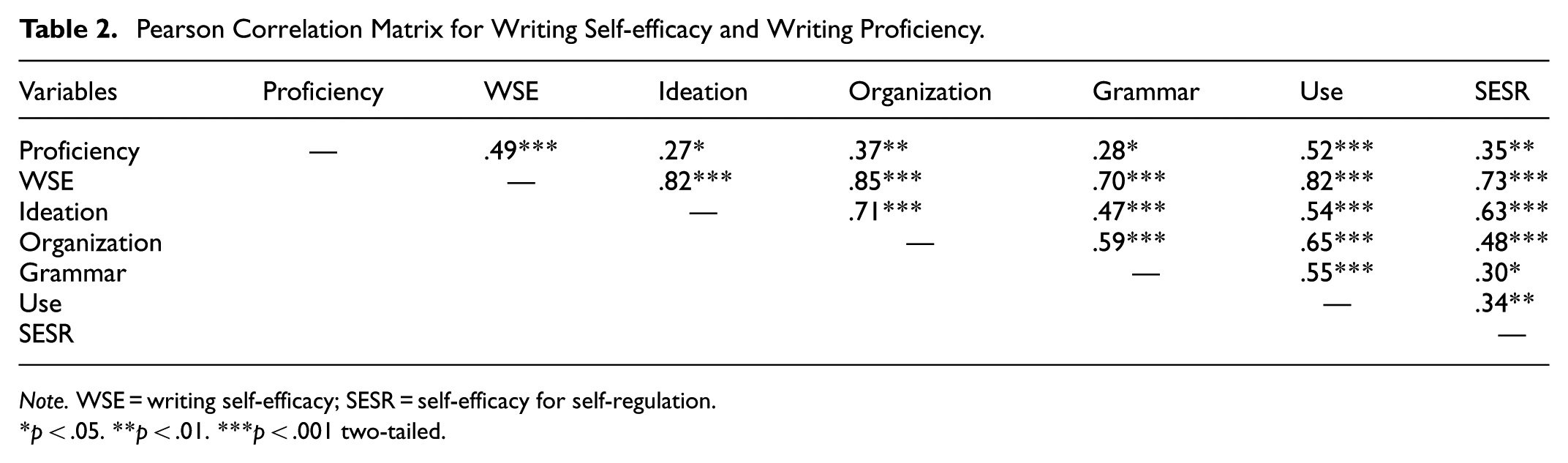
Note. WSE = writing self-efficacy; SESR = self-efficacy for self-regulation.
p < .05. **p < .01. ***p < .001 two-tailed.
As shown in Table 2, the results demonstrated a significant positive correlation between writing self-efficacy and writing proficiency (r = .49, p < .001), which is not surprising since writing self-efficacy is a key underlying variable in the self-regulation writing model and affects individuals’ motivation and achievement (Zimmerman & Risemberg, 1997). These results echo previous findings (Bruning et al., 2013; Pajares & Valiante, 2001; Sabti et al., 2019) and are slightly greater than the value of .441 reported in a meta-analysis for L2 learners by Sun et al. (2021), possibly because of the influence of majors as participants (C. H. Wang et al., 2017), as English majors’ greater self-efficacy may have strengthened this relationship.
Specifically, all five subcategories of writing self-efficacy were significantly correlated with writing proficiency, with the use of English writing having the highest correlation coefficient (r = .52, p < .001), whereas ideation (r = .27, p < .05) and grammar (r = .28, p < .05) had the lowest coefficients. One possible explanation for this could be students’ variability with respect to each subscale. This variation might be attributed to students’ greater self-efficacy in fundamental skills such as ideation and grammar, which are emphasized in Chinese exam-oriented writing instruction (Yao et al., 2023), whereas comprehensive skills such as the use of English receive less attention from instructors.
In retrospective interviews, both successful and unsuccessful writers acknowledged the correlation between writing self-efficacy and writing proficiency. Writers with high self-efficacy believed that self-efficacy motivated them to start writing and reduced anxiety and emotional burden. In contrast, although writers with low self-efficacy hesitated to start writing, they noted that self-efficacy drove them to seek ways to improve and overcome the weakness. These perceptions may be attributed to the mediating roles of anxiety and motivation, which align with previous findings that anxiety and motivation act as mediators (Sabti et al., 2019; Shen et al., 2023), thereby reinforcing the view that writing is a social–cognitive process. Notably, low self-efficacy was not perceived as a negative factor but rather as a driver of improvement, possibly because the participants were English majors, which gave them a strong motivation to improve.
Correlation Between Writing SRL Strategies and Writing Proficiency
Pearson correlation analysis revealed a moderate positive correlation between writing SRL strategies and writing proficiency (see Table 3), and the qualitative data further supported these results.
Pearson Correlation Matrix for Writing SRL Strategies and Writing Proficiency.

Note. WSRLS = writing self-regulated learning strategies.
p < .05. **p < .01. ***p < .001 two-tailed.
Table 3 reveals a moderate positive correlation between writing SRL strategies and writing proficiency (r = .32, p < .01), which aligns with prior findings (Bai & Guo, 2018; L. S. Teng, 2021) but is slightly greater than the average (r = .22) from a meta-analysis of LLS and English achievement (Zhang et al., 2013). It is reasonable that English majors would adopt more strategies.
All three subcategories significantly correlated with writing proficiency, with environmental strategies (r = .33, p < .01) being slightly above average (r = .32, p < .01) and behavioral strategies (r = .27, p < .05) and personal strategies (r = .24, p < .05) being marginally below. A potential explanation could be that Chinese EFL teachers focus more on teaching personal SRL strategies (e.g., checking before handing in work) than environmental strategies (e.g., asking others for help) in score-oriented contexts.
In the retrospective interviews, writers from both the low- and high-proficiency groups highlighted the correlation. Emotionally, when they felt anxious about writing, they adopted SRL strategies to calm down and find a quiet place to write. Technically, the SRL strategies activated their knowledge base and improved writing quality in terms of richness, fluency, and accuracy. This finding aligns with previous findings on the role of SRL strategies in regulating emotions and enhancing quality (L. S. Teng, 2021; Teng & Zhang, 2020). Although overall writing SRL strategies were perceived as correlated with writing proficiency, the writers also reported that the effectiveness of specific strategies depended on the context. This finding aligns with previous studies (Bai, 2018; Teng & Zhang, 2020) and the self-regulated writing model (Zimmerman & Risemberg, 1997), which emphasizes the interplay among the environment, behavior, and the person (self) in the writing process.
Differences
Distribution of Writing Proficiency Between Low- and High-Proficiency Writers
Students were divided into low and high writing-proficiency groups on the basis of the top and bottom 25% of their writing proficiency test scores (Qin, 2009). Descriptive statistics for writing proficiency are shown in Table 4.
Descriptive Data of Writing Proficiency Between the Low- and High-Proficiency Groups.

As shown in Table 4, the low-proficiency group (n = 18) scored between 8.83 and 10.83 (M = 10.25, SD = .59), whereas the high-proficiency group (n = 19) scored between 12 and 13.5 (M = 12.48, SD = .45).
Differences in Writing Self-Efficacy Between Learners with Low and High Writing Proficiency
To explore the differences in writing self-efficacy between the low- and high-proficiency groups, an independent t test was conducted (see Table 5).
Comparison of Writing Self-efficacy Between the Low- and High-Proficiency Groups.

Note. SESR = self-efficacy for self-regulation.
p < .05. **p < .01. ***p < .001 two-tailed.
As shown in Table 5, high-writing-proficiency students (M = 3.85, SD = 0.33) significantly outperformed low-proficiency students (M = 3.31, SD = 0.39) in terms of overall writing self-efficacy (MD = .54, t(37) = 4.537, p < .001, d = 1.492) and the five subscales. The difference (d > .7) was significant according to Cohen (1998) and Hattie (2009).
The greatest difference was in the use of English writing (MD = .69, t(37) = 5.121, p < .001), and the least differences were in ideation (MD = .43, t(37) = 2.328, p < .05), grammar (MD = .43, t(37) = 2.673, p < .05), and organization (MD = .42, t(37) = 2.763, p < .01). The prioritization of English writing instruction in China, driven by exam requirements, likely explains the smaller differences in ideation, grammar, and organization. For example, the TEM-4 rubric (Q. Li, 2014) emphasizes these aspects, leading teachers and students to focus on them more. However, practice in real-life English writing, such as texting friends in English or keeping English diaries, is neither required by teachers nor assessed in exams, leading to significant variation and contributing to the greater differences in the use of English writing.
The results of the retrospective interviews revealed that less proficient writers had lower writing self-efficacy, whereas more proficient writers exhibited greater self-efficacy. Below are two excerpts from both low- and high-proficiency writers:
Excerpt 1: Honestly, I am not confident about my writing. For one thing, I have struggled to generate ideas and polished sentences since young, which causes me a great deal of anxiety. I think my difficulties in writing may be due to the lack of daily accumulation and ineffective learning methods. For another, receiving low grades on my compositions has further eroded my confidence, leaving me feeling like I sucked in writing. Although my teachers have given me some feedback, they are not targeted, and I still do not know how to improve my writing. (S2-Interview) Excerpt 2: I think my writing self-efficacy was quite high because I feel motivated and eager to write. Rather than viewing it as a burdensome task, I find the writing process enjoyable. Additionally, my interest [in reading] also boosts my writing confidence. As I read the original English works, I would admire and take notes of their expressions. As a result, I am eager to improve my writing proficiency so as to better express my ideas. (S3-Interview)
Low-proficiency writers attributed their low self-efficacy to mastery experiences (difficulty with idea generation, poor language proficiency, lack of specific improvement instructions), vicarious experiences (observing other excellent students’ high scores), verbal persuasion (negative feedback from teachers), and emotional and physiological states (anxiety from teachers’ high standards) (Bandura, 1997). Most of these factors were teacher related. This finding was consistent with previous research showing the crucial role of EFL teachers (Teng & Zhang, 2020), particularly with respect to feedback. Teachers tended to focus on similar types of comments, emphasized language-specific errors, and often provided confusing and arbitrary feedback, hindering students’ writing proficiency development (Zamel, 1985).
High-proficiency writers attributed their self-efficacy to mastery experiences (motivation and interest in writing, extensive English reading, and abundant writing practice), vicarious experiences (admiration for skilled writers’ expressions), verbal persuasion (positive feedback from teachers and peers), and emotional and physiological states (a sense of achievement from writing). These factors align with Bandura’s (1997) self-efficacy theory. Their high self-efficacy originated from an interest in English reading and writing, which led to increased input and output of English and was strengthened by positive feedback. Therefore, cultivating students’ interest in English writing and reading is crucial (Graham et al., 2013). Shen et al. (2023) reported that interest predicted all aspects of self-efficacy in English writing, which is vital for improving writing proficiency.
Differences in Writing SRL Strategies Between Learners with High and Low Writing Proficiency
Independent t tests (see Table 6) were carried out to reveal the differences in writing SRL strategies between the two groups.
Comparison of Writing SRL Strategies Between Low- and High-Proficiency Groups.

Note. WSRLS = writing self-regulated learning strategies; SAS = seeking assistance strategies; PS = persistence strategies; RRS = review of records strategies; SOS = seeking opportunity strategies; SMS = self-monitoring strategies; SCS = self-consequences strategies; SES = self-evaluation strategies; OTS = organization and transformation strategies; GPS = goal setting and planning strategies.
p < .05. **p < .01. ***p < .001 two-tailed.
Table 6 shows a significant difference in SRL strategy use between the high (M = 3.41, SD = .44, n = 19) and low (M = 2.99, SD = .39, n = 18) writing proficiency groups (MD = .42, t(35) = 3.13, p < .01, d = 1.029). This result supports previous findings that successful writers use more SRL strategies (W. Guo & Bai, 2022). This is reasonable, as writing requires personal regulation as well as regulation of behavior and environment, and adopting diverse strategies helps individuals manage reciprocal interactions during writing.
The two groups differed statistically in three subcategories, with the greatest difference observed in environmental SRL strategies (MD = .53, t(35) = 3.69, p < .001, d = 1.213) and the smallest difference identified in personal SRL strategies (MD = .34, t(35) = 2.04, p < .05, d = .672). Specifically, the groups differed significantly in persistence strategies (MD = .79, t(35) = 4.68, p < .001, d = 1.54), seeking opportunity strategies (MD = .59, t(35) = 2.61, p < .05, d = .858), and self-monitoring strategies (MD = .57, t(35) = 3.26, p < .01, d = 1.073). According to Cohen (1998) and Hattie (2009), these differences were very large (d > .7). This discrepancy across subcategories highlights the importance of balancing one’s efforts in all aspects rather than focusing on just one (Bai, 2018; Teng & Zhang, 2020). Moreover, the frequent use of these strategies by successful writers aligns with previous research identifying persistence, initiative, and self-monitoring as key traits for self-regulated learners (Baggetun & Wasson, 2006).
The qualitative data were collected through both TAPs and retrospective interviews. The writing SRL strategies used during the think-aloud session were calculated (see Table 7), and additional insights into their use of writing SRL strategies were then provided. The results from both methods were consistent, showing that less successful writers used fewer strategies, whereas successful writers employed more strategies.
The Frequency of Writing SRL Strategies During Think-Aloud Sessions.

Note. WSRLS = writing self-regulated learning strategies; low WP = low writing proficiency; high WP = high writing proficiency; SAS = seeking assistance strategies; PS = persistence strategies; RRS = review of records strategies; SOS = seeking opportunity strategies; SMS = self-monitoring strategies; SCS = self-consequences strategies; SES = self-evaluation strategies; OTS = organization and transformation strategies; GPS = goal setting and planning strategies.
As shown in Table 7, low-proficiency writers (S1 and S2) and high-proficiency writers (S3 and S4) differed notably in their use of writing SRL strategies, both overall and within the three subcategories. Successful writers typically engaged in overall planning and considered the audience’s needs before writing. They also reflected more frequently on their previous English writing experiences and showed greater persistence when they encountered obstacles. Throughout the writing process, they often rephrased their ideas by drawing from their knowledge acquired from books and regularly summarized their writing patterns while providing self-feedback. In contrast, unsuccessful writers relied mainly on organization and transformation strategies. They often struggled to find suitable expressions to convey their ideas and tended to begin writing hastily without a prior plan, a pattern also noted in previous studies involving high- and low-proficiency writers (Victori, 1999).
In their interviews, students shared their insights regarding the context and origins of their use of SRL strategies. Three students indicated that when writing tasks were urgent, challenging, or lacked a time limit, which caused them to feel anxious, they adopted more strategies, echoing previous findings (F. Teng & Huang, 2019). Conversely, one student noted that when she felt relaxed and had no time constraints, she would use such strategies more often. With respect to the origins of their strategies, all students identified two main sources: teachers and their own experiences. Their strategy choices reflect that writing processes are shaped by environmental, behavioral, and personal factors (Zimmerman & Risemberg, 1997). Here is one typical example.
Excerpt 3: I like to use English in daily life, including communicating with others and writing down my thoughts. I enjoy the writing process and regard it as an excellent opportunity for practice. To improve my writing, I have amassed a collection of well-written sentences and words from original books and tried to incorporate them into my own writing. Additionally, I often seek guidance from my teachers. Furthermore, another (writing SRL) strategy I often use is to create an outline before writing. (S3-Interview)
As S3 mentioned, she had a passion for and interest in learning English. Some strategies were suggested to students by teachers and had become habitual for them, whereas other strategies were discovered through their personal experiences and feelings; these sources align with the two main sources identified in previous research (Bai, 2018; L. S. Teng & Zhang, 2016).
Predictive Effects
Predictive Effects of Writing Self-Efficacy on Writing Proficiency
Two linear regression analyses were conducted to investigate the predictive effects of writing self-efficacy—as a whole construct and its five subscales—on writing proficiency. Assumptions of normal distribution residuals and nonlinear correlation were satisfactorily met. A t test revealed no significant gender differences in terms of writing proficiency, self-efficacy, or SRL strategies; thus, gender was not controlled for in the regression models. The results are shown in Tables 8 and 9.
Simple Linear Regression: Important Statistics for Writing Self-efficacy.

Note. N = 73.
p < .01 ***p < .001.
Multiple Linear Regression: Important Statistics for Writing Self-efficacy Subscales.

Note. N = 73. SESR = self-efficacy for self-regulation.
p < .05. **p < .01. ***p < .001.
According to the data in Table 8, the whole construct of writing self-efficacy predicted writing proficiency, F(1,71) = 22.406, p < .001. The R square value (.240) in Table 8 indicates that 24% of the variance in students’ writing proficiency was explained by overall writing self-efficacy.
As shown in Table 9, linear regression analyses revealed that self-efficacy in English use (p < .01) and self-regulation (p < .05) significantly predicted writing proficiency. However, self-efficacy in ideation, organization, and grammar did not independently predict writing proficiency. The results highlighted that English use and self-regulation were the strongest predictors, aligning with the differences identified between successful and unsuccessful writers. This finding supports previous research on the independent contribution of writing self-efficacy to writing outcomes (Sun & Wang, 2020). However, their study also identified grammar self-efficacy as a predictor, likely because of the variance in participant groups.
In the retrospective interviews, participants were asked to evaluate the predictive effects of these two variables on writing proficiency and describ these effects through metaphors. Unsuccessful writers believed that writing self-efficacy was a stronger predictor.
Excerpt 4: I would prefer writing self-efficacy. Personally speaking, writing SRL strategies may relieve my anxiety or fear in the moment. However, as for writing self-efficacy, receiving positive feedback would boost my confidence and help me improve myself. So, I think it [writing self-efficacy] has a stronger impact … I think using writing SRL strategies can be linked to tidying or cleaning, as they can help organize writing and remove potential obstacles. Writing self-efficacy is more like filling up the oil to give me strength to keep improving. (S1-Interview) Excerpt 5: I feel like writing self-efficacy is more important. When your writing self-efficacy is at a low level, you cannot write a good composition. Although utilizing writing self-regulated learning strategies helps improve writing proficiency, if self-efficacy is severely lacking, the person may not even initiate the writing process … If comparing the writing process to crossing a river, I think writing self-efficacy would be the boat and the writing SRL strategies would be the paddles. (S2-Interview)
Unsuccessful writers (S1 and S2) emphasized the importance of writing self-efficacy over SRL strategies for predicting writing proficiency. They compared self-efficacy to filling a car with oil or a boat for crossing a river, highlighting its fundamental role in initiating and sustaining writing efforts. Their views aligned with research suggesting that self-efficacy is vital for motivation and long-term writing success (Shen et al., 2023; L. S. Teng, 2021). We can infer that self-efficacy may be more crucial for low-proficiency writers than SRL strategies are.
Predictive Effects of Writing SRL Strategies on Writing Proficiency
The same steps were followed as in the previous section. The results of the two linear regressions by the whole construct and its three subscales are displayed in Tables 10 and 11.
Simple Linear Regression: Important Statistics for Writing SRL Strategies.

Note. N = 73.
p < .01.
Multiple Linear Regression: Important Statistics for Writing SRL Strategies Subscales.

Note. N = 73.
p < .05. ***p < .001.
Consistent with the previous steps, Table 10 shows that the whole construct of writing SRL strategies predicted writing proficiency statistically, F(1,71) = 7.845, p < .01. The R square value (.099) in Table 11 indicates that 9.9% of the variance in students’ writing proficiency was explained by the overall writing SRL strategies.
As shown in Table 11, the three subscales did not predict writing proficiency (p > .05). As mentioned earlier, the two student groups differed statistically in their use of writing SRL strategies across the three aspects, indicating that no stand-out strategy had a greater effect on writing proficiency and thus further supporting the predictive effects. Although the predictive effects were generally in line with those identified in previous studies, they differed significantly in magnitude. For example, H. Li (2013) reported that writing SRL strategies explained 32% of score variance, Sun and Wang (2020) reported a predictive effect of 14%, and more recent research by M. F. Teng et al. (2022) revealed a predictive effect of 76.8%. The large difference in magnitude may be due to the participant group. For example, M. F. Teng et al. (2022) investigated young secondary school students, who may not have accurately reported their strategy use.
Although the use of writing SRL strategies was less predictive of writing proficiency than writing self-efficacy was, successful writers emphasized the role of these strategies over that of writing self-efficacy in predicting writing proficiency.
Excerpt 6: I think writers who adopt more writing SRL strategies will have higher writing proficiency than those who have higher writing self-efficacy. From the perspective of language learning, SRL strategies could enhance the effectiveness of learning, such as applying Ebbinghaus’s forgetting curve to remember English words. By optimizing the learning methods through adopting strategies, we can achieve more with less effort and improve our proficiency … Comparing writing to computers, I think writing SRL strategies can be linked to the system upgrade. By employing more and better strategies, it is similar to optimizing computer arithmetic, resulting in saved time and improved outcomes. Besides, writing self-efficacy can be compared to a booster or filling up the oil in a car. (S3-Interview) Excerpt 7: I think people who frequently use writing SRL strategies are likely to have higher writing proficiency. Writing SRL strategies facilitate the effective mobilization and utilization of existing knowledge, whereas writing self-efficacy may only help alleviate the anxiety or the psychological burden … If the writing goal was to cross the river, writing self-efficacy was more like the boat, while writing SRL strategies were the paddles. Although you need confidence to get started, it cannot help you reach the other bank. Instead, an impellent force like the use of SRL strategies is needed. (S4-Interview)
Successful writers emphasized the importance of SRL strategies for writing improvement, comparing them to computer upgrades or paddles for crossing a river. They asserted that although self-efficacy initiated the writing process, SRL strategies determined their level of success. Their perceptions aligned with a meta-analysis identifying strategy instruction as the most effective instruction for writing development (Graham & Perin, 2007). Thus, it can be inferred that the effectiveness of strategy instruction varies between low- and high-proficiency writers, suggesting that instruction should be tailored to students’ current writing levels (Bai, 2018).
Implications and Limitations
In light of the findings of this study, implications for language instructors and EFL learners as well as the limitations of this study are summarized.
For language instructors, prioritizing the development of students’ writing self-efficacy and SRL strategies is essential, as these factors are integral to enhancing writing proficiency. To apply these findings effectively in real-world classroom settings, instructors should create a learning environment that fosters students’ interest, confidence, and motivation. This support can be achieved by offering constructive and positive feedback that emphasizes students’ strengths, provides them with successful experiences, and guides them through areas that need improvement. Additionally, it is important for teachers to encourage practices that go beyond the traditional focus on grades. For instance, teachers should emphasize the practical use of English, such as keeping English journals or taking notes in English, as mentioned in the interviews. These non-score-oriented strategies are critical for students’ long-term growth and self-regulation. Moreover, instructors should incorporate SRL strategies into their teaching by helping students break down the writing process into multiple aspects. By guiding students to better understand and regulate their writing process, instructors can empower them to take ownership of their learning and thus improve their writing proficiency.
Moreover, EFL learners, particularly those with varying levels of writing proficiency, can benefit greatly from applying the findings of this study in their own learning process. For lower-proficiency students, the key to improving writing lies in gradually increasing self-efficacy through positive reinforcement. This can be achieved by fostering a genuine interest in reading and writing as well as engaging in focused, deliberate practice. For higher-proficiency students, developing and applying SRL strategies becomes critical, especially environmental and behavioral SRL strategies. Since no single SRL strategy alone predicts proficiency, it is important for students to employ a range of suitable strategies. By adopting these strategies, EFL learners can improve their writing, leading to consistent progress in proficiency.
Although this study was rigorously designed and conducted, several limitations should be addressed. The sample included 73 sophomore English majors for the quantitative data and four participants for the qualitative data, all from one key university. This relatively small and homogeneous sample limits the generalizability of the findings, as the results are context specific and may not apply broadly to other populations or settings. Additionally, the use of only argumentative writing prompts may not have fully captured the full spectrum of students’ writing proficiency. Furthermore, this study investigated only two pairs of relationships and did not consider the combination of the two independent variables or other influential factors, such as motivation and anxiety, which were mentioned in the retrospective interviews. To conclude, future studies should include a larger, more diverse sample from universities in different regions and academic levels, explore a broader range of writing prompts to better assess students’ proficiency, and investigate additional psychological variables and their relationships in greater depth.
Conclusion
Previous studies have predominantly used quantitative data to explore the role of writing self-efficacy and writing SRL strategies in writing proficiency but have not revealed the mechanism underlying this relationship. This study adopted a mixed-methods approach that included questionnaires, writing tests, a think-aloud protocol and semistructured interviews to investigate the relationships among Chinese English majors’ writing self-efficacy, writing self-regulated learning strategies, and writing proficiency. First, significant positive correlations were found among writing self-efficacy, writing SRL strategies and writing proficiency. Second, high- and low-proficiency writers differed substantially in overall writing self-efficacy and writing SRL strategies. Third, the predictive effects of writing self-efficacy and writing SRL strategies on the variance in writing proficiency were 24% and 9.9%, respectively. The results enrich the research on improving writing proficiency from the SCT perspective, especially in the Chinese EFL context, and provide participants’ insights into the reasons behind this relationship. Notably, high- and low-proficiency writers perceived the roles of writing self-efficacy and SRL strategies in opposite ways. This finding therefore indicates that to improve writing proficiency, high-proficiency writers should focus more on enhancing their writing SRL strategies, whereas low-proficiency writers need to prioritize improving their writing self-efficacy first. Furthermore, the main difference between the two groups lay in their interest in English, emphasizing the role of interest cultivation in successful learning. To conclude, the results provide compelling evidence for improving writing proficiency through writing self-efficacy and SRL strategies and suggest that prioritization should consider current writing proficiency levels.
Supplemental Material
sj-docx-1-sgo-10.1177_21582440251406353 – Supplemental material for Investigating Writing Self-Efficacy and Writing Self-Regulated Learning Strategies Across Different Writing Proficiency Levels in Chinese English Majors: A Mixed-Methods Design
Supplemental material, sj-docx-1-sgo-10.1177_21582440251406353 for Investigating Writing Self-Efficacy and Writing Self-Regulated Learning Strategies Across Different Writing Proficiency Levels in Chinese English Majors: A Mixed-Methods Design by Peiqi Zhu and Xiaohui Sun in SAGE Open
Footnotes
Acknowledgements
We deeply appreciate all the participants involved in this research, especially the four who contributed to the qualitative study.

Ethical Considerations
The study was conducted in strict accordance with ethical guidelines. Measures were taken to ensure that the confidentiality and privacy of the participants were protected throughout the research process.
Consent to Participate
Prior to the study, participants were fully informed of the research purpose, procedures, potential risks and benefits, as well as their right to withdraw at any time. All participants provided written informed consent before the study commenced.
Consent for Publication
Not applicable.
Funding
The authors received no financial support for the research, authorship, and/or publication of this article.
Declaration of Conflicting Interests
The authors declared no potential conflicts of interest with respect to the research, authorship, and/or publication of this article.
Data Availability Statement
The datasets used and/or analyzed during the current study are available from the corresponding author on reasonable request.
Supplemental Material
Supplemental material for this article is available online.
References
Supplementary Material
Please find the following supplemental material available below.
For Open Access articles published under a Creative Commons License, all supplemental material carries the same license as the article it is associated with.
For non-Open Access articles published, all supplemental material carries a non-exclusive license, and permission requests for re-use of supplemental material or any part of supplemental material shall be sent directly to the copyright owner as specified in the copyright notice associated with the article.
