




Abstract
It has been argued that many metaphors are understood through the mapping of an image-schematic structure from the source onto the target. This image-schematic structure can be depicted by a gesture that is called gestural depiction of metaphor schema. In this study, we tried to find out how metaphor schema’s gestural depiction may affect metaphor comprehension. Three groups of participants made judgments on the acceptability of the same set of metaphors in three different conditions: congruent gesture-aligned conditions, incongruent gesture-aligned conditions, and no-gesture conditions. In congruent gesture-aligned conditions, metaphor schema, and the gesture accompanying the metaphor were congruent. In incongruent gesture-aligned conditions, metaphor schema, and the accompanying gesture were not congruent. Our findings showed that in congruent conditions, acceptability judgments were made in the shortest periods of time, and metaphorical sentences had the highest degrees of acceptability. In contrast, in incongruent gesture-aligned conditions, acceptability judgments were made in the longest periods of time, and metaphorical sentences had the lowest degrees of acceptability. Based on these results, we suggest that gestural depiction of metaphor schema activates the prominent property defining the metaphorical meaning and suppresses metaphorically-irrelevant properties. This impact is more significant when the key semantic property is spatial.
Plain Language Summary
Several past priming studies have investigated the impact of gestural representation of metaphor schema on metaphor comprehension. We built on these studies and examined the impact of gestural representation of metaphor schema on metaphor comprehension when this gesture accompanied the metaphor. Three different groups of participants made sensibility judgments on the same set of metaphors in three conditions: congruent gesture-aligned conditions, incongruent gesture-aligned conditions, and no-gesture conditions. In congruent gesture-aligned conditions, metaphor schema and the gesture accompanying the metaphor were congruent. In incongruent gesture-aligned conditions, metaphor schema and the accompanying gesture were not congruent. The results showed that in congruent gesture-aligned conditions, sensibility judgments were made in the shortest periods of time, and metaphorical sentences had the highest degrees of sensibility. In contrast, in incongruent gesture-aligned conditions, sensibility judgments were made in the longest periods of time, and metaphorical sentences had the lowest degrees of sensibility. Based on these results, we suggest that gestural representation of metaphor schema activates the key salient feature defining the metaphorical meaning and suppresses metaphorically-irrelevant features. When the key semantic feature is spatial and motoric, the process of understanding the metaphor is significantly facilitated by the gestural representation of metaphor schema.
Introduction
The concept of image schema was initially introduced into cognitive linguistics by Langacker (1976, 1987) and Talmy’s (1975, 1978, 1983) works on spatial terms and motion events in various languages. According to Gibbs and Colston’s (1995, p. 349) definition, image schemas are “analog representations of spatial relations and movements in space.” Image schemas can be seen as general patterns of spatial associations and motion in the space. Johnson (1987, 1990) and Lakoff (1987) built on the early ideas and introduced various types of image schemas such as container, part-whole, and source-route-destination schemas. Image schemas reflect a schematic picture of phenomena by presenting the shapes, locations, and trajectories of objects involved in those phenomena (Johnson, 1990; Lakoff, 1987; Mandler & Pagán Cánovas, 2014; see also Nittono & Ihara, 2017; Peng et al., 2024; Wojciechowska & Juszczyk, 2014). According to Lakoff (1993), a metaphor is understood through projecting an image schema from a source onto a target. For example, the metaphor love is a journey is understood through the mapping of an image schema in which an object starts its movement from one point and ends it in another point. This image-schematic structure can be shown by a gesture depicting an object moving from a starting point to a destination. This is the gestural depiction of the schema.
According to Dodge and Lakoff (2008), many spatial and motion-related experiences described by a certain word (e.g., in, out, up) can be put in one class and represented by a certain image schema. The sentences Merry went out of the kitchen, the car went out of the garage, and the cat went out of the garden share an image schema that is characterized by the word out. Although the concrete elements in the events described by these sentences are very different, the abstract spatial pattern is the same in all these events. These sentences are literal. However, image schemas may be used in metaphorical sentences as well. The metaphorical sentences prices are going up and when he heard the news, he went to the sky involve a schema that is shared by all of them. Khatin-Zadeh (2023) uses the term metaphor schemas to discuss these structures. In these two metaphorical sentences, the metaphor schema is characterized by the word going up. These two metaphorical sentences convey different meanings but involve the same schema. Metaphor schema is a dynamic structure that can be shared by a number of metaphors having very different meanings (Khatin-Zadeh & Khoshsima, 2021). A set of metaphors that “share an image schematic structure in metaphorical description of concepts” (Khatin-Zadeh, 2023, p. 71) are called homo-schematic metaphors. The metaphorical statements the system is going down in corruption, the temperature is coming down, and he fell down into a state of sadness share the same schema (X is going down). Therefore, they are homo-schematic. Also, we are approaching holidays, the country is moving toward prosperity, and we are getting closer to our financial goals share the same metaphor schema (X is going toward Y).
The next section reviews several studies that have tried to find out how gestural depiction of metaphor schema affects metaphor processing when this type of gesture co-occurs with a metaphor.
Literature Review
In an empirical study, Khatin-Zadeh (2023) tried to find out how gestural depiction of metaphor schema affects the process of comprehending metaphors in two priming conditions and no-prime conditions. The participants interpreted a set of metaphors in congruent gesture-prime conditions, opposite gesture-prime conditions, and no-prime conditions. In each item of congruent conditions, they interpreted a metaphor immediately after seeing a schema-congruent gesture. In each item of opposite conditions, they interpreted a metaphor immediately after seeing a schema-opposite gesture. In each item of the third set of conditions, they interpreted a metaphor without seeing any prime. Interestingly, the first group had the best performance and the second group had the worst performance. Based on these results, Khatin-Zadeh (2023) suggested that metaphor schema is the core part of metaphorical meaning, and the activation of this core semantic part by the gestural depiction of metaphor schema can facilitate metaphor understanding.
Khatin-Zadeh (2023) asked three groups of participants to make acceptability judgments on a set of metaphors in congruent gesture-prime conditions, incongruent gesture-prime conditions, and no-prime conditions. Results showed that in congruent conditions, metaphors were more acceptable for participants, and reaction times were shorter. Furthermore, reactions times of acceptability judgments were shorter in congruent gesture-prime conditions. These suggest that congruent gesture-prime conditions can facilitate the process of comprehending metaphors. In another study, a group of participants’ comprehension of metaphors immediately after performing or imagining body movements related to the metaphors was examined (Wilson & Gibbs, 2007). For example, participants performed a pushing action and then read the metaphor push an argument. The results showed that actual doing or imagining a body movement associated with the base domain of the metaphor could facilitate understanding the subsequent metaphor.
In the above studies, gestures were used as primes. In all these studies, the participants saw, performed, or imagined a gesture and then interpreted metaphors. In our study, we aimed to examine how gestural depiction of a metaphor schema could affect metaphor understanding when the gesture co-occurred with the metaphor. The impact of these gestures on the understanding of the metaphor could be different from the impact of gestures that were presented as primes before presenting the target metaphor. In our study, we examined three groups of participants’ acceptability judgments on a set of metaphors in three conditions: congruent gesture-aligned conditions, incongruent gesture-aligned conditions, and no-gesture conditions. In each item of congruent gesture-aligned conditions, a metaphor was accompanied by a gesture congruent with the schema of the metaphor. In each item of incongruent gesture-aligned conditions, a metaphor was accompanied by a gesture incongruent with the schema of the metaphor. The aim was to answer these questions:
Are time of metaphor processing and acceptability judgment on a metaphor affected by the gestural depiction of metaphor schema in congruent gesture-aligned conditions and incongruent gesture-aligned conditions?
How can time of metaphor processing and acceptability judgments be affected in congruent gesture-aligned conditions and incongruent gesture-aligned conditions?
We hypothesized that the accompanying congruent/incongruent gesture affects time of making acceptability judgment, acceptability judgment (acceptable or unacceptable), and the process of metaphor comprehension.
Method
Participants
Forty-eight students (24 males and 24 females, age range = 19–27, mean = 22.06) were randomly selected. The participants were not given any information about the aim of the study. They were classified into three groups of equal numbers, each one containing eight males and eight females. Each group took part in just one set of experimental conditions (congruent gesture-aligned conditions, incongruent gesture-aligned conditions, no-gesture conditions). All participants of the study participated voluntarily and gave their written informed consent. The study was carried out according to the declaration of Helsinki (World Medical Association, 2013).
Stimuli
Sixteen metaphorical sentences were used in the experiment. The same sixteen metaphorical sentences were used in the three sets of conditions for the three groups of participants (see the Appendix). They were presented to the participants one-by-one through PsychoPy. The translations of these sentences have been given in the Appendix. Each one of these metaphors contained an image schematic structure that could be depicted by a gesture. This was the main criterion for selecting metaphors. In each video that was used in our study, a presenter verbally produced a metaphor while generating a gesture that depicted the image schema of the metaphor. For instance, the conceptual metaphor a business is an organism was represented in the metaphorical sentence “their business is growing up and becoming stronger day by day.” The corresponding co-speech gestures for this metaphor are illustrated in Figure 1 (from left to right). The presenter uses his hands to show how business grows up (lifting his hands and chin, and eyebrows) and strong (fisting).
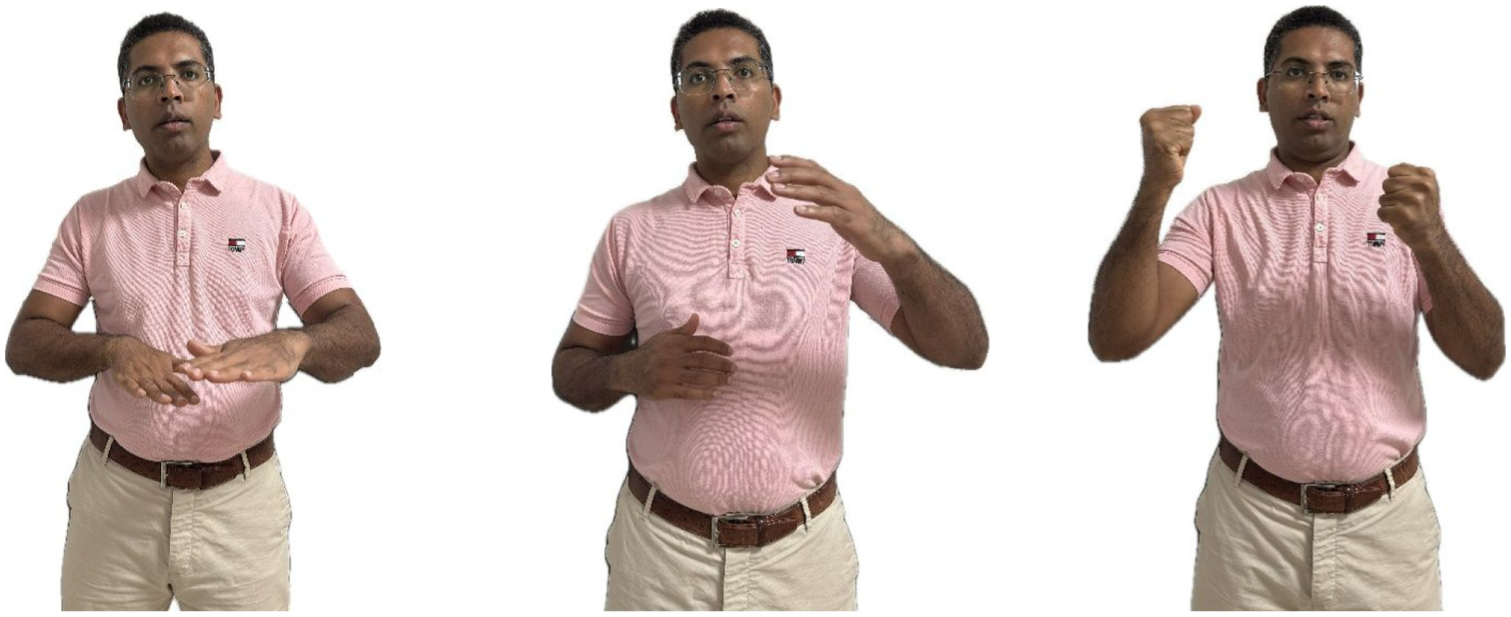
Gestural simulation of a business is an organism.
Procedure
The participants initially attended a training session. In this session, details of the experiment were explained and several samples were given to them to answer. But nothing was said about study’s purpose. Before conducting the main experiment, detailed oral instructions were given to the participants. In each item of congruent gesture-aligned conditions, the first group of 16 participants watched a 12-s video that showed an individual uttering a metaphorical sentence while producing a gesture that depicted the schema of the metaphorical sentence. The participants had to make an acceptability judgment on the sentence within the 12 s that the video was being presented. They did this by pressing a key. The participants had to press a button immediately after making an acceptability judgment. After a pause of 7 s, the next item was presented to the participants. We recorded acceptability judgment and reaction time (RT) of acceptability judgments for each item. The procedure and requirements for incongruent gesture-aligned conditions were similar to those in congruent gesture-aligned conditions, the only difference being the incongruency between metaphor schema and the accompanying gesture. In no-gesture conditions, the metaphorical sentence was not accompanied by a gesture. The same sixteen metaphors were used for the three groups of participants in the three sets of conditions. For example, in one of the items of congruent gesture-aligned conditions, the metaphorical sentence the rumor became viral across the country was accompanied by a gesture showing the circulation and spread of something. In incongruent gesture-aligned conditions, this metaphorical sentence was accompanied by a gesture that showed the two hands moving toward one another. In no-gesture conditions, this sentence was not accompanied by any gesture. We used Graphpad and RStudio to analyze the data.
Data Analysis
The proportions of sentences judged to be “acceptable” or “unacceptable” in the three sets of conditions were obtained. The aim was to compare degrees of acceptability of metaphorical sentences in the three different sets of conditions. In the next stage of data analysis, RTs of acceptability judgments in the three sets of conditions were compared. First, for each participant in each set of conditions, RTs to all items that were judged as acceptable were listed. For each group, a K-S test was used to examine the normality/abnormality of distribution of RTs. Then, to compare RTs in the three sets of conditions, a Kruskal–Wallis test and Post Hoc Dunn’s test were used. Our aim was to investigate any significant difference between RTs in the three sets of conditions.
Results
Acceptability Judgments
First, we calculated the percentages of sentences that were considered to be acceptable in each set of conditions. In congruent gesture-aligned conditions, 78% of sentences were judged as acceptable. In incongruent gesture-aligned conditions, 63% of sentences were judged as acceptable. In no-gesture conditions, 70% of sentences were judged as acceptable.
Times of Acceptability Judgments
To examine normality of distribution of RTs in the three sets of conditions, we used a K-S test. In congruent gesture-aligned conditions, K-S test statistic (D) was .10 and the p-value was .24. In incongruent gesture-aligned conditions, K-S test statistic (D) was .14 and the p-value was .004. In no-gesture conditions, K-S test statistic (D) was .13 and the p-value was .003. Therefore, in the three sets of conditions, the distributions of RTs were not normal. We used Kruskal–Wallis H test to compare RTs in the three sets of conditions. The results indicated that there was a significant difference in the RTs of the three groups (χ2[2] = 105.4, p < .001), with mean rank RTs of 183.18, 344.03, and 300.58 for congruent gesture-aligned group, incongruent gesture-aligned group, and no-gesture group, respectively. The medians in the three conditions were 7.03, 8.18, and 7.89, respectively. The Post Hoc Dunn’s test using a Bonferroni corrected alpha of .017 indicated that the mean rank RT of each group was significantly different from the other two groups. The data of mean rank difference for each pair of groups have been given in Table 1 and Figure 2.
Mean Rank Difference for Each Pair of Groups.


Mean rank difference of the three groups.
Therefore, in congruent gesture-aligned conditions, metaphorical sentences had the highest degrees of acceptability. In these conditions, participants made the fastest judgments on the acceptability of metaphorical sentences. In contrast, in incongruent gesture-aligned conditions, metaphorical sentences had the lowest degrees of acceptability. In these conditions, participants made the slowest judgments on the acceptability of metaphorical sentences.
Discussion
As mentioned in the results, when the gesture that accompanied a metaphor was congruent with metaphor schema, the judgment on the acceptability of the metaphor was made in a shorter period of time and the metaphor was judged to be more acceptable. In contrast, when the gesture that accompanied a metaphor was incongruent with metaphor schema, the judgment on the acceptability of the metaphor was made in a longer period of time and the metaphor was judged to be less acceptable. In order to explain this, we can assume that metaphor schema is a central or at least is a major part of metaphorical meaning. The activation of this key or central component can facilitate the activation of the whole metaphorical meaning of a statement. When a gesture that accompanies a metaphorical statement is incongruent with metaphor schema, the incongruency may hinder the activation of this key component of metaphorical meaning. In fact, because of its non-congruency with metaphorical meaning, it can prevent the activation of metaphorical meaning and even strengthen the activation of information that is metaphorically irrelevant. This contextually-inappropriate activation of information can disrupt the process of deriving the metaphorical meaning and delay it for some time. Furthermore, since metaphorically-irrelevant information is activated, metaphor is judged to be less acceptable. In the following four sub-section, we discuss four possible explanations for the results of our study.
Features Defining Literal Meaning and Metaphorical Meaning
Our first explanation for the facilitative role of congruent gestures and de-facilitative role of incongruent gestures is based on the salience imbalance theory (Ortony, 1979). According to this theory, metaphor is a mechanism for attributing a very prominent feature of a concept to another concept that has the same feature with a lower degree of prominence. For example, the feature of “being protective” is very prominent in “bodyguard.” The metaphor a lawyer is a bodyguard attributes this prominent feature of bodyguard to lawyer. Here, the metaphorical meaning of the statement is totally based on this key feature. Khatin-Zadeh and Vahdat (2015) argue that metaphorical meaning is often based on a single or a small number of semantic features, while literal meaning is often based on a much larger set of semantic features. For example, during processing the metaphor a rumor is a virus, “rapid spread” is the most-attended sematic feature. Other features of virus such as “being tiny” and “cause of diseases” are metaphorically irrelevant. These features are in the periphery when this metaphor is processed because they have no role in the metaphorical meaning of the statement. The important point is that the key feature defining the metaphorical meaning can often be incorporated into a metaphor schema or the gestural depiction of a metaphor schema. In the case of the metaphorical statement the rumor became viral across the country, the key metaphorical feature of “rapid spread” can be expressed by the gestural depiction of the metaphor schema. This gesture can help the comprehender to maintain her/his focus of attention on metaphorically-relevant features and disregard other features. The metaphorically-relevant feature of “rapid spread” is highlighted. While this feature remains highly-attended, metaphorically-irrelevant features (tiny, cause of diseases, reproductivity, etc.) are pushed to the periphery of attention or suppressed. Here, the key point is the schematic nature of the feature that determines the metaphorical meaning. If this feature is visual, spatial, and motoric (having a schematic nature), it can be well depicted by co-speech gestures. In such a situation, comprehending the metaphor can be significantly facilitated when the metaphor co-occurs with a gesture depicting the metaphor schema.
To take another example, the meaning of the metaphorical statement there has been a sea of changes in the world is based on the key feature of “being extensive.” This is the prominent property of sea and the base of metaphorical meaning of this statement. Other features of sea such as “having water,”“having a seabed,” and “having sea creatures” are metaphorically irrelevant and are disregarded. When the term sea is used literally, these properties are relevant. This means that metaphorical meaning of sea is based on a single key feature, while its literal meaning is constructed by activating a large number of properties. Like the previous example, the key metaphorical property (being extensive) is visual and schematic. It can be easily shown by a gesture to depict to extensiveness of something. In this way, the gesture that depicts metaphor schema helps the comprehender to focus her/his attention on this key property and suppress metaphorically-irrelevant properties. Therefore, a key distinction can be made between literal and metaphorical meanings of concepts. Literal meaning is based on and defined by wide range of properties, while metaphorical meaning is based on and defined by a single property or small set of metaphorically-relevant properties. If the single property determining the metaphorical meaning is spatial and motoric, it can be easily shown by a gesture. This is why gestures can significantly enhance metaphor comprehension. In fact, a gesture depicting a metaphor schema presents the main content of the metaphorical statement. On the other hand, a gesture that accompanies a literal statement presents a visual description of a specific part of literal meaning. We call this type pf gesture literal gesture. Literal gesture is irrelevant to metaphorical meaning of the accompanying speech. Literal gesture can also enhance the process of understanding as it presents one part of the message in a visual mode. However, in a literal statement, a wider range of other properties are also involved and need to be taken into account during processing. This means that the way that metaphoric gestures contribute to the process of comprehension is different from the way that literal gestures contribute. A metaphoric gesture presents a visual description of almost the whole of the intended meaning, particularly when it depicts a metaphor schema. On the other hand, a literal gesture presents one specific part of the intended meaning. In literal statements, other features that are not expressed by gesture are also important and need to be taken into account during processing. Therefore, it can be said that the amount of the intended metaphorical meaning expressed by a metaphoric gesture is much larger than the amount of the intended literal meaning expressed by a literal gesture. That is, the first one expresses almost the whole intended metaphorical meaning, while the latter one expresses one specific part of the intended literal meaning. This could mean that the contribution of metaphoric gestures to understanding metaphorical statements is larger than the contribution of literal gestures to understanding literal statements. This is especially the case with metaphoric gestures that depict metaphor schemas. For example, an upward gesture used with the sentence the price of orange is going up is a metaphoric gesture. On the other hand, a gesture showing the shape of an orange refers to a literal dimension. Therefore, it is a literal gesture. These two types of gesture can affect the process of understanding this sentence in different ways.
In the following section, we discuss metaphoric and literal meanings as two networks of features. We explain how a congruent metaphoric gesture depicting a metaphor schema can support the process of suppression and activate the whole of metaphoric network, while an incongruent gesture can activate metaphorically-irrelevant features and delay the activation of the metaphoric network.
Metaphoric and Literal Meanings as Networks of Features
As mentioned, based on Khatin-Zadeh and Vahdat (2015) proposal, literal meaning of a statement involves a wide range of related semantic properties, while metaphorical meaning involves a single property or at most a small set of semantic properties. Therefore, we can see literal meaning of a concept as a large network of related semantic properties. For example, in a literal sense, meaning of the term sea contains a large network of semantic properties. But, when it is used in its metaphorical sense in the metaphorical statement there has been a sea of changes in the world, only the property of “extensiveness” and properties that are closely related to it are relevant. This is a much smaller set of semantic properties that creates a small network of metaphorical meaning. This small network is formed on the basis of a suppressive-oriented mode of processing (Khatin-Zadeh & Vahdat, 2015) as most properties of sea are suppressed or disregarded. Here, gesture can be an effective tool to support the process of suppressing metaphorically-irrelevant properties. As Khatin-Zadeh et al. (2022) suggest, one of the main functions of gesture is to support the process of suppression. Gestures can bring the most important and most relevant information into the focus of attention and push less important and less relevant information out of the focus of attention. The visual nature of gesture plays an important role in this function of gesture. When a metaphoric statement is accompanied by a gesture depicting the metaphor schema, metaphorically-relevant properties are immediately activated and brought into focus of attention. At the same time, it can suppress metaphorically-irrelevant properties. This can shorten the time that is needed for comprehending the metaphor.
If the gesture that is used with a metaphoric statement is incongruent with the metaphor schema, the activation of metaphorically-relevant information may be delayed or hindered. The delay in activating metaphorically-relevant information may lead to the activation of literal information. This means that literal network can be activated for some time. The activation of the network of literal features can make metaphors less acceptable. This particularly takes place in comprehending novel metaphors and also when the context does not provide sufficient information for deriving the metaphorical meaning.
Suppressive Function of Metaphoric Gestures Depicting Metaphor Schemas
It has been argued that suppressing or inhibiting metaphorically-irrelevant features is one the key mechanisms of metaphor processing (Glucksberg et al., 2001). This proposal holds that when a metaphor is processed, metaphorically-relevant information is maintained, while metaphorically-irrelevant information is suppressed. Based on this proposal, it can be suggested that congruent gestures (in congruent gesture-aligned conditions) help the comprehender to maintain metaphorically-relevant information and suppress metaphorically-irrelevant information. On the other hand, literal gestures do not have this function. The strong suppressive function of metaphoric gestures is an important difference between metaphoric gestures and literal gestures. Metaphoric gestures express almost the whole intended message and also function as a tool to suppress all contextually-irrelevant literal information; literal gestures provide extra visual information about a specific feature but do not suppress all other information. In this regard, literal gestures have a complementary function. The information provided by a literal gesture is combined with other types of information and completes them. This means that the suppressive function of metaphoric gestures is stronger than the suppressive function of literal gestures. In other words, the amount of information that is suppressed by a metaphoric gesture is much larger than the amount of information that is suppressed by a literal gesture. Especially, a metaphoric gesture depicting the metaphor schema can express the whole semantic content of the metaphor.
The Role of the Motor System in Metaphor Schema Processing
As mentioned, a metaphor schema is a special type of image schema that has a special function. Image schemas are represented by neural circuits that are computed and established in multi-modal sensorimotor operations (Dodge & Lakoff, 2008; Gallese & Lakoff, 2005). Image schemas are networks of circuits that are established in people’s sensorimotor experiences. As a special type of image schemas with a special function, metaphor schemas represent metaphoric meanings in terms of spatial and motoric features. When the metaphoric meaning of a statement is expressed in terms of a metaphor schema, almost the whole meaning is represented in terms of spatial and motoric features. Therefore, the motor system can play a crucial role in processing such statements. When a metaphoric statement is accompanied by a gesture depicting the metaphor schema, observing that gesture can activate the motor system. This could lead to active engagement of the motor system during metaphor comprehension. This means that the motor system comes into play as a supporting cognitive resource to comprehend the metaphorical statement. Such explanation is confirmed by the findings of studies demonstrating the key role of the motor system in the grounding and the processing of spatial, motoric, and even abstract concepts (e.g., Dreyer & Pulvermüller, 2018; Harpaintner et al., 2020; Tschentscher et al., 2012). If the main part of the metaphorical meaning of a statement is represented by a metaphor schema, the motor system and gestures representing the metaphor schema can play a central role in processing that statement.
It should be noted that in the same way that image schemas are established in recurrent experiences and can be activated later in new situations, metaphor schemas can be formed by the support of sensorimotor systems and activated again in new situations when the individual faces with novel metaphors. A metaphor schema can be regarded as the core part of the metaphorical meaning that can be shared by a large number of metaphors. When an individual is repeatedly faced with a set of metaphors sharing the same schema, this metaphor schema is established in her/his mind and can be activated during processing even novel metaphors that have the same metaphor schema. The established metaphor schema carries the core meaning of all these metaphors.
Conclusion
This study suggested that the way that metaphorical gestures contribute to mental processing of sentences is different from the way that non-metaphorical gestures contribute. Metaphorical meaning is often based on a single prominent property or a small set of properties associated with that prominent property. During processing a metaphorical statement, this property is at the center of attention, while metaphorically- and contextually-irrelevant properties are suppressed. If this prominent property has a schematic nature and has a spatial/motoric nature, the process of understanding the metaphorical statement can be significantly facilitated by a gesture depicting the metaphor schema. Since almost the whole of metaphorical meaning is based on metaphor schema, the gesture that depicts the metaphor schema plays a very important role in deriving the whole meaning of the metaphorical statement. The prominent property defining the metaphorical meaning and the metaphor schema depicting that property are the essence of metaphor as almost the whole of metaphorical meaning is based on and expressed by them. In this regard, a metaphoric gesture depicting the metaphor schema has a function that is different from the function of literal gestures. A literal gesture is used with a literal statement to give a visual description of a specific part of the message. The amount of information conveyed by a literal gesture is just one part of the meaning, while the amount of information that is expressed by a metaphoric gesture depicting the metaphor schema is almost the whole of the intended meaning. Metaphoric gestures create metaphorical meanings by a predominantly suppressive mechanism, while literal gestures provide extra information and have a complementary function. Therefore, it could be said that metaphoric gestures have a higher function compared to literal gestures. Finally, we should note that throughout this paper we discussed incongruency as a general property of gestures occurring with metaphoric statements. However, incongruent gestures may be in various forms. Some incongruent gestures may be exactly the opposite form of a metaphor schema. Some incongruent gestures may depict something that is different from metaphor schema in some other ways (but not opposite). The ways that metaphor processing is affected by various types of incongruent gestures is a question that can be discussed in future works.
Footnotes
Appendix

Ethical Considerations
All participants of the study either received course credit or participated voluntarily and gave their written consent. The study was carried out according to the declaration of Helsinki (World Medical Association, 2013). The data of this study were collected from Iran. In Iran there is no mechanism for assigning ethical code to such studies.
Author Contributions
OK-Z and HB collected and analyzed the data. OK-Z wrote the first draft of the paper. HB and DF commented on the first draft and revised it. All authors approved the final version.
Funding
The authors received no financial support for the research, authorship, and/or publication of this article.
Declaration of Conflicting Interests
The authors declared no potential conflicts of interest with respect to the research, authorship, and/or publication of this article.