




Abstract
Education practice remains pivotal for developing competent teachers globally, yet persistent theory-practice disconnects challenge its effectiveness. Within China’s BA English Education programs, systemic issues in integrating theory, practice, and research impact graduate readiness, prompting this mixed-methods investigation aligned with China’s National Teacher Development Initiative. Analysis of curriculum documents from four representative universities (166–180 credits) and written interviews with 25 novice English teachers revealed significant structural imbalances: practical courses constituted only 3.57% to 10% of total credits, with practice-to-theory credit ratios as low as 0.33 within the core educational modules. Qualitative findings identified three interconnected challenges: outdated curriculum and evaluation systems characterized by rigid content and inconsistent assessment; a theory-practice disintegration stemming from fragmented curricular design; and weakened University-Government-School (U-G-S) collaboration that hinders resource sharing and research synergy. Novice teachers particularly emphasized the need for enhanced practical skill integration and closer curriculum alignment with classroom realities. To address these gaps, we propose a reflection-practice-oriented framework, operationalized through a measurable U-G-S implementation plan. This plan emphasizes multi-stage competency development tasks that integrate theoretical knowledge, practical application, and critical reflection, supported by a closed-loop evaluation system. The proposed reconstruction offers a concrete, evidence-informed pathway to cultivate adaptive English educators, equipping them for contemporary pedagogical demands while advancing national teacher development goals and contributing actionable insights to global educational reform discourses.
Keywords
Introduction
The imperative to prepare effective teachers for rapidly evolving global educational landscapes is a universal challenge confronting teacher education systems worldwide (Feng et al., 2023; Lee & Day, 2016). In response, attention to various forms of pre-service teacher research has grown internationally in recent decades (e.g. Cochran-Smith et al., 2009; Van Katwijk et al., 2023; F. Wang & Y. Wang, 2025; Zohar et al., 2025). This focus responds to a critical disconnect (Matsumoto-Royo & Ramírez-Montoya, 2021; Phillips & Condy 2023; Sarkar et al., 2024), namely, pre-service teachers frequently perceive teacher educators as out of touch with classroom realities and inadequately trained to prepare them for the profession, revealing a systemic gap between campus-based training and actual school challenges. This theory-practice gap, which has puzzled teacher education and many other fields for decades, reflects the ability of applying theoretical knowledge to real-world situations effectively (Arteaga et al., 2024). To bridge this divide, aligning practice with theory through guided modeling and reflection during teaching practice is essential.
Within this context, education practice serves as a critical bridge designed to equip pre-service teachers with pedagogical competencies for translating theoretical knowledge into effective classroom action. However, a persistent and well-documented theory-practice gap undermines this objective, limiting graduates’ ability to apply learned principles in authentic teaching scenarios (Allen & Wright, 2013; Korthagen, 2010; Wideen et al., 1998). This gap signifies a fundamental disconnect between university-emphasized theoretical frameworks and the complex, situated demands of actual teaching practice, and the significance of education practice for pre-service teachers to connect the expanding knowledge to teaching practice (Hilton et al., 2025; Loughran, 2016).
From the 1950s to the 2020s, China has initiated waves of educational and curricular reform for primary and secondary schools (Li et al., 2019). Central to this reform has been the Ministry of Education, PRC (MOE, hereafter), which has taken charge of developing curriculum standards that guide English language instruction across all grade levels. In 2020, the MOE released a revised edition of the 2017 English Curriculum Standards for Senior High Schools, followed by the introduction of the English Curriculum Standards for Compulsory Education in 2022. Both sets of curriculum standards aim to foster students’ subject core competencies that consist of language ability, cultural awareness, thinking ability, and learning ability through the instruction of theme-based units (Zhou & He, 2025). This curricular evolution has, in turn, raised the bar for teachers’ practical teaching capabilities. Teacher preparedness is typically achieved through pre-service teacher preparation programs. Therefore, the significance of practice-oriented teacher education has been increasingly recognized through national policies like China’s Teacher Education Curriculum Standards (Trial Implementation) (MOE, 2011), The Action Blueprint for Rejuvenating Teacher Education (2018–2022) (MOE, 2018a), New Era Teacher Enhancement Initiative for Basic Education (MOE, 2022), as well as Notice of the General Office of the Ministry of Education on Organizing and Implementing the Digital Empowerment Teacher Development Action (MOE, 2025a). These initiatives advocate for robust education practice systems, particularly under the collaborative U-G-S model, to align teacher preparation with ongoing basic education reforms. Guided by these policy directives, practice-based courses that directly enhance teaching competencies have received growing scholarly attention, assuming a critical position in the entirety of pre-service teacher education curricula (Chen et al., 2022). Consequently, numerous university education programs have expanded practical opportunities for pre-service teachers, facilitating the acquisition of essential pedagogical skills through on-campus coursework alongside school-based fieldwork (Dalinger et al., 2020; X. D. Wang & Wei, 2022).
While the global discourse on bridging the theory-practice gap is rich (Darling-Hammond, 2016; Hu & Qin, 2021; Hubbard, 2022; Resch & Schrittesser 2021; Sahlberg, 2013), critical lacunae exist concerning the specific challenges and potential reconstruction pathways for education practice systems in BA English Education programs within the Chinese context. Empirical evidence and critical analyses suggest that teacher education, including its practical components, remains a vulnerable aspect of the national reform strategy (MOE, 2018a). Existing research often focuses on teacher education broadly or lacks granular analysis of curriculum structures and the lived experiences of graduates transitioning into the profession. However, persistent issues such as short practicum duration, simplistic models, weak supervision, and a pronounced disconnection between theoretical coursework and practical application continue to hinder the effectiveness of education practice, especially within specialized programs like BA English Education (X. D. Wang & Wei, 2022; Wu & Rao, 2018). Furthermore, the crucial role of systematic reflection – identified as a key mechanism for integrating theory and practice (Kitchen & Petrarca, 2016; Loughran, 2002) – remains underexplored within the operational frameworks of these programs in China.
Therefore, this study aims to critically reassess the current education practice system within Chinese BA English Education programs. It moves beyond broad policy analysis to empirically investigate the specific structural and operational challenges hindering the integration of theory, practice, and reflection. By employing a mixed-methods approach – analyzing curriculum documents from four representative universities and gathering reflective insights from novice English teachers – this research seeks to answer the following questions:
1) What are the distinctive structural features (particularly regarding theory-practice balance) of curricula in BA English Education programs across different Chinese universities?
2) What are the core challenges faced by the education practice system within these programs, as perceived by novice teachers transitioning into the profession?
3) Based on these findings, how can the education practice system be effectively reconstructed to foster reflective, competent English educators?
Addressing these questions will provide concrete evidence on the alignment (or misalignment) between program design, implementation, and the needs of school-based English teaching. More significantly, it will propose a practical, evidence-informed framework for systemic reconstruction, centered on a reflection-practice orientation within the U-G-S collaborative model. This contribution is vital not only for enhancing the quality of English teacher preparation in China but also for informing international efforts to design more effective and responsive teacher education practices.
Literature Review
Teacher education is a progressive, evolving process spanning all stages of a teacher’s career, encompassing pre-service preparation, induction training, and in-service development as a continuous, developmental, and integrated educational framework (Darling-Hammond, 2006). While this concept originated in the early 20th century, it was not formally introduced to China until the late 1980s. Despite decades of development, China’s teacher education field remains a relatively young domain compared to well-established systems in Western countries (Ye et al., 2025). International research on teacher education, though complex has consistently prioritized two key areas over the past decade (2014–2023), that is cultivating teachers’ professional practical abilities and supporting early-career teachers’ retention and development ( F. Wang & Y.Wang, 2025). Within this landscape, the development of pre-service teachers’ practical capabilities has emerged as a prominent area of inquiry.
Practical experiences during teacher education, particularly school-based placement, are indispensable for cultivating pre-service teachers’ professional competencies and underpinning the quality of teacher preparation (Dunst et al., 2019; Whatman & MacDonald, 2017; Wiese et al., 2024). Pre-service teachers often express a strong desire for more practical experience in teacher education, which requires teacher educators to consider new, meaningful opportunities for field experiences (Resch et al., 2024). However, insufficient practical opportunities are widely recognized as a critical quality deficit in teacher education (Darling-Hammond, 2021; Resch & Schrittesser, 2021; Zhou, 2025). Thus, educational practice systems have garnered significant scholarly attention globally as pivotal levers for enhancing teacher preparation quality (Darling-Hammond, 2016; MOE, 2018a; Resch & Schrittesser, 2021), as practice problems have already appeared to be longstanding and nearly universal across the international literature. These obstacles continue to trouble stakeholders, even though they are sometimes described with different terms.
Within this context, teacher educators’ pedagogical approaches are fundamentally shaped by their understanding of the professional identity and the curricula (Richter et al., 2021). Pre-service teachers consistently report that many remain disconnected from contemporary classroom realities and ill-equipped to develop profession-ready competencies. There are major differences between practice schools regarding “attitudes, support, facilities, mentors and possibilities to learn from experiences” (Ulvik et al., 2018). Phillips and Condy (2023) maintain that a critical misalignment exists between campus-based training methodologies and the authentic challenges students encounter in school classrooms. Consequently, teacher education systems worldwide face sustained pressure to reconcile tensions between theoretical preparation and practical application. This enduring challenge, widely conceptualized as the pervasive theory-practice gap, manifests as a fundamental disconnect wherein graduates struggle to effectively apply educational theories in authentic pedagogical settings (Aspfors & Eklund, 2017; Bilican et al., 2021; Gray, 2013; Ion & Iucu, 2016; Korthagen, 2011; Råde, 2019). Such systemic deficiencies have spurred extensive cross-national research on reconstructing practice-oriented frameworks, raising profound concerns about the efficacy of prevailing teacher preparation models.
Cochran-Smith (2005) and Cochran-Smith and Fries (2005) notes its marginalization and reliance on historical and political approaches, often resulting in a focus on teachers’ knowledge, beliefs, and learning within communities, while neglecting the crucial pathway linking teacher education to pupil learning. Key unresolved issues central to this gap include the transition from pre-service to novice teacher, the relationship between content and pedagogy in teacher preparation, and critically, the integration of theoretical knowledge with practical application (Eritsland, 2004; Ottesen, 2006). The crucial solution to this problem lies in the interaction between theory and practice, which refers to training experts to practice initiative and then lead teachers to theory. This mutual entry can be achieved through the “doubleleap-over” mechanism (Zhou & Wang, 2024). However, the current teacher education curricula suffers from several issues, including insufficient courses on professional belief education, curricula that lag behind the changes of the times and remain rigid, barriers to cross-temporal and spatial curriculum practices, as well as inadequate exploration of local curricula and their functions (Zhou & He, 2025).
Teachers’ professional knowledge is not acquired through simple transmission but developed via practice in authentic contexts and interaction with the external environment. As C. Wang (2024) notes, teachers “do not construct knowledge in a vacuum; their knowledge, beliefs, attitudes, and skills are formed within socio-cultural contexts.” Teaching practice thus serves as a critical platform for social interaction and dialogue among pre-service teachers. Contemporary perspectives increasingly frame education practice not merely as skills training but as a complex, interactive, and dynamic process. This involves the development of external skills, internal reflection by pre-service teachers, and collective introspection – all fostering continuous improvement. This shift aligns with the broader “practical turn” in teacher education, which challenges conventional programs to prioritize field-based experiences (Kitchen & Petrarca, 2016). Darling-Hammond (2016) further emphasizes that effective teacher education fundamentally necessitates explicitly connecting the study of learning with the study of teaching. Such integration reveals their interaction and clarifies how teaching can purposefully cultivate sophisticated learning.
However, despite this recognition, translating the ideal of “practice-oriented” education into effective program design remains elusive as many linguistic theories often fail to translate into classroom language socialization practices. Questions persist about whether teachers genuinely integrate learned theories into their thinking about practice. For EFL teacher education, this gap manifests uniquely in the disjuncture between linguistic theories and classroom language socialization practices (Borg, 2019; Pale et al., 2023). Within the Chinese context, a significant gap exists between pre-service teacher education and in-service professional development, diminishing the perceived impact of education practice within the overall teacher education continuum (X. D. Wang & Wei, 2022). In China’s BA English programs, this is exacerbated by curricula prioritizing abstract Second Language Acquisition theories over situated pedagogical reasoning, resulting in pre-service teachers’ inability to mediate between target-language structures and learners’ sociocultural identities. Criticisms specifically directed at education practice in China include its short duration, simplistic models, inadequate supervision, and, most pertinently, the disconnection between theoretical courses and practical demands (He et al., 2024; Wu & Rao, 2018).
The education field must develop capacity to ensure teachers’ professional learning, efforts requiring grounding in use-inspired research and inquiry culture within university-based teacher education programs (Tatto, 2021). Although the theory-practice gap is well-documented, research specifically examining how effectively the practicum facilitates the integration of these dimensions remains less prevalent. A potential factor limiting the success of traditional “theory-into-practice” models may be an underestimation of reflection’s role. In the 1980s, Donald Schön’s “Reflective Practice Theory”, that is, Reflection-in-Action and Reflection-on-Action, triggered profound transformations in the field of teacher professional development research. It has become a consensus in teacher education worldwide that reflection plays a pivotal role in the professional development of pre-service teachers (Nesje & Lejonberg, 2022) and pre-service teachers’ reflection is closely intertwined with educational practice activities (Hu et al., 2023). Teachers’ educational practice and their practical knowledge have become focal points of research.
Understood as complex, active, and intentional meaning-making (Kitchen & Petrarca, 2016), reflection is essential for mediating the interplay of theory and practice, as reflection in teaching practice during internships would frequently reinforce the pre-service teachers’ professional self-development consciousness, while community engagement in practice strengthens independent professional development consciousness, catalyzing teaching practice and reflection (Hu & Miao, 2024). Crucially, practicum experiences frequently neglect domain-specific reflective cycles addressing language teaching dilemmas. To explore reflective practice implementation in English as a Foreign Language (EFL) teacher education, Karimi et al. (2024) identify key features of a reflective approach for EFL institutions, drawing on expert teacher educators’ theoretical knowledge and practical experience. Furthermore, pre-service teachers’ criticality can be developed through pedagogical strategies such as debates, discussions, role plays, written argumentative tests, and oral interviews (Xu & Sheng, 2024). Such reflection-oriented teacher education programs are posited as more effective in linking theory and practice domains (Loughran, 2002), explicitly demonstrating this necessary linkage for prospective teachers. These findings collectively underscore that teacher educators should integrate reflective practice into teaching practica, and that effective EFL teacher education must prioritize disciplinary praxis – the dialectical integration of language acquisition theories, localized teaching artifacts, and critical reflection on intercultural pedagogy (Cadiz, 2022; Y. Wang et al., 2023).
In response to these challenges, the MOE has implemented reforms based on the principles of “student-centred, output-oriented and continuous improvement” (F. Wang et al., 2021). China’s National Teacher Development Initiative (MOE, 2022) and the Opinions on Accelerating Digital Education (MOE, 2025b) mandate discipline-specific reconstruction of practice systems through U-G-S collaboration. These policies further require cultivating students’ higher-order thinking, critical judgment, and practical competencies. These reforms focus on developing practical teaching abilities and aligning teacher training with the demands of basic education, advocating a shift from “teaching-centered” to “learning-centered” models. This policy context provides a timely impetus to critically re-examine the specific challenges facing the education practice system within China’s BA English Education programs and explore pathways for its reconstruction.
Research Methodology
The integration between theory and practice within teacher education has been examined by many researchers (Sahlberg, 2013). However, there has been little comprehensive reflection on the education practice system, in particular the reflection of education practice system on the BA English Education programs enrolled in Chinese universities.
Exploring these questions listed in the introduction will provide deep insight into (a) the assessment on the theory and practice courses of existing BA English education programs in Chinese universities, (b) the role of practice courses in BA English education programs, as well as the challenges encountered in teacher education in Chinese universities, and (c) further improvement of Chinese teacher education.
This study is both qualitative and quantitative. The quantitative investigation is based on the analysis of the curricula in the four Universities’ BA English education programs. It is supplemented by a qualitative analysis of written interviews from novice English teachers, which utilizes topic modeling via the Latent Dirichlet Allocation (LDA) model to identify latent themes in their responses, focusing on the education practices system within teacher education in China. This study intends to highlight the similarities and differences in the four universities’ curriculum of the BA English Education programs.
Definition of Key Terms
To ensure conceptual clarity and consistency in this research, the following key terms are defined as they are used in this study:
1) Education Practice: Used as an umbrella term encompassing all forms of practical training within the teacher education curriculum.
2) Practical Courses: Refers to university-based courses that are primarily focused on developing hands-on teaching skills (e.g., Microteaching, Teaching Skills Workshop).
3) Teaching Practicum /Internship: Refers to the sustained period of supervised teaching experience conducted in a school setting. These terms are used interchangeably in this paper.
4) Field Experience: A broader term that may include shorter, less intensive school-based activities such as observations and field investigations, which often precede the formal Teaching Practicum.
5) School-Based Placement: Emphasizes the location and context of the practical experience, specifically denoting that the training occurs within a partner school.
Curriculum Data Analysis Rules
The BA English education programs involved in this study have been established in four universities in Chinese mainland, that is, Jiangsu University of Technology (JSUT, formerly named Jiangsu Teachers University of Technology, a normal university characterized by vocational teacher education in China), Nanjing Normal University (NNU), China West Normal University (CWNU), as well as Henan Normal University (HNU). These four universities are geographically located in China’s western region, northern China, and the developed Yangtze River Delta region, respectively. They include both top-tier normal universities in China and typical regional normal universities, thus providing institutional and geographical diversity. The selected education programs involved in this study were either sourced from publicly available resources on the universities’ websites or provided by the respective academic program directors in 2024.
The total credit analysis is agnostic to the semester in which a course is offered. We summed the credits for all courses listed in the official program training plan, regardless of their temporal sequence. To ensure a comprehensive and faithful representation of each program’s structure, the following protocol was applied during the study:
1) Scope of Analysis: The analysis included all courses (both compulsory and elective) listed in the official program. This approach was chosen to fully capture the complete curriculum offered to students, as elective courses, particularly “directed electives”, often form an integral part of the intended learning experience. Furthermore, while the credit hour system is standardized across Chinese universities (1 credit≈16-18 lecture hours), the specific workload and intensity might vary. Our analysis operates on the assumption that a credit represents a comparable unit of academic effort across institutions for the purpose of identifying large-scale structural trends.
2) Course Categorization: The primary rule for categorization was to adhere to the official classification provided in the source documents from each university. For example, a course titled “Advanced English with Teaching Methodology” would be classified under Disciplinary Courses if its content was predominantly language acquisition, rather than Pedagogical Courses. This prevented double-counting.
3) Resolution of Ambiguities: In instances where a course’s categorization was ambiguous, not explicitly stated, or where content appeared to overlap across categories, two researchers independently reviewed the available course descriptions and syllabus. Any discrepancies in initial categorization were resolved through discussion until a consensus was reached. This process prioritized understanding the course’s primary focus and intent within its native program context.
4) Theory-Practice Division: Within the educational module, each course was classified as Theoretical or Practical based on its described primary mode of instruction and learning outcome, again following the university’s definition where possible.
5) Credit Calculation: The credit values for all courses within a finalized category were summed to produce the totals presented in Table 1. The practical/theoretical ratio was calculated as (Total Practical Course Credits) / (Total Theoretical Course Credits). The percentage of total credits was calculated as (Total Educational Module Credits) / (Total Program Credits) * 100%. For instance, if a university’s program had 80 total required credits, and its educational module contained 12 credits of theoretical courses and 8 credits of practical courses, the practical/theoretical ratio would be calculated as 8/12≈0.67, and the percentage of total credits would be (12+8)/80 = 25%.
Credit Allocation for Educational Module Course in BA English Education.

Written Interview
For the written interview, a total of 25 novice middle school English teachers were invited to participate. All the participants were selected through a purposive sampling strategy, facilitated by the program directors at each university. The sole criteria for selection were that participants must be recent graduates (within the past 2–3 years) of one of the four target BA English Education programs and currently employed as English teachers. This ensured that all participants had direct, recent experience with the curriculum under review and were navigating the transition from pre-service preparation to in-service practice. The primary focus of this study is on the institutional curriculum rather than individual teacher demographics. Therefore, to protect anonymity and focus on the relevant institutional variable, we only collected and report data on the participants’ university of graduation, that is, five from JSUT, nine from HNU, six from NNU, and five from CWNU. The distribution of participants demonstrate that the sample captures perspectives from each of the varied institutional contexts under study. While this sampling method provided essential access to a relevant participant pool, it is acknowledged that facilitation by program directors may introduce a potential bias, for instance, if they were more likely to recommend graduates who were more engaged or performed highly. This limitation is further discussed in the Conclusion part of this passage.
The question issued to the interviewees are as follow: As a former English education graduate and a newly qualified teacher, please briefly evaluate the curriculum of the English education program in your university. Do you think what you learned during your college years can satisfy you in your current job of teaching English in secondary schools?
Ethical approval for this study, including the written interviews with novice teachers, was granted by the Institutional Review Board (IRB) of School of Foreign Languages in Jiangsu University of Technology (Approval No. 20241201). The written interview was conducted in December, 2024. All participants provided written informed consent prior to participation. Participation was voluntary, and participants were informed of their right to withdraw at any time without penalty. Data were anonymized during analysis. The interview adopted an introspective approach, inviting all participants to evaluate the teacher education courses they received from the perspective of an in-service teacher. The qualitative analysis aims to further analyze and explain the challenges that the novice middle school English teachers meet based on the data of the quantitative analysis.
The written interview data were analyzed using the Latent Dirichlet Allocation (LDA) model within a Python framework, implemented with the Gensim library. The text preprocessing involved several steps: first, the Chinese text was segmented into tokens using the jieba package, an open-source Python library widely used in natural language processing (NLP) for efficient Chinese word segmentation. Second, a custom stop-word list was applied to remove common function words, for example, de (的, a Chinese function word expressing possessive relationship), he (和, and in English) as well as frequent but contextually meaningless terms specific to the education domain, for example, kecheng (课程, course in English), laoshi (老师, teacher in English). Third, words were lemmatized to their base form.
To determine the optimal number of themes, we computed the coherence score (C_v) for models with themes ranging from 1 to 5. The model with three themes yielded a coherence score of 0.55, which was among the highest and, upon manual inspection, produced the most semantically meaningful and distinct themes. The model was run for 1,000 iterations to ensure convergence.
The initial five themes generated by the LDA model were subsequently reviewed by two independent experts in teacher education. Through a process of inductive clustering based on conceptual overlap, they collaboratively grouped the five topics into three broader, overarching themes (See Table 3 for theme definitions and keywords). The high inter-rater reliability (Kappa=.87) confirms the robustness of this thematic clustering. This approach allowed us to balance the data-driven output of the LDA with the theoretical expertise required for meaningful interpretation within the field of education.
Each theme is, in turn, modeled as an infinite mixture over an underlying set of topic probabilities (Blei et al., 2003). As a widely used unsupervised topical modeling method, LDA model can be applied to theme analysis in critical discourse analysis (Zhang & Wei, 2023), since it can avoid human intervention, automatically achieve theme clustering, and present the theme of written texts at a macro level.
Results & Analysis
Types of Courses in BA English Education Programs
Over the past two decades, many developed countries have introduced new standards, monitoring systems, accreditation criteria, course and fieldwork requirements for teacher education (Cochran-Smith, 2021; Zhao et al., 2024). Since 2014, the MOE has authorized professional institutions to implement the Accreditation of Teacher Education Programs. Guided by professional accreditation principles, the accreditation verifies whether teacher education programs meet training standards and ensures their training objectives dynamically align with basic education needs. Consequently, it ensures alignment with educational objectives, emphasizes graduate competency outcomes, and drives ongoing enhancements in teaching quality and program effectiveness. Although the accreditation does not specify content or hours/credits, China’s teacher education curricula under accreditation are mainly structured into four areas: general courses (courses related to social foundations or specific to national development), disciplinary courses (courses aligned with the national PK-12 curricular framework and pedagogical content knowledge), professional courses (courses focusing on student learning and development, assessment, curriculum, and related pedagogical matters), and field-based preparation courses (a series of teaching-related curricular activities co-supervised by on- and off-campus mentors at schools).
Unlike the first two types of courses in curricula, professional courses and field-based preparation courses emphasize the improvement of pre-service teachers’ teaching skills. Taking the BA English Education programs at four universities (i.e., JSUT, NNU, CWNU, and HNU) as examples, statistics show that the required credits at these four universities range from 166 to 180. Meanwhile, the proportion of the educational module in the program (i.e., professional courses and field-based preparation courses) is relatively low, ranging from 14.29% to 23.61% (see Table 1). Furthermore, theory courses account for a significant proportion within the educational module. Consequently, the proportion of practice courses in the overall curriculum system for teacher education majors is correspondingly reduced. The lowest ratio of practical course credits to theoretical course credits is 0.33. This proportion (3.57%–10%) is substantially lower than the practical credit benchmarks implied in international teacher education frameworks (e.g., OECD, 2019; UNESCO Institute for Statistics, 2015) and fails to meet the explicit requirement of “no less than one semester of educational practice” stipulated in China’s Teacher Education Curriculum Standards (Trial Implementation) (MOE, 2011), a requirement recently reinforced by national initiatives such as the New Era Teacher Enhancement Initiative for Basic Education (MOE, 2022).
The above analysis provides a descriptive comparison of the curriculum structures across the four universities. These findings are presented to demonstrate substantive and structural differences. However, it should be noted that due to the nature of the data (a purposeful sample of specific programs), formal inferential statistical testing is not conducted, and the focus is on the qualitative significance of the disparities.
In addition, in spite of the diversity of courses in the educational module of BA English Education programs, these courses can be simply specified into Professional Courses and Field-based Preparation Courses of BA English Education programs at the four studied Chinese universities (see Table 2).
Course Types in BA English Education Programs.

Currently, theoretical courses are delivered via classroom teaching. Higher Education Courses provide foundational knowledge about educational principles, ethics, psychology, cognition, learning, teacher morality, basic teacher abilities, and adolescent development (e.g., Principles of Education, Educational Psychology). Pedagogical Courses focus specifically on the theory and methodology of teaching English as a subject. These cover foreign language teaching theories, curriculum design, assessment, spoken language skills for teachers, and methodologies for teaching English at the secondary level (e.g., English Teaching Methodology, English Testing and Assessment). Educational Research Courses aim to develop research awareness and competence. Topics include modern educational technology, research methods, computer-assisted language teaching, digital tools in teaching, current issues in education, and analysis of curricula/textbooks (e.g., Educational Research Method, Digital Technology and Classroom Teaching).
On the other hand, Field-based Preparation Courses represent the practical component of the educational module. These courses involve hands-on experience and skill development related to actual teaching practice. These courses encompass a blend of classroom-based instruction and practical activities. The teaching activities are often conducted within real school settings (“School Observation”) or simulated environments (“Simulating Teaching” like Microteaching). Examples include workshops on teaching skills, microteaching training, school-based placement, and full teaching practice periods (e.g., Teaching Practice, Microteaching Training).
The table structure visually reinforces a key challenge in these programs, that is, the stark separation between theory and practice. The Professional Courses section is entirely theoretical and classroom-based, while practical application is confined to the separate Field-based Preparation Courses. This segregation within the “Educational Module” itself illustrates the structural difficulty in achieving seamless theory-practice integration, as the courses representing these domains are fundamentally distinct in nature, location, and instructional method. Furthermore, the Field-based courses are noted as occurring under joint university/school supervision, contrasting with the solely university-based delivery of the Professional Courses.
Ideally, knowledge from different types of courses within the educational module should mutually corroborate and integrate with each other. However, due to the complexity of teachers’ educational/professional backgrounds, there is a lack of communication among teachers. This leads to insufficient connection between theoretical and practical courses in the education module of English teacher training. Take the Educational Research Courses as an example. University teachers and school teachers often deviate from the teaching focus due to their own expertise (Darling-Hammond & Bransford, 2017). University-based teacher educators prioritize pedagogical theories, curriculum frameworks, and evidence-based research, while school-based mentors emphasize classroom adaptability, student engagement, and immediate problem-solving skills. University courses are mostly taught in a top-down method, while middle school teachers’ research tends to be based on the bottom-up summary and analysis of practical teaching experience.
To sum up, from the perspective of curriculum design, the teacher training programs of four universities share common issues such as vague and broad positioning of educational objectives and a lack of prominence in the pedagogical nature of the curriculum system. The proportion of disciplinary and general education courses is relatively high, while that of subject-specific pedagogy courses and teaching practicum courses remains comparatively low, reflecting a tendency toward prioritizing “academic rigor” over “pedagogical focus” in curriculum design.
Novice Teachers’ Critical Thinking on BA English Education Program
To systematically analyze the thematic content of the written interviews with 25 novice middle school English teachers, this study applied LDA, an unsupervised probabilistic model for identifying latent topics in text corpora, to avoid subjective bias and identify dominant themes. This method identified three dominant themes reflecting the graduates’ critical reflections on their BA English Education program experiences (See Table 3).
Key Themes from LDA Analysis of Novice Teacher Interviews.
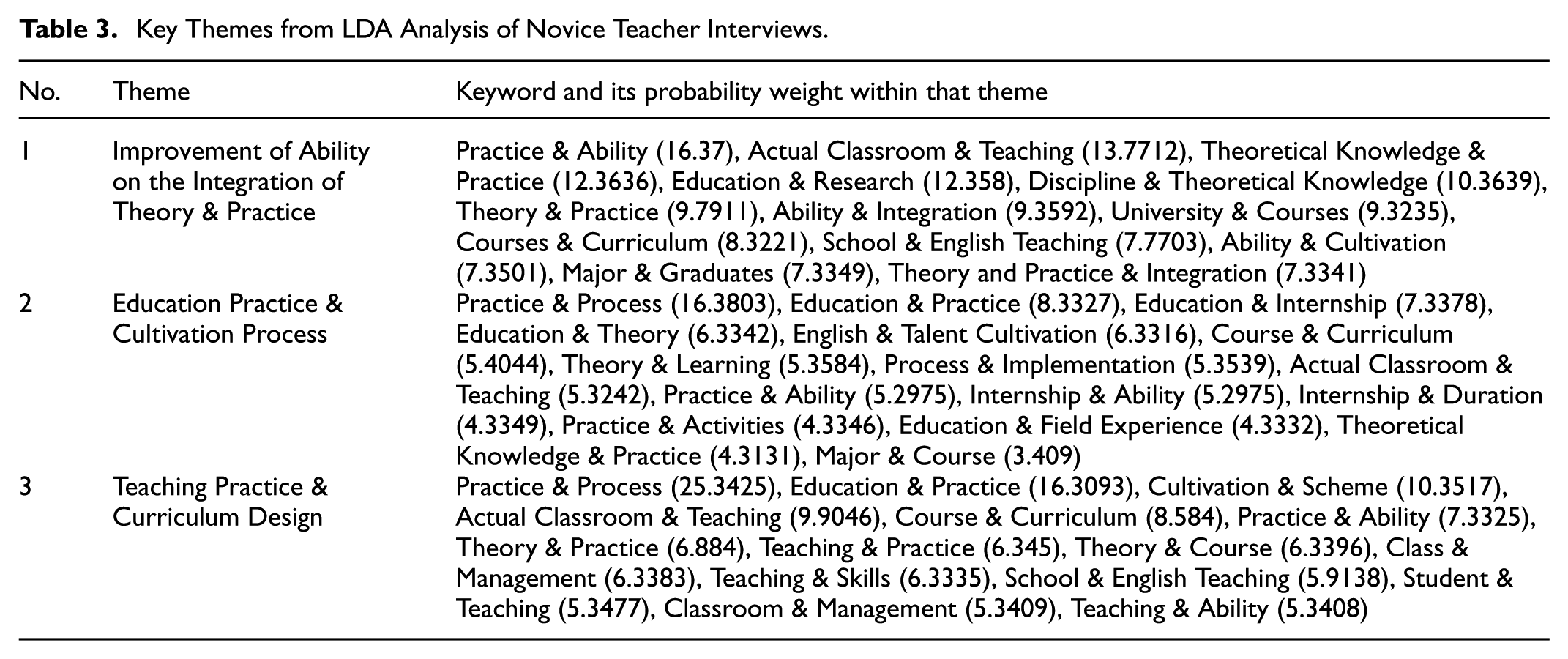
Table 3 now presents the top keywords for each theme, providing transparency into the LDA output that formed the basis of our interpretation. Further analysis revealed the following core perspectives held by novice teachers, which are richly illustrated by representative quotes from the participants:
Theme 1: Need for Enhanced Theory-Practice Integration
Keywords such as “Practice & Ability”, “Theoretical Knowledge & Practice”, “Ability & Integration”, and “Theory & Practice” underscored the graduates’ emphasis on the critical importance of effectively bridging educational theory with practical teaching skills. They believed this integration was essential for understanding how theoretical knowledge applies to real classroom contexts. For example, T15 stated: “We spent many hours studying second language acquisition theories, but I was completely unprepared to design a lesson that would work for my 50 students in a rural classroom. The gap between what we learned and what we do is huge.”
Furthermore, keywords like “Actual Classroom & Teaching” and “School & English Teaching” highlighted their expressed need for more substantial opportunities to observe and participate in authentic teaching environments to refine their practical abilities and grasp the nuances of teaching English as a second language. As T07 noted, “The theory courses feel like a separate world. You need to see it, do it, and then reflect on it with a mentor to really understand how the theory connects.”
Theme 2: Focus on Practical Application and Process
The prominence of keywords like “Practice & Process”, “Actual Classroom & Teaching”, “Internship & Ability”, and “Education & Field Experience” indicated the novice teachers’ prioritization of hands-on experience within the cultivation process. They stressed the value of structured activities such as classroom observations and full-time internships under experienced mentors. These experiences, they noted, allowed pre-service teachers to analyze real teaching scenarios, engage in teaching practice, and reflect on their own teaching behaviors. The participants’ written reflections consistently highlighted the irreplaceable value of immersive practice and the shortcomings of its current structure. For example, one teacher (T18) articulated: “The most valuable part of my entire degree was the eight-week block teaching practicum. It was the first time I wasn’t just pretending to teach. You can’t learn classroom management from a book; you have to be in the chaos and figure it out.” Another (T04) critiqued the fragmented nature of existing arrangements: “Our observations were too brief and sporadic. We need a sustained connection to one school and one mentor, not just snapshots. Learning to teach is a process, not an event.” Keywords like “Course & Curriculum” and “English & Talent Cultivation” also pointed to their view that adjustments to coursework and curriculum design related to English language teaching methodologies were crucial for deepening theoretical understanding and enabling practical application.
Theme 3: Integration of Teaching Practice and Curriculum Design
Keywords including “Course & Curriculum”, “Cultivation & Scheme”, “Actual Classroom & Teaching”, and “Practice & Ability” revealed a focus on the relationship between curriculum structure and practical skill development. The graduates suggested that engagement in teaching practice enables students not only to observe and analyze real classrooms but also to develop their own teaching strategies. However, many felt the current curriculum design failed to make these connections explicit. A common criticism was the disconnect between theoretical coursework and practical skill acquisition. One participant (T12) explained: “We had a whole course on ‘English Testing and Assessment’, but it was all about theories of validity and reliability. I passed the exam, but on my first day, I had no idea how to actually grade a student’s essay or give feedback that helped them improve.” Another (T09) pointed to the omission of critical practical skills from the formal curriculum: “Why didn’t our curriculum include a mandatory course on how to talk to parents? Or how to handle a student having an emotional crisis? These are the real skills we need, not just another lecture on linguistics.” Keywords like “Teaching & Practice” and “Teaching & Skills” reinforced this connection. Furthermore, terms like “Class & Management” and “Classroom & Management” implied that curriculum design should incorporate flexibility to accommodate diverse teaching methodologies and practical skill development, including classroom management.
Collectively, the LDA-derived themes indicate that novice teachers’ reflections centered on the interplay between practical experience (“Practice”) and theoretical grounding (“Theory”). This dynamic manifested in their evaluations of the program’s curriculum structure, teaching ability development, practical skill acquisition, and educational internship quality. Participants identified the BA English Education Program’s efficacy as heavily contingent on a robust education practice system. The foremost challenge reported by participants was the insufficient integration of theoretical and practical courses, which was closely tied to their call for enhanced cultivation of practical abilities. These factors represent critical barriers during their transition from pre-service training to professional practice and are central to systemic reconstruction.
This emphasis resonates with findings from Phillips and Condy (2023), whose semi-structured interviews with in-service teachers revealed parallel concerns. Interviewees concurred that university-based teacher education programs inadequately linked theory to practice, noting that training initiatives insufficiently bridged these domains during professional preparation.
The Systemic Challenges in China’s Education Practice Systems
The education practices have more or less been overshadowed by an excessive focus on the theoretical courses (Table 2). This emphasis has led to a disconnect between theoretical and practical education (Sang, 2011), resulting in issues like disengagement of in-service teachers in curriculum design and collaboration, unclear objectives, ambiguous content, weak supervision, and inadequate evaluation (MOE, 2016). Quantitative curriculum analysis (Table 1) and novice teacher perspectives (Table 3) converge to reveal three interconnected challenges in BA English Education programs.
Challenge One: Structural Imbalance between Outdated Curriculum and Ineffective Evaluation
The BA English Education Program suffers from an outdated curriculum system disproportionately dominated by theoretical instruction, particularly foundational language skills (listening, speaking, reading, writing), while practical pedagogical training remains underdeveloped (Zhou, 2025). Educational modules accounted for only 14.29% to 23.61% of the total credits, and the proportion of practical credits was extremely low (as low as 3.57%). The ratio of practical credits to theoretical credits is as low as 0.33, reflecting that the curriculum system is seriously biased towards theory. This structural imbalance creates a disjointed relationship between theoretical and practical courses, with rigid, decades-old content in educational practice curricula failing to align with the evolving demands of modern teacher education. Many programs retain obsolete frameworks for educational practice design, teaching methodologies, and assessment systems, rendering them ill-equipped to address contemporary pedagogical innovations or societal shifts in education.
Compounding this issue is the lack of standardized evaluation and supervision for practical courses. While curricula nominally outline teaching objectives and assessment criteria, implementation remains inconsistent due to uneven faculty expertise and institutional resources. The content of the practicum program is solidified in “classroom observation/management” and does not cover core competencies such as educational research and adaptive teaching. Lack of standardization in assessment leads to “random mentor matching” and “subjective evaluation” (Table 3, Theme 2, Keywords: Process & Implementation, Internship & Duration). School-based mentors, constrained by vague evaluation guidelines and institutional pressures, frequently provide superficial assessments that prioritize task completion over meaningful pedagogical growth. Consequently, feedback fails to address pre-service teachers’ theoretical-practical integration, perpetuating a cycle of homogenized training and ineffective skill development.
Challenge Two: Theory-Practice Disintegration in Curriculum Design
Pre-service teachers engage with educational theories within decontextualized, single-classroom environments, lacking opportunities to actively construct theoretical knowledge within specific educational contexts (Hu et al., 2023). This disconnect is particularly pronounced in the BA English Education Program, which struggles to bridge the gap between theoretical instruction and practical application. Current optimizations to practice curricula remain largely superficial, focusing on incremental adjustments to practice duration and timing rather than pursuing disruptive innovation or systematic reform to address this divide. Compounding this issue, educational internships for various majors are typically scheduled in the 6th or 7th semester, while the duration of teaching observations is generally too brief to support meaningful interaction with theoretical coursework (Zhou, 2025). On the other hand, despite the curriculum’s emphasis on foundational pedagogical knowledge – encompassing curriculum design, teaching methodologies, and educational research – these theoretical components remain divorced from hands-on training. Theoretical courses (Table 2: Three Major Categories of Professional Courses) and practical courses (Table 2: Field-based Courses) are entirely siloed: disciplinary courses (e.g., English Teaching Methodology) fail to integrate teaching method practices, and specialized courses (e.g., Educational Psychology) are not connected to real-world classroom management scenarios.
Besides, novice teachers emphasize the need to integrate “theoretical knowledge and practical skills” (Table 3 Theme 1 Keywords: Theory & Practice, Ability & Integration), yet existing courses fail to provide pathways for theoretical transfer (e.g., cognitive development theory→instructional design). Practical training modules, such as classroom management or lesson planning, often operate in isolation from theoretical frameworks, failing to reinforce how concepts like cognitive development or curriculum standards inform teaching practices. This disjointed structure hinders pre-service teachers’ ability to synthesize theory with on-the-ground challenges, ultimately limiting their capacity to innovate or adapt to evolving educational demands. Therefore, the current BA educational programs are frequently criticized to a deficiency in fostering innovation and practical skills among students (Zhou, 2016). The primary obstacles to the quality of teacher education within China’s basic education system, we argue, are the inadequate distribution of practical resources, insufficient enhancement of pre-service teachers’ pedagogical and innovative capabilities, and the failure to satisfy the requirements of school instruction.
Challenge Three: Fragmented U-G-S Collaboration and Research-Practice Divide
The development and sustaining of collaboration in teacher education is an important goal, ultimately benefitting the entire learning community (Jakhelln & Postholm, 2022). A serious collaboration among English teacher colleges, the Ministry of Education, school stakeholders, and professional learning communities is required to drive English teachers to engage continuously in their professional development. Ensuring teaching practice quality requires systemic alignment across mentorship, institutional structures, and collaborative frameworks, with teacher education institutions driving standards, support systems, and research-informed practices (Wiese et al., 2024; Zhang, 2024).
However, the U-G-S model lacks a common foundation for long-term cooperation among its three parties. On the one hand, although the three parties share consistent overall goals in teacher education and have cooperative needs in many aspects, there are significant differences in their respective subjective and objective conditions as well as developmental aspirations (Ling et al., 2022). The Education Program suffers from fragmented collaboration among universities, schools, and local governments in the U-G-S collaborative model. Therefore, a declining rate of school and mentor teacher participation results in an over-reliance on a portion of the teaching workforce to sustain these preparatory experiences, as indicated in Analysis of placement data in Australia. (Hilton et al., 2025). Universities dominate curriculum design, but primary and secondary school-based mentors lack clarity regarding internship objectives (Table 3 Theme 2 Keywords: Education & Internship, Practice & Activities), resulting in practice being reduced to mechanical task execution. The existing challenges can be attributed to the weakening dominant role of universities in teacher education, resulting in a relatively homogeneous strength (MOE, 2014).
This was poignantly expressed by one novice teacher (T17): “My university supervisor told me to focus on trying out a new communicative teaching method, but my school mentor was more concerned with finishing the textbook chapters on time… Their goals were completely different, and I was stuck in the middle.” This misalignment, coupled with a lack of structured communication, often reduces the internship experience to mechanical task execution rather than meaningful pedagogical development. Participants frequently reported experiences similar to that of T09: “My internship felt like being a teaching assistant. My main duties were grading homework, proctoring exams, and maintaining classroom discipline. I rarely had the chance to actually design a lesson… It was more about helping with chores than learning to teach.”
On the other hand, the separation of teaching skill training from research capacity building within the program’s framework undermines synergies. Universities emphasize “educational research” (Table 2: Educational Research Courses), with institutions focusing on “classroom adaptability” (Table 3 Theme 1 Keywords: Actual Classroom & Teaching). This disconnect is exemplified by the absence of formal mechanisms for knowledge exchange. For instance, none of the analyzed university program handbooks or internship agreements outlined a procedure for school-based mentors to provide structured feedback to university faculty on curriculum relevance. Similarly, there was no evidence of a shared digital portal where common challenges encountered by student teachers in schools could be documented, analyzed, and fed back into the university’s course design or academic research. The internship situation of student teachers is only simply recorded in the internship manual, which serves as the basis for the academic assessment of universities, but it cannot serve as a bridge between university faculty and school-based mentors. This disconnect likely hinders opportunities for reciprocal knowledge exchange, such as integrating school-level challenges into university research or updating curricula based on teaching realities. Consequently, collaboration becomes transactional rather than transformative, which may fail to incentivize innovation or the shared resource development between institutions.
To sum up, these aforementioned challenges collectively result in the deficiency of core competencies among pre-service teachers (Table 3 Theme 1: Ability & Cultivation), failing to meet the demands of basic education.
Discussion and Reconstruction of the Education Practice System
Core Paradigm Shift: From Knowledge-Competence to Reflection-Practice Orientation
Teacher education has undergone significant reforms, with alternative preparation models emerging beyond traditional university settings. However, the ineffectiveness of non-reflective practice in supporting professional development underscores the necessity of models that integrate theory-guided reflective thinking with on-the-ground practical experiences. For instance, Resch et al. (2024) argue that internships – conceptually narrow in their focus on job-related school experiences – fail to capture the full methodological and didactic potential of engaging pre-service teachers in practice, highlighting the need for broader approaches.
Pre-service teacher competency development is understood to progress through three stages – generation, reconstruction, and creation – facilitated by five tiers: understanding & cognition, perception & comprehension, simulation practice, comprehensive practice, and innovative research. In China, traditional teacher education has largely followed a knowledge-competence-oriented approach (Ju & Wang, 2000), which confines competency development primarily to the lower tiers (understanding & cognition, perception & comprehension). This limitation perpetuates the theory-practice disconnect previously identified in the second Challenge.
Scholars have responded to this challenge by advocating for integrated models. Rose (2020) and Lim et al. (2020) propose work-integrated learning in higher education, emphasizing critical learning theories and pedagogies to bridge theory and practice. Their calls have resonated with Chinese researchers. Ma and Huang (2025) note that the emphasis on practice has led to an overfocus on cultivating “embodied skills” among pre-service teachers, creating tension with the parallel push for academic competence – a dynamic they term the “dualism of academic drift-skills fixation in pre-service teacher education.” Additionally, Xun and Pan (2025) critique the traditional model, where teacher education institutions dominate and primary/secondary schools are relegated to mere “practice bases,” advocating instead for collaborative partnerships. They propose restructuring teacher preparation around school-based practices, involving joint curriculum design, instructional implementation, practical transformation, and professional development evaluation to create a comprehensive, school-centered model that supports teachers’ full professional growth. Theoretical and empirical work further supports these shifts. Badyal and Singh (2017) frame experiential and work-based learning as conceptually grounded, experience-based pedagogical models rather than abstract constructs. McCarthy (2016) similarly conceptualizes this process as cyclical, requiring learners to engage with each stage to generate new learning.
Qualified teachers are required to reflect on and improve their own teaching practices, recognizing and taking responsibility for the continuous development of their professional expertise (Department for Education and Skills & Teacher Training Agency, 2024), while pre-service teachers increasingly reject the notion of professional internships as mere application of theory, preferring to view them as reflection in action (Shen et al., 2025). Building on these foundations, we advocate a reflection-practice-oriented model (similar to PGCE program in Britain) with three core features: (a) integrating competency development across all five tiers (from understanding to innovation); (b) prioritizing critical reflection as the bridge between theoretical knowledge and practical application; and (c) embedding reflective tasks throughout all stages of training. This model combines on-campus coursework to develop theoretical literacy with field-based assessments to promote reflective teaching practices. Centering on critical thinking, innovation, and research orientation, we argue that this approach necessitates systemic restructuring to enhance theoretical comprehension and skill integration, supported through collaborative engagement with key stakeholders.
Task-Driven System Reconstruction: Addressing the Three Core Challenges
Task design serves as the core mechanism for reconstructing the educational practice system within the proposed framework. Currently, teacher education curricula are predominantly structured as discrete disciplinary programs, where content is organized around the internal logic of knowledge and delivered through traditional lectures. Consequently, while students may achieve proficiency in declarative knowledge (e.g., concepts, propositions), they often struggle to translate these into actionable teaching skills, a disconnect exacerbated by a curriculum that fractures the intrinsic connections between courses (Hu et al., 2023). This lack of a coherent, integrative framework has been identified as a key issue in teacher preparation (Floden et al., 2021).
The core of pre-service teacher training lies in the organic integration of “backward design” based on educational needs with “forward construction” guided by training objectives, achieving seamless alignment between pre-service teacher training goals and the practical demands of primary and secondary schools (Liu, 2025). The proposed reconstruction, therefore, shifts from a subject-centered to a task-driven model, deconstructing the traditional curriculum and rebuilding it around a dual framework that prioritizes task-centered learning while complementing it with disciplinary knowledge. This model positions hands-on practical experiences as the starting point, creating a dynamic alternation between the study of educational theory and its implementation in teaching practices. The core of this approach lies in designing interconnected tasks across theoretical, practical, and reflective dimensions for each tier of teacher competency development.
This transformation converts traditional disciplinary knowledge modules into competency development modules. For each tier of competency goals, we can design distinct yet interconnected tasks across three dimensions (theoretical, practical, and reflective) at the foundational levels. By engaging with these tasks, pre-service teachers not only acquire theoretical knowledge but also strengthen practical skills and enhance critical thinking abilities. The competency-based task framework proposed here directly targets the systemic failures identified in Section 4.3 through three strategic interventions (Table 4).
Competency-Based Tasks Directly Target Systemic Challenges.

As synthesized in Table 4, the competency-based task framework directly targets the three systemic challenges identified earlier through strategic interventions:
To counter the outdated curriculum (Challenge One), the framework implements progressive competency tiers (e.g., Task 1), which are designed to substitute for low-credit practical courses by validating skills dynamically across multiple levels, from understanding to innovation.
To resolve the theory-practice disintegration (Challenge Two), it employs mandatory bridging activities and tripartite reflection tasks (e.g., Task 2, Reflection 1). These are explicitly designed to break course silos by requiring comparative analysis and collaborative critique of lesson logic, thereby operationalizing reflective cycles (Korthagen, 2010; Korthagen & Nuijten, 2022).
To repair fragmented U-G-S collaboration (Challenge Three), the framework embeds tripartite co-creation mechanisms (e.g., Reflection 2, Task 3), which aim to activate collaboration by institutionalizing partnership principles and transforming stakeholders into active co-designers of the teacher education process.
Crucially, this task-based approach may enforce the MOE’s (2018b) outcome-driven mandate by making U-G-S co-assessment of competency development an integral part of every major task.
A Measurable Implementation Framework: From Principles to Action
To translate the proposed reflection-practice-oriented framework from theory into sustainable action, this section outlines a three-phased implementation plan guided by four core principles. This plan specifies concrete, measurable interventions to address the systemic challenges identified in this study. Its effectiveness will be evaluated against three Key Performance Indicators (KPIs): achieving a practice-to-theory credit ratio of at least 1:1 within the educational module (KPI 1, structural change); establishing functional U-G-S communities of practice (KPI 2, collaboration depth); and demonstrating a significant improvement in graduates’ self-efficacy in integrating theory and practice (KPI 3, outcome validation).
Guiding Principles
Successful implementation hinges on four interdependent principles that form the foundation for all interventions.
Spatiotemporal Integration: Effectively merging online digital platforms with offline practice bases to overcome the temporal and spatial fragmentation of traditional practical experiences, thereby supporting coherent and immersive experiential learning.
Stakeholder Role Reconfiguration: Schools must transition from passive hosts of internships to active co-designers of the curriculum; universities should evolve from being mere knowledge transmitters to facilitators linking theory with practice and conduits of research; government agencies should act as enablers, coordinating resources and ensuring policy support.
Capacity Co-development for Mentors and Pre-service Teachers: Establishing rigorous procedures for the selection, certification, and continuous professional development of dual-mentors, focusing on cultivating their competencies in observation, feedback, and guiding reflective practice to directly support pre-service teachers’ growth.
Closed-Loop Evaluation and Continuous Improvement: Creating a dynamic, mixed-methods evaluation system co-designed by U-G-S stakeholders, ensuring that interventions can be iteratively refined based on feedback, thus forming a self-improving cycle.
A Three-Phase Implementation Roadmap
The initial implementation stage will establish the essential enabling conditions. This foundational work begins with the formal constitution of a joint U-G-S steering committee through a memorandum of understanding that delineates the roles, resources, and responsibilities of each partner. Concurrently, development will commence on a shared digital platform to host video libraries, mentoring forums, and curriculum resources. In parallel, two partner schools will be equipped as specialized practice bases with video recording equipment and spaces for post-observation debriefing. A critical task force comprising university faculty and school mentors will be tasked with co-designing two pilot curriculum modules that authentically integrate theoretical knowledge, practical application, and critical reflection. The success of this stage will be measured by three tangible outputs: the convening of the inaugural steering committee meeting, the execution of finalized partnership agreements, and the academic approval of the pilot module syllabi.
Upon this foundation, the strategy will progress to a phase of pilot implementation and capacity development. The co-designed modules will be deployed with a select cohort of pre-service teachers, serving as a crucial testbed. The effectiveness of this pilot will be formatively assessed through metrics such as student task completion rates, the quality of reflective journals, and feedback from participant focus groups. This practical deployment will be complemented by the launch of a certified training program for the group of dual-mentors. This program will focus on developing competencies in observational feedback and guiding reflective inquiry. Success in this phase will be defined by the successful completion of the pilot modules by over 90% of the cohort, the certification of at least 80% of the participating mentors, and the production of a formative evaluation report detailing actionable insights for refinement.
The final stage will focus on systematic scaling and summative evaluation. Based on the insights gained from the pilot phase, the refined curriculum and support systems will be extended across the entire teacher education program. A comprehensive, mixed-methods evaluation will then be carried out to assess the overall impact of the initiative. This evaluation will analyze the official curriculum to confirm the achievement of a practice-to-theory credit ratio of at least 1:1 (KPI 1). It will examine activity logs from the digital platform and minutes from steering committee meetings to document evidence of sustained, functional collaboration (KPI 2). Moreover, it will administer a standardized self-efficacy survey to graduates to gauge the growth in their practical competence (KPI 3). The culmination of this process will be the creation of a public evaluation report and a refined implementation toolkit. These deliverables will ensure not only the accountability of the initial implementation but also the sustainability and transferability of the framework, thereby establishing a cycle of continuous improvement within the teacher education ecosystem.
Conclusion
This study empirically identifies systemic deficiencies within China’s BA English Education practice systems through mixed-methods analysis. Quantitative curriculum audits reveal a critical structural imbalance: practical training constitutes only 3.57% to 10% of total credits, with practice-to-theory credit ratios as low as 0.33. Qualitative insights from novice teachers further expose three interconnected challenges, namely, outdated curriculum assessment frameworks failing to align with contemporary pedagogical demands; fragmented theory-practice integration in course design; ineffective U-G-S collaboration undermining teaching-research synergy.
To address these gaps, we propose a reflection-practice-oriented framework grounded in the U-G-S model. Its core innovations include competency progression through five tiers, replacing isolated knowledge transmission; task-driven integration of theory, practice, and reflection, which directly resolves identified disconnections; and institutional role redefinition ensuring reciprocal university-school-government engagement. This reconstruction is aligned with and responds to China’s national teacher education reform mandates (e.g., MOE, 2022, 2025a) which call for a discipline-specific reconstruction of practice systems. By centering on reflective competence and collaborative praxis, the framework offers a scalable model for cultivating adaptive English educators capable of navigating evolving classroom realities. Future research should empirically validate its implementation across diverse institutional contexts.
Despite its contributions, this study has several limitations that should be acknowledged. First, the curriculum analysis and novice teacher sample, while purposively selected to provide institutional and geographical diversity, are limited to four Chinese normal universities. This confines the generalizability of our findings, and future research could expand the scope to include more novice teachers from comprehensive universities or institutions in different socio-economic contexts. Second, the study primarily relies on documentary analysis and self-reported interview data. Future studies could incorporate observational data from teaching practicums or longitudinal designs to track the long-term impact of the proposed framework on teacher development. Finally, the effectiveness of the proposed reflection-practice-oriented framework, while grounded in theory and empirical findings, awaits future empirical validation through implementation in teacher education programs. Addressing these limitations provides a fruitful agenda for further research aimed at deepening the understanding and enhancing the practice of English teacher education in China and beyond.
Footnotes
Appendix
Top Term Frequencies from Interview Corpus.
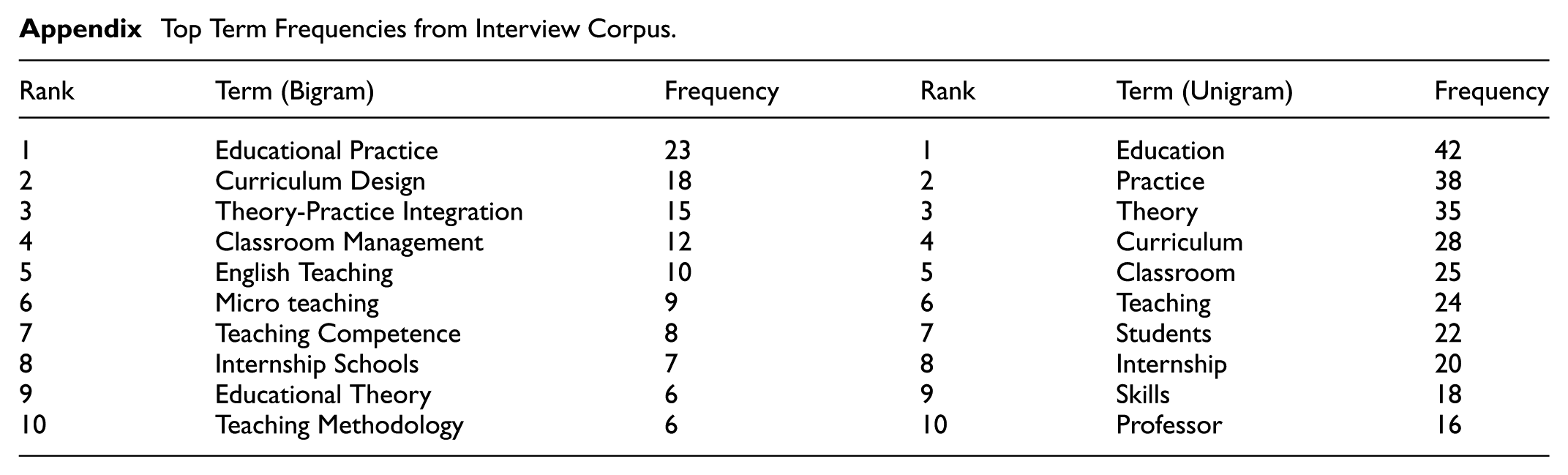
| Rank | Term (Bigram) | Frequency | Rank | Term (Unigram) | Frequency |
|---|---|---|---|---|---|
| 1 | Educational Practice | 23 | 1 | Education | 42 |
| 2 | Curriculum Design | 18 | 2 | Practice | 38 |
| 3 | Theory-Practice Integration | 15 | 3 | Theory | 35 |
| 4 | Classroom Management | 12 | 4 | Curriculum | 28 |
| 5 | English Teaching | 10 | 5 | Classroom | 25 |
| 6 | Micro teaching | 9 | 6 | Teaching | 24 |
| 7 | Teaching Competence | 8 | 7 | Students | 22 |
| 8 | Internship Schools | 7 | 8 | Internship | 20 |
| 9 | Educational Theory | 6 | 9 | Skills | 18 |
| 10 | Teaching Methodology | 6 | 10 | Professor | 16 |
Ethical Considerations
This study received ethical approval from the Institutional Review Board (IRB) of School of Foreign Languages in Jiangsu University of Technology (Approval No. 20241201) in December 2024.
Funding
The author disclosed receipt of the following financial support for the research, authorship, and/or publication of this article: Zhongwu Young Innovative Talents Program (JSUT H&R [2021] No.167), the Program of Master Teachers (Training Candidates) (JSUT H&R [2022] No.113) Funded by Jiangsu University of Technology, Research Project on the Current Situation and Optimization of Ideological and Political Education Teaching Reform in Educational Practical Training Courses for English Majors under the Context of High-Quality Development of Foreign Language Education in Jiangsu Colleges and University (2024WYJG030).
Declaration of Conflicting Interests
The authors declared no potential conflicts of interest with respect to the research, authorship, and/or publication of this article.
Data Availability Statement
The curriculum datasets generated and analyzed during the current study are available from the corresponding author on reasonable request. The full interview transcripts are not publicly available to protect the privacy and anonymity of the participants. A term-frequency table derived from the interviews, which supports the findings of this study, is available as Supplementary Information ( ).
).