




Abstract
In 2020, the world faced a sudden change and general disruption that included all aspects of life because of the corona virus (COVID-19) pandemic. It has made the whole world adopt general and comprehensive emergency measures that have affected every sector, including health, business, and especially education. In order to continue the education process, educators have responded by adopting distance education. This paper explored the attitudes, practices, and emotions of faculty members in a college of education toward the forced adoption and educational transformation to distance education during the corona pandemic. A coding approach was used to analyze 20 reflective articles, which revealed main themes related to difficulties and challenges. The findings highlight skills and experiences that were gained. Hence, the findings promote that faculty members understand professional practices and behaviors in using distance education as an emergency solution for supporting the education process.
Keywords
Introduction
In 2020, the world faced a general disruption and the need for quick actions involving all aspects of life because of COVID-19 (Y. Wang et al., 2021). It made the whole world adopt general and comprehensive emergency measures that have affected every sector, including health, business, and education (Al Lily et al., 2020; Al-Sukayt et al., 2020; Baber, 2020; Daruwala, 2020; Kaur, 2020; McCarthy, 2020; Wnuk et al., 2020; Yang & Forney, 2013).
It was imperative to adapt to and address this pandemic, overcome all difficulties, search for and investigate ways to adapt, and use all capabilities in line with the environment and existing conditions. Reducing direct contact, eliminating large gatherings, and emphasizing social distancing between individuals were some of the first precautionary processes to reduce and prevent the spread of the virus (Al Lily et al., 2020; Baber, 2020; Fenza et al., 2021; Hung et al., 2020; Y. Wang et al., 2021). Although education is an important part of every community, a decision came to suspend school attendance. The educational field faced the impact of the suspension of school attendance, which completely halted the direct educational process (Mayo, 2020; McCarthy, 2020; Viner et al., 2020). This was a shocking and sudden step, which UNESCO (2020) Director-General Audrey Azoulay described in his statement, “Never before have we witnessed educational disruption at this scale. Partnership is the only way forward” (p. 1). Y. Wang et al. (2021) evaluated the level of anxiety and its effecting elements during the corona pandemic among teachers in Henan, China; they found that 59% of the teachers were very worried, and more female teachers were very worried than male teachers. In the same context, Al-Sukayt et al. (2020) assessed the level of anxiety and its effecting factors through the corona pandemic among students in Riyadh, Saudi Arabia; they reported that 35% of the students suffered average to high levels of anxiety. There was only one way to continue the educational process, which was a transformation to distance education through electronic platforms (Al Lily et al., 2020; Al-Sukayt et al., 2020).
Interestingly, distance education was not pioneered as a result of the COVID-19 pandemic; its roots and the broad concept date back around 150 years (Dumford & Miller, 2018; Sikand, 2017). As indicated and confirmed by many studies, distance education has created opportunities to expand education and provide access to a large number of distance learners, as the spatial and temporal boundaries of the educational process have diminished (Dumford & Miller, 2018; Taylor et al., 2020). For example, Dumford and Miller (2018) revealed that it is necessary to use distance education, especially in cases of weather fluctuations, to prevent suspension of the educational process. It was worth mentioning that Goguen (2020) called distance education a “friend to [the] environment,” as it helps to reduce building, electricity, stationery, and printing consumption, as well as environmental pollutants caused by transportation. In the same context, Moore et al. (2011) supported distance education as a way to change the current view of nature and the components of educational facilities; they promoted the idea that the educational process can take place anywhere without walls in the era of technological sovereignty.
However, some studies address problems in the use of distance education for various reasons. For instance, W. Wang et al. (2020) and Hodges et al. (2020) confirmed the existence of a physical gap between the teacher and the learners due to the application of distance education, which had a role in limiting the building of relationships between these two basic elements in the educational process (Cakula et al., 2016). Some studies noted that distance education would not yield completely positive results without a very high degree of self-discipline (Al-Abdullatif et al., 2020; Augner et al., 2012; Lee et al., 2016). Moreover, many studies (Abd-Alrazaq et al., 2020; Fenza et al., 2021; Ha & Stoel, 2009; Meuter et al., 2003; Sellberg & Susi, 2013; Tarafdar et al., 2013; Yin et al., 2014; Yoon, 2002; Wahlund et al., 2021) have presented the negative side of technology and distance education from psychological, educational, social, behavioral, emotional, and economic aspects.
In contrast, some studies have dealt specifically with the possibility of applying distance education in Arab countries. For example, Ibrahim et al. (2016) aimed to find the readiness of the colleges of education in Khartoum State to use distance education and the extent of faculty members’ knowledge of requirements for this type of education. This study revealed that the application of distance education was one of the future aims for the colleges of education, and the faculty members had positive trends toward using distance education. This study revealed that the application of distance education was one of the aims of future Colleges of Education and the faculty members have positive trends toward using the distance education. Moreover, Al-Mawla et al. (2018) aimed to identify distance education competencies among the faculty members of the College of Education at the University of Khartoum in Sudan. They found that the faculty members’ distance education competencies were average, and that the competencies for designing electronic learning resources were weak. Therefore, they recommended training faculty members in the use of distance education competencies.
In addition, Abu Adma and Al-Sharif (2010) discussed the extent to which distance education systems can be applied to meet the challenges facing educational institutions in light of the requirements of the information technology era at Taibah University in the Kingdom of Saudi Arabia. They found that faculty members supported the application of distance education to meet the challenges facing educational institutions in different situations. Thus, the study recommended that educational institutions move away from traditional education and secure the infrastructure necessary to be incubators for distance education with equipment and technical capabilities.
Therefore, we found that most studies and research related to distance education have covered, addressed, or focused on the pros and cons of distance education and the learners’ benefits. Such studies include those of Brik (2017), Al-Bitar (2016), Al-Subaie (2015), Aql (2014), Abdul Hafeez (2010), Mohan (2010), and Al-Zahrani (2019). At the same time, we found that some studies dealt with the distance education issue during the COVID-19 pandemic from cultural, psychological, or economic aspects (Al Lily et al., 2020, 2021; Al-Sukayt et al., 2020). However, to our knowledge, there is a lack of studies and research on the topic of distance education and professional practices during the COVID-19 pandemic from the perspectives of faculty members, such as that of Al-Thuwaini (2010), Al-Hawamdeh (2010), and Al-Kharbasha (2010). Hence, to bridge the gap between the lack or absence of studies that capture the attitudes and perspectives of faculty members in Arab universities on the COVID-19 pandemic and education, this study explored the attitudes, behaviors, practices, and emotions of faculty members in the College of Education toward the forced adoption of distance education during the COVID-19 pandemic.
In the same context, the university has practiced distance education since 2009—for over 11 years. However, it has been limited to some courses in specializations in the College of Humanities specified by the university, and limited to the best male faculty members, except final exams that were taken face-to-face in educational buildings on campus. Despite this experience in distance education during the COVID-19 pandemic, the majority of the College of Education’s faculty members adopted traditional delivery styles for the educational process elements, such as lectures, assessment methods, assignments, and exams (Al Lily et al., 2020, 2021).
However, during the COVID-19 pandemic, the adoption of a traditional style of teaching has resulted in disturbance and confusion for faculty members, and the educational process was disrupted during the first period of the pandemic. This was particularly noticeable when the situation suddenly completely changed and the distance education system was compulsorily adopted without preparation as the official tool for running the educational process. This was due to the majority lacking experience in distance education, which until then was limited to very basic use of the Blackboard system.
This study aimed to explore and highlight the attitudes and reactions of faculty members in College of Education toward the forced adoption of distance education during the COVID-19 pandemic from various perspectives. Thus, this study targeted selected faculty members of the College of Education to answer the study’s main question: What were the faculty members’ attitudes and reactions in College of Education to forced adoption of distance education during the COVID-19 pandemic?
The structure of this paper is as follows: Section 2 presents the theoretical ground of the study, section 3 describes the methodology and data, section 4 presents the findings and discussion, section 5 presents the conclusion, and section 6 presents the recommendations in light of the findings.
Theoretical Ground of the Study
According to the article entitled that was done across Europe, “The COVID-19 pandemic has changed education forever” (Li & Lalani, 2020), it was noted that families from higher social classes provided a better environment for homeschooling for their children. It was determined that in Denmark, most families from higher social classes borrowed more books from the library during this period of pandemic and therefore the performed better success chances (Hodges et al., 2020). However, the same situation cannot be seen for the lower social classes. This is proof of inequality that results from distance learning.
In the same context, according to theories of self-regulated learning, show the effect of independent study methods, such as using online learning. Students who perform poorly during this period because of unequal opportunities to access efficient online learning are more likely to develop a negative self-perception and might, for example, show lower skills in technical subjects (Bozkurt & Sharma, 2020). Therefore, there is a need to develop adaptive education for online learning practices to bridge the gap between the affluent and poorer groups of students.
Alshehri et al. (2020) researched how regular teaching converted to fully online teaching in higher education in Saudi Arabia during COVID-19. They found many challenges associated with this transition for universities, faculty members, and students, especially since distance education was mandatory. Educators needed to learn effective methods of presentation while students had to be more engaged and adapt to emergency remote education (Bond, 2020; Bozkurt & Sharma, 2020; Hodges et al., 2020). Emergency remote education was an interim online solution to continue teaching during the COVID-19 pandemic. It could not be classified as distance education since it did not have a systematic design and planning model. It also did not depend on the collaborative environment of linked elements, or on comprehensive dimensions of all areas of distance education (Bond, 2020; Bozkurt & Sharma, 2020; Hodges et al., 2020). These theories set the research basis for this study.
Methodology and Data
Research Context and Sample
This is qualitative phenomenology study, which was utilized to capture and explore the attitudes, practices, and emotions of faculty members in the College of Education toward the forced adoption of distance education during the COVID-19 pandemic. This methodology was chosen since it allowed the researchers to get an in-depth understanding of participants’ reactions and attitudes and to understand and describe the individual experience of each participant (Creswell, 2004, 2013). To achieve this aim, 20 faculty members from this college participated in this study. The faculty members were female and of three Arab nationalities (Saudi, Egyptian, and Syrian). Of these 1 was a professor, 14 were assistant professors, and 5 were lecturers. They represented the different departmental majors: curriculum and instructions, educational leadership, education and psychology, special education, and kindergarten. In addition, the participants had varying levels of experience with technology in general, and the distance education system in particular.
Data Collection and Measurement
This study was conducted in the second semester of the 2020 academic year in Saudi Arabia. To answer the study question, a qualitative approach was used (Creswell, 2013; Willis, 2008). According to the nature of the study, reflective notes were used as documents to collect study data. The participants were asked to write reflective notes describing their behaviors, practices, emotions, and attitudes toward the educational process of distance education within the previously defined themes adapted to this context.
Females were selected to participate because they had not previously practiced distance education, unlike their male colleagues, who may have had previous experience with the distance education system.
To answer the study question, the participants’ reflective notes (in which they reviewed their experiences in using distance education the during COVID-19 pandemic), were analyzed. The notes were considered an information-rich dataset and provided a valuable opportunity to monitor and observe their experience in detail. The reflective notes included the following themes:
- Difficulties, challenges, and behaviors associated with presenting the educational process in the distance education system.
- Gaining skills, practices, and behaviors from the experience of using the distance education system.
As a precautionary procedure, and to achieve social distancing, we considered it necessary to obtain written or audio-recorded information through a social media communication platform and email. Hence, reflective notes were received via WhatsApp and email (17 written reflective notes and 3 audio-recorded notes). Moreover, a qualitative approach was used in the analysis, which was based on the process of examining and organizing the collected data to understand and interpret the phenomenon studied (Marshall & Rossman, 2006). The data were transcribed and classified into major themes and sub-themes using the guidelines of Saldana (2013) and according to the following steps:
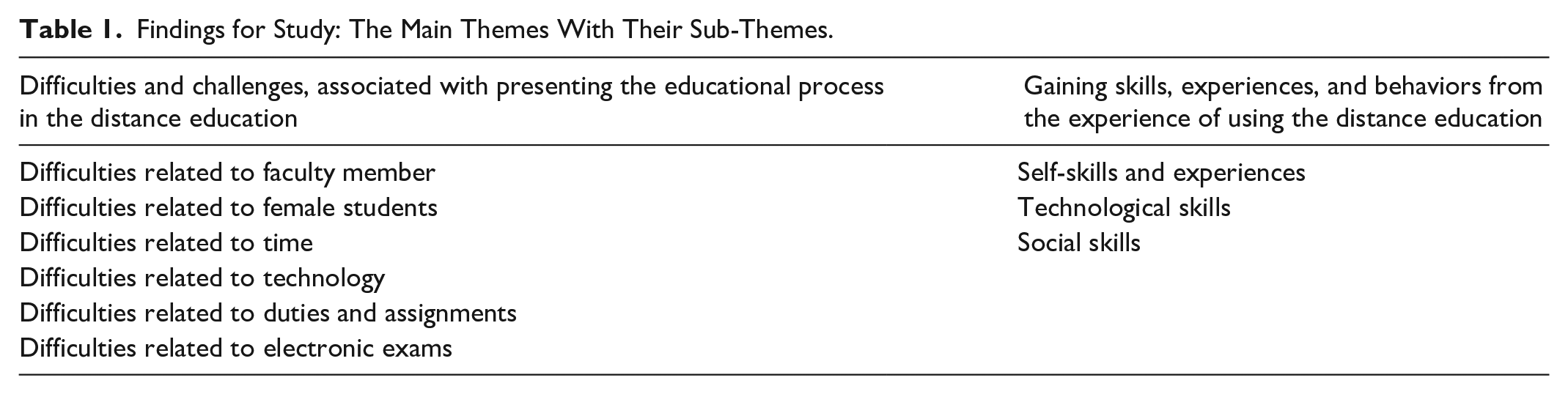
A. Coding the information: The main themes were denoted as Theme 1 to Theme 2. The sub-themes under each main theme were assigned a sub-sequence number that followed the main theme number as shown below. Theme 1 included information that fell under “difficulties and challenges associated with presenting the educational process in the distance education system.” The six sub-themes of Theme 1 were denoted as follows: 1.1 “difficulties related to faculty members,” 1.2 “difficulties related to female students,” 1.3 “difficulties related to time,” 1.4 “difficulties related to technology,” 1.5 “difficulties related to duties and assignments,” and 1.6 “difficulties related to electronic exams.” Theme 2 included information on “gaining skills, experiences, and behaviors from the experience of using the distance education system.” The three sub-themes of Theme 2 were denoted as follows: 2.1 “self-skills and experiences,” 2.2 “technological skills,” and 2.3 “social and behavior skills.”
B. Understanding and highlighting the idea or topic that combines codes (information).
C. Organizing the codes and grouping them according to the coding detailed in step A.
D. Identifying the main themes and sub-themes and naming them.
E. Summarizing and displaying the main themes and sub-themes in knowledgably maps.
F. Discussing the themes and preparing the report or recommendations.
Findings and Discussion
The Study Findings and Discussion
Here, the findings that resulted from the analysis of the participants’ reflective notes are presented according to the two main themes and nine sub-themes, as illustrated in Table 1.
Findings for Study: The Main Themes With Their Sub-Themes.
Theme 1: The difficulties and challenges associated with presenting the educational process in the distance education system during the COVID-19 pandemic
This theme included the various difficulties and challenges faced by the participants, and reported by almost all participants, while presenting the educational process in the distance education system during the pandemic. The sudden and total shift to distance education were the factors that contributed the most to these difficulties and challenges. This finding was in line with the results of Al Lily et al. (2020, 2021), Al-Sukayt et al. (2020), and Hodges et al. (2020), which noted that education was affected by the COVID-19 pandemic and different before and after the COVID-19 pandemic.
Only one participant stated that she did not face any difficulty: “I did not encounter problems or challenges with this. On the contrary, the educational process was carried out easily”
It is worth noting here that when the participants were asked to mention the difficulties and challenges they faced, they began to reveal some of the feelings they experienced during this exceptional experience. Some described a feeling of dread about using a new education system that they had never used before, and one participant said, “Human is the enemy of what he does not know” (Meuter et al., 2003). Another participant explained the reason for her fear of this experience: “At the beginning, I was afraid of the experience and that I cannot behave well confidently, communicate well, and transfer what I want to my students, but after I started the first lecture, I felt that it was easy and did not need all this tension. I started my lecture as if the students were with me and in front of me.” This finding is in line with what other studies have found—that technostress impacts people’s behaviors, feelings, and practices. Technology has been identified as a main cause of stress and anxiety for teachers and students (Al-Abdullatif et al., 2020; Lytras et al., 2021; Meuter et al., 2003; Nimrod, 2018; Ragu-Nathan et al., 2008; Tarafdar et al., 2007; Tekinarslan, 2008; Thatcher & Perrewé, 2002).
Another participant expressed her feelings about going through the experience in a different way: “Honestly, in the beginning the news of distance education was more difficult for me than the seriousness of the spread of this disease, but later I thought that I was supposed to face this reality that I believed very difficult, and that it was not within my capabilities to deal with technology or the distance education. However, soon this pressure began to relieve little by little and I felt that it was just psychological pressure, because I was facing a world almost unknown to me. So, I started looking here and there in the Internet and the instructions that were sent to us and asking around me those who have previous knowledge or experience in the subject, and the knots of the long journey began to unlock in front of me one after the other.” In the same context, another participant said, “The pandemic occurred and the study was transformed into distance learning. It created confusion in the beginning due to the lack of sufficient experience to deal with the simple system, but soon we started working hard and trying to overcome the initial difficulties that we faced.” This finding about participants’ feelings and behaviors is in agreement with the results of studies by Abd-Alrazaq et al. (2020), Al-Sukayt et al. (2020), Ayyagari et al. (2011), Ceyhan and Gürcan (2000), Daruwala (2020), Fenza et al. (2021), Meuter et al. (2003), and Y. Wang et al. (2021), which indicated that anxiety is one of the negative impacts of using technology during the COVID-19 pandemic.
Table 2 presents the difficulties and challenges faced by the participants in this study. These were classified into the sub-themes listed below.
Difficulties Associated With Presenting the Educational Process in the Distance Education: The Findings Got From the Analysis of 20 Reflective Notes.

Difficulties related to faculty members
This sub-theme dealt with the difficulties encountered by the participants related to their behaviors and self-competency toward distance education technology, from presenting lectures or exams to time management skills to everything related to the educational process during the COVID-19 pandemic. The following difficulties and challenges were revealed in the reflective notes.
Lack of experience with using the distance education system at this depth was considered one of the most prominent difficulties and challenges faced by participants. All 16 participants were in agreement on this. It caused a disturbance at the beginning of the transition period to distance education. One of the participants expressed, “Since my appointment at the university, and I have been teaching face-face in the university halls, I had not ever thought of resorting to distance education, or we one day will need to direct virtual sessions, but in light of these exceptional circumstances with the Corona virus, I found that my colleagues and me suffered from the difficulty dealing with distance education because we did not know how deal with it before, especially with Blackboard system. That was normal feeling at the beginning, but with the days and practice I found myself enjoyed dealing with this type of education, and I was afraid of preferring it to the traditional (face to face) education.” This finding was in line with studies that had noted technostress influences people’s emotions and practices because technology has been identified as a source of stress and anxiety for users it, especially for one who didn’t have knowledge about it before (Al-Abdullatif et al., 2020; Al-Sukayt et al., 2020).
The lack of readiness to use this type of education system due to them not needing it before the pandemic was indicated by six participants. They preferred the traditional education (face-to-face) system in halls, and they did not have the need to use distance education previously. Therefore, they did not care or think about learning to use the technology beforehand, had no prior training, and were not prepared to use the distance education system. This finding was in line with those of Tran et al. (2017) and Yu et al. (2017), who stated that many people lacked experience in using technology before the pandemic. It also supported the results of Al Lily et al. (2020) and Hodges et al. (2020), which noted that the COVID-19 pandemic forced teachers to use distance education even though they were unprepared, and this was a challenge. At the same time, this finding aligns with those of studies that indicated that the COVID-19 pandemic was an opportunity to spread a culture of digital literacy and reshape beliefs, attitudes, and behaviors toward technology and distance education (Hung et al., 2020; Kunzmann, 2020; LaValle et al., 2011; Mora et al., 2017; Ross et al., 2013). Thus, it is now important to provide all workers with 21st century skills, especially those related to the use of technology.
The lack of skills for dealing with crises was a challenge for three of participants in terms of finding channels through which to communicate with the students and finding alternatives and appropriate solutions to technical problems. This result was consistent with Fenza et al.’s (2021) study, which indicated that the COVID-19 pandemic revealed an absence and lack of necessary skills in individuals, such as crisis management skills and emergency handling skills.
A lack of time management skills under the conditions of distance education during the pandemic was one of the most notable difficulties associated with faculty members. One of participants indicated her dissatisfaction with her inability to control and allocate time and prioritize tasks associated with students’ enquiries, the timing of her lectures, and her household, family, and social responsibilities. This finding is in line with studies that reported that the COVID-19 pandemic showed the importance of gaining the behaviors and skills needed to adapt to and foster various circumstances (Fenza et al., 2021).
Difficulties related to female students
This sub-theme dealt with the difficulties and challenges related to female students that the participants faced while using the distance education system during the COVID-19 pandemic. The identified difficulties and challenges related to female students are listed below.
The lack of commitment of the presence of the female students during direct lectures in virtual sessions was one of the most prominent difficulties and challenges faced by the 16 participants. It had a negative effect on the delivery of the educational process. There was a lack of interaction among students in the discussions in the virtual sessions. According to one participant, “The small number of attendees of students perhaps because of their knowledgeable, technological, economical, and social circumstances or situations; subsequently this led to spend a more time from me to answer the questions of absentees, regarding their assignments and exams.” This finding agrees with those of Al Lily et al. (2020, 2021) and Al-Sukayt et al. (2020), who reported that the economic and family conditions of students were among the strongest challenges and difficulties that education faced during the COVID-19 pandemic in Arab societies, where some of students could not commitment and attend all the virtual sessions because they did not have personal devices to use in anytime, and at the same time they share it with other of family members.
The students’ lack of experience with the Blackboard distance education system was identified as an issue. The majority of participants (n = 18) indicated that this was one of the difficulties that led to stress and confusion for them while using the distance education system. One participant said, “The problem completely parallel to my ignorance of this technology was the students’ ignorance of using it also.” In addition, some participants mentioned that the students’ did not know how to submit assignments, join the virtual sessions, participate in the discussion rooms, or do electronic exams in the system (Al Lily et al., 2020, 2021). This finding was in line with the recommendation of Al-Sukayt et al. (2020), which encouraged the consideration of different students’ circumstances during the COVID-19 pandemic. Hence, it is essential to spread the culture of digital literacy among teachers and students, especially during the COVID-19 pandemic (Hung et al., 2020; Johnson et al., 2021; Kunzmann, 2020) and to support those who lack experience with the relevant technology (Tran et al., 2017; Yu et al., 2017).
Economic challenges were considered one of the challenges outside the limits and capabilities of faculty members and students. They include the inability of some students to buy or access computers or laptops to use for attending lectures in virtual classrooms and submitting assignments in Blackboard. This impeded the progress of the educational process and the ability of faculty members to provide all students with content at the same time, which made them search for alternative platforms or applications, such as WhatsApp, Telegram, and Zoom. Four of the participants reported that some students had access to only one computer or device that was shared with all family members. This finding was in line with the study of Al Lily et al. (2020), which stated that the sudden transition from the direct education system to distance education represented an economic burden on the family, which may not be able to provide computers for every learner in the family. This led to clashes between learners in the family who used the device, which caused them anxiety and stress (Al-Sukayt et al., 2020; Fenza et al., 2021).
Social challenges were an indirect cause of female students’ reluctance to join discussions in direct lectures in the virtual classroom. As one of the participants observed, some female students preferred to participate in the discussion via the “chat” function instead of the audio. This matter impacted one participant’s behaviors and practices: “The reluctance of students to interact by voice in the direct lecture in virtual classrooms may effect on my performance and behavior in the teaching, also. I felt like I talk with myself.” In contrast, the same issue led two participants to direct sudden oral questions to particular students, which resulted in the rest of the students being focused and paying attention. The reason for this reluctance to participate may be related to culture, social phobia, or unfamiliarity with the distance education system by the students, particularly females. This finding was consistent with other studies that noted that the female’s sense of fear of voice participation in direct virtual classrooms was probably due to the sensitivity of the social culture to the voice and image of women in Arab societies (Al Lily et al., 2020, 2021).
The multiplicity of instruction sources for students caused great difficulty for eight of the participants when using the distance education system, and it was difficult for them to address it with some students. As one of them explained, the students did not care about receiving or following up on instructions from official university sources and channels. In addition, the lack of benefits from student services was a difficulty revealed by three participants. For example, students did not benefit from the services provided by the university’s administration, such as communication with technical support teams, news and announcements on the university’s official channels, or follow-up services advertised via the Blackboard system and university mail. Because the students did not use these services, it was difficult to communicate with them through these channels. This became an additional burden for course professors who needed to use these channels to collect information and respond to students’ inquiries. Hence, professors were not able to respond due to a lack of adequate knowledge about these inquiries. This finding is in agreement with the results of study by Alawamleh et al. (2020) which indicated that the COVID-19 pandemic has a negative effect on communication between students and their instructors via distance education. There was a lack of clear communication system among them and university administrators and people who provided services, thus causing some chaos, burdens, and stress.
Lack of 21st century skills in learners was a challenge related to female students. Three of the participants stated that students need to develop effective communication skills and the ability to adapt, take responsibility for self-learning, and work to acquire skills. These factors were noted as being fundamental for continual education in this century and for human growth and self-development to meet future challenges. This finding aligns with Alshehri et al. (2020), who stated that instructors and students have to be aware of that learning via distance education was not choice like before, especially during COVID-19 pandemic. Therefore, they have to improve their communication skills and learn the effective methods and adopt the appropriate ways for self-learning to well deal with technology.
Difficulties related to time
This sub-theme covers the following difficulties and challenges related to time identified by the participants.
The timing of adopting the distance education system as an official tool for the educational process during the pandemic, as well as the suddenness and lack of planning and preparation, was one of the most prominent difficulties and challenges faced by 17 of the participants. A lack of previous experience with the Blackboard distance education system made it difficult for some participants to use it initially.
It should be noted here what four participants said about the university’s role when things were rapidly changing and the circumstances were challenging. The university provided: training courses on the use of Blackboard immediately after the decision was made to suspend classes on campus; a technical support team; and scientific departments with instructions, publications, and recorded educational films that contained complete explanations of the Blackboard system. A participant said, “undoubtedly the distance education is the best alternative solution during the Corona pandemic, the university is considered the pioneer in this regard based on its previous experiences in this field, luckily I joined a workshop for 2 days, 2 weeks before the study suspension, this workshop is one of the enrichment program that the university offers to the faculty members. The good thing about this program is that it was held in the computer lab and this is what made us apply what we learned at the same time, established in my mind method of blackboard applications. This is what gave me experience in the system and helped me as a coordinator of the department to transfer my wonderful experience to the members of my department, who have no experience and who need some inquiries regarding its use.” This finding is consistent with studies that support people who lack the skills needed to use technology (Tran et al., 2017; Yu et al., 2017). In addition, this actually shows the importance of training for the support people in the educational institutes so that they can provide the similar support to students.
Furthermore, there was a lack of time for virtual sessions. These were limited to 1 hour each, which created a race against time to cover the material for 10 participants, with one saying, “Presenting the lecture at the specified time was not sufficient to present the educational process with all its elements, as time is not sufficient for students to participate, discuss, or ask interactive questions, and it was not sufficient for the pre, interim, or final evaluation. Thus, I was so worried and tense.” This finding aligns with the studies of Al-Abdullatif et al. (2020), Fenza et al. (2021), and Y. Wang et al. (2021), which indicated that using technology was one of causes of stress and anxiety for users.
Difficulties related to technology
This sub-theme monitored the technological difficulties and challenges faced by the participants as they used the distance education system during the COVID-19 pandemic. The study revealed the significance of these difficulties, in particular, as communication between all parties depended on technology. The following difficulties were encountered.
A weak internet connection was a difficulty that significantly impacted the educational process from proceeding in the desired manner. A total of 15 participants stated that poor internet connection in some areas where students resided, such as villages and rural areas, prevented the students from receiving the academic lectures in their entirety. The issues included repeated sudden interruptions to connectivity and a lack of network availability due to family and economic reasons. This finding was similar to that of Al Lily et al. (2020), which showed that internet and technology interruption was one of the most prominent problems faced by students and families in Arab societies in distance education during the COVID-19 pandemic. The participants’ reflective notes showed their human side in their interactions with their students, and their appreciation of the circumstances that were beyond their control as they worked to find solutions for students who missed lessons. This was also confirmed by Al-Sukait et al. (2020), who proposed considering different students’ circumstances during the COVID-19 pandemic.
The Blackboard system posed technical difficulties and challenges for 16 participants that were beyond their control, such as malfunctions, sudden stops, and system suspension. In addition, there were technical problems when using the system, such as an inactive microphone, weak or low sound, sudden sound interruption, removal of students from the virtual session and not allowing them to enter again, and removal of students from the virtual session before the scheduled finish time. Furthermore, this system did not support some educational programs and was slow in downloading some content during the direct lecture in the virtual sessions, which took a lot of the lecturer’s time. This led participants to create other lectures through alternative channels to make up for what they had missed, resulting in them becoming exhausted (Al Lily et al., 2020; Fenza et al., 2021; Samuel et al., 2020).
Difficulties related to duties and assignments
In this sub-theme, difficulties related to duties and assignments are highlighted and outlined below.
The abundance of duties was one of the difficulties that burdened both professors and students. Four of the participants asserted that the abundance of duties resulting from the large number of students posed a burden and put pressure on the course professor in terms of correcting and grading. Another participant shared, “One of the most important things that bothered me and confused my behavior and performance was the students complaining about the large number of duties.” Moreover, 14 participants had difficulty providing immediate feedback through the distance education system, especially in courses of an applied and practical nature, such as those that required students to design and develop lessons or undertake practical education (educational internship), which require immediate feedback. These findings were consistent with the study of Visvizi et al. (2020), which noted that it was important that the use of technology and its tools be consistent with the capabilities and expectations of users to benefit from it easily and effectively.
Difficulties in uploading and downloading some assignment files in the system, such as files that contained films or audio, prompted two participants to receive duties and assignments by email. One participant reported that this delayed grading. It is worth mentioning here the humanitarian role of faculty members who spared no effort in overcoming all the difficulties and challenges to complete the educational process to the fullest. Hence, it was nice to note that those with experience supported those who were unfamiliar with the technology (Tran et al., 2017; Yu et al., 2017). This finding was in line with the studies of Taylor et al. (2020) and Al-Sukayt et al. (2020), which recommended that teachers find the best methods and assignments to make the transition from traditional education to distance education acceptable and easy, especially when students have not experienced this type of education before and are worried about the pandemic.
Difficulties related to electronic exams
The participants reported facing difficulties related to electronic exams when evaluating the learning outcomes of their courses during the COVID-19 pandemic. The difficulties are outlined below.
The phenomenon of cheating caused concern to 16 of the participants. They reported that the probability of cheating on electronic exams in the distance education system far exceeded the rate of cheating in the traditional system. Also, they expressed their fear of the spread of questions. This finding was confirmed by Al Lily et al. (2021), who noted that cheating on exams was easier in distance education situations than in traditional education.
The type of questions constituted a challenge and difficulty for 11 of the participants. One said, “The distance education system characterized from a limited diversity of questions, or in other words it limits the use of essay questions that have a role in capturing the students’ comprehension. The majority use the certain types of questions, such as multiple choices, false or true, or others to suit our level of beginning in dealing with electronic exams; in addition because of the ease of correction this type of questions, the difficulty of correcting the essay questions because of our lack of experience in dealing with the electronic forms.” Also, the lack of use of essay-based exams in the distance education system may be due to the fear of technical problems, such as interruption of connection and the loss of information during the specified exam period, which may cause stress and anxiety for teachers and students (Abd-Alrazaq et al., 2020; Chen et al., 2020; Hung et al., 2020; LaValle et al., 2011; Meuter et al., 2003; Tarafdar et al., 2007; Yoon, 2002; Zhang et al., 2017).
The nature of the practical courses did not correlate well with the use of electronic exams. Seven participants stated that because their courses were practice-based (e.g., educational internship), it was not appropriate to use electronic exams for assessment.
Theme 2: The skills and experience gained from using the distance education system
This theme included a set of experiences, behaviors, and skills that faculty members who participated in this study gained as a result of using the distance education system during the pandemic. These have been classified as follows.
Self-skills and experiences
The circumstances of the COVID-19 pandemic resulted in faculty members gaining several skills. One participant mentioned that skills had been “discovered.” Such skills may have been latent and did not appear until she was forced to test herself.
The participants identified a set of personal skills that included: time management during a crisis, dealing with crises and emergencies, rapid decision-making, development of scientific research skills, and self-discovery. For example, one of the participants said, “Facing fears of experimenting with the unknown is a positive point in my favor in this experiment, because it made me have to rely on myself and learn how to use the distance education system, which I had no previous experience in dealing with, as it was the unknown thing.” In the same context, five of the participants expressed what they had gained, such as “breaking the fear barrier and trying new things, which in many cases are a source of anxiety and fear. I has penetrated and braked the fear of technology.” Two participants mentioned the great opportunities they had during the implementation of distance education to develop their research skills and have more time for practical research; the circumstances of the pandemic provided them with time to devote themselves to scientific research and attend online training courses on scientific research.
Technological skills
Among the learning outcomes of distance education during the COVID-19 pandemic was that faculty members gained technical skills. A total of 16 participants mentioned improving and benefiting from their basic knowledge of technology and their in-depth knowledge of Blackboard tools, such as using electronic tests, creating question stores, managing an electronic course, uploading and downloading content, creating assignments and ways to save them in the system, and actively using the university email with students. One participant said, “It was a beautiful experience, which I enjoyed developing my technical knowledge.”
Social skills
The faculty members gained social value from the experience of teaching online during the pandemic, and these appeared within the lines of the participants’ reflective notes. The value of cooperation was clearly present in this crisis, with one participant saying, “This experience that we all lived was an opportunity to cooperate with each other in exchange practices and experiences of teaching and technology in using the distance education system.” In the same context, the skill of dealing with a range of personalities and circumstances appeared, with one of the participants pointing out that: “This experience provided me with an opportunity for effective communication and mental and emotional convergence with my students and the ability to deal with them according to their different personalities and circumstances.”
In addition, cooperation between faculty members emerged as a factor that contributed to solving technical, educational, and psychological issues. One participant said, “From the nice things that I came out with from this experience, the value of cooperation, whether with colleagues at work or students, I felt that we all go through the same experience, the same tension. I loved cooperation between people, it was a beautiful thing, as it gained me knowledge of how people have dealt with this epidemic, that was, they have gained knowledge of how they were keen to study and complete it, whether students or university employees. Thank the colleagues and the university administration for these wonderful efforts.”
These findings clearly show the extent of the faculty members’ awareness of and capability to seize opportunities and benefit from them, as well as their ability to keep pace with rapid change and quickly learn new teaching skills. This was confirmed by Al Lily et al. (2020, 2021), who noted that the COVID-19 pandemic presented opportunities that could be exploited in different ways.
In this time of uncertainty and rapid change, the administrative capabilities and crisis management skills of the College of Education faculty members were a reflection of their professional competencies, which were adapted to the new situation. The adoption of the distance education system had a significant moral impact—it was a positive response to the pandemic that demonstrated the successes that could be achieved using the energy and competencies within the college. Therefore, the decision (to implement emergency distance education) was calculated to be in favor of the administration of the university and its faculty members, who facilitated the transition to distance education during the COVID-19 pandemic (Alshehri et al., 2020)
Conclusion
The impact of COVID-19 on the attitudes and reactions of the faculty members in the College of Education who were forced to adopt a distance education during this pandemic was investigated. This study entailed capturing how educators dealt with difficulties and challenges and gained from experience. This paper examines attitudes and reactions to distance education during COVID-19 by reviewing faculty members’ experiences at a College of Education.
In summary, the findings showed that the university demonstrated its readiness to deal with crises during the COVID-19 pandemic. The College of Education faculty members showed their sense of responsibility by completing the educational process despite the difficulties and challenges at various levels. A significant problem was some faculty members’ lack of experience with the available distance education system (Al Lily et al., 2020; Hodges et al., 2020). Yet, they professionally overcame these difficulties and completed the educational process (Johnson et al., 2021). Some faculty members exhibited a lack of skills when dealing with crises and time management (Al Lily et al., 2020; Fenza et al., 2021).
This study also presented common difficulties relating to some students, such as a lack of experience dealing with technology and the distance education system, lacking 21st century skills, and economic and social challenges (Al Lily et al., 2020, 2021; Al-Sukayt et al., 2020). The findings also captured the difficulties related to time, technology, and electronic exams, such as internet problems and the phenomenon of cheating. However, the results highlighted faculty members’ skills, most prominently, technological and social skills (Al Lily et al., 2021).
Recommendations
The findings of this study provide unique insights into how faculty members view and manage a distance education system. The findings may aid policymakers in creating interventions to address the crisis results. They may also assist administrators and faculty members in finding the best ways to help and support students during and after this pandemic or in times of emergency (Abbas et al., 2021; Fenza et al., 2021). In addition, the topic was approached from several angles: the educational, technological, academic, social, personal, and administrative aspects. These all affect the educational process. Therefore, based on the results, we make the following recommendations:
–From an academic perspective, approve the creation of a blended education system that integrates distance education and traditional direct education, improving the educational process. This will help enhance learning activities because almost everyone has adapted to distance learning and now has experienced its convenience and flexibility. Distance education improves academic performance and should also be continued (Alshehri et al., 2020; Fenza et al., 2021). It should be integrated with the traditional direct education system to improve education in learning institutions and reduce the pressure on the blackboard system.
–From technological, social, personal, and academic aspects, creative interactive online classes should be planned to improve the students’ social and emotional development and their relationships with lecturers and tutors within the education system. In the future, a combination of traditional and online education systems should reduce the chances of shock and techno-stress (Bozkurt & Sharma, 2020). Civic education is also essential to encourage the community to support students to become academically responsible. Digital literacy should become a priority in the education system. This pandemic has shown the necessity of this intervention within the education system. There should also be psychological support for students using electronic platforms since it has been proven that it can be stressful, and they might need guidance.
In addition, it is necessary to provide more certified training programs for students on the use of the distance education system to encourage them to register and spread the culture of digital literacy (Johnson et al., 2021; Lytras et al., 2021). This will ensure that they are conversant with the digital environment and can use any device to access learning materials easily and overcome technological problems. Obligatory programs for the sustainable development of faculty members’ skills should be introduced, especially concerning developing digital skills for the 21st century. This will help equip all those involved in the distance learning system with relevant skills (Fenza et al., 2021; Yu et al., 2017). Everything in the distance learning system comprises the use of digital technology. These skills will help the faculty members perform other activities apart from education.
For the administrative aspect, a study needs to be conducted to determine the feasibility of establishing an accredited certificate program delivered via distance education in parallel with programs offered via traditional education in the humanities and other disciplines in Saudi universities. This feasibility study will help determine whether distance learning is more economical than normal learning (Bond, 2020; Bozkurt & Sharma, 2020). The results should encourage the more economical learning method. It is crucial to adopt the distance education system as a contingency plan for future force majeure circumstances that may prevent classroom-based learning, such as adverse weather conditions (Wnuk et al., 2020). Adopting a distance education system can solve any crisis that produces difficulties within the traditional direct education system (Bond, 2020; Bozkurt & Sharma, 2020). Some problems may be natural disasters like floods, which may prevent easy and safe access to educational institutions. A distance learning system might solve this problem to ensure that ongoing learning activities are carried out effectively.
It is vital to encourage the adoption of online methods for the submission of assignments and projects in all courses to reduce paper consumption and enhance environmental sustainability (Dumford & Miller, 2018). Using online platforms to submit assignments will make students more familiar with the distance learning system, encouraging them to use digital devices in the future.
Further studies could measure the impact of sudden adoption of distance education systems in other colleges, especially with applied fields. Such a study would determine whether distance learning could be applied in technical fields.
Footnotes
Declaration of Conflicting Interests
The author(s) declared no potential conflicts of interest with respect to the research, authorship, and/or publication of this article.
Funding
The author(s) disclosed receipt of the following financial support for the research, authorship, and/or publication of this article: The Deanship of Scientific Research at King Faisal University under the Grant number [NA000238].
