



Abstract
This study employs a dual machine learning model to examine the influence of government procurement on corporate green innovation and its underlying mechanisms. We utilize data on listed Chinese companies from 2015 to 2022. The results show that government procurement significantly elevates corporate green innovation by enhancing expected market returns and alleviating financial constraints. Local governments’ environmental commitment can amplify this effect. The heterogeneity tests indicate that the effect of government procurement is more significant for non-state-owned, small-sized, and clean firms. Local government orders are more effective at motivating green innovation. The integration of demand-and supply side policies synergistically boosts green innovation, particularly for firms with strong innovation capabilities. This study has implications on how to improve the effectiveness and accuracy of green public procurement policies.
Plain Language Summary
This study employs a dual machine learning model to examine the impact of government procurement on corporate green innovation and its underlying mechanisms, using data from Chinese listed companies between 2015 and 2022. The findings indicate that government procurement significantly enhances corporate green innovation by improving expected market returns and mitigating financial constraints. Local governments’ environmental commitments can further strengthen this effect. Heterogeneity tests reveal that government procurement exerts a more pronounced impact on nonstate- owned, small-sized, and clean firms. Local government orders prove to be more effective in stimulating green innovation. Combining demand-side and supply-side policies provides a synergistic boost to green innovation, particularly for firms with robust innovation capabilities. This research offers insights for enhancing the effectiveness and precision of green public procurement policies.
Introduction
Green innovation is critical for coordinated economic and social development. However, its spillover effects (positive externalities; Shang et al., 2022) have led to a lack of incentives for corporate green innovation. Therefore, fiscal incentives (Wei et al., 2023) and environmental policies are required to eliminate externalities. Governments play a pivotal role in promoting green innovation and sustainable development. By offering financial incentives such as green innovation subsidies, governments can directly support firms in developing green products and technologies. Governments can indirectly foster markets for green products by prioritizing them in public procurement policies. This provides a stable demand for green products and also encourages companies to innovate and invest in green technology. Japan, the Philippines, and Canada are examples of countries where public procurement policies have been effectively used to stimulate sustainable economic development (Witjes & Lozano, 2016).
China’s environmental regulatory policies are predominantly command-and-control oriented. As the formulators and executors of these command-type environmental regulatory policies, local governments need to establish standards and regulations for environmental protection, monitoring, and compliance enforcement (Kong & Liu, 2024). They sometimes act to administer punitive measures for non-compliance (C. Wang et al., 2015). Given the diversity in economic development and pollution issues, relying solely on command-and-control has been insufficient for thoroughly tackling environmental problems. There is an urgent need to provide effective and flexible innovation incentives through market-based environmental regulations (Blackman et al., 2018).
As the largest purchaser in the market, the government plays a vital role in green consumption and production. In 2002, the Global Summit on Sustainable Development called for “encouraging the development of environmentally friendly products (services) through government procurement policies.” In China, the Government Procurement Law, issued in 2003, stipulated that government procurement should contribute to environmental protection. The government subsequently launched the “Government Procurement List of Energy-Saving Products” in 2004 and the “Government Procurement List of Environmental Label Products” in 2006, implementing a regulatory framework based on these two lists that obligates and prioritizes procurement supporting environmental protection. The “Notice on Adjusting and Optimizing the Implementation Mechanism of Government Procurement of Energy-Saving Products and Environmental Label Products,” launched in 2019, further clarified the responsibilities of purchasers in implementing green policies. This policy emphasized the role of government entities in setting an example of green procurement and reinforcing the commitment to procure energy-efficient and environmentally-friendly products. This underscores the government’s role in enforcing environmental standards and also in fostering market demand for green products. It indirectly encourages manufacturers to enhance green production and innovation. This policy reflects the ongoing commitment to incorporate environmental consciousness into governance and serves as an integral part of China’s strategy towards sustainable development.
Green innovation refers to the collective term for technologies, products, and processes that reduce pollutant emissions and energy usage, and is the core force and crucial support for promoting green development and accelerating the green transformation of the economic structure (M. Wang et al., 2021). Unlike general innovation or environmental investments, green innovation aids in reducing pollution emissions from the production process and enhancing environmental performance. It also helps firms produce differentiated green products and enhance their green competitiveness (Stucki et al., 2018). Government procurement is an essential policy tool for promoting innovation on the demand side (Krieger & Zipperer, 2022). In supporting green development, government procurement focuses more on green consumption and production than on green innovation. Because government procurement does not include specific clauses on green innovation, it is unclear whether it can promote corporate green innovation. This study aims to bridge this gap.
We collected data from the “Government Procurement Contract Announcements” on the Chinese Government Procurement website for the years 2015 to 2023. This study examines the impact and mechanisms of government procurement on corporate green innovation and finds that it significantly facilitates corporate green innovation.
Institutional Background and Theoretical Hypotheses
Institutional Background
Public procurement is largely driven by the significant scale of government demand. Government innovation support policies can be broadly categorized into two types: supply side policies (e.g., innovation subsidies, research and development (R&D) tax incentives and intellectual property protection, etc.), and demand-side policies (they support corporate innovation primarily through procurement and trade regulations). In China, innovation subsidies have been central to government strategies, with Chinese listed companies receiving an average of 37.4 billion Yuan annually in government innovation subsidies from 2015 to 2020—nearly double the 19.3 billion Yuan allocated to government procurement during the same period. By contrast, developed countries increasingly rely on government procurement policies, which are considered more effective than subsidies in stimulating corporate innovation. For example, Guerzoni and Raiteri (2015) highlighted how U.S. military procurement has been pivotal in establishing global technological leadership, with defense procurement contributing to major breakthroughs in semiconductors, computing, and the Internet.
In China, government procurement became an official tool for innovation policy with the release of the “National Medium- and Long-term Science and Technology Development Plan Outline (2006–2020).” By 2020, government procurement in Organization for Economic Co-operation and Development (OECD) countries accounted for an average of 14.3% of the GDP, whereas it was only 3.6% in China, suggesting substantial potential for growth in this area.
With China increasingly prioritizing green development, government procurement has been incorporated into policies to promote environmental protection and sustainability. The Government Procurement Law enacted in 2003 explicitly stated that procurement should contribute to environmental preservation. Since then, China has implemented tools such as the “Energy-Saving Products Government Procurement List” (2004) and the “Environmental Labeling Products Government Procurement List” (2006), which prioritized the purchase of environmentally friendly products with fiscal funds.
These measures reflect China’s early efforts to establish a regulatory framework that supports environmental protection through procurement. In 2019, the “Notice on Adjusting and Optimizing the Execution Mechanism for the Government Procurement of Energy-Saving and Environmental Labeling Products” further refined the system, consolidating energy-saving and environmental protection lists and emphasizing higher green standards in procurement needs. The 2022 “Consultation Draft” explicitly calls for government procurement to promote green and low-carbon development, driving the adoption of green products, services, and infrastructure. This evolving framework increasingly prioritizes suppliers with advanced green production capabilities to promote high-quality environmentally-sustainable products.
Theoretical Hypotheses
Government procurement’s role in stimulating corporate green innovation can be attributed to its ability to mitigate information asymmetry and reduce market uncertainty. Owing to the inherent uncertainty in market demand, consumers often struggle to determine which innovative products or services are worth purchasing. This uncertainty is transmitted to the production and supply sides, lowering expectations of returns on innovation. García-Quevedo et al. (2017) observed that insufficient expected market returns significantly diminished firms’ R&D investments. Supplier companies can gain a more stable market outlook for green innovation by signing government procurement orders.
First, government procurement directly creates demand for green products, establishing a minimum market size for green innovations (Bleda & Chicot, 2020), thereby reducing the risks associated with such innovations. Moreover, by expanding the market for innovative products and services, government procurement enables firms to achieve economies of scale and scope in a short period (Edler & Georghiou, 2007), enhancing market incentives for engaging in innovation.
Second, government procurement indirectly stimulates the demand for green products by requiring innovative projects to undergo a formal tendering process, as assessed by experts with specialized knowledge. This rigorous selection process ensured that only high-quality projects were awarded contracts. As a result, winning a government procurement contract acts as a de facto quality “label” for firms. It signals to consumers and investors that a company’s innovations have been vetted and are technically advanced. These positive signals reduce consumers’ switching costs when adapting to new products and services (Chicot & Matt, 2018). Accordingly, we propose Hypothesis 1:
In China’s predominantly bank-driven financing system, banks tend to favor stability and tangible collateral, making it difficult for innovative enterprises to secure financing. Innovation activities characterize by high investments, long cycles, and significant risks, often leading to unstable early returns (Schäfer et al., 2024). Furthermore, many innovative firms lack valuable tangible assets with which to offer collateral (X. Yang et al., 2023), making them less attractive to banks and creating widespread financing constraints (Hall & Lerner, 2010). These constraints often crowd out R&D investments and suppress innovation activities.
Winning government procurement contracts can signal the quality and technological advantages of a firm’s innovation, attract external investments, and ease financing constraints. Government procurement can also increase the present value of a firm’s cash flows, both from immediate cash inflows and future receivables, thus reducing the financing premium and alleviating financing constraints (Hebous & Zimmermann, 2021). Once a firm has secured a procurement contract, it can use the anticipated cash flow as collateral to obtain loans. Di Giovanni et al. (2022) provided empirical evidence to support this finding, showing that procurement contracts boost loan growth in Spanish firms, particularly in the form of unsecured loans. This leads to the following hypothesis:
The impact of government procurement on green innovation may vary depending on local governments’ environmental commitment. Local governments with a strong environmental commitment are likely to prioritize green solutions in their procurement practices, often embedding such priorities within a broader policy framework that supports green innovation through innovation grants, tax incentives, and favorable regulatory environments (Benito-Hernández et al., 2023; Cho et al., 2023). In these regions, government procurement signals a clear and consistent demand for green technologies, which reduces market uncertainty and creates a stable environment for green R&D investment.
By contrast, regions where local governments show lower levels of environmental commitment may undermine the effectiveness of government procurement for green innovation. In such cases, procurement contracts may lack environmental sustainability requirements, preventing the market from shifting toward green innovation. Without clear and consistent demand for green products through government procurement, firms may hesitate to invest in innovative green technologies because of the risks and uncertainties regarding market acceptance and returns. Based on this reasoning, we propose the following hypothesis:
Methodology
Models
This study explored the impact of government procurement on corporate green innovation. Although existing research often employs traditional causal inference models for policy effect assessment, these models have limitations. For instance, the difference-in-differences (DID) model requires strict adherence to the parallel trends assumption; the synthetic control method may build a virtual control group that complies with parallel trends but demands that the treated group does not have “extreme” characteristics and is only suitable for “one-to-many” cases; propensity score matching (PSM) can be highly subjective in the selection of matching variables. To address the shortcomings of traditional models, scholars focus on the application of machine learning in causal inference (Athey et al., 2019; Chernozhukov et al., 2018; Knittel & Stolper, 2021), particularly on double machine learning (DML). DML integrates machine-learning algorithms to estimate the treatment effect by controlling for confounders in observational data, enhancing predictive accuracy, and reducing model bias. The use of machine-learning techniques in policy evaluation reflects an innovative trend towards more robust and sophisticated analytical methods in economic research.
DML was formally introduced by Chernozhukov et al. (2018), and the related literature can be categorized into two main types. The first focuses on employing DML for the causal assessment of economic phenomena. For example, Yang et al. (2020) used a gradient boosting algorithm-based DML to investigate the average treatment effects of top-ranked auditing firms and verified its robustness compared with PSM. Zhang et al. (2022) quantified the impact of London’s introduction of night tube services in 2016 on the city’s nighttime economy, real estate prices, traffic accidents, and crime rates using DML. Farbmacher et al. (2022) combined DML with causal mediation analysis using data from the National Longitudinal Survey of Youth conducted by the U.S. Bureau of Labor Statistics; they measured the causal impact of health insurance coverage on youth health levels and examined the indirect mechanism of regular health checkups. The second type of literature innovates the DML methodology and theory. Chiang et al. (2022) proposed an improved multi-way cross-fitting DML estimator. It estimates robust standard errors for double clustering and also provides regression results for high-dimensional parameters; it is effectively adapted to multiway clustered sampling data and enhanced the validity of estimates. Bodory et al. (2022) combined dynamic analysis with DML to estimate the causal effects of multiple treatments over different periods. They used weighted estimation to evaluate the dynamic treatment effects for specific subsamples, expanding the dynamic quantitative extensions of the DML. Both types of literature contribute to the development and application of DML in economic research by providing robust tools for causal inference that can deal with the high-dimensional settings typical of big data. These advancements are essential for researchers and policymakers to draw reliable conclusions from complex data sets.
The DML used in this study offers several advantages over traditional DID models, particularly in handling high-dimensional data and complex relationships. First, DML excels in controlling high-dimensional covariates without overfitting. Unlike DID, which requires the careful selection of control variables, DML uses machine learning to flexibly account for confounders, thereby improving the precision of treatment effect estimates. Second, DML addresses nonlinear relationships and complex interactions between covariates, which traditional DID models may miss because of their linear assumptions. By using flexible machine learning algorithms, DML better captures the true underlying dynamics of treatment effects. Third, DID strictly requires assumptions, such as parallel trends, which can be difficult to justify. The DML relaxes these assumptions, allowing for heterogeneous treatment effects and more accurate causal inferences. In summary, the DML’s ability to manage complex, high-dimensional data and its flexibility in modeling nonlinear effects make it a superior choice for estimating the causal impact of government procurement on corporate green innovation compared with traditional DID methods (J.-C. Yang et al., 2020).
Based on these considerations, this study employed the DML model to assess the policy effects of government procurement. We construct a partially linear DML model as follows:


where i represents the city and t represents the time.

where n denotes the number of observations. We can further investigate the estimation bias as follows:

where,
To accelerate the convergence rate and achieve an unbiased estimate of the treatment effect, we construct an auxiliary regression:


where

Equation 7 can be described as

Variable Selection and Data Resources
In this study, green innovation was measured by the number of green patent applications (lngre) and the proportion of green patent applications to the total number of patent applications (gre). Existing literature often uses research and development (R&D) expenses as indicators, which do not effectively distinguish inputs specific to green technological innovation. Green patent data come from the State Intellectual Property Office and are identified using international standards published by the World Intellectual Property Organization (WIPO) to ensure data accessibility and accuracy. Patents typically take 1 to 2 years from application to grant, and can influence firms during the application process; using the number of patent applications rather than grants is more immediate and reliable. The proportion of green patent applications helps to control for other unobservable factors that affect innovation at the macroeconomic level, such as innovation subsidies and the extent to which a firm prioritizes green innovation. Definitions of each variable are provided in Table 1.
Variable Definition Table.

Government procurement is the treated variable. Data on whether listed companies have received government procurement orders are obtained from the Chinese Government Procurement website. The “Regulations on the Implementation of the Government Procurement Law of the People’s Republic of China” enacted in 2015 mandated that government procurement information should be disclosed. Consequently, the study gathered and organized data on government procurement contracts concluded between 2015 and 2022, including details such as contract number, contract name, date of contract signing, name of the procuring entity, list of suppliers, name of the main object of procurement, quantity of the main object of procurement, unit price, and total amount. This study matches the names of suppliers with the full names of the listed companies and their subsidiaries. In the regression analysis, the dummy variable (pur) indicates whether a listed company obtained a government procurement order in a given year.
The DML can effectively cope with high-dimensional control variables using its regularization algorithm. In order to ensure the accuracy of the policy effect estimation, we added several control variables: company size (size), the natural logarithm of the total assets of the listed companies; firm age (age), the logarithm of firm age; capital structure (lev), the ratio of total liabilities to total assets; cash flow (cash), the net cash flow from operating activities divided by the total assets; profitability (roa), the ratio of net profits to total assets; market power (market), the natural logarithm of the ratio of sales revenue to operating costs; capital density (density), the natural logarithm of the total amount of fixed assets divided by the number of employees; ownership concentration (top1), the shareholding percentage of the largest shareholder; ownership (soe), a dummy variable indicating whether the firm is state-owned holding. We also controlled for regional factors: regional economic growth (GDP), the natural logarithm of GDP per capita; regional trade dependence (trade), the proportion of total exports and imports to regional GDP; labor quality (labor); and the number of university students per 100 individuals.
The model incorporated the quadratic terms of the control variables to enhance the precision of the regression analysis. Moreover, firm and time fixed effects were included.
The data used in this study were sourced as follows: (1) data on green innovation were derived from the China Research Data Services Platform (CNRDS); (2) government procurement data were obtained from contract information published on the China Government Procurement website, collected through a combination of web scraping and manual organization; and (3) additional variable data primarily originated from the China Stock Market & Accounting Research (CSMAR) database, supplemented by Wind and CNRDS where necessary. (4) The regional variables were obtained from the China Statistical Yearbook. The raw data were subjected to the following: (1) exclusion of ST, ST*-labeled, and financial industry-listed companies; (2) omission of samples with incomplete data; and (3) removal of samples with debt ratios less than 0 or greater than 1, indicating significant data anomalies, resulting in 29,008 firm-year observations. To mitigate the impact of outliers, we winsorized the samples at the 1% percentile.
Table 2 presents the descriptive statistics of the full sample. The average number of green patent applications filed annually by listed firms is 1.42 (with the corresponding variable lngre having a mean of .35), and the mean proportion of green patent applications to total patent applications is 6.06%. This suggests that the number and proportion of green patent applications among listed companies are relatively low. In terms of government procurement, the mean of pur was .08, indicating that 8% of firms obtained government procurement orders during the sample period. Table 3 presents the descriptive statistics for the subsamples divided according to whether listed companies received government procurement orders. On average, firms that receive government procurement orders submit significantly more green patent applications. This provides preliminary evidence that supports the hypothesis that government procurement promotes green corporate innovation.
Descriptive Statistics.

Descriptive Statistics Using Different Samples.

Empirical Results
Baseline Results
This study employed the DML model to estimate the policy effect of government procurement on green innovation. The sample was split in a ratio of 1:4, utilizing a random forest algorithm to predict and solve the main and auxiliary regressions, with the results presented in Table 4. Columns (1) and (3) control for firm fixed effects, time fixed effects, and the linear terms of the other city variables. The regression coefficients for government procurement of green innovation are positive and significant at the 1% level, suggesting that government procurement can promote corporate green innovation. Columns (2) and (4) further control for the quadratic terms of the city variables, with the regression coefficient remaining significantly positive.
Baseline Results of the DML Model.

Signify statistical significance at the levels of 1%, with robust standard errors reported in parentheses.
Robust Checks
Adjusting the sample scope: Firstly, because the core independent variable in this study–green innovation–has many zero values, the estimation results may be biased. To reduce bias, this study excluded samples with no green patents. Second, government procurement differs significantly across sectors in China, and certain industries import more robots than others, which may dominate the final empirical regression results. To avoid this, we re-estimated by excluding the top 1 industry that received the most government procurement. The results are reported in columns (1) and (2) of Table 5.
Robust Results.

Note. The dependent variable is green patent applications (ln).
Signify statistical significance at the levels of 1%, with robust standard errors reported in parentheses.
Adding fixed effects: Although we controlled for year and firm fixed effects, variations were inherent over time in industries and cities. These differences may affect firms’ green innovation decisions. Hence, columns (3)–(5) in Table 5 include year * industry, year * city, and city * industry fixed effects. The coefficient of government procurement remains positive. Column (6) simultaneously includes the year * industry, year * city, and city * industry fixed effects to affirm the robustness of our findings. The magnitude and significance of the purity coefficients pur hold.
Resetting the DML model: To mitigate the influence of potential model specification biases inherent in the DML framework on the results, this study adopted strategies to test the robustness of the findings. First, the study changed the sample split ratio from 1:4 to 1:2 and 1:7, and the results are reported in columns (1) and (2) of Table 6; second, ridge regression, gradient boosting, and neural networks are used as substitutes for the random forest algorithm; third, we employed the interactive model (IM) to replace the partially linear model. The estimated coefficient of the interactive model is:

Fourth, we replaced the linear model with a support vector machine (SVM) model and reported the results in column (7) of Table 6.
Robust Results of Resetting the DML Model.
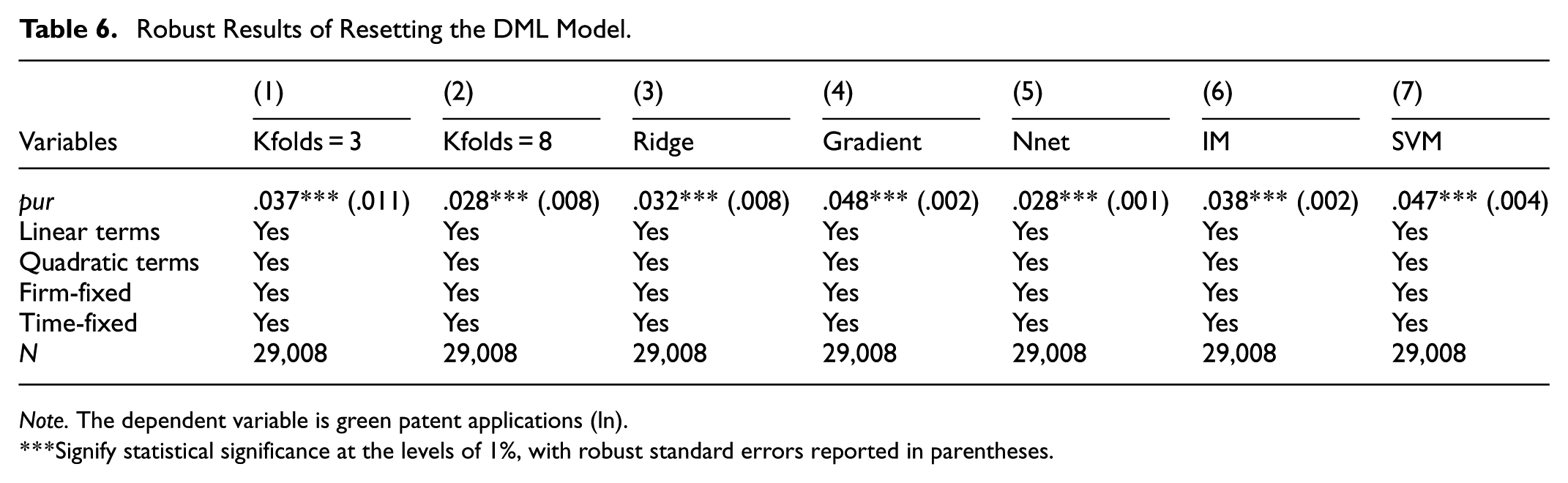
Note. The dependent variable is green patent applications (ln).
Signify statistical significance at the levels of 1%, with robust standard errors reported in parentheses.
Controlling for endogeneity: First, to alleviate endogeneity due to the reverse causality between government procurement contracts and corporate green innovation, following Chernozhukov et al. (2018), we developed a partially linear instrumental variable model:


where
Results of Controlling Endogeneity Problems.

Note. The dependent variable is green patent applications (ln).
Signify statistical significance at the levels of 1%, with robust standard errors reported in parentheses.
Heterogeneity Tests
Heterogeneity of ownership: Ownership preferences have long been present in the Chinese financial system (Acharya et al., 2007). Private firms, which have fewer resources compared to state-owned enterprises (SOEs), face greater challenges when engaging in innovative activities. Furthermore, non-state-owned enterprises (non-SOEs) may be motivated to improve green innovation to maintain order stability. Therefore, government procurement may exert a greater increase in green innovation among non-SOEs. Table 8 presents the regression results, differentiated by firm ownership. The regression coefficient of pur is not significant for SOEs, whereas it is significantly positive at the 1% level for non-SOEs.
Heterogeneity Tests.

Note. The dependent variable is green patent applications (ln).
Signify statistical significance at the levels of 1%, with robust standard errors reported in parentheses.
Heterogeneity in firm size: A stable cash flow from government contracts is an important policy instrument employed by the state to promote the development of small and medium-sized enterprises (SMEs). The “Government Procurement Measures for the Promotion of Small and Medium-sized Enterprise Development” issued in 2020 emphasized the role of government procurement policy in fostering SMEs’ growth. The “Notice on Printing and Distributing a Package of Policies and Measures to Stabilize the Economy” issued by the State Council in 2022 also highlighted using government procurement to support smaller enterprises. Thus, government orders may promote green innovation among SMEs. This study distinguishes large- and small-scale enterprises based on annual medians. The regression results reported in Table 8 indicate that the coefficient of government procurement is larger and more significant for smaller firms than for larger ones.
Local governments may have a greater impact on resource allocation and administrative approval for listed companies than non-local governments. Their proximity to listed firms results in shorter regulatory distance from local listed companies. Therefore, procurement from local and non-local governments may have different impacts on green corporate innovation. This study distinguishes samples into two groups: those who have received local government orders and those who have not. DML analysis was conducted again. These findings reported in Table 8 suggest that local government orders significantly promote green innovation in listed companies in contrast to orders from non-local governments.
This study examines whether government procurement induces green innovation effects in both polluting and clean industries. This study identifies polluting and non-polluting industries according to the “Notice on Further Standardizing the Environmental Protection verification work of production and operation companies in heavily polluting industries applying for listing or refinancing” issued by the State Environmental Protection Administration. The regression results in Table 8 show that government procurement does not significantly affect the green innovation of listed companies in polluting industries. However, it also significantly enhances green innovation in non-polluting industries. This is because the attractiveness of green patents for polluting industries for institutional investors is low.
Mechanisms Analyses
This study measures expected market returns (return) by calculating the difference between the sales of a company in the current year and the average sales over the previous 2 years. A greater er value indicates a higher expected market return. An increase in a company’s current-year sales relative to previous years may be the result of both production and consumption side effects. These effects reflect a company’s positive expectations or forecasts of improvement. Columns (1) and (2) of Table 9 present the test results of the expected market return enhancement effect. The results indicate that the coefficients for government procurement are significantly positive, suggesting that government procurement can directly create demand and indirectly induce demand, thereby enhancing the expected market returns and forming a strong positive incentive for corporate innovation.
Mechanisms Tests.

Signify statistical significance at the levels of 1%, with robust standard errors reported in parentheses.
In addition, we use the ratio of interest expenses to total liabilities as a measure of financial constraints (constraint). Columns (3) and (4) of Table 9 report the results for easing financial constraints. The coefficients for government procurement are significantly positive, indicating that government procurement helps to mitigate the financial constraints, subsequently exerting a positive impact on corporate green innovation.
Local governments’ environmental commitment refers to the ratio of energy conservation and environmental protection expenditures to the general fiscal budget (commitment). We added the interaction term pur × commitment to the DML model. The results reported in columns (5) and (6) of Table 9 indicate that local governments’ environmental commitment plays a positive moderating role. In other words, the stronger a local government’s environmental commitment, the more significant the impact of government procurement on corporate green innovation.
Supplementary Analysis
Innovation policies can be categorized into two types: supply side and demand side. Certain firms have benefited from both policies. In this study, 1,509 firms, accounting for 3.6% of the total sample, received both supply side subsidies and demand-side procurement. Policy overlap does not necessarily lead to additive effects because these incentives are closely related to the characteristics of enterprises that receive support from the government. Hence, building upon the preliminary examination of single-policy effects, this study further analyzes how demand-side policies interact with supply side policies to drive corporate innovation.
Supply-side policies focus primarily on reducing innovation costs, whereas demand-side policies aim to enhance market incentives for innovation. These two policies work synergistically to foster corporate innovation. On the one hand, although supply-side policies can reduce the costs of innovation for firms (Guerzoni & Raiteri, 2015), the fundamental impetus for innovation lies in the economic returns garnered from the marketization of innovative outcomes. Without sufficient anticipated market returns, firms may lack the incentive to innovate. Demand-side policies can create direct and indirect demand, thereby elevating the expected market returns and motivating firm-level innovation. R&D uncertainty is a significant factor influencing corporate innovation decisions. Even with support from supply side policies, firms are unlikely to engage in innovation if the uncertainty in generating valuable innovative outcomes is high. Demand-side policies facilitate the transmission of demand information, knowledge, and critical inputs between government users and manufacturing firms, thereby reducing R&D uncertainty and stimulating innovation.
However, although demand-side policies increase market incentives for innovation and reduce the uncertainty associated with R&D, capital requirements for innovative activities are considerable. Firms often face significant funding constraints in the Chinese financial system, which may diminish their incentives to innovate. While demand-side policies can attract external financing, this effect is not as direct or as effective as that of supply-side policies (Baqaee et al., 2024). Supply-side policies can provide favorable conditions to ease financial constraints for firms, such as R&D subsidies, which can directly bolster R&D capital and drive innovation.
This study employs the DML model to investigate the effects of the interaction between demand- and supply-side policies. The treated variable refers to the incentive policies; incentive equals 1 if a firm simultaneously obtains supply-side subsidies and demand-side procurement, otherwise 0. Table 10 presents the DML results. The coefficient of incentive is significantly positive at the 1% level, indicating that a combination of demand- and supply-side policies reduces R&D costs and enhances market incentives, thereby stimulating corporate green innovation.
The Cooperative Effect of Demand-Side and Supply-Side Policies.

Indicate statistical significance at the 1% levels. Robust standard errors are reported in parentheses.
The cooperative effect of demand- and supply-side policies may vary depending on the level of green innovation. This study divides the sample into two categories based on the median proportion of green patents: firms with high green innovation and those with low green innovation. As illustrated in Table 10, for firms with a higher proportion of green innovation, the cooperative effect of demand- and supply-side policies is more significant. Firms with a high level of green innovation commonly experience the “Schumpeterian innovation effect,” which is a critical way to strengthen their core competitiveness (Zhou et al., 2023). Policy utilization capability enables them to allocate internal innovation resources efficiently, facilitating a positive response to both demand-and supply side policies (Sirmon et al., 2011). Consequently, for these firms, the “bilateral” support policies will generate a “complementary effect.”
By contrast, firms with low green innovation may have weaker incentives for green innovation. Once receiving support from “bilateral” policies, the abundance of policy support resources may diminish their motivation for innovation and lead to a resource curse (Al-Kasim et al., 2013).
Discussion
Green innovation has emerged as a key factor that drives green development. This study examined how government procurement stimulates green corporate innovation. The findings demonstrated that government procurement has a significant effect on the number of green patents and their relative shares. Government procurement incentivized green innovation by enhancing the anticipated market rewards and alleviating financial constraints. Local governments’ environmental commitments can strengthen this stimulatory effect. Heterogeneity tests revealed that government procurement primarily stimulated green innovation in non-state-owned, small, and clean firms. Furthermore, procurement from local governments has a more significant impact than procurement from non-local governments. The concurrent implementation of demand- and supply-side policies engendered a synergistic influence on green innovation, especially for firms equipped with robust innovatory prowess. The findings of this study demonstrate the pivotal role of government procurement in guiding the transition towards green development, offering a framework for understanding the Chinese approach.
This study makes several contributions. First, it enriches the literature on the economic consequences of government procurement. Existing studies have explored the effects of government procurement on international trade (McAfee & McMillan, 1989), corporate social responsibility (Flammer, 2018), corporate transparency (Samuels, 2021), corporate innovation (Ntsonde & Aggeri, 2021), and corporate environmental performance (Zheng & Wen, 2024), but have paid insufficient attention to green innovation. Sustained high-level green innovation is crucial to enhance green competitiveness. This study demonstrates that government procurement can enhance green innovation capabilities and promote green development, providing evidence of the economic consequences and efficacy of government procurement as a demand-side policy tool.
Second, this study enhances the policy evaluation effects using a double machine learning (DML) model. Existing literature predominantly employs parametric methods to assess policy effects, which inevitably confronts issues of “the curse of dimensionality” and model specification bias. Owing to the advantages of machine learning algorithms in high-dimensional and nonparametric predictions, this study utilized the DML model for causal inference. This approach can mitigate endogeneity concerns and regularity bias shortcomings, thereby enabling a more accurate evaluation of the microeconomic effects of government procurement.
Third, the study reveals that government procurement improves green innovation by enhancing expected market returns and easing financial constraints. Local governments’ environmental commitments can strengthen this stimulatory effect. Moreover, we found a synergistic effect of the concurrent implementation of demand- and supply-side policies on corporate green innovation. Thus, the conclusions provide policy insights for optimizing government procurement strategies.
Theoretical Implications
The theoretical implications of this study contribute to the literature on innovation policy and green development in several key dimensions. First, our findings bridge a critical gap in demand-side innovation theory by empirically demonstrating how government procurement, as a strategic policy instrument, stimulates corporate green innovation. While prior studies predominantly emphasize supply-side mechanisms such as R&D subsidies, we reveal that procurement policies create dual incentives through market demand signaling and financial constraint alleviation. This dual mechanism underscores the complementary role of demand-side interventions in addressing both innovation uncertainty and resource limitations, thereby enriching the theoretical discourse on policy tool interactions.
Second, our analysis advances the understanding of institutional heterogeneity in policy effectiveness. By identifying the moderating role of local governments’ environmental commitment, we integrate institutional theory into the innovation policy framework. This aligns with Benito-Hernández et al. (2023)’s arguments on regional policy coherence and demonstrates how institutional priorities amplify procurement-driven innovation signals. Such insights refine the conceptual model of policy implementation by emphasizing the interplay between macro-level governance and micro-level firm behaviors.
Third, the study extends the “policy mix” theory by quantifying the synergistic effects of concurrent demand- and supply-side interventions. Our results reveal that policy complementarity reduces R&D uncertainty while enhancing resource availability, a finding that challenges the conventional view of policy trade-offs and proposes a dynamic model of innovation ecosystems. This theoretical extension has implications for designing multi-layered policy frameworks in developing economies.
Finally, we contribute to the conceptualization of green innovation drivers by integrating demand-pull mechanisms into the Schumpeterian innovation paradigm. The empirical validation of procurement-induced market incentives as catalysts for green patenting activities redefines the boundaries of environmental innovation theory, which has traditionally focused on regulatory push or cost-driven motivations. These theoretical advancements provide a foundation for future research on sustainable transition pathways in institutionally diverse contexts.
Practical Implications
This study offers several policy implications. First, the government’s scale of green procurement should be expanded to foster green corporate innovation. This study indicates that as a demand-side policy instrument, government procurement promotes green corporate innovation activities. However, given fiscal budget constraints, China’s government procurement accounts for only approximately one-quarter of the GDP share compared to OECD countries. This suggests a significant untapped potential for policy-driven support for green innovation through demand-side procurement. It is advisable to intensify the implementation of government procurement policies that support green innovation, increase the proportion of green procurement in government budgets to guide green innovation and foster green economic development.
Second, it is essential to refine the top-level design of the policy framework for green government procurement. Although China has introduced various policy documents and regulations to promote government green procurement and optimize its scope and methods of green purchasing, these provisions are generally included only within laws related to government procurement, energy conservation, and environmental protection. Clauses related to green procurement often focus on guiding social consumption towards green options, with a strong emphasis on principles and direction, and lack concrete implementation plans and performance evaluation systems for green procurement. Therefore, it is recommended that the related legal frameworks be refined to provide a solid legal foundation for the enforcement of green government procurement policies.
Third, government procurement should be closely integrated with the implementation process, treaty design, and targeted government support. During the procurement process, governments can set environmental standards and performance requirements to select enterprises that employ new environmentally beneficial processes and establish supply relationships. When designing procurement contracts, provisions should define the possibility of the government auditing supplier firms to ensure compliance with environmental performance commitments. Regarding targeted government support, consideration should be given to bolstering subsidies directed toward green innovative enterprises and aiding them in undertaking long-term green innovations at a lower incremental cost.
Limitation
Despite this study has made certain contributions, several limitations warrant further exploration in future research. First, our reliance on patent application data as a proxy for green innovation, while standard, does not fully capture non-patentable activities like process improvements. Future research could develop a more composite metric to provide a holistic view. Second, while the DML model effectively addresses high-dimensional confounding, its causal claims rest on the unconfoundedness assumption. Unobserved variables, such as managerial environmental awareness, cannot be entirely ruled out. Future studies could employ quasi-experimental designs to further strengthen causal identification. Third, our analysis focuses on the quantity of green innovation, leaving its quality and technological impact unexplored. It is unclear whether government procurement incentivizes incremental adjustments or radical breakthroughs. Future work could use patent citation data to distinguish the nature of the induced innovations. Finally, our findings are based on Chinese listed firms from 2015 to 2022. The generalizability of these results to different institutional and market contexts, particularly in developed economies, requires further investigation. Cross-country comparative studies would be valuable in testing the external validity of our conclusions.
Footnotes

Ethical Considerations
Formal ethical approval has been waived instate this study adhered to the principles of the Declaration of Helsinki following strict ethical standards. Formal ethical approval was waived due to Participation was anonymous, confidential, and voluntary, with informed consent obtained from all participants. There were no biomarkers or tissue samples collected for analysis. Participants had the freedom to withdraw from the study at any point.
Author Contributions
Shu Guan: Conceptualization, Methodology, Validation, Formal analysis, Investigation, Writing, Visualization, Project administration, Funding Acquisition. Mingshan Li: Conceptualization, Methodology, Validation, Writing, Supervision.
Funding
The authors disclosed receipt of the following financial support for the research, authorship, and/or publication of this article: We are grateful for the financial support from National Natural Science Foundation of China (No. 72304055), China Postdoctoral Science Foundation (No. 2023M740470), and Fundamental Research Funds for the Central Universities (3132025313).
Declaration of Conflicting Interests
The authors declared no potential conflicts of interest with respect to the research, authorship, and/or publication of this article.
Data Availability Statement
The data that support the findings of this study are available from the corresponding authors upon reasonable request.