




Abstract
This paper aims to accurately identify, assess, and enhance the incentive effects of the Chinese government’s innovative procurement policy reform on its procurement strategy by applying textual analysis to identify the more than 640,000 pieces of government procurement contract data collected from 2015 to 2024, screen out the amount of government innovative procurement contracts signed therein, and select the deepening of the government procurement system adopted by the resolution of November 2018 reform program as the time point of public procurement regulations reform, establish a double difference model to verify the impact of the policy landing on the government innovation procurement contract data, and analyze the R&D investment and scientific and technological transformation results on the policy landing on the government innovation procurement contract data of the role of the mechanism test. The results of the study show that the double difference effect value is 1,176.159 > 0 and shows a 5% level of significance. This means that the adoption of the decision to deepen the reform program of the government procurement system in 2018 has a significant positive effect on the number of government procurement contracts for innovation, and through the test of the mechanism of action, it can be seen that scientific research inputs and the results of scientific and technological transformation also play a positive role in promoting the number of government procurement contracts for innovation.
Keywords
Introduction
Government procurement, as an important component of public fiscal expenditure, plays a significant role in resource allocation efficiency, which has a profound impact on economic innovation and social development. Since the trial implementation of the Government Procurement Law in China in 1996, the government procurement system has been gradually improved. In 2002, the Government Procurement Law of the People’s Republic of China was officially promulgated, marking the establishment of the basic framework for China’s government procurement regulations. With rapid economic development, the original procurement regulations gradually showed limitations and could not meet the new demands of the current circumstances (Wang et al., 2018). In 2018, the fifth meeting of the Central Comprehensive Deepening Reform Commission approved the Plan for Deepening the Reform of the Government Procurement System, marking the beginning of a new phase of reform in China’s government procurement system. In 2024, the release of the Interim Measures for the Management of Innovative Procurement Methods in Government Procurement Cooperation (Draft for Comments) further clarified the policy positioning of government procurement in supporting technological innovation, while also optimizing the procurement process. Globally, the United States is a leader in technological development, with research indicating that government defense and military procurement played a crucial role in the country’s technological advancements. Significant technological breakthroughs in fields such as semiconductors, computers, and the internet are closely related to the support provided by defense procurement (Wang et al., 2024). Against this background, studying the impact of public procurement regulation reforms on innovative procurement strategies has significant theoretical and practical implications. Theoretically, exploring the role of policy reforms in driving innovative procurement helps enrich academic research on government procurement and innovation. Practically, analyzing the effects of policy implementation can provide decision-making basis for the government to optimize procurement systems and promote high-quality economic development. This study focuses on the following core questions: Did the 2018 public procurement law reform significantly promote the growth of government contracts for innovative procurement? What are the mechanisms behind this? However, existing research on the impact of innovative procurement strategies primarily focuses on different enterprises and their directions, such as corporate green innovation (Maria, 2022), corporate innovation (Chiappinelli, 2025), and corporate capacity (Fu et al., 2024). There is relatively little research specifically addressing the impact of public procurement regulation reforms on innovative procurement strategies. Therefore, this paper proposes the following three research topics.
Based on the data of about 640,000 government procurement contracts from 2015 to 2024, the government innovation procurement is identified from the overall government procurement by using text analysis method and referring to the Classification of Strategic Emerging Industries (2018).
Using the gray prediction model and based on the data from 2015 to 2017, predict the amount of innovative procurement from 2018 to 2024 without the “Deepening the Reform Plan of Government Procurement System,” and compare it with the actual amount of innovative government procurement from 2018 to 2024 (Zhu & Li, 2025).
Taking the forecast group of government innovation procurement quantity from 2018 to 2024 as the experimental group, the control group and the actual data experimental group, establishing DID model, selecting the number of government innovation procurement contracts as the explained variable, deepening the reform scheme of government procurement system as the core explanatory variable, and the expenditure of research and experimental development funds and the number of invention patent applications granted as the control variables, systematically analyzing the impact of the issuance of public procurement laws and regulations on the number of government innovation procurement, and put forward suggestions for follow-up government innovation procurement (Zhao et al., 2024).
Institutional Background and Literature Review
Institutional Background
In 1996, China’s Government Procurement Law entered the trial stage; In 2002, China promulgated the Government Procurement Law of the People’s Republic of China, and the government procurement laws and regulations of China were basically established (Liu et al., 2024). The regulations were formulated within the framework of procurement methods and procurement procedures, so the contents were relatively narrow and basic, which was not enough to adapt to the rapid development of procurement; At the end of 2014, China formally submitted the 6th bid list for accession to the Government Procurement Agreement (GPA) to WTO; At the beginning of 2018, it was proposed at the Boao Forum for Asia that China would take major measures to “actively expand imports” and promote the process of joining the Agreement on Government Procurement of the World Trade Organization; on November 14, 2018, the fifth meeting of the Central Committee for Comprehensive Deepening Reform was held, and the Resolution on Deepening the Reform Plan of the Government Procurement System was adopted; at the end of 2019, China submitted its seventh bid list to the WTO. For the first time, the military component appeared in the list, with seven new provinces, 16 state-owned enterprises and 36 local colleges and universities (Zhou, 2025). The submission of this list means that China’s accession to the GPA negotiations have entered a deep stage. On July 15, 2022, the Ministry of Finance announced the new version of the Government Procurement Law of the People’s Republic of China (Draft for Comments on the Revised Draft), which, compared with the Government Procurement Law of the People’s Republic of China promulgated in 2002, expanded the procurement subject to public welfare central enterprises, no longer required suppliers to have “good business reputation,” and centralized procurement institutions could work across districts. On February 1, 2024, the Ministry of Finance promulgated the Interim Measures for the Administration of Innovative Procurement Methods of Government Procurement Cooperation (Draft for Comments) (hereinafter referred to as the Draft for Comments), and solicited opinions from the public. This approach is a key measure to implement the Plan for Deepening the Reform of the Government Procurement System, defines the policy orientation of government procurement in supporting the application of scientific and technological innovation, and flexibly optimizes and upgrades the existing procurement process (Cao et al., 2022).
China promulgated the Government Procurement Law in 2002. The definition of government procurement in this law is relatively limited, and the content covered is not as broad as now (He et al., 2025). The system is mainly designed around centralized procurement and competitive contracting procurement, and two conditions are stipulated as key standards to apply the scope of law, namely, centralized procurement catalogue and quota standard. The treatment methods are divided into applicable treatment and exception treatment. Applicable treatment mainly focuses on single-source procurement, while exception procurement refers to the procurement behavior involving national security and military field, as well as the procurement behavior requiring the help of relevant foreign organizations and governments. At present, the situation of government procurement after continuous development, has produced many new changes, so China’s current competitive contracting as the basic point of government procurement system needs to be reconsidered, the current system of government procurement framework should be redesigned from the direction of structured government procurement. In 2002, China promulgated the “government procurement law,” there have been many new situations, mainly for the following aspects. First of all, from the perspective of the increased types of procurement, the adoption of service procurement makes this part of the government’s functions transfer, and the adoption of centralized procurement increases the intensification and convenience of the procurement of medical insurance drugs and medical procurement. On this basis, the supervision method applicable to the new types of procurement is designed and has been applied. Secondly, from the perspective of the change of procurement supervision scope, taking 2018 as the watershed, the government procurement has expanded the supervision vision from the contents covered by the centralized procurement catalogue to the contents outside the catalogue, from above the quota standard to below the quota standard. Taking the electronic store as an example, this part of government procurement will be covered by the supervision mechanism after 2018. After that, the revised version of the Government Procurement Law proposed that it also intended to cancel the restrictions previously set, thus further broadening the legal norms of government procurement and the boundaries of government supervision (Devlin & Coaffee, 2021).
Literature Review
Government procurement is an important way to promote enterprise innovation, the formulation of government innovation procurement strategy mainly depends on the formulation and continuous improvement of superior laws and regulations, so the collation of relevant literature can be started from two parts, respectively, is about the public procurement law and the government innovation procurement strategy for the promotion of enterprises (Jiang & Zhang, 2025).
Research on public procurement law has primarily focused on qualitative analysis, highlighting the issues within the Government Procurement Law of the People’s Republic of China and future development directions (Liao et al., 2024). Other scholars have explored the optimization of government procurement in specific industries, especially in the context of new technologies or different settings (Uyar et al., 2024). The impact of government procurement on innovation strategies has received academic attention for some time, with numerous studies reaching the same conclusion: whether driven by technological change or incentivizing corporate innovation, government procurement plays a key role in these processes. Major advancements in the semiconductor, computer, and aerospace industries in the United States were closely linked to the government’s procurement activities in the defense and military sectors. It can be said that the global technological leadership of the U.S. is inseparable from the implementation of these procurement activities. General-purpose technologies, which became one of the most influential technologies in the U.S. during the 20th century, made significant progress due to defense procurement as a driving force.
Existing research on government procurement behavior rarely differentiates specific procurement activities, treating procurement as a single behavior and failing to distinguish between routine and innovative procurement (Ruiz, 2024). However, further differentiation of government procurement activities is necessary. Routine government procurement generally involves mature, stable products that do not involve innovation or R&D, meaning that there is no associated R&D investment before or after procurement. Goods and services that have already been standardized cover about 80% of the categories involved in government procurement. Therefore, procurement activities in these categories do not effectively drive innovation. Recognizing procurement in high-tech fields as innovative procurement, further identifying procurement behavior using this approach, although this method still lacks sufficient detail. Research in China is gradually focusing on recognizing government procurement activities and categorizing data (Foss & Bonacelli, 2025).
Compared with developed countries like those in Europe and the U.S., China’s public procurement reform is more focused on flexible adjustments based on the country’s economic development stage and innovation needs. The 2018 Plan for Deepening the Reform of the Government Procurement System clarified the core role of government procurement in supporting technological innovation and encouraged enterprises to increase R&D investment and technological conversion through specific measures such as simplifying procurement processes and introducing competitive mechanisms. This “top-down” policy design model provides valuable experience for other developing countries, especially regarding balancing central and local relationships and ensuring policy continuity and stability during execution. China’s public procurement reform has adopted a data-driven research approach, offering new research perspectives for global scholars (Auwalin, 2025). It also emphasizes the importance of data transparency and standardization in policy evaluation.
However, China’s public procurement reform also has some critical limitations. For example, the uneven implementation of policies has led to varying results in different regions. Despite clear policy objectives set by the central government, local governments often face resource, capability, and interest-related constraints during implementation, resulting in inconsistent policy outcomes. Additionally, the ambiguous definition of innovative procurement remains a prominent issue. Existing research has not sufficiently distinguished between routine and innovative procurement, leading to some inaccuracies in research findings. These issues not only limit the effectiveness of China’s public procurement reform but also serve as a warning for policy design in other countries.
In conclusion, China’s public procurement reform has contributed a long-term perspective on institutional change to the global debate on procurement and innovation. The 2018 reform plan directly increased the number of innovative procurement contracts, optimized resource allocation, and incentive mechanisms, thereby promoting higher enterprise R&D investment and technological conversion. The long-term perspective of institutional change provides new dimensions for global scholars, particularly in analyzing the delayed effects and long-term impacts of policy reforms.
Theoretical Analysis and Research Hypothesis
Deepening the Reform of Government Procurement System and the Number of Government Innovation Procurement Contracts
The plan to deepen the reform of the government procurement system was adopted at the end of 2018. As an important reform plan of the government procurement law, it is of great significance to standardize policy procurement. In the same year, the National Bureau of Statistics issued the Classification of Strategic Emerging Industries clarifies relevant emerging industries, including nine major fields such as new generation information technology industry, high-end equipment manufacturing industry, new material industry, biological industry, new energy automobile industry, new energy industry, energy conservation and environmental protection industry, digital creative industry and related service industry. Relevant industrial fields supported by policies are also important directions for national development. Therefore, the number of government procurement in strategic emerging fields should increase significantly. Based on the above analysis, This paper proposes:
Deepen Government Procurement System Reform Program to Promote the Growth of Government Innovation Procurement Contracts by Increasing R&D Investment
The simultaneous implementation of relevant procurement system schemes will bring about investment in relevant scientific research funds. According to relevant data, China’s research and experimental development expenditure in 2015 was 1417 billion yuan, which has increased to 3327.8 billion yuan by 2023, an increase of nearly 1.4 times. For enterprises to carry out innovation activities, the production of innovative products is accompanied by high investment, long time and high risks, which also makes it more difficult for enterprises to survive. First of all, the research and development process of innovative products is difficult, the initial investment is silent and the cost is high, and once there is no sales volume of innovative products, it is a devastating blow to enterprises. At the same time, for enterprises, if they blindly develop innovative products, it will also be accompanied by financing difficulties. Because innovative enterprises lack collateral for high-value and molded products, financing institutions are naturally unwilling to finance innovative enterprises in order to reduce risks, which brings financing constraints. The continuation of this phenomenon makes the innovation power of the whole society decline and social progress stagnate. Therefore, ordinary government procurement cannot alleviate the financing constraints of enterprises. However, the government participates in the innovation procurement strategy from the R&D process, which also needs the support of R&D investment, and the support of funds will also stimulate the innovation vitality of enterprises. Therefore, based on the above analysis, this paper proposes:
Deepen the Reform Plan of Government Procurement System, Promote the Growth of Government Innovation Procurement Contracts by Improving the Transformation Level of Scientific and Technological Achievements
As strategic emerging industries are involved in industries that have not been studied or studied deeply before, relevant scientific and technological achievements are bound to increase, which is also a necessary condition for increasing the number of government innovation procurement contracts signed. Only when scientific and technological achievements are transformed and landed can corresponding innovative products be made, and the number of government innovation procurement contracts will also increase synchronously. Therefore, based on the above analysis, this paper proposes:
Study Design
Policy procurement can effectively promote the innovation activities of enterprises and accelerate enterprise innovation through a series of policies such as innovation subsidies and financing relaxation. China also attaches great importance to the impact of innovation procurement strategies on enterprise innovation when formulating policies. China government innovation procurement mainly includes three means of realization: The first is the certification of some conventional innovative products. By establishing an innovative certification catalogue, the products included in the catalogue will be given certain preferential policies to the production enterprises in the follow-up policy procurement activities. The second is the certification of some key R&D equipment or other important emerging strategic industries. Refer to the Classification of Strategic Emerging Industries issued by the National Bureau of Statistics in 2018 or the Guidance Catalogue for Independent Innovation of Major Technical Equipment issued in 2012 to include the national key innovation fields proposed in these documents. If enterprises succeed in R&D in these key emerging fields, the government will give priority to procurement. This plays a positive role in promoting enterprise innovation; the third type is for emerging areas not included in the catalogue, which have an important role in the progress of society and are supported by government procurement.
This study employs the Differences-in-Differences (DID) model to evaluate the impact of the 2018 reform plan for deepening the government procurement system on the number of government innovation procurement contracts. The DID model is a widely used econometric method for policy evaluation. Its core idea is to identify the net effect of a policy by comparing the changes in the experimental group and the control group before and after policy implementation. This method effectively controls for time trends and group differences, reducing omitted variable bias and improving the accuracy of causal inference.
The 2018 reform plan for deepening the government procurement system is a nationwide policy, and theoretically, there are no regions completely unaffected by the policy. Therefore, the “control group” in the traditional DID model cannot be directly obtained through regional divisions. To address this issue, this study constructs a virtual control group using the Grey Forecasting Model (GM(1,1)). The Grey Forecasting Model is suitable for small sample sizes and incomplete information, and it can predict future trends using a limited amount of data to simulate the number of innovation procurement contracts in the absence of policy implementation. Given the short research time frame (2015–2024) and limited sample size, the DID model can provide reliable causal inference even with small samples. By using the differences-in-differences approach, the DID model effectively controls for time trends and group differences, reducing omitted variable bias. The research data is primarily sourced from the China Government Procurement website, which includes detailed government procurement contract entries after 2015, such as contract name, amount, number, signing date, and provincial and municipal information, providing a solid empirical foundation for the study.
Data Sampling and Processing
There are many studies on the impact of government procurement on innovative procurement of enterprises, but most of the studies fail to distinguish between conventional project procurement and innovative procurement. For example, even if the policy changes for the procurement of conventional office supplies, office supplies are fixed expenditures. Therefore, if the government innovative procurement projects are not distinguished in the study, the accuracy of the results will be greatly affected and the error of the results will be increased. Actually, in foreign countries, Many scholars have also put forward their own views on this issue, their research results ultimately point to the obvious difference between conventional procurement and innovative procurement, and the innovative effects produced are also different. The scope of government innovation procurement defined in this paper is consistent with Sun Wei’s research. China Government Procurement Network can collect more detailed government procurement contract items after 2015, including name, amount, number, signing date, province and city, etc. The disclosure of this data provides detailed data support for the research of this paper. Since the contract information before 2015 is not detailed, the research time range of this paper also starts from 2015. 2015 to 2024 was selected as the study period.
Collected more than 640,000 government procurement contract data from 2015 to 2024, using text analysis methods, referring to the classification of strategic emerging industries in the Classification of Strategic Emerging Industries, summarized that all activities in the four industries of new generation information technology industry, high-end equipment manufacturing industry, new energy automobile industry and energy conservation and environmental protection industry belong to strategic emerging industry projects, and excluded some activities belong to strategic emerging industry projects. The project time is subject to the signing time of the contract. Finally, a government innovation procurement keyword database containing more than 100 words such as “information security equipment manufacturing,”“Internet access and related services,”“industrial robot manufacturing,”“service consumption robot manufacturing,”“aircraft manufacturing,”“radio and television satellite transmission service,”“marine energy development and utilization engineering construction” is obtained. Strict inclusion and exclusion criteria were applied when selecting innovation procurement contracts. The inclusion criteria require that the contract description contains at least two innovation-related keywords and that the contract amount exceeds 100,000 yuan. The exclusion criteria include duplicate contracts, invalid contracts (e.g., contracts with a value of 0), and contracts clearly unrelated to innovation (e.g., office supplies procurement).
To ensure the accuracy of the screening results, this study employed a combination of manual verification and cross-validation methods: 10% of the selected contracts were randomly sampled for manual review to confirm whether they met the definition of innovation procurement contracts. Additionally, cross-validation was conducted by comparing the data with publicly available data from local government procurement platforms to ensure consistency and reliability.
On this basis, matlab software is used to import government innovation procurement contract data. Logic matching is carried out from the established data thesaurus matrix, the conforming procurement items are derived, and the government innovation procurement items are identified from the overall government procurement. See Figure 1 for the sorted data, and Figure 2 for the change amount and change rate.
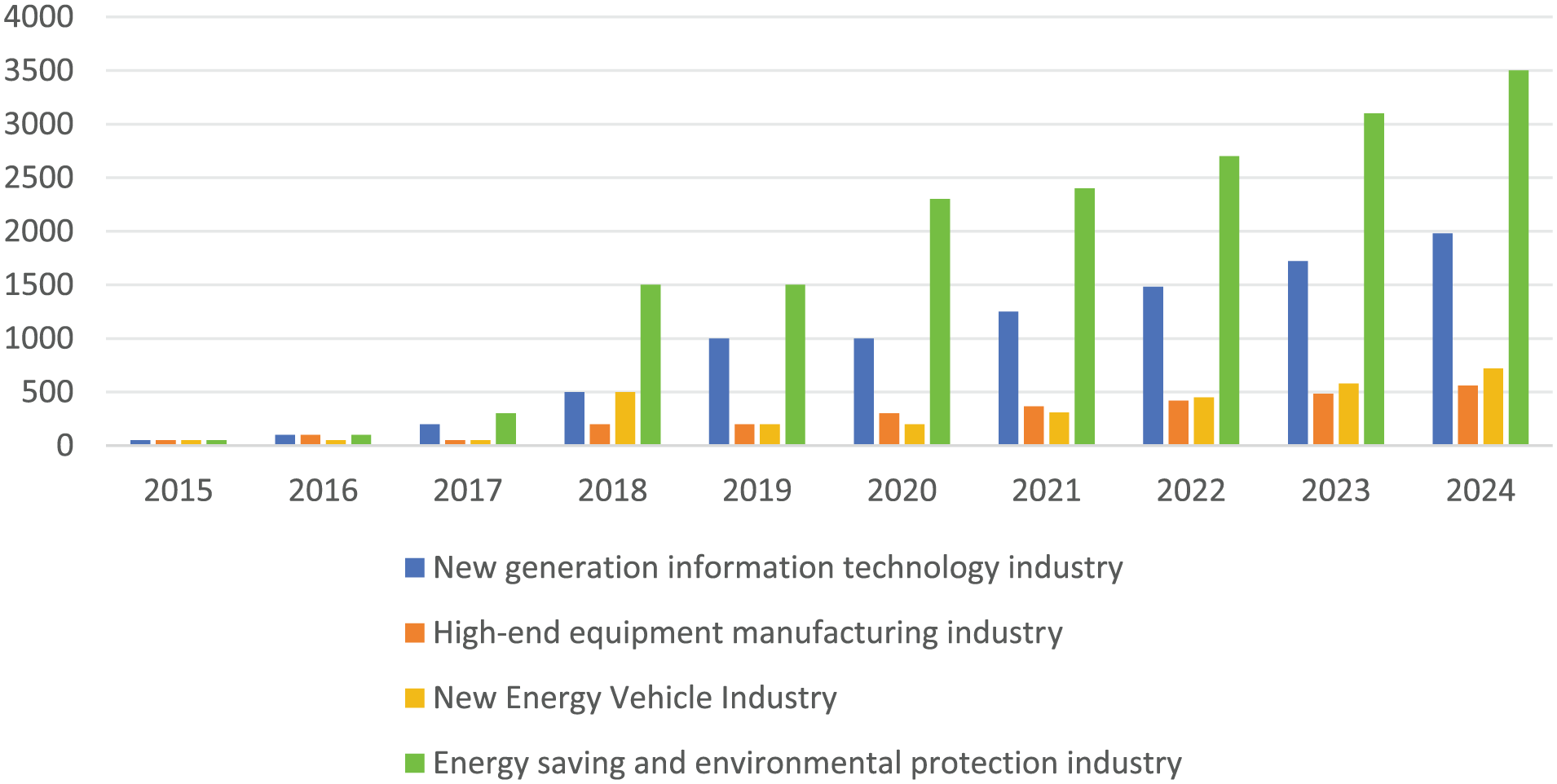
Statistics on the number of government innovation procurement contracts from 2015 to 2024.
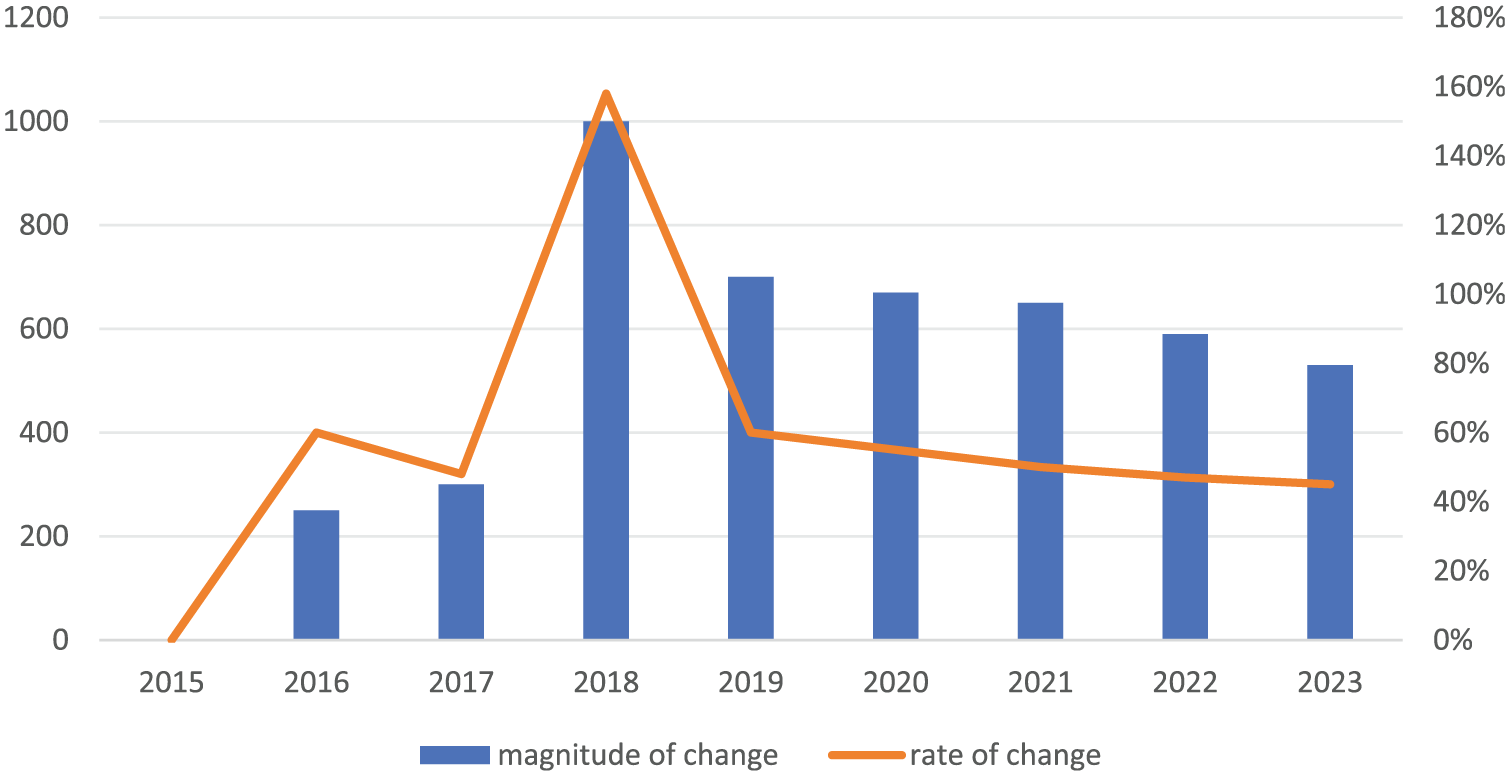
Changes and rates of government innovation procurement contracts from 2015 to 2024.
It can be seen from the statistical data that after the adoption of the policy decision in 2018, the number of innovation contracts has increased significantly, with a change of 1,632, of which the energy conservation and environmental protection industry has the highest proportion of improvement, with a change rate of nearly 2.0.
Variable Selection
Explained Variables
The number of government innovation procurement contracts is based on the number of government innovation procurement contracts from 2015 to 2024 obtained from the above analysis as the explained variable.
Core Explanatory Variables
In 2018, the reform plan for deepening the government procurement system (did), the year in which the policy is implemented and the year after it, the did value is 1; the year before the policy is implemented, the did value is 0.The did value of the control group was always 0.
Control Variables
Based on the existing literature, this paper selects the following control variables: R&D investment (FD).The government has increased financial expenditure on science and technology and provided financial support for scientific research activities. Therefore, and adopts the natural logarithm of R&D expenditure to represent R&D expenditure. This indicator only reflects the scale of capital investment, but cannot directly measure the efficiency or output of research and development activities.
Scientific and Technological Achievements Transformation (TR).The transformation of scientific and technological achievements generally refers to the transfer, licensing and pledge of patents. Considering that the value and conversion rate of invention patents are higher than those of the other two types of patents, and the transfer behavior is the direct embodiment of technology transfer, selects the number of invention patents granted to characterize the transformation of scientific and technological achievements. Based on the occurrence time of patent transformation behavior, this paper calculates the number of patent transformations at different years. The natural logarithm of patent transformation times plus 1 is taken as proxy variable of transformation level of scientific and technological achievements. Patent data can only reflect the potential conversion ability of technological achievements, rather than the actual conversion effect.
M Model Establishment
Control Group Data Processing
In this paper, a double difference model is established (Differences-in-Differences, DID). The impact of government procurement law reform on innovative procurement strategies has been verified. However, considering that the policy is issued for the whole country, there is no area unaffected by the policy. Therefore, considering that there is less sample time series data, a grey prediction model established by a small amount of incomplete information is considered, based on 2015 to 2017 data. Forecast the number of government innovation procurement contracts from 2018 to 2024 as a research control group to compare the actual data with the control group data.
Grey Model Construction
The model was developed in five steps:
First: The formula for calculating the level ratio is: the level ratio is the previous period data/current period data. When the level ratio data is [0.982, 1.0098], it meets the requirements of the model.
Second, if the grade ratio test value directly meets the requirements of the relevant data, no change is required. If the requirements of the prediction model cannot be met, the relevant data processing needs to be carried out by “translation transformation.” The processing method is also very simple, that is, the original data sequence is added with corresponding transformation values, so that the data after adding the transformation values can meet the data requirements of the model. After the final prediction data is obtained, the added transformation values can be subtracted.
Third: calculate the development coefficient a, grey action b, and posterior difference ratio C, and provide a small error probability p value; the construction process is as follows:
Generate nearest neighbor mean series from validated data


Where a is the development coefficient, the size of a value can reflect the development trend of the original series and the cumulative series; b is the coefficient to be determined, called the gray action. This paper uses the least squares method to solve the problem, and the calculation process is as follows:


Based on the original equation of GM(1,1) prediction model, the least squares method is used to solve the two parameters a and b:

Solving the above formula yields the time response formula:


Fourthly, the forecast period is selected. In this paper, the forecast of sea-rail intermodal transport data in the next 12 years is selected.
Fifth: Model test, this paper uses the grade ratio deviation test, the calculation formula is:

Model Rationality Test
For GM(1,1) model, it is necessary to calculate the development coefficient a, grey action b, and posterior difference ratio C value and small error probability p value; first, the development coefficient a and grey action b are the output values of model construction; second, the posterior difference ratio C value is used for model accuracy grade test, and the correlation between this value and accuracy is shown in Table 1; third, the small error probability p value is judged. A comparison of the results for p values and correlation precision is shown in Table 1.
Accuracy Rating Standard Table.
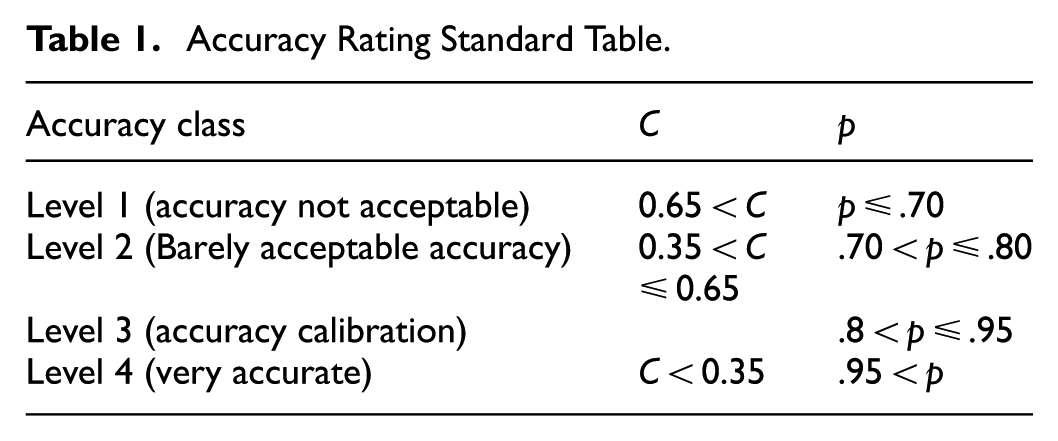
See Table 1 for the evaluation criteria.
Double Difference Modeling
The impact of the reform of public procurement laws and regulations on government procurement can be verified by using double difference model. First, this paper uses matlab program to extract about 12,000 data that can be used in this model by using text fuzzy search method. Since the policy is issued for all cities in the country, there is no control group data, so the gray prediction model is adopted based on the data from 2015 to 2017. The prediction results in 2018 to 2024 data as a control group.
Considering that the resolution of “Deepening the Reform Plan of Government Procurement System” was passed in November 2018, but the government innovation procurement contract has increased significantly in December 2018, 2018 is taken as the experiment (follow up period After) in the establishment of the model, and the following multi-period double difference model is constructed:

At the same time, in order to further identify the relationship between the decision-making of deepening the reform of government procurement system and the number of government innovative procurement contracts, this paper constructs the following measurement model:

Empirical Studies
Basic Data Analysis
Comparison of Calculation Stage Ratio and Translation Conversion
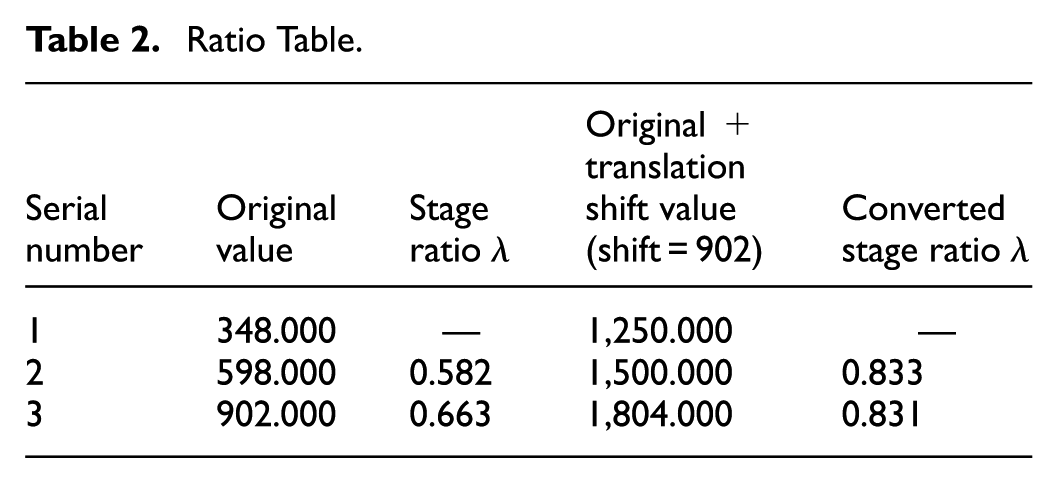
Double difference model needs to process the data of control group. In this section, the grey prediction model established in four parts generates the data of control group, and SPSS software is used for prediction. First, the ratio of original data level is calculated according to the data of the previous period/the data of the current period. See Table 2 for test results.

The grade ratio of the original data is in [0.982, 1.0098], which means that the grade ratio of the original data is 0.582 and 0.663, which is outside the reasonable interval. It is said that the grade ratio of the signed quantity value of the government innovation procurement contract from 2015 to 2017 cannot be directly used for model modeling. In this case, the common processing method for GM(1,1) model is to add translation conversion value to the original data. After calculation, the transformed data class ratios are 0.833 and 0.831, and the test of these values is within the standard range of class ratios after transformation and translation [0.607, 1.649], which also indicates that the transformed and translated data can be used for model analysis.
Ratio Table.
Rationality Test Analysis
The least squares method is used to solve two parameters: development coefficient a and grey action b. The results are shown in Table 3.
Results of Model Construction.
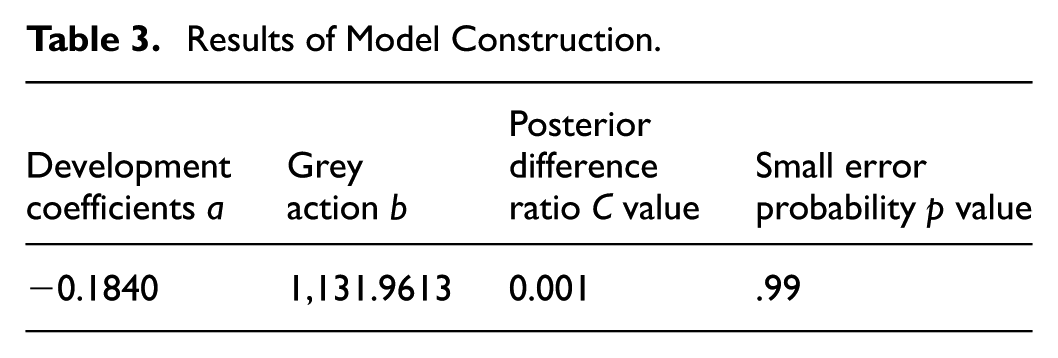
According to Table 3, it can be seen from the above table that a = −0.1840, b = 1,131.9613, the test index C value and p value of the model precision are .001 and .99 respectively. Compared with the statement for precision description in Table 1 above, the C value is less than 0.35 and the p value is greater than .95, which reflect that the precision of the model is very good and the predicted results are highly reliable.
Control Group Data Results
The predicted values are presented in Table 4, and the forecast is illustrated in Figure 3.
Model Predicted Values Table.

RMSE=5.6632.
Mean Square Error MSE: 32.0717.
Mean absolute error MAE: 5.5847.
Mean absolute percentage error MAPE: 0.0075.
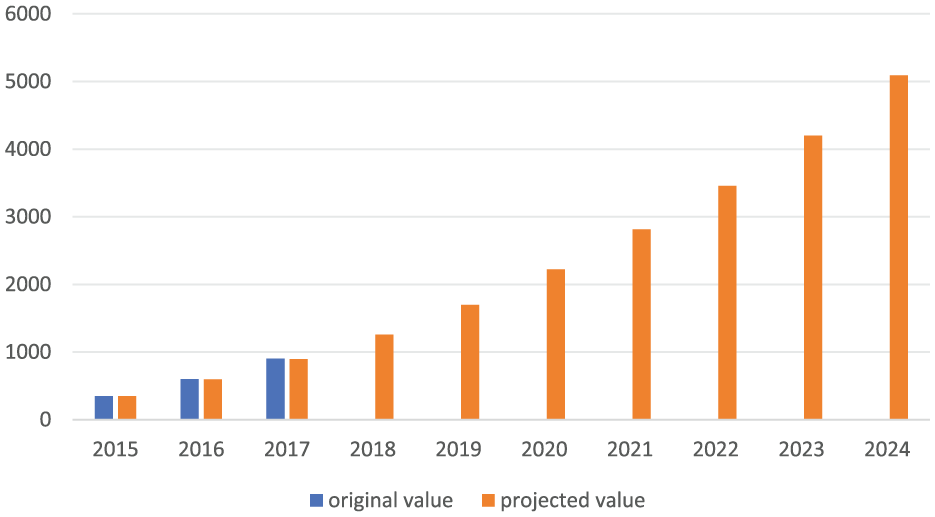
Graphical representation of predicted and actual data.
Model Fitting Situation Analysis
Calculation indexes such as relative error and grade ratio deviation shall be used for the analysis of model fitting, and the relevant calculation results are shown in Table 5. The three groups of error value and fitting value in the negative correlation development, namely the error value is bigger that the fitting situation is worse, whereas the error value is smaller that the fitting situation is better, specifically, generally less than 0.2 fitting situation is higher, if can reach less than 0.1, fitting degree at a high level.
GM(1,1) Model Test Table.

It can be seen from the above table that the relative error and grade deviation value can be analyzed after the model is built to verify the model effect; the maximum value of the model relative error value is 0.008 < 0.1, which means that the model fitting effect meets the high requirements; the maximum value of the grade deviation analysis is 0.3, which indicates that the fitting situation is ordinary, and the comprehensive analysis shows that the fitting situation is good (Figure 4).

Fitting of predicted data and actual data.
Analysis of the Implementation of Laws and Regulations on Innovative Procurement Strategy
Analysis of Raw Data Form
Double difference model (DID, difference method) is commonly used to study the impact of an event/policy/effect, first of all, the original control group, the experimental group of data in the form of rationality test, the results are shown in Table 6. Treated refers to the treatment variable, with the number 0 representing the control group and the number 1 representing the experimental group; Time refers to the experimental period, with the number 0 representing the period before the experiment (base period Before) and the number 1 representing the period after the experiment (follow up period After); the table shows the cross summary data of Treated and Time.
DID Model Description Statistics.

It can be seen from the above table that the pairwise combination of treated and time forms 4 cross cells in total, and the sample size of the 4 cells is greater than 0, which meets the basic data format requirements of double-difference difference model.
Parallel Trend Test
The basic premise of using the double difference method needs to meet the parallel trend H, there are many kinds of parallel test methods, including t-test method, graphic method, interactive regression method, etc.; In this paper, t-test method is used, that is, for the data before the experiment, the processing variables and the explanatory variables t-test, if not showing a significant show that meet the “parallel trend” test, that is, before the implementation of the policy, the number of government innovation procurement contracts in the experimental group and the control group showed a common trend of change in the parallel trend H is established, otherwise it does not meet the “parallel trend” test, the model is not established, t-test results are shown in Tables 7 and 8, graphical results are shown in Figure 5.
t-Test.

p < .05. **p < .01.
Results of OLS Regression Analysis (n = 12).

Explanatory variable: Number of government innovative procurement contracts.
p < .05. **p < .01.
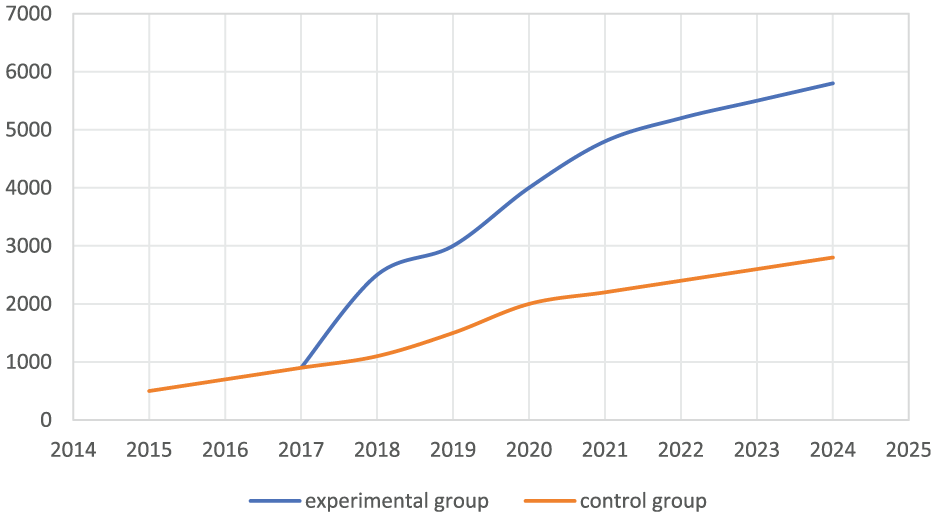
Graphical parallel trend test analysis.
From Table 7 we can see that the treatment variables and study variables t-test results, before the implementation of the policy, t value of 0, p value of 1.0 > .05, indicating that the pre-experiment did not show significant, Table 7 we can see the post-experiment t value of 2.981, p value of .041 < .05, indicating that the post-experiment treatment variables and study variables showed significant changes.
The overall results show that the “parallel trend” test is satisfied before the experiment, that is, before the implementation of the policy, the number of government innovation procurement contracts in the experimental group and the control group presents a common trend of change. The parallel trend H is established, and the model is valid.
Differential Effect Value Analysis
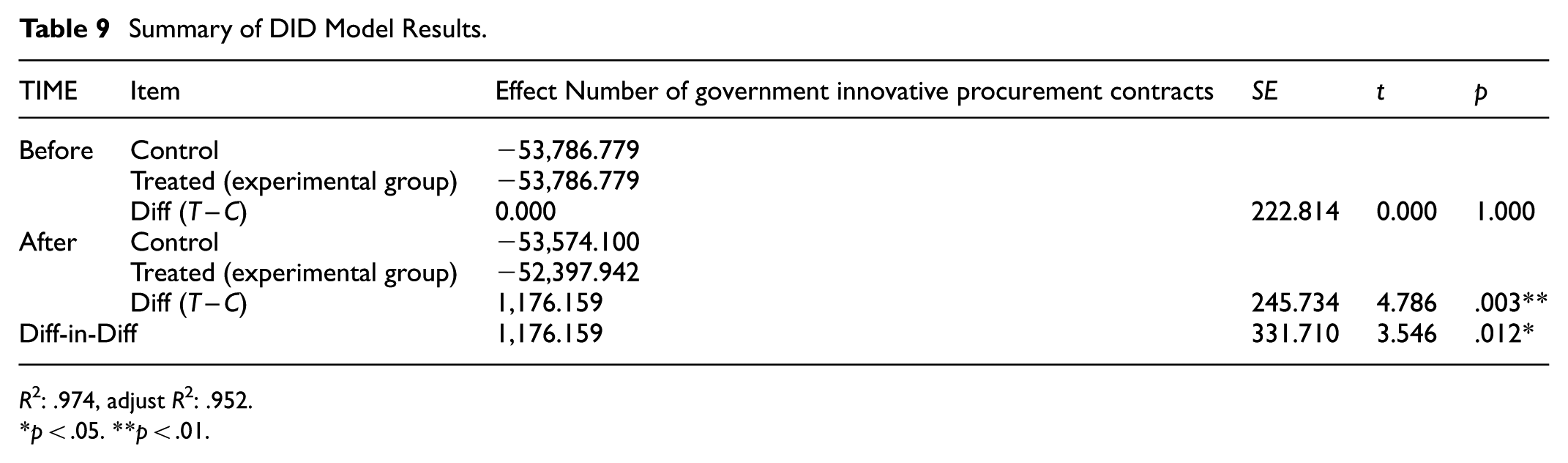
The model calculation experiment before and after the difference effect value data and double difference (Diff-in-Diff) effect value, if the value is significant, it means that the policy plays a role in the change of the data, if the Diff value before the experiment if significant, means that before the experiment control group and the experimental group effect value has a significant difference; If the Diff value after the experiment is significant, it means that there is a significant difference between the effect values of the control group and the experimental group after the experiment. See Table 8 for the regression results of the model OLS, and see Table 9 for the summary of the results of the DID model.
Summary of DID Model Results.
R2: .974, adjust R2: .952.
p < .05. **p < .01.
From Table 9, we can see that the effect value calculated by the double difference model after the policy is issued is 1,176.159, which is >0, and the p value is .3%, showing the significance at the level of 1%, which can explain that the effect gap between before and after the policy is issued is obvious, and the decision-making of deepening the reform scheme of government procurement system promotes the significant increase in the number of government innovation procurement contracts. For the whole model, the effect value is 1,176.159, which is >0. The p-value is 1.2%, which is at the significance level of 5%, which can indicate that the adoption of the decision to deepen the reform plan of government procurement system in 2018 plays a positive role in the number of government innovation procurement contracts.
Mechanism of Action Test
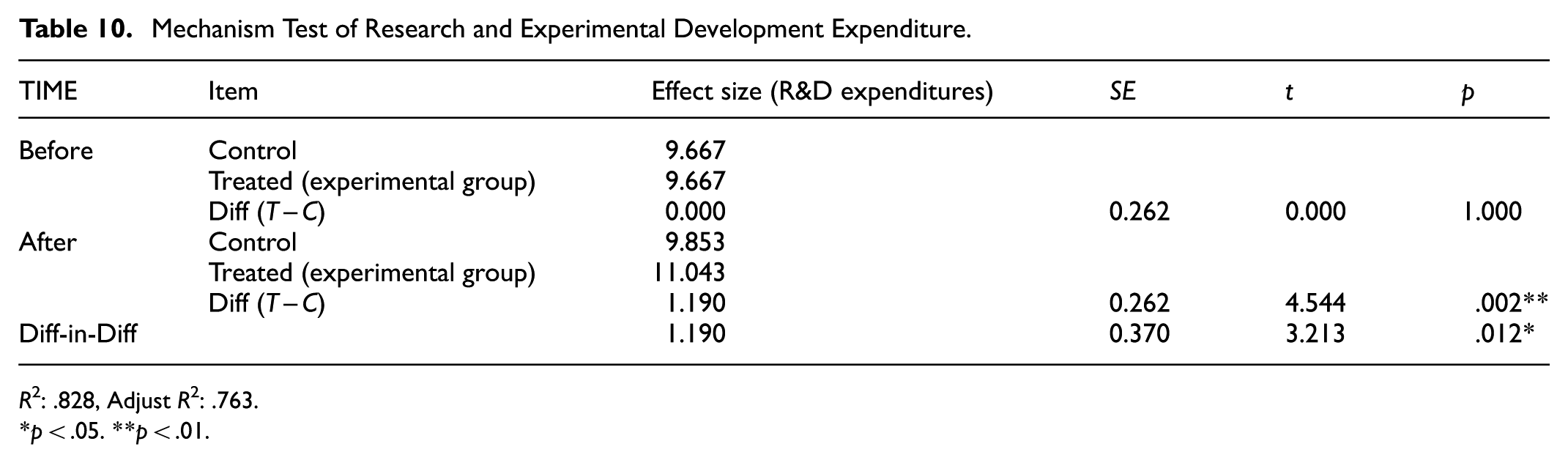
The control variables proposed in this paper for the R D investment and scientific and technological achievements, the following two control variables on the impact of the number of government innovation procurement contracts to verify the H2, H3, research and experimental development expenditures regression analysis results in Table 10.
Mechanism Test of Research and Experimental Development Expenditure.
R2: .828, Adjust R2: .763.
p < .05. **p < .01.
From the data processed by the model in the above table, we can see that the effect value calculated by the double difference model after the policy is issued is 1.190, which is >0, and the p value is .2%, showing a significance of 1% level, which can indicate that the number of government innovation contracts has been further increased through the expenditure of research and experimental development funds, and the effect gap between before and after the policy is issued is obvious. For the whole model, the effect value is 1.190, which is >0. The p value is 1.2%, which is at the significance level of 5%, which shows that deepening the reform of government procurement system has played a positive role in promoting the research and experimental development funds.
From the data processed by the model in the above table, we can see that the effect value calculated by the double difference model after the policy is issued is 1.703, which is >0, and the p value is .2%, showing a significance of 1% level, which can indicate that the number of government innovation contracts has been further increased by studying the transformation of scientific and technological achievements. The effect gap between before and after the policy is issued is obvious. For the whole model, the effect value is 1.703, which is >0, and the p value is 1.1%. At the significance level of 5%, this can explain that deepening the reform of government procurement system has played a positive role in promoting the transformation of scientific and technological achievements.
According to the data in Tables 10 and 11, the decision-making of deepening the reform of government procurement system promotes the signing of government innovation contracts through the number of scientific research investment and scientific and technological achievements transformation, so H2 and H3 are established. However, it should be noted that the amount of scientific research investment and scientific and technological achievements transformation is the government innovation support policy on the supply side, that is, the government supports enterprise innovation with innovation subsidy, R&D tax exemption and intellectual property protection policies, but in practice, the policy support on the demand side is also very important.
Research and Invention Patent Transfer Number Mechanism Test.

R2: .852, adjust R2: .797.
p < .05. **p < .01.
Research Conclusions and Recommendations
This study, based on the Differences-in-Differences (DID) model, analyzed the impact of the 2018 public procurement law reform on the number of government innovation procurement contracts. The results show that the policy reform had a significant positive effect on the number of innovation procurement contracts, with an effect size of 1,176.159, and the effect is significant at the 5% level. This indicates that the 2018 reform plan for deepening the government procurement system significantly promoted the growth of government innovation procurement contracts. Furthermore, the mechanism test revealed that research and development investment and the transformation of scientific and technological achievements also played an active role during the policy implementation process. These findings offer empirical evidence of the policy reform’s actual effects. However, there are some limitations in the study. Despite controlling for time trends and group differences before and after the policy implementation, the risk of omitted variable bias still exists. Additionally, the study did not sufficiently discuss the differences across departments in the policy implementation. Some sectors may have significantly benefited from the policy reform, while others may have shown different outcomes due to their own characteristics or changes in the external environment. Moreover, the overall increase in innovation or R&D activities in China might have driven the adoption of procurement reforms, rather than the reform directly leading to an increase in innovation. This potential reverse causality requires further investigation.
Based on the findings and limitations of the research, the following recommendations are offered:
Control for confounding factors and endogeneity issues: Future research should fully consider the influence of other concurrent policies or broader economic trends when analyzing policy effects. It is recommended to use multidimensional control variables or instrumental variable methods to reduce omitted variable bias. Further investigation into the possibility of reverse causality should be conducted, including the introduction of lagged variables or causal inference methods to verify the causal relationship between policy reforms and innovation procurement.
Refine sector and regional analysis: The effects of policy reforms may differ significantly across sectors or regions. It is suggested that future research delve deeper into the performance of different sectors and regions in policy implementation and explore the heterogeneity of policy effects.
Based on the research results, it is recommended that the government continue to promote the reform of the public procurement law while focusing on the synergy with other innovation support policies (such as R&D subsidies, tax incentives, etc.), to form a cohesive policy force. During policy implementation, dynamic monitoring and evaluation of different departments and regions should be strengthened to ensure the balance and sustainability of the policy effects. Future research can further enhance the scientific rigor of the conclusions and the relevance of policy recommendations. These improvements will not only help provide a more comprehensive assessment of the actual effects of the policy reform but also offer important insights for optimizing innovation procurement strategies.
Footnotes
Authors’ Note
I would like to declare on behalf of my co-authors that the work described was original research that has not been published previously, and not under consideration for publication elsewhere, in whole or in part. All the authors listed have approved the manuscript that is enclosed.

Funding
The author received no financial support for the research, authorship, and/or publication of this article.
Declaration of Conflicting Interests
The author declared no potential conflicts of interest with respect to the research, authorship, and/or publication of this article.
Data Availability Statement
The data that support the findings of this study are available from the corresponding author upon reasonable request.