



Abstract
Corporate green innovation has undergone mountainous growth during the last decade, which has led to an essential accumulation of knowledge in the recent literature. This study conducts a systematic literature review of green innovation research in business economic discipline to understand corporate green innovation’s internal and external origin drivers. We explored the drivers, mediating and moderating effects, and consequences of individual conceptual frameworks following internal and external origins. Using a systematic literature review (SLR) and a content analysis approach, the PRISMA model included 91 published research articles for the review. The findings reveal the following critical conclusions: (a) both internal origin and external origin drivers stimulate the development of corporate green innovation; (b) the internal origin drivers are particularly more relevant in developing proactive and reactive green product and process innovation, whereas external origin drivers foster the development of reactive green innovations; however, (c) the role of corporate board is crucial in navigating and mitigating external origin uncertainties through building strategic goals and actively engaging with top management team based on firm-specific capabilities and resources for proactive green innovation development. This is the first systematic review to adapt a comprehensive content analysis approach to uncover internal and external origin drivers of green innovation under resource dependence theory and its complementary notions in comparison to notable business management theories. The findings of the review paper highlight various future research opportunities and practical implications for firms opting for green innovation development.
Introduction
Governments and regulatory bodies have implemented environmental policies to guide enterprises in achieving energy efficiency and emission reduction through green innovation. Green innovation has become a crucial avenue for governments worldwide to foster sustainability and carbon neutrality. Various countries have designed and implemented national policies to promote green innovation as a pathway to green transition, for instance, Chinese Green Finance Pilot Policy (GFPP) (Xu et al., 2023), German Renewable Energy Source Act (Rogge & Joachim Schleich, 2018a), Japanese Green Innovation Fund Projects (Herrador et al., 2024) and US Clean Energy Innovation Strategy (Kuchina-Musina & McMartin, 2024). Destruction of the ecological environment caused by industrial economic growth, high energy consumption, and high pollution is a critical problem that many countries are eagerly solving (Ramalingam et al., 2018). At times, choosing to close high-emission enterprises or reduce the production of energy-consuming products can directly affect national economic growth (Alshebami, 2023; Gu, 2022). An increasing deterioration of the ecological environment can discourage sustainable development, which is inconsistent with sustainable future targets set by the United Nations Sustainable Development Goals (UN-SDGs) and net-zero carbon emissions under the Paris Climate Agreement goal by 2050 (D. Hu et al., 2021; Shahzad et al., 2021; J. Sun et al., 2022). At the United Nations Climate Change Conference (COP26), countries made significant commitments to reducing methane emissions, stopping and reversing forest loss, aligning the financial sector with the net-zero goal by 2050, hastening the phase-out of coal, ceasing the production of internal combustion engines, and stopping the foreign financing of fossil fuels (WRI, 2022). Although significant progress has been made on many fronts, national climate and financing commitments have yet to meet what is needed to address global climate risk (WRI, 2022). In current times, major carbon emission emitters, for instance, the United States, China, and India need to upgrade their emission reduction targets by 2030 to align with the net-zero emission targets, considering Finland as an example (Alola & Adebayo, 2023). Considering the importance of sustainable development and carbon efficiency, decoupling economic growth and environmental sustainability has become a critical concern for the business community (Z. Chen et al., 2021; Xu et al., 2023). In this context, complex green innovation on multiple frontiers has been identified as a feasible path to achieve green economic transformation (Xu et al., 2023). Green innovation fosters innovative solutions with minimal energy consumption and environmental and social adversities (B. Lin & Xie, 2023; Naveed et al., 2023; Yousaf et al., 2024). The development of green innovation has become a prominent pathway among scholars and firms (Jia et al., 2024). Therefore, managers and scholars need to understand the drivers and protocols of green innovation to produce the dual-layer advantage of generating favorable consequences for society and the environment as well as business performance in terms of gaining competitive advantage and financial and economic gains.
In recent years, extensive research has been conducted on the concepts of corporate green innovation worldwide (Feng et al., 2024; Jia et al., 2024; Xia et al., 2022). The expanding body of literature on green innovation across various industries and countries can sometimes yield contradictory or conflicting findings. This may lead to ambiguous conclusions and foster a perception of inconsistency in understanding green innovation development (Tariq et al., 2017). Generally, in this research, the existing knowledge on innovation is characterized by five main theoretical perspectives: (a) stakeholder theory (Alkebsee et al., 2023; K. Gao et al., 2022; Guoyou et al., 2013; Jiang & Bai, 2022; Kim et al., 2021; D. Li & Shen, 2022; Liang et al., 2022; Mbanyele et al., 2022; Ren & Wang, 2023; Singh et al., 2022; X. Su et al., 2020; Vasileiou et al., 2022; Yang & Chen, 2023; Yuan & Cao, 2022; Zhai et al., 2022; Zhang, Li, et al., 2022), (b) institutional theory (Aguilera-Caracuel & Ortiz-de-Mandojana, 2013; Chang, 2011; Dong et al., 2022; Duque-Grisales et al., 2020; Elmawazini, Atallah, Rafiquzzaman, et al., 2022; Guoyou et al., 2013; J. Hu et al., 2022; Huang Mbanyele, Wang, et al., 2022; Huang, Li, Xiang, et al., 2022; Jiao et al., 2020; Kim et al., 2021; Kim et al., 2020; Lian et al., 2022; H. Lin et al., 2014; Naveed et al., 2023; Ren & Wang, 2023; Rogge & Schleich, 2018b; J. Sun et al., 2022; Wu et al., 2020; Q. Zhang & Ma, 2021; Zhang, Hu, et al., 2022), (c) resource-based view (RBV) (Alshebami, 2023; Anik & Sulistyo, 2021; S. Chen et al., 2021; Q. Guo & Wei, 2021; Y. Guo et al., 2020; Gürlek & Tuna, 2018; Ho et al., 2023; Jiao et al., 2020; J. Li et al., 2023; H. Lin et al., 2014; Ma et al., 2022; Mulaessa & Lin, 2021; Shahzad et al., 2021; Tariq et al., 2020; Wu et al., 2020; Zhai et al., 2022; Zhang, Hu, et al., 2022), (d) resource dependence theory (RDT) (Asni & Dianawati, 2023; Bai & Lin, 2022; Feng et al., 2024; D. Gao et al., 2023; W. Hu et al., 2021; Ilg, 2019; Javeed, Latief, & Akram, 2023; Jia et al., 2024; Kuo et al., 2022; Lapologang & Zhao, 2023; Z. Li et al., 2023; Liu & Cao, 2024; Qadeer et al., 2024; Rahman, 2023; R. Su et al., 2023; Usman et al., 2020; Xia et al., 2022; Yousaf et al., 2024; Yousaf et al., 2022; Zhuo et al., 2024), and (5) upper echelon theory (UET) (H. Lin et al., 2022; D. Sun et al., 2021; Tan & Zhu, 2022; Ullah et al., 2023). Several recent studies have investigated the concept of green innovation under multiple theoretical frameworks. However, RDT can offer a broader and complete view, capturing the vastly studied concept of green innovation and classifying the driving factors into internal and external origins.
RDT (Pfeffer & Salancik, 1978, 2003) positions two aspects: (a) external uncertainty in the environment and (b) the management and its firm-specific aspects, which can be further generalized as internal and external origins. In internal origin, management adapts and transforms internal or firm-specific capabilities and resources to optimize green innovation and achieve sustainable competitive advantage or desired outcomes. On the other hand, the external environment considers external driving forces such as stakeholders, market competition, market uncertainty, political uncertainty, resources, capital, restrictions and regulations, provision of technology and funds, etc. (Liu & Cao, 2024; Qadeer et al., 2024; Rahman, 2023; R. Su et al., 2023). Firms depend on external driving forces, which influence green innovation progression and practices within the firm. To achieve optimized green innovation outcomes, RDT theory emphasizes incorporating corporate boards offering support to firms to navigate their external environments and firm dependencies on external vulnerabilities and encourage firms to develop effective internal green innovation practices or firm-specific capabilities as well as encourage firms to manage green innovation practices in accordance to external requirements to contribute the firm performance. It is important to note that internal and external stakeholders’ perspectives of stakeholder theory (Freeman, 1984) may ignore important factors from internal and external origins, which are equally crucial in developing green innovation. According to RDT, we analyze the literature from two aspects: (a) internal origin and (b) external origin, which is crucial to understanding the holistic view and multifarious drivers of green innovation. On the other hand, theories often complement each other in understanding complex organizational phenomena such as green innovation. Thus, the authors may not entirely exclude the role of other theoretical frameworks in understanding drivers of green innovation.
From the practice, dividing the drivers of green innovation into these two aspects is also meaningful. Studying the internal and external origins factors of green innovation is crucial for comprehending their varied roles in fostering different types of green innovation (Y. S. Chen et al., 2012). According to Y. S. Chen et al. (2012), it is important to understand that green innovation can have both proactive and reactive natures and can be driven by different origins, that is, internal and external origins. The distinction between internal and external origins can be simplified such that internal origin stems from within the firm, and external arises from outside the firm. The internal origin includes several internal factors such as firm characteristics, firm capability (green, digital, and dynamic), environmental culture, internal control, knowledge management process, management style dynamics, and internal stakeholders such as employees, top management team, and board of directors. On the other hand, external origin includes external factors such as financial constraints, technological advancement, financial support, environmental complexity, uncertainty, and pressure from external stakeholders such as governments and sustainability regulatory institutions. Therefore, by delving into internal and external origins, researchers and practitioners can better understand and identify internal strengths and weaknesses as well as external opportunities and challenges for advancing green innovation.
How do internal and external origin drivers influence the development of green innovation? Nevertheless, an important objective is to make theoretical and practical contributions to green innovation development. This literature is based on the following three primary research questions (RQs):
RQ1: What are green innovation’s internal and external origin drivers?
RQ2: What are the key mediators and moderators studied in previous green innovation research?
RQ3: What are the key consequences of developing green innovation?
RQ4: Can green innovation’s internal and external origin drivers be explained in a unified theoretical framework?
This paper contributes to previous research in quite a following ways: (a) it provides a systematic review to depict the development of green innovation dividing into proactive and reactive natures driven by internal and external origins, represented in Figures 1 and 16; (b) given the description and limitations of the leading theories, it contributes that the multifarious drivers of green innovation may not be comprehended into a unified theoretical framework, drawing research attention on the application of multiple theoretical frameworks to understand multifarious drivers of green innovation; (c) it lays a clear foundation for future research opportunities offering a proposed framework and new ideas to compensate gaps in existing research on green innovation; (d) this study enriches the theoretical understanding and applicability of RDT, enhancing theoretical discourse in green innovation research due to its greater relevance in capturing both external and internal aspects of firms in green innovation development. Additionally, this review paper adds valuable insights to corporate green innovation literature using a systematic literature review (SLR) based on 91 published research papers relevant to green innovation literature to address the subsequent research questions. The paper also underscores the following characteristics of the selected articles: (a) productive journals, (b) theoretical underpinning, (c) industry focus, (d) methodologies, (e) country focus, and (f) year of publication.

Conceptual framework.
The remainder of the article is structured as follows: Section “Methods and Data Screening” describes the methods and screening process; Section “Theories in the Green Innovation Literature” discusses the theories considered in the green innovation literature; Section “Green Innovation Definition” defines green innovation as a concept; Section “Drivers of Green Innovation” explores the drivers; Section “Mediating and Moderating Effects and Consequences of Green Innovation” considers mediating and moderating effects and consequences of green innovation; Section “Conclusions and Future Research Directions” concludes the review paper with future research avenues.
Methods and Data Screening
This study employed a structured approach for a literature review on green innovation. Generally, a structured approach is based on a systematic literature review (SLR), where the findings of previous studies are discussed on a concept or research questions. The Preferred Reporting Items for Systematic Reviews and Meta-analyses (PRISMA) framework was developed to identify related research papers. Subsequently, three major criteria were applied to the previously published research on green innovation in the Web of Science (WoS) to retrieve the most relevant research papers, following Adams et al. (2016) for the systematic reviews.
The paper must be published in the discipline of business and economics.
The selection process: This study screened out the relevant literature to identify search terms for drivers and consequences of green innovation using the following keywords, (“Green innovation,”“sustainable innovation,”“environmental innovation,” and “ecological innovation”).
The article must have been published between the period of 2010 to 2024.
In the first stage, authors searched for articles in the WoS platform and Scopus using the predefined keywords from 2010 to 2024, followed by a substantial increase in publications on green innovation since 2010. This time frame also allows us to capture significant technological advancement, SDGs development, net-zero carbon emission target period, and evolution and maturation of green innovation technologies and practices. Applying the first criteria, we found 2488 research articles in the first stage indexed in the WoS platform in the business economics area, higher than the Scopus database. 1 In our literature review, we consider the WoS database as a primary and single source of screening and selecting papers to establish the reliability and validity of findings and ensure that results are trustworthy and accurate. 2 The WoS database is the oldest and most comprehensive (Pu et al., 2022), offering a more selective, structured and balanced database that provides a wide range of information purposes (Birkle et al., 2020) 3 in social sciences (Xiao et al., 2023). Previous research across the disciplines has also acknowledged the usability, credibility and widespread literature accumulation of the web of science (Birkle et al., 2020; Pu et al., 2022; Xiao et al., 2023; Zhu & Liu, 2020; Zhu & Liu, 2020). 3 The tree map in Figure A1 shows the consideration of green innovation concepts across diverse disciplines; among them, the “Business Economics” area is the leading area of green innovation research. Since the research focuses on firm-level green innovation, “Business Economics” articles were chosen and transferred to the next stage.
In the second stage, the selection process was carried out on initially selected articles; the selection process illustrated in Figure 2 ensured a step-by-step process as follows: (a) searching strings or keywords in the title helped us to exclude 710 articles, (b) applying selection criteria across abstract, intext and variables dimensions and research frameworks, if given, was finished on choosing not more than 427 articles (c) making final relevancy call on the inclusion or exclusion, ended us selecting 102 research articles suitable for the review. Finally, the authors screened out 19 duplicate articles, and 91 research articles were considered samples and deployed to the next stage.

Article screening and selection process.
In the final stage, the study used content analysis, which is particularly useful in business and economics research since it applies objective coding to condense the data and make them systematically comparable (Tariq et al., 2017; Tranfield et al., 2003). A thorough examination of the pertinent literature served as the basis for the study’s structure, which provided validity and relevant literature findings (Adams et al., 2016). The information from selected articles that made up the shortlist has divided the content into internal origin and external origin (Y. S. Chen et al., 2012), mediators and moderators, consequences, and major theories employed in the literature on green innovation.
Research Characteristics
The characteristics of the selected articles for the analysis of the review paper are classified into six major categories: (a) productive journals, (b) theoretical underpinning, (c) industry focus, (d) methodologies, (e) country focus, and (f) year of publication. Figures 3 to 8 plots illustrate various key characteristics of the reviewed papers. Figure 3 shows that the articles on green innovation have been published in more than 45 journals; however, the Journal of Cleaner Production, Business Strategy and the Environment, Technology in Society, Sustainability, and Journal of Business Research were major platforms for authors to publish green innovation research. These are highly reputed journals indexed in the Web of Science and Social Sciences Citation Index (SSCI). Figure 4 suggests several theories researchers used to support the research frameworks. Among them, resource dependence theory was the leading theory, featured in 21 research papers, followed by the resource-based view, stakeholder theory, and institutional theory in 13, 14, and 13 papers, respectively. Upper echelon theory was less represented, appearing in four papers. It is important to note that some published papers did not incorporate any theoretical framework, while others utilized multiple theories instead of focusing on a single theory. Figure 5 illustrates the industry focus of the published research. The manufacturing sector was a widely focused sector across published research taking data from China A-Share, and Chinese listed companies, owning its significance in addressing sustainability and environmental adversities. However, the studies have given relatively limited attention to the financial services, hotel industry, and other service sectors. Research published from 2010 to 2024 was considered, as Figure 6 illustrates that research on corporate green innovation has shown a rising trend. Among the considered studies, 22 were published in 2022 and 12, 13, and 11 were published in 2020, 2021, and 2023, respectively. Figure 7 shows that regression, structural equation modelling (SEM), ordinary least squares (OLS), and the logit/probit models were key methodological techniques applied in previous research on green innovation. Regression has been the most widely used analysis technique, followed by structural equation modelling. Figure 8 delineates the country of focus of the reviewed articles. The plot demonstrates that China has been a leading country of focus where green innovation research has been published considering various domestic sectors, particularly the manufacturing industry. Few researchers have focused on the US, Taiwan, Thailand, Indonesia, and Pakistan as drivers of green innovation research. These characteristics are shown in Table 1.
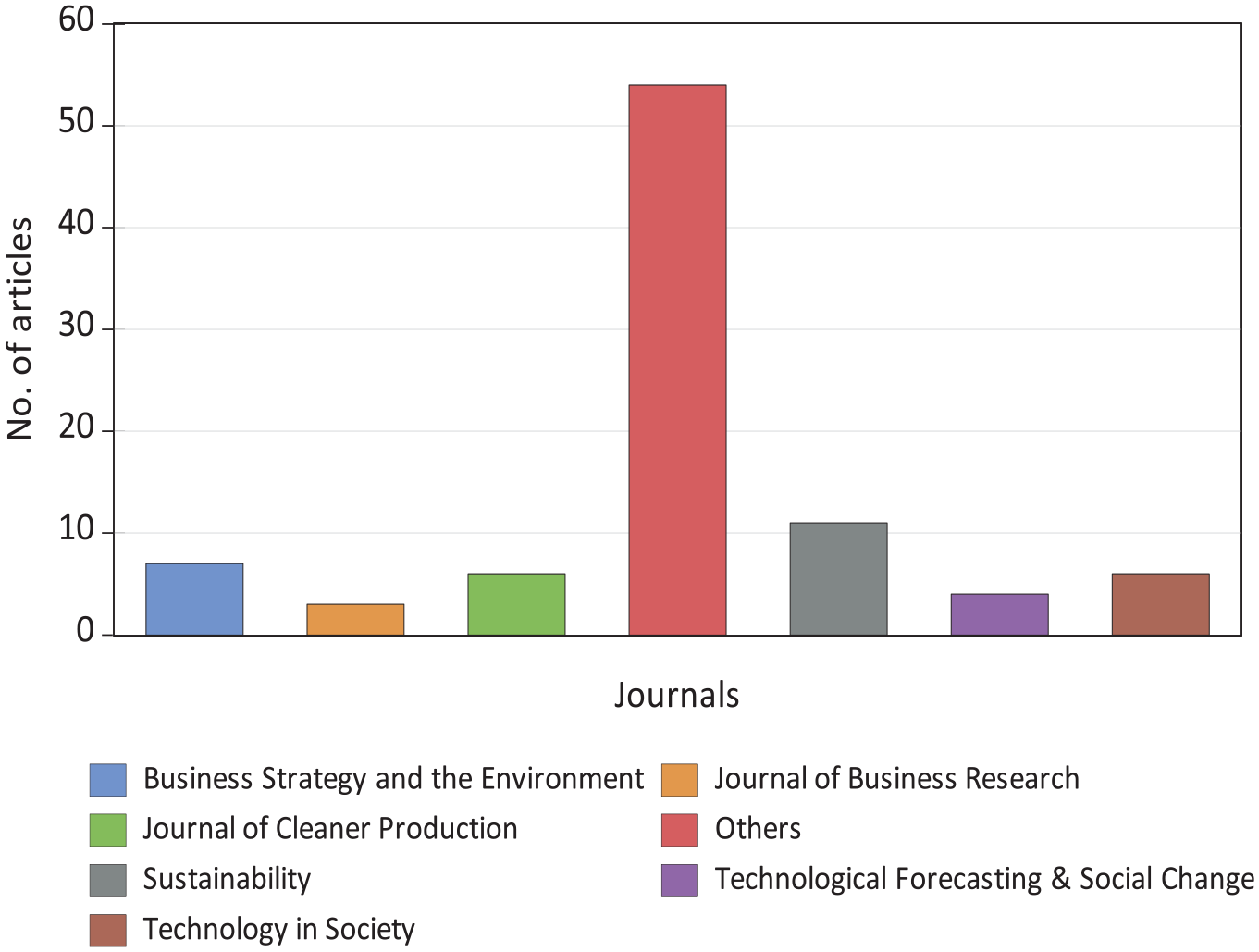
Productive journals.

Theories across green innovation research.
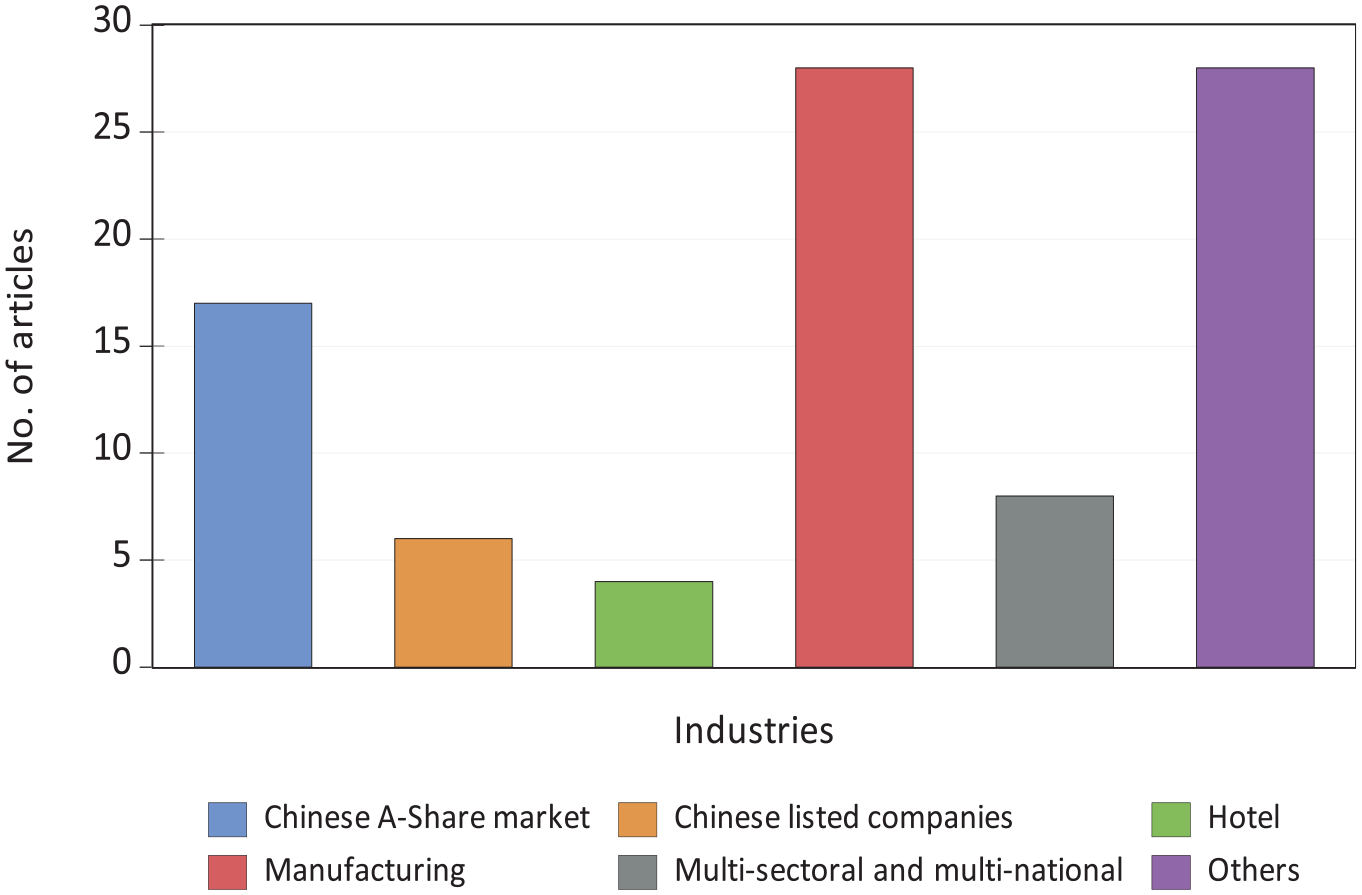
Industry focus.

Number of publications yearly.

Research methods across research.

Country of focus.
Key Characteristics of Included Articles.

Source. Collected and presented by the authors.
Theories in the Green Innovation Literature
The literature on green innovation has a variety of theoretical underpinnings for supporting research models; among them, five theories dominate research on green innovation: the RBV theory (Barney, 1991), institutional theory (Meyer & Rowan, 1977), stakeholder theory (Freeman, 1984), RDT (Pfeffer & Salancik, 1978, 2003), and UET (Hambrick & Mason, 1984). The RBV theory claims that readily available resources, assets and capabilities can support attaining a sustainable competitive advantage in the market (Dong et al., 2022; Tariq et al., 2017). However, the RBV theory ignores environmental dynamics due to external forces or external origin drivers (Tariq et al., 2017). Therefore, there is a need to explore the external origin drivers of green innovation, which are key sources of green innovation development according to the previous literature (Y. S. Chen et al., 2012). Institutional theory (Meyer & Rowan, 1977) explores the interaction between organizations and intuitions. It states that a firm’s ability to sustain itself in the market relies heavily on the conformation of stakeholders and social norms (Qi et al., 2021; J. Zhang et al., 2020). Several researchers have used institutional theory to uncover the role of pressure from institutions in developing green innovation (Elmawazini, Atallah, Rafiquzzaman, et al., 2022; J. Hu et al., 2022; Huang, Mbanyele, Wang, et al., 2022; Huang, Li, Xiang, et al., 2022; Jiao et al., 2020; Kim et al., 2021; Kim et al., 2020; Lian et al., 2022; H. Lin et al., 2014; Rogge & Schleich, 2018b; J. Sun et al., 2022; Zhang, Hu, et al., 2022). Generally, such research focuses on external stakeholders, such as institutional roles (Tariq et al., 2017); however, it largely ignores internal origin drivers, such as firm capabilities, assets, and the characteristics of management and CEOs, critical drivers of proactive green innovation. Stakeholders theory generally states that stakeholders are key elements that directly influence decisions and strategies; therefore, previous research has shown that stakeholders play a critical role in shaping green innovation (Guoyou et al., 2013; Jiang & Bai, 2022; Ren & Wang, 2023; Singh et al., 2022). Although stakeholder theory provides a comprehensive theoretical foundation for understanding the role of internal (customers, suppliers, managerial staff, and employees) and external stakeholders (investors, competitors, regulatory bodies, and governments) (Weng et al., 2015), it still ignores the role of firm-specific factors, for example, a firm’s resources, dynamic capabilities, technological capabilities, and green technological capabilities.
Given the limitations of previously discussed theories, it is evident that a more comprehensive framework is necessary to address green innovation. Thus, this emerges as a pertinent avenue for inquiry. The Resource dependence theory was initially given by Pfeffer (1972a, b, c) and later developed by (Pfeffer & Salancik, 1978, 2003). Figure 9 displays that the influence of external factors in the environment can directly or indirectly affect business actions or structure (Nienhüser, 2008). As a result, this can affect achieving green innovation (Asni & Dianawati, 2023; D. Gao et al., 2023) in a proactive and reactive mechanism (Y. S. Chen et al., 2012). For instance, developing green innovation can be influenced by internal and external sources, which must be differentiated separately. Figure 9 of the dependence theory was a graphical representation from Nienhüser (2008) based on Pfeffer (1972a, 1972b, 1972c). According to Davis and Cobb (2010); Hillman et al. (2009), RDT is based on three main principles: (a) the social environment matters, (b) organizations have tactics to increase their autonomy and pursue interests, and (c) power (rather than just rationality or efficiency) is crucial for comprehending internal and external actions. In addition, it considers the role of the corporate board in controlling uncertainty spillovers from external origins (Davis & Cobb, 2010; Hillman et al., 2009; Nienhüser, 2008). The theory suggests corporate boards can support tackling uncertainty from external sources by utilizing internal control systems and strategies (Hillman et al., 2009). Moreover, RDT theory significantly balances internal and external origins by incorporating the corporate board. In short, how firms develop their internal control system with the guidance and support they receive from the board of directors as per external dependencies can significantly influence the development of green innovation and its consequences in achieving favorable financial and environmental outcomes and competitive advantage. Thus, by taking a strong relevance to the objectives of the current literature review, RDT offers a broad and complete view of green innovation development across both external and internal factors compared to other theoretical frameworks. It supports our choice to construct an integrated framework for the green innovation literature based on external and internal origin drivers in understanding proactive and reactive corporate green innovation. Therefore, RDT provides a complete foundation for building an understanding and an integrated framework of green innovation development considering the impact of external origin drivers, internal origin drivers, and consequences of corporate green innovation.

Resource dependence theory.
Green Innovation Definition
Previous studies have used multiple terminologies to interchangeably define green innovation as a concept. These terms include “sustainable innovation,”“environmental innovation,” and “ecological innovation.” These terms have similar meanings as constructs; however, a minor difference in their description does not separate them, so the operational definition of green innovation in this review is synonymous with sustainable, environmental, and ecological innovation. Expanding green innovation as a construct generally focuses on green product innovation and process innovation. Green product innovation refers to the designing, manufacturing, and selling of a product with minimal effect on society and the environment, where it outperforms conventional alternatives while creating more value for users. Relatedly, green product innovation refers to transforming processes and technologies used to produce products with minimal effects on society and the environment. Therefore, following Z. Chen et al. (2021); Rennings (2000), this review defines green innovation “as new or modified products and processes, including technology, managerial, and organizational innovations, which help sustain the surrounding environment.” Generally, two types of green innovation have been discussed in earlier literature: proactive and reactive green innovation (Y. S. Chen et al., 2012). The current review paper follows the definitions and classifications of green innovation by Y. S. Chen et al. (2012), where proactive green innovation involves active environment-related innovation initiatives by the organization relating to new product or practice initiatives, cost-effectiveness, competitive edge, and seizing opportunities. On the other hand, reactive green innovation is passively environmentally related through compliance with national or international regulations and externalities, including external stakeholders. The subsequent discussion debates over previous findings in the literature on green innovation considering the external origin and internal origin drivers and consequences.
Drivers of Green Innovation
In recent years, scholars have given great attention to addressing several drivers of green innovation. Previous studies view drivers of green innovation in several domains, such as market factors, stakeholder pressure, technological factors, organizational-level factors, sociocultural and ethical factors, and collaborative factors (Tariq et al., 2017). However, the drivers of green innovation can be classified into two categories: internal origins and external origins (Y. S. Chen et al., 2012). Internal origins factors are more company-specific, such as environmental culture, environmental capabilities, and environmental leadership, whereas external origins consider environmental regulations, external stakeholders, and other national or international laws. Therefore, the impact of green innovation drivers identified in previous research is classified and discussed based on their origins in this literature review to better understand their role in corporate green innovation development.
Internal Origin Drivers
As noted above, internal origin drivers are generally company- and management-specific factors. Figure 10 demonstrates the internal origin drivers of green innovation studied previously. In the previous literature, management power was viewed as one of the prominent drivers of green innovation. For instance, in D. Gao et al. (2022), management power negatively affected green innovation and was more pronounced for state-owned companies than nonstate-owned firms. However, green human resource management (GHRM) practices and knowledge management processes positively lead to organizational green innovation (Munawar et al., 2022; Shahzad et al., 2021). Similarly, the short-termism of managers negatively impacts green innovation in China’s A-share listed companies (Fan, 2023). He et al. (2021) and Yi et al. (2023) found that powerful chief executive officers (CEOs) and senior management academic expertise are influential sources of increasing corporate green innovation in China due to their control over green corporate resources and allocation of green innovation development (Yi et al., 2023). In particular, CEOs with higher trustworthiness, education attainment, and humility have a greater probability of greater green innovation (Y. Sun et al., 2021; Ullah et al., 2023; Zhang, Zhou, et al., 2022).

Internal origin drivers of green innovation.
In the previous literature, firm-specific factors such as technological capabilities and internal control are also notable sources of green innovation (Ma et al., 2022; Tariq et al., 2020; Wu et al., 2020). In a similar domain, green digital capabilities also drive green innovation positively and with statistical significance (Singh et al., 2022). Firms’ ethical and corporate social responsibility (CSR) practices are also key drivers of green innovation and significantly promote green product and process innovation (Yuan & Cao, 2022). Firms’ CSR practices positively influence environmentally sustainable development and increase green innovation (Shahzad et al., 2020; Shahzad et al., 2021). Similarly, corporate environmental ethics drive a firm’s green practices, as does green innovation (Y. Guo et al., 2020). Thus, internal origin factors such as proactive environmental business strategies are important in developing green innovation and green competitive edge (Kuo et al., 2022). Moreover, firms with higher executives’ environmental awareness are more prone to develop and implement green innovation within the firms (Liu & Cao, 2024). Green human resource practices drive team green innovation (W. Hu et al., 2021). In addition, higher first-time costs and project complexity are critical barriers to green innovation development in the construction industry (Ilg, 2019).
External Origin Drivers
The second class of green innovation drivers is external origin drivers, and Figure 11 demonstrates the external origin drivers of green innovation studied previously. According to earlier research, environmental regulations are among the widely studied external-origin drivers of reactive green innovation and are viewed as favorable for accelerating green innovation (Lian et al., 2022; H. Lin et al., 2014). To control the environment, the government can also create policies and regulations that compel businesses to adopt environmentally friendly practices (Jiao et al., 2020). For example, cleaner production standards (J. Hu et al., 2022), green finance pilot zones (Huang, Mbanyele, Wang, et al., 2022), and intellectual property rights and competition policy (Elmawazini, Atallah, Rafiquzzaman, et al., 2022). Moreover, market incentives and command and control regulations demonstrate a U-shaped relationship with green innovation (Zhang, Hu, et al., 2022). Notably, stringent environmental regulations stimulate green innovation in multi-national companies (Kim et al., 2021) and manufacturing firms in China (H. Lin et al., 2014). Implementing China’s Plan for Sustainable Development of Resource-Based Cities (SE Policy) promotes heavily polluting firms’ green technology innovation. The impact of SE policy on firms’ green technology innovation is more significant for firms with a high degree of slack resources (J. Sun et al., 2022). Similarly, China’s Green Finance Pilot (GFPZ) policy substantially restricts enterprises from engaging in low-quality green innovation. It encourages them to spur high-quality innovation in the long run (Huang, Mbanyele, Wang, et al., 2022). Likewise, firms are more likely to enhance the quality and output of green innovation in countries where mandatory CSR disclosure laws are implemented (Mbanyele et al., 2022). In particular, China’s mandatory CSR disclosure policy promotes greater green innovation in large, pollution-intensive industries and state-owned firms than non-CSR reporting firms (Hong et al., 2020; Ren et al., 2022).
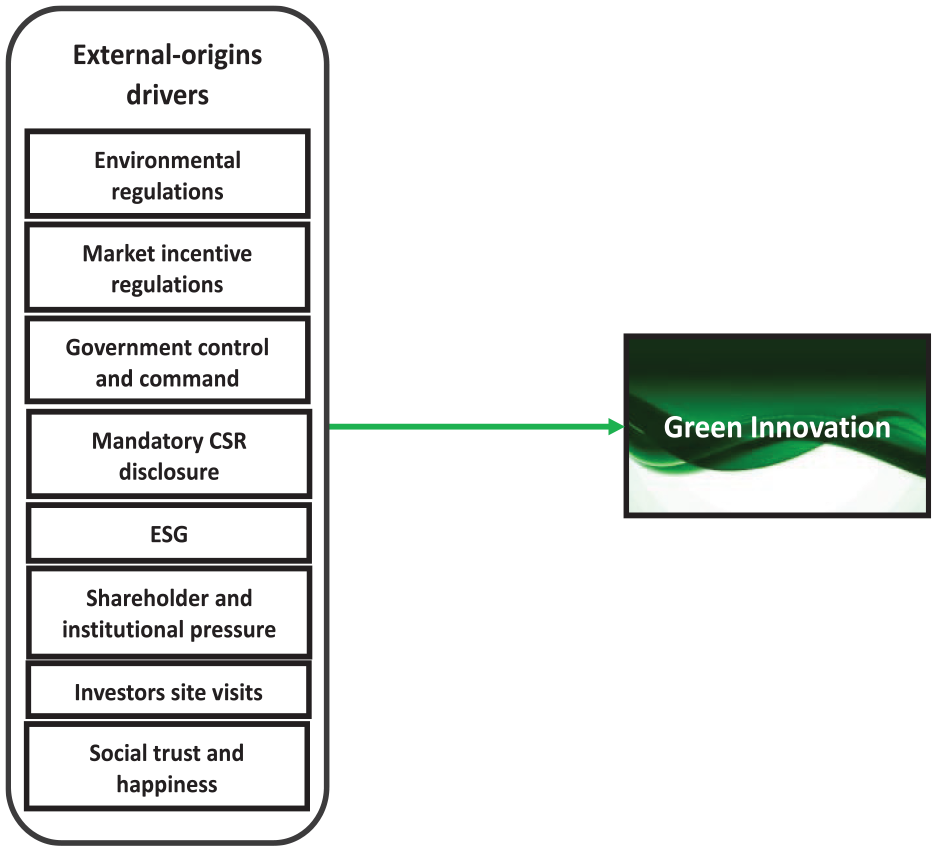
External origin drivers of green innovation.
Considering the above concept of external origin drivers, better environmental, social, and governance (ESG) conditions lead to better green innovation (Tan & Zhu, 2022; Zhai et al., 2022). Some studies have argued that the ESG performance of green innovation corporations can significantly induce green innovation in other peer companies in the industry (J. Li et al., 2023). Stakeholder and institutional pressure are notable drivers in the literature that force green innovation in organizations. Stakeholder pressure forces enterprises to expand their green digital capabilities, which leads to better green innovation (Singh et al., 2022). Moreover, institutional pressure also motivates firms to facilitate green innovation, and institutional pressure is sometimes more effective for polluting firms to induce green innovation development (Ren & Wang, 2023). Sometimes, investor site visits induce green innovation, mainly when pressure-resistant investors are involved, and this phenomenon is more prominent in firms with dual CEO positions (Jiang & Bai, 2022). Stakeholders such as foreign customers can drive companies to follow green product and process innovation (Guoyou et al., 2013).
Resource dependence theory was analyzed across several external origin factors; for instance, green financing and digitalization level are notable external factors that may lead to green innovation development (Bai & Lin, 2022). Zhuo et al. (2024) also documented a similar finding and concluded that digital transformation has a stronger ability to positively influence the quality and capacity of green innovation in firms. Moreover, environmental information disclosure requirements positively impact corporate green innovation (Feng et al., 2024; Lapologang & Zhao, 2023). Notably, the local government’s political resources and soft pressure foster green innovation; however, mimetic pressure may decrease the intensity of green innovation progress (Z. Li et al., 2023). It is important to note that political ties have been crucial to strengthening or weakening the positive relationship (Lapologang & Zhao, 2023; Z. Li et al., 2023). Several other external factors are helpful drivers of green innovation patents, such as corporate collaborations, government subsidies, regional university research, development intensity, and government attention (D. Gao et al., 2023). The business-to-government relationship influences green innovation, highlighting the importance of exploring the internal influence and external determinants (Jia et al., 2024). In the related standard, Qadeer et al. (2024) documented that state participation promotes green innovation (Qadeer et al., 2024). Moreover, institutional pressure and financial constraints significantly influence the development of corporate green innovation (R. Su et al., 2023). These have shown that external origin drivers, such as green financing, digitalization, and environmental disclosure, influence green innovation under resource dependence theory.
Role of Corporate Board
The presence of the corporate board plays a crucial role in developing sustainable innovation through overseeing internal and external origins. Through the competencies and characteristics, the board of directors can enhance green innovation and firm performance by linking internal and external origins drivers of green innovation. For instance, board internationalization strengthens green innovation practices in firms (Usman et al., 2020). In addition, board size positively impacts green innovation development in heavily polluting firms (Zhao et al., 2022). Board gender diversity is also crucial and can improve the quality of green innovation (B. Lin & Xie, 2023; X. Lin et al., 2022), particularly by increasing the number of females on the board of directors (Naveed et al., 2023; Xia et al., 2022). Green theme trainings from the board of directors positively influence the development of green innovation (Asni & Dianawati, 2023). On the other hand, board capital, both human and social capital, can support the development of green innovation and green productivity, influenced by government regulations (Javeed, Latief, & Akram et al., 2023; Javeed, Teh, Ong, et al., 2023). Akin to this, Yousaf et al. (2022) also documented that board capital can positively affect green innovation as well as the environmental performance of firms. Yousaf et al. (2024) document a strong relationship between board competence and green innovation; however, external factors, such as external government mechanisms, including media coverage, imitative pressure, and audit quality, can influence this relationship. Therefore, the board of directors plays a crucial role in balancing internal and external origins, considering the needs and stakes of management and external stakeholders, which are major external drivers of reactive green innovation.
Mediating and Moderating Effects and Consequences of Green Innovation
According to resource dependence theory (Hillman et al., 2009), indirect or intervening variables are more significant due to their role in organizations to address external origins or uncontrollable factors (Davis & Cobb, 2010; Hillman et al., 2009). Moreover, undefined moderating and mediating variables provide a critical framework for examining the current theoretical landscape (Baumann et al., 2002). Following their importance, the current review paper provides a comprehensive understanding of mediating or moderating variable studies in the green innovation literature.
Mediating Effects
To understand the mechanisms influencing the development and success of green innovation, researchers have explored several mediating variables in previous research, as illustrated in Figure 12. Figure 12 classifies the mediators based on independent variables or important drivers due to their origins (internal or external) to the mediators mediating the relationship between drivers and green innovation.

Mediating effects.
Financial constraints in the green innovation literature are a widely studied mediating variable in the internal environment. A higher EGS can lower the financing constraints of the industry and improve green innovation (J. Li et al., 2023). An EGS motivates the environmental awareness of executives and mitigates financing constraints that enhance the speed of green innovation development (J. Li et al., 2023). Tan and Zhu (2022); (Zhai et al., 2022) revealed that alleviating financing constraints positively mediates the relationship between EGS and the green innovation of corporations. Therefore, earlier research on green innovation has studied the role of financing constraints. Similarly, regional happiness decreases financing constraints for organizations that ultimately develop positive relationships with green innovation (D. Li & Shen, 2022). Similarly, social trust can decrease financing constraints, leading to better green innovation (Pan et al., 2021).
Munawar et al. (2022) found that the green human capital and environmental knowledge of employees mediate the relationship between green human resource management and green innovation, and they documented statistically significant serial partial mediation. Similarly, human capital mediates the relationship between corporate digitalization and green innovation (J. Li et al., 2023). Tan and Zhu (2022) found that increasing managing environmental awareness mediated the linkage between ESG performance and green innovation. Environmental investment partially mediates the relationship between the internal control of an enterprise and green innovation (Ma et al., 2022).
Environmentally sustainable development positively mediates the relationship between CSR and employees, consumers, the environment, the community, and green innovation (Shahzad et al., 2020). Likewise, sustainable development practices partially mediate the impact of the knowledge management process (acquisition, dissemination, and application) on green innovation at the corporate level (Shahzad et al., 2021). Yuan and Cao (2022) concluded that green dynamic capabilities partially mediate the relationship between CSR and green product and process innovation. Similarly, green dynamic capabilities mediate the linkage between stakeholder pressure and green innovation, and green innovation mediates the relationship between green dynamic capabilities and firm financial and market performance (Singh et al., 2022). K. Gao et al. (2022) found that although managerial power significantly impacts green innovation, innovation input partially mediates this relationship. Green innovation practices mediate the relationship between environmental leadership and financial performance (X. Su et al., 2020).
In addition, D. Sun et al. (2021) suggested that green business strategy mediates the linkage between CEO humility and green innovation in Chinese manufacturing firms. Moreover, Tariq et al. (2020) viewed building technological capabilities as an essential strategy for firms in developing higher green process innovation and concluded that digital capabilities mediate the relationship between a firm’s life cycle and green process innovation. A cooperative R&D strategy mediates the linkage between technological capabilities and eco-innovation performance (Wu et al., 2020). However, Yi et al. (2023) find that digital capabilities alone are not enough to develop green innovation better; however, innovation input also plays a crucial role; hence, innovation input mediates the relationship between digital capabilities and green innovation.
Moderating Effects
The moderating effects are also segregated based on their origins, as depicted in Figure 13. By emphasizing the internal environment, senior management characteristics, such as managerial environmental concerns, positively moderate the linkage between green human resource management and green innovation (Munawar et al., 2022). Highly educated management and key management positions have a positive moderating role in senior management academic experience and green innovation among corporations (He et al., 2021). Moreover, as a moderator, environmental knowledge learning strengthens the positive linkage between environmental leadership and green innovation (X. Su et al., 2020). CEOs with higher social responsibility awareness positively buffer the relationship between powerful CEOs and green innovation efficiency (Yi et al., 2023). Executive team environmental attention positively buffers the relationship between human capital and green innovation (J. Li et al., 2023). Firm size is a key moderating variable between institutional investors’ site visits and green innovation. Jiang and Bai (2022) found that firm size positively moderates institutional investors’ site visits and green innovation. Studying the moderating role of business and political ties between environmental ethics and green innovation, Y. Guo et al. (2020) state that business ties strengthen the relationship; however, political ties mitigate the linkage between environmental ethics and green innovation. The integration of marketing and technology strengthens the connection between green business strategies and the green innovation of corporations (D. Sun et al., 2021). Wu et al. (2020) documented that state ownership and government support are necessary moderating forces that strengthen the connection between technological capabilities and eco-innovation performance.

Moderating effects.
Considering the external environment, government support positively moderates the linkage between green innovation and corporate competitive edge (Dong et al., 2022); therefore, government support and subsidies are important sources for strengthening the linkage between green innovation and competitive edge. Similarly, government subsidies can help to strengthen the linkage between environmental regulations and green innovation (Lian et al., 2022). Moreover, loser control and command mechanisms allow firms to operate independently; therefore, the relationship between social trust and green innovation becomes more prominent or strengthened in the presence of loser control commands (Pan et al., 2021). Similarly, media attention also plays a critical role in strengthening the relationship between green innovation and organizational performance (J. Li et al., 2023).
Consequences of Green Innovation
Research has revealed multiple outcomes of green innovation, and more noticeable are disclosure quality, competitive advantage, and firm, environmental, economic, and financial performance, as depicted in Figure 14. Figure 14 shows that green innovation helps companies improve the disclosure quality of information (Ho et al., 2023; Hong et al., 2020; Kim et al., 2020; Mbanyele et al., 2022; Ren et al., 2022). Studying the consequences of corporate environmental ethics and green innovation, green innovation boosts a company’s economic performance (Alshebami, 2023; Gu, 2022; Y. Guo et al., 2020; Zhang & Ma, 2021; Zhang & Tang, 2022) explicitly through more revenue and lower costs. Similarly, green innovation can strengthen an enterprise’s overall performance (Aeknarajindawat & Jermsittiparsert, 2019; Y.-S. Chen et al., 2016; Hao et al., 2022; Liang et al., 2022; Mulaessa & Lin, 2021; Qing et al., 2022; X. Su et al., 2020; Tang et al., 2018; Chenyu Zhang, Li, et al., 2022). Higher green innovation also influences the cost of equity capital (Alkebsee et al., 2023; Elmawazini, Chkir, Mrad, et al., 2022; Ma et al., 2022). Moreover, green innovation development increases competitive advantage for firms in the marketplace (Anik & Sulistyo, 2021; Chang, 2011; Y.-S. Chen & Chang, 2013; Chiou et al., 2011; Dong et al., 2022; Gürlek & Tuna, 2018; Wang, 2019). Similarly, exploring the mediating role of green innovation and green innovation technology, X. Su et al. (2020) found that green innovation positively predicts financial performance (Aguilera-Caracuel & Ortiz-de-Mandojana, 2013; de Azevedo Rezende et al., 2019; Duque-Grisales et al., 2020; D. Hu et al., 2021; Vasileiou et al., 2022). However, the financial performance of organizations can also predict green innovation (Yang & Chen, 2023). Likewise, green product innovation may develop positive financial gains for the firms; despite this, the more substantial financial performance is also a significant driver of green product innovation (Rahman, 2023). Therefore, green product innovation is a predictor and a consequence of financial performance (Rahman, 2023). Overall, previous related research builds the notion that green innovation fosters favorable consequences for society and businesses, such as support for gaining a competitive advantage in the market, improving financial and economic performance, and increasing environmental quality.

Consequences of green innovation.
Conclusions and Future Research Directions
Prior research has already emphasized the need to focus on the significant yet unclear drivers of green innovation development and its consequences. We aim to contribute to this debate while laying the foundations for future research opportunities in resource dependence theory and green innovation research. In the end, the authors propose a conceptual framework and inform potential research avenues for future research. This research paper attempts to analyze the internal and external origin drivers of green innovation and the consequences of corporate green innovation underpinning resource dependence theory. It also aims to uncover the internal origin and external origin mediators and moderators that may influence the affects of internal origin and external origin drivers on proactive and reactive green innovation.
Parallel to the objectives outlined in this study, 91 research articles linked to green innovation research from the “business and economics” discipline were under investigation. The search was done in the Web of Science database, screening relevant papers published from 2010 to 2024 employing prescribed terms in the paper’s title, abstract and body. Based on the selected papers’ content analysis and findings, green innovation’s internal and external origin drivers must be classified into two domains. The primary purpose behind this classification is to understand the roles of internal origin and external origin drivers in developing proactive and reactive green innovation. We further infer that internal and external origin drivers significantly trigger the development of green innovation, but the type of green innovation may differ. Considering internal and external origins, internal origin drivers are particularly relevant for developing proactive and reactive green products and process innovation capabilities, strategies and internal control plans. Akin to this, external origin drivers also foster the development of reactive green innovation. However, external origin drivers may influence proactive green innovation by influencing corporate boards within the firms. Moreover, the indirect and moderating forces have a solid tendency to influence the linkage between internal and external origin drivers; among them, the characteristics of CEOs and managerial staff can significantly deviate from their interlinkage to foster green innovation in firms. Besides, the present research strongly builds upon the notion that the internal origin and external origin drivers of green innovation significantly drive it in a heterogeneous manner and that strengthening green innovation might lead to enhanced organizational and environmental outcomes, that is, economic, financial, environmental performance, competitive advantage, and low cost of capital or equity.
These results offer actionable insights for firms striving to enhance green innovation initiatives. In addition, by recognizing the significance of internal and external drivers in driving green innovation efforts, firms can develop more comprehensive strategies to promote green innovation and firm and environmental performance. Of equal importance, firms can design and implement proactive environmental strategies and cultivate executive awareness and training to foster a culture of sustainability to advance green innovation proactively. More importantly, firms must prefer investing in internal origin to develop their resources and capabilities rather than in external origin factors. Investing more in internal origin over external origin may offer more value to firms as internal origin factors can foster both proactive and reactive green innovation. However, the external origin may instigate reactive green innovation, which can influence proactive innovation by incorporating boards. Proactive green innovation fosters the introduction of new practices, initiatives, and business models ahead of competitors, which may offer more opportunities to lead in the market and seize the opportunities for a sustainable competitive edge. Thus, firms can develop effective and unique internal control systems under the control of boards to navigate and tackle external origin drivers such as intuitional pressures, environmental regulations and the environmentalism of external stakeholders.
Another important practical implication is that the factors of external origin may not be influenced due to their exogenous and systematic nature. In other words, firms may need more time to influence them; therefore, investing resources and efforts in external origin factors to develop green innovation may cause financial loss or become sunk cost (Dougal et al., 2012) due to higher dependency on external resources and institutions. Meanwhile, firms should develop collaborative partnerships with external stakeholders to balance different stakeholders’ needs and legislative requirements through corporate boards. In order to accelerate both proactive and reactive green innovation within products and processes while engaging external stakeholders, the role of the board of directors and top management teams is crucial in defining a clear vision, objectives, commitments, and strategy. These findings are also consistent where resource dependence theory complements upper echelon theory, indicating that for the best practices to achieve a high level of proactive and reactive green innovation, support from the top management team is the suitable choice.
We draw a meaningful conclusion by presenting integrated conceptual models of corporate green innovation (see Figures 15 and 16). In terms of theoretical contributions, the integrated frameworks draw two considerable theoretical contributions. First, previous research needs to have addressed the widespread application of resource dependence theory in green innovation research. We contribute that green innovation can be classified into two origins, namely internal origin and external origin, and its exploration of how these drivers influence the development of proactive and reactive green innovation. The application of resource dependence theory in practice can foster effective management of factors related to external resources through planning a more robust internal control system under the board of directors and strategies based on internal origin drivers to develop sustainable green innovation and desired outcomes or firm performance. Using the RDT framework, the differentiation between internal and external origin drivers is crucial to identify which factors are related to resources in the external origin that firms need to survive to develop green innovation.

An integrated model of corporate green innovation.
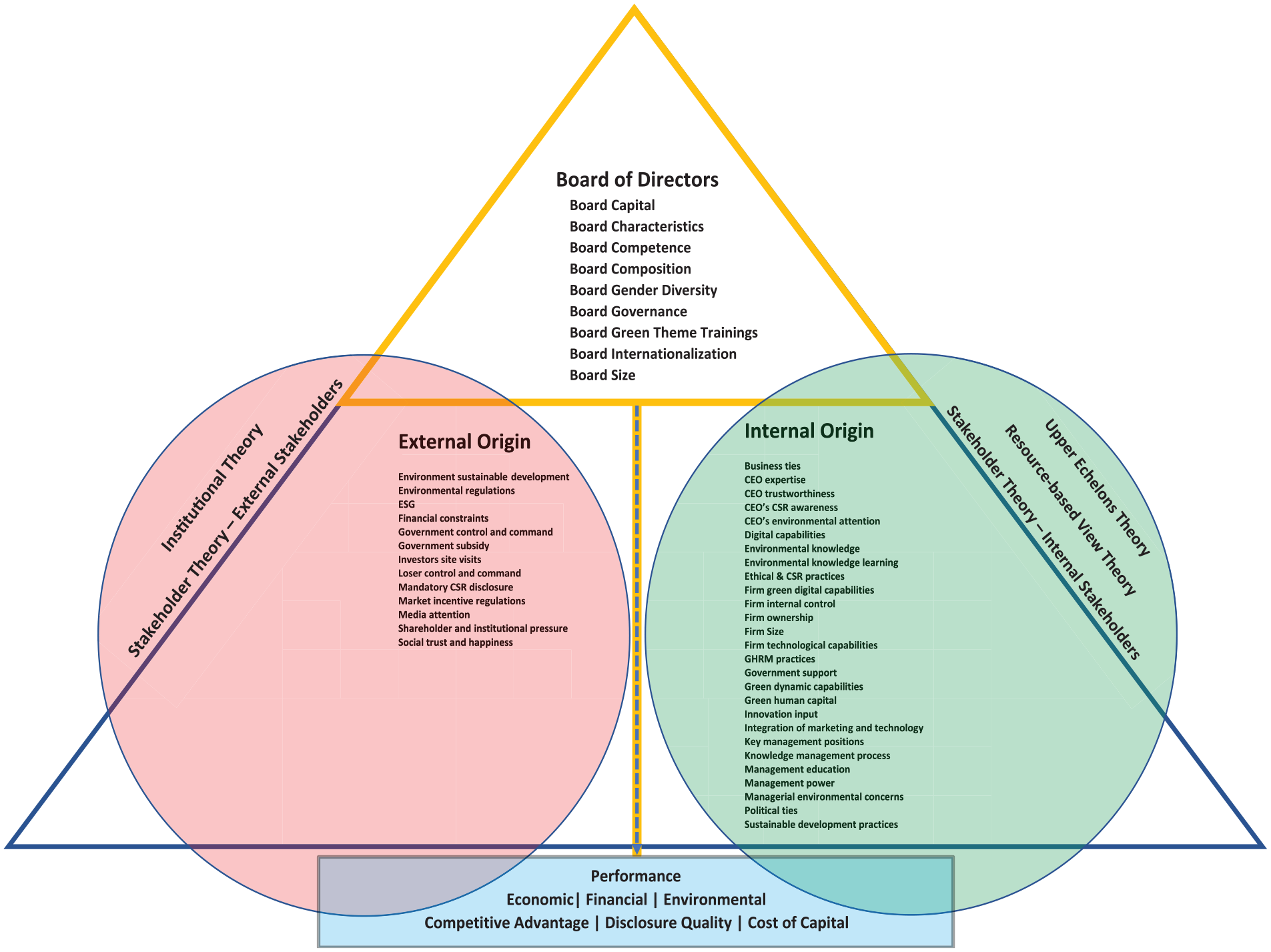
Green innovation development and resource dependence theory
Second, since drivers of green innovation are multifarious, we contribute that green innovation’s internal and external origin drivers may not be explained in a unified theoretical framework. Figure 16. also reveals how different theories complement RDT in green innovation research. It is important to understand that the corporate board can influence internal and external origins as well as firm performance indicators. Additionally, designing an upward arrow indicates that, using this framework, firms can optimize organizational green innovation practices. This study contributes to green innovation literature by proposing a broader potential of resource dependence theory. RDT complements several theories in organization studies, examining when, why, how, and what affects green innovation development. Resource dependence theory complements the specific counterparts of theories. For instance, RBV theory focuses on operating internal resources and capabilities for green innovation development, which complements RDT on how firms manage their internal mechanism to deal with external factors to foster green innovation of firms. Stakeholder theory underpins the interests of internal and external origin stakeholders in organizational decision-making to improve green innovation practices. Complimenting with RDT, stakeholder theory helps to understand how firms navigate their dependency upon internal and external origin stakeholders while valuing their interests to create value through green innovation. According to RDT, top management teams and CEOs play a critical role in engaging and balancing stakeholders’ needs through collaborations with external origin stakeholders, such as collaborating with regulatory agencies and building political ties to address resource dependence and promote green innovation development. Institutional theory focuses on the influence of intuitional pressure arising from the external origin on organizational behavior and practices in developing green innovation. RDT complements institutional theory on how organizations manage their internal control system to tackle external pressure from institutions or environmental regulations to maintain reactive green innovation development within firms. The upper echelon theory also complements RDT from an internal origin diverse perspective, examining the influence of top management teams and CEO characteristics on firms’ action plans toward building green innovation. More importantly, high environmental awareness and environment-themed training of the organization’s top management team can strategically build an effective internal control system to mitigate and manage external origin drivers of green innovation and develop proactive environmental business strategies for fostering proactive green innovation. Finally, the role boards are crucial to fostering green innovation development and achieving desired goals through overseeing internal and external origins.
In terms of limitations, it is evident that many studies highlight constraints specific to countries or industries. Research findings strongly focus on the manufacturing industry, particularly within the Chinese context. However, very few studies have focused on the service industry in fostering green innovation. The application of findings from considered research papers in policymaking and managerial decision-making may be limited in different countries due to the following factors. These factors include (a) cultural differences, (b) levels of green innovation activities that vary among countries, industries, and firms at various scales, and (c) differences in governmental laws and environmental regulations.
In future research prospects, considering the previous findings and knowledge available on green innovation, this review suggests several key avenues for forthcoming research on green innovation, as illustrated in Table 2. This research highlights potential future research avenues based on themes, research gaps, future research avenues, and respective studies that can be focused on to generate new ideas for future research in green innovation. In terms of internal origin drivers of green innovation, this research calls on exploring the impact of management power, CEOs trustworthiness, GHRM practices and CSR practices on green innovation (D. Gao et al., 2023; Munawar et al., 2022; Ullah et al., 2023; Yuan & Cao, 2022). On the external origin side, researchers should explore how to engage with external stakeholders and resources, such as political connections (Zhang, Zhou, et al., 2022). Exploring these internal and external origin drivers may support companies to build robust internal control systems and capabilities under the board of directors, enabling them to balance green innovation practices within firms and meet external origin requirements. Furthermore, more studies are required to generalize the understanding of proactive and reactive green products and process innovation from different sectors based on geographical areas and country-specific laws and regulations (J. Sun et al., 2022). In particular, previous research findings seem more reliant on the manufacturing industry, which ignored the service industry’s practical implications and theoretical contributions (Arici & Uysal, 2022; Munawar et al., 2022). Considering these issues, the study suggests upcoming research on the service industry, mainly hotel, banking, information technology, transportation, and healthcare sectors.
Research Gaps and Future Research Avenues.

Source. Collected and presented by the authors.
Additionally, a comparative analysis of the role of stakeholder pressures, green dynamic capabilities, green innovation, and firms’ performance (Singh et al., 2022) across SMEs and large-scale firms. In terms of methodological application, we infer that further analysis techniques can be applied to green innovation in future research. For instance, a case study approach and survey technique using questionnaires could be used to obtain more detailed information (He et al., 2021; Jiao et al., 2020). In addition, applying a mixed-method approach can contribute to the existing research (Soomro et al., 2024). More importantly, previous research needs to offer more knowledge of the role of the board of directors’ characteristics and competencies. Future research can aid this area by studying the role of corporate board competencies and characteristics across different countries and corporate structures, such as unitary and dual boards(Asni & Dianawati, 2023; B. Lin & Xie, 2023; Naveed et al., 2023; Xia et al., 2022; Yousaf et al., 2024). Resource dependence theory may offer a more practical way of balancing external origin factors and internal origin resources and capabilities (Wang et al., 2020). It is important to differentiate between proactive and reactive green innovation (Aeknarajindawat & Jermsittiparsert, 2019; Y.-S. Chen et al., 2016; Y. S. Chen et al., 2012; Mulaessa & Lin, 2021; Qing et al., 2022). In addition, little attention has been given to the impact of external origin factors on internal origin factors to develop green innovation; therefore, future research needs to investigate the roles of the top management team in managing external drivers and arranging resources and capabilities within the organization can support practical and theoretical implications in green innovation development. Considering stakeholder theory, scholars are suggested to explore exaggerated pride and confidence in the executives and organizations may influence green innovation and developing sustainable business model innovation. Scholars should explore how organizational hubris differs from executive hubris in developing green innovation and sustainable business model innovation (Arena et al., 2018) and how it influences stakeholders, resource dependence and firm flaunting (Gamache et al., 2024; Bass et al., 2023). These potential research avenues can help scholars contribute to and build a comprehensive understanding of green innovation drivers from internal and external origins.
Footnotes
Appendix
Acknowledgements
The authors would like to extend their sincere thanks to editor and anonymous reviewers for their insightful feedback during the review process.
Declaration of Conflicting Interests
The author(s) declared no potential conflicts of interest with respect to the research, authorship, and/or publication of this article.
Funding
The author(s) disclosed receipt of the following financial support for the research, authorship, and/or publication of this article: The authors would like to extend their sincere appreciation to the Social Science Foundation (21BGL047), China.
Ethical Approval
N/A

Data Availability Statement
Data are available upon request from corresponding author.