




Abstract
As a combination of innovation and environmental development concepts, green innovation is of great significance to sustainable development. This article takes supply chain learning as an intermediary to examine the direct and indirect effects of green entrepreneurial orientation (GEO) on green innovation. This study builds a theoretical model among GEO, green incremental innovation, and green radical innovation, and uses empirical data from 416 enterprises in China for testing. The results show that corporate GEO has a positive impact on green incremental innovation and radical innovation. Supply chain learning has a significant positive effect on green incremental and radical innovation. In addition, corporate supply chain learning plays a mediating role in the relationship between GEO and green radical innovation, as well as plays a mediating role in the relationship between GEO and green incremental innovation. This study has an important contribution to enrich the theory of entrepreneurial orientation, green innovation, and supply chain learning, and is of great significance for managers to understand how to use GEO in the process of green innovation development.
Introduction
As the global environmental crisis continues to escalate (De Marchi, 2012), Chinese enterprises are accepting increasingly severe environmental challenges. On one hand, enterprises need to face powerful pressure from a series of government regulations. On the other hand, pursuing green economic growth is becoming a strategic business opportunity for enterprises to cope with the environmental market requirements (Li, 2014). In this context, the development of green innovation has become an inevitable choice to lead low-carbon development, transform economic growth mode, and build ecological civilization. Green innovation may reduce the negative impact of economic activities on the environment through innovation in products, processes, society, institutions, or organizations (Borghesi et al., 2015). More and more enterprises choose to use green innovation as an effective strategy to achieve their sustainable competitive advantages. It is an important issue to clarify the driving factors for enterprises to adopt green innovation.
Most studies have analyzed the driving factors of green innovation from the external perspective (Arnold & Hockerts, 2011; Xavier et al., 2017; Y. Zhou et al., 2018). For example, it aims to keep up with the industry’s technical level (Singh et al., 2015), respond to external competition (Pondeville et al., 2013), meet consumer demand (Horbach et al., 2012; Huang et al., 2016), meet social expectations (Bossle et al., 2016), and obtain legality (Ashford & Hall, 2011). However, these external factors are not the most fundamental driving factors for enterprises to adopt green innovation, and these factors cannot explain the early green innovation behavior of enterprises (Borghesi et al., 2015; De Marchi, 2012; Y. Zhou et al., 2018). In addition, in a market-based transition economy like China, green innovation has a high degree of uncertainty and dynamics (Y. Zhou et al., 2018). It is not enough to explain the green innovation of enterprises by external factors alone (Arnold & Hockerts, 2011); seeking internal factors that influence green innovation of enterprises has become important and essential.
As a critical internal factor, GEO refers to a firm-level proactive strategic inclination to identify and grasp the eco-friendly business opportunity (Covin & Slevin, 1989). GEO has cultural penetration and leadership (Arnold & Hockerts, 2011), making the process of corporate green innovation more dynamic (Silajdžić et al., 2015). In addition, the GEO can drive enterprises to move toward green voluntarily and proactively. This pulling factor is in stark contrast to the driving factors of government regulation and stakeholder pressure. However, there are few studies that use GEO as an antecedent to study its impact on the development of green innovation. To make up for this shortcoming, this article will attempt to explore the impact of GEO on green innovation.
Although GEO is closely related to green innovation, enterprises with GEO may not be able to successfully achieve green innovation (Arzubiaga et al., 2018; Kollmann & Stöckmann, 2014). It is because green innovation is more complex and demanding than general innovation (De Marchi, 2012; Rennings, 2000). In this view, achieving green innovation requires corporate capabilities such as interorganizational learning (Bossle et al., 2016; Jakobsen & Clausen, 2016), which is realized through organizations with different technical capabilities and resources. Particularly, in the developing countries like China, it is more difficult for enterprises to achieve green innovation based on their own. So, Chinese enterprises need to develop their green innovation through interorganizational learning network, such as their supply chain partners, that is, supply chain learning (SCL).
Some literature emphasized the importance of interorganizational learning networks in environmental management literature (Clarke & Roome, 1995; Hartman et al., 1999; Pratono et al., 2019); however, there are few studies that analyzed SCL in context of environmental management. Therefore, from the perspective of SCL, this article explores the mechanism of corporate GEO influencing green innovation of Chinese enterprises. Specifically, our study focuses on the following research questions:
To achieve our goals, the remainder of the study are as follows. The next section presents the literature review and hypothesis. The “Research Design” section describes the research methodology, followed by the data analysis and results in the “Results” section. Finally, in the “Discussion and Conclusion” section, the article presents the conclusion, implications, limitations of this study, and suggestion for future research.
Literary Review
GEO and Green Innovation
The GEO research originated from the combination of entrepreneurial orientation theory and green entrepreneurship theory. Specifically, enterprises with strong GEO should not only comply with the principle of environmental protection based on the triple bottom line but also follow the entrepreneurial orientation based on enterprise development. Entrepreneurship-oriented pioneer Miller (2011) believes that enterprises that are truly entrepreneurially oriented should be characterized by innovation, risk taking, and initiative. Regarding the composition of GEO, scholars hold different views. Lumpkin and Dess (1996) explicitly defines entrepreneurial orientation as a set of practical processes or decision-making activities that enable enterprises to create or trigger new entry behaviors, adding two dimensions of initiative and competitive aggressiveness. As asserted by some studies (Arruda, 1999), GEO includes initiative and environmental orientation. Some scholars have asserted that sustainable entrepreneurial orientation may have two important characteristics: social orientation and environmental orientation (Cohen & Winn, 2007). In addition, some scholars divided GEO into innovative and social orientation (Becker, 2010). Notably, according to Covin and Slevin’s (1989), the initial measurement of entrepreneurial orientation, and later works, most studies combine multiple dimensions of entrepreneurial orientation into a single factor (Wiklund & Shepherd, 2003; Zhao et al., 2011). Based on the existing literature, this article believes that GEO should be viewed as an independent system, which represents the unique operation and strategic decision-making model characteristic of strategic and complex. In addition, drawing on the definitions by Covin and Slevin (1989) and Dean and McMullen (2007), as well as Jiang et al. (2018), we offer the following definition: GEO refers to a firm-level proactive strategic inclination to identify and grasp the eco-friendly business opportunity based on the comprehensive consideration of risks and benefits.
Traditional innovation refers that enterprises create new products, new materials, new processes, new services, and new organizational forms to gain competitive advantage. The biggest difference between green innovation and traditional innovation lies in its dual externality, namely the innovation spillover effect in the R&D and innovation stage and the environmental spillover effect in the adoption and diffusion stage (Rennings, 2000). Fussler and James (1996) first proposed the concept of green innovation, which refers to the improvement of environmental performance, including product innovation, process innovation, and project innovation, through the development and utilization of new products, new processes, and new services. Borghesi et al. (2015) pointed out that green innovation may reduce the negative impact of economic activities on the environment and the use of resources through innovation in products, processes, society, institutions, or organizations. Green innovation is considered to be the key to addressing sustainability issues (social, economic, and environmental) and enhancing organizational competitive advantage (Tamayo-Orbegozo et al., 2017). According to different levels of technology, green innovation can be divided into green radical innovation (GRI) or green incremental innovation (GII) (Chen et al., 2014; Dai et al., 2015). Combined with existing research (Chen et al., 2014; Li et al., 2008), this article defines GRI as a firm’s novel or unique artistic creation of green products, processes, or services by radically developing or introducing new environmental technology. With reference to previous definitions (Chen et al., 2014; Li et al., 2008), this article adopts the following definition of GII: a firm’s minor improvement or expansion of existing green products, processes, or services by adjusting, reinforcing, or enhancing current environmental technology.
As the literature has proposed, entrepreneurial orientation may have direct or indirect effects on corporate innovation (Alegre & Chiva, 2013; Li et al., 2017; Pérez-Luño et al., 2011), and innovation may be the essence of entrepreneurial orientation (Covin & Miles, 1999; Schumpeter, 1934). Based on the VRIO framework (namely valuable, rare, inimitable, and non-substitutable resources can bring competitive advantage), entrepreneurial orientation represents how enterprises are organized to discover and exploit opportunities (Wiklund & Shepherd, 2003). Schumpeter (1934) highlighted the connection between entrepreneurship and innovation, innovative activity, and novel products. More specifically, entrepreneurial activities essentially consist of radical noncontinuous innovations, as well as incremental modifications and improvements to current processes (Brazeal & Herbert, 1999), which suggests that entrepreneurial orientation may drive radical innovation and incremental innovation in enterprises. In addition, enterprises with green entrepreneurship condense various resources and reduce environmental impacts, enabling them to discover and use green innovation opportunities by deploying and arranging more controllable resources (K. Z. Zhou et al., 2005). As a strategic gesture, GEO may help enterprises to form an organizational force within their own to produce as many innovative green products as possible.
Therefore, although the ultimate goal of green entrepreneurial-oriented enterprises is economic benefits (Schaltegger & Wagner, 2011), it becomes easier for them to achieve green innovation than those who simply focus on economic interests (Drucker, 1998). That is to say, although GEO is based on the goal of improving technology and reducing costs, it can intentionally or unwittingly promote green innovation of products, services, and processes (Bos-Brouwers, 2010). Therefore, if enterprises have strong GEO, they will demonstrate environmentally responsible management and innovation in products, services, processes, strategies, or business models, namely green innovation. Hence, this article argues that GEO may improve corporate initiative and the willingness to undertake green technology risks, thereby promoting green innovation and proposing the following assumptions:
The Influence of SCL on Green Innovation
The concept of SCL originates from the theory of interorganizational learning and involves how members of the organization work together to create collective knowledge (Mariotti, 2012). Bessant and Tsekouras (2001) were the first to study at the network level and to treat the supply chain as a network. There exists a “knowledge flow” in the supply chain, allowing the upstream and downstream enterprises to acquire different information and technologies through interorganizational learning, which may lead to win-win cooperation (Collins et al., 2002). SCL was defined as a kind of learning behavior across organizational contexts and was identified as three distinct phases: the creation phase, the implementation phase, and the maintenance phase (New & Westbrook, 2004). Some scholars provided a formal and broad definition for SCL: interaction and learning focus on supply chain issues and solutions among diverse supply chain partners (Flint et al., 2008). Recent research indicated that SCL may be a strategic resource that contributes to supply chain performance (Chen et al., 2014; Zhu et al., 2018). As some studies have asserted, joint learning capabilities among supply chain partners have a positive impact on relationship innovation (Jean et al., 2017).
It is difficult for enterprises to achieve green innovation within a single organization, and complementary cooperation with relevant organizations is essential to create valuable green products and services (Zeng et al., 2017). As Guo et al. (2019) have asserted, external knowledge acquisition may play a positive role in promoting green innovation. Learning among alliance partners may be conducive to the improvement of enterprises’ technology information and knowledge base based on the dynamic capabilities, thus becoming a powerful stimulus for green technology innovation in alliance products (Grant & Baden-Fuller, 2004). Due to the diversity of green technology resources and capabilities grasped by the upstream and downstream customers, SCL emphasizes the interaction among organizations. Enterprises may achieve the exchange of green technology-related information, knowledge sharing, and the complementarity of green innovation products through SCL, which may be conducive to formulate better green technology plans and promote corporate GII. Besides, learning and mastering the green technology resources of supply chain partners may overcome the limited green knowledge system, and allow enterprises to generate new ideas and develop GRI. Considering the above:
The Influence of GEO on SCL
Entrepreneurial orientation is a high-level organizational learning mechanism that encourage and support exploration and risk taking in the process of technological innovation (Teng, 2007). In recent years, some studies have found a positive relationship between entrepreneurial orientation and organizational learning (Alegre & Chiva, 2013; Fernández-Mesa & Alegre, 2015; Shan et al., 2016). Some scholars believe that entrepreneurial-oriented enterprises can help to form learning atmosphere, promote learning behavior, and provide the direction and scope of corporate learning (Grant and Baden-Fuller, 2004). Furthermore, entrepreneurial-oriented enterprises usually focus on expanding as quickly as possible no matter if they have all the necessary knowledge resources. As a result, entrepreneurial orientation may lead to a shortage of corporate knowledge resources (Teng, 2007), forcing enterprises to seek resources from outside of the organization and develop interorganizational learning, such as SCL. As asserted by some studies, entrepreneurial orientation has a positive impact on learning and resources in alliances, and may provide management support for the learning process of supply chains (Shan et al., 2016). From the perspective of green entrepreneurship, they often encourage organizational structures that promote interfirm cooperation (Schumpeter, 1934), thereby promoting the development of SCL. In addition, the empirical findings of Pratono et al. (2019) have demonstrated that GEO may enhance interorganizational learning among enterprises. Hence, we propose the following hypothesis:
The Mediating Influence of SCL
The impact of GEO on green innovation depends on organizational factors (Fernández-Mesa & Alegre, 2015; Li et al., 2017). As green innovation is essentially a new knowledge innovation process, the influence of entrepreneurial orientation on corporate innovation is inseparable from interorganizational learning (such as SCL). According to the resource-based view, SCL can be regarded as a resource related to corporate strategic behavior and may play a bridge role in the relationship between GEO and green innovation. It is because supply chain partners may provide different ideas, information, and resources that are critical for a company’s consolidation of its GEO. That is to say, when enterprises possess strong GEO, green innovation may be promoted through SCL. Therefore, this article argues that enterprises can successfully transform GEO into green innovation through SCL, and we make the following assumptions:
Based on the above analysis, the theoretical model established in this article is shown in Figure 1.
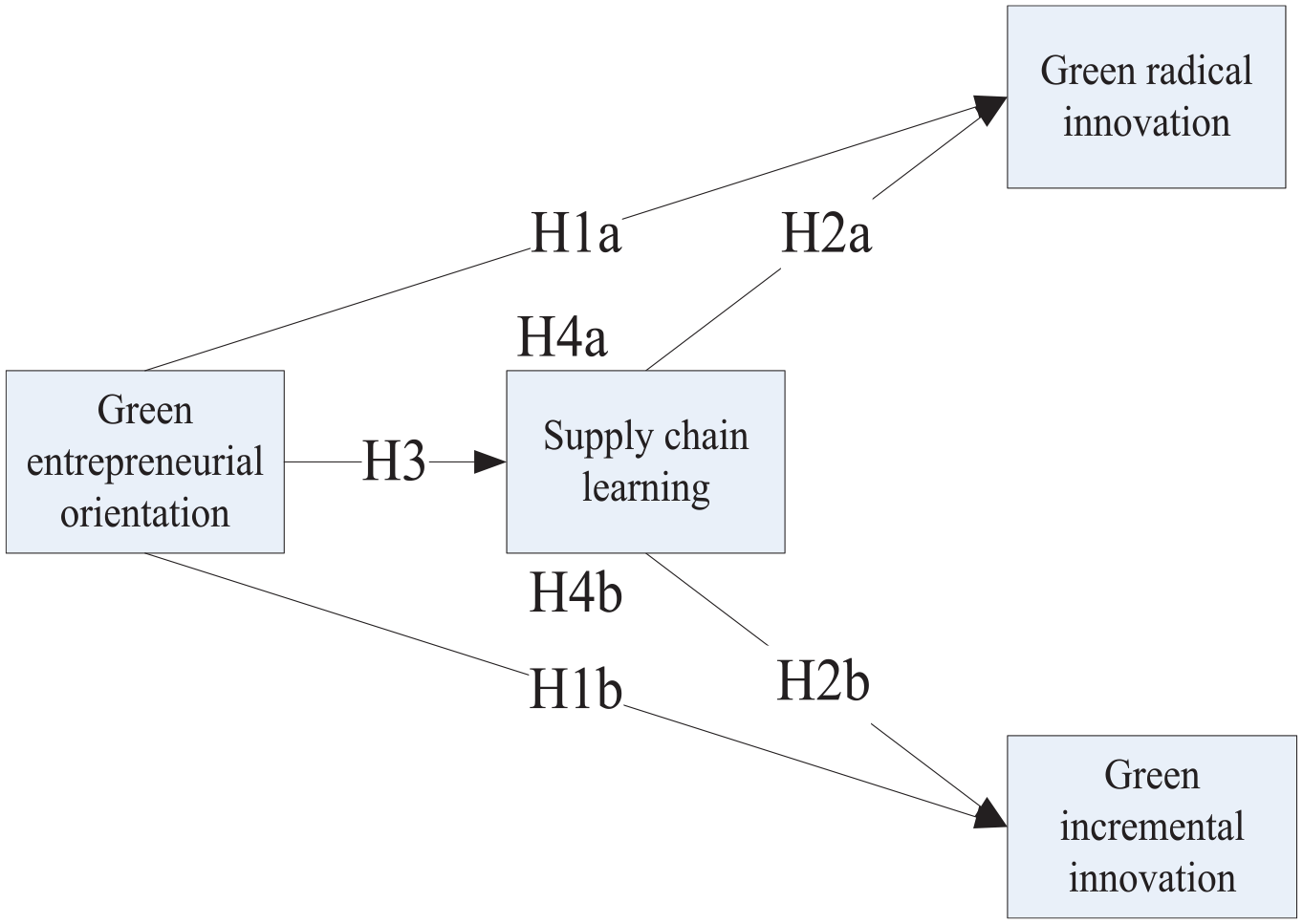
The theoretical model.
Research Design
Sampling and Data Collection
Using the questionnaire, we sought responses from the middle and senior managers of the firms in our study sample. We used the EMBA/MBA/IE graduates lists offered by a business school at several universities in Northwest China. To avoid biases, the samples were selected randomly based on firm size and industry. The sampled firms can cover a broad range of industries, such as electronic, transportation equipment, and chemicals, located in four provinces or cities: Shaanxi, Guangdong, Shanghai, and Tianjin, respectively, representing the industrial centers of western China, the Pearl River Delta, the Yangtze River Delta, and the Bohai Rim region of China. We made phone calls to those graduates who were at least R&D or general managers in enterprises and to invite them to participate in the research. When a selected graduate did not have sufficient knowledge in answering the questionnaires, we requested the person to identify a right person in their enterprises to complete this survey. We then mailed the survey with a cover letter highlighting the survey’s background and goals. Follow-up calls were made by our research team to improve the response rate.
We sent out a total of 784 questionnaires and received 480 returned surveys, which yield a response rate of 61.2%. We excluded 39 questionnaires due to incomplete database and 25 wrong questionnaires, thus 416 valid questionnaires were used for analyzing. Table 1 provides descriptive statistics for participating enterprises and respondents.
Demographic Profile of Sampled Firm and Respondents.

To evaluate nonresponse bias (the difference between the answers of respondents and nonrespondents; Lambert & Harrington, 1990), the final sample was divided into two: 216 responses received at the beginning of data collection process and the remaining 200 responses received in the middle and later of the data collection period. We compared the early and late data to examine if they differed in their questionnaire responses. The t test results performed no statistically significant differences on demographic characteristics at p ≤ .05, indicating that the data were relatively free from nonresponse bias issues.
We mitigated the potential dangers of common method variance bias. First, we surveyed top managers who are knowledgeable about the firms’ green innovation management. These individuals are considered to provide accurate and reliable information (Narayanan et al., 2011). Second, we examined the potential of common method variance based on Harman’s single factor test for all variables in the study (Podsakoff & Organ, 1986). The unrotated factor analysis shows that no single factor occupies the majority of the variance, and even the first factor captures only 32.6% of the overall variance, which is below the critical value of 50%. Besides, the dependent variables and independent variables loading on different factors. The above findings show that common method variance threat did not seem to be a serious concern in this study.
Measures
The survey questionnaire was structured into three sections, namely, GEO, SCL, and green innovation. All measurements used a 7-point Likert-type scale. To ensure the reliability and validity, we assembled our questionnaire using established survey items to fit our research context. The research questionnaire was first compiled in English and then translated into Chinese. A preliminary questionnaire was pretested by firm’s mid-level or senior-level managers, graduate students, and six pioneering management professors. They hold sufficient knowledge about the innovation management and then made some minor modifications to the questionnaire before a formal investigation. The Chinese questionnaire with such alterations was subsequently back-translated into English by a third party to ensure that the items included accurately reflect the original meanings in the Chinese context. We reviewed carefully these two English versions and were satisfied that there were no substantial differences between the two versions in the meanings of the scales.
First, five items for measuring GEO were adopted from the study of Zhao et al. (2011), Jiang et al. (2018), and Li et al. (2010). Next, five items for measuring SCL were adopted from the study of Flint et al. (2008) and Zhu et al. (2018). Finally, we measured green innovation. Four items measured GRI, all adopted from Dai et al. (2015) and Li et al. (2008). Four items measured GII, all adopted from Dai et al. (2015). For details of variable measurements, see the appendix.
Results
This study employed SPSS 22.0 and AMOS 22.0 to process the data analysis, which comprised four procedures as follows. First, an exploratory factor analysis (EFA) was conducted to extract the four factors from the scale items used in this study. Second, we performed Cronbach’s alpha reliability test to check the reliability of the scales. Third, the confirmatory factor analysis (CFA) of the measurement model was performed to assess model fitness. In addition, the composite reliability (CR) and average variance extracted (AVE) of the variables were calculated based on CFA factor loadings to assess the validity of the scales. Finally, we carried out AMOS 22.0 to examine the structural equation model (SEM) and tested the proposed research hypotheses.
The Reliability and Validity of the Variables
Based on 416 samples, we ran EFA on all the items through SPSS 22.0 to assess the factor structures. The initial factor solution resulted in four factors with eigenvalues higher than unity. The four-factor solution for the 18 items accounted for 75.0% of the total variance explained. Table 2 shows the factor loading results of 18 items with a clear factor structure in four factors from the results of EFA. Each measuring item was loaded into a single extracted factor as illustrated, with a factor loading between 0.787 and 0.918, all above 0.5. The four factors extracted were named GEO, SCL, GRI, and GII.
Results of Exploratory Factor Analysis.

Note. Extraction method: principal component analysis. Rotation method: Varimax with Kaiser normalization. Underline indicates the highest loading. A rotation converged in five iterations.
The reliability of the data was indicated by Cronbach’s alpha. If construct’s reliability coefficient turns out to be 0.7 or greater, it can be considered reliable (Hair et al., 2010). Table 3 lists the scale’s Cronbach’s alpha calculated using SPSS 22.0. Because it can be observed that the reliability of each construct is higher than the threshold value 0.7, thereby we suggest that the theoretical constructs in this article exhibit good internal consistency.
Convergent Validity and Reliability.

Note. CR = composite reliability; AVE = average variance extracted; GEO = green entrepreneur orientation; SCL = supply chain learning; GRI = green radical innovation; GII = green incremental innovation.
The validity of the data was tested by the structural validity and the content validity. Instructions on the cover of our questionnaires make informants knowledgeable about the purpose of this research was to examine corporate green innovation practices and outcomes. Confidentiality nature is also ensured. In addition, we design in-depth managerial interviews and a preliminary test to modify our measurement items so as to ensure they actually capture constructs of interests. Thus, the scale of this study has a good content validity.
Construct validity includes convergent validity and discriminant validity. This research verified the construct validity through CFA by using AMOS 22.0. The model fitting results are as follows: CMIN/DF = 1.981, goodness-of-fit index (GFI) = 0.934, comparative fit index (CFI) = 0.975, incremental fit index (IFI) = 0.975, Tucker–Lewis index (TLI) = 0.970, root mean square error of approximation (RMSEA) = 0.049, which indicates that the measurement model had a good degree of fit (Hu et al., 1992). Convergent validity is “the degree to which multiple attempts to measure the same concept by different methods are in agreement” (Phillips, 1981). Table 3 indicates that AVE for each scale is more than 0.5, the CR for each scale is well above 0.7 and all factor loadings are greater than 0.7. It suggests the acceptability of convergent validity of all constructs.
For discriminant validity, Table 4 indicates that the diagonal elements in bold representing the square roots of the AVE for constructs are significantly higher than the off-diagonal elements, satisfying Fornell and Larcker’s (1981) criterion for discriminant validity.
Descriptive Statistics and Correlations Matrix.

Note. (a) The diagonal elements in bold are square roots of average variance extracted and (b) the off-diagonal elements represent correlations between constructs. GEO = green entrepreneur orientation; SCL = supply chain learning; GRI = green radical innovation; GII = green incremental innovation.
p < .01.
Hypothesis Testing
The research model with five direct hypotheses and two mediating hypotheses was tested by using SEM.
Direct effects
For the test of the direct effects, Table 5 illustrates the normalization coefficient of the structural path and its associated significance values generated by AMOS 22.0.
Model Results.

Note. CR = composite reliability; GRI = green radical innovation; GEO = green entrepreneur orientation; GII = green incremental innovation; SCL = supply chain learning.
p < .01. ***p < .001.
H1a and H1b show that GEO has a significant positive impact both on GRI (β = .149, p < .01) and on GII (β = .177, p < .001). In addition, the results of H1a and H1b indicate that the effect of GEO on GII is greater than the effect on GRI. The positive influence of GEO on enterprises’ green innovation is mainly embodied through GII. H2a and H2b show that SCL has a significant positive impact both on GRI (β = .320, p < .001) and on GII (β = .273, p < .001). The results also indicate that the effect of SCL on GRI is greater than the effect on GII. H3 shows that GEO has a significant positive impact on SCL (β = .211, p < .001).
Mediating effects
This research tested the mediating effects by applying bootstrapping. It used analysis software of the AMOS 22.0, set the sample size as 1,000, and confidence interval (CI) as 95%. The bias-corrected bootstrapping test results are shown in Table 6. Neither of the CIs contain 0, indicating that the mediating effects hypothesized by this research are significant. The intermediaries H4a and H4b in the research are both supported.
Bootstrapping Analysis of Intermediate Effect.

Note. GEO = green entrepreneur orientation; SCL = supply chain learning; GRI = green radical innovation; GII = green incremental innovation.
H4a show that SCL plays a mediating role in the relationship between GEO and GRI (β = .068, 95% bias-corrected confidence interval [BC CI] = [0.034, 0.115]). This indicates that GEO not only has a direct positive impact on GRI but also indirectly improves GRI through SCL. H4b shows that SCL plays a mediating role in the relationship between GEO and GII (β = .058, 95% BC CI = [0.028, 0.104]). This indicates that GEO not only have a direct positive impact on GII but also indirectly improve GII through SCL.
Discussion and Conclusion
In the context of the Chinese market, this study constructed a conceptual model among variables of corporate GEO, SCL, GRI, and GII. We examined the impacts of GEO on green innovation and the internal mechanisms of this impact from the perspective of SCL. The research results show that corporate GEO has a positive impact on GRI and GII. In addition, SCL can partly mediate the relationship between GEO and GRI as well as that between GEO and GII. This research makes contributions to the theory of entrepreneurial orientation, green innovation, and SCL. Besides, it is of great significance for managers to understand how to make full use of GEO in the process of green innovation development.
Theoretical Contribution
Our research has the following contributions to the literature. First, this article contributes to the research of green innovation. Most of the existing researches focus on the external determinants that influence the adoption of green innovation practices. There are few studies on the internal factors of green innovation or the processes within the organization. Although GEO is a critical internal factor of the enterprise, there is a lack of research between it and green innovation. Therefore, this article examined how GEO influences enterprises’ voluntary adoption of green innovation, which may enrich the existing research of green innovation theory.
Second, this article contributes to the study of entrepreneurial orientation. Although some scholars have empirically studied the relationship between entrepreneurial orientation and innovation (Miao et al., 2017; Shan et al., 2016), the results are still controversial. This may be due to the fact that most of the existing research focused on the direct link between entrepreneurial orientation and innovation (Ojha et al., 2016; Pérez-Luño et al., 2011), paying less attention to the improvement of behavioral processes and capabilities, and ignoring possible intermediaries. This article analyzes the influence mechanism of GEO on green innovation in the context of the environment management, opening up the black box of how GEO influences green innovation, enriching the existing entrepreneurial orientation theory.
Third, this article has a certain contribution to the research domain of SCL. There have been few empirical studies on the relationship between SCL and green innovation. This study introduces the interorganizational variables of SCL into the field of environmental management and broadens the current literature on supply chain management. In addition, this article builds an integrated model of SCL, GEO, and green innovation, which provides new research opportunities and research perspectives for future researchers.
Implications for Practitioners
Our findings provide the following implications for practitioners. First, this study finds that corporate GEO may have a positive impact on GII and GRI. The findings show that if enterprises want to achieve high levels of green innovation, whether it is GRI or GII, management should pay attention to the cultivation of GEO and incorporate it into their corporate strategy system. For policy makers, in promoting the green innovation of enterprises, especially when it comes to green innovation in the early stage, they should advocate and encourage the GEO of enterprises. For example, they can develop a training program policy that may strategically encourage enterprises to enhance their GEO, thereby promoting the development of GRI and GII.
Second, our results reveal that SCL has positive effects on GRI and GII. As an important organizational behavior of the organization’s outward extension, SCL may be an important factor in the realization of green innovation. In the era of knowledge economy, enterprises should strengthen their ability to acquire knowledge and technology from the cooperation of supply chain partners and improve their SCL level, thus developing green innovation and enhancing organizational advantages. For example, enterprises can try to stimulate the atmosphere of SCL, encourage more investment, and strengthen relationships with supply chain partners, which may be particularly important for developing countries such as China.
Third, our results demonstrate that SCL plays a mediating role in the impact of GEO on green innovation. This proves that the impact of GEO on green innovation is conditional, that is, GEO enhances the level of green innovation by enhancing SCL. This result can answer why even if the company’s management shows a high GEO, there is still a problem of low level of green innovation development, that is, there may be a lack of attention to SCL. Therefore, this article suggests that when senior management tries to follow a higher GEO, they should pay attention to strengthening SCL and providing conditions for enterprises to fully use GEO to develop green innovation in the supply chain environment.
Limitations and Future Research Directions
Our study is subject to several limitations that make opportunities for future research. First, this study takes supplier learning and customer learning together to value the SCL scale, it is important for additional research to recognize the individual effects of each dimension. More precisely, future research should address the impacts of different SCL dimensions, explore how each dimension operate independently, making a deeply understanding of the relationship between GEO and green innovation in supply chain context.
Second, from the variable point of view, we only examined the SCL as a mediator between GEO and green innovation relationship without exploring the possible moderating roles of environmental conditions. Besides, other organizational issues which related to organizational learning and innovation are not considered in our study. Variables such as collaborative commitment (Cuerva et al., 2014), supply chain integration (Zhu et al., 2018), technological resources (Selnes & Sallis, 2003), and information technology (Leal-Millán et al., 2016) may also likely have effects in our conceptual model. Future research should explore the impacts of these variables on the GEO and green innovation relationship.
Third, as a cross-sectional research, our study is based on just a snapshot data of ongoing time, which cannot exactly assess the future implication of GEO on green innovation. Future longitudinal research should try to replicate this study to examine the dynamics of the relations established in the theoretical model. Furthermore, our results are based on the information from just one company of a partnership, which may reduce the robustness. We are aware of the difficulties of obtaining data from all relevant enterprises in supply chain. Future research relied on data from all supply chain partners is going to be a meaningful extension.
Footnotes
Appendix
Construct Items.

| Constructs | Label | Measurement items | Sources |
|---|---|---|---|
| GEO | GEO1 | Our firm has an attitude of adventure and proactiveness to green projects when faced with uncertainty | Zhao et al. (2011), Jiang et al. (2018) and Li et al. (2010) |
| GEO2 | Our firm has a strong tendency for high-risk green product development projects which have a chance for very high returns | ||
| GEO3 | Our firm has a strong emphasis on green R&D, technological leadership, and innovation | ||
| GEO4 | Our firm has a tendency to initiate green actions for competitors to respond to | ||
| GEO5 | Our firm has a tendency to be a market leader, always first in introducing green products, services, or technologies | ||
| SCL | SCL1 | We ensure that our employees and managers change their behaviors and processes appropriately as they gain new knowledge from our key suppliers (e.g., the technology gained from the suppliers will be incorporated into the process of green product development) | Flint et al. (2008) and Zhu et al. (2018) |
| SCL2 | We ensure that our employees and managers change their attitudes about our market situation as they gain new knowledge from our key supply chain partners (e.g., to be aware of the market potential of environmentally friendly packaging materials by gaining information from the suppliers) | ||
| SCL3 | We ensure that managers in our key suppliers learn better ways to manage their business and work with us (e.g., in the process of green product development, suppliers can communicate closely with customers and partner) | ||
| SCL4 | We ensure that managers in our key suppliers are learning better ways to operate and serve us (e.g., the suppliers optimize their operating models through the involvement of manufacturing or engineering) | ||
| SCL5 | We ensure that our employees and managers change their attitudes about customers when needed as they gain new knowledge about customers (e.g., to understand whether customers have environmental preference for packaging materials and take corresponding action) | Flint et al. (2008) | |
| GRI | GRI1 | We often introduce radically new concept innovations to make products more environmentally friendly (e.g., introduce radically new environmental concepts in the process of product research and development) | Dai et al. (2015) and Li et al. (2008) |
| GRI2 | We often develop and introduce radically new environmentally friendly technologies into the industry (e.g., Develop and introduce of radically new renewable energy technologies to reduce pollution of soil, atmosphere, and water bodies) | ||
| GRI3 | We often create radically new environmentally friendly products (e.g., create radically new hybrid or hydrogen-fueled vehicles) | ||
| GRI4 | We often introduce radical innovations to make processes more environmentally friendly (e.g., to replace a key component with radically new component in the process of product development, and significantly reduce the environmental impact) | ||
| GII | GII1 | We often improve an existing product to make it more environmentally friendly (e.g., improve products to make them more recyclable) | |
| GII2 | We often improve existing processes to make them more environmentally friendly (e.g., to reduce the emission of toxic and harmful substances such as dust and particulate matter by improving the processes of production and consumption) | ||
| GII3 | We often exploit existing technologies to make processes more environmentally friendly (e.g., to reduce pollutant emissions by using existing pollution control technologies or existing waste management technology) | ||
| GII4 | We often exploit existing technologies to make products more environmentally friendly (e.g., to make products have a longer life cycle by using existing technologies) |
Note. All items were of seven-level Likert-type scale in the questionnaire. GEO = green entrepreneur orientation; SCL = supply chain learning; GRI = green radical innovation; GII = green incremental innovation.
Acknowledgements
We would like to thanks Kevin De Moortel for his comments and advise on a previous version of this paper.
Declaration of Conflicting Interests
The author(s) declared no potential conflicts of interest with respect to the research, authorship, and/or publication of this article.
Funding
The author(s) disclosed receipt of the following financial support for the research, authorship, and/or publication of this article: This research was supported by the National Social Science Foundation of China (grant 19BGL093) and the National Social Science Foundation of China (grant 15BGL073).
