




Abstract
This article calculates the sustainability level of the digital industry and urban economic resilience across Chinese counties, utilizing data from the Fujian Statistical Yearbook and the Chinese Industrial Enterprise Database. And then we employ spatial kernel density estimation, System Generalized Method of Moments, threshold regression, and the Spatial Durbin Model to analyze the mechanisms through which digital industry sustainability influences urban economic resilience. The empirical results indicate that: (1) the levels of urban economic resilience across counties tend to converge; however, there is significant clustering characterized by low resilience. (2) The coordinated development of the digital industry among counties is not significant, and spatial spillover effects remain weak. (3) The relationship between digital industry sustainability and urban economic resilience is found to be highly significant and stable, exhibiting a clear U-shaped pattern.
Plain Language Summary
This study looks at how the development of Fujian Province’s digital industry-especially its electronic information sector-affects the ability of cities in China to withstand economic shocks and grow steadily. Using government and enterprise-level data, the researchers measured the health of the digital industry and the strength of local economies across multiple cities. They found that cities with better-developed digital sectors tend to be more resilient in the face of economic disruptions. However, this positive effect only appears once the digital industry reaches a certain level of maturity. In early stages, the digital industry can actually reduce resilience due to high startup costs and competition with traditional sectors. The study also found that although some coastal cities have benefited from government-led industrial plans, these benefits have not effectively spread to surrounding areas. Based on these findings, the paper recommends targeted financial support, stronger regional coordination, and flexible policies that evolve as local industries develop.
Keywords
Introduction
Manufacturing serves as the cornerstone of a national economy and is a crucial engine driving China’s sustained economic growth. Fujian Province, as a major manufacturing powerhouse located along China’s southeastern coast, has prioritized the electronic information industry since 2000. In its recent “14th 5-Year Plan,” Fujian further emphasizes core electronic components, high-end general-purpose chips, fundamental software, industrial software, and artificial intelligence, stressing the necessity of “coordinated construction of major industrial collaboration chains and clusters.” The province aims to establish itself as a prominent base for electronic information and equipment manufacturing on the southeastern coast, promote digital transformation and upgrading in economic development and social governance, and build itself into a national leader in digital applications. However, in the context of globalization, regional economic development inevitably faces various internal and external shocks. In particular, the recent intensification of international geopolitical tensions and the increasing fragility of global supply chain shave posed severe challenges to both industrial sustainability and regional economic stability. Therefore, amid growing domestic and international economic uncertainties, it is imperative to evaluate the effectiveness of Fujian’s digital industry development policies and spatial planning in stabilizing or enhancing urban economic resilience, in order to provide informed references for government decision-making.
The uneven effects of economic shocks or disturbances have long been a central focus of regional economic geographers (Hu & Hassink, 2020; Martin & Sunley, 2015, 2020). A key question frequently posed is why certain industries or regions are more effective in mitigating or responding to economic shocks compared to others (Faggian et al., 2018; Sutton et al., 2023). This issue has directed substantial scholarly attention toward the concept of “resilience.” Martin and Sunley (2015) defined economic resilience broadly as the capacity of an economy to withstand or recover from market, competitive, and environmental shocks, or to transition toward a new sustainable development trajectory. They further proposed a four-dimensional analytical framework for economic resilience, encompassing vulnerability, resistance, recovery, and robustness. In terms of research focus, current academic discussions on resilience primarily focus on two dimensions: industrial chain resilience and regional economic resilience. The former emphasizes how specific industry chains respond to disturbances and maintain operational stability (Gong et al., 2020), whereas the latter highlights the response and recovery mechanisms of regional economies to external shocks (Martin et al., 2016; Sutton et al., 2023). Concerning the relationship between these two dimensions, existing literature generally identifies industrial structure as a critical determinant of regional economic resilience (Martin et al., 2016). Industrial agglomeration can effectively enhance resilience by facilitating shared labor markets, economies of scale, and knowledge spillovers (Costa & Matias, 2020; Kim et al., 2023; Xu et al., 2023). Likewise, industrial diversity disperses economic shocks across different sectors, thereby mitigating impacts on specific industries and enhancing resilience (Sedita et al., 2017).Nevertheless, the role of industrial agglomeration or diversification in strengthening industrial chain or regional economic resilience remains inconclusive (Martin & Sunley, 2015). Industrial agglomeration might result in path dependence, causing structural rigidity and reducing a region’s adaptability to economic changes (Boschma et al., 2013; He et al., 2019). Similarly, industrial diversification could lead to shocks spreading widely across interconnected economic sectors through production networks (Elliott et al., 2022), thereby potentially undermining economic resilience (Frenken et al., 2007). Thus, significant uncertainty remains regarding policy implications derived from studying regional economic resilience based on industrial agglomeration or diversification. Furthermore, current research on the digital economy predominantly focuses on digital transformation (B. Zhang et al., 2024), digital infrastructure (Y. Jiang et al., 2024), or indirectly measures the digital economy through proxies such as mobile phone penetration, total telecommunications business volume, and broadband internet penetration (Fang et al., 2022; Wang, Song, & Zhang, 2024) to assess its impact on regional economic resilience. Yet, there remains a notable gap in the literature regarding the direct influence of the sustainability of the digital industry itself on regional economic resilience.
Bukht and Heeks (2018) define the digital economy as the portion of economic output that is entirely or primarily based on digital technologies. At its core lies the information technology/information and communication technology (IT/ICT) industry, which produces fundamental digital products and services. Based on this definition, and in alignment with Fujian Province’s digital industry development plan and its delineation of the electronic information industry’s scope, this article investigates the impact of the digital economy on urban economic resilience from the perspective of electronic information industry sustainability. The rationale underpinning this approach includes the following considerations: Firstly, regardless of whether industrial agglomeration or diversification positively affects regional economic resilience, the influence ultimately manifests through industrial sustainability. Specifically, greater industrial sustainability contributes significantly to regional resilience by stabilizing factor supply and preventing supply chain disruptions when faced with external shocks. In crisis situations, robust industrial sustainability helps mitigate substantial economic fluctuations and facilitates rapid recovery through mechanisms such as risk diversification, supply-chain substitution, and collaborative governance, thereby promoting high-quality regional economic development. Secondly, the sustainability of the electronic information industry can provide essential and suitable hardware infrastructure to facilitate local digital economic development, attracting high-skilled entrepreneurial talent inflows (Giustiziero et al., 2023). Additionally, it drives digital transformation at the firm level (Acemoglu & Restrepo, 2018), promotes industrial structural upgrading and transformation (Duan et al., 2022), and enhances innovation accumulation and risk-sharing capacities, thereby substantially improving urban economic resilience (Brown & Greenbaum, 2017).
The main body of this article proceeds as follows: First, an evaluation indicator system is constructed to measure the sustainability level of the electronic information industry across counties within Fujian Province, calculates urban economic resilience, and applies spatial kernel density estimation to analyze their spatio-temporal evolution, thereby evaluating the effectiveness of Fujian’s industrial spatial planning policies. Second, to assess the impact of the province’s policy orientation toward the electronic information industry on economic resilience, the study builds an empirical model to explore the U-shaped relationship between the industry’s sustainability and urban economic resilience; it then employs a threshold regression model to identify the inflection point of this U-shaped relationship and uses a spatial Durbin model to evaluate the spatial effects of Fujian’s industrial planning. Finally, the article proposes policy recommendations for promoting regional coordinated development from the perspectives of industrial support and spatial planning.
Potential contributions of this paper include: (1) Existing research often overlooks the structural differences of the digital industry at different development stages and the changing mechanisms through which it affects local economic resilience. This article adopts the perspective of industrial sustainability to deeply investigate how the development level of the electronic information industry influences urban economic resilience through resource crowding and innovation diffusion effects. It reveals a significant non-linear U-shaped relationship between the two, clarifies the staged nature of industrial development, and its intrinsic link with regional economic resilience, thus enriching and expanding both the theoretical perspective and empirical paradigm in resilience studies. (2) Unlike most existing studies on the digital economy that focus on the provincial or prefectural level, this study refines the analytical scale to the county level. Such micro-scale spatial analysis enables a clearer identification of local clustering and diffusion patterns of the electronic information industry and uncovers the nuanced spatial effects and localized differences in its impact on urban economic resilience, addressing the current gap in regional heterogeneity and micro-spatial mechanisms in the literature. (3) Grounded in evolutionary economic geography and spatial economic analysis theories, this paper systematically examines the spatio-temporal evolution and spatial spillover effects of Fujian’s electronic information industry using a combination of spatial kernel density estimation, dynamic spatial panel models, threshold regression, and spatial Durbin models. It further tests the actual effectiveness of local government spatial planning policies and their influence on spatial spillovers during regional industrial development, providing solid theoretical foundations and empirical evidence to support spatial planning decisions made by local governments.
Literature Review and Research Hypotheses
Impact of Industrial Sustainability on Urban Economic Resilience
Industrial sustainability endows an industrial system with the capacity to maintain stable growth, continuous innovation, dynamic competitive advantage, and adaptability in changing economic environments, enabling it to effectively adapt, adjust, and evolve in response to technological shifts, market fluctuations, institutional adjustments, and external shocks (Simmie & Martin, 2010). The stronger the industrial sustainability, the greater the ability of regional economies to maintain stability or rapidly recover to their pre-shock growth trajectories (Hu & Hassink, 2020).The electronic information industry integrates multiple sub-sectors, including software development, hardware manufacturing, information technology services, digital communications, artificial intelligence, and semiconductor manufacturing, with high inter-sectoral connectivity and coordination. Its technological attributes not only drive rapid evolution within the industry itself but also facilitate profound integration with traditional sectors such as manufacturing, services, and finance, effectively reduces search costs, replication costs, transportation costs, tracking costs, and verification costs in economic activities (Goldfarb & Tucker, 2019), thereby fostering regional digital transformation and high-end industrial upgrading (Du et al., 2025). In particular, the deep application of digital technologies such as artificial intelligence, the Internet of Things, cloud computing, and semiconductors continuously propels the intelligent transformation of manufacturing and the digital upgrading of the service sector, enhancing the resilience of industrial chains (Wang, Yang, & Feng, 2024) and significantly strengthening urban economic resilience (Lei et al., 2023). According to digital platform economy theory (Parker et al., 2016), the development of the electronic information industry reinforces the foundational infrastructure of digital platforms, reduces information asymmetries and transaction frictions, and improves systemic resource allocation efficiency and shock absorption capacity—thus promoting regional coordinated development and enhancing cities’ ability to resist risks. Moreover, a solid industrial foundation generates significant economic inertia effects, equipping regional economies with greater resistance and recovery capabilities (Boschma, 2022).Consequently, this study proposes the following hypothesis:
Nonlinear Relationship Between Industrial Sustainability and Urban Economic Resilience
Although the sustainability of the electronic information industry generally contributes positively to enhancing regional economic resilience, the nature of limited economic resources in practice suggests that this relationship may not be strictly linear. Instead, it is likely characterized by stage-specific variations and nonlinear dynamics. Particularly in capital- and technology—intensive sectors such as electronic information, the inherent attributes of “capital-intensive, technology-intensive, and long development cycles” suggest that the relationship between industrial sustainability and urban economic resilience might exhibit a U-shaped pattern, initially declining before subsequently increasing.
In the initial development stage, the electronic information industry typically encounters substantial entry barriers, including high upfront capital investments, prolonged technology development cycles, pronounced market uncertainties, and financial constraints. Additionally, its early-stage growth may lead to a “crowding-out effect” on established traditional industries or services, thereby reducing the overall industrial capacity to withstand risks (Yeung, 2024). The “high-risk and low-output” characteristic of the electronic information industry in its early development phase makes it difficult to generate positive economic returns in the short term. On the contrary, it can intensify regional dependence on a single industrial path and increase the vulnerability of the economic system (Peck et al., 2023), thus weakening the urban system’s ability to recover when faced with sudden economic shocks. However, as the electronic information industry gradually matures and supportive infrastructure systems improve, the industry enters a stage characterized by accelerated returns. On the one hand, the industrial chain evolves from an initially isolated (“point-based”) development toward a network-based collaborative structure, integrating supply chains, research and development (R&D) networks, capital markets, and talent pools, thereby forming a spatially clustered and organizationally coordinated industrial ecosystem. This transition reduces production uncertainty and information asymmetry. On the other hand, enhanced innovation capabilities within the region generate significant knowledge spillovers, facilitating technological diffusion into other sectors and thus strengthening the adaptability and evolutionary dynamics of the entire urban economic system (Sutton et al., 2023). This process embodies the concept of “nonlinear growth and institutional evolution,” wherein the positive effects of industrial development on the economic system become significantly more pronounced once the industry surpasses a critical scale threshold (Arthur, 1994). Graphically, this nonlinear relationship can be depicted as a typical U-shaped curve, where the electronic information industry’s contribution to urban economic resilience is negligible or negative during its early stages but progressively increases as the industry’s scale and institutional environment mature. Based on these considerations, the following hypothesis is proposed:
Spatial Effect Mechanisms of Government Industrial Spatial Planning
Spatial effects represent a key area of inquiry in regional economics and spatial econometrics, emphasizing the profound influence of geographical proximity and spatial interactions on regional economic development (Anselin, 1988; LeSage & Pace, 2009). Within regional economic systems, spatial spillover effects typically manifest when industrial growth in one area positively influences neighboring regions through mechanisms such as technological diffusion, human capital mobility, and shared infrastructure, thereby fostering coordinated regional development. Such interregional linkage mechanisms constitute a significant source of regional economic resilience, enhancing the system’s overall capacity to withstand and recover from external shocks (Grillitsch, 2019; Hassink et al., 2019).
Nonetheless, to achieve specific policy objectives, local governments frequently engage in industrial spatial planning, serving as a critical institutional factor influencing regional industrial evolution and economic resilience (Rodríguez-Pose, 2021). Specifically regarding the development of the electronic information industry, provincial governments in China, including Fujian Province, generally adopt a spatial strategy emphasizing “focused layouts and differentiated development,” reinforcing industrial zoning management through administrative measures. Fujian Province explicitly designates coastal cities such as Fuzhou, Xiamen, Quanzhou, and Ningde as core electronic information industry clusters, concentrating resources such as land allocations, financial subsidies, and R&D support. Although such policies accelerate industrial scale expansion within designated areas, they inadvertently create “boundary lock-in” effects, weakening cross-regional coordination and spatial self-organization capabilities of industrial development (Wu et al., 2020). This can lead to closed interregional industrial divisions, restricted resource mobility, and insufficient innovation interactions, ultimately hindering natural technological diffusion, and industrial linkages.
Therefore, Fujian Province’s strategic objective of developing an electronic information industry base along its southeastern coast may indeed facilitate industrial agglomeration in designated areas; however, it may concurrently decrease industrial coordination in inland cities such as Longyan and Sanming. Moreover, localities predominantly build self-contained industrial chains centered within their administrative jurisdictions, reducing complementarities and resource exchange among regions and potentially causing fragmented regional economic development. From a spatial econometric perspective, the spatial spillover effects of industrial sustainability on neighboring urban economic resilience may thus become insignificant or even negative. Based on the above reasoning, this study advances the following hypothesis:
Data Sources, Research Methods, and Indicator System Construction
The data related to the electronic information industry in this study are primarily drawn from the 1998 to 2013 China Industrial Enterprise Database. Based on the key content of Fujian Province’s 5-Year Plans over the years and the national standard- Industrial Classification for National Economic Activities (GB/T 4754-2002), this paper defines the electronic information industry as comprising sectors C39, C40, and C41—namely, the manufacturing of electrical machinery and equipment; the manufacturing of communication equipment, computers, and other electronic equipment; and the manufacturing of instruments, meters, cultural, and office machinery. And all data for the dependent and control variables are obtained from the Fujian Statistical Yearbook. Regarding data cleaning procedures: First, for years with missing industrial value added, it is estimated using the formula: industrial value added = total industrial output − intermediate inputs + value-added tax. Second, in line with existing research practices, data for the year 2010 are excluded, and any missing values in other years are filled using linear interpolation.
Measurement of Urban Economic Resilience
Existing studies offer three main methodological approaches to measure economic resilience: the core variable approach (Behrens et al., 2020; Di Tommaso et al., 2023; Martin et al., 2016), the composite index approach (Bolson et al., 2022; Hu & Zhang, 2023; Klimek et al., 2015), and the input–output model approach (Giannakis & Bruggeman, 2017; Kitsos et al., 2023; Klimek et al., 2019). Considering that GDP is a key metric closely monitored by local governments and is highly sensitive to external shocks (Hu et al., 2022), this study adopts the core variable method proposed by Martin et al. (2016), using real GDP to assess urban economic resilience. The formula is specified as follows:

Where:
A positive
Kernel Density Estimation
Kernel density estimation (KDE) is a widely used non-parametric method for assessing the spatial distribution of variables. Known for its robustness, KDE effectively captures the evolutionary patterns of spatial distributions. The traditional estimation formula is as follows:


where
While traditional kernel density estimation allows for the analysis of spatio-temporal evolution of variables, it falls short in capturing the interdependence and mutual influence among counties over space and time. To address this limitation, this study employs spatial kernel density estimation, which enables a more comprehensive analysis of the spatio-temporal dynamics of urban economic resilience and the sustainability of the electronic information industry in Fujian Province. The estimation is conducted from three perspectives: unconditional, spatially static, and spatially dynamic. The relevant formulas are as follows:


Where
Construction of Indicator System
As discussed above, the electronic information industry is confronted with significant uncertainties and intense market competition. Particularly given its capital-intensive nature and rapid technological iteration, the financial robustness and profitability of enterprises constitute essential supporting factors for sustainability. Existing research indicates that resilience measures often lack comparability across different empirical contexts or backgrounds (Barrett et al., 2021). Moreover, there is no universally accepted definition of industrial sustainability, and definitions vary across different research contexts (Malek & Desai, 2020).To enhance comparability and in accordance with the theory of dynamic capabilities (Teece, 2018), this paper adopts a “few but essential” principle in indicator selection. It focuses on two fundamental dimensions—risk and profitability—viewing the sustainability of the electronic information industry as the capacity to maintain long-term operation and high adaptability in a dynamic environment. This sustainability reflects the industry’s overall characteristics in terms of resource allocation efficiency and risk resilience. The risk indicator system captures a firm’s ability to withstand external shocks and internal pressures, while the profitability indicator system reflects its efficiency in resource allocation and long-term development potential.
In terms of risk, four core sub-indicators are selected: (1) Asset-to-debt ratio, defined as the ratio of total liabilities to total assets. This indicator measures an enterprise’s solvency and financial leverage risk (Dodd & Liao, 2025). A higher ratio suggests greater dependence on external debt during operations. Consequently, financial stability becomes increasingly vulnerable to external shocks, such as rising interest rates or tightened financing conditions, increasing bankruptcy risk. (2) Current ratio and quick ratio (Zhu et al., 2019); The current ratio, calculated as current assets divided by current liabilities, reflects an enterprise’s short-term solvency. A higher ratio indicates sufficient liquidity to cover immediate debt obligations, thus reducing bankruptcy risk. The quick ratio excludes inventories, computed as current assets minus inventories divided by current liabilities, providing further insight into immediate liquidity under conditions where inventories cannot readily be liquidated. Together, these two indicators assess enterprises’ short-term asset liquidity and debt coverage capacity, reflecting their foundational stability in response to liquidity shocks. (3) Inventory turnover ratio; Maintaining lower inventory levels can reduce storage costs and improve cash flow (Bates et al., 2009). As Dodd and Liao (2025) suggest, high inventory levels expose enterprises to elevated risks during crises such as the COVID-19 pandemic. This indicator, calculated as the cost of goods sold divided by average inventory balance, measures inventory management efficiency and capital liquidity (Dodd & Liao, 2025). A higher inventory turnover ratio indicates faster inventory conversion into cash, shorter product circulation cycles, and reduced capital occupancy, thereby strengthening enterprises’ responsiveness to market volatility and enhancing their risk resistance capability, crucial for dynamically adapting to market changes.
Regarding profitability, four core sub-indicators are selected:(1) EBIT and profit margin; EBIT, defined as earnings before interest and taxes divided by total assets (Levine et al., 2018), measures the profitability generated by core business activities independent of capital structure and tax effects. The profit margin, calculated as operating income divided by main business revenue, indicates basic profitability per unit of revenue. Together, these two indicators comprehensively measure enterprises’ operational efficiency and profitability, where EBIT emphasizes asset utilization efficiency, and profit margin underscores the capability of converting revenue into profit. (2) Return on Assets (ROA) and Return on Equity (ROE); Numerous studies affirm that ROA and ROE significantly enhance enterprises’ sustainability (Lu et al., 2022; Uddin et al., 2022). ROA, calculated as total profit divided by total assets, reflects asset utilization efficiency (Uddin et al., 2022). A higher ROA indicates superior asset utilization and greater profitability flexibility and resource allocation capability in response to external shocks. ROE, calculated as total profit divided by shareholders’ equity (total assets minus total liabilities), reflects enterprises’ capacity to generate returns for shareholders. A higher ROE indicates not only strong profitability but also an optimal capital structure, effectively attracting and safeguarding long-term investor engagement. Collectively, these two indicators illustrate enterprises’ multi-layered profitability, ranging from overall asset utilization efficiency to capital structure performance, thus reflecting both robustness in resource utilization and sustainable financing capability in capital markets.
Table 1 presents the indicator system for measuring the sustainability of the electronic information industry. The calculation factors for each indicator—such as total liabilities, total profits, etc.—are derived by aggregating data from all enterprises within the industry using the Marshallian aggregation approach. This is based on the following considerations: (1) It aligns with the calculation method of GDP used in Equation 1 for measuring economic resilience. Currently, county-level GDP data in China are primarily obtained through Marshallian aggregation. (2) The financial robustness and profitability of enterprises constitute the micro-level foundation for the sustainable development of an industry. Through shared supply chain networks, knowledge spillovers, labor markets, and technological platforms, enterprises collectively form an industrial ecosystem, enhancing the efficiency of resource allocation and adaptive capacity. This, in turn, mitigates the negative impact of external shocks on the overall regional economy. Considering the differences in dimensions and scales among the evaluation indicators, this study applies the entropy method to quantify the informational variation of each indicator. This method objectively reflects each indicator’s actual contribution to the evaluation system, thus determining the optimal weights. It effectively embodies the intrinsic informational value of the indicators and substantially minimizes subjective interference in the evaluation process (L. Zhang et al., 2024).
Indicator System of the Electronic Information Industry Sustainability.

Spatial Evolution Analysis
This study first employs traditional kernel density estimation to examine the changes in sustainability of the electronic information industry and urban economic resilience from year T to T + 3 for counties in Fujian Province, as illustrated in Figure 1. Subsequently, static spatial kernel density estimation is applied to investigate the dynamics of these indicators under the influence of neighboring areas, as depicted in Figure 2. Finally, incorporating a temporal dimension, dynamic spatial kernel density estimation is utilized to explore the evolution trends of these indicators from year T to T + 3, influenced by neighboring regions in year T, as shown in Figure 3. Figures 1 through 3 present contour plots illustrating the kernel density of urban economic resilience and electronic information industry sustainability across counties in Fujian Province. Higher density contours near the center indicate a greater distribution probability.

Traditional kernel density estimation. (a) Urban economic resilience. (b) Electronic information industry sustainability.

Static spatial kernel density estimation. (a) Urban economic resilience. (b) Electronic information industry sustainability.

Dynamic spatial kernel density estimation. (a) Urban economic resilience. (b) Electronic information industry sustainability.
Traditional Kernel Density Estimation
Figure 1 shows the results of traditional kernel density estimation, with the X-axis representing urban economic resilience or electronic information industry sustainability at year T, and the Y-axis reflecting the corresponding indicator’s evolution by year T + 3. This approach intuitively indicates the degree of dependence on historical levels. Specifically, a probability concentration along the 45-degree diagonal line indicates overall stability in the indicators, while positions above or below this line suggest upward or downward trends, respectively. A horizontal distribution parallel to the X-axis suggests convergence in sustainability or resilience among counties.
In Figure 1a, the contours representing urban economic resilience in Fujian Province cluster near the origin and are predominantly located below the 45-degree diagonal line. This indicates generally low resilience levels across most counties, coupled with potential risks of further deterioration. Horizontally, the contours appear largely parallel to the X-axis, reflecting convergence toward consistently lower resilience levels among most counties. Vertically, however, certain counties exhibit notable volatility, displaying significant resilience improvements, whereas others face substantial resilience decline, highlighting marked spatial heterogeneity. Specifically, within economically developed coastal areas, excluding the counties of Ningde City—which exhibit a clear resilience improvement—counties within Fuzhou, Xiamen, Putian, Zhangzhou, and Quanzhou Cities all reveal downward resilience trends. Conversely, less developed inland cities such as Sanming and Nanping demonstrate modestly increasing resilience trajectories.
In Figure 1b, contours depicting electronic information industry sustainability strongly cluster near the origin, indicating persistently low sustainability levels across most counties throughout the studied period, with minimal evident improvement. However, regional differences remain apparent: excluding some counties within Sanming and Nanping, the majority of counties in Fujian exhibit gradually increasing sustainability from a relatively weak foundation.
Static Spatial Kernel Density Estimation (Conditional)
Static spatial kernel density estimation is employed to analyze the influence of neighboring areas’ economic resilience or industrial sustainability on a given locality, disregarding temporal lag. Figure 2 illustrates the results, with the X-axis denoting neighboring regions’ resilience or sustainability, and the Y-axis representing the corresponding local indicator levels influenced by these neighbors. A distribution along the 45-degree diagonal line indicates clear spatial spillover effects, characterized by clusters of low-low or high-high indicators. Conversely, a horizontal distribution parallel to the X-axis signifies limited spatial influences among adjacent areas.
As shown in Figure 2a, contours representing urban economic resilience exhibit an elliptical shape centered near the origin and oriented approximately along the 45-degree diagonal, suggesting positive spatial correlations in economic resilience among counties within Fujian Province. Nonetheless, contour lines become sparser in regions corresponding to higher indicator values, revealing limited spatial spillover effects emanating from counties with high resilience.
In Figure 2b, the sustainability of the electronic information industry displays contours strongly concentrated within low-value areas, distributed predominantly in horizontal bands parallel to the X-axis. This pattern implies negligible influence from neighboring areas, indicating insufficient spatial interaction mechanisms among counties, and weak spatial spillover effects. Even in cases where adjacent regions exhibit higher sustainability levels, their ability to drive local sustainability improvements remains limited. Comparative analysis of Figure 2a and b indicates that although economic resilience demonstrates spatial correlation, it predominantly manifests as “low-low” clustering, with minimal spillover from high-resilience counties. Conversely, electronic information industry sustainability evolves in isolated “island-like” patterns, suggesting substantial scope for enhancing regional coordination.
Dynamic Spatial Kernel Density Estimation (Conditional)
To further investigate dynamic spatial influences, the analysis incorporates a temporal lag within the static spatial kernel density framework. Figure 3 illustrates this dynamic analysis, where the X-axis represents neighboring regions’ indicator levels in year T, and the Y-axis shows the local indicator levels at year T + 3, influenced by these neighbors.
Figure 3a reveals that, within the [−1, 1] range on the X-axis, contours align closely with the 45-degree diagonal, indicating moderate spatial correlations among counties. Overall, however, the probability distribution forms horizontal bands parallel to the X-axis, signifying convergence of economic resilience among counties within the [−1, 1] interval.
Similarly, Figure 3b demonstrates that the sustainability levels of the electronic information industry generally form horizontal distributions parallel to the X-axis, indicating limited spatial spillover effects over time. Specifically, sustainability levels in neighboring areas in year T do not significantly influence local sustainability indicators after 3 years, reaffirming the restricted extent of spatial interactions among counties.
Empirical Analysis
Model Specification
Theoretical analysis above suggests that the sustainability of the electronic information industry has a nonlinear effect on regional economic resilience. Moreover, Figure 1a indicates that the level of economic resilience in year T may have a certain degree of influence into year T + 3, albeit with considerable inter-city heterogeneity. Based on these insights, the following baseline empirical model is constructed:
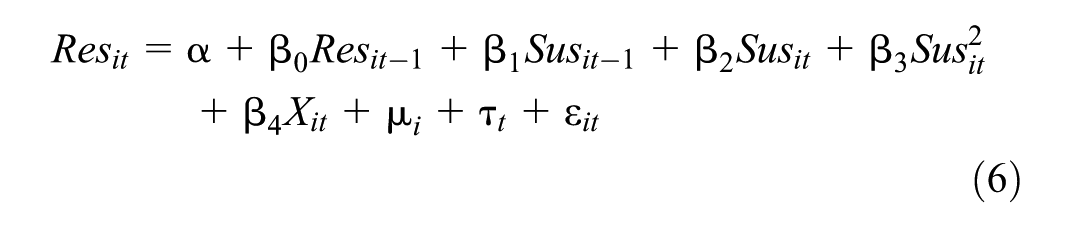
Where
Control Variables
Existing research shows that fiscal expenditure significantly influences local economic resilience (Alichi et al., 2021; Petrović et al., 2021). Given the central focus of this study on the role of industrial positioning and spatial planning in shaping local economic resilience in Fujian Province—and considering that fiscal expenditure is a key policy instrument for government intervention in the economy—this study incorporates the natural logarithm of fiscal expenditure (lnFIS) as a key control variable to reflect the role of local government intervention. In addition, the following control variables are included to account for other potential influences on economic resilience: The share of secondary industry in GDP (IBL), reflecting the structural importance of the manufacturing sector, following Hu et al. (2022);Per capita GDP growth rate (PGR), capturing regional trends in purchasing power (Jiang et al., 2023);Population density (TPD, the ratio of the resident population to administrative area), measuring the potential influence of population agglomeration on local resilience (Kitsos et al., 2023); Number of teachers per 100 residents (JBL, the ratio of the number of teachers to the resident population), used as a proxy for regional education levels (Kitsos et al., 2023). These control variables comprehensively account for the effects of fiscal policy, industrial structure, income level, demographic characteristics, and education quality, thereby enhancing the robustness and validity of the empirical analysis.
Descriptive Statistics
As shown in Table 2, the urban economic resilience indicator exhibits considerable variation across counties, suggesting significant heterogeneity in the shock-absorption capacity among the sampled regions. The mean value is −.016 and the median is −.031, indicating that the economic resilience level is relatively low in most counties and cities. Similarly, both the mean and median values of the electronic information industry sustainability indicator are well below .5, suggesting that the sustainability of this industry is weak in the majority of regions. The fiscal expenditure variable (lnFIS) also shows high dispersion, indicating notable differences in government spending levels across regions. All other explanatory and control variables fall within reasonable value ranges, with no extreme outliers detected.
Descriptive Statistics of Variables.

Analysis of Regression Results
Basic Regression Results
To assess the presence of multicollinearity, this study conducted a Variance Inflation Factor (VIF) test for all variables. The results show that all variables except Sus and its squared term have VIF values below 5, indicating that the model does not suffer from serious multicollinearity issues overall. The VIF values for Sus and Sus2 are 11.05 and 8.87, respectively, which is expected due to their functional relationship and does not compromise the robustness of the model estimation. Since Equation 6 includes a lagged dependent variable and potential endogeneity among explanatory variables, and given the panel data structure with a relatively large cross-sectional dimension (N = 66) and a short time span (T = 14), the conditions are suitable for using the Generalized Method of Moments (GMM). To obtain consistent and unbiased estimators, this study employs the System Generalized Method of Moments (SYS_GMM) and Difference Generalized Method of Moments (DIF_GMM) techniques for dynamic panel estimation. The Arellano-Bond test for autocorrelation and the Sargan test for the validity of instruments are reported in Table 3 as well. The AR(1) test results are satisfactory across all models. Although the AR(2) test p-values are slightly above .05 after controlling for time effects (as shown in columns [2], [4], and [5]), the overall outcomes remain acceptable considering the consistently high p-values (above .99) obtained in the Sargan tests and the stability of core regression coefficients across SYS_GMM and DIF_GMM methods.
Basic Regress Result.

Note. Standard errors in parentheses, p-values in brackets. All regression models are estimated using the two-step GMM method. L.RES = the one-period lag of regional economic resilience; L.Sus = the one-period lag of the sustainability of the information industry; Sus_sq = the squared term of information industry sustainability; Constant = the constant term; Obs = the number of observations; City FE and Year FE represent city and year fixed effects, respectively. The same applies hereafter.
p < .10. **p < .05. ***p < .01.
As indicated by the SYS_GMM estimation in columns (1) and (2), the lagged term of the sustainability indicator (L.Sus) is significantly positive, suggesting that accumulated development within the electronic information industry consistently enhances urban economic resilience, thus validating hypothesis H1 proposed in this study. In other words, the historical buildup of industrial development can provide sustained momentum in innovation, production efficiency, and industrial synergy, which in turn strengthens a region’s capacity to adapt and recover (Boschma, 2022; Martin & Sunley, 2020). Further, the coefficients of the linear term (Sus) and the quadratic term (Sus_sq) are significantly negative and positive, respectively, across all models. This clearly indicates a U-shaped relationship between the sustainability of the electronic information industry and urban economic resilience, thereby supporting hypothesis H2. Specifically, at low levels of industry sustainability, the large upfront investments, weak industrial foundation, and resource crowding may inhibit urban economic resilience. However, once the sustainability level surpasses a certain threshold, with a more complete industrial chain, stronger coordination effects, accelerated innovation diffusion, and enhanced digitalization of the economy, urban economic resilience improves significantly (Demartini et al., 2019; Ji & Huang, 2024).
Analysis of Control Variables
From columns (1) to (4) of Table 3 and columns (1) to (4) of Table 4, the coefficient of fiscal expenditure (lnFIS) is negative when controlling only for city fixed effects (except for column [3] of Table 4, where it is insignificant). However, it turns positive and highly significant when both city and year fixed effects are included. This shift may reflect the interaction mechanism between government fiscal expenditures and macroeconomic shocks (Bachtrögler et al., 2020; Petrović et al., 2021). Without controlling for time effects, the impact of macroeconomic fluctuations cannot be adequately isolated, potentially manifesting passive counter-cyclical fiscal policy measures as a negative correlation with economic resilience. After incorporating year fixed effects, the influence of annual macroeconomic fluctuations can be effectively neutralized, revealing the proactive role of fiscal expenditure through public investment, infrastructure development, and industrial policy support in enhancing regional resilience to external shocks (Martin & Sunley, 2015).
Robustness Checks.

Note. Standard errors in parentheses, p-values in brackets. Curly brackets indicate the Stock–Yogo critical values for the weak identification test: the 10% critical value is 16.38, the 15% critical value is 8.96, and the 20% critical value is 6.66. All GMM regression models are estimated using the two-step method.
p < .10. **p < .05. ***p < .01.
The share of secondary industry in GDP (IBL) exhibits consistently positive and highly significant coefficients across all models, implying that a larger manufacturing sector proportion stabilizes urban economies and strengthens resilience. The per capita GDP growth rate (PGR) is significantly positive in all models, indicating that sustained increases in purchasing power enhance economic resilience. Conversely, population density (TPD) shows significantly negative coefficients, suggesting that excessive population concentration may intensify resource competition and infrastructure overload, thus reducing urban economic resilience. Additionally, the number of teachers per 100 people (JBL) is significantly negative, which may reflect a relative mismatch between local educational development and the demands of the industrial structure.
Robustness Checks
To verify the robustness of the above regression results, this study conducts robustness checks in two dimensions:
Alternative core explanatory variable: Grossman et al. (2023), Uddin et al. (2022), and Rautaray et al. (2022) emphasize the importance of corporate profits in enhancing firm flexibility and supply chain resilience. Therefore, this study adopts a core-variable approach, aggregating corporate operating profits in the electronic information industry for each county as an alternative measure of industry sustainability. As shown in columns (1) and (2) of Table 4, the regression results are fully consistent in sign and remain highly significant compared to columns (1) and (2) of Table 3. Additionally, considering that production efficiency is a fundamental basis for enterprise innovation, management optimization, production capacity, and sustainable development, this study further uses industrial value added per employee to represent productivity as a proxy for the electronic information industry sustainability. As shown in columns (3) and (4), the regression results remain robust.
Alternative estimation method: This study uses the Two-Stage Least Squares (2SLS) method for further robustness checks. Given Fujian Province’s mountainous terrain, constrained land resources significantly impact regional economic development. This study selects the elevation of corresponding counties as an instrumental variable. Considering that elevation is time-invariant, we utilize the interaction between the logarithm of the one-period lagged total retail sales of consumer goods and elevation as the final instrumental variable, as shown in column (5) of Table 4. The rationale is twofold: First, both elevation (a geographical feature) and lagged retail sales (historical economic data) satisfy exogeneity conditions, as they are unaffected by contemporaneous economic factors. Second, elevation likely increases production and logistical costs, thus affecting investment decisions, while historical sales influence investment and production expectations, making their interaction a valid instrument. In addition, this study uses the interaction between elevation and year as an alternative instrument, with the regression results shown in column (6). The results in columns (5) and (6) of Table 4 consistently indicate a U-shaped relationship between the sustainability of the electronic information industry and urban economic resilience. Regression results in Table 4 columns (5) and (6) reaffirm the U-shaped relationship between industry sustainability and urban resilience. However, the coefficient for the lagged dependent variable L.RES is not statistically significant in these columns. When combined with the heterogeneity test in Table 6 and the spatial Durbin model in Table 8, the sign and significance of L.RES appear unstable—consistent with the contour patterns shown in Figure 1a.
Moreover, considering that the number of fixed telephones in 1990 can, to some extent, reflect the information infrastructure at that time and attract related investments that enhance the resilience of the electronic information industry, it meets the relevance condition for a valid instrument. At the same time, given the high development level of the current information industry, fixed telephones are no longer expected to have a direct impact on industry resilience, thus satisfying the exogeneity requirement. Based on this reasoning, the interaction between the number of fixed telephones in 1990 and the lagged retail sales of consumer goods is used as an instrument, with regression results reported in column (7). The results in column (7) also confirm a U-shaped relationship between electronic information industry sustainability and urban economic resilience, while fiscal expenditure exhibits a highly significant positive effect on regional economic resilience.
Threshold Effect Analysis
The previous analysis identifies a nonlinear relationship between electronic information industry sustainability and urban economic resilience, largely due to constraints such as limited economic resources. However, critical questions remain unresolved, particularly regarding the precise sustainability threshold necessary to trigger positive impacts and determining the appropriate timing for the reduction of governmental support. To provide more actionable guidance for policymaking, this study employs a threshold regression approach to characterize the identified nonlinear relationship. Following the methodology of Lee et al. (2023), this study adopts the dynamic panel threshold model proposed by Seo and Shin (2016), with the model specified as follows:

Where, q denotes the threshold variable and r represents the threshold value; I(•) is the indicator function, which equals 1 when the condition is satisfied and 0 otherwise. The definitions of the other variables are consistent with those in Equation 6.
Table 5 presents the regression results of Equation 7. In column (1), the sustainability of the electronic information industry (Sus) is used as the threshold variable. The results show that when Sus is below the threshold value of .109, a 1% increase in fiscal expenditure (lnFIS) leads to a .132 decrease in local economic resilience. However, when Sus exceeds .109, a 1% increase in fiscal expenditure results in a .454 increase in economic resilience—substantially higher than .132—consistent with the baseline regression results in Table 3. In column (2), fiscal expenditure is used as the threshold variable. The findings indicate that when lnFIS is below the threshold of 1.649, the electronic information industry has a negative effect on local economic resilience. Conversely, when fiscal expenditure exceeds this threshold, the industry has a significantly positive impact on resilience. In column (3), the ratio of secondary industry value added to GDP (IBL) serves as the threshold variable. The results show that when IBL exceeds .529, the electronic information industry has a clear positive effect on local economic resilience.
Threshold Regression Results.
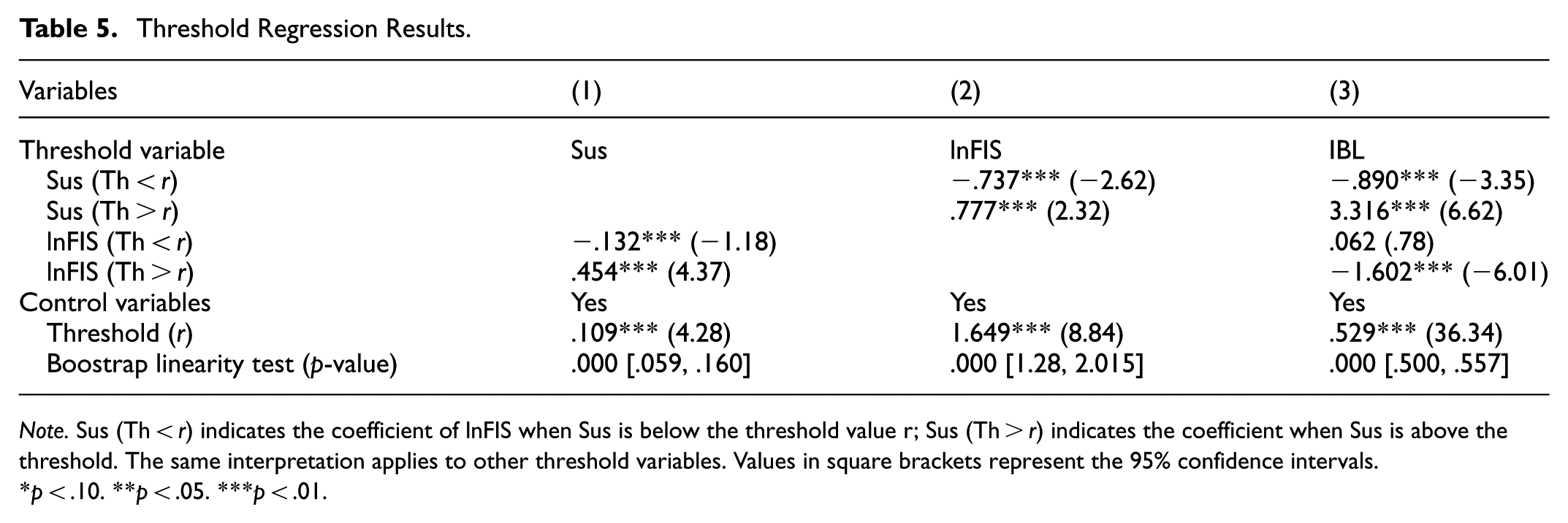
Note. Sus (Th < r) indicates the coefficient of lnFIS when Sus is below the threshold value r; Sus (Th > r) indicates the coefficient when Sus is above the threshold. The same interpretation applies to other threshold variables. Values in square brackets represent the 95% confidence intervals.
p < .10. **p < .05. ***p < .01.
Analysis of the Effectiveness of Government Spatial Planning
In recent years, Fujian Province has attached great importance to the spatial layout and regional agglomeration effects of the electronic information industry. Successive provincial 5-Year Plans have explicitly proposed the continued strengthening of the southeastern coastal region as a strategic hub for the development of the electronic information industry. To evaluate the implementation effectiveness of these regional industrial spatial planning policies, the sample is subdivided into two groups: key planned areas (Fuzhou, Xiamen, Quanzhou, and Ningde, henceforth referred to as “planned areas”) and other regions within Fujian Province (“non-planned areas”). Group regressions are then conducted based on Model (12), with the results reported in columns (1) and (2) of Table 6.
Heterogeneity Test of the U-Shaped Relationship.

Note. Standard errors in parentheses, p-values in brackets. All GMM regression models are estimated using the two-step method 5.4. Spatial Durbin Model Regression Analysis.
p < .10. **p < .05. ***p < .01.
Columns (1) reports regression results for the planned areas, demonstrating a significantly positive relationship between the development of the electronic information industry and local economic resilience, exhibiting a typical U-shaped nonlinear structure. Although the lagged sustainability term (L.Sus) is not statistically significant, its positive direction indicates a potentially beneficial foundational effect. By contrast, columns (2), representing non-planned areas, shows generally insignificant results, suggesting that these counties are still at an initial or developmental stage, with the U-shaped structure lacking robustness. Although the directions of coefficients for Sus and Sus_sq align with theoretical expectations, statistical significance remains weak, highlighting incomplete industrial ecosystems and limited sustainable development capacity in these regions. Collectively, the spatial planning of Fujian’s electronic information industry has achieved preliminary successes in the planned areas, enhancing local economic resilience and promoting internal sustainability. However, the spatial spillover effects remain limited, failing to significantly drive coordinated industrial development in surrounding regions.
To further examine how geographic features, industrial structure, and government intervention influence the relationship between the sustainability of the electronic information industry and local economic resilience, this study introduces three variables: terrain ruggedness, industrial diversity, and the intensity of government subsidies. Each county is categorized into high and low groups based on the median value of these variables. Industrial diversity is calculated using the formula:
According to analyses presented in Figures 2 and 3, there is a discernible spatial correlation among counties in terms of economic resilience, predominantly characterized by low-low clustering, whereas spatial correlations of electronic information industry sustainability are weak. Table 7 and Figure 4 further confirm these conclusions. In Table 7, most Moran’s I indices for local economic resilience are positive and highly significant, indicating varying degrees of spatial correlation among counties and cities. However, the local Moran scatter plots in Figure 4 show relatively few instances of “high-high” clustering. Moreover, most of the Moran’s I indices for the sustainability of the electronic information industry in Table 7 are statistically insignificant, suggesting that the spatial correlation of this industry across counties is generally weak.
Moran’s I Test.

Note. p-values in parentheses.

Local Moran’s I scatterplots of economic resilience in 1998 and 2013.
Considering the spatial correlation of economic resilience and the sustainability of the electronic information industry across counties, and to quantify spatial effects, this study adopts the dynamic Spatial Durbin Model (SDM) based on the robust LM test results (all p-values = .000) and the Hausman test result (p-value = .000). Building upon Equation 6, the specific model is specified as follows:

Where ρ denotes the spatial autoregressive coefficient of the dependent variable; δ represents the spatial regression coefficient of the independent variable, and W is the spatial weighting matrix. Other variables are defined consistently with Equation 6. Results are shown in Table 8, with columns (1) to (2) employing Queen adjacency and inverse economic distance (INV) weighting matrices, respectively, and columns (3) to (4) employing total operating profit as an alternative independent variable to verify robustness.
Spatial Doberman Model Regression Results.

p < .10. **p < .05. ***p < .01.
From Table 8, after incorporating spatial lag terms, the U-shaped nonlinear relationship between electronic information industry sustainability and urban economic resilience remains robust, with lagged terms largely retaining statistical significance (except in column [2]). However, the spatial lag terms (W.Sus) are consistently insignificant across all specifications, indicating weak spatial correlations among counties in terms of industry sustainability during the study period, corroborating the findings presented in Figures 2b, 3b, Tables 6 and 7. A possible reason is that Fujian Province has actively promoted a “one county, one specialty” strategy, focusing on cultivating distinct industrial features in each county, thereby weakening cross-county collaboration in the electronic information industry. Moreover, provincial fiscal allocations—both general budget and special funds—have largely followed the priorities set in successive 5-Year Plans, primarily supporting the development of the electronic information industry in cities such as Fuzhou, Xiamen, Quanzhou, and Ningde, while neglecting other regions. This further contributes to the limited spatial spillover effects of the industry and validates the H3.
Meanwhile, the spatial lag terms for economic resilience (W.Res) exhibit significant positive correlations, consistent with Figures 2a and 3a, confirming spatial spillover effects characterized predominantly by low-low clustering. In Figure 2a, most points are concentrated near the origin, and in Figure 4, the majority of points fall below the (1, 1) line—indicating that most counties have relatively low economic resilience, and the spatial spillovers have not exerted a positive effect, resulting in a certain degree of non-virtuous cycle.
Conclusion and Policy Implications
To evaluate the effectiveness of Fujian Province’s electronic information industry policies and spatial planning, this study first measured the economic resilience of counties. It then constructed a sustainability indicator system for the electronic information industry, measured city-level sustainability, and applied spatial kernel density estimation to analyze the spatio-temporal evolution of both urban economic resilience and industry sustainability. Furthermore, System GMM and Spatial Durbin Models were employed to empirically test the relationship between the two variables. The main findings are as follows: (1) Urban economic resilience levels across counties converge within the range of [−1, 1], suggesting increasing regional economic balance. However, a significant “low-low” clustering pattern is evident. (2) There is limited coordination in the development of the electronic information industry across counties. Spatial planning implemented by the provincial government has strongly promoted industry sustainability in designated planning areas, but spillover effects on surrounding regions remain weak and spatial diffusion is not significant. (3) A statistically significant and stable U-shaped relationship exists between electronic information industry sustainability and urban economic resilience. In the early stages of industrial development, constrained by limited economic resources, initial investment may crowd out other productive activities, negatively affecting resilience. However, once sustainability exceeds a critical threshold (e.g., above .082), the industry contributes positively to resilience by facilitating digital transformation and other adaptive mechanisms.
Based on the above findings, this study proposes the following policy recommendations:
(1) Continuously optimize resource allocation and enhance the overall development level of the electronic information industry. Given that the sustainability of the electronic information industry may have negative impacts on regional economic development in its early stages but can significantly enhance urban economic resilience once mature, it is recommended that provincial governments continue to strengthen policy support for the industry. This can be achieved by moderately tilting fiscal transfer payments, tax incentives, and innovation subsidies toward regions with strong development potential, thereby laying the foundation for industrial diffusion and subsequent gradient-based industrial relocation. Additionally, in the early stages of industry development, governments could establish dedicated support funds and guarantee mechanisms to improve firms’ risk resilience and financial stability during transformation and upgrading.
(2) Strengthen regional coordination mechanisms and build a “point-axis-network” model of collaborative development. Although the electronic information industry in Fujian Province has achieved notable progress in the designated planning regions, its spatial spillover effects remain limited, and a strong regional linkage mechanism has yet to be formed. Efforts should be made to promote deep integration between planning regions and their surrounding areas in terms of innovation resources, supply chains, and information platforms. Leveraging high-speed railways, digital infrastructure, and other transportation and communication networks, the government should strengthen coordination in technology R&D, industrial support, talent mobility, and information exchange between core and peripheral cities. This includes establishing joint laboratories, regional innovation platforms, and cooperative industrial parks across locations to promote in-depth interregional cooperation.
(3) Establish a performance-oriented support withdrawal mechanism to dynamically optimize the allocation of policy resources. It is advisable to construct a dynamic evaluation system centered on the development performance of the electronic information industry, with comprehensive monitoring and assessment of counties across dimensions such as technological level, output efficiency, and industrial spillover effects. For planning regions that have achieved strong independent innovation capacity and stable market-based operations, policy support should gradually shift to “soft support”—for example, enhancing assistance for setting technical standards, protecting intellectual property, and training industrial talent.
Although the empirical analysis in this study focuses primarily on the relationship between the electronic information industry and urban economic resilience in Fujian Province, its analytical framework and core conclusions possess a degree of generalizability and offer valuable reference for other Chinese provinces that are also actively promoting the electronic information industry or the digital economy. First, eastern coastal provinces such as Guangdong, Zhejiang, and Jiangsu also host highly developed electronic information industry clusters. These regions share similarities with Fujian in terms of development pathways, industrial structure, and innovation ecosystems. Therefore, the conclusions of this article offer strong theoretical and policy relevance for those regions. Second, this study provides an important theoretical perspective for local governments: in the process of promoting digital economy development, it is crucial for governments to accurately identify the critical thresholds of electronic information industry development and to pay close attention to the timing, intensity, and ecosystem maturity of resource investment during industrial development.
Footnotes

Ethical Considerations
This research did not involve any human participants or identifiable personal data, and therefore did not require ethical approval.
Consent to Participate
Not applicable.
Funding
The authors disclosed receipt of the following financial support for the research, authorship, and/or publication of this article: National Science Foundation of China Grant (72074104): “Information Disclosure, Social Trust, and Crisis Management: Empirical Investigation and Policy Design”; Major Project of the Fujian Provincial Social Science Foundation (FJ2025A006): Research on the Pathways and Policies for Empowering High-Quality Development of County-Level Industrial Chains in Fujian through Digital Trade.
Declaration of Conflicting Interests
The authors declared no potential conflicts of interest with respect to the research, authorship, and/or publication of this article.
Data Availability Statement
The data supporting the findings of this study are available from the corresponding author upon reasonable request.