




Abstract
To study the impact of the digital economy on industrial structure upgrading, this paper constructs the dynamic spatial Durbin model, dynamic spatial intermediary model, and spatial threshold model based on the panel data of 155 prefecture-level cities in China from 2011 to 2021. It is found that: (a) the improvement of the digital economy in the region can directly promote the upgrading of local industrial structure, but there is a significant “siphon effect,” which makes the spatial spillover effect negative and significant. (b) The digital transformation of enterprises plays a mediating role in the path of digital economy-driven industrial structure upgrading, with a short-term mediating effect size of about 17.18%. (c) The digital economy has a threshold effect on the path of enterprise digital transformation for industrial structure upgrading. These findings provide suggestions for policy.
Keywords
With the development of big data, artificial intelligence, machine learning, and other technologies, together with their wide application, the digital economy is flourishing as a new economic model. The White Paper on China’s Digital Economy Development and Employment (2020) reports that the scale of China’s digital economy in 2019 increased from 2.6 trillion yuan to 35.8 trillion yuan between 2005 and 2019, with an average annual growth rate of 2.4 trillion yuan and an average annual growth rate of 20.6%. During the same period, its share of gross domestic product (GDP) also increased from 14.2% in 2005 to 36.2% in 2019. The digital economy has not only become a stabilizer and booster of China’s economic development but also an important cornerstone of China’s technological innovation, industrial structure upgrading, and high-quality economic development. The national strategic plan calls for improving China’s industrial digitization and digital industrialization, creating digital economic advantages, promoting the deep integration of digital technology and the real economy, and empowering the transformation and upgrading of traditional industries. However, China’s industry has always suffered from duplicated layouts, a low overall development level of the tertiary industry structure, low industrial quality, and overcapacity in recent years. Specifically, traditional industries experience the harsh reality of technological constraints and insufficient effective demand, and the serious impact of COVID-19 on the global industrial chain and the development of China’s industrial structure is undoubtedly more difficult. Thus, how the digital economy contributes to upgrading industrial structure is an important research topic.
The existing literature on theoretical research on the development of the digital economy driving industrial structure upgrading is mainly from the perspectives of resource allocation efficiency, production efficiency, and technology innovation level, but rarely from the perspective of enterprises’ digital transformation. There is a lack of research to empirically test the relationship between the three. Hence, we choose to construct a spatial Durbin model to analyze the impact of digital economy development on industrial structure upgrading from a spatial perspective based on panel data of 155 prefecture-level cities in China with 16 indicators from 2011 to 2021, with reference to Lu and Zhu (2022) and other studies. Furthermore, from a spatial perspective, this study tests the mediating effect of the mechanism of action based on the new path of enterprise digital transformation to clarify the mechanism of action of digital economy development. Simultaneously, this study also includes the test of the threshold effect to study the threshold role of digital economy development in the path of enterprise digital transformation for industrial structure upgrading.
In contrast to the existing findings, this study reveals that there is a negative spatial spillover effect of digital economy development on industrial structure upgrading, making the digital economy development in the region, to a certain extent, inhibit the industrial structure upgrading in neighboring regions. It also finds that the digital economy can drive industrial structure upgrading through the intermediary path of enterprise digital transformation.
The contribution of this study to the literature is threefold. First, from a research perspective, this study investigates the relationship between the digital economy and industrial structure upgrading at the spatial level and examines its spatial spillover effects in depth. This approach complements the gaps in the relevant research literature and helps the government optimize the spatial development pattern of the digital economy and industrial structure. Second, in terms of research methodology, this study differs from the traditional intermediary effect model as it examines the intermediary effect of enterprises’ digital transformation from the perspective of dynamic space, which clarifies the mechanism, path, and effect of the intermediary effect. This study also examines the threshold effect of digital economy development from a spatial perspective by constructing a spatial threshold effect model, which further complements the existing literature and provides policy suggestions for local governments to determine the appropriate development path. Third, at the research level, this study discusses the relationship between digital economic development and industrial structure upgrades based on prefecture- and city-level data.
Literature Review
The Digital Economy
First, the research related to the connotation of the digital economy can be traced back to the end of the 20th century, when Tapscott (1994), an American scholar, first proposed the concept of the digital economy, mainly studying the new trend of the economic system after the popularization of information highways in the United States, but did not clearly define the digital economy. Turcan et al. (2014) further shows that the key resource of the digital economy is information. Digital information can create new economic value, bringing great opportunities for new product development and service creation. Second, regarding digital economy measurement, Reinsdorf and Schreyer (2020) highlighted that the development model of the digital economy has exposed the flaws of the existing economic scale accounting, and that direct method accounting will result in omission of digital economy accounting or underestimation of GDP accounting, which cannot effectively reflect the contribution value of the digital economy. Thus, the indicator analysis method is more common; for example, Jiao and Sun (2021) proposed the use of the dimensions of Internet development, digital transactions, and industrial efficiency for calculation and analysis.
Industrial Structure Upgrading
Current research on industrial structure upgrading focuses on financial development, scientific and technological innovation, and institutional innovation. Wang and Zheng et al. (2020) noted that scientific and technological innovation strongly supports industrial agglomeration and promotes the formation and upgrading of industrial chains. Tu et al. (2021) found that there are self-promoting mechanisms for science and technology innovation and industrial structure upgrading among regions based on the panel vector autoregression (PVAR) model, and the promotion mechanism of science and technology innovation is more significant. Zhang et al. (2021) observed a threshold effect of financial development scale on the promotion of industrial structure upgrading, and foreign direct investment has a significant promotion effect on industrial structure rationalization only when the level of financial development is greater than the threshold value.
Impact of Digital Economy on Industrial Structure Upgrading
Scholars have studied the impact of the digital economy on industrial structure upgrading from different perspectives. At the theoretical level, Pradhan (2019) believes that the digital economy can promote industrial transformation and upgrades by improving production efficiency and optimizing resource allocation. Jing and Sun (2019) reported that the development of the digital economy can promote industrial structure upgrading, which, in turn, promotes high-quality economic development. Moreover, the development of the digital economy has introduced a series of new industries and models, such as platform and sharing economies, which bring new opportunities for industrial structure upgrading (Ren & Dou, 2021). Zhu and Wang (2021) further theorized about China’s digital economy development empowering industrial transformation in terms of the connotation and extension of industrial digitalization and its main characteristics. In terms of empirical evidence, X. Z. Li and Wu (2020) analyzed the dynamic interaction between the digital economy and industrial structure transformation and upgrading using the PVAR and impulse response models by region, and found a positive dynamic interaction between them. According to Chen et al. (2020), the digital economy has a marginal incremental upgrading effect on the level of China’s industrial structure. Y. J. Li and Han (2021) highlighted this notion from the perspective of the east, middle, and west of the country. Moreover, the development of the digital economy is positively correlated with the increasing level of industrial structure and can suppress it from deviating from equilibrium and improve its level of rationalization (Han & Li, 2022). However, the development of the digital economy positively impacts the upgrading of industrial structure at the prefecture level, as shown in the empirical analysis by Guan et al. (2022). Regarding the influence mechanism, X. M. Zhao and Hou (2020) found there is a positive interaction between the digital economy, market behavior, and market performance, which drive the optimization and upgrading of industrial structure. Su et al. (2021) showed that the digital economy can promote the upgrading of industrial structure through the intermediary path of technological innovation. Furthermore, Tang et al. (2021) observed that the development of a digital economy can mainly optimize the efficiency of resource allocation and facilitate the integration of digital technology and traditional industries to achieve industrial structure upgrading. Liu and Chen (2021) employed the intermediary effect model, finding that the development of a digital economy can influence the level of human capital and scientific and technological innovation, thereby influencing the advancement and rationalization of China’s industrial structure.
Thus, most studies on the impact of the digital economy on industrial structure upgrading have analyzed its effects and basic transmission mechanisms, but does not provide precise information about certain aspects. These include examining the direct and indirect transmission mechanisms at the spatial level and further analyzing the relationship between the two based on the level of Chinese prefecture-level cities. Thus, the present study follows this approach.
Theoretical Analysis and Research Hypothesis
Inner Mechanism of the Digital Economy
With the rapid development and wide application of digital technologies, such as big data, artificial intelligence, cloud computing, Internet of Things, and mobile Internet, the process of digital industrialization and industrial digitization continually advances, and the contribution of the digital economy to industrial structure upgrading cannot be underestimated (Liu & Chen, 2021). First, with the increasing strength of digital industrialization, new digital technology-based industries are increasing. Notably, the emergence of a large number of innovative digital industries has bolstered the level of technological innovation in industrial development, making the related industrial production system more comprehensive while promoting the expansion of the scale of digital service industries. Second, the continuous development of industrial digitalization has brought many new opportunities, such as the emergence of new digital models (e.g., sharing economy and e-commerce), which have improved the allocation efficiency of production factors and reduced production costs, gradually facilitating the modernization of traditional industries, such as agriculture (i.e., the upgrading of the primary industry).
Furthermore, the digital economy is the core and key of the fourth industrial revolution, which can promote the construction of the “5G+Industrial Internet” project, expand the scale of the industrial Internet industry by leveraging digital technology, and support platform construction and maintenance services. Additionally, digital technology at the production end can replace low-end manual labor in assembly line operations or high-risk complex production links through machinery and equipment, artificial intelligence, and other pathways, to improve industrial production efficiency and promote the intelligent transformation of enterprises. Hence, the development of the digital economy provides an effective information supply to the industry in research and development (R&D), production, and transportation; it also accelerates the development of the industrial Internet and smart manufacturing, helping enterprises shift to intelligent and efficient development, and consequently promoting the upgrading of the secondary industry. The mutual integration and penetration between the digital economy and the service industry enables the supply side of the service industry to respond quickly to market demand, truly meet customer needs, improve service quality, enrich service content, and expand the scale of the service industry (i.e., raising the proportion of the tertiary industry).
The digital economy, with its characteristics of networking and data, makes the traditional three industries intermingle and upgrade alongside it and constantly gives rise to new industries, thus promoting industrial efficiency and the development of technology and knowledge-intensive industries, expanding the scale of the modern service industry, and realizing the optimization and upgrading of the industrial structure. The specific influence mechanism is shown in Figure 1. Thus, the following hypothesis is proposed:
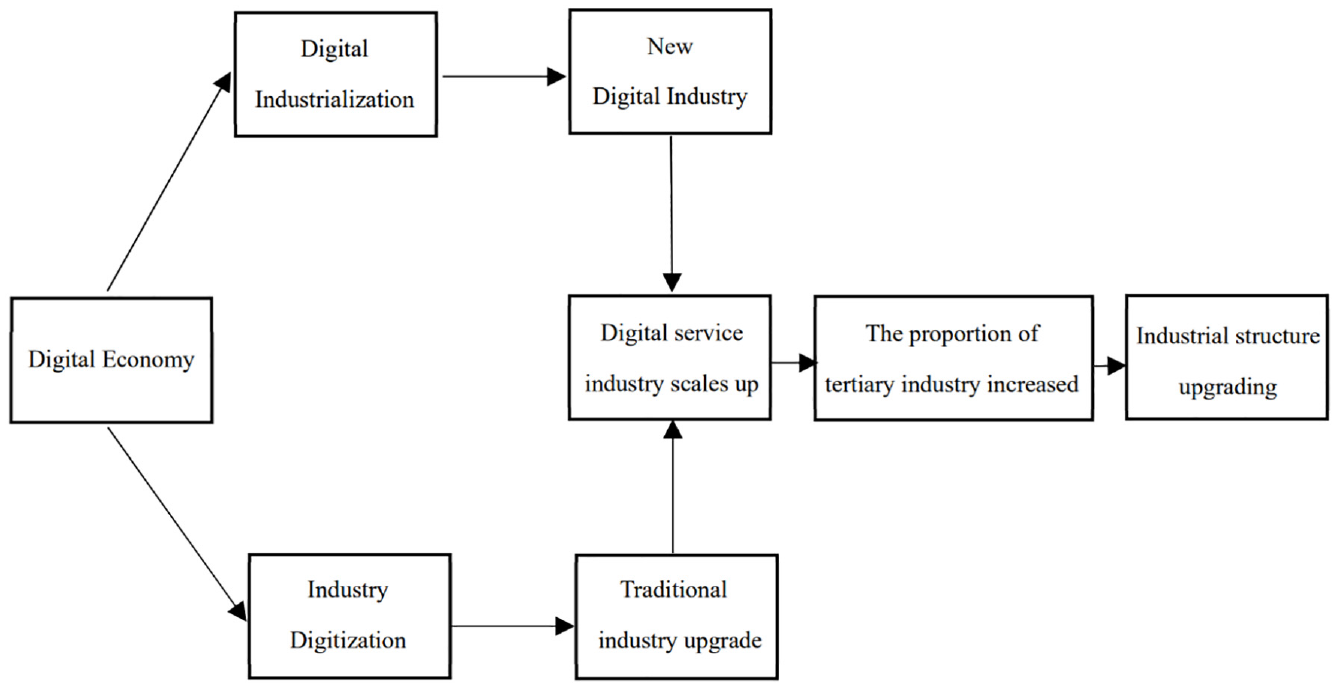
Mechanism of the impact of the digital economy on industrial structure upgrading.
H1: Development of the digital economy can promote the upgrading of the industrial structure.
Spatial Spillover Effect of the Digital Economy on Industrial Structure Upgrading
The digital economy can realize the open sharing of resources to accelerate the flow of social resources and production factors between regions, while the emergence of the digital economy brings new production factors (i.e., digital technology and data factors), which break the spatial constraints on the development of the digital economy. Notably, data factors are not constrained by time and space compared to traditional factors of production and have lower circulation costs, which gives data factors strong mobility. Hence, the constraints of geographical distance are overcome, allowing for the strong spatial spillover effects of the digital economy in influencing industrial structure upgrading (Ma, 2022). However, the characteristics of digital technology development differ from those of general technological innovations in the following ways. Digital technology development takes data as the key input factor, and its innovation output also needs to serve data production, storage, and application (Yu, 2017). Hence, digital technology development is impacted by the degree of data concentration. However, the border cost of data is equal to zero, and it has the characteristic of a natural monopoly, which may cause a high concentration of data in a few enterprises and a few regions, forming a “winner-takes-all” situation, indirectly resulting in a higher spatial concentration and monopoly of digital technology (X. Z. Li & Shi, 2021). Therefore, the spatial effect of digital economic development on industrial structure upgrading may show characteristics opposite to the general positive spillover effect. Thus, we propose the following hypothesis:
H2: Digital economy development has a negative spatial spillover effect on industrial structure upgrades.
Mediation Effect of Digital Economy on Industrial Structure Upgrading
The vigorous development of the digital economy has given rise to digital technologies, such as artificial intelligence, e-commerce, and cloud computing, which empower and upgrade traditional industries. Currently, big data drive big intelligence, empower enterprises in smart manufacturing, and promote the transformation of social production methods and enterprise development to digitalization (Huang, 2019). The digital economy relies on artificial intelligence, big data, blockchain, and other digital technologies to continuously integrate with all aspects of enterprise R&D, production, and sales, which not only greatly promotes the digital transformation of enterprises but also facilitates an effective connection between people, machines, products, and services, and leads to extensive changes in the production methods and development models of enterprises. Simultaneously, it also links enterprises’ business processes to form valuable digital assets, improves the efficiency of enterprises’ utilization of resources, effectively promotes communication efficiency between the upstream and downstream of the industrial chain, promotes the optimal allocation of supply chain resources, and achieves a significant increase in production efficiency by replacing the manual aspects of production management with digital technology. Furthermore, the digital economy can also promote and enhance human–machine collaboration, ensure flexible and intelligent manufacturing, and improve enterprise production efficiency and production quality (Li et al., 2021). The core of industrial structure upgrading is enterprise productivity and market competition. Through digital transformation, enterprises reduce production costs and optimize resource allocation, and enhance the ability of enterprises to obtain, store, and analyze data. Digital transformation also helps enterprises take advantage of the Internet’s big data and cloud computing resources to bring into play the “1 + 1 > 2” synergistic effect, enhance productivity and competitiveness, and thus promote industrial structure upgrading (Han & Li, 2022). Thus, we propose the following hypothesis:
H3: The digital economy can promote industrial structure upgrades by facilitating the digital transformation of enterprises.
Research Design
Empirical Model Setting
Spatial Autocorrelation Test
Before establishing a spatial econometric model, a preliminary analysis of the main variables can be conducted to test whether they are spatially correlated. In this study, referring to the study by Ma (2022), we used Moran’s I index as it is the most common method for testing spatial autocorrelation. The specific formula is as follows:

where
Spatial Measurement Model Selection
Referring to Lu and Zhu (2022), this study initially determined the construction of a spatial Durbin model using LM (Lagrange Multiplier) test results, which showed that fixed effects should be added to this model. This was further confirmed by the LR (Likelihood ratio) test. The data in this study were not suitable for constructing a spatial lag model and a spatial error model, and a spatial Durbin model was the optimal choice. The results of the diagnostic tests are shown in Table 1. Elhorst (2012) believes that the use of dynamic spatial panel model can effectively overcome the endogeneity problem among variables. Therefore, we constructed a dynamic spatial panel model to evaluate the data and integrated the test results to finally determine the construction of a double fixed-effect dynamic spatial Durbin model. In particular, the spatial weight matrix was based on the “la-queen” relationship. In this paper, we used Stata 17 for data analysis. Model construction and diagnostic tests were as follows:
Diagnostic Tests Result.

***,**,* indicate significance at the 1%, 5%, and 10% levels, respectively, and are the same in the following tables.

where
Mediation Effect
Can the digital economy drive high-quality economic development by promoting the digital transformation of enterprises? Is the digital transformation of enterprises a mediating variable in this path? To test the existence of the path of action and the mediating effect, we adopted a stepwise regression method based on the dynamic spatial Durbin model to test and analyze the mediating effect mechanism from a spatial perspective, referring to the findings of Wen et al. (2004) and others. The specific model settings were as follows:
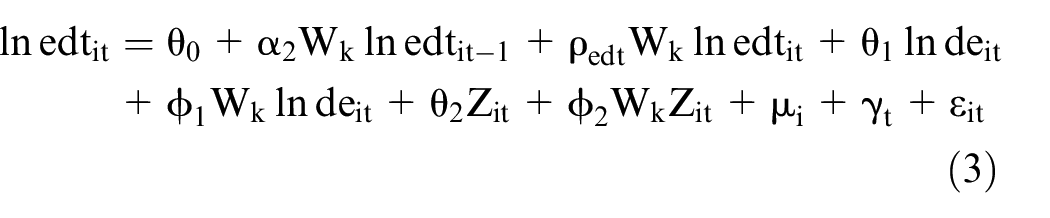

where
According to Figure 2, the steps of the mediating effect test are as follows. In the first step, we tested whether the total effect c shown in Figure 2b existed (i.e., whether the regression coefficient

Mediation effect mechanism.
Indicator Setting
Explanatory Variable
Industrial Structure Upgrading Index (AIS)
Drawing on the method of Xu and Jiang (2015), we included the primary, secondary, and tertiary industries and constructed the industrial structure upgrading index. The measurement formula is:

where
Explanatory Variables
Digital Economy Development Level (DE)
With the recent rapid development of the digital economy, it has become a common practice to quantify the development status of the digital economy by selecting relevant indicators. However, due to the limitation of access to quantitative indicators, most studies have been conducted at the provincial level and no authoritative and unified measurement system has been formed. Moreover, even fewer studies have been conducted at the prefecture level. Accordingly, we calculated the digital economy index according to T. Zhao et al. (2020) approach, and the specific indicators were selected from the number of Internet broadband access users, number of employees in the computer services and software industry, telecommunication business income, number of cell phone subscribers, and digital inclusive finance index of prefecture-level cities. The comprehensive index value is obtained via the entropy weighting method as shown in Table 2. The data were sourced from the China Urban Statistical Yearbook published by the National Bureau of Statistics of China.
Digital Economy Measurement System.

Mediating Variable
Degree of Enterprise Digital Transformation (EDT)
This study drew from the idea of Wu et al. (2021) and used Python’s crawler function to organize the annual reports of all listed companies in China from 2011 to 2021, and counted the number of words in five aspects, namely artificial intelligence technology, blockchain technology, cloud computing technology, big data, and digital technology application. These were then categorized and organized to build an index system of enterprise digital transformation by summing up the frequency of the five word categories. The data were sourced from the Guangdong Institute of Finance.
Control Variables
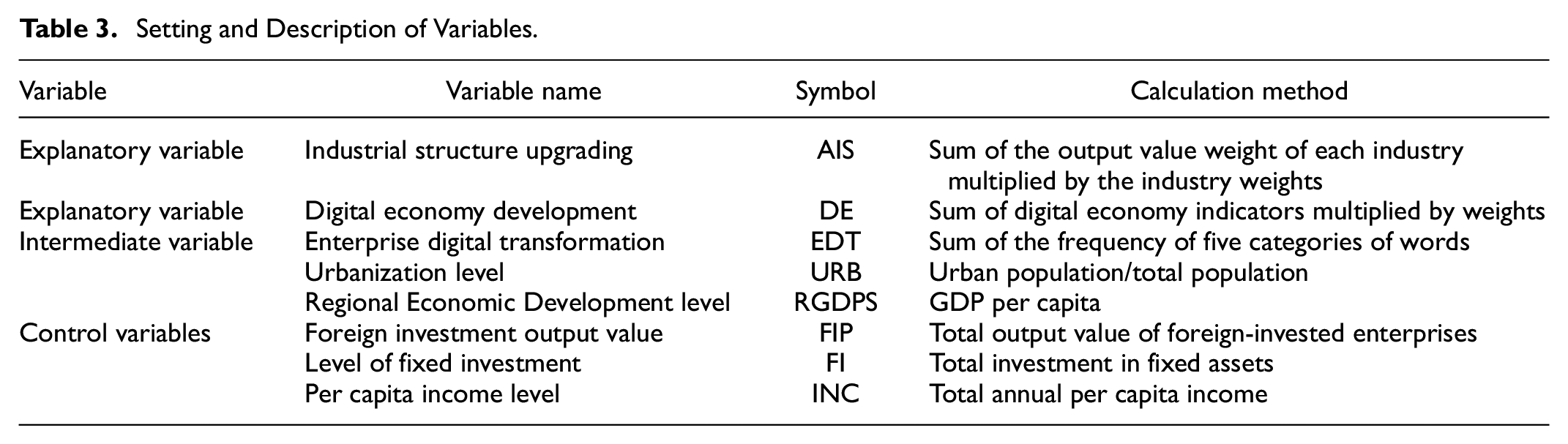
In this study, the levels of urbanization, regional economic development, foreign investment, fixed investment, and per capita income were selected as control variables with reference to the studies of Ma et al. (2022) and Sun et al. (2022), and the specific set of variables is provided in Table 3.
Setting and Description of Variables.
Urbanization Level
The urbanization level is obtained by counting the total population and urban population of each prefecture-level city, and calculating the urban population divided by the total population. The data source is China Urban Statistical Yearbook.
Regional Economic Development Level
The GDP per capita of each prefecture-level city is used to measure the local economic development level. The data source is the China City Statistical Yearbook.
Foreign Investment Output Value
The total output value of foreign-invested enterprises in each prefecture-level city is counted to measure the foreign investment output value. The data source is the China City Statistical Yearbook.
Level of Fixed Investment
The level of fixed investment is measured by the total investment in fixed assets of each prefecture-level city. The data source is the China City Statistical Yearbook.
Per Capita Income Level
The level of per capita income is measured by the total annual average income of people in each prefecture-level city. The source of data is the statistical yearbook of each province in China.
Research Sample and Data Sources
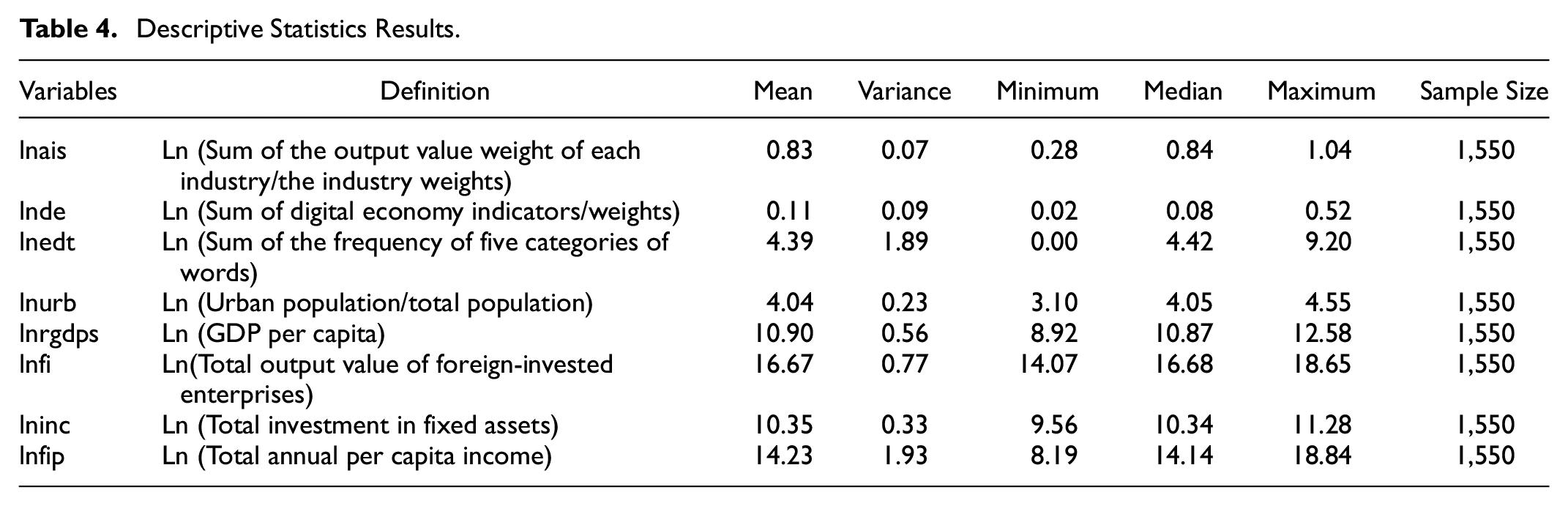
Given the data availability of the mediating variable of enterprise digital transformation, there are too few or no enterprises related to digital transformation in some prefecture-level cities. Therefore, this study excluded some prefecture-level cities for analysis and collected and collated statistical panel data on 19 indicators for the 10 years from 2011 to 2021, using 155 prefecture-level cities across China as the research objects. Some had a small number of missing indicators, which were supplemented using the interpolation method. The study sample data were logarithmically processed, and the descriptive statistics are presented in Table 4.
Descriptive Statistics Results.
Empirical Results and Analysis
Spatial Correlation Analysis
Based on an understanding of the characteristics and dynamics of national digital economy development, we used Moran’s I index to test whether there is a spatial correlation between the level of digital economy development and the level of industrial structure upgrading of each prefecture-level city from 2011 to 2021. The test results are presented in Table 5.
Global Moran’s I Index Value.

From 2011 to 2019, Moran’s I for the level of digital economy development, digital transformation of enterprises, and industrial structure upgrading level are all positive and have strong significance, indicating that the development of the three is not independent in each region but has a positive spatial correlation. Hence, it is imperative to consider the spatial correlation when analyzing the relationship between the three factors. Further analysis revealed that Moran’s I index of the digital economy level, which fluctuates less within a certain range, was insignificant for 2021, indicating that the spatial correlation of the digital economy in each region is generally relatively stable but varies. Moran’s I index of enterprise digital transformation, as a whole, shows an upward trend, denoting the increasing degree of mutual influence of enterprise digital transformation in each region. Moran’s I index of industrial structure upgrading shows a fluctuating upward trend, with a peak in 2017 and a decline in the following 4 years. Only in the last 2 years is it insignificant, denoting that the spatial correlation of industrial structure upgrading among regions shows an inverted U-shaped trend.
Spatial Regression Analysis
Dynamic Spatial Durbin Model Regression Analysis
Table 6 shows the regression results of non-dynamic and dynamic spatial Durbin models. The coefficients of the spatial and temporal lags of industrial structure upgrading are significant, highlighting that changes in the level of industrial structure upgrading are characterized by time and space dependence; thus, the dynamic spatial Durbin model has the best estimation characteristics.
Spatial Durbin Model Test Results.

The dynamic spatial Durbin model in Table 5 shows that the regression coefficients of the core explanatory variables at the digital economy level are all significantly positive at the 1% level, suggesting that the development of the digital economy can significantly promote the upgrading of the industrial structure in the region, thus verifying H1. However, the regression coefficients of the variable Wlnde are all significantly negative at the 1% significance level, indicating that the upgrading of the digital economy in the neighboring regions, rather than promoting the upgrading of the industrial structure in the region, inhibits the upgrading of the industrial structure in the region, verifying H2. The regression coefficients of the control variables urbanization level (URB) and per capita income (INC) are both significantly positive, indicating that an increase in urbanization rate and per capita income can promote upgrading of the industrial structure in the region, consistent with the previous analysis. As the rural population relocates to towns, the overall production level of towns and cities improves, and the competitiveness of enterprises increases, promoting the upgrading of the industrial structure. The increase in per-capita income promotes the upgrade of consumption, which subsequently promotes the upgrade of industrial structure from the demand side. The regression coefficients of the fixed investment level (FI), foreign investment (FIP), and regional economic development level (RGDPS) are not significant, outlining that the impact on upgrading the local industrial structure is not clear. From a spatial perspective, the urbanization level (Wlnurb), foreign investment (Wlnfip), and regional economic development level (Wlnrgdps) all have positive spatial spillover effects. This shows that improvements in urbanization, foreign investment, and regional economic development levels in the region can positively promote the upgrading of industrial structures in neighboring regions. However, per-capita income (Wlninc) has negative spatial spillover effects, and the regression coefficient of the fixed investment level (Wlnfi) is not significant, conveying that its impact on neighboring regions is unclear.
Analysis of Direct, Indirect, and Total Effects
Lesage & Pace (2009) argue that when using the spatial Durbin model, if the coefficient of the spatial lag term of the dependent variable is significantly non-zero, then the obtained results may be systematically biased. The spatial lag term for industrial structure upgrading in Table 6 is significantly non-zero. Therefore, to better analyze the role of the digital economy in each prefecture-level city on the upgrading of the industrial structure in local and neighboring areas and to eliminate possible systematic bias, this study decomposed the total effect of the digital economy development level into direct and indirect effects as shown in Table 7.
Regression Results for Direct, Indirect, Total, and Mediated Effects.
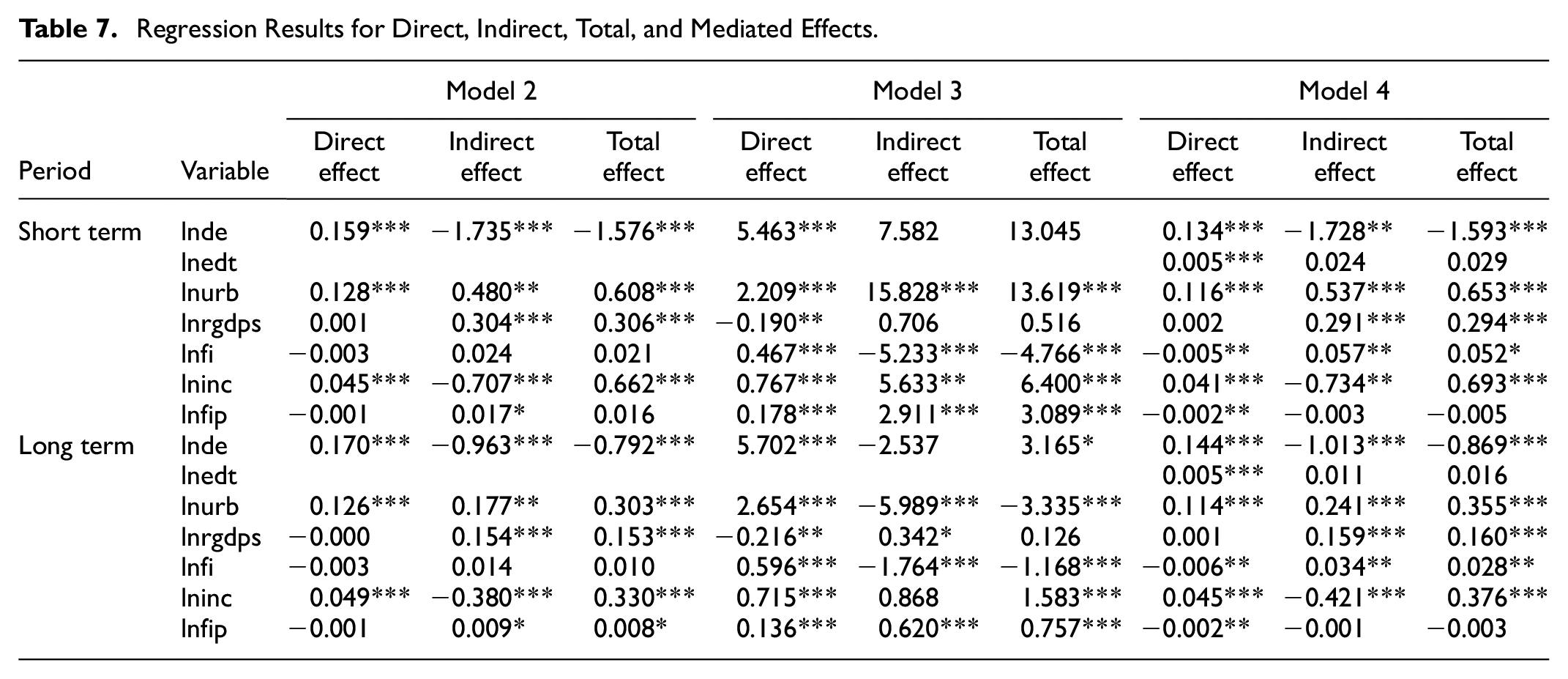
In the short term, for the direct effect, the regression coefficient of the digital economy is significantly positive at the 1% level, indicating that the development of the digital economy can directly drive the upgrading of the local industrial structure. For the indirect effect, the regression coefficient of the digital economy is significantly negative at the 1% level, indicating that the development of the local digital economy limits the upgrading of the industrial structure in neighboring areas. This limitation indirectly leads to a higher spatial concentration and monopoly of digital technology, forming a “siphon effect” and thus shows a negative spatial spillover effect in the short term. For the total effect, the regression coefficient of the digital economy is significantly negative at the 1% level, validating that although the development of the digital economy has a positive driving role in upgrading the local industrial structure, it has a restrictive role in the development of neighboring regions, which verifies H1 and H2.
In the long term, the direct-effect coefficient of the digital economy is also significantly positive at the 1% level and is slightly larger than the coefficient in the short term. Hence, the development of the digital economy has a more significant effect on the promotion of industrial structure upgrades in the long term. For the long-term indirect effect, the regression coefficient of the digital economy is also significantly negative at the 1% level, and its absolute value is slightly smaller than that of the short-term coefficient, confirming that there is still a “siphon effect” in the long run, but its intensity is weakened. Digital technology still possesses spatial agglomeration and monopoly, and the development of the local digital economy will still restrict the upgrading of industrial structures in neighboring areas, but the intensity of the restriction is weakened. Similar to the short-term effect, the long-term aggregate effect was still negative at the 1% level.
Overall, the direct effect of the development of the digital economy on the upgrading of industrial structure is significantly positive in both the long and short term, and the indirect and total effects are significantly negative in both the long and short term. The indirect effect is larger than the direct effect, indicating that the impact of the digital economy in the region on the upgrading of the industrial structure in the neighboring areas is stronger than the impact on the local area. This could be because the aggregation of the digital economy itself makes its data elements easier to spread and gather, forming a monopoly and strengthening the negative spillover effect on the neighboring areas.
Analysis of the Mechanism of Spatial Mediation Effect
As shown in Table 7, from a dynamic spatial perspective, the intermediary effect of the digital transformation of enterprises is examined to verify the role of the digital economy in promoting the digital transformation of enterprises and upgrading the industrial structure.
In the short term, the impact of digital economy development on industrial structure upgrading is first analyzed. Model (2) shows that the regression coefficient of the digital economy (0.159) is significantly positive at the 1% level. Model (3) denotes that the regression coefficient of the digital economy (5.463) is significantly positive at the 1% level, indicating that an improvement in the digital economy can facilitate digital transformation of enterprises in the region, while the coefficient of the indirect effect (7.582) is not significant, suggesting that there is no spatial spillover effect. Model (4) shows that the regression coefficients of the digital economy and enterprise digital transformation are significantly positive at the 1% level. Thus, enterprise digital transformation has a partial mediating effect, and the proportion of the mediating effect to the total effect is (5.463*0.005)/0.159 = 17.18%.
In the long run, by repeating the test steps above, it was found that the proportion of the mediating effect to the total effect was (5.702 × 0.005)/0.170 = 16.77%. Therefore, the mediating effect of the digital economy in promoting industrial structure upgrading through enterprise digital transformation is slightly more obvious in the short term than in the long term. This could be because in the long term, the marginal promotion effect for industrial structure upgrading decreases as enterprise digital transformation proceeds to a certain extent. Hence, the development of the digital economy will promote industrial structure upgrading through other channels, decreasing the share of the intermediary effect.
Threshold Effect Test
Considering that the degree of digital economy development may affect the correlation between enterprises’ digital transformation and industrial structure upgrading, this study constructed a threshold effect model to explore the nonlinear relationship between enterprises’ digital transformation and industrial structure upgrading under different levels of digital economy development. Referring to the bootstrap method proposed by Hansen (2000) to test the number and value of thresholds, the corresponding F- and p-values were derived. This study treated the variables with spatial lags to explore the relationship between the three from a spatial perspective; the test results are shown in Table 8.
Results of the Threshold Effect Test.
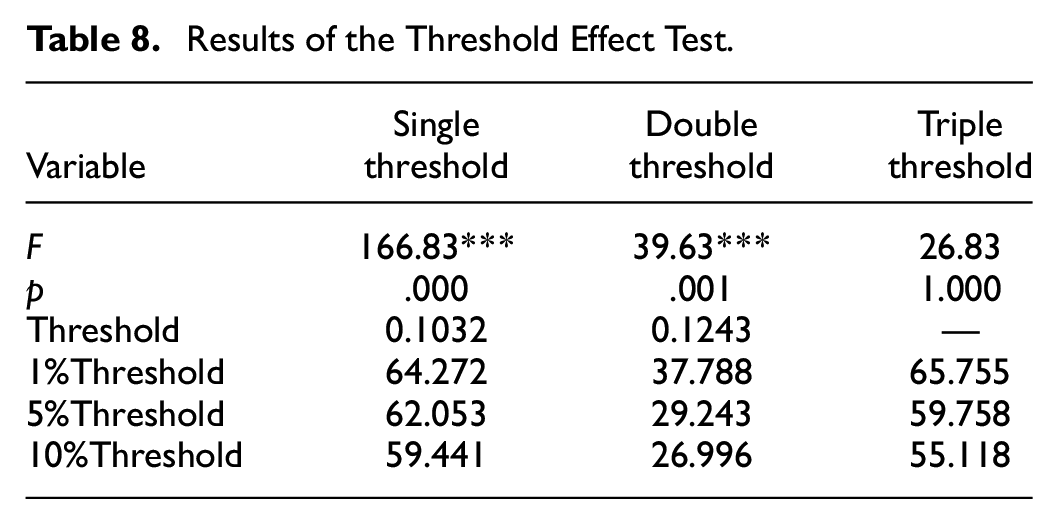
The single and double thresholds of enterprise digital transformation are significant at the 1% level, but the triple threshold effect does not pass the 10% significance test. In other words, there is a double threshold effect of enterprise digital transformation in the digital economy’s impact on industrial structure upgrading. Hence, based on the threshold effect test, the double threshold value of the enterprise digital transformation was measured and tested as shown in Table 8.
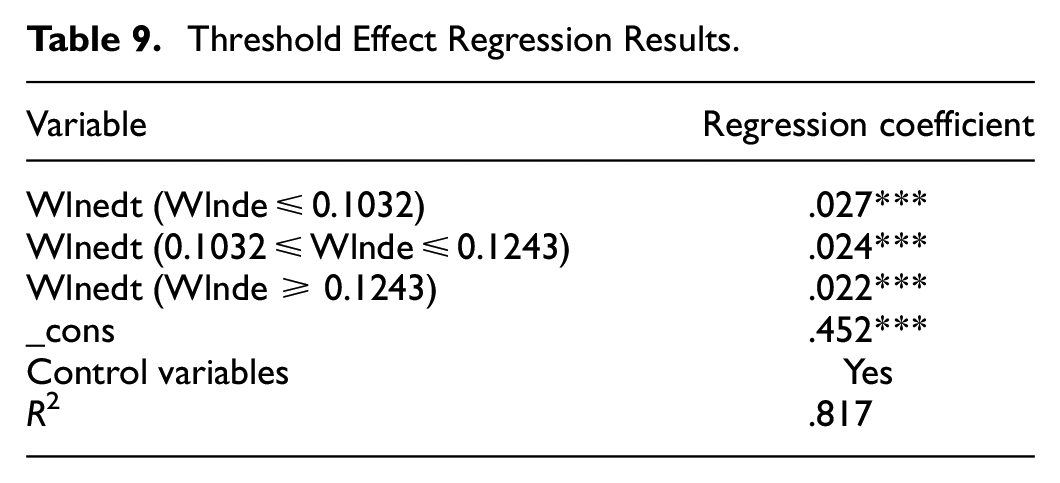
Table 9 shows that regardless of the level of digital economy development, enterprises’ digital transformation has a significant effect on the upgrading of industrial structure. However, when the level of digital economy development does not cross the threshold value of 0.1032, the influence coefficient of enterprise digital transformation on industrial structure upgrading is 0.027. When the level of digital economy development is between the threshold value of 0.1032 and 0.1243, the influence coefficient of enterprise digital transformation on industrial structure upgrading is 0.024. When the level of digital economy development crosses the threshold value of 0.1243, the impact coefficient of enterprise digital transformation on industrial structure upgrading is 0.022. Therefore, as the level of digital economy development continues to increase, the catalytic effect in the process of enterprise digital transformation for industrial structure upgrading gradually decreases. Thus, regions at different levels of digital economy development can all enjoy the digital dividend. However, it is only when the digital economy starts to develop to a certain extent that the regional industrial structure upgrading gains the most from enterprises’ digital transformation (Figure 3).
Threshold Effect Regression Results.

Schematic diagram of the threshold effect.
Robustness Testing
Referring to Lu and Zhu (2022), the robustness of the model was tested by replacing its spatial weight matrix and shortening the sample years. In this study, we mainly used the adjacency matrix, which was replaced with the inverse distance spatial weight matrix and the economic distance matrix to test the model’s robustness. The findings show that, except for the slight floating changes in the regression coefficients and significance levels of the model, the main conclusions were almost unchanged, denoting that empirical results are more robust (Table 10).
Robustness Test Results.

To test the robustness of the model, we replaced the spatial adjacency matrix with the spatial inverse distance weight matrix, the spatial inverse distance squared weight matrix, and the economic distance matrix. The re-estimated results are shown in Models (5), (6), and (7) in Table 10. The regression results for each explanatory variable are in good agreement with those in Model (4) without significant changes, and the regression results are robust.
The results of shortening the years of the original sample from 2011–2021 to 2014–2021 are shown in Model (8) of Table 10. Notably, the regression coefficients of both the digital economy and digital transformation of enterprises are significantly positive, which is consistent with Model (4), and the regression results are robust.
Heterogeneity Analysis
As far as the digital economy itself is concerned, its impact on industrial structure upgrading may be influenced by other social factors, which cannot be revealed by the estimation results of the total sample alone. Therefore, we divided the 155 prefecture-level cities into three parts according to the eastern, central, and western regions. Simultaneously, regarding the Notice on Adjusting the Criteria of City Size Classification issued by the State Council, they were divided into large cities, medium-sized cities, and small cities according to their population size to further explore the differences in the impact of the digital economy on industrial structure upgrading.
Table 11 shows that the impact of digital economy development on industrial structure upgrading had obvious regional differences. The digital economy in the east, central, and western regions can promote industrial structure upgrading, but it is most significant in the central region. The reason is that the integration process of digital technology and industry in the central region is developing rapidly, the efficiency of resource allocation is greatly improved, and enterprises’ core productivity is enhanced. The positive direct impact of the digital economy on industrial structure upgrading is more obvious, and the circulation of data elements in central and western regions is more costly than that in eastern regions, which makes the aggregation of digital technology and data elements more difficult to occur and reduces the generation of monopoly, and the negative spatial spillover impact is weaker, which makes the local industrial structure upgrading constrained. Thus, the positive impact of the digital economy on industrial structure upgrading is stronger in central and western regions than in eastern regions.
Estimated Results of Regional Heterogeneity.

As shown in Table 12, the impact of the digital economy on the industrial structure shows obvious differences depending on city size; the development of the digital economy in small, medium, and large cities can promote the upgrading of the industrial structure, and the driving effect is most significant for small cities. The integration of digital technologies, such as big data, cloud computing, and artificial intelligence, is easier with local industries, and enterprises’ productivity can be improved, making the promotion of industrial structure upgrading more significant. Therefore, the development of the digital economy can significantly promote the upgrading of local industrial structures. Comparing large cities and medium-sized cities, we see that the impact of digital economy development on industrial structure upgrading is more obvious in medium-sized cities, primarily because digital elements are more easily circulated between large cities, and the transfer cost is smaller. Hence, the monopoly of data elements is more likely to occur, which makes the negative spatial spillover effect between large cities more significant. The local industrial structure upgrading receives the constraints of other large cities; accordingly, the overall performance of the digital economy development in medium-sized cities has a more significant impact on industrial structure upgrades than in large cities.
Estimated Results of City Size Heterogeneity.

Conclusions and Policy Recommendations
Conclusion
The main conclusions of this study are as follows. First, the development of the digital economy drives industrial structure upgrading with significant spatial spillover effects. In the short term, the improvement of the digital economy in the region can directly promote the upgrading of the local industrial structure; however, the conclusion still holds in the long term, and the long-term effect is more obvious. However, due to the significant existence of the “siphon effect,” the spatial spillover effect is negative and significant, and the improvement of the digital economy in the region will restrict the industrial structure upgrading of neighboring regions, and the “siphon effect” will be weakened in the long run.
Second, the digital economy can indirectly promote industrial structure upgrades by promoting the digital transformation of enterprises, and there is a positive spillover effect. The digital transformation of enterprises is a mediating variable in the path of the digital economy-driven industrial structure upgrading, with a partial mediating effect. In the short term, the mediating effect is more obvious. According to measurement, the short-term mediating effect size is about 17.18%. Simultaneously, the existence of a positive spatial spillover effect improves the digital transformation level of enterprises in this region, which can also facilitate industrial structure upgrades in neighboring regions.
Third, the impact of digital economy development on industrial structure upgrading in different regions is inconsistent. The central region has the most significant role in the digital economy, driving industrial structure upgrading, and the driving effect in the western region is lower than that in the central region. In comparison to the central and western regions, the driving effect in the eastern region is lower than that in the central and western regions, considering the more significant null-negative inter-spillover effect. However, digital economy development can significantly drive the upgrading of local industrial structures. The impact of digital economy development on industrial structure upgrading is also inconsistent across cities of different sizes, with small cities having the most significant pull effect on industrial structure upgrading. Medium and large cities are also able to significantly drive local industrial structure upgrading but with less effect than small cities.
Fourth, there is a threshold effect on the process of enterprises’ digital transformation to promote industrial structure upgrading, and the driving effect varies with different levels of digital economic development. When the level of digital economic development is high, the driving effect of enterprises’ digital transformation on industrial structure upgrades is stronger. When the level of digital economy development is not very high, the driving effect of enterprises’ digital transformation on industrial structure upgrades weakens.
Theoretical Contributions
This study has several theoretical contributions. First, it investigates the relationship between digital economic development and industrial structure upgrades at the spatial level from a spatial perspective. Most previous studies only consider a simple linear relationship between the digital economy and industrial structure upgrading. For example, Chen et al. (2020) points out that the digital economy can enhance the level of industrial structure in China while having a marginal incremental upgrading effect, and Li et al. (2021) argues that the development of the digital economy can promote the optimization and upgrading of industrial structure when analyzed from the perspective of different regions in China. In fact, these studies only focus on the impact of digital economy development on local industrial structure upgrading without considering its spatial effect. However, our study reveals that there is also a negative spatial spillover effect on the impact of the digital economy on industrial structure upgrading.
Second, this study expands the path of the role of the digital economy in promoting industrial structure upgrading by analyzing the factors of enterprises’ digital transformation. Most existing studies have analyzed macro factors, such as resource allocation efficiency and science and technology innovation capacity. For example, Tang (2021) argues that the development of the digital economy mainly promotes industrial structure upgrading by optimizing resource allocation efficiency and promoting the integration of digital technology and traditional industries. Furthermore, Liu and Chen (2021) uses the mediating effect model to gage whether the development of the digital economy can promote industrial structure upgrading by influencing the human capital level and science and technology innovation capability. Based on the previous studies, this study focuses on the microscopic perspective of enterprise digital transformation and elaborates on the mechanism of digital economy development for industrial structure upgrading from the enterprise level. It also investigates the spatial effects of this intermediary path at the spatial level, making the process more explicit.
Therefore, this study fully responds to the relationship between digital economy development, enterprise digital transformation, and industrial structure upgrading, and provides a methodological reference for future research on the digital economy.
Policy Recommendations
First, we should support and guide the development of the digital economy from two perspectives—digital industrialization and industrial digitization—and then drive the upgrading of the industrial structure. In terms of digital industrialization, we should increase support for the development of digital technologies, such as cloud computing and big data, promote the integration of digital technologies and industries, and promote digital industrialization by accelerating new industries’ development and driving the growth of new modes and business models, thus promoting the development of the digital economy and optimizing the industrial structure. In terms of industrial digitization, the employment of digital technology realizes the digital upgrading of all factors upstream and downstream of the industrial chain, optimizes the efficiency of resource allocation, improves the efficiency of pairing, promotes the development of enterprises, enhances the core competitiveness of enterprises, and thus promotes the upgrading of the industrial structure.
Second, the spatial development pattern of the digital economy and industrial structure is optimized, and digital technology monopoly is prevented. The digital economy is an important driving force for promoting industrial structural upgrades. From the research results, the development level of China’s digital economy is unbalanced, and the level of industrial structure upgrading in some cities is low. While the government promotes more extensive cooperation and communication between regions regarding digital economy development and industrial structure upgrading, it should pay attention to the prevention of aggregation and monopoly of digital technology, and impose certain restrictions on the flow of digital technology resources and production factors between regions when necessary.
Third, it supports the development of the digital transformation of enterprises and provides corresponding assistance to enterprises that have the conditions for digital transformation, including policy support such as subsidies and tax exemptions. The intermediary effect of enterprises’ digital transformation is obvious and is an important driving force for the upgrading of industrial structures. Enterprises should be encouraged to use digital technologies, such as big data and cloud computing, to integrate digital resources and carry out digital transformation when conditions allow and provide relief and escort for enterprises through a variety of ways, including policy support.
Fourth, sub-regional development strategies promote the upgrade of industrial structures. The digital economy can promote the upgrading of industrial structures but will have different impacts in different regions. For the eastern region, a low cost of digital technology circulation, fewer threshold restrictions, and ease of gathering and forming monopolies strengthened the supervision of this area. For the central and western regions, we should seize the opportunity to focus on the development of the digital economy and give full play to the pulling effect of the digital economy on industrial structure upgrading. Small cities, which are less affected by the negative spatial spillover effect, can focus on the construction of the digital economy and industrial structure, strengthen talent and technology reserves, and lay the foundation for development, while large and medium-sized cities, which have a good digital economy and are easily affected by the negative spatial spillover effect, can strengthen the support for the digital transformation of enterprises and drive the upgrading of industrial structure through this intermediary path.
Limitations and Future Research
First, due to the consideration of data availability of certain variables, the overall number of sample observations is slightly small, which may make the research results slightly biased, limiting the generalizability of the research results to some extent. Future research can select other variables to broaden the overall sample size and enhance explanatory power.
Second, the object of this study is Chinese cities, and the results may not necessarily explain the relationship between digital economy development and industrial structure upgrading in other regions. Future studies can be based on sample data from all Asian countries for analysis and research to obtain more widely applicable conclusions.
Supplemental Material
sj-xlsx-1-sgo-10.1177_21582440241233940 – Supplemental material for Spatial Impact of Digital Economy on the Upgrading of Industrial Structure: Evidence From Chinese Cities
Supplemental material, sj-xlsx-1-sgo-10.1177_21582440241233940 for Spatial Impact of Digital Economy on the Upgrading of Industrial Structure: Evidence From Chinese Cities by Yang Lu and JunJie Hu in SAGE Open
Footnotes
Acknowledgements
We would like to thank the reviewers for providing professional comments on the manuscript.
Author Contributions
Yang Lu and Junjie Hu contributed equally to the article.
Declaration of Conflicting Interests
The author(s) declared no potential conflicts of interest with respect to the research, authorship, and/or publication of this article.
Funding
The author(s) disclosed receipt of the following financial support for the research, authorship, and/or publication of this article: 1. Jiangxi Provincial Social Science Foundation Project “Research on the Impact of Digital Economy Development on Employment Structure and Quality in Jiangxi Province and Countermeasures” (Grant No. 23YJ55D). 2. Jiangxi Province University Humanities and Social Sciences Research Project “Research on the Dynamic Mechanism and Countermeasures of Industrial Digitalization to Promote the High-quality Development of Jiangxi’s Manufacturing Industry” (Grant No. JJ22218).
Ethical Approval
The research in this paper does not include ethical issues.

Supplemental Material
Supplemental material for this article is available online.
Data Availability Statement
Data sharing not applicable to this article as no datasets were generated or analyzed during the current study.
References
Supplementary Material
Please find the following supplemental material available below.
For Open Access articles published under a Creative Commons License, all supplemental material carries the same license as the article it is associated with.
For non-Open Access articles published, all supplemental material carries a non-exclusive license, and permission requests for re-use of supplemental material or any part of supplemental material shall be sent directly to the copyright owner as specified in the copyright notice associated with the article.
