




Abstract
In the deepening stage of urbanization, China is inevitably undergoing urban space transformation. However, urban sprawl involves complex and diverse actors, such as governments at all levels, enterprises, landowners, local and non-local residents, who create significant challenges. Existing studies have employed concepts such as “growth alliances,”“growth machines,” and “governance alliances” to describe these actors; however, they have not yet established a clear theoretical framework or explained the internal mechanisms underlying urban space transformation. Through a comparative analysis of three typical urban renewal cases in southern China, this study identifies three core factors: capital flow, space value, and public service. These three factors shape the benefits, cost sharing, and cost-benefit balance among different actors in urban space transformation. The interplay among them influences the stability of actor relationships, thereby prompting urban governments to adopt differentiated space transformation policies. This article constructs an institutional logic of urban transformation from an active perspective and establishes a new framework for understanding urban government behavior, thereby facilitating a shift toward a “government-actor -space” model. This study concludes that promoting sustainable space transformation requires not only equitable benefit distribution, but also the provision of public services and the prevention of losses for vulnerable actors.
Plain Language Summary
Through comparative analysis of three typical urban renewal cases in southern China, this study identifies core factors: capital flow, space value, and public service. Moreover, it points out the policy variations among urban governments under differing structural relationships. This article constructs the institutional logic of urban transformation from an active perspective and establishes a new framework for understanding urban government behavior, thereby facilitating a shift in the transformation model towards “government-actor relationship-space”.
Introduction
Chinese cities have entered a phase of deepening and transformation. Rapid urban expansion is driving the restructuring and redevelopment of urban spaces. This process involves two aspects: first, it seeks to explain the mechanisms underlying urban space transformation, such as improving space utilization, optimizing resource allocation, and enhancing governmental management (Jing et al., 2020; Z. Xu et al., 2019). Second, it addresses the question of who drives this transformation at the structural level, focusing on the interactions and influences among key actors (Ju et al., 2024; Wang et al., 2025; Ye et al., 2024). The interplay of cooperation, competition, and conflict among these actors shapes the complexity and diversity of urban space transformation.
Research on this topic can be approached from three main perspectives. The institutional perspective examines the motivation, methods, and impacts of transformation. For example, local governments attract investment and obtain fiscal revenue through spatial development. Meanwhile, promotion incentives have stimulated local officials to utilize urban spaces to drive economic growth. In practice, local governments do not directly manage enterprise but instead control spatial resources (Y. Xu et al., 2019). Additionally, urban space is treated as a financial asset, enabling capital appreciation through innovative investment. The actor perspective discusses the interactions among the government, state-owned enterprises, commercial enterprises, villagers and local resident, shaping various models, such as government-led initiatives, diversified cooperation, and government-enterprise interaction (K. Chen et al., 2020, 2024). The spatial perspective focuses on changes in ownership and function. Specifically, the essence of urban space transformation lies in altering the rights arrangements between owners and users. For example, China’s “urban villages” are neither slums nor commercial communities but rather a community type based on the collective land system, where interests are shared between village collective and its villagers (Yuan et al., 2015). Therefore, their transformation involves the relationship between the space ownership and its organizations, as well as the allocation and disposal of associated rights, such as land ownership, use rights, qualification rights (Wong et al., 2021).
There are two shortcomings in current research. First, most studies treat urban space as a uniform and integrated entity, failing to account for differences in ownership and function, thus complicating explanations of varying transformation approaches (Ma et al., 2024; Long, 2013). Second, the existing property right framework is incomplete and characterized by a “property right constraint,” which separates the roles of owners, managers and decision-makers, making it difficult to discern interactions and operational logic among the government, enterprises, village collectives, and villagers (Pan et al., 2024; Zhou et al., 2020). Without clarifying these relationships, exploring the underlying mechanisms of urban transformation becomes considerably more challenging.
In 2025, the Chinese government issued the Opinions on Continuously Advancing Urban Renewal Action, emphasizing high-quality renewal and clarifying land-use policies and financial support. Shanghai plans to fully launch urban village renovations by 2026, while Beijing aims to comprehensively renovate 500 old residential communities. In practice, urban space transformation can be categorized into three types: demolishing old buildings and constructing new ones; adjusting space function; and comprehensive governance. These practices involve multiple stakeholders, including central and local governments, real estate enterprises, and urban residents. To understand the mechanisms of urban space transformation, it is essential to identify the key influencing factors and driving logic. By constructing an analytical framework based on “capital flow- space value-public service”, this study compares three typical cases to address the core questions: Why do city governments choose different methods? Why do they adopt differentiated institutional arrangements?
Literature review
Research on actors in urban development has identified three key influencing factors:
Capital flow across domains and regions
Neoliberal urban theory views urban space as a nexus of capital, power and society, serving as a critical node in the capitalist production process. It not only promotes capital flow but also absorbs capital surplus (Beraud, 2012; Serin et al., 2020). Local governments seek to enhance the local economy, operating profits, and excess land rent by optimizing urban space functions to enable low-cost and efficient capital flows, thereby accelerating capital accumulation and circulation. For example, they attract overseas investment and expand construction funding through large-scale infrastructure, real estate initiatives, and favorable financial policies; launch urban redevelopment plans and build transportation hubs; streamline administrative approval processes to reduce barriers to resource flow; incorporate urban planning and administrative adjustments into local policy agendas; link housing policies with the financial system; and foster diverse expressions while improving coordination mechanisms among government, enterprises, and multinational corporations (Atkinson, 2020). In addition, central and local governments shape spatial separation to promote differentiated capital flows and to capture excess land rent. In short, by establishing a local governance system that integrates public and private sectors, cities can become key nodes in global capital flows (Aalbers & Haila, 2018; He & Zhao, 2020a, 2020b).
The unity and separation of space value
Urban space possesses both exchange value and use value (Christensen, 2014; Farahani, 2017; Ozola et al., 2020). When capital flows into cities, it increases the value of space and redistributes it among various actors (G. Yin et al., 2024). For example, the governments obtain land-use fee and transfer fee; village collectives and villagers obtain land compensation and rental income; and enterprises obtain investment returns and operating profits (Zhang, 2021). This phenomenon involves two aspects. First, the emphasis on exchange value often comes at the expense of use value. To obtain space exchange value, various actors strive to exploit local resources, such as forming elite governance alliances, engaging in corporate lobbying, and designating growth zones. When residents do not benefit from exchange value, they instead bear the associated costs, which can lead to conflicts (Yi et al., 2024). Second, balancing exchange value and use value is crucial. Focusing solely on exchange value may pose significant risks, including hindering local governments’ ability to provide collective goods and services, promoting the privatization and financialization of urban operations, and exacerbating wealth inequality and social polarization (Painter et al., 2022).
Therefore, it is essential to enhance use value and promote inclusive development to mitigate conflicts between exchange-value seekers and use-value protectors. For example, policymakers should prioritize the redevelopment of aging communities, foster community identity, and ensure that growth benefits are widely shared. Moreover, in response to development inequality, growthism needs to be revised by replacing narrow economic targets with broader, sustainable development objectives.
Public service supply
The above two perspectives directly relate to the provision of public services. On the one hand, capital inflow drives capital reproduction, leading to cuts in collective consumption expenditures. This conflicts with workers’ needs for collective consumption, resulting in space exclusion and social stratification. On the other hand, the divergence between exchange value and use value means that certain actors benefit from space transformation, while others bear its costs. This may lead to various problems, including urban center decline, shrinking municipal revenues, and widening wealth gaps.
Therefore, public services are crucial for bridging urban social differentiation (Barseghyan et al., 2021). For city governments, public services serve as a key source of political legitimacy (Zhang et al., 2025). When social tensions emerge, they implement public service policies to mediate the interests of various actors. This includes connecting functionally diverse urban areas into integrated metropolitan networks; providing professional community services to improve social welfare; and accelerating fiscal transfers to enhance redistributive efficiency (Li et al., 2025; Trofimov 2017). For non-governmental actors, growing pressure to provide comprehensive public services has prompted private and semi-public entities to participate in public-private partnerships (PPPs). For example, in Pittsburgh, youth groups have advocated for and participated in education reform campaign. In TianJin, China, community committees play a dominant role in delivering public goods, especially in social services and sports projects (Luova, 2011).
In summary, the above factors highlight the core issues of urban space transformation: who benefits? Who bears the costs, risks and negative externalities? And how can contradictions be reconciled? Furthermore, these factors affect shape actor relationships across three aspects: benefit acquisition, cost sharing, and benefit-cost coordination.
Shortcomings of existing studies
Based on the strengths, goals, cooperation and game mode of actors, four types of governance relationships emerge: “a strong central government with a weak local government”, “a weak central government with strong local government,”“a weak government facing strong community and business elites,” and multi-level governance relationships across space scales. Various actors are integrated to promote urban transformation, forming models led by growth alliances, community alliances, and state-led initiatives (Chen, 2019; Guo et al., 2018; Liu et al., 2018). However, several shortcomings remain apparent. First, while existing studies focus on spatial reconfiguration and property rights, they lack clarity on the underlying influencing factors. In particular, there is insufficient explanation for areas characterized by limited capital flow, uncertain value distribution and incomplete public services. This instability in actor relationships complicates efforts to uncover the dynamic mechanisms and institutional logic underpinning urban spatial transformation. Second, the analytical perspective tends to be fragmented, lacking a comprehensive framework for understanding the behavioral logic of actors. As a result, boundaries between interest subjects become blurred, and interaction mechanisms grow increasingly complex, making it challenging to establish a clear conceptual and classification system. Third, there is insufficient analysis of how governments respond and formulate policies in relation to different governance configurations. In view of these shortcomings, this paper integrates various influencing factors through three case studies of urban areas, aiming to examine the decision-making logic and internal mechanisms of urban governance.
Analytical framework and case selection
Analytical framework
This paper constructs an analytical framework based on three perspectives: capital flow, space value and public services. First, neoliberal urban theory holds that capital flow is the central factor in urban development. Capital generates surplus profits, absorbs over-accumulated capital, and produces differential ground rent, thereby becoming a focal point for various actors (Harvey, 2001). Governments attract investment through various spatial policies and distribute benefits to actors. When actors benefit, they are likely to cooperate and actively promote spatial transformation. Conversely, if anyone fail to benefit, competition and conflict may arise. This leads to Proposition 1: Due to the separation of space operation rights and ownership, once one party’s interests are damaged, cooperation may break down and the transformation process may stall.
Second, urban space transformation drives a separation between the use value and exchange value of space, leading to divergent outcomes in which some actors capture value while others bear the costs (Logan, 1997). Therefore, urban space transformation must address not only “who benefits” but also “who pays.” For example, areas with high land-use efficiency and low development costs have been allocated to local governments and real estate enterprises, allowing them to capture exchange value, that is “price increases return to the public”. However, many residents are excluded from these benefits while bearing the associated social and economic costs. This leads to Proposition 2: Urban space transformation separates exchange value from use value, resulting in a mismatch between those who benefit and those who bear the costs. Then benefits are captured by one party while others bear the costs, conflict and resistance may emerge, potentially disrupting the transformation process.
Third, neo-Marxist urban theory argues that capital accumulation promotes expanded reproduction while reducing collective consumption, creating a contradiction with the social reproduction needs of labor and leading to social polarization and urban crisis (Neuman & Smith, 2010). This dynamic necessitates government provision of urban public services to reduce disparities among cities, between urban and rural areas, and within urban communities (Castells, 1983). Therefore, urban space transformation has blurred the boundaries between urban and rural areas, leading to functional confusion, diversification and complexity among actors, and exacerbating the pressure on public resources. Governments should improve the coverage and supply efficiency of public services to narrow the regional disparities. This leads to Proposition 3: public services can help compensate for the unequal distribution of benefits and costs resulting from space transformation. Otherwise, imbalances and conflicts may arise, ultimately stalling the transformation process (Figure 1).
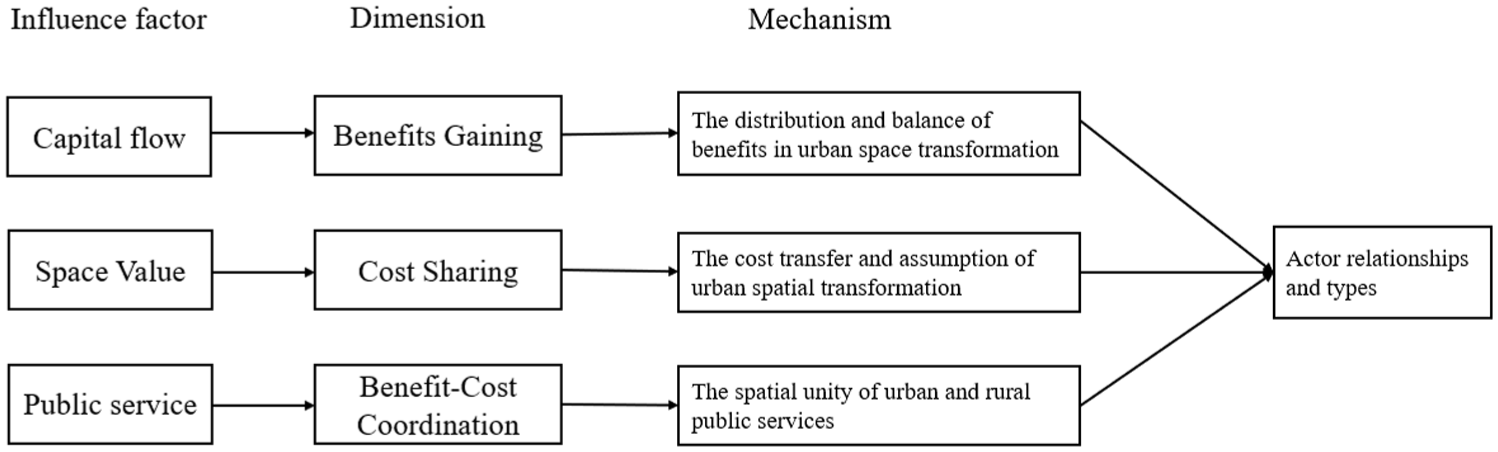
Analytical framework.
Core concept and research method
The analysis focuses on three key dimensions. First, capital functions as the primary driver of urban development. Governments utilize urban space to attract corporate investment and achieve commercialization of urban assets. Second, space value encompasses both use value and exchange value. The transfer of ownership and management rights can lead to a divergence in value capture, for example, real estate enterprises appropriate exchange value while residents retain only use value. Third, urban public services refer to infrastructure and services that meet residents’ needs for survival and development, including transportation, energy, healthcare, public safety (Table 1).
Measurement and Investigation of the Analytical Framework.

This article employs a qualitative case study approach and conducts a comparative analysis of three typical urban renewal cases in southern China. Compared to other research methods, case comparison can systematically analyze complex phenomena through a small number of cases, thereby facilitating better control over confounding variables. It also enables the tracing of causal mechanisms and explaining why certain outcomes occur by comparing how different regions address similar challenges.
Case selection is guided by two criteria. First, the principle of “maximum difference”: The three areas represent distinct models of space transformation. B Street in L District involves demolishing old buildings and constructing new ones; D Town in N District focuses on adjusting space functions; and F Street in H District emphasizes comprehensive governance. At the same time, all three areas share common characteristics: they pursue urban development through small-scale, decentralized, and low-cost interventions. Common challenges include low land utilization and yield rates, ambiguous land uses and boundaries, and encroachment on residents’ rights and interests. As a result, identifying a transformation pathway has become a pressing priority for all three areas. Second, controlling for temporal and space factor. Temporally, the development processes of the three areas are comparable. In each case, local governments have deregulated the supervision and operation of collective land to attract investment, prompting villagers to independently construct factories and lease them to enterprises, resulting in a fragmented space pattern. Furthermore, these three areas have gradually transitioned to the phase of stock development, necessitating the promotion of space redevelopment. Geographically, the three areas are proximate, sharing similar institutional and governance contexts.
Case comparative analysis
This study examines the internal mechanism of urban space transformation. Urban space transformation unfolds through three distinct models, each exemplified by one of the selected cases. The analytical framework identifies capital flow, space value, and public service as the key drivers of transformation; the analysis therefore focuses on these elements and their interplay.
B Street in L District
In 2002, all land in the city had been converted to state-owned ownership, accelerating the nationalization of collective land on B Street. Of the 3,054 hectares of land within the jurisdiction, construction land accounts for 57%, forest land for 22.36%, and other types for 20.64% (Figure 2, Figure 3). Due to the scarcity of available construction land, there is no surplus land for future development, and expansion can only occur through urban renewal. This paper analyzes the governing logic of actor interactions through three analytical lenses: capital flow and benefit distribution, space value transfer and cost sharing, and public service provision and coordination.
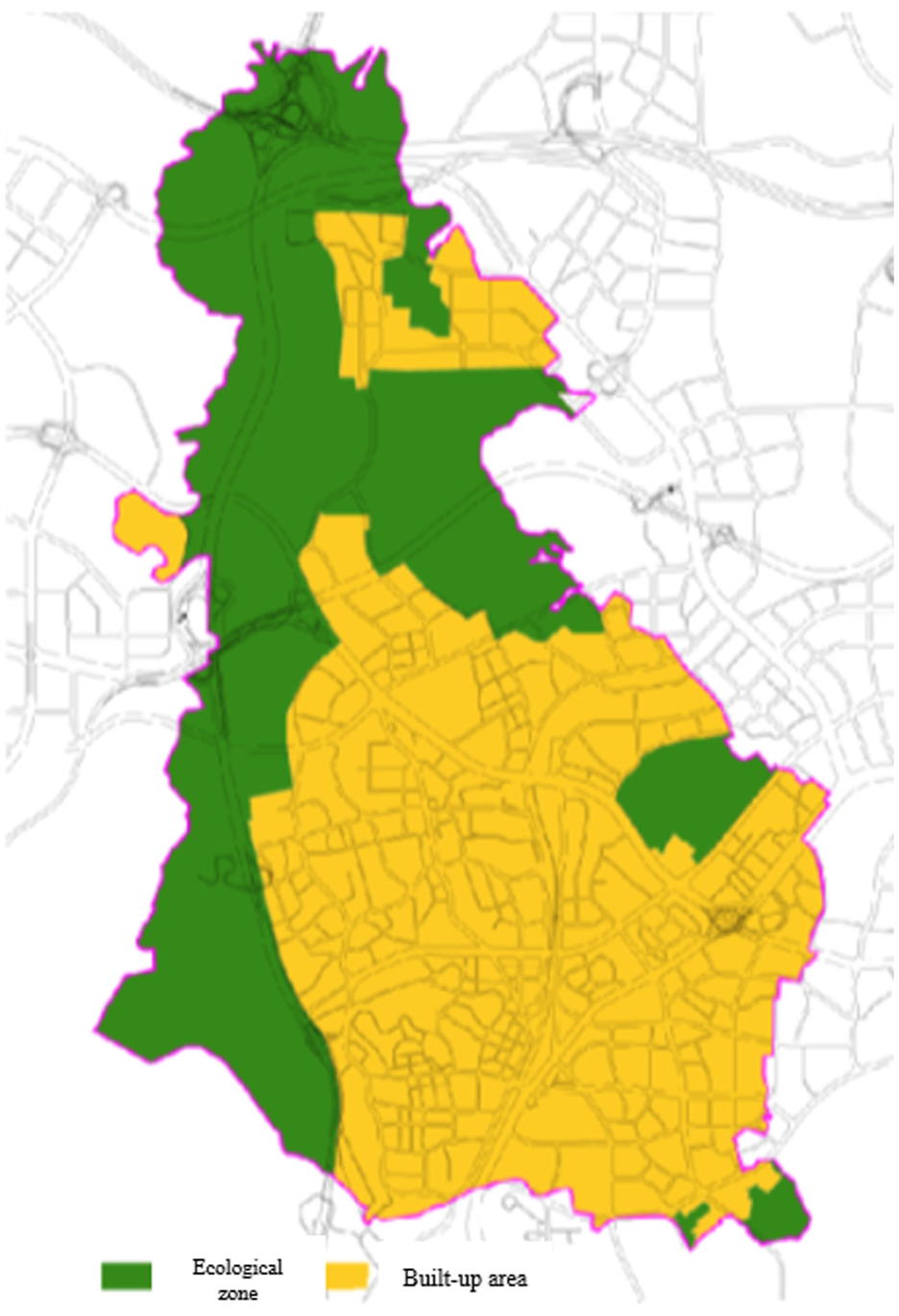
Ecological control and built-up area of B Street

Non-agricultural construction land of B Street.
Capital flow and benefit distribution
There is strong demand for demolishing old buildings and constructing new ones in B Street, with two primary objectives: improving the road network and to cultivating new industries. Given the high population density and reconstruction costs, small enterprises struggle to undertake such projects. Therefore, large-scale real estate enterprises with sufficient funds are brought in to lead redevelopment. The success of this transformation depends on two factors: one is aligning with the interests of landowners. As B Street has become a residential rental hub for migrant workers, developing commercial housing aligns with local residents’ interests, thereby supporting the transformation. Second, there is a better social foundation and public opinion consensus. Land compensation facilitates interaction between villages and enterprises, thereby reducing negotiation time and costs. This accelerates the shift from productive leasing to residential leasing, improving space utilization and profitability. At this point, all parties stand to benefits. For examples, enterprises can not only obtain land premiums and rent but also expand asset scale and form high development expectations. Local governments secure funds and promote balanced development. In fact, B Street, located at the urban periphery, had previously received little attention from higher authorities. The involvement of large enterprises helps bridge the funding gap. In response, the government provides financing facilities such as loans, factory mortgages, and fixed asset loans, and proactively plans infrastructure and attracts investment. Residents benefit in three ways: transitioning to new livelihoods and receiving land rent; enjoying an improved community environment and better public infrastructure; and reduced production risks and enhanced administrative accountability.
Space value transfer and cost sharing
During urban space transformation, various actors both benefit from and bear the costs of redevelopment. The government bears two responsibilities. First, it prevents illegal operations of space by standardizing functional zoning, improving administrative procedures, and resolving the difficulties in village collective decision-making. For example, because land is collectively owned by the village community, reaching compensation agreements is challenging when faced with insufficient funds, high land values in adjacent areas, and inflated resident expectations. To address this, the government lowered the approval threshold from over 90% to 80%, making it easier to include projects in the renovation plan. This adjustment has blurred property rights and weakened collective decision-making, thereby expediting the renovation process. Second, the government mitigates production risks by regulating enterprise operations, as urban redevelopment may compromise workplace safety, public security, and environmental hygiene, requiring strong oversight. Additionally, it prevents commercial interests from encroaching on public welfare. For example, overemphasizing economic infrastructure may lead to the neglect of livelihood services such as transportation, education, and power facilities. To balance these interests, the government provides technical guidance and procedural support while restricting the use of high-quality land for real estate development. Similarly, local village collectives and villagers bear two responsibilities: preventing production and living risks. By constructing public facilities and phasing out outdated industries, small enterprises with low value and severe pollution are forced to exit, thereby freeing up space for functional transformation. This approach also prevents the failure of grassroots governance. The transformation of urban space has led to overlap between city and rural areas, resulting in confusion of responsibilities, mutual buck-passing, and mismatched powers. Therefore, promoting the separation of community autonomous organizations from collective economic organizations has become an important direction for the reform of grassroots governance system.
Public service and coordination
In 2016, B Street underwent administrative division adjustment, with construction and planning authority centralized at higher levels, while administrative approvals and responsibilities were devolved to lower levels. This shift in focus has resulted in a shortage and uneven distribution of public services. The governance system in B Street has been reformed in two key areas. First, institutional reforms have enabled resources to flow to grassroots communities, helping to correct imbalances in public service provision. The community workstation is a typical example. On the surface, its main tasks are similar to community committees, including social services, social security, and administrative affairs. However, there are differences between the two in terms of organizational structure and administrative relationships. The latter is a grassroots autonomous organization for residents to self-manage, self-educate, and self-serve, while the former serves as an extension of government administration. Community workstations make closer connections between communities and grassroots governments, enabling the rapid implementation of policies, efficient allocation of public resources, and enhancing the effectiveness of administrative supervision. Second, public service delivery in urban villages has been optimized. There are two common problems in the public services of “urban villages”: one is organizational structure blockage. The functional division among horizontal government departments is unclear, and the information flow of vertical departments is not smooth. This results in the overall urban space being divided by specialized functional departments, leading to waste and mismatch of public resources. The other problem is confusion in the construction process and timeline. Urban renewal involves the simultaneous development and coordination of multiple types of spaces, which can hinder the development progress once conflicts arise. To address these issues, B Street has integrated village collectives as key co-providers of public services, aiming to build a more comprehensive and integrated system. This includes maintaining infrastructure, improving road and pipeline construction, strengthening supervision of collective land and asset transactions, and standardizing village collective operations.
D Town in N District
The blind expansion and disorderly growth of urban space have led to low utilization efficiency and an inability to meet the needs of industrial development (Figure 4). In response, N District has introduced a series of planning schemes. For example, in 2014, the Provincial Department of Land and Resources designated it as a comprehensive pilot for “3 years old reconstruction”. In 2017, it was identified as a pilot area for reform of the national homestead system. In 2018, plans were made to demolish 1.5 million square meters of illegal buildings. The functional adjustment of D Town includes four approaches: breaking through operational time limits; clarifying ownership and administrative processes; restricting the scale of agricultural industrialization; and integrating fragmented spaces. These initiatives aim to integrate the intertwined village-level industrial parks, shift the space function from production to consumption, and improve the overall quality of urban areas. It is also examined from three aspects:

Collective construction land of N District.
Capital flow and benefit distribution
With the deepening of urbanization, the production mode of enterprises in D Town is increasingly inconsistent with the development needs, creating a strong motivation for space transformation. The space in D Town exhibits three characteristics: low construction costs, short operation times, and chaotic functions. These factors lead to small-scale enterprises, low production standards, severe pollution, and conflicts with government governance requirements. When the pressure is transferred to owners and users, it forces them to undertake space renewal and promotes industrial upgrading. During this process, enterprises can extend their operation times and obtain lower rental costs. The government not only obtains land revenue but also gains various benefits, including optimizing the industrial structure, preventing real estate from crowding out other manufacturing industries, achieving a balance between space form and industrial structure, and balancing the proportion of urban population to public services. By restricting the supply of commercial real estate and reasonably allocating land transfer funds, the government ensures that fiscal revenue covers public expenditure. Meanwhile, it redefines governance boundaries, optimizes relationships among governments, enterprises, residents, and villagers, and reduces management pressures. Furthermore, as the owners of the space, local residents benefit in three ways: increased rental income; reduced production safety risks; and improved environmental quality. Urban space transformation eliminates high-pollution and low-efficiency enterprises, allowing new enterprises with large scales and high standards to pay higher land rents.
The government formulates industrial catalogs and lists, refusing to introduce industries with high production risks and low taxes. Additionally, by limiting waste metal and plastic processing industries removes polluting production links while retaining key technologies.
Space value transfer and cost sharing
First, the government should coordinate various conflicts, which involves two main aspects. The one is mediating conflicts between the government and society. For example, D Town has launched a campaign to demolish “two violations” (illegal construction and illegal land use), which may conflict with local residents’ interests in streamlining procedures and accelerating project implementation. Meanwhile, N District is seeking suitable locations for public facilities to alleviate the shortage of public services. However, many residents oppose the siting of such facilities as hospitals, highways, and parking lots near their homes due to concerns about noise, traffic, and property values. Furthermore, space occupiers tend to construct industrial projects with small scale, short-cycle operating industrial projects with quick returns, rarely reserving land for public infrastructure. The second aspect involves coordinating conflicts among government departments. In urban road network construction, differences in finance resources, technical standards, and administrative capacities across different levels of government hinder the implementation of unified planning, resulting in an imperfect and fragmented network system. At the same time, horizontal departments apply inconsistent criteria in defining spatial types, boundaries, and functions. For example, discrepancies between urban planning and land use planning lead to overlapping or conflicting zoning designations, unclear planning control lines, weak enforcement of ecological protection boundaries.
Second, imbalances in interests and burdens can trigger social risks. For example, D Town’s development strategy emphasizes urbanization in the east, industrialization in the central region, and ecological conservation in the west (Figure 5). This approach results in a higher proportion of construction land in the eastern area compared to a lower proportion in the western area. Such differentiated spatial positioning leads to unequal land transfer revenues, exacerbating regional economic disparities and triggering social tensions. Especially for actors located in agricultural or ecological conservation areas, they are unable to reap the benefits and lack sufficient funds to promote transformation. In short, while various actors may obtain certain benefits, the distribution of responsibilities and costs remains highly uneven.

Three development regions of N District.
Public service and coordination
In response to growing demand for public services, D Town has adopted two complementary strategies. First, it promotes balanced economic and social development through a regionally targeted public finance model. This model has four features: Ensuring alignment with government objectives. For example, N District’s fiscal policy not only implement the municipal government’s development strategy but also funds public services such as healthcare, education, and health services for the district residents; Reducing regional development disparities. Fiscal revenue in N District have grown unevenly, and expenditures are also unevenly distributed, leading to significant regional imbalances. Therefore, D Town should promote industrial integration and provide transfer payments and special subsidies to underdeveloped areas; Improving the quality of public facilities. By issuing local government bonds or adopting Public-Private Partnership (PPPs) models, D Town can finance the construction of urban Transit-Oriented Development (TOD) projects, water supply and drainage systems, and sewage treatment facilities, while ensuring a rational layout of public infrastructure to improve people’s livelihoods; Balancing public welfare and financial sustainability. The construction of public facilities must consider both local fiscal capacity and project profitability, including return on investment, financing efficiency, and development intensity.
Second, addressing the shortcomings in rural public services is crucial. The urban-rural dual land system has led to fragmented service delivery, with village collectives responsible for rural areas. However, this arrangement faces challenges such as insufficient maintenance funds and poor service quality. In response, D Town has linked economic compensation to public services provision by reserving a portion of land transfer fees for future maintenance. Specifically, 50% of the land transfer fee is allocated to the original landowner, 30% to the town government, and 20% to the district government, which oversees public services in the village community.
F Street in H District
F Street provides low-cost spaces for production, living and trading support the textile industry. However, with the acceleration of urbanization, the textile industry has become incompatible with urban development, leading to problems such as high spatial compression, difficulties in industrial upgrading, and elevated governance costs. In response, H District has launched a comprehensive renewal plan targeting 638 plots covering a total area of 26.37 km2, aiming to improve the urban landscape and expand functional urban space (Figure 6, Figure 7).

Commercial space layout of H District.

The space functional division of F Street.
Capital flow and benefit distribution
Although F Street has implemented rural land reforms for many years, persistent challenges remain, including fragmented agricultural land use and weak management capacity. These issues manifest in three key characteristics: Industrialization of residential space. Due to limited capital and weak management capacity, residents lease their homesteads to small-scale, informal enterprises. As a result, both the village collective and individual households receive irregular, informal, and relatively low incomes. While the government has expropriated part of the village land, compensation and social safeguards remain inadequate, widening income inequality among residents; Entangled urban-rural spatial structure. The interweaving of urban and rural spaces leads to disorganized management and the emergence of regulatory gray zones. Under the principle of territorial management, local governments struggle to coordinate resource allocation, resulting in fragmented oversight and inter-agency buck-passing. Meanwhile, the textile industry frequently relies on “cash, spot, on-site” transactions, which limits formal financial tracking and reduces tax revenues. Enterprises gain a cost advantage by circumventing regulations, such as through lower land rents, reduced renovation expenses, lower manufacturing and labor costs, and minimized financial compliance costs. For example, village collective factories are often built to minimal construction standards, reducing renovation costs. Many workers are paid on a daily or piece-rate basis, lowering labor expenses. Additionally, the high density of industrial clusters helps minimize transportation and logistics costs.
Space value transfer and cost sharing
Many village collectives and enterprises generate profits through illegal and irregular means, yet shift the costs to the government and society. First, the government bears more pressure. As rural communities retreat from management, traditional governance mechanisms based on land allocation and economic dividends have gradually weakened, making it difficult to effectively supervise collective assets. To achieve space transformation, authorities must address irrational land uses, potential safety hazards, and environmental pollution stemming from the previous economic model. The government should establish unified management of collective land and property, promoting transparency, digitalization, and standardization in collective asset transactions, and ensuring alignment between villagers’ rights and responsibilities.
Second, enterprises face numerous policy restrictions and bear high transformation costs. For example, enterprises require fast approvals and fewer production stages, which are incompatible with the fragmented and inefficient government administration. Simultaneously, H District strictly restricts real estate development and imposes limits on plot ratios and building heights, which may dampen enterprise profitability and investment enthusiasm. Moreover, urban spaces designated for production rather than residential use often result in functional mismatches and higher development costs, discouraging many enterprises from relocating.
Public service and coordination
Due to weak self-management and difficulties in land expropriation, F Street has developed a fragmented and low-quality public service system. First, from a top-down perspective, public services fail to penetrate and cover rural areas. This manifests in two aspects: The separation of urban and rural infrastructure. Taking the sewerage network as an example, the urban part is managed by the municipal government, while the “urban villages” are managed by village communities. The latter often have low construction standards and outdated facilities, preventing domestic sewage from connecting to the urban sewage system; Chaotic space layout. This has fostered a highly heterogeneous and mobile social structure, making government management more difficult. Many buildings serve dual residential and industrial functions, generating both household and industrial waste. Consequently, treating industrial waste using household waste standards not only increases operational costs but also exceeds the government’s management capacity
Second, from a bottom-up perspective, the village collective lacks the capacity to independently provide public services. The urbanization of F Street has driven the restructuring of village communities and shifted public service responsibilities to the district government. However, this transformation involves changes in administrative identity and functional roles without clearly defining accountability. Typically, the economic association and its affiliated cooperatives organize production and operations while also assuming certain community management and service duties. This shift has led to collective funds being used to cover what were previously individual maintenance costs, reducing residents’ sense of responsibility for collective assets and further exacerbating the imbalance in public service provision.
Conclusion and discussion
Case summary
As previously mentioned, the analysis of the three cases primarily focuses on three aspects: whether the benefits generated by capital flows are equitably distributed among different actors; how responsibilities and costs are shared among actors during the process of space value transfer; and whether public services can be effectively provided to compensate for imbalances between benefits and costs. The more balanced these three aspects are, the lower the costs and the higher the effectiveness of promoting urban space transformation.
In case 1, with respect to capital flows and benefit distribution, the scale of development and functional transformation align with the goals of the government and enterprises, enabling all actors to benefit. In terms of space value transfer and cost sharing, all actors are treated equally. Concerning public service provision and coordination, the city government has made efforts to bridge the gap between urban and rural public services, thereby minimal conflict among actors. Thus, a balanced relationship emerges. In case 2, due to uneven collective land transfers and functional divisions, some actors benefit while others do not, resulting in a mismatch between benefits received and costs borne. Moreover, N District has made substantial fiscal investments to integrate fragmented public services. Thus, an adaptive relationship emerges. In case 3, certain actors derive illicit gains, while others not only fail to benefit but also bear the costs of spatial transformation. Furthermore, significant disparities in urban-rural public services persist and are difficult to overcome, contributing to an adversarial relationship among actors. These cases support the propositions presented in this paper, that is, under a balanced relationship, actors experience equal benefit distribution, even cost-sharing, and unified public services, resulting in a high degree of consistency in their objectives and promoting smoother urban space transformation. Under an adaptive relationship, actors may both disagree and collaborate, necessitating government mediation. Under adversarial relationship, actors experience unequal benefits, uneven cost-sharing, and inadequate public services, preventing concerted action and hindering urban space transformation (Table 2).
The Influencing Factors of Urban Space Transformation and Actor Relationships.
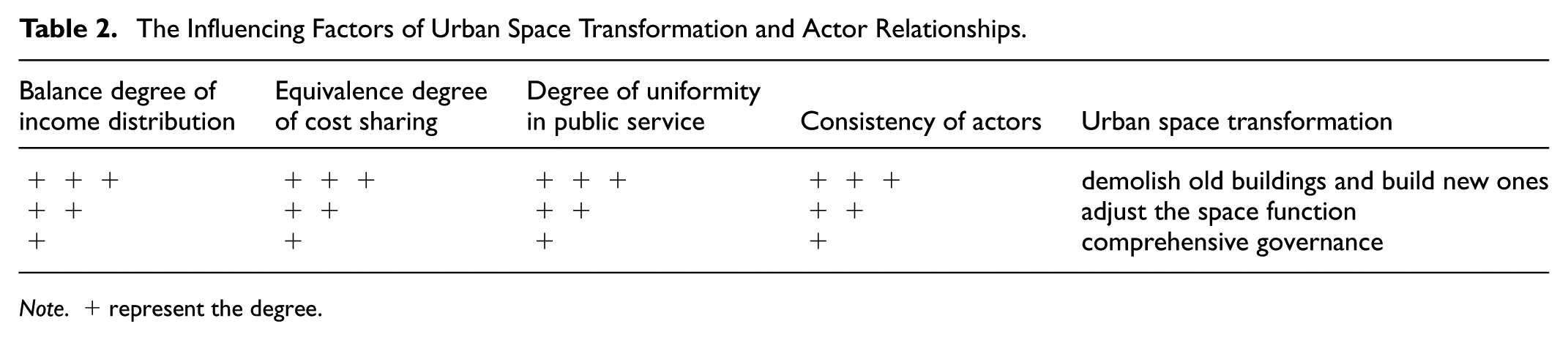
Note. +represent the degree.
Urban space transformation redistributes interests and reshapes the structural relationships among actors. In response to varying actor dynamics, the government adopts differentiated governance strategies. Government policy objectives are not only to promote the local economy, land finance and official promotions but also to enhance social welfare and ensure long-term stability. Obviously, once a public policy might affect social stability, even if it promotes economic growth, the government tends to suspend or revise the decision. As deepening of urbanization, actors have become increasingly complex, diverse and heterogeneous. This shift means that urban policies are increasingly formulated based on the structural relationships among various actors, rather than within a homogeneous bureaucratic framework. In the cases discussed above, despite significant changes during the process of demolishing old structures and build new ones, actors in B Street share common goals and cooperate effectively, avoiding profound contradictions. Actors in D Town engage in strategic interactions, prompting the government to adopt more moderate policies to balance competing interests. Actors in F Street are in conflict or even confrontation, limiting the effectiveness of comprehensive governance and reducing its impact on individual actors. Such a differentiated governance approach facilitates urban spatial transformation while minimizing social conflict at a relatively low cost.
Conclusion and recommendation
This paper explores the fundamental drivers and organizational foundation of urban space transformation. Its significance is multifaceted. First, it explores optimization strategies for urban space transformation from the perspective of key actors. Existing studies generally fall into three categories. The first proposes models based on “dominant-dominated” dynamics, such as government-led, enterprise-led, or social-led. The second classifies spatial transformations according to intervention intensity such as demolition, controlled redevelopment, and incremental renewal. The third evaluates outcomes in terms of public welfare, cost spillovers, and cost internalization, often in relation to risk distribution. However, these explanations tend to overlook the underlying reasons for the formation of actor relationships. This paper provides a theoretical analysis framework and identifies the necessary conditions for building a stable structural relationship: balancing benefit distribution and cost sharing, and promoting the equalization of public services. Second, this paper contributes to the theory of urban governance by analyzing how local governments adapt to evolving actor dynamics. Urban space transformation has blurred the boundaries between urban and rural areas, constraining governmental authority, straining administrative resources, and increasing governance burdens. Applying the analytical framework of “capital flow- space value-public service,” this paper establishes a systematic linkage among local governments, actor relationships and urban space. This approach endows space transformation with not only economic attributes but also social and governance attributes, thus making it more flexible and adaptable.
These insights offer practical implications for urban governance. Variations in economic development, social structure, and access to public services shape diverse actor relationships. Government strategies depend on the stability of these relationships and are influenced by capital flows, space value distribution, and public service provision. When structural relationships are stable, governments may pursue more aggressive development strategies. In contrast, when relationships are fragmented or adversarial, they tend to adopt more moderate and adaptive policies.
This paper has two main limitations. First, the case study approach has inherent limitations. Although these three cases exemplify three models of urban spatial transformation, other areas—such as ecological conservation and urban village redevelopment—have not been covered. Relevant cases in these domains should be examined in future research. Second, the discussion on policy implications is relatively simple. In reality, urban policies are highly complex and multifaceted, and further research is needed to identify optimal strategies for urban spatial transformation.
Footnotes

Funding
The authors disclosed receipt of the following financial support for the research, authorship, and/or publication of this article: Young Fund Project of the Humanities and Social Sciences Research of the Ministry of Educationt “Research on collective land development mechanism and policy optimization under the background of urban governance modernization” (21yjc630171) General Project of Guangdong Provincial Social Science Planning 2025 “Research on Urban Spatial Transformation and Governance Risk Generation Mechanism under High Quality Development”(GD25CGG16)
Declaration of Conflicting Interests
The authors declared no potential conflicts of interest with respect to the research, authorship, and/or publication of this article.
Data Availability Statement
My manuscript has no associated data or no data will not be deposited.