



Abstract
As urbanization accelerates, the collaborative governance of green spaces has become a critical issue for megacities seeking sustainable development. Most existing studies focus on the successful experiences of Western democracies, and there is a lack of systematic discussion on the collaborative dynamics and practices under different political systems. This paper develops a theoretical framework based on grounded theory to analyze the collaborative governance of green spaces in Chinese megacities and reveals its key dynamics. The findings indicate that principled engagement, shared motivation, and capacity for joint action are essential drivers contributing to collaborative governance in China. In a centralized system, the government achieves efficient governance through specific screening mechanisms, top-down political pressure, strong leadership and resource integration capabilities. This study provides a robust theoretical framework and empirical insights into centralized collaborative governance, offering references to the Chinese experience in enhancing the effectiveness of green space governance in global megacities.
Introduction
With rapid global urbanization, the number and size of megacities are increasing. These cities serve as engines of global economic growth but also concentrate significant environmental pressure (Brokking et al., 2021; Kong et al., 2021; Ma et al., 2019). Green space, as a core component of the urban ecological environment, undertakes multiple functions such as improving air quality, mitigating the urban heat island effect, and improving the quality of life of residents (Chi et al., 2020; Kothencz et al., 2017; Misiune et al., 2021; Xu et al., 2018). However, high population density and limited land resources present pressing challenges for the effective management and expansion of green spaces in megacities (Kong et al., 2021).
Existing research indicates that the governance model for urban green spaces has shifted from “government” to “governance” (Breen et al., 2020; T. J. M. Mattijssen et al., 2015). This transformation has not only redefined the government’s role in managing urban green spaces but also fostered new forms of interaction between the state and other non-state actors (Buizer et al., 2015; Fox-Kämper et al., 2018). In the complex socio-economic landscapes of megacities, governance is no longer driven solely by government decision-making and implementation. Instead, it involves collaborative efforts with enterprises, non-governmental organizations (NGOs), communities, and the broader public. However, most existing studies focus on the successful experiences of developed countries (Rao et al., 2022; Zhu et al., 2020), with limited attention to developing nations. In particular, research on achieving collaborative governance of green spaces in countries with unique political systems, such as China, remains scarce.
Since its reform and opening up, China has undergone the largest and fastest urbanization process in the world (X. Chen & Greene, 2012; Fang & Wang, 2015; Lin et al., 2021). As urbanization accelerates, several megacities—such as Beijing, Shanghai, Guangzhou, and Shenzhen—have rapidly emerged. The number and scale of these megacities make China an ideal context for studying green space governance. These cities not only grapple with the urban sprawl and environmental pressures common to global cities, but also face distinct governance challenges. In other words, China’s green space governance reflects both the universal issues associated with global urbanization and the unique characteristics shaped by its specific socio-economic and political context (Zhou et al., 2021). As China’s influence in international affairs continues to rise, there is increasing global interest in its urban governance model. In recent years, the Chinese government has prioritized green development and ecological civilization, implementing various policies to expand and protect green spaces. National strategic initiatives, such as the “Beautiful China” and the “Park City,” have accelerated the scaling up of urban green space development. By the end of 2022, the total green spaces in the built-up areas of cities across China reached 2,579,700 hectares, marking a year-on-year increase of 3.5%. Additionally, the per capita area of parks and green spaces in urban areas stood at 15.29 square meters, representing a growth of 0.42 square meters compared to the previous year (Ministry of Housing and Urban-Rural Development of the People’s Republic of China, 2023). These initiatives provide a good policy framework and practical foundation for studying collaborative governance in green spaces. By examining the governance scenario in China, scholars can gain a better understanding of how collaborative governance can be effectively implemented within different political systems. This paper develops a theoretical framework for centralized collaborative governance based on grounded theory and analyzes the dynamic mechanisms of green space governance in Chinese megacities. The findings not only deepen academic understanding of centralized collaborative governance but also offer practical insights for improving the effectiveness of urban green space management.
In the following, Section 2 is the literature review, Section 3 presents the methodology. Section 4 describes the findings of the studies. Section 5 and Section 6 provide a discussion and conclusion.
Literature Review
Challenges of Urban Green Space Governance
The governance of urban green spaces faces a range of social, ecological, and economic challenges, particularly in the context of rapid urbanization and urban sprawl, which further complicates management efforts (Buijs et al., 2019; Li et al., 2019). As cities grow, land resources become increasingly scarce, intensifying spatial competition between green spaces and other urban functions (Tappert et al., 2018; Zhu et al., 2020). In densely populated megacities, urban planning often prioritizes real estate development, commercial facilities, and infrastructure construction, leaving limited available land for green spaces (Baumgartner, 2021; Huang et al., 2021; Mwanzu et al., 2023). In this context, balancing urban expansion with green space conservation amidst constrained land resources has become a key governance challenge.
The coordination of diverse interests is a traditional dilemma in urban green space governance. This process involves multiple stakeholders, including governments, enterprises, NGOs, and citizens, each with distinct needs and priorities regarding the use, management, and maintenance of green spaces (Kaczorowska et al., 2016; MacKenzie et al., 2019). Balancing these varied interests and expectations of these actors is a complex task. Some scholars further point to the asymmetry of power and resources among participants. In Poland, for example, the management of urban green spaces remains predominantly controlled by public institutions, with other actors playing a relatively minor role (Kronenberg et al., 2016). This underscores the urgent need to engage a broader range of stakeholders in urban green space governance, an issue faced by many cities and countries worldwide.
Insufficient funding and sustainability are also prominent concerns (W. Y. Chen & Hu, 2015; Drake & Lawson, 2015; Kabisch, 2015). The planning, construction, and long-term maintenance of urban green spaces require sustained financial investment. However, green space governance is not prioritized in many places, especially in countries or cities under development pressure. It is even seen as an expensive and extravagant initiative by some government departments with tight budgets (Breed et al., 2023).
Governance Models: From “Government” to “Governance”
In recent years, the management of urban green spaces has triggered extensive discussions in academia (Casprini et al., 2023). In the past, the planning and management of urban green spaces was mostly the responsibility of the government (Azadi et al., 2011). The authorities have a dominant position in planning, resource allocation, policy formulation, and implementation. This model played a positive role in the early urban development process, and was able to concentrate resources and rapidly promote the construction and expansion of green spaces. However, with the expansion of cities and changes in social needs, the traditional government-led model is unable to cope with the increasingly complex governance challenges. The governance model of urban green spaces has gradually shifted from “government” to “governance” (Behagel & Arts, 2014; Breen et al., 2020). This shift has led to innovative forms of interaction between state and non-state actors. It includes arrangements for consulting non-state actors in green space decision-making processes, or some forms of cooperation between governmental and non-governmental actors (Buizer et al., 2015).
Although stakeholder engagement can result in urban green space governance being both time-consuming and expensive, evidence suggests that they are critical to its success (Hadjichambis et al., 2022; Jansson & Lindgren, 2012). Governments are therefore increasingly developing new forms of cooperation and governance through the involvement of other stakeholders. One common approach is through public-private partnerships (PPPs), where governments collaborate with the private sector to jointly fund, develop, and manage green spaces (Casprini et al., 2023). A typical example is the Million Tree Campaign launched by New York City (NYC) in 2007 (Maharramli & Romolini, 2023). While PPPs can reduce the financial burden on the government, private companies seeking a return on investment may make it more difficult for marginalized people to access public services, leading to new inequalities. To address these pitfalls, some scholars advocate for partnerships with civil society organizations instead of private enterprises (Garrison, 2019). Citizen-centered self-governance models have also been widely disseminated and applied in the past decades. Particularly in Europe, authorities frequently encourage citizens to actively participate in the management or co-production of urban green spaces through co-governance or support for self-governance (Akaateba et al., 2023; Colucci, 2023; T. J. M. Mattijssen, 2022; T. Mattijssen et al., 2018). In the context of the growing adoption of collaborative governance, researchers have sought to identify the key factors influencing the success of such collaborations to evaluate their synergistic potential. According to existing studies, these factors include leadership, institutional design, influence, trust, membership structure, shared goals, and incentives, among others (Akaateba et al., 2023; Ansell & Gash, 2008; Healey, 2003; Huxham, 2003; Opdam, 2020).
Urban Green Spaces in the Chinese Context
Chinese scholars began to pay attention to the urban green space system in 1957 (Fuyuan et al., 2017), and the existing studies have focused on the measurement of ecological land demand, ecosystem service assessment, spatial pattern and its evolution, spatial planning, and management. Firstly, the measurement of urban ecological land demand is an important element to ensure the sustainable development of urbanization in China. Relevant studies have shown that the ecological land that accounts for 50% of the municipal area is the minimum ecological land that can satisfy each objective (L. Zhang et al., 2008). Secondly, ecosystem service assessment can be divided into comprehensive assessment and individual assessment. In the single evaluation, there are more natural ecosystem service evaluations, such as vegetation coverage (Xiao et al., 2022; Y. Zhang et al., 2020), and air quality (Tan & Mao, 2021). To some extent, a systematic understanding of the spatial and temporal evolution of urban green spaces in the process of urbanization is very important for policy formulation and implementation (Li et al., 2019). Therefore, some scholars have focused on analyzing the spatial distribution and spatial-temporal characteristics of urban green spaces in certain urban agglomerations (Beijing-Tianjin-Hebei (Chu et al., 2022)) and megacities (e.g., Beijing (Kong et al., 2021; Li et al., 2019), Shanghai (L. Zhang et al., 2019), and Wuhan (Xing et al., 2018)) to avoid the aggravation of imbalance in the process of urban expansion in China. With the comprehensive promotion of ecological civilization, urban green space planning and management in China has begun to pay attention to environmental justice and accessibility (Huang et al., 2023). For example, Kong et al. (2021) explored how urbanization factors in Beijing lead to changes in the accessibility and equity of urban parks. Wang et al. (2022) found in an empirical study of Shanghai that not only are parks most inaccessible to people of lower socio-economic status, but these marginalized groups are always excluded from decision-making and implementation processes.
In recent years, the Chinese authorities have been making efforts to introduce collaborative governance between governmental and non-governmental actors. Examples of the role of non-state stakeholders can be found in conjunction with existing research, including a range of management approaches and strategies. For example, M. Chen et al. (2015) developed environmental community advisory groups as an innovative way to engage the public. Since 2020, Shenzhen has introduced a novel approach to urban management called “Our Garden” (X. Zhang et al., 2022). It supports the establishment of a new governance structure with non-profit organizations as the core and bridge to facilitate effective communication between the government and the public. Similarly, the community garden program in Shanghai has experimented with a variety of collaborative activities, based on community-university partnerships (Kou et al., 2019). However, these explorations of collaboration are still not independent of the framework of actions set by the government, and are more of a centralized collaborative governance led by the government (Mai et al., 2023; Zhou et al., 2021).
In general, current academic research focuses mainly on the governance practices and successful experiences of developed countries. These studies reflect the political, economic, social, and cultural contexts of Western democracies, and some of the findings and conclusions may not be fully applicable to developing countries or nations with different political systems. Urban green space research in China has gradually shifted from an economy-centered to a people-centered approach, with increasing emphasis on the participation of non-government actors. However, more theoretical and empirical research is needed to understand how multiple actors collaborate under a centralized system. This paper develops a theoretical framework through grounded theory that reveals the practice of collaborative governance of green spaces in Chinese megacities, thereby complementing research in non-Western contexts. Additionally, existing research in China focuses on the developed eastern coastal regions, particularly megacities like Beijing, Shanghai, and Shenzhen, leaving governance practices in the central and western regions underexplored. We choose Chengdu, a prominent city in Southwest China, as the study area to provide a more comprehensive understanding of governance practices in various regions of China and offer targeted insights for local governance.
Methodology
Case Selection
The city of Chengdu is chosen as a typical case for this study. Chengdu is located in southwest China, the capital city of Sichuan province, and is the center of economic development in China’s inland region (J. Zhang & Xu, 2023) (as shown in Figure 1). By the end of 2022, it has reached 21.268 million people in Chengdu and has been listed as one of China’s megacities (Chengdu Municipal Statistics Bureau, 2023). Chengdu was chosen as an ideal case for green space governance in China’s megacities because it has accumulated numerous experiences and achievements in the field of urban green space governance as China’s “Park City Demonstration Zone.” In February 2018, President Xi Jinping proposed the concept of a park city for the first time in Chengdu (F. Zhang et al., 2022). In 2019, Chengdu’s systematic urban green space planning was recognized by the United Nations Development Program, which included the Chengdu park city construction project in the National Human Development Report Special Edition (United Nations Development Programme, 2019). On January 28, 2022, China’s State Council officially approved Chengdu’s construction of a “Park City Demonstration Zone” to implement the idea of green development. After nearly 6 years of innovative exploration, Chengdu’s achievements in urban green space governance are far ahead of other cities in China. In addition, choosing Chengdu as the study area can make up for the lack of attention paid to governance practices in the inland areas of China’s urbanization process, and explore how to build an efficient green space governance mechanism in megacities that have relatively limited resources and are facing rapid urban expansion.
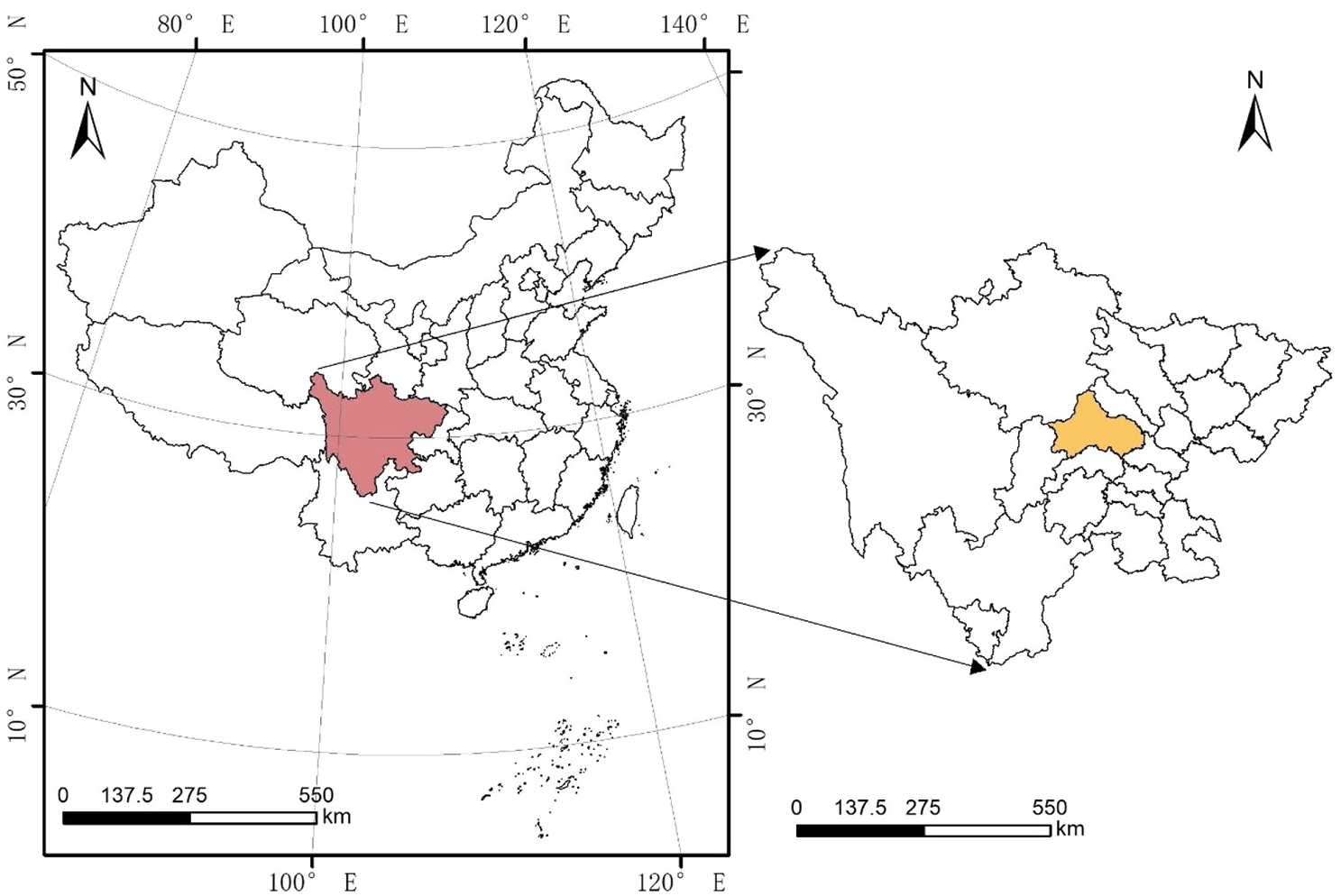
Geographical location of the study area.
Data Collection
Given that the “park city” initiative represents a long-term development strategy, we have monitored its progress in Chengdu from 2018 to 2024. As part of this effort, we identified the “Greenways of Paradise” as a representative project and selected it for further investigation. Semi-structured interviews were conducted between May 11 and June 26, 2024. In line with the study’s objectives, interviewees were selected from government departments, enterprises, and individuals related to the construction of park city. After several rounds of screening, 25 participants were successfully interviewed, with each session lasting 30 to 45 min. These included three officials from Chengdu Municipal Park City Construction and Administration Bureau (PCCAB) and Sansheng Street, two employees of Chengdu Paradise Greenway Construction and Investment Group Co. Ltd, three greenway planners and researchers, six professional/amateur cyclists, and 11 local residents who like to walk on the greenway in their spare time. The characteristics of the participants can be seen in Table 1. With the participants’ verbal consent, the interviews were recorded, and the recordings were later transcribed, yielding a total of 37,350 words. Of these transcripts, 20 were randomly selected for coding and analysis, while the remaining five were reserved for testing. Additionally, secondary sources such as official announcements from government websites, news reports, and published literature were used for triangulation. This approach ensured the research data were both comprehensive and reliable.
Participant Characteristics (n = 25).

Data Analysis
In this study, grounded theory was employed to analyze and interpret the data, aiming to develop theoretical insights. Following the procedural framework proposed by Corbin and Strauss (1990), we conducted a three-stage coding process—open coding, axial coding, and selective coding—using the Maxqda24 software.
Open Coding
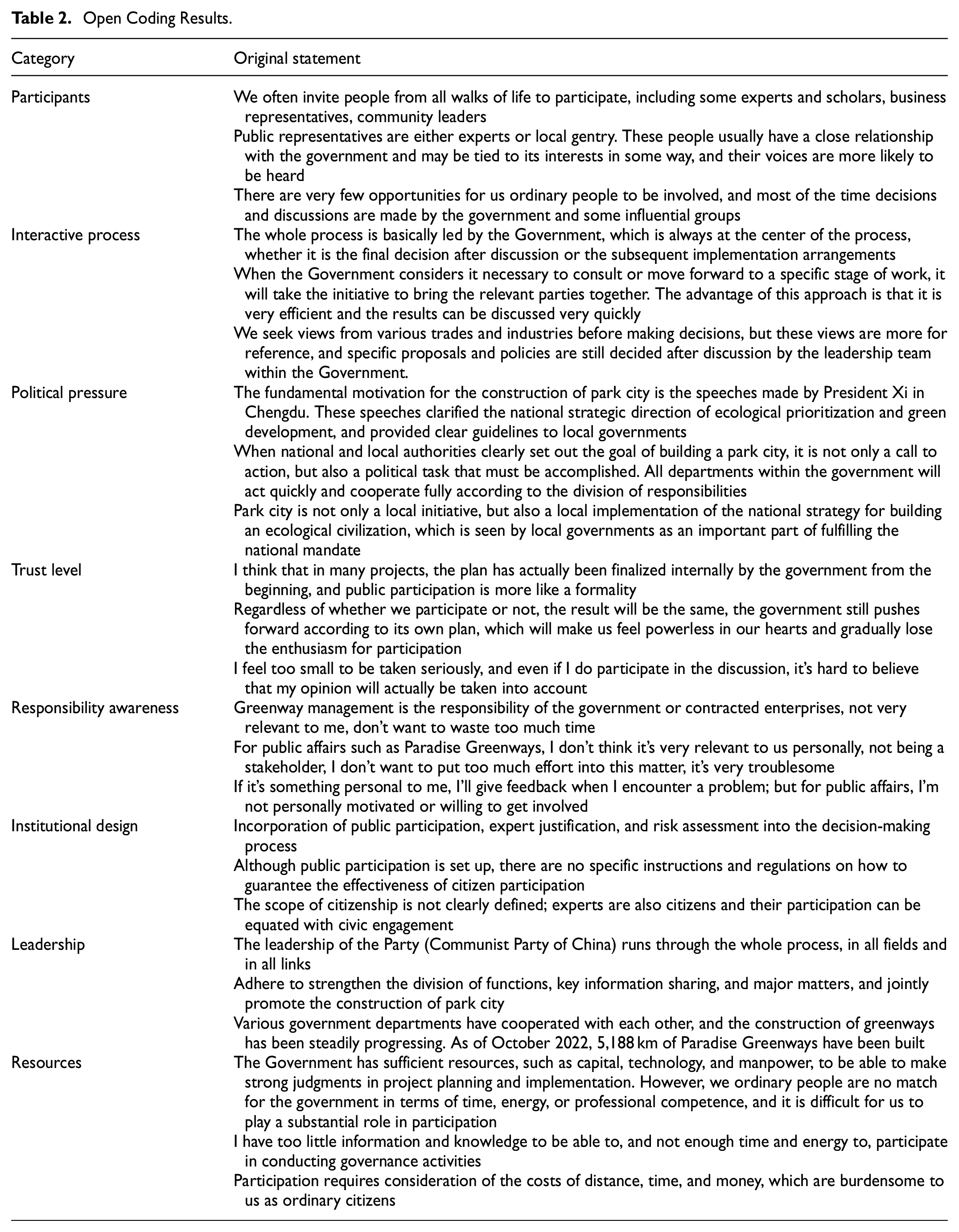
Open coding is the word-by-word coding of the original interview text. Each step, from breaking down the material to filtering statements to reorganizing concepts and mining categories, emphasized fidelity to the original text and reduced researcher subjectivity. Firstly, we imported the 20 transcribed audio texts into Maxqda24 software one by one. Then, based on previous studies, we identified possible concepts and terms under the core issue of “What are the driving elements for the construction of collaborative governance mechanisms for green spaces in megacities?,” such as public affairs, stakeholders, negotiation, willingness, etc., and screened all the statements. To avoid preconceived notions, we retained the original expressions of the interviewees to the greatest extent possible, and summarized the same type of original statements into an initial concept. After the above steps, the data obtained were still very heterogeneous and cross-cutting, which made it difficult to reflect the causal relationships behind them. Therefore, the third step of “categorization” was carried out, in which initial concepts with less than two occurrences or conflicting initial concepts were eliminated, and those that were related to each other were further aggregated into eight categories (as shown in Table 2).
Open Coding Results.
Axial Coding
Axial coding is the process of analyzing and summarizing the categories formed by open coding and the relationships between the categories in order to further develop the main categories. Based on the coding situation, we further integrated and summarized the eight categories formed by open coding into three main categories, namely, “principled engagement,”“shared motivation,” and “capacity for joint action” (as shown in Table 3). Principled engagement is an iterative process in which participants engage in interactive activities of discovery, definition, deliberation, and determination (Emerson et al., 2012). Shared motivation is a self-reinforcing cycle of three elements: political pressure, trust levels, and responsibility. Political pressure is not broadly defined as interest groups, lobbies, or street power (Kalk & Sorger, 2023), but rather refers to the top-down influence or constraints that individuals or organizations feel as a result of a particular political environment, power structure, or ideology. The level of trust refers to the extent to which citizens or interested participants believe that the parties can work together effectively to achieve common goals and safeguard their respective interests. Awareness of responsibility refers to an individual’s or organization’s perception of, and willingness to assume, the duties, obligations, or consequences of their actions. Finally, the capacity for joint action refers to “the collection of cross-functional elements that together create the potential for effective action” (Emerson et al., 2012). This study conceptualizes the capacity for joint action as a combination of three necessary elements: institutional design, leadership, and resources.
Axial Coding Results.

Selective Coding
After a comparative analysis of the main categories, the core category of this paper is identified as “collaborative dynamics of green space governance in megacities.” It is analyzed that collaborative dynamics consists of three key dimensions: principled engagement, shared motivation, and capacity for joint action (as shown in Figure 2). Through principled engagement, people with different backgrounds, relationships, and interests interact across institutional, sectoral, or jurisdictional boundaries. Based on principled engagement, shared motivation emerges from the interaction, that is, a willingness to collaborate based on pressures, trust, and a sense of responsibility. In a way, the shared motivation is an intermediate result of the initiation of principled engagement. Once shared motivation is formed, it in turn facilitates principled engagement. Finally, principled engagement and shared motivation contribute to the development of institutional design, leadership, and resources that create and sustain the capacity for joint action. These collaborative dynamics elements support and reinforce each other, and together they drive eventual collaborative actions. When successful collaborative actions are achieved, the resulting positive experiences further enhance the collaborative dynamics, creating a feedback loop of continuous improvement.

A theoretical framework for collaborative governance of green spaces in megacities.
Theoretical Saturation Test
In order to test the theoretical saturation of the results, the remaining five interview transcripts were coded in this study sequentially with open coding, axial coding, and selective coding. There was no emergence of new concepts and categories, no new associations were made between categories, and the relationships between the three main categories were further corroborated. Therefore, the results of this study are theoretically saturated.
Findings
Principled Engagement
Many practices and studies have shown that the “right” people should be involved in governance (Ansell & Gash, 2008; Emerson et al., 2012). However, government-led collaborative activities in centralized regimes usually leave the authorities to decide on the exact composition of participants. This arrangement reflects the characteristics of decision-making in centralized systems, where the selection of participants tends to prioritize the achievement of policy objectives and the maximization of administrative efficiency over broad social representation or the expression of diverse views. This is well reflected in the interview texts: The public representatives they (the government) choose are either experts or local townspeople, who tend to be tied to government interests and seldom raise opposing views (ZHANG-14).
By screening participants, the interactive process of discovery, definition, deliberation, and determination can be carried out efficiently by participants. This screening mechanism helps to pool knowledge and expertise and greatly enhances the effectiveness of principled engagement. For example: In the Paradise Greenways construction project, we were invited as a technical team to participate in the formation and planning of the program. The purpose and roles of both parties were clearly defined, so the communication process was smooth and efficient (LUO-12).
There are drawbacks to the regime: There is an inherent imbalance in power and status among the participants, and their interactions with each other are more of a one-way arrangement between the government and the other subjects, rather than a true collaboration among equals. For example: Although we have the opportunity to participate, we are more likely to make suggestions or point out problems to the government than to participate directly in the decision-making process (KUN-4).
Furthermore, the voices of ordinary citizens and grassroots organizations are frequently overlooked, reducing the inclusiveness and representativeness of decision-making processes. This exclusion can undermine the fairness of participation and diminish public acceptance of the outcomes. For instance: In many municipal projects, it seems that only some large enterprises or experts have the opportunity to participate. There is simply no one to ask for the opinions of ordinary residents, and there is no channel for feedback. When these projects are finally completed, they sometimes do not match our actual needs (XIE-17).
Shared Motivation
In a centralized system, political pressure from superiors can quickly lead participants to develop coherent goals and actions in practice. Such pressure usually stems from national strategies, instructions from superiors, or mandatory requirements of policy objectives. For example: The construction of a park city in Chengdu is actually an embodiment of the implementation of the national strategy of building an ecological civilization (ZHAO-18). Both the central and local leaders attach great importance to park city construction, so we must work together to do a good job and accomplish the expected goals of national and urban development (LI-19).
The study further revealed that the authorities, as the dominant players, tend to choose those partners with a higher level of trust and a stronger sense of responsibility. For instance: There is a tendency to invite experts from universities or research institutes that have cooperative projects with the government to join the discussion, and there are more state-owned enterprises among the enterprise representatives. Because we are more familiar with each other and trust each other, the cooperation is smoother (WU-21).
This approach ensures coordination and consistency among all parties during task implementation. However, it also suggests that trust and commitment are not gradually cultivated through the interactive process but are instead predetermined early on. This customary practice often excludes the general public, thereby limiting opportunities for broader collaboration.
Capacity for Joint Action
The capacity for joint action develops gradually through the interaction of key elements such as institutional design, leadership, and resources (Akaateba et al., 2023; Emerson et al., 2012). Specifically, Chengdu has established a macro-framework for park city construction through legislation, reports, and other means. These formal and informal institutional arrangements guided subsequent cooperation activities. However, in practice, public and expert participation has often remained superficial, and struggling to meaningfully influence decision-making. The grounded results reflect this: The program was stipulated at the beginning, and public participation or non-participation had little impact (SUN-7). I think sometimes the authorities only pursue the form, as long as it conforms to the procedures (GUO-19).
Second, China’s distinctive integrated party and government leadership ensures the vertical transmission of policy goals from the central to local levels. The central government outlines the top-level design through strategic planning and leaders’ speeches, while local governments formulate specific implementation programs in alignment with these unified goals. For example: Our work ideas are closely centered on the ecological civilization construction strategy and the top-level design of park cities proposed by the central government (LI-5).
Under this unified leadership, authorities maintain significant control over resources and can swiftly mobilize core assets such as land, capital, technology, and talent, providing robust support for implementing large-scale green space projects (F. Zhang et al., 2022). However, the high degree of centralization in resource allocation and decision-making often limits the autonomy and motivation of non-governmental actors, particularly with regard to public participation. For instance: As individuals, especially we ordinary citizens, have limited knowledge and capacity. Even if we put forward suggestions, they are often not adopted or are just used as a reference without genuinely influencing the government’s decisions, so people are reluctant to participate in public affairs (WANG-19).
Discussion
The Tension Between Efficiency and Equity
Principled engagement, as a key dynamic of collaborative governance, represents the interaction among diverse stakeholders in achieving policy goals. However, significant institutional differences exist between China and Western countries in this regard, highlighting the tension between efficiency and equity. In China, the centralized governance system enables government-led collaborative governance to prioritize stakeholders that are closely aligned with policy objectives. This selective participation significantly enhances the efficiency of policy implementation. However, it also has notable shortcomings in terms of fairness, as the voices of the general public and grassroots organizations are often overlooked. On the contrary, Western countries have empowered non-governmental actors with more voice and influence through, for example, support for self-governance or shared governance (T. Mattijssen et al., 2018). These approaches have helped improve policy fairness and social acceptance. However, such inclusive consultation processes can be time-consuming and may delay policy implementation, particularly in responding to urgent challenges. For China, lessons can be drawn from Western practices to expand channels for public participation and enhance social equity. At the same time, maintaining an efficient decision-making mechanism is crucial to achieving the sustainability of collaborative governance.
The Unique Role of Political Pressure
Who exerts political pressure? In countries such as those in Europe and the United States, political pressure often arises from the complex demands of diverse interest groups, lobbying organizations, and the public (Kalk & Sorger, 2023). Negotiations and decision-making in these contexts are prolonged and complicated by competing interests among various stakeholders (Groen & Niemann, 2011). As a result, political pressure functions more as a decentralized constraint, reducing the efficiency of collaboration and the consistency of goals. In contrast, political pressure in China’s governance system operates under a different logic. In a centralized system, pressure is transmitted top-down, primarily originating from the ruling party’s policy directives and mandates from higher levels of government. This form of pressure is distinctly goal-oriented. Upon perceiving political pressure, local governments quickly adjust their agendas to align with higher-level directives, integrating them into local action plans. For example, the construction of a park city as a national initiative is swiftly incorporated into local development strategies, facilitating a unified cooperation framework across sectors and fields. In this context, political pressure becomes a key driver of collaboration among governance actors, including local governments, enterprises, and the public.
Advantages and Disadvantages of Centralization
The Chinese government has developed a strong capacity for joint action through vertical transmission and unified leadership, which has become a core strength in green space governance. This system ensures that policy goals are delivered swiftly and implemented efficiently, with a clear advantage in resource deployment. The government’s high level of control over critical resources such as land, power, capital, and talent gives it a unique edge in addressing common challenges like land disputes, competing interests, and loss of expertise. For example, the government can quickly introduce and implement a unified land policy to effectively manage land use and expropriation for urban green space planning, thus avoiding governance obstacles caused by conflicting interests (Shi & Tang, 2020; F. Zhang et al., 2022). However, this strong governmental control can reduce the willingness of non-governmental actors to participate. The public often finds it difficult to influence decision-making with their opinions and suggestions, which diminishes their motivation to engage in governance. Over time, this system may foster a “habitual” culture of non-participation, leading to a gradual decline in citizens’ interest and willingness to engage in public affairs. This, in turn, affects the overall cooperative atmosphere and the effectiveness of governance in society. In Western countries, the interaction between government and non-governmental actors is more balanced. The public, enterprises, and community organizations typically have a more active role in resource allocation and decision-making. This experience encourages China to focus on how to balance the government’s leading role with the participation of multiple social actors in future governance, in order to improve the effectiveness, fairness, and social acceptance of policies.
By analyzing the above, this paper examines the collaborative dynamics and constraints of green space governance in megacities within the context of China’s political system and administrative structure. Under a centralized organizational framework, specific screening mechanisms are employed to concentrate knowledge and expertise, thereby ensuring the efficient advancement of governance objectives. This approach effectively addresses inefficiencies caused by conflicts of interest, which are frequently observed in Western societies. The analysis further highlights political pressure, strong leadership and resource integration capabilities as key factors driving the success of green space governance in China’s megacities. These findings enrich the discussion of “centralized collaborative governance” with Chinese characteristics in the existing literature. Moreover, the paper confirms significant resource disparities among participants in urban green space governance, a phenomenon that is particularly pronounced in China compared to democratic countries. In China’s highly centralized governance system, the government wields substantial control over power and resources, maintaining a dominant position in decision-making and resource allocation. As a result, ensuring the participation rights of non-state actors presents a particularly challenging issue for the Chinese government. Finally, this paper reveals the dilemmas faced by Chinese citizens in participating in collaborative governance, which helps to identify the commonalities and differences in citizen participation in different countries or regions, and provides lessons for other governance systems.
Conclusion
This paper develops a theoretical framework for centralized collaborative governance using a grounded theory approach. The framework provides a theoretical logic for understanding collaborative green space governance in Chinese megacities and serves as a tool for studying, practicing, and evaluating collaborative governance in centralized political systems. Through this analytical framework, we gain a deeper understanding of the factors contributing to collaborative success in China and the construction of its dynamic mechanisms. The framework comprises three dimensions: principled engagement, shared motivation, and capacity for joint action, which mutually reinforce each other to drive effective collaborative actions. Under a centralized system, the government ensures the effectiveness of principled engagement through specific screening mechanisms, which facilitate the efficient advancement of governance objectives. Building on principled engagement, the parties gradually develop a willingness to collaborate through ongoing interactions. In this process, top-down political pressure emerges as a key factor in fostering shared motivation, enabling large-scale green space projects to be rapidly incorporated into local development agendas and promoting the formation of a unified framework for cross-sectoral and cross-domain cooperation. With principled engagement and shared motivation in place, strong leadership and resource integration are established and sustained, shaping the capacity for joint action and providing robust support for green space governance in megacities. However, while this centralized collaborative governance model ensures the efficient implementation of policy objectives, it may overlook the inclusiveness and equity of governance processes. Therefore, we propose that collaborative efficiency should be pursued alongside efforts to expand opportunities for public and nongovernmental participation. By building a more inclusive and equitable participation mechanism, it can better balance diverse interests and achieve sustainable governance outcomes.
This research holds significant academic value and practical relevance. At the theoretical level, by constructing and elaborating on the framework of collaborative dynamics, this paper provides an in-depth analysis of the unique operational logic of centralized collaborative governance. It enhances understanding of the complex, multidimensional relationships between efficiency and equity, central and local authorities, and government and society. Moreover, it enriches and extends the applicability and theoretical boundaries of collaborative governance theory. At the practical level, using Chinese megacities as a case study, this research illustrates how governments, enterprises, and the public can collaborate to achieve green space governance objectives within China’s political system. The analysis highlights the distinctive features of the Chinese experience, such as government-led screening processes and internal decision-making mechanisms, while also uncovering the limitations of centralized governance, particularly in terms of inclusiveness and public participation. These insights offer valuable lessons and practical references for other megacities—especially those in countries with strong centralization of resources and authority. By learning from China’s successes and challenges, these cities can better balance efficiency and equity in their green space governance strategies, thereby improving the overall effectiveness of governance.
This paper has some limitations. Firstly, the development of the theoretical framework is rooted in China’s unique centralized system and governance model, which may reduce its applicability in countries or regions with multiparty or decentralized governance structures. This limits the framework’s potential for broader generalization across diverse governance contexts. Secondly, this study focuses exclusively on Chinese megacities and does not sufficiently address governance differences in small and medium-sized cities, rural areas, or international settings. This oversight may affect the generalizability of the findings. Furthermore, Chengdu, as one of the first pilot cities for “park city” construction, benefits from significant policy support and resource allocation. This unique context may result in findings that deviate from the realities faced by other cities. In future research, we aim to broaden the scope of the study by conducting cross-country and cross-regional comparative analyses to evaluate the applicability and stability of the framework in varying governance contexts.
Footnotes
Acknowledgements
The authors sincerely thank the editors for their dedication to this paper and extend heartfelt gratitude to the anonymous reviewers for their invaluable feedback and constructive suggestions, which have greatly enhanced the quality of this work. Appreciation is also extended to all interview respondents in this study for their insightful contributions, which provided essential data for the research.

Ethical Approval
This study has been approved by the Ethics Committee of the School of Public Administration, Sichuan University (Approval: NO.202405050001).
Consent Details
During the data collection process, participants’ full names were not recorded, but only their last names and demographic information were documented in the informed consent form.
Funding
The author(s) disclosed receipt of the following financial support for the research, authorship, and/or publication of this article: This research was funded by the China Scholarship Council (CN). The grant number is CSC202306240173.
Declaration of Conflicting Interests
The author(s) declared no potential conflicts of interest with respect to the research, authorship, and/or publication of this article.
Data Availability Statement
Data sharing not applicable to this article as no datasets were generated or analyzed during the current study.