




Abstract
Human Development Index (HDI) serves as a crucial measure of socio-economic progress, yet the nuanced relationships between HDI and key factors such as economic growth, urbanization, institutional quality, environmental pollution, and corruption control remain underexplored. This study examines the impact of economic growth, urban development, institutional quality, environmental pollution and control of corruption on HDI in the Southern African Development Community (SADC), a region with diverse economic and social challenges. To achieve this, the study employs advanced econometric techniques, specifically the Dynamic Common Correlated Effects (DCCE) and Augmented Mean Group (AMG) estimators. This research analyzes panel data spanning from 2000 to 2020 across 16 SADC countries, addressing cross-sectional dependence and heterogeneous slopes. The findings indicate that economic growth has a consistently positive impact on HDI in several countries, including Botswana, Comoros, Eswatini, Lesotho, Madagascar, Malawi, and the overall panel emphasizing its vital role in enhancing human development. Urbanization effects vary, with both positive and negative outcomes observed in countries like Zimbabwe and Seychelles. Institutional quality is positively linked to HDI in Lesotho and Mauritius, reinforcing the importance of effective governance. Environmental pollution shows a complex impact, benefiting HDI in Angola but impairing it in Zimbabwe. Corruption control also exhibits mixed effects, with negative impacts on HDI in Lesotho and Seychelles. This study highlights the need for tailored policy interventions that address specific regional and national contexts. It recommends enhancing institutional quality and tackling environmental pollution to promote sustainable human development across the SADC region.
Introduction
The Southern African Development Community (SADC) is a regional economic community comprising 16 countries in Southern Africa (Figure 1A). The SADC region is rich in natural resources and tourist attractions, making it a key destination for global investors (Zheng, 2024). With a population of approximately 340 million and a combined GDP of US$720 billion, SADC plays a vital role in promoting sustainable and equitable economic growth, socio-economic development, good governance, and lasting peace and security among its member states (Omay et al., 2017; Southern African Development Community [SADC], 2024). The community aims to boost intra-regional trade, foster regional trade integration, and enhance economic cooperation among its members (Moyo, 2023). The SADC region is notable for its significant economic activities, especially in the mining sector, which contributes more than 10% of GDP in countries such as Angola, Namibia, Botswana, and Zimbabwe (Isheloke & Blottnitz, 2023). One of the key responsibilities of governments within the SADC is to improve the welfare of their populace. Article 5 of the SADC Treaty emphasizes that the main objectives of SADC are to foster economic growth and socio-economic development, eradicate poverty, and ensure peace, security, and democracy through regional cooperation and integration (SADC, 2022; Seleteng & Motelle, 2016). SADC shares this vision and aims to achieve economic well-being, improve living standards, enhance social justice, and promote peace and security for the people of Southern Africa (Joseph, 2022).
The Human Development Index (HDI) often the measure used to assess this progress. The HDI, developed by the United Nations Development Programme (UNDP), is a composite measure used to assess and compare development levels across countries (Jaman, 2020). It serves as a benchmark for evaluating quality of life and well-being within regions or countries, offering a comprehensive snapshot of human progress (Urzúa & Vilbert, 2023). The HDI includes indicators such as life expectancy, education levels, and standard of living, providing a holistic view of human development achievements (Đorđević et al., 2022). According to Helen Suzman Foundation (2019), SADC countries have a median HDI of 0.58. Only Mauritius and Seychelles surpass the global median, with Mauritius and Seychelles having HDI values above 0.700. Botswana and South Africa fall between 0.600 and 0.699, Namibia and Eswatini between 0.500 and 0.599, while Zambia, Angola, Zimbabwe, Comoros, Tanzania, Madagascar, and Lesotho are below 0.600, and Malawi, DRC, and Mozambique have HDI values below 0.500. These figures demonstrate how societal welfare levels are diverse in the region. Income inequality is a growing global concern, with people across the political spectrum believing it should be reduced. However, inequalities in human development are even more profound, as shown by stark differences in education and life expectancy between children born in high and low human development countries, as well as significant life expectancy gaps within countries based on income levels. For example, while over half of 20-year-olds in high-human development countries are enrolled in higher education, only 3% are in low human development countries, and children in the latter are far more likely to die before age 20 (United Nations Development Programme [UNDP], 2019). In the SADC region, HDI is an important measure of holistic progress beyond economic output into dimensions that are fundamental to human well-being and sustainable development. It integrates life expectancy, education, and per capita income; each one of these dimensions addresses directly SADC’s objectives for the promotion of equitable growth, social welfare, and economic integration among its member states. Given the vast differences in income and development across this region, the HDI provides a standardized system through which these improvements in quality of life and access to basic resources are quantified. In addition, in countries characterized predominantly by features of inequality, health, and education disparities-which, for the most part, pertains to the many countries in the SADC region-HDI becomes particularly handy in pointing out disparities that are camouflaged by economic indicators. As member states of SADC strive for regional integration and the attainment of goals on sustainable development, HDI offers a useful yardstick against which progress in efforts toward inequality reduction and human welfare enhancement-both core priorities of SADC’s Regional Indicative Strategic Development Plan (2020-2030)-can be measured. Based on this assertion the HDI level of a country is thus of great importance, consequently, understanding its determinants is crucial not only for policymaking but also for policy implementation in the SADC region.
Economic growth is crucial for advancing human development, as it provides the resources necessary for investment in education, healthcare, and infrastructure, thereby improving living standards. Higher income levels, often resulting from economic growth, are linked to better access to education and healthcare. Research indicates that economic development can enhance institutional quality in lower-middle and low-income countries, contributing to overall human development (Redmond & Nasir, 2020). This underscores the need for sustainable economic policies and investments in key sectors to foster population well-being and prosperity. Urbanization, a prominent trend in the SADC region, impacts human development in diverse ways. Effective urbanization can enhance access to essential services and economic opportunities, while inadequate infrastructure and overcrowding in urban areas may impede progress (Vitenu-Sackey, 2023). Institutional quality also plays a pivotal role in shaping human development outcomes. Strong governance structures and effective institutions enhance resource allocation and contribute to better human development. Studies consistently highlight the positive impact of institutional quality on human development, highlighting the need for robust governance frameworks to achieve social and economic objectives (Ariu et al., 2016). Improving institutional quality can boost public service delivery, reduce corruption, and support sustainable development in SADC member countries. Effective governance, transparency, and adherence to the rule of law are crucial for translating economic gains into meaningful improvements in human development.
Corruption significantly undermines institutional quality, economic growth, and human development outcomes. It weakens public institutions by diverting resources from essential services and hindering socio-economic progress. Therefore, effective anti-corruption measures are crucial for ensuring transparency, accountability, and good governance, all of which are vital for sustainable development (Thi Cam Ha et al., 2023). Environmental pollution is a major challenge to human development in the SADC region, adversely affecting health, well-being, and overall quality of life. Addressing environmental degradation and adopting sustainable practices are critical for protecting human development outcomes. Research indicates that environmental factors, such as pollution, can adversely impact human development indicators, highlighting the urgent need for proactive environmental policies and conservation efforts (Hashmat et al., 2024).
This study seeks to answer the question—what is the effect of economic growth, urban development, institutional quality, environmental pollution and corruption control on Human Development Index (HDI) in SADC member countries? The study aims to provide insights into the determinants of human development in the region, offering valuable guidance for policymakers striving to enhance development outcomes in Southern Africa. While HDI is widely recognized for encompassing welfare aspects in measuring overall economic development, the complex interplay between HDI and various environmental and socio-economic factors remains underexplored. For instance, the direct relationship between environmental pollution and HDI has not been thoroughly investigated, with existing research, such as Gyawali et al. (2023), primarily offering comprehensive reviews of scholarly articles without delving into empirical analysis. These studies highlight the detrimental effects of pollution, including increased incidences of diseases such as cancer and cardiovascular conditions. However, the lack of empirical data and econometric models to determine the nature of the relationship between environmental pollution and HDI may result in an incomplete representation of the issue.
Moreover, previous studies, including Hardi et al. (2023), Akinbode et al. (2020), Tripathi (2021), Nguea (2023), Sarabia et al. (2020), Sangaji (2016), Nginyu et al. (2025), and Thi Cam Ha et al. (2023), have often overlooked cross-sectional dependence by failing to consider correlations across different entities within the panel. This is particularly critical in the SADC region, where countries such as Lesotho and Eswatini, though independent, share borders with South Africa and maintain close trade relations. This study addresses these gaps by employing advanced econometric techniques, the Dynamic Common Correlated Effects (DCCE) and Augmented Mean Group (AMG), which are well-suited for handling panel data with cross-sectional dependence and heterogeneous slopes. Additionally, given the choice of variables, the time frame of the study, recent global developments, and the impact of COVID-19, this research is timely. Unlike previous studies, such as Akinbode et al. (2020), which focused on government health spending and effectiveness on HDI before COVID-19 (2015-2018), and Nginyu et al. (2025), which examined government effectiveness on HDI from 2010 to 2017, this study spans a more comprehensive period from 2000 to 2020. It incorporates five independent variables—economic growth, urban development, institutional quality, environmental pollution, and corruption control—and one dependent variable, HDI, providing a more holistic analysis of human development in the SADC region.
Literature Review
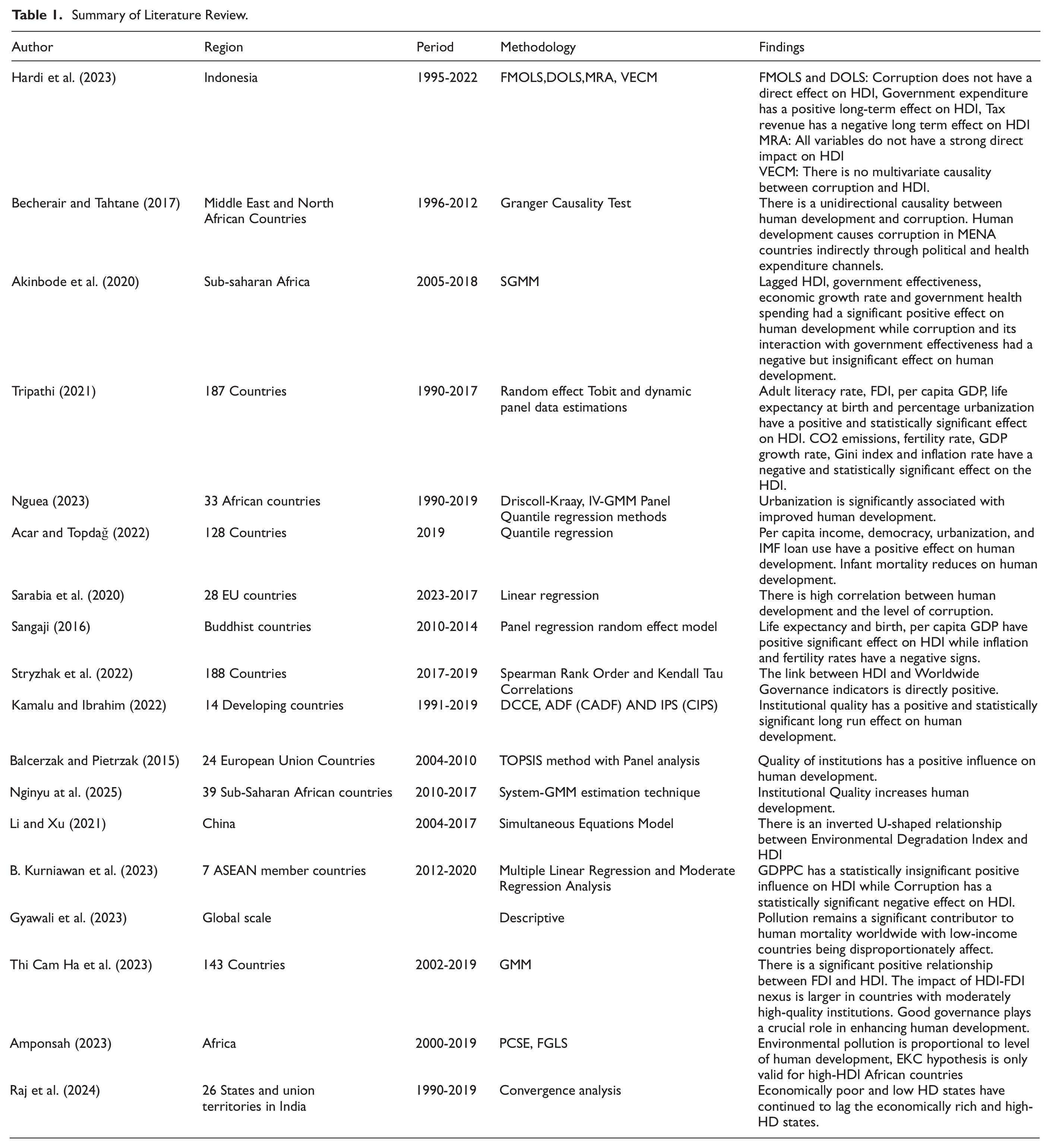
This section reviews literature on human development in relation to urbanization, control of corruption, institutional quality, economic growth, and environmental pollution. To broaden the scope of development beyond purely economic measures and include social dimensions, the United Nations Development Programme (UNDP) introduced the Human Development Index (HDI) as part of its Human Development Report. Conceptualized by Mahbub ul Haq, the HDI is a composite index measuring average achievement in three key dimensions: life expectancy, education, and standard of living. The introduction of the HDI marked a significant shift in development discourse, attracting considerable attention to welfare issues at a time when many experts believed that welfare levels would automatically improve with GDP growth. Since its inception, the HDI has garnered increasing attention in the literature, with researchers and policymakers exploring its relationship with various other variables. Notable studies in this domain include Saybasachi (2019), who investigated the impact of urbanization on HDI values using random effect Tobit panel data estimation from 1990 to 2017. The study found that total urban population, percentage of urban population, and percentage of urban population living in million-plus agglomerations positively affect HDI, even after controlling for other significant determinants. Similarly, Selçuk (2006) examined the relationship between corruption and human development using a sample of 63 countries for the year 1998. Employing three different corruption indices, the study concluded that there is a statistically significant negative relationship between corruption and human development, with more corrupt countries exhibiting lower levels of human development. Further research on these variables is summarized in Table 1.
Summary of Literature Review.
Evaluation
Most studies do not address cross-sectional dependence among panel data, potentially weakening the robustness of their findings. This is particularly relevant for the SADC region, where economic, social, and environmental factors are highly interconnected across borders, ignoring these dependencies can lead to biased estimates, as some models employed in prior research overlook cross-sectional dependence. Additionally, while environmental pollution is widely recognized as a determinant of health outcomes and mortality, its specific effects on HDI remain underexplored in empirical analyses. Although existing research highlights the impact of environmental degradation on development, the literature lacks models that quantitatively analyze this relationship within HDI frameworks, particularly for the SADC region. This gap underscores the need for empirical, data-driven approaches to provide a more comprehensive understanding of environmental factors on human development.
Data and Model
Data
The Human Development Index (HDI) measures progress in health, education, and standard of living. This article explores how economic growth, urban development, institutional quality, environmental pollution, and control of corruption affect the HDI in SADC member countries over the period 2000 to 2020. The period is selected primarily based on availability of data. The region is selected due to its economic potential and similarity of their political and social environment. The study adopts these determinants as justified by existing studies. Economic growth is crucial for human development, providing resources for education, healthcare, and infrastructure, and positively correlates with the HDI (Arisman, 2018). Existing research shows that there is a positive relationship between higher economic growth and improvement in HDI, enhancing income levels, life expectancy, and educational attainment (Ramesh & Abebe, 2016). For instance, the study by Ramesh and Abebe (2016) found that economic growth in Ethiopia had positive impacts on HDI through betterment in income and life expectancy, signifying that economic advancement can result in superior outcomes in human development. In addition, according to Suyanto (2023), in improving the quality of human life, economic growth plays a vital role; hence, solidifying its position as a key determinant of HDI. Urban development improves access to services and employment, positively impacting HDI (Ghifara et al., 2022).For instance, a study by Jiang et al. (2021) revealed that while most often uncontrolled, the rise in urban land in Africa provides increased economic activities and living standards if well managed. Urbanization ensures better access to education and health, which are key components of HDI. It also brings about challenges like poor infrastructure and degradation of the environment, hence requiring sustainable urban planning for maximization of its gains (Manteaw, 2020). This duality in urbanization makes it very important as a variable impacting HDI. Institutional quality, marked by effective governance and rule of law, enhances HDI by improving policy implementation and reducing corruption. Runtunuwu et al. (2023) supports this by showing an illustration of how institutional quality directly relates to HDI improvements through the need for strong governance frameworks. Strong institutions are the environment needed for economic development and growth in human development, as it ensures that resources are well allocated to reach set goals equitably. Corruption undermines economic growth and human development, making anti-corruption measures essential for improving HDI (Y. Kurniawan et al., 2020). Hope (2021) observes that corruption is an antithesis to sustainable development and a deterrent to progress in critical sectors pivotal to HDI, such as health and education. Corruption is one of the significant malaises facing most of the countries in Africa and is associated with negative impacts on both economic growth and human development. It has been found that corruption diverts resources from the provision of basic public goods and services that are vital to increasing HDI (Hope, 2020). For instance, Mlambo et al. (2019) point out that corruption not only inhibits economic growth but also embeds the level of poverty and inequality, hence hampering HDI. The presence of effective anti-corruption must therefore be met in order to enhance HDI as it allows for a better allocation of resources toward health, education, and infrastructure development (Muhammad et al., 2023). Environmental pollution negatively affects health and quality of life, highlighting the need for sustainable practices. According to Safitri (2023), pollution is known to cause health problems and result in lower life expectancy and general well-being according to Manteaw (2020). Rapid urbanization in Africa has the marks of inadequate waste management and pollution; hence, good sustainable practices are needed to reduce these impacts. Environmental sustainability has to be ensured since it directly impacts HDI, as health outcomes and living conditions depend on it. Said differently, the selected independent variables—economic growth, urbanization, institutional quality, corruption, and environmental pollution—are justified on the basis of their established relationships with HDI in prior studies. Each of these variables adds to a comprehensive understanding of the determinants of human development in Africa and thus provides a need for integrated approaches to fostering sustainable developments. Further details on the data used is available in Table 2.
Summary of Variables.

Model
The Dynamic Common Correlated Effects (DCCE) and Augmented Mean Group (AMG) techniques can be applied to the analysis of dynamic panel data for countries with interdependent economies, especially in consideration of including unique national characteristics and cross-country interdependencies. Multi-country studies need to take great care in accounting for both the common economic or environmental influences and the individual country differences, in which case DCCE and AMG both have particular advantages. The DCCE model handles cross-sectional dependence effectively by factoring in the potential impact events in one country may have on others, mostly through economic or policy channels. This is achieved by adding cross-sectional averages, which net out common influences and, therefore, isolate country-specific dynamics, reducing the estimation bias. This method is most helpful in a long-panel-data setting as in this case, SADC region, where countries face common external shocks, so that country-specific findings are not clouded by global movements.
Further, the AMG approach addresses the heterogeneity of responses of individual countries to similar determinants. Since economic or environmental impacts vary across countries, it allows unique slope estimation for each country, permitting nuanced appreciation of local responses to global issues. The AMG enhances the robustness of the estimates by accounting for unobserved common factors and allowing for different national trajectories. This is especially useful in studies of economies with great diversity, where individual responses to policies—like carbon reduction strategies—may vary a lot, which shall give the policymakers more tailored and specific insights.
The Dynamic Common Correlated Effects (DCCE; Chudik & Pesaran, 2015) and Augmented Mean Group (AMG) (Eberhardt & Stephen, 2009; Eberhardt & Teal, 2010) estimators are advanced econometric techniques well-suited for handling panel data with cross-sectional dependence, and heterogeneous slopes. In dynamic panels, the Common Correlated Effects (CCE) estimator, typically consistent in nondynamic settings, faces challenges due to the presence of lagged dependent variables, which introduces endogeneity. As such, where the errors are weakly cross-sectionally dependent, and the lagged dependent variable is no longer strictly exogenous, the CCE estimator may often be inconsistent. The DCCE mean group model applied in this study follows the dynamic Equation 1 below:

Where
The AMG, unlike the CCEMG estimator, where unobservable common factors are treated as nuisances, the AMG approach considers these unobservables as representing total factor productivity (TFP), which is crucial in cross-country production functions. The AMG procedure involves three key steps: A pooled regression model augmented with year dummies is estimated using first-difference OLS. The coefficients on the differenced year dummies represent the estimated cross-group average of the unobservable TFP’s evolution over time, referred to as the “common dynamic process.” The group-specific regression model is then adjusted by including the estimated TFP process. This can be done either by explicitly adding it as a variable or by imposing it on each group member with a unit coefficient, effectively subtracting the estimated process from the dependent variable. An intercept is also included in each regression model to account for time-invariant fixed effects, representing TFP levels. Similar to the MG and CCEMG estimators, the group-specific model parameters are averaged across the panel, with optional weighting applied to the averages. This approach allows for a more nuanced analysis of the role of TFP in cross-country production functions, accounting for both common dynamics and group-specific effects. The AMG follows the empirical Equation 2 as below:

Where
The DCCE and AMG estimators are adept at handling panel data where variables are stationary at first difference, as they manage non-stationary data by differencing variables, thus ensuring reliable regression results (Kredo et al., 2012). They are also proficient in capturing long-run relationships among cointegrated variables, providing insights into equilibrium dynamics (Moirangthem & Nag, 2021). Furthermore, these estimators address cross-sectional dependence, accounting for correlations across different entities within the panel to ensure robust estimation results (Pretorius et al., 2021). Additionally, they accommodate heterogeneous slopes, allowing for the estimation of individual-specific effects and capturing the varying impacts of independent variables on the dependent variable across different panel entities (Mbulawa, 2015). In this study the general equation followed is given by Equation 3:

Methodology and Empirical Results
Methodology
The study adopts a four-stage methodological approach (Figure 1), firstly descriptives are reported, then cross-sectional dependency and stationarity is assessed. In the third stage, slope homogeneity is examined, followed by cointegration tests. Finally, DCCE and AMG long run estimators are obtained.

Analysis strategy.
In the first phase of the study, descriptive statistics are examined to determine the basic characteristics of the dataset including mean, variance and skewness. Over the period of study, the HDI of the SADC countries was 0.544, and a maximum and minimum of 0.808 and 0.303 respectively. The regions GDP per capita averaged at 3165.9USD with a minimum of 293.23USD and a maximum of 19481.6USD. Detailed descriptives are presented in Table 3. Additionally graphical distribution of the variables for the 16 countries over the period of study are given in Figures 2A to 7A (in the Appendix).
Descriptive Statistics.

Note. Table of descriptives of the variables-HDI, GDP, URB, IQ, EP, and CORR used in the study.
In the second phase of the study, cross-sectional dependence among the variables under study is examined. This is necessitated by the fact that the economies being studied are interconnected and may exhibit correlations across different countries due to shared regional characteristics, economic linkages, and common external shocks, when not accounted for, such interconnections may lead to biased estimates and unreliable statistical inference. In this context, the Pesaran test of cross-sectional dependence (CD) is used (Jianguo et al., 2022). It is observed from the results presented in Table 4, that cross sectional dependence was present in HDI, GDP, URB, and EP.
Diagnostics.

Note. a, b, and c imply the rejection of null hypothesis at the 1%, 5%, and 10% significance levels. In conducting the CIPS stationarity test, the Portmanteau test for white noise is included, as well as both trend and constant deterministic terms. The critical values for significance decision criteria were at −2.63, −2.73, and −2.92 for the 10%, 5%, and 1% levels, respectively. A value is significant if more negative than the critical values at corresponding significance level.
The next diagnostic test conducted by the study is the stationarity test. A time series is stationary if its statistical properties—such as mean, variance, and autocorrelation—are constant over time. In a stationary series, values fluctuate around a fixed mean level without a trend, and the spread of values (variance) remains stable. Stationarity is important in time series analysis because it allows for more reliable modeling and forecasting, as future behavior can be inferred based on past behavior without shifts in the underlying structure of the data. To differentiate between a true unit root process and a stationary process influenced by random independent shocks, a unit root test incorporating white noise into the model is employed. It is essential to ascertain whether the data series is trend stationary( stationary around a deterministic trend) or difference stationary (stationary after differencing). The CIPS (Cross-Sectionally Augmented Im-Pesaran-Shin) and Breitung and Das (2005) tests are employed due to their robustness in handling cross-sectional dependence (Woldu & Szakálné Kanó, 2023). As shown in Table 4, all variables are stationary at first difference.
The third phase of the study, the Pesaran and Yamagata (2008) Delta Test is used to test the hypothesis that the coefficients of the explanatory variables are the same across all cross-sections in a panel data model. This helps determine if there is significant heterogeneity in the relationship between the dependent and independent variables across different cross-sections. As shown in Table 4, the data exhibited heterogenous slopes. Cointegration refers to a relationship between two or more non-stationary time series that share a common stochastic trend. If two series are cointegrated, they may individually wander over time (non-stationary), but there exists a linear combination of them that is stationary. This means that while each series may be trending or drifting, they maintain a stable, long-term equilibrium relationship, allowing for meaningful modeling of their relationship despite their non-stationary nature. The Pedroni and Westerlund cointegration tests are used in this context to establish presence of long run relationship among the variables in the panel. It is confirmed that cointegration is present in the data (Table 4).
Empirical Results
In the final stage of the analysis, DCCE and AMG long run estimators are obtained and shown in Table 5. From the robust findings, in Botswana, Comoros, Eswatini, Lesotho, Madagascar, Malawi and in the overall panel, GDP had a positive effect on human development index. These findings suggest that economic growth is a critical factor in enhancing human development outcomes. In the context of SADC, the economic integration and growth facilitated by regional trade agreements have been instrumental in improving HDI. For instance, the SADC has actively pursued policies aimed at reducing trade barriers, which has led to increased economic activity and investment in member states. This economic dynamism is reflected in the HDI improvements observed in countries such as Botswana and Eswatini, where GDP growth has been linked to better health, education, and living standards (Egu & Aregbeshola, 2017; Thow et al., 2015). The presence of South African multinational corporations (MNCs) in the region has also contributed significantly to economic development, providing capital and innovation that bolster local economies and, consequently, human development (Egu & Aregbeshola, 2017). Moreover, the HDI, which incorporates GDP per capita as a key component, underscores the importance of economic resources in enhancing well-being. The UNDP’s methodology for calculating HDI emphasizes that GDP per capita accounts for a substantial portion of the index, thereby establishing a direct correlation between economic performance and human development (Haq & Zia, 2022). This relationship is evident in the SADC region, where countries with higher GDP per capita tend to exhibit better HDI scores, reflecting improved access to education, healthcare, and overall quality of life. Empirical studies have reinforced this connection, demonstrating that increases in GDP are associated with significant improvements in HDI across various SADC nations. For example, research focusing on the determinants of economic growth in the SADC region indicates that economic expansion directly correlates with enhancements in human development metrics (Musora & Matarise, 2023). This finding is consistent with broader economic theories that advocate for the role of GDP as a predictor of human development outcomes (Bechtel, 2018, 2019).
Long-run Estimate Results.

Note. These are findings from the DCCE and AMG estimators obtained from Stata output. a, b, and c imply 1%, 5%, and 10% significance levels. The values in colored frames are robust and significant results.
Urbanization recorded varied effects, a negative effect in Zimbabwe, positive effects in Lesotho and Seychelles while it exhibited mixed effects in Madagascar, Malawi, and Mauritius. The impact of urbanization on HDI in various countries within the SADC is very complex and has varied widely depending on the socio-economic context, institutional frameworks, and stages of urban development for each country. This complexity is particularly revealed through case studies of Madagascar, Malawi, Mauritius, Zimbabwe, Lesotho, and Seychelles. In Madagascar, Malawi, and Mauritius, urbanization presents opportunities and challenges that contribute to ambiguous effects on HDI. Urbanization can improve access to basic services like healthcare, education, and work, which are all included in HDI. However, inadequate urban planning and insufficient investment in infrastructure may cause overcrowding of urban centers with slimmed-down public services, bringing out mixed results in human development (Patt et al., 2010). For example, whereas Mauritius has relatively more progressive development policies that harness urbanization for economic development, thus the ambiguous effect warrants further investigation. In Madagascar and Malawi, urbanization often overshoots infrastructure development, creating variable and unpredictable consequences for HDI (Kounou, 2020). This duality of urbanization in these contexts raises the importance of good governance and strategic planning that maximizes benefits but also minimizes negative outcomes. Conversely, Zimbabwe’s experience with urbanization is marked by negative impacts on HDI, as indicated by both the DCCE and AMG methods. The country’s economic instability, governance challenges, and deficiencies in urban planning contribute to this negative correlation. High rates of urbanization without adequate support for job creation and public services exacerbate inequality and strain resources, ultimately hindering human development (Soheylizad et al., 2016). Urban areas in Zimbabwe are characterized by housing shortages, high unemployment rates, and inadequate healthcare services, illustrating how urbanization can impede progress when not accompanied by robust socio-economic support mechanisms (Suryanto et al., 2022). In contrast, there are positive links between urbanization and HDI in Lesotho and Seychelles. In Seychelles, urbanization comes with better access to health, education, and economic opportunities, enabled by strong policy frameworks effective in managing urban growth and reducing poverty (Coburn & Blower, 2017). Similarly, urbanization policies in Lesotho are aligned with development goals, particularly through investment in education and health infrastructure, which significantly raises HDI (Crush et al., 2017). Taken together, the heterogeneous effects of urbanization on HDI in SADC countries show that the relationship is not homogenous but instead mediated by the different policy regimes, economic structures, and institutional capacities of each country. In addition, effective governance, economic stability, and investment in infrastructure are important for urbanization to act as a catalyst for human development. This is consistent with broader literature that emphasizes the need for enabling frameworks to realize the potential of urbanization while mitigating its adversities (Silva et al., 2022).
Institutional quality consistently had positive effects on human development effects in Lesotho and Mauritius. The benefits associated with good quality institution in enhancing human development in Lesotho and Mauritius spring from a number of interrelated factors such as good governance, sound policies and their application that are aimed toward enhancing the HDI. In the case of Lesotho, the institutional context is a significant determinant of the level of human development attained. The Lesotho National Development Corporation (LNDC) is one of the main institutions created to provide guidance to the development of the manufacturing sector in the country. Its success depends on the institutional arrangements in place and development or growth of Private Sector Economies (Makhetha et al., 2022). Strong institutions result in good governance which is important in promoting policies that drive economic growth and provision of social services leading to better HDI (Thamae, 2015). In addition, the introduction of public private partnerships (PPPs) within the health care system has its own benefits as it has improved the quality of services offered as well as management systems which are key in the improvement of health and human development in general (Hellowell, 2019). Similarly, high quality of governance plays a role in the enhancement of human well being in Mauritius. This island nation is known for good governance, which is based on transparency, accountability, and concern for the well-being of its citizens. This allows Mauritius to follow policies that respond to the needs of the population as a result health, education and economic growth improves (McGuire et al., 2024). The governance of regulatory regimes in Mauritius has also been particularly effective with regards to telecommunication services and other similar businesses.
Environmental pollution had a positive effect on HDI in Angola while the effect is negative in Zimbabwe. The effects of environmental pollution on HDI are contradictory in Angola and Zimbabwe which could be attributed to their different socio-economic and governance realities. In Angola, some indicators of environmental pollution may be positively associated with HDI due to the country’s reliance on natural resource extraction, which can drive economic growth and improve living standards despite the associated environmental degradation. In this case, however, the picture cannot be painted black and white because any form of enhancement can be realized at a very high health cost, which Nazeer et al. (2022) argues can be counter-productive in the long run. On the other hand, Conversely, Zimbabwe experiences a negative impact of environmental pollution on HDI. The country’s economic instability and governance challenges exacerbate the adverse effects of pollution, leading to deteriorating public health and reduced quality of life. High levels of pollution, coupled with inadequate infrastructure and public services, contribute to health crises that undermine human development (Odiete, 2020). The lack of effective environmental regulations further compounds these issues, resulting in a situation where pollution detracts from overall human development outcomes (Nahar et al., 2021). Thus, while Angola may leverage pollution for economic gain, Zimbabwe’s context illustrates how environmental degradation can severely hinder human development.
Control of corruption recorded a negative effect on HDI in Lesotho and Seychelles. The negative effect of corruption control measures on the Human Development Index (HDI) in Lesotho and Seychelles can be understood through a nuanced examination of the socio-political contexts and the implementation dynamics of these measures. While corruption control is generally aimed at enhancing governance and equitable resource distribution, its short-term impacts can be disruptive, particularly in environments where corruption is deeply embedded in economic and political systems. In Lesotho, the implementation of stricter corruption controls may initially lead to a decline in HDI due to the disruption of established patronage networks that have historically facilitated access to public resources and services. These entrenched systems often provide essential services to communities, and their dismantling can result in temporary service delivery interruptions, adversely affecting health and education outcomes, which are critical components of HDI (Amate-Fortes et al., 2015). Moreover, the challenges associated with effectively enforcing anti-corruption policies can lead to bureaucratic inefficiencies, further complicating the landscape of public service delivery and limiting access to resources necessary for human development (Amate-Fortes et al., 2015). Seychelles, despite its relatively higher economic stability, faces unique challenges where corruption control initiatives can indirectly impact HDI. The government’s focus on strengthening regulatory frameworks may divert resources away from critical sectors such as healthcare and education, especially in a small economy with limited fiscal capacity (Ortega et al., 2013). This redirection of funds can temporarily hinder the provision of essential services, thereby negatively affecting HDI components. Additionally, the adjustment period required for institutions to adapt to new anti-corruption measures can exacerbate these challenges, as public services may struggle to maintain quality during the transition (Ganda, 2020). These findings underscore the complexity of the relationship between corruption control and human development in specific African contexts. While anti-corruption initiatives are essential for long-term development, their immediate effects can be counterproductive if not managed carefully, particularly in countries like Lesotho and Seychelles where corruption has been intertwined with socio-economic structures. The interplay between the implementation of these measures and the capacity of institutions to maintain service quality is crucial in determining the overall impact on HDI (Qaiser et al., 2018).
Discussion
The empirical findings from the Dynamic Common Correlated Effects (DCCE) and Augmented Mean Group (AMG) estimators align with existing literature, offering nuanced insights into the determinants of HDI across the SADC region. Broadly, the results echo existing studies highlighting the positive link between economic growth and HDI, such as Tripathi (2021) and Amponsah (2023), which emphasize that increased income facilitates investments in key development sectors like education and health. However, similar to Hardi et al., (2023), this study recognizes the importance of sustainable growth, especially for countries heavily reliant on fluctuating commodities, a critical point for ensuring long-term human development. Urbanization’s impact on HDI in this study reflects the diverse findings in previous literature, with both positive and negative outcomes contingent on local contexts. Saybasachi (2019) and Nguea (2023) observed positive associations between urbanization and HDI, attributing this to better access to essential services. This aligns with positive findings in Lesotho and Seychelles, where managed urbanization appears to enhance human development. Conversely, the negative effect in Zimbabwe, mirroring Akinbode et al. (2020), suggests that challenges like overcrowding, inadequate infrastructure, and insufficient public services may hinder development gains from urbanization. The mixed results in Madagascar, Malawi, and Mauritius further substantiate that urbanization’s impact is context-sensitive, as supported by varying country experiences in urban governance and resource allocation.
The study’s findings on institutional quality, showing positive impacts on HDI in Lesotho and Mauritius, are consistent with Kamalu and Ibrahim (2022) and Nginyu et al. (2025), who underline the role of strong governance in fostering human development. Effective institutions enhance policy execution, reduce corruption, and strengthen public service delivery, ultimately promoting health, education, and economic security. The convergence with literature underscores the imperative for robust institutional frameworks in the SADC context to achieve sustained improvements in HDI. The divergent impact of environmental pollution on HDI across countries, such as the positive effect in Angola, supports Li and Xu (2021)’s findings on the complex, often nonlinear relationship between economic growth, environmental pollution, and HDI. Short-term economic gains from industrial activities may momentarily elevate HDI, despite environmental costs. However, as Zimbabwe’s case demonstrates, long-term environmental degradation can undermine HDI through health impacts, validating findings by Gyawali et al. (2023). These outcomes emphasize the necessity for development policies balancing economic growth with environmental sustainability, especially for countries like Zimbabwe where pollution’s adverse health effects directly diminish HDI.
Unexpectedly, the observed negative effect of corruption control on HDI in Lesotho and Seychelles warrants further exploration. This outcome deviates from Selçuk (2006) and Sarabia et al. (2020), who find that reduced corruption generally correlates with higher HDI. A possible explanation, as suggested, may involve short-term inefficiencies arising from anti-corruption efforts that disrupt entrenched systems, temporarily hindering public service delivery. Alternatively, the delayed benefits of institutional reforms might explain this lag, with improvements in HDI becoming apparent only after sustained anti-corruption measures. This finding suggests the importance of a balanced approach to anti-corruption, where reforms are carefully implemented to mitigate potential adverse effects on human development outcomes.
Conclusion and Recommendations
Conclusion
The study aims to examine the impact of economic growth, urbanization, institutional quality, environmental pollution, and corruption control on the Human Development Index (HDI) in 16 SADC member countries from 2000 to 2020. Given that HDI represents a broad measure of well-being, it is crucial to understand how these variables—often emphasized in development theory—specifically shape human development outcomes in the Southern African region. In exploring this topic, the study addresses gaps in previous literature, such as the lack of empirical analysis on environmental pollution’s direct effects on HDI, which has mostly been studied in theoretical or review-based contexts. Further, prior research has often disregarded the importance of cross-sectional dependence, despite the shared borders and strong trade linkages among SADC countries, particularly between countries like Lesotho, Eswatini, and South Africa. This research employs the Dynamic Common Correlated Effects (DCCE) and Augmented Mean Group (AMG) estimators, which account for cross-sectional dependence and heterogeneity—both essential in capturing unique regional dynamics. The use of DCCE and AMG methods proved invaluable for capturing the complexity of these relationships, which would be challenging to detect with traditional models. Additionally, by covering a more extended period (2000-2020), the study offers insights into how these relationships may have evolved, particularly capturing the context of recent events like the COVID-19 pandemic. Unlike previous studies that used shorter time frames or limited variables, this study provides a comprehensive analysis by including five key predictors of HDI, thus ensuring a holistic examination of development determinants in SADC. In Botswana, Comoros, Eswatini, Lesotho, Madagascar, Malawi, and the overall panel GDP positively influenced the Human Development Index (HDI). This reinforces the vital role of economic progress in enhancing human development, but it also suggests that for growth to translate effectively into human development, it must be accompanied by robust institutional frameworks and anti-corruption measures. Urbanization showed varied effects: a negative impact in Zimbabwe, positive impacts in Lesotho and Seychelles, and mixed results in Madagascar, Malawi, and Mauritius; indicating that the benefits of urbanization depend on factors like governance quality, planning, and environmental policies. In cases where rapid urbanization led to environmental degradation, gains in HDI were offset by the associated health and social costs. Institutional quality consistently had a positive effect on HDI in Lesotho and Mauritius. Environmental pollution positively impacted HDI in Angola but had a negative effect in Zimbabwe. Control of corruption negatively affected HDI in Lesotho and Seychelles. These nuanced results underscore the need for country-specific policies rather than blanket solutions. Policymakers should tailor interventions to each country’s unique conditions, balancing the goals of economic growth, urban development, and environmental management with the need for high institutional quality and effective corruption controls.
Recommendations for Policy
To enhance human development in the Southern African Development Community (SADC) region, policymakers must implement multifaceted strategies tailored to the unique challenges and opportunities of each country. In Botswana, the Comoros, Eswatini, Lesotho, Madagascar, and Malawi, where a positive relationship between GDP and Human Development Index (HDI) has been identified, it is imperative to diversify the economic base by reducing reliance on extractive industries and promoting sectors such as manufacturing, tourism, and digital services, thereby fostering a more resilient economy capable of sustaining human development gains amidst external shocks. Investment in human capital is crucial; thus, policymakers should allocate resources toward education, healthcare, and social protection, prioritizing budgets for primary healthcare, early childhood education, and vocational training that align with local job market needs. Additionally, strengthening social safety nets through targeted welfare programs offering unemployment benefits, health insurance, and affordable housing support can significantly reduce vulnerability among low-income populations. For countries like Zimbabwe, where rapid urbanization has adversely affected HDI, the focus should shift to urban infrastructure and service provision, necessitating the development of integrated urban plans that anticipate population growth, allocate land for housing, and expand essential infrastructure, including water, sanitation, and waste management facilities. Furthermore, affordable housing initiatives and investments in public transportation are essential to mitigate overcrowding and ensure equitable access to urban resources, while Lesotho and Seychelles should leverage urbanization for economic growth by enhancing urban infrastructure and fostering employment opportunities, which can be supported by initiatives for small and medium-sized enterprises (SMEs), expanded digital access, and the creation of urban zones that attract investment and skilled labor. Given the positive impacts of institutional quality on HDI in Lesotho and Mauritius, governance improvements across SADC should encompass capacity building for public institutions through training programs for civil servants, judicial reforms to enhance accountability, and the modernization of bureaucratic processes to improve service delivery. Engaging the community and enhancing transparency are vital; thus, governments should adopt participatory governance models and strengthen public oversight mechanisms, including public expenditure tracking and digital transparency initiatives. Context-sensitive anti-corruption measures must be prioritized, recommending a phased approach to implementing reforms that mitigate short-term disruptions while ensuring long-term benefits. Moreover, to address the mixed effects of pollution on HDI, particularly in Angola and Zimbabwe, it is essential to strike a balance between economic growth and environmental health, promoting clean energy initiatives and strengthening pollution regulation in high-emission industries, while providing government subsidies for clean technology and incentivizing private sector compliance with environmental standards. The Environmental Kuznets Curve (EKC) hypothesis may serve as a strategic framework for high-HDI countries, allowing for a phased transition from pollution-intensive growth to stricter environmental controls as HDI improves, supplemented by public health campaigns to raise awareness about pollution impacts. Finally, while anti-corruption measures offer long-term benefits for HDI, it is critical to ensure that these interventions do not disrupt immediate service delivery; thus, gradual and transparent institutional reforms, pilot programs in key public sectors, and robust monitoring and feedback systems should be established to assess the short-term effects of anti-corruption initiatives, allowing for timely adjustments to minimize negative impacts on HDI. Enhanced transparency in public funds and procurement processes can serve as an effective entry point for anti-corruption policies, fostering accountability and facilitating the effective implementation of these multifaceted strategies aimed at improving human development across the SADC region.
Limitations and Recommendations for Further Research
This study’s shortcomings stem from its dependence on publicly accessible data, which might not adequately capture the complex dynamics of the many variables affecting the Human Development Index (HDI) within the Southern African Development Community (SADC) area. The possible exclusion of unobserved variables that might have a substantial impact on the results and result in partial or distorted interpretations of the correlations among the components under study is one of the main limitations. Furthermore, variations in definitions, measuring techniques, and data quality between nations may contribute to the difficulties in cross-country comparisons, making it more difficult to interpret the findings and ensure the validity of the conclusions drawn. Furthermore, the varied effects of urbanization and environmental degradation underscore the need for more in-depth investigations into these relationships, particularly how contextual elements drive these outcomes. This necessitates the application of qualitative methodologies, such as case studies or ethnographic research, particularly in countries exhibiting unique patterns in HDI, to capture the local realities and socio-political dynamics influencing development. The unexpected negative impacts of corruption control on HDI also warrant further scrutiny, ideally through longitudinal studies that assess the temporal lag between anti-corruption initiatives and their subsequent effects on human development outcomes. Future research should consider expanding the scope to include additional nations beyond the SADC, as well as extending the timeframes under investigation to test the generalizability of these findings. This could enable a more comprehensive understanding of the dynamic interactions between the variables impacting HDI. Moreover, alternative methodologies, such as mixed-methods approaches that combine quantitative analysis with qualitative insights, could provide a richer exploration of the complexities surrounding human development and yield more nuanced policy recommendations tailored to the specific contexts of each country. Future research could also consider widening the scope to include other nations and longer timeframes to test the generalizability of the findings and investigate the dynamic interactions between these variables
Footnotes
Appendix

Funding
The author(s) received no financial support for the research, authorship, and/or publication of this article.
Declaration of Conflicting Interests
The author(s) declared no potential conflicts of interest with respect to the research, authorship, and/or publication of this article.
Data Availability Statement
The datasets used or analyzed during the current study are available from the corresponding author on reasonable request.