




Abstract
Farmer participation is crucial in the construction of the digital countryside, as it can fully reflect the actual needs of farmers and promote the matching of supply and demand and the sustainable development of digital village construction. This study identified six antecedent conditions affecting the participation behavior of farmers from three dimensions: subjective experience, mobilization tools, and the action arena, which we aimed to use in an analytical framework to explain farmer participation in digital village construction. Necessary condition analysis and fuzzy set qualitative comparative analysis were used to analyze 30 digital village construction cases in China, which revealed multiple causal relationships affecting farmers’ participation in village construction. No single factor was effective but five configuration paths were identified for farmers to participate effectively in the construction of digital village areas, with certain adaptabilities according to the local development situation that were summarized into three formative modes: producer-, service-, and environment-driven. These findings can be used to improve farmers’ participation in multi-subject coordination, system design, skill training, and integrated digital platform construction. This study found the causal relationship that promotes farmers’ effective participation in digital village construction from a configurational perspective, which is rare in previous studies. This study also contributed to the digital transformation of rural areas and provided a decision-making reference for sustainable village construction.
Plain Language Summary
Involving farmers in building digital villages is essential to make sure these projects meet their needs and can thrive over time. This study examined what influences farmers to participate, including their personal experiences, the tools available to get them involved, and the environment they live in. This study analyzed 30 cases of digital village construction in China and found five different paths that farmers can effectively participate in. These approaches depend on local conditions and fall into three main types: those focused on farming activities, services for farmers, and improvements to the local environment. The study highlighted practical ways to encourage farmer participation, such as better collaboration between groups, simpler systems, skill training, and creating digital tools that are easy to use. By focusing on how farmers can play an active role, this research offered helpful ideas for building successful and sustainable digital villages.
Keywords
Introduction
China officially released strategic requirements for digital village construction in 2019 (The State Council of the People’s Republic of China, 2019), aiming to enhance cross-departmental rural cooperation through digital means such as digital infrastructure and digital platforms. The concept of the digital village, derived from the digital or smart city, involves combining the advantages of the village itself with the concepts of information technology and innovation to benefit the countryside through the Internet (Juan & McEldowney, 2021). In China, the concept of a digital village has been increasingly highlighted and comprises the following aspects. From a social perspective, bandwidth construction in the digital countryside has helped farmers reduce their digital divide (Horn & Rennie, 2018). Economically, farmers have been encouraged to start businesses through e-commerce and digital inclusive financing to increase their local incomes (Lian et al., 2023; Wang et al., 2022). Digital agriculture has reduced resource consumption and promoted sustainable environmental development (Tim et al., 2021).
However, there is a large gap in digital technology accessibility between farmers and urban residents (Philip & Williams, 2019). Consequently, farmers, although expected to be beneficiaries of the digital countryside, rarely participate in the construction of the digital countryside. In China, digital village construction is a macro-strategy designed, formulated, and implemented by the government. This is mainly because digital construction does not distinguish between rural and urban areas in the construction process. Nevertheless, the large amount of government investment has not improved farmers' satisfaction with digital village construction but rather has brought greater uncertainty to farmers. Cooperation between different stakeholders, especially farmers, has long been overlooked; however, it is necessary for sustainability and the effective implementation of decisions (Usadolo & Caldwel, 2016). Rural development is complex and must consider the diversity of knowledge and values in rural communities to ensure stakeholder involvement in the decision-making processes (Reed, 2008). The reciprocal relationship involved among stakeholders increases their involvement in rural development programs, allowing them to appreciate the legitimacy of each other’s views. In relation to the digital countryside, the participation of farmers is particularly important; otherwise, digital construction will not differ from other technological innovations and simply lead to new social and economic inequalities (Abdulai, 2022). Information technology facilitates farmers’ participation to some extent. There is a positive relationship between the use of digital media and citizen participation (Thompson, 2021), and the popularity of the Internet makes it easier for marginalized groups to obtain the information dividend of the digital age and benefit from environmental advantages (F. Chen et al., 2023).
Despite a growing scholarly interest in the outcomes of digital village initiatives, a significant research gap persists in understanding the specific mechanisms and pathways through which farmers—as the core beneficiaries and key stakeholders—can effectively participate in the entire process of digital village construction, from planning and implementation to monitoring and evaluation. Existing studies have primarily emphasized macro-level policy effects (Mao et al., 2024), the welfare outcomes of vulnerable groups (Q. Liu & Zhu, 2024), or participation in specific governance domains such as experiences with digital technologies (Rush et al., 2025). Although Gan et al. (2025) revealed the spatial disparities in digital development, they did not elucidate the underlying social mechanisms—such as insufficient farmer participation or the dominant role of local governments—that contribute to these imbalances. In contrast, the “digital social innovation” framework proposed by Sommer et al. (2025) emphasizes bottom-up participation, hybrid learning, and institutional empowerment. However, their research is situated within the European rural context, and its applicability to China’s government-led digital village construction remains unverified. In summary, prior research has largely examined digital village initiatives from the perspective of outcome indicators such as income disparity (M. Liu & Liu, 2024), governance efficacy (He et al., 2025), and quality of life (Bai et al., 2024), and has explored their transmission mechanisms. Yet, there remains a general lack of in-depth and systematic empirical research on “farmer participation” as a core process in itself. In most studies, farmers are treated as passive “beneficiaries” or a “conditional variable” in models, rather than as active “participatory agents.”
Therefore, digital village construction is integral to the lives of farmers, and farmers should be included in digital village construction as a key component. Only by fully mobilizing the enthusiasm of farmers to participate can the social trust level of farmers be improved in terms of enhancing their engagement with this phenomenon, after which digital construction can be adjusted and improved according to the needs of farmers and local characteristics.
Therefore, this study, through selecting digital village construction cases from 30 villages in the eastern, central, and western regions of China for a mixed-method study using necessary condition analysis (NCA) and fuzzy set qualitative comparative analysis (fsQCA), aimed to explore the influencing factors and complex causal relations of farmers’ participation in digital village construction. Specifically, this study aimed to determine how farmers can effectively play a leading role in digital village construction, to understand the main factors affecting farmers' participation, and to provide a practical reference for sustainable village construction.
The key questions to be addressed in this study are as follows: (1) What are the factors influencing farmers' participation in digital village construction? (2) Are there any indispensable conditions that affect farmers' participation in the construction of the digital countryside? (3) How do the various influencing factors act together?
Theoretical Foundation and Analytical Framework
Citizen Participation
There is no doubt that civic participation in public policy can drive the positive development of society and the environment. The active participation of citizens enables administrators to develop public policies that reflect popular preferences and gain widespread popular support (Stivers, 1990). In the process of public governance, citizens who actively participate are more effective than passive citizens, and citizen participation plays a role in optimizing the governance process. Active civic participation can enable citizens to become government evaluators, which is ultimately conducive to the construction of a harmonious society with fewer differences and easier management (Irvin & Stansbury, 2004). Civic participation can be a powerful lever for social development, generating better public policies, and bringing more positive benefits to society (Beierle, 1999). However, research indicates that civic participation faces many challenges, such as the high cost of participation (Lawrence & Deagen, 2001), uncertainty in terms of participation tendencies (Williams et al., 2001), and unequal representation of participation (Smith & McDono, 2001). Ideal civic participation needs can only be determined in relation to the actual environment and in terms of relevant stakeholders. Civic participation is one process that may lead to empowerment (Rich et al., 1995). To develop positive civic participation behavior, participants must enter into the process of public policy in various ways and be given as much decision-making power as possible. Successful participation is characterized by an appropriate participation mechanism, organizational structure, and environmental characteristics in the target organization (Yang & Pandey, 2011). In the digital age, the cost of participation is greatly reduced and the orientation of participation is broader. With the gradual development of government information disclosure, citizen participation is moving from offline to online, creating a data-driven interaction between citizens and the government (Evans & Campos, 2012). Civic participation requires formal participation mechanisms and the intellectual environment provided by digital technologies (Jasanoff, 2003). Through digital technology, groups that were previously outside the participation process can also enter this process through various means, including education, publicity, consultation, and other means, which have become more feasible in the digital environment. In the construction of the digital countryside, vulnerable groups, such as farmers, now find it more convenient to participate, such that the implementation of public policies can better represent the preferences of most people. Therefore, citizen participation is extremely important in the construction of the digital countryside. Digital technology creates ideal conditions for participation and encourages citizens to use their knowledge and skills to solve common problems.
Theory of Co-production
Co-production, proposed by Ostrom, mainly refers to the process in which the input for the production of goods or services is provided by individuals who are not in the same organization (Ostrom, 1996). Co-production is a way to produce synergistic effects between government and civic actions (Brandsen & Pestoff, 2006). In other words, the service orientation of professionals and managers in public institutions has shifted from professional communities to engagement with other participants, forming new networks and communities (Brandsen & Honingh, 2015). The purpose of co-production is to develop or improve the active and voluntary participation of the public at different stages of the public service supply process to achieve synergies in public service delivery (Amann & Sleigh, 2021). Through co-production, the government and public can have a direct dialogue to better understand the real needs of the public and accurately respond to such needs. In the context of increasing financial pressure, coproduction can improve the operational efficiency of public services. While involuntary civic behaviors also belong within the category of co-production, citizens need to have their own independent decision-making power, and if such power is lacking, they cannot be classified as co-producers.
Co-producers primarily include regular and consumer producers. The government, social organizations, enterprises, and other public institutions are regular producers. The public comprise participants in production and consumer producers, consumers who are more skilled are therefore more likely to engage in co-production (Etgar, 2008). Regular and consumer producers participate in the activities of the entire public service cycle based on the synergistic relationship between multiple participants (Nabatachi et al., 2017). Co-production means that the general public can no longer be regarded as simple participants. Compared with general public participation, the dominant position of citizens in co-production is a key influencing factor. These citizens have the same status as other participants, such as the government, social organizations, and enterprises, and can have equal weight. Simultaneously, co-production emphasizes the co-participation of multiple participants in the entire process of public service delivery. The contributions of both public organizations and citizens to successful service delivery should be recognized. Co-production combines the inputs of regular and consumer producers to promote the production of services (Brudney & England, 1983). Co-production focuses on four equally important common behaviors: co-commissioning, co-design, co-delivery, and co-evaluation for co-production (Loeffler, 2021). Policy tools or action strategies in specific situations attract citizens to public service engagement. Therefore, the relations of production constructed by co-production provide an opportunity and platform for citizens to intervene in public services so that public decision-making can be better informed (Percy, 1984). The value of co-production is expressed through the enhanced quality of service and sense of gain, based on feedback from all producers. In addition, co-production occurs in a certain social environment, such as infrastructure construction and the institutional environment, as well as in relation to political, economic, and cultural factors, which work together to create the production situation needed for co-production. The level of social and economic development in different regions will affect the willingness of citizens to participate in co-production and will also change the attitude of government workers toward co-production (Magno & Cassia, 2015). The level of social capital around citizens can enhance the level of citizens’ co-production, producing a spillover effect and a virtuous cycle of co-production (Thijssen & van Dooren, 2016). Social governance requires active co-production to stimulate potential co-executors to transform into active co-suppliers, influencing the behavioral motivation of producers and the service and public values they generate.
Analytical Framework
According to civic participation and co-production theory, active civic participation requires a certain scale of producers and is expected to create a positive internal and external experience, encourage participants to participate in the delivery process of public services, and form appropriate action fields. Therefore, an analytical framework of farmers’ participation in digital village construction was developed comprising three dimensions: subjective experience, mobilization tools, and the action arena in digital village construction (Figure 1).

Conceptual framework.
Subjective Experience
Positive experiences promote participation, especially when such experiences involve farmers themselves and other participants. Self experience (SE) helps participants understand and recognize others. The process of yearning for understanding, deep recognition, and validation by significant others strengthens and constructs SE, no less than the ability to be alone and act independently (Yerushalmi, 2016). In the construction of the digital countryside, fostering SE requires the government to provide a good service experience for farmers in which officials and citizens can articulate service experiences, recognize common ground, and negotiate service improvements (Needham, 2008). Additionally, multi-agent collaboration constitutes outside experience (OE). Previous studies have generally focused on the role of citizens; however, regular producers have not been fully discussed. Participation in decision-making is based on the response of government officials to important stakeholders that drive participation (Yang & Callahan, 2007). In this case, citizens must compete with other stakeholders for their voices to be heard (Nguyen et al., 2015).
Mobilization Tools
In addition to participants’ experiences, engagement behavior is influenced by various mobilization tools, which include service delivery (SD) and proposition communication (PC). Mobilization in the digital age may foster greater political equality through engaging otherwise relatively marginal citizens (Vaccari, 2017). For participants to participate more effectively, a certain degree of SD is required to ensure the feasibility of their participation. According to co-production theory, regular producers promote direct contact with citizens through various forms of service supply and improve citizens’ support for public services that foster the goals of citizenship (Levin & Fisher, 1984). Simultaneously, China’s unique “mobilization governance” model, operating through various forms of publicity, mobilization, and organization, enables the public to engage with a continuous governance model that facilitates the following of instructions and other expected behaviors (Hao et al., 2023). Therefore, PC can be used in various ways as an important organizational means to help farmers enter the production process on the premise of realizing their right to relevant knowledge, and which allows farmers to effectively adjust their behavior.
Action Arena
The arena of action of citizens shapes their understanding and awareness of public services, and the more open the external environment, the more likely they are to develop cooperative behavior (Tsou & Hsu, 2015). The production environment for digital village construction includes the digital environment (DE) and institutional supply (IS). Because the ultimate beneficiaries of the digital technology environment are farmers, their activities involve a natural integration of service resources (Lusch & Vargo, 2006). Digital technology can provide technical support for farmers to participate in the construction of the digital countryside. At the same time, digitalization can also create common values between citizens and the government, fundamentally changing the way citizens shape public services (Larsson & Skjølsvik, 2023; Lember, 2018). In addition, public participation is also influenced by institutions, including not only formal institutions, but also informal institutions in relation to local cultures and routines (Lynggaard, 2001). Digital village construction involves capital allocation, technical support, multidepartment coordination, and other aspects that require cooperation. However, it is difficult for farmers to achieve effective production by themselves. Effective institutional arrangements can guide farmers to participate alongside the work of the government.
Research Methodology
Variables Definitions
Definition of Outcome Variable
Farmers’ Participation Behavior
As the primary component of rural society, the active participation of farmers is a key factor in the success of digital village construction. Effective participation requires farmers to participate in the design, practice, communication, and learning of digital village construction and that their passive acceptance be transformed into active participation. Therefore, this study included FPB as an outcome variable and focused on the form of farmer participation. In accordance with the Guidelines for Farmers ‘Participation in Village Construction (Trial) issued by the National Rural Revitalization Bureau and six other departments (The State Council of the People's Republic of China, 2023), farmers’ participation was divided into three categories: participation in negotiations (designer), participation in construction (practitioner), and participation in voluntary services (discriminator).
Definitions of Antecedent Variables
Outside Experience
The external experience of farmers as consumer producers in co-production is related to that of regular producers. Regular producers mainly include state actors or private actors acting on behalf of state actors (Bassoli & Campomori, 2024). Therefore, the assignment of outside experience, such as community-level officials, social organizations, and enterprises was primarily based on the participation of regular production participants.
Self-Experience
Farmers are the beneficiaries of digital village construction, and their own experience is manifested as virtual or physical experience elements in digital village construction (Minkiewicz et al., 2016), including interaction opportunities in relation to touch and other senses. Therefore, the value of self-experience depends on three factors: sensory experience (the attractiveness of digital platform page design), content experience (the completeness of content presentation on digital platforms), and interactive experience (the impact of digital services on personal life).
Service Delivery
Service delivery in digital village construction is a type of technical training that serves digital village construction. In accordance with the Digital Village Construction Guide 1.0, service delivery was divided into three categories: new professional farmer training, farmers' self-training, and community-level officials’ training (Cyberspace Administration of China, 2021).
Proposition Communication
Digital village construction requires informing farmers through diversified policy communication methods, and government policies will affect farmers’ willingness to participate (Siebert et al., 2006). Concerning specific methods and in accordance with the requirements of the previously mentioned guide, three main mobilization methods were considered: digital media, oral publicity, and paper media.
Digital Environment
Digital environment is an ecosystem created and supported by digital technologies, it serves as a visual platform that allows people to participate in digital interactions, information exchange, and social activities (Plekhanov et al., 2023). The digital environment in which farmers participate was considered to include digital infrastructure, digital culture, and digital industries.
Institutional Supply
Co-production occurs because of institutional influence (Trinh et al., 2014), and institutional supply is an indispensable link for farmers to participate in digital village construction. Specific value assignment was conducted in relation to three categories: a formal system with national regulations as the main content, a quasi-formal system with village rules and civil contracts as the main content, and an informal system with rural self-governing organization rules as the main content.
Research Methods
In this study, NCA and QCA mixed methods were used to analyze the necessary and sufficient conditions of farmers’ participation in digital village construction. Necessary conditions indicate that the results will inevitably occur in the existence of certain prior conditions, while sufficient conditions indicate that the results are produced through the combination of precursor conditions (Dul, 2024). NCA is an analysis method based on the causal logic of necessity that, unlike QCA, can also quantitatively calculate the effective amount of the necessary conditions and the bottleneck level of the necessary conditions (Dul et al., 2020). In contrast to traditional quantitative methods based on additive logic, NCA applies necessity logic to better identify the necessary conditions in a dataset, and can determine whether discrete or continuous variables are necessary (Vis & Dul, 2018). To some extent, NCA compensates for QCA in analyzing whether the presence or absence of the antecedent condition is necessary for the presence or absence of the outcome variable to further identify the necessary conditions that cannot be considered regarding “degree” in the QCA method (Bokrantz & Dul, 2023). Simultaneously, QCA was used to test the robustness of the NCA results to achieve a cumulative verification outcome involving a mixed-method approach and to improve the reliability of the findings. The QCA method, with its configuration identification technique, aims to analyze the condition combination of established results and whether multiple combinations of conditions will produce the same result, that is, whether there are sufficient conditions. QCA is based on the qualitative comparative analysis method of Boolean algebra and set theory (Fiss, 2011), and can be used to analyze the causal mechanisms of social phenomena from a configuration perspective. QCA addresses the limitation of the pure linear assumption of causality in traditional quantitative research, as well as enabling case-based analysis that addresses “generalization” concerns. Therefore, it was considered reasonable to use a mixed-method approach to explore the necessary conditions for fostering farmers’ participation and the mechanisms of farmers' participation in digital village construction.
Specifically, the application of the above methods in this study involved the following steps: (1) selecting appropriate cases and conducting data collection; (2) determining research variables and assigning values; (3) using the NCA method for single-condition necessity analysis and bottleneck-level analysis and then conducting a robustness test of the results through QCA; and (4) using the QCA method for adequacy analysis and obtaining the condition configuration.
Case Selection
According to Rihoux and Ragin (2009), the principle of case selection is used to satisfy maximum similarity and largest difference requirements. Therefore, in terms of case selection, this study attempted to meet the requirement of achieving maximum inter-case heterogeneity in the minimum number of cases to enhance case representativeness and typicality. QCA is fundamentally a method for constructing theoretical models through an iterative dialogue between empirical evidence and theory. This process typically entails repeated refinement and validation of causal configurations. Researchers employing QCA often encounter instances of equifinality—where multiple distinct causal pathways lead to the same outcome. In such cases, one strategy to resolve contradictory or complex configurations is to introduce additional relevant variables into the analytic framework. The number of conditions included in a QCA should be kept at a moderate level. Too many conditions in QCA are dysfunctional (C. Q. Schneider & Wagemann, 2012). There are seven conditional variables in this study, and it is appropriate to select 10 to 40 cases. Meanwhile, researchers should ensure that the variation of conditions between different types of cases is treated as a “variable” rather than a constant. Concerning digital village construction, this study used the “Digital village Standard Construction Guide” (The State Council of the People’s Republic of China, 2022) and chose digital industry (DI), digital governance (DG), digital public services (DPS), and digital ecology (DE) as the key components. Moreover, due to the vast territory of China and the significant development differences between eastern, central and western regions, the study tried to balance the number of cases from different regions when selecting cases to ensure coverage. Finally, this study selected 30 cases that covered as many different key construction directions of digital countryside and different regions as possible.
To obtain first-hand materials and data required for the research, this study contacted relevant research participants in the case regions through multiple channels. Firstly, relying on a project from the Ministry of Agriculture and Rural Affairs of China, we directly contacted local responsible persons via telephone or online social platforms to schedule field research time. Secondly, to cover diverse perspectives, this study also connected with village leaders or villager representatives in central and western regions through academic collaboration networks. Finally, supplementary background information for the above primary data was obtained from the official website of the Ministry of Agriculture and Rural Affairs. Throughout all communication processes, we provided research explanatory letters in advance, clearly informing participants of the research purposes, privacy protection measures, and data anonymization principles to ensure their informed consent and voluntary participation. All participants were anonymous. The scope of the case selection is shown in Tables 1 and 2.
List of Selected Cases.

Note. DI = digital industry; DG = digital governance; DPS = digital public services; DE = digital ecology.
Regional classification criteria for the selected cases were obtained from the National Bureau of Statistics of China. The eastern region includes Beijing, Tianjin, Hebei, Shanghai, Jiangsu, Zhejiang, Fujian, Shandong, Guangdong, and Hainan provinces (municipalities); the central region includes Shanxi, Anhui, Jiangxi, Henan, Hubei, and Hunan provinces; the western region includes Inner Mongolia, Guangxi, Chongqing, Sichuan, Guizhou, Yunnan, Tibet, Shaanxi, Gansu, Qinghai, Ningxia, and Xinjiang provinces (autonomous regions and municipalities); and the northeastern region includes Liaoning, Jilin, and Heilong jiang.
Calibration Rules of Conditions.

Note. FPB = farmers’ participation behavior; OE = outside experience; SE = self experience; SD = service delivery; PC = proposition communication; DE = digital environment; IS = institutional supply.
Measurement of Variables
Four fuzzy set values were used in determining variable values (Ragin, 2017) to distinguish the directional difference in the qualitative data (van der Heijden, 2015). Table 2 lists the measurement and calibration parameters for each condition.
Results
NCA Results
Necessity analysis is the premise of configuration analysis, and the necessity of the antecedents must be tested before constructing a truth table. If a condition is identified as necessary, it must exist, leading to the occurrence of the result; however, its existence does not guarantee the inevitable occurrence of the result. However, the fsQCA method can only assess whether X is necessary for Y (Vis & Dul, 2018), while the NCA method can provide insights into the extent to which X is necessary for Y. Therefore, this study first used the NCA method to test the necessity of a single condition. R 4.3.1 software was used to analyze the effect size and significance of the necessary conditions using ceiling regression (CR) and ceiling envelopment (CE) methods. According to Dul’s recommendation, NCA must meet two necessary conditions: (1) the effect size (d) is greater than 0.1; and (2) the results are significant in Monte Carlo simulation permutation tests (Dul et al., 2020). Based on these standards, Table 3 identifies the necessary conditions for farmer participation. Six antecedent conditions did not meet the relevant criteria as necessary conditions for farmers’ participation in digital village construction.
Necessary Condition Analysis of Farmers’ Participation Behavior.

Note. The accuracy is the number of cases equal to or below the upper limit divided by the total number of cases multiplied by 100%; the effect size (d) is based on 10,000 random samples generated by approximate permutation, where 0 < d < 0.1 is “small effect,” 0.1 < d < 0.3 is “medium effect,” 0.3 < d < 0.5 is “high effect”; the p uses the permutation test in the NCA analysis.
As the degree of necessity of the condition variable in relation to the outcome variable was not fixed, further bottleneck-level analyses were required. The bottleneck level is the value to be satisfied in the maximum observation range of the condition in relation to the maximum observation range of the result (Dul, 2016). Table 4 presents the bottleneck levels for each variable (NN in the table indicates that the condition is “not necessary”). For example, not all conditions are necessary when the farmers’ participation level is 60% or lower, while SD and PC are necessary at 70% or higher. To reflect the highest level of farmers’ participation, the threshold levels required for SD and PC were set at 49.3% and 33%, respectively. There were no bottlenecks in OE, SE, DE, and IS.
Bottleneck-level Analysis of Necessary Conditions.
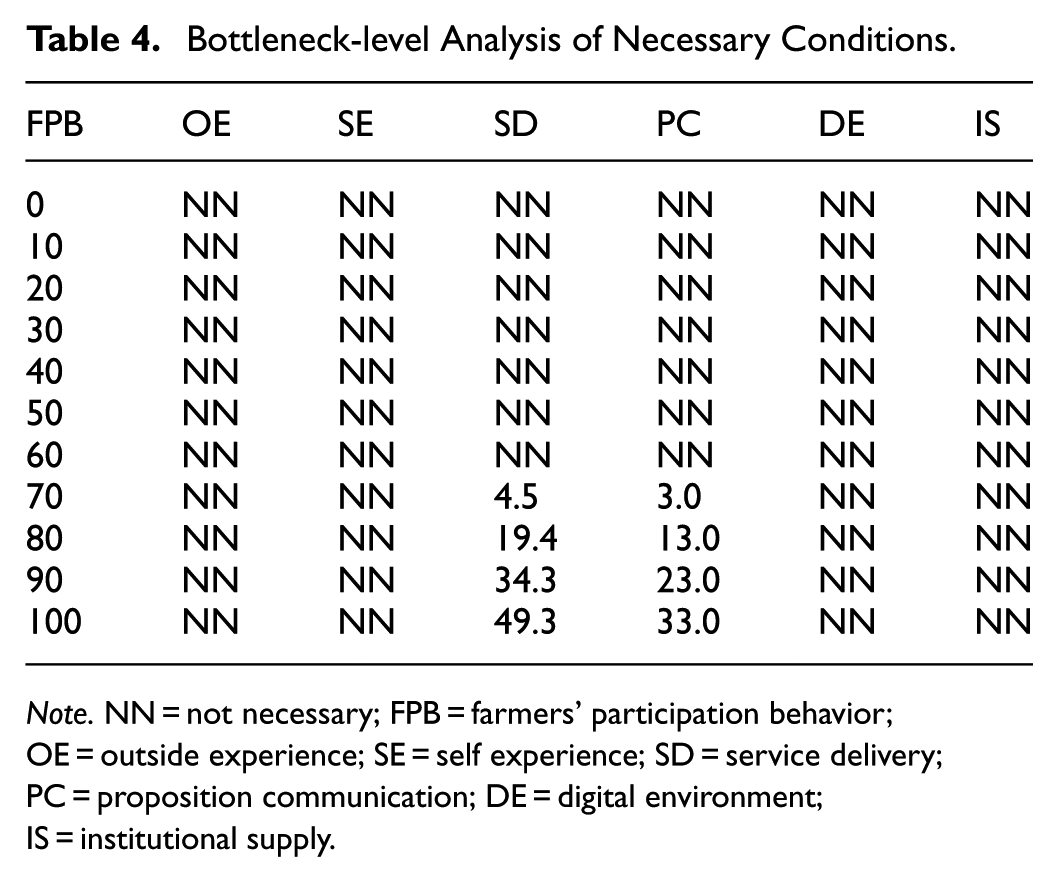
Note. NN = not necessary; FPB = farmers’ participation behavior; OE = outside experience; SE = self experience; SD = service delivery; PC = proposition communication; DE = digital environment; IS = institutional supply.
QCA in Relation to NCA Results
If the consistency of the condition in the QCA essential condition test is greater than 0.9, the condition is considered necessary (M. R. Schneider et al., 2010). Unlike the NCA method, QCA uses the diagonal of a scatterplot as a reference line. NCA uses the upper limit line that can be moved or rotated to analyze the outcome variable at different specified levels. Thus, the results of QCA essential condition analysis are a subset of NCA, and the results can be expected not to conflict (Thomann & Maggetti, 2020). Table 5 presents the QCA results in relation to the NCA results, which show that not all conditions were necessary to cause the farmers to participate, further confirming the NCA findings.
Analysis of Necessary Conditions.

Note. FPB = farmers’ participation behavior; OE = outside experience; SE = self experience; SD = service delivery; PC = proposition communication; DE = digital environment; IS = institutional supply.
Condition Configuration Analysis
Conditional configuration adequacy analysis is at the core of the QCA method and is an effective way to understand farmers’ participation in digital village construction. Through truth table construction, the case frequency threshold was set to 1, the original consistency threshold to 0.8, and the proportional reduction in inconsistency (PRI) consistency threshold to 0.7, yielding three solutions with different complexities: complex, parsimonious, and intermediate solutions. Since intermediate solutions incorporate meaningful “logical residual terms,” they usually outperform complex and parsimonious solutions (Pappas & Woodside, 2021). Therefore, this study used an intermediate solution to analyze the configuration of farmers’ subjective participation in digital village construction, and then used a simple solution to identify the core and edge conditions in the configuration. Some antecedent conditions appearing in both the parsimonious and intermediate solutions were core conditions that had a strong causal relationship with the results. However, the only condition that existed in the intermediate solution was the edge condition, which had a weak causal relationship with the results. From the conditional combination output results, the consistency of the solution was greater than 0.8 and the coverage of the solution was greater than 0.7, indicating that these configurations explained over 70% of the cases. The results of the configurational analyses are listed in Table 6.
Configurations for Farmers’ Participation Behavior in Digital Village Construction.

Note. OE = outside experience; SE = self experience; SD = service delivery; PC = proposition communication; DE = digital environment; IS = institutional supply.
● Denotes the existence of core conditions, • denotes the existence of edge conditions, ⨂ denotes the lack of core conditions, ⊗ denotes the lack of edge conditions, and the space denotes that the condition is dispensable.
Robustness Test
A robustness test was performed that involved: (1) improving the PRI consistency from 0.7 to 0.75 while keeping the original consistency unchanged; (2) improving the original consistency from 0.8 to 0.85 while keeping the PRI consistency unchanged (Greckhamer & Gur, 2021). Table 7 presents the results of the robustness test. The analysis results concerning (1) showed that the coverage of the solution decreased slightly, but that the core condition did not significantly change except S1b*; the results concerning (2) showed that the new configuration did not change significantly. Overall, the results demonstrated good robustness.
The Robustness Test.

Note. PRI = proportional reduction in inconsistency; FPB = farmers’ participation behavior; OE = outside experience; SE = self experience; SD = service delivery; PC = proposition communication; DE = digital environment; IS = institutional supply.
● Denotes the existence of core conditions, • denotes the existence of edge conditions, ⨂ denotes the lack of core conditions, ⊗ denotes the lack of edge conditions, and the space denotes that the condition is dispensable.
and ** indicate the two robustness test configuration results.
Discussion
According to the results in Table 6, there were five configurations that led farmers to participate effectively in the construction of the digital countryside, where S1a, S2a, S2a, and S2b had common core conditions that differed only in their edge conditions. Based on the common points and characteristics of the different configurations, this study integrated the five configurations into three modes to more clearly identify the factors involved that influenced farmers’ effective participation in the construction of the digital countryside (Fiss, 2011) (See Table 8).
Cases Conforming to the Causal Solutions and Modes of FPB.

Note: FPB = farmers’ participation behavior; OE = outside experience; SE = self experience; SD = service delivery; PC = proposition communication; DE = digital environment; IS = institutional supply.
M1 includes S1a and S1b. Both share two core conditions: strong outside experience and effective proposition communication. The minor difference is that S1a does not include the edge condition of service delivery. A key insight from this model is that a strong combination of outside experience and proposition communication can effectively promote farmers’ participation, even when institutional supply is relatively weak. In such cases, village grassroots organizations typically play a strong leadership role. They focus on building partnerships with enterprises and social organizations, and actively provide villagers with digital life and labor information. Through mobile phone applications, video tutorials, online platforms, and so on, these organizations can obtain the latest agricultural technology and market information at a low cost (Deichmann et al., 2016) and then understand and join in the construction of the digital countryside. For example, in the typical case #19 of this model, the village released village employment information through the “cloud horn” and actively trained professional farmers to sell agricultural products. In case #3, the village formed a high-quality skill training team that relied on local universities and built a rural youth maker center. At the same time, integrated management of information services should be carried out, and farmers’ right to know and speak in digital village construction should be improved through multi-subject cooperation.
M2 contains S2a and S2b. These two configurations are both built around two core conditions: service delivery and institutional supply. They differ mainly in the edge conditions, namely outside experience and digital environment. This pattern demonstrates that well-developed service delivery and institutional supply can stimulate farmer participation even when other conditions are less supportive. Compared with urban residents, farmers generally lack professional skills in data management and analysis (Forney & Epiney, 2022). Training in various digital skills can encourage farmers to participate more actively in digital village projects. The relationship between digital skills and engagement in digital activities is also positively mediated by factors such as political interest and attention to social issues, underscoring their role in encouraging greater digital participation (Y. Zhang et al., 2025). For example, in Case #7, the village used an intelligent platform to carry out various learning lectures for ordinary villagers to train them in e-commerce skills. In case #22, more attention was paid to the digital skills training of government officials to change the villagers’ cognition, behavior mode, and degree of participation in digital village construction.
S3 reflects M3, with the biggest difference between this model and the former two models being that farmers’ participation in the construction of the digital countryside can also be formed when the digital environment and institutional supply are both sufficient. Configuration S3 indicates that it is necessary to take the initiative to create an environment that includes digital infrastructure and system design related to digital village construction, change farmers’ perceptions of the external environment, enrich the policy design of digital village construction (P. Zhang et al., 2023), and create a positive environment for digital village construction. Therefore, it is necessary to maintain the construction of digital environment in rural areas. The improvement of citizen engagement has brought more attention to the problem of affordability, and quality/speed of connectivity in rural areas and remote communities (Rajabiun, 2020). For example, in case #2, the village established an intelligent platform to encourage information awareness involving interaction and communication with the villagers, and set up a digital “homesickness museum” to protect the traditional culture of the village. At the same time, higher-level government departments could issue relevant work plans to build future communities, and farmers could then actively participate in the construction of digital villages.
In addition, this study identified two configurations (NS1 and NS2). The results showed that, compared with the three models mentioned above, even if the SE of digital village construction in villages is better, it is difficult for farmers to participate effectively in village digital construction in relation to the other elements. In this mode, rural areas are often affected by administrative pressure and build relatively complete digital platforms; however, other supporting facilities do not correspond to the real needs of farmers. At the same time, this type of village has often lost a substantial number of young people, the activities of social organizations are limited, and there is a lack of targeted digital training. The digital divide in China in rural remains (D. Chen et al., 2010), and the loss of young adults, the lack of digital skills training, and the lack of funding prevent farmers from participating effectively.
Conclusions and Limitations
Conclusions
This study explored the mechanisms underlying farmers’ participation in digital village construction by examining 30 representative cases across China. Guided by co-production theory, we employed necessary condition analysis (NCA) and qualitative comparative analysis (QCA) to identify various configuration paths that enhance farmer involvement. Our analysis considered factors related to subjective experience, mobilization tools, and the action field. The findings indicate that no single factor alone is necessary for effective participation; instead, a combination of multiple elements is required. Among the antecedent conditions, outside experience merged as the most influential, followed by institutional supply, service delivery, proposition communication, digital environment, and self-experience. Furthermore, we identified five distinct configuration paths that can be categorized into three main models: producer-driven, service-driven, and environment-driven participation.
Building on these findings, this study contributes to theory by extending co-production theory into the specific context of digital village construction. It highlights the interactive roles of farmers, government, social organizations, and enterprises, underscoring the significance of co-production in advancing digital rural initiatives. The proposed three-dimensional framework, subjective experience, mobilization tools, and action field, offers a structured way to analyze farmers’ participation behavior and enhances both theoretical and practical understanding of how co-production can be operationalized. Citizen engagement is considered to be an important cornerstone for improving the quality of democracy. Digital media is a new form of socialized communication, forming the characteristics of self-generated in content, self-directed in emission, and self-selected in reception (Castells, 2007). The digital environment has significantly reduced the time and economic costs of civic engagement, and citizens can access political information sources through social media anytime and anywhere. Online media helps to foster political discussion and as a result influence civic participation (Gainous & Wagner, 2013). A principal component of the new media is the notion of political interactivity, or mediated real-time feedback between political actors and citizens (Hacker, 1996). Such reciprocal communication could facilitate communication characterized by greater transparency and public co-presence, networked collective action, dialogical debate and individual self-representation (Coleman & Blumler, 2009). In this process, farmers’ engagement through digital platforms exemplifies the core propositions of citizen participation theory: it lowers barriers to involvement, promotes inclusive and reciprocal interaction between citizens and governance mechanisms, and facilitates a more deliberative form of democracy anchored in everyday communicative practices. Thus, the active participation of farmers in digital village construction not only validates but also extends the citizen participation theory by demonstrating its applicability and adaptability in non-western and rural contexts.
From a practical perspective, the results suggest several implications. First, it is essential to strengthen collaboration among multiple stakeholders, including government, enterprises, and social organizations. The government should focus on meta-governance, while enterprises ought to channel technology and capital into rural areas. Social organizations can provide human resources and intellectual support, collectively enabling more effective farmer involvement. Second, system design should formally incorporate farmer participation as an evaluation criterion in digital village initiatives. Establishing clear, scientific, and standardized systems will help clarify the rights and responsibilities of farmers and ensure their voices are heard and respected. Third, enhancing farmers’ digital capabilities through diversified training programs is critical. These should cater to different needs, such as nurturing e-commerce skills among new professional farmers and providing basic IT guidance for those at risk of being left behind. Online and offline training systems should be established to facilitate farmers’ learning anytime and anywhere (Marshall et al., 2020). Fourth, improving the IT services platform is vital. Building an information service platform that integrates market information, technical consultations, online trading, and other functions would provide a one-stop service for farmers and address the information asymmetry problem (Pesci et al., 2023). Additionally, it is necessary to strengthen publicity concerning digital-related policies (McCampbell et al., 2023) and add experiential methods such as knowledge quizzes and game competitions to help farmers better understand the content of digital village construction and their significant position within such construction.
Research Limitations and Future Directions
There are some limitations to this study. First, there are few empirical studies on farmers’ participation in digital village construction, and no accepted theoretical model has been formulated. While there are considerable amounts of qualitative data, more quantitative data need to be gathered in future research. Second, the mixed-method approach involving NCA and QCA is still under development. In future research, a dynamic analysis of the issue of how to promote farmers’ subjective engagement in digital village construction could be conducted from the perspective of a time series. Third, because of the limited availability of data and the economic advantages available for digital village development in the eastern region of China, further balancing in terms of the selection of cases in different regions is needed, and more attention should be paid to digital construction cases in the central and western regions of China in future research.
Footnotes
Acknowledgements
The authors are grateful to editors and anonymous reviewers of this paper.

Ethical Considerations
There was no research ethics committee at the authors’ institution at the time of data collection. However, this study was conducted in accordance with the 1964 Helsinki declaration and its later amendments or comparable ethical standards.
Consent to Participate
Electronic informed consent was obtained from all participants in this study.
Author Contributions
Funding
The authors disclosed receipt of the following financial support for the research, authorship, and/or publication of this article: This study was supported by The National Social Science Fund of China (22AZZ008).
Declaration of Conflicting Interests
The authors declared no potential conflicts of interest with respect to the research, authorship, and/or publication of this article.
Data Availability Statement
Data will be made available on request.