




Abstract
This study highlights the role of a high-speed railway system in driving the tourism industry, as the tourism market prepares to achieve sustainable development after the COVID-19 pandemic. Considering the example of southwestern China, this study summarizes the configuration patterns of sustainable tourism development based on the fuzzy-set qualitative comparative analysis method, and subsequently uses the gravity model to express its core factor based on the ArcGIS platform. The study found that the tourism development pattern in this area was not homogenous, but rather a combination of six equivalent patterns (namely configured pattern). Tourism Economic Connection was the core variable to promote tourism development. Therefore, based on the configurational theory, each city should determine its own pattern and accordingly develop strengths as well as complement weaknesses. Furthermore, determined by the complexity theory, cities should capitalize on the strength of the high-speed railway system and learn from the accomplishments realized in other cities.
Keywords
Introduction
The southwest of China is a popular tourist destination because of its stunning scenery, rich history, and unique cultural practices. Limited accessibility, unequal distribution of tourist resources, and fragmented development plans across different towns are only a few of the obstacles to sustainable tourism growth in this region. The Chinese government has begun building a high-speed railway (HSR) system in southwestern China to overcome these obstacles and realize the region’s tourism potential. The HSR network is designed to facilitate better transit links, shorter travel times, and more regional cooperation. Many people are now curious about how the HSR system will affect the direction of sustainable tourist growth in the area.
The outbreak of COVID-19 at the end of 2019 negatively impacted the tourism and hospitality industries across the globe (Chang, 2020; Ivanov et al., 2020). The World Tourism Organization (2020) reported that the number of international tourists around the world declined by 60% to 80% in 2020, translating into a loss of USD910 billion to 1.2 trillion. Although the COVID-19 situation in China was by and large controlled in 2020, it triggered uncertainty in terms of tourism development. Therefore, Higgins-Desbioles (2020) initiated a challenge to the new mechanism, pattern, and system of sustainable tourism development. Z. Li et al. (2022) suggested that tourism stakeholders should be encouraged to adopt new ways to create new tourism growth patterns.
Transportation reform tends to have a profound impact on the development of regional tourism (Yamaka et al., 2021). As part of transportation reform, high-speed railway (HSR) systems play a distinct role in shortening the space-time distance between places and promoting economic, social, and cultural exchanges among regions. China’s HSR construction is conducive to making contributions to sustainable development (Zhou et al., 2023). Increasing accessibility to tourism destinations will undoubtedly help promote the mechanism of regional tourism development. It is necessary to emphasize that sustainable tourism development is closely-linked to paying attention to consumers because it can attract more consumers (Luekveerawattana, 2018), and an HSR system undoubtedly provides consumers with convenience when traveling. Therefore, it is imperative to highlight the role of the HSR system in promoting sustainable tourism after the pandemic has ended.
The cities in southwestern China included in the current study were located in adjacent provinces; they were relatively similar in terms of the construction progress of the HSR system, the richness of tourism resources, and the level of economic development. HSR construction in these areas progressed substantially from December 2013 to January 2019. Presently, nine HSR lines are in operation, accounting for 12.7% of China’s HSR system, while HSR tracks cover 3,643 km, accounting for 10.42% of the country’s HSR system. The data show an increase in the HSR construction in this region. In addition, the tourism development level of a region can be gauged by tourism income. The degree of growth rate is used to reveal the potential of tourism development, and the extent of growth value can illustrate the level of tourism development. The division of degree can be displayed on a map with cluster distribution. Therefore, based on the ArcGIS platform, Figure 1 demonstrates the operation of the HSR system and the cluster distribution of tourism development status.

Cluster distribution of tourism development status.
In Figure 1, the range of high growth rate is categorized according to the upper quartile of a sequence which consists of the average growth rate from 2015 to 2019 of each city, with the range of low growth rate divided according to the lower quartile. Simultaneously, the range of fast growth value is classified according to the upper quartile of a sequence which consists of the average growth value from 2015 to 2019 of each city, and the range of low growth value is segregated according to the lower quartile. The growth value and growth rate of tourism development in most cities are not positively correlated, indicating that the tourism development status is relatively complex. Specifically, cities with high growth values, such as Guiyang, Nanning, and Kunming, do not necessarily have high growth rates. These are the three provincial capitals and the hub of the HSR system. In contrast, cities with low growth value, such as Lincang, Pu’er, and Hechi that are not located along the HSR lines, do not necessarily have low growth rates. Furthermore, the overall level of tourism development in this study area is low, but the development potential is high. There are 26 cities with low growth values, accounting for 66.7%; however, there are 30 cities with medium and high growth rate, accounting for 76.9%.
The purpose of this study is to investigate the relationship between the HSR system and sustainable tourism development by identifying the patterns and key factors involved. Particularly, we aim to identify and analyze the patterns of sustainable tourism development in the study area by implementing the HSR system. Additionally, we aim to determine the key factors that contribute to the development of sustainable tourism within the context of the HSR system. The findings will be used to provide recommendations for policy and practice. With the COVID-19 pandemic coming to an end, it is urgent to explore ways to promote tourism development in the region by leveraging the HSR system. However, despite the rapid development of the HSR system in the study area, Figure 1 shows that it has not significantly supported tourism development. Therefore, it is necessary to establish a scientific pattern to promote sustainable tourism development in conjunction with the HSR system. Therefore, the research questions are summarized as follows:
RQ1: Does the HSR system contribute to sustainable tourism development in the study area, and what patterns can be observed?
RQ2: What are the core factors that influence the development of sustainable tourism in the context of the HSR system?
Literature Review
Sustainable Tourism and Its Patterns
Conceptually, sustainable tourism refers to all activities, management, and development of tourism that maintain the natural, economic, and social integrity. It aims to improve the welfare, economy, and public health of a community (Streimikiene et al., 2021). Thus, sustainable tourism development can be thought to possess three dimensions, namely environmental, economic, and social (Amerta et al., 2018). One of the principles of sustainable tourism development is to provide benefits to local communities and tourists (Amerta, 2017). More specifically, from the economic and socio-cultural points of view, tourism should be able to contribute to better living conditions for the residents as well as to the preservation of their cultural tourism (Amerta et al., 2018). Many scholars have studied sustainable tourism from different disciplines, such as geographic information systems and natural resource management in communities (Ramaano, 2022), water-centric themes (Moyle et al., 2022), and gender intersectionality (Chambers, 2022), and focusing on residents and industries (Weaver et al., 2022). In addition, the research on the pattern of sustainable tourism development has attracted scholars’ attention. They put forward a sustainable tourism pattern with ecological behavior of leisure tourists (Dvarskas, 2017), a sustainable tourism education pattern based on the empirical learning philosophy (Bowan & Dallam, 2020), a pattern of sustainable tourism development with the change theory (Olya, 2023), the sustainable development pattern of local tourism based on social exchange theory (Pramanik & Rahman, 2023), etc.
Sustainable Tourism Supported by HSR
An increasing number of studies have focused on the effect of the HSR system on tourism. They cover research scope, such as countries (T. Huang et al., 2019), provinces (He et al., 2021), and economic belts (Yang & Li, 2020), and focus on temporal and spatial evolution (Pagliara & Mauriello, 2019), the relationship (Jou & Chen, 2020), development efficiency (Zeng et al., 2021), the time-space compression effect (T. Li et al., 2022), influencing factors (Holešinská et al., 2022), and the ex-post effects (Albalate et al., 2022). With the development of HSR construction, some scholars have also conducted joint research on the HSR system and sustainable tourism, especially in the pattern. Sun and Lin (2018) proposed a tourist travel pattern with the HSR system that conforms to the concept of sustainable tourism consumption. Then Zhang and Jiang (2021) proposed a discrete choice pattern of urban destination preference with the HSR system.
Research Gap
This study first combines configuration theory, complexity theory, push-pull theory, fsQCA method, and gravity model to study the pattern and its core factor of sustainable tourism supported by the HSR system. This reflects a research gap, which is to study the pattern and its core factor of sustainable tourism affected by the HSR system from the perspective of equivalent configuration.
Theoretical Framework
A precondition of the complexity and configuration theories is that multiple combinations must each be equally effective (Woodside, 2014).
Configuration Theory
The configuration theory is based on the principle of causal asymmetry, which is used to illustrate that a condition (or a combination of conditions) explaining the presence of an outcome can be different from the conditions that lead to the absence a similar outcome (Fiss, 2011). Configurational theorizing moves the focus of researchers from the evaluation of the “net effects” of causal variables to a more contextual appreciation of the numerous ways in which causal conditions may interact to create a given outcome (Ragin, 2018). Configurational theory is based on three principles: (1) conjunctural causation: the effect of a single condition unfolds in conjunction with other conditions; (2) equifinality: multiple configurations (or combinations) of conditions may lead to the same outcome; and (3) causal asymmetry: the causes leading to the presence of an outcome of interest may be quite distinct from those leading to its absence.
Dess et al. (1993) state that “a configuration involves interactions between elements or objects representing multiple domains.” Consequently, configurational theorizing advances the theoretical discourse because it is not limited to the examination of net consequences (i.e., the more X, the more Y). For instance, “linear regression investigates the net effect of a variable on a result by holding other factors constant” (El Sawy et al., 2010). In contrast, configurational theory examines the global effect resulting from a configuration (or combination) of causal factors. QCA is likely one of the most formalized configurational comparative methods that relies on Boolean algebra as opposed to linear algebra, the logic of implication as opposed to covariation, and conjunctural causality as opposed to simple interaction effects (Thiem et al., 2016). Specific to this study, high image as a condition can lead to high intention in a destination for a tourist, while low image may not lead to low intention. This study applied the theory to depicting the pattern of sustainable tourism development from two opposite directions.
Complexity Theory
Complexity theory advocates that all complex systems have some characteristics in common (Hidalgo, 2021). These structures are the sum of many autonomous elements behaving as one. It is believed that the behavior of vast and complex systems cannot be explained by the laws of nature laid the groundwork for what would later become known as complexity theory (Haynes & Alemna, 2022). It seeks to learn how the various parts of a system influence one another and the system as a whole, as well as how these parts evolve over time. Complexity theorists, despite the remarkable similarities between their theories, argue that chaos cannot explain the consistency of self-organizing, complex systems (Haynes & Alemna, 2022).
The complexity theory pays more attention to the configurated pattern of independent variables, and explains the combination of multiple independent variables of dependent variables more profoundly (Olya & Mehran, 2017). Therefore, it can better explain the relationship between dependent and multiple independent variables, and can be used to develop a generalized pattern of complex results (Woodside et al., 2016). According to the complexity theory, relations among the condition variables are statistically nonlinear, so it is naturally complex. If a condition in the configuration changes suddenly, the original outcomes will change with it. This offers a step toward a simultaneous understanding of the patterns these conditions create. Therefore, this study takes the complexity theory as the theoretical support, and then proposes the complex causal structure of the pattern of sustainable tourism development supported by the HSR system, which is feasible (Woodside, 2014).
Method
Method Selection
This study applies the content analysis technique to publicly available data from government sources. We did not seek data from human subjects or participants so an exemption from an ethical review was granted. Specifically, we primarily relied on quantitative data with the aim to identifying the configuration pattern using the fuzzy-set Qualitative Comparative Analysis (fsQCA), a commonly used technique in tourism research (Valaei, 2019; G. Yu et al., 2022). The fsQCA method was used in combination with the gravity model in economics, the push-pull theory in demography, and the ArcGIS technology in geography, with a focus on sustainable tourism development in southwestern China with the advent of the HSR system.
Analytical Strategy
fsQCA is a method for comparing samples, and embodies the configuration and complexity theories (Pappas & Woodside, 2021). In the current study, data analysis was performed using the fsQCA (3.0) software. The analytical steps were variable selection, anchor point calibration, robustness test, and configuration induction. Qualitative comparative analysis (QCA) can effectively overcome the shortcomings of traditional qualitative and quantitative methods (Codurasa et al., 2016) by analyzing multiple conditional combinations of outcome variables (Judge et al., 2014). The different combinations of specific causal variables with synergistic nature describe specific outcomes. Fuzzy-set qualitative comparative analysis (fsQCA) is a variant of QCA, which can completely capture the complexity caused by the natural variance of dependent variables (Rihoux & Ragin, 2008). Specifically, fsQCA seeks to explore the possible conclusions and schemes to explain the same outcome (Pappas et al., 2016) through both the induction and deduction of theory building, elaboration, and testing (Park et al., 2020). This approach is taken to meet the current research objective of effectively exploring the configuration pattern of the entire region and not just a single pattern.
Variable Selection
Dann (1977) applied the push-pull theory to the field of tourism research for the first time. He believed that tourism is produced by the joint action of internal and external factors. The pull factor is caused by external elements and plays an important role in the choice of destination. Based on subsequent research, most scholars believe that push factors refer to the driving agents that encourage tourists to identify and meet their needs, such as relaxation, prestige, and knowledge (Mshai et al., 2022), and pull factors are destination attractiveness and destination-related motives held by tourists, such as inspiring destination and enjoyable activities (Prabawa & Pertiwi, 2020). Both push and pull factors are positive and encourage tourists to make travel choices (Arowosafe et al., 2022; Su et al., 2020).
We collected various data with respect to tourism such as total tourism income (TTI), economic development level (EDL), tourism resource endowment (TRE), high-speed railway accessibility (HRA), and tourism economic connection (TEC). Using the fsQCA method, the variables were categorized into outcome and condition variables. Given that sustainable tourism development should be measured based on economic data, the outcome variable is represented by TTI which embodies the development level of the city’s tourism industry and is expressed by the total annual tourism income. In view of the push-pull theory, condition variables were divided into push (internal) and pull (external) factors. According to the basic internal conditions of tourism development in a region, the push factor selects EDL and TRE. EDL reflects the local economic situation and is expressed by the total annual GDP. TRE represents the actual situation of tourism resources in each city and is calculated based on the rating of tourism resources. Considering that the HSR system is the key external condition affecting tourism development, the pull factors select HRA and TEC. HRA can reflect the accessibility (expressed by commute time) of tourists to other cities using the HSR system and is calculated by a fixed formula (Kapatsila et al., 2023). TEC indicates the proximity of tourism economic connection between cities under HSR operation and is calculated by a professional formula (Tarik & Umit, 2018).
Data Source and Processing
TTI and EDL data were collected from the Statistical Bulletin of National Economic and Social Development (per city), TRE data were derived from the Department of Culture and Tourism (per province), HRA data were retrieved from the State Railway Administration of China; and lastly, TEC data were obtained from the Bureau of Statistics (per province). To eliminate the problem of inconsistent units of variables and increase comparability among different cities, we normalized those raw data with results as shown in Table 1.
Normalized Data.
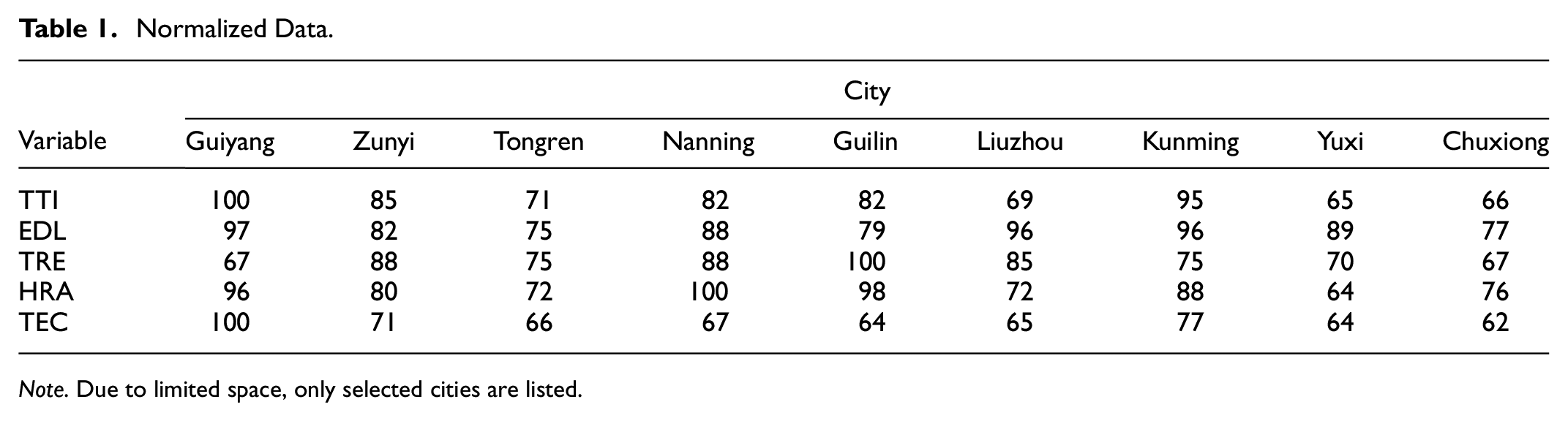
Note. Due to limited space, only selected cities are listed.
Anchor Point Calibration
According to the principle of anchor point setting (Judge et al., 2014) and the research requirements of the current study, three anchor points were set. The first was 0.05, indicating non-membership, with the corresponding value being the lower quartile of a sequence. The second was 0.5, which denotes the intersection point with the corresponding value being the average value of a sequence. The third anchor point was 0.95, indicating full membership, with the corresponding value being the upper quartile of a sequence. The target set had two situations: factual and counterfactual. The factual set represents the positive aspect of each variable, while the counterfactual set represents the negative. For example, the first number in Table 2 is 64.00, which is interpreted as follows: In the factual set, all data for the TTI variable are sorted. The point in the lower quartile of TTI sequence is 64.00, so this point is deemed not to belong to the range of high TTI and is recorded as non-membership. The anchor points with calibration are shown in Table 2.
Anchor Points of Variables.

Results
Robustness Test
Considering the number of cases and the requirements of the consistency threshold provided by Tarik and Umit (2018), eight combinations were found, the number of acceptable cases was set to 1 and 2, and the consistency thresholds were .75, .8, .85, and .9, respectively. The fsQCA software was used to test the robustness of different combinations of the consistency threshold and acceptable number of cases. It was found that they were not robust, so all combinations were used for conditional classification to eliminate instability.
Configuration Induction
Configuration induction has two directions: factual and counterfactual analyses. Combined with the context of this study, factual analysis was applied to induce the configuration of promoting sustainable tourism development, and counterfactual analysis was used to generate the configuration of restricting sustainable tourism development. Configuration induction adopts the principle of condition classification by Fiss (2011). The core condition refers to all conditions appearing in the parsimonious solution, and the supplementary conditions concern those that appear in the intermediate solution but were excluded by the parsimonious solution. If the consistency index of each configuration exceeds the theoretical value of 0.8, it shows that all cities in each configuration meet the consistency conditions, that is, the four condition variables proposed in this study can be used as sufficient conditions for the outcome variable. If the consistency index of the overall scheme is greater than the theoretical value of 0.8, it further shows that all the conditional variables selected in this study were appropriate.
According to the use of symbols in the logical scheme table proposed by Ragin (2018), the factual set data were input into the fsQCA (3.0) software and six configurations were obtained without repetition. The promotive configuration (PC) which aimed to promote sustainable tourism development revealed six different types, as demonstrated in Table 3.
Configuration Induction for Promoting Sustainable Tourism Development.

Note.  = a certain condition appears;
  = a certain condition does not appear. Large, filled circles indicate core conditions; small, filled circles indicate supplementary conditions; an absence of a circle indicates a condition that has no influence.
According to the use of symbols in the logical scheme table proposed by Ragin (2018), the data of the counterfactual set were entered into the fsQCA (3.0) software and eight configurations were obtained without repetition. The restrictive configuration (RC) which aimed to restrict sustainable tourism development revealed eight types, as shown in Table 4.
Configuration Induction for Restricting Sustainable Tourism Development.
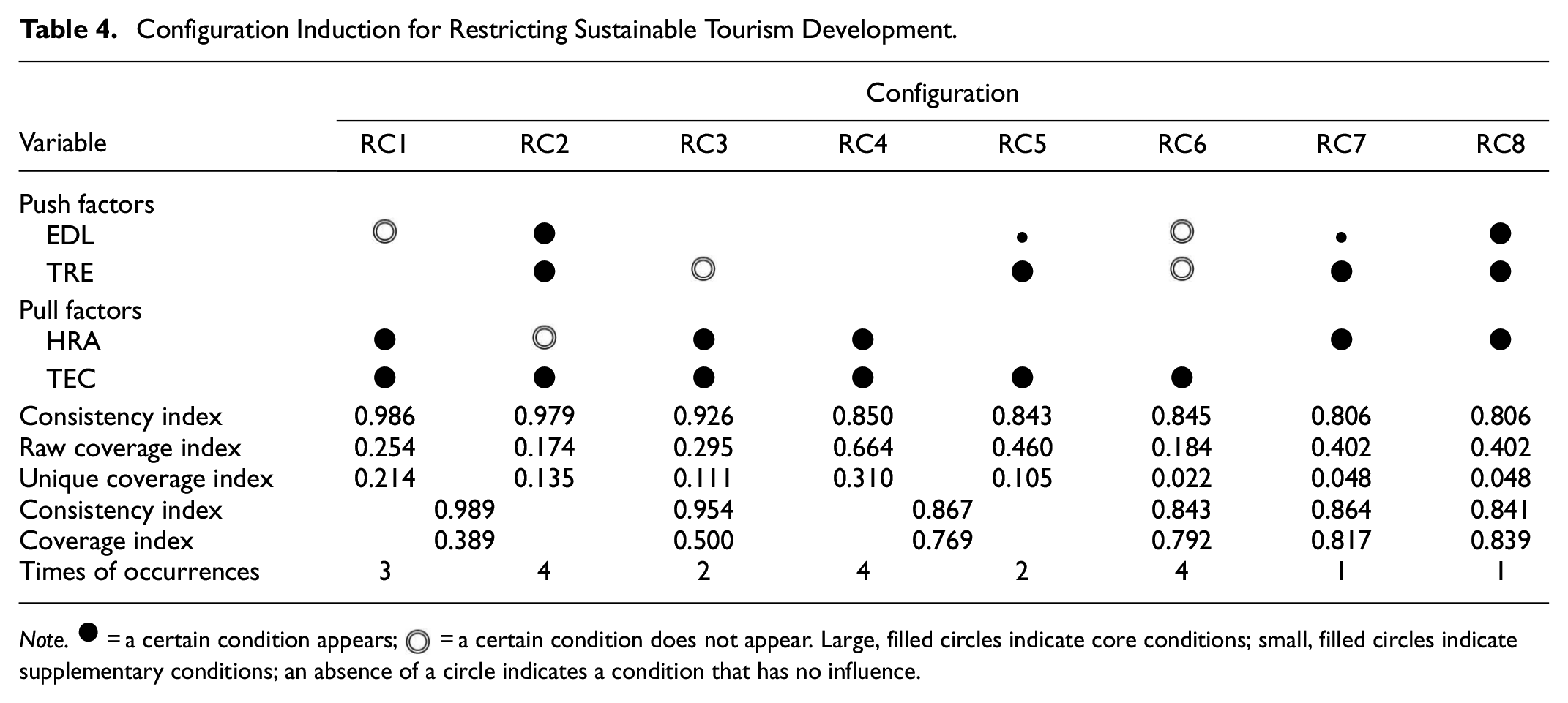
Note. = a certain condition appears; = a certain condition does not appear. Large, filled circles indicate core conditions; small, filled circles indicate supplementary conditions; an absence of a circle indicates a condition that has no influence.
Configured Pattern
The domination of push-pull factors can be categorized into Comprehensive, Push-dominated, Pull-dominated, and Push-pull hybrid types. Comprehensive indicates that the core conditions were composed of four push-pull factors. Push-dominated implied that the core condition was a combination of two push factors, or alternatively a combination of two push factors and one pull factor. In the Pull-dominated type, the core condition was composed of two pull factors or two pull factors and one push factor, while the Push-pull hybrid suggested that the core condition involved certain push and pull factors. According to the direction of the outcome variable, it can be divided into Promotive and Restrictive types. Based on whether there were representative cities in the calculation result from the fsQCA software, six patterns were finally obtained, namely Comprehensive promotive, Comprehensive restrictive, Push-dominated restrictive, Pull-dominated promotive, Pull-dominated restrictive, and Push-pull hybrid promotive patterns, as demonstrated in Table 5.
Configured Pattern With Its Representative Cities.

Note. P1 to P6, respectively, represents Pattern 1 to 6.
Core Factor
In addition to the configurations PC3, RC7, and RC8, TEC was a common factor in other configurations, demonstrating that a strong tourism economic connection can increase tourism income, so it was also used as a core variable of a sustainable tourism development pattern. Some studies have recommended combining fsQCA with other data analysis techniques if possible (Schneider & Wagemann, 2010) because a core variable can reflect a strong causal relationship with the outcome (Fiss, 2011). Therefore, the current study used the gravity model as an auxiliary tool to fsQCA to provide opportunities for deeper and richer insights into the core variable. The gravity model (Tarik & Umit, 2018) is presented in equation (1):

In equation (1),
In order to vividly illustrate the TEC variable, the current study used the gravity model to describe the spatial characteristics from TEC’s strength and scope based on the ArcGIS platform. It can be seen directly from Figure 2 that the strength and scope of the tourism economic connection of cities in the HSR system were better than those without HSR connection, as shown in Figure 2.
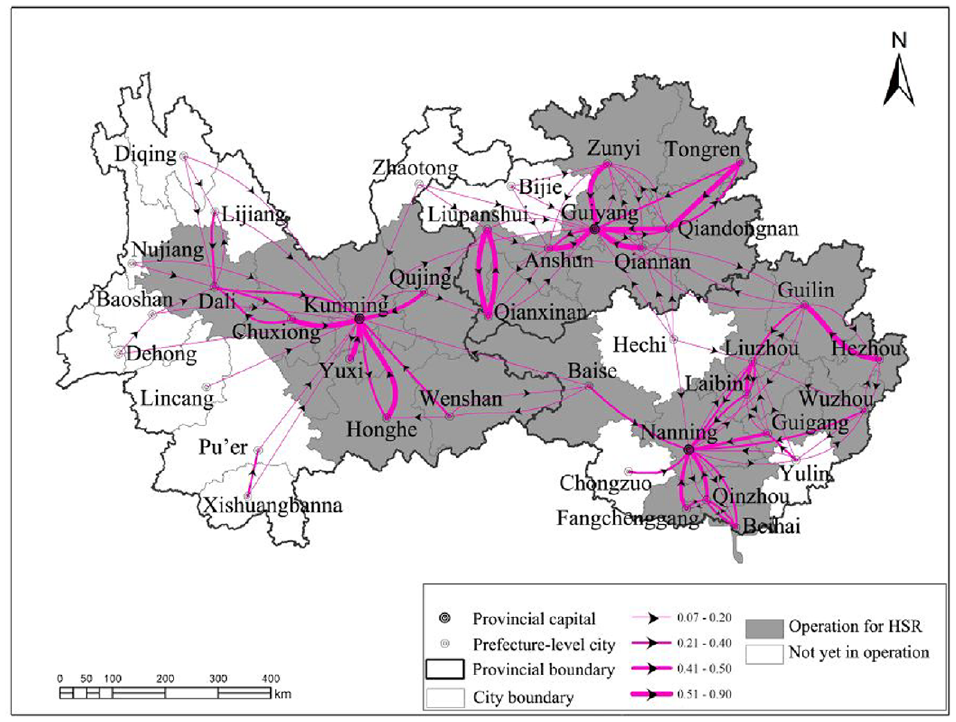
Spatial relationship of TEC variable.
Conclusion and Findings
Conclusion
Based on the configuration analysis in Tables 3 and 4, and whether there were representative cities in the calculation result from the fsQCA software, the configured pattern was finally obtained, namely Comprehensive promotive, Comprehensive restrictive, Push-dominated restrictive, Pull-dominated promotive, Pull-dominated restrictive, and Push-pull hybrid promotive patterns, as demonstrated in Table 5.
By observing Tables 3 and 4, this study found a common factor TEC that is the core factor of the pattern of sustainable tourism development in southwestern China. Then, the gravity model is used to research this core factor for deeper and richer, and the results are shown in Figure 2.
Findings and Its Application
Sustainable tourism development in the study area under the influence of the HSR system has two distinct implications.
On one hand, the sustainable tourism development pattern presents the configuration form, and one configuration is equivalent to another, meaning any configuration should receive the same attention. Since each configuration has corresponding cities, these cities form a complete area. The HSR system is not confined to a city, but belongs to an entire area.
Based on the configurational theory, individual cities should determine their own development model. For example, for the pull-dominated promotive pattern, tourism development of representative cities, such as Qiandongnan, Tongren, and Anshun, is affected by two pull factors. Therefore, these cities should vigorously develop the pull advantage in tourism projects. For the push-dominated restrictive pattern, the tourism development level of representative cities, such as Zhaotong, Pu’er, and Bijie, is relatively backward, driven by the insufficient development of their internal factors. Accordingly, cities belonging to this model should complement their own weaknesses, such as developing characteristic and innovative tourism products to attract tourists. For the comprehensive restrictive pattern, representative cities, such as Qujing, Wenshan, Guigang, and Chuxiong, should not only improve the overall economic level, but also strengthen the construction of tourism service facilities and the overall tourism environment, in order to accommodate the tourism service overflow of core cities and traffic point cities, and finally stimulate local tourism development.
On the other hand, the conditions for sustainable tourism development were complex. There is only one outcome, that is, sustainable tourism development, while the conditions for achieving the outcome are different. For example, tourism development in the cities of Zhaotong and Yulin has been restricted, but the constraints were driven by different conditions. The former can be attributed to the lack of tourism resources and the latter to poor accessibility. Based on the above analysis, the following suggestions can be made.
Based on the complexity theory, each city should make use of the strength of the HSR system and learn from the accomplishments realized in other cities. Since the conditions leading to the outcome were complex and changeable, the operation of the HSR system has brought new opportunities to all cities. The closer a city is to the HSR system, the easier it is to determine the associated advantages of tourism development. Considering that tourism is a comprehensive industry with high relevance and a strong driving force, it has strong vitality in economic and social development. This study identified TEC as the core variable to promote sustainable tourism development, and the construction of the HSR system has strengthened connections in the tourism economy. Although this study area has rich and diverse tourism resources, their distribution is not uniform, which can easily lead to differentiation in the levels of tourism development. For example, Guiyang and Bijie are geographically adjacent. The former belongs to cities with high tourism development, while the latter pertains to cities with low tourism development. Due to the development of the HSR system, these two types of cities have similar status in time and distance, blurring regional differences. Therefore, the advantages of adjacent cities can be shared, which will promote the sustainable development of tourism in the entire area.
Discussion
Within the context of the HSR system, this study investigates the core factors that exert influence on the development of sustainable tourism. By integrating multiple theoretical frameworks such as the push-pull theory, the gravity model, and the ArcGIS technology, the research explores the complex interrelationships between several factors. The study examines various aspects, including economic factors, social factors, environmental considerations, and infrastructure development.
Innovations
Most scholars apply the fsQCA method independently to the subject (Ageeva et al., 2018; Beynon et al., 2020), and only a few have combined it with other methods (Amara et al., 2020; Santos & Gonçalves, 2019). Notably, the current study draws lessons from the practice of certain scholars and takes the gravity model as the auxiliary method to extend and analyze the results obtained using the fsQCA method, which is the first innovation of this study. Simultaneously, in addition to the two theories contained in the fsQCA method, scholars also combine other theories, such as institutional theory, resilience theory, the critical theory of risk society, or actor-network theories (Capurro, 2020; Y. Huang & Bu, 2023; Moser et al., 2021; Salem et al., 2023; X. Yu et al., 2023). In a departure from these other research results, the current study combined the fsQCA method, its own two theories, and the push-pull theory, which is the second innovation. Overall, this study has made new progress in the application of the fsQCA method and has shone new light on thinking regarding sustainable tourism development.
Limitations and Future Research
Nevertheless, the current study has one limitation that can be attributed to using the fsQCA method. No method or theory can perfectly solve a complex social problem in a given area, though the fsQCA method is recognized as surpassing other qualitative and quantitative assessment techniques. In the process of applying this method, despite objective data and software for quantitative analysis, individual subjective judgment is also required. The qualitative analysis provides scholars with an opportunity to express their views, but also introduces a most controversial point regarding the selection of conditional variables. The current study selected conditional variables based on the push-pull theory, but other theories can also be used, providing appropriate explanations are provided according to the research background. Notably, the configuration obtained will inevitably be different owing to different condition variables. At present, since there are no unified indexes to measure sustainable tourism development, it is difficult for scholars to resolve problems accurately and scientifically in specific areas.
Although the expansion of the tourism industry in a region may bring short-term economic benefits (Streimikiene et al., 2021), it is essential to take into account the sector’s effect on a specific site across the business’s whole life cycle (Hidalgo, 2021). Those who are considering diverse options for development like the HSR system in this study have a responsibility to take into account the long-term effects that increased tourist numbers will have on various ecological condition indicators. This is especially important in situations where the tourism industry is dependent on a particular ecological state.
Therefore, future research directions should focus on enhancing the scientific development and applicability of measurement indexes for sustainable tourism development, in conjunction with the implementation of the fsQCA method. This would contribute to a more comprehensive and robust understanding of the complex relationship between the HSR system and sustainable tourism.
Implications for Policy
The findings of this study have important implications for policy development in the context of sustainable tourism. By recognizing the interdependency of cities and configurations in the study area, policymakers should adopt a comprehensive and interconnected approach to sustainable tourism development. Instead of focusing solely on individual cities, policy efforts should encompass the entire region, considering the influence of the HSR system that spans across multiple cities.
Based on the identified patterns of sustainable tourism development, policymakers can tailor their strategies to the specific characteristics of representative cities. For instance, cities experiencing a pull-dominated promotive pattern, such as Qiandongnan, Tongren, and Anshun, should concentrate on developing their pull advantages in tourism projects. On the other hand, cities following a push-dominated restrictive pattern, like Zhaotong, Pu’er, and Bijie, need to address internal weaknesses by developing unique and innovative tourism products to attract visitors. Representative cities falling under the comprehensive restrictive pattern, such as Qujing, Wenshan, Guigang, and Chuxiong, should focus on improving their overall economic level, enhancing tourism service facilities, and creating a favorable tourism environment to accommodate the overflow of tourists from core cities and traffic point cities.
Furthermore, policymakers should leverage the strength of the HSR system and foster knowledge exchange among cities. Given the complexity and variability of the conditions for achieving sustainable tourism development, the HSR system presents new opportunities for all cities. Cities in closer proximity to the HSR system have a better chance of capitalizing on the associated advantages for tourism development. Therefore, promoting collaboration and sharing best practices among cities can enhance their collective capacity to achieve sustainable tourism growth.
In terms of regional disparities, policymakers should aim to mitigate the differentiation in tourism development levels caused by uneven distribution of tourism resources. The implementation of the HSR system has the potential to blur regional differences, particularly between geographically adjacent cities. By leveraging the advantages of adjacent cities and fostering shared benefits, policymakers can facilitate more balanced and inclusive tourism development throughout the entire study area.
The policy implications derived from this study highlight the importance of a holistic and integrated approach to sustainable tourism development. Policymakers should consider the specific characteristics and needs of each city, while also acknowledging the interconnectedness of the entire region. Collaboration, knowledge sharing, and targeted strategies can help maximize the potential of the HSR system and drive sustainable tourism growth in a way that benefits both individual cities and the overall study area.
Conclusion
In conclusion, this study examined sustainable tourism development in a specific study area under the influence of the HSR system. The findings have important implications for policy and offer valuable insights into the factors and dynamics shaping sustainable tourism in this context.
The study revealed two significant implications of sustainable tourism development in the study area. Firstly, the pattern of sustainable tourism development takes on a configuration form, highlighting the interconnectedness of cities and the need to consider the entire area as a cohesive unit. The HSR system spans across the region, emphasizing the importance of viewing sustainable tourism development from a holistic perspective rather than focusing solely on individual cities. This recognition of interdependencies provides a basis for a comprehensive and effective approach to sustainable tourism development.
Secondly, the study identified complex conditions influencing sustainable tourism development. Different cities faced distinct constraints and opportunities, such as variations in tourism resources and accessibility. Understanding these conditions is crucial for formulating targeted policies and strategies to overcome constraints and leverage opportunities. The HSR system presents new opportunities for all cities, and closer proximity to the system enhances the advantages for tourism development. Sharing the advantages of adjacent cities can promote sustainable tourism development throughout the entire area.
The study employed the fsQCA method and combined it with the gravity model, representing an innovative approach to analyzing the data. By integrating these methods and theories, the study contributes to the advancement of the application of the fsQCA method and sheds new light on sustainable tourism development. However, the generalizability of the findings should be approached with caution. The target population, sampling validity, contextual factors, measurement methods, and temporal aspects all influence the external validity and ecological validity of the findings.
Overall, this study provides valuable insights into sustainable tourism development in a specific study area influenced by the HSR system. The implications for policy highlight the need for a comprehensive and interconnected approach to sustainable tourism development. Policymakers can draw upon the findings to design strategies tailored to the unique conditions of the study area. While the generalizability of the findings may be limited to the specific context, they serve as a foundation for future research and contribute to the broader understanding of sustainable tourism development.
Supplemental Material
sj-xls-1-sgo-10.1177_21582440231181368 – Supplemental material for Configuring the Pattern of Sustainable Tourism Development as Affected by the Construction of a High-Speed Railway System
Supplemental material, sj-xls-1-sgo-10.1177_21582440231181368 for Configuring the Pattern of Sustainable Tourism Development as Affected by the Construction of a High-Speed Railway System by Yanan Li and Sid Terason in SAGE Open
Footnotes
Declaration of Conflicting Interests
The author(s) declared no potential conflicts of interest with respect to the research, authorship, and/or publication of this article.
Funding
The author(s) received no financial support for the research, authorship, and/or publication of this article.
Ethical Approval
This paper primarily focuses on the analysis of secondary data. All the data used in this study were sourced exclusively from the official website of the government.

References
Supplementary Material
Please find the following supplemental material available below.
For Open Access articles published under a Creative Commons License, all supplemental material carries the same license as the article it is associated with.
For non-Open Access articles published, all supplemental material carries a non-exclusive license, and permission requests for re-use of supplemental material or any part of supplemental material shall be sent directly to the copyright owner as specified in the copyright notice associated with the article.
