




Abstract
In the context of China’s rural revitalization strategy, the significance of county economic development cannot be overstated. Aligning county economic development with the deeper implications of this strategy is a pressing concern for governments at every level. This study, drawing from the Technology-Organization-Environment (TOE) framework, employs the fs-QCA method to elucidate the causal mechanisms underpinning high-quality county-level economic development. Utilizing data from 57 counties in an agricultural province in China, this research investigates the interplay between antecedent conditions and county economic development, delineating distinct developmental pathways that yield optimal outcomes. The findings reveal that, (1) no singular condition suffices to attain superior county economic development; rather, it emerges from the confluence of multiple factors. (2) Four distinct pathways, technology-led industry-pull, technology-driven government-supported, all-factor linkage, and technology-organized balanced, are instrumental in achieving high-level county economic development. (3) Substitutional relationships exist among the antecedent conditions. These insights deepen our comprehension of the multifaceted determinants influencing county economic growth. By highlighting the interdependencies among these conditions, this research offers valuable perspectives that can guide the formulation of pragmatic, synergistic policies, paving the way for efficient county economic developmental trajectories.
Plain Language Summary
Purpose: The study aimed to comprehend the intricacies of county-level economic development in China, particularly in light of China’s emphasis on rural rejuvenation. Methods: The research utilized an analytical approach known as the fs-QCA to discern how various elements, including technological advancements and organizational structures, influence county economic trajectories. For this examination, data from 57 counties in an agrarian province of China were scrutinized. Conclusions: Several notable conclusions were drawn. Firstly, there isn’t a singular determinant that exclusively boosts county economic development. Instead, prosperity appears to arise from a harmonious interplay of multiple determinants. Four specific combinations or “pathways” of these determinants leading to economic success were identified. Implications: The findings of this research offer profound insights for policymakers and stakeholders. It emphasizes the importance of recognizing and leveraging the interdependence of multiple factors when devising strategies for economic enhancement at the county level. Limitations: The data encompasses only 57 counties from a specific province, and observations are derived from a single year. Consequently, these results might not be universally applicable, nor do they capture the dynamic evolution of economies over time. It is advisable for future research endeavors to encompass a broader geographical scope and extended time frames to furnish a more holistic understanding.
Introduction
The 20th National Congress of the Communist Party of China’s report accentuated the importance of rural revitalization, emphasizing the unparalleled challenges within rural realms. With statements asserting that the most profound challenges in establishing a modern socialist nation lie predominantly in the countryside, it brings to the fore the essential role of county-level economic development in this landscape. Indeed, the nuanced interplay between urban and rural sectors, and the need for robust agricultural and rural advancements, is evident (Albouy & Kim, 2022). The evolution and expansion of county economies, particularly in regions like Anhui Province with its consistent socio-economic growth, are instrumental in the larger narrative of China’s economic metamorphosis (Barbero et al., 2018).
Despite the crucial role of county economies, their development journey is fraught with challenges, such as antiquated developmental paradigms, dwindling competitiveness, industrial imbalances, and limited liberalization. To navigate these complexities, we need not only resource alignment across technological, organizational, and environmental facets but a deeper exploration of the structural intricacies of rural economies. While a substantial body of academic research has delved into county-level economic development, most adhere to a tripartite schema: analyzing the current state, delineating issues, and proposing remedies (Wang et al., 2021). More often than not, these investigations approach the challenges from a single dimension, often sidelining the interconnected influences or the comprehensive frameworks wherein these economies operate (Dul et al., 2020). This lacuna in the extant literature highlights the need for an integrative and holistic examination.
This study adopts the “Technology–Organization–Environment (TOE)” framework, and combines it with the fuzzy set qualitative comparative analysis (fs-QCA), to comprehensively explore county economic development, taking data from 57 counties in Anhui Province. By merging the three dimensions of technology, organization, and environment, this research aims to offer a multi-faceted understanding, pinpointing five core conditions that significantly influence county economic development (Barzin et al., 2018; Gao & Wu, 2017). The empirical findings show that, firstly, no single condition can independently lead to high-quality county economic development; rather, it is the synergy of multiple factors. Secondly, there exist four distinct developmental pathways - technology-led industry-pull, technology-driven government-supported, all-factor linkage, and technology-organized balanced - instrumental in catalyzing high-caliber county economic development. Thirdly, there are potential substitutional relationships among the antecedent conditions. The findings will not only deepen academic and practical understanding of the multitudinous factors influencing county economic development but also can provide actionable insights to inform and guide efficient strategies for rural economic construction.
Structured over five chapters, this paper commences with this introduction, delves into the intricacies of the TOE framework in Chapter 2, elucidates the research design in Chapter 3, and presents an empirical analysis of the data in Chapter 4. Chapter 5 encapsulates the conclusions drawn, discussing the broader implications of the research and its potential limitations.
TOE Framework and County Economic Growth
TOE Framework
The Technology-Organization-Environment (TOE) framework, conceptualized by Tornatzky et al. (1990), delineates three crucial contextual domains pivotal in shaping economic outcomes within an entity. Firstly, technological conditions emphasize the inherent characteristics of a technology, including aspects such as its regional scientific and technological innovation capacity (Asante Boakye et al., 2024). Secondly, organizational conditions hone in on the innate organizational attributes synergistic with the technology, encompassing systems, mechanisms, and financial investment dynamics (Hossain et al., 2021). Lastly, environmental conditions encapsulate external and macro-environmental factors, accentuating the nuances of market and institutional environment development, particularly resources, demand, and infrastructure (Zhong & Moon, 2023). The expansive application of the TOE framework in contemporary research underscores its relevance, especially in decoding the nuances of economic development across diverse sectors and regions (Ganguly, 2024).
In the realm of county economic development, it’s pivotal to recognize that this evolution is not propelled by isolated variables but by an intricate interplay of multifaceted factors. Central to this development is scientific and technological (S&T) innovation, buttressed further by government support, industrial advancement, and the robustness of regional infrastructure and public services (Ferreira et al., 2020). The TOE framework emerges as a quintessential analytical model, segmenting the influencing factors into technology, organization, and environment.
Elaborating, the technological conditions segment notably includes innovation capacity. Within the TOE spectrum, technological innovation’s impact on county economic progression stands out. It’s not just a catalyst for regional economic growth but the very nucleus of it, furnishing both resource assurance and intellectual prowess for superior economic evolution (Hu et al., 2011; Malik et al., 2021). Moreover, the region’s economic prosperity is intrinsically linked with how efficiently its scientific and technological feats are translated into actionable applications. Consequently, S&T innovation capacity presents a compelling proxy for technological conditions within the TOE architecture.
Organizational conditions, on the other hand, can be bifurcated into Government Support and Industry Development Degree. Here, the government emerges as an indispensable orchestrator of economic growth, with its budgetary dispositions offering a transparent window into its commitment to socio-economic upliftment (Chen et al., 2019). Concurrently, the industry development degree, as detailed by Li et al. (2017), signifies the pivotal role of governmental bodies in championing and architecting county economic progress.
Diving into environmental conditions, these primarily revolve around Fundamental Public Service and the overarching financial milieu. As Li et al. (2017) posited, the fundamental public service offers a gage to the infrastructure maturity of a region, inevitably influencing its economic trajectory. An optimized financial ecosystem, as highlighted by Liu (2011), not only facilitates capital consolidation and judicious resource allocation but also spurs scientific and technological breakthroughs, further amplifying regional economic ascension.
In essence, the TOE framework’s three-dimensional approach—technological, organizational, and environmental—merges to spotlight five precursors impacting county economic development as shown in Figure 1. While these dimensions individually wield significant influence, their collective impact operates synergistically, forging a network of interconnected influences. This study embarks on a meticulous exploration of these conditions and their interrelationships, employing a qualitative comparative analysis of fuzzy sets to distil the intricate dynamics steering county economic development.

Configurational framework.
The Relationship Between Each Dimension and County Economic Growth
Research Design
Research Method
The qualitative comparative analysis (QCA) of fuzzy sets is utilized. It was developed by Ragin, which is based on the research that considers the set theory and generalized Boolean algebra theory, and the probabilistic statistical method considers small and medium-sized samples. First, the QCA method, which can comprehensively and effectively reveal developmental patterns, partially solves the problem pertaining to the traditional statistical analysis method. The QCA method overcomes the defects that characterize the linear relationship between the single variable and outcome variable. This method applies to only large historical samples; furthermore, it not only analyzes medium and small samples (sample size; 10–60), but also combines qualitative case orientation and quantitative variable orientation, and it explores the antecedent configurational paths that are created by the dependent variables and the logic of the generated outcome variables (Dul et al., 2020). Second, the QCA method does not require homogeneity or the special treatment of variables at different levels; therefore, with respect to the histological analysis pertaining to the multiple categories of variables, it is highly suitable.
To obtain systematic, causal, and effective conclusions and recommendations, researchers combine the TOE framework with the fs-QCA method (Fiss, 2011). This combination distinguishes the current study from other studies that consider county economic impact factors.
Sample Selection
To explore the path pertaining to county economic development, this study considers 57 counties that are located in Anhui Province, and it offers general economic development proposals that can be applied in other regions. The following observations support the rationale of the research methodology: First of all, Anhui Province, as the pioneer of rural reform and opening-up, has already achieved remarkable results in the process of reform and opening-up for more than 40 years (Chan, 2012; Veeck & Shui, 2011). Second, the labor force population is the engine of economic development (Fortunato et al., 2017). In 2020, 51.63% of the country’s population will be in counties (Li et al., 2017). In this study, Anhui Province as the object of study is also useful for the development of county economy in other regions. In the process of data collection, which was considerably limited, Yingshang County and Zongyang County were excluded. The sample covers 57 county-level administrative units; thus, it attains the data analysis requirements pertaining to the medium sample that characterizes the QCA method.
Measurement and Calibration of Variables
Outcome Variable
The GDP index provides a clear indication of the development realities and future development potential of interregional economies and serves as a basis for Governments to formulate and change policies. Herein, the GDP index of 57 counties (including county-level cities) are selected as the outcome variable.
Antecedent Variables
Herein, we combine the three dimensions that characterize the TOE framework, namely technical dimension, organizational dimension and environmental dimension, and we separately establish five antecedent variables that can affect the level of county economic development (Table 1).
Variable Measurements and Descriptions.

Government support: Government support means that government which crucially supports organizational growth guides the economic development process (J.Zhang & Yan, 2022). County governments need to formulate appropriate policies to create a favorable environment for county economic development (Simms et al., 2014). The leading role of local governments depends to a large extent on the effective functioning of the fiscal system, and thus fiscal expenditure is an institutional factor that may affect the economic development of the county. Revenue from the general public budget is an important indicator of a region’s wealth and economic strength and is the basis of the government’s budgetary system (Slaper et al., 2011). Therefore, fiscal expenditure is an institutional factor that can affect county economic development, because it measures the government’s contribution toward county economic development.
Industrial development degree: Industrial development degree entails the contribution of governmental organizations toward county economy development. Government organizations can promote the development of industrial enterprises by implementing policy support (Treyz, 2023). Therefore, under the organizational dimension, governmental support and the degree of industrial development are classified as secondary variables. In regard to governmental organization, county economic development entails the process through which the government establishes a robust development environment (Drucker et al., 2020). The government should comprehensively consider the external economic conditions and internal approval rules for regulating the development of industrial enterprises, thus promoting the development of local industrial enterprises above the effective scale (Castillo et al., 2017). In regard to enterprise development, the development of above-scale enterprises can promote rural economic development. County economy development should be promoted by above-scale industrial enterprises (Zhou, 2015). Therefore, the industrial development status of a certain county can be measured by the number of above-scale industrial enterprises. In order to enhance the accuracy and credibility of the measurement, this paper uses the ratio of the number of above-scale enterprises to the resident population as a proxy variable for the degree of industrial development.
Fundamental public services: The level of regional economic development is influenced by the regional basic environment. High-level public services immensely promote county economic growth. Several scholars have studied that the low level of rural economic development can be attributed to the insufficient supply of basic public services. Therefore, the government should strengthen the construction of basic public services ( X.Zhang et al., 2017). The level of electricity consumption can promote the development of local industrialization and urbanization, thus providing a positive role for the development of fundamental public services. In addition, the state of regional road construction will also affect the fundamental public services. The development of public services also depends on education expenditure. The increase of education expenditure can promote the employment rate and economic development. Consequently, to measure the level of the fundamental public services, this study selects industrial electricity consumption, road density, and education expenditure as proxy variables, and the three factors exhibit the following weights, respectively: 0.22, 0.26, and 0.52. Furthermore, the weights are obtained by dimensionless processing and entropy weighting.
Financial environment: A rational and robust financial environment can promote capital accumulation and the growth of investment and savings, which provides sufficient financial support for county economic development (Hsu & Ma, 2021). In addition, the financial environment of a region can influence its economic development. Some scholars indicate that the county economy has become a crucial factor that affects the rural revitalization strategy; however, problems such as out-dated infrastructure, business environment, and financial services negatively affect county economic development (Hibbard & Lurie, 2023). Herein, the deposit balance–loan balance value is utilized as a proxy variable that reflects the financial environment, and this value is based on the existing literature that considers the measurement of regional financial service capacity (Johansen & Arano, 2016).
Variables Calibration
To increase the accuracy and speed of the fs-QCA software, the initial data should be dimensionless. In regard to QCA, calibration entails the conversion of the absolute values pertaining to the conditional and explanatory variables into the corresponding fuzzy set affiliations, which is one of the differences between the QCA method and traditional statistical regression analysis methods (Ghio et al., 2015). The calibrated set affiliation is set at 0 to 1, and the anchor point indicates the transformation of the original data into fully affiliated, midpoint, and fully unaffiliated data. This study was based on preceding economic studies and on the corresponding position of the statistical values pertaining to each indicator data that constitutes the total sample and the actual scenario of the sample cases, and the conditional variables that exceeded the 5%, 50%, and 95% values were selected as calibration parameters; thus, subjective assumptions were negated (Szerb et al., 2020), and the specific descriptive statistics and calibration anchor points are depicted in Table 2.
The Calibration Anchor Points and Descriptive Statistics.

Source. Anhui Provincial Statistical Yearbook 2021; 2021 Statistical Yearbook of prefectural cities and government bulletins that consider county-level units; official website of Anhui Intellectual Property Business Development Centre.
Empirical Analysis
Necessary Conditions Analysis
Before conducting conditional configurational analysis, a necessary condition analysis should be performed. Usually, when utilizing QCA operations, univariate necessity analysis, which considers consistency indicators, is performed. Herein, the consistency threshold is set to 0.65, and the necessity analysis of the county’s economic development potential is performed using fs-QCA The results indicate that the consistency of all five conditional variables is <0.9, which indicates that the high-quality country economic development is not occasioned by a single antecedent condition, but by the concurrent causality of multiple interdependent conditional variables. Therefore, an empirical analysis that considers the combinations among the antecedent variables is an imperative (see Table 3).
Necessity Analysis of Single Condition.
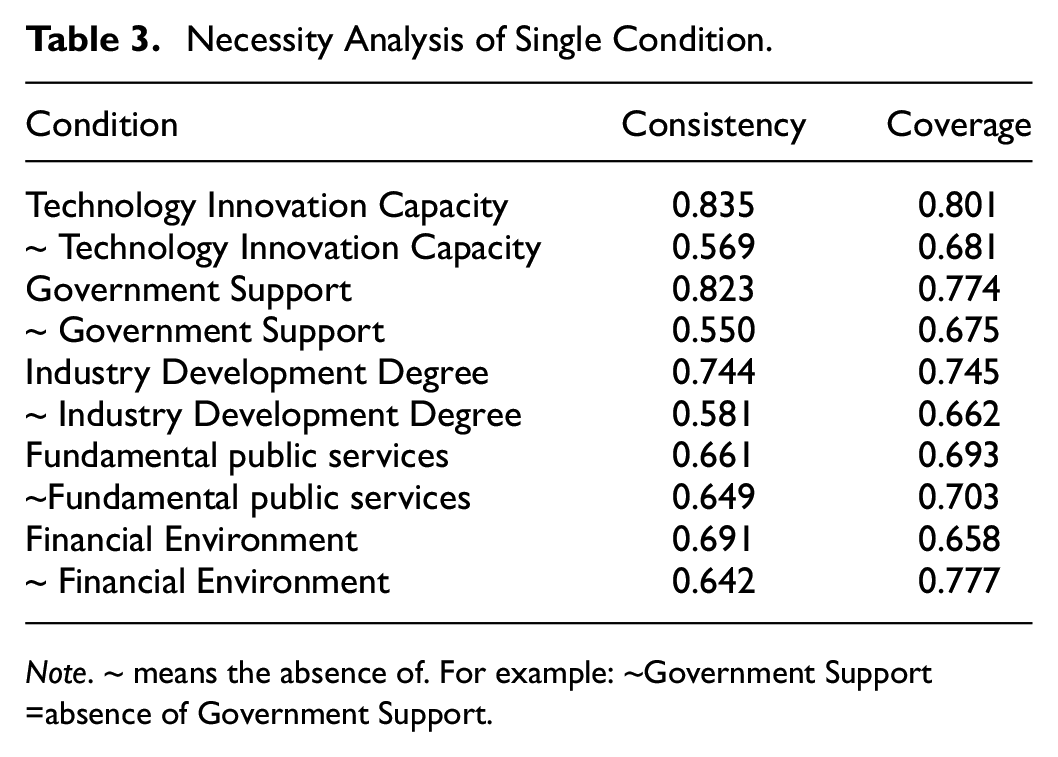
Note. ~ means the absence of. For example: ~Government Support =absence of Government Support.
Sufficient Solutions
This session explores whether the outcome always occurs when the conditional grouping occurs, and it answers the following question: When the five variables are introduced, can we obtain high-quality county economic development? After retaining the minimum case frequency, consistency threshold, and PRI (Proportional Reduction in Inconsistency), which is a method of satisfying the criteria analysis, the consistency threshold is set to 0.8, the PRI threshold is set to 0.7, and the frequency is set to 1. The software outputs three types of solutions: complex, parsimonious, and intermediate. Interpretation of the results of the analysis generally uses intermediate and parsimonious solutions, and the conditions that appear in the parsimonious solutions are referred to as the core conditions for a given grouping. The core condition indicates a robust causal relationship with the outcome of interest; by contrast, the remaining conditions, which appear in the intermediate solution, but not in the parsimonious one are referred to as marginal conditions, and they exhibit a weaker causal relationship with the outcome. With regard to the five conditional variables, the results of the group state analysis are depicted in Table 4; the results indicate the existence of four paths that facilitate high-level economic development.
Configurations Sufficient for High-Level Country Economic Development.
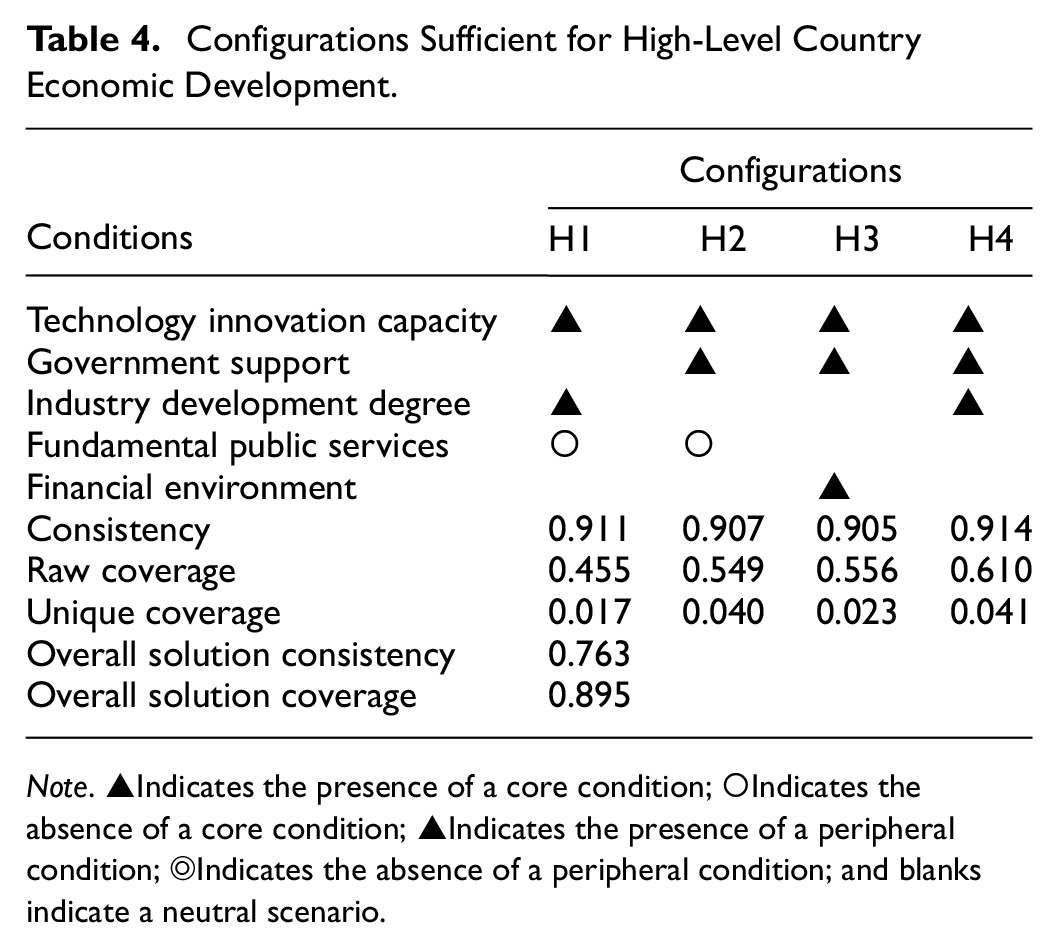
Note. ▲Indicates the presence of a core condition; ○Indicates the absence of a core condition; ▲Indicates the presence of a peripheral condition; ◎Indicates the absence of a peripheral condition; and blanks indicate a neutral scenario.
Based on the configurational results, which were combined with the derived logic that regulates high-quality county economic development, the study established four driving paths that can promote county economic development:
Technology-Led Industry-Pull Type
H1 refers to high technology innovation capacity, high industry development degree, and non-high fundamental public services as the core conditions, the combination of which can produce a high-level county economic development model. Path H1, in which two core conditions (i.e., fundamental public services) are missing, indicates the considerable effect that fundamental public services exert on county economic development; however, because the effect of this condition is eliminated by the complementary impact that is exerted by other conditions, county economic development exhibits robustness even in the scenario in which the level of fundamental public services is low (Canzian et al., 2019). Under this path, scientific and technological innovation ability and industrial development degree are interrelated and contribute to county economic construction together. Therefore, this path is named technology-led industry-pull type. The county economy has made great progress, and under the influence of regional technical support, innovation is the fundamental way out for a local area to develop its economy by virtue of its own resource endowment, break down development barriers and deal with root contradictions (Byrd & Matthewman, 2014). In addition, the development of county economy is affected by the scale of regional enterprises. How to promote the development of scale enterprises and improve the quality and efficiency of industrial development are the key points that need to be considered in the development of county economy (Liu, 2011).
Technology-Driven Government-Supported Type
H2 indicates that the technology innovation capacity, government support, and the lack of a fundamental public services are the core conditions that generate high-level county economic development (Kolko, 2012). Configurations H2 illustrates that the lack of regional infrastructure and public services can be compensated by strong technical support and complete government funding. In this path, technology innovation capacity and government support play a central role, so this driving path is named technology-driven government-supported type. The government’s investment in science and technology can promote industrial upgrading, and industrial upgrading will also empower the government’s investment in science and technology, thus forming a virtuous cycle of economic development (Deskins et al., 2010). In the process of county economic development, it is necessary to adhere to the innovation as the first power, and actively cultivate new development momentum ( F. S.Hung & Lee, 2010). At the same time, the reform of the governmental system should be accelerated and the transformation of governmental functions should be promoted, so as to provide an important institutional guarantee and a strong driving force for the rapid development of the county economy (Fullerton et al., 2013; Garcia-López et al., 2015).
All-Factor Linkage Type
H3 indicates that the technology innovation capacity, government support, and financial environment are the core conditions that can facilitate high-level county economic development. Under this path, technology, organization, and environment dimensions all have conditions to play a central role, so we name this driving path as all-factor linkage type. With respect to this path, technological, organizational, and environmental dimensions jointly modify the level of county economic development, which indicates that scientific and technological innovation immensely influences county economic development (Fatehin & Sjoquist, 2021). Besides, the government sets national development policies and targets, and it enhances its level of financial expenditure and capital investment; thus, it facilitates county economic development. In addition, a robust regional financial development environment also facilitates the growth of the local economy.
Technology-Organization Balance Type
H4 refers to the core conditions pertaining to high technological innovation capacity, high government support, and high industry development degree, and this configurational path can facilitate high-quality county economic development. In regard to H4, both the technological innovation capacity that constitutes the technological condition and the two conditions that constitute the organizational condition, namely government support and industry development degree, considerably influence county economic development; thus, the technological and organizational condition jointly exert a considerable synergistic effect on county economic development.
In summary, multiple conditions and antecedents need to work together in the process of county-level economic development, and a few or a single variable can’t play a role in county economic development, indicating the complexity of realizing a high level of county economic development.
Contrasting Analysis
Potential Substitution Relationship
A contrasting analysis of the four group states reveals that there are potential substitution relationships among technological conditions, organizational conditions, and environmental conditions. First, there is a substitution relationship between condition groups 1 and 2. When the technological innovation capacity is strong, the government support and industry development degree, under the organizational latitude, can substitute each other (Figure 2); thus, high-quality county development can be promoted. Second, the comparison of condition groups 3 and 4 indicates that the industrial development degree (i.e., organizational condition) and financial environment (i.e., environmental condition) can be substituted when the technological innovation capacity is strong, and that the regional government provides sufficient financial support for economic development (Figure 3).

Substitution relationship under the same dimension (organization).

Substitution relationship in different dimensions (organization and environment).
Cross-sectional Analysis
A cross-sectional analysis of the antecedent variables indicates that Technology innovation capacity exists only in high-level county economic development outcomes, whereas non-high-level county economic development outcomes lack Technology innovation capacity, which indicates that Technology innovation capacity can significantly influence county economic development. Technology innovation capacity is highly correlated with high levels of county economic development. However, county economies are capable of producing high quality development outcomes – regardless of the presence or absence of industrial development degree or financial environment; therefore, to produce high-level county economic development outcomes, industrial development degree or financial environment should be effectively combined with other conditions.
Robustness Checks
To enhance the credibility and scientific validity of the study, the fs-QCA analysis results should be subjected to a robustness test. By increasing the PRI consistency to 0.7, this study tests the robustness of the antecedent conditions pertaining to high-level county economic development. The results of the analysis are similar to the results that are depicted Table 4, which indicates that the results of the fs-QCA analysis are robust.
Conclusions and Limitations
Conclusions
This study utilizes relevant data from 57 counties in Anhui Province to construct a TOE general analytical framework for county economic development, and the main conclusions are as follows.
First, technological innovation capacity, government support, industrial development degree, fundamental public services, and financial environment cannot individually constitute the conditions that are necessary for high-quality county economic development. Thus, because single antecedent factor is weakly explanatory for high-quality county economic development, it can be inferred that the combination of antecedent factors facilitates high-level county economic development.
Second, the histological analysis reveals four paths that yield high-level county economic development, namely technology-led industry-pulled, technology-led government-supported, total factor-driven, and technology-organized balanced.
Third, Scientific and technological innovation capacity and government support play a more important role in the process of county economic development, so promote scientific and technological innovation, give full play to the functions of the government, help to promote the high-quality development of the county economy.
Fourth, there is a potential substitution relationship between antecedent conditions. A combination of different antecedent conditions and linkages can achieve a high level of economic development in the county.
Research Implications
First, this paper adopts the TOE framework to analyze the antecedent conditions affecting county economic development, which is conducive to deepening the understanding of the influencing factors of county economic development from a holistic perspective.
Second, the analytical method of fs-QCA is used to explore the driving mechanisms that promote the high-quality development of county economies. It helps to analyze the complex mechanisms behind county economic development from a group perspective.
Third, this study provides insights into high-quality county economic development. Long-term county economic development is jointly influenced by several factors, and for the government to achieve the efficient utilization of the relevant resources that promote county economic development, they should screen out the peculiar conditions that are suitable for different regions in a localized and highly targeted manner.
Fourth, the synergy that affects the technology, organization, and environment indicates the complex mechanism that influences high-quality county economic development. Different counties should focus on the synergy between different conditions, and they should consider their peculiar economic development and formulate realistic policies; thus, they can create an efficient path for county economic development.
Limitations
First, in regard to data collection, only 57 counties which are located in Anhui Province, were collected as samples. To enhance the credibility and the overall robustness of the analysis, the number of samples can be increased. Second, with respect to data analysis, only 1 year was selected; furthermore, only static data, which exhibits a certain lag and cannot be analyzed for dynamic time-series changes, were obtained. To enable researchers to conduct an in-depth analysis of the mechanisms that facilitate county economic development, future research can include cross-year scenarios, and to build a scientifically effective index system and an evaluation system, they can design a practical implementation plan; thus, the objectivity and accuracy of the assessment results can be enhanced.
Footnotes
Declaration of Conflicting Interests
The author(s) declared no potential conflicts of interest with respect to the research, authorship, and/or publication of this article.
Funding
The author(s) disclosed receipt of the following financial support for the research, authorship, and/or publication of this article: This work was supported by the Anhui Provincial Department of Education Natural Science Fund Outstanding Youth Project (Grant No. 2023AH030013), the Youth Project of Anhui Provincial Philosophy and Social Science Planning Fund (No. AHSKQ2022D054), and the Anhui University of Finance and Economics Postgraduate Student Fund Innovation Program (ACYC2023001).

Data Availability Statement
Data sharing not applicable to this article as no datasets were generated or analyzed during the current study.