




Abstract
The use of Internet tools virtually increases the work connectivity behavior after-hours (WCBA), is becoming increasingly common. Previous studies have found that WCBA has a double-edged sword effect on turnover intention (TI), but the configuration effect had been ignored. To investigate the configuration effect of WCBA, internal factors (i.e., psychological capital and mindfulness), and external factors (i.e., family-to-work conflict and social support), on TI. A total of 305 participants have been collected using convenience sampling. A questionnaire that covers six personal and contextual scales of the WCBA, psychological capital (PsyCap), mindfulness, family-to-work conflict (FWC), social support (SS), and TI, was used to gather data. Adhering to configurational theory, the study was conducted using fuzzy-set qualitative comparative analysis (fsQCA). it was revealed that seven antecedent configurations could achieve high TI, among them, WCBA existed in S4 and S6 but was absent in S5 and S7. Moreover, WCBA can exist and be absent in S1-S3 simultaneously; and for the 13 configurations that achieve low level of TI, WCBA can exist or not. Therefore, although the achievement of low level of TI is to some extent influenced by WCBA, it relies more on the influence of other factors (i.e., PsyCap, mindfulness, ∼ FWC, and SS). The study proves that WCBA has a double-edged effect on TI. The absence of FWC and existence of SS, PsyCap, and mindfulness are critical variables to buffer the loss of psychological resources caused by WCBA and recover psychological resources in time. These results may be helpful to recognize the negative effect of WCBA existence, accompanied with the absence of mindfulness on TI; also, the absence of SS was as crucial as the existence of FWC in the process of achieving high level of TI.
Plain Language Summary
This study investigates the double-edged sword effect of WCBA on TI from a configuration perspective. A questionnaire survey was conducted on 324 enterprise employees, and the results showed that: (a) Seven configurations achieve high level of TI. When WCBA exists, for the internal factor, compared with PsyCap, the absence of mindfulness was a more critical factor leading to TI; for the external factor, the absence of SS was as crucial as the existence of FWC in the process of achieving high level of TI. (b) 13 configurations achieve low level of TI, which can be divided into seven categories based on the existence of core conditions. When WCBA exists, as long as FWC does not exist or PsyCap or SS exists, low level of TI can be achieved. (c) The absence of mindfulness is the critical cause of high level of TI, but the existence of mindfulness is not the critical cause of low level of TI. The existence of PsyCap is a critical factor in achieving low level of TI, but the absence of PsyCap is not the critical factor leading to high level of TI.
Keywords
Introduction
With the development and application of communication technology and mobile internet, it has become a norm for employees to use communication devices for work during non working hours (i.e., work connectivity behavior after-hours, WCBA). Turnover intention (TI) is a desire and tendency for employees to end and leave their current job and look for new employment opportunities (March & Simon, 1958). Currently, numerous studies on WCBA suggested that WCBA leaded to higher TI by depleting employees’ psychological resources, suppressing psychological disengagement, increasing work-to-family conflict (Zhou et al., 2020), and triggering emotional exhaustion (Muhamad Nasharudin et al., 2020).
However, the impact of WCBA on TI may not always be negative. Some studies have also found that WCBA enhances employees’ work flexibility and autonomy (Yang et al., 2022), enabling them to more effectively utilize their time and resources, promoting the achievement of work goals and improving efficiency (Cheng et al., 2022), improving their job performance and satisfaction, and thereby leading to a decrease in TI (Diaz et al., 2012).
Therefore, there are inconsistent results regarding the impact of WCBA on TI. This study suggests that the relationship between WCBA and TI is influenced by other factors, and the interdependence between WCBA and other factors has led to inconsistent results in previous studies (Diaz et al., 2012; Muhamad Nasharudin et al., 2020; Zhou et al., 2020).
Many factors affects this impact path. According to the conservation of resources theory (Hobfoll et al., 2018), WCBA consumes employees’ psychological resources by inhibiting psychological detachment and triggering work-to-family conflict, which leads to higher TI. Family-to-work conflict (FWC) emphasizes the interference of behavior and time pressure brought by family to work-related responsibilities (Boyar et al., 2005). In this process, FWC can also accelerate the loss of psychological resources. Psychological capital (PsyCap) is a positive psychological state, including confidence, optimism, resiliency, and hope (Luthans et al., 2005). Social support (SS) is one of the individual’s social capital, includes visible and practical support as well as emotional support (Bjørlykhaug et al., 2021). If individuals have a high level of PsyCap and SS, they can effectively resist the loss of psychological resources. Mindfulness is a purposeful way to focus on the present without judgment (Kabat-Zinn, 2009). If individuals have a high level of mindfulness, they can effectively reduce the loss of psychological resources and restore psychological resources. Therefore, the impact path of WCBA on TI is also affected by FWC, PsyCap, SS, and mindfulness. According to the conservation of resources theory’s resource caravans and resource caravan passageways principles, the resources owned by individuals do not exist independently, but are interconnected and influenced like convoys traveling together on the road (Hobfoll et al., 2018). How do WCBA, internal factors (i.e., PsyCap and mindfulness), and external factors (i.e., FWC and SS) affect TI in an interdependent relationship? According to configuration theory, when various psychological resources are interdependent and mutually influencing, the independent variables will affect TI in configuration (Rihoux & Ragin, 2008). Meanwhile, independent variables may achieve high TI in some combinations and low TI in other configurations, reflecting the causal complexity between variables (Rihoux & Ragin, 2008). So whether this interdependence is manifested in configuration and causal complexity?
Previous studies have used regressive analysis and structural equation model to examine the impact of WCBA on TI (Diaz et al., 2012; Muhamad Nasharudin et al., 2020; Zhou et al., 2020). But they all examined the marginal “net effect” of independent variables on dependent variables, which cannot explain the complex causality such as the interdependence of independent variables (Rihoux & Ragin, 2008). Therefore, to clarify the inconsistent results between WCBA and TI, this study adopts the fuzzy-set qualitative comparative analysis (fsQCA), regards the research object as the configuration of different combinations of conditional variables, and investigates the configuration effect and causal complexity of WCBA, PsyCap, mindfulness, FWC, and SS on TI.
Theoretical Background
Work Connectivity Behavior After-Hours and Turnover Intention
TI is a desire and tendency for employees to end and leave their current job and look for new employment opportunities (March & Simon, 1958). TI is often caused by emotional exhaustion because of the loss of psychological resources (Lee & Cho, 2021).
WCBA mainly refers to employees using mobile wireless communication equipment to handle work or communicate work-related affairs with colleagues during non-working hours (such as before and after work, weekends, and holidays) (Richardson & Benbunan-Fich, 2011; Sinha & Laghate, 2021). However, the impact of WCBA on TI is currently controversial.
WCBA can increase TI. The commonly used Internet tools, such as mobile phones, chat software (e.g., Facebook and WeChat), and tablets/computers, blur the boundary between work and non-work, virtually decreasing psychological detachment (Davis, 2016). Individuals with low psychological disengagement cannot be better separated from work to life, which increases work-to-family conflict (Zhou et al., 2020), exhaustion (Muhamad Nasharudin et al., 2020), and even TI (Rahim & Cosby, 2016). That is, WCBA affects TI through the mediating effect of psychological detachment and work-to-family conflict (Davis, 2016; Sonnentag, 2012).
WCBA can reduce TI. WCBA can enhance employees’ work flexibility and autonomy, enabling them to more effectively utilize their time and resources (Cheng et al., 2022), promoting the achievement of work goals and improving efficiency (Yang et al., 2022), improving their job performance and satisfaction, and thereby leading to a decrease in TI (Diaz et al., 2012). Moreover, the use of communication tools by employees during non working hours can promote individual work-family enrichment, enhance job satisfaction, and ultimately reduce TI (Derks et al., 2016).
Psychological Capital and Turnover Intention
PsyCap is a positive psychological state, including confidence, optimism, resiliency, and hope (Luthans et al., 2005). According to the conservation of resources theory, PsyCap can effectively buffer the loss of psychological resources caused by external work requirements (Hobfoll et al., 2018). The psychological quality of individuals with high PsyCap is more positive, such as being more optimistic, tenacious, and conducive to coping with the emotional exhaustion caused by WCBA (Luthans et al., 2005). Moreover, from the perspective of pressure relief, employees with a high level of PsyCap have a more positive psychological state, a less sensitive perception of stressors, a more vital ability to relieve pressure, and are less likely to have recovery needs (Riolli et al., 2012). Thus, when WCBA occurs, PsyCap can reduce individual emotional exhaustion, prevent internal resources depletion, and reduce TI (Hobfoll et al., 2018).
Mindfulness and Turnover Intention
Mindfulness is a purposeful way to focus on the present without judgment (Kabat-Zinn, 2009). Studies have shown that mindfulness can ease the symptoms of depression (Doherty et al., 2015) and mental illness (Shonin et al., 2014). At the same time, mindfulness is in positive mental health. Studies have shown that mindfulness can improve individual well-being and productivity (Kersemaekers et al., 2018).
Mindfulness can control employees’ attention to the current work task, making employees clearly understand the present work objectives (Kabat-Zinn, 2009). Thus, the employee cannot be affected by the negative stimulation of high demand and pressure and can timely adjust their perception of positive events and information related to work tasks (Kersemaekers et al., 2018). Thus, according to the conservation of resources theory, mindfulness can buffer the loss of psychological resources caused by WCBA, and restore psychological resources in time (Hobfoll et al., 2018), which can improve work investment and well-being (Kersemaekers et al., 2018), and reduce emotional exhaustion and TI (Lee et al., 2021).
Family-to-Work Conflict and Turnover Intention
Work-family conflict includes work-to-family conflict and FWC. FWC, as an external factor, can consume psychological resources (Wang et al., 2021). FWC emphasizes the interference of behavior and time pressure brought by family to work-related responsibilities, and work-to-family conflict is the opposite (Boyar et al., 2005). Because both are related to role, time, strain, and behavior conflict (Sharafi, 2012), FWC is always accompanied by work-to-family conflict. So, like work-to-family conflict, which WCBA causes, FWC can always produce TI through the loss of psychological resources (Sharafi, 2012). Previous studies focused more on the mediating role of work-to-family conflict in WCBA and psychological resource but ignored the critical role of FWC in resource loss and recovery (Dong et al., 2022).
The negative effect of FWC on TI is often aimed at married employees. Nevertheless, for unmarried or divorced employees, FWC may not occur and will not be used as an external factor to consume psychological resources, which will not affect TI.
Social Support and Turnover Intention
For unmarried or divorced employees, FWC from their spouses is small or even nearly non-existent. Therefore, SS is a vital force to help individuals cushion the loss of psychological resources caused by WCBA. SS includes visible and practical support (e.g., direct material assistance and social networks) as well as emotional support (e.g., the experience of being understood and respected and its satisfaction) (Bjørlykhaug et al., 2021). SS is one of the individual’s social capital and one of the sources of personal psychological resources (Koutsogeorgou et al., 2020). When COVID-19 occurs, objective SS (e.g., an online psychological crisis intervention hotline) will help reduce the occurrence of psychological crises. Previous studies have shown that SS can effectively buffer the negative effect of WCBA on job satisfaction, and then SS can effectively reduce employees’ TI (Bajaba et al., 2022). Thus, SS can mitigate the loss of employees’ psychological resources, improve individual subjective well-being, and reduce TI.
Configuration Effect of Antecedent Conditions on Turnover Intention
Configuration theory takes a holistic perspective on social phenomena (Rihoux & Ragin, 2008). Configuration theory emphasizes that antecedent conditions often rely on and interact with each other, forming multiple concurrent causes and equivalent paths that lead to the results (Rihoux & Ragin, 2008). Configuration theory also emphasizes that the existence and absence of outcome variables have different causes (i.e., different combinations of antecedent conditions) (Rihoux & Ragin, 2008). It reflects the causal asymmetry between variables (Rihoux & Ragin, 2008). Therefore, the impact of WCBA on TI also depends on other factors.
There are inconsistent results regarding the impact of WCBA on TI. Some studies have found that WCBA reduces TI (Derks et al., 2016; Diaz et al., 2012), while others have found that WCBA increases TI (Davis, 2016; Muhamad Nasharudin et al., 2020; Rahim & Cosby, 2016; Sonnentag, 2012; Zhou et al., 2020). WCBA has a double-edged sword against TI. This inconsistent result suggests that the relationship between WCBA and TI may depend on other variables. Previous studies have used regression or structural equation modeling methods to investigate the marginal net effect and symmetry relationship between variables, but ignored the interdependence and asymmetric relation.
According to the conservation of resources theory (Hobfoll et al., 2018), PsyCap, mindfulness, FWC, and SS can reduce emotional exhaustion and TI by reducing the loss of psychological resources caused by WCBA and restoring psychological resources in time. Thus, PsyCap, mindfulness, FWC, and SS play a moderating role between WCBA and TI. According to the conservation of resources theory’s resource caravans and resource caravan passageways principles, the resources owned by individuals do not exist independently, but are interconnected and influenced like convoys traveling together on the road (Hobfoll et al., 2018). Therefor, WCBA, internal factors, and external factors are interdependent and work together in the process of resource loss and acquisition (Hobfoll et al., 2018). The relationship between the above variables is too complex. WCBA, PsyCap, mindfulness, SS, and FWC may influence TI in various configurations, which reflect the causal asymmetry.
WCBA, PsyCap, mindfulness, FWC, and SS are interdependent and affect each other. WCBA (Dong et al., 2022), mindfulness (Ghasemi-Jobaneh et al., 2016), FWC (Mishra et al., 2019), and SS (Newman et al., 2018) can directly affect PsyCap. Mindfulness (Wilson et al., 2020) and FWC can also predict perceived SS. PsyCap (Karatepe & Karadas, 2014) and mindfulness (Kiburz et al., 2017) can directly affect FWC. SS moderates the relationship between FWC and TI (French et al., 2018). Thus, there are complex interdependencies among variables. Especially when there is a correlation between independent and moderating variables, the unique effects of a single variable may be masked by related variables (Rihoux & Ragin, 2008). Therefore, WCBA, PsyCap, mindfulness, FWC, and SS may influence TI in various configurations.
Previous scholars have also examined similar studies (Xu, Hou, Zhang, Yu, Guan, et al., 2022; Xu, Hou, Zhang, Yu, & Li, 2022; Xu et al. 2023). Xu, Hou, Zhang, Yu, Guan, et al. (2022), Xu, Hou, Zhang, Yu, and Li (2022), Xu et al. (2023) used configuration perspective to examine the effects of human capital, social capital, and PsyCap on well-being, job performance, and career adaptability. The results indicated that the three types of capital were interdependent with each other, achieving a high level of well-being, job performance, and career adaptability in configurations. Therefore, in the context of the existence of WCBA, FWC, SS, PsyCap, and mindfulness may indeed rely on each other to influence employees’ TI in configurations. However, although Xu, Hou, Zhang, Yu, Guan, et al. (2022), Xu, Hou, Zhang, Yu, and Li (2022), Xu et al. (2023) adopted a configuration perspective, they overlooked the differences in the combination of antecedents for achieving high-level and low-level outcome variables. According to configuration theory, the antecedent configurations for achieving high-level and low-level outcome variable may be different (Rihoux & Ragin, 2008). Therefore, unlike the study by Xu, Hou, Zhang, Yu, Guan, et al. (2022), Xu, Hou, Zhang, Yu, and Li (2022), Xu et al. (2023), this study not only examined the antecedent configuration of high-level TI, but also examined the antecedent configuration of low-level TI. The antecedent configurations of WCBA, FWC, SS, PsyCap, and mindfulness for high-level and low-level TI may be different.
Research Problem and Purpose
This study aims to examine the double-edged sword effect of WCBA on TI from a configuration perspective.
According to configuration theory, complex configuration relationships between variables can lead to the existence or absence of outcome variables (Rihoux & Ragin, 2008). Therefore, the different configuration modes of WCBA and PsyCap, mindfulness, FWC, and SS may lead to high or low level of TI. This study aims to examine the following problems: Can some configurations of WCBA and PsyCap, mindfulness, FWC, and SS lead to high level of TI? Can other configurations lead to low level of TI?
Based on the above theoretical foundations, this study proposes the following hypotheses:
H1: WCBA, PsyCap, mindfulness, FWC, and SS affect TI in configuration;
H2: The configurations that achieve low TI is not the opposite of the configurations that achieve high TI.
The Present Study
The traditional regression analysis or structural equation model only examines the symmetric relationship and independent effects among variables, and cannot examine the configuration effect and asymmetric relation of variable interdependence, and it is also difficult to examine the moderating effect of more than three moderator variables. Thus, to explain the causes of social phenomena, we need to adopt a “holistic” and combined way by using fsQCA. That is, WCBA, PsyCap, mindfulness, SS, and FWC achieve high or low level of TI in the form of configuration, which reflects the causal complexity. See Figure 1 for the theoretical model. All independent variables are combined in the circle.

Theoretical model.
FsQCA takes a configurational analysis perspective and regards the research object as the configuration of different combinations of conditional variables, reflecting the causal symmetry among variables. It finds the set relationship between antecedent configuration and results through set analysis, which can effectively overcome the above defects of multiple regression analysis.
Thus, considering the inconsistent results of WCBA on TI, namely the double-edged sword effect of WCBA on TI, this study adopts complex system perspective and fsQCA to examine how WCBA and other factors (i.e., PsyCap, mindfulness, SS, and FWC) are interdependent, and ultimately achieve high TI and low TI.
Method
Participants
A total of 324 participants have been collected using convenience sampling in 2022. The participants included enterprise employees who came from four provinces of China. This study used the “Questionnaire Star” platform for questionnaire distribution, which is a Chinese questionnaire distribution platform similar to Amazon Mturk. Distribute electronic questionnaires to employees by several professionally trained researchers. Informed sent was observed from all participants in the study on-line. The questionnaires filled out by the participants include demographic variables (i.e., gender and age), WCBA scale, PsyCap scale, mindfulness scale, WFC scale, and SS scale. Moreover, this study set one anti-counterfeiting item, such as “Please directly select ‘strongly agree.’” If the item was selected incorrectly, it would be regarded as invalid data. The final analysis included 305 enterprise employees, with a valid rate of 94.14%. 52.79% of participants were males, and 47.21% of participants were females. 20.00% of participants under the age of 25, 33.11% of participants aged 26 to 35, 24.92% of participants aged 36 to 45, 15.74% of participants aged 46 to 50, and 6.23% of participants aged 51 and above.
Measures
Work Connectivity Behavior After-Hours (WCBA)
We measured WCBA with six items from Raghuram and Fang (2014). Although the scale is an American version, it has been proven by many Chinese studies to be suitable for Chinese participants and has high reliability and validity. This scale includes items such as: “I will use my mobile phone, email, computer, and other work-related tasks at home in the evening or on weekends.” The responses to statements were rated on a 5-point Likert scale, ranging from 1 (“strongly disagree”) to 5 (“strongly agree”). Cronbach’s α for scale was .82.
Psychological Capital (PsyCap)
We measured PsyCap with 24 items from Luthans et al. (2005). Although the scale is an American version, it has been proven by many Chinese studies to be suitable for Chinese participants and has high reliability and validity. This scale includes items such as: “I always see the bright side of my work.” The responses to statements were rated on a 6-point Likert scale, ranging from 1 (“strongly disagree”) to 6 (“strongly agree”). Cronbach’s α for the scale was .96.
Mindfulness
We measured mindfulness with 14 items from Yang and Chung (2019). Although the scale is a Korean version, it has been proven by a large number of Chinese papers to be suitable for Chinese participants and has high reliability and validity. This scale includes items such as: “I am inquisitive.” The responses to statements were rated on a 5-point Likert scale, ranging from 1 (“strongly disagree”) to 5 (“strongly agree”). Cronbach’s α for the scale was .82.
Family-to-Work Conflict (FWC)
We measured FWC with eight items from Carlson et al. (2000). Although the scale is an American version, it has been proven by many Chinese studies to be suitable for Chinese participants and has high reliability and validity. This scale includes items such as: “I always think about work at home.” The responses to statements were rated on a 5-point Likert scale, ranging from 1 (“strongly disagree”) to 5 (“strongly agree”). Cronbach’s α for the scale was .84.
Social Support (SS)
We measured SS with ten items from Xiao (1994). The scale was developed using Chinese participants and has high reliability and validity. This scale includes items such as: “How many close friends do you have who can get support and help?” The responses to statements were rated on a 5-point Likert scale, ranging from 1 (“strongly disagree”) to 5 (“strongly agree”). Cronbach’s α for the scale was .80.
Turnover Intention (TI)
We measured TI with three items from Farh et al. (1998). The scale was developed using Chinese participants and has high reliability and validity. This scale includes items such as: “I often think of quitting my present job.” The responses to statements were rated on a 5-point Likert scale, ranging from 1 (“strongly disagree”) to 5 (“strongly agree”). Cronbach’s α for the scale was .85.
Fuzzy-set Qualitative Comparative Analysis
FsQCA is a person-centered approach (Rihoux & Ragin, 2008). FsQCA adopts a holistic perspective, which is more in line with the interdependency and multiple causal complexity of management practices. The overall perspective offs fsQCA is rooted in configuration thinking, which believes that the antecedent variables affect the dependent variables in an interconnected configuration structure rather than in isolation from each other, and therefore cannot be understood in an isolated analysis of components (Fiss, 2011). FsQCA emphasizes the causal relationship of multiple concurrency. FsQCA denies any form of constant causal relationship, believing that causal relationships are dependent on specific contexts and configurations. Therefore, it is different from mainstream statistical methods that attempt to develop a single causal model that best fits the data, but rather focuses on the diversity and complexity of causal relationships, determining the number and characteristics of different causal models between multiple comparable cases (Rihoux & Ragin, 2008). At the same time, fsQCA relaxed several assumptions in mainstream statistics and expanded the analytical framework for causal relationships:
Firstly, the assumption of additivity has been broken. The idea that a single cause has its own and independent impact on the outcome is not valid and is replaced by the assumption of “concurrent causal relationship.” It means that multiple causes occur simultaneously and form configuration of a certain outcome (Rihoux & Ragin, 2008).
Secondly, equifinality exists between configurations. Equifinality refers to the fact that multiple paths (configurations) can produce the same result. It means that the possible paths to achieve a desired result are diverse and there is no solution to the only optimal path that is balanced in traditional analysis methods (Rihoux & Ragin, 2008). A given combination of causes may not be the only path to produce a specific result, and other combinations may also produce the same result (Rihoux & Ragin, 2008). Configuration thinking is based on causal complexity, believing that the concurrent formation of various higher-order configurations by first-order elements may have equivalent effects on the results (Fiss, 2011; Rihoux & Ragin, 2008)
Thirdly, it is asymmetry assumption. The asymmetric assumption of fsQCA can be divided into: causal asymmetry, and conditional asymmetry (Rihoux & Ragin, 2008). The causal asymmetry means that the existence or absence of a certain result requires different combinations of causes to explain it separately (Fiss, 2011; Rihoux & Ragin, 2008). The conditional asymmetry action refers to the possibility that a given cause, when combined with certain conditions, may have a positive impact on the result, while when combined with other conditions, it may have a negative impact. At the same time, a higher or lower level of antecedent conditions can achieve the same expected result, depending on the form in which the antecedent conditions are combined.
This study emphasizes on the one hand that WCBA, PsyCap, mindfulness, FWC, and SS affect TI in the form of configurations, and on the other hand, emphasizes the differences in the antecedent configurations for achieving high-level TI and low-level TI. Therefore, this study used fsQCA to investigate the configuration effects of WCBA, PsyCap, mindfulness, FWC, and SS on TI.
Statistical Analysis
Since the Likert scale data does not meet the conditions for Boolean logistic analysis, the score was calibrated by fsQCA 3.1, and the raw data were converted into collective data between 0 and 1. Firstly, we calculated each scale’s 5th, 50th, and 95th percentile. Then we encoded the 5th percentile as complete non-membership, the 95th percentile as complete membership, and the 50th percentile as the maximum fuzzy point (see Table 1). The scale score was converted through three thresholds into a fuzzy membership degree between 0 and 1. The fsQCA3.1 software was used to analyze the necessity of antecedent conditions and perform a standard analysis of antecedent configuration.
Calibration Anchor Point of Each Variable.

Note. WCBA = work connectivity behavior after-hours, PsyCap = psychological capital, FWC = family-to-work conflict, SS = social support, TI = turnover intention.
Result
Necessity Analysis
The necessity of each antecedent condition to the outcome variable is analyzed (Table 2). The consistency of each antecedent variable to the results did not exceed 0.9, which did not constitute a necessary condition. Thus, these conditions were included in the condition range of configuration analysis.
QCA Necessity Analysis for the Outcome of Turnover Intention.

Note. ~indicates a logical NOT (the absence of a condition). WCBA = work connectivity behavior after-hours; PsyCap = psychological capital; FWC = family-to-work conflict; SS = social support; TI = turnover intention.
Configurations for High level of Turnover Intention
FsQCA 3.1 incorporated various antecedent conditions into standard analysis to analyze the configuration solutions affecting TI and ∼ TI (∼ means that the condition does not exist). According to Fiss (2011) and Ragin (2009), when the sample size exceeds 150, the frequency threshold can be set to 3. Thus, we set the frequency threshold to 3.
The results in Table 3 show that the antecedent configuration for high TI included seven combinations. The overall consistency was 0.72 and overall coverage was 0.82, indicating that the overall configuration provided a convincing explanation for the results. The seven configurations were as follows: “∼ PsyCap *∼ SS” (S1), “∼ SS * FWC” (S2), “∼ PsyCap * FWC” (S3), “WCBA *∼ Mindfulness *∼ SS” (S4), “∼ WCBA * Mindfulness *∼ SS” (S5), “WCBA *∼ Mindfulness * FMC” (S6), and “∼ WCBA * Mindfulness * FMC” (S7). Among them, WCBA existed in S4 and S6 but was absent in S5 and S7. Moreover, WCBA can exist and be absent in S1 to S3 simultaneously. Hypothesis 1 was supported.
Configurations for TI.

Note. Blank indicates that the condition exists and absents in the configuration, simultaneously. WCBA = work connectivity behavior after-hours; PsyCap = psychological capital; FWC = family-to-work conflict; SS = social support; TI = turnover intention.
● core causal condition exist.
⊗ core causal condition absent.
• complementary causal condition exist.
When WCBA existed, there were two configurations (i.e., S4 and S6) to achieve high TI. In S4, when WCBA existed, the absence of mindfulness and SS were the critical factor in achieving high TI. In S6, when WCBA existed, the absence of mindfulness and the existence of FWC were critical factors in achieving high TI. Thus, when WCBA existed, for the internal factor, compared with PsyCap, the absence of mindfulness was a more critical factor leading to TI; for the external factor, the absence of SS was as crucial as the existence of FWC in the process of achieving TI.
When WCBA was absent, S5 and S7 can also lead to high TI. In S5 and S7, even if mindfulness existed, as long as SS absents or FWC exists, it could lead to high TI. Thus, the influence of mindfulness on TI depended more on external factors (i.e., SS and FWC).
In S1 to S3, WCBA could exist or be absent simultaneously. When WCBA existed in S1 to S3, even if PsyCap exist, as long as SS absents or FWC exist, it could lead to high TI. Moreover, for S1 to S7, FWC existed in four configurations; SS, PsyCap, and mindfulness were absent in four, two, and two configurations, respectively. Thus, compared with internal factors, external factors (i.e., SS and FWC) were more important factors leading to TI.
Configurations for Low Level of Turnover Intention
The results of standard analysis in Table 4 show that the antecedent configuration for low level of TI included 13 combinations, which can be divided into seven categories based on the existence of core conditions. The overall consistency was 0.69 and overall coverage was 0.87, indicating that the overall configuration provided a convincing explanation for the results.
Configurations for ~ TI.
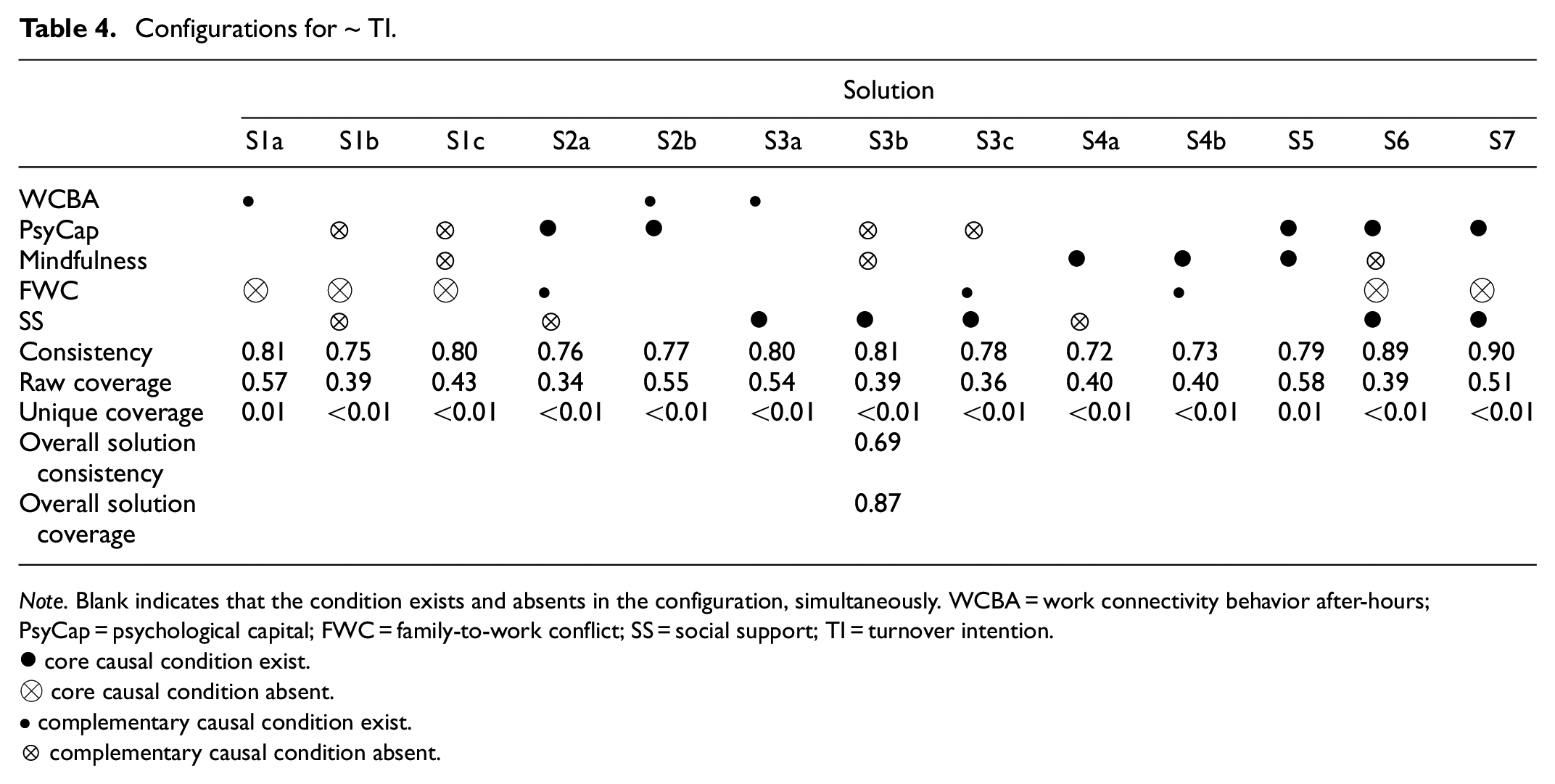
Note. Blank indicates that the condition exists and absents in the configuration, simultaneously. WCBA = work connectivity behavior after-hours; PsyCap = psychological capital; FWC = family-to-work conflict; SS = social support; TI = turnover intention.
● core causal condition exist.
⊗ core causal condition absent.
• complementary causal condition exist.
⊗ complementary causal condition absent.
In the seven categories of antecedent configurations, each type of configuration contains the following core conditions, respectively: “∼ WFC” (S1), “PsyCap” (S2), “SS” (S3), “Mindfulness” (S4), “PsyCap * Mindfilness” (S5), “SS *∼ FWC” (S6), and “PsyCap * SS *∼ FWC” (S7).
WCBA only exists in S1a, S2b, and S3a. Based on the consistency and raw coverage of each configuration, subjects were 81%, 77%, and 80% likely to achieve low level of TI when WCBA was existed, and 57%, 55%, and 54% of participants were explained. However, based on the unique coverage, the three configurations only explained less than 1% of the participants.
When WCBA exists, as long as FWC does not exist or PsyCap or SS exists, low-level TI can be achieved.
For the other 10 configurations that achieve low level of TI, WCBA can exist or not. Therefore, although the achievement of low level of TI is to some extent influenced by WCBA, it relies more on the influence of other factors (i.e., PsyCap, mindfulness, ∼ FWC, and SS).
Discuss
The Double-Edged Sword Effect of Work Connectivity Behavior After-Hours on Turnover Intention
Previous studies have used multiple regression or path analysis to investigate the relationship between WCBA and TI, which investigated the marginal “net effect” between variables and reflected causal symmetry (Diaz et al., 2012; Muhamad Nasharudin et al., 2020; Zhou et al., 2020). It may be the important reason for the inconsistent relationship between WCBA and TI. Considering the double-edged sword effect of WCBA on TI, this study examined how WCBA depends on internal factors (i.e., PsyCap and mindfulness) and external factors (i.e., FWC and SS) and what configuration form leads to high and low level of TI. Compared to previous studies (Diaz et al., 2012; Muhamad Nasharudin et al., 2020; Zhou et al., 2020), examining the relationship between variables from a configuration perspective can provide a clearer understanding of the double-edged sword effect of WCBA on TI.
WCBA can lead to high level of TI. By investigating the configuration effect between variables, this study found seven antecedent configurations to achieve a high level of TI. When WCBA exists, for the internal factor, compared with PsyCap, the absence of mindfulness is a more critical factor leading to TI; for the external factor, the absence of SS is as crucial as the existence of FWC in the process of achieving TI. The influence of mindfulness on TI depended more on external factors (i.e., SS and FWC).
WCBA can lead to low level of TI. 13 configurations can achieve low level of TI, which can be divided into seven categories based on the existence of core conditions. When WCBA exists, as long as FWC does not exist or PsyCap or SS exists, low level of TI can be achieved. Although the achievement of low level of TI is to some extent influenced by WCBA, it relies more on the influence of other factors (i.e., PsyCap, mindfulness, ∼ FWC, and SS).
Therefore, for external factors, the absence of FWC and the existence of SS are equally important in terms of impact on TI. When WCBA exists, both the existence of FWC and the absence of SS can lead to high level of TI, while the absence of FWC and the existence of SS can lead to low level of TI. However, for internal factors, there are differences in the impact of PsyCap and mindfulness on TI. When WCBA exists, the absence of mindfulness is the critical factor of high level of TI, but the existence of mindfulness is not the critical factor of low level of TI. It is consistent with previous research results (Lee et al., 2021). Moreover, the existence of PsyCap is a critical factor in achieving low level of TI, but the absence of PsyCap is not the critical factor leading to high level of TI.
Although many studies have shown a close relationship between mindfulness and PsyCap (Ali et al., 2022; Roche et al., 2014). The results of this study indicate that there are still significant differences in the positive mechanisms of mindfulness and PsyCap. Specifically, according to the conservation of resources theory, mindfulness is more effective in reducing the process of resource depletion caused by WCBA, while PsyCap acts on the process of resource accumulation (Hobfoll et al., 2018). The impact of resource loss is far more important than resource acquisition, with faster and longer lasting impacts (Hobfoll et al., 2018). Therefore, individuals often first reduce the depletion of resources and then accumulate more resources (Hobfoll et al., 2018). As previous research has found, mindfulness often plays a positive role through the mediating role of PsyCap, with mindfulness playing a leading role and PsyCap playing a later role (Ali et al., 2022; Roche et al., 2014). By focusing on the present through mindfulness, individuals can effectively alleviate the depletion of psychological resources caused by stress about WCBA. Individuals then accumulate more resources through positive psychological qualities such as confidence, optimism, and hope. Therefore, when WCBA exists, the absence of mindfulness leads to high-level TI, while the existence of PsyCap leads to low-level TI.
In addition, the positive role of mindfulness depends to some extent on external factors such as the existence of SS and absence of FWC. It is consistent with previous studies (Chen et al., 2021; Raza et al., 2018). Chen et al. (2021) found that mindfulness played a moderating role in SS and posttraumatic growth. Specifically, individuals with higher levels of dispositional mindfulness, their perceived social supports within family was positively associated with posttraumatic growth, while for individuals with lower levels of dispositional mindfulness, there is no significant relationship between them (Chen et al., 2021). Raza et al. (2018) found that work-family conflict plays a moderating role in mindfulness and job satisfaction. Specifically, individuals with lower levels of work-family conflict, their mindfulness was positively associated with job satisfaction, while for individuals with higher levels of work-family conflict, there is no significant relationship between them (Raza et al., 2018). It can be explained based on the conservation of resources theory’s resource caravans and resource caravan passageways principles. This principle holds that the resources owned by individuals do not exist independently, but are interconnected and influenced like convoys traveling together on the road (Hobfoll et al., 2018). Therefore, mindfulness and external factors are interdependent and work together in the process of resource loss and acquisition.
Practical Significance
Enhancing employees’ PsyCap, mindfulness, SS, and reducing FWC, can help alleviate the negative effects of WCBA on TI.
Enterprises should focus on improving employees’ PsyCap. (a) Develop new recruitment and selection plans. Using PsyCap theory to assist recruitment can be appropriately incorporated into the PsyCap assessment process in written exams and interviews. (b) Conduct training on improving PsyCap. To enhance employees’ positive psychological quality and work efficiency, enterprises should provide more PsyCap training, purchase EAP services appropriately, and cultivate their self-efficacy and resilience when facing difficulties. (c) Create a corporate atmosphere that values PsyCap. Enterprises should continuously instil a positive corporate culture in employees to preserve their long-term vitality and passion and develop their self-efficacy, hope, optimism, and resilience. Only in a harmonious, upward, and indomitable corporate culture environment can enterprises cultivate employees who are positive, willing to take on responsibilities, confident, strong, and full of hope for the future. (Lupşa et al., 2020).
Enterprises can conduct mindfulness training courses within the organization. Due to the positive prediction of employees’ subjective vitality during the day, individuals with higher levels of mindfulness have higher levels of vitality (Young et al., 2022). In enterprises, managers can invite professional mindfulness trainers to conduct mindfulness stress relief training courses, strengthen employees’ mindfulness meditation, provide time management guidance, and incorporate it into the partner system to enhance accountability for adhering to planned activities. Research has shown that adhering to exercise and a healthy diet is also beneficial for managing stress reducing the frequency of drinking or smoking due to stress (Young et al., 2022). Eating more fruits and healthy vegetables cultivating a healthy lifestyle, is more conducive to improving mindfulness (Krägeloh et al., 2019; Young et al., 2022). In addition, mindfulness can also be improved through yoga training, which requires a wholehearted focus on the present during training. Individuals who practice yoga for a long time will have a higher level of mindfulness than ordinary people (Hilcove et al., 2021).
Enterprises should pay attention to the significant impact of family factors on employees’ work behavior. Family harmony can provide employees with positive psychological resources, which helps them effectively work and actively cope with work pressure. Enterprises and managers should try their best to understand employees’ basic family situation, improve employee profiles, and provide specific policy support, such as carrying out work-family plans to help employees solve family problems and be cautious of negative effects of family conflicts on employees’ work (Bardoel et al., 2014).
Enterprises need to pay attention to the impact of perceived SS on employees’ work behavior. Enterprises can provide care to employees through various policies, such as EAP, various holiday benefits, etc. In addition, enterprises can also provide psychological training to employees to stimulate them to actively perceive the support provided by organizations, leaders, family, and friends in their work and life.
Lastly, although WCBA has a double-edged effect on TI, the level of WCBA should be maintained at a moderate level. Enterprises should not excessively force employees to use communication tools during non working hours, and should moderately reduce the control over employees’ non working hours.
Limitation
This study has some limitations. Firstly, this study uses cross-sectional data and cannot infer the causal relationship between variables. In the future, fsQCA, based on the time change, can investigate whether the antecedent conditions and the configuration formed by the antecedent conditions have changed with the communication technology becoming the working mode.
Secondly, this study examined the interdependence between WCBA and some internal factors (i.e., PsyCap and mindfulness) and external factors (i.e., SS and FWC). But WCBA may also have interdependent relationships with many other factors, such as leadership as an external factor. Moreover, job factor (such as job and career characteristics, position, commuting time, salary, and benefits, etc.) can also affect employees’ TI. However, this study overlooked the impact of job factor. In the future, more other factors can be considered in the complex configuration relationship between WCBA and TI.
Conclusion
Seven configurations achieve high level of TI. When WCBA exists, for the internal factor, compared with PsyCap, the absence of mindfulness was a more critical factor leading to TI; for the external factor, the absence of SS was as crucial as the existence of FWC in the process of achieving high level of TI.
Thirteen configurations achieve low level of TI, which can be divided into seven categories based on the existence of core conditions. When WCBA exists, as long as FWC does not exist or PsyCap or SS exists, low level of TI can be achieved.
The absence of mindfulness is the critical cause of high level of TI, but the existence of mindfulness is not the critical cause of low level of TI. The existence of PsyCap is a critical factor in achieving low level of TI, but the absence of PsyCap is not the critical factor leading to high level of TI.
Footnotes
Authors Contributions
Aihua Tao: conceptualization, data collection, writing-review and editing, and funding acquisition. Qian Xu: conceptualization, data collection, formal analysis, and writing-original draft preparation. Chencui Zhou: data collection and writing-original draft preparation. Wei Wang: data collection and writing-original draft preparation. Feng Yu: writing-review and editing.
Declaration of Conflicting Interests
The author(s) declared no potential conflicts of interest with respect to the research, authorship, and/or publication of this article.
Funding
The author(s) disclosed receipt of the following financial support for the research, authorship, and/or publication of this article: This work was supported by a General Project of Jiangxi Provincial Education Science “14th Five-Year Plan” (grant number: 22YB137).
Ethical Approval
The study was conducted in accordance with the Declaration of Helsinki, and approved by the Institutional Review Board of Jiangxi Science and Technology Normal University.

Data Availability Statement
Data will be made available on request.