



Abstract
Museums play a vital role in tourism, and as venues for shopping, are conventionally associated with souvenirs. Cultural and creative products from museums have gained popularity in China in recent years, but visitors’ purchase of these products remains underexamined in the literature. The present study, inspired by the theory of consumption values, aims to explore how visitors perceive cultural and creative products from museums. It employed a qualitative approach to collect data by conducting 39 semi-structured interviews and utilized thematic analysis to analyze the interview data. The study argues that, for visitors, cultural and creative products from museums are beyond souvenirs, which is primarily manifested in three aspects: product features, modes of purchase, and connectedness to daily life. Further, visitors perceive six consumption values by purchasing these products, which include cultural value, creative value, aesthetic value, functional value, emotional value, and social value. The theoretical and practical implications of this study are also discussed.
Introduction
Museums are institutions that collect, interpret, and exhibit tangible and intangible heritage. They are not only places for research and conservation, but also play a significant role in tourism (Chen, 2024). When it comes to shopping, museums are conventionally associated with souvenirs, which visitors often purchase to document their travel (Timothy, 2005). Interestingly, cultural and creative products from museums have gained popularity in China in recent years. Cultural and creative products from museums refer to products that are inspired by museums, mainly including their collections, exhibitions, and architectures, with cultural elements and/or creative designs (He & Timothy, 2024; Tsang et al., 2022; Tu et al., 2019). It was reported that the Palace Museum generated revenue of RMB1.5 billion (USD220 million) by selling cultural and creative products in 2017 (CGTN, 2019). The sales of cultural and creative products from museums in Shanghai reached over RMB0.49 billion (USD68 million) in 2024 (Guangming Online, 2025).
Despite their popularity, cultural and creative products from museums remain underexplored in the tourism literature, with only a small number of studies on visitors’ purchase of these products being identified (e.g., Gu & Zhao, 2025; He & Timothy, 2024; Z. Li et al., 2021; Y. Li & Li, 2022; Shiau & Hu, 2020). A further examination of these studies reveals that most of them are quantitative and directly apply concepts from consumer research to visitor behavior. It is often assumed that cultural and creative products from museums are the same as souvenirs (He & Timothy, 2024; Tu et al., 2019). The voices of visitors in these products are thus largely neglected, and so are the sociocultural contexts within which purchasers of these products are embedded. Also, previous studies mainly examined visitors’ purchase intention rather than their actual purchase behavior (e.g., Gao & Ma, 2024; Gu & Zhao, 2025). This could be problematic, as there exists an inconsistency between what consumers say and what they actually do (Caruana et al., 2016).
The present study, inspired by the theory of consumption values (Sheth et al., 1991), seeks to fill these research gaps by taking a qualitative approach to explore how visitors see their purchase of cultural and creative products from museums. More specifically, this study aims to address two research questions: (1) Do visitors think cultural and creative products from museums the same as souvenirs? (2) What values do visitors perceive by purchasing cultural and creative products from museums? By answering these questions, the study contributes to advancing the knowledge of souvenir research by distinguishing between souvenirs and cultural and creative products from museums. It is also among the first to develop a typology of consumption values of cultural and creative products from museums, with a conceptual clarification of value in souvenir studies being provided. Practically, this study provides directions for tourist attractions, especially cultural institutions such as museums, to optimize the design of cultural and creative products that better satisfy the shopping needs of tourists.
Literature Review
Souvenirs
Souvenirs, which mean “to remember,” generally serve as a reminder of special moments and events in life (Gordon, 1986). This category of products has a close relationship with tourism (Thompson et al., 2012). As Swanson and Timothy (2012) stated, souvenirs play a significant role in tourism from both demand and supply perspectives. Souvenirs are the most commonly purchased products by tourists throughout the world, which contribute billions of dollars each year to the global tourism economy (Timothy, 2005). Accordingly, souvenirs have received considerable attention in tourism research (Shen & Lai, 2022; Swanson & Timothy, 2012).
In particular, some researchers tried to understand tourists’ souvenir purchases by revealing their perceived values. For instance, Paraskevaidis and Andriotis (2015), inspired by Marx (1976) and Baudrillard (1981), proposed that the values of souvenirs consist of use value, exchange value, sign value, and spiritual value. Wei (2018) found that sign value, meaningfulness, and hedonic value are three primary values associated with Chinese tourists’ souvenir purchases in Shanghai Disney Resort. More recently, Chang et al. (2022) applied the customer value framework developed by Holbrook (2006) to examine the values of food souvenirs in Kaohsiung that Ethnic Chinese tourists perceive, with four values being identified – hedonic value, economic value, social value, and altruistic value.
As can be seen, the findings of the above-mentioned studies are inconsistent, with different values being identified in different research contexts. A further examination shows that the conceptualization of value varies in these studies. For example, although sign value was identified in both Paraskevaidis and Andriotis (2015) and Wei (2018), the former focused on the values of souvenirs as commodities, while the latter explored the values of souvenir purchase. This difference makes it necessary to scrutinize how the term of value is conceptualized and used in the original sources of references, such as Marx (1976), Baudrillard (1981), and Holbrook (2006).
Consumption Values
Marx (1976), in the first volume of Capital, outlined that a commodity has a dual character, possessing both use value and exchange value. As he stated, “The usefulness of a thing makes it a use-value”; exchange value appears as “the quantitative relation, the proportion, in which use-values of one kind exchange for use-values of another kind” (Marx, 1976, p. 126). Later on, Baudrillard (1981), in the book For a Critique of the Political Economy of the Sign, put forward the concept of sign value, which mainly refers to the quality that a commodity has to express social status and prestige. According to Baudrillard (1981), commodities in modern capitalism are not merely characterized by use value and exchange value, as Marx (1976) claimed, but by sign value, which takes on meaning according to their place in a differential system of prestige and status. Use value, exchange value, and sign value are based on the logic of utility, equivalence, and difference, respectively (Baudrillard, 1981).
Besides, value in consumer research has also been employed by researchers to examine tourist perceived values of souvenir (purchases). A typical example is Zeithaml (1988), where perceived value is defined as “the consumer’s overall assessment of the utility of a product based on perceptions of what is received and what is given” (p. 14). It is obvious that Zeithaml (1988) considered value as a trade-off between costs and benefits. Sheth et al. (1991) developed a theory of consumption values, where five consumption values are identified that influence consumer choice. These values are functional value, social value, emotional value, epistemic value, and conditional value (Sheth et al., 1991). Although Sheth et al. (1991) did not provide a definition of value, it can be argued that this term was used in the sense of customer perceived utility of products based on their elaborations on these specific values.
Babin et al. (1994) advocated that value is not simply provided by product acquisition, but by consumption experiences. Thus, they considered value from an experiential perspective, with shopping value being categorized into two types: utilitarian value and hedonic value. More specifically, utilitarian value reflects shopping with a work mentality, which means a product is often purchased in a deliberant and efficient manner; hedonic value reflects shopping’s potential entertainment and emotional worth, which results more from fun and playfulness than from task completion (Babin et al., 1994). In a similar vein, Holbrook (2006) defined consumer value as “an interactive relativistic preference experience” (p.9) and presented a typology of consumer value, which includes extrinsic versus intrinsic value, self-oriented versus other-oriented value, and active versus reactive value.
Taken together, a review of value in souvenir studies and their original sources of references shows that this term has mainly been defined in three different senses. The first definition of value focuses on the product per se (see Baudrillard, 1981; Marx, 1976). It holds that value resides in the product itself as one of its properties. The second definition conceptualizes value from an experiential perspective, assuming that value depends upon customer experiences (see Babin et al., 1994; Holbrook, 2006). The third definition of value takes an intermediate position (see Sheth et al., 1991; Zeithaml, 1988). It suggests that value involves customers’ perception of the utility of a product to meet their needs. In other words, this definition situates value in the relationship between a product and its customers, and emphasizes how the product is evaluated by customers. These definitions reflect the multifaceted nature of value. As Babin et al. (1994) stated, any of these definitions can be appropriated in a particular context.
The present study, inspired by the theory of consumption values (Sheth et al., 1991), aims to explore how visitors perceive cultural and creative products from museums. This theory remains up to date in the consumer behavior literature and has been applied to a variety of research areas such as digital marketing, tourism, and higher education (for comprehensive reviews, see Bahoo et al., 2024; Tanrikulu, 2021). As Tanrikulu (2021) stated, the main charm of the theory of consumption values lies in its ability to provide value-oriented explanations for product, product category, and brand choice behavior. It is thus considered suitable as a theoretical foundation of this study, given the recent emergence of cultural and creative products from museums (Z. Li et al., 2021; Tsang et al., 2022). Accordingly, the study puts emphasis on identifying consumption values that visitors acquire from this new type of product rather than those of their shopping experiences.
Methodology
This exploratory study employs a qualitative methodology, which builds on the epistemological orientation of interpretivism (Bryman, 2016). Qualitative methodology is appropriate to use in this study as its main purpose is to explore a relatively new topic – visitors’ perceived values of cultural and creative products from museums. Specifically, semi-structured interviews were conducted to collect data, with thematic analysis being utilized to analyze the collected interview data to identify themes within them. The processes of data collection and analysis are presented in detail as follows.
Data Collection
The semi-structured interviews were carried out mainly between August 2022 and May 2023. The authors used a purposive sampling method to select participants. First, Chinese people who visited domestic museums and purchased cultural and creative products there over the past 2 years were treated as the target group to get up-to-date information relevant to the present study. Meanwhile, the authors gave priority to choosing those who were born after 1980, as it was reported that this group of people accounted for more than 80% of customers of cultural and creative products from museums (The Paper, 2022). In addition, maximum variation was employed as a principle to ensure the heterogeneity of participants with respect to both their demographic characteristics (e.g., gender and occupation) and their shopping practices (e.g., the museums they visited).
The sampling process started by using two popular Chinese social media platforms – WeChat and RedNote – to look for participants who met the selection criteria. The authors introduced this study to their friends on WeChat and asked them to recommend potential participants, while on RedNote, information on this study was posted to recruit potential participants from the broader platform users. In both cases, potential participants were approached by the authors to confirm their willingness to be involved in the study, with when and how to conduct interviews being discussed. As a result, 39 Chinese visitors were recruited as the interview participants, whose profile is summarized in Table 1. It should be mentioned that the sample size was not set in advance. The researchers continued interviews until they found that no new information was generated. It was therefore concluded that data saturation (Bryman, 2016) had been reached with the 39 interviews and further data collection was unnecessary.
Profile of the Interview Participants.

A participant may have visited more than one museum and purchased different categories of cultural and creative products.
Each semi-structured interview consisted of two major parts (see the Appendix for the interview guide). In the first part, the authors established rapport with the participants by collecting general information on their visits to museums and accompanying purchases of cultural and creative products. The second part proceeded by asking the participants more detailed questions about their purchases in order to scrutinize how they perceive cultural and creative products from museums. For example, the participants were requested to tell the researchers why they bought specific products and whether these products are the same as souvenirs. If possible, photos relevant to their purchases were also collected and utilized to elicit more information from participants. The interviews were conducted either face-to-face or on the Tencent Meeting app (a popular video conferencing platform in China) with an average length of 50 min. All of them were recorded with consent, with the participants being coded from P-01 to P-39. In total, the collected interview data comprises more than 520,000 words and 42 photos.
Data Analysis
The data analysis in this study was conducted by performing a combination of inductive and deductive thematic analysis (Braun & Clarke, 2006). On the one hand, the study tried to identify themes that are strongly linked to the data themselves without fitting them into a pre-existing coding frame, as visitors’ purchase of cultural and creative products from museums has rarely been examined in tourism research. On the other hand, this study was inspired by the theory of consumption values (Sheth et al., 1991), where values are deemed to be the utility of products perceived by customers.
The analytic process started with transcribing the interview data verbatim into written form. The authors familiarized themselves with the data by repeatedly reading the transcripts and noting down initial ideas on visitors’ perceived values of cultural and creative products from museums. The data were then imported into and coded in NVivo 12. After identifying codes, the authors went through all of them, thought about the relationships between them, and sorted them into different themes. These potential themes were then further reviewed and refined based on two criteria – internal homogeneity and external heterogeneity (Patton, 2014). Table 2 shows the main information on hierarchical nodes in NVivo 12.
Hierarchical Nodes in NVivo 12.

It should be noted that despite the phases described above, the data analysis in this study was a recursive rather than linear process. This process involves movements back and forth to develop codes and themes that are most appropriate to interpret the data. To enhance the reliability of data analysis, the two authors independently coded the data first and then compared and discussed their codes until a consensus on coding was reached. Photos relevant to the participants’ purchase of cultural and creative products from museums were also used to triangulate the text data.
Findings
Cultural and Creative Products From Museums Are Beyond Souvenirs
Cultural and creative products from museums started to appear in the Chinese government documents in 2016, when 92 museums were selected as pilot organizations to develop this new type of product (National Cultural Heritage Administration, 2016). Conventionally, museum stores are deemed to be places where visitors purchase souvenirs to document their travel (Timothy, 2005). In comparison to souvenirs, are cultural and creative products from museums like old wine in new bottles? Based on the 39 interviews conducted in this study, it can be argued that, for visitors, cultural and creative products from museums are beyond souvenirs. On the one hand, souvenirs and cultural and creative products from museums are similar in the sense that both of them can function as a reminder of the places that people visit and their travel experiences. The roles that souvenirs play, such as memory and evidence (Swanson & Timothy, 2012), can also apply to cultural and creative products from museums. On the other hand, cultural and creative products from museums have much more to offer than souvenirs. The differences between them are primarily manifested in three aspects – product features, modes of purchase, and connectedness to daily life.
First, cultural and creative products from museums are more diversified than souvenirs. Souvenirs in the tourism literature are generally viewed as homogeneous objects, which are cheap, kitschy, and crudely made (Anastasiadou & Vettese, 2019). These negative adjectives are frequently used by participants in this study to describe souvenirs. In contrast, they perceive cultural and creative products from museums as “fun,”“beautiful,” and “distinctive.” Cultural and creative products from museums, as the name implies, embrace a duality of culture and creativity. These products generally contain elements extracted from collections in museums, which embody culture and history. At the same time, the products are infused with creative design so that the elements selected are presented in a new manner (Tu et al., 2019). A good combination of cultural elements extracted from collections in museums and creative designs makes these products different from the homogenized souvenirs that are common in many tourist attractions.
A second and related feature of cultural and creative products from museums is that they are not merely purchased by people who visit museums. Rather, the participants in this study commonly make purchases of these products from online shopping websites without visiting museums. In other words, the cultural and creative products from museums that customers buy are not necessarily connected to travel and tourism. This is in stark contrast to the purchase of souvenirs, which serve as tangible manifestations of tourist experience, and accordingly, are deemed to be collected by people from the places they actually visit (Swanson & Timothy, 2012). Although online shopping platforms offer tourists more options on when and where to buy souvenirs (Abendroth, 2011; Yuan et al., 2022), the items they choose have much to do with their travel experience. As P-13 said, “Cultural and creative products from museums are such goods that you could purchase online even if you do not visit these places. But for souvenirs, only if you travel to these places can your purchase of them have value.”
In addition, cultural and creative products from museums, compared to souvenirs, can have more connections with everyday life. As Lasusa (2007) stated, souvenirs, which are normally purchased as mnemonic devices, rarely fulfill everyday functions. Even if some souvenirs, such as T-shirts and spoons, seem to be functional objects, they are often shelved and displayed rather than used in ordinary life (Lasusa, 2007). In this sense, souvenirs are sacred, representing the extraordinary experience of travel. Cultural and creative products from museums, however, can not only be sacred as souvenirs, but also be profane, playing different roles in daily life. For example, P-09 bought cultural and creative products, such as bookmarks and notebooks, from the Palace Museum while visiting there with her family, and she said,
These products are not items that you would display somewhere and cherish, but items that we use in daily life. You know it [the Palace Museum] also sells cosmetics, right? Although I did not purchase cosmetics there, I think people buy these products primarily for use. It is just that we perceive extra cultural value when we use these products.
Consumption Values of Cultural and Creative Products From Museums
The above-stated argument that cultural and creative products from museums are beyond souvenirs can be further verified by revealing visitors’ perceived values of these products. The study finds that visitors perceive six consumption values by purchasing cultural and creative products from museums. These consumption values are cultural value, creative value, aesthetic value, functional value, emotional value, and social value. The consumption values identified are discussed in detail below.
Cultural Value
Cultural value in this study refers to the perceived utility acquired from a product’s capacity to reflect the culture that a museum presents and associated connotations. Culture is a broad concept that encompasses beliefs, norms, customs, and artefacts, among other things (Kroeber & Kluckhohn, 1952). In particular, artefacts, as visible components of culture, often embody evidence of cultural meaning (Soares et al., 2007). In a museum context, artefacts, especially collections and architectures, are the main sources of inspiration for developing cultural and creative products. For example, A Thousand Miles of Rivers and Mountains, drawn by Ximeng Wang from the Northern Song Dynasty, is a landscape scroll painting collected in the Palace Museum. This masterpiece inspired the design of a series of cultural and creative products from the Palace Museum, such as necklaces, rulers, and watches.
More specifically, cultural values of cultural and creative products from museums are perceived and evaluated by visitors from two main aspects: cultural extracts and cultural connotations. Cultural extracts here refer to particular parts of artefacts collected in museums that are used in the design of cultural and creative products. These extracts can theoretically be anything chosen from the original artefacts, such as patterns in paintings, shapes of bronzes, and decorations on buildings. The artefacts selected are often treasures, which are exhibited only in specific museums, and are of great value in culture. For visitors, cultural and creative products inspired by these artefacts not only present distinctive features of different museums or places, but also are infused with cultural values. P-01 bought a notebook from Hunan Museum and described,
You know Xin Zhui, right? Her corpse was well preserved in her tomb. The T-shaped silk painting laid on her coffin shows the heavenly world, the human world, and the underworld. It is a national treasure and should be one of its kind. Some elements of the painting are printed on the notebook from the museum. It is likely to be unique in the whole world.
Visitors perceive cultural values of cultural and creative products not only from the aspect of cultural extracts as stated above, but also from that of cultural connotations. Cultural connotations here are defined as the implied meanings that cultural and creative products from museums hold in a particular culture. For visitors, cultural extracts and cultural connotations afford them cultural values in different ways. The former represents features of museums that they visited, while the latter shows implications of cultural and creative products for daily life. P-28, for instance, bought a bookmark from the Palace Museum called “Chan Gong Zhe Gui.” Chan Gong Zhe Gui is a Chinese idiom, which literally means plucking a branch of osmanthus from the toad palace (i.e., the moon). The idiom symbolized succeeding in the imperial examination in ancient China, and is now broadly used to imply achieving goals and dreams. This implied meaning is a main reason why P-28 purchased the bookmark, and she repeatedly stressed the importance of connotations for her to choose cultural and creative products. Similarly, P-32 mentioned that a brooch from Nanjing Museum Administration caught her attention, because “there is a little rabbit on it, and this year [2023] is the year of the rabbit.”
Creative Value
Creative value in this study refers to the perceived utility acquired from a product’s capacity to offer something new. Reckwitz (2017) argued that contemporary society has been fundamentally transformed by the expectation and desire to be creative. This also applies to the tourism industry. As Richards (2011) stated, creativity has been integrated with tourism in a range of forms via creative people, products, processes, and places. For some visitors, their purchase of cultural and creative products from museums largely depends on whether these products are creative. More specifically, the creative value of these products can be examined from two perspectives. First, visitors perceive new forms of products as having high creative value. P-22 and P-28 are good examples in this respect. P-22 bought a bedside lamp from the Palace Museum and described, “the product is like a book when it is folded, but when you unfold it, it is a Chinese fan-shaped lamp.” He further explained, “As I have never seen a product like this, I think it is creative.” P-28 showed a product photo to the first author during the interview (Figure 1). It was a stereoscopic puzzle that she purchased from Chongqing Museum. She said, “I did not see this kind of product often when I travelled to other places. But there are many cultural and creative products like these in Chongqing, so I think they are very special.”

A stereoscopic puzzle P-28 purchased from Chongqing Museum.
Second, visitors evaluate the creativity of cultural and creative products based on the re-creation of cultural elements extracted from museums. As mentioned above, cultural and creative products from museums are generally inspired by the artefacts collected in these museums. For some visitors, the creative value of these products depends on whether elements extracted from these artefacts can be utilized in a re-creative manner. For instance, P-04 stressed,
I think the word ‘creative’ in the name of cultural and creative products means re-creation. That is to say, you use elements such as patterns within a cultural theme to create something anew. I think this is a feature of cultural and creative products. But for many souvenirs, for example, those inscribed with local landscapes, there is a lack of process of re-creation. Accordingly, souvenirs may only be mementos showing that you visited specific places, while cultural and creative products allow you to not only identify where you travelled, but also know the historic stories or culture they represent.
It can be seen that visitors perceive the creativity of cultural and creative products from museums, via either new product forms or the re-creation of elements extracted from collections. Given their perceived creative value of these products, it is no surprise that visitors commonly use adjectives such as “fun,”“interesting,” and “special” to describe their purchases. Actually, creativity is seen as a defining feature of cultural and creative products, on which visitors differentiate souvenirs from them based. Similar to P-04, P-28 stated,
Creativity is more salient in cultural and creative products [than it is in souvenirs]. A mug inscribed with the logo of Chongqing Museum is a souvenir. But this is only a souvenir. The elements consisting of cultural and creative products are much richer.
Aesthetic Value
Aesthetic value in this study refers to the perceived utility acquired from a product’s capacity to offer something beautiful or elicit pleasure when appreciated aesthetically. During the interviews, many participants asserted that a primary reason why they purchased cultural and creative products from museums is that these products are very beautiful. As illustrated by P-18, who bought a Chinese fan from the Palace Museum, “I did not plan to buy that fan, but it looked so beautiful that I was attracted by it. So I purchased it.” Similarly, P-16 puts beautiful appearance in the first place when she selects cultural and creative products. As she said, “If a product cannot catch my eyes at first sight, it is very likely that I would not buy it.” It can be seen that visitors perceive a cultural and creative product to be beautiful for its own sake. This aesthetic practice is not guided by purposes or interests, but involves autonomous acts of perception and feeling. As Reckwtiz (2017) argued, aesthetic perception is an end in itself, and this is a decisive feature that distinguishes it from mere processing of information towards rational ends.
A further examination shows that visitors evaluate the aesthetic value of cultural and creative products from an integrated perspective. A combination of product features, mainly including color, pattern, material, and quality, is taken into account by them to judge whether a product has high aesthetic value or not. Cultural and creative products with these features arranged in a harmonious way are deemed by visitors as “look pleasing to the eye.” For example, P-18 explained why she thought the Chinese fan she bought from the Palace Museum was beautiful,
First of all, I think the quality of it is good. The guards, ribs, and panel of the fan are exquisitely made. Also, the picture on the panel is painted in a very ancient Chinese style. I do not think that is just a copy of a specific antique. It is an integration of patterns extracted from flower and bird paintings collected in the museum. The colors of the picture, including blue and green, and the flowers in it are exquisite.
Functional Value
Functional value in this study refers to the perceived utility acquired from a product’s capacity for functional or utilitarian performance. As souvenirs are seen as “messengers of the extraordinary” (Gordon, 1986, p. 135), these products are purchased by people primarily to preserve their travel experience, rather than for practical use (e.g., Fu et al., 2018; Wilkins, 2011). Souvenirs thus rarely fulfill everyday functions, but instead are often shelved and displayed (Lasusa, 2007). Nevertheless, visitors generally perceive functional value from cultural and creative products. Taking P-09 as an example, she purchased bookmarks from the Palace Museum, and said, “I use bookmarks in my daily life. So these items come in useful. That is, they would not be simply displayed and then not touched anymore. We are likely to use them often after travel.”
For P-02, the biggest difference between souvenirs and cultural and creative products lies in their practical utility. As she stated,
Souvenirs, in my opinion, serve no functional purpose. They are placed at home. Once you see them, you know where you travelled…Cultural and creative products can be integrated into everyday life. Lipsticks, for example, are available at many places. However, lipsticks from the Palace Museum are special and appealing to me, as they are infused with cultural elements from the museum. So I would like to buy them, plus I could use them in my daily life.
In addition to bookmarks and lipsticks as discussed above, ice creams (see Figure 2), tapes, notebooks, and Chinese fans are frequently mentioned cultural and creative products that participants purchase from museums. Functional value might not be the biggest difference between these items and souvenirs as P-02 said. This value is no doubt an important factor to consider when visitors make purchase decisions at museums.

An ice cream P-07 bought from Nanjing Museum and the cultural relic that inspired this product.
Emotional Value
Emotional value in this study refers to the perceived utility acquired from a product’s capacity to remind visitors of their travel experience. It is well documented that souvenirs hold emotional value to tourists (Abendroth, 2011; Shtudiner et al., 2019). As sentimental objects, souvenirs allow tourists to capture their intangible travel experiences in a tangible way (Anastasiadou & Vettese, 2019). Cultural and creative products and souvenirs are similar in the sense that both of them can function as tangible carriers of intangible experiences. For example, P-17 purchased a lucky bag from He Art Museum. He said,
I wanted to have something that can remind me of my visit there [He Art Museum]. I rarely had the chance to travel to Guangzhou. That was also a special experience. I mean, it was a rare opportunity to visit there together with my friend. So I would like to take that opportunity to buy something as a memory.
As can be seen, the lucky bag performs the role of memory in the case of P-17. This product was purchased by P-17 as it allows this participant to remember that he had extraordinary experience with friends. Similar to souvenirs, cultural and creative products from museums are purchased not only as a memory, but also as evidence (Wilkins, 2011). This can be illustrated by P-21, who bought a bookmark from Nanjing Museum. She treated this bookmark as “a mark of her visit to Nanjing Museum.” She further explained,
When it comes to tourism, sometimes I feel like I did not travel to some places, although I actually have visited these places. If I buy something unique to a specific place, it would be evidence of my visit there.
Social Value
Social value in this study refers to the perceived utility acquired from a product’s capacity to meet social needs. Tourist shopping is more than an individual matter (Jin et al., 2017). This also holds true for the purchase of cultural and creative products from museums. According to the interviews, it can be identified that gift and taste are two key types of social values that visitors perceive from these products. Firstly, cultural and creative products from museums are commonly purchased by visitors as gifts for others. For instance, P-18, a first-year college student, often uses cultural and creative products from museums as gifts for friends, and receives these kinds of products as gifts from her friends. As she said,
Cultural and creative products are appropriate gifts for middle and high school students, no matter in terms of their prices or forms. We could not afford things that are too expensive. [Buying] cultural and creative products from the Palace Museum or other museums would not place a burden on us. For example, if I receive a very expensive gift from you, I would think about how to give you a gift in return every day. As a gift receiver, I would not be happy then. So we all give gifts that we can afford. These gifts can bring our lives the joy of pleasant surprises.
Cultural and creative products from museums play the role of gifts not only in personal lives as in the case of P-18, but also at work. The latter can be exemplified by P-24, who is a human resource offer. He often purchases a batch of these products on behalf of his company. As he described,
Our company always purchases [cultural and creative products from the Palace Museum] in a unified manner, and the products we choose depend on the seasons. The Palace Museum, at the beginning and the end of the year, for example, usually releases new products. We would then purchase a batch of them. Normally, when you visit your clients, you give them small gifts. These gifts could shorten the distance between you and your clients, as it is likely to be your first time meeting them.
Arguably, cultural and creative products from museums are purchased by visitors as gifts for a variety of recipients, ranging from family and friends to advisors and business partners. These gifts can serve as the passport for visitors to re-enter their social groups after having been away (Pearce et al., 2013), but can also be used on other occasions, such as birthday celebrations, weddings, and graduation ceremonies. Echoing with Jin et al. (2021), visitors’ purchase of cultural and creative products from museums as gifts reflects the prevalence of guanxi maintenance in Chinese society.
Taste is the second type of social value that visitors perceive from purchasing cultural and creative products. According to Bourdieu (1984), taste classifies, which can be reflected in people’s consumption activities, and is a manifestation of their status and identity. In the words of Baudrillard (1988, p. 22), consumption is “a systematic act of the manipulation of signs.” Cultural and creative products in this study are consumed by visitors as signs to express their taste, thereby showing who they are. P-04 bought a canvas tote bag, which was inspired by a painting by Van Gogh, from Guangdong Museum after seeing the temporary exhibition of Rembrandt to Monet: 500 years of European paintings. As he stated,
If I go out carrying this bag, which I think is a symbolic item, I am telling others: “Look! I like this kind of culture.” Maybe I would meet someone who has the same interests as me on some occasions. So it is an easy way to find people who have interests in common.
Conclusion and Discussion
Museums play a significant role in tourism, and as venues for shopping, are conventionally associated with souvenirs. It is reported that cultural and creative products from museums have gained popularity in China, but visitors’ purchase of these products remains underexamined in the literature. Based on 39 semi-structured interviews, this study draws upon the theory of consumption values (Sheth et al., 1991) to explore how visitors perceive cultural and creative products from museums, with the key findings being summarized in Figure 3.
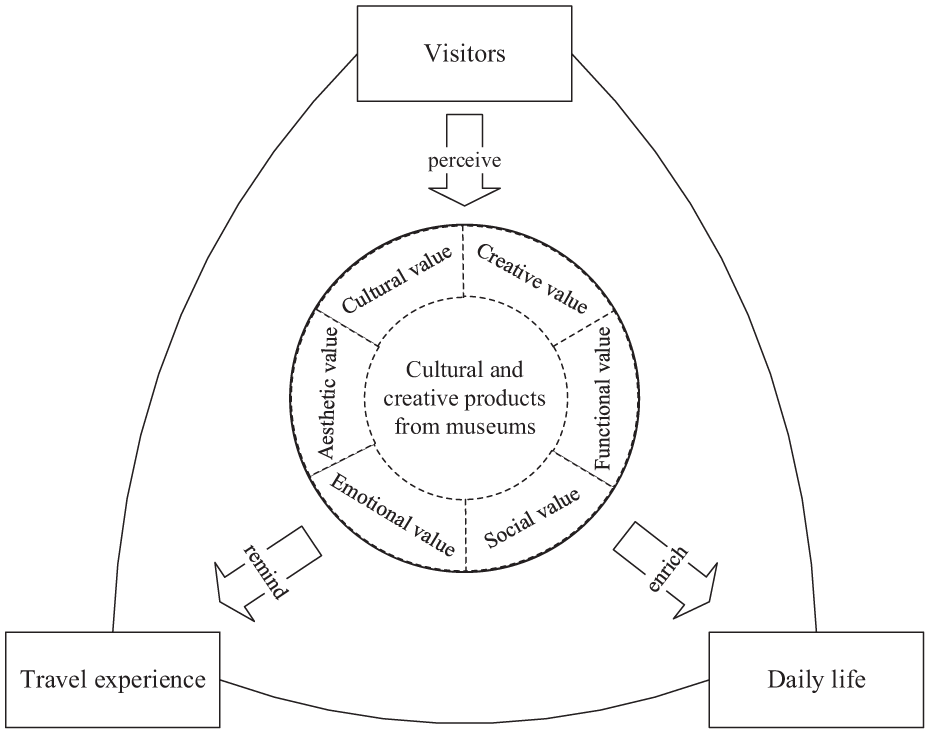
Consumption values of cultural and creative products from museums.
The study finds that, for visitors, cultural and creative products from museums are beyond souvenirs, which is primarily manifested in three aspects: product features, modes of purchase, and connectedness to daily life. This type of product is much more diversified than souvenirs. Visitors do not merely buy cultural and creative products from the museums they actually visit. Rather, these products are commonly purchased by them from online shopping platforms with no relevance to travel. Unsurprisingly, these products can not only function as reminders of travel experience as souvenirs do, but also play substantive roles in daily life. Further, visitors perceive six consumption values by purchasing cultural and creative products from museums, which include cultural value, creative value, aesthetic value, functional value, emotional value, and social value. As Figure 3 shows, these consumption values are interconnected. For example, visitors perceive cultural value from cultural and creative products as these products are infused with cultural elements, which are extracted from artefacts in museum collections. The cultural elements selected are often designed into products in new ways. Visitors accordingly perceive creative value from these products.
Theoretical Implications
The present study contributes to the conceptual clarification of value in souvenir studies. Although the concept of value has been employed by researchers to examine the values of souvenir (purchases), previous studies in this regard rarely provided a clear definition of this concept (e.g., Chang et al., 2022; Paraskevaidis & Andriotis, 2015; Wei, 2018). As a consequence, the findings of these studies are neither consistent nor comparable, with the concept of value being utilized differently in different research contexts. The present study addressed this issue by scrutinizing how value is conceptualized in the sources of references in souvenir studies, and identified three types of usage of this concept, which focus on products per se, customer experiences, and the relationships between products and customers, respectively. Given the multifaceted nature of value, it is suggested that researchers be clear about which version of this concept is adopted in their studies. Otherwise, this concept is likely to be misused. For example, hedonic value was originally utilized by Babin et al. (1994) to describe the fun and playful aspects of shopping experience, while in the studies of both Chang et al. (2022) and Shen and Lai (2023), this value was considered as one of major values of souvenirs.
Further, this study contributes to distinguishing between souvenirs and cultural and creative products from museums. Souvenirs are the most ubiquitous items purchased by tourists throughout the world (Timothy, 2005). Nevertheless, these items are often disparaged as cheap, banal, and tacky kitsch (Anastasiadou & Vettese, 2019). Although local specificity is an important product attribute, which is positively assessed by tourists, souvenirs in general have become homogenous in the process of globalization (Dumbrovská & Fialová, 2020). Cultural and creative products from museums examined in this study embrace a duality of culture and creativity. This type of product combines cultural elements extracted from collections in museums with creative designs, making them having much more to offer in comparison to souvenirs. As discussed above, these products are purchased by visitors not only as carriers of their intangible travel experiences, but also as articles of everyday use. This study thus argues that cultural and creative products from museums are beyond souvenirs, and contribute to transcending the binary distinction between the sacred state of travel and the mundane state of daily life.
Moreover, this study is among the first to develop a typology of consumption values of cultural and creative products from museums. The consumption values identified in this study provide an integrated picture of what utility cultural and creative products from museums can offer to visitors, and shed new light on the mechanisms behind their purchase of this new type of product. The findings not only enrich tourist perceived values of souvenirs in previous research (e.g., Chang et al., 2022; Paraskevaidis & Andriotis, 2015), but also show that the values included in the theory of consumption values developed by Sheth et al. (1991) cannot be directly applied to this study. For instance, conditional value put forward by Sheth et al. (1991) was not identified in the present study; social value in this study not only refers to a product’s association with specific groups as shown in Sheth et al. (1991), but also involves its capacity to be purchased as gifts. In other words, the present study suggests that critical examinations of concepts or theories originated from other disciplines are necessary before applying them to tourism research.
Practical Implications
The findings of this study provide guidelines for museums to optimize the design of cultural and creative products. In accordance with Sheth et al. (1991), the consumption values identified in the present study explain why visitors make purchases of specific cultural and creative products from museums. It is thus suggested that museums take these consumption values into consideration in the design process of cultural and creative products. For instance, museums are recommended to take advantage of cultural extracts from their exclusive collections and creatively incorporate these extracts into products that could be used in daily life. In this way, consumers are likely to perceive a combination of cultural, creative, and functional values from one product. Meanwhile, a quick response code could be added to the product to provide more information on this design process to consumers.
The findings of this study also offer insights for practitioners in the tourism industry regarding souvenir innovation. Souvenirs play an essential role in tourism, but are often deemed to be kitschy and homogenous (Anastasiadou & Vettese, 2019). These negative stereotypes are likely to be broken if souvenirs could provide tourists with a range of consumption values that have been recognized in the present study. Taking creative value as an example, the creativity of souvenirs in tourist attractions could be enhanced by offering customers new forms of products, such as 3D-printed models and blind boxes. Souvenir designers are also encouraged to tap into the unique attributes of tourist attractions and integrate these attributes into souvenirs in a re-creative manner.
In addition, this study has practical implications for shopping-related tourism marketing and management. As cultural and creative products can play a dual role as both reminders of travel experience and articles for daily use, the target customers of this type of products include not only tourists, but also local people. It is thus advised that tourist attractions in general and cultural institutions such as museums in particular put vending machines or even open retail stores to sell these products in high foot traffic areas such as shopping malls and subway stations. Especially with the advent of omnichannel retailing (Verhoef et al., 2015), cultural and creative products can also be marketed to the broader market of online shoppers.
Limitations and Directions for Future Research
As with any study, the present study has some limitations. Firstly, this qualitative study is exploratory in nature, with the sample being limited to Chinese visitors. More research is thus warranted to examine the extent to which the findings of this study can be applied to other sociocultural contexts. Complementary to the present study, quantitative methods are suggested to be used in future research to develop and validate a scale to measure the consumption values of cultural and creative products from museums. Based on this validated scale, the relationships between visitors’ consumption values and other variables, such as their purchase behavior, can be investigated in a quantitative manner.
Also, as there are increasingly more cultural and creative products from museums available online, visitors do not necessarily purchase these products after visiting museums. It is thus worthwhile to dig deeper into the relationships between visitors’ in-store and online shopping practices in this regard. Last but not least, cultural and creative products from museums are reported to be primarily purchased by young customers who were born after 1980 (The Paper, 2022; Southern Metropolis Daily, 2024), but this group of visitors often negatively perceives museums as boring or unapproachable (Y. Li et al., 2023). It would be interesting to uncover whether and how cultural and creative products can make museums more attractive to these young visitors. Overall, cultural and creative products from museums have only started to attract academic attention in recent years. More research needs to be conducted to examine and extend the findings of this study.
Footnotes
Appendix Interview Guide

Ethical Considerations
Southeast University does not require ethics approval for the conduct of this non-interventional study.
Funding
The authors disclosed receipt of the following financial support for the research, authorship, and/or publication of this article: This work was supported by Humanities and Social Sciences Fund of Ministry of Education of China under Grant Number 21YJCZH054.
Declaration of Conflicting Interests
The authors declared no potential conflicts of interest with respect to the research, authorship, and/or publication of this article.
Data Availability Statement
Data sharing not applicable to this article as no datasets were generated or analyzed during the current study.