




Abstract
Based on the theory of consumer values, this study aimed to examine the relationship between green consumption values and pro-environmental consumption intention by establishing a “value-motivation-intention” model and to check the moderation effect of green involvement. In total, 741 shoppers were recruited. Data analyses showed that (a) green consumption values positively influenced pro-environmental consumption intention; (b) the behavioral approach system positively influenced pro-environmental consumption intention, but the behavioral inhibition system did not; (c) the behavioral approach system positively mediated the relationship between green consumption values and pro-environmental consumption intention; and (d) green involvement positively moderated the relationship between green consumption values and pro-environmental consumption intention.
Keywords
Introduction
Climate change, industrial pollution, and excessive personal consumption have all been increasingly affecting the environment and bringing progressively harsher effects on human life (Carfora et al., 2017; Thøgersen, 2009). Meanwhile, people’s awareness over the importance of environmental protection has been growing, so much so that it, alongside the goal to achieve sustainable development, has been slowly turning into a consensus among nations worldwide. Governments and enterprises, as important economic entities, have started an endeavor toward environmental protection by changing production methods, developing green products, and adjusting environmental protection policies. However, consumers’ role in environmental protection cannot be ignored; past research showed that a reduction in environmental hazards produced by consumers by increasing pro-environmental consumption behavior was a very significant step toward environmental protection. Thus, the role of pro-environmental consumption behavior is very important in the establishment and maintenance of environmental protection.
Mainieri et al. (1997) defined pro-environmental consumption behavior as a type of volunteer behavior that consciously seeks to tackle environmental issues, such as climate change, global warming, and environmental degradation. This type of behavior has been shown to minimize the negative impact of one’s actions in the environment through the purchase of organic products that are environmentally beneficial (Mainieri et al., 1997). Typical pro-environmental consumption behaviors include the purchase of environmentally responsible products that minimize environmental impact, products from firms with good environmental reputations, and/or products produced using biodegradable, carbon neutral or recycled inputs, and so on (Cleveland et al., 2012). Many studies have analyzed pro-environmental consumption behaviors from multiple perspectives, and, although pro-environmental consumer behavior has been more widely studied in recent years, there are still major research problems in the subject; we believe that the key to resolve this problem does not lie within the understanding of what this type of behavior is or how to activate it—topics often explored in previous literature. We identified the research gap by this question: How do we make pro-environmental consumption behavior become not a short-term but a long-term behavior?
Previous research has found that people’s values are positively related to pro-environmental consumption behavior (Stern, 2000). Stern (2000) suggested the values–belief–norm theory and divided people’s values into three categories: egoism values, altruistic values, and biological values; the same author also discussed the relationship between these values and pro-environmental behavior. Chan (2001) used evidence from Chinese consumers and discussed the effect of a man–nature orientation on pro-environmental behavior. Furthermore, people’s values are a relatively stable state of mind, as they tend to remain the same for a certain period of time. Therefore, it is necessary to analyze the relationship between values and pro-environmental consumption behavior as well as the role of consumer contextual factors and personal traits.
Thus, this study primarily aimed to explore the mechanisms behind the relationship between green values and pro-environmental consumption behavior, and to analyze the mediating effect of approach and avoidance motivation on consumers’ psychological motivation characteristics when purchasing pro-environmental products.
This study secondarily aimed to explore the moderating effect of green involvement (GI) and analyzed the differences between consumers who have different levels of GI.
Theoretical Background and Hypotheses
Pro-Environmental Consumption Behavior
Recently, pro-environmental consumption behavior has been receiving increasing attention in the literature (Lacroix, 2018; Lange & Dewitte, 2019; Mainieri et al., 1997; Maio & Wei, 2013; Moser, 2015; Steinhorst & Klöckner, 2018; Urban et al., 2019; Welsch & Kühling, 2009). This focus is consistent with an increasingly broader interest in understanding pro-environmental behavior that has persisted for several decades (e.g., Hines et al., 1987; Kollmuss & Agyeman, 2002; Lange et al., 2018). Overall, such studies mainly focused on achieving harmony between man and nature through the realignment of consumer behavior, and they have mostly sought to understand the differences among individual consumers regarding their pro-environment consumption behavior. Some of these studies have focused on finding pro-environmental consumers and segmenting them in the market, something that can be illustrated by some researches’ description of pro-environmental consumers: They regard that these consumers are mostly female and older, and have more income and higher educational levels. Nonetheless, these same studies were limited in the sense that they did not analyze why and how pro-environmental consumption behavior is generated.
Therefore, other studies have tried to solve this problem and turned their research perspectives into understanding how pro-environmental consumption behavior can be promoted: One study identified that both psychological and contextual factors are important variables affecting pro-environmental consumption behaviors (Ertz et al., 2016). Specifically, the psychological factors that predict pro-environmental consumption behavior include environmental attitude, social norms, motivation, perceived value (Gifford & Nilsson, 2014; Miao & Wei, 2013), and personal ethics (Bamberg, 2003). Regarding the contextual factors, they include interpersonal relationships, laws, and the convenience of recycling facilities; the stimulation of consumers’ perceptions regarding such contextual factors was shown to be able to change their psychological factors, thereby producing actual pro-environmental consumption behavior (Guagnano et al., 1995; Steg & Vlek, 2009; Stern, 2000). In sum, this means that pro-environmental consumption behavior is a result of the interweaving between psychological and contextual factors. Notwithstanding, there are few studies exploring which elements among these factors enable the continuous promotion of pro-environmental consumption behavior, so it is a topic that requires further examination.
Theory of Consumption Values
Based on the theory of consumption values, green consumption values (GCVs) were defined as one’s tendency to express its own environmental protection values through his or her purchases and consumption behavior (Haws et al., 2014). Many researchers suggested that consumers’ GCVs are an important factor that guides consumer behavior and affects their preference regarding which goods and services they access in a pro-environmental context (Candan & Yıldırım, 2013; Gonçalves et al., 2016). Another study showed that the pro-environmental outcomes of one’s GCVs are achieved through intrinsic and extrinsic factors that are associated with the components of a given purchase (Biswas & Roy, 2015). This finding suggested that GCVs are part of a more extensive nomological network associated with conversations beyond environmental resources; it emphasized three facets of consumer choice behavior: (a) consumer choice of what to buy and what not to buy, (b) consumer choice of preferring one type of product to another, and (c) consumer selection between different brands. Consumers with stronger GCVs would be more conscientious in the use of financial and physical resources (Biswas & Roy, 2015).
Regarding financial resources, past research suggests that green consumption (or conservation) may be related to concerns regarding spending money (e.g., family size). Regarding physical resources, consumers that are more aware of green consumption may try to use products in their entirety and try not to use more than the necessary amount, all with the intent for the product to effectively perform its function (Haws et al., 2014). Furthermore, one’s GCVs have remained unchanged for a period of time.
Pro-Environmental Consumption Behavior and GCVs
Many studies suggested that value was a critical influential factor of pro-environmental consumption behavior. Stern (2000) subdivided pro-environmental consumption behavior into two categories according to their environmental impact during the stages of production and consumption: green consumerism and the purchase of major household goods and services. These categories denote that pro-environmental consumption behavior not only relied on the actual behavior but also guided by one’s inner values.
De Groot and Steg (2015) suggested that individuals with environmental values, such as apathy for nature, personal inclination toward preserving the planet, and ecocentric philosophies, were more committed to displaying pro-environmental behaviors. Nguyen et al. (2016) found that biospheric values can influence pro-environmental consumption behavior; other research supported this same conclusion, for instance, Qasim et al.’s (2019) research subdivided people’s values into social value, conditional value, epistemic value, and emotional value. By doing so, they found that conditional value, emotional value, and epistemic value had a significant positive influence on consumers’ behavioral intention to consume organic food.
Behavioral intention is regarded as an important predictor of actual behavior (Ajzen, 1991). Pro-environmental consumption behavior is the practical expression of one’s pro-environmental consumption intention (PCI). Thus, it can be said that the stronger the PCI, the more likely the actual pro-environmental consumption behavior will occur. Therefore, pro-environmental consumption behavior was replaced by PCI as an outcome variable. In the relationship between GCV and PCI, GCVs included values of environmental consumption, such as purchasing green or recyclable production and reducing consumption environmental hazard. Therefore, we assumed that PCI was influenced not only by biospheric and environmental values but also by GCVs, mainly because GCVs are more embedded in the consumption context than are environmental values. Thus, we hypothesized the following:
Approach and Avoidance Motivation
When consumers face green products, in terms of decision making, they need to judge their benefits and compare the differences between expected and actual results. Consumers with strong GCVs tend to consider the benefits that purchasing products bring not only to themselves but also to the environment. In the process of evaluation, such people tend to make their choices toward a more environmentally friendly result (owing to its importance for them) and avoid environmentally hazardous results.
Furthermore, approaching happiness and avoiding pain is the most important nature of human beings. Gray (1987) proposed a behavioral motivation theory (Reinforcement Sensitivity Theory [RST]), which describes the behavioral approach system (BAS) and the behavioral inhibition system (BIS). BAS refers to one’s sensitivity to rewards and positive stimuli, activating behaviors that produce positive or pleasurable goals, whereas BIS refers to one’s sensitivity to punishment cues and negative stimuli, inhibiting behaviors that produce unpleasant outcomes to avoid them (Carver & White, 1994; Merchán-Clavellino et al., 2019). Spielberg et al. (2011) found that the activation approach (BAS, or approach motivation) was associated with left-lateralized middle frontal gyrus activation and that the region responds to stimuli associated with expectations, harvests, and pleasure. Conversely, avoidance (BIS, or avoidance motivation) was associated with right-lateralized middle frontal gyrus activation and that the region responds to stimuli associated with disappointment, loss, and pain. Therefore, BAS and BIS are not related to the same part of the nervous system, meaning that both systems could, potentially, be activated at the same time.
Recently, these two concepts have been directly studied in research areas such as emotion, sense of power, risk predictions, sports psychology, and human experiences (Keltner et al., 2003; Lochbaum & Gottardy, 2015; Updegraff et al., 2004). These researches usually examine two aspects of these two systems: (1) How to activate the BAS and BIS, such as how Keltner et al. (2003), which suggested that high-power perception activates the BAS; in another example, Kramer and Yoon (2007) found that both positive and negative emotional information influenced individuals’ BAS. (2) The factor which can be affected by the BAS and the BIS, such as Carver and White (1994), which found that the BAS can influence and evoke different emotions that makes consumers have different emotional experiences in the consumption process, which are affected by the BAS and the BIS, findings that are supported by Arnold and Reynolds (2012).
Moreover, BAS and BIS are closely related to consumer behavior. Based on the regulatory focus theory (Higgins et al., 2001), it was found that the BAS and the BIS could govern how people pursue goals, and could be a chronic predisposition of individuals or could be situational induced (Aaker & Lee, 2001; Higgins et al., 2001). This finding denotes that specific situations could activate the BAS and the BIS. Arnold and Reynolds (2012) discussed the effect mechanism of approach (BAS) and avoidance motivations (BIS) on hedonic consumption in a retail setting, and found that, as fundamental motivational dispositions, BAS and BIS are cross-situational and could be positively related to hedonic shopping motivations.
Generally speaking, BAS should be related positively to PCI for several reasons. (a) Keltner et al. (2003) suggested that high-power perception would activate the BAS; in the pro-environmental consumption setting, the consumer could feel high-power perception by helping in the diminishment of environmental degradation, thereby activating the BAS, and the consumers’ environment improvement goal would subsequently lead to PCI. (b) PCI can bring others’ moral recognition and provide consumers with positive feedback for their actions, which helps consumers to perceive the positive value brought by their behavior; these expectations that the consumers have toward evoking positive reactions from the environment by the prospect of a pro-environmental behavior tend to activate the BAS, ultimately leading to the PCI.
In the relationship between BIS and PCI, consumers may come to feel powerlessness about environmental change, which could evoke low-power perception, thereby activating the BIS (Keltner et al., 2003); this may help consumers to avoid behaviors that could produce further negative results for the environment, leading them to act toward preventing such occurrences; pro-environmental consumption behavior is one of the ways to prevent negative results caused by environmental changes, subsequently leading consumers to exert their PCI. Thus, we hypothesized the following:
BAS and BIS, as fundamental motivation dispositions, are influenced by cultural norms and values (Carver & White, 1994; Updegraff et al., 2004). Hence, in the pro-environmental consumption context, GCVs could be one of the important influence factors that activate the BAS and the BIS. In other words, consumers with stronger GCVs may more positively perceive the purchase of green products (BAS activation/approach motivation) and may help other consumers understand the benefits of such products (BIS activation/avoidance motivation), which promotes environmental protection and pollution avoidance. The result of this series of psychological mechanisms is the generation of pro-environmental consumption behavior. Therefore, the BAS and the BIS can play a mediating role between GCVs and PCI.
GI
GI refers to the outcome of the interaction between consumers and green products. Anti et al. (1986) defined the concept of involvement as a state of perceived importance or a statement of one’s interest that was evoked by the stimulus and the situation. Others have defined it somewhat differently: Rothschild (1984) defined involvement as a statement of one’s interest, motivation, or arousal, and subdivided the concept into two categories, persistent involvement and situational involvement. Persistent involvement refers to consumers’ persistent attention toward a product, whereas situational involvement refers to consumers’ short attention toward a product in a specific consumption situation. Rothschild (1984) determined that involvement can have a positive impact on consumers’ brand sensitivity: Consumers with high involvement levels tend to more thoroughly search for product information to compare and evaluate the product, and consumers with low involvement tend to skip the information searching process and go straight for the purchase. In this study, we defined GI as a statement of interest, motivation, or arousal toward green products.
In the relationship between GCVs and PCI, consumers with high GI will search for more information about green products to compare and evaluate them—from functional and valuable perspectives—to assist them in their purchasing decisions. Consumers who have low GI will ignore product information and only be affected by the product advertisements. In a pro-environmental consumption context, consumers with high GI would be able to evaluate the environmental effect of their pro-environmental behavior, which demonstrates that GI may be a mechanism influencing people’s GCVs, thereby making consumers with higher GCVs more likely to display PCI. Therefore, GI may be a moderating variable between GCVs and PCI (see Figure 1).
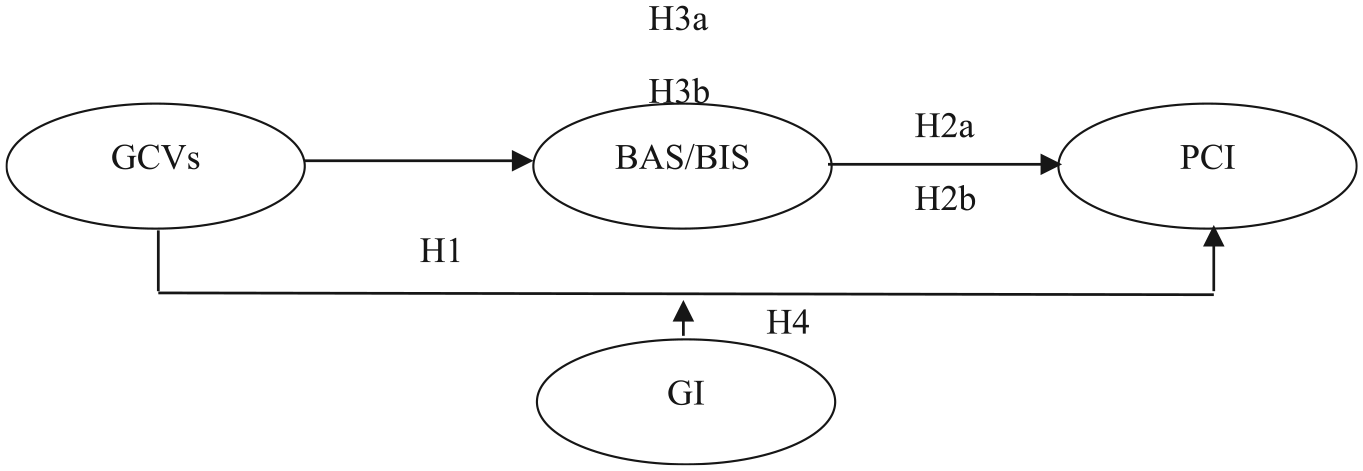
Theoretical research model.
Method
Data Collection and Sample Description
Data were collected from actual shoppers in four urban Chinese shopping streets—including Chongqing Road of Changchun, Henan Street of Jilin, Taiyuan Street of Shenyang, and Central Street of Harbin—through face-to-face intercept surveys. Shoppers were randomly intercepted and recruited to participate in this study. Data were collected from 10:00 a.m. to 5:00 p.m. The face-to-face surveys were administered by research assistants who were well trained and instructed in intercepts and interviewing techniques.
Participants
Participants were assured that the collected data of this research would be used exclusively for academic purposes. Participants were asked to read a paragraph, including the following content, before proceeding to the surveys: If you need to buy a refrigerator for your family, there are two kinds of refrigerators you can choose, which are the energy-efficient refrigerator and the ordinary refrigerator. Compared with the conventional refrigerator, the energy-efficient refrigerator is consistent in freezing and refrigeration, but has better energy efficiency and a higher price.
Following Bentler and Chou’s (1987) and Hair et al.’s (2014) suggestions, the sample sizes should be at least 15 times the number of the items in the measure of the observed variables to ensure good statistical power of the study. In this study, there were 34 items, so the minimum sample size required was 510 samples, and 741 out of 1,000 intercepted shoppers agreed to complete the survey questionnaire, resulting in a 74.1% response rate. Therefore, the statistical analysis of this study had strong statistical power.
The demographic profile of these shoppers can be characterized as follows: There were slightly more female participants (59.2%); approximately 62% of the participants were aged between 18 and 25 years old; 26% were married and 74% were single; 74.4% had completed a university degree; and all income ranges were well represented, as 21.9% reported income between 12,000 and 15,000 Renminbi (RMB), and 8.8% had an income greater than 80,000 RMB.
Measures
Scale structure and reliability analysis
The measurement scales employed in this research were developed and validated in a past study. For GCVs, we used a six-item scale adapted from Haws et al.’s (2014) study. In this study, the Cronbach’s alpha was .914. For the BAS and the BIS, we used 13 (BAS) and seven items (BIS) that were adapted from Carver and White’s (1994) study. In this study, the Cronbach’s alphas were .915 and .769, respectively. The PCI scales used three items adapted from Ajzen’s (1991) study, and GI scales used five items adapted from Traylor and Joseph’s (1984) study. In this study, the Cronbach’s alpha for the PCI scale was .831, and the Cronbach’s alpha for the GI scale was .897. All items were rated on a 5-point Likert-type scale, and all Cronbach’s alpha exceeded .700, exhibiting sufficient reliability.
Validity Analysis
Except for BIS (0.424), other constructs’ average variance extracted were all above 0.500, and all constructs’ consistency reliability were above 0.700. The chi-square value for the confirmation factor analysis containing all research construct measures was 2,493.831. Other goodness-of-fit measures were χ2/df = 6.704, non-normed fit index = 0.814, comparative fit index = 0.837, and root mean square error of approximation = 0.088.
We also followed Bollen and Stine’s (1992) model and analyzed the model fit of this research. The Bollen-stine bootstrap tests were 2,000 times; the results showed that the χ2 was 515.49, χ2/df = 1.386, comparative fit index = 0.931, non-normed fit index = 0.925, and root mean square error of approximation = 0.023. We also chose five demographic variables as control variables in this research (gender, age, income, marital status, and education). Construct analyses are shown in Table 1.
Mean, Reliability, and Validity.

Note. SD = standard deviation; AVE = average variance extracted; CR = composite reliability; GCV = green consumption value; PCI = pro-environmental consumption intention; BAS = behavioral approach system; BIS = behavioral inhibition system; GI = green involvement; NNFI = non-normed fit index; CFI = comparative fit index; RMSEA = root mean square error of approximation.
Intercorrelations among the variables are reported in Table 2. The results indicated that GCVs were significantly related to PCI (r = . 697, p < .001), BAS (r = .446, p < .001) and BIS (r = .299, p < .001) were significantly related to PCI, GCV was significantly related to BAS (r = .527. p < .001), GCV was significantly related to BIS (r = .322, p < .001), and GI was significantly related to PCI (r = . 632, p < .001).
Zero-Order Correlations Between All Variables (N = 741).
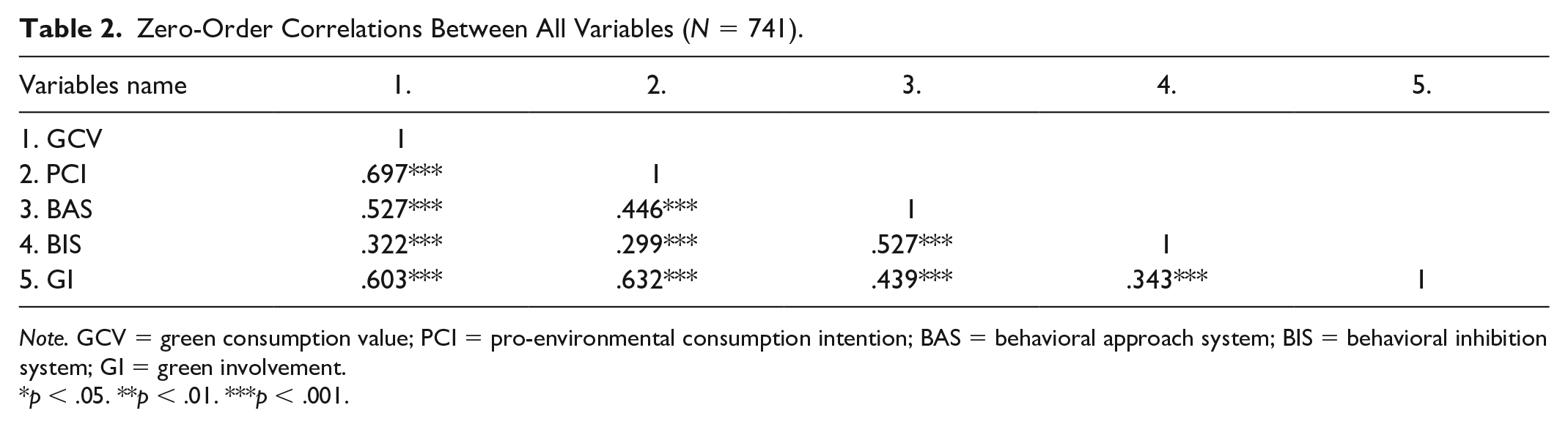
Note. GCV = green consumption value; PCI = pro-environmental consumption intention; BAS = behavioral approach system; BIS = behavioral inhibition system; GI = green involvement.
p < .05. **p < .01. ***p < .001.
Results
Total and Indirect Effects
This study used the Partial Least Squares Structural Equation Model (PLS-SEM) to test the hypotheses. By comparing with the hierarchical linear regression model (e.g., ordinary least squares [OLS]) and traditional structural equation model (e.g., Analysis and Moment of Structure [AMOS]), PLS-SEM relaxes the restrictions on normal distribution and sample size, which helps researchers to more easily explore the relationship between variables (Hair et al., 2012). In this study, the independent variable was GCVs, the dependent variable was PCI, and the mediating variables were BAS and BIS. There were five control variables in the model (gender, age, income, marital status, and education). In accordance with the method of Hair et al. (2012), this research used the 2,000 times bootstrapping method to test the total effect, direct effect, indirect effect, and moderation effect of the variables.
When testing for the total effects, results showed that the five control variables, except for married (t-value = 2.222, p < .05), did not account for a significant portion of the variance in PCI. GCVs positively and significantly influenced PCI (total effect: path coefficient = 0.730, standard deviation [SD] = 0.025, t-value = 29.177, p < .001; direct effect: path coefficient = .640, SD = 0.035, t-value = 18.129, p < .001), denoting that H1 was supported.
BAS positively and significantly influenced PCI (path coefficient = 0.097, SD = 0.049, t-value = 2.001, p < .05), denoting that H2a was supported. However, BIS did not significantly influence PCI, denoting that H2b was not supported.
When testing for indirect effects, results showed that the indirect effect between GCVs and PCI was significantly supported (indirect effect: path coefficient = 0.090, SD = 0.026, t-value = 3.401, p < .01), and we found that GCVs positively and significantly influenced BAS (path coefficient = 0.645, SD = 0.028, t-value = 22.858, p < .001), and BAS positively and significantly influenced PCI (path coefficient = 0.097, SD = 0.049, t-value = 2.001, p < .05). Therefore, the BAS positively and significantly mediated the relationship between GCVs and PCI, denoting that H3a was supported.
Although GCVs positively and significantly influenced BIS (path coefficient = 0.418, SD = 0.037, t-value = 11.087, p < .001), BIS did not significantly influence PCI (path coefficient = 0.066, SD = 0.040, t-value = 1.586, ns). Therefore, the BIS did not positively mediate the relationship between GCVs and PCI, and H3b was not supported (see Table 3).
Test of Total Effect, Direct Effect, and Indirect Effect Between All Variables, Except for Green Involvement (N = 741).

Note. 2,000 times bootstrapping model. SD = standard deviation; GCVs = green consumption values; PCI = pro-environmental consumption intention; BAS = behavioral approach system; BIS = behavioral inhibition system.
p < .05. **p < .01. ***p < .001.
Moderation Effect
When testing for the moderation effects (Table 4), results showed that all five control variables did not account for a significant portion of the variance in PCI. GCVs positively and significantly influenced PCI (path coefficient = 0.549, SD = 0.040, t-value = 13.829, p < .001); GI positively and significantly influenced PCI (path coefficient = .326, SD = .044, t-value = 7.488, p < .001); the interaction between GCVs and GI positively and significantly influenced PCI (path coefficient = .047, SD = .020, t-value = 2.206, p < .05), showing that the moderation effect was significant, which denoted that H4 was supported.
Test for the Moderation Effect of GI in the Relationship Between GCVs and PCI (N = 741).

Note. 2,000 times bootstrapping model; GI = green involvement; GCVs = green consumption values; PCI = pro-environmental consumption intention; SD = standard deviation; BIS = behavioral inhibition system.
p < .05. **p < .01. ***p < .001.
Discussion
This article aimed to show empirical evidence of the relationship between GCVs and PCI. First, we showed that a consumer’s intention to use a pro-environmental product was influenced by the GCVs using the theory of consumer values in the pro-environmental consumption setting. Second, we found that the pro-environmental consumption setting activated consumers’ approach motivation, but that it did not activate avoidance motivation, which meant that, when GCVs were influenced by BAS—not BIS—such influence affected consumers’ PCI. Third, we confirmed the moderating effect of GI in the relationship between GCVs and PCI; consumers with higher GI were able to evaluate the environmental effect of the pro-environmental behavior, which was an influence mechanism for GCVs that affected PCI. Thus, compared with lower GI consumers, higher GI consumers had their GCVs influenced and became more likely to produce PCI.
In this research, there were two hypotheses that were not supported (H2b and H3b), and both focused on the relationship between BIS and PCI. After analyzing, we found two possible reasons for why these hypotheses were not supported: First, based on the prospect theory (Tversky & Kahneman, 1981), when a gain-framed message is targeted toward a distant future, consumers tend to exhibit more positive attitudes and higher purchase intentions than when the message is targeted at the present moment (Chang et al., 2015). When consumers buy green products, they often base their psychological imagery in a scenario that makes the future a better place; so, because the activation of the BIS requires avoidance, and such a relatively positive imagery does not usually evoke one’s desire to avoid such future, green consumption could not activate the BIS, so it did not affect the PCI. Second, consumer’s avoidance motivation for environmental pollution is an indirect motivation type, which, compared with the benefits that environmentally friendly products evoke in the situation of green product purchases, may be hard to be perceived by consumers. Therefore, the hypotheses were not supported.
Thus, green consumption behavior was empirically associated with personal values; the consumer will be more involved with the green consumption behavior. The current findings may help the field of pro-environmental behavior change further to improve theory-driven empirical approaches that study the effect of values on consumers’ intention, as well as develop better and more efficient consumer GCVs to promote pro-environmental consumption behaviors.
Managerial Implications
This study not only extends the conventional theory of green consumption behavior but also provides a reference for the government and enterprises on how to bridge the gap between people’s GCVs and their actual behavior. For the government, first, it could use soft power policy tools to help people improve their GCVs, include educational interventions to promote pro-environmental knowledge, public service advertising, establishing a hero of environmental protection, reward for environmental activities, and so on. Second, it could adjust industrial policies to promote the development of environmentally friendly products, enable the pro-environment industry to gradually replace the backward non-environmental industries, and increase the supply and availability of environmentally friendly products.
For enterprises, first, in the sales environment, incentives toward activating consumers’ approaching motivation should be added, so that he or she can perceive the benefits brought by the eco-friendly product to nature and themselves in an environmental-friendly space/situation. Second, they could adjust product structure by increasing the development and supply of environmentally friendly products, by enhancing consumers’ awareness of environmentally friendly products through product advertising, and by helping consumers in the formation of their GCVs.
For consumers, it is important that they establish GCVs. At the same time, the purchase of green products should not only be a passive choice made based on the manufacturer’s marketing and stimuli but also be consumers’ active choice, which can be enhanced by their own perceptions as they are able to promote environmental improvements through their own pro-environmental behaviors that enable the development of society toward green and environmental protection.
Limitations and Directions for Future Research
No study is without limitations. The first limitation of the present study was that shoppers lived in a specific area: the north area of China; furthermore, although we attempted hard to make sample collection as randomized as possible, sample distribution was not normal. Even if we used the PLS-SEM method to correct the bias coming from the non-normal distribution, such an approach still poses several limitations.
The second limitation of the present study was that the research method used to analyze BAS and BIS is brain neuron cognitive systems connected to participants’ brains, but it was difficult to introduce them into the green product purchase scenario owing to limitations of the conditions in which we performed the study. The questionnaire survey method can only be used according to the experience of previous scholars (Carver & White, 1994), which affects the accuracy of this study to a certain extent.
The present study was one of the first to uncover the relationship between GCVs and PCI from the BAS/BIS perspective. In sum, consumers should establish appropriate GCVs. At the same time, the purchase of green products should not only become a passive choice made based solely on manufacturer’s marketing but also become the active choice of consumers themselves, which could happen by promoting environmental changes through our own environmental behaviors and promoting the development of society toward green and environmental protection.
Footnotes
Declaration of Conflicting Interests
The author(s) declared no potential conflicts of interest with respect to the research, authorship, and/or publication of this article.
Funding
The author(s) disclosed receipt of the following financial support for the research, authorship, and/or publication of this article: This study is supported by National office for Philosophy and Social Sciences (Grant number 18BGL215).
