




Abstract
Traditional patterns are enriched with unique ethnic and artistic significance and serve as a valuable inspiration for creating culturally innovative products. This study employs a Kano model-based user needs analysis rooted in the Three Levels of Culture theory to explore the must-be, one-dimensional qualities of cultural creative products inspired by the traditional patterns of the She Nationality. The findings suggest that optimizing the transformation design of traditional She Nationality patterns should focus on three key areas: cultural memory, modern innovation, and design aesthetics. Building on this foundation, this study applies extenics theory to establish a comprehensive semantic design framework for traditional patterns, specifically focusing on the iconic Panhu pattern through empirical research. The research methodology established in this study highlights the investigation of the visual characteristics and cultural significance embedded in the patterns. The systemic and structured elements are adaptable for open-ended extension. This approach supports realizing the three transformation design objectives, substantially contributing to the sustainable development of innovative cultural and creative products inspired by traditional patterns.
Keywords
Introduction
Patterns emerge and evolve from simple, unembellished graphic symbols. Traditional patterns embody human ingenuity and craftsmanship, reflect aspirations and ideals, and act as vessels of cultural memory. Chinese traditional patterns, shaped over thousands of years, are rich in unique ethnic traits and cultural meanings. These patterns hold considerable artistic value and offer a wealth of inspiration for creating cultural and creative products.
The innovative transformation of traditional patterns involves integrating their visual features and cultural meanings into creative cultural products, offering an effective method for preserving and passing on ethnic cultural heritage (Gong, 2020; Zhou, 2019). Currently, there are three key challenges in the transformation design of Chinese traditional patterns. Initially, designs often replicate traditional patterns without fully exploring or harnessing their embedded cultural meanings. In addition, overreliance on designers’ personal experiences and emotional interpretations may compromise the quality of transformation design because it can be influenced by varying levels of cultural understanding. In addition, cultural and creative products often fail to respond swiftly to user needs and adapt to changes in the consumer market. As a result, designs of Chinese cultural and creative products incorporating traditional patterns often fail to align with market demand, resulting in considerable homogenization and a lack of ethnic identity and aesthetic value (Ma & Zheng, 2021). These challenges have become obstacles to the sustainable use of traditional patterns.
The She Nationality is an ethnic minority in China with a profound cultural heritage (Ming, 2012). Without a written script, the She people use patterns as their main method of recording and transmitting their historical and cultural heritage. The historical heritage of the She Nationality’s traditional traditions is vast. These patterns encompass a broad range, capturing key elements of the She Nationality’s cultural memory and holding considerable artistic value (J. Li et al., 2020). Currently, cultural and creative products featuring the She Nationality’s traditional patterns are limited, with unclear market positioning and a lack of systematic development. They also encounter the same challenges associated with the transformation of traditional Chinese patterns, as previously mentioned. Therefore, this study uses the traditional patterns of the She Nationality as a case study to analyze user needs for cultural and creative products that incorporate traditional patterns and to investigate innovative design strategies for transforming these motifs.
Literature Review
Aesthetic Value of Traditional Patterns
Traditional patterns represent a vast repository of both explicit (visual features) and implicit (cultural meanings) knowledge. Explicit knowledge mainly pertains to patterns’ form, structure, and color, all of which are easily observable. Traditional patterns are primarily categorized into geometric, character-based, animal-inspired, plant-inspired, and human-related designs (Tian, 2003; Yu & Li, 2014). The zigzag pattern is a prominent symbol in the She Nationality’s geometric patterns, often featured on the collars, hems, and cuffs of their clothing. Animal-themed patterns, such as the 盘瓠 (Panhu) and phoenix motifs, are especially significant, as they represent a distilled expression of the She Nationality’s reverence for animal totem worship, deeply embedded in their myths and auspicious beliefs. Plant-inspired patterns such as those featuring pomegranates and peonies are characterized by bold and ornamental qualities. The structure of the She Nationality’s traditional patterns can be classified into continuous, irregular, adaptive, and symmetrical. Deep blue and black are the primary colors representing the She Nationality, enhanced by secondary hues such as red, magenta, yellow, and green, which together create a vivid and ethnic palette (J. Y. Chen, 2013; Y. M. Li, 2019; H. L. Qiu, 2011; Xia, 2017).
The implicit knowledge within traditional patterns includes historical narratives, spiritual meanings, aesthetic principles, and ethnic traits, all of which are highly personal and intangible. A common belief among the public is that “a picture must convey meaning,” implying that traditional patterns must carry symbolic significance. The phrase “a picture must have meaning” (traditional patterns must have symbolism) is a common understanding among the public. The cultural meanings of these patterns emerges from their embeddedness in folklore, their role in shaping collective cultural identity, and their harmony with the natural environment (Zhu et al., 2010). A major challenge in transforming traditional patterns is the extraction and communication of implicit knowledge, which is often achieved through metaphors and reasoning, during the design process.
Transformation Design of Traditional Patterns
The transformation design process for traditional patterns involves three key stages: collecting patterns, extracting pattern elements, and applying them innovatively. Studies on the transformation design of traditional Chinese patterns have focused primarily on these three stages. The key areas of focus include exploring traditional pattern resources, developing methods for extracting pattern elements, and implementing innovative approaches to transform these elements. Among these areas, the extraction of traditional pattern elements remains a central issue in this field of study.
Methods for extracting traditional pattern elements have evolved, with graphic deconstruction being the earliest approach. This approach depends on the designers’ interpretations and perceptions of traditional patterns, involving the manual breakdown of these patterns into fundamental elements. M. T. Zhao and Wang (2018) analyzed pomegranate patterns in 12 Qin embroidery zodiac products and extracted graphics and colors to create basic elements. Q. X. Zheng and Liang (2014) derived elements from gemstone flower patterns in Tang Dynasty garments by examining overall designs, petal motifs, and color schemes. With advances in computer science, computer-aided element extraction methods have been developed. These methods employ graphic processing software and computer technology to digitize traditional patterns, enabling the segmentation and extraction of key elements. Hou et al. (2019) introduced an automated method for segmenting elements in national dress patterns using morphology-connected component labeling and the CV model (MCC-CV). Zhan and Zhao (2020) extracted peony pattern elements by quantitatively analyzing their hierarchical structure combined with a qualitative analysis of pixel processing for peony colors. A recently developed semantic extraction technique transforms subjective visual features into semantic vocabulary by analyzing patterns’ semantic attributes. Jiang and Dong (2020) identified 16 pairs of semantic vocabulary representing the cultural significance of Yao Nationality’s clothing patterns in a survey conducted with tourists.
The above methods have certain limitations. The graphic deconstruction extraction approach is highly dependent on the designer’s expertise, which can result in errors during pattern deconstruction, especially if the designer lacks sufficient experience or leans excessively toward standardization. Although computer-aided extraction methods enhance efficiency, they often cannot interpret the cultural intricacies within patterns, which can lead to inaccurate element extraction. The semantic extraction method is adept at exploring the visual features and cultural meanings of patterns and is still in its early stages of development for comprehensive pattern interpretation. However, the proposed semantic extraction method requires further refinement.
Research on Transformation Design of She Nationality’s Traditional Patterns
Research on the transformation design of traditional She Nationality patterns remains scarce. Existing studies have mainly focused on explicit knowledge and extracting visible features for design applications. For example, P. P. Liu & Yu (2022) investigated innovative applications of embroidery patterns from traditional weaving and embroidery in She Nationality by analyzing their shapes and structures. Similarly, X. Zheng (2017) analyzed phoenix and flower patterns in She Nationality clothing and adapted them into a design framework.
The transformation design of traditional She Nationality patterns should go beyond merely highlighting explicit knowledge. Implicit knowledge, as a unique and vital element of these patterns, is integral to establishing the core competitive edge of design products (Y. H. Pan & Zhu, 2007). Designing a product without integrating implicit knowledge into a country’s traditional patterns lacks the corresponding cultural value. Implicit knowledge often embodies complex cultural meanings that are assigned varying importance to different elements. Z. L. Li et al. (2022) explored the cultural significance inherent in the patterns of the She Nationality’s silver jewelry. Through qualitative methods, they created cultural maps of these patterns, laying the groundwork for their reinterpretation and incorporation into product designs. Currently, She Nationality’s cultural creative products fail to fully capture the implicit knowledge within the patterns and lack the integration of systematic and rational approaches.
In summary, scholars have embarked on partial and phase-specific explorations of the transformation design of She Nationality’s traditional patterns, examining both explicit and tacit knowledge representation (Table 1). However, the current state of transformation design in She Nationality’s traditional patterns predominantly relies on experiential and intuitive approaches. It lacks the capacity to systematically generate schemes based on predefined principles and is challenged in its ability to swiftly respond to user needs.
Studies of Transformation Design in Traditional She Nationality Patterns.

In summary, the researchers conducted focused, stage-specific analyses of the transformation design in traditional She Nationality patterns, investigating explicit and implicit knowledge representation (Table 1). However, the current approach to transformation design in traditional She Nationality patterns is largely based on experiential and intuitive methods. The proposed model lacks a structural framework for generating solutions based on established principles, and it struggles to quickly adapt to user needs.
Extenics and Extensive Design
Extenics, a theory developed by Chinese Professor Cai Wen (Cai, 1990; Cai et al., 1997), uses formalized models to intricately describe the objective world. Extenics investigates the principles and techniques related to extension and innovation, particularly concerning “things” and “objects.” Its primary aim is to methodically resolve contradictory issues within a scientific framework (David & Cai, 1997). At its core lies extension element theory, which breaks down objects into components and systematically examines their characteristics using formal methods such as numerical and textual representations. Building on this foundation, Extenics explores how the characteristics of these elements can be extended. Specifically, it employs structured triplets—comprising “element (N), characteristic (C), and value (V)”—to form a formalized model (R) of elements [R = (N, C, V)]. These models were used as the basis for qualitative analysis and quantitative evaluation of element characteristics (Cai, 1999).
In recent years, extenics has seen notable applications, especially in the field of novel product conceptualization and design, leading to a wide range of design innovations (Y. W. Zhao et al., 2006, 2015). Based on the theoretical foundation of extenics, extensive design applies formalized modeling, transformation, extension, and evaluation to research subjects. It focuses on resolving complex and contradictory issues that often emerge in product design processes, resulting in the development of innovative and intelligent design solutions (T. Wang & Li, 2022; L. H. Yang et al., 2020). To address the inherent conflicts between the user requirements of existing products, extensive design incorporates three unique creative approaches. The first approach involves a thorough analysis of user requirements, which are then represented as element characteristics. This transformation and extension approach creates innovative, entirely new product solutions. The second methodology begins with existing products that are translated into elemental representations. Transformative and expansive strategies are applied to these representations, paving the way for the creation of entirely new product concepts. The third methodology is based on an analysis of deficiencies in current products. These limitations are portrayed through element characteristics. Using transformation and extension techniques, this approach produces fresh and innovative product schemes (C. Y. Yang & Cai, 2016).
Extensive Semantic Design
Extensive semantic design is a specialized approach within the framework of extensive design (P. P. Liu & Yu, 2022). This approach follows a structured six-step process: (a) Feature Exploration: Identifying element characteristics, including visual traits and cultural meanings. (b) Semantic Transformation: Translating the subjective features of elements into organized semantic characteristic vocabularies through the application of semantic reasoning. (c) Quantification of Semantic Features: Measuring the degree to which semantic vocabulary encapsulates inherent characteristics, thereby creating a precise semantic model for the elements. (d) Visual Representation: Emphasizing visual expression by employing graphic thinking to effectively convey semantic features vividly. (e) Graphics Expansion: Broadly developing graphical elements to yield a wide variety of creative materials. (f) Creation of Novel Designs: Developing and evaluating innovative patterns or designs to identify the most suitable options.
Extensive semantic design is especially effective for the creation and design of shapes and patterns. It effectively addresses challenges related to formalization and quantification in the creative thinking process. This approach has already demonstrated significant applications in various domains, including the design of creative cultural products and service-oriented offerings (X. Chen & Wu, 2018; Duan et al., 2019). W. L. Li et al. (2020) applied extensive semantic design in the development of service products, incorporating the “Sun God Bird” pattern from Chengdu City as a key element. This approach led to a striking exterior design for Chengdu subway trains, seamlessly blending regional culture into the design. Similarly, P. P. Liu & Yu (2022) drew inspiration from China’s Beichen peasant paintings, applying extensive semantic design principles to the creative process, which led to the development of innovative products that deeply resonate with cultural values.
In summary, comprehensive semantic design, which is based on semantic analysis and visual representation of semantic features, includes quantitative analysis of design terminology and incorporates visual attributes and cultural meanings. This approach significantly reduces reliance on subjective experiences during the design process, promoting a more organized and methodical framework for creative work.
Research Methods
User Needs Analysis
The Kano model, pioneered by Professor Noriaki Kano, is a key instrument for organizing and prioritizing user requirements during product design and development stages (J. Yang, 2017). This model enhances product optimization by aligning it more closely with user needs by categorizing these needs into five distinct groups: must-be quality (M), one-dimensional quality (O), attractive quality (A), indifferent quality (I), and reverse quality (R).
Incorporating visual elements and cultural significance is crucial in the transformation of traditional patterns. To guide this process, the Three Levels of Culture theory was applied to identify key items for transforming the She Nationality’s traditional patterns. Leong and Hazel (2003) categorized culture into three distinct levels: external tangible, intermediate behavioral, and internal intangible. Later research has expanded on and applied this framework, especially in the areas of visual, functional, and emotional design (Y. W. Liu & Zhou, 2021). Using this approach, this study identified 12 items that need to be transformed for traditional She Nationality patterns (Figure 1).
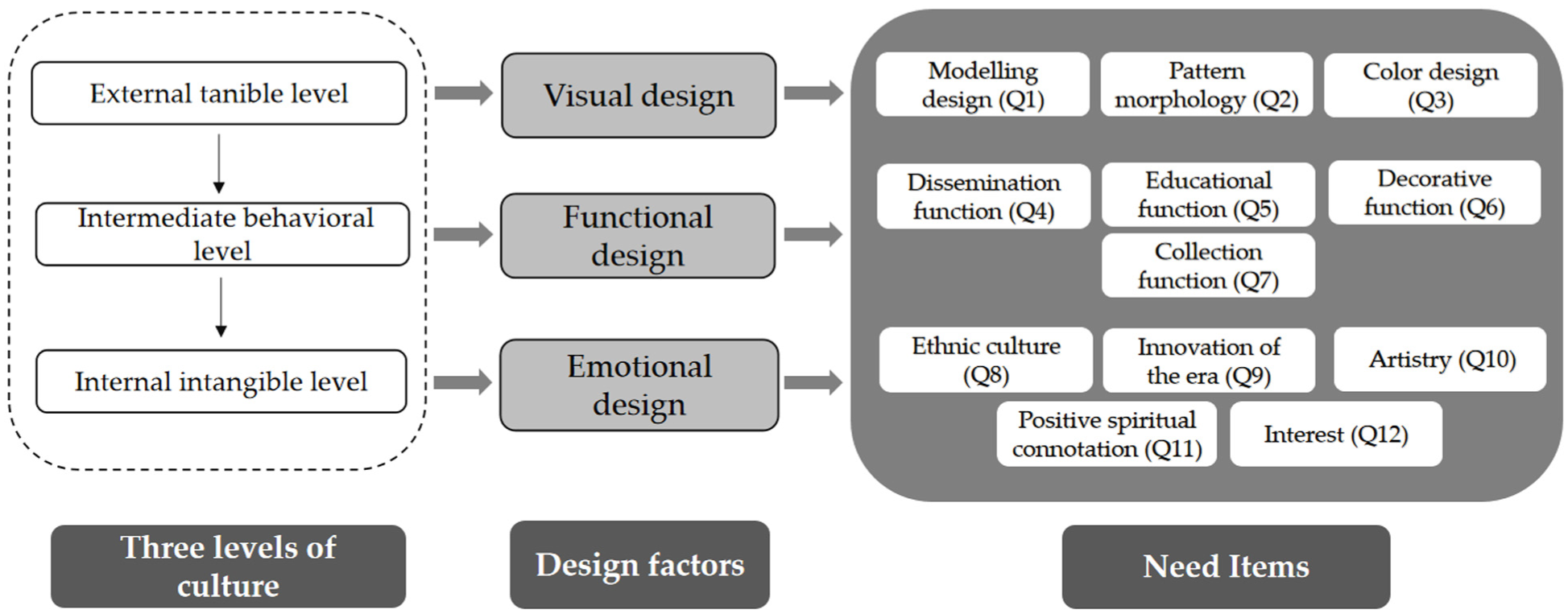
Three Levels of Culture of user needs for the transformation design of the She Nationality’s traditional patterns.
This study uses a questionnaire designed for the transformation of She Nationality’s traditional patterns, based on the Kano model. The questionnaire was divided into two main sections. The first section collected essential demographic data from the participants, while the second was aligned with the Kano framework. The proposed model includes the previously identified user need items and evaluates user satisfaction concerning the presence or absence of these specific elements. The demand attributes for each item were determined using the Better-Worse coefficient method (Berger et al., 1993). The satisfaction coefficient (Kbetter) and dissatisfaction coefficient (Kworse) for these user needs were calculated using the formulas Kbetter = (A+O)/(A+O+M+I) and Kworse = −(M+O)/(A+O+M+I), respectively. Furthermore, following the methodology proposed by Z. L.Li et al. (2022), the relative importance (ω) of each need item was assessed, enabling prioritization in the design process.
Extensive Semantic Design Approach of Traditional Patterns
The extensive semantic design method plays a vital role in extracting semantic insights from explicit knowledge of traditional patterns, including their forms, compositions, and lines. This explicit knowledge is then translated into a visual language. At the same time, the method delves into implicit knowledge that is challenging to articulate in a rational or standardized manner, revealing the subtle semantic features inherent in traditional patterns. Then, it employs graphical reasoning to visually represent these semantic features, facilitating the extension and evolution of graphic elements, which serve as a powerful design tool for innovating traditional patterns. The process of extensive semantic design for traditional patterns (Figure 2) comprises three key stages: semantic analysis, graphical representation of semantic features, and extension of semantic graphics.

Extensive semantic design process of She Nationality’s traditional patterns.
Extensive Semantic Analysis
Utilizing extension element theory, let P represent the semantic model of the She Nationality’s patterns, S denotes the embodiment of these patterns, C represents the semantic characteristic vocabulary associated with the patterns, and V is the extensive interval capturing the values of this semantic vocabulary. In the extensive semantic design of the She Nationality’s patterns, the semantic model can be expressed as P = [S, C, V]. Assuming each She Nationality pattern expresses n semantic vocabulary elements denoted by C, with each element Ci having a corresponding extensive interval Vi, this interval can be further subdivided into Vx and Vy. Here, Vx represents the association with cultural meanings intrinsic to She Nationality’s patterns, whereas Vy indicates the design value within the traditional cultural context of She Nationality.
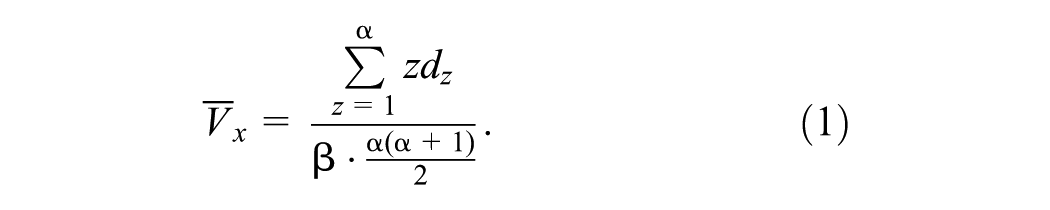
The significance of cultural connotations within each semantic characteristic vocabulary item was evaluated using a scoring scale. The scoring interval for each semantic characteristic vocabulary ranged from 1 to α was assumed, with α representing the maximum score. The total number of participants in this assessment is denoted by β, while dz represents the number of scores assigned to each semantic characteristic vocabulary. The mean value Vx of each semantic characteristic vocabulary is computed as follows:
In the parallel evaluation, the design values were examined. Assuming that the nth evaluator assigns a cultural value score, bn, to the corresponding semantic characteristic vocabulary, where bn∈ [1, θ], and n∈ [1, φ], with θ representing the maximum possible score and φ indicating the total number of evaluators, the formula for calculating the mean Vy for each semantic characteristic vocabulary is given below:

An extensive semantic evaluation of the She Nationality’s pattern semantic characteristic vocabularies was conducted in the proposed comprehensive approach, with both cultural connotation relevance and design value. Consequently, the extensible interval V for the She Nationality’s pattern semantic characteristic vocabularies is calculated as follows:

An elevated V value reflects a stronger connection to cultural connotations and denotes greater cultural importance in design applications.
Graphical Representation of Semantic Features
Divergent thinking is essential in the transformation design of a Nationality’s patterns, enabling the exploration of diverse design possibilities. By employing graphic thinking—an open and visually cognitive approach—semantic vocabulary elements are represented and analyzed, fostering the generation of design concepts (Y. H. Pan & Zhu, 2007; Zhu et al., 2010). Unlike textual descriptions’ potential vagueness, visual representations provide a more direct influence on design inspiration and creativity. Recognizing visual elements that align with semantic meanings can effectively expand the designer’s creative scope and improve innovation within the design process. To this end, a search for suitable semantic graphics was conducted using web-based resources, followed by a preliminary screening using the Delphi method. Subsequently, the identified semantic graphics were performed.
The recognition of a graphic (Vgx) was assessed based on the premise that the n-th evaluator assigns a recognition score cn to each graphic, where cn∈ [1, θ]. In this context, φ represents the total number of evaluators, and θ denotes the maximum possible score. The mean Vgx of each graphic was calculated using the following formula:

Concurrently, the design value of graphics was assessed by assuming that the n-th evaluator assigns a design cultural value score fn to the graphic, where fn∈ [1, θ]. In this context, φ represents the total number of evaluators, and θ denotes the maximum possible score. The formula for calculating the mean Vgy of each graphic is as follows:

Using this holistic approach, an in-depth evaluation of semantic graphics in She Nationality’s patterns was conducted, addressing both graphic recognition and design value dimensions. As a result, the extensible interval Vg for the semantic graphics of She Nationality’s patterns was calculated as follows:

A higher Vg value indicates improved graphic recognition and a stronger cultural relevance in design applications.
Extension of Semantic Graphics
The transformation design of traditional She Nationality patterns is deeply rooted in a modern cultural framework. This approach harmonizes the cultural significance of these patterns with a design strategy that resonates with contemporary advancements. It involves breaking down and reassembling graphics to authentically represent semantic features, resulting in innovative, culturally unique, and aesthetically modern designs. This stage, known as the extension of semantic graphics (W. W. Wang et al., 2017), begins with the vectorization of semantic graphics and proceeds with morphological analysis to dissect the original designs. Subsequently, the fundamental principles of shape grammars (SG; Han, 1993; D. Liu & Sun, 2022) are employed to enable the morphological evolution of patterns. By adhering to these basic core transformation rules, specific constraints are introduced to consciously steer the evolution of design styles. This approach ensures that the resultant design retains a strong connection to the creative logic inherent in She Nationality’s patterns while seamlessly integrating modern aesthetic sensibilities.
The application of SG in extending semantic graphics serves a dual purpose: It preserves the essential characteristics of the original pattern, ensuring continuity, while also enabling the creation of novel forms that align with contemporary aesthetics. Through this process of morphological evolution, creative source materials specifically tailored for She Nationality’s pattern innovation were generated, providing a solid foundation for subsequent innovative pattern designs.
Case Analysis
User Needs in the Transformation Design of Traditional She Nationality Patterns
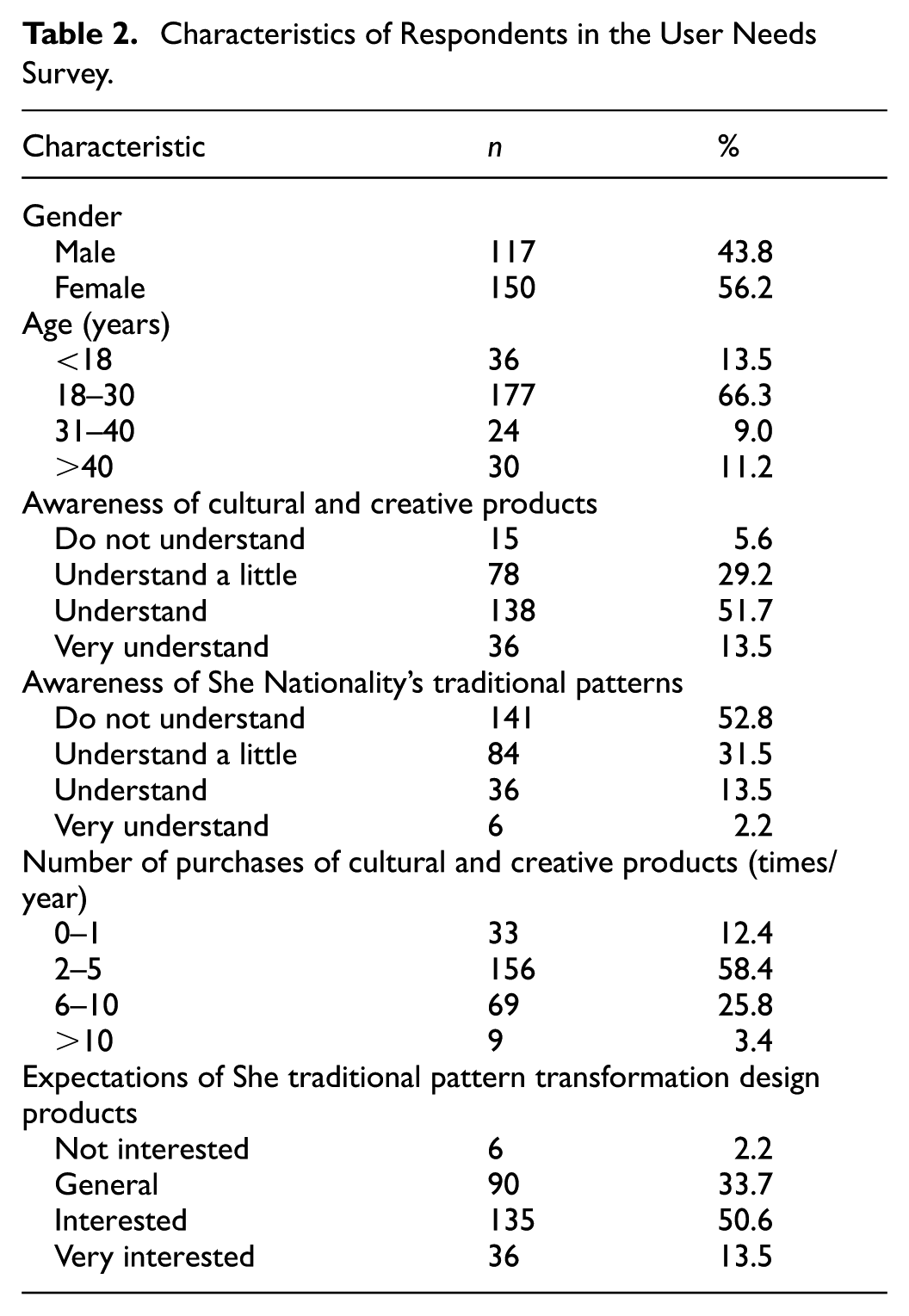
In this section, user needs for the transformation design of traditional She Nationality patterns were examined. A total of 294 questionnaires were randomly distributed randomly to respondents, both online and offline. Offline distribution occurred at Jingning She Museum, Cangnan Daili She Tourist Attraction, and Tonglu Eshan She Tourist Attraction, where one willing tourist was randomly intercepted every 10 min for interviewing to ensure sample randomness. Online distribution was conducted via SoJump (https://www.wjx.cn), China’s leading online survey platform. The survey achieved a response rate of 93.9%, with 276 questionnaires returned. After excluding questionnaires with high duplicate rates and illogical responses, 267 valid questionnaires remained, yielding an effective rate of 96.7%. Reliability and validity analyses indicated strong survey robustness, with a Cronbach’s α coefficient of .829 and a KMO value of 0.786. Among the 267 respondents, 117 were male (43.8%) and 150 were female (56.2%).
Regarding familiarity with creative cultural products, 252 respondents exhibited varying levels of knowledge, with 234 (87.6%) reporting that they purchased such products twice or more annually. However, only 6 respondents had comprehensive knowledge of She Nationality’s traditional patterns, while 225 (84.3%) had limited or partial understanding. Notably, 135 respondents expressed interest in She Nationality’s pattern transformation design products, with 36 indicating very high levels of interest, collectively representing 64.0% (Table 2). These findings suggest a strong demand for creative cultural products by the surveyed population. Although their knowledge of She Nationality’s traditional patterns is limited, their significant interest in products derived from these patterns is noteworthy.
Characteristics of Respondents in the User Needs Survey.
The data collected from the structured questionnaires regarding user needs were employed to create a scatter plot of design need items using the Better-Worse coefficient method (Figure 3). This approach categorizes various need items based on specific attributes.
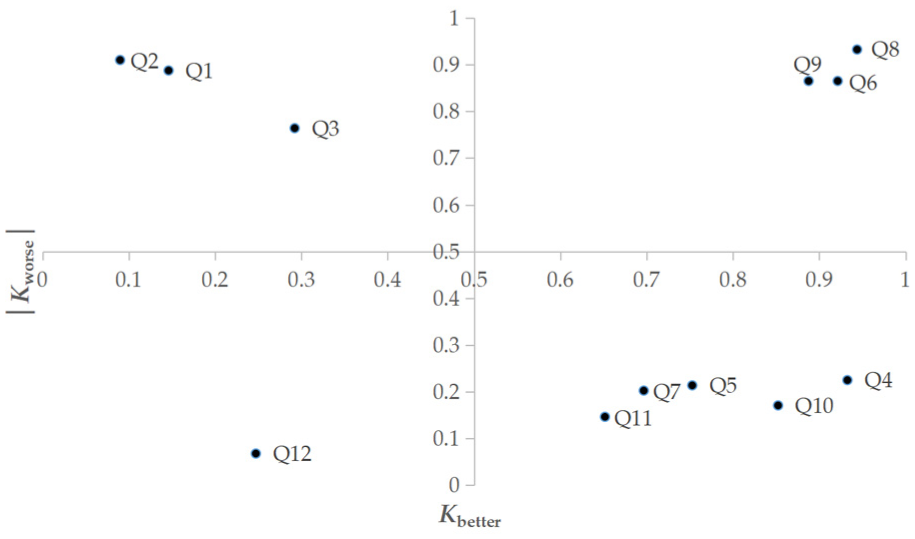
Scatter plot of design need items for the transformation design of She Nationality’s traditional patterns.
Using the methodology outlined by Z. L. Li et al. (2022) to assess the importance of need items, this study analyzed the relative significance of various need items within their respective categories. The analysis revealed the following hierarchical order of sensitivity coefficients: ω(ethnic culture) (1.327) > ω(decorative function) (1.264) > ω(innovation of the era) (1.240). In the M category, the sensitivity coefficients were ranked as follows: ω(pattern morphology) (0.914) > ω(modeling design) (0.900) > ω(color design) (0.818). For category A, the sensitivity coefficients were as follows: ω(dissemination function) (0.959) > ω(artistry) (0.869) > ω(educational function) (0.782) > ω(collection function) (0.725) > ω(positive spiritual connotation) (0.668). These findings indicate that ethnic culture, decorative function, and innovation of the era are crucial for user satisfaction, placing them in the second quadrant. In addition, in the domain of visual design at the external tangible level, the sensitivity coefficients for pattern morphology, modeling design, and color design are comparatively high, placing them within the second quadrant. This suggests that neglecting these three items would likely reduce user satisfaction, highlighting their essential role in design development.
Semantic Analysis of She Nationality’s Representative Panhu Pattern
Central to She culture is the veneration of the Panhu totem, an ancestral figure in She folklore (Han, 1993). The Panhu belief weaves its way through She ancestral portraits, genealogies, legends, songs, and even their attire (G. Z. Qiu, 2003). The Panhu pattern is the primary medium for the strong ethnic identity of the She Nationality. At the same time, the She people usually gathers together to form relatively independent communities, which allows the Panhu pattern to be passed down from generation to generation in a relatively closed environment. The closed nature of this cultural inheritance enables the Panhu pattern to still preserve its unique cultural connotations in modern society, becoming an important symbol and spiritual symbol of She culture. The Panhu pattern has also become an important link between the past and present, tradition and modernity, allowing people to glimpse the spiritual world and aesthetic taste of the predecessors.
In She costume patterns, Panhu often manifests as an exaggerated, almost surreal canine-like head (Figure 4). Panhu pattern is frequently embroidered onto children’s hats, affectionately known as “龙犬帽” (Dragon-Dog Hats). In this study, we focused on Panhu pattern of She Nationality. Through a meticulous process involving literature review and on-site investigations, we meticulously distilled and extracted the visual attributes and cultural connotations of Panhu pattern. Employing the nuances of semantic thinking, we distilled the essence of Panhu pattern into a set of semantic characteristic vocabularies: “gallant,”“auspiciousness,”“strength,”“power,” and “mystery.”

Panhu pattern of She Nationality.
Extensive Semantic Analysis of Panhu Pattern
To conduct a thorough analysis of Panhu pattern, we engaged 30 culture holders of She Nationality from various regions, including Jingning She Autonomous County, Tonglu Eshan She Township, and Cangnan Dailing She Township in Zhejiang Province to assess the cultural relevance. Culture holders of She Nationality refers to individuals who possess and uphold the cultural heritage of the She Nationality. Additionally, we enlisted five design professionals with a specialization in ethnic pattern design to evaluate the design value within She Nationality’s traditional cultural context. Respondents provided their evaluations using a rating scale from 1 to 5. The results of these evaluations are thoughtfully summarized in Table 3. The semantic model of Panhu pattern is as follows:

Extensive Range of Semantic Characteristic Vocabularies for PANHU Pattern.

Semantic Graphics for Panhu Pattern
To further refine the Panhu pattern, three primary semantic characteristic vocabularies—“gallant,”“auspicious,” and “mysterious”—were identified. An extensive online search was conducted, and the Delphi method was employed to select suitable semantic graphics, resulting in three distinct semantic graphics for each attribute, labeled g1, g2, and g3 (Table 4). A panel of five designers then comprehensively evaluated these semantic graphics, focusing on two key aspects: graphic recognition (Vgx) and design value (Vgy), both rated on a scale from 1 to 5. The results of these evaluations are summarized in Table 5.
Semantic Graphics of Panhu Pattern.

Extensive Range of Semantic Graphics for PANHU Pattern.

Extension and Design Process of Panhu Pattern
The initial phase involved vectorizing the semantic graphics associated with “gallant,”“auspiciousness,” and “mystery” to establish the foundation for the design schemes. Using shape grammar principles, this study employed various transformative techniques, such as addition, deletion, cutting, removal, replacement, scaling, translation, mirroring, rotation, contour deformation, and structural deformation. These methods were crucial in generating innovative materials for the Panhu pattern. Figure 5 shows the graphical extension process, highlighting g2 with the widest range for “gallant,”g3 with the widest range for “auspiciousness,” and g1 with the widest range for “mystery.”
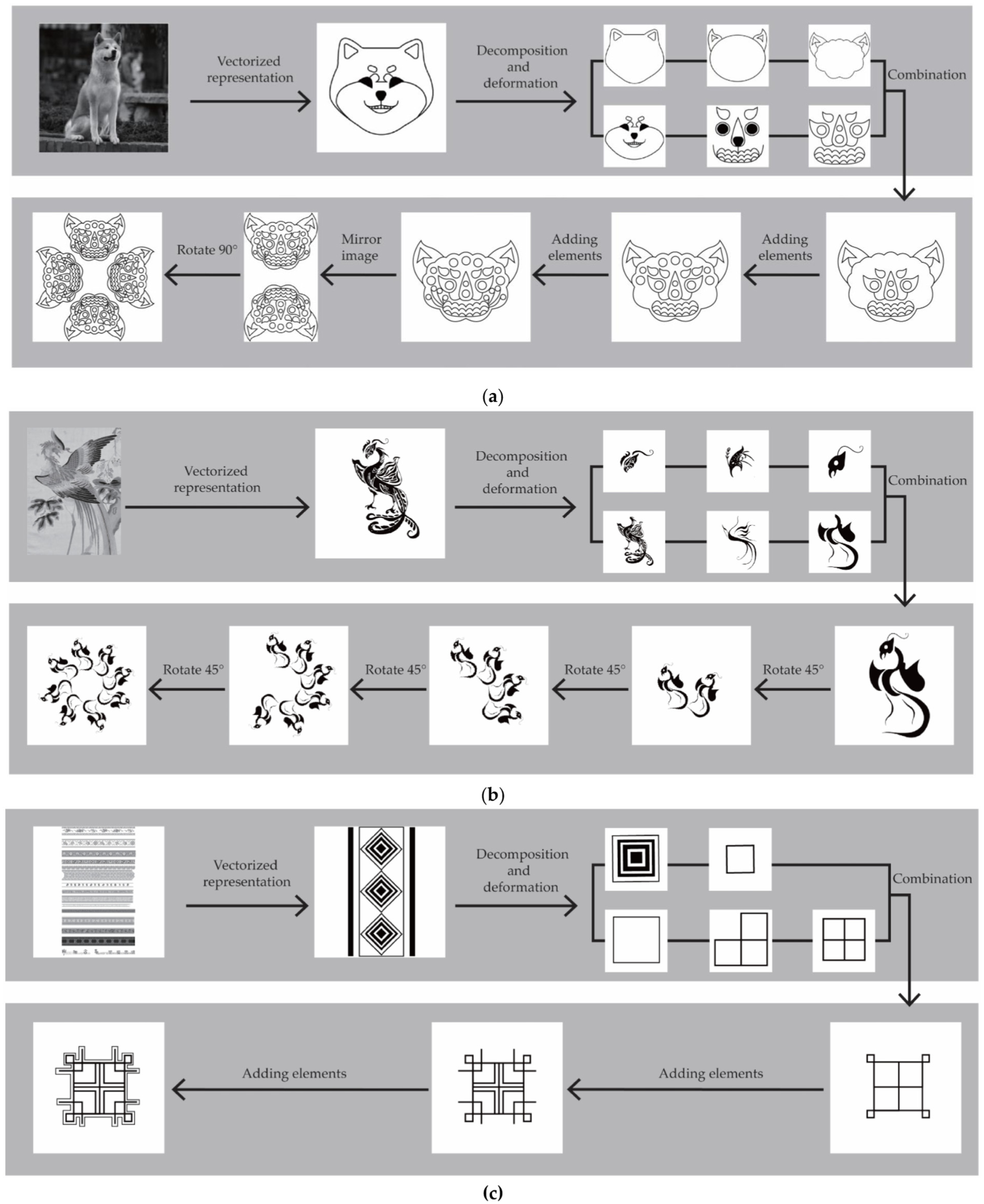
Examples of innovative materials for “gallant,”“auspiciousness,” and “mystery” attributes of Panhu pattern. (a) Innovative materials for g2 of “gallant”; (b) innovative materials for g3 of “auspiciousness”; and (c) innovative materials for g1 of “mystery.”
The creative materials prominently featured the primary “gallant” semantic graphic as the central element, seamlessly integrated with components from the “auspiciousness” and “mystery” semantic graphics. These materials form the basis for developing three distinct design schemes: S1, S2, and S3. Each scheme adhered to key design principles, with an emphasis on graceful, flowing lines. The outer contours of the designs were intentionally square, and each scheme demonstrates a balanced composition with vertical and horizontal symmetry. The interiors incorporate patterns inspired by elements such as peony flowers and tile motifs. Color selection was influenced by the distinctive color characteristics of the She culture (Figure 6).
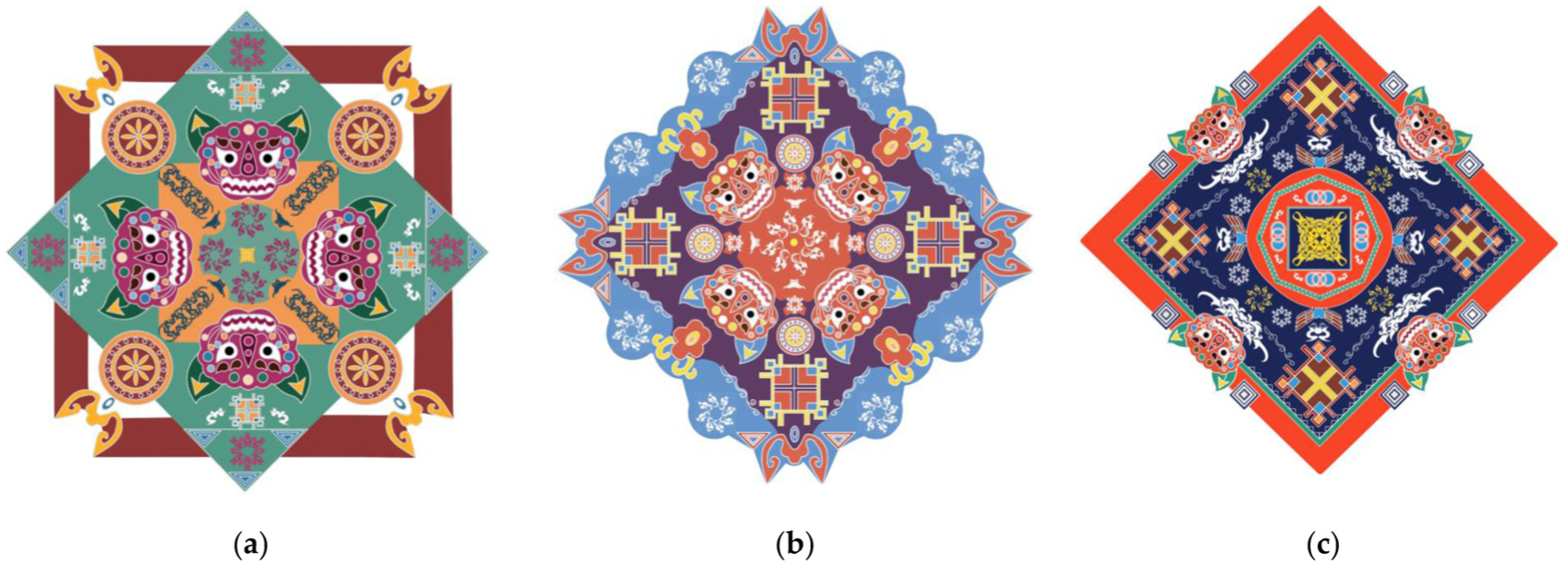
Design schemes for the transformation of Panhu pattern: (a) S1, (b) S2, and (c) S3.
Evaluation and Output of Cultural and Creative Product Design Schemes
This study engaged 32 design professionals and 35 individuals from the She Nationality to examine the design schemes. The evaluation was based on three key criteria: cultural expressiveness (Sx), innovativeness (Sy), and visual aesthetics (Sz), each rated on a scale from 1 to 5. The overall evaluation score (S) of each design scheme was then determined using a defined formula.

A higher S value indicates a greater degree of excellence in the design scheme. The detailed results of the excellence evaluations for each design scheme are summarized in Table 6. As a result, S3 was determined to be the most suitable direction for practical implementation. The visual representations of the designs are shown in Figure 7.
Evaluation of Design Schemes for Panhu pattern.


Design visual representations.
Discussion and Conclusions
Discussion
The incorporation of She Nationality’s traditional patterns into creative cultural products has thrived, fueled by the rapid development of She-local tourism, She Nationality cultural creative industrial parks, and art exhibitions showcasing She Nationality culture (X. R. Pan & Lin, 2023; Z. Y. Qiu, 2022). For example, villages such as Eshan in the She Nationality have successfully launched a wide array of creative cultural products, seamlessly merging traditional cultural elements with modern aesthetic trends.
In the context of rapid economic development, consumer culture has increasingly shifted toward prioritizing quality, diversity, and personalized experiences (Bai, 2012). Consequently, creative cultural products based on traditional patterns must adapt to meet evolving consumption trends and emerging consumer preferences. This calls for the creation of traditional pattern-based cultural products that resonate with modern consumer expectations (Huang & Chen, 2021; Lu & Chen, 2022). While traditional patterns have historically been shaped by experiential knowledge and artistic intuition, contemporary demands emphasize systematic approaches that center on user needs and follow structured methodologies, enabling a timely response to these shifting requirements.
User-provided requests and expectations often convey rich imagery and emotions but typically lack the structured foundation required for effective pattern transformation design. By employing structured Kano model-based user needs analysis, the inputs can be transformed into precise, comprehensive, and quantifiable data. The analysis reveals a growing demand for creative cultural products by the public. While the overall awareness of traditional patterns remains relatively low, there is notable confidence in and anticipation for high-quality creative products that showcase intangible cultural heritage. The Kano model-based user needs analysis has enabled the development of optimization strategies for the transformation design of traditional patterns: (a) Explore cultural connotations: The core value of traditional patterns resides in their deep cultural meaning, acting as a defining element in design and setting these products apart from mainstream cultural items. (b) Align with modern trends and encourage creativity: The transformation design of traditional patterns focuses on innovation and originality, catering to the growing need for personalization and variety in modern consumer preferences. (c) Elevate visual allure: Cultural products derived from traditional patterns should deliver aesthetic satisfaction by embracing artistic principles and resonating with public taste, effectively fulfilling heightened aesthetic expectations. In summary, this study highlights the transformation design approach for traditional patterns by focusing on cultural significance, modern innovation, and visual appeal to enhance design quality and elevate user satisfaction.
The creative thinking process in the transformation design of traditional patterns involves three key phases: inception, convergence, and optimization. Extensive design introduces procedural creativity by systematically converting design challenges into standardized frameworks. This process involves modeling, transformation, extension, and evaluation to develop innovative schemes. Such an approach not only fosters the creation of novel product designs but also expedites responses to user needs, providing an effective solution to design challenges (Gao & Ma, 2022; Qin et al., 2021). Furthermore, extensive semantic design, rooted in extenics theory, quantifies the cultural connotation inherent in traditional patterns, offering a structured means to articulate their significance. This approach reduces the inherent ambiguity in designer thinking, enhancing the precision of cultural connotation conveyance (Jin et al., 2017). When these connotations are effectively quantified and externalized, design innovation takes shape through graphical representation. Graphic thinking acts as a medium for imaginative exploration, logical analysis, and modeling, facilitating the extension of innovative designs. By integrating designer inputs and user evaluations, the process ensures alignment with public aesthetic preferences. Consequently, the extensive semantic design approach developed in this study effectively addresses user needs related to cultural connotations, modern innovation, and design aesthetics.
However, this study also has some limitations. Empirical research has only been conducted on the representative Panhu pattern of She Nationality, and has not covered many other patterns with unique cultural connotations and artistic values, such as Phoenix pattern, Cloud Thunder pattern, etc. This to some extent limits the universality of research conclusions. In addition, in the traditional pattern extensive semantic analysis and design scheme evaluation, the number of participants can be expanded to avoid potential bias. Therefore, the methodology process can be promoted and applied among designers in the future, and further improved in the design practice of more traditional pattern culture creative products.
Conclusion
Traditional patterns, which represent a vital aspect of intangible cultural heritage, encapsulate deep cultural significance and hold substantial design potential. Insights from the proposed user need survey indicate that optimizing the transformation design of traditional patterns should prioritize three core dimensions: preserving cultural memory, embracing contemporary innovation, and enhancing design aesthetics.
Drawing from the theoretical foundation of the comprehensive semantic design process for traditional patterns and empirical design cases, such as the representative Panhu pattern, this study developed a model for an extensive semantic design pathway for traditional patterns. The model comprises six steps: (a) examination of the visual characteristics and cultural significance of traditional patterns, (b) application of semantic analysis to derive pertinent semantic characteristic terms, (c) development of a semantic model through comprehensive evaluation, (d) visual representation of semantic characteristic vocabularies through graphic thinking, (e) expansion of semantic graphics using SG, and (f) creation of novel design schemes.
This study provided a specific and feasible methodological process for innovative design of traditional patterns, helping designers create design products that meet modern aesthetic and functional needs while maintaining the visual characteristics and cultural connotations of traditional patterns, and enhancing the commercial value and social influence of traditional patterns. On the other hand, applying traditional patterns to modern product design can enhance public awareness and interest in traditional culture, promote the sustainable development of cultural heritage, and enable its continuation and development in modern society.
The extensive semantic design process of traditional patterns proposed in this study is highly compatible with generative AI. In the future, the advantages of generative AI in data-driven feature extraction and semantic model construction (Gozalo-Brizuela & Garrido-Merch’An, 2024) can be utilized to further optimize the semantic model of traditional patterns, expand design ideas using its powerful generation capabilities, and achieve innovative applications of traditional patterns in modern design.
Footnotes

Ethical Considerations
This study does not involve any human subjects or animal testing in a clinical or biomedical context. This study involved data collection through anonymous surveys, ensuring that no personally identifiable information was recorded or stored. Participants were informed about the purpose of the research and provided their consent to participate voluntarily. Participants were also informed in the questionnaire that they have the full right to withdraw from the study at any time without having to provide any reasons. As the data are fully anonymized and do not involve sensitive or identifiable information, ethical approval from an institutional review board was not required. Therefore, the study adheres to accepted ethical standards for social science research.
Funding
The authors disclosed receipt of the following financial support for the research, authorship, and/or publication of this article: Hangzhou Culture International Communication and Discourse Strategy Research Center, Key Research Base of Philosophy and Social Sciences in Hangzhou (2023JD14); Zhejiang Federation of Social Sciences Research Project (2022N68); National Art Foundation Funding Project of China (2024-A-05-075-587)
Declaration of Conflicting Interests
The authors declared no potential conflicts of interest with respect to the research, authorship, and/or publication of this article.
Data Availability Statement
Data sharing not applicable to this article as no datasets were generated or analyzed during the current study.