



Abstract
This study investigates how industrial internet platforms (IIPs), as external knowledge resources, enhance the technology management capabilities of small and medium-sized manufacturing enterprises (SMEs) during digital transformation stage. While existing studies have largely overlooked the role of such platforms in improving firms’ technology management capabilities, we have addressed this gap by analyzing 4,290 annual report observations from listed Chinese manufacturing SMEs (2017–2022). We innovatively measure technology management capabilities through both process and outcome dimensions. Employing multi-period difference-in-differences (DID) and propensity score matching (PSM)-DID methods, the results demonstrate that IIPs significantly strengthen SMEs’ technology management capabilities. The effects vary across ownership structures and regional contexts, highlighting the moderating role of institutional and geographic factors. These findings advance understanding of platform-driven capability building in manufacturing digitization.
Plain Language Summary
This study looks at how industrial internet platforms can help small and medium-sized businesses (SMEs) get better at using technology in their daily operations. We collected data from over 4,000 companies in China from 2017 to 2022 and used special statistical methods to see if using these platforms really makes a difference. What we found is that when SMEs use industrial internet platforms, they get better at managing technology, which is important for how they produce things and run their businesses. We also noticed that private companies and those in areas with more developed economies seem to get an even bigger boost in their tech management skills from using these platforms. This might be because these companies are more used to working in a market-driven environment. Overall, our research shows that these platforms can be a powerful tool for small businesses to improve how they handle technology.
Introduction
Under the strategic guidance of Made in China 2025 and the 14th 5-Year Plan National Economic and Social Development (with an emphasis on digital economy development), digital transformation has become a key pathway for Chinese manufacturing enterprises to achieve high-quality development (Li et al., 2023). However, many small and medium-sized enterprises (SMEs) face significant challenges during this transformation process. Compared to large enterprises with abundant resources, SMEs generally face issues such as weak technical foundations, limited digital strategies and implementation capabilities, and insufficient talent reserves (Bao, 2009; Qi et al., 2023; Cheng et al., 2023). In addition, the highly fragmented internal information systems create “digital silos,” which significantly hinder cross-departmental and cross-process collaboration efficiency (Tortorella et al., 2020). The difficulty of integrating digital technologies with existing management mechanisms further limits resource integration and the depth of transformation.
In this context, Industrial Internet Platforms (IIPs), as emerging digital infrastructure, offer SMEs a new pathway to overcome bottlenecks. By leveraging technologies such as cloud computing, big data, and industrial IoT, IIPs integrate knowledge, technology, and resources, helping enterprises optimize management processes and enhance organizational learning capabilities (Allard & Holsapple, 2002; Qi et al., 2023; Zhou et al., 2023). Platform providers dismantle knowledge management barriers through service embedding and knowledge collaboration, enabling SMEs to reshape their capabilities within the digital ecosystem (Meski et al., 2019; Shujahat et al., 2019).
Although IIPs have gained academic attention as key supports for improving digital capabilities in enterprises (McIntyre & Srinivasan, 2017; Santoro et al., 2018), existing studies mainly focus on their macro impact on operational performance or their application experiences in large enterprises. As a core organizational capability linking technology application with strategic execution, technology management capability is becoming increasingly important in the context of digital transformation (Cetindamar et al., 2009; Lee et al., 2023). However, there is still limited research on how IIPs affect technology management capabilities, especially empirical studies in the context of SMEs.
Moreover, SMEs exhibit significant heterogeneity in terms of organizational structure, institutional environment, and resource access. For example, compared to private enterprises, state-owned enterprises have unique characteristics in terms of policy response, organizational hierarchy, and government collaboration, which can affect their adoption efficiency of IIPs (Lin et al., 2020; Ping et al., 2016; Song et al., 2015). At the same time, there are significant regional disparities in digital infrastructure in China, with economically developed regions having stronger foundations in policy support, platform coverage, and technology supply, which may further amplify the capability-enhancing effect of IIPs (Beilock & Dimitrova, 2003; Wu et al., 2012). Existing studies have not systematically examined these internal and external moderating mechanisms.
Based on this, this article focuses on SMEs in China’s manufacturing industry, using data from 4,290 annual reports of listed companies from 2017 to 2022. Combining time-varying difference-in-differences (DID) and propensity score matching (PSM) methods, it empirically investigates the impact of IIPs on enterprises’ technology management capabilities, with a focus on answering the following two research questions: First, does the use of IIPs significantly boost SMEs’ technology management capabilities? Second, does this impact exhibit heterogeneity based on internal company attributes and external environmental factors?
Theoretical Background and Hypothesis
Technology Management Capability
Technology management capability is a key capability for enterprises to effectively allocate, integrate, and transform technological resources, playing a central role in enhancing organizational innovation and competitive advantage (Cetindamar et al., 2009; Lee et al., 2023). In the context of digital transformation, technology management capability not only reflects the ability to build technical systems but also indicates a company’s capacity to acquire, apply, and manage knowledge resources. Early research mainly defined technology management from the perspectives of strategic integration and interdisciplinary collaboration (Drejer, 1997; Madsen & Ulhøi, 1992), emphasizing its comprehensive nature across engineering, science, and management fields. The National Research Council (NRC) further proposed that the core of technology management capability lay in embedding technological capabilities into organizational strategies and operational objectives, serving the long-term development of the enterprise.
With the development of the digital economy, the knowledge aspect of technology management has become increasingly prominent. Badawy (2009) argued that technology management is no longer merely the management of “things” but focuses more on the systematic integration of “knowledge” and “processes.”Jafari-Sadeghi et al. (2018) and Kimiagari and Baei (2024) based on users’ cognitive differences in the digital environment, emphasized the role of cognitive-structural alignment in capability building. In the process of digital transformation, a company’s mastery over technology often depends on the efficiency of knowledge asset integration and its ability to systematize capabilities.
From a theoretical perspective, technology management capability is closely related to knowledge management, with both supporting each other. Suarez (2014) and Schilling (2015) argued that organizational knowledge forms the foundation for the operation of technological systems, influencing information flow and knowledge diffusion. Alavi and Leidner (2001), starting from knowledge management systems, emphasized that the acquisition, integration, sharing, and utilization of knowledge are fundamental to enhancing a company’s technological adaptability and innovation capabilities. Knowledge management behaviors such as knowledge creation, sharing, and application foster organizational learning and technological innovation, forming an essential part of technology management (Shujahat et al., 2019). In contrast, technology management focuses more on the overall management of the “technology lifecycle,” including the acquisition, evaluation, deployment, transformation, and commercialization of technology. Its focus is on “technological assets” and “technology infrastructure,” achieving strategic goals through managing technological pathways. Argote and Hora (2017) pointed out that there is a complex interaction mechanism between technology management behaviors and organizational learning, where technological changes often accompany the reconstruction of knowledge flows and organizational memory (Sivanathan et al., 2017). Barros et al. (2020) further argued that technology management is a core channel for knowledge transfer and technology absorption and serves as an important intermediary for organizational capability leapfrogging.
In the context of SMEs, building technology management capability is particularly dependent on external knowledge and platform support (De Marchi & Di Maria, 2020). Due to limited resources, enterprises often rely on collaborative mechanisms and platform integration to compensate for internal knowledge gaps, achieving “embedded capability” organizational upgrading (Santoro et al., 2018). Research has shown that capability enhancement not only comes from technology adoption but also depends on how enterprises internalize external knowledge into actionable, process-oriented capabilities (Jeenanunta et al., 2017; Zhang & Tang, 2017).
Industrial Internet Platform and Technology Management Capability
China’s rapid digital transformation has led to significant disparities in the intelligent upgrading process of many SMEs. According to the “Regulations on the Classification Standards of SMEs” issued by the Ministry of Industry and Information Technology of China in 2011, SMEs in the manufacturing industry generally refer to enterprises with fewer than 1,000 employees and annual revenues of less than 400 million yuan. These enterprises typically face limited resources and issues such as weak research and development capabilities, poor data infrastructure, and a lack of specialized talent (Lin et al., 2020; Song et al., 2015). As a result, technological innovation in these enterprises relies heavily on external knowledge support and digital infrastructure. This makes IIPs a key enabling tool for SMEs to enhance their technology management capabilities.
An IIP is a comprehensive platform system that integrates key technologies such as the internet of things (IoT), cloud computing, and big data analytics. It features a “connect-collaborate-optimize” structural model (Chiou & Chiu, 2014; Qi et al., 2023; Zhou et al., 2023). Through the platform’s resource integration and service embedding mechanisms, enterprises can achieve cross-departmental information integration, resource collaboration, and process reengineering, thereby overcoming traditional system silos and improving organizational agility and technical adaptability (Badir et al., 2008; Meski et al., 2019; Tortorella et al., 2020). Existing studies have shown that the adoption of IIPs by enterprises is driven not only by external environmental factors but also by the platform’s usability, operability, and flexibility of embedded services. SMEs are more likely to adopt platforms that reduce technical barriers and have scalable data architectures to compensate for their deficiencies in technical infrastructure and human resources (Kimiagari & Baei, 2021; Marzi et al., 2023). Once adopted, the platform leads to a reconstruction of the enterprise’s knowledge structure and management processes, evident in capabilities such as faster knowledge acquisition, optimization of data-driven decision-making systems, and process transparency (Li et al., 2023; Shujahat et al., 2019). On this basis, the enabling mechanism of IIPs is reflected not only in resource provision but also in the capability reconfiguration path. Research indicates that the adoption of IIPs enhances a company’s technological learning and cross-organizational collaboration capabilities, promoting the development of data-driven adaptive knowledge systems and increasing the resilience of technological evolution (Allard & Holsapple, 2002; Nemati et al., 2002). Additionally, the standard reuse, process templates, and outsourcing capabilities offered by IIPs allow enterprises to integrate “process-knowledge-technology” efficiently and at a low cost (Carrillo & Gaimon, 2000; Lista Rossetti et al., 2024).
The Resource-Based View (RBV) emphasizes that firms build sustainable competitive advantages by acquiring, integrating, and reconfiguring scarce resources (Barney, 1991). In the context of SMEs, the IIP, as an embedded, non-replicable, and highly collaborative “strategic resource,” can collaborate with internal knowledge mechanisms through an embedded path to form composite capabilities for innovation and management (Grandori & Soda, 1995; Herrmann et al., 2007; McIntyre & Srinivasan, 2017). The platform not only expands the enterprise’s knowledge boundaries but also becomes a key node in its capability structure, thus supporting the building of dynamic capability in digital transformation (Maries & Scarlat, 2011).
In conclusion, IIPs in SMEs play not only the role of a technological tool but also, through promoting knowledge acquisition, data utilization, and organizational learning, become a significant driving force for enhancing the enterprises’ technology management capabilities. Therefore, this article proposes the following research hypothesis:
Moderating Role of Firms’ Internal and External Factors
Although IIPs have universal enabling potential, their actual effectiveness in SMEs is often significantly influenced by both the internal structural characteristics and external environmental conditions of the enterprises. Existing research suggests that the ultimate effectiveness of platform empowerment depends not only on the platform’s functional design but also on the enterprise’s ability to integrate, absorb, and match the platform’s capabilities (Allard & Holsapple, 2002; Nemati et al., 2002). Therefore, understanding how internal and external heterogeneity moderates the relationship between platform use and technology management capabilities holds significant theoretical and practical value.
Ownership structure, as a fundamental institutional arrangement, profoundly affects a firm’s strategic behavior, resource acquisition capacity, and organizational flexibility (Goldeng et al., 2008; Lin et al., 2020; Song et al., 2015). In the Chinese context, state-owned enterprises (SOEs) often have stronger policy resources, more stable organizational processes, and higher institutional compliance, allowing them to enjoy greater policy support and technical guidance in the use of IIPs. However, SOEs also face issues such as slow information feedback and organizational rigidity. In contrast, private enterprises tend to be more agile in market response, organizational flexibility, and technology adoption drivers (Ping et al., 2016). However, due to limited resources, private enterprises are more dependent on the embedded functions of the platform in the process of absorbing and transforming platform capabilities. Related studies have found that the realization of platform value is often related to the firm’s absorptive capacity. Without administrative support, private enterprises are more proactive in using platforms as knowledge gateways and tools for technological cooperation (Wu et al., 2012). Based on this, it can be inferred that private enterprises are more likely to drive capability reconfiguration and organizational transformation through flexible mechanisms when using IIPs. Therefore, we propose the following hypothesis:
SMEs in China show significant regional disparities. Economically developed regions generally have better digital infrastructure, platform supply capacity, and talent aggregation effects, providing a more favorable external environment for the deployment and transformation of platform capabilities (Beilock & Dimitrova, 2003). In contrast, enterprises in the central and western regions, as well as less developed areas, often face issues such as information asymmetry, insufficient technical service provision, and poor institutional adaptability, which limit the effective transformation of platform resources into enterprise capabilities (Wu et al., 2012).
At the same time, the development of enterprise capabilities depends not only on internal absorptive structures but also on the availability of external resources and inter-organizational collaborative networks (Lane et al., 2006). In the digital platform ecosystem, the interconnectivity between platforms, service maturity, and government guidance mechanisms in developed regions are more robust, enabling SMEs to integrate and optimize digital technologies with lower institutional costs. Therefore, we propose the following hypothesis:
Research Methodology
Model Building
The most effective method for addressing endogenous issues caused by missing variables and evaluating policy impact is the Difference-in-Differences (DID) approach. The deployment of the IIPs can be viewed as the implementation of a digital transformation policy for SMEs. However, companies adopt the IIPs at different times due to variations in strategic planning, corporate financing, and organizational structures, leading to differing time frames for the platform’s impact. The traditional DID method requires the alignment of policy implementation timelines. Therefore, to evaluate the effects of IIPs deployment across various organizations over time, this research introduces a Time-Varying DID model, which allows for dynamic changes in treatment timing and policy effects and better approximates real-world policy scenarios. This model builds on previous research and accounts for the reality that organizations implement the IIPs at different points in time.

In Equation 1, i denotes the enterprise, t denotes the year,
Variable Measurement
The Dependent Variable
The dependent variable in this study is the technology management capability (TMC) of the enterprise. Given that TMC is a non-financial organizational capability, it is difficult to quantify directly through traditional financial data. Therefore, this study combines existing research (Barros et al., 2020; De Marchi & Di Maria, 2020) and uses a text mining approach to construct proxy variables. Specifically, TMC is measured based on the frequency of technology management-related keywords in corporate annual reports, which reflects the level of attention and integration of technological elements in the organization’s management. The effectiveness of the keyword method is demonstrated in two key aspects: first, the keywords have clear conceptual orientations and cover typical dimensions of TMC, such as research and development organization, process management, and knowledge governance (Alavi & Leidner, 2001; Argote & Hora, 2017); second, the text data is self-disclosed by the enterprise, which more accurately reflects the management focus and capability layout, offering strong self-report validity.
Technically, keyword analysis was performed using Python 3.5, with the ratio of technology management-related keywords to the total word count considered a representative measure of TMC (Muslu et al., 2015). Traditional evaluations of TMC emphasize enterprise achievements and innovation processes, following Wu et al. (2012)’s classification of innovation indicators which include terms such as “Core Technology,”“Technical Performance,”“Patents,” and “Number of Patents.” Additionally, keywords related to technical management competencies were identified using internationally recognized scales and extensive questionnaire data. These keywords include terms like “Technical Capital,”“Technical Equipment,”“Professional Equipment,”“Equipment Management,”“Quality Standards,”“Technical Standardization,” and “Technical Risk Management.” This study also indirectly assesses changes in knowledge management by describing the digital adaptation environment. Based on previous research, it evaluates the state of enterprise digital innovation activities over time by measuring the level of digital innovation scenario construction (Lu & Dong, 2020). Keywords used in this phase include “Digitization,”“Informatization,” and “Network Economy.”
The Independent Variable
The independent variable in this article is the use of the IIPs, represented as a dummy variable. If the enterprise utilized the IIPs during the research period, the variable is assigned a value of 1; otherwise, it is assigned a value of 0. To determine whether the IIPs were implemented, we systematically reviewed the company’s annual reports for relevant keywords and verified their accuracy. The search keywords included “Industrial Internet”“IIOT”“Industrial Internet of Things,” and “Industry 4.0.”
The Control Variables
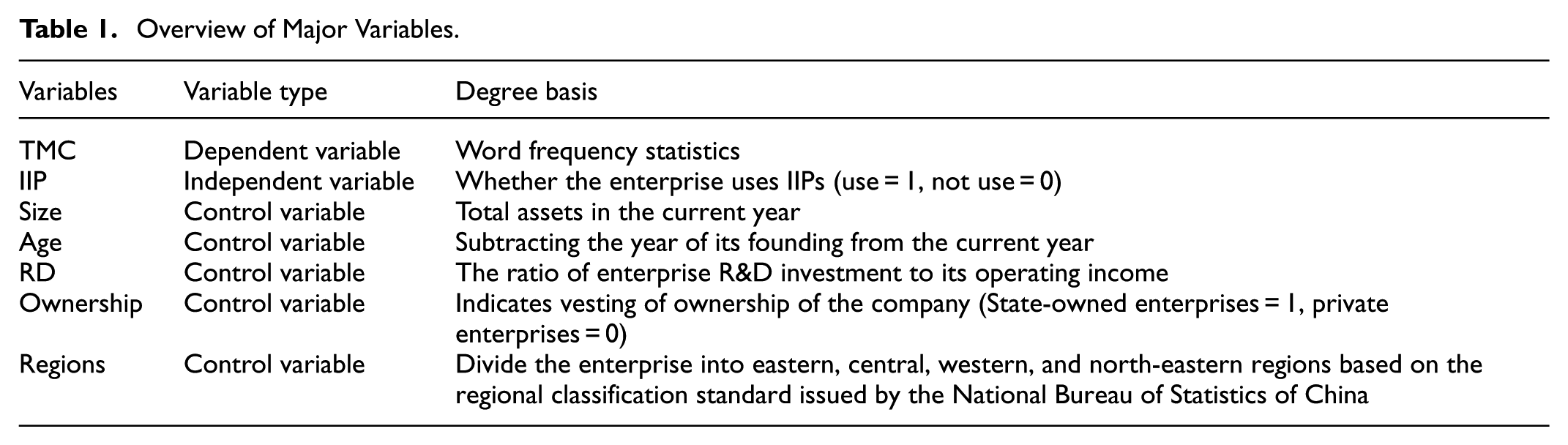
To examine the net effect of IIPs adoption on the technology management capabilities of SMEs, the following control variables are defined based on prior research: company size, age, R&D investment (denoted as RD), ownership (a binary variable), and geography (Li & Gao, 2022; Zhuo & Chen, 2023). The baseline regression will focus on three key variables: company size, age, and R&D investment. Company size is measured by a firm’s total assets in the current year, while age is calculated by subtracting the year of establishment from the present year. A firm’s R&D investment is expressed as the ratio of R&D expenditure to operating income.
Heterogeneity analysis will assess whether different types of enterprises demonstrate varied levels of platform performance, utilizing ownership and regional variables. Ownership is determined from Industrial and Commercial Bureau registration records, with state-owned companies assigned a value of 1 and private companies a value of 0. Geographical classification follows the criteria of China’s National Bureau of Statistics, which divides the country into four regions: eastern, central, western, and northeastern. The eastern region comprises 10 provinces/municipalities: Beijing, Tianjin, Hebei, Shanghai, Jiangsu, Zhejiang, Fujian, Shandong, Guangdong, and Hainan. The central region includes Shanxi, Anhui, Jiangxi, Henan, Hubei, and Hunan. The western region encompasses 12 provinces/municipalities: Inner Mongolia, Guangxi, Chongqing, Sichuan, Guizhou, Yunnan, Tibet, Shaanxi, Gansu, Qinghai, Ningxia, and Xinjiang. The northeastern region consists of Liaoning, Jilin, and Heilongjiang. Firms from these regions are grouped and coded accordingly.
Sample and Data Collection
This study focuses on firms listed on China’s Growth Enterprise Market (GEM) and Small and Medium Enterprise (SME) Board, identifiable by stock codes starting with 300 and 002, covering 15 industries including manufacturing and information technology. Initially, all listed firms meeting the stock code criteria were included to ensure industry representativeness. Final exclusions applied only to firms with incomplete data (e.g., missing annual report texts or financial data) and delisted firms. As listed company data are publicly available and standardized, their technological management behaviors can be objectively reflected in annual report texts, avoiding the subjective bias inherent in convenience sampling (Haileselasie Gebru, 2009). To screen annual reports of target firms, we first collected all annual reports of Chinese listed companies from 2017 to 2022. Then, we filtered them by stock codes to obtain reports from firms listed on the GEM and SME boards. We selected data from 2017 to 2022 because the concept of the Industrial Internet emerged in 2012, with the world’s first IIP built in 2014, and China’s first major IIP launched around 2017. Given the time lag in IIP adoption, post-2017 data offers a comprehensive and representative view.
The enterprises selected for this study primarily come from the Growth Enterprise Market (GEM) and the Small and Medium-sized Enterprises Board (SME Board) in China. Both of these market segments were established with the clear objective of supporting “innovative and growth-oriented SMEs,” and they impose higher requirements on information disclosure, especially in areas such as research and development investment, platform usage, and technology management, making them typical representatives of such enterprises (Ping et al., 2016). Compared to companies listed on the main board, these enterprises rely more on the flexible configuration of external platforms and organizational capabilities, which enables them to more accurately reflect the level of attention given to technology management capabilities during the digital transformation process. Therefore, selecting enterprises from the GEM and SME boards as samples is highly representative and targeted. After obtaining the reports, we used Python to calculate word frequencies to determine specific values for the dependent variables. Secondary data, such as company size, age, ownership, and R&D investment, was sourced from the Wind database and the Chinese Industrial and Commercial Bureau. We manually excluded firms with incomplete data between 2017 and 2022, as well as defunct enterprises. In total, 4,290 samples were collected. Detailed information on the variables is provided in Table 1.
Overview of Major Variables.
Results
Benchmark Regression
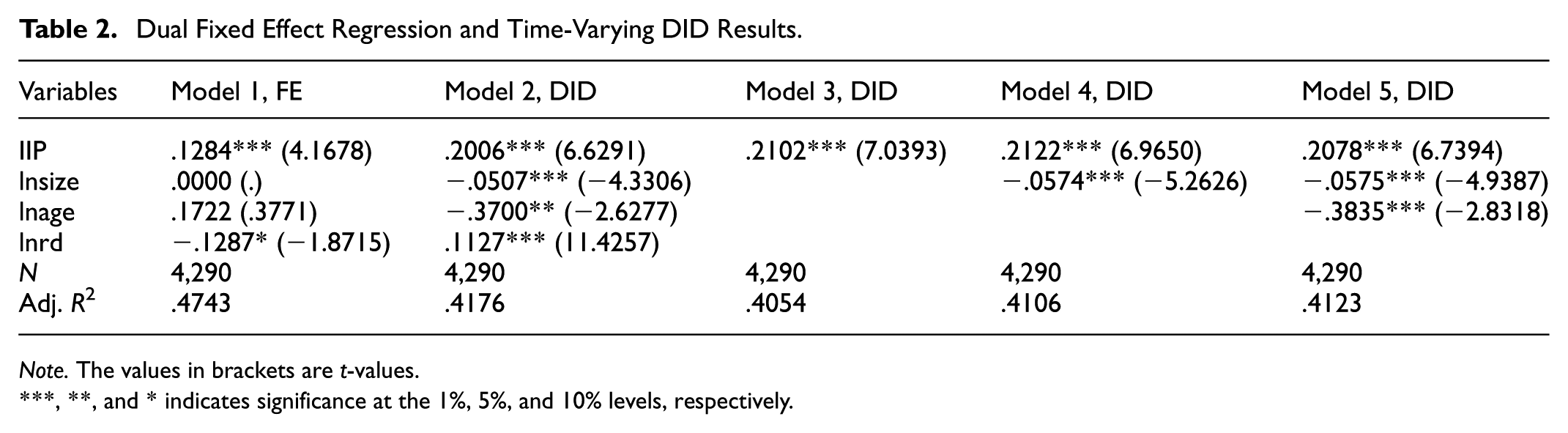
Table 2 presents the baseline regression results. Model 1 uses the two-way fixed effects model, showing IIPs have a positive and significant effect (coefficient = .1284, t = 4.17). To improve accuracy, a time-varying DID model was constructed. Model 2 is the full model with control variables. The IIPs’ coefficient increases to .2006 (t = 6.63), which is approximately 56% higher than in the FE model. Model 3 excludes all control variables. The core coefficient remains stable at .2102 (t = 7.04), confirming the robustness of the effect. Models 4 to 5 gradually introduce firm characteristic variables: adding the size variable (lnsize) slightly increases the coefficient to .2122 (Model 4); including the age variable (lnage) results in only a 1.5% decrease to .2078 (Model 5). In all DID models, coefficients fluctuate by less than 2.5%, proving the positive effect of IIPs is unaffected by adding or removing control variables. The coefficient range of the time-varying DID models (.2006–.2122) indicates that the application of IIPs lead to an approximate improvement of 22.21% to 23.64% (
Dual Fixed Effect Regression and Time-Varying DID Results.
Note. The values in brackets are t-values.
, **, and * indicates significance at the 1%, 5%, and 10% levels, respectively.
Robustness Test
To ensure the impartiality of the double-checking results, it is necessary to meet the parallel trend assumption between the experimental and control groups. Specifically, any differences in practice trends between these groups before the application of the IIPs must be examined. This step is crucial to attribute any observed changes in trends to the introduction of the Industrial Internet. Therefore, it is essential to verify that the technology management capabilities of both groups were similar prior to the implementation of the IIPs. As shown in Figure 1, the growth trend for technology management capabilities in both the experimental and control groups was comparable before the application of the IIPs. However, after the IIPs were introduced, there was a significant change in the growth trend of the effect between the two groups. This confirms that the Time-Varying DID model employed in this study satisfies the parallel trend assumption.
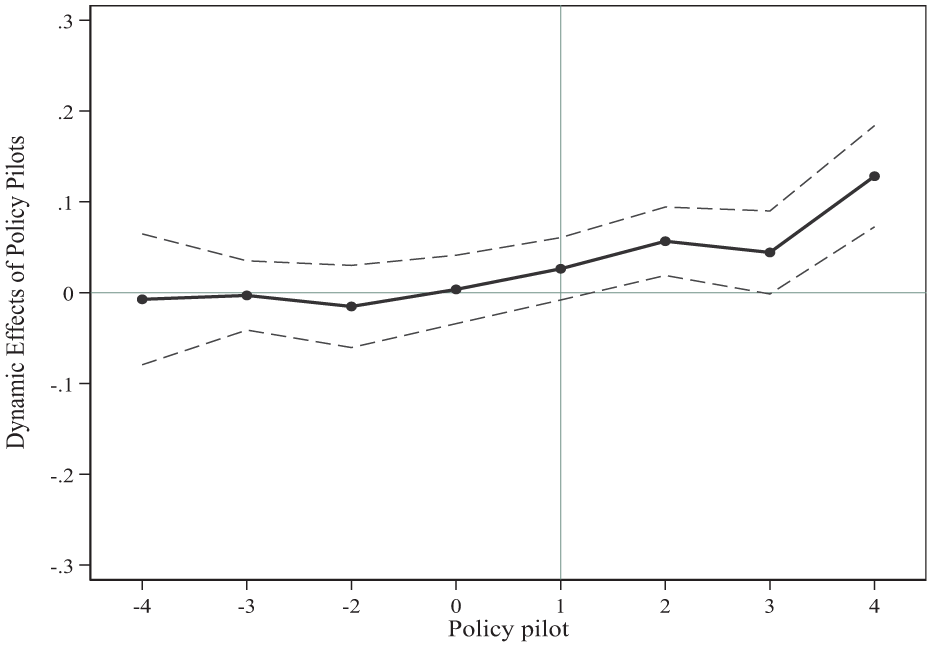
Parallel trend test.
To further test the robustness of the results, the PSM-DID model regression was applied. Since propensity score matching (PSM) is typically used for cross-sectional data, this study follows the method of Heyman et al. (2007), matching year-by-year during the PSM stage, and then using the matched data for difference-in-differences (DID) analysis. A 1:1 matching of the data was performed using all available data, resulting in 373 control firms and 340 treated firms over 6 years. The kernel density curves of the successfully matched samples indicate an improved matching effect between the treatment and control groups, reducing potential estimation errors due to sample self-selection. Figure 2 presents the kernel density curves for the matched treatment and control groups, demonstrating the enhanced matching effect.

Probability distribution of propensity score.
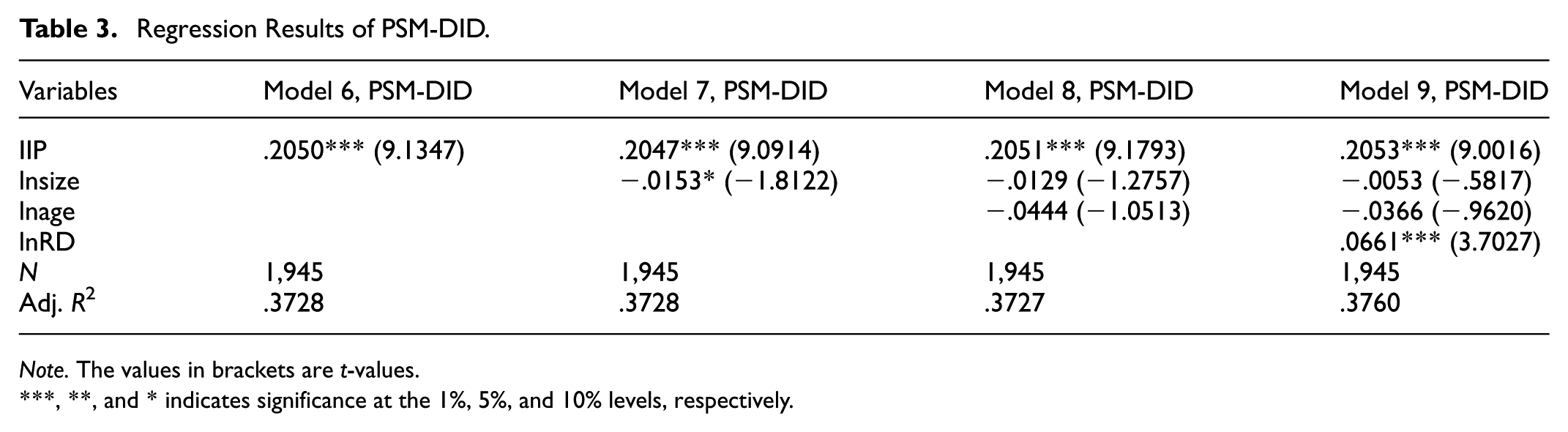
The results presented in Table 3 is derived from regression analysis of the collected data. Model 9 includes both control variables and key independent variable, while Model 6 uses only the independent variables. Models 7 and 8 incorporate the main independent variables along with a subset of control variables for the PSM-DID analysis. The PSM-DID results show that the independent variable remains significant at the 1% level, with no notable changes in the model’s fit. Based on the analysis, it is evident that the utilization of industrial internet platforms (IIPs) significantly enhances the technology management capabilities of SMEs. The core coefficients range from .2047 to .2053, indicating that the adoption of IIPs by SMEs could promote an improvement of 22.72% to 22.79% in their technology management capabilities. This finding remains robust across all models in Table 3.
Regression Results of PSM-DID.
Note. The values in brackets are t-values.
, **, and * indicates significance at the 1%, 5%, and 10% levels, respectively.
Heterogeneity Analysis
It is hypothesized that the technology management capabilities of enterprises may be influenced by differences in ownership structure and geographic location. Enterprises with varying ownership structures in China may operate within distinct governmental contexts, while firms in different regions are subject to diverse levels of economic development and infrastructure. To account for these variations, this study conducted tests for ownership and regional heterogeneity. Table 4 presents the results of the heterogeneity test. Models 10 and 11 address ownership heterogeneity, with Model 10 representing a regression for state-owned enterprises and Model 11 for private enterprises. Models 12 through 15 focus on regional heterogeneity, covering the eastern, central, western, and northeastern regions, respectively. The regional classifications are based on the official categorization method used by the Chinese Bureau of Statistics, which divides provinces accordingly.
Results of the Heterogeneity Analysis.

Note. The values in brackets are t-values.
, **, and * indicates significance at the 1%, 5%, and 10% levels, respectively.
Hypothesis 2 of this study is supported, as the findings from comparing Models 10 and 11 indicate. The use of the IIPs have a significant positive effect on both state-owned and privately held enterprises. Specifically, the application of the platforms led to an approximate improvement of .1639 (
The results show that in economically developed regions, the use of IIPs have a more pronounced impact on the technology management capabilities of enterprises, supporting Hypothesis 3 of this study. Models 12 and 13 suggest that the IIPs significantly enhance the technology management capabilities of enterprises in the eastern and central regions. However, this effect has not yet been significantly observed in the western region. The impact of IIPs on improving technology management capabilities is .2263 (
The eastern and central regions are more economically developed compared to the western and northeastern regions. In general, the more economically developed a region is, the more effective the IIPs becomes in promoting the technology management capabilities of enterprises located there. In summary, the heterogeneity analysis not only supports the proposition of Hypotheses H2 and H3, but also indicates significant variation in the empowerment effect of industrial internet platforms across institutional types and regional environments. This further demonstrates that the platform’s mechanism of action relies on the joint functioning of firms’ resource absorption capacity and external support conditions.
Conclusion and Implications
This study examines 4,290 listed small and medium-sized enterprises in China using a time-varying DID model. The results demonstrate that IIPs’ adoption significantly strengthens firms’ technology management capabilities through knowledge integration and process optimization. These effects are more pronounced in market-oriented private enterprises and economically advanced regions. The findings not only underscore IIPs’ strategic value as digital infrastructure but also elucidate the intrinsic mechanism of platform economy-driven capability upgrading: transcending resource boundaries and optimizing knowledge management processes to achieve systematic improvements in technological competencies. This study provides empirical evidence to help policymakers design differentiated digital transformation strategies and assist SMEs in optimizing technology management practices.
Theoretical Implications
Drawing on the Resource-Based View (RBV) within the context of SMEs digital transformation, this study examines how IIPs enhance firms’ technology management capability through resource embedding and knowledge integration mechanisms. Our findings are empirically validated and advance several theoretical domains.
First, this research deepens the dynamic application of RBV in platform environments. Traditional RBV emphasizes firms building differentiated capabilities through internal resources (Barney, 1991). However, in the digital era, platforms serve as critical external resource sources, leading to open and platform-dependent capability boundaries. This paper conceptualizes IIPs as embedded strategic resources, revealing their role in reshaping firms’ capability-building paths through knowledge restructuring and process coordination. This perspective extends RBV from internal resource logic to co-creation logic in digital platform contexts (Barros et al., 2020; De Marchi & Di Maria, 2020).
Second, our work broadens theoretical perspectives on technology management capability research. Existing literature primarily focuses on technology management capability measurement or its impact on innovation output (Badawy, 2009; Kimiagari & Baei, 2024), with limited attention to how platforms shape capability development. By incorporating IIPs into the analytical framework, we highlight their supportive role in resource and knowledge integration. This enriches understanding of technology management capability formation mechanisms and addresses the understudied process of capability development in organizational learning and knowledge governance research (Argote & Hora, 2017).
Third, this study enriches micro-level applications of platform theory for SMEs. Prior work largely examines platform governance structures and ecosystem-level network effects (McIntyre & Srinivasan, 2017), paying scant attention to how platforms strengthen internal capabilities. Focusing on SMEs, we investigate IIPs’ supportive function in capability formation under resource constraints. This addresses the research gap concerning micro-mechanisms of capability-building in platform studies.
Practical Contributions
Our findings provide multifaceted implications for SMEs management practices and platform service design.
First, SMEs managers should proactively integrate IIPs into strategic and operational systems. Research indicates platforms not only provide technical resources but also enhance knowledge integration, process optimization, and management efficiency (Qi et al., 2023; Zhou et al., 2023). Firms should therefore establish internal coordination mechanisms for platform interfaces, such as appointing dedicated technology managers, promoting cross-departmental data integration, and embedding platform services into R&D and supply chain processes. This fully unlocks the platform’s potential (Barros et al., 2020). Private enterprises, leveraging their organizational flexibility advantages, should particularly utilize platforms to strengthen knowledge absorption and capability transformation (Song et al., 2015).
Second, IIPs providers should prioritize SME users’ characteristic differences and capability profiles by enhancing service customization and embedment. Given regional resource allocation imbalances, platform firms should develop differentiated service modules and support strategies based on enterprise heterogeneity in technical levels, data foundations, and business types across regions. This improves platform usability and user stickiness.
Consequently, SMEs and platform providers should co-create service-oriented relationships centered on capability formation, achieving mutual reinforcement between platform value and enterprise capabilities.
Policy Recommendations
Against the backdrop of China’s 14th 5-Year Plan and the Digital China Construction Master Plan, our findings offer three policy implications for industrial policymaking.
First, we recommend accelerating regional industrial internet infrastructure development for SMEs. Studies show platforms demonstrate stronger capability-transformation effects in resource-abundant regions (Beilock & Dimitrova, 2003; Wu et al., 2012). Governments should thus advance regional resource-balancing initiatives like “East Data West Computing” and the “Industrial Internet Identification and Resolution System.” This includes encouraging leading platform firms to establish nodes in central/western China to narrow regional digital divides and enhance SME access to precise technological empowerment.
Second, policymakers should strengthen “Platform-SME” collaborative innovation instruments. Platforms serve not only as digital infrastructure but also as intermediaries for industrial knowledge and capability diffusion. Governments should target “Specialized, Sophisticated, Distinctive, and Novel” enterprises through special funds for platform integration costs. Concurrently, they should incentivize platform firms to open high-value module interfaces, facilitating multi-level, cross-industry embedded collaboration and capability co-development among SMEs.
Third, we advocate establishing platform service certification and enterprise capability assessment standards. To address information asymmetry in platform services, governments should collaborate with industry associations to develop service capability standards and third-party evaluation mechanisms. Additionally, encouraging enterprises to disclose digital capability development in annual reports would enhance assessment transparency and policy identifiability.
Limitations and Future Research
Several limitations of this study should be considered when interpreting its findings. First, the Time-Varying DID test effectively captures long-term impacts but may miss short-term effects of IIPs on businesses. We must acknowledge the discrepancy between long-term and short-term effects of IIPs. Second, although the Time-Varying DID model could control the selection bias effectively that caused by time-invariant factors as well as performing better in the scenarios with heterogeneous treatment timing. And we also use the PSM to overcome the bias problem, but this article did not use the instrumental variables (IV) tools to make the results more clear which is the direction we should go. Third, the study focuses on high-tech private SMEs listed on the GEM and SME boards, limiting the generalizability of the findings to smaller or less-established firms. Still, this study laid the groundwork for future research with respect to IIPs. Future research should explore the short-term effects of IIPs adoption and examine its impact on smaller firms outside the high-tech sector to generalize our findings. This study does not distinguish between different types of IIPs, as both large and small firms engage with the same platform framework. Future research should examine these differences, as the intensity level of IIPs may vary both within and across firms. Finally, future research should explore the alignment between platform capabilities and enterprise needs, focusing on regional differences and platform selection strategies.
Footnotes

Funding
The authors disclosed receipt of the following financial support for the research, authorship, and/or publication of this article: This work was supported by the National Social Science Fund of China (No. 21BGL119) and by the Hangzhou Key Research Base of Philosophy and Social Sciences “Research Center for Innovation and Development of Platform Economy”.
Declaration of Conflicting Interests
The authors declared no potential conflicts of interest with respect to the research, authorship, and/or publication of this article.
Data Availability Statement
The data supporting this study were obtained from publicly available annual reports, the Wind database, and National Bureau of Statistics of China.