




Abstract
The advancement in usage of information technology in past decades have revolutionized the business environment. For instance, the introduction and widely acceptance of e-commerce technologies have transformed the retail landscape. Same as the emerging of streaming services and platforms like Netflix has change the entertainment especially the movie sector drastically. Like other sectors of the economy, the adoption of technology has transformed the functional activities of diverse organizations and organizational units. Specifically, the adoption of eHRM is argued to enrich organizational effectiveness. The study attempts to investigate the effect of organizational leadership, organizational structure, and employee technological capabilities on the implementation success of e-HRM system. Data is collected from a novel dataset that is based on list of human resource practitioner/professional that was made available by the Chartered Institute of Human Resource Practitioners, Ghana. The outcome of the study indicates organizational structure and employee technological efficacy/competence have a positive and significant influence on the successful implementation of e-HRM. Conversely, organizational leadership did not have significant influence on the success of e-HRM. However, it must be acknowledging internal marketing plays critical role in aligning organizational goals, employee’s capabilities, and expectation.
Keywords
Introduction
The advancement in the utilization of information technologies in past decades has revolutionized the business environment. For instance, the introduction and widely acceptance of e-commerce technologies have transformed the retail landscape. Same as the emerging of streaming services and platforms like Netflix has change the entertainment especially movie sector drastically. The adoption of technology has impacted the functional activities of diverse organizations including human resource practices and processes (Gueutal et al., 2005; Kavanagh et al., 2015). The utilization of technology has transformed and influenced organizational recruitment, hiring, and selection process; it has further affected the design and delivery of training and career development programs, especially in COVID-19 era. Electronic human resource management is defined as technological system that allowed managers and applicants/employees to gain access to human resource related to information and services through the intranet or web portal (Lengnick-Hall & Moritz, 2003).
The adoption of technology has altered the collection, storage, use, and dissemination of employee information and data. Utilization of technologies such as telework, virtual teams, and web-based application has overhauled the relationship between employee, management, and employer. Apparently, the interaction between internal stakeholders is enriched through the usage of technological platforms. The nature of job relationship, jobs and task responsibilities, and supervisory roles have also been transformed in this era (Aguinis & Lawal, 2013; Strohmeier, 2007).
Technology induced HRM practices is based on the notion that the utilization of information technology would affect organizational structure (Lin, 2011). The underlying phenomenon for the utilization in HRM processes and practices is based on its ability to automate administrative task and further have significant consequence on HRM decision making. The adoption of eHRM promise to decouple complex tasks involved in functional activities of HRM by leveraging technology, data, and analytics enrich service delivery journey and experience. In such regards, the duty and responsibilities of HRM teams are enhanced to adapt to these new technologies and its impact on its activities (Marler & Fisher, 2013; Marler & Liang, 2012). This perspective, however, competes with an alternate view. In this alternative perspective, managerial strategic choice plays the primary role and choices are made concerning how technology best serves the organization in achieving strategic objectives (Barley, 1986). From this perspective, when and how e-HRM is adopted and deployed is dependent on strategic decision-making and managerial intent (Broderick & Boudreau, 1992; Ruël & Bondarouk, 2018).
Ultimately the adoption of eHRM is argued to enrich organizational effectiveness and performance. From a transactional theory perspective, adoption of eHRM is documented to enhance the productivity of HRM teams through optimize resource allocation systems. HR personnel are able to allocate enough time for strategic HR policy and strategy, that is, steered toward achieving organizational goals. Human resource policies and strategies have a consequence on the performance of organization. eHRM turns to replace time consuming administrative and daunting human resource management processes and practice with a more valuable and efficient mode of discharging functional activities (Groe et al., 1996; Panayotopoulou et al., 2007; Yusoff & Ramayah, 2012). In addition, integrating technology and human resource practices is considered best practices and competitive tool in the business environment. Firms that adopt these technologies are acknowledged to gain competitive edge over counterparts in the business landscape. Technological integration is fuelled by the opportunity to make informed analytical decision required to success in business ecosystem (Alder, 2003; Bell et al., 2006; Dulebohn & Johnson, 2013).
Studies have identified several factors to influence the adoption of eHRM. From institutional theory the adoption of eHRM is influenced by mimetic and normative factors. Persuasion from third parties to adopt such technologies is rooted in the ability to enable firm comply with industrial best practices. In most cases vendors and third party affiliates of enterprise resource planning and organizational systems turns to argue that HRM best practices are built into these software’s and electronic portal (Cedar Crestone, 2013; Heikkilä, 2013).
E-HRM has the potential to enrich, steer, and support HRM practices and processes efficiently. However, there are generic factors that serve as the thrust for adoption of eHRM in organizations. This assertion is true because the adoption of eHRM entail complex change management paradox—that requires mangers to continuously find answers to questions regarding factors that influence the implementation of eHRM in organizations (Bondarouk et al., 2017; Stone & Deadrick, 2015). Lessons from literature indicating the effect of these enablers in the adoption of eHRM shifts from one organization to another and most case different jurisdiction. In addition, studies have arrived at different outcomes, consensus on subject matter is inconclusive at best. The body of knowledge on the adoption of eHRM is extant with most studies conducted in developed economies with less attention on developing economies. It is evident that organizations in developing economies especially Africa operates in a comparatively unstable business environment. These dynamics of business environment such as volatile, uncertain, complex, and ambiguities affects the adoption of new innovations. From an organization perspective, business entities in this context turn to enjoy a more hierarchical structure coupled with top–down decision making processes. In such system the buy-in of top management is critical to the acquisition and implementation of any new technologies. However previous studies have paid limited attention as to how organizational structure and leadership contributes to adoption and implementation of technologies such as electronic human resource management systems. The study address this gap by empirically examining the effect of factors such as organizational leadership, human factors, and organizational structure on eHRM adoption and it consequence on eHRM success. Nonetheless studies have failed to ascertain the circumstances that simulate the relationship between enablers and adoption. The current study examines the moderating role of internal marketing as a mechanism to improve probability to adopt particular eHRM technology. Internal marketing is conceptualized as a tool to enrich the internal communication strategies and relationship marketing between diverse talents in organization. Firm capabilities in ensuring an agile environment that foster trust and employee involvement are argued to influence the adoption of new technologies. It is further documented internal marketing has positive impact on employee satisfaction and involvement (Kanyurhi & Akonkwa, 2016). Thereby the central theme of the study is to examine the antecedent of eHRM adoption and is consequence on eHRM implementation success. In addition, the moderating role of internal marketing is ascertained. The remainder of the study is arranged as follows: Section 2 focuses on literature review of eHRM and theoretical foundation of the study. The hypotheses of study are highlighted in this section. Section 3 presents the research methodology. Section 4 presents the outcome of empirical analysis. Section 5 emphasizes on the implication, conclusion, and further research direction.
Literature Review
Electronic Human Resource Management
Firms have aligned its business trends and practices to evolving technological trends to remain competitive and relevant. The adoption of technology provides firms the requisite tools to function efficiently. In addition, the adoption of technology had influence almost every facet of business and society. For instance, technology has altered the manner in which purchasing and consumption of product and services occur. In the organizational settings it has altered the financial, marketing, operations/production, and human resource management activities (Gueutal et al., 2005; Kavanagh et al., 2015).
In recent times the functional activities of human resource department such as recruiting, selecting, motivating, and retaining superior talents have been transformed by the usage of technologies. The wave of technological change in the practice of human resource management is acknowledged by both practitioners and academics alike (Dessler, 2000). The continuous transformation and alignment of human resource management practices and technological systems have given birth to what known as electronic human resource management (eHRM). Electronic human resource management is described as application of information technology for networking and supporting employees in their shared performing of human resource activities. Inference from this definition indicates eHRM comprises of the alignment of human and technological factors to achieve an organization’s human resource objective and goals. However, defining e-HRM is challenging due to diverse dimension of information technology (Orlikowski & Scott, 2008). Although there is no consensus on the definition of e-HRM, the study adopts the definition proposed by Marler and Fisher (2013) that classifies e-HRM in which information technology is a physical entity (e.g., hardware, software, etc.) that is separate from individuals in an organization but at the same time also incorporates organizational processes such as HR activities. Indicating e-HRM is configurations of computer hardware that can enable organization attain its organizational HRM goals (Strohmeier, 2020).
The adoption of e-HRM provides firms with diverse merits and challenges in both short and long run (Bondarouk et al., 2017). The adoption of e-HRM led to reduction in the cost of HR activities since most of functional activities are automated. There is a reduction of costs due to the automation of the activities and administrative functions. It is also strictly connected to the reduction of the execution times of the activities and bureaucratic practices (Bondarouk & Ruël, 2013; Moussa & El Arbi, 2020). Although some scholars have argued that the reallocation of resources does not offer significant cost reduction, it undoubted that the adoption of e-HRM contributed to the achievement and maintenance of firm competitive advantage through the efficient usage of resources (Parry, 2011).
The adoption of e-HRM is influence by several factors—these factors have been classified as organizational factors, people factors, and technological factors. The operations and size of organization serves as underlying factor when deciding to either adopt or not adopt a particular technology. Comparatively large organizations with enough resource are able to adopt new method of managing human capital as against small ones (Berber et al., 2018). In addition, organizations with superior talent in area of information and communication technology happen to implement strategies and mechanism that ensure the integration and usage of e-HRM systems and portal (Galanaki, 2019; Lazazzara & Galanaki, 2018). The robustness of e-HRM system is a precursor to the success of such a system (Betchoo, 2016; Bondarouk et al., 2017). However, there is no consensus on the antecedent of e-HRM success.
Utilization of technology has resulted in reduction in routine work time. This has positive implication on HR department and overall organization. Slack time acquired as a result of reduction in routine activities is mostly channeled into performing other rewarding tasks. The concept and motivation for the adoption of e-HRM is to promote efficiency, efficacy, and standardization of work. In addition, it plays an intermediate role in restructuring entire organization processes (De Zubielqui et al., 2019; Fenech et al., 2019; Nagendra & Deshpande, 2014; Obeidat, 2016). As elaborated in the literature the adoption of e-HRM is done in the spirit of enriching the overall performance of any organization (e.g De Zubielqui et al., 2019).
eHRM promises to enrich organizational productivity and performance. The implication of eHRM to organizational performance has attracted the attention of researcher and practitioner to unearth critical success factors. Lessons from studies conducted in information system success models have identified system quality, user satisfaction, and service quality as influencing factors in the adoption and success of eHRM systems (Alshibly, 2014; Ziebell et al., 2019).
However, these findings do no elucidate the role of organizational system such as structural and individual technological competences. Burbach and Royle (2014) argued that institutional factors have an impact on the success of eHRM. Their study provided insights into how organizational level factors influence the successful diffusion of eHRM systems. However, this study relied on a single case study with no empirical evidencetherefore affecting the validity and generalization of findings. A successful eHRM system would be facilitated by both corporate level and organizational unit level factors. In addition, individual factors such as user satisfaction are crucial to the success of such system. Despite findings in these domain employee resistant and non-conformity to change management processes have affected the success of eHRM success. Also the discourse on eHRM success is inconclusive regarding contributory factors. Therefore, this study attempts to fill this gap by examining contributory factor of eHRM success. The study conceptualizes that eHRM success can be achieved when organizational structures are streamline to accommodate eHRM system as a strategic tool for organization. In order for eHRM to gain the attention and resource needed commitment from leadership plays a pivotal role coupled with the competence of employee in the usage of such new innovations.
Theoretical Foundation and Hypotheses Development
Organizational Leadership, Organizational Structure, and e-HRM Success
Organizations are engaged in immersed competition in recent times coupled with an ever changing business environment. The survival and success of firms are under constant threat from competitors and other externalities (Karami et al., 2008). The continuous usage of information and communication technology tools and related processes is reinventing the operational and functional model of every organization. The consequence of these new technologies presents organizations with new opportunities and threats. To maintain a firms’ competitive edge/advantage requires the adoption and utilization of technologies. However, to design and implement organization’s digital strategy/digital business model requires effective leadership.
From transformational leadership theory perspective, leaders are responsible for converting knowledge and potentials of individuals into valuable assert that geared toward achieving organizations goals (Siangchokyoo et al., 2020). As advocated by Drucker (2001) managers or leaders are supposed to make productive use of knowledge embodied in an individual or employee. More so, leaders bear the responsibility to steer the affairs of the organization to productivity and growth. The degree of leadership involvement and commitment affects innovation prowess and capabilities of particular organization. The innovation process of an organization is documented to be influence by the leadership of an organization (Ding et al., 2019; Jung et al., 2004). Having in place adaptive and transformation leadership can aid an organization to enhance its innovation process; gain access to new and improved technology that would impact on the overall success of organization (Buil et al., 2019; Gumusluoglu & llsev, 2009).
The role of organizational leaders in the adoption of innovation or new technologies cannot be underestimated. In line with transformational leadership theory, leader should act as promoters of new technologies in an organization to court employee buy-in. Managers in organization should adopt new technology to serve as antecedent for wide organization acceptance (Van Wart et al., 2017). In addition, the commitment of a leader or management of an organization is argued to have a positive impact on adoption of new technologies. Commitment from superior management provides employee the relevant policies, strategies, platform, and tools to operate efficiently (Zorn et al., 2011). This finding is augment by study conducted by Hwang et al. (2021) to examine the consequence of leader–member exchange on technology acceptance. The study revealed that organizational leadership to some extent plays critical role in the adoption of new technologies. However, for a leader to thrive in global and technological era is to possess sufficient e-leadership competence. Individuals with high degree of competence in technology adoption and usage can design deliberate measure to enroll the commitment of other stakeholder in the selection and deployment of new technologies (Liu et al., 2018; Roman et al., 2019). However, there are a dearth of studies examining the direct impact of organizational leadership and commitment through exchanges on technology acceptance and utilization.
Although organizational leadership plays a critical role in the adoption and diffusion of new technologies and innovation, the structure of an organization plays an integral role. Organizational structure either organic or mechanistic has an influence on the leadership style of particular organization. In addition, the organization structure guides the relationship between employees and management. The interplay of management style and relationship style has the potential to influence the organization positively or negatively toward the adoption of new technologies such as e-HRM systems. Organizational structure and leadership capabilities streamline knowledge creation and utilization processes. Since the acquisition of e-HRM system is mostly a knowledge oriented activity the structure and relationship style of organization would influence the attitude and behavior of employee toward adoption of such innovation (Damanpour & Aravind, 2012; Matikiti et al., 2018).
The study conceptualizes that organizational leadership would have a positive impact on employee attitude and behavior toward the adoption of new technologies such as e-HRM system. In addition, commitment from top management personnel and leaders has impact on the success of such e-HRM system. Furthermore, the structure of organization that defined the leadership and relationship style of organization has the potential to affect the success of e-HRM. Based on above argument, the hypotheses 1 and 2 are formulated;
H1: Organizational Leadership and commitment has an impact on the success of e-HRM system.
H2: Organizational Structure has an impact on the success of e-HRM system.
Employee Technological Competence and e-HRM Success
Human factors are considered an essential factor in the adoption of any technology and as such e-HRM system (Galanaki, 2019). The survival of any innovation and technology rests mostly on the employees of specific organizations. Drawing lessons from technology acceptance model, individual technological competence and trust plays critical role in adoption of new technology. The technological capabilities and efficacy of employee is the bedrock for the adoption and implementation of technologies such as e-HRM system. Undoubtedly the successes of e-HRM system rest on the competence of user (Al-Emran et al., 2018; Wu & Chen, 2017).
Discourse on the role of employees in the adoption of new technologies such as e-HRM presents such interesting findings. Studies have acknowledged the importance of human capital to the adoption of new technologies, however, it identifies the age of employees as a crucial factor in the adoption of new systems. For instance, organizations with younger individuals turn to adopt new technologies as compared to organizations with older individuals or employees. Therefore, the impact of employee age on technology adoption and usage cannot be underestimated (Galanak, 2019; Ramayah & Kurnia, 2012).
Another significant factor pertaining to the adoption of technology is the competence and capabilities of employees. These relevant technological competences of an individual are termed as employee technological capabilities for the purpose of the study. Using technology acceptance model as a theoretical lens the skills and capabilities of individuals is crucial in the adoption of new technologies and systems. Well educated individuals turn to adopt technologies rapidly and efficiently as compared to uneducated counterparts. When employees are better educated, the probability of failure is less and employers are more likely to make return on investments of this type, confident of their success. Confirming what has been said, from the interviews conducted by Mahfod and Khalifa, on a sample of 87 employees, it emerged that the lack of skills necessary for the use of these technological systems has a negative impact on its use and therefore on its effectiveness. The technological capabilities and competence of individuals in an organization cannot be underestimated if high degree of success would be attained. Employee technological oriented competence serves as leverage in the adoption and diffusion of eHRM systems organizational wide. The study hypothesizes that employees with superior competence in information technologies would contribute positively toward the success of e-HRM system. The hypothesis 3 is proposed based on this assertion.
H3: employee technological efficacy has an impact on the success of e-HRM system.
Moderating Role of Internal Marketing
There has been an increase in the interests’ and role of internal marketing in influencing organizational and employee behavior. Internal marketing is considered a topical notion in human resource management discourse (Lewis et al., 2019). Through internal marketing practices firms are able to gain the buy-in of employee in the design and implementation of corporate strategy especially in era of digitalization (Al-Hazmi, 2020; Frye et al., 2020). Internal marketing is described as meeting the needs of employees with products that attract, develop, motivate, and retain superior employee (Kotler, 2017). The concept of internal marketing is derived from marketing concept, however it advocates for the management of internal customer such as staff in same manner that relationship between external customers is managed (Hoffman & Bateson, 2016; Kotler, 2017). An organization must define internal marketing as satisfying the internal customer using good human resource management practices. Internal marketing includes providing employee benefits, performance bonuses, channels for communication, and education and training, as well as setting clear goals and providing opportunities for promotion. Internal marketing is geared toward offering leverage or platform for satisfying employee desire (Kim, 2012). Internal marketing from studies indicates it has the potential to mitigate employee turnover and further increase the degree of utilizing new digital channels. Subsequently it improves service quality and employee satisfaction (Mazzarolo et al., 2021; Schulz et al., 2017).
To gain employee commitment organizations should endeavor to project the expected satisfaction employee stands to gain in the idea generation and implementation stage. Provide employees the avenue to gain insights into the expected outcome of product or service serve as a thrust for organization wide acceptance, adoption, and utilization. Internal marketing would have impact on the orientation of organizational imperative. Since internal marketing promotes effective exchanges between employees through effective communication and interactions it aids to shaping organizational structure. With improved marketing, internal behavior and attitude of leaders is shaped. Furthermore, the orientation and structure of organization is altered with a proactive internal marketing campaign (Bailey et al., 2016; Kanyurhi & Akonkwa, 2016).
Organizations that possess significant degree of internal marketing prowess helps shape the behavior of internal customers. Employees of an organization are considered as its internal customers. Since the survival and success of technologies depends mostly on the competence and capabilities of employee. Therefore, it is prudent to pay attention to wellbeing of such individuals through constant exchanges and interactions (Galanaki, 2019). Organizations are able to further identify any source of hesitancy and quell it in the process. In addition, from a change management perspective, the process of change from strategy formulation to execution is smoothening when a firm involves internal customer through constant engagements. It is therefore imperative for organizations to formulate and consciously implement people oriented strategies and mechanism that offer high degree of employee satisfaction. Firm that possess such competences it able to build agile teams needed for the success of new service, product, or technology. The study argues high degree of internal marketing would moderate the relationship between employee technology competence and success of e-HRM system. The study conceptualizes that organization that possesses and implements high degree of internal marketing principles and mechanism stands the change to satisfy employee needs and desires while achieving organizational goals. The moderating role of internal marketing would address the inconclusive findings on organizational leadership, organizational structure, and employee technology capabilities on the success of e-HRM system. Based on this assertion hypotheses 4 to 6 is formulated (Figure 1);
H4: Internal marketing can positively moderate the relationship between organizational leadership and success of e-HRM system.
H2: Internal marketing can positively moderate the relationship between organizational structure and success of e-HRM system.
H3: Internal marketing can positively moderate the relationship between employee technological competence and success of e-HRM system.
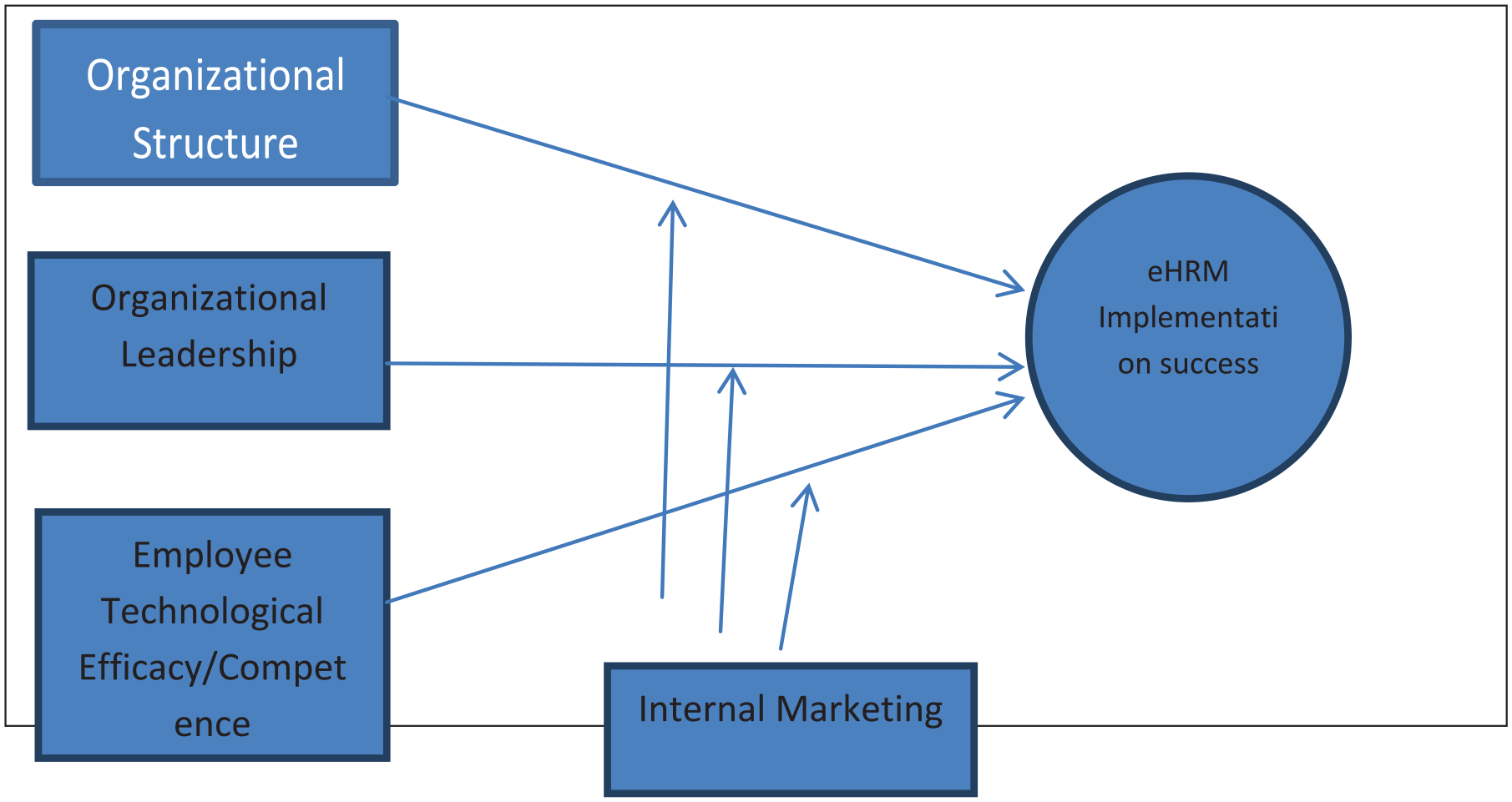
Conceptual model of the study.
Methodology
Study Design
A cross-sectional quantitative survey data is employed to address the theoretical relationship encapsulated in the conceptual model. Field survey is conducted to obtain information from key informant in the human resource management landscape. Key informant is purposively selected from wide range of industries. To collect data a novel dataset is establish based on list of human resource practitioner/professional that was made available by the Chartered Institute of Human Resource Practitioners, Ghana. The list contains most of recognize HR professionals and practitioners in the country. Primary data is gathered from field survey because there is no readily available source of secondary data to address research questions and hypotheses stated for the study. More so the usage of primary data is an acceptable practice in this domain of research (Galanaki, 2019).
The target population for the study is Human Resource Professionals and Practitioners in Ghana. Out of this population a purposive sampling approach is utilized to identify and select informant to be included in the field survey. As elaborate in earlier section, list of Human Resource Professionals was provided by the Chartered Institute of Human Resource Management (Ghana). From the list initiated contact is made with identified individuals through electronic mail. This mail seeks to solicit for their attention and permission to administer questionnaire. In addition, the purpose and objective of the study is elucidated. In total 350 individuals were contacted for the field survey.
Data Collection
The survey is conducted using questionnaire as data collection instrument. The data collection instrument is design in accordance with recommendation from management literature. Questionnaire needs to be clear and free from any forms of ambiguities (Heimeriks & Duysters, 2007; Yin, 2000). The questionnaire divided into two distinct sections—Section 1 focus on the profile and background of respondent; Section 2 focuses on the construct understudy. The questionnaire comprises of statement measuring a 7-Likert-scale. Each latent variable is measured with not less than three indicators. To establish content validity, measurement items are adapted from management literature. Inasmuch as some of the variables were self-developed, it underwent rigors validity and reliability test (Nunnaly & Bernstein, 1994). In designing the research instrument, the issue common method bias is addressed by shuffling the questionnaire in a manner that would be difficult for the respondent to predict the study outcome (Krishnan et al., 2006).
Pilot test is conducted to ascertain the initiate validity and reliability of construct understudy. In addition, face validity of the questionnaire is conducted with the aid of three professors in the fields of public administration and information systems. The questionnaire is distributed to HR professionals and academic experts in human resource management. The outcome of pilot test indicated the initiate questionnaire needed some adjustment and based on suggestions further revision were made before distributing for data collection. This approach is an essential because it offers the avenue to access the validity of data collection instrument and measurement items (Krishnan et al., 2006). Furthermore, the discourse with key informant during the pretest suggests social desirability bias would not affect the validity of outcome.
Response from the field survey accounts for 70% comprising of 248 answered questionnaires. During the survey period these individuals were promised complete anonymity and this ensure higher response rate. Reasons for non-reasons were attributed to the respondents overwhelming work schedules and a lower percentage have retired and not practicing at the time of the survey.
In furtherance the common method bias test is performed to ascertain if there are the presents of common method bias. Conducting common method bias test confirms the authenticity and reliability of data acquired from the field survey (Kanwal et al., 2019) and as used in study conducted by Saridakis et al. (2017). According to the outcome of the study indicates there is no issues of common method bias because number of factors had a factor value of 58.8% of the variance and the methods factors comprises 1.7% of the variance, respectively (Pavlou & El Sawy, 2006).
Measures
Dependent Variables
e-HRM success is the dependent variable for the study. The measurement is to elucidate insights into the degree of satisfaction employee/organization regarding the implementation of e-HRM system. The measurement in this section seeks to examine individual’s perception about the level of success. The variable measures the extent organization is satisfied with the diffusion of eHRM in particular organization.
Independent Variables
Organizational leadership
Organizational leadership examines how the involvement and commitment of management or leader influence the adoption and implementation of e-HRM. It measured how technology oriented leadership contributes to the success of electronic human resource management. Measurement items are synthesized from studies conducted by Van Wart et al. (2017) and Zorn et al. (2011).
Organizational structure
Measures the degree at which organizational structure influence the implementation and adoption of e-HRM system. Measurement items are drawn from studies conducted by Damanpour and Aravind (2012), Čudanov et al. (2009), and Andrade and Joia (2012).
Employee technological capabilities
Employee technological capabilities is classified as employee or individuals’ skill, knowledge, and competence regarding the usage of technological systems and platform. The variables are measure based on a self-developed scale. However, this scales are rooted in studies in management literature and has its premise in the technology acceptance model.
Moderating Variables
To gain insight into the conditions that stimulate superior performance between independent variables and the success if e-HRM, internal marketing is adopted as moderating variable. It measures processes and mechanism implemented by organization in order to satisfy internal customers, thus employee. This is measured by adapting items from scale developed by Foreman and Money (1995). It further measures the communication and relation management channels organization deploys to gain employee attention and lock-in.
Control Variables
Previous studies have document the impact of firm size, firm age, and trust as antecedent to the adoption of new technologies in organizations. These variables are treated as control variables to avoid issues of omitted variable bias.
Data Analysis
Profile of Respondents
The study utilized a sample of 248 respondents selected from diverse organizations. These informants are knowledge and have enough experience in the practice of human resource management across different industries. Respondent demonstrated an appreciable amount of knowledge in the field and practice of human resource management. The profile information of respondents is presented in Table 1.
Profile of Respondents.

Descriptive Statistics of Measurement Items
The distribution and characteristics of data is presented in Table 2. The mean, standard deviation, and excess kurtosis is highlighted in this section. In addition, the skewness of data, minimum, and maximum data point is eluded. The outcome indicate data is normally distributed and do not display any signs of significant outlier that might affect the validity of result.
Descriptive Statistics.

Structural Model Assessment
Exploratory Factor Analysis
Exploratory factor analysis is classical measurement model to assess observed and latent variable. It aids to investigate structural equivalence of observed and latent variable (Zuckerman & ALuja, 2015). Structural validity is analyzed using exploratory factor analyses. Four factors were explicitly extracted using the principal component method with varimax rotation (N = 248). These factors accounted for 28.27% of the variance. In addition, the Initial Kaiser–Meyer Olkin (KMO) measure of sample adequacy and Barttett test of Sphericity is performed. The outcome of the test indicates the structural model has a Barttet test of Sphericity (Approx: χ2 = 901.432, df = 248, sig. = 00) and KMO (value of 0.653). The measurement items satisfied the accepted threshold for factor loading (Korzynski et al., 2020; Hair Jr et al., 2014).
In addition, reliability and validity of measurement items are tested using Cronbach’s alpha and average variance extracted techniques, respectively. Each of the constructs understudy had an appropriate alpha value and average variance extracted value. The outcome of these test provides the grounds to perform further analysis to ascertain the relationship between various latent variables—thus the effect of organizational leadership, organizational structure, and employee technological capabilities on the success of e-HRM system. Table 3 presents the factor loadings, alpha value, and average variance extracted value.
Factor loadings, alpha value and average variance extracted value.

Correlation and Regression Analysis
Tables 4 and 5 present the outcome of correlation and regression analysis conducted to test the effect of organizational leadership, organizational structural, and employee technological capabilities on the success of e-HRM system. In addition, the moderating role of internal marketing is ascertained. The outcome of correlation test indicates multicollinearity is not present within the data, therefore providing some degree of credibility for the findings of the study. In addition, correlation test provides basic insights into the relationship between discussed variables.
Correlation Outcome.

Regression Outcome.

Hierarchical regression analysis is conducted to examine the relationship between independent variables and success of e-HRM. From the outcome of the regression analysis it can inferred that mutual trust had significant relationship with alliance performance as indicated by it t-statistics across all three models. The model I, II, and III had R2 value of .104, .349, and .662, respectively. Inference indicates control variables had 10% influence on the performance of alliance; model II had 34.9% influence on success of e-HRM systems and model III had 66% on the success of e-HRM system. Furthermore, internal marketing had the ability to moderate the positive relationship between organizational structure and e-HRM success at t = 3.014, p = .000 < .01. And employee technological capabilities at t = 6.472, p = .000 < .01. The outcome of the empirical analysis support four out of the six stated hypotheses.
Discussion
The study examines the impact of organizational leadership, organizational structure, and employee technological capabilities on the success of e-HRM systems. In addition, the moderating role of internal marketing is investigated. Drawing on a sample of HR professionals and practitioners, the findings of the study revealed that organizational structure and employee technological capabilities have significant and positive impact on the success of e-HRM system. The outcome of the study indicates trust in the system as major determinant of e-HRM success. Trust builds confidence and morale of users of particular system. In addition, exchanges between relevant parties in the adoption and utilization of e-HRM are enhanced with the presence of trust. The insights this study provide supports assertions made by Scherer et al. (2019) and Taherdoost (2018) that emphasis on the role trust plays in the adoption and utilization of e-service technologies.
Firm age and size is found to not have any significant influence on the success of e-HRM and this is intriguing because previous studies such as Meyer et al. (2011) has acknowledge the role firm’s age plays in adoption of technologies. These findings are further augment by study conducted by Pan et al. (2021) that found no significant relationship between firm size, age, and technology competences. The rationale for such contradiction is rooted in the changing trends of firms’ operations in the business environment-firm in recent times are increasingly becoming tech savvy organization. Tech savvy organization in these times can range from small and medium enterprise comprising of a single employee or a large corporation. The advancement in technology over the period have provided the requisite for these enterprises to thrive and further eliminating firm size and age as barrier to adoption of new e-service technologies such as e-HRM.
The finding of the study further reveals organizational structure has an impact on the success of e-HRM system in organizations. Organizational structure defines the exchanges style of organization. A proactive organizational structure would definitely impact the efficiency of exchanges. Continuous exchanges between units and individuals would translate into the acquisition of relevant skills needed for deployment of e-service technologies such as e-HRM. Organizations that have a robust and agile organizational structure are able to adopt/adapt to changing technological trends in rapid manner. This finding support previous one arrived at by Damanpour and Aravind (2012). Organizational structure plays a critical role in the diffusion of knowledge and technology in an organization. Inasmuch as organizational structures have a positive impact on the success of e-HRM, the onus lies on management to align organizational technological aspirations with employee’s expectation in order to satisfy its internal staff. By adopting internal marketing principles and practices organizations are able to communicate and motivate staff to adopt positive attitude toward certain organizational policies and technologies. The caveat in this situation is organization need to possess superior skills in identify and aligning organizational goals and employee expectation. Ultimately role of internal marketing in enrich organizational structures in times of technological change and adoption cannot be underestimated.
The impact of human capital on the success and performance of technologies cannot be underrated. Organizations with superior human capital turn to enjoy high degree of competence in functional activities. When individual possess requisite skills and knowledge it hastens an organization competitive advantage building process. Superior human capital transforms every facet of an organization including its technological services and products. The adoption and utilization rest mostly on its users. Whiles some individuals might be resistance to change in technological era, organization with employee that possess competence and knowledge in usage of technological tools and products are shifting the paradigm in discharge of functional activities. The efficacy of individuals in an organization in most cases translates into organization efficacies and competencies. Therefore, organization with ICT savvy individuals would have high possibility of adopting e-HRM system and services. In addition, this finding contributes to studies such as Zhang et al. (2017) and Tsai et al. (2019) in the area of technology adoption that argues the essence of individual or employee self-efficacy and technology oriented knowledge on the success of technology adoption and utilization.
Organizations that seek to thrive in competitive business landscape should implement prudent communication and relationship management channels to facilitate and streamline job design and processes. Internal marketing is crucial if firms can recruit and retain superior talent in a competitive world. Through such activities management are able to provide sufficient insight to employee about the mutual benefits regarding the adoption of new improved systems.
Conclusion
The study attempts to investigate the effect of organizational leadership, organizational structure, and employee technological capabilities on the success of e-HRM system adoption and usage. It further examined the moderating role of internal marketing. Drawing lessons from technology acceptance model the state formulated and examined six hypotheses. Data to test theoretical relationships proposed is collected from HR professional and practitioners in a developing economy. The outcome of the study indicates organizational structure and employee techno because previous studies suc logical capabilities have a positive and significant influence on the success of e-HRM. Conversely, organizational leadership did not have significant influence on the success of e-HRM. However, it must be acknowledging internal marketing plays critical role in aligning organizational goals, employee’s capabilities, and expectation.
Although the study makes some interesting to theory and practice, there are some shortcomings that needs to be addressed in future research. Future research should endeavor to conduct longitudinal studies to ascertain the effect of time on the performance of these constructs. Since e-HRM is at the infant stage in developing country such as Ghana, it would be interesting to understanding how it evolves over time. Comparative studies of antecedent of e-HRM adoption and usage in other developing economic would be interesting.
Footnotes
Declaration of Conflicting Interests
The author(s) declared no potential conflicts of interest with respect to the research, authorship, and/or publication of this article.
Funding
The author(s) received no financial support for the research, authorship, and/or publication of this article.
