




Abstract
Malaysian manufacturing firms play an important role in the country’s social and economic development. However, the industry faces challenges in productivity and competitiveness due to rapid globalization and economic instabilities affecting countries worldwide. To address these challenges, technological capability has become an essential requirement for a firm’s technological progress to remain sustainable and competitive. This study aims to identify factors that influence the technological capability of food manufacturing firms by using a questionnaire. Using IBM SPSS Statistics 27, exploratory factor analysis (EFA) was employed to examine the dataset obtained from the survey and analyze the factors that contribute to a firm’s technological capability. Overall, firms are influenced by knowledge management, organizational learning, and organizational innovation in their technological capability development. By understanding these factors, firms can develop their technological capability and further improve their productivity, ultimately achieving a sustainable competitive advantage in the market.
Keywords
Introduction
In today’s rapidly evolving business landscape, the ability to leverage technology has become a critical factor for firms looking to gain a competitive edge. Technological capability, defined as a firm’s ability to effectively apply its technological knowledge and skills to create value, has therefore become increasingly important. For manufacturing firms, particularly those in the food industry in Malaysia, the acquisition and accumulation of knowledge are necessary to strengthen technological capability and achieve sustainable growth. These firms face intense competition in the global market, making technological capability crucial for their success. Recognizing this importance, the Malaysian government has launched several initiatives to support local firms in adopting new technologies. The National Policy on Industry 4.0, known as “Industry4WRD,” was launched in 2018 to promote the adoption of Industry 4.0 technologies and to encourage firms to develop their technological capability. Similarly, the recently launched Malaysia Digital Economy Blueprint in 2021 emphasizes the government’s commitment to accelerating Malaysia’s progress as a technologically advanced economy. Given this context, this study aims to explore the drivers of technological capability development in Malaysian food manufacturing firms by analyzing data from various sources.
The manufacturing sector in Malaysia plays a vital role in the country’s economic development, contributing about 23% to its Gross Domestic Product (GDP) in the past 5 years (Ministry of International Trade & Industry, 2019). With significant forward and backward linkages, the manufacturing industry has high multiplier effects on the nation’s activities and growth. It includes economic productivity, job creation, and new technology transfer (Malaysia Investment Development Authority, 2021). In particular, the food manufacturing industry contributed to about 18.49% of the total sales value of the manufacturing sector in 2020, amounting to a value of RM 249 billion. It is the third-highest value recorded after electrical and electronic products (31.50%) and petroleum, chemical, rubber, and plastic products (25.16%) (Department of Statistics Malaysia, 2021).
The food manufacturing firms in Malaysia encompass companies involved in value-added activities using agricultural or horticultural products, with key growth areas including functional food, health food, convenience food, and ingredients (Ministry of International Trade & Industry, 2019). Despite its growth, the food manufacturing industry constitutes only about 10% of the manufacturing output. Furthermore, eventhough the export performance of this sector has more than doubled in the last 10 years, Malaysia remains a net importer of food items, with the import value of processed food totaling RM 20.0 billion (Malaysian Investment Development Authority, 2019). Malaysia’s domestic consumption of various food products, including rice, dairy products, and seafood, relies heavily on imports. Therefore, the food manufacturing firms in Malaysia are facing a challenge to improve their productivity. To remain competitive and sustainable in this dynamic environment, food manufacturing firms must prioritize growth, production performance, and innovation. Various factors, including rising wages, a workforce shortage, and competitive pressure from other rising economies in Southeast Asia, have compelled Malaysian manufacturing businesses to transition from labor-intensive to capital-intensive and technology-intensive operations.
To achieve sustainable competitive advantage and continuous growth, manufacturing firms need to accumulate knowledge and strengthen their technological capability. Malaysian food manufacturing firms must strengthen their technological capability to face the fierce global market competition and achieve continuous growth. In support of global industrial development, the Malaysian government has launched the National Policy on Industry 4.0, named “Industry4WRD.” This initiative fosters manufacturing firms’ effort to develop their technological capability, expediting the transformation into a technology-intensive industry. Hence by utilizing data from Malaysian food manufacturing firms, this study investigates the drivers of technological capability development.
Technology acquisition can be achieved through the utilization of internal resources or through the acquisition of external resources (Nonaka et al., 2008). A firm with strong technological capability may be able to use its resources to develop new products, enter new markets, and improve the efficiency of its operations. This in turn can help the firm to gain a sustainable competitive advantage over its rivals. Moreover, having a strong technological capability will also help in operation improvements and cost reductions through automation, data science, and other technological advancements. By using these resources to streamline the operations, firms can increase their productivity and ultimately improve their profitability (Feng et al., 2020).
The demand in the food manufacturing industry requires highly skilled workers, such as professionals and technicians, so that the production of good quality products will be sufficient (Mohamad Yunus, 2020). However, the food manufacturing industry in Malaysia is predominantly dominated by SMEs, where many challenges hinder their performance. New technology needs to be learned because, in technology transfer, the technologies cannot talk or express themselves; therefore, it requires talents and investment in technology companies. Therefore, learning is essential in developing technological capability because it will help enhance the employees’ skills and productivity.
Technological capability helps firms improve products, enhance production, and perform better in a turbulent environment by responding to market change (Chang & Chuang, 2016; Salisu et al., 2018). The inclusion of technological knowledge, production skills, trade secrets, and invaluable patterns within technological capability creates a significant obstacle for competitors attempting to replicate or imitate (Kim, 2017; Santos et al., 2015), ultimately allowing firms to establish a durable competitive advantage. The current study investigated and reviewed aspects influencing the technological capability of food manufacturing firms. This study used exploratory factor analysis (EFA) to examine the dataset. A total of 50 Malaysian food manufacturing firms were chosen for the study using a random sampling method.
Conceptual Background
A review of the literature on technology in manufacturing enterprises indicated a dearth of research that discussed technological capability factors. Nonetheless, by continuing this line of study, published materials about a firm’s technological capacity are identified through online databases and article reference lists. Web of Science and Scopus were the primary sources of information for this review. “Technological capability,”“innovation,” and “manufacturing industry” were among the search terms. A model was created based on a thorough evaluation. Before delving into the research design, this paper discusses the potential effects of each construct.
Technological Capability (TC)
Technological capability is widely acknowledged as a fundamental strategic resource that empowers firms to establish enduring competitive advantages. This stems from its composite nature, incorporating elements such as technological knowledge, production skills, trade secrets, and invaluable patterns, which collectively pose significant challenges for competitors in their attempts to replicate or imitate (Kim, 2017; Santos et al., 2015). The assertion made by Fung (2019) further emphasizes the critical role of technological capability in sustaining a firm’s competitive advantage. Without it, even substantial investments in research and development (R&D) may not yield long-term benefits, as rivals could quickly imitate such efforts. However, when technological capability is deeply ingrained within a firm, it becomes an intangible asset that cannot be easily transferred or replicated. It is developed through the iterative process of “learning by doing,” building upon unique experiences and insights gained within the firm. Consequently, competitors without similar experiences are unlikely to fully comprehend or successfully replicate the firm’s technological capability, solidifying its status as a valuable and rare resource.
Any organization desires technological capability to create increased performance in technological development. Firms with sophisticated technological capabilities tend to perform better because cutting-edge technologies give them the first-mover advantage, leading to efficiency gains (Tzokas et al., 2015). In addition to this, when firms achieve higher efficiency gains by pioneering process innovations, they will perform better in a more turbulent environment by responding to market change (Chang & Chuang, 2016; Salisu et al., 2018). Furthermore, firms can produce superior products with better technological capability by performing R&D through state-of-the-art technologies. Besides, it will help firms enter the growing market by producing innovative products and designs. When technological capability has become a firm’s core competency, it will develop the economy of scope, which will become a barrier to entry for competitors (Poudel et al., 2019). Additionally, products are improved, production can be enhanced, and costs will be reduced. Consequently, the turnover and profit will improve as well. Ariana (2019) also argued that technological capability improves customer value and competitive advantage.
New technology needs to be learned because, in technology transfer, the technologies cannot talk or express themselves; therefore, it requires talents and investments in technology companies. These movements will give a spillover effect to the other firms and institutions, in which the technologically affected firms will also contribute to this cycle by enhancing their technological capability (Esendemir & Zehir, 2017). Typically, the higher technological capability will eventually guarantee higher returns on the R&D performed; hence, firms with high technological capability will have a greater incentive to increase their investment of R&D because technological capability lowers the risk in the R&D investment (Kang et al., 2017). Overall, technological capability helps firms invest efficiently and acquire new technologies.
Technological capability is an essential requirement for firms to effectively adapt to market dynamics. Extensive research has consistently indicated that a firm’s technological capability is not an instantaneous acquisition but rather a product of continuous development and accumulation based on its past experiences (Nanayakkara et al., 2018; Siwadi & Pelser, 2015). However, several issues affected the technological capability level of the firm. Some firms experienced weak technological capability development due to the lack of proficient skills. In this vein, adequate fund is important to ensure training and development is not hindered and cutting-edge technologies can be acquired (Ofoka & Nwalieji, 2019). Moreover, it is worth noting that if there is a lack of interaction among actors, there will be limited opportunities to accumulate technological capability through learning and development. With this regard, several studies have been undertaken to explore the role of knowledge management and organizational learning as the driving factors that promote technological capability (Hansen & Lema, 2019; Xu et al., 2015; Yan et al., 2018; Yu et al., 2017). Another study also suggested that organizational innovation may influence the accumulation of a firm’s technological capability (Helfat & Campo-Rembado, 2016).
Knowledge Management (KM)
In today’s world, the generation of wealth and performance outcomes has shifted toward intellectual capital, where knowledge has emerged as a valuable asset. To effectively harness this asset, knowledge management practices play a crucial role in ensuring that information and intellectual resources are utilized strategically, transforming them into valuable contributions. By identifying and applying the “right knowledge” at the appropriate times, firms can leverage this social capital to establish a sustainable competitive advantage. This, in turn, enables manufacturing firms to adapt to evolving market requirements, enhance operational efficiency, and foster a culture of innovation (Saqib & Zarine, 2018). Empirical research conducted on Jordanian manufacturing firms further supports the significance of knowledge management, indicating its positive influence on a firm’s competitive advantage (Al-Nawafah et al., 2019). These findings underscore the importance of effective knowledge management in driving organizational success and positioning firms at the forefront of their industries.
Current globalization is heavily driven by knowledge. It is a knowledge-based economy, which is the most significant competitive advantage. Thus, it is only sustainable for firms to develop their knowledge to create new products. A unique product will give a firm a competitive advantage when customer satisfaction and loyalty increase, ultimately increasing sales volume (Birasnav, 2014). Knowledge management is helpful in manufacturing firms because it improves employees’ skills and staff retention. It also helps in decision-making and, most importantly, in better customer handling (Shah & Kant, 2018).
To enhance their technological capability, organizations should consider knowledge management as a crucial aspect. It enables the sharing and spreading of information which is crucial for developing and improving technological capability. By making valuable knowledge accessible to those who need it, organizations can foster innovation, upgrade the skills and abilities of their workforce, and make informed decisions (Rozkwitalska & Lis, 2022). Additionally, by implementing knowledge management practices, organizations can keep pace with the latest technological advancements, identify opportunities for growth and improvement, and gain a competitive edge in the market.
To fully leverage technology and remain competitive, organizations must continuously improve their technological capability. This requires acquiring the necessary knowledge, skills, and cognitive resources through interactions and collaborations with other industry players and internal efforts to create new knowledge and enhance the firm’s technological capability (Peerally et al., 2022). Thus, organizations must engage in both external and internal investments in acquiring and applying new technologies to develop and maintain their technological capability.
Numerous research studies have examined various factors influencing the advancement of technological capabilities. However, there has been a dearth of investigations specifically focusing on the direct relationship between knowledge management and technological capability. In a study conducted in the manufacturing industry of Thailand, Chantanaphant et al. (2013) discovered a positive association between knowledge acquisition, assimilation, transmission, and application, and the development of technological capability. Building on this, Qiu et al. (2022) conducted a qualitative interpretive study, which reinforced the notion that a company’s accumulation of technological capability heavily relies on a solid knowledge foundation and expertise in technology. It is through effective knowledge management systems that companies can generate novel knowledge, enabling them to create new technologies, enhance existing ones, and elevate their technological capabilities. In alignment with these findings, Adepoju et al. (2017) conducted a study supporting the argument that companies in developing countries should focus on expanding their prior knowledge base and engage in intensive learning to swiftly acquire technological capability. These studies collectively highlight the significance of knowledge management in facilitating the acquisition and development of technological capabilities by firms.
To sum up, knowledge management is a critical factor for manufacturing firms to gain a competitive advantage in today’s knowledge-driven economy. By effectively managing and utilizing their intellectual capital, firms can adapt to market requirements, increase efficiency, and foster innovation. Studies have shown that knowledge management positively impacts firm’s ability to develop their technological capability. As technology continues to advance rapidly, manufacturing firms must recognize the importance of investing in their knowledge management systems to remain competitive in the global market. By doing so, they can generate new knowledge, create unique products, and ultimately enhance customer satisfaction and loyalty, leading to increased growth and improved performance.
Organizational Learning (OL)
As the manufacturing industry relies heavily on technological development, the employees’ involvement in problem-solving activities will always be relevant and will remain critical in improving the operation’s performance (Tortorella et al., 2020). Despite employees being the agents of learning and natural learners, organizational learning is a conscious process. It is not merely a pool of individual knowledge. The nucleus of organizational learning is the transfer of knowledge from individuals to the organization through social interactions. Hence, learning must be shared among the firm’s members to ensure the organizational learning effort is fruitful. The learning outcome must be saved and applied in the organization’s system and environment (Almaian & Qammaz, 2019).
On the other hand, organizational learning will be impeded if the generated and stored data is not shared or practiced within the firm. Eventually, it prevents the firm from improving its manufacturing operations (Nardello et al., 2017). In a nutshell, organizational learning is the process by which the organizational members’ experience combined with task performance is converted into new knowledge so that proper decision-making can be established to enhance the firm’s efficiency and effectiveness.
The main concern of organizational learning involves change. Without the presence of the organizational learning process, it will be difficult for firms to change their operations paradigm. Organizational learning is needed so that a firm can learn new behaviors and interpret phenomena in different ways (Zhang & Zhu, 2019). Eventually, this will create a new approach to organizational operations and decision-making. Besides, firms that can learn faster than their competitors will have a better chance of identifying market trends and changes. Hence, they will be able to cope with external opportunities and threats. As a result, they will be able to take proactive action faster than their competitors (Roque López & Arriaga Martínez, 2019).
Organizational learning is also relevant in stimulating cooperation and teamwork among employees when they work interactively on problem-solving as a learning process. This process contributes to expanding the organizational knowledge and improving the skills and capabilities, which eventually lead to innovative behaviors and ideas (Muniz, 2019). In addition to this, it also results in better employees’ job satisfaction and performance (Darma Rosmala Sari & Sukmasari, 2018).
Numerous research studies have endeavored to establish a correlation between a firm’s technological capability and its organizational learning. One revealed that local suppliers can enhance their technological capability by capitalizing on backward linkages and learning from multinational companies. The investments made by subsidiaries of multinational companies serve as a valuable source of knowledge acquisition for these suppliers (Zakariah, 2012). Similarly, another study indicated that investing in learning, immigration, and technical experts, in addition to importing highly complex products, are essential elements for developing technological capability (Pérez Hernández, 2019). Factors such as international immigration can help attract talent and increase a firm’s productivity. Additionally, the training of skilled workers, cooperative relationships, and knowledge distribution emerged as critical factors influencing a firm’s technological capability (Lin & Lai, 2021). These findings collectively underscore the significance of organizational learning and various contributing factors in shaping a firm’s technological capability.
The combination of these various elements results in the creation of an environment that is conducive to investing in long-term strategies that can enhance a firm’s technological capabilities. When firms allocate resources toward these initiatives, it allows them to develop and improve their technological capacities. This, in turn, can increase their overall productivity and enhance their ability to compete within the market. By continuously investing in and improving upon their technological capabilities, firms can position themselves to stay ahead of the curve, anticipate market trends, and take proactive measures to address any potential threats or challenges. Ultimately, this enables firms to remain competitive and agile, and stay at the forefront of the industry.
Organizational Innovation (OI)
Many people usually perceive innovation as merely the product or process innovation. Nevertheless, there are several types of innovation, including marketing innovation and organizational innovation. It is fundamental to distinguish them to understand the various innovations. It is beneficial to understand different kinds of innovation, even though they are not entirely independent (Chung & Kim, 2017). Organizational innovation, as defined by the Organization for Economic Development and Cooperation, entails the adoption of a novel organizational approach within a firm’s operations, workplace organization, or external interactions. It involves the implementation of new managerial practices that have not been used previously (OECD/Eurostat, 2005). Moreover, organizational innovation encompasses a wide range of activities, including the introduction of new programs, services, equipment, systems, or policies that facilitate and materialize innovative outcomes within the firm (Chen et al., 2020). It serves as a means for the firm to identify problems, gather relevant information, generate fresh ideas, and explore viable solutions to address the identified issues.
The impact of organizational innovation on a firm’s innovation performance cannot be overstated. Both internal organizational factors and external environmental factors play a role in shaping a firm’s ability to innovate effectively, and organizational innovation creates an environment conducive to the development of new technologies (Chung & Kim, 2017). This is particularly true for the food manufacturing industry, which can benefit greatly from organizational innovation (Ciliberti et al., 2017). By prioritizing organizational innovation, firms can effectively respond to customer demands, cultivate new organizational practices, foster stronger external relationships, and stimulate innovation activities, all of which contribute to enhanced overall performance (Chaubey et al., 2019).
Moreover, the success of technical innovation frequently hinges on the integration of organizational innovation. This is because implementing new technologies and processes requires new procedures, capabilities, and managerial skills. By fostering a supportive environment that promotes the adoption and utilization of novel technologies, firms can enhance their technological capability, boost profitability, attain market leadership, and foster a conducive work environment for their employees. In a nutshell, while technical innovation is critical in the food manufacturing industry, firms must also prioritize organizational innovation to maintain a sustainable competitive advantage. By fostering a culture of innovation that encourages experimentation with new technologies and problem-solving approaches, firms can improve their overall innovation performance and enhance their technological capability, ultimately leading to long-term success in the market.
Methodology
For this study, a questionnaire was devised by incorporating multiple measurement items and conducting an analysis of relevant literature. The questionnaire encompassed 67 variables to evaluate the constructs of “Technological Capability,”“Knowledge Management,”“Organizational Learning,” and “Organizational Innovation.” To ensure the validity and refinement of the questionnaire, it was subjected to a validation and refinement process by a panel of experts. Additionally, a pre-test was conducted to assess its effectiveness. The data was gathered from the Federation of Malaysian Manufacturing’s directory. In total, 50 completed surveys were collected. Fifty respondents are considered a reasonable absolute minimum sample size for conducting Exploratory Factor Analysis (de Winter et al., 2009), while Ali Memon et al. (2017) recommended 30.
By using the IBM SPSS Statistics 27 software, this study employs the Exploratory Factor Analysis (EFA) because the determinants of technological capability in the manufacturing industry have received relatively little attention before further establishing a framework for future studies. Principal Component Analysis (PCA) extraction was followed by orthogonal Varimax rotation with Kaiser normalization in all EFA procedures to provide the factor loading structure. PCA simplifies data by identifying patterns, creating new variables and Varimax rotation makes it more interpretable. This statistical approach is used to confirm the validity and reliability of the questionnaire before it is modified to the new study model. It helps to ensure that the questionnaire is measuring what it is intended to measure. Many research recommended employing the EFA approach for each construct to ascertain if the dimensionality of the items has varied from the original study where the dimensions were established (Hoque et al., 2017; Noor et al., 2015; Yahaya et al., 2018). The present study diverges from previous research in several aspects, including the specific field of study, cultural and socioeconomic characteristics of the studied populations, as well as the time gap between the current study and prior investigations. These variations may lead to differences in the dimensionality of the current study. In other words, the dimensions examined in previous research may not align completely with the dimensions explored in the present study, particularly considering that the current study focuses on a new industry and environment setting (Awang, 2014).
Empirical Results
The statistical model in this study utilizes 67 variables that were derived from a thorough literature review. Given the comprehensive and detailed analysis conducted, it is challenging to determine the most appropriate number of variables. Various factors, including the study’s scope, participant characteristics, the rigor of the literature review, and the formal criteria applied in the exploratory factor analysis (EFA), differed across studies. Consequently, we have decided to commence the analysis with three factors that were identified during our preliminary research. We used items from previous pieces of literature for the selected constructs of knowledge management (Rašula et al., 2012), organizational learning (Tohidi et al., 2012), organizational innovation (Wang & Ahmed, 2004), and technological capability (Latip, 2012). The instrument was developed specifically to collect data on the determinants of technological capability in food manufacturing firms, and the items were adapted from prior research due to their established use in the literature. Additionally, all of the constructs exhibited satisfactory original composite reliability values of greater than 0.7 (Hair et al., 2010).
A series of changes were made to improve the quality of the initial factor model, which comprised 67 variables. Variables that are substantially linked with two or more factors were removed from the model one at a time, depending on their substantive compatibility. The same procedure was used for each construct’s exploratory factor analysis. As a result of the gradual reduction and assessment of other model quality attributes, the final model consists of four constructs and 44 variables. PCA was utilized for extraction, and Varimax was employed for rotation (Variation Maximization). The results in Table 1 reveal that Bartlett’s Test of Sphericity for each construct is significant (p-value .05), and the Kaiser-Meyer-Olkin (KMO) measure of sample adequacy is outstanding, exceeding the required value of 0.6. (Hoque et al., 2017; Yahaya et al., 2018). These results suggested that the data was sufficient to continue with the EFA’s data reduction technique.
KMO and Bartlett’s Test.

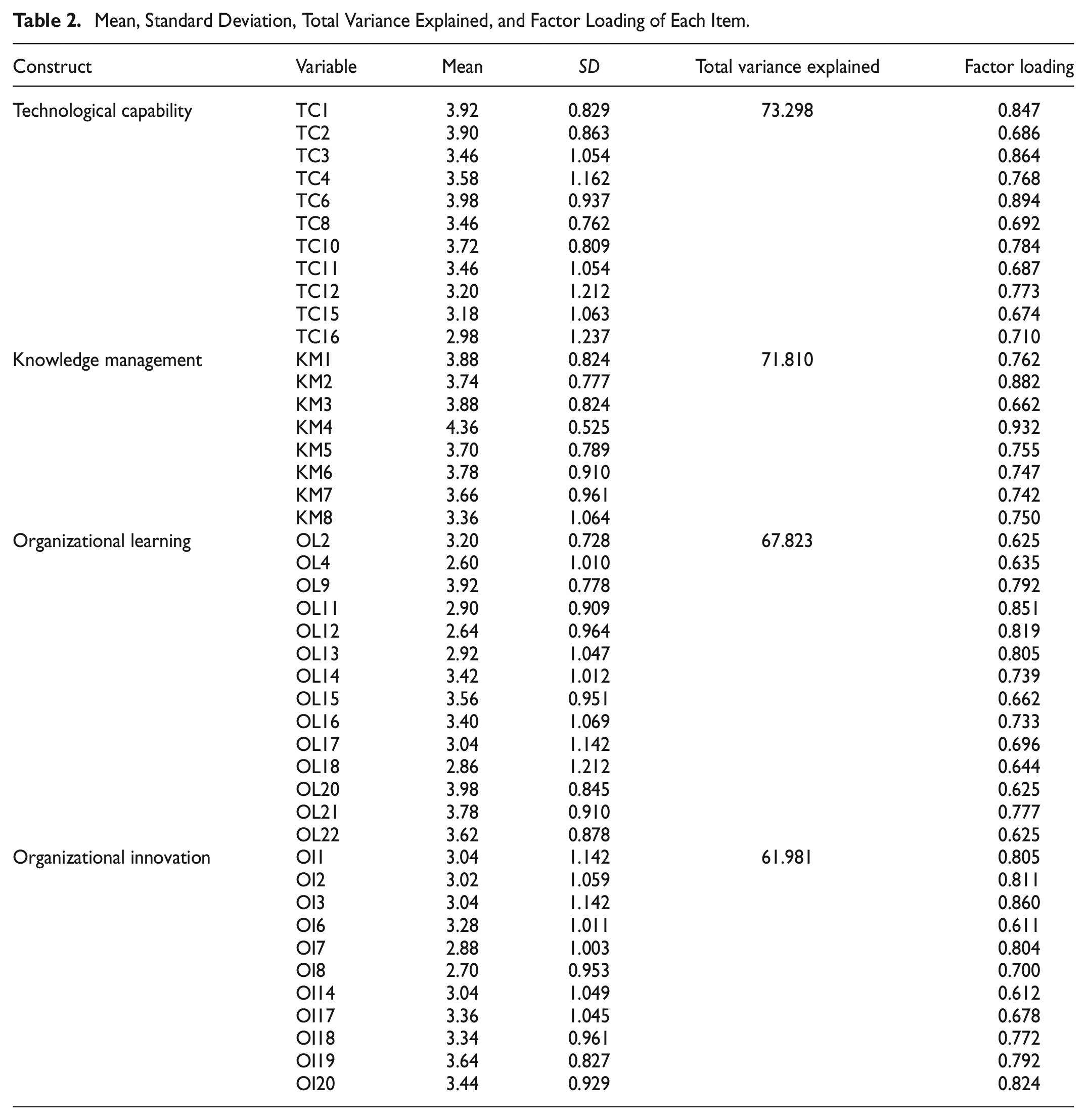
Table 2 shows the basic statistics of the final exploratory model with four constructs. It summarizes the mean, standard deviation, total variance explained for each construct, and the factor loading of all the measurement items. Since they exceeded the minimum criteria of 60%, the total variance explained is acceptable for all constructs (Noor et al., 2015). In the analysis, an item was not considered to load on a factor if its factor loading was less than 0.60. Hence, items with loadings lower than 0.60 or greater on more than one factor were omitted.
Mean, Standard Deviation, Total Variance Explained, and Factor Loading of Each Item.
Cronbach’s alpha is used to measure the internal reliability of each construct. Internal reliability measures how well individual items are proportionally associated to each other when measuring a particular construct. Cronbach’s alpha should be better than .7, according to Awang (2014), for the construct to achieve internal reliability. The reliability analysis for each construct is shown in Table 3. Cronbach’s alpha values for all constructs are greater than .7, indicating that the items for each construct are appropriate and reliable in assessing the response.
Reliability Analysis.

Based on the result, we proposed a model that includes two independent constructs, one mediating construct and one dependent construct defined by 44 variables. We discovered major aspects that may affect the technological capabilities of manufacturing enterprises from the standpoint of technological management. Existing scholarly research has consistently shown that effective knowledge management (KM) practices have a positive impact on a firm’s innovation capacity. This is primarily due to the role of KM in facilitating research and analysis activities that support the generation of new ideas and innovations, as highlighted by Sesay et al. (2018). Similarly, Breznik (2018) demonstrated that KM can stimulate innovation by providing access to essential information and expertise for idea generation. By implementing robust KM practices, organizations can effectively support their innovation efforts and maintain a competitive edge in the market.
A considerable body of research has investigated the relationship between organizational learning and innovation in firms. Ma’toufi and Tajeddini (2015) noted that firms that demonstrate a strong commitment to learning, possess an open-minded culture, and share common goals tend to experience higher levels of innovation. Moreover, learning plays a critical role in enabling individuals to enhance their skill sets, which, in turn, facilitates the development and implementation of organizational innovation. Ciliberti et al. (2017) provide empirical evidence supporting this notion, emphasizing that learning enables firms to establish innovative organizational practices in areas such as external relationships, decision-making processes, and various business activities. These findings highlight the importance of organizational learning as a catalyst for fostering innovation within firms. Figure 1 depicts the proposed factor model. The model is made up of four constructs: KM (Knowledge Management), OL (Organizational Learning), OI (Organizational Innovation), and TC (Technological Capability). The developed model provides a detailed overview of how the organizational variables drive a firm’s technological capability.

Model of the factors affecting the technological capability of food manufacturing firms.
Discussion and Conclusion
The primary objective of this study was to investigate the factors influencing the technological capability of food manufacturing firms in Malaysia. Our findings suggest that knowledge management, organizational learning, and organizational innovation, are underlying factors that contribute to the development of technological capability. These findings are consistent with previous studies that has emphasized the importance of these constructs in developing technological capability of a firm (Adepoju et al., 2017; Chaubey & Sahoo, 2019; Lin & Lai, 2021; Qiu et al., 2022). Specifically, we found that knowledge management processes such as knowledge sharing and knowledge application, as well as organizational learning elements such as openness and interaction with external environment significantly influence the technological capability of food manufacturing firms. Hansen and Ockwell (2014) suggested that firms in developing countries will develop their technological capability better by learning from their local and foreign technology partner compared to if they learn only from local spillovers. Nevertheless, it is important for firms to carefully select their foreign partners and to ensure that they have the capacity to absorb and use the new knowledge and technologies (Ho et al., 2019). These findings reinforce the importance of these constructs in enhancing technological capability.
Moreover, our study highlights the role of organizational innovation in driving technological capability. Firms that prioritize and emphasize organizational innovation are more likely to have higher technological capability. Organizational innovation must be given more attention to develop technological capability because without adequate emphasize on organizational innovation, firms may struggle to adopt and integrate new technologies, processes, and practices. The strategic planning and proper frameworks emphasized in previous literature further support the significance of organizational innovation in developing technological capability (Vimal et al., 2023).
Additionally, it is important to emphasize that the factors explored in this research (knowledge management, organizational learning, organizational innovation) provide guidance for managers to focus when developing technological capability. The initial step managers should take is to ensure a proper and effective knowledge management system is in place, for instance, providing updated and systematic database management to ensure that knowledge collected can be retrieved and applied in the future. Furthermore, a work environment that is conducive to organizational learning must be created so that tacit and explicit knowledge can be shared among employees. Technological capability can only be improved when there is knowledge and skill exchanges to create new knowledge. Despite the importance of knowledge management and organizational learning, organizational innovation plays a crucial role in maximizing the potential of technological capability development. Therefore, managers should design the firm policies and procedures that promote innovative activities and are strategic for technological capability development.
While our study extends existing findings by examining these relationships within the specific context of food manufacturing firms in Malaysia, it is important to note the potential limitations. The dynamic nature of technological capability, the feedback between interconnected organizational factors, and the influence of specific factors on firms’ ability to attain optimal technological capability were not comprehensively explored in this study. However, incorporating such complexity would make the framework challenging to comprehend and interpret. Nonetheless, the findings of this study would be of importance to the policymakers in designing the future program for technological technology acquisition and development in the country. As strategic orientations are vital issues and need to be considered for feasible business management, some concepts used in this study can be applied in training programs. The findings are equally relevant to various government agencies, from the local development authorities to the states and federal authorities, in having information regarding the technological capability of the food manufacturing firms to develop different policy initiatives to improve the food manufacturing industry.
The results presented here is relevant for both industry players seeking to enhance their technological capability and academia. Understanding the factors that drive technological capability enables firms to craft strategic activities to develop technological capability and improve the overall performance of the firm. Moreover, academia can benefit from these results as they serve as a foundation for future research endeavors. The topic of technological capability in the context of food manufacturing firms is an area that warrants further investigation. This study serves as an exploratory and descriptive analysis, opening avenues for further debate and complementation through confirmatory studies and other empirical approaches. Conducting additional research will help consolidate and advance our understanding of technological capability, particularly in the context of Industry 4.0.
Footnotes
Declaration of Conflicting Interests
The author(s) declared no potential conflicts of interest with respect to the research, authorship, and/or publication of this article.
Funding
The author(s) disclosed receipt of the following financial support for the research, authorship, and/or publication of this article: The work was supported by the UMCares–Universiti Malaya Community Engagement Grant (RUU2022-CE (06)).

Data Availability Statement
The datasets generated during and/or analyzed during the current study are available from the corresponding author on reasonable request.