



Abstract
While self-leadership has been widely studied, its specific impact on college students’ learning absorption lacks attention. This study addresses this gap by investigating the influence of self-leadership on learning absorption, focusing on students’ self-perceived influence. We used a three-dimensional model of self-leadership to assess its effect on learning absorption. Data were collected from college students via questionnaires, and descriptive statistics, correlation analysis, and analysis of variance were used to process the data. Multiple regression analysis helped determine the relationship between self-leadership and learning absorption. Our findings show a significant correlation between self-leadership and learning absorption. Each dimension of self-leadership—behavior-focused strategy, natural reward strategy, and constructive thinking model strategy—positively impacted learning absorption. Notably, the constructive thinking model strategy had the strongest effect, followed by the natural reward strategy, with behavior-focused strategy showing the least impact. These results highlight the vital role of self-leadership in college students’ learning. Implementing behavior-focused strategies can help clarify learning goals, while natural reward strategies can boost motivation and satisfaction. Additionally, fostering constructive thinking can enhance overall learning experiences. Ultimately, students who embody self-leadership characteristics tend to have better learning absorption, providing a strong foundation for personal and academic success.
Keywords
Introduction
Some college students today are facing significant challenges in maintaining focus (Oc et al., 2023). The vast amount of information available in the era of big data has adversely affected their cognitive skills (Liu et al., 2020). Additionally, the ease of accessing knowledge has cultivated a sense of complacency, resulting in the creation of an “information cocoon” (Yu et al., 2017). As a result, the capacity of some college students to absorb and engage with learning has markedly declined (An et al., 2024; Wong et al., 2022). Meanwhile, self-leadership is not confined to formal leadership roles; rather, it is a vital skill that anyone can develop in their daily life (Stewart et al., 2011). By embracing self-leadership, individuals have the opportunity to take charge of their actions, make informed decisions, and inspire those around them, fostering personal growth and meaningful relationships (Harari et al., 2021). This capacity is inherent in everyone, regardless of their role, making it a powerful tool for success in all pursuits (Haw et al., 2023). Individuals demonstrating strong self-leadership exhibit a heightened capacity to effectively regulate their time, emotions, and actions, ultimately facilitating significant personal growth and achievement (Yue et al., 2024). To enhance students’ learning absorption, this article examines how self-leadership can improve this aspect of their education.
The concept of self-leadership, developed by American psychologists Charles Manz and Henry Sims in the 1980s, offers a comprehensive framework for understanding the intricate dynamics of leadership within organizational contexts (Duignan et al., 2024). This theory emphasizes the idea that individuals can significantly enhance their personal accountability and intrinsic motivation by cultivating self-leadership skills (Manz et al., 1980). Self-leadership encompasses several key processes through which individuals effectively guide themselves toward achieving personal and professional goals (Chen et al., 2022). This includes self-awareness, which refers to the ability to understand one’s own thoughts, emotions, and behaviors; self-motivation, which involves harnessing internal drive and enthusiasm; and self-regulation, which relates to managing one’s actions and impulses to stay focused on objectives (Boonyarit, 2021; Manz et al., 1980). Central to this theory is the belief that individuals can take charge of their own actions and decisions, rather than relying solely on external influences for motivation or problem-solving (Amundsen et al., 2015; Manz et al., 1980). The application of self-leadership extends across multiple disciplines, including management, psychology, business economics, and education (Harari et al., 2021; Hall et al., 2023; Stewart et al., 2011). This versatility is attributed to the foundational elements of self-management that underpin self-leadership, emphasizing cognitive processes and intrinsic rewards (Chen et al., 2022). Such an emphasis goes beyond superficial behavioral changes and focuses on the internal drivers that motivate individuals to achieve their goals (Markham et al., 1995; Quinteiro et al., 2016). In general, the drivers of self-leadership are categorized into two main forces: internal and external (Manz et al., 1987). Internal forces operate at the individual level and arise from personal characteristics or influences within a team, such as the individual’s own values, beliefs, and skills (Harari et al., 2021). On the other hand, external forces emerge from the broader context in which individuals work, including organizational culture, team dynamics, and available resources (Stewart et al., 2019). Moreover, self-leadership, which is characterized as a process of self-influence, has gained substantial attention in academic studies and literature (Manz, 1986; Stewart et al., 2019). This growing interest is largely due to the recognition that effective leadership begins with self-leadership; leaders must first engage in self-motivation and proactive behavior before they can influence and inspire others effectively. By doing so, they create an environment that fosters collaboration, creativity, and ultimately, organizational success (Klofsten et al., 2021).
Research on absorptive capacity (ACAP) has garnered considerable attention in academic literature over the past few decades, highlighting its importance in various contexts (An et al., 2024). A seminal study in this area by Cohen and Levinthal (1989) presents a comprehensive definition of absorptive capacity, which comprises three interrelated dimensions: recognition, assimilation, and utilization of knowledge: recognition pertains to the ability to identify valuable external information; assimilation involves the processes through which this information is analyzed and integrated into existing knowledge; and utilization is the capability to apply this newly acquired knowledge effectively within organizational practices. Absorptive capacity is crucial for understanding how individuals and organizations engage in learning, whether through internal procedures, collaborative efforts, or environmental interactions (Dzhengiz et al., 2020).Furthermore, it serves as a bridge connecting key concepts such as competencies, capabilities, and organizational learning processes (Fernández-Mesa et al., 2022). A majority of existing research has primarily focused on the development of absorptive capacity within organizations and among their research teams (Gao et al., 2024). This body of work emphasizes the necessity of having a diverse breadth of research as well as the effective application of various ACAP dimensions within these teams (Sancho-Zamora et al., 2021). In contrast, the application of absorptive capacity to the context of college students—who are poised to be the future workforce—has received limited exploration (Patrick, 2024). While many scholars within the field of education acknowledge the significant benefits that an understanding of absorptive capacity could provide, this concept has not been widely integrated into educational systems and curricula (Cadiz et al., 2009). Therefore, conducting a thorough assessment of college students’ absorptive capacity is essential for identifying areas for development. By enhancing this capacity, students can adopt effective learning strategies, engage in deeper self-reflection, and better prepare themselves for the demands of their future careers (Cadiz et al., 2009). Moreover, a robust absorptive capacity is instrumental in shaping their job prospects, fostering skills that are highly valued in today’ s dynamic work environments (Jiménez-Barrionuevo et al., 2011; Todorova et al., 2007). In summary, investing in developing absorptive capacity in college students is pivotal not only for individual growth but also for equipping them to meet the challenges of the evolving workforce landscape.
Research indicates that enhancing students’ absorptive capacity is closely linked to several critical organizational conditions. These conditions include students’ relevant prior knowledge, the presence of effective communication channels within the educational environment, and strong strategic knowledge leadership (Farrell et al., 2019). Notably, self-leadership is a fundamental component of personal development, empowering individuals to take charge of their behaviors and establish new patterns conducive to growth (Wallo et al., 2024). Engaging in systematic training programs has been shown to significantly enhance self-leadership skills, which not only benefits the individual student but also contributes to broader societal progress (Avcı et al., 2021). Moreover, the successful development of self-leadership is heavily reliant on robust learning strategies that promote effective learning experiences (Avcı et al., 2021). This relationship underscores the importance of learning ability, knowledge absorption, and the enhancement of self-leadership skills, which collectively facilitate both personal and social advancement (Maykrantz et al., 2020). This study specifically targets university students to investigate the intricate connection between self-leadership and learning absorption. Previous research has demonstrated that leadership plays a vital role in enhancing students’ capabilities by improving their learning potential, fostering positive character traits, and reducing the impact of negative emotions (Day et al., 2016). The outcomes of this research could yield significant implications for individual students, enriching their educational experiences, and may also extend to positively influence the wider community by fostering a culture of strong leadership and effective learning practices.
In conclusion, this article analyzes the predicted impact on students’ absorptive capacity by examining three dimensions of self-leadership among college students. This will have significant practical implications.
Theory and Hypotheses
We utilized the definition of absorptive capacity provided by Cohen and Levinthal (1989), which encompasses three dimensions: recognition, assimilation, and utilization. This framework allowed us to assess college students’ absorptive capacity from their own perspective. Since our study focuses on the impact of self-leadership among college students, this approach aligns more closely with our research theme than a perspective from the staff. Self-leadership refers to the influence individuals have over themselves to achieve self-motivation and self-direction, allowing them to act more effectively (Manz, 1986). We selected the framework provided by Prussia et al. (1998) to outline the dimensions of self-leadership, which include behavior-focused strategy, natural reward strategy, and constructive thinking model strategy.
The Relationship Between Behavior-Focused Strategy and Learning Absorption
Behavior is a key aspect of self-leadership (Prussia et al., 1998). A behavior-focused strategy refers to specific actions aimed at self-assessment, self-reward, and self-discipline (Wilkerson et al., 2016). This method empowers college students to set clear, measurable goals and break them into actionable steps. And by understanding their strengths and weaknesses, they can effectively plan for a successful future (Lin, 2017). It is imperative for college students to effectively implement their action plans, engage in consistent and focused practice, and persistently strive toward their goals in order to attain academic and personal success (Heimann et al., 2022). In the meantime, college students must develop self-motivation instead of relying on external sources. By prioritizing mental health and managing emotions and stress, they can better navigate academic and personal challenges (Knotts, 2022). In addition, college students should regularly reflect on their behaviors to identify strengths and weaknesses. And this self-assessment fosters personal growth, allowing them to enhance skills and improve goal-setting for greater success in their academic and personal lives (Luthans, 2002).
Implementing behavior-focused strategy can empower college students to manage their time and energy effectively, greatly enhancing their learning efficiency and outcomes (Andressen et al., 2007; Robertson et al., 2021). By adopting this approach, students can improve their self-control and self-efficacy, leading to greater engagement in their studies (Müller et al., 2018). Moreover, these strategies foster positive study habits, perseverance, and resilience in overcoming challenges (Heimann et al., 2022). Mastering these skills is essential for coping with academic stress and enhancing performance. Therefore, we present the following assumptions.
The Relationship Between Natural Reward Strategy and Learning Absorption
The natural reward strategy highlights the positive experiences individuals gain after completing tasks (Neck et al., 2006). In the workplace, it fosters commitment, enhances positive beliefs, and increases enjoyment of work (Prussia et al., 1998). These intrinsic rewards, such as satisfaction and self-affirmation, are vital for personal fulfillment (Liu et al., 2019). By utilizing this strategy in self-leadership, individuals can enhance motivation and self-efficacy through positive self-feedback mechanisms (Williams et al., 2023). Embracing this approach can lead to a more engaged and productive workforce.
Natural reward strategy assist college students in setting challenging yet attainable academic goals, fostering intrinsic motivation and competitive drive (Nall et al., 2021). As students pursue their goals, they should focus on their progress and personal growth, which enhances their intrinsic sense of achievement (Lee et al., 2010; Ryan et al., 2020; Wigfield, et al., 2010). Timely affirmations and rewards are essential for sustaining effort and boosting self-efficacy and motivation (Brady et al., 2016). Additionally, a constructive self-feedback mechanism helps individuals reflect on their performance, identify strengths and weaknesses, and strive for continuous improvement (Yan et al., 2022). Self-leadership through natural reward strategy emphasizes internal satisfaction and self-perception to increase self-efficacy (Cranmer et al., 2019). To enhance learning absorption, students must cultivate awareness of emotional factors such as achievement, difficulty, and autonomy, which aids in regulating emotions and improves learning efficiency (Chiquet et al., 2023; Lei et al., 2024). Therefore, we propose the following hypothesis.
The Relationship Between Constructive Thinking Model Strategy and Learning Absorption
The constructive thinking model strategy emphasizes the importance of adjusting one’s mindset to create meaningful change (Prussia et al., 1998). Manz (1986) identifies four key strategies for transforming thinking patterns: engaging in self-analysis to refine belief systems, utilizing mental imagery of success, practicing positive self-adjustment, and implementing practical life planning. This model empowers individuals to develop a positive mindset focused on solutions, inspiring others in the process (Cranmer et al., 2019). Key strategies include: (1) Emotion management—learn to control your emotions and approach challenges with a positive attitude; (2) Innovative thinking—address problems creatively and seek new solutions (Basadur, 2004); (3) Opportunity seeking—proactively search for opportunities and commit to ongoing learning; (4) Solution focus—concentrate on finding practical solutions rather than dwelling on problems (Akça, 2019); (5) Leading by example—motivate others through your positive actions and enthusiasm (Abrami, 2015). By applying these strategies, individuals can enhance their abilities and positively influence those around them (Abrami, 2015).
The constructive thinking model is essential for enhancing college students' learning absorption (Tsai et al., 2023). This approach helps students face challenges and frustration more effectively (Rovai, 2004). When students adopt a negative mindset, they may feel overwhelmed, which can hinder their ability to learn (Vermunt & Vermetten, 2004). Conversely, constructive thinking encourages a positive outlook, enabling students to develop strategies that enhance their learning absorption (Contreras Gutierrez et al., 2011). Additionally, this model supports a deeper understanding and application of knowledge, further improving learning absorption (Tsai et al., 2023). A narrow perspective can cause students to miss complexities, preventing them from fully grasping concepts (Contreras Gutierrez et al., 2011). Finally, constructive thinking enhances students’ planning and management of their learning activities (Rovai, 2004). Poor planning can waste time and reduce productivity, undermining absorption (Munro et al., 2018; Valente et al., 2024). In contrast, a constructive mindset fosters better organization and more effective learning (Tsai et al., 2023). Therefore, we propose the following hypothesis.
To facilitate a clearer understanding of the proposed framework, Figure 1 presents the schematic diagram of the theoretical model.

Diagram of the theoretical framework model.
Methodology
Sample and Data Collection Procedure
Data for this study were gathered from college students attending three universities in Guangdong Province, China. Two of the institutions are full-time public undergraduate universities (Guangdong Shaoguan University and Guangdong University of Petrochemical Technology), while the third is a full-time public vocational college (Guangdong Songshan Polytechnic). To ensure a diverse and representative dataset, we employed purposive and convenience sampling methods, allowing us to include institutions at varying academic levels and thereby enhance the overall value of the survey results.
We contacted participants through the colleges and relevant teachers and sent emails seeking informed consent from colleges to ensure voluntary participation of schools and students in the study. At the same time, we assured them that the data and other private information were strictly confidential and would not be leaked. We used web technology to send the questionnaire information to the teachers in charge of the relevant universities via cell phones, and then forwarded it to the students to fill out, and finally obtained a total of 306 valid questionnaires. After the questionnaires were collected, we used SPSS to analyze the demographic information, perform descriptive statistics and correlation analysis, and conduct multiple regression analysis and ANOVA.
The questionnaire we sent out included self-leadership and learning absorption, and was answered by undergraduate students at an online link. Of the 306 undergraduates who participated in the questionnaire, 184 (60.1% of the total) were male and 122 (39.9% of the total) were female. One hundred fifty-five (50.7% of the total) were aged 18 to 20, 62 (20.3%) were aged 21 to 22, and 89 (29.1%) were aged 22 or older. The number of first-year college students who participated in the survey was 85, or 27.8%, while the number of second-year, third-year, and fourth-year college students was 103, 48, and 70, or 33.7%, 15.7%, and 22.9% of the total, respectively. Since this survey focuses on individual students in each year, the number of students in each year is similar. There was little difference between Colleges A and B, with 83 and 93 students, or 27.1% and 30.4%, respectively. College C had the highest number of participants, with 130 students, or nearly half (42.5%). In response to the question “internship or part-time experience,” 197 answered “yes,” or 64.4%, while 109 students, or 35.6%, had no such work experience (Table 1).
Demographic Characteristics of the Sample.
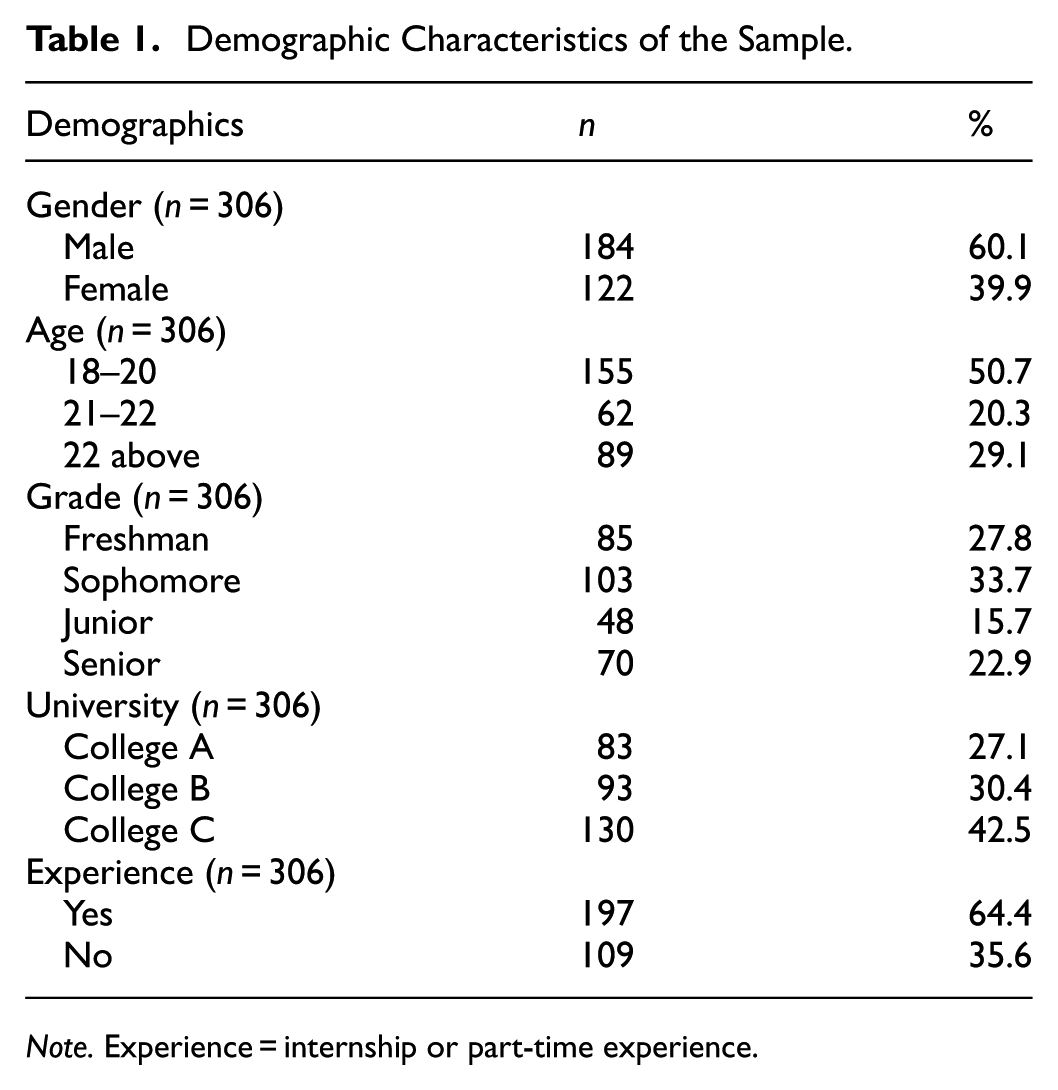
Note. Experience = internship or part-time experience.
Measures
All variables were measured on a Likert five-point scale, where 1 represents a low value of the variable and 5 represents a high value of the variable. We used English scales and translated them into Chinese questionnaires; after all, Chinese is the national language of Chinese universities. We engaged translators with expertise in the languages and cultures of both countries. Two translators initially translated the original scale into Chinese and then collaboratively reviewed their work to resolve ambiguities and discrepancies, resulting in a finalized literal translation. This literal Chinese version was then back-translated into English by two additional translators who had not seen the original. They compared their translations and addressed any inconsistencies. Finally, we assessed the scale’s reliability and validity using statistical analysis methods, confirming its suitability within the target cultural context.
College Students’ Learning Absorption
We used Cadiz et al. (2009) to integrate the dimensions of the Acap model proposed by Cohen and Levinthal (1990; assessment, assimilation, application) and combined it with the Absorptive Capacity Scale recommended by Todorova and Durisin (2007) to optimize the value identification component. “This scale incorporates both individual and organizational values. This scale includes the performance of the different processes by which individuals and organizations transform new knowledge into usable knowledge (Cadiz et al., 2009),” including the assessment, assimilation, and application described above. This fits well with this study and, therefore, resulted in a 9-item scale that does not overburden respondents, has good internal reliability, and does not stretch the length of the entire survey instrument. We did not add or remove questions from the questionnaire, but changed “our team” to “I” in each item to be consistent with the study population, analysis, and results. For example, replace “The people on my team are able to decipher the knowledge that is of last value to us” with “I am able to decipher the knowledge that is of most value to me. For example, replace “The knowledge shared in my team makes it easy to understand new arguments made in our technical area” with “The knowledge shared in my team makes it easy for me to understand new arguments made in my technical area.” For example, replace “My customers can immediately benefit from the new technical knowledge learned by the team” with “I can immediately benefit from the new technical knowledge learned by the team.” By changing the respondents from teams and clients to individual college students, the scale can show the degree of absorption ability of college students very well.
Self-Leadership Among College Students
We used a 20-item scale developed by Prussia et al. (1998) to explore the potential for self-leadership among college students. This is because the scale contains three clear and exploratory dimensions, namely: behavior-focused strategy, strategy with natural rewards, and strategy with constructive thinking patterns. The variables and corresponding items were examined by the researcher and there was no too high crossover error between the three variables, so they also met the purpose of our study. The scale clearly incorporates the three dimensions of self-leadership described above, for example, “I think about my progress at work” indicates a behavior-centered strategy element. “I try to extend my responsibility” indicates the natural reward strategy factor, emphasizing that responsibility is a natural reward and that the natural reward value of a given activity stems from the competence and self-discipline developed in the process of doing something. “If I have a problem, I will solve it myself” and “I try to think of the positive things I can do at work” indicate a constructive thinking model strategy, where self-problem solving represents a mindset that does not treat problems as obstacles, which is important for self This is important for the development of self-leadership.
Data Analysis
To verify the reliability and validity of the research data, this study uses numerous statistical approaches for systematic analysis, as follows.
Reliability Analysis
Cronbach’s α coefficient was used to evaluate the scale’s internal consistency. This coefficient assesses the scale’s stability by measuring item correlations. Generally, a α coefficient ≥.7 indicates good dependability, with .6 to .7 being an acceptable range. Values below .6 necessitate scale changes. Prior to formal analysis, pre-test data were tested for reliability, and low-reliability items were removed to assure the scale’s reliability.
Validity Testing
Validity analysis encompasses both Convergent and discriminant validity. Confirmatory Factor Analysis (CFA) was conducted to assess the construct validity of the scale, with key model fit indices evaluated to determine the appropriateness of the model. Furthermore, Average Variance Extracted (AVE) and Composite Reliability (CR) were computed to examine convergent validity, with acceptable thresholds set at AVE > .5 and CR > .7.
Correlation Analysis
The Pearson correlation coefficient was used to examine the linear relationships between variables, with values ranging from −1 to +1. A higher absolute value indicates a stronger linear association, while the sign (±) denotes the direction of the relationship. This analysis served as an initial exploration of variable interrelationships, helping to identify potential patterns and justify subsequent regression modeling. Notably, if high collinearity (r > .7) is detected among variables, it should be carefully addressed in the regression analysis to ensure robust results.
Multiple Linear Regression Analysis
To examine the independent effects of predictor variables on the outcome variable while controlling for covariates, multiple linear regression was performed. The magnitude of influence was evaluated using standardized regression coefficients (β), whereas F-tests and t-tests assessed the overall model significance and the unique contributions of individual predictors. In cases where multicollinearity was detected (VIF > 10), stepwise regression or ridge regression techniques were applied to mitigate collinearity effects and optimize model stability.
All statistical analyses, including descriptive statistics, reliability/validity assessments, correlation analyses, and regression modeling, were conducted using SPSS. Additionally, confirmatory factor analysis (CFA) was performed in AMOS to ensure the structural validity of measurement instruments, thereby enhancing the scientific rigor and credibility of the findings.
Results
Descriptive Statistics and Correlations
The means, standard deviations, and correlation coefficients among the study variables are listed in Table 2. These statistics provide basic information about each variable and the distribution of the variables. Where “n” indicates the sample size, that is, the number of participants in the study. In this sample, each variable has an n value of 306, meaning that all variables have the same sample size. “Mean” indicates the mean of each variable, which is the sum of all data in the sample divided by the sample size. In this sample, the Natural variable has the lowest mean of 3.720, while the Behavior variable has the highest mean of 3.917. “SD” indicates the standard deviation of each variable, which is the sum of the squares of the deviations of each data point from the mean. The square root of the mean. The standard deviation is used to measure the dispersion of a data set and can also be used to compare differences between data sets. In this sample, the natural variable has the highest standard deviation of .734, indicating that the values of this variable are relatively dispersed, while the Constructive variable has the lowest standard deviation of .625, indicating that the values of this variable are relatively concentrated.
Descriptive, Correlations, and AVE Square-Root Value Among the Study Variables.

Notes. n = 306. The discriminant validity is presented here as well, and the bold is AVE square-root value. Behavior = behavior-focused strategy; Natural = natural reward strategy; Constructive = constructive thinking model strategy; Absorption = learning absorption.
p < 0.05. **p < 0.01.**Correlation is significant at the 0.01 level (2-tailed).
Behavior-focused strategy is positively related to natural reward strategy (r = .737, p < .01), constructive thinking model strategy (r = .798, p < .01) and learning absorption (r = .746, p < .01). Constructive thinking model strategy (r = .731, p < .01) and learning absorption (r = .734, p < .01) are positively correlated with natural reward strategy. Constructive thinking model strategy is positively related to learning absorption (r = .781, p < .01). In a word, all the variables are positively associated with each other.
Reliability and Validity
Cronbach’s Alpha Reliability
In the present study, we utilized SPSS to analyze the reliability of two scales. The Cronbach’s alpha coefficient for the self-leadership scale was .973. For the subscales, behavior-focused strategy had an alpha of .905, natural reward strategy .919, and constructive thinking model strategy .940. The internal reliability coefficient for the learning absorption was .948. Overall, both scales showed an internal consistency coefficient greater than .90, indicating good internal reliability.
Convergent and Discriminant Validity
Since two scales belong to the mature scale, which therefore do not use the exploratory factor analysis to interpret validity. However, before testing our research hypotheses, we also conducted confirmatory factor analysis (CFA) in AMOS to establish convergent and discriminant validity among the study variables (Chughtai, 2019), using scale items related to behavior-focused strategy, natural reward strategy, constructive thinking model strategy, and learning absorption as manifest indicators of the latent constructs. Tables 2 and 3 show the average variance extracted (AVE) square-root values alongside the correlation coefficients, standard factor loadings, average variance extracted (AVE), and composite reliability (CR) values. In summary, the AVE square root values for the four study variables (.786, .812, .819, .820) are nearly larger than the corresponding correlation coefficient (shown in Table 2), indicating relatively good convergent validity for all subscales in the study. Each scale item’s standard factor loading coefficient is above .5, the AVE value is above .5, and the CR value is greater than .7 (shown in Table 3), indicating excellent discriminant validity (Zada et al., 2022).
Convergent Validity Among the Study Variables.

Notes. Behavior = behavior-focused strategy; Natural = natural reward strategy; Constructive = constructive thinking model strategy; Absorption = learning absorption.
Hypothesis Testing
The research hypotheses were put to the test through multiple linear regression analysis. This analytical approach enables the examination of the isolated effect of a specific independent variable on the dependent variable, while systematically controlling for the potential confounding influence of all other variables within the model. During the analysis, various models of the multiple linear regression equation were tested, as well as the prediction results of the independent variable on the dependent variable. The results can be found in Table 4, Figures 2 and 3.
Regression Analysis of the Self-Leadership in Predicting Learning Absorption.

Notes. n = 306. Dependent variable: LA = learning absorption; Predictors: (Constant), behavior, natural, constructive. Behavior = behavior-focused strategy; Natural = natural reward strategy; Constructive = constructive thinking model strategy; Absorption = learning absorption.
p < .05. **p < .01.

Histogram of regression standardized residuals.

Normal P-P plot of regression standardized residuals.
Testing the Multiple Linear Regression Equation Model
The first, the multiple correlation coefficient R is .826, revealing a strong linear correlation between all the independent variables and the dependent variable. The closer the value is to 1, the stronger the correlation. Furthermore, the coefficient of determination R2 has a value of .682, indicating that 68.2% of the variation in learning absorption can be explained by behavior-focused strategy, natural reward strategy and constructive thinking model strategy. This means that this model has a strong explanatory power and that the independent variables as a whole have a greater influence on the dependent variable. The closer R2 is to 1, the better the model fits the data. The adjusted R2 has a value of .679, which is similar to R2 and is another significant indicator of the quality of the multiple linear regression model (Table 4). Adjusted R2 is slightly lower than the R2, which implies that the fit of the model is not affected by the sample size. In addition, the standard error of the estimate is .377, which implies that the dependent variable has a small measurement error.
The second, regarding the ANOVA of the output results, the variance analysis results for testing the overall significance of the regression model are shown in Table 4. The F-statistic is 216.236, with a p-value of less than .001. At a test level of α = .05, it can be concluded that the fitted multiple linear regression equations are statistically significant.
The third, the coefficients table in the result output indicates that there is little to no multicollinearity among the independent variables, all of which, have a tolerance value greater than .3. The VIF of all independent variables is less than 10. This is confirmed by the collinearity diagnosis statistics (Table 4).
The fourth, the model summary table in the results output shows a Durbin–Watson value of 1.791, which indicates that there is no significant correlation between the residuals. This satisfies the condition of the residuals being independent from each other. Typically, the range of values for this statistic is between 0 and 4, and a value close to 2 indicates independence among the residuals (Table 4).
Lastly, from the histogram of regression standardized residuals, it is clear that the residuals follow a normal distribution, with a standard residual mean of 0 and a standard residual SD of approximately 1 (.995; Figure 2 and Table 4). Additionally, on the normal P-P plot of regression standardized residuals, the scattered points are mainly located around the diagonal line of the first quadrant, providing further evidence that the residuals follow a normal distribution (Figure 3).
Overall, the multiple linear regression equation shows an excellent and statistically significant model fitting effect with hardly any multicollinearity among the independent variables. The residuals are independent of each other and follow a normal distribution. These results confirm that it was appropriate to proceed with hypothesis testing.
Testing the Associations Between Variables
All independent variables are statistically significant as indicated by their t-value and p-value (p < .05). The larger the absolute of t-value while the smaller the p-value indicates the more significant effect of this independent variable on the dependent variable, and the relationship between each independent variable and the dependent variable is unlikely to be due to chance. In the meantime, there is a positive relationship between behavior-focused strategy and learning absorption (β = .221, p < .01), which supports H1. H2 is also supported by the data, as natural reward strategy and learning absorption have a positive association (β = .276, p < .01). Finally, H3 is supported by the fact that constructive thinking model strategy and learning absorption are positively connected (β = .403, p < .01). All three independent variables were significant predictors of learning absorption. Of all the factors, constructive thinking model strategy has the highest predictive value for the learning absorption of college students, while behavior-focused strategy has the lowest predictive value for learning absorption of college students (Table 4).
These results provide some valuable information that can be used in educational practice. Educators can improve student learning absorption by encouraging behavior-focused strategy, natural reward strategy, constructive thinking model strategy.
Discussion
Theoretical Implications
The cultivation of learning absorption capacity among college students has become an increasingly important area of focus (Wong et al., 2022), and our study contributes to this growing body of research. We proposed that self-leadership, encompassing behavior-focused strategy, natural reward strategy, constructive thinking model strategy, would positively influence students’ learning absorption capacity. Our findings strongly support these hypotheses, demonstrating that self-leadership plays a crucial role in enhancing students’ ability to absorb and apply new knowledge. Ultimately, self-leadership exerts a significant impact on the learning absorption process in college students, highlighting its importance in educational development.
The first, the findings of this study indicate that constructive thinking model strategy within self-leadership (referred to as the Constructive dimension) was the strongest predictor of learning absorption among college students (in H3). Constructive thinking model strategy provides students with a framework to systematically organize and manage their learning processes, which leads to a more profound understanding of material as well as enhanced absorption of new information (Wong et al., 2022). This strategy is particularly vital for college students as it plays a significant role in enhancing their capacity for effective learning absorption (Tsai et al., 2023). When students encounter challenges or obstacles—often referred to as “hitting a stone wall”—this approach encourages them to maintain a positive mindset (Contreras Gutierrez et al., 2011). Rather than feeling overwhelmed, students are guided to explore various strategies and solutions, which not only aids in overcoming these hurdles but also contributes to an overall improvement in their learning absorption (Chiquet et al., 2023). Moreover, the constructive thinking model fosters a deeper comprehension and application of the knowledge students acquire throughout their studies (Santos-Ruiz et al., 2012; Thayer-Bacon, 1998). This is achieved by encouraging active engagement and practical application, further enhancing their ability to absorb and retain information (Zhao et al., 2024). On the other hand, when students do not engage in effective planning and management of their learning activities, they risk wasting valuable time and experiencing lower learning efficiency (Munro et al., 2018). This lack of structure can lead to decreased learning absorption, as students may struggle to retain or apply what they have learned (Valente et al., 2024). Therefore, the adoption of constructive thinking not only enhances learning absorption but also facilitates better overall programming and management of students’ learning behaviors, ultimately paving the way for a more effective educational experience (Contreras Gutierrez et al., 2011).
The second essential factor in fostering effective learning absorption is the natural reward strategy, which plays a pivotal role in amplifying motivation and engagement through the creation of rewarding learning experiences (in H2). This strategy revolves around the intrinsic rewards that individuals experience personally, encompassing feelings such as satisfaction, accomplishment, and self-affirmation (Mayfield et al., 2021). In the context of self-leadership, the natural reward strategy emerges as a powerful tool for self-motivation, enabling individuals to establish and cultivate robust positive self-feedback mechanisms (Alves et al., 2006). These mechanisms are critical in enhancing self-efficacy—the belief in one’s abilities to succeed—as well as overall learning motivation (Williams et al., 2023). In practical terms, this strategy encourages college students to formulate both challenging yet attainable goals throughout their academic endeavors (Nall et al., 2021). This goal-setting process is foundational; it not only provides direction but also instills a sense of purpose and focus. As students diligently work toward achieving these goals, they are encouraged to engage in self-recognition and reward practices that reinforce their determination and commitment to their studies (Fotuhi et al., 2022). This timely self-affirmation serves to bolster their self-efficacy and learning motivation, ultimately resulting in a deeper engagement with their academic work (Brady et al., 2016). Moreover, individuals can actively create and refine their positive self-feedback mechanisms (Yan et al., 2022) through regular reflections on their progress and achievements. The natural reward strategy inherently emphasizes motivation through the cultivation of internal satisfaction and a positive perception of oneself, which significantly contribute to increased self-efficacy and overall motivation (Cranmer et al., 2019). To effectively foster learning absorption, it is crucial for college students to develop an acute awareness of emotional factors that influence their academic journey, such as their feelings of achievement, the challenges they encounter, and their experiences of autonomy within the learning process (Chiquet et al., 2023). This emotional awareness equips them to better navigate their feelings and attitudes toward learning. By effectively adjusting their emotional responses, students can enhance their overall learning effectiveness and improve their capacity for absorption of knowledge (Lei et al., 2024). Thus, the natural reward strategy serves not just as a motivational tool but as a framework for cultivating a reflective and engaged learning environment (Chiquet et al., 2023).
The third, the Behavior dimension, which represents behavior-focused strategy, such as focusing on self-assessment, self-reward, and self-discipline, also showed a moderate positive correlation with absorptive capacity (Prussia et al., 1998; in H1). This correlation indicates that when students actively manage their learning behaviors, they are more likely to engage in a deeper understanding of the material, thereby enhancing their knowledge retention (Al-Zahrani, 2015). Implementing behavior-focused strategies allows college students to more effectively identify their strengths and weaknesses. This self-awareness is crucial as it enables students to plan their academic journeys more strategically (Kurpis et al., 2017). By setting clear, specific, and quantifiable goals, students can break these larger objectives down into manageable actions and detailed action plans (Lin, 2017). Furthermore, it is essential for students to not only set these goals but also have the capability to execute their action plans diligently and practice them consistently (Heimann et al., 2022). In addition to execution, ongoing reflection is vital, and college students should routinely assess their behavior and learning experiences, documenting what strategies worked and what didn’t (Kuh, 2001). This continuous learning process allows them to refine their action plans and improve their goal-setting techniques (Luthans, 2002). Behavior-focused strategies significantly enhance the way students manage their time and energy (Korpershoek et al., 2016). By applying these strategies, college students can improve their learning efficiency and academic outcomes. For instance, these strategies can lead to the establishment of effective study routines and behavioral patterns that nurture qualities like perseverance and self-discipline (Korpershoek et al., 2016). They also support students in developing their adaptability and resilience, making them better equipped to handle challenges and setbacks during their academic journey (Heimann et al., 2022). Ultimately, the traits cultivated through behavior-focused strategies constitute essential components of effective learning absorption. This not only aids students in coping with learning stress and challenges but also contributes positively to their overall academic achievement (Houghton et al., 2012). Thus, it is evident that focusing on self-regulated and behavior-driven learning strategies can lead to significant improvements in students’ academic experiences and outcomes.
Practical Implications
The results of our study reveal significant implications for the personal development of college students, the strategies that colleges and universities can implement to enhance their learning potential, and the overall improvement of students’ future employability.
Our findings indicate that self-leadership plays a crucial role in predicting college students’ ability to absorb and engage with knowledge effectively. This suggests that universities should consider the integration of self-leadership courses, programs, or extracurricular activities aimed at fostering an environment of active participation among students (An et al., 2024). For example, academic institutions could offer specialized courses focused on self-discipline, time management, and goal-setting. These courses could not only help students develop vital personal management skills but also provide them with practical tools to navigate the demands of college life. Additionally, the establishment of self-development learning associations or departmental organizations could serve as platforms for students to connect with peers who share similar academic and career aspirations. Such initiatives would empower students to take charge of their educational journeys, aiding them in identifying their personal and professional goals. By having structured guidance, students could better map out their college experiences, aligning their studies with their long-term ambitions. Ultimately, developing self-leadership and related skills will not only facilitate personal growth during their college years but will also equip students with essential competencies and effective study habits necessary for success in their future careers. By prioritizing these areas, universities can play a pivotal role in shaping capable, self-directed individuals ready to meet the challenges of the workforce.
Individuals who exhibit strong self-leadership qualities tend to possess an exceptional capacity for self-planning and goal-setting, which allows them to effectively navigate challenges and seize opportunities. As a result, they often attract like-minded, high-quality peers who are motivated to excel. This phenomenon occurs because such individuals prioritize efficiency and achievement, both of which are crucial in today’s competitive landscape. They have a knack for creating significant value not only within their organizations but also in the broader community. For college students, cultivating self-leadership skills is particularly important. These skills empower them to fully immerse themselves in their academic and extracurricular pursuits, enabling them to stand out in their respective fields. Employers and human resource specialists increasingly recognize the importance of self-leadership, which means that students who hone these abilities are likely to be in high demand, even if they have not yet assumed formal leadership roles during their studies. Moreover, as they transition into the workforce, students with well-developed self-leadership skills often find themselves at an advantage. They are more inclined to receive promotions or salary increases, thanks to their proactive approach and ability to drive results (Yue et al., 2024). Therefore, it is crucial for college students to deliberately focus on developing their self-leadership capabilities. By doing so, they will be better equipped to adapt to and thrive in the diverse and evolving work environments that lie ahead in their careers.
Strengths, Limitations, and Future Directions
This study represents a pioneering effort to predict college students’ learning absorption abilities by analyzing the three-dimensional characteristics of self-leadership. The findings derived from this research provide valuable insights into the relationship between self-leadership traits and learning absorption. However, it is important to recognize certain limitations inherent in this study.
One significant limitation is that our understanding of self-leadership and its impact on learning absorption is primarily derived from the assessments provided by the college students themselves. This reliance on self-evaluation presents a potential bias, as it reflects a singular perspective. To enhance the robustness of our findings, it would be advantageous to incorporate evaluations or feedback from a wider array of stakeholders. Insights from teachers, who observe students in educational settings, as well as input from graduates who can reflect on their own experiences, employers who assess the capabilities of recent hires, and human resource experts familiar with industry standards, could significantly enrich our understanding of self-leadership. This multifaceted feedback could illuminate various strategies and methods to improve college students’ learning absorption across different contexts.
Furthermore, the potential for a longitudinal study could provide deeper insights into the dynamics of self-leadership and learning absorption over time. By monitoring students’ performance with and without self-leadership strategies, we could gain valuable data on their self-efficacy regarding learning absorption. Such a study would allow students to reflect on their development and progress, revealing how self-leadership influences their academic outcomes and overall learning experiences. This comprehensive approach could pave the way for more effective educational interventions and support systems aimed at fostering higher levels of learning absorption among college students.
Conclusion
A considerable number of studies have investigated the influence of leadership on students from the perspectives of educational institutions, school principals, and teachers. However, there exists a notable scarcity of empirical research examining the leadership qualities of students themselves (Shen et al., 2020; Yalçın et al., 2023). The assessment and development of students’ leadership capabilities are, therefore, of paramount importance (Van Diggele et al., 2022). The present study explored the relationship between self-leadership and learning absorption among college students, focusing on three specific dimensions of self-leadership: behavior-focused strategy, natural reward strategy, and constructive thinking model strategy. The findings revealed that all three dimensions exert a significant positive influence on students’ learning absorption, with constructive thinking demonstrating the strongest impact. These results underscore the critical role of self-leadership in enhancing students’ capacity to engage with and absorb academic content effectively (Chiquet et al., 2023). By fostering self-leadership, higher education institutions can significantly improve educational outcomes for students, which holds substantial implications for both their academic and professional trajectories. Overall, self-leadership emerges as a pivotal predictor of learning absorption and should be systematically incorporated into college student development programs.
Footnotes

Ethical Considerations
Students from the three universities participated in the questionnaire survey on a voluntary basis, but the teacher responsible for distributing the questionnaire did not agree to indicate the name of the school in the article.
Funding
The authors received no financial support for the research, authorship, and/or publication of this article.
Declaration of Conflicting Interests
The authors declared no potential conflicts of interest with respect to the research, authorship, and/or publication of this article.
Data Availability Statement
The data that support the findings of this study are openly available in [SAGE OPEN] at [10.1177/21582440251392687].