




Abstract
This article describes a faculty self-leadership study and its impact on outcomes—extra effort, effectiveness, and satisfaction. The research questions asked faculty’s perceptions of classroom leadership—specifically whether they perceive themselves as leaders. This preliminary, small study aims to consider other avenues to improve the student learning experience and faculty performance. Faculty perception of self-leadership may account for their efforts to cultivate others effectively. The notion of faculty leading or grassroots leadership may be a paradigm shift or game-changer; the norm is that the pioneers of change, innovation, and creativity are found in administrative positions in an organization. This norm equates leadership with status, authority, and position. The concept of transformational classroom leadership is not widespread but where else can one find a better fit to integrate this concept than in teaching. What better place exists to examine its impact than the classroom? There is a need to “step outside the culture” and ask teachers how they construe a leadership role to alter higher education’s status quo.
Keywords
Competent leadership has been associated with worthy outcomes for its beneficiaries, enhancing motivation, commitment, and positive performance. Moreover, it determines the effectiveness and satisfaction of followers with leaders. Good leaders possess exceptional qualities (unique attributes) and can compellingly influence others. University and college faculty are usually dedicated to their discipline. Still, informal leadership practices, characteristics, and the exercise of leadership competencies, regardless of position or designation, may make a difference in the quality of students’ educational experience. This study explored a different perspective to share a notion of faculty transformational leadership competencies. Faculty classroom leadership behaviors and practice may stimulate students’ involvement to wholeheartedly deepen their knowledge of doctrine and attain better intellectual growth. In addition to motivating students to learn, the behavior exercised may improve students’ satisfaction with learning and, in turn, enhance more of it with improvements in skill, performance, and behavior. The research study will answer the question of how faculty perceive such individual leadership behavior. The answers to this question may have a significant implication for higher education. Preliminary study results suggest that faculty see themselves as leaders with the potential and ability to influence others. Positive outcomes of faculty leaders as being more effective and successful teachers might be a pedagogical implication for faculty training and development.
Introduction
COVID-19 pandemic combined with other challenges in higher education exposed the need for revolutionary changes to prepare students to lead in a complex world with agile faculty that can contribute to the core values of creativity and commitment. Educational systems need an excellent personal evaluation system to measure teacher’s performance that also spurs professional development and originality. Extant literature has not been able to place teaching or teaching efficacy within the framework of current leadership theories. The paucity of research on the effect of transformational leadership in a university classroom setting created a need for this study. This research study was conducted to explore the connection between the leadership behaviors exhibited by faculty and its impact on valuable educational outcomes. The study challenged traditional stereotypical assumptions about leadership. This small and preliminary study investigated leadership through an unusual lens. It dispersed the leadership responsibility to the group by examining faculty self-perception of leadership.
A convenience sample of faculty members from the State University of New York (SUNY) at Canton and SUNY Potsdam contributed to the research data. The data used in this analysis are scores of self-reported leadership behaviors measured with the Multifactor Leadership Questionnaire (MLQ). On the MLQ scale, 36 items quantified nine leadership behaviors and nine items evaluated leadership outcomes—extra effort, effectiveness, and satisfaction. These leadership outcomes determine the impact of transformational leadership on those being led. The scores of transformational leadership behaviors were aggregated and summarized with descriptive statistics, such as the mean and standard deviation. Correlation analyses were conducted to check for a significant relationship between transformational leadership behaviors and leadership outcomes. The results of this study suggest that faculty members across gender with college teaching experiences of 20 or fewer years focus on transformational rather than transactional leadership, precisely the individualized consideration and intellectual stimulation influencing factors. Yet, the value of the Pearson product–moment correlation coefficient (r) registered the most impact between the inspirational motivation factor and the two leadership outcomes—extra effort (r = .683) and effectiveness (r = .625).
Faculty as Leaders
Teaching can be enlarged to include faculty who practice the leadership lessons of influencing and motivating students within the classroom. Faculty perception self-leadership may account for their efforts to cultivate others, as leaders continually shape others effectively. Faculty self-leadership may provide an avenue to improve the quality of the classroom experience for students. The notion of faculty or grassroots leadership may be a paradigm shift or game-changer; the orthodox leader is the pioneer of change, innovation, and creativity found in organizations’ administrative positions. This norm equates leadership with status, authority, and formal leadership positions like presidents, military generals, chancellors, provosts, and deans, with little understanding of grassroots leadership, particularly in higher education. Schein (2010) clarifies leadership as a dispersed role assumed by anyone who enables progress toward a needed outcome. Gronn (2000) makes leadership accessible to all organizational members and views leadership as a collective phenomenon, “as a flow of influence in organizations which disentangles it from any presumed connection with headship” (p. 334). Northouse (2018) presents leadership as a process where an individual influences a group to achieve a common goal. Successful organizations understand that it is crucial to foster a leadership mentality throughout the organization with the higher turbulence, uncertainty, change, and global competition that characterize today’s environment.
College campuses worldwide are faced with pressures to respond to various challenges from the global pandemics, shrinking enrollments, fiscal distress, changing demographics, globalization, and technology. Although faculty grassroots leadership is a subject of little study, some authors have examined its sustainability. May et al. (2013) investigated how top-down and faculty grassroots leaders created change and concluded that it could be sustained with sensitivity to the institution’s campus priorities and cultural and contextual differences. Others insist that every person can stimulate change quietly and persistently. According to Kezar et al. (2011), faculty can exercise various leadership tactics that strengthen leadership capacity within an academic setting, honoring the institution’s norms, values, and mission while simultaneously challenging enacted practices. Expressly, transformational classroom leadership’s past applications incorporate critical pedagogies of transformational teaching and learning (Mitra, 2013) and transformational assessment practices (Pounder, 2008a). According to Noland and Richards (2014), teacher transformational leadership can significantly predict student motivation and learning.
This study focused on transformational leadership, the most frequently studied leadership theory among academics over the past two decades (Van Knippenberg & Sitkin, 2013; Yukl, 2012), reviewed in management and organizational contexts but only recently applied to the classroom setting. Transformational leaders provide intellectual stimulation, develop follower skills, build collective efficacy, and offer individualized consideration. Faculty do more than teaching; they act as content experts, increase interest in the subject, and serve as role models for their students (Bogler et al., 2013). Therefore, it is necessary to alter the status quo in higher education, “step outside the culture,” and develop and ascertain talented faculty leaders. Several authors recommend selecting or developing transformational leadership that initiates and facilitates metamorphosis in organizations to meet the challenges of the 21st century (Bass, 1985; Bennis & Nanus, 2007; Kouzes & Posner, 2017). Pounder’s (2008b) inquiry indicated that scores on the transformational leadership dimensions were significantly and positively correlated with classroom leadership outcomes—extra effort, effectiveness, and satisfaction. Competent leadership has been associated with excellent results for followers, enhancing motivation, commitment, and positive performance (Yukl, 2013). Moreover, it determines the effectiveness and the satisfaction of the followers with the leaders. Transformational classroom leadership is unconventional, but where else can one find a better fit to integrate transformational leadership and its desired outcomes than teaching? What better place exists to examine the significance of this phenomenon than the classroom? But how do faculty perceive such individual leadership? The answer to these questions may have significant implications for higher education.
The survey instrument used in collecting data for this study is the MLQ. One of the principal benefits of this survey instrument above other leadership measures is its comprehensiveness and focus on development. Faculty gained directly from participation. By examining personal leadership characteristics, they became aware of their leadership styles. These insights are thought-provoking and can be used by faculty for transitioning to the preferred leadership behavior that will impact teaching outcomes. This study’s results might find application in professional training programs by providing valuable feedback on existing procedures, identifying and correcting flaws, and perhaps even aiding in faculty growth. Students benefit indirectly from any teaching proficiency indicators; colleges and universities profit from alternative measures of performance. It may also have implications for the policymakers in education in augmenting decision-making, and fellow researchers benefit from new knowledge and a generalizable body of awareness that contributes to leadership and education.
Transformational Leadership Process
The transformational leadership process involves a form of influence that changes and transforms people to accomplish extraordinary things; it raises the level of human behavior and ethical aspirations, transforming both leaders and followers to do better. The transformational leadership renaissance began in the 1980s when researchers became interested in the emotional perspective of leadership that inspires followers beyond their natural self-desires or reasonable expectations to larger ideals and the greater good (Burns, 2003; Howell & Avolio, 1993; Shamir et al., 1993). According to Bass and Riggio (2006), this leadership model is appealing because it prioritizes the followers’ intrinsic motivation and growth.
Transformational leadership was brought to the limelight by the political sociologist James McGregor Burns (1978), who dissociates leadership from power-holding because authentic leadership is inseparable from the followers’ needs. Knowledge of transformational leaders’ core behaviors is essential to identify what transformational classroom leaders should do to foster valuable outcomes. Burns (1978) offered three forms of influence: (a) inspiration (transformational), (b) exchange (transactional), and (c) legitimate authority. Other researchers have examined the principle of transformational leadership. Two major group contributors—Bennis and Nanus (2007) and Kouzes and Posner (2017)—developed models to prescribe essential qualities, behaviors, and actions of transformational leaders. Bennis and Nanus interviewed middle- and senior-level managers to construct their models of leadership. Bennis and Nanus concluded that leaders who wish to transform others must (a) articulate a compelling vision, (b) build a shared sense of purpose, (c) forge a commitment to the organization, and (d) fuse positive self-worth with work. Using research methods similar to Bennis and Nanus, Kouzes and Posner (2017) described five transformational leaders’ fundamental practices. Kouzes and Posner’s model recommends that leaders who wish to transform others (a) model the way by setting personal examples for others, (b) inspire a shared vision with clear perception to guide other people’s behavior, (c) challenge the process by experimenting with new ideas, (d) enable others with friendship and esprit-de-corps collaboration, and (e) encourage the heart by rewarding accomplishments. The two models describe sets of behaviors that can be learned and taught, and these behaviors are not imprisoned in personality types. In excellent organizations, anyone, regardless of title or position, is encouraged to act as a transformational leader.
Transformational leadership is a rare form of influence that appeals to followers’ values, emotions, and ideals (Bass, 1985, 1996; Bennis & Nanus, 2007). Transformational leadership theories anticipate followers’ emotional influence and motivation because of the leader’s behavior (House et al., 1988). Transformational leaders’ mature followers need, generate awareness and collaboration, and in doing so, motivate followers to transcend self-interest to those of the higher purpose and mission of the group (Burns, 2003; Yammarino & Bass, 1990). Yammarino and Bass (1990) agreed that “the transformational leader articulates a realistic vision of the future that can be shared, stimulates subordinates intellectually, and pays attention to the differences among the subordinates” (p. 151).
Followers’ self-efficacy, confidence, and development are enhanced through the transformational leadership process. In the transforming model, the leader discovers and considers followers’ needs and purposes, ultimately helping them reach their fullest potential. When necessary, they also provide support and encouragement, and the followers respond with trust, respect, and motivation that transcend the status quo to accomplish higher-order objectives. Transformational leadership appears in faculty who involve students in more than content learning and knowledge sharing. Instead, they connect content with a distinctive meaning and ennobling possibilities for students to engage in a worthy and more in-depth understanding that changes the student and the faculty for the better. Mahatma Gandhi, Nelson Mandela, and Mother Theresa exemplify this style of leadership. They changed perception, raised the hopes and dreams of millions of people, and in the process evolved as human beings. According to Burns (2003), in transformational leadership, leaders and followers engage and raise one another to higher motivation and morality levels.
Influencing Tactics
Transformational leaders emphasize ideals, inspiration, innovation, and individual concerns, whereas transactional leaders focus on exchanging value items for expected outcomes and management-by-exception. This model described the five dimensions of behaviors used by transforming leaders as (a) idealized influence (attributed), (b) idealized influence (behavior), (c) inspirational motivation, (d) intellectual stimulation, and (e) individualized consideration (Bass & Avolio, 1994).
Factors 1 and 2—Idealized influence (attributed or behavior) or charisma: The leaders kindle followers’ emotions and identify with them by providing a clear vision and a sense of mission. Factor 3—Inspirational motivation: This describes leaders who communicate a challenging and meaningful vision to focus followers’ efforts; they use emotional pleas, symbols, and models. Factor 4—Intellectual stimulation: The leader challenges followers to be more conscious of issues, question assumptions, traditions, and beliefs, and perceive problems in new ways (Bass, 1985; Bass & Avolio, 1990). Factor 5—Individualized consideration: The leader coaches, advises, provides support and consideration for the followers’ need to reach self-actualization, self-fulfillment, and self-worth (Yammarino & Bass, 1990). Bryman (1992) affirms that individualized consideration is similar to Ohio State University studies’ conception of care by showing concern for subordinates’ well-being. But it goes beyond demonstrating genuine concern for the subordinates’ welfare to giving them opportunities to enhance their skills and prosperity to grow and excel (Bass, 1985). Bolkan and Goodboy (2011) identified charisma, individualized consideration, and the instructor’s intellectual stimulation communication behaviors created transformational leadership perception for students.
MLQ
The MLQ developed by Bass and Avolio (1989) is often used to measure transformational, transactional, and laissez-faire individual leadership behaviors. The MLQ contains behavior statements expected in these various dimensions of transformational leadership. According to Bass (1990), his leadership model is a new paradigm that cannot be substituted or interpreted by other models even though it integrates ideas from trait, style, and contingency approaches of leadership. Antonakis et al. (2003) determined that the MLQ is a psychometrically sound leadership instrument. Using 3000 raters, they found strong support for the MLQ full range of leadership models’ validity.
Interlinking Transformational Leadership and Teaching
The linking of leadership and teaching is not a new concept. Silva et al. (2000) argued that the relationship between leadership and teaching could be analyzed in three stages or waves of development. In the first wave, the quintessential leader is the departmental head, whose role focuses on maintaining an efficient and effective educational system (Evans, 1996); this focus is not on instructional leadership. Teachers were only perceived as the implementers of the decisions of the leader or the departmental head. The second wave of teacher-leadership acknowledged teachers’ importance as instructional leaders but delegated this responsibility to the organizational leadership positions such as team leaders, curriculum developers, and instructional designers. They created prepackaged materials for classroom teachers to implement. The third wave and current conceptualization of teacher-leadership allow teachers to engage in schools as organizations (Evans, 1996) meaningfully. The third wave is grounded in professionalism and collegiality, recognizing that teachers carrying out their duties should express individual leadership competencies in organizations. Literature generally proposes that teacher leaders are excellent classroom performers. Pounder (2006) argued the fourth wave of teacher-leadership embraces transformational classroom leadership as one of the defining qualities of a teacher leader.
Method
This quantitative research study used a correlational design. Data were collected with the MLQ questionnaires. The questionnaires assessed the degree to which respondents expressed leadership behaviors in their interactions. The MLQ survey used in the data collection measured leadership factors from the least significant, laissez-faire factor to the most influential, idealized influence factor. The study hypothesis is interested in establishing how faculty in higher educational settings manifest transformational-transactional leadership characteristics defined by the MLQ. The researcher collected data from faculty at two SUNY Colleges.
The approach to this inquiry, in the collection and analysis of data, was quantitative. The researcher used the MLQ to measure faculty self-reported leadership behaviors with an online survey deployed to faculty participants to gather their perceived leadership behavior data. The sample used in this study is a convenience sample; the selection of institutions from which samples were collected depended on facilitating cooperation and geographic proximity. This researcher drew upon her peers’ collegiality to enlist support for the research, and she also had easy access to them. The researcher invited all faculty members on the mailing list from the two institutions to participate. Faculty were asked to voluntarily provide information or complete the MLQ, following an informed consent process. All protocols violation of the privacy of subjects and breach of confidentiality agreement were implemented. Special consideration was given in the methodology, presentation, results, discussion, and conclusion to the fundamental ethical principle of respect for persons, beneficence, and justice. The internet survey design also provided the option to withdraw from the study. Participants who wished to withdraw could do so at any time and with no consequences. The MLQ Form 5X-Short Instrument was administered, with permission received from Mind Garden Inc., on February 19, 2010. Data collection, analysis, and inferences were limited to those who accepted this invitation to complete the MLQ.
Seventy-five faculty members rated themselves on their leadership behaviors and leadership outcomes. The behavioral leadership data were compared to leadership outcomes—extra effort, effectiveness, and satisfaction. Demographic data, such as discipline, gender, race, years of experience, and appointment type, were also collected from faculty solely for sample subject identification and ease of discussing the subgroups within the population. The MLQ data from the 75 faculty members were analyzed for patterns. Basic statistical methods such as descriptive statistics were used to summarize and present information, and correctional analysis was used to help understand the relationship among the measures. Statistical Package for the Social Sciences Version 17.0 (SPSS Version 17.0) was used to present and describe data collected from questionnaire items. Faculty scores on their perception of leadership behaviors were presented with descriptive statistics such as frequencies, percentages, central tendencies (means, modes, and median), and variability measures (range, variance, and standard deviation).
Certain assumptions were made in the study. One is that the operational definitions of leadership behavior are adequate indicators of leadership behaviors. Another is that the items on the questionnaires of the MLQ are examining and can sufficiently measure faculty perceived leadership behaviors and outcomes. It is also assumed that the faculty would honestly self-assess, self-report, self-rate, and adequately give informed answers to the instrument’s content. Finally, it is assumed that the questionnaire is straightforward and lacks ambiguous items that different respondents can interpret differently.
Some limits to the study include response bias. It is possible that if all truthful responses were considered, the results of the study might differ. There is the possibility that some respondents may rate themselves high or low despite fundamental differences in their leadership behaviors. Another possible problem is the demand effect when subjects know what the researcher is looking for and tend to provide it or not provide it. A low response rate occurred, partly due to the discarded samples if subjects did not respond adequately to all questions or selected the option to withdraw. But prior research, Pounder (2008b) used five instructors with approximately 432 students. Another possible constraint is the limitation of the questionnaire; behavioral description questionnaires are often ambiguous and superficial. This obscurity was guarded against using questionnaire items that were as clear and unambiguous as possible. It is possible that the operational definitions for faculty leadership behavior were not helpful and were not sufficiently valid to be measured or expressed quantitatively.
This study’s delimitations include the convenience samples used that may not reflect or represent the general population. Since sample collection is limited to faculty in only two state institutions of higher education, data collected and inferences may not indicate the faculty at large. The MLQ form used is the self-rater form that allows only individuals to rate themselves compared to the rater versions that permit multiple rater input. The self-rater version does not measure leadership; it only measures the perception of leadership.
Result
The following—study subjects, demographic information, findings, tables and graphs, and summary—result from the researcher’s investigation. Seventy-five faculty participants were surveyed, and descriptive statistics were collected on institution, discipline, gender, ethnicity, appointment type, educational background, leadership behaviors, and leadership outcomes. The majority of the participants, 53 (71%) faculty members, were from SUNY Canton, and 22 (29%) faculty members were from SUNY Potsdam; Tables 1 and 2 display these faculty’s descriptive characteristics groups. As shown in Table 1, the ethnic code of the study subjects was mainly white 62 (83%); Table 2 displays the appointment type as generally full-time, 40 (53%). Nevertheless, the sample was just about evenly divided for gender and years of college teaching experience. Thirty-seven (49%) of the participants were female, 38 (51%) were male; the data composition for the number of years of college teaching experience showed a steady distribution for less than 5 years, 5 to 10 years, and 11 to 20 years. Twenty-one (28%) faculty members in this study had fewer than 5 years of college teaching experience, 22 (29%) had 5 to 10 years of college teaching experience, and another 21 (28%) had 11 to 20 years of college instruction practice. The educational background data reflected that most faculty members had a doctorate, 38 (51%), or a master’s degree, 32 (43%).
Ethnic Code and Gender Composition.

Years of Teaching Experience With Appointment Type.

Note. Appt = appointment type.
Findings revealed the presence of leadership behaviors in the faculty participants. Faculty participants reported very high scores on the transformational dimensions in comparison to the transactional aspects. Figure 1 shows that the highest mean (arithmetic average) score was calculated based on individualized consideration; the lowest was the passive management-by-exception and Laissez–Faire factors.
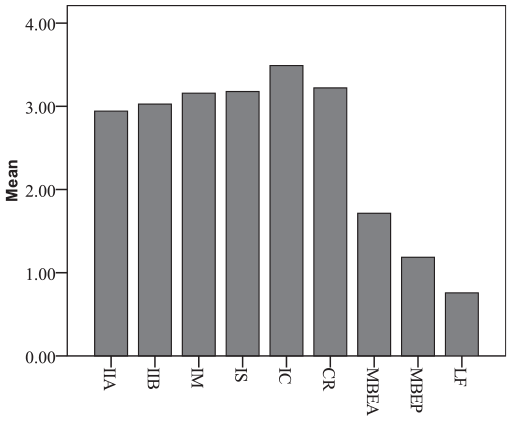
Mean scores on transformational-transactional and Laissez-Faire factors.
Multifactor Leadership Level Analysis
Are faculty members transformational or transactional? Figure 1 reflects that these faculty members view themselves as more transformational than transactional. Closer examination and additional statistics in Table 3 shed more light on the faculty’s perception of self-leadership. The most frequently occurring (mode) and the middle score (median) in the set of scores are on the transformational leadership end of the spectrum, including contingent rewards; they are all above 3.00. Most faculty scores indicate that they emphasized the spectrum’s transformational element and not the transactional or Laissez-Faire influencing tactic. By analyzing the self-reported leadership characteristics of faculty, the researcher answered that faculty members focus on transformational rather than transactional leadership, precisely the individualized consideration and intellectual stimulation influencing factors.
MLQ Factor Statistics (Summary Measures and Variability).

Note. MLQ = multifactor leadership questionnaire; MA = active management-by-exception; MP = passive management-by-exception.
Multiple modes exist; the smallest value is shown.
Leadership Behaviors and Outcomes
Each leadership style on the transformational leadership full-range model has been connected to expected performance outcomes (Dumdum et al., 2002) (Dumdum et al., 2013). This universal relevance was supported by a positive relationship between transformational leadership and effectiveness at diverse levels of authority, organizational types, and countries (Bass, 1997, 1998). The transformational approach to leadership is a comprehensive perspective that includes how leaders exchange rewards for achieving goals, but it also has how leaders empower and nurture followers in change (Avolio, 1999; Bass, 1985). This approach to leadership encompasses all the different dimensions of the process of leadership. A transformational leader aims to help people feel that they matter and that their contribution to the greater good is significant (Northouse, 2018).
Harrison’s (2011) study in an online instruction environment showed instructor transformational leadership behaviors were more significant predictors of cognitive and affective learning, perceptions of instructor credibility, and communication satisfaction than transactional leadership behaviors. Pounder (2008b) correlated each transformational leadership dimension with leadership outcomes—extra effort, effectiveness, and satisfaction. Pounder (2008b) indicated that scores on the transformational leadership dimensions were significantly correlated with classroom leadership outcomes—extra effort, effectiveness, and satisfaction. The researcher also computed the association of faculty leadership behavior variables and the leadership outcome variables to explore their connection. Table 4 explains the relationship between the faculty’s perceived behaviors and leadership outcomes in a university setting.
Intercorrelations Among MLQ Factors.

Note. MLQ = multifactor leadership questionnaire; MA = management-by-exception active; MP = management-by-exception passive; EE = extra effort; EFF = effectiveness; SAT = satisfaction.
p < .05. **p < .01.
The findings validated existing literature by displaying significant and positive correlations between the idealized influence (attributed), idealized influence (behavior), inspirational motivation dimensions, and the three leadership outcomes. The most robust relationship was detected for the inspirational motivation factor with the two leadership outcomes—extra effort (r = .683) and effectiveness (r = .625). The two main factors—individualized consideration and intellectual stimulation—identified in the sample subjects, only individualized consideration showed a significant and positive correlation with scores on extra effort and satisfaction with an actual value of r = .368 and r = .311, respectively.
Discussion
These research findings are in harmony with other studies; scholars have argued the immense value of transformational classroom leadership. Pounder (2008b) indicated that scores on the transformational leadership dimensions were significantly correlated with classroom leadership outcomes—extra effort, effectiveness, and satisfaction. This study’s findings validated existing literature by displaying significant and positive correlations between the idealized influence (attributed), idealized influence (behavior), and inspirational motivation dimensions and the three leadership outcomes—extra effort, efficiency, and satisfaction. The value of the Pearson product–moment correlation coefficient (r) showed the most substantial relationship for the inspirational motivation factor with the two leadership outcomes—extra effort (r = .683) and effectiveness (r = .625). The individualized consideration attribute showed a significant and positive correlation with scores on extra effort and satisfaction with actual values of r = .368 and r = .311, respectively; intellectual stimulation showed nothing noteworthy.
Pounder (2006) discussed a fourth wave of teacher-leadership that embraced transformational classroom leadership as one of the teacher leader’s defining qualities. Teachers who use transformational behaviors can increase student learning, satisfaction, and motivation (Bolkan & Goodboy, 2009; Pounder, 2008b). Pounder (2014) maintains the substantial advantages of transformational classroom leadership as an instructional approach to enhance teaching quality and educational outcome. Moreover, Tsai and Lin (2012) determined with an instrument based on the MLQ that classroom transformational leadership behaviors were positively associated with student engagement and satisfaction. Slavich and Zimbardo (2012) posit transformational teaching creates dynamic relationships between teachers, students, and a shared body of knowledge to promote student learning and personal growth. A few authors determined that instructors with a transformational leadership style can improve classroom engagement (Bogler et al., 2013; Pounder, 2009). Bolkan et al. (2011) advocate understanding how transformational leadership impacts student behaviors to impact education quality. While various transformational classroom leadership studies are self-reported, research indicates that many educational outcomes resulting from transformational classroom leadership are related to actual academic performance (Pounder, 2009; Richardson et al., 2012).
This study contributed to the existing research by providing valuable insights into college teaching faculty’s individual leadership behaviors. This researcher explored other criteria, such as leadership behaviors, for assessing effectiveness in the classroom while also examining the effect of these leadership styles on leadership outcomes. Faculty mainly used seven out of the nine factors to influence. Those on the transformational leadership end of the spectrum, in particular, are likely to be necessary to theory and practice, and further investigation is encouraged. Transformational leadership—the intellectual stimulation dimension—has been linked with challenging subordinates to be creative, think critically, and independently find unique solutions to problems while seeking a broad input range (Bass, 1998). Transformational leadership—the individualized consideration dimension—has been perceived as the medium for developing subordinates’ confidence to deal with problems (Bass, 1985). Others argued that enhanced learning results from transformational leadership. Literature has generally submitted that the transformational instructor could cultivate students’ intellectual curiosity, promote creativity, and integrity. The ultimate aim of a transformational leader is to help people feel that they matter and that their contribution to the greater good is significant (Northouse, 2018).
This study contributed to literature in leadership assessment, training, development, practice, or/and teaching aptitude. In addition to the immediate relevance to higher education or teaching, one of the principal benefits of the survey instrument used, the MLQ, above other leadership measures is its comprehensiveness and focus on development. The MLQ Leader Form or the self-assessment version (see Appendix) used to assess personal leadership competency stimulated thinking on its content and enabled individual faculty members to gain an idea of their strengths and weaknesses in the leadership arena. Once participants have the opportunity to reflect, they may pinpoint specific areas for improvement; they can then use these assessments as a basis for change to the desired leadership style. This study also contributed to the existing research on classroom teaching effectiveness by examining the effect of these recognized leadership styles on teaching outcomes. This researcher explored other criteria, such as leadership competencies for assessing effectiveness in the classroom, while also providing some valuable insights into the individual leadership behavior of college teaching faculty. Therefore, the researcher benefited by learning about faculty personal leadership styles and how they correlate and contribute to teaching outcomes in tertiary institutions. The results of this study might find application in professional training programs by providing valuable feedback on existing procedures, identifying and correcting flaws, and perhaps even aid in faculty growth. Students benefit indirectly from any indicators of teaching proficiency; colleges and universities profit from measures of performance. It may also have implications for the policymakers in education in augmenting decision-making, and fellow researchers benefit from new knowledge and a generalizable body of awareness that contributes to leadership and education.
Conclusion
This article describes faculty leadership behaviors on the full range of the transformational-transactional leadership spectrum. Faculty participants reported very high scores on the transformational dimensions than the transactional aspects, precisely the individualized consideration, and intellectual stimulation influencing factors. Through individualized consideration, the leader/faculty pays attention to the difference among followers/students; gets to know them personally, including their personal goals, strengths, and address developmental needs (Dionne et al., 2004; Walumbwa et al., 2004). With intellectual stimulation, bottom-up influence is shared and available, leading to students’ transformational learning opportunities (Mitra, 2013). Intellectual stimulation leads toward careful problem-solving, intelligence, and innovative thinking, and the examination of assumptions.
Faculty members across gender and college teaching experiences of 20 or fewer years view themselves as more transformational than transactional. This conclusion addresses the study’s broader implications concerning faculty self-leadership, practice, and impact. Faculty self-leadership leadership is gaining importance and relevance as researchers recognize the power of grassroots leadership behaviors to, directly and indirectly, affect students’ learning and outcomes. Higher education systems are faced with several challenges, so they desire easing strategies. Faculty self-leadership can become a part of the solutions mainly because faculty leaders focus more on quality teaching, pedagogical changes, access, and student success.
In contrast, traditional top-down leaders emphasize revenue, accountability, prestige, and recognition. Pounder (2008a) urged educational institutions to experiment and develop classroom assessment approaches that depart from the conventional Student Evaluations of Teaching (SET), providing information on what happens in the classroom. This study was a small and preliminary investigation that the researcher hopes can lead (expand) to broader debates and discussions.
Footnotes
Appendix
For use by Marcellina Hamilton only. Received from Mind Garden, Inc. on February 19, 2010
Published by Mind Garden, Inc.
MLQ, © 1995 Bruce Avolio and Bernard Bass. All Rights Reserved.
Published by Mind Garden, Inc., www.mindgarden.com
For use by Marcellina Hamilton only. Received from Mind Garden, Inc. on February 19, 2010
Declaration of Conflicting Interests
The author declared no potential conflicts of interest with respect to the research, authorship, and/or publication of this article.
Funding
The author received no financial support for the research, authorship, and/or publication of this article.
