



Abstract
This article examines the relationship between the English medium instruction teacher’s classroom leadership and their teaching self-efficacy. The self-reported data were collected from 188 English-medium instruction teachers at a Chinese public university. The correlational analysis of data revealed that there was a close positive relationship between classroom leadership and teaching self-efficacy (r = .70, p < .001), and the teacher’s classroom leadership contributed 48% of the variance of their teaching self-efficacy. Among the three components of teaching self-efficacy, self-efficacy for student engagement had the highest correlation with the teacher’s classroom leadership (r = .66, p < .01). The multiple regression analysis showed that teaching self-efficacy was significantly predicted by two components of classroom leadership, that is, intellectual stimulation (β = .29, p < .001) and idealized influence (β = .24, p < .05). The ANOVA test results showed that classroom leadership increases with the teacher’s EMI teaching experience, reaching the highest when it gets to 10 years, and then decreases later, while teaching self-efficacy increases continuously. The findings have great potential to open new areas for the development of the English-medium instruction teacher’s self-efficacy.
Keywords
Introduction
English medium instruction (EMI) has achieved a fast growth in higher education institutions across the world (Macaro et al., 2018). EMI is the practice of teaching disciplinary subjects through the use of the English language in countries where the official language is not English (Dearden, 2014). Due to inadequate levels of English proficiency of both teachers and students, great challenges and concerns around the effectiveness of EMI have been reported in many countries (O’Dowd, 2018). Thus, universities and institutions are delivering a variety of professional development programs for EMI teachers, for example, the course entitled Academic Teaching Excellence provided by the British Council, the Test of Oral English Proficiency for Academic Staff (TOEPAS) offered at the University of Copenhagen in Denmark (Kling & Stæhr, 2012), and the English Medium Instruction Quality Management (EMI QM ) provided at the University of Freiburg in Germany (Dubow & Gundermann, 2017).
Traditionally, teacher self-efficacy (Bandura, 1997) has been considered as an important perspective in the study of teaching effectiveness, including teachers’ effort, teaching performance, and teachers’ aspiration level (Klassen & Tze, 2014; Tschannen-Moran & Hoy, 2001). Teacher self-efficacy is defined as the teachers’ beliefs about their ability to successfully accomplish a teaching task (Tschannen-Moran & Hoy, 2001). More recent literature shows that teachers’ transformational classroom leadership can act as an alternative conceptual lens for examining teaching effectiveness (Pounder, 2008). Classroom leadership depicts a teacher’s interactional behaviors in the learning environment and the level of students’ respect and trust to the teacher. The transformational and ethical nature of classroom leadership may contribute to intimate teacher-student relationship and teaching effectiveness.
Some recent studies found that teacher leadership is both positively related to teacher self-efficacy and student academic performance (Li & Liu, 2022; Liu et al., 2022). However, there is limited research which provides direct evidence to relate classroom leadership to teacher self-efficacy in an English medium instruction context. It is unknown whether it is practical to enhance EMI teacher self-efficacy through improving their classroom leadership. The present study sought to explore the relationship between the English medium instruction teacher’s classroom leadership and their teaching self-efficacy. The knowledge of the relationship will provide a better understanding of the EMI teacher development. This study adds to the extant literature on teacher self-efficacy and its development in an EMI context, and in particular, it contributes to seeking more possible interventions for the development of the EMI teacher’s self-efficacy (Tsui, 2018).
Literature Review
Classroom Leadership
The concept of classroom leadership has its origin in the transformational leadership theory (Bass & Riggio, 2006). Transformational leadership is a process in which leaders influence followers through idealized influence, inspirational motivation, intellectual stimulation, and individual consideration (Bass & Riggio, 2006). Transformational leadership involves not only influencing subordinates by the means of instilling pride, respect, and trust in the leader, but also inspiring the followers toward an agreed upon goal within an organization through coaching, mentoring, challenging, and support (Bass & Riggio, 2006). Compared with transactional leadership, transformational leadership is more likely to empower and motivate followers to go beyond expectations, satisfy individual needs, and thus result in subordinates’ higher level of satisfaction (Bass & Avolio, 2004).
Inspired by the transformational leadership theory, Pounder (2008) coined the term transformational classroom leadership to describe the university teachers’ classroom leadership behaviors. A teacher acts similarly as a transformational leader by articulating a course’s learning vision, motivating and challenging students, and caring about the individual differences among the students (Balwant, 2016; Pounder, 2008; White et al., 2017). According to Chory and McCroskey (1999), organizational concepts can operate in the classroom “in much the same way as they do in the workplace” (p. 2). Transformational classroom leadership considers the university classroom as a social organization, and focuses on the teacher-student relationship in the classroom context (Pounder, 2008). In fact, the use of the leadership theory as a basis for the improvement of teaching effectiveness in the university classroom has long been suggested.
To date, much research indicates that university teachers play a role of transformational leaders (Andy-Wali & Wali, 2018; Balwant, 2016; Bolkan & Goodboy, 2011; Daniels & Goodboy, 2014). Teachers as transformational leaders influence students by shaping their development and inducting them into the subject discipline in a similar way that organizational leaders influence and initiate subordinates (Harrison, 2011). This influence emanates from the close link between transformational leadership and intrinsic motivation in subordinates (Bass & Riggio, 2006). Teachers’ transformational leadership behaviors in the classroom may serve as a model for students, help to motivate change, inspire students, and meet their needs at an individual level (Gill et al., 2010; White et al., 2017). The four components of transformational leadership were all found to be consistent with characteristics of care ethics (Bass & Steidlmeier, 1999).
The Ethics of Classroom Leadership
Burns (1978) proposed the idea that morality was a crucial aspect of transformational leadership, and even categorized transformational leadership as a type of moral leadership, due to the inspiring effects that leaders had on their followers. Those being led by a transformational leader work together for a collective purpose, setting self-interest aside, unknowingly increasing ethical aspirations between both the leaders and the followers. Bass (1985) posited that motivation has a large impact on whether a transformational leader is ethical or unethical, with a significant portion of the leadership quality affected by faith, admiration, and respect. According to Bass and Steidlmeier (1999), the ethics of leadership rest upon three pillars: the leader’s moral character; the ethical values embedded in the leader’s vision, articulation, and realization; and the morality of ethical choice and action by both the leader and the followers.
Transformational leadership describes an ethical and moral leader (Bass & Avolio, 2004). Ethical leadership is “the demonstration of normatively appropriate conduct through personal actions and interpersonal relationships, and the promotion of such conduct to followers through a two-way communication, reinforcement and decision-making” (Brown et al., 2005, p. 120). Transformational leadership overlaps with ethical leadership in that the leader cares about the followers, behaves with integrity, considers ethical issues of decision-making, and acts as a role model for the followers (Brown et al., 2005). Moreover, an increase in moral reasoning was found to be linked with a higher perception of transformational leadership (Turner et al., 2002). Simola et al. (2010) found that transformational leadership is positively related to an ethic of care, while transactional leadership tends to have a positive relationship with an ethic of justice. In ethics of care, decisions are made on the basis of involvement and the needs of a group, and in ethics of justice, decisions are made based on universal sets of rules and fairness (Botes, 2000).
Noddings (2012) argues that school morality should focus on caring as a moral orientation to teaching. According to Haughey’s (2007) research, teaching can be viewed as a leadership process based on moral and ethical principles. Establishing and maintaining relations of care and trust is the basic ethic of teaching (Noddings, 2012). Solving moral dilemmas in teaching, such as duty to students and critical self-reflection, should develop the teachers’ professional virtues continually (Macfarlane, 2004). Empathy and sensitivity to the needs of students contribute to successful caring relationships between an instructor and the students (Tarlow, 1996). Transformational leadership, due to its ethical dimension, becomes the most suitable leadership style for guiding the interactional relationship between a teacher and the students.
Classroom Leadership and Teaching Effectiveness
According to Treslan (2006), there exists evidence supporting the positive effects of a teacher’s transformational leadership on effective teaching. Empirical studies on transformational classroom leadership have indicated the link between transformational leadership and teacher effectiveness, including student effort, motivation, learning experience, approaches to studying, and academic achievement (Bolkan et al., 2011; Pounder, 2008). Balwant’s (2016) meta-analytic review showed that there was a positive correlation between a university instructor’s teaching leadership and students’ motivation, satisfaction, academic performance, and their evaluation of instructors.
An influential teacher can cause a change in a student’s motivation in a way that leads to deeper and more strategic methods of learning (Bolkan et al., 2011). Noland and Richards (2014) confirmed the critical role of transformational leadership in the motivation of students. Andy-Wali and Wali’s (2018) study found that a teacher’s transformational classroom leadership practices have a positive impact on students’ learning experiences. Pounder (2008) examined the classroom leadership in a university setting in Hong Kong, and found that the approach of university teachers as transformational leaders could increase students’ extra effort, perceptions of leader effectiveness, and their satisfaction with teachers. Gill et al. (2010) found that the improvement of a Canadian university teacher’s transformational leadership would result in the increase of student satisfaction and the reduction of student stress. Transformational leadership behaviors, for example, being caring, optimistic, and encouraging, may also impact students’ spiritual growth (White et al., 2017).
To date, much research has been conducted on the association between classroom leadership and students’ achievements. However, little attention has been paid to the relationship between the level of teachers’ classroom leadership and their teaching self-efficacy. Literature does note a positive relationship between transformational leadership and self-efficacy (Fitzgerald & Schutte, 2010). Teaching self-efficacy, different from the general self-efficacy or the leadership self-efficacy, is a teacher’s beliefs about his or her pedagogical abilities to enact specific classroom tasks, including classroom management, instruction, and student engagement (Tschannen-Moran & Hoy, 2001).
The present study sought to explore the correlational relationship between the English medium instruction teacher’s classroom leadership and their teaching self-efficacy. This study is guided by the following research questions:
(1) Is there any relationship between the EMI teacher’s classroom leadership and their teaching self-efficacy?
(2) To what extent does the EMI teacher’s classroom leadership affect their teaching self-efficacy?
(3) Is there any difference in the variances of the EMI teacher’s classroom leadership and teaching self-efficacy at the different stages of their teaching experience?
Method
Data Collection
This study used a convenience sampling method, considering the homogeneous target population. A quantitative questionnaire packet was used for data collection, which included demographic information and two scales: the 20-item Multifactor Leadership Questionnaire (MLQ;Bass & Avolio, 2004) adapted for measuring classroom leadership and the 12-item Teacher Self-Efficacy Scale (Tschannen-Moran & Hoy, 2001). The questionnaire used a 5-point Likert scale, from 0 = strongly disagree to 4 = strongly agree.
The number of participants required for this research was determined by utilizing the G-power tool, setting the significance level at 0.05 and an effect size at 0.06, which was based on a special effect variance of 0.03 and a residual variance of 0.5. Hedges and Rhoads (2010, p. 12) state that a power of .8 or higher is deemed satisfactory for standard statistical practices in educational research. For this investigation, the G-power analysis indicated that a sample size of 185 individuals is necessary to achieve a statistical power of 0.8.
A total of 188 EMI teachers participated in the self-report survey. For all the participants, Chinese is their mother tongue, and English is used as a foreign language. The participants’ similar background roughly represents sample homogeneity, which is the main assumption of convenience sampling. Before the survey, all participants were informed that they could stop completing the questionnaires whenever they decided to do so, and their confidentiality would be guaranteed. No names of the participants would be identified in the publication of the results. In line with the research ethics, the participants were encouraged to provide honest answers.
Data was collected using a survey uploaded to the qq survey, an online survey platform. The link of the survey was sent by email to the English-medium instruction teachers at a Chinese public university. The gathered data was secured with a password and maintained on the qq survey website for subsequent access. Upon retrieval, the data was directly downloaded in the form of an Excel spreadsheet. The frequency analysis was then conducted in SPSS, and no data was missing. The acquired data underwent evaluation for multiple regression prerequisites, such as normality and linearity. The assessment of the normal distribution involved examining descriptive statistics and normal Q-Q plots for the variables.
Instruments
The MLQ Transformational Leadership Scale
The Multifactor Leadership Questionnaire (MLQ; Bass & Avolio, 2004) is a well-validated scale used to measure leadership performance. The MLQ has been used widely by researchers in educational settings including university classrooms (Bolkan et al., 2011; Pounder, 2008). In this study, the 20-item short version of the MLQ Scale was used to measure the lecturer’s classroom leadership. Previous research indicated that this instrument has a high reliability alpha (Dvir et al., 2002). The scale’s construct includes four components: idealized influence, inspirational motivation, intellectual stimulation, and individual consideration. To increase its clarity and suitability for the university setting, some small adaptations were made by changing “others” into “students” and “the group” into “the whole class.”
The Teachers’ Sense of Efficacy Scale
This study used the 12-item Teachers’ Sense of Efficacy Scale (TSES; Tschannen-Moran & Hoy, 2001) to measure the EMI teacher’s self-efficacy. Three components are included in the scale: self-efficacy for instructional strategies, for classroom management, and for student engagement. The reported reliabilities for each component are 0.91 for instruction, 0.90 for management, and 0.87 for engagement (Tschannen-Moran & Hoy, 2001). The TSES scale was adjusted slightly for the university setting. For example, the word “children” was changed into “students,” and two items were replaced by the ones from the long form version of the scale.
Reliability and Validity
The SPSS v. 23.0 was used for this study’s reliability analysis and exploratory factor analysis. The internal consistency Cronbach α was used for determining the reliability of each translated scale. The Cronbach α of the Transformational Leadership Scale is 0.92, and the Teacher Self-Efficacy Scale 0.90. The Total Variance Explained table and the Rotated Factor Matrix table were checked for construct validity. It was found that all the components of the translated scales were generally consistent with the constructs of the original scales, which indicated the good construct validity of the Chinese versions.
Results
Preliminary Analysis
In this study, the English-medium instruction teacher’s classroom leadership is treated as the independent variable, and teaching self-efficacy as the dependent variable. No data were missing after checking the frequencies using SPSS. The data were screened to check its normality and linearity to meet the basic assumption for correlational analysis and linear regression. The descriptive statistics show the low standard deviations, which means that the data of the study tend to be close to the means: Classroom Leadership (M = 3.07, SD = 0.42) and Teaching Self-Efficacy (M = 2.97, SD = 0.46; Table 1). The skewness and the kurtosis indicated that the data are symmetric and near normal. The normal Q-Q plot of the two variables were almost a line, which also showed the variables’ distribution normality. The scatter plots of the variables showed insignificant deviation from linearity.
Descriptive Statistics for the Variables (Means, Standard Deviation, Skewness, and Kurtosis).

Note. N = 188.
M, SD, and SE represent mean, standard deviation, and standard error, respectively.
Five-point Likert scale where 0 = strongly disagree to 4 = strongly agree. The maximum score is 4.
Correlational Analysis
The correlational analysis was conducted to answer the first research question. The results of the Pearson correlation showed strong positive correlation between the teacher’s classroom leadership and their teaching self-efficacy (r = .70, p < .001). Among the three components of Teaching Self-efficacy, self-efficacy for student engagement (r = .66, p < .01) had the highest correlation with the teacher’s classroom leadership, compared with self-efficacy for classroom management (r = .61, p < .01) and self-efficacy for instructional strategies (r = .50, p < .01; Table 2).
Pearson Correlations of Classroom Leadership (CL) and the Constructs of Teaching Self-efficacy (TS; N = 188).
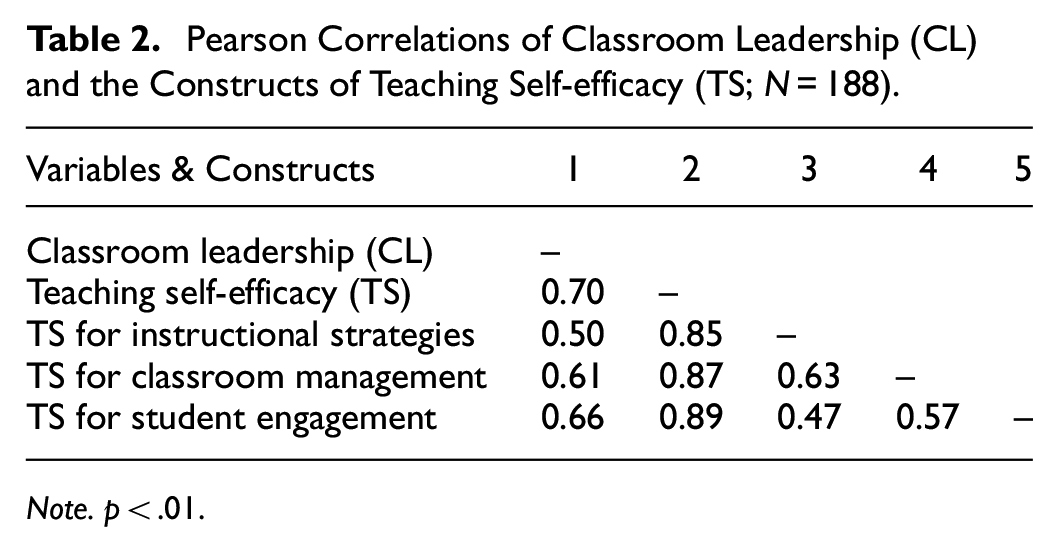
Note. p < .01.
Regression Analysis
To answer Question 2, a linear regression between Classroom Leadership and Teaching Self-efficacy was first conducted, which would determine the extent that the teacher’s classroom leadership affects their teaching self-efficacy. The results of the regression analysis indicated that the teacher’s classroom leadership explained 48% of the variance of their teaching self-efficacy [R2 = 0.48, F(1,186) = 173.86, p < .001] (Table 3).
Summary of Regression Analysis for Classroom Leadership (CL) Predicting Teaching Self-Efficacy (SE; N = 188).

Note. R2 = 0.48, F(1,186) = 173.86, *p < .001.
The four constructs of Classroom Leadership were then regressed on Teaching Self-efficacy. The multiple regression would determine the amount of variation in the teacher’s self-efficacy attributed to each of the four constructs of Classroom Leadership as independent variables. The results show that Teaching Self-efficacy was significantly predicted by intellectual stimulation (β = .29, p < .001) and idealized influence (β = .24, p < .05), while inspirational motivation or individual consideration had no significant contribution to the variance of Teaching Self-efficacy.
ANOVA Test
To answer the third research question, the study made use of an ANOVA test to analyze the variances of the teacher’s classroom leadership and teaching self-efficacy on teaching experience. The ANOVA results showed the comparisons of the means and the standard deviations of the teacher’s classroom leadership and teaching self-efficacy (Table 4). The F-test shows that the means of all the groups are significantly different (p < .001 for groups of Teaching Self-efficacy, p < .05 for groups of Classroom Leadership; Table 5). Interestingly, the results revealed that Classroom Leadership increases with the teacher’s EMI teaching experience, reaching the highest when it gets to 10 years, and then decreases later, while Teaching Self-efficacy increases continuously (Figure 1). In particular, the teachers with more than 10 years of EMI teaching experience have lower level of classroom leadership than those with 5 to 10 years’ EMI teaching experience (Table 4). Further analysis indicated that, two components of Classroom Leadership are decreasing after teaching experience gets to 10 years: inspirational motivation from M = 3.33 (SD = 0.49) to M = 3.17 (SD = 0. 49), and individual consideration from M = 3.39 (SD = 0.42) to M = 3.30 (SD = 0. 46).
Means of Classroom Leadership and Teaching Self-efficacy per EMI Teaching Experience.

F-Test of the One-Way ANOVA.

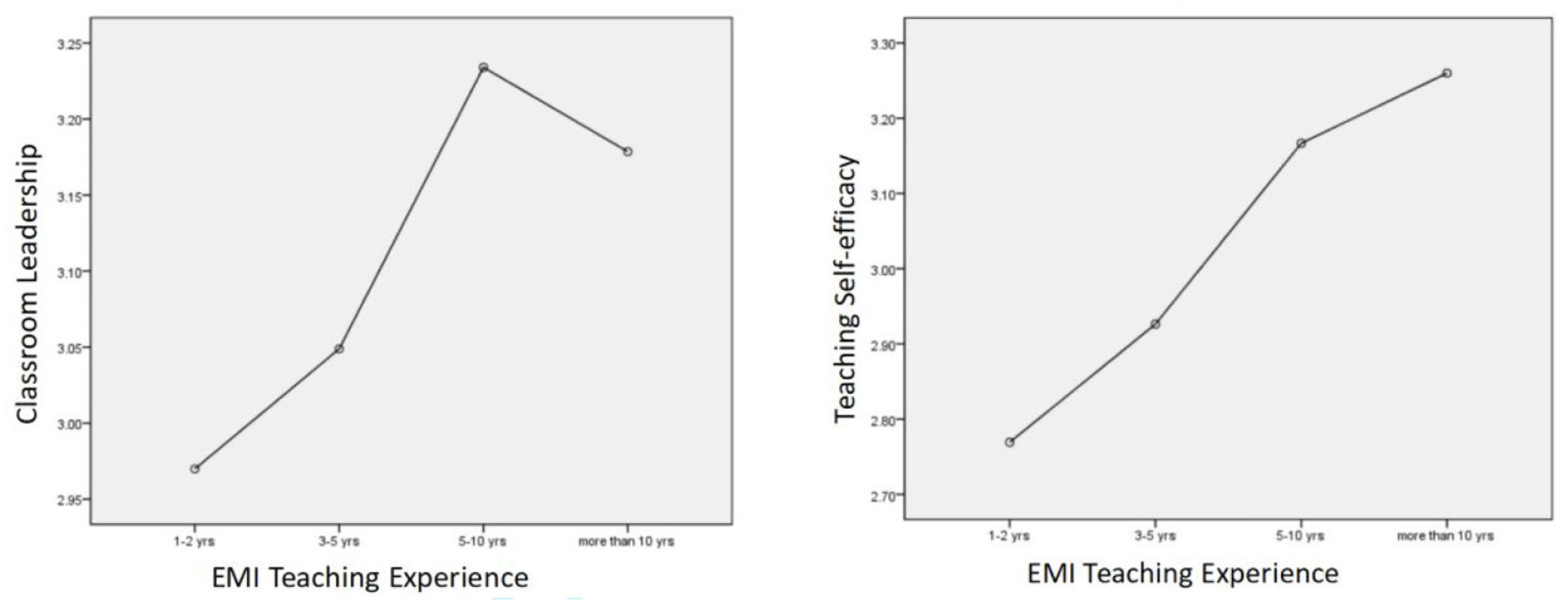
Means plot of classroom leadership and teaching self-efficacy per EMI teaching experience.
Discussion and Implications
Classroom Leadership and Teaching Self-Efficacy
The results of this study showed that there is a close relationship between the English medium instruction teacher’s classroom leadership and teaching self-efficacy, and the teacher’s classroom leadership explained much of the variance of their teaching self-efficacy. The findings echoed with the related previous studies on the association between teachers’ leadership and their teaching abilities (Pounder, 2008). The results supported in part that excellent teachers tend to have skillful leadership and successful teacher leaders are perceived to be pedagogically excellent. In addition, the results resonate with the previous findings on the positive relationship between transformational leadership and self-efficacy (Fitzgerald & Schutte, 2010; Li & Liu, 2022). Fitzgerald and Schutte (2010) found that an intervention aimed at boosting self-efficacy in transformational leadership could lead to enhanced self-efficacy for such leadership. Li and Liu (2022) concluded that both principal transformational leadership and teacher leadership had positive effect on teacher self-efficacy. The results of this study were generally in alignment with the previous research.
The close relationship between the teacher’s classroom leadership and teaching self-efficacy may be partly explained by the significant overlap of university instructors’ transformational leadership behaviors and their teaching behaviors (Daniels & Goodboy, 2014). Treslan (2006) noted that transformational leadership is evident when looking at university instructors’ teaching behaviors in the classroom, though this is not necessarily taught to them as a teaching style. Instructors may provide individual feedback to students, thus reflecting individualized consideration. Instructors may challenge students and encourage independent thought, which indicates intellectual stimulation. Instructors must motivate students, and this denotes inspirational motivation. An instructor also gains respect from students by showing their charisma, which reflects idealized influence. Research has already confirmed the close link between transformational leadership and various aspects of teacher effectiveness (Bolkan et al., 2011; Pounder, 2008). In this study, the results seem to show that transformational classroom leadership, because of its ethical nature reviewed in the previous section of literature review, has a positive effect on the EMI teacher’s psychological self-empowerment.
Among the three components of Teaching Self-efficacy, self-efficacy for student engagement had the highest correlation with the teacher’s classroom leadership. Student engagement, for students’ active involvement in academic activities emotionally, cognitively, and, behaviorally (Balwant, 2016), has long been considered as the core of effective education. Classroom leadership had the behavioral clusters of motivating, encouraging, challenging, and caring for students. These ethical leadership behaviors, in essence, reflect an instructor’s ability to enhance the teacher-student interactional relationship and to engage students better with their academic learning.
It was found in this study that intellectual stimulation and idealized influence were the two significant predictors of the teacher’s self-efficacy, while inspirational motivation or individual consideration had no significant contribution to the variance of the teacher’s self-efficacy. This finding is consistent with the previous research. For example, Harvey et al. (2003) found that intellectual stimulation and idealized influence (charisma) together accounted for 66.3% of the variance of teachers’ performance ratings. Intellectual stimulation is an interactive teaching style, by which the teacher challenges students and encourages their independent thought. According to Bolkan et al. (2011), teachers’ intellectual stimulation behaviors can influence students’ intrinsic motivation so that students adopt approaches to their studying in deep and strategic ways, rather than surface-level approaches. The mechanism of intellectual stimulation in transforming student learning may help explain the role of classroom leadership in increasing teaching effectiveness and teacher self-efficacy. In addition, in this study, idealized influence was another significant predictor of teaching self-efficacy, which confirmed the finding of previous research that respect and trust from students can increase teacher self-efficacy (Milner & Hoy, 2003).
The Role of Teaching Experience
This study found that both the teacher’s classroom leadership and teaching self-efficacy were influenced by teaching experience. Prior research also emphasized the importance of teaching practice in the training programs for EMI teachers (Ball & Lindsay, 2013; Cheng, 2017). Dimova and Kling’s (2018) study found that EMI instructors’ teaching experience and content knowledge can facilitate their language performance. In previous studies, language was found to be a significant predictor for both the teacher’s classroom leadership and teaching self-efficacy in the English medium instruction context (Wang, 2021, 2023). Furthermore, with the accumulation of experience, the teacher could increase their knowledge of the student body and the classroom culture, which might be conducive to creating the environment for transformational classroom leadership.
The plots of ANOVA test results indicated that teaching self-efficacy increases continuously with the EMI teaching experience, whereas classroom leadership increases first, reaching the highest when it gets to 10 years, and then decreases later. This finding appears to suggest that teaching experience plays a more important role for the teacher’s self-efficacy rather than their classroom leadership. The importance of teaching experience for the EMI teacher’s self-efficacy in this study can be supported by the finding of previous research that mastery experience is the most powerful source of self-efficacy (Bandura, 1997; Tschannen-Moran & Hoy, 2001).
Further analysis showed that the two components of Classroom Leadership, inspirational motivation and individual consideration, decrease once the EMI teaching experience gets to 10 years. These findings are also consistent with the prior research (Brekelmans et al., 2005; Klassen & Chiu, 2011). According to the study by Brekelmans et al. (2005), teacher influence grew in the first 6 years of the teaching career, and proximity in the teacher-student relationship began to decrease slightly after the first 10 years of the career. Another study on teacher self-efficacy by Klassen and Chiu (2011) had the finding of a similar trend in terms of different phases of the teaching career. The study found that the self-efficacy of mid-career teachers may grow and decline with the change of work demands and teachers’ capabilities, ambition or energy (Klassen & Chiu, 2011).
Huberman’s (1993) model of teachers’ professional engagement in their careers is likely to explain the changing level of Classroom Leadership in this study. According to Huberman (1993), the first 3 years is the phase of survival and discovery, during which teachers lack leadership experience and have not developed adequate behavioral repertoire or necessary cognitions for classroom leadership. The 4 to 6 years is the second phase of stabilization, teachers have reached instructional mastery and gained effective classroom management. Later, the phase of disengagement may begin with the sign of the diminishing teacher-student proximity as teachers tend to develop less interest in students’ lives (Huberman, 1993). In this study, the EMI teacher may have experienced the similar development phases.
The findings of this study may give some insights into increasing the English-medium instruction teacher’s self-efficacy through developing their classroom leadership, as well as their teaching practice. As Tschannen-Moran and Hoy (2001) proposed, teachers’ professional development should attend to their self-efficacy and its sources when planning the training design. Classroom leadership and teaching experience, evidenced in this study as sources of teacher self-efficacy, have great potential to open new areas for developing teacher self-efficacy, and in particular, contribute to a practical approach to the EMI teacher’s self-efficacy development. To be specific, according to the findings of this study, the development of the EMI teacher’s intellectual stimulation and idealized influence should be prioritized, as well as their teaching experience accumulation.
Limitations and Future Research
There are some limitations in this study. Firstly, although the sample size has a satisfactory power for standard statistical practices in educational research, the participants were from only one Chinese university, which means the findings of this study cannot be generalized to other universities or a different country. Secondly, the data collected in this study was only based on EMI teachers’ self-report survey. Thirdly, the data of this study were cross-sectional, which might leave the findings inconclusive. Longitudinal studies would be able to better track changes in teaching self-efficacy over time as EMI teachers gain more experience, training, and exposure to different teaching contexts.
Future research may investigate the impact of targeted professional development programs that equip EMI teachers with the necessary leadership skills, and explore which program components are most effective in boosting their teaching self-efficacy. It is believed that this kind of research can provide actionable insights into how to support EMI teachers in developing a stronger sense of efficacy, ultimately leading to improved educational outcomes for students in multilingual and multicultural classrooms.
Footnotes
Declaration of Conflicting Interests
The author declared no potential conflicts of interest with respect to the research, authorship, and/or publication of this article.
Funding
The author disclosed receipt of the following financial support for the research, authorship, and/or publication of this article: This work was supported by Zhejiang Provincial Teaching and Education Fund [project number: JG20190144] and Zhejiang Provincial Philosophy and Social Science Planning Project [project number: 24NDJC176YB].
Ethical Statement
This study was approved by the ethics committee of Zhejiang Sci-Tech University. All participants were informed that their confidentiality would be guaranteed, and no names of the participants would be identified in the publication of the results.

Data Availability Statement
Data will be available on request to the author.