



Abstract
Most existing studies focus on the objective factors that influence migrant workers’ decisions to return to their hometowns to start businesses, while paying little attention to the subjective factor of “nostalgia,” a psychological state reflecting emotional ties to a place. To address this gap, this study constructs a theoretical model integrating place attachment theory, motivational theory, and social cognitive theory to investigate the influence of nostalgia on migrant workers’ home-return entrepreneurial behavior. The empirical results indicate a significant positive relationship between nostalgia (within the Chinese socio-cultural context) and home-return entrepreneurial behavior. Specifically, emotional nostalgia boosts all three motivations (survival, social, and achievement), whereas identity nostalgia primarily fuels survival motivation with less impact on social and achievement goals. Home-return entrepreneurial motivations mediate the relationship between nostalgia and entrepreneurial behavior. Furthermore, policy and market environments moderate the impact of entrepreneurial motivations on behavior. The market environment significantly moderates the mediating effect of motivations, whereas the moderating effect of the policy environment on this mediation is non-significant. This study elucidates the role of nostalgia, shaped by China’s dual urban-rural structure, in driving migrant worker entrepreneurial, revealing the underlying psychological mechanisms and boundary conditions, thereby contributing novel theoretical perspectives to the entrepreneurship literature.
Keywords
Introduction
Since the term “migrant workers” was formally introduced in 1984 to refer to rural residents who leave their hometowns to engage in non-agricultural work elsewhere, often in urban areas, research on this group has spanned nearly 4 decades (Liu, Qi, et al., 2024; Qi, 2013). Research indicates that migrant workers frequently experience a psychological tension between place identity maintenance and adaptation challenges—described as a dualistic state of “longing for rural origins while enduring urban existence”—where in return to rural hometowns remains unfeasible despite urban hardships (Tang, 2018). This phenomenon parallels the findings of China’s inter-provincial trade research, where cultural proximity (e.g., shared surnames and dialects) has been shown to overcome geographical distance barriers and facilitate economic exchanges between distant regions (Sala et al., 2008). However, recent studies highlight a “reverse urbanization” pattern: urban laborers are increasingly relocating to county-level economies, with migrant workers transitioning from pure labor export to home-return entrepreneurship (Leng et al., 2020), accompanied by a demographic shift toward growth centers on the periphery of metropolitan areas (Berry, 1976). Existing literature offers two dominant explanations for this shift. First, structural-environmental perspectives posit home-return entrepreneurship as a rational response to exogenous factors, including global economic volatility, unemployment pressures, rural revitalization policies, and localized entrepreneurial infrastructure (Yan & Cheng, 2023). Second, human capital frameworks emphasize individual determinants, such as demographic characteristics (age, gender, and marital status), capital accumulation (human, economic, and social) during urban migration, and psychological attributes such as risk preferences, as predictors of entrepreneurial intent (Wang & Zhu, 2021). While these studies establish a robust “survival-economy” analytical paradigm, recent work by Lv et al. (2024) and Rana et al. (2021) has extended this understanding by incorporating psychological factors, such as place attachment and subjective norms. Building on these developments, our study examines how place-based nostalgia—conceptually related to but distinct from place attachment—interacts with these established factors to influence entrepreneurial behavior.
Over China’s 40-year reform era, migrant workers have developed potent nostalgia arising from geographical displacement and eroded place belonging, an affective-cognitive state embedded in their psychological fabric (Liu, 2016). As David (1997) notes, “Consciousness serves as the explanatory substrate for behavior causation.” Contemporary scholarship deconstructs nostalgia as a bittersweet emotional composite, identifies its place-relevant triggers (objects, landscapes, social contexts, and cultural artifacts), and theorizes its multidimensional value (intrinsic emotional, economic, and cultural; Wu & Li, 2025). Critically, research also documents the intergenerational decline of nostalgia, revealing diminished place attachment and heightened alienation among younger migrant workers (Gao, 2010). Despite these advances, nostalgia is yet to receive sufficient attention in entrepreneurship studies, limiting the systematic understanding of the home-return entrepreneurship phenomenon (Liu, 2020).
While the extant research elucidates the external drivers of home-return entrepreneurship, it does not adequately address subjective psychological mechanisms, particularly overlooking the causal influence of nostalgia. To address this limitation, our study innovatively integrates place attachment theory, motivational theory, and social cognitive theory to construct a three-dimensional “affect-motivation-context” analytical framework. Within this framework, place attachment theory establishes the affective foundation by revealing how rural nostalgia shapes entrepreneurial tendencies (Cheung et al., 2013; Tuan, 1975); motivational theory builds the transformative bridge by analyzing the pathway from nostalgic affect to entrepreneurial motivations (Shumaker & Taylor, 1983); and social cognitive theory provides the contextual lens that clarifies how environmental appraisals moderate motivation-behavior translation (Bandura, 1989). These three theories form an integrated progressive chain mechanism of “affective foundation—motivational catalysis—contextual regulation” rather than simple juxtaposition, collectively constituting a comprehensive explanatory system for nostalgia’s influence on entrepreneurial behavior. The framework examines the following:
(a) How do emotional nostalgia (affective longing) and identity nostalgia (self-concept anchoring) directly and indirectly influence home-return entrepreneurial behavior;
(b) The mediating role of entrepreneurial motivations (survival, social, and achievement);
(c) The boundary conditions imposed by entrepreneurial environments (policy and market).
By investigating these causal pathways and contextual contingencies, this study advances the theoretical understanding of how place-based psychological processes in China’s dual urban-rural structure shape entrepreneurial action.
Literature Review and Research Hypotheses
Nostalgia and Home-Return Entrepreneurial Behavior
Nostalgia constitutes an affective yearning for a past place-time matrix, emerging from physical or anticipated separation from one’s place of origin due to migration (Thurber & Walton, 2007). As a spatially displaced population, rural migrant workers face chronic environmental uncertainties that deplete psychological resources, heightening their vulnerability to negative affect and place-focused nostalgic states (Stroebe et al., 2015).
Nostalgia manifests through two theoretically distinct dimensions. Emotional Nostalgia reflects affective bonds between ancestral landscapes and kinship networks. Detachment from rural origins activates deeply encoded place memories and spiritual needs, forming an attachment system centered on home (Khan, 2015). Industrialization disrupts but does not eliminate this rootedness; urban environments’ failure to provide place belonging triggers a longing for past socio-spatial configurations (Counted et al., 2025). Critically, contrary to urban-centric decline narratives, many migrants perceive villages as reservoirs of dormant place capital (natural/cultural resources), which motivate entrepreneurial returns. Identity Nostalgia emerges from the identity dissonance experienced by migrant workers in China’s urban-rural duality system (Hu, 2008). The structural mismatch between their rural household registration identity and the urban living contexts creates acute identity crises. Simultaneously, institutional exclusion through the hukou system systematically blocks urban integration, while constant social comparisons with urban citizens generate profound relative deprivation (Sedikides, 2015). Urban policies enacting “conditional inclusion” (granting limited residency while withholding civic rights) exacerbate place identity discontinuity (Ma & Li, 2007). Faced with systemic exclusion, exploitative labor conditions (militarized factory regimes and dehumanizing assembly lines), and identity disposability, workers reject urban identity integration (Wang & Fan, 2012). This identity precarity—empirically linked to extreme psychological distress manifestations—fuels the perception of entrepreneurship as an identity restoration mechanism to break intergenerational stigma.
Various factors influence rural migrant workers’ decisions to return home and start businesses, with socio-psychological factors being crucial in determining whether they continue to stay in cities or return home to start businesses (Luo & Tian, 2025). Social cognition analyzes individual psychological functioning based on social cognitive theory and explains human social behaviors (Martin & Clark, 1990). The unique lifestyle of rural migrant workers, who move away from their hometowns to work in cities, to some extent, influences and changes their social cognition. Enhanced social cognition enables the recognition of place-embedded entrepreneurial opportunities (Zhang et al., 2023), positioning nostalgia, and catalyzing home-return entrepreneurship. This yields the following hypotheses:
The Mediating Role of Home-Return Entrepreneurial Motivation
Motivation refers to the psychological inclination or drive that stimulates and sustains individual activities and forms the basis of most human behaviors (Weiner, 1985). Entrepreneurial motivation is the internal drive that prompts individuals to initiate and maintain venture creation activities (Zhou et al., 2020). Place-based psychological factors influence different motivational aspects of migrant workers in different ways. For instance, survival motivations emerge from the employment press (urban integration barriers, employment precarity), driving entrepreneurship as a means of securing livelihood necessities; social motivation manifests as pro-place stewardship, the desire to contribute to hometown development, and collective welfare; and achievement motivation reflects self-actualization needs through entrepreneurial success and personal mastery. By drawing on motivational theory (Ajzen, 1991), which posits that needs induce motivations that determine behavior, we hypothesize that place-attachment dimensions differentially predict motivational pathways:
Entrepreneurial motivations positively impact entrepreneurial behavior, stimulating individuals’ intentions, and subsequently triggering entrepreneurial activities (Wu et al., 2023). Furthermore, different dimensions of entrepreneurial motivation have varying impacts on the home-return entrepreneurial behaviors of rural migrant workers. Therefore, it can be concluded that increasing entrepreneurial intention is of great practical significance for promoting Chinese Migrant Workers to achieve employment and increase income through entrepreneurship, promoting local economic and social development, and revitalizing rural areas (Wu et al., 2023). Economic motivations positively influence survival entrepreneurship but negatively affect opportunity entrepreneurship, whereas social motivations positively influence survival entrepreneurship but have no significant impact on opportunity entrepreneurship. Achievement motivation negatively influences survival entrepreneurship but positively influences opportunity entrepreneurship (Liu, 2013a). Spiritual, responsibility, and glory motivations significantly influence entrepreneurial tendencies (Ogba et al., 2022). Therefore, entrepreneurial motivations prompt potential entrepreneurs to engage in entrepreneurial activities, with different dimensions of entrepreneurial motivations affecting home-return entrepreneurial behaviors in rural migrant workers. Based on this, the following hypotheses are proposed:
Motivational theory suggests that internal and external needs can induce motivations, which in turn determine behaviors (Kirkpatrick, 2002). Existing research indicates that home-return entrepreneurial motivation is a prerequisite for the willingness to return to hometown entrepreneurship, promoting rural migrant workers to engage in entrepreneurial activities (Liu, 2013b). Thus, entrepreneurial motivations can help individuals clarify entrepreneurial directions and subsequently lead to entrepreneurial behaviors. In context of the mediating effect of entrepreneurial motivations, some studies have found that it mediates the impact of social, human, and psychological capitals on rural migrant workers’ entrepreneurial intentions (Wu & He, 2018). Other studies have found that glory and opportunity motivations play intermediary roles in the impact of perceived entrepreneurial opportunities on rural migrant workers’ entrepreneurial intentions (Shi et al., 2016). We extend this logic and position home-return motivation as the psycho-spatial mechanism that translates place attachment (nostalgia) into spatially embedded entrepreneurial action. Thus, the following hypothesis is proposed:
Moderating Role of the Entrepreneurial Environment
The entrepreneurial environment constitutes a constellation of external contextual factors that influence entrepreneurs’ activities beyond individual control, but significantly determine venture outcomes (Austin et al., 2006). Environmental psychology emphasizes that place-based affordances and constraints shape behavioral enactment through person-context transactions (Kytta, 2002). Empirical evidence reveals that tax incentives increase potential entrepreneurs’ motivation to seek business opportunities, whereas rigid and complex bureaucratic procedures, and excessive government control can suppress entrepreneurial motivation (Urban, 2013). A stable, supportive institutional environment and a flexible, efficient market operation environment can promote investment and entrepreneurship among returning overseas entrepreneurs (Lin et al., 2025). Studies also find that the entrepreneurial environment often plays a moderating role in the entrepreneurial process (Lu & Tao, 2010). For example, the policy environment negatively moderates the influence of information resources on opportunity recognition (Zhang et al., 2022), whereas the market environment positively moderates the effect of creativity on entrepreneurial intention, meaning that the better the perceived entrepreneurial environment, the higher the entrepreneurial intention (Zhao & Wu, 2023). Digital development presents both opportunities and challenges for home-return entrepreneurs. Digital technologies (e.g., e-commerce and social media) may strengthen emotional nostalgia and hometown connections by maintaining social capital through virtual spaces (Niemeyer & Siebert, 2023), while reducing information barriers and geographical constraints. However, digitization may also intensify market competition and disrupt traditional entrepreneurial models (Liu, Dong, & Qian, 2024). This suggests contextual contingencies; the strength of motivation-behavior linkages depends on perceived environmental favorability. Therefore, we propose the following hypotheses:
Moderated Mediation Effects
By integrating our theoretical framework, we propose a contextual contingency model in which home-return entrepreneurship motivation mediates the nostalgia-behavior relationship, and entrepreneurial environments moderate this mediation pathway. Formally, the magnitude of this mediated effect depends on environmental favorability: under high environmental support, nostalgia’s indirect effect through motivation intensifies, and under low environmental support, this indirect effect attenuates. This aligns with environmental psychology’s person-context transaction principle: motivational pathways that translate place attachment into behavior are contingent on external affordances (Stokols, 1995). Thus, we propose the following hypotheses:
As illustrated in Figure 1, our integrated model synthesizes the following:
Place Attachment Theory: nostalgia (emotional/identity) as place-based antecedents; Motivational Theory: entrepreneurial motivations as proximal behavioral drivers; and
Social Cognitive Theory: environment-behavior transactions as boundary conditions. This framework elucidates how place attachment (nostalgia) operates through psycho-spatial mechanisms (motivations) to drive spatially embedded entrepreneurial behavior, contingent on contextual affordances (policy/market environments).

Theoretical model: Nostalgia and home-return entrepreneurship.
Research Methods
Sampling and Data Collection
We implemented a spatially stratified sampling strategy that targeted rural-to-urban migrant workers across critical transition nodes in their mobility pathways. Recruitment sites were strategically selected to capture place-attachment dynamics: (1) government-designated entrepreneurship pilot counties in Shandong Province representing policy-supported return environments; (2) rural townships during the Spring Festival peak return period to access temporary returnees; (3) migrant employment service centers as institutional contact points; (4) high-density urban labor markets; and (5) manufacturing/service enterprises with ≥70% migrant workforce composition. The survey data used in this study were collected as part of the Research Project: A Study on Home-Return Entrepreneurship among Chinese Migrant Workers.
Field procedures employed structured, interviewer-administered, in situ delivery to maintain the ecological validity of place-based responses. Prior to participation, all respondents were presented with a detailed information sheet outlining the research purpose, assuring complete anonymity, and explaining data confidentiality measures. Informed consent was obtained through the completion and return of the anonymous questionnaire, a procedure reviewed and approved as compliant with ethical standards for minimal-risk research under Section 8.05(1)(b) of the APA Ethical Principles. The initial distribution yielded 493 retrievals from 520 questionnaires (94.8% retrieval rate). After rigorous screening for response consistency and completeness, 30 surveys were excluded, resulting in 463 analyzable cases (89.0% valid response rate). The sample demographics (Table 1) reflect the core characteristics of the target population.
Main Variable Definitions.

Variable Selection and Measurement
Based on participants’ characteristics, the questionnaire underwent iterative refinement through pilot testing and expert consultation. The final instrument comprised five sections: (1) home-return entrepreneurial behavior, (2) nostalgia, (3) home-return entrepreneurial motivation, (4) entrepreneurial environment, and (5) demographic information. Demographic variables employed nominal and ordinal measurements, whereas latent constructs used 5-point Likert scales (1 = strongly disagree to 5 = strongly agree).
Dependent Variable: Home-Return Entrepreneurial Behavior
Operationalized as the behavioral enactment of entrepreneurial intentions, this construct was measured using four items adapted from Farmer et al. (2011), including the following: “I have invested substantial time in a home-return entrepreneurial project,” and “I have made financial investments in a home-return venture.” The scale’s Cronbach’s α value is .959, which is greater than .7, indicating good reliability; the KMO value is .875, which is greater than .7; and Bartlett’s test of sphericity’s Chi-square value is 2,081.687 with a significance level of .000, which is suitable for factor analysis.
Independent Variable: Nostalgia
This construct, defined as the affective-cognitive state encompassing longing for ancestral place attachments and the distress resulting from spatial dislocation, was divided into two theoretically distinct dimensions following Stroebe et al. (2002). Emotional nostalgia includes longing for family, friends, and hometown, whereas identity nostalgia includes loneliness and adaptation difficulties, with a total of 20 items, such as “During urban employment, I intensely miss familial connections,” and “While working in the city, I feel lonely.” For the overall scale, the Cronbach’s α value is .915. The emotional nostalgia scale has a Cronbach’s α value of .940, and the identity nostalgia scale has a Cronbach’s α value of .919, all exceeding .7, indicating good reliability. The KMO value is .919, and Bartlett’s test of sphericity has a Chi-square value of 7,280.388 with a significance level of .000, allowing for factor analysis.
Mediator Variable: Home-Return Entrepreneurial Motivation
Defined as the psychological impetus triggering place-reembedded venture creation, this construct was multi-dimensionalized based on Barba-Sánchez et al. (2012) and Wang and Zhu (2021). Survival Motivation: Necessity-driven responses (e.g., “I initiate businesses to elevate socioeconomic standing”); Social Motivation: Community-oriented stewardship (e.g., “Entrepreneurship serves hometown revitalization”). The Cronbach’s α value for the 12-item scale is .908, which is greater than .7, indicating good reliability. The KMO value is .899, and Bartlett’s test of sphericity has a Chi-square value of 3,824.575 with a significance level of .000, supporting factor analysis.
Moderator Variable: Entrepreneurial Environment
Conceptualized as external contextual factors beyond entrepreneurial control, this moderator was dimensionalized into policy and market environments. By drawing on Wang and Sun (2018) and Guo and He (2017), we operationalized the construct through eight items including, “Local governments provide specialized entrepreneurial training programs” (policy dimension) and “My products/services hold competitive advantages in the local markets” (market dimension). The Cronbach’s α value for the scale is .896, which is greater than .7, indicating good reliability. The KMO value is .867, and Bartlett’s test of sphericity has a Chi-square value of 2,843.531 with a significance level of .000, making factor analysis feasible.
Controlled Variables: Basic Information
Consistent with Raijman’s (2001) migration-capital framework and migrant worker characteristics, we included covariates for the following:
Demographic factors: Gender, age, education level, marital status;
Economic capital: Annual household income;
Social capital: Entrepreneurial social networks (relatives/friends as entrepreneurs), institutional connections (relatives/friends as officials);
Experiential factors: Entrepreneurship training participation;
Psychological factors: Risk propensity.
Empirical Analysis
Common Method Bias Test
Procedural remedies included avoiding leading questions to ensure the respondents’ anonymity. Harman’s single-factor test revealed that the first principal component accounted for 29.639% of the variance (eigenvalue = 13.041), below the 40% threshold, indicating no substantial method bias. Collinearity diagnostics confirmed the absence of multicollinearity (all VIF < 10).
Reliability and Validity Testing
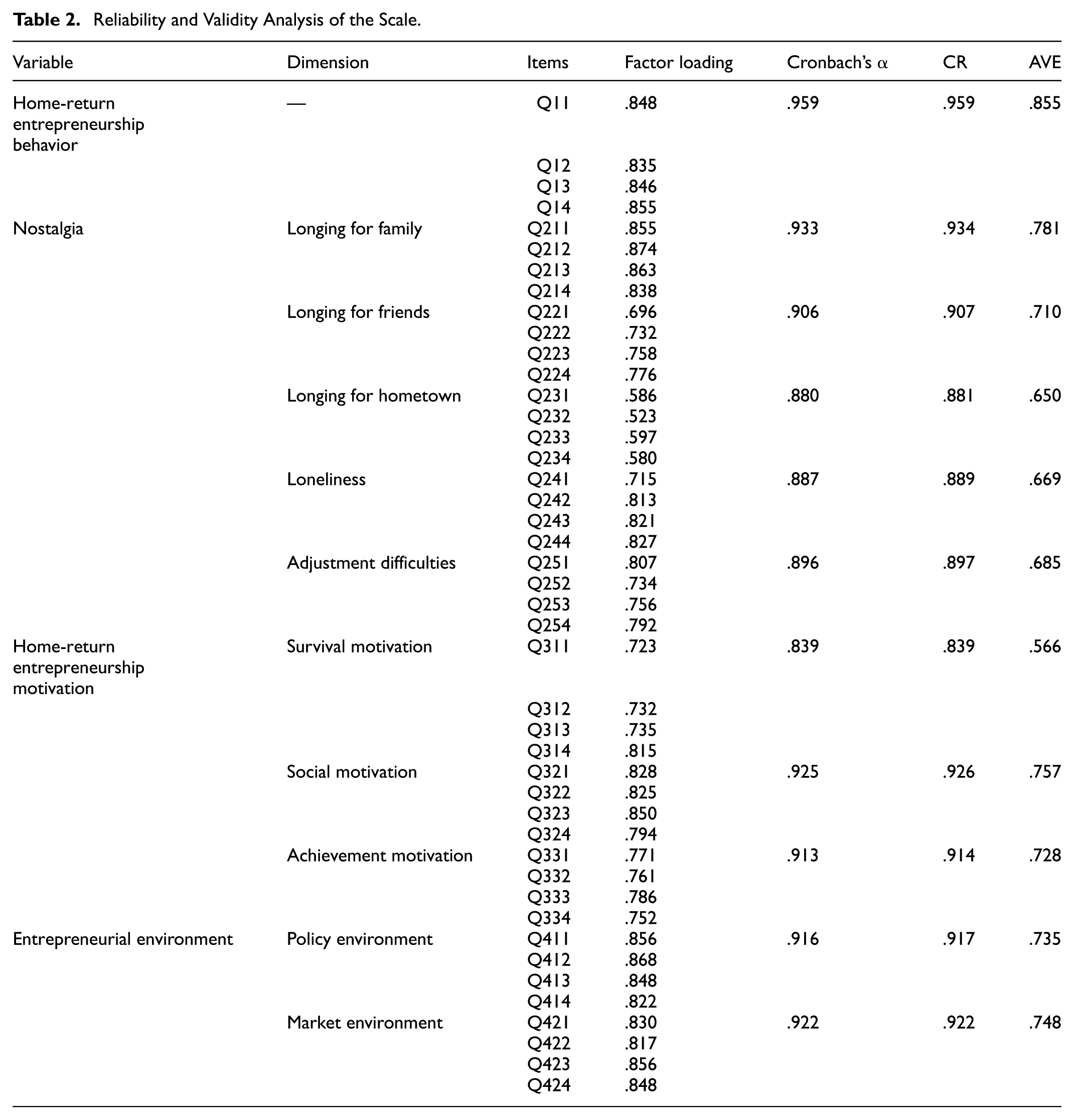
Scale reliability was assessed via Cronbach’s α, while convergent validity used composite reliability (CR) and average variance extracted (AVE). Discriminant validity was evaluated by comparing inter-construct correlations with the square root of AVE. As presented in Table 2, the Cronbach’s α values for all variables are greater than .7, and removing any item does not significantly improve the Cronbach’s α value. The factor loadings for all measurement items are greater than .5, indicating good reliability of the scale. The CR values for all variables are greater than .7, and the AVE values are greater than .5, indicating the scale’s good convergent validity. Additionally, the square roots of all variables’ AVE values are greater than the corresponding correlations in the rows and columns, indicating the scale’s good discriminant validity. Furthermore, confirmatory factor analysis using Amos 21.0 shows that the model’s fit indices—χ2/df = 1.929, NFI = .901, TLI = .945, CFI = .948, and RMSEA = .046—meet acceptable standards, indicating a good model fit.
Reliability and Validity Analysis of the Scale.
Correlation Analysis
As shown in Table 3, the four latent variables were significantly positively correlated, consistent with the study’s hypotheses, providing initial evidence for hypothesis validation.
Means, Standard Deviations, Correlations, and Discriminant Validity of Variables.
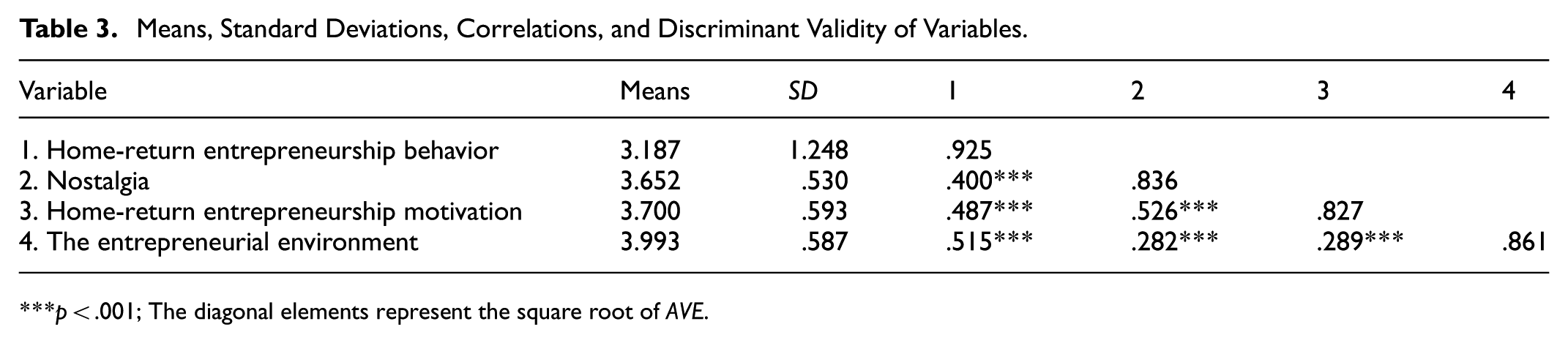
p < .001; The diagonal elements represent the square root of AVE.
Hypothesis Testing
Hierarchical regression analysis was used to examine the hypothesized relationships. The main effects were tested using Equations 1 and 2:


According to Kenny (1998), when testing the mediating effect of home-return entrepreneurship motivation, in addition to considering Equations 1 and 2, the results of including both nostalgia and home-return entrepreneurship motivation in the regression equation should also be considered. The regression model is shown in Equations 3 and 4:


In this context, Behavior refers to home-return entrepreneurship behavior, nostalgia refers to nostalgia, Motivation refers to home-return entrepreneurship motivation, environment refers to the entrepreneurial environment, and
Main Effect Testing
The results are summarized in Table 4. Model 1 is the base model, which examines the effect of control variables on migrant workers’ home-return entrepreneurship behavior. Model 2 indicates that nostalgia significantly positively affects home-return entrepreneurship behavior (β = .280, p < .001). Model 4 shows that both emotional nostalgia (β = .173, p < .001) and identity nostalgia (β = .183, p < .001) significantly and positively affect home-return entrepreneurship behavior, supporting Hypotheses 1-1 and 1-2.
Regression Analysis of Nostalgia on Home-Return Entrepreneurship Behavior.

p < .05. **p < .01. ***p < .001.
Mediation Effect Testing
Kenny et al.’s (1998) four-step procedure was followed.
Step 1 (Supported H1): Place-based nostalgia positively predicts home-return entrepreneurial behavior (previously established in Table 4).
Step 2: Nostalgia significantly positively affects home-return entrepreneurial motivation (β = .465, p < .001; Table 5, Model 2). From Table 6 Model 2, 4, and 6, it is found that emotional nostalgia significantly positively affects survival motivation (β = .164, p < .001), social motivation (β = .374, p < .001), and achievement motivation (β = .427, p < .001), while identity nostalgia significantly positively affects survival motivation (β = .350, p < .001) but does not significantly affect social motivation (β = .062, p > .05) and achievement motivation (β = .043, p > .05), thus confirming H2-1, H2-2, H2-3, and H2-4, but not H2-5 and H2-6. This phenomenon can be interpreted through two dimensions: the nature of motivation and the cultural context. First, from the perspective of motivational essence, identity nostalgia often stems from the crisis of social identity faced by individuals (such as the stigmatization or marginalization experienced by migrant workers), with behavioral motivation primarily manifesting as defensive coping strategies (Ilchuk, 2024). Specifically, it reflects a strong demand for survival needs, such as economic security and basic social acceptance (survival motivation), rather than developmental goals, such as social contribution or self-actualization (social/achievement motivation). Second, China’s unique cultural context reinforces this mechanism. The traditional concept of “securing livelihood and establishing identity,” proposed by Fei (1992), profoundly influences the logic of identity formation among Chinese people. Within this cultural framework, returning entrepreneurs often prioritize rebuilding their economic identity (survival motivation) as their primary goal. This pragmatic inclination relegates the pursuit of higher-order social values (social/achievement motivation) to a secondary position.
Step 3: Home-return motivation positively affects entrepreneurial behavior (β = .340, p < .001; Table 7, Model 2). Table 7 Model 5 indicates that survival motivation (β = .171, p < .001), social motivation (β = .135, p < .01), and achievement motivation (β = .117, p < .05) significantly positively affect home-return entrepreneurship behavior, thus confirming H3-1, H3-2, and H3-3.
Step 4: Table 8 Model 3 shows that nostalgia significantly positively affects home-return entrepreneurship behavior (β = .156, p < .001), and home-return entrepreneurship motivation significantly positively affects home-return entrepreneurship behavior (β = .265, p < .001), though this effect is reduced, indicating that home-return entrepreneurship motivation partially mediates the relationship between nostalgia and home-return entrepreneurship behavior, supporting H4.
Regression Analysis of Nostalgia on Home-Return Entrepreneurship Motivation.

p < .05. **p < .01. ***p < .001.
Regression Analysis of Nostalgia’s Sub-Dimensions on Sub-Dimensions of Home-Return Entrepreneurship Motivation.

p < .05. **p < .01. ***p < .001.
Regression Analysis of Home-Return Entrepreneurship Motivation on Home-Return Entrepreneurship Behavior.

p < .05. **p < .01. ***p < .001.
Regression Analysis of the Mediating Effect of Home-Return Entrepreneurship Motivation.

p < .05. **p < .01. ***p < .001.
Additionally, using Hayes’s PROCESS V3.4 program to further test the significance of the mediation effect, Table 9 shows that the mediation effect of home-return entrepreneurship motivation is .290, with a 95% confidence interval of [.172, .418], excluding 0, indicating that home-return entrepreneurship motivation mediates the relationship between nostalgia and home-return entrepreneurship behavior, further supporting H4.
Testing Results of the Mediating Effect of Home-Return Entrepreneurship Motivation.

Moderation Effect Testing
Home-return entrepreneurship behavior is set as the dependent variable, and control variables, home-return entrepreneurship motivation, entrepreneurial environment, and the interaction term of home-return entrepreneurship motivation and entrepreneurial environment are added to the regression analysis. The results in Table 10 Model 3 show that the entrepreneurial environment positively moderates the effect of home-return entrepreneurship motivation on home-return entrepreneurship behavior (β = .108, p < .01). The moderating effects of policy and market environments are tested, and the results are presented in Tables 11 and 12. Table 11 Model 3 shows that policy environment positively moderates the effect of home-return entrepreneurship motivation on home-return entrepreneurship behavior (β = .080, p < .01). Table 12 Model 3 shows that market environment positively moderates the effect of home-return entrepreneurship motivation on home-return entrepreneurship behavior (β = .098, p < .01), supporting H5, H5-1, and H5-2.
Regression Analysis of the Moderating Effect of Entrepreneurial Environment.
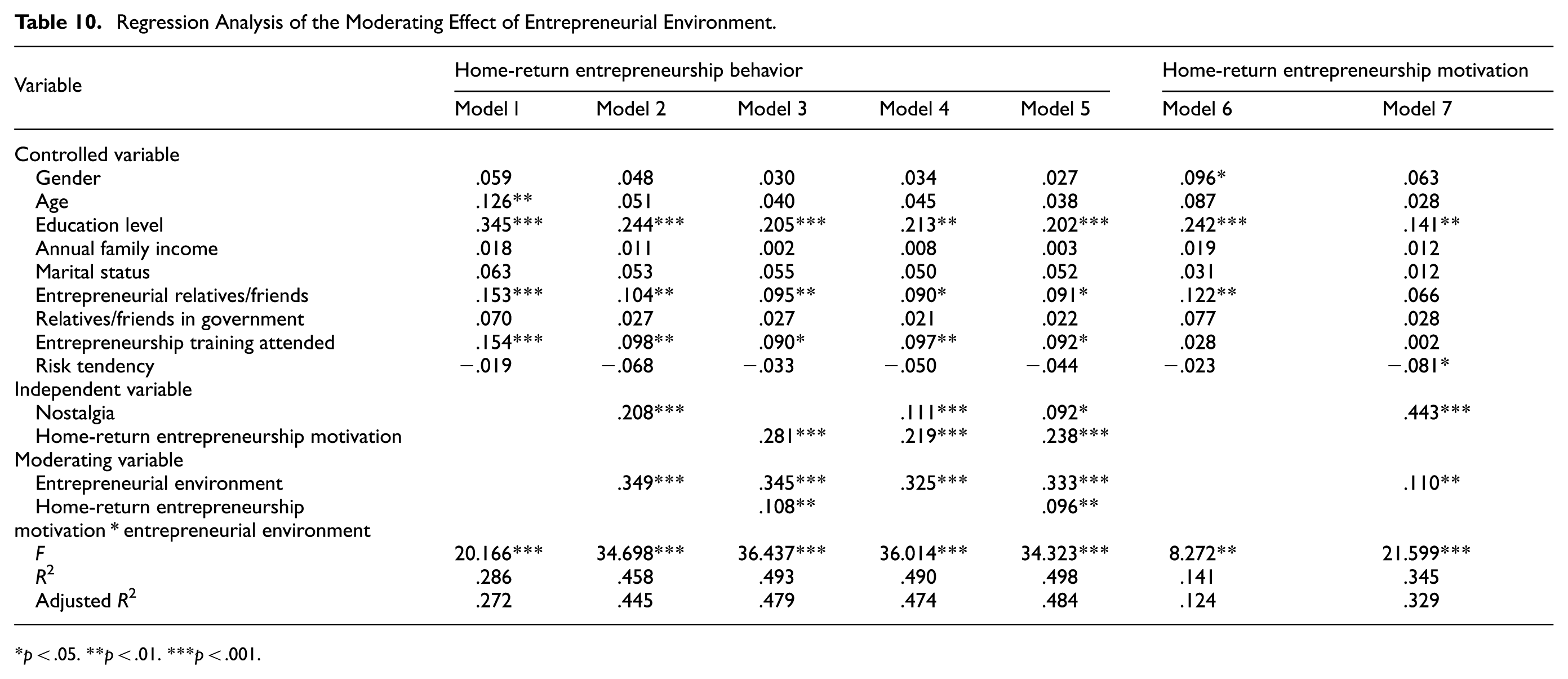
p < .05. **p < .01. ***p < .001.
Regression Analysis of the Moderating Effect of Policy Environment.

p < .05. **p < .01. ***p < .001.
Moderation Analysis of the Entrepreneurial Environment on Mediating Effect.

p < .05. **p < .01. ***p < .001.
To further illustrate the moderating effects, interaction plots (Figures 2 –4) are created following Cohen et al. (2000). The results show that when the entrepreneurial environment is unfavorable, the effect of home-return entrepreneurship motivation on home-return entrepreneurship behavior is not significant (β = .169, p > .05), whereas when the environment is favorable, the effect is significantly positive (β = .834, p < .001). Therefore, a more favorable entrepreneurial environment increases the likelihood that migrant workers’ home-return entrepreneurship motivation translates into actual entrepreneurship activities. Both policy and market environments have a significantly positive impact on home-return entrepreneurship behavior under both unfavorable and favorable conditions, with stronger effects when the environment is favorable. These results confirm that institutional support (policy) and resource munificence (market) operate as catalytic contextual conditions, amplifying motivation-behavior linkages when environmental favorability increases.

Moderating effect diagram of entrepreneurial environment.

Moderating effect diagram of policy environment.

Moderating effect diagram of market environment.
Moderated Mediation Effect Testing
Following Wen et al.’s (2012) moderated mediation framework, we tested four sequential conditions using hierarchical regression. First, nostalgia significantly predicted home-return entrepreneurship behavior (β = .208, p < .001; Table 10 Model 2). Second, nostalgia exerted significant positive effects on entrepreneurial motivation (β = .443, p < .001; Table 10 Model 7). Third, entrepreneurial motivation significantly influenced entrepreneurial behavior (β = .219, p < .001; Table 10 Model 4), confirming mediation. Fourth, the Motivation * Entrepreneurial Environment interaction term demonstrated significance (β = .096, p = .007; Table 10 Model 5). Collectively, these results establish that the entrepreneurial environment moderates the mediation pathway, thus supporting H6.
Subsequent dimensional analysis revealed the differential effects. For the policy environment (Table 11), while nostalgia significantly predicted behavior (β = .246, p < .001; Model 2) and motivation (β = .459, p < .001; Model 7), and motivation mediated the nostalgia-behavior relationship (β = .252, p < .001; Model 4), the critical Motivation * Policy Environment interaction was non-significant (β = .070, p > .05; Model 5). Conversely, for the market environment (Table 12), all mediation conditions were satisfied (nostalgia→behavior: β = .212; nostalgia→motivation: β = .438; motivation→behavior: β = .213; all p < .001), with a significant Motivation*Market Environment interaction (β = .084, p = .023; Model 5). The policy may not work well because of implementation gaps. Farhan et al. (2024) found that in developing countries, entrepreneurial policies often suffer from diminished effectiveness due to rigid bureaucratic procedures, making it difficult for migrant workers to translate motivation into action, given the high cost of accessing policy benefits. Additionally, Boudreaux et al. (2019) noted that the policy environment must align with entrepreneurs’ cognitive frameworks to be effective because misunderstandings about policies among migrant workers may weaken their moderating role. Dai (2018) highlighted that when policy stability is insufficient, entrepreneurs tend to rely more on market signals, which could further obscure the moderating effect of policies (Table 13).
Regression Analysis of the Moderating Effect of Entrepreneurial Environment.

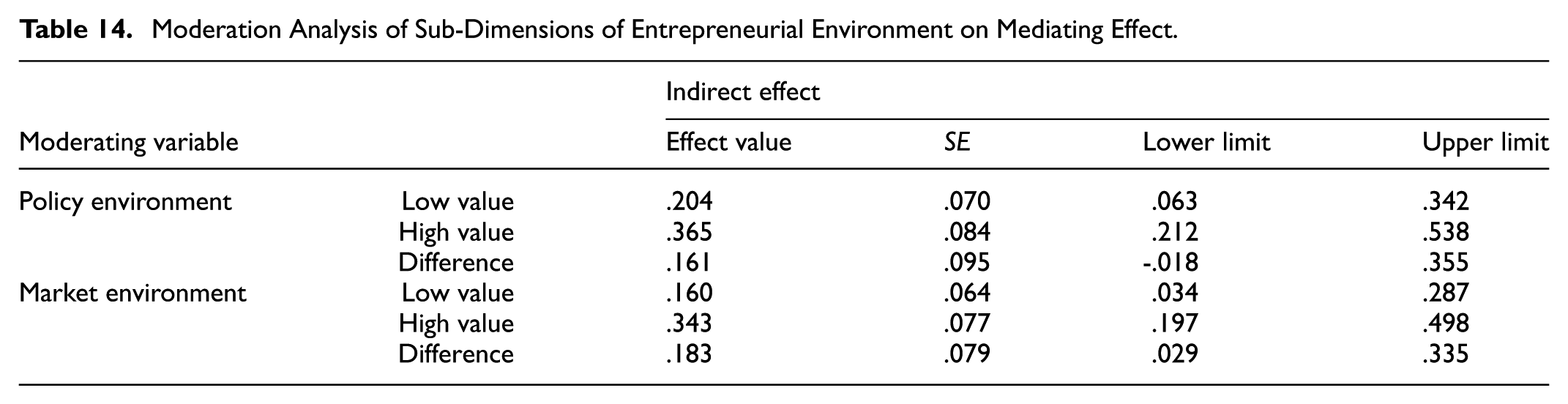
Robustness checks using Hayes’s PROCESS (v3.4, 5,000 bootstraps) corroborated these findings as the composite entrepreneurial environments showed significant moderated mediation (index = .221, 95% CI [.042, .425]). Dimensional analysis confirmed non-significant policy environment moderation (index = 0.161, 95% CI [−.018, .355]) but significant market environment moderation (index = .183, 95% CI [.029, .335]), demonstrating contextual amplification specifically through resource-based market affordances (Table 14).
Moderation Analysis of Sub-Dimensions of Entrepreneurial Environment on Mediating Effect.
Robustness Analysis
Following Yin and Li’s (2023) robustness framework, this study conducts additional robustness checks through two strategies: random sub-sampling and the inclusion of additional control variables. First, considering that variations in the sample size may have influenced the empirical results, we randomly selected a 90% subsample from the original 463 observations to re-estimate the theoretical model. As shown in Table 15, nostalgia continues to exert a significant positive influence on home-return entrepreneurial behavior (β = .281, p < .001), with an adjusted R2 of .333. Key control variables—including age (β = .108, p < .001), education level (β = .288, p < .001), whether relatives or friends are entrepreneurs (β = .126, p < .01), and participation in entrepreneurship training (β = .142, p < .001)—remain statistically significant, with coefficient directions consistent with the baseline model. Second, acknowledging that home-return entrepreneurial behavior may also be influenced by work experience, we incorporated “work experience”—operationalized as the duration of employment—as an additional control variable. The results presented in Table 5 indicate that, even after including work experience, nostalgia retains a significant positive effect on home-return entrepreneurship (β = .276, p < .001). This coefficient shows no substantive change compared to Model 1 (β = .281), while the adjusted R2 slightly increases to .341. The newly added work experience variable is not statistically significant (β = .039, p > .05), and the significance levels and directions of all other control variables remain largely unchanged. These findings collectively confirm that the core results of this study are robust against both sample variability and potentially omitted variable bias.
Robustness Checks.

p < .01. ***p < .001.
Conclusions and Discussion
Research Conclusions
By integrating place attachment, motivational, and social cognitive theories, this study elucidates the psychological mechanisms through which place-based nostalgia influences rural-to-urban migrants’ home-return entrepreneurial behavior. The key findings reveal the following.
First, nostalgia significantly predicts home-return entrepreneurial behavior. Within China’s dual urban-rural structure, nostalgia manifests as dual forces, then (1) Emotional nostalgia functions as an active place-attraction force—manifested as desires for glorious homecoming and ancestral place stewardship—that pulls migrants toward entrepreneurial return; (2) Identity nostalgia operates as a displacement pressure—stemming from systemic marginalization, cyclical mobility patterns (pre-marriage urban work, post-marriage circular migration, elderhood rural return), and stigmatized labor identity—that pushes migrants to break intergenerational occupational inheritance and transcend “low-quality laborer” stereotypes through entrepreneurship. This finding shares common ground with international migration research on “the driving role of emotional ties in return migration decisions.” For instance, studies on Mexican migrants indicate that emotional attachment to their hometown communities (akin to “emotional nostalgia”) is a core factor in their return migration (Smith, 2006). However, unlike the present study, Mexican migrants’ return decisions rely more on direct familial summons from hometown networks, whereas Chinese migrant workers’ nostalgia is more intertwined with identity anxiety under the urban-rural duality system (“identity nostalgia”), reflecting a unique dual-drive mechanism of emotional attachment and institutional exclusion. Additionally, research on India’s seasonal laborers reveals that acculturation difficulties (similar to “identity nostalgia”) strengthen return intentions. However, given the constraints due to India’s rural land tenure system, most returnees opt to resume farming rather than start businesses (Deshingkar & Farrington, 2009). This contrasts with Chinese migrant workers, who view entrepreneurship as a pathway to transcending identity barriers, highlighting how differences in institutional environments shape the direction of nostalgia-driven outcomes.
Second, home-return entrepreneurial motivation fully mediates the nostalgia-behavior relationship. Critically, emotional nostalgia amplifies survival and achievement motivations, whereas identity nostalgia only enhances survival motivation without significant effects on social or achievement dimensions. This demonstrates how distinct place-attachment dimensions activate differentiated motivational pathways. This mediating mechanism shares partial logical similarities with international studies while exhibiting distinct characteristics due to contextual differences. Place attachment shapes sustainable entrepreneurial actions among ethnic minorities through the interaction between individual psychology and the physical environment (Al Mamun et al., 2025). Entrepreneurial motivations driven by place attachment align somewhat with those stemming from emotional nostalgia, although the former focuses more on sustainability in specific urban settings, whereas Chinese migrant workers’ emotional nostalgia is more closely tied to traditional rural cultures and familial obligations. Research on Syrian migrants in Istanbul found that identity crises caused by displacement weaken their sense of belonging in new environments (Alirhayim, 2025), which bears resemblance to the survival anxiety triggered by identity nostalgia. However, Chinese migrant workers proactively choose entrepreneurship as a means of transcending identity constraints, whereas Syrian migrants are often in a more reactive state of adapting to new surroundings. This contrast highlights the differences in motivational transformation pathways in varying migration contexts.
Third, the entrepreneurial environment positively moderates both the motivation-behavior relationship and the mediation pathway. Market environments significantly amplify the mediating effects, whereas policy environments show non-significant moderation. This indicates that resource munificence (market), rather than institutional support (policy), catalyzes the translation of place-attachment motivations into spatial-reembedded entrepreneurial action. This moderating effect varies significantly across institutional contexts. In Uganda, credit support policies have been shown to strengthen the translation of entrepreneurial motivation into actual behavior (Blattman et al., 2014). However, this study finds that China’s policy environment has no significant moderating effect. This discrepancy may stem from the fact that Chinese migrant workers rely more on “relational networks” than “formal policies” for entrepreneurship (Wang, 2025), a finding that aligns with research from other emerging economies such as India and Brazil. These parallels highlight how policy implementation efficiency in transitional economies can constrain entrepreneurial behavior (Frisch-Aviram et al., 2020). This divergence suggests that while institutional support should theoretically facilitate entrepreneurship, its actual impact depends on the local institutional ecosystem. In China, informal social capital appears to play a more pivotal role than state-led policy interventions in enabling migrant workers’ entrepreneurial transitions, a phenomenon that warrants a deeper exploration of how institutional trust and bureaucratic effectiveness shape development outcomes in the Global South.
Research Contributions
This study makes three primary theoretical advances in environmental psychology. First, it extends place attachment theory (Altman & Low, 1992) beyond its traditional domains of environmental geography and tourism studies to migration-entrepreneurship intersections. By applying this framework to home-return entrepreneurship, we establish how place-based bonds function as motivational drivers in the context of labor mobility, thus creating new theoretical pathways for understanding person-place transactions in transitional economies. Furthermore, integrating motivational theory reveals a psycho-spatial mediation mechanism whereby nostalgia triggers entrepreneurial action through survival, social, and achievement motivations, providing a more nuanced understanding of how affective place connections translate into spatial re-embedding behaviors.
Second, this research advances the conceptualization of nostalgia by operationalizing its dual-dimensional structure (emotional vs. identity nostalgia). This differentiation provides a novel theoretical lens for analyzing migrant workers’ lived experiences across temporal-spatial dislocations during China’s reform era. By distinguishing affective bonds with ancestral places from struggles with stigmatized identities, we illuminate the previously obscured psychological pathways through which place attachments influence return-migration decisions, thereby enriching theoretical explanations of entrepreneurial spatial re-embedding beyond economic determinism.
Third, this study identifies critical boundary conditions through environment-behavior transactional theory (Gifford, 2014). We empirically demonstrate how market environments, which function as resource conduits, significantly moderate the mediated nostalgia-entrepreneurship relationship, whereas policy environments show limited catalytic effects. This delineation between institutional affordances and market munificence clarifies how distinct environmental subsystems differentially enable the translation of place-attachment motivations into entrepreneurial action, advancing the theoretical understanding of contextual contingencies in migration-entrepreneurship linkages.
Research Implications
First, rooted in the cultural core of “home” and the differentiated characteristics of migrant worker groups, we propose targeted strategies to activate the practical value of nostalgia. For migrant workers who have integrated into urban life, tap into the tradition of “returning home in glory” to evoke emotional nostalgia, and guide them to engage in “linked entrepreneurship” through policies such as tax incentives and green finance, thereby addressing rural industrial hollowing-out. For migrant workers hampered by identity-related challenges, focus on resolving identity nostalgia by promoting equal access to urban-rural public services, reducing institutional exclusion, while strengthening their willingness to give back through hometown elite mentorship and cultural heritage exhibitions, thereby driving “labor home-return” and improving rural governance.
Second, based on the motivational differences between emotional and identity nostalgia, we built a categorized support system. Social and achievement motivations triggered by emotional nostalgia, strengthen the guidance for mission-driven entrepreneurship through hometown networking platforms and entrepreneurial resource-matching events, with priority support for projects that drive rural development. For survival motivations associated with identity nostalgia, improve entrepreneurial training (e.g., e-commerce skills and management knowledge) and financing guarantee mechanisms to reduce passive entrepreneurial risks while expanding social network resources to help identify sustainable, development-oriented entrepreneurial opportunities.
Third, construct a policy-market-society three-dimensional support system. On the policy front, implement targeted measures—simplify tax reduction procedures, improve grassroots policy interpretation, and customize entrepreneurial training based on needs. On the market front, establish information exchange platforms to provide real-time industry trends and supply-demand data, enhancing market adaptability for startups. On the societal front, strengthen emotional and resource support, encourage collaboration among relatives and friends, and leverage social organization assistance to form a closed-loop system of motivation catalysis-resource guarantee-action implementation.
Research Limitations and Future Directions
This study has three limitations. First, while examining motivation-behavior linkages, we did not differentiate entrepreneurship typologies (e.g., necessity-vs. opportunity-driven ventures). Subsequent studies should employ longitudinal designs to classify behavioral archetypes and examine motivation-type contingencies. Second, our adaptation of existing nostalgia scales warrants the development of culturally grounded instruments that capture the unique place-attachment manifestations of Chinese migrants. We advocate co-creative scale localization with migrant populations to dimensionalize context-specific nostalgic expressions and their temporal dynamics. Third, although we controlled for the key observed confounders, unobserved heterogeneity (e.g., latent entrepreneurial aptitude and work experience) may still introduce endogeneity concerns. While our robustness checks (VIF diagnostics) mitigated the common method variance, the self-selection bias inherent in returnee populations, particularly the capital-dependent translation of nostalgia into entrepreneurial action, requires future verification through quasi-experimental designs or propensity score matching. Future research should implement multi-informant designs or administrative data triangulation to strengthen causal inferences.
Footnotes

Ethical Considerations
This study was conducted in strict compliance with ethical standards to adequately protect participants’ rights and well-being. Prior to the study, voluntary informed consent was secured from all participants, who were clearly informed of their right to withdraw at any time without consequences. The research utilizes fully anonymized data and has undergone comprehensive risk-benefit assessment, confirming that the anticipated benefits substantially outweigh potential risks. Appropriate data security measures have been implemented throughout the research process. In summary, this study complies with the ethical exemption criteria for minimal-risk research as specified in Section 8.05(1)(b) of the APA Ethical Principles of Psychologists, as well as the exemption conditions outlined in China’s “Ethical Review Measures for Research Involving Humans.” The study has been reviewed and approved by the Ethics Review Committee of Qufu Normal University, granting an exemption from full ethical review.
Consent to Participate
The research procedures adequately protect the rights, safety, and well-being of all participants. Prior to the research, verbal informed consent was obtained from all participants. The return of the completed questionnaire was considered as implicit consent to participate. Participants were informed that their involvement was entirely voluntary and that they could withdraw at any time without consequence. This study uses anonymized information data to conduct research. The research procedures ensure participant safety, and a thorough risk-benefit assessment confirms that the study’s substantial academic value in understanding home-return entrepreneurship psychology clearly outweighs the minimal risks inherent in using anonymous, non-sensitive questionnaires. The project includes appropriate measures for secure data handling and management.
Author Contributions
All authors contributed to the study. Data collection: Leihong Pan, Mingman Ni, and Yunbo Liang. Methodology: Jinfa Liu, Leihong Pan, and Mingman Ni Writing-original draft preparation: Leihong Pan, Mingman Ni, and Yunbo Liang. Review and editing: Jinfa Liu, Leihong Pan, and Mingman Ni. All authors contributed to manuscript revision, read, and approved the submitted version.
Funding
The authors disclosed receipt of the following financial support for the research, authorship, and/or publication of this article: This research was supported by the National Social Science Fund of China (Grant No.: 24BGL252).
Declaration of Conflicting Interests
The authors declared no potential conflicts of interest with respect to the research, authorship, and/or publication of this article.
Data Availability Statement
Data sets generated during the current study are available from the corresponding author on reasonable request.