



Abstract
Hanfu has sparked a national tourism trend in China and caught the attention of many researchers. This study focused on the co-creation of cultural experiences between Hanfu tourists and the destination experiencescape. To investigate the underlying mechanism through which Hanfu influences tourists’ behavioral intentions to revisit a cultural destination, we integrated memorability, authenticity, and place attachment into our model. Provided the absence of operational scales for measuring Hanfu tourists’ culture-related motivations, we first conducted a pilot study (n = 374) to refine and validate the scale, producing a four-factor structure: historical, performative, social, and spiritual. We then proceeded to estimate a moderated mediation model in the main analysis (n = 877). Results indicated that Hanfu tourists’ culture-related motivations positively predicted their perceptions of memorability and authenticity, both of which were significantly associated with their revisit intention, with place attachment serving as a reliable mediator. The destination experiencescape was found to have significantly positive interactions with Hanfu tourists’ culture-related motivations, particularly with their performative motivation on memorability and their historical motivation on authenticity.
Plain language summary
Hanfu has emerged as an important driver of cultural tourism in China, drawing growing attention from both visitors and researchers. This study examines how Hanfu tourists and cultural destinations co-create meaningful experiences. To understand how Hanfu influences tourists’ intentions to revisit, we proposed a model that includes memorability, authenticity, and place attachment. Because no existing scales captured Hanfu tourists’ culture-related motivations, we first conducted a pilot study (n = 374) to develop and validate a four-factor structure: historical, performative, social, and spiritual motivations. In the main study (n = 877), we tested a moderated mediation model. The results showed that Hanfu tourists’ motivations positively shaped their perceptions of memorability and authenticity, which in turn enhanced their intentions to revisit. Place attachment served as a key mediator. Moreover, the destination’s experiencescape amplified the effects of performative motivation on memorability and historical motivation on authenticity.
Introduction
Hanfu, the historical attire of the Han people in China dating back thousands of years, is characterized by flowing robes, wide sleeves, and elaborate designs. Rooted in the Han Dynasty, Hanfu embodies the cultural heritage and aesthetics of ancient China, with an emphasis on elegance and glamor. Over time, Hanfu evolved with various styles and exquisite textile processes, particularly on silk, incorporating elements from foreign cultures and, in turn, influencing the traditional costumes of other cultures as well. According to a report released by iiMedia Research, China’s Hanfu market is projected to reach RMB 19 billion in 2025 (https://www.iimedia.cn/c400/87077.html). Notably, the past decade has witnessed a thriving fad of Hanfu in China’s tourism sector (Zhang et al., 2023; Zhong, Yang et al., 2024; Zong & Tsaur, 2024), mainly due to the Hanfu Movement spearheaded by sociocultural supporters and revivalists of traditional Chinese cultures (H. Yang et al., 2021). Incentivized by a strong desire to reconstruct cultural and social identities, enthusiasts have been donning their beloved Hanfu garments to participate in a multitude of tourism pursuits at cultural heritages (Zong & Tsaur, 2024). Observing this burgeoning trend, destinations have initiated to introduce various Hanfu-themed activities and services, including parades, carnivals, and festivals, often blending elements of each. The innovative integration of Hanfu cultural celebrations into destination experiences is known as Hanfu tourism (Zhong, Qi et al., 2024; Zong et al., 2025).
In tourism research, there is a substantial focus on the “experience economy” (Pine & Gilmore, 1998), which posits that greater value is assigned to the experiential facets of consumption. It accentuates the centrality of experiential benefits in creating economic value by asserting that nowadays customers tend to prioritize the quality of their consumption experience over functionality or utility (Suntikul & Jachna, 2016). Accordingly, destinations have been devoted to providing meaningful and memorable travel experiences in an effort to distinguish themselves from competitors. Effective differentiation strategies in tourism not only justify premium pricing (Adhikari, 2015; C. Wang et al., 2020) but are also likely to invite voluntary word-of-mouth promotion that attracts additional visitors (Abubakar & Mavondo, 2014). Ultimately, attaching significance to experience-laden tourism activities and resources can enhance a destination’s image, brand, financial performance, and sustainability (Chang, 2018; Hwang & Lee, 2019).
When navigating a cultural heritage, costumes are extraordinarily conducive to enriching tourists’ experiences by providing a unique lens to explore their cultural identities (O’Regan, 2016). In this sense, Hanfu plays an essential role in the value creation process of tourism experiences, with visitors becoming increasingly inclined to self-define the services or products they consume, rather than being restricted to pre-determined options (Prebensen et al., 2013). Dressing culturally appropriately enables tourists to engage more intimately with the historical narratives and cultural nuances of the visited sites. Clothing choices in accordance with a cultural heritage reflect a decent understanding of and respect for the traditions and values inherently embedded in these heritage locations. Meanwhile, the experiential value contributed by Hanfu naturally resonates with the emerging discussion of “experiencescape” in the tourism literature, which refers to the physical and social environments that facilitate the co-creation of experiences wherein they are staged and consumed (Blumenthal & Jensen, 2019; Zong & Tsaur, 2024). Originally as a marketing concept derivative of “servicescape” (Bitner, 1992), experiencescape is largely inspired by the recognition that “experiences are highly personal, subjectively perceived, intangible, ever fleeting and continuously on-going” (O’Dell, 2005, p 15). The inclusion of experiencescape into the formula stresses the cultural linkage between Hanfu and heritage destinations, designating spatial meanings and values for activities featuring Hanfu. For example, it is not uncommon to observe Hanfu tourists preoccupied with artistic photography as a deliberate way to exhibit their multifaceted identities (Dinhopl & Gretzel, 2016). Such bodily and immersive experiences nourish a sense of belonging and form a relational bond with the cultural heritage symbolically represented by Hanfu (Fan & Ip, 2023; Zhong, Qi et al., 2024). Consequently, a distinct aspect of the visitor’s identity becomes emotionally and psychologically connected to the cultural heritage, which profoundly influences their attachment to the place and their intention to revisit.
Cultural experiences are arguably one of the most prominent attractions of Hanfu tourism as manifested throughout various Hanfu activities (Zong, 2023). The present paper aimed to examine the influence of Hanfu tourists’ culture-related motivations on their behavioral intentions to revisit a cultural destination using a serial mediation model, wherein their perceptions of memorability and authenticity and sense of place attachment serve as mediators. We also capitalized on moderation effects to captivate the co-creation of cultural experiences between Hanfu tourists and the destination experiencescape. Given the dearth of operational scales for measuring the cultural motivations of Hanfu tourists in extant literature, we first conducted a pilot study to validate a truncated scale based on the qualitative work of Zong (2023), who had developed a comprehensive scale covering Hanfu tourists’ motivations in general. A four-factor structure (historical, performative, social, and spiritual) was obtained and subsequently utilized to measure Hanfu tourists’ culture-related motivations. In the main analysis, the moderated mediation model was estimated, and several theoretical and practical implications were derived accordingly. Our study contributes to research on Hanfu by elucidating its cultural significance, highlighting its interplay (i.e., co-creation) with the destination experiencescape, while incorporating the perceptual, emotional, and behavioral dimensions of Hanfu tourists.
Theoretical Backgrounds
Culture-Related Motivations of Hanfu Tourists
Culture-related motivations inherently play a pivotal role in driving the popularity of Hanfu tours (Zong, 2023). To begin with, the selection process of culturally fitting Hanfu itself helps tourists learn about the history and cultures of ancient China. Each style of Hanfu embodies distinctive characteristics that not only stand for the specific dynasty it originated from but can also mirror the gender and social status disparities prevalent during that time. For example, the Han Dynasty Hanfu accentuated simplicity and practicality, typified by straight, loose silhouettes and muted colors, with common use of hemp and linen. In stark contrast, Tang Dynasty Hanfu was elegant and ornate, marked by vibrant colors, rich fabrics like brocade, and the blending of foreign elements, with high-waisted, wide-sleeved styles reflecting the era’s cosmopolitan flair.
Figures 1 and 2 illustrate representative Hanfu from the Han and Tang Dynasties, respectively. Hanfu tourists proactively seek out visually and aesthetically appealing garments, through which they gain deeper insights into the historical and cultural background they are about to explore. When actually visiting the cultural heritage sites, they can subsequently engage with historical narratives and discourses firsthand, enabling them to contextualize and visualize ancient events and lifestyles vividly. Hence, the desire to validate their knowledge and conceptions of history galvanizes individuals to participate in Han tourism to establish personal ties with the past (J. Li & Pan, 2021).

Han Dynasty style Hanfu.

Tang Dynasty style Hanfu.
Second, Hanfu tourism is characterized by in-depth involvement with cultural activities. Hanfu-themed events, such as ethnic dance and square parades, are well-renowned for their participatory and performative nature, inviting tourists to immerse themselves in the costume activity experience (Zong, 2023). As a creative and immersive form of subcultural expression, playing certain historical characters in Hanfu, whether celebrities or ordinary people, enables transient deviation and escape from the fast pace, utilitarianism, and homogenization that dominate contemporary society (Zhang et al., 2023). In so doing, Hanfu tourists can freely discover cultural identities in accordance with their inner spirit. Additionally, they might launch dialogues with local communities and cultural organizations dedicated to preserving traditional cultures (Liu et al., 2024). Such meaningful communications can provide deeper insights into the collective endeavors to sustain and revive historical etiquette and customs in the modern era. The social value of wearing Hanfu while traveling also extends to peers with similar cultural affinities and preferences, both online and offline (Shi, 2021).
The culture-related motivations of Hanfu tourists are further pronounced through temporal and cross-cultural identification and differentiation. As per the interviews conducted by Zong (2023), tourists reported a sense of time travel when experiencing Hanfu culture. A Chinese mainland participant described attending a Hanfu festival in Xitang town, where a multitude of Hanfu styles created an illusion of journeying through different dynasties in China’s history. Likewise, a Taiwanese interviewee reflected on the stark contrast between ancient and modern times and emphasized the rooted connection to their Han heritage. Interestingly, a Malaysian interviewee, from a cross-cultural point of view, mentioned that Hanfu was somehow reminiscent of the Japanese kimono. In the above cases, Hanfu functions as a practical manifestation of personal and cultural identities, distinguishing itself from other modern clothing choices by centering on nationality and traditional cultural values. This vividly exemplifies the symbolic significance of costumes in modeling and expressing one’s identity (Horning, 2014).
Memorability and Authenticity
Discussions surrounding the memorability and authenticity of travel experience have garnered tremendous momentum in cultural tourism research. Both can give rise to desirable perceptual and behavioral outcomes, including favorable destination image, increased revisit intention, and a greater tendency of positive electronic word-of-mouth (Rasoolimanesh et al., 2021; Yi et al., 2017; Zhang et al., 2018). Memorability in tourism is defined as the enduring impression or impact that a travel experience leaves on tourists, determining the ease with which they can recall specific details, emotions, or activities, with a positive or negative attitude (Campos et al., 2016; Oh et al., 2007). According to seminal literature, contributory factors to memorable tourism experiences (MTEs) consist of sensory stimulation, emotional rejuvenation, cultural interpretation, expectation fulfillment, and personal development (J.-H. Kim et al., 2012; Sthapit & Coudounaris, 2018; Tung & Ritchie, 2011). These factors echo cognitive appraisal theory (Lazarus, 1991), which posits that emotional responses, and in turn memorability, depend on how individuals evaluate an experience’s personal relevance to their goals or identity (Tung & Ritchie, 2011). Furthermore, the peak-end rule (Kahneman et al., 1993) suggests that recollections of experiences are predominantly shaped by the most intense moments and the concluding phases, a principle that has been increasingly applied in tourism studies to design experiences that help optimize emotional impact and enhance memorability (H. Kim & Kim, 2019; S. Li et al., 2022). In cultural tourism, the meaningful interaction between tourists and the cultural elements of a destination, such as local customs, arts, cuisine, language, and lifestyle, was found to be significantly associated with MTEs (H. Chen & Rahman, 2018). Although empirical evidence remains scarce, pioneering research on Hanfu tourism appears to have reached a consensus that the unique experience of historical reenactment and cultural immersion facilitated by Hanfu can create lasting and vivid memories for participants (Liu et al., 2024; Zhong, Qi et al., 2024; Zong, 2023).
Authenticity in tourism is a multifaceted construct that broadly pertains to the extent to which tourists perceive an experience or cultural representation as genuinely reflective of its original or traditional form (N. Wang, 1999). This concept entails both the objective authenticity of the cultural artifact or practice, along with the subjective meanings and interpretations ascribed to it by the tourist. N. Wang (1999) theoretically classified authenticity into objective, constructive, and existential subtypes. Objective authenticity pertains to the originality that provides genuine touristic experiences once recognizing the unadulterated and verifiable essence of objects and surroundings. Constructive authenticity presumes that the perceived reality is constructed internally by personal minds, and externally by social, cultural, and political influences. Finally, existential authenticity underscores a strong inner sense of truth and authentic self-awareness amid the relaxation, freedom, and sensory enjoyment derived from the tourism experience, making possible respite from the constraints of everyday life. In particular, the existential perspective on authenticity can be further dichotomized as intrapersonal and interpersonal orientations (N. Wang, 1999; Zhu, 2012). The former orientation relates to bodily sensations of pleasure, relaxation, and spontaneity, not necessarily stemming from tourists’ perception of the authenticity of encountered objects, but rather from their pure exposure to activities that transcend the mundane aspects of life. The latter refers to a craving for initiating cultural exchange within touristic communitas, in hopes of obtaining emotional and social gratification. Previous research on this topic has indicated that tourists who engage actively in lieu of passively observing are likely to gain a sense of existential authenticity (Davidov & Russo-Netzer, 2022; MacLeod, 2006). Considering this, we adopted the existential paradigm to describe the authenticity sought and perceived by Hanfu tourists. Recent research demonstrates that Hanfu can be instrumental in increasing the authentic well-being of tourists (Zhang et al., 2023).
Culture-related motivations are multidimensional, each contributing uniquely to tourists’ perceptions of memorability and authenticity. Historical motivation revolves around the longing to learn about and connect with a community’s cultural heritage and past (Huang & Hsu, 2009). Hanfu tourists often seek authentic representations of Chinese dynastic aesthetics and customs. Experiential exposure to such historically grounded activities is aligned with deeper cognitive engagement, thereby enhancing both memorability (J.-H. Kim et al., 2012) and authenticity (N. Wang, 1999). They perceive the experience as genuine when it resonates with historically accurate narratives or symbolic meanings (Chhabra et al., 2003). Performative motivation captures tourists’ interest in active participation and self-expression through culturally embedded performances or rituals (Dela Santa & Tiatco, 2019). Hanfu-related activities, such as costumed parades, traditional dances, and etiquette reenactments, afford immersive experiences that engage both body and emotion. These embodied interactions invite emotional arousal and personal relevance, which are established predictors of MTEs (Tung & Ritchie, 2011) and perceived authenticity via in-situ engagement (Cohen, 1988). Social motivation deals with the pursuit of belonging, shared identity, and community interaction through tourism experiences (Wolfe & Hsu, 2004). In the Hanfu community, group events foster collective appreciation and peer validation, both of which reinforce the emotional salience of the experience. Socially oriented experiences often facilitate stronger episodic recall (J.-H. Kim et al., 2012) and a greater sense of authenticity through interpersonal affirmation (Poria et al., 2006). Lastly, spiritual motivation underscores the quest for personal meaning, transcendence, or moral resonance in cultural engagement (Cheer et al., 2017). It is not uncommon for Hanfu tourism to incorporate rituals, ceremonies, or philosophical connections that allow for self-reflection and symbolic alignment. Prior studies have observed that experiences imbued with spiritual or existential significance are more likely to be emotionally enduring (Kirillova et al., 2014) and perceived as authentic due to their deep personal relevance (Ram et al., 2016). In sum, it is hypothesized that these four types of culture-related motivations respectively enhance tourists’ perceptions of the memorability and authenticity of Hanfu experiences:
In addition, literature consistently demonstrates that perceived memorability and authenticity serve as robust predictors of revisit intention. MTEs encourage positive emotional connections and lasting impressions that increase the likelihood of return behavior (Hosseini et al., 2023; Zhang et al., 2018), whereas perceived authenticity can elicit a sense of place attachment, which in turn boosts tourists’ loyalty and their intention to revisit (Souza et al., 2019; Zhou et al., 2022). These relationships are disproportionately pronounced in cultural tourism, where emotional and symbolic resonance profoundly affect post-visit behaviors (Ramkissoon et al., 2013). As such, we propose the following hypotheses:
Experiencescape and Value Co-Creation
In recent tourism and hospitality research, there is substantial interest in the concept of experiencescape. Evolving from servicescape (Bitner, 1992), it concentrates on the physical, social, and symbolic environments that contribute to the co-creation of experiential consumption scenarios (Pizam & Tasci, 2019). For travelers, a destination represents a synthesis of spaces and products, with experiencescape pertinent to both tangible (e.g., architecture, layout, cleanliness) and intangible (e.g., social interaction, cultural authenticity, symbolic meaning) dimensions of a clearly defined geographical zone (Seaton & Bennett, 1996). Tourists might encounter multifaceted experiential pleasures evoked by various sensory cues in their course of travel. In this sense, any environmental stimuli a destination utilizes to stage and craft memorable experiences fall under the affordances of experiencescape (Fossgard & Fredman, 2019). Relevant studies have documented that experiencescapes significantly shape tourists’ emotional engagement, such as nostalgia, MTEs, place attachment, destination loyalty, as well as post-visit behaviors such as revisit intention and word-of-mouth (Agapito et al., 2013; O’Dell & Billing, 2005). Technology-oriented research also points out the co-creative and dynamic nature of experiencescapes, wherein tourists proactively participate in creating their experiences mediated by digital tools like augmented and virtual reality (Neuhofer et al., 2014).
To accommodate Hanfu tourists’ needs, destinations devote resources and efforts to enrich the Hanfu experience by hosting activities such as Spring Festival lantern fairs and Lunar New Year Hanfu parades. Convenience and memorability are exemplified by the provision of one-stop services for Hanfu rental, makeup, and photography, and immersive performances like folkloric shows and laser lighting. Innovative services such as Hanfu-themed restaurants, stores, and homestays epitomize customized attractions for Hanfu tourists. The destination experiencescape can be interpreted from the perspective of Pizam and Tasci (2019), conceptualizing it as the perceived culture in the form of values, norms, and rules of multi-stakeholders within the environment.
Value co-creation, a central tenet of the service-dominant (S-D) logic framework, presumes that value is not unilaterally delivered by service providers but rather co-produced through interactions between providers and consumers (Vargo & Lusch, 2006, 2008). In contrast to the traditional goods-dominant logic, which regards value as embedded in outputs, S-D logic theorizes the co-creative role of the customer as an active participant in the value-generation process. Value co-creation occurs when individuals bring their motivations, skills, and interpretations into an experiential setting that supports meaningful interaction and reflective engagement (Prahalad & Ramaswamy, 2004). In the context of cultural tourism, this suggests that visitors’ intrinsic motivations, such as the desire to learn history, express identity, or connect socially, interact with the affordances of the destination environment to produce valuable outcomes (Campos et al., 2018). Experiencescapes, therefore, function as an enabling context that facilitates co-creation through symbolic elements, participatory opportunities, and emotional resonance. In Hanfu tourism in particular, value is not solely derived from passive consumption of cultural artifacts but from participatory and performative engagements. When the environment is well replete with cues and affordances that align with tourists’ motivations (e.g., historical reenactment sites, costume rental services, or social sharing opportunities), co-created experiences emerge that are personally and culturally meaningful (Cui et al., 2024; Y. Yang et al., 2023). As such, in our study, the interplay between Hanfu tourists’ culture-related motivations and the cultural affordances embedded within the experiencescape is conceptualized as a value co-creation process, wherein both individual agency and environmental conditions collectively contribute to the perceived memorability and meaningfulness of the experience. This process is operationalized as the interaction effects between the variables of interest.
How well culture-related motivations translate into strengthened perceptions of memorability and authenticity hinges largely on the cultural accommodation of the experiencescape, particularly its cultural affordances, namely environmental features that enable meaningful cultural interactions (Gibson, 2003). For historical motivation, such affordances can be exemplified by authentic artifacts, narratives, and spatial contexts that deepen cognitive engagement and memory formation (Z. Chen et al., 2020; Ries & Schwan, 2024), both of which are positively related to stronger perceptions of authenticity and memorability (J.-H. Kim et al., 2012). Performative motivations can be fulfilled by experiencescapes that facilitate participatory cultural practices, such as designated spaces and interactive events, that reinforce sensory immersion and the construction of authentic experiences (Neuhofer et al., 2014). Social motivations gain momentum when the experiencescapes nurture social interaction, group identity, and communal rituals through spaces and symbols that solidify emotional bonds and place attachment (Ramkissoon et al., 2013). Lastly, spiritual motivations tend to be closely interwoven with cultural affordances that readily provoke symbolic meanings and transcendental experiences, allowing tourists to achieve personal significance and emotional resonance that intensify both authenticity and memorability in heritage and pilgrimage contexts (Di Giovine & Choe, 2019; H. Kim & Jamal, 2007). Drawing from the above summary of relevant literature, we formulate the following hypotheses to capture the potential moderating effects of the experiencescape on the relationships between culture-related motivations and tourists’ perceptions of memorability and authenticity:
Place Attachment
Place attachment, originating from environmental psychology, refers to “a positive connection or bond between a person and a particular place” (Williams & Vaske, 2003, p. 831). Grounded in attachment theory, it captures the multifaceted meanings of the physical environments ascribed by both tourists and residents (Dwyer et al., 2019). In addition to a human-place dyad, place attachment inevitably contains a service component as interpersonal interactions significantly shape one’s experience within a particular context (Trauer & Ryan, 2005). Tourists develop attachments to destinations when their social interactions and personal experiences are perceived as meaningful and salient, with the strength of these emotional bonds ranging from a brief, transient sensory connection to a profound, enduring affection for the place (Low & Altman, 1992). A dichotomous approach, which divides the notion into place identity and dependence, seems to dominate disproportionately in the literature (J. Lee et al., 2007; Pretty et al., 2003). To be precise, place identity refers to the cognitive domain of emotions for a place, emphasizing the symbolic meanings attributed to it and how individuals identify themselves with it (Dwyer et al., 2019). This identity may develop either through positive cognitive associations or simply through repeated exposure to the place (Proshansky et al., 2014). Place dependence, on the other hand, is conceptualized as a functional attachment to a place (Alrobaee & Al-Kinani, 2019). It underscores the behavioral exclusivity of the place, regarding it as uniquely suited for specific activities due to its distinctive opportunities and resources (Moore & Graefe, 1994). Thus, people are likely to form a dependence on a place because of its practical utility and suitability for their activities, such as recreation and leisure (Hunt, 2008).
It is well established in the tourism literature that memorability and authenticity serve as two important contributory factors to the development of place attachment. Memorable experiences are typified by sensory richness (Kastenholz et al., 2020) and their ability to provoke intense emotional arousals (Mai & Schoeller, 2009; Şahin & Güzel, 2020). When engaging in unique or exceptional activities, tourists often launch positive mental associations between their experiences and the place (Lu et al., 2022). Meaningful social interactions, whether they be through adventures, festivals, or other events alike, and vivid narratives emerging from these experiences further enhance visitors’ perceptions of the place and solidify its identity in their memory (Efstathiou, 2020). Tourists are increasingly attracted to destinations that offer authentic, unfiltered experiences. Immersing themselves in local traditions, cuisines, and lifestyles allows visitors to connect in person and in depth with the cultural identity of the place while nourishing a sense of belonging (Rickly-Boyd, 2013). Authenticity in tourism refers to the genuine representation of a destination’s culture, history, and people. If tourists perceive a place as authentic, they are more likely to experience greater subjective well-being, feel satisfied with their experience, and harbor a desire to return (Wu et al., 2019; Zhou et al., 2022). Moreover, place attachment is deemed an instrumental construct to rationalize many tourists’ behavioral intentions. In particular, research has documented its role in mediating a destination’s environmental attributes and the tourists’ revisit intention (Su et al., 2018). This means tourists opting for the same destination and repurchasing identical tourism products or services are often motivated by their affective attachment to a place (Song et al., 2017). With these in mind, we formulate three hypotheses in relation to place attachment and present the complete conceptual research model in Figure 3:

The conceptual research model.
Method
Pilot Study
The conceptual research model in our study involves culture-related motivations of Hanfu tourists. Previously, Zong (2023) has qualitatively identified the motivations and experiences of Hanfu tourism, resulting in 32 items. However, the author did not validate a scale, nor had any other researchers yet. In order to address this issue, we first conducted a pilot study to purify and validate a scale specifically attuned to measuring Hanfu tourists’ culture-related motivations, based on the original work of Zong (2023). An expert panel, comprising the authors of this paper and three industry practitioners who specialize in Hanfu tourism (one destination manager, two Hanfu renters), undertook a face validity evaluation of the initial set of the 32 items to determine which items should be retained for further analysis. Face validity is a well-recognized approach for item generation and truncation, with domain experts meeting to appraise the relevance of each item prior to the formal examination of content validity (Hardesty & Bearden, 2004). In this process, we eliminated eight items that were unanimously agreed upon to be not relevant to the culture-related motivations of Hanfu tourists (e.g., “climate challenge,”“travel tips”).
Exploratory factor analysis (EFA) was implemented to identify the underlying factor structure. We utilized a mixed sampling method combining both convenience and random sampling to gather data from 400 consumers who have purchased or rented Hanfu clothing. While 10 Hanfu sellers or renters were selected for convenience, the consumers were recruited randomly. Out of the 400 responses received, 26 were excluded because of inconsistent information or evident errors, leaving 374 valid responses for the purification process. This provided a subject-to-item ratio exceeding 10:1, based on a total of 24 survey items. Among the 374 participants in the final sample, their average age was 21.59 (SD = 4.22) and 77% were female. 9.63% had an education level lower than high school, 35.83% had a high school diploma, and 54.55% had a bachelor’s degree or higher. Additionally, 12.57% reported having a household income lower than 5,999 RMB, 39.84% had an income between 6,000 and 11,999 RMB, 32.62% had an income between 12,000 and 17,999 RMB, and 14.97% had an income higher than 18,000 RMB.
Respondents rated the items on a 5-point Likert scale (1 = strongly disagree, 5 = strongly agree). Whereas principal axis factoring and varimax rotation were used to identify the latent structure of the observed constructs and increase interpretability, the number of factors was primarily determined as per eigenvalues and the scree plot (Figure 4). The acceptance criterion for items was factor loadings of ≥0.50 (Tabachnick & Fidell, 2007). Four items whose factor loadings were less than 0.5, accordingly, were removed. The EFA yielded a four-factor structure encompassing the historical, performative, social, and spiritual motivations of Hanfu tourism, as detailed in Table 1.
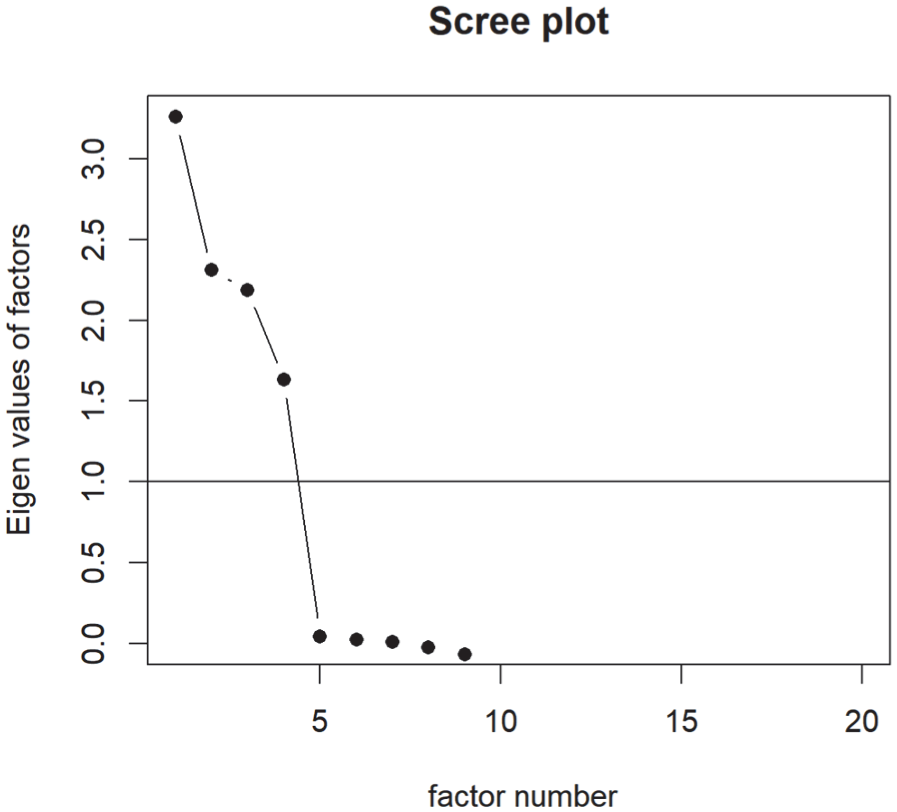
Scree plot.
Confirmatory Factor Analysis of the Four-Factor Structure (n = 374).
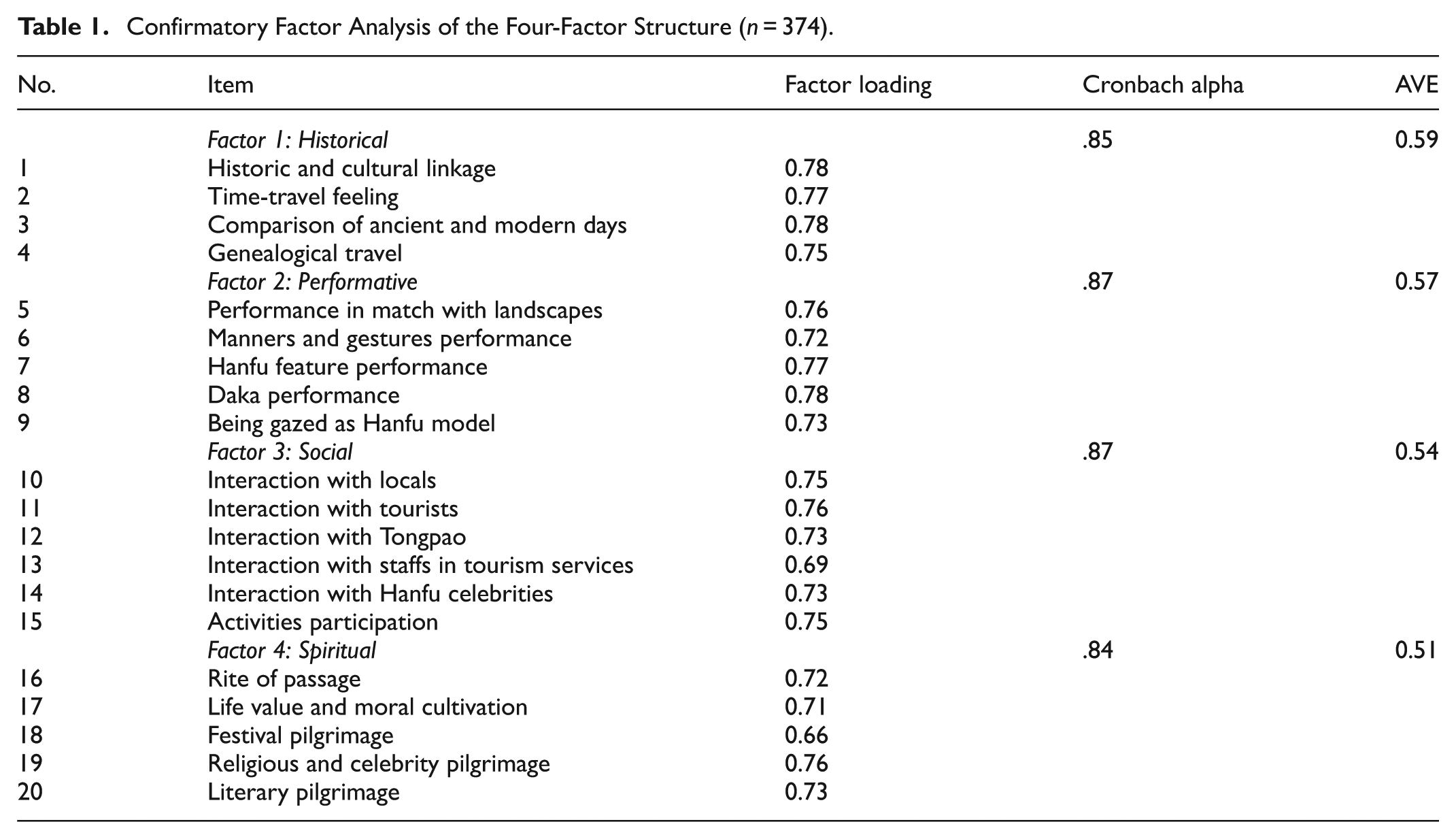
We proceeded to validate the four-factor model through a confirmatory factor analysis (CFA). The results, including factor loadings, reliability, and convergent validity, are presented in Table 1. All factor loadings were 0.50 or higher, Cronbach’s alphas met the minimum threshold of 0.70, and average variance extracted (AVE) was greater than .50 (Fornell & Larcker, 1981; Hatcher, 1994). The model fit indices were comparative fit index (CFI) = 1.00, Tucker-Lewis index (TLI) = 1.00, root mean square error of approximation (RMSEA) = 0.00, and standardized root mean residual (SRMR) = 0.02, all satisfying the cutoff values recommended by Brown (2015), indicating a strong model fit. As such, these 20 items (see Table 1) were used as the measurement of Hanfu tourists’ culture-related motivations in the following main analysis.
Main Study
Participants and Procedure
The participants in the main study were tourists wearing Hanfu, recruited on-site at Great Tang All Day Mall, a nationally and internationally renowned cultural area in Xi’an, China. The mall, themed around the Tang Dynasty, is designed to replicate the architecture and style of this influential historical period, offering a unique hybrid of history, culture, and modern entertainment. The survey was conducted over a 2-week period in early August 2024, with data collection occurring from afternoons to early evenings on both weekdays and weekends. Using a purposive convenience sampling method with a direct on-site approach, participants were screened through an initial question to confirm their status as tourists. Recruitment continued until the target sample size of 900 valid responses was reached. All participants were given a general overview of the study’s purpose and relevance to mitigate potential biases, after which they provided informed consent to participate. Among the received responses, 23 were manually eliminated due to apparent errors, such as reporting an age of 2 or selecting 1 for all scale items. Therefore, 877 valid responses were used for statistical analysis. In this sample, the participants were predominantly female, making up 74.69%. Their average age was 24.66 (SD = 5.20). Regarding education, 21.44% had not completed high school, 27.71% held a high school diploma, and 50.86% had a bachelor’s degree or higher. In terms of household income, 9.58% earned less than 5,999 RMB, 34.44% had an income between 6,000 and 11,999 RMB, 45.50% earned between 12,000 and 17,999 RMB, and 10.49% had an income above 18,000 RMB.
Measures
Authenticity and Memorability
Following C. Wang et al. (2020), we utilized three items adapted from Oh et al. (2007) and six items from Zatori et al. (2018) to evaluate Hanfu tourists’ perceptions of the memorability and authenticity of their experience, respectively. Sample items were “I had wonderful memories about this Hanfu tourism experience” (memorability) and “My Hanfu tourism experience seemed to be authentic” (authenticity). Items were measured with a 7-point Likert scale, ranging from 1 (strongly disagree) to 7 (strongly agree).
Place Attachment
Three items drawn from Suntikul and Jachna (2016) were used to measure Hanfu tourists’ place attachment to the destination city Xi’an as well as the site Great Tang All Day Mall. On a 5-point Likert scale (1 = strongly disagree, 5 = strongly agree), the participants rated “The atmosphere here gives a feeling of the unique character of Xi’an,”“Great Tang All Day Mall is a comfortable and pleasant place to be,” and “This site is promoted as a must-see place for visitors to Xi’an.”
Revisit Intention
Hanfu tourists’ revisit intention was measured using three items slightly modified from Zhang et al. (2018), including “I tend to visit Great Tang All Day Mall again,”“I’d love to come to Great Tang All Day Mall again,” and “I think I will come back to Great Tang All Day Mall in future.” These constructs reflected their revisit propensity, willingness, and probability. The participants assigned scores on a 5-point Likert scale (1 = strongly disagree, 5 = strongly agree).
Cultural Value of Experiencescape
The perceived cultural component of Hanfu tourists’ experience related to the destination’s physical and social environments was measured using five items from a scale developed and validated by Zong et al. (2025). Sample experiencescape items were “Great Tang All Day Mall has an overall cultural atmosphere that attracts Hanfu tourists” and “Great Tang All Day Mall provides the performing space for Hanfu-related arts, crafts, and etiquette.” These items were rated on a five-point scale (1 = strongly disagree, 5 = strongly agree).
Statistical Analysis
The statistical analysis for the main study was implemented using the R software and its lavaan package, which specializes in structural equation modeling (SEM). First, we computed the descriptive statistics and correlations of the constructs in question. Second, CFA was conducted to evaluate the reliability and validity of the scale items. The cutoffs for acceptance in this step were factor loadings above 0.50, AVE above 0.50, and composite reliability (CR) above 0.70 (Kline, 2016). Third, SEM was performed on the full moderated mediation model. Lastly, we visualized the moderation effect concerning the cultural value of experiencescape on the relationships between Hanfu tourists’ culture-related motivations and their perceptions of memorability and authenticity. The criteria for an acceptable model fit were CFI and TLI values of 0.90 or higher, SRMR of 0.08 or lower, and RMSEA of 0.06 or lower (Hu & Bentler, 1999).
Results
We display the correlation matrix of the constructs of interest in Table 2. While most of the constructs were positively and significantly correlated, two notable exceptions emerged. First, the cultural value of experiencescape did not correlate with Hanfu tourists’ culture-related motivations at a statistically significance level, suggesting these two sets of constructs operate independently, with the latter epitomizing internal pursuits and the former external offerings. Second, place attachment had no significant correlation with the historical and social motivations. Table 3 presents the results of CFA, with factor loadings, AVE, and CR all meeting the recommended thresholds. The overall measurement model demonstrated a good fit, as the fit indices fell within acceptable ranges: CFI = 1.000, TLI = 1.000, RMSEA = 0.004, and SRMR = 0.022.
Correlation Matrix of the Analyzed Constructs.

p < .05. **p < .01. ***p < .001.
Descriptive Statistics and Confirmatory Analysis of the Constructs of Interest.

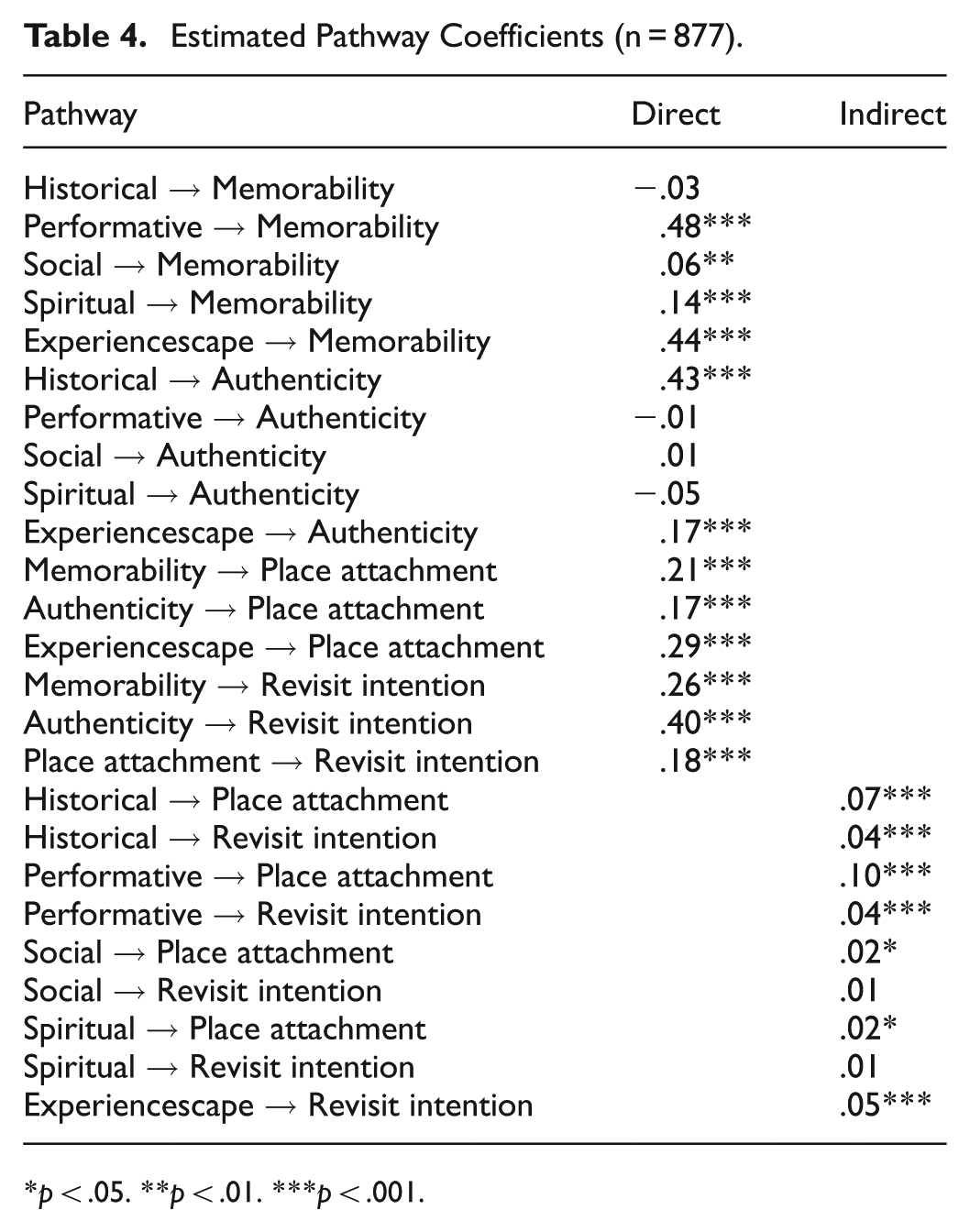
The estimated path coefficients, including both direct and indirect effects, are reported in Table 4. Specifically, whereas Hanfu tourists’ performative (β = .48, p < .001), social (β = .06, p < .01), and spiritual pursuits (β = .14, p < .001) were significantly associated with the perceived memorability of their travel experience, their historical motivation (β = −.03, p > .05) was not. Therefore, H1b, H1c, and H1d received confirmation. In stark contrast, only the quest for historical elements (β = .43, p < .001) had a significant correlation with the perceived authenticity of Hanfu tourism, lending support to H2a. No significant effects were observed for the other three motivations on authenticity. The cultural value of experiencescape, on the other hand, was positively associated with both the perceptions of memorability (β = .44, p < .001) and authenticity (β = .17, p < .001). H6a, H6b, and H7 were validated, as memorability (β = .21, p < .001), authenticity (β = .17, p < .001), and the cultural value of experiencescape (β = .29, p < .001) were found to be significant predictors for levels of place attachment. With regard to the mediators, memorability (β = .26, p < .001), authenticity (β = .40, p < .001), and place attachment (β = .18, p < .001) directly predicted revisit intention. Hence, we obtained supporting evidence for H3a, H3b, and H8. Concerning the moderation effects, it was observed that the cultural value of experiencescape significantly enhanced the influence of the performative motivation on memorability (β = .13, p < .001) and that of the historical motivation on authenticity (β = .14, p < .001), thereby confirming H4b and H5a. Figures 5 and 6 visualize the above-mentioned moderation effects, respectively. The fit indices of the moderated mediation model were: CFI = 0.972, TLI = 0.934, RMSEA = 0.051, and SRMR = 0.019.
Estimated Pathway Coefficients (n = 877).
p < .05. **p < .01. ***p < .001.
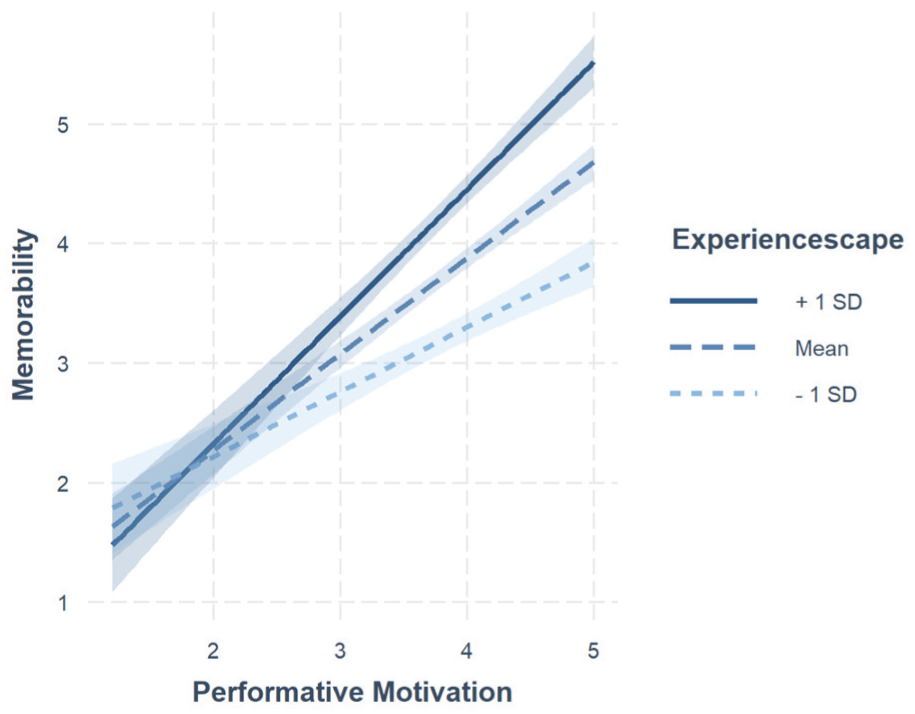
Moderation effect of experiencescape on Hanfu tourists’ performative motivation.

Moderation effect of experiencescape on Hanfu tourists’ historical motivation.
Discussion
This study examined how Hanfu tourists’ culture-related motivations influence their perceived memorability and authenticity of the travel experience, and how these two perceptual factors in turn contribute to their affective attachment to the place as well as their behavioral intention to revisit. Moreover, we integrated the cultural value of experiencescape to investigate its interplay with Hanfu tourists’ motivations alongside its impacts on memorability, authenticity, and place attachment. With regard to the hypotheses under consideration, it was found that Hanfu tourists’ performative, social, and spiritual motivations positively predicted perceived memorability, whereas their historical motivation positively predicted perceived authenticity. Both the perceived memorability and authenticity of the Hanfu tourist experience were positively related to their revisit intention. Likewise, these two perceptual factors displayed significantly positive correlations with place attachment. Subsequently, place attachment was a predictor of revisit intention. Besides its direct positive effects on the perceptions of memorability and authenticity, as well as on place attachment, the cultural value of experiencescape had significant interactions with Hanfu tourists’ culture-related motivations, particularly with their performative motivation on memorability and their historical motivation on authenticity.
For hypotheses that did not receive empirical support, we also provided possible explanations. First, the hypothesized positive effect of tourists’ historical motivation on memorability was not statistically significant. This might be because they already find Hanfu experiences highly memorable regardless of specific motivations, or historically motivated tourists tend to prioritize cognitive or educational outcomes over emotional engagement, which is more directly linked to memorability. Second, Hanfu tourists’ performative, social, and spiritual motivations were not significantly associated with their perceptions of authenticity, contrary to expectations. One plausible explanation is that while performative, social, and spiritual motivations precede active engagement, they would not guarantee a sense of authenticity if the experience is perceived as staged, commodified, or detached from its historical roots. In such cases, tourists are likely to enjoy the activity but still question its cultural or historical legitimacy, resulting in weaker associations with perceived authenticity. This finding stresses the complexity of authenticity perception, which may rely more on perceived historical fidelity or contextual depth than on the nature of the tourists’ motivations alone. With regard to the unverified hypotheses surrounding moderation, including H4a, H4c, H4d, H5b, H5c, and H5d, these remain relatively more tentative or exploratory in nature, indicating that their effects are potential rather than solidly established.
Theoretical Implications
Our study makes several theoretical contributions to the tourism literature. First, unlike conventional heritage tourism typified by passive observation, Hanfu tourism exemplifies a participatory, bottom-up form of cultural engagement, wherein tourists actively seek, reinterpret, and perform their traditional culture (Zong, 2023). This corroborates existing models of heritage consumption by indicating how intangible heritage is not only preserved but also navigated, negotiated, and embodied through lived experiences (Park, 2010). Moreover, Hanfu tourism expands our understanding of identity construction in tourism by showing that visitors pursue self-expression and collective belonging through symbolic participation, in the form of historical dress, public reenactment, and social media visibility (Shi, 2021). It also contributes to emerging discussions on cultural revival and grassroots movements, elucidating how tourism can serve as a platform for reimagining cultural identity and promoting mundane heritage practices (Duxbury et al., 2025; Fayard, 2024). By situating cultural experiences within a Chinese sociocultural context, Hanfu tourism research broadens and enriches tourism literature through greater cultural contextualization.
Second, we delved into the culture-related components of Hanfu by categorizing and clarifying them as historical, performative, social, and spiritual, which arguably cover the majority of Hanfu tourists’ motivations and engagement. This complements previous research on Hanfu and its functions in tourism experiences. Despite the growing body of research on the topic frequently underscoring the cultural significance of Hanfu (Liu et al., 2024; Zhong, Qi et al., 2024; Zong, 2023), it has yet to provide an operational approach for incorporating the cultural dimension of Hanfu into empirical studies. Furthermore, our classification of the culture-related motivations of Hanfu tourists responds to the emergent discussion about the role of costume in enriching tourism experiences (K.-Y. Lee & Lee, 2019). Notably, with greater emphasis being placed on the experiential facet of travel, it is highly warranted to probe more nuanced aspects of how costumes positively affect visitors’ perceptions and feelings. Simply recognizing the importance of clothing is not sufficient; we must advance our understanding of the specific characteristics and functions that drive tourists to adopt and showcase it.
Third, this study disentangled the cultural synergy between Hanfu wearing and the physical and social environment through the lens of value co-creation. In the field of tourism, co-creation refers to the various opportunities through which consumers can proactively participate in the design and production of services and products. It provides a valuable perspective for explicating and rationalizing the strong appeal of highly personalized travel experiences in attracting tourists (Sfandla & Björk, 2013). In addition to echoing the experience economy (Pine & Gilmore, 1998), the value co-creation perspective aligns with and captures the more recent idea of experiencescape, which entails the physical and social surroundings that enable the co-production of experiences within a specific context (Blumenthal & Jensen, 2019). Significant interactions were detected between Hanfu tourists’ culture-related motivations, particularly historical and performative, and the cultural value of experiencescape. According to Zhang et al. (2023), such interaction effects can be aptly explained by the third space theory (Soja, 1989), which blends perceived reality with imagined virtuality in a shared space. The third space offers a more inclusive viewpoint to analyze an ever-evolving realm where awareness and practice coexist and continuously interact. When properly combined, these insights relevant to the physical and social environment help to address how the cultural attractiveness of Hanfu can strengthen tourists’ sense of place attachment, ultimately ameliorating their perception of the destination’s image and increasing their likelihood of revisit.
Fourth, our research model integrated the motivational, perceptual, psychological, and behavioral aspects of Hanfu tourists, enabling a relatively holistic examination of Hanfu’s cultural significance within the context of tourism. Our findings confirmed positive associations between the historical, performative, social, and spiritual motivations of Hanfu tourists and their perceived memorability and authenticity, though to varying degrees. Visitors’ perceptions of memorability and authenticity are supposedly indispensable to meaningful and enduring tourism experiences, significantly influencing satisfaction, loyalty, as well as desirable behaviors such as word-of-mouth referrals and repeat visits (Genc & Gulertekin Genc, 2023; Yi et al., 2017; Zhou et al., 2022). Place attachment revolves around the emotional, psychological, and relational bonds between individuals, not necessarily visitors, and spatial settings. This relation is determined, to a considerable degree, by personal experiences and perceptions (Loureiro, 2014; Vada et al., 2019). Therefore, to connect the cultural significance of Hanfu with tourists’ behavioral intentions to revisit, it is reasonable to incorporate place attachment as a sequential mediator following memorability and authenticity in a research model. Finally, the results in our study about the direct and indirect pathways corroborated the above-mentioned cultural, perceptual, and psychological factors in leading to Hanfu tourists’ revisit intention.
Practical Implications
The current study also yielded three major practical implications. First, by examining our conceptual research model, it was confirmed that the culture-related motivations of Hanfu tourists are indispensable in forming positive perceptual and psychological impressions of a cultural destination, and ultimately giving rise to revisit intentions. Since it is neither financially feasible nor convenient for tourists to bring multiple Hanfu outfits during a single journey, destination managers should strive to facilitate small businesses in Hanfu rental services to increase accessibility and variety. Offering rental options would make it easier for tourists to access Hanfu clothing without the burden of carrying a large collection of outfits by themselves. Moreover, these rental services could feature a diverse range of Hanfu styles and designs, providing visitors with a broader selection to choose from. Beyond clothing itself, many other items, such as replica weapons and baskets reminiscent of ancient times, are also conducive to enhancing the Hanfu tourism experiences. Such complementary items should also be taken into account.
Second, our study found that the cultural offerings of experiencescape in a destination can fulfill the historical and performative motivations of Hanfu tourists, alongside its direct influence on memorability and authenticity. The historical sense depends primarily on tourists’ ability to engage with both the tangible and intangible elements of history, including architecture, artifacts, traditions, and narratives. When tourists visit heritage sites, they are not only observing and admiring relics but also are immersing themselves in the stories, values, and cultural contexts of bygone eras. Accordingly, managers should focus on maintaining historical and cultural accuracy in the design, presentation, and layout of exhibits whilst integrating authentic details such as period-appropriate décor to make possible a more immersive and engaging experience for visitors. The performative motivation pertains to active participation and re-enactment of historical and cultural practices, with tourists being actors in the cultural narratives. The performative engagement allows them to embody historical experiences in a personal and distinctive manner, deepening their emotional and intellectual connections to the cultural destination and rendering the experience more memorable and impactful. Considering this, on top of organizing live performances, the destination should spare spaces where Hanfu tourists can individually perform in accordance with their own interests and preferences.
Third, place attachment was observed to be a reliable mediator for linking Hanfu tourists’ culture-related motivations and their revisit intentions. When individuals feel strongly attached and committed to a destination, they are likely to develop favorable associations with it, establish a sense of belonging or nostalgia, and even form loyalty and cultural identity. Consequently, this emotional connection enhances the desire to return, transforming the destination from simply a travel location into a meaningful personal or cultural space. Therefore, destinations are suggested to create designated areas for reflection, where visitors can readily recapture and commemorate their experiences, contributing tremendously to enduring associations with the destination. Lastly, sharing anecdotal stories from locals surrounding the site’s history, culture, and relevance might be instrumental to deepening tourists’ emotional investment and cultivating their sense of place attachment.
Limitations and Future Research
The current study has some limitations that should be addressed before generalizing the findings. First, despite that the entire study focused on the cultural dimension of Hanfu and the destination environment, it did not differentiate tourists based on their cultural backgrounds. All participants were native Chinese citizens. Future research could explore how non-Chinese tourists are attracted to heritage sites in China due to the cultural value of Hanfu, as well as why a small number of Chinese tourists wear Hanfu when engaging in international travel. Second, to explore the relation between Hanfu tourists’ culture-related motivations and their behavioral intention to revisit the destination, we leveraged place attachment as a mediator. However, it is worth noting that this particular concept might be more applicable to experiences formed over an extended period, in lieu of a one-time journey. Thus, future research could capitalize on prominent constructs such as destination image or destination brand to analyze the perceptual and behavioral impacts of Hanfu. Third, the data used in our study were collected from a single tourism destination. Future research might as well examine the model’s applicability in other locations featuring different types of Hanfu experiences. Lastly, the linkage of Hanfu’s cultural value with heritage destinations within the co-creation experience remains open for further exploration. Although we have identified several key cultural factors that contribute to value co-creation, other interesting constructs, such as experience co-design and knowledge sharing, may have been ignored. Future studies should consider integrating additional relevant factors when investigating the co-creation process in relation to Hanfu.
Footnotes

Ethical Considerations
The study was reviewed and approved by the Institutional Review Board (IRB) of the Communication University of Zhejiang.
Consent to Participate
Written informed consent was obtained from all participants involved in the study, with clear communication of the study’s purpose, procedures, potential risks, and voluntary participation.
Funding
The authors disclosed receipt of the following financial support for the research, authorship, and/or publication of this article: This research was funded by the National Social Science Fund of China (Grant No. 22BZZ026).
Declaration of Conflicting Interests
The authors declared no potential conflicts of interest with respect to the research, authorship, and/or publication of this article.
Data Availability Statement
The data supporting this study are available upon reasonable request.