




Abstract
Colorado became the first state in the United States that passed the legalization of recreational (retail) marijuana with Amendment 64 in 2012. With this unprecedented tourism environment, it is imperative to understand different perspectives of stakeholders involved. In particular, residents’ view is important in that their attitude and behaviors plan and manage the design of marketing activities and sustainable development of the tourist place. Therefore, the purpose of the study is to examine the local residents’ image, attachment, and support of marijuana tourism as a result of the legalization of recreational marijuana in Colorado. Results of the study concluded that the highly attached residents held a positive image of their place, which in turn influence their support of marijuana tourism. Implications for industry professionals and state policy makers are presented.
Introduction
To be successful, a tourist place needs the residents’ support (Nunkoo, Ramkissoon, & Gursoy, 2012; Stylidis, Sit, & Biran, 2014; Stylidis & Terzidou, 2014). Considering that the development of a tourist place exerts a significant influence on people’s daily lives and working environments, an investigation of residents’ image has played a role of a guideline to explore their level of support and/or identify any negative views toward any tourism development (Schroeder, 1996; Stylidis, 2016). Many benefits, such as lessening negative emotions and behaviors and promoting a tourist place to serve as a better place to live, have been used to mitigate the local residents’ negative images (Avraham, 2004) and enticing both new residents and visitors (Ward, 1998).
Colorado became the first state in the United States that passed the legalization of recreational marijuana with Amendment 64 in 2012. As of March 2018, there are eight states and D.C. that have legalized recreational marijuana (Kang & Lee, 2018). Dubbed as a new “green rush,” the U.S. marijuana market is estimated to be US$22 billion in sales by 2020 (Huddleston, 2016). The marijuana legalization has created a different business landscape in Colorado including hospitality and tourism (Kang, O’Leary, & Miller, 2016). One of the primary goals of tourism development is the revitalization of the local economy and improvement of residents’ quality of life by planning and fostering sustainable development (Smith & Ong, 2015).
It is indisputable that the legalization has generated substantial business opportunities, employment, and tax revenues (Kang et al., 2016). At the same time, the recreational marijuana legalization in Colorado has brought some concerns among Colorado residents: a possible deteriorating image of the state and where they live and negative social impacts, such as congestion, crime, and a loss of preservation of and pride in the local culture. Thus, promoting the state as a mecca of recreational marijuana has not been widely accepted by some residents. Therefore, it is imperative to understand how the residents of a tourism destination perceive their places in the wake of this unprecedented tourism development (Rasoolimanesh & Jaafar, 2016). Especially, understanding residents’ support for sustainable development for a once-controversial industry is crucial for state policy makers and regulators to plan and coordinate the future development efforts (Kang & Lee, 2018). This study is an attempt to respond to this inquiry by examining Colorado residents’ perceptions toward recreational marijuana tourism in conjunction with their image perception and place attachment.
Literature Review
Resident Perspective: Place Attachment
People and places can be connected through strong relationships (i.e., Williams & Vaske, 2003) because places are associated with people’s psychological norms: attitudes, values, and beliefs (Sack, 1992). Place attachment or a sense of belonging postulates that people are linked with places emotionally and symbolically (Tuan, 1980).
Compared to visitors, local residents interpret a tourist place differently because it encompasses more than a transient holiday destination (Stylidis et al., 2014). From a residents’ perspective, a tourist place is the “commercial center” where they make their living, the “nest” where they raise their family, and the “social hub” where they interact and create a bonding with other community members (Hudson, 1988). Consequently, due to its complexity and multidimensionality, understanding the local residents’ image of a tourist place has become more challenging (Andereck & Nyaupane, 2011). Therefore, the examination of residents’ perception of a tourist place is often accompanied by the concept of place attachment.
Like image construct, place attachment has been popularly studied with tourists to understand their perceptions and behaviors (i.e., Gross & Brown, 2006; Kyle, Graefe, Manning, & Bacon, 2004; Prayag & Ryan, 2012; Ramkissoon, Smith, & Weiler, 2013), encompassing tourists’ revisit intention of a destination, their emotional attachment with a destination, and a relevant role in the visitor’s decision-making process (Gitelson & Crompton, 1984; Lee & Shen, 2013; Prayag & Ryan, 2012). Rehmet and Dinnie (2013) reported that residents with stronger place attachment (or community attachment) tend to involve with community efforts more actively and to demonstrate positive behaviors, “by capitalizing on an individual’s willingness to protect important and meaningful places” (Ramkissoon et al., 2013, p. 553). The determination of residents’ support for place development is strongly related to residents’ degree of attachment to a place (Chen & Dwyer, 2010). Therefore, community attachment is considered as a key factor in assessing residents’ willingness to promote their place. To understand residents’ community attachment in tourism development projects, McCool and Martin (1994) investigated the relationship between Montana residents’ community attachment and tourism development. The findings of the study reported that the highly attached respondents showed stronger views on both positive and negative impacts, concluding that those more attached were more informed and, therefore, more concerned.
Furthermore, place attachment has been empirically tested as an antecedent (e.g., Hwang, Lee, & Chen, 2005; Yuksel, Yuksel, & Bilim, 2010), an outcome (e.g., Gross & Brown, 2006; Kyle et al., 2004), a mediator between tourists’ attitudes and their behavioral intention (e.g., Prayag & Ryan, 2012; Tsai, 2012), and a moderator (e.g., Chung, Kyle, Petrick, & Absher, 2011; Kyle et al., 2004). Results of these studies, however, show mixed results of place attachment as a key factor in explaining a stakeholder’s attitudes and behaviors. First, mainly, community attachment in the context of tourism development is known to have both a direct and mediated positive effect on residents’ tourism support (Nicholas, Thapa, & Ko, 2009; Rasoolimanesh, Jaafar, Kock, & Ahmad, 2017), whereas some studies reported only partial influences or no influences at all (Gursoy, Jurowski, & Uysal, 2002; McCool & Martin, 1994). For instance, McCool and Martin’s (1994) study revealed no association between community attachment and residents’ perceptions of tourism impacts. In addition, Gursoy et al. (2002) reported that no causal relationship was found between community attachment and perceived costs and benefits of tourism-related activities. They concluded that other variables might be mediating between the community attachment and perceptions related to tourism activities. In a recent study on a world heritage site in Malaysia, Rasoolimanesh, Jaafar, Kock, and Ramayah (2015) and Rasoolimanesh et al. (2017) reported an insignificant effect on the favorable perceptions of residents regarding place attachment. Based on the preceding discussion, the following hypotheses are drawn:
Resident Perspective: Place Image
The stakeholder theory encapsulates that sustainable tourism development should recognize the important role of various stakeholders in the decision-making process (Murphy, 1985; Stylidis et al., 2014). The stakeholder theory also emphasizes the necessity to consider all stakeholders’ perspectives, which are an important part of tourism planning and development. Despite the substantial evidence about the residents’ roles and contribution to tourism development, the attention has been primarily given to tourists’ (visitors’) perceptions in most place-image studies (e.g., Sun, Ryan, & Pan, 2015), making other stakeholders underrepresented in the extant place-image literature (Stylidis et al., 2014).
The success of tourism destinations and a strong community involvement are intertwined (Getz, 1987), as the participation of residents can both “increase the effectiveness and efficiency of tourism plans, the development of social capital in the host community, and improve the guest–host relationships” (Vollero, Conte, Bottoni, & Siano, 2018). Furthermore, residents’ image of their own place as a tourism destination help understand their attitudinal and behavioral intentions, including their support for tourism development (e.g., Schroeder, 1996; Stylidis, Biran, Sit, & Szivas, 2014) or their willingness to spread positive word-of-mouth about their residing place (e.g., Bigne, Sanchez, & Sanz, 2005).
In tourism studies, destination image has been one of the most popular researched topics (e.g., Kock, Josiassen, & Assaf, 2016; Stepchenkova & Li, 2013; Stylidis, 2016; Sun et al., 2015). In particular, the causal relationship between residents’ image and their behavioral intentions are reported to exert significant influences on visitors’ perceived image, decision making, and onsite behaviors (e.g., Bigne et al., 2005; Schroeder, 1996; Stylidis, Shani, & Belhassen, 2017; Walls, Shani, & Rompf, 2008). Several tourism studies have concluded that if residents have more positive images, they are likely to spread more favorable word-of-mouth (Bigne et al., 2005; Hsu, Wolfe, & Kang, 2004; Schroeder, 1996), demonstrating their support for tourism. For instance, Schroeder (1996) reported that North Dakota residents with favorable images demonstrated a more favorable tendency toward state funding for tourism development and support for the state tourism and were more likely to recommend the destination to others. In a similar vein, Bigne et al. (2005) also confirmed the positive association between residents’ place-image and future behavioral intentions (e.g., intention to recommend the place to others).
In the context of destination marketing, residents have been called “ambassador” (Braun, Kavaratzis, & Zenker, 2013; Hudson & Hawkins, 2006; Rehmet & Dinnie, 2013; Schroeder, 1996), “evangelists” (Kavaratzis, 2012; Simpson & Siguaw, 2008), “informants” (Gitelson & Kerstetter, 1994; Shani & Uriely, 2012), or “salespersons” (Schroeder, 1996). All terms denote the importance of residents’ engagement in place promotion by affecting tourists’ destination image, travel decision-making, and visit experience (e.g., Gallarza, Saura, & Garcia, 2002; Walls et al., 2008). Campelo, Aitken, Thyne, and Gnoth (2014) also enunciated the significance of integrating residents’ images into destination marketing strategy because this stakeholder group can improve tourists’ experiences by utilizing the “local knowledge.” Furthermore, this “local knowledge” contributes to the development and marketing activities of the tourist place and to the enhancement of residents’ quality of life (Andereck & Nyaupane, 2011; Campelo et al., 2014; Elliot, Papadopoulos, & Kim, 2011).
In summary, employing local residents as the unit of analysis among place-image studies are limited (Stylidis et al., 2014). Thereby, investigating residents’ place image is vital for developing tourism plans that will preserve, maintain, and revitalize a place (Kock et al., 2016; Stylidis, 2016). Based on the preceding discussion, the following hypotheses are proposed:
Study Justification and Purpose
The inconclusive reports on the relationship between place attachment and other constructs insinuate that place attachment may play a different role depending on its location and development phase, warranting the examination of residents’ support in the context of their situational environment (Lee, Kang, & Reisinger, 2010). Furthermore, the current literature concerning the place image of a tourist destination perceived by other stakeholders, especially local residents, deems scant and thus requires more urgent attention (Stylidis et al., 2014). This gap is more pronounced at the destinations where new unprecedented tourism development is being in progress. Therefore, the purpose of the study is to examine the local residents’ image and support of marijuana tourism as a result of the legalization of recreational marijuana in Colorado. Figure 1 presents the proposed research model.
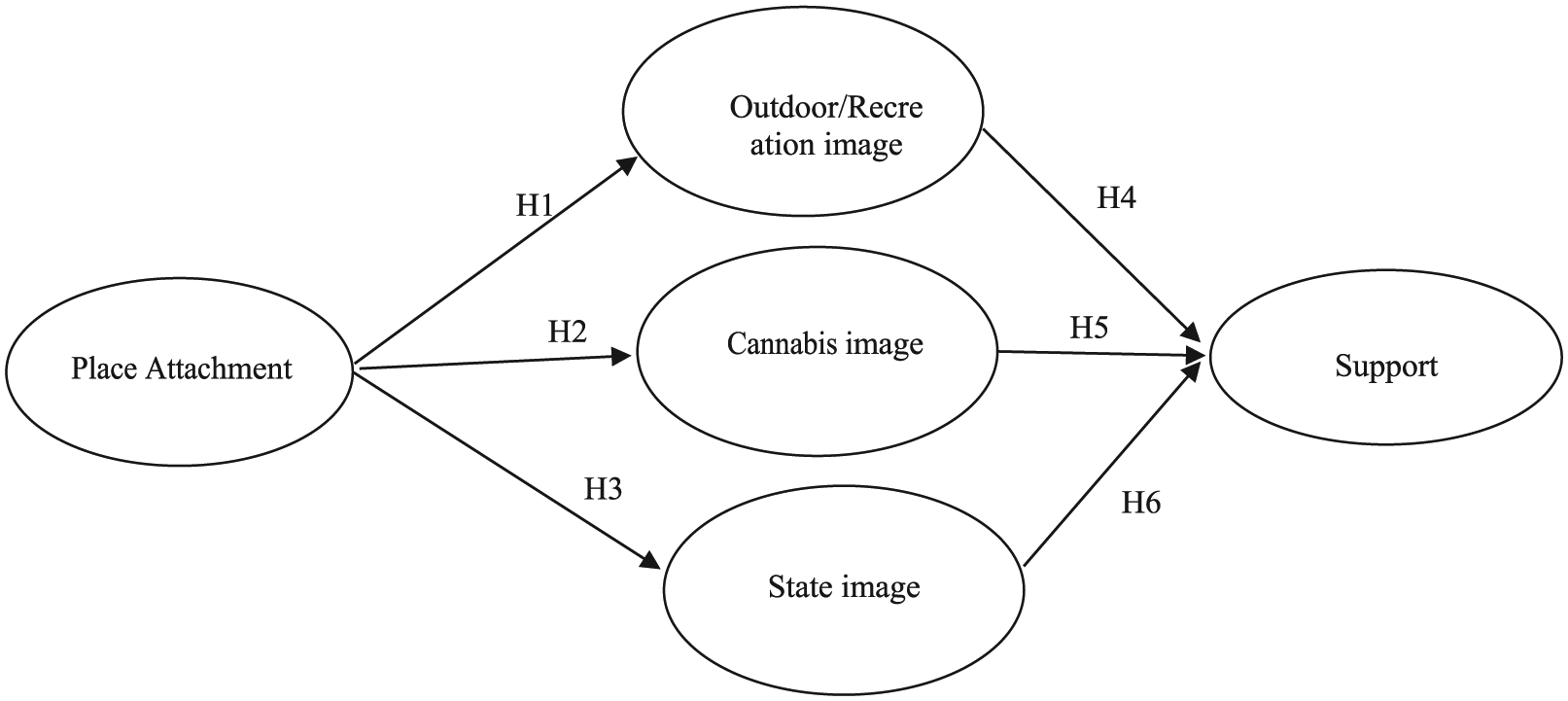
Proposed research model.
Method
Research Instrument
All questions were adapted and modified from tourism and gambling studies to reflect its meaning in the context of marijuana tourism. To attenuate the measurement error, multi-item scales were utilized. Specifically, place attachment was assessed with eight items (e.g., Echtner & Ritchie, 1991; Gross & Brown, 2006; Kyle et al., 2004; Tsai, 2012). A single item was deleted due to its unsatisfactory loading value. Place attachment was treated as a unified latent variable (e.g., Hwang et al., 2005; Ramkissoon, Weiler, & Smith, 2012).
Perceived image of the state of Colorado was assessed with 15 items but two items were deleted (e.g., Baloglu, 2001; Baloglu & Brinberg, 1997; Baloglu & McCleary, 1999; Chen, 2001; Kock et al., 2016; Walmsley & Jenkins, 1992). Support of marijuana tourism was evaluated with five items (e.g., Lee & Back, 2003; Lee et al., 2010; Long, 1996). A 5-point Likert-type scale was used to evaluate all questions (1 = strongly disagree and 5 = strongly agree).
The face validity of the instrument was verified by two industry professionals working in the marijuana industry (e.g., a retail shop owner and a municipal policymaker). They provided feedback on the clarity and appropriateness of each item in evaluating residents’ perceptions about marijuana tourism. Then, 32 Colorado residents participated in a pilot study to finalize the instrument.
Data Collection and Respondent Profile
College students from the Hospitality and Tourism Management Program in a land-grant university in Colorado were recruited to collect the data for the study. Four responses out of 250 were removed from the data due to their zero month of residency in Colorado. The data were collected from October 2015 to December 2015, when the state marked the second year of the recreational marijuana legalization. Out of 246 respondents, nearly two-thirds of the respondent were female (73.2%) and were Colorado residents (80.9%). The average age of the respondents was 20.9 years.
Data Analysis
A preliminary result of normality tests showed that the data of the study do not satisfy the normality assumption required in a traditional structural equation modeling. A normality test using the skewness and kurtosis statistics indicated that some values of the skewness and kurtosis fell between −2 and +2, ranging from −2.605 to 7.999, demonstrating that the data were considered violating the normality assumption (George & Mallery, 2010; Hair, Hult, Ringle, & Sarstedt, 2017). Partial least squares structural equation modeling (PLS-SEM) using SmartPLS 3.2.6 version, therefore, was chosen to analyze the data for this study because PLS-SEM does not require to meet the normality assumption.
This study followed a two-stage procedure recommended by Hair et al. (2017). The first step requires examining the measurement model or outer model first to check the validity and reliability of the measure. In delineating the relationships between indicators and latent constructs, this model also employed a reflective–reflective type, where the measurement of the indicator variables is caused by the construct (Hair et al., 2017). As the second stage of the procedure, the evaluation of the structural model was used to test the proposed model. To check the statistical significance of the path coefficients and loadings in the model, a bootstrapping method with 5,000 resamples was used (Blunch, 2008; Henseler, Hubona, & Ray, 2016). A series of evaluation indices such as R2, Q2, f2, and q2 were examined.
Results
The following section shows a two-step procedure of the PLS-SEM in presenting the findings of the study: (a) a measurement model analysis to verify scale validity and reliability and (b) a structural model analysis to examine the proposed hypotheses (Barclay, Higgins, & Thompson, 1995; Hair et al., 2017; Henseler et al., 2016).
Measurement Model Evaluation
The following three assessments were conducted for the measurement model evaluation: (a) convergent validity, (b) internal reliability, and (c) discriminant validity (Hair et al., 2017). First, to check convergent validity, indicator loadings (>.70 as a threshold), indicator reliability (>.50 as a threshold), and average variance extracted (AVE; >.50 as a threshold) were reviewed (Hair et al., 2017). As presented in Table 1, all indicator loadings and indicator reliability exceed the recommended levels after deleting some items under the thresholds (see Table 1 for deleted items). In addition, all AVE values, which reflect the total variance in the indicators explained by the construct, are larger than the threshold of .50 (Hair et al., 2017). Therefore, the convergent validity of the composite scales was supported in the proposed model.
Convergent Validity With Reflective Measurement Model.

Note. Deleted items:
Place attachment: (a) I am actively involved in issues and activities in Colorado; (b) Colorado is an ideal place to live.
Cannabis image: (a) Decrease in recreational tourism because of legalized marijuana.
Reverse coded (strongly disagree with negative image means strong support).
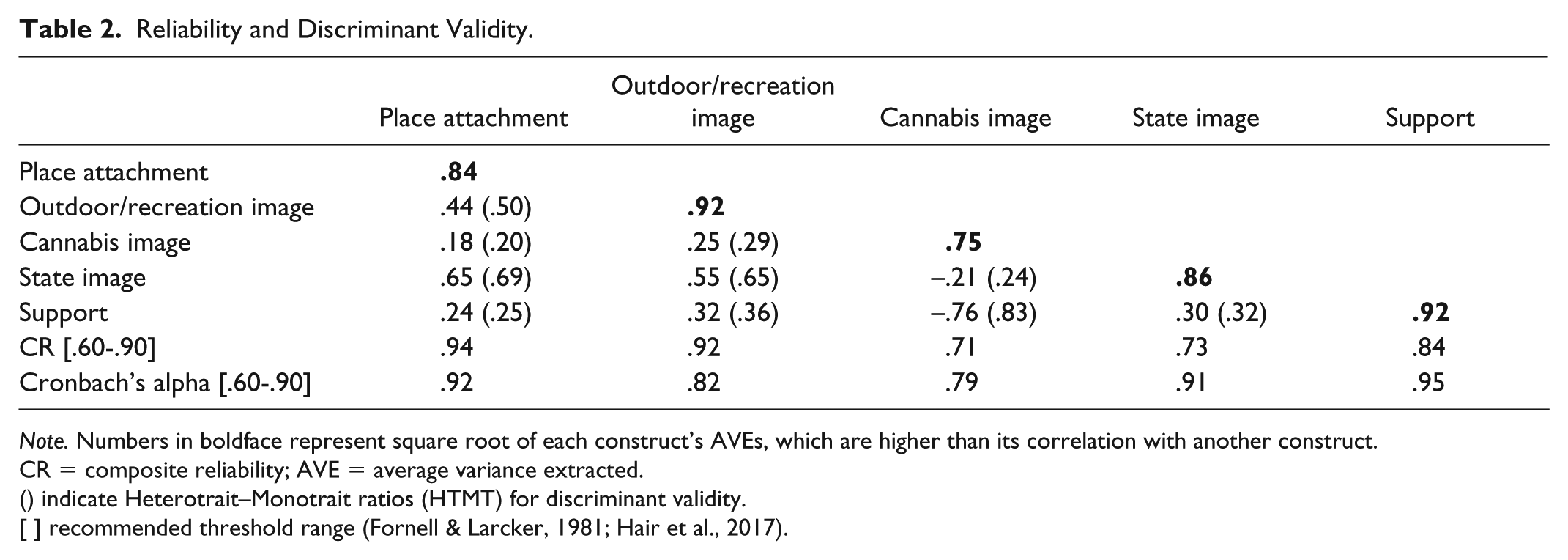
Second, reliability values for the constructs were examined by using two criteria: composite reliability (CR) and Cronbach’s alpha. All CR values and Cronbach’s alphas exceed the threshold of .70 as shown in Table 2, thereby confirming the reliability of the measurement model (Fornell & Larcker, 1981).
Reliability and Discriminant Validity.
Note. Numbers in boldface represent square root of each construct’s AVEs, which are higher than its correlation with another construct. CR = composite reliability; AVE = average variance extracted.
() indicate Heterotrait–Monotrait ratios (HTMT) for discriminant validity.
[ ] recommended threshold range (Fornell & Larcker, 1981; Hair et al., 2017).
Finally, the measurement model was evaluated for the discriminant validity in two ways. The first method is a conventional way of comparing AVE values and correlations. Table 2 presents that the square roots of the AVE between constructs (as noted with diagonal values) are larger than the correlations across construct, thus confirming the constructs’ discriminant validity (Fornell & Larcker, 1981).
The examination of heterotrait–monotrait (HTMT) ratios for correlations were employed as another way to verify discriminant validity in PLS-SEM analysis (Hair et al., 2017; Henseler et al., 2016; Henseler, Ringle, & Sarstedt, 2015). As shown in Table 2, all HTMT values are less than .85, thereby proving the discriminant validity of the measurement model. Furthermore, if the HTMT confidence interval (CI) includes 1, discriminant validity is violated (Hair et al., 2017; Henseler et al., 2016). Results also confirm that all HTMT CI values fall below 1, again verifying the discriminant validity.
Structure Model Evaluation
The results of the structural model assessment show the model’s capability to predict target construct, support for marijuana tourism, in this study. Specifically, the structural model was assessed using a six-step evaluation as recommended by Hair et al. (2017): (a) test collinearity, (b) test the significance of path coefficients, (c) examine level of coefficients of determination, or R2, (d) review f2 effect size, (e) check predictive relevance, Q2, and (f) review q2 effect size.
First, the structural model was inspected for collinearity. Each set of predictor construct’s tolerance was reviewed with a variance inflation factor (VIF) values. As a rule of thumb, a VIF of 5 or lower (i.e., the tolerance level of 0.2 or higher) should be obtained to avoid the collinearity problem (Hair et al., 2017). The results of the study in Table 3 show that all VIFs are below 5, ranging from 1.00 to 1.48, proving that there is an absence of collinearity among predictor constructs.
VIF, R2, and Stone–Geisser index (Q2).

Note. VIF = Variance Inflation Extracted.
Second, the significance of beta and path coefficient using t values were examined. As shown in Table 4 and Figure 2, all path coefficients except for the relationship between outdoor/recreation image and support for marijuana tourism are significant. Specifically, place attachment significantly influenced all three image dimensions: First, the two image dimensions, outdoor/recreation image and cannabis image, are significantly influenced by place attachment, respectively (H1: β = .438, t = 6.802, p < .01; H2: β = .183, t = 3.345, p < .01). Second, place attachment exhibits the strongest impact on state image (H3: β = .652, t = 13.842, p < .01). These results indicate whether respondents exhibiting stronger place attachment with Colorado are more likely to rate outdoor/reactional image and state image favorably. Also, respondents whose place attachment is strong tend to disagree with the negative image brought by the marijuana legalization.
Hypotheses Testing.

Note. f2 and q2: 0.35—strong, 0.15—moderate, and 0.02—weak.
p < .05. **p < .01. ***p < .001.

PLS results.
No significant difference was found between outdoor/recreation image and support. However, the other two image dimensions affected support significantly. First, cannabis image demonstrates the strongest impact on support (H5: β = .719, t = 24.763, p < .01). This result insinuates that if respondents agree with the state’s negative image due to marijuana legalization, they are less likely to support marijuana tourism. A positive and significant relationship is observed between state image and support (H6: β = .102, t = 2.105, p < .05). In summary, all five hypotheses except H4 are supported based on the significances of path coefficients evaluation.
Third, the level of coefficients of determination (R2) was examined (see Table 3 and Figure 2). There were two R2 values generated from the analysis. First, place attachment explains 19.1% of the variance in outdoor/recreation image and 42.5% of the variance in state image. The variance in cannabis image, however, is explained little by place attachment (3.4%). Second, all three image dimensions contribute 60.5% of the variance in support, which is considered as substantial (Cohen, 1988).
Fourth, the effective sizes (f2) of an exogenous construct were assessed to examine to what extent the exogenous construct contributes to an endogenous latent variable’s R2 value. The evaluation followed Cohen’s (1988) guidelines: f2 values above 0.35 are considered as large or strong, 0.15 or higher as medium or moderate, and 0.02 or higher as small or weak. As shown in Table 4, f2 values indicate strong (or large) effects between place attachment and state image (0.74) and between cannabis image and support (0.81). Meanwhile, the relationship between place attachment and outdoor/recreation image (0.24) is either strong or weak in the range. Notably, the associations between attachment and cannabis image, between outdoor/recreation image and support, and between state image and support show weak impacts.
Fifth, to measure predictive accuracy, it is recommended to examine the cross-validated redundancy measure or Stone–Geisser’s Q2 value (Chin, Peterson, & Brown, 2008; Geisser, 1975; Stone, 1974). The blinding folding procedure generated Q2 values showing how well the data can be empirically reconstructed using the model and the PLS parameters (Ali, Kim, & Ryu, 2016). If Q2 values are greater than zero, it can be concluded that the exogenous constructs have predictive relevance for the endogenous constructs under consideration. All Q2 values presented in Table 3 are above zero, thereby demonstrating the exogenous constructs’ high predictive powers on the endogenous constructs.
As a final step, to evaluate an exogenous construct’s ability to explain an endogenous latent variable’s Stone–Geisser’s Q2, q2 effect sizes were reviewed (Hattke, Vogel, & Znanewitz, 2017). The threshold values of 0.02 (small), 0.15 (medium), and 0.35 (large) were used to test a relative measure of predictive relevance. Results indicate that the exogenous variables have a small, medium, or large predictive relevance for the endogenous construct (Hair et al., 2017; Henseler et al., 2016). Following this rule of thumb, the effect sizes for the relationships tested in this model range from being significant to being weak as presented in Table 4. In particular, the predictive power of cannabis image on support is strongest with 0.477, followed by place attachment on state image with 0.419.
Discussion and Conclusion
Colorado was the first state that has legalized recreational marijuana in the United States. As the legalization is still in progress nationwide, it is important to evaluate how the legalization has shaped the tourism industry in the state. This study provides an imperative checking into the current status and positioning strategy of the state’s marijuana tourism market by investigating residents’ perspectives in Colorado. Findings of the study confirm casual relationships among place attachment, image, and support constructs surrounding recreational marijuana tourism among residents in Colorado. With little research done on the topic, this study will serve as a seminal work in understanding the early era of the recreational marijuana tourism market in the United States.
The findings of the study conclude that respondents’ place attachment had significant impacts on all three image constructs, supporting the extant literature that residents’ strong place attachment and image are significantly related. The more attached the residents were to Colorado, they were more likely to see outdoor/recreation and state image positively. However, if they were highly attached to Colorado, they were less likely to perceive cannabis image negatively, proving that the highly attached residents tend to view place image more favorably in the context of marijuana tourism. These results are in line with what has been reported in the tourism literature with various settings (e.g., Nicholas et al., 2009; Rasoolimanesh et al., 2017), supporting that the role of place attachment may exert a significant impact on determining residents’ support and image perception within the context of marijuana tourism. Furthermore, this study’s finding that the image construct significantly mediated the relationship between place attachment and tourism support is meaningful for policy makers and tourism professionals in comprehending how marijuana tourism is perceived with their residents.
The significant relationships between two image constructs and residents’ support of marijuana tourism also illustrate that depending on the type of image constructs, residents’ level of support could differ. Specifically, those respondents who did not perceive the negative image of marijuana legalization appeared to support marijuana tourism more favorably. Furthermore, respondents who had a positive state image were more likely to support marijuana tourism. An interesting result from this study is that how people’s attachment is related to a situation-specific image construct (i.e., cannabis image). In summary, the significant relationships among place attachment, state image, and tourism support confirm a well-established research claim that the highly attached residents usually have positive images, which in turn influence their support of tourism development (Lee et al., 2010; Nicholas et al., 2009; Rasoolimanesh et al., 2017; Rasoolimanesh et al., 2015) in the context of marijuana tourism.
Implications
The findings of the study will provide practical contributions on how to create a competitive but sustainable business environment for marijuana tourism, which is a keen interest for state/city/municipal policymakers, and the industry marketers. Specifically, the importance of community attachment on the level of support suggests implications to the industry professionals. The importance of residents in planning and developing tourism promotion has been significantly highlighted by many researchers (Hall, 2008; Sautter & Leisen, 1999; Stylidis, Sit, & Biran, 2014). Therefore, their engagement in tourism initiatives is vital for sustainable tourism development (Fyall, Garrod, & Wang, 2012; Kavaratzis, 2012) by generating social capital, contributing to their quality of life, and improving guest and host relationships (Gursoy et al., 2002; Jamal & Getz, 1995; Tosun, 2006). In creating more place attachment among residents, engagements of residents using the “bottom-up” approach (Hudson, Cárdenas, Meng, & Thal, 2016; Zouganeli, Trihas, Antonaki, & Kladou, 2012) have been proven to be effective: sharing new communication content and channels, such as “place storytelling, reviews, or viral videos” (Kavaratzis, 2012; Klijn, Eshuis, & Braun, 2012; Lichrou, O’Malley, & Patterson, 2010). Destination management organizations (DMOs), community leaders, and state policy makers, thus, should find ways to appreciate and encourage residents’ participatory views about their communities or living places.
Furthermore, industry professionals should endeavor to find a way to educate and share the facts and myths about the marijuana tourism market. For example, organizing open forums or events about the legalization’s overall impacts is an easy way to connect with various community stakeholders and to hear about their opinions on the pressing matters. During these gatherings, concerns surrounding the legalization and ensuing marijuana tourism can be addressed, which may have affected their civic pride and community attachment. Continued efforts and conversations between community residents and the tourism industry will be necessary and crucial in understanding each other’s standpoints.
Limitation and Future Research
This study is the first empirical study examining marijuana tourism from a residents’ perspective since recreational marijuana legalization took place in the United States. The study’s findings, however, should be interpreted with caution. In exploratory in nature, the college students were used as the study’s sample, which may not represent the general population in Colorado. This sample frame can be expanded so that different sociodemographic profiles are compared to understand different segments of the population. A longitudinal approach in following residents’ perception changes over time will generate fruitful insights on how and why their perceptions evolve.
The investigation of comparison of place images held by residents and visitors would be an interesting research topic worthy to be investigated. As enunciated by numerous researchers (e.g., Lee, Kang, Reisinger, & Kim, 2012; Schroeder, 1996), the image incongruity between these two important stakeholders can be an important factor in understanding residents’ support for tourism development and/or resentment toward tourists.
Footnotes
Declaration of Conflicting Interests
The author(s) declared no potential conflicts of interest with respect to the research, authorship, and/or publication of this article.
Funding
The author(s) received no financial support for the research, authorship, and/or publication of this article.
