




Abstract
This paper explores the communication strategy that can generate social capital when a business cluster publishes and interacts on the X platform (formerly Twitter). The methodology follows a replicable process, in which data were collected directly from the platform and analysed at the level of content according to communication characteristics and at the level of interactions represented by mentions given or received. The interaction network was constructed to extract more information to calculate social capital. Communication variables are strategies that group communication characteristics. A conceptual model was proposed: it was evaluated by the partial least squares structural equation modelling (PLS-SEM) technique, and its predictive capability was studied using PLSpredict. The results indicate explanatory effects among the variables analysed and high predictive power for the dependent variables of the proposed model. This suggests that designing communication strategies and prioritizing specific characteristics, can improve the performance of social capital. This work highlights implications and opportunities for future studies that could provide value in decision-making among marketing academics and practitioners.
Introduction
Corporate communication is a central element in creating and strengthening organizational relationships, facilitating the formation of social networks such as clusters or associations. Through communicative interaction, organizations mobilize resources (experiences, innovations, or knowledge) and generate value in the form of reputation and social capital, which in turn drives social profitability, growth, and business development (C. Lee & Hallak, 2020; Muniady et al., 2015). Thus, corporate communication acts as a trigger that influences how audiences receive and respond to organizational messages.
With the rise of virtual platforms, much of this corporate communication now occurs through social networking sites (SNS), which enable fast, two-way exchanges and foster direct connections with diverse audiences (Kang & Sundar, 2016). Organizations use these platforms to share information about their activities, promote their identity and values, and amplify their reach in less time. Previous research has shown that posts related to corporate activities, products or services sustain community interaction around shared interests (Cvijikj & Michahelles, 2013). However, expectations have evolved. Today, beyond capturing attention, corporate communication is now expected to generate add value by building social awareness, identity, willingness to cooperate (Carlisle & Patton, 2013). As a result, many organizations increasingly publish content related to sustainability social engagement, the environment or education.
In this context, the literature emphasizes that communication strategies on SNS should not only inform, but also stimulate dialogue, interaction, and mutual benefits (Capriotti et al., 2021). The use of audiovisual elements (photo, video, audio), specific designs, or text symbols in their posts increases the level of participation (Lei et al., 2017), although the frequency and scheduling of posts also influence audience interaction (Menon et al., 2019). At the same time, it has been documented that communication on SNS can enhance reputation, legitimacy, brand popularity, prestige, organizational image, and various dimensions of social capital (Arslanagic-Kalajdzic & Zabkar, 2017; Marschlich & Ingenhoff, 2022; Ravina-Ripoll et al., 2023; Suh, 2016; Yang & Li, 2016). Furthermore, frequent use of these platform reinforces social trust and perception of homophily, consolidating relational ties (Degli Antoni & Portale, 2011; Pang et al., 2024).
Despite these advances, research on how communication on SNS contributes to the construction of social capital limited. The literature tends to fragment the analysis, on the one hand, measuring social capital through dimensions such as trust, commitment, reciprocity, generally inferred from visible interactions (Ali et al., 2023; Cuomo & Maiorano, 2018; Kucukusta et al., 2019; Surucu-Balci & Balci, 2023; Swani et al., 2017) . On the other hand, evaluating the impact of design, programming, and content communication characteristics on user reactions (de Vries et al., 2012; Lovejoy & Saxton, 2012; Luarn et al., 2015; Macias et al., 2009). However, it is still not clear which attributes of communication on SNS can generate social capital. In addition, methodological gaps persist: (i) interviews, surveys, or document analysis predominate over data extracted directly from platforms; (ii) there is no consensus on the measurement of social capital; (iii) analyses tend to categorize posts by keywords rather than by the collective logic of clusters or associations; and (iv) most studies privilege the perspective of individual actors over that of the organization.
To address these gaps, this paper explores which communication strategies generate social capital when a business cluster posts and interacts on an SNS platform. For this, (i) data were collected directly from SNS; (ii) we built an interaction network based on mentions between members to gather more information; (iii) we evaluated social capital variables using social network analysis (SNA); (iv) the communication variables were grouped into strategies based on design, programming and content characteristics; (v) we analysed the posts made by a cluster of companies over time, not by relevant keywords; (vi) we worked with a cluster of companies that prioritize collective benefit and shared value; and (vii) we used structural equation modelling (SEM) to validate the model and estimate the hypothesized relationships.
This study is limited to companies that are part of a cluster and seek shared benefits. Specifically, we selected the Foretica Social Impact (SI-Foretica) cluster, which focuses on increasing cooperation in terms of sustainability, knowledge generation and exchange of social action experiences in Spain. In addition, the study is limited to working with publications on the X platform, formerly Twitter, because (i) it enables fast sharing of text, links, articles, and opinions; (ii) it allows the flow of resources between network actors that make up a cluster; (iii) it allows the amplification of corporate activities using retweets, mentions, etc.; and (iv) others features. Thus, the unit of observation is the posts made by companies of the SI-Foretica cluster on X platform and the variables studied are attributes of those posts.
This article contributes to the field by offering empirical evidence on how the characteristics of corporate communication on SNS influence the generation of social capital. The results have academic and practical implications for the design of digital communication strategies aimed at the collective good.
The paper is structured to present the hypotheses and a visual representation of the relationships between communication characteristics and social capital in the theoretical framework section. The research methods section details the methodology, including the criteria adopted and the procedure followed. The results and discussion sections develop the main empirical findings and analysis, and interpretation in relation to the study objectives and existing literature Finally, we present the conclusions, outlines implications and future research that can contribute to the literature.
Theoretical Framework
Social Capital
The literature presents the multidimensional nature of the concept of social capital with two main approaches (Woolcock & Narayan, 2000). One approach focuses on social structure, represented by bonds inherent in relationships called the ties-type approach (Gould, 1998). The other, called the resource approach, looks at the types of material or symbolic resources mobilized in exchange or transfer relationships (N. Lin, 2001).
In the corporate context, each organization has its own resources and the resources of its contacts, which are mobilized during the process of social interaction to create and accumulate social capital (N. Lin, 2001). Organization with strong connections to diverse audiences can arguably access and mobilize resources more easily and quickly. They can also share more opportunities, experiences, and ideas with others in their network. However, investing in relationships implies that organizations need to know how to impact each social position, how to access and mobilize resources, what the hierarchy within the network looks like, etc. (Adam & Rončević, 2003). Based on this, we decided to focus on the resource approach of social capital in the corporate context adopting the approach proposed by Nahapiet and Ghoshal (1998). These authors consider social capital from three interrelated dimensions: structural (resources in terms of size and composition of the network); cognitive (resources resulting from interactions due to a common understanding of shared ideas or opinions); and relational (resources available to each network member along with those originating from the intensity and strength of relationships).
Thus, this study aims to approach social capital using four constructs to ascertain how interactions can influence the generation of social capital. Three of the constructs refer to the dimensions proposed by Nahapiet and Ghoshal (1998); the fourth is made up of indexes of transferred resource measures to be analysed within the model. These constructs were evaluated according to SNA properties and information from the SNS platform.
Corporate Communication on SNS
In the literature, the elements used in the design of publications are called communication characteristics. Previous research shows that published content can be described by topic, dimensions of corporate social responsibility (CSR), message purpose, vividness, valence (sentiment), and the post schedule (Okazaki et al., 2015). Using digital and audiovisual content (images, videos, audio) or text elements (symbols, signs) significantly boosts interactions between companies and audiences on SNS platforms. This increased interactivity not only strengthens the importance of the message but also encourages active participation from different social groups (Lei et al., 2017).
The same effect occurs when publications highlight corporate abilities (i.e., products, goods, services) or CSR activities. This enhances the publication and extends engagement within communities with shared interests (Cvijikj & Michahelles, 2013). However, previous communication research exploring the characteristics of posted content has analysed the communication characteristics separately, depending on metrics like likes, comments, etc. (Schultz, 2017). In contrast, this paper combines communication characteristics into strategies (Table 1). These strategies were constructed as variables using principal component analysis (PCA) with orthogonal rotation (see variables and measurement section).
Route of Categorization of Communication Characteristics (Own Elaboration).

Building Community as a Communication Strategy
In this paper, the building community forms a communication strategy for those publications that generate interactions through the exchange of ideas, opinions, and suggestions about a common interest. That is to say, this strategy shows that the published message aim to encourage conversations, especially by sharing transparent initiatives linked to social responsibility (Gruber et al., 2015; Lovejoy & Saxton, 2012). The published message is also designed to stimulate positive or neutral emotional responses by including images or gifs and using language with a neutral or positive sentiment (de Vries et al., 2012; H. Lin et al., 2023; Shawky et al., 2019). Additionally, the strategy considers that the message is posted during working hours (8:00–18:00).
In this paper, it is considered that this strategy can promote greater interaction between actors in a corporate network that fosters social value and, in turn, generates social capital; which gives rise to the proposition that the communication strategy building community affects the dimensions of social capital. In summary, this hypothesis considers the possibility that the published message promotes conversation and positively stimulates the sensory dimensions of the receiver influencing the dimensions of social capital. Based on this idea, the following hypotheses are proposed:
Post Schedule
In this study, the post schedule variable includes two communication features: frequency and day of publication. Posting frequency refers to the number of posts made per week. Previous research has found that companies post on SNS platforms with indeterminate (non-fixed) scheduling patterns depending on the day of the week. Typically, there is more activity on workdays than at weekends (Menon et al., 2019; Rutz & Bucklin, 2011). Furthermore, previous research has found that the more frequently a corporate activity or product is posted about, the more likely it is to attract a larger audience and promote greater interaction among the actors in a corporate network (Godes & Mayzlin, 2004).
In a way, the scheduling of a publication reflects the company’s plan of action to attract a larger audience and invest in the transfer of resources among the actors of its corporate network. Therefore, it is considered that post schedule increases the presence of companies on X platform (formerly Twitter) by generating a greater volume of links between the actors in their corporate network. In this paper, only the relationship between post schedule and structural social capital is considered because the structural dimension is considered to facilitate action (Adler & Kwon, 2002). Therefore, we propose the following hypothesis:
Report Initiatives as a Communication Strategy
The report initiatives form a communication strategy of those publications that report on the commercial, social, and productive initiatives of an organization. These are publications that promote participation, but not engagement or interaction between the audience and the company, and are valuable for communicating risk situations, social initiatives, etc. (Lovejoy & Saxton, 2012). In other words, this strategy reveals that the published message aims to disseminate corporate activities concerning the company’s products, goods, and services. However, the published message is designed with neutral or negative language, includes only text and/or links, and is published during non-working hours. This paper considers that this strategy can promote interaction between the actors of a corporate network generating social capital and so giving rise to the proposition that the communication strategy of reporting initiatives affects the dimensions of social capital. In summary, this hypothesis raises the possibility that publications reporting on business initiatives promote interaction, shared interests and growth in relationships, affecting the dimension of social capital. Based on this idea, the following hypotheses can be put forward:
Social Capital Dimensions and Social Capital as a Target Variable
The initial proposition of social capital theory is that the ties of actors in a social network act as information conduits to provide access to resources (Yu et al., 2006). In terms of the dimensions of social capital suggested by Nahapiet and Ghoshal (1998), it can be said that structural social capital captures the degree of accessibility between actors in a network, those links originating from the interaction between actors in the corporate network, thus promoting relational social capital (Carey et al., 2011; Chow & Chan, 2008; Gulati, 1995; Tsai & Ghoshal, 1998). When networks are dense, consisting of a large proportion of strong and direct ties between actors in a social network, trust and cooperation are relatively easy to achieve (Friedman & Krackhardt, 1997; Krackhardt, 1992). That is to say, the more actors in a network are in contact for a considerable period, the more likely it is that a relationship based on trust will develop and, in turn, a “habit of cooperation” (Wasko & Faraj, 2005) is likely to be created. This leads to the following hypothesis, which refers to the possibility that the volume of connections and participation promotes the development of trust, cooperation and collaborative work, generating relational social capital and social capital as a target variable:
The source of social capital lies in the structure and content of the relationships between actors in the corporate network and its nature arises from the resources that are mobilized (Adler & Kwon, 2002). It is therefore considered that,
Previous research has considered that social interactions based on the affinity of interests, beliefs, and values between actors in a network foster close relationships based on trust and distanced from individualistic behaviour (Sitkin & Roth, 1993; Tsai & Ghoshal, 1998). In this way, cognitive social capital is enriched by the availability of a common belief system and the associated ability of network actors to make sense of resource-sharing experiences (Carey et al., 2011). In this paper, it is proposed that relational social capital can be generated simply by the initial bond and/or by interaction that is motivated by common interests and interpretations. A relationship between cognitive social capital and structural social capital is not proposed, because it is considered that the structural dimension facilitates action (Adler & Kwon, 2002). This leads to the following hypothesis, which refers to the possibility that the affinity of interests, beliefs and values may foster close relationships based on trust, generating social capital:
When members in a social network share common perspectives by building relationships based on trust and working together, they can generate social value and benefits that translate into social capital. Therefore, it is considered that:
Relational social capital represents both the resources embedded in the network and those originating from interactions (Burt, 2001). It is considered as the set of accruable resources formed by direct and indirect relationships that generate social capital (Dierickx & Cool, 1989; Putnam, 1995). The importance of relational social capital, according to Arregle et al. (2007), lies in the fact that it is a valuable resource that allows network actors to share and exchange material or symbolic assets while maintaining positive expectations in their interactions with others. Thus, this article considers direct or indirect relationships that mobilize resources by maintaining positive expectations that generate social capital.
Corporate Communication and Social Capital
This paper aims to explore which communication strategy can create social capital directly or indirectly through the mediation of other variables. We seek to know if there are variables that have a mediating role in the hypothesized model, since they can be significant factors in the improvement of social capital performance. Therefore, it is considered that:
In summary, we develop a framework to explain the relationship between corporate communication and social capital (Figure 1).
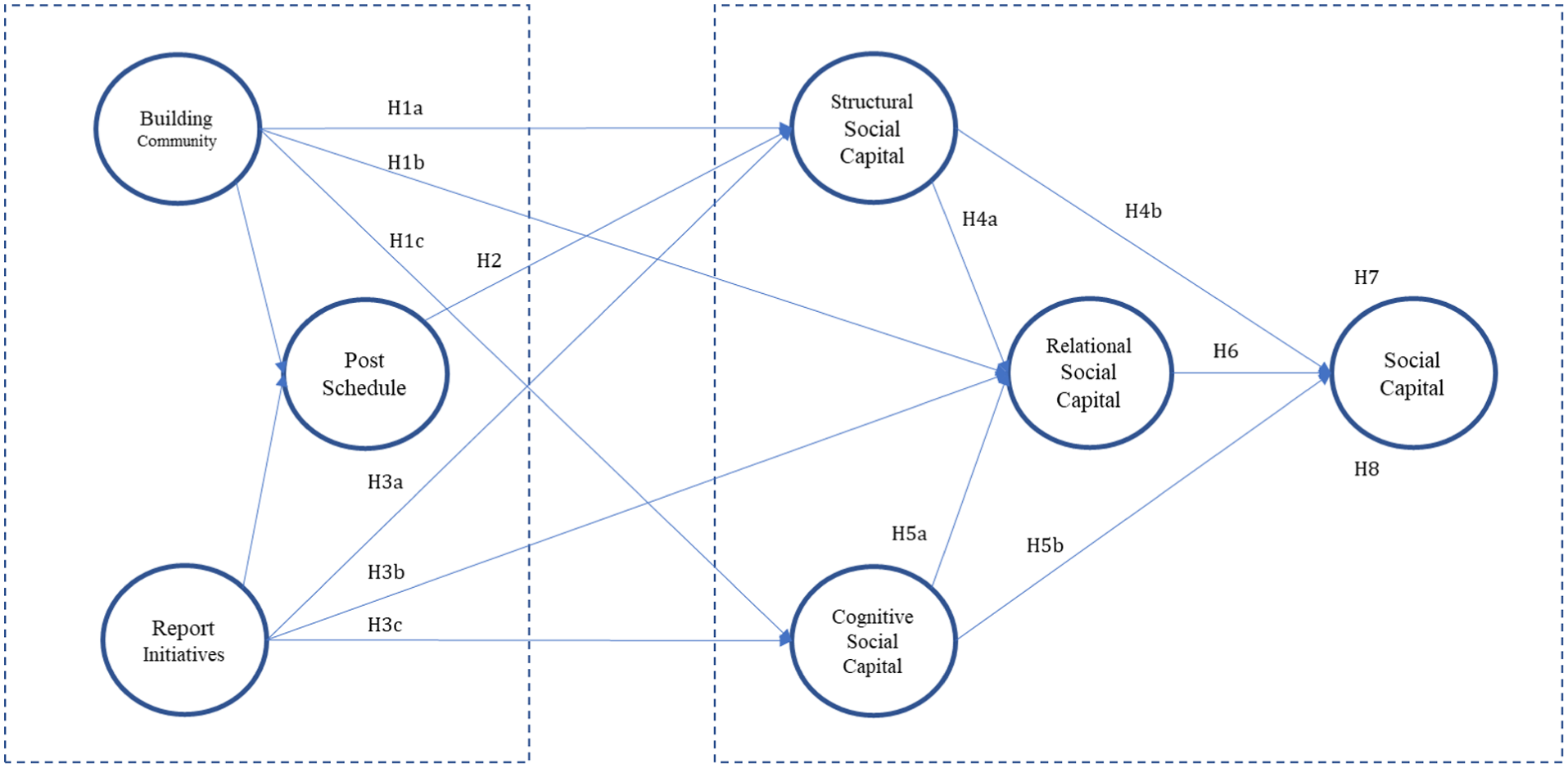
Visual representation of the relationship between variables (own elaboration).
Research Methods
This study employed a four-stage methodological design, described in detail below.
Sample and Data Source
This study explores how communication on the X platform (formerly Twitter) influences the social capital of a business cluster. The empirical setting is the SI-Foretica cluster, a network of companies in Spain dedicated to promoting cooperation in areas such as sustainability, knowledge generation and the exchange of experiences. Therefore, Forética was selected as the case study given its mission is to integrate sustainability into corporate strategy and management. Forética coordinate a broad portfolio of projects organized across five thematic areas. Within its social domain, the Social Impact Cluster serves as a hub that brings together more than 50 companies (e.g., Ferrovial, Caixabank, Cepsa, Enaire, etc.) from different sectors. To define the sample, the websites of all member companies were reviewed in order to identify their social media profiles, with a focus on accounts that were active between March-2021 and March-2022. Many cluster companies maintained an active presence on the X platform (formerly Twitter). In several cases, companies operated multiple profiles, either segmented by geographical region (e.g., Mapfre), by business divisions (e.g., Ilunion), or through associated foundations (e.g., Sanitas). Ultimately, 79 active profiles belonging to cluster members were identified and grouped into a curated list on the X platform (formerly Twitter). This grouping reflects the potential for interaction among companies, enabling them to exchange and circulate resources through their audience.
X platform (formerly Twitter) was chosen as data source because it allows the dissemination of varied content formats, including text, links and multimedia. Thus, users can follow others, and they can post for others to follow them or react to those posts (by likes, comments, mentions, etc.). This allows the construction of an interaction network for each type of reaction or relationship and, in turn, can be analysed for different purposes. Moreover, (i) it is a platform that facilitates real-time interactions with diverse social groups; (ii) it enhances visibility and legitimacy for corporate profiles; (iii) it provides access to extensive metadata useful for analysis; (vi) it plays a crucial role in both the social and commercial communication of companies; and, (v) prior studies highlight its relevance for fostering user-to-user and organization-to-organization engagement (Etxabe, 2018).
In this study, the interaction network was operationalized through mentions exchanged among cluster members, allowing for the construction and analysis of directed, weighted networks that capture patterns of relational exchange.
Data Collection
Custom software was developed to connect with the X platform (formerly Twitter)’s application programming interfaces (API) and systematically collect relevant data. The software was designed to track, filter, extract and store metadata to interactions between cluster members. Two categories of data were collected.
Independent Variables
Independent variables were derived from the content publications (tweets). Metadata includes the full text, tweet identifier, date and time of publication, type of post (original or re-tweet), number of retweets and numbers of mentions received, etc. During the study period, cluster companies generated a total of 75,010 tweets, from which a sample of 6,314 tweets was extracted to ensure manageable data handling and robust analysis. The sample data were stored in a preselected path as .csv format and subjected to systematic content analysis for categorization and further evaluation.
Dependent Variables
Dependent variables were based on mentions received and/or sent by SI-Foretica member companies. These data were organized in a matrix called “relationship matrix,” also saved as a .csv format. From this matrix, a weighted directed network of mentions was constructed, and social capital indicators were calculated using social network analysis (SNA). The relationship matrix was imported into Gephi software, which was used to computer network level indicators. These indicators provided the empirical basis for assessing the cluster’s social capital.
Variables and Measurement
Corporate Communication
Corporate communication was operationalized through three variables (Sánchez-Arrieta et al., 2023). Two of these represent communication strategies grouping communication characteristics, while the third refers to post schedule. Communication strategies were derived using principal component analysis (PCA) with orthogonal rotation (Varimax). Correlations between indicators were obtained with values from 0.2 to 0.4. Indicators that did not group within a factor with loadings greater than 0.4 or that grouped within a theoretical factor other than the one proposed were eliminated.
The PCA generated two distinct factors comprising twelve communication indicators, where the rotation with Kaiser normalization converged three iterations and explained more than 53 per cent of the total variance (Cronbach’s alpha = 0.742). One factor, building community, is a variable that integrates six attributes (e.g., communication function, vividness medium,) that reflect the extend to which posts foster medium or long-term relationships among network actors (Table 2).
Description of Independent Variables (Own elaboration)

The other factor, report initiatives, is a variable that comprises six attributes (e.g., function inform, topic corporate abilities) that capture the dissemination of business activities aimed at informing network actors (Table 2). The third variable, post schedule, was operationalized using two attributes (posting frequency and publication day). On average, SI-Foretica cluster published 119 tweets during of the study year (SD = 29.25). During 31 weeks of the study period, companies posted at least one tweet per week; in 21 weeks, they posted between one and five times. Only two companies exceeded five tweets per week.
Social Capital
Social capital was assessed using four variables (Table 3). Three follow the classical framework proposed by Nahapiet and Ghoshal (1998). That is, Structural social capital is measured by network indicators reflecting the overall patterns of connection within the cluster (Lőrincz et al., 2019). Cognitive social capital refers to the distance or steps to access and disseminate resources in terms of cohesion. Relational social capital indicates information about an individual’s position in the network that creates and strengthens social interactions (Riquelme & González-Cantergiani, 2016).
Description of Social Capital Variables.
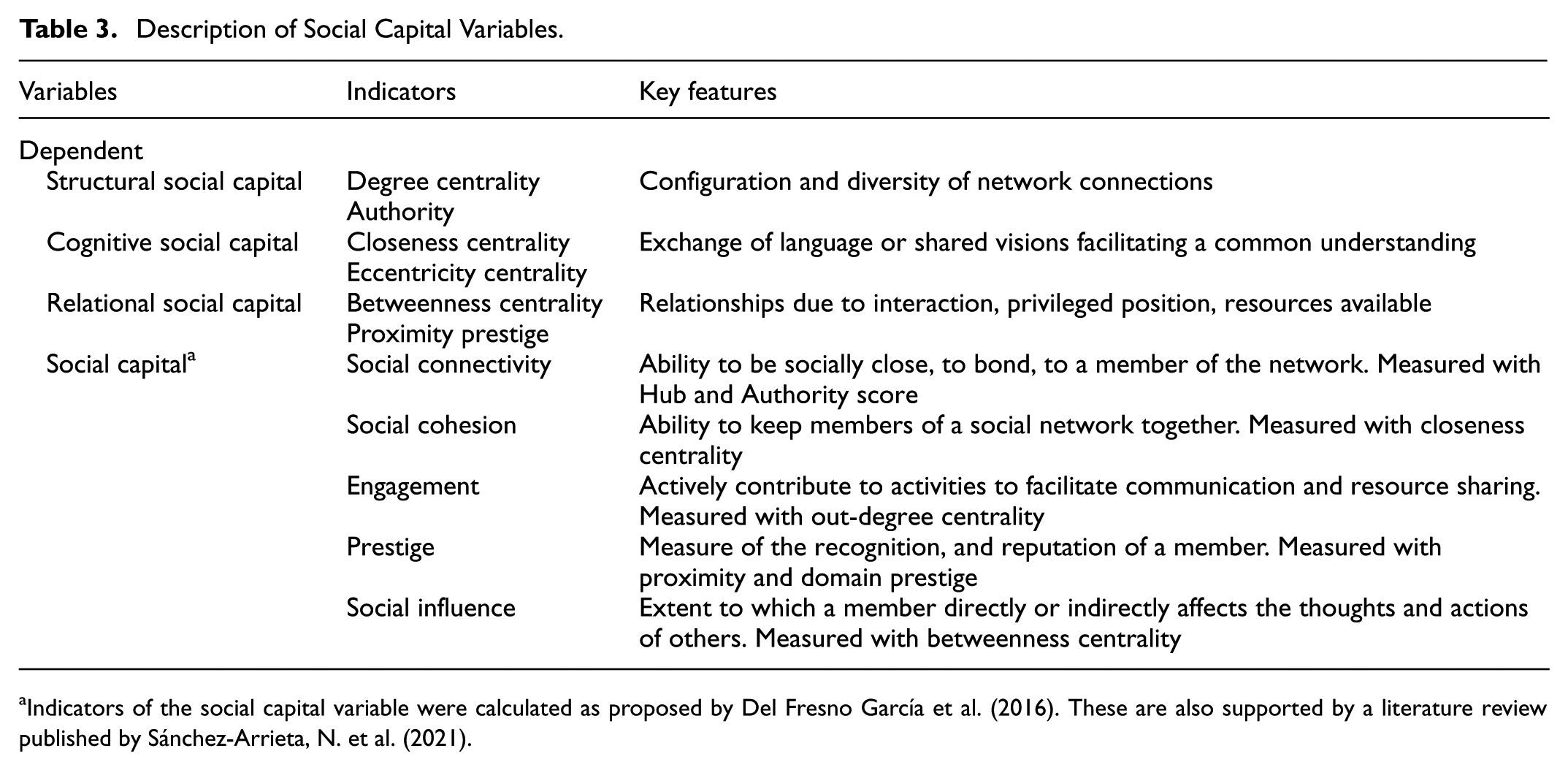
Indicators of the social capital variable were calculated as proposed by Del Fresno García et al. (2016). These are also supported by a literature review published by Sánchez-Arrieta, N. et al. (2021).
The fourth variable, social capital, was operationalized through five index measures representing the material or symbolic resources exchanged in the network through interactions (Sánchez-Arrieta, N. et al., 2023).
Figure 2 presents the proposed research model analysed using the partial least squares structural equation modelling (PLS-SEM) technique.
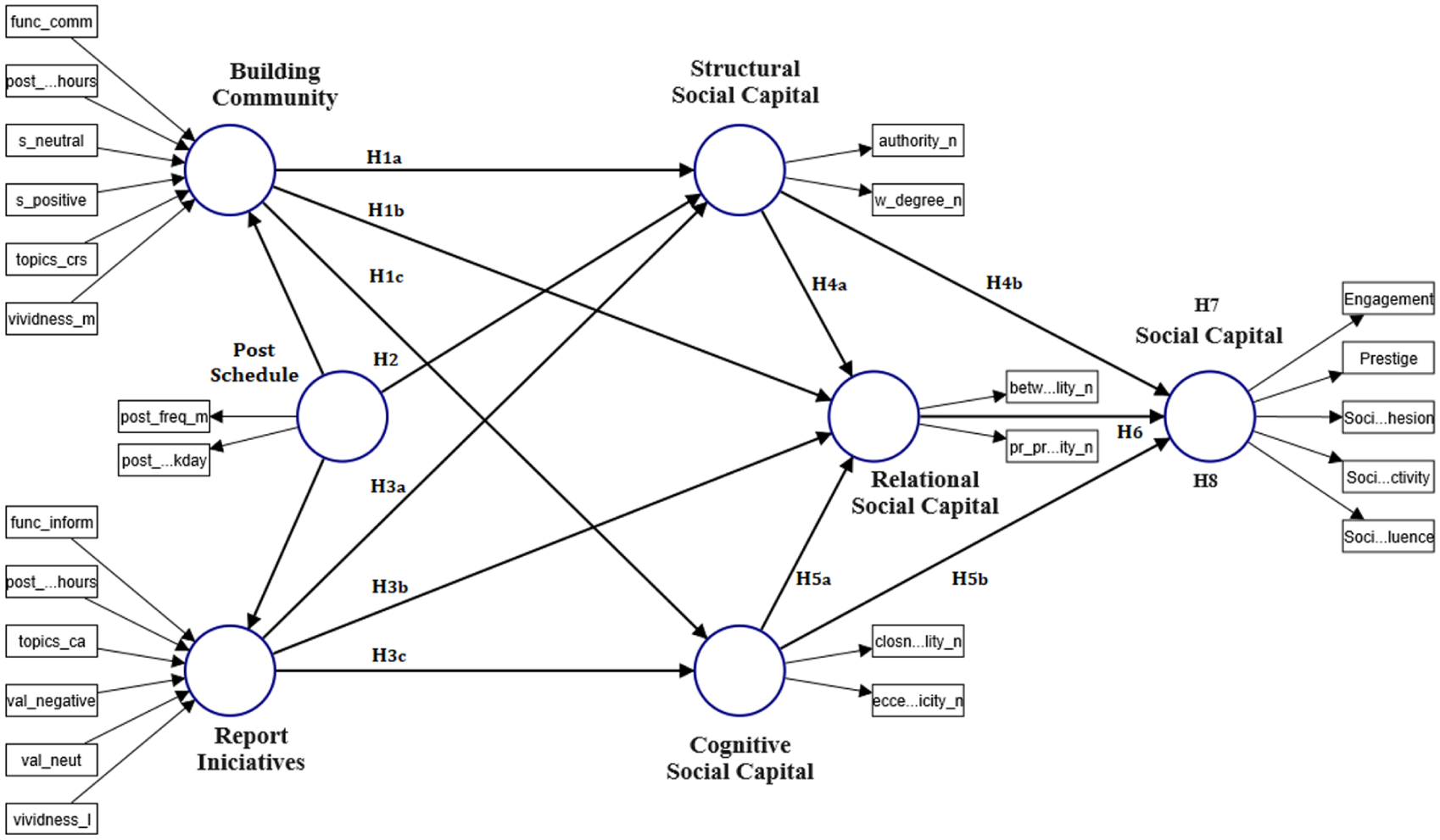
Research model in PLS-SEM.
Data Analysis
Partial Least Squares (PLS) Measurement
The hypotheses and research model were test using PLS-SEM implemented in SmartPLS 4.0 software (Ringle et al., 2015). The minimum required sample size was determined using G*Power 3.1.9.2 software with a priori power analysis (Faul et al., 2009). The analysis was based on a one-tailed t-test with an expected effect size (f2) of 0.10, conventional significance level of 0.05, expected statistical power of 0.8, and predefined number of the predictor (Lakens et al., 2018). The results indicated a minimum sample size of 64 cases, confirming that the study’s sample exceeded the threshold required for reliable estimation.
Results
Measurement Model
Evaluation of the measurement model was carried out according to the reflective and formative character of its variables. Regarding the reflective nature of the variables, Table 4 shows that the composite reliabilities and Cronbach’s alpha values of all the measures are greater than 0.7. As this work is an exploratory investigation, the minimum of 0.6 for Cronbach’s alpha and CR ≤0.95 is met indicating that variables with high scores have good internal reliability (Hair et al., 2019).
Reliability and Validity Statistics for Reflective Variables.
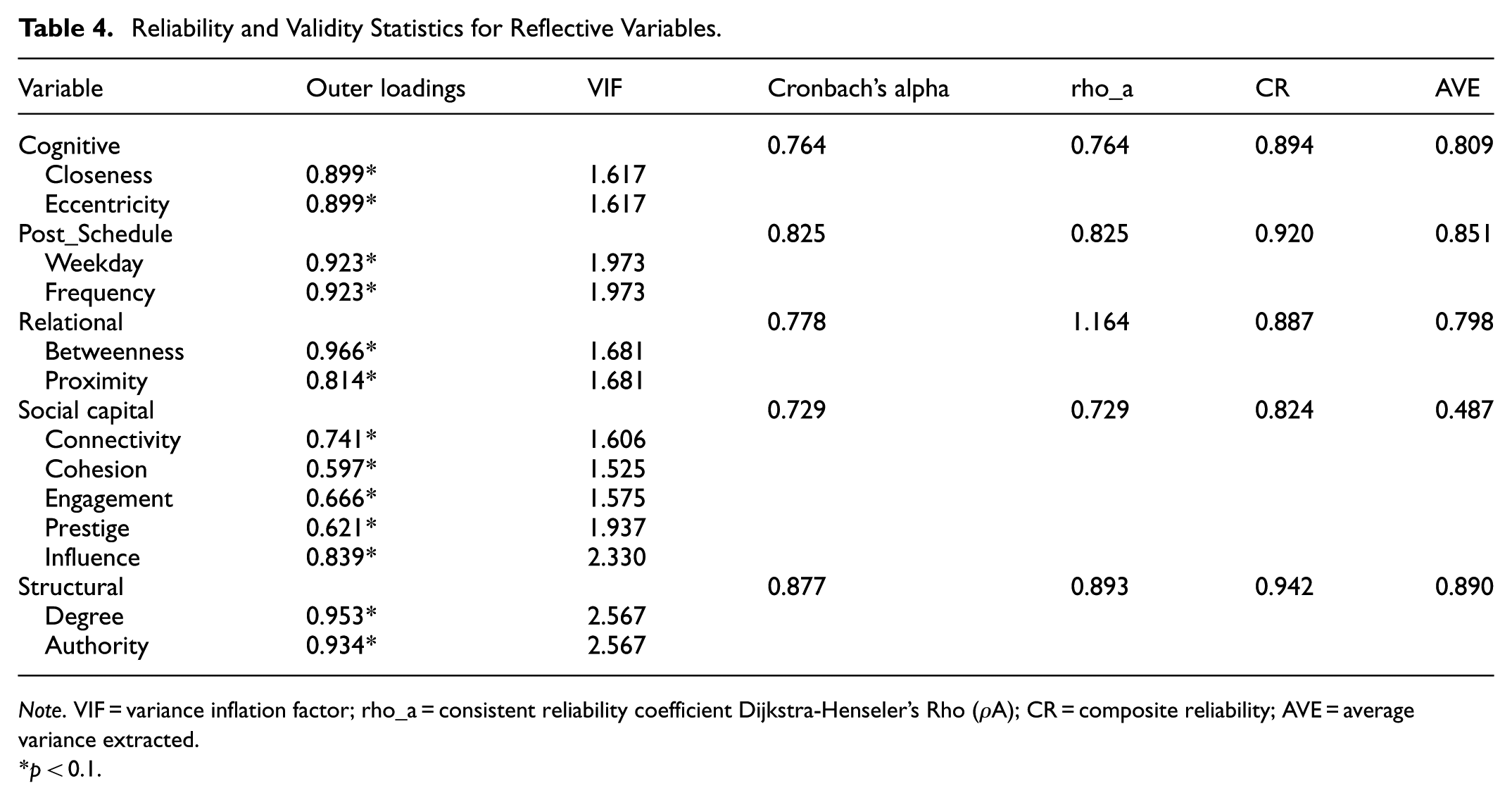
Note. VIF = variance inflation factor; rho_a = consistent reliability coefficient Dijkstra-Henseler’s Rho (ρA); CR = composite reliability; AVE = average variance extracted.
p < 0.1.
The average variance extracted (AVE) was used to evaluate the convergent validity of the reflective measures. Table 4 shows that four of the variables have AVE values above 0.5, complying with the recommendations of Fornell and Larcker (1981). This suggests that the latent variable explains at least 50% of the variance of its items and has good shared validity (Hair et al., 2019). For the social capital variable only, the AVE value is slightly below 0.5. According to Fornell & Larcker (1981), “AVE is a more conservative metric than composite reliability (CR)” (p. 46). Thus, based on CR alone the research “can conclude that the convergent validity of the construct is adequate, even though more than 50% of the variance is due to error” (p. 46). As the composite reliability of the social capital variable is above the recommended level, the convergent validity of the measures is acceptable.
Likewise, Table 4 shows that the item loadings of the latent variables have values greater than 0.7. According to Vinzi et al. (2010), this indicates that more than 50% of the variance of the indicator can be explained by the underlying latent variable. A particular case is observed with the social capital variable. However, as this is exploratory research using newly developed scales or indices, a less restrictive criterion can be considered. We have considered the criterion proposed by Hulland (1999), who suggests not to consider items of reflective measures with loadings below 0.4 for a research measurement model with newly developed variables. Assuming this criterion, it can be said that the variance of the indicators can be explained by the social capital variable since the loadings are above 0.4. Thus, adjusted values of AVE, CR, and significance in the analysed measures of each variable provide evidence of convergent validity.
Regarding discriminant validity, Table 5 shows for all the variables analysed using the Fornell and Larcker (1981) method that the values of the square root of the AVE do not exceed the threshold of 0.95 (Gold et al., 2001). That is to say, each variable is more closely related to its indicators than to those of the other variables, which implies adequate discriminant validity (Fornell & Larcker, 1981). On the other hand, most of the variables have heterotrait-monotrait (HTMT) ratio values below 0.9 with confidence intervals differing from zero, thus meeting the threshold established for conceptually distinct variables (Henseler et al., 2015).
Discriminant Validity.
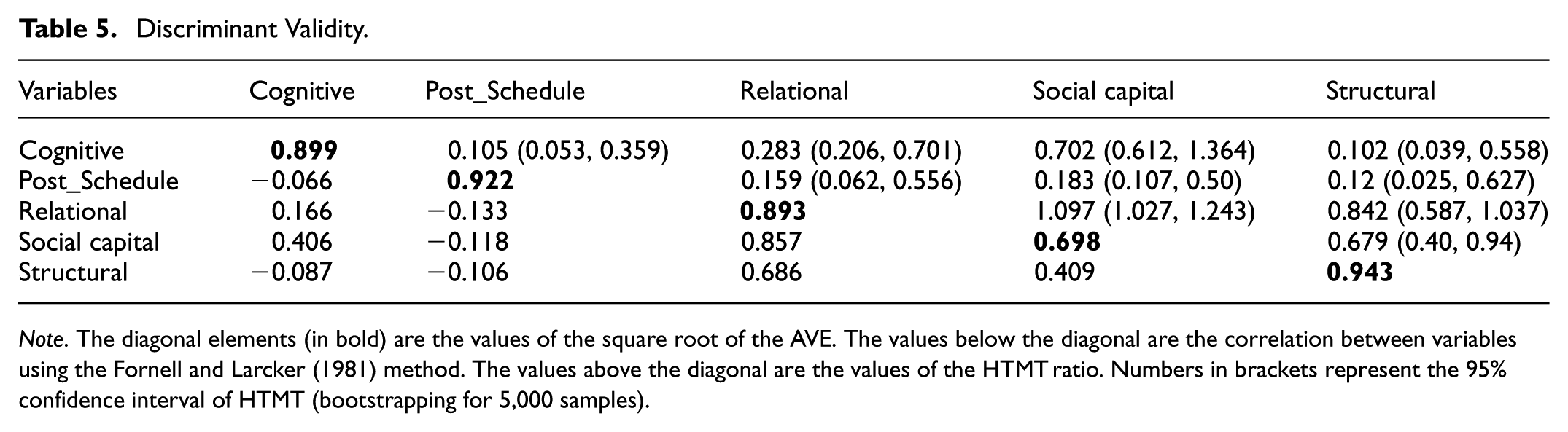
Note. The diagonal elements (in bold) are the values of the square root of the AVE. The values below the diagonal are the correlation between variables using the Fornell and Larcker (1981) method. The values above the diagonal are the values of the HTMT ratio. Numbers in brackets represent the 95% confidence interval of HTMT (bootstrapping for 5,000 samples).
The measurement model proposed includes two formative measurement variables: building community and report initiatives. Results obtained from the analysis of these variables (see Table 6) show that there is no presence of collinearity in any of the indicators of the formative variables; therefore, there is no issue that affects the estimation of the proposed model (Becker et al., 2015; Petter et al., 2007).
Reliability and Validity Statistics for Formative Variables.

Note. VIF = variance inflation factor.
p < 0.1.
Results show that the indicators contribute absolutely to the formative measurement variables, which are defined by their external loadings. In other words, it is confirmed that the variables building community and report initiatives can be conceptualized as formative variables.
Structural Model Results
The structural model is tested using the bootstrapping technique with 5,000 sub-sample iterations. In this paper, a significance level of 10% was considered for two-tailed tests as it was exploratory research (Hair et al., 2017).
Statistical Relevance and Significance
Table 7 presents the results obtained for the relevance and statistical significance of the path coefficients, the explanatory power and the bias-corrected and accelerated 95% confidence interval (CI-BCa), as well as all hypothesized relationships using path coefficients (β). The results reveal that from the significance level of the path coefficients, hypotheses H1a, H1b, H1c, H3c, H4a, H4b, H5a, H5b, H6, H7, and H8 are supported.
Assessment of the Structural Model.
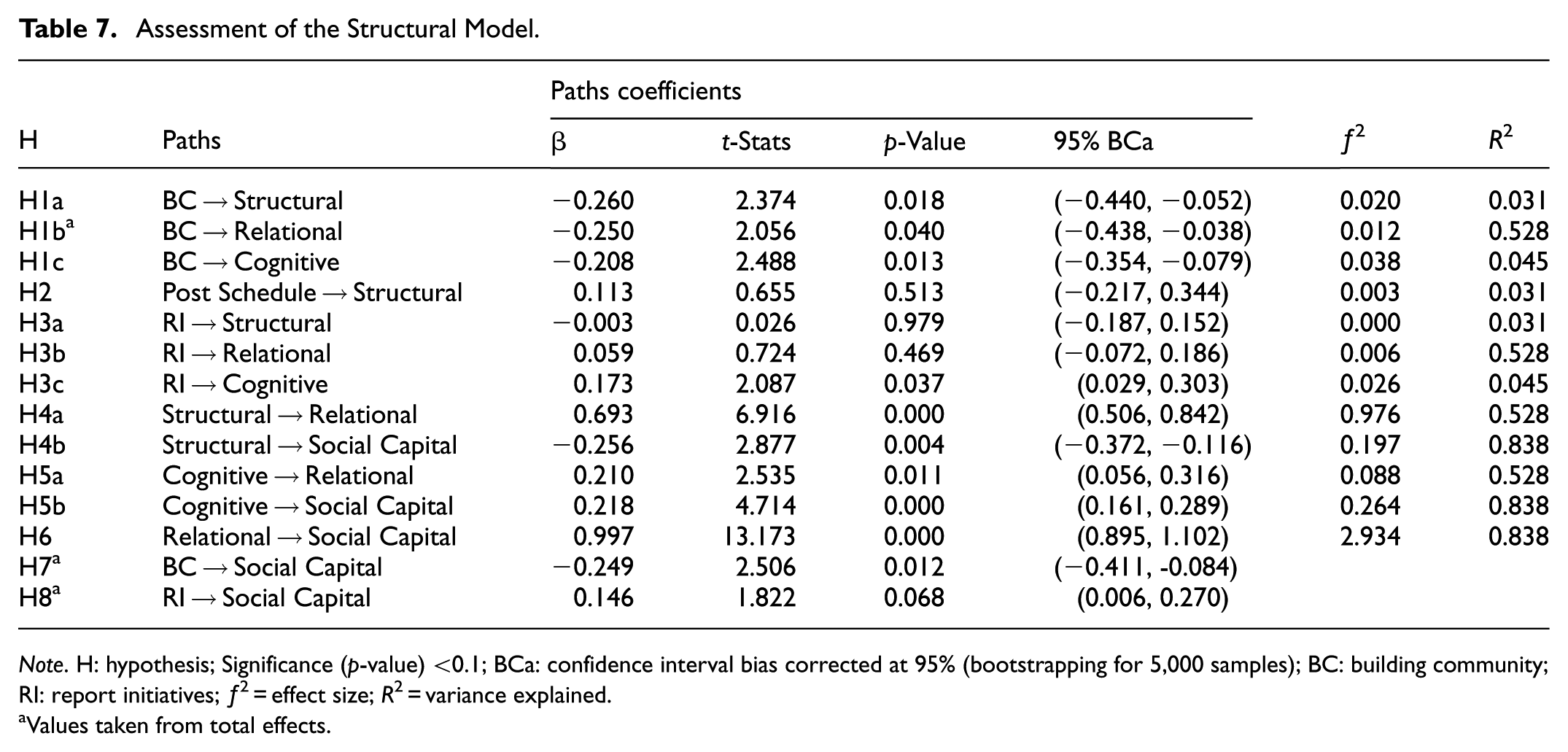
Note. H: hypothesis; Significance (p-value) <0.1; BCa: confidence interval bias corrected at 95% (bootstrapping for 5,000 samples); BC: building community; RI: report initiatives; ƒ2 = effect size; R2 = variance explained.
Values taken from total effects.
Table 7 shows the direct relationships between the communication variables and the social capital variables. Firstly, it is observed that messages published under the building community communication strategy promote conversation and positively stimulate the sensory dimensions of the receiver, having a significant effect on structural social capital and cognitive social capital. Secondly, it is observed that those publications that inform about commercial initiatives of the companies promote interaction, shared interests and growth in relationships, having a significant effect on cognitive social capital.
Thirdly, it is evident that the volume of connections and participation, represented by structural social capital, promotes the development of trust, cooperation and collaborative work, generating relational social capital and, in turn, social capital as an objective variable. Structural social capital has the greatest effect on relational social capital because it has a higher path coefficient. Fourthly, it is evident that the affinity of interests, beliefs and values, represented by cognitive social capital, fosters close relationships based on trust that generate relational social capital and, in turn, social capital as an objective variable. Fifthly, it is evident that relationships that mobilize resources while maintaining positive expectations, represented by relational social capital, generate social capital.
Finally, it is observed that the variables building community and report initiatives variables have a significant indirect relationship with social capital, which is possibly mediated by another variable. The bootstrapping confidence interval results for each significant relationship show that 81.2% of the path coefficients are different from zero, confirming the explanatory effect in each of these relationships (e.g., CB → Structural; RI → Cognitive).
The coefficient of determination (R2) allowed us to determine that the explanatory power is significant for the relational social capital and social capital variables (Shmueli et al., 2019). That is to say, 83.8% of the variance of the social capital variable is explained by the other predictor variables of the structural model (Table 7). According to the criteria suggested by Hair et al. (2017), this can be considered a substantial value. The strongest effect on social capital is exerted by relational social capital, followed by cognitive social capital and then structural social capital. Likewise, the R2 value of 0.528 for the relational social capital variable reaches a level that can be considered moderate (R2 > 0.5) (Falk & Miller, 1992).
Predictive Power of the Model
The predictive power of the model was determined using PLSpredict with 10 folds and one repetition to mimic how the PLS model would ultimately be used (Hair et al., 2019). The results obtained from the redundancy measure (Q2) and predictive performance indicate predictive relevance for the cognitive social capital, relational social capital, and social capital variables as the values are greater than zero (Table 8). Furthermore, lower prediction errors in terms of root mean squared error (RMSE) were obtained for all indicators compared to the linear regression model (LM) analysis. According to Shmueli et al. (2019), this result indicates that the model has high predictive power.
Predictive Performance of the PLS Model Versus Benchmark LM.

Note. MAE = mean absolute error.
Discussion
We follow the work of several researchers in this field (Suh, 2016; Xu & Saxton, 2018) and support the idea that corporate communication should create added value for both the receiver and the sender. Therefore, this paper explores communication strategies that can generate social capital as an added value. For this, we focused on the posts made by members of the SI-Foretica cluster on the X platform (formerly Twitter) and how these posts generate social capital.
We used a four-phase method (explained in research methos section). In the third stage, we analysed the posts made by the cluster companies. This allowed us to check whether it is possible to group communication design features into strategies and define communication variables. One variable involves design resources that encourage dialogue or joint problem-solving. Another variable includes resources that promote interaction by reporting corporate initiatives and expressing corporate objectives. We also assessed how building a network of interactions can help gather a wider range of information (Zamudio et al., 2014). This helped us define the variables of social capital using direct indicators of the SNA. With this, we contribute to the small number of studies that use network properties based on data from SNS rather than relying on survey-based measures of social capital (e.g., ISCS by Williams, 2006, SCIS by Chen et al., 2015, etc.).
In the fourth phase, we tested the hypotheses of the conceptual model to examine the relationship between communication strategies and social capital variables. The results show statistically significant relationships between corporate communication and social capital. We identified which communication strategies are most effective in improving the performance of social capital when companies communicate their activities on SNS.
For example, the report initiatives strategy has a direct positive effect on cognitive social capital and an indirect positive effect on overall social capital. This suggests that communications focusing on showcasing corporate capabilities and product or service quality strengthen the company’s image and positively affect its social capital. These communications were mostly simple in design features with low vividness: text-only or including a link, aimed at informing rather than encouraging dialogue, and often generating neutral or negative emotion (Yue et al., 2021). Previous studies show that one-way communications like these can create a sense of consensus among the audience, as they share a common interest. This shared understanding helps audiences better grasp corporate goals and builds cognitive social capital (Gibbs & Coleman, 1990; Zheng, 2010). In some cases, these shared interests can even encourage the exchange of resources, leading to active interactions that boost social capital.
The building community strategy involves communications that include images or a gifs and are designed to encourage dialogue and create positive emotion. These messages are two-way and aim to spark direct conversations with the audience. They promote trust, solidarity, commitment and cooperation. This strategy shows a significant direct effect on structural social capital and cognitive social capital, and a significant indirect effect on relational social capital and overall social capital. The results help explain how interactions among online communities develop: a publication triggers connections between members of the cluster, shaping the structure and layout of the network (structural social capital). It also reflects shared interests, values, or beliefs (cognitive social capital). When these types of connections grow stronger, they lead to direct and indirect interactions and exchanges of trust, support, and resources, all of which build social capital.
In some cases, we found that the effects between t the building community variable and social capital variables had negative path coefficients. This suggests that communications aimed at building a community and showing social responsibility sometimes fail to improve social capital as expected (Crane & Glozer, 2016). We believe this may be due to how the audience perceives and interprets companies’ publications. When companies share many posts about their social responsibility initiatives, the audience might see these actions as self-serving rather than genuinely community focused. This perception can create a sense of insincerity, which weakens trust, collaboration, dialogue, and ultimately social capital. It is also possible that these results are influenced by superficial interactions, where mentions occur without deeper engagement. This may happen because of the fast and brief nature of user behaviour on the platform (Dacin & Brown, 2002; Lovejoy & Saxton, 2012; Morsing & Schultz, 2006).
Although communicating responsible actions can bring important benefits to organizations (Dutot et al., 2016; Maignan & Ferrell, 2001; Morsing et al., 2008), research on CSR communication also shows some opposite results. For example, S. Kim and Ferguson (2018) found that when CSR communication seems too strategic or self-promotional, it can be counterproductive, reducing the company’s perceived authenticity and weakening relationships with the audience. Similarly, Du et al. (2010) noted that poorly managed CSR messages can cause audience scepticism, especially when there is a gap between what a company communicates and what it actually does. Therefore, these results suggest that not all community-building communication will be received positively, especially if it is perceived as insincere or misaligned with audience expectations.
This finding contrasts with Saxton and Waters (2014), who argued that genuine, frequent community-focused interactions build stronger social bonds. We believe that the success of each strategy depends on the communication context. Therefore, companies should carefully review and adjust their elements to find the right combination that strengthens their social capital.
Conclusions
This study examined how communication strategies on the X platform (formerly Twitter) contribute to the generation of social capital within a business cluster called SI-Foretica. For this purpose, a model was proposed and tested using the PLS-SEM technique. The results of the model analysis provide empirical evidence for the relationship between communication variables and social capital variables. From the results, it can be deduced that when companies publish messages under a communication strategy that promotes conversation and positively stimulates the sensory dimensions of the receiver, they can generate social capital.
The evaluation of the measurement model confirmed the reliability and validity of the proposed constructs. Although the social capital variable presented a slightly lower AVE, the overall convergent and discriminant validity criteria were met, supporting the adequacy of the measurement approach for exploratory research. Furthermore, the identification of building community and report initiatives as formative variables strengthens the theoretical proposition that communication strategies on SNS should be conceptualized as multidimensional constructs that integrate design, content, and scheduling characteristics.
The structural model results reveal several key insights. First, communication strategies focused on community-building significantly enhance structural and cognitive social capital, supporting prior findings that interactive and vivid content promotes engagement and network cohesion (Capriotti et al., 2021; Lei et al., 2017). Second, initiatives reporting corporate activities were shown to strengthen cognitive social capital, aligning with studies highlighting the role of transparency and information sharing in fostering shared identity and cooperation (Carlisle & Patton, 2013; Cvijikj & Michahelles, 2013). Third, the results confirm the sequential relationships among the three dimensions of social capital proposed by Nahapiet and Ghoshal (1998): structural connections facilitate trust and collaboration (relational capital), which ultimately translate into greater social capital at the cluster level. This reinforces previous evidence that digital networks function as enablers of trust, reciprocity, and collective value creation (Arslanagic-Kalajdzic & Zabkar, 2017; Pang et al., 2024).
The explanatory and predictive power of the model is also noteworthy. The finding that relational social capital exerts the strongest effect on overall social capital underscores the importance of trust-based ties for transforming network interactions into tangible collective resources. This supports earlier research that identified relational trust and reciprocity as central mechanisms in the development of social capital within digital platforms (Riquelme & González-Cantergiani, 2016; Suh, 2016). Moreover, the high R2 values and predictive performance of the model contribute to ongoing methodological discussions on the robustness of SNA and SEM approaches in analysing online communication dynamics (Hair et al., 2019; Shmueli et al., 2019).
From the results, it can be inferred that business messages can generate social capital when they are designed with a communication strategy that promotes conversation and positively stimulates the sensory dimensions of the receiver, they can generate social capital. Additionally, companies can generate social capital when they publish their commercial initiatives. However, under this strategy, companies should use scheduling as a tool to encourage more interaction and growth in relationships based on shared interests. Designing communication in SNS under the context of strategies suggests the prioritization of communication features to improve the performance of social capital.
Moreover, the results show that relational social capital is the variable that most influences social capital since it represents the relationships that mobilize resources by maintaining positive expectations among network members. Therefore, cluster companies should strengthen communication strategies to optimize the content of their social actions to form highly collaborative and cooperative groups.
The theoretical contribution of this work lies in the contribution of practical ideas about strategies that bring together the characteristics of communication and which of them promote the generation of social capital. These ideas can be used by companies to follow up on the investments made, allowing them to improve their communication strategies. The study data were collected directly from the SNS where the interaction network was built to extract more information. The social capital variables were evaluated from the perspective of social network analysis and communication variables as strategies that characterize group communication. It should be highlighted that the method is valid to use in similar studies with other SNS platforms since it only requires a platform that offers its users three main components: a public or semi-public profile, a stream of content that they can consume or interact with, and a set of links to other users. These components should make it possible to create a social structure within the system to determine the social interactions present during the exchange of resources on the network.
Taken together, these contributions demonstrate that social capital in digital environments is not merely the byproduct of interaction volume but emerges from strategically designed communication practices that build networks, foster shared meaning, and cultivate trust. Future research could extend these findings by comparing different types of clusters, platforms, or sectors, and by further refining the measurement of social capital in online contexts.
Limitations and Future Research
This study has certain limitations. Firstly, the results presented are restricted to messages disseminated on X platform (formerly Twitter). Future research should consider the analysis of posts made on other social media platforms (e.g., Facebook) to gain a more complete perspective. Secondly, we worked with data from a cluster consisting of a group of companies with profiles, mainly in Spain. It would be interesting to know whether communication on the SNS of companies in a cluster with worldwide interaction generates social capital. Thirdly, the data used to analyse social capital refers to interactions by mentions given and received in tweets. Future research should assess social capital in terms of different types of interactions (i.e., retweets, replies). Fourthly, we collected data over a 1-year period, between 2021 and 2022, during the COVID-19 period. It would be interesting to present new studies from other periods to compare the communication strategies that influence the generation of social capital when publishing on SNS. Furthermore, in this study we have not considered the cultural context as a variable that impacts the process of generating social capital when companies communicate on SNS. Therefore, it is suggested that future research explore how culture influences the communication strategies used to create social capital. Fifthly, the model was proposed without the consideration of mediating or moderating variables, with the objective being to understand the direct relationship between communication strategies and the generation of social capital. Future research should take into account variables such as network externalities, gamification dynamics, stress, or addictive usage patterns, in order to understand the possible mediating or moderating role on the effectiveness of communication strategies in creating social capital. Finally, based on the results obtained from the significance analysis between variables, it is suggested to investigate which communication factors are relevant to designing strategies for messages to have a positive impact on social capital variables.
Footnotes
Acknowledgements
The corresponding author gratefully acknowledges the Universitat Politècnica de Catalunya for the financial support of her pre-doctoral grant FPU-UPC, with the collaboration of Banco de Santander.

Funding
The authors received no financial support for the research, authorship, and/or publication of this article.
Declaration of Conflicting Interests
The authors declared no potential conflicts of interest with respect to the research, authorship, and/or publication of this article.
Data Availability Statement
The data that support the findings of this study are available from the corresponding author.
Human Participants
This article does not contain any studies with human or animal participants.