




Abstract
Personality traits of teachers are critical to their teaching reflections as well as students learning and satisfaction. However, there is no guiding framework about which personality factors and style of communication are important for teachers’ communication effectiveness during their classroom teaching. The current research studies the impact of personality traits on Communication Effectiveness (CE) of teachers during their classroom teaching and the mediating role of their Communication Style (CS). A sample of 250 teachers from Indian higher education institutions participated in the exploratory study. The study applies PLS-SEM, a theoretical model was proposed and the results point to a total mediating impact of CS on the relationship between personality and CE. The direct effect of the personality traits on communication effectiveness, although positive becomes insignificant, indicating that to a major extent the influence of personality traits on communication effectiveness is explained by the communication style of the teachers. “Conscientiousness” and “Extraversion” personality traits are the most significant personality traits which bring about communication effectiveness in teachers through their “expressive” and “precise” communication styles. Validation of the proposed model will facilitate the teachers to assess their personality traits and identify the most suitable teaching styles which will make their classroom teaching effective thus, enhancing students’ class participation and academic performance.
Keywords
Introduction
Teachers’ consistent and effective communication with their students determines the excellence of Educational Institutions. Effective classroom communication of teachers is vital for students’ understanding, learning and making them result-oriented; it also builds a structure of thought which shapes the thinking of the students (Asrar et al., 2018; Ergin & Birol, 2005; Khan et al., 2017). The concept of an educator’s teaching style can help us to understand him/her acting as an “instrument of thought,” shaping the reality of the classroom. Closely related to teachers’ thoughts, feelings and credibility are series of personality trait variables, which are the core factors influencing their performance and effectivenesscondusive to the transfer of learning (Buttner et al., 2015; Polk, 2006; Renta Davids et al., 2017). Students’ learning, motivation, and academic achievement are affected by teachers’ behavior, personality, and teaching style (Joe et al., 2017; Maulana et al., 2011; Mehrani & Khodi, 2014; Moskovsky et al., 2016; Papi & Abdollahzadeh, 2012). Teachers’ performance is related to their personality traits and student’s learning outcomes are also mainly affected by teacher’s personality through the psychological environment of the classroom (M. M. Kennedy, 2012; Rose et al., 2014; Thornton et al., 2005). Teachers’ personalities are significant in reflecting their teaching practices and could determine their teaching style (Safarie & Tarlani-aliabadi, 2014). Therefore, educator’s personality is very crucial to ensure effective teaching practices for effective learning.
As there is a paucity of research that analyzes the impact of personality traits on teachers’ communication effectiveness by understanding their style and identifying the traits of teachers’ personality and their style which leads to effectiveness during their classroom teaching, the present research seeks to take an insight into the impact of teacher’s personality traits on their communication effectiveness (CE) while teaching in classrooms and to determine the mediating role of communication style (CS). Explicitly, it is an endeavor to explore the best predictors amongst diverse components of communication style and personality traits that lead to enhanced communication effectiveness.
Literature Review and Hypotheses Development
Personality explains the particular psychological traits that impact individuals’ feelings, thoughts, and behavior across different times as well as situations. Feist and Feist (2006) defined personality as a pattern of unique characteristics and permanent traits that give both stability and individuality to an individual’s behavior. It describes constant human behavioral responses to environmental stimuli (Adelstein et al., 2011; Roberts & DelVecchio, 2000) which also include their communicative styles (Celli, 2013). How individuals express themselves and communicate with others is affected by their personality traits (Koppensteiner & Grammer, 2011).
Personality traits of teachers are exhibited not just in classroom activities particularly in strategies, their choice of materials, instructional behavior, and classroom management (Johns et al., 1989; Woolfolk, 1998) but also in the communication with their students (Henson & Chambers, 2002). Teachers’ personality traits while delivering the lectures, with effective communication skills, latest information and proper classroom management, drastically affected the learning and academics of the student, motivated them, led to moral development thus, facilitating the overall performance of the students (Khan et al., 2016; Kheruniah, 2013). Teachers’ personality types are significant for their varied academic behaviors and there is also a noteworthy correlation between their personality factors and effective teaching (Clayson & Sheffet, 2006; Fatemi et al., 2015; Kim et al., 2019; Poropot, 2009), furthermore, students’ interest in the subject is to a large extent dependent on their teachers’ teaching style.
Personality theories provide the best explanation for the role played by a teacher’s personality in the educational process and the professional attitude of the teacher. (Cramer, 2013; Magno & Sembrano, 2008; Raymond, 2008). Personality types of the educator do infer preferred teaching methods and styles as well as dimensions of teachers’ professional performance (Curtis & Cheng, 2001; Ionescu, 2013). Earlier research, analyzing the association between personality traits and effectiveness in teaching highlighted that extraversion, agreeableness, and conscientiousness traits of personality have a positive correlation with effectiveness of teaching (Kim & MacCann, 2018; Kim et al., 2018; Klassen et al., 2017) whereas traits of neuroticism and openness do not have indicative relationship to teachers’ effectiveness (Kalafat, 2012; Othman, 2009). Assertiveness correlates with several professional performance dimensions and extraversion was an affirmative characteristic of teachers (Clayson & Sheffet, 2006; Emmerich et al., 2006; Ionescu, 2013). Emotional stability and agreeableness were significantly associated with interactive teaching methods (Chamorro-Premuzic et al., 2007).
In recent years, a rising body of research suggests that CS is not only essential for personal relationships but are also crucial in professional communication such as between teachers and pupils, sales agents and customers, doctors with their patients, politicians and the public, consultants with clients (de Vries et al., 2013). A person’s CS is a natural expansion and expression of his or her personality type and vice versa, people interact with others in the same manner as they feel, behave, act or experience (Adler & Rodman, 2006; Yeakley, 1982). When an individual communicates with others, it is largely dependent on a particular mannerism he/she displays. For example, a friendly, calm, optimistic person is the one who communicates more expressively, and is known among others as helping and humorous (De Vries et al., 2011). Individuals who have traits of extroversion, intuition and thinking, have an argumentative style of communication compared to those who have traits of introversion, sensing, and feeling (Loffredo & Opt, 2003; Weaver, 2005).
CE of the teachers, timely response to the requirements of their students, creating a sense of community and building student-teacher association enhances the classroom participation of students, resulting in improved academic performance. It is teacher’s approach toward teaching practices which acts as a major determinant of students’ outcomes. (Blomeke et al., 2016; De Meyer et al., 2014; Shan et al., 2014; Singh & Sarkar, 2015). The CS of an instructor focuses on how an activity is delivered, not just the content that is delivered (Macfadyen & Bailey, 2002, p. 57; Buang & Samad, 2011; Guerrero & Floyd, 2006). Teaching style of every teacher has exclusivity in his/her choice to employ a peculiar training and their CS relies on several factors such as their teaching expectations and preferences requirements of the learners, class size, students academic level, and pedagogical outcomes (Clark & Artiles, 2000; Duţă, 2010; Duţă et al., 2015; Murphy et al., 2017). Several styles are employed by the teachers to achieve their teaching and assessment objectives. The academic results of the students improve and become steady when a teacher is successful in altering their style to match the learning style of the students and verbal with nonverbal interactions between teachers-students is vital for understanding, learning, and motivation of the students (Doménech-Betoret & Gómez-Artiga, 2014; Hein et al., 2012; Jurik et al., 2014). Learner-centric style of teaching and the good class management skills of the teachers, explain the presence of effective classroom practices (Opdenakker & Van Damme, 2006).
There have been several studies which highlighted that students have a preference for certain styles of teaching. They prefer teachers’ delegator-facilitator-expert style of teaching compared to facilitator-personal style and model-expert style. (Heydarnejad et al., 2017; Şen, 2018) and if teachers employ a humorous style while teaching it fosters a healthy student-teacher relationship whereas their actor, the human and authoritative style influences students’ participation in the classroom (Makewa et al., 2011; S. A. Myers & Rocca, 2007). Students were more satisfied with attentive, friendly, relaxed, impression leaving and contentious attributes of teachers which also predicted their effectiveness (Bota & Tulbure, 2015; Fallah, 2014; S. A. Myers, 2012). Teachers’ affirmative style made students’ communication functional, participatory, and relational and their expressive style improved student engagement whereas, their authoritative style is inversely related to the student-teacher relationship. (Giles et al., 2012; Goodboy & Myers, 2008; Parayitam et al., 2007).
As mentioned above, attempts have been made to investigate the personality traits of teachers, their effectiveness, and diverse styles of communication in the classes about students’ satisfaction and academic outcomes. But, there is a scarcity of research that analyzes the impact of personality traits on teachers’ CE by understanding their style during their classroom teaching. Mainly, studies are examining teachers’ effectiveness traits (Montalvo et al., 2007; Polk, 2006; Thibodeau & Hillman, 2003), but there is a paucity of research examining the teachers’ personality traits in terms of the HEXACO-PI- R and NEO-PI-R model of personality (M. C. Ashton & Lee, 2008; M. C. Ashton et al., 2004) which have medium to a very strong association with Communication Styles Inventory (de Vries et al., 2013).
The current study posits that personality traits based on Hexaco dimensions of personality (i.e., agreeableness, conscientiousness, extraversion, Honesty-Humility neuroticism, and openness to experience) influence the communication effectiveness of teachers while teaching students in a classroom setting and CSs proposed by de Vries et al. (2009), (i.e., expressiveness, emotionality, impression manipulativeness, preciseness, questioningness, and verbal aggressiveness) act as a mediator between personality traits of teachers and their CE. Specifications of the model must be done in accordance with the familiarity of the theory and empirical research (Byrne & Stewart, 2006), hence, in consistency with Gong (2008) and Jiang (2016), Figure 1 presents the postulated model. The proposed hypotheses for the validation of the model are:
H1. Personality traits as per HEXACO model influence Communication Effectiveness of teachers during their classroom teaching.
H1a. Agreeableness has an impact on Communication effectiveness of teachers.
H1b. Conscientiousness has an impact on Communication effectiveness of teachers.
H1 c. Honesty-Humility has an impact on Communication effectiveness of teachers.
H1 d. Emotionality has an impact on Communication effectiveness of teachers.
H1 e. Extraversion has an impact on Communication effectiveness of teachers.
H1 f. Openness to Experience has an impact on Communication effectiveness of teachers.
H2. Communication styles as per CSI have full mediation in the relationship between personality traits and communication effectiveness of teachers during classroom teaching.
H2a. Aggressiveness mediates the relationship between personality traits and communication effectiveness of teachers.
H2b. Emotionality mediates the relationship between personality traits and communication effectiveness of teachers.
H2c. Expressiveness mediates the relationship between personality traits and communication effectiveness of teachers.
H2d. Impression Manipulativeness mediates the relationship between personality traits and communication effectiveness of teachers.
H2e. Preciseness mediates the relationship between personality traits and communication effectiveness of teachers.
H2f. Verbal Questioningness mediates the relationship between personality traits and communication effectiveness of teachers.
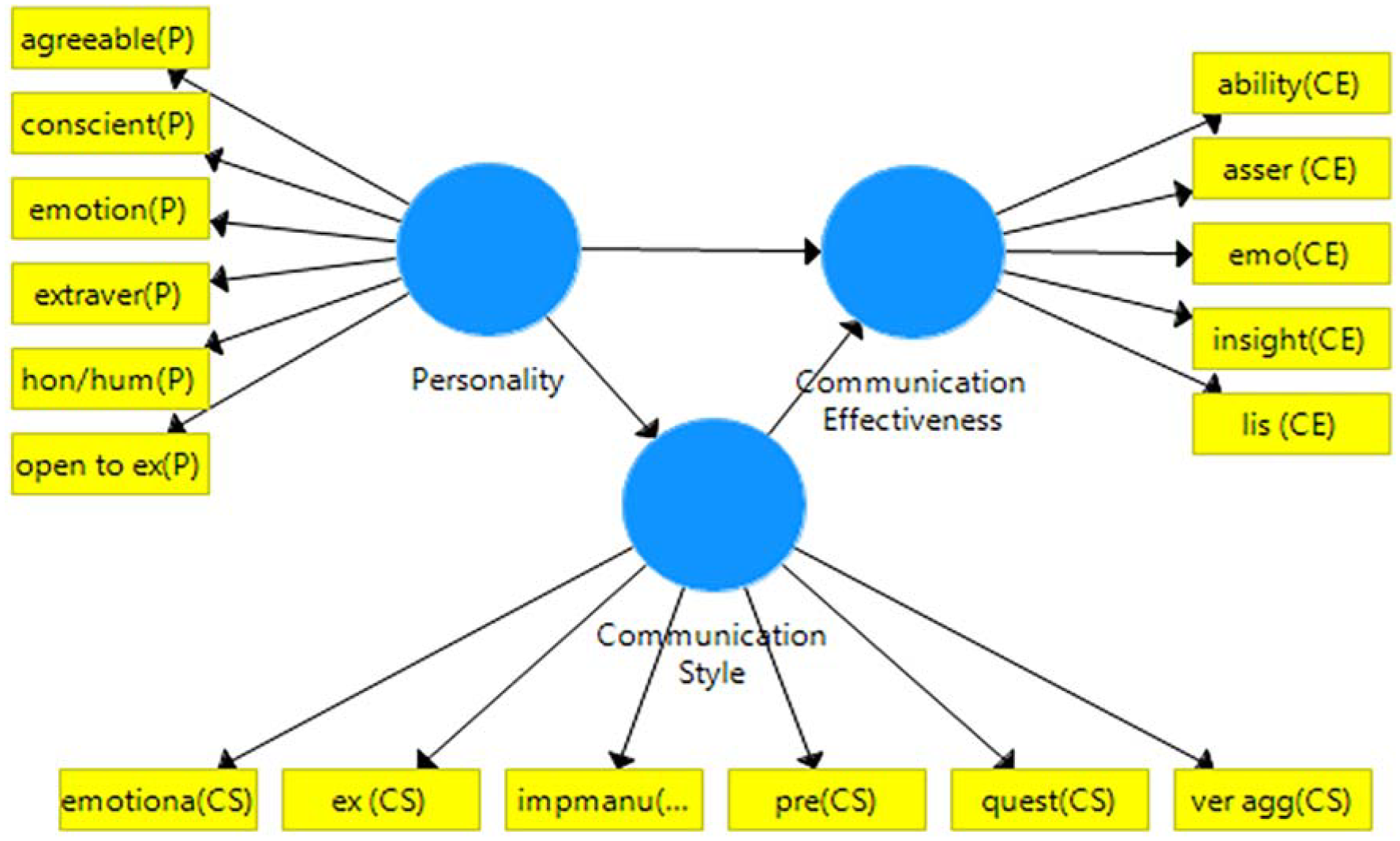
Hypothesized model of the relationship between Personality and Communication effectiveness.
Research Methodology
The current research employed a quantitative research method using descriptive, cross-sectional, and exploratory design to analyze the influence of teachers’ personality traits on their CE and the mediating role of their CS. If there is some lucidity about the problems’ nature; descriptive research is carried out to supply precise information concerning the problem (Zikmund, 2000). A cross-sectional study was carried out that is, the data was collected at a single point of time from the higher educational institutions of India.
Participants
The study has been based on faculty from higher educational institutions from India’s north region. They were divided into groups based on their gender, age (25–60 years), work experience (5–30 years), and specialization of the subject. To begin with, the questionnaires were sent out to 500 academicians. An email which contained the questionnaire’s URL was sent to respondents, they voluntarily participated in the research by filling the questionnaire. The preliminary rate of response was very low, 3 weeks later, another mail was sent to solicit responses. This followed another reminder requesting those who had not responded to fill in the questionnaires. On the whole 250 (120 females and 130 males) complete and valid, usable responses were received to our solicitations. The sample comprised of 20% professors, 32% associate professors, and 48% assistant professors, based on the distribution of academics. In terms of subject specialization, 47% of respondents were teaching technical subjects whereas 53% of participants had non-technical specialization.
Measures and Procedure
To assess personality, 60 items of HEXACO Personality Inventory-Revised (M. Ashton & Lee, 2009) was employed. The HEXACO-PI-R (agreeableness, conscientiousness, honesty-humility, emotionality, extraversion, and openness to experience) measures six domains of personality and there is an additional interstitial facet called altruism (Table 1). Six scales include 10 items which together include broad array of content; it has minimum two items which represent all four narrow traits of six major scales of HEXACO-PI-R. Response to all the statements was given by the participant on a 5-point Likert scale ranging from 1 = strongly disagree to 5 = strongly agree.
HEXACO-PI-R.
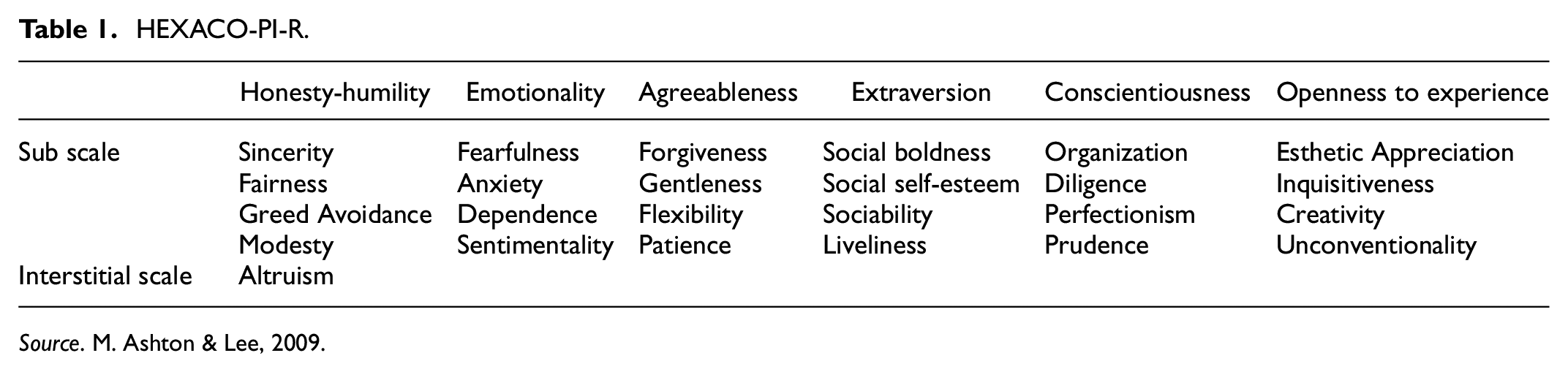
Source. M. Ashton & Lee, 2009.
CS was measured by employing a modified version of CSI (Communication Styles Inventory), which has its roots in lexical research on communication styles (de Vries et al., 2009). The survey instrument was modified to suit the sample, classroom setting, teachers’ interaction with the students and the objective of the study. CSI was chosen as it has been validated to measure for CS (de Vries et al., 2013), and it also has trait-based and dimensional aspects that focus on the senders’ behaviors during communication (de Vries et al., 2013), it was also shaped with its basics in the five-factor model as well as HEXACO personality models. Six domain-level communicative behavior scales: Aggressiveness, Emotionality, Expressiveness, Impression Manipulativeness, Preciseness, and Verbal Questioningness are distinguished in CSI (Table 2). The CSI framework, further encompass four supplementary facets for all the traits. The scale comprised of 48 items (Each component of CS had eight items). Five Point Likert-type scale was used to answer all the items of instrument as it was rational to presume that views of the faculty can range from most of the time to almost never. The proposed answers were—Most of the time, Quite often, Sometimes, Rarely, Almost never.
Communication Styles Inventory.

Source. de Vries et al., 2013.
Communication effectiveness (Table 3) was measured using a modified version of Kevin Loy’s (Loy, 2006) Communication Effectiveness questionnaire. An effort was made to make all the questionnaire items, lucid, easy, precise, and short
Communication Effectiveness Variables.

Source. Loy, 2006.
The survey instrument was selected and modified after a careful and detailed literature review that was applicable to the sample and the objective of the study. Each sub-scale was connected back to one or more of the research questions. Five Point Likert-type scales were used to measure all the items on the instrument. The proposed responses were Most of the time, Quite often, Sometimes, Rarely, Almost never. A complete analysis of the replies received through questionnaires was done. This approach was adopted as it is helpful for the researchers to receive personalized responses when a series of questions are solicited from the respondents. As a result, the responses can be quantified, which is the postulation for the research (Driessnack et al., 2007).
The reliability of the modified research survey instrument was checked by computing Cronbach’s coefficient alpha for all 48 items of CS and 26 of CE. Keeping up with earlier studies, where the reliability of these scales had been consistently strong, varying from .65 to .88 (Naqvi & Ahmed, 2015; de Vries et al., 2013; Loy, 2006), the internal consistency of CS and CE is robust with alpha values at .706 and .713 respectively.
Method
To confirm the proposed structural model, the study is based on the variance-based “Partial Least Squares Structural Equation Modeling” (PLS-SEM) approach; it’s an exploratory technique using data for testing the relationship amongst latent variables and to examine the path of their relationships in models. “PLS-SEM” is a multivariate analysis technique rooted in series of regular least squares regressions, with advanced levels of statistical control compared to its covariance-based counterpart, particularly for samples that are small in size (Klarner et al., 2013). It is recognized mainly for its noteworthy benefits in behavioral research (Hair et al., 2011) because, it is helpful in comprehending the association between different sets of observed variables (Hair et al., 2013). In addition, “PLS-SEM” is more apposite when the theory is not much developed. Mostly, it is employed in exploratory research for proposed theories (Ravand & Baghaei, 2016; Rönkkö & Evermann, 2013). In order to calculate path model in appraising the results and report them, the study employs Smart PLS 3.2.0 (Ringle et al., 2015). A bootstrapping method was also employed to examine the implications of all the loadings because PLS is non-parametric procedure.
Model Estimation and Result Evaluation
Measurement Model Assessment
Two different types of measurement scales of structural equation modeling are Formative and Reflective. In the formative scale, latent variables are caused by the indicators and they are not exchangeable among themselves (Haenlein & Kaplan, 2004; Petter et al., 2007). On the other hand, in the reflective scale construct drives the indicators, which are interchangeable and are greatly correlated hence their validity and reliability has to be carefully examined (Haenlein & Kaplan, 2004; Hair et al., 2013; Petter et al., 2007). As all the constructs of the model that has been proposed are reflective, thus, the foremost action in the model analysis measurement is to assess reliability and validity for all the constructs. The first stage in assessing SEM is the measurement of models, after that the structural model’s outcomes (Chin, 2010; Henseler & Chin, 2010) and then models are validated (Baghaei & Tabatabaee Yazdi, 2016). The model fitness was calculated according to the item loadings on the latent variables, the Average Variance Extracted (AVE) the Composite Reliability Score, and the Discriminant Validity (Ringle et al., 2010). Loadings that are over 0.70 are considered high, if they are between 0.40 and 0.70 they are believed to be satisfactory, provided if the indicators are removed, it will not increase the reliability of the model (Hair et al., 2011), so variables that had loading above 0.40 were taken into account. “Emotionality” and “Agreeableness” had loadings below 0.40 on personality so they were discarded. Two indicators of CS also had a weight less than 0.40, so indicators above 0.40 were considered, as shown in Figure 2. The AVE and the Composite Reliability Score is considered optimum if it is above 0.50 and0.70 respectively (Hair et al., 2011). The AVE and composite reliability values of personality were 0.573 and 0.811 respectively, AVE of CS was 0.502 and composite reliability was 0.802, for CE AVE was 0.532 and composite reliability values were 0.749. Cronbach’s coefficient alpha calculates the internal consistency of items related to a single trait within a questionnaire (Nunnally, 1978). In the present study, the Cronbach’s Alpha value of all the three variables is above .70 confirming the construct’s measure of internal consistency and reliability (Table 4).
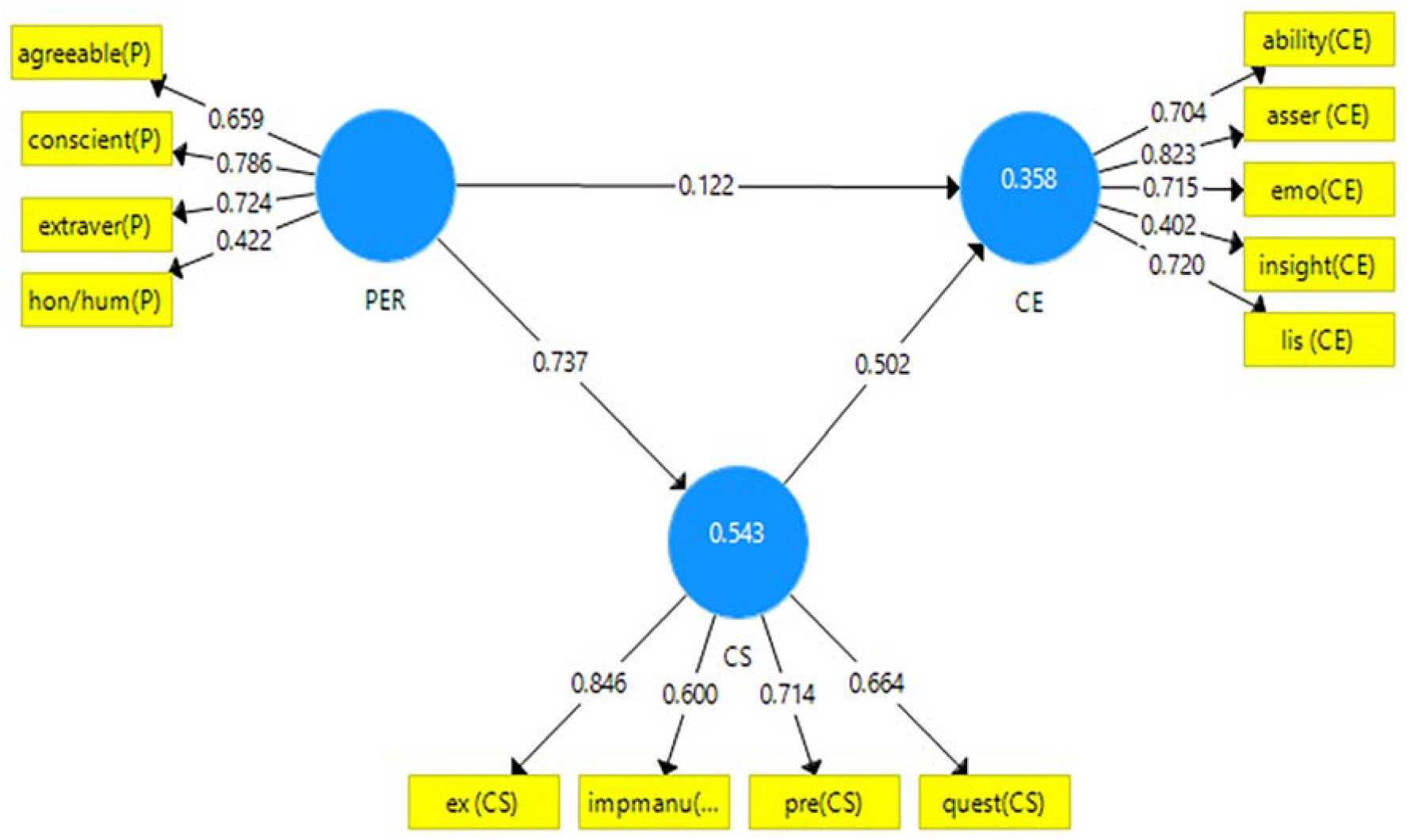
Items loading, path coefficient, and R2.
Measurement Model Analysis.

Source. Authors’ Calculation.
The discriminant validity (cross-loadings) was assessed using Fornell and Larcker (1981). In accordance with the Fornell-Larcker testing system (Table 5), AVE (amount of variance estimated by the construct) and shared variance with the other constructs is compared in order to evaluate discriminant validity. In the matrix in Table 5, off-diagonal values indicate correlations between latent constructs. The outcomes thus state that based on cross-loadings criterion, there is presence of discriminant validity amongst all the constructs.
Discriminant Validity According to Fornell–Larcker Criterion.

Source. Authors’ Calculation.
Table 6 shows variance inflation factor (VIF), the given value proves the existence of multi-colinearity between exogenous variables. If the VIF value is larger than 10, there is the existence of the severe problem of multicollinearity in the model (Hair et al., 1995; P. Kennedy, 1992; Neter et al., 1989). Researchers (Craney & Surles, 2002; Hocking & Pendleton, 1983) have recommended that for large VIFs, the cutoff values range from 5 to 10. Values of VIF that are higher than 5 reveal the presence of multicollinearity in the model and if the value is larger than 10, it indicates a major issue of multicollinearity. There is no issue of multicollinearity in the proposed model as the VIF values of the inner model are lesser than 2. Likewise, the VIF values of the outer model are below 3. In addition, the assessment of structural model contains the significance of the path coefficients with running the bootstrapping method of 5 thousand re-samples (Hair et al., 2011). Only those latent variables, indicators, and paths were engaged in the model which had achieved a 0.05 significance level after Bootstrapping analysis. Evaluation of the measurement model established that the reflective construct is valid and reliable.
Outer and Inner VIF.
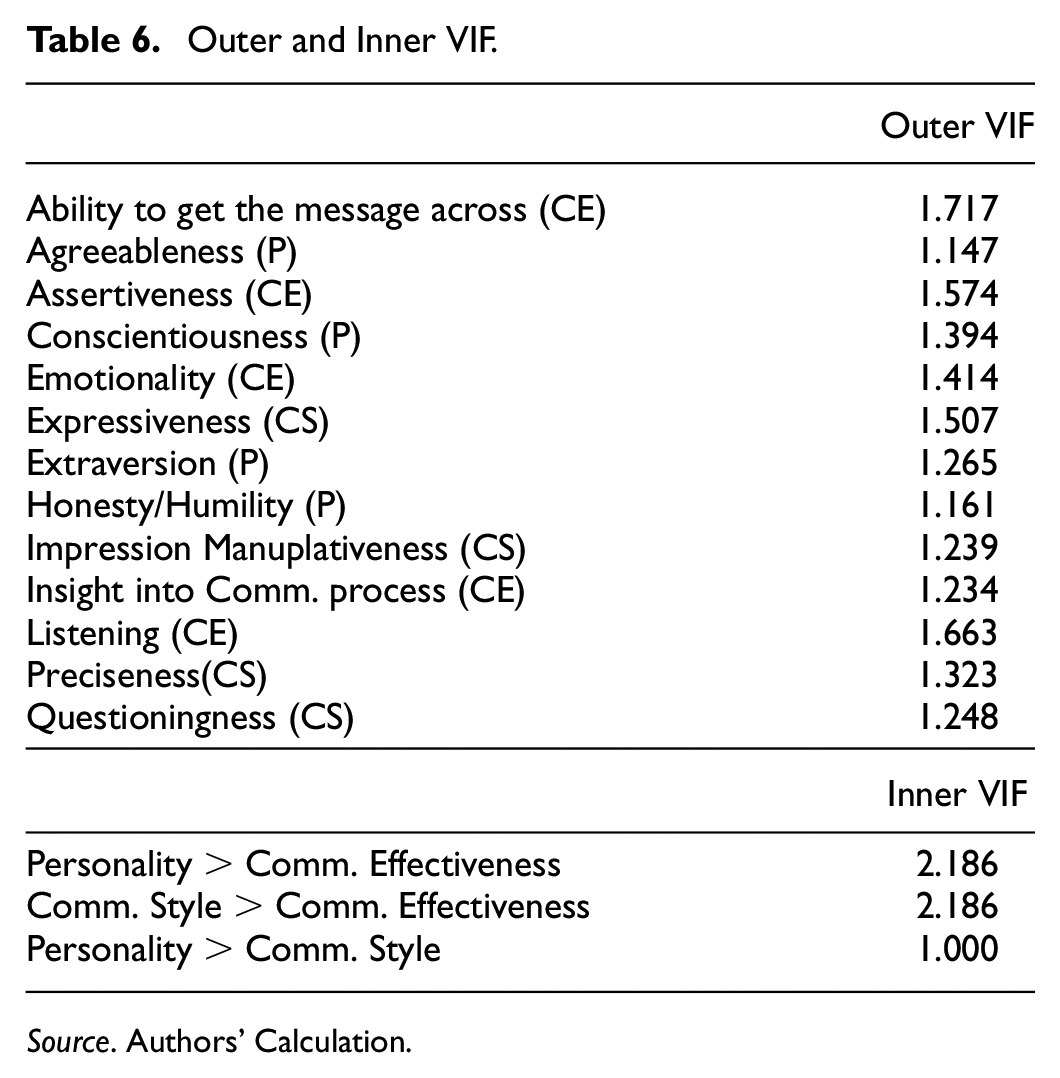
Source. Authors’ Calculation.
Structural Model Assessment
Prior to examining the structural model, the model’s validity and reliability were calculated and established. After that the composite reliability, AVE, and the discriminant validity were assessed in order to calculate reflective measurement models’ outer loadings. The methodology suggested by Hair et al. (2014) for model assessment was adopted. In the first step, the focus was on the direct association between the personality traits of teachers and their CE during classroom teaching, subsequently, a mediator was introduced to develop an independent partial model. In the absence of a mediator, the model estimation with a path coefficient at 0.499 (p = .000) showed that the direct effect was highly significant. The value of R2 (coefficient of determination) for the target construct was .340, confirming the predictive validity of the model (Hair et al., 2014). This result was supported by Stone Geisser’s Q2 value for predictive relevance. On running a blindfolding process with 300 iterations and omission distance of 7, Stone Geisser’s Q2 value of 0.115 was obtained for Communication Effectiveness outcomes, as it was above zero it implied the model’s predictive relevance.
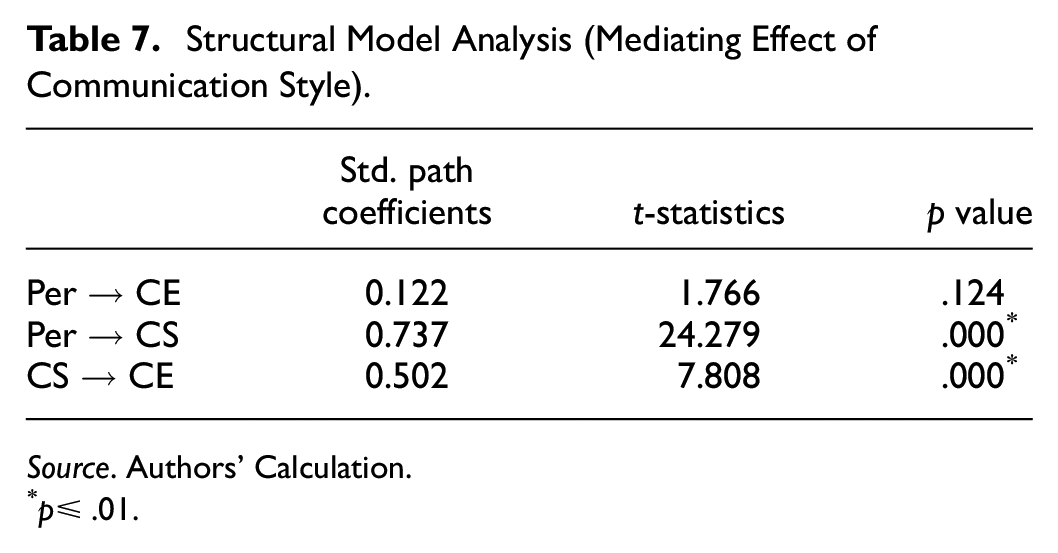
Hereafter, communication style’s role as a mediator was assessed. A bootstrapping procedure was run to verify the significance (“T- statistics”) of path coefficients of the inner model. On using a two-tailed t-test at a 5% significance level, the path coefficient is significant if the T-statistics is higher than 1.96. Figure 2 and Table 6 show the results which explicitly indicate that the communication style mediates the relationship between the personality of the teachers and their communication effectiveness during their classroom teaching. The indirect path coefficients (Table 7) 0.737 (p-value .000) and 0.502 (p-value .000) are highly significant whereas direct path coefficient 0.122 (p-value .073) has been rendered non-significant. As seen in the first step, the direct impact of independent variable Personality traits on dependent variable CE was highly significant (0.499 p value = .000). But when the mediator (CS) was introduced the direct impact become non-significant thus there is full mediation of CS.
Structural Model Analysis (Mediating Effect of Communication Style).
Source. Authors’ Calculation.
p≤ .01.
In addition, Table 8 highlights that coefficient of determination (R2) value of the main construct is 0.353, authenticating the predictive validity of the model and fulfilling the mediation criterion (Hair et al., 2014). Employing the blindfolding procedure, 0.158 Stone Geisser’s Q2 value was obtained for the construct, signifying the predictive relevance of the path model.
Predictive Accuracy and Predictive Relevance of the Model.

Source. Authors’ Calculation.
To establish as to what extent the indirect effect of the mediator absorbs the direct effect (Sarstedt et al., 2014), we calculated VAF (variance accounted for) for the model by employing the given formula:

The VAF value (0.751) was much higher than 0.20, the threshold value (Hair et al., 2014), highlighting a vital role of Communication Style as a robust mediator in the relationship between teachers’ communication effectiveness and their personality traits during their classroom teaching.
Discussion and Conclusion
In this study, an endeavor was made to analyze (Table 9) the extent to which the personality traits of faculty influence their CE during their classroom interaction with students and to what extent their CS mediates the association between personality and style. To this end, a model was projected and tested using PLS-SEM, based on available literature. The results point to a considerable mediating effect of CS on the correlation between personality and CE. The direct effect of the personality traits and CE, even though positive becomes insignificant, this shows that to a major extent the influence of personality traits on CE is explained by the CS of the teachers. It is harmonious with the findings of the research by De Vries et al. (2011) highlighting that personality trait expresses itself in diverse ways, concluding that an individual communication with others is dependent on how he/she behaves in particular. Teachers’ teaching effectiveness is influenced by their personality traits and their personality is a significant determiner of their styles while teaching (Safarie & Tarlani-aliabadi, 2014) and further, the style of teachers has a considerable effect on their communication and teaching effectiveness while interacting with their students in a classroom setting (Dhillon & Kaur, 2021). Individuals’ way of communication and their ability to successfully lead others can be influenced by their personality and it plays a major role in developing an individual’s communication competence (Berne, 2011; Grant et al., 2011; Layton, 2013; Teven et al., 2006).
Results of Hypotheses Testing.

The outcomes of the current research as shown in Figure 3, keeping up with earlier research literature highlight that personality trait “Conscientiousness” and “Extraversion” with loading at 0.782 and 0.762 respectively emerged as a significant predictors leading to improved communication effectiveness of the teachers. The impact of “Agreeableness” and “Honesty-Humility” is also significant but with low loading at 0.699 and 0.422 respectively. The outcomes are congruous with a large body of evidence connecting conscientiousness-related measures to the performance of the employees and their retention across professions. Individuals who have a higher level of conscientiousness are aligned to being achievement-focused, extremely accountable, and organized resulting in the successful completion of tasks (Barrick & Mount, 1991; John et al., 2008; Salgado, 2003), conscientiousness personality traits of teachers had an affirmative influence on students’ extrinsic and intrinsic knowledge and motivation (Hazrati-Viari et al., 2012; Khalilzadeh & Khodi, 2021). Studies have divulged a considerable positive relationship between conscientiousness and academic performance as well as with teacher value addition and evaluation ratings (Bastian et al., 2017; Conard, 2006; Noftle & Robins, 2007; Wagerman & Funder, 2007). Multiple meta-analyses of teachers delineated that students’ Big Five realms have positive connection with their academic accomplishment, mainly predicted through conscientiousness (O’Connor & Paunonen, 2007; Poropat, 2009; Richardson et al., 2012; van Daal et al., 2014).

Mediation effect of communication style.
The results are in line with earlier studies that extraversion was a confirmatory characteristic of teachers and their assertive behavior correlated with several dimensions of professional performance (Clayson & Sheffet, 2006; Emmerich et al., 2006; Ionescu, 2013). Students preferred teachers who had traits of agreeableness, conscientiousness, extraversion, and openness besides there was a positive affiliation between extrinsic and extraversion motivation (Eryilmaz, 2015; Komarraju et al., 2009). Extraversion traits of teachers had a constructive impact on students’ intrinsic-motivation-knowledge and also their thinking and aspiration for self-improvement were positively correlated with extraversion traits of teachers (Khalilzadeh & Khodi, 2021).
CS’s role as mediator revealed that personality traits influenced CE mainly through “expressive” and “precise” styles whereas “verbal aggression” and “emotionality” lowered the effectiveness of teachers while interacting with the students. The role of “Impression Manipulativeness” and “Questioningness” as a mediators is also significant but with low loading at 0.600 and 0.644 respectively. The results concur with study by Bakker-Pieper and De Vries (2013), which observed that both the expressive style as well as the precise style of communicating showed incremental validity when the criteria of leaders were predicted and focused on the significance of communicative behavior of leaders. The expressive style of teachers enhanced their immediacy with students’ needs, which further improved student-teacher relationships. Expressiveness (enthusiastic) not only focused on the content of the message, rather it had a much stronger impact on the outcomes (Awamleh & Gardner, 1999; Giles et al., 2012). “Conscientiousness” and “Extraversion” personality traits with the strong mediating impact of “Expressiveness” and “Preciseness” facilitate teachers to have better control of the classroom as well as enhanced the effectiveness of their performance. Expressiveness encompasses the characteristics of extraversion personality trait and extraversion exhibit a considerable positive relation with preciseness. Extraversion personality trait predicted expressiveness whereas Conscientiousness had high chances of having preciseness (Naqvi & Ahmed, 2015; De Vries et al., 2011).
It is evident from above discussion that for teachers’ CE during their classroom teaching is significantly influenced by their personality and their CS plays a very major role to mediate between their personality traits and classroom effectiveness. The study also identifies “Conscientiousness” and “Extraversion” as significant predictors resulting in enhanced communication effectiveness of teachers through their “expressive” and “precise” styles of communication, which lead to pedagogical efficiency and communication effectiveness during their classroom teaching. Conscientiousness and extraversion traits of instructors enhanced their knowledge-sharing attitude and students’ knowledge accumulating behavior. The characteristics of CE of teachers can be understood by evidence-based frameworks as the HEXACO and CSI which can assist the expansion of theory and its refinement. Good teaching involves communication and building relationships with students, thus it is imperative to encourage effective communicative interactions between instructors and students leading to improved interpersonal relationships between them and bringing about excellence in education. Communicative competency is indispensable to develop an interpersonal affiliation with students and society on the whole (Codina, 2004). Classroom environment and students’ learning and understanding are influenced by teachers’ style of teaching and their personality traits, thus they should be incorporated when conceptualizing the effectiveness of teachers and schools. The results of the current study have implications for academicians’ pedagogical practices, mainly concerning their effectiveness, professional enhancement, and subsequently in the evaluation of their academic success. Even though personality types and CSs of teachers have been an inevitable topic of discussion but the relationship between personality traits and CS with effectiveness has relatively been an underexplored area. The relationship established amongst the personality traits, CS, and CE of teachers will give a unique direction to the teaching profession and will amplify students’ class participation, academic performance, and social skills.
Limitations
The study had a limited research setting as it was conducted in selected institutions of India that confines the scope to which the outcomes can be generalized. Secondly, the current research was cross-sectional, thus the relationships which have been presented may not replicate a complete picture. Therefore, there is a need to explore this relationship based on longitudinal information gathered from academic institutions all over. The study considered a single variable, “personality traits of the teachers,” as an antecedent to the variable “communication effectiveness” in the model. Although it has a noteworthy influence on the teachers’ effectiveness, it cannot be the only determinant. Additional parameters such as cultural setup, institutional characteristics along subject area and course content can also have a vital impact on the communication effectiveness of teachers. Keeping in view these limitations, future research of this kind should be conducted with participants from colleges and universities across the world to authenticate the results. The data collection was constrained to teachers based on self-report questionnaires; future research should involve students for measures that involve direct observation, to understand the effect of personality traits of teachers on their CS leading to their effectiveness in the classrooms.
Footnotes
Declaration of Conflicting Interests
The author(s) declared no potential conflicts of interest with respect to the research, authorship, and/or publication of this article.
Funding
The author(s) received no financial support for the research, authorship, and/or publication of this article.
