




Abstract
Trade shows as temporary clusters have gained attention in corporate innovation research, yet their specific mechanisms remain underexplored. This paper examines the relationship between temporary clusters, knowledge transfer, and corporate innovation using the China International Sport Show as a case study (N = 368 exhibiting companies). Through questionnaire surveys and structural equation modeling (SEM), the study found that temporary clusters create a “global buzz” information exchange ecosystem comprising global co-presence, face-to-face interaction, observation, focused communities, and multiplex meetings and relationships. These elements significantly enhance knowledge transfer between participating enterprises and other knowledge entities, which subsequently promotes corporate innovation. Results confirm knowledge transfer’s mediating role between temporary clusters and corporate innovation. This study advances existing literature by decomposing temporary clusters into constituent elements and empirically validating each component’s discrete effects on knowledge transfer and corporate innovation. Drawing on evidence from China’s sports industry, the research provides systematic insights into temporary cluster mechanisms and their role in facilitating inter-organizational knowledge transfer and innovation outcomes. The findings offer both theoretical contributions to the temporary clusters literature and practical implications for innovation-oriented enterprise development strategies.
Keywords
Introduction
In the knowledge economy era, knowledge surpasses labor and capital as the primary production factor, becoming a crucial resource for social development and a revolutionary force driving industrial innovation and economic growth. Consequently, inter-organizational knowledge transfer has become a vital means for companies to gain competitive advantages (Segarra-Ciprés et al., 2012). While traditional industrial clusters have long served as crucial platforms for inter-firm knowledge exchange, their inherent limitations—including extended growth cycles, knowledge lock-in effects, and innovation inertia—have prompted scholarly attention toward alternative clustering mechanisms (Li & Wei, 2018; Wan & Hu, 2018). Temporary clusters, exemplified by international trade shows, have emerged as significant venues for knowledge transfer and innovation facilitation. Maskell et al. (2006) demonstrated that temporary industrial clusters enable rapid convergence of geographically dispersed firms for intensive knowledge exchange activities, allowing participants to access new technologies, observe emerging trends, and establish global networks through face-to-face interactions (Bathelt & Gibson, 2015; Bathelt & Zeng, 2014; Comunian, 2017; Ramirez-Pasillas, 2008; Shan et al., 2014; Zhang et al., 2023). Additionally, these engagements help cluster enterprises overcome challenges such as long growth cycles, knowledge lock-in, and innovation inertia (Zhang & Gu, 2023), facilitating the continuous evolution and upgrading of industrial clusters based on ongoing knowledge renewal.
However, existing research on temporary clusters exhibits notable limitations. Current studies predominantly focus on manufacturing sectors in developed economies, with limited investigation of temporary clusters in non-manufacturing industries, particularly within emerging markets like China. While few studies have examined Chinese trade fairs’ impact on knowledge transfer (Shan et al., 2014; Zhu & Zeng, 2017; H. Zhu et al., 2018; Y. Zhu et al., 2020), these investigations have primarily concentrated on technology-intensive or creative industries, leaving significant sectoral gaps unexplored. The sports industry represents a particularly compelling yet understudied context. As an emerging sector in China’s economic development, the sports industry demonstrates unique characteristics—encompassing both goods and services, emphasizing experiential engagement, and utilizing sporting events as attraction mechanisms—that distinguish it from traditional manufacturing contexts. These distinctive features warrant specific investigation of temporary cluster dynamics within this sector.
This study addresses the identified research gap by examining knowledge transfer mechanisms and innovation outcomes within China’s sports industry temporary clusters. Taking the China International Sport Show as the empirical context, the research employs Structural Equation Modeling to investigate the pathways through which temporary clusters facilitate inter-organizational knowledge transfer and corporate innovation among participating enterprises. The study contributes theoretically by extending temporary cluster theory to non-manufacturing contexts in emerging markets, while providing practical insights for sports industry stakeholders and trade fair policy development. The findings offer strategic guidance for enterprises seeking innovation-driven development and inform broader understanding of temporary clusters’ role in knowledge-based economic growth.
Literature Review
Basic Concepts of Temporary Clusters
Maskell et al. (2006) first introduced the concept of temporary clusters in their study of international trade fairs. They argued that international trade fairs gather core personnel from companies with similar or complementary capabilities and related interests, forming unique and temporary clusters. These fairs serve as crucial platforms for information exchange and relationship building, facilitating information dissemination, network establishment, and the generation of new ideas. These characteristics align closely with those of permanent industrial clusters. Specifically, the networks at international trade fairs involve both horizontal and vertical connections within the value chain (Bathelt & Schuldt, 2008a, 2008b; Maskell et al., 2006; Rosson & Seringhaus, 1995; Shan, 2014; Zhong & Luo, 2018). Vertically, participating companies can exchange information on future product demands and market trends with suppliers and customers from around the world. This fosters innovative thinking, strengthens relationships with customers and suppliers, and facilitates collaborative agreements. Horizontally, participating companies can systematically examine competitors’ exhibits, sales strategies, and customer responses to competitors’ products, assisting businesses in clarifying market positioning and understanding market trends. Furthermore, through regularly held trade exhibitions and conferences, potential partners can better understand each other, thereby establishing a certain level of trust. Moreover, initial contacts may gradually evolve into strong and enduring partnerships. Based on this, Maskell et al. (2006) argue that these temporary human gatherings, cyclical socio-economic behaviors, and specialized international gatherings with organizational proximity, due to possessing knowledge exchange mechanisms similar to permanent industrial clusters, can be termed “temporary clusters.”
Temporary clusters specifically refer to short-term economic activity clusters that emerge in a particular region under the organization of specific institutions. These clusters consist of enterprises from various countries or regions, engaged in similar or related industries and of different sizes, aiming to extend their business networks and enhance industry visibility through brief periods of information exchange and knowledge transfer (Bathelt & Schuldt, 2008b). Temporary clusters encompass economic productive cross-border activities such as network analysis studios, global business travel, transnational knowledge groups, and international trade fairs (Bathelt & Schuldt, 2008b). In these brief business gatherings, companies not only prioritize reaching sales contracts but also focus on maintaining existing or potential relationships. Additionally, they value information exchange and knowledge sharing to address current issues, prioritize seeking innovative ideas, and emphasize summarizing industry development trends (Shan, 2014).
Research on Temporary Clusters and Knowledge Transfer
Currently, economic geographers consider international trade fairs as temporary industrial clusters. Research on temporary industrial clusters and knowledge transfer mainly includes three aspects: First, demonstrating the knowledge transfer function of temporary industrial clusters; second, analyzing the patterns of knowledge transfer in temporary industrial clusters; and third, identifying the influencing factors of knowledge transfer in temporary industrial clusters.
In discussing the knowledge transfer function of temporary industrial clusters, Liu et al. (2013) believed that temporary industrial clusters serve as vital intermediaries linking information flow between different clusters. Rinallo and Golfetto (2011) pointed out that trade fair organizers facilitate information exchange and knowledge flow between exhibitors and buyers. Maskell et al. (2004) argue that trade fairs, as temporary clusters, promote the processes of knowledge creation and dissemination. Bathelt and Spigel (2012) pointed out that international exhibitions, through globally distributed industrial agglomerations, help companies systematically acquire knowledge and industry dynamics from competitors, suppliers, and customers, serving as a long-term knowledge channel among enterprises. Luo and Zhong (2016) based on empirical research on Chinese exhibitions, demonstrated that exhibitions function as platforms for knowledge flow. Cortez (2022) emphasized that trade exhibitions are important platforms for collecting information about customers, industry trends, technology, new markets, and supply chains. Schuldt and Bathelt (2011) believed that trade fairs gather business entities from different regions of the world in a short period. Zhang et al. (2023) pointed out that exhibitions serve as temporary hubs stimulating the processes of knowledge creation and dissemination. Henn and Bathelt (2023) identified four primary mechanisms for knowledge generation and learning in trade fairs and business conferences, which include feedback and problem-solving, improvement of existing products and development of new ones.
When analyzing the patterns of knowledge transfer in temporary industrial clusters, relevant studies mainly fall into two camps. One camp focused on the vertical knowledge dissemination between suppliers and buyers (Borghini et al., 2006; Ling-Yee, 2006). However, the other camp argued that the former overlooks peer interactions, suggesting that exhibitions function as interconnected exchange networks among businesses, with knowledge exchange stemming from both horizontal and vertical dimensions of the value chain (Bathelt & Schuldt, 2008a, 2008b; Maskell et al., 2006; Rosson & Seringhaus, 1995; Shan, 2014; Zhong & Luo, 2018). Vertical interactions refer to exchanging information with suppliers and customers about the latest market trends, experiences, new products, and expert insights, while horizontal interactions involve observational interactions with competitors (Shan et al., 2014).
Additionally, in terms of factors influencing knowledge transfer in temporary industrial clusters, the relevant literature is relatively limited, mainly focusing on four aspects: transfer agents, transfer content, transfer context, and transfer media. Regarding transfer agents, researchers primarily focused on the sender’s willingness and capability to transmit knowledge, as well as the receiver’s ability to absorb it (Lin, 2020). Regarding transfer content, relevant studies primarily investigated the impact of the tacit and complex nature of knowledge on the effectiveness of knowledge transfer (Lin, 2020). In the aspect of transfer context, relevant studies have focused on exploring the influence of knowledge distance and relational distance on knowledge transfer (Lin, 2020). In terms of transfer media, observing and inspecting these products becomes one of the key ways for professional audiences to acquire the latest knowledge (Nonaka, 1994; Reychav, 2009; Zhong & Luo, 2018). Additionally, forums, conferences, booth discussions, and evening receptions offer exhibiting companies diverse opportunities for face-to-face knowledge exchange.
Research on Temporary Clusters, Knowledge Transfer, and Enterprise Innovation
Currently, research on the factors influencing corporate innovation primarily revolves around perspectives of organizational structure, resources and capabilities, management and culture, market environment, and institutional environment (Jiang et al., 2021; C. Li et al., 2023; Moradi et al., 2021). Only a few studies have focused on the impact of temporary industry clusters on enterprise innovation. Bathelt and Zeng (2014) found that trade fairs can promote innovation and industrial upgrading through knowledge exchange. Ramirez-Pasillas (2008) believed that companies obtain and analyze knowledge from outside the cluster through trade fairs, which plays a significant role in innovation. Shan et al. (2014) used the China International Industry Fair as a case study and combined qualitative interviews with structural equation modeling (SEM) to study the knowledge flow generated in exhibitions and its impact on enterprise technological innovation. H. Zhu et al. (2018) investigated whether international exhibitions in the creative industry contribute to innovation in emerging economies. They found that temporary clusters play a significant role in knowledge dissemination and innovation by creating global buzz (H. Zhu et al., 2018). Zhu and Zeng (2017) analyzed the learning and innovation processes of exhibitors in exhibitions based on a three-tier path model of “object-action-effect.” Using the China International Industry Fair as a case study, they tested the effectiveness of this path in China. Zhu et al. (2020) combined patent cooperation network data from the Shanghai equipment manufacturing industry with data from the Shanghai Metalworking CNC Machine Tool Exhibition to study the role of trade fairs in local innovation knowledge networks.
Research Gaps
Overall, most studies primarily focus on exploring the significant role of temporary clusters in knowledge transfer. There is a limited amount of research that further investigates the relationship between temporary clusters and enterprise innovation. Moreover, these studies mostly concentrate on industries with high technological or creative intensity. Research related to different industries still needs to be enriched and supplemented. Furthermore, most studies on temporary clusters, knowledge transfer, and enterprise innovation focus on direct communication and indirect observation to demonstrate the impact of face-to-face interactions and observations during exhibitions on knowledge acquisition. The deconstruction of the global buzz information exchange ecology during temporary cluster periods is not sufficiently comprehensive and systematic. Based on this, this paper takes the China International Sport Show as an example to explore the relationship between temporary clusters, knowledge transfer, and enterprise innovation from the perspective of global buzz. It provides valuable supplements to existing research in terms of research perspectives and content and offers evidence from the Chinese sports industry to further confirm the significant role of temporary clusters in knowledge transfer and enterprise innovation.
Research Hypotheses
Temporary Clusters and Knowledge Transfer
The characteristic of temporary industry clusters represented by international trade fairs is the formation of specific communication and information patterns among exhibitors, visitors, and experts (Maskell et al., 2004). Bathelt and Schuldt (2010) refer to this specialized information and communication ecology as “global buzz.” The concept of “global buzz” is similar to descriptions of “local buzz,”“local broadcasting,”“noise,” and Marshall’s “industrial atmosphere,” referring to a specialized information communication ecology. It typically occurs in international professional gatherings such as exhibitions, conferences, meetings, and other similar events, composed of elements like global co-presence, face-to-face interactions, observation, focused communities, and multiplex meetings and relationships (Bathelt & Schuldt, 2010). It is precisely because international trade fairs possess this “global buzz” information exchange ecology that they promote the transfer of knowledge between exhibiting enterprises and other knowledge entities.
Global Co-Presence and Knowledge Transfer
Co-presence’ is used to describe the spatiotemporal proximity relationship between people where they are mutually perceived, accessible to each other, and belong to each other (Goffman, 1963). The “global co-presence” at international trade fairs refers to bringing together companies from both upstream and downstream of the global industry chain, forming a gathering of global suppliers, manufacturers, users, retailers, experts, media representatives, and other stakeholders (Bathelt & Schuldt, 2010). Being present in this specific space allows for temporary geographical proximity among these entities (Shan, 2014). Moreover, participants, away from their daily workplaces, have dedicated time not shielded by specific tasks and possess a strong dedication spirit. They can focus on activities held over several days during the exhibition (Bathelt & Schuldt, 2010; Blythe, 2002), exchanging information about exhibits, technologies, and future industry trends, creating a unique atmosphere for exploring the latest knowledge and industry experiences. It’s not just physical co-presence but also emotional co-presence.
Co-presence creates conditions for deep communication, reduces communication costs, and greatly assists in knowledge transfer, especially tacit knowledge transfer (Yu et al., 2006). On one hand, during international trade fairs, the global co-presence of specialized companies in specific value chains creates a unique environment for the exchange of experience, information, and knowledge within clusters (Bathelt & Turi, 2011). Being present in this specific space allows for temporary geographical proximity among entities, facilitating face-to-face exchanges of products, sharing experiences, and discussing industry trends (Shan et al., 2015). Studies have shown that the communication within this field is more intense and diverse than what can be expected in daily work situations (Bathelt & Schuldt, 2008a). From the perspective of exhibiting companies, such communication may include discussions on business transactions with customers and suppliers, general conversations about the nature and development of the industry with interested agents, possibilities for problem-solving or improvement, and negotiations with long-term clients from around the world (Bathelt & Schuldt, 2010). On the other hand, the communication atmosphere in this environment is more relaxed and emotionally focused, which is conducive to knowledge exchange and transfer between enterprises. Exhibitors and visitors are away from their daily workplaces, focusing on exploring the development level of industry technology, without the distraction of handling daily administrative affairs. They are usually mentally relaxed, hence more open-minded toward new ideas and technologies, and willing to critically compare their industrial practices with those of other companies (Borghini et al., 2006; Shan, 2014). Therefore, such an environment is highly beneficial for both parties to exchange experiences and discuss new solutions (Schuldt & Bathelt, 2011). Based on the above analysis, this paper proposes the following hypotheses:
Face-to-Face Interaction and Knowledge Transfer
During international trade fairs, exhibiting companies gain numerous opportunities for face-to-face interaction and engagement with other exhibiting entities through booth visits, attending opening ceremonies, concurrent meetings, and various events. Reviewing relevant literature, economic geographers have emphasized the importance of temporary face-to-face (F2F) contacts in the processes of knowledge creation and transfer (Grabher, 2002; Norcliffe & Rendace, 2003; Storper & Venables, 2004). Specifically, first, face-to-face communication contains crucial non-verbal cues that make the transfer of complex information and knowledge possible (Bathelt & Turi, 2011). Second, face-to-face exchanges allow for additional important inputs to be grasped by observing the other party’s facial expressions and gestures, reducing information asymmetry between both parties and thereby enhancing mutual trust (Maskell et al., 2006). Third, face-to-face interactions assist exhibitors in evaluating potential future partners, reducing the risks of interactions (Jones, 2007).
Therefore, face-to-face meetings and negotiations at international trade fairs allow companies to systematically acquire and filter information and knowledge about competitors, suppliers, customers, as well as their technological and strategic choices. They can also promptly receive feedback from the demand side, prevent distortion in knowledge transfer, and make the transfer of knowledge more effective (Borghini et al., 2006; Reychav, 2009). Based on the above analysis, this paper proposes the following hypothesis:
Observation and Knowledge Transfer
International trade fairs attract top industry professionals from around the world, providing exhibitors with abundant opportunities for observational learning (Blythe, 2002; Borghini et al., 2006). Exhibiting companies can carefully observe other exhibits, engage in peer observation, and “become part of the crowd” to observe the reactions of other attendees (Bathelt & Schuldt, 2008a; Blythe, 2002). These observations offer excellent opportunities for collecting various ideas and knowledge, thereby refining their existing development strategies (Borghini et al., 2006; Nonaka, 1994). Specifically, first, by observing the frequency and reactions of visitors at different booths, companies can gain initial insights into their attitudes toward products and thereby gauge consumer preferences. Second, new knowledge and ideas are embedded in new products (Zhong & Luo, 2018). Through observing and comparing the new products of exhibiting companies, exhibiting companies can understand the company’s broader concepts (Bathelt & Schuldt, 2008a) and capture new signs to learn about the latest market trends (Zhong & Luo, 2018). Third, by observing the interactions between competitors and customers, exhibiting companies can understand their sales tactics. Overall, participants can achieve knowledge transfer in product information, company concepts, consumer preferences, and industry development trends through the observation process. Based on the above analysis, this paper proposes the following hypothesis:
Focused Communities and Knowledge Transfer
Focused communities refer to the intersection of Communities of Practice and epistemic communities. Community of Practice is an informal group formed spontaneously by employees for knowledge sharing (Brown & Duguid, 1991; Etienne, 1998). Members of such communities gather around specific topics and join based on a shared interest in sharing experiences and knowledge. Their cohesion stems from a common professional knowledge and shared interests (Brown & Duguid, 1991; Etienne, 1998). Members exchange ideas and share knowledge informally, fostering feelings of connection and trust among members, which promotes friendship, group belonging, and cohesion, developing a value system and shared vision conducive to knowledge sharing. Thus, members of Communities of Practice often have similar knowledge bases, shared visions for knowledge sharing, and mutual trust. Epistemic communities refer to groups of professionals recognized for their abilities in a specific field (Haas, 1992). Participants in epistemic communities are typically heterogeneous, connected through joint group activities. They share common cognitive frameworks (Lars, 2005) and have mutual trust built on reputation and proprietary knowledge (Rycroft & Kash, 2004).
At international trade fairs, there is a cross-mixing of epistemic communities and Communities of Practice (Bathelt & Schuldt, 2010). Exhibiting companies, governments, industry associations, and university experts from around the world converge at the venue of international trade fairs. Based on common interests, professional knowledge, and target visions, they form various Communities of Practice, participating in forums, conferences, gatherings, and other activities to exchange and share knowledge. Additionally, international trade fairs facilitate the integration of experts globally who possess similar or related skills. Experts with different professional knowledge and technological focuses gather during international trade fairs to form epistemic communities, meeting their respective peer groups and sharing impressions, views, and expectations (Borghini et al., 2006). The cross-mixing of different Communities of Practice and epistemic communities reflects the richness and heterogeneity of knowledge at international trade fairs and a certain level of common knowledge base or cognitive proximity among participants (Nooteboom, 2000), which is of significant importance for knowledge transfer. In particular, firstly, Communities of Practice and epistemic communities can provide venues for discussions, enabling knowledge to diffuse through these discussions (Liu & Xu, 2010). Secondly, within the same Community of Practice or epistemic community, members, based on similar knowledge bases, shared visions, and trust relationships (Brown & Duguid, 2000), help stimulate a more open communication mode than usual situations (Bathelt & Schuldt, 2008a), accelerating information flow and knowledge transfer. This leads to the generation of more creative solutions to problems (Etienne, 1998) and further collective capability development. Thirdly, the cross-mixing of different communities showcases the heterogeneity and richness of knowledge. Different communities focus on different areas, providing diverse and heterogeneous knowledge sources for knowledge transfer. These will play a crucial role in problem-solving, strategic planning, diffusion of best practices, and interpreting significant trends (Bathelt & Schuldt, 2010), and to some extent, this heterogeneity creates opportunities for companies to discover novelties (Shan et al., 2015). Fourthly, while the knowledge contained in different communities is heterogeneous, it all belongs to the same industry. Members of different communities also share a certain level of common knowledge base or cognitive proximity. Thus, members from different communities can support each other’s participation, share skills, and engage in meaningful negotiations based on similar knowledge bases or shared experiences (Etienne, 1998), achieving effective transmission of information and knowledge. This also helps in sparking collective interpretations of new information and extracting valuable knowledge components for future applications (Bathelt & Schuldt, 2010). Based on the above analysis, this paper proposes the following hypothesis:
Multiplex Meetings and Relationships and Knowledge Transfer
International trade fairs offer a rich array of concurrent activities, including leisure events, artistic performances, conferences, forums, and banquets (Blythe, 2002), providing participants with diverse channels to acquire new information and accelerating knowledge transfer (Bathelt & Schuldt, 2010). Moreover, the numerous relationships and personal connections developed during international trade fairs stimulate the flow of knowledge (Bathelt & Schuldt, 2010). These networks of connections encompass vertical, horizontal, and lateral relationship networks, serving as crucial means for individuals to search for knowledge and providing excellent channels for exhibitors to obtain accurate information (Dou & Wang, 2012). These networks represent an intangible asset that sets international trade fairs apart from other platforms and is difficult to replicate. Specifically, vertical relationships encompass suppliers, product manufacturers, and consumers; horizontally, they gather industry competitors and partners; laterally, they include relationships with government, associations, co-exhibitors, and media (H. Zhu et al., 2018). Vertical relationships along the supply chain assist businesses in understanding the latest trends in goods and services and gathering customer demand information (Bathelt & Schuldt, 2010). On the horizontal level, trade fairs offer businesses various opportunities to observe and compare their products and development strategies with competitors. Strong lateral relationships provide exhibitors with quality services for knowledge transfer, enhancing the efficiency of knowledge dissemination. Additionally, they help exhibitors obtain market trend insights from government, associations, and academic professionals. Overall, the multiple relationships and diverse possibilities of conferences at international trade fairs offer agents multiple channels and conveniences to acquire new information. This can facilitate the transmission of clearer and more useful knowledge, speeding up knowledge transfer. Moreover, even after the fair concludes, these trust-based relationship networks can continuously provide access to knowledge from other regions of the world (Bathelt & Schuldt, 2010). Based on the above analysis, this paper proposes the following hypothesis:
Knowledge Transfer and Enterprise Innovation
Knowledge is the wellspring of organizational innovation, and the renewal of organizational knowledge plays a crucial role in driving product or process innovation within companies (Yli-Renko et al., 2001). Moreover, knowledge flow is generally considered by economic geographers as a fundamental form of innovative activity, with the integration and flow of different types of knowledge being key to innovation (Zhu & Zeng, 2017). Therefore, there’s a consensus in academia that knowledge transfer effectively promotes innovation. For instance, Yang and Yang (2008) believed that knowledge transfer provides the prerequisites and foundation for enterprise innovation. The effective transfer of knowledge is pivotal for a company’s innovation and enhancing its competitive advantage (Kogut & Zander, 1992). Zhang (2015) found that knowledge transfer positively influences the innovation performance of alliance enterprises. Adler and Kwon (2002) discovered that the transfer of knowledge and technology between enterprises and partners aids in achieving internal technological innovation. Wang and Wu (2001) pointed out that the key to successful technological innovation lies in the successful transfer and sharing of sticky knowledge within networks. Jiang et al. (2013) found that effective knowledge transfer within clusters promotes cluster innovation. Based on the aforementioned analysis, this study proposes the following hypothesis:
Based on the above hypotheses, the pathway through which temporary clusters promote enterprise innovation is illustrated in Figure 1.

The pathways by which temporary clusters promote enterprise innovation.
Method
This study adopts structural equation modeling (SEM) as the primary analytical methodology. In comparison to conventional regression analysis, SEM enables researchers to examine relationships among multiple dependent variables within a unified analytical framework, making it particularly well-suited for the theoretical model employed in this study, which involves complex interrelationships among multiple latent constructs including temporary clusters, knowledge transfer, and enterprise innovation. In this section, the sample and data collection as well as the measurement of the variables under study are outlined.
Measurements
Based on a literature review, 7 one-dimensional scales were selected to measure our theoretical constructs. Each item was evaluated on a five-point Likert scale (1: “totally disagree”; 5: “totally agree”).
Global co-presence was evaluated on a five-item scale developed by Bathelt and Schuldt (2010): “The exhibition gathered agents from all around the world” (GC1), “The exhibition created a unique and professional communication environment” (GC2), “During the exhibition, there were few interruptions from daily affairs” (GC3), “During the exhibition, critical self-reflection is sometimes conducted” (GC4), “It’s easy to connect with other exhibitors at the exhibition” (GC5).
Face-to-face interaction was evaluated on an five-item scale developed by Bathelt and Schuldt (2010): “Face-to-face interactions during the exhibition can clearly capture each other’s facial expressions, gestures and mimics”(FI1), “Face-to-face interactions during the exhibition can convey complex messages and provide instant feedback”(FI2),“Face-to-face communication during the exhibition can capture diverse information flows”(FI3),“Face-to-face communication during the exhibition allows for permanent evaluation and re-evaluation of news” (FI4), “Face-to-face communication during the exhibition can reduce risks in building future partnerships” (FI5).
Observation was evaluated on a three-item scale developed by Bathelt and Schuldt (2010): “During the exhibition, we can conduct in situ observations, inspect, touch, and experience products and services” (OB1), “During the exhibition, we can observe the reactions of others” (OB2), “During the exhibition, we can observe the behaviors and philosophies of competitors” (OB3).
Focused communities was evaluated on an four-item scale developed by Bathelt and Schuldt (2010): “The exhibition hosts a diverse mixture of communities of practice or epistemic communities” (FC1), “Participants at the exhibition have overlapping or complementary knowledge bases” (FC2), “The exhibition creates a high-quality professional milieu” (FC3), “Collective interpretations at the exhibition can ease individual choices” (FC4).
Multiplex meetings and relationships was evaluated on an four-item scale developed by Bathelt and Schuldt (2010): “Various planned or unplanned meetings with specialists were held during the exhibition” (MR1), “There are tight network of different agents or relationships at the exhibition” (MR2), “There are direct or credible feedback mechanisms at the exhibition” (MR3), “Participation in the exhibition contributes to the development of initial trust based on swift trust” (MR4).
Knowledge transfer includes the acquisition of new knowledge during the exhibition and the application of new knowledge after the exhibition (Shan et al., 2014). Therefore, knowledge transfer was evaluated on an six-item scale developed by H. Zhu et al. (2018) and Zhu and Zeng (2017): “I obtained the latest information on new products or technology at this exhibition at the exhibition”(KR1),“I obtained information about changes in customer demands at the exhibition”(KR2), “I obtained information about new market opportunities at the exhibition”(KR3),“I obtained information about market development trends at the exhibition ”(KR4),“ I gained new insights and inspiration at the exhibition”(KR5),“After the exhibition, the acquired information and knowledge can be applied to business development practices” (KR6).
Enterprise innovation was evaluated on an four-item scale developed by Reverte et al. (2016): “Applying the knowledge gained during the exhibition contributes to the innovation of products or services for the company”(CI1),“Applying the knowledge gained during the exhibition contributes to the innovation of production processes for the company”(CI2),“Applying the knowledge gained during the exhibition contributes to the innovation of marketing for the company”(CI3),“Applying the knowledge gained during the exhibition contributes to the innovation of organizational management for the company”(CI4).
Sample and Data Collection
This text takes the China International Sport Show as a case study. The reasons for the selection include the following three points: First, the importance of the sports industry. The sports industry is a green and sunrise industry in China, playing a positive role in promoting health, enhancing happiness, and fostering harmonious social development. As a result, it has become a new growth point for China’s economic development. Therefore, once the knowledge transfer and innovation value of the International Sport Show are confirmed, it is expected to provide a path for innovative development for sports enterprises, thereby assisting in the high-quality development of China’s sports industry and advancing China’s strategy to become a sports powerhouse. Second, there’s the uniqueness of the sports industry. The China International Sport Show feature both sports goods and services, strong embodied experiential displays, and characteristics of drawing crowds through sports events. Therefore, using sports international trade fairs as a case study allows for examination of both manufacturing and service sectors. Moreover, it can demonstrate the impact of embodied experiential displays and event-driven crowd attraction on knowledge transfer, potentially offering insights from the sports industry to international trade fairs in other industries. Third, the China International Sport Show has significant international influence. The China International Sport Show is a national-level, international, and specialized sports exhibition in China. It is the largest and most authoritative sports event in the Asia-Pacific region. The 40th China International Sport Show held in 2023 featured a series of events including industry summits, industry-specific forums, technical seminars, standard release conferences, investment promotion meetings, brand activities, new product launches, sports events, and experiential activities. These provided diverse avenues and platforms for knowledge transfer for participating enterprises, aligning with the theme of this text and offering rich materials for this study.
The subjects of this study are the exhibitor companies participating in the 2023 China International Sport Show. Questionnaires were distributed through both online and offline channels. On one hand, questionnaires were distributed through online channels. First, the questionnaire was edited through the questionnaire network and the questionnaire link and a QR code was created. Next, questionnaires were distributed through WeChat groups of participating companies or individual WeChat accounts of employees from participating companies. On the other hand, I attended the 40th China International Sport Show in Xiamen, China, from May 25 to 28, 2023. I distributed questionnaires on-site at the exhibition. After 3 weeks, a total of 394 questionnaires were collected, with 368 valid responses. The effective rate reached 93.4%, meeting the sample size requirements for structural equation modeling (SEM) analysis. The sample comprises sports enterprises from across the nation, encompassing organizations of varying sizes and types, which fundamentally reflects the overall characteristics of China’s sports industry. The demographic characteristics of the questionnaire responses are shown in Table 1.
The Demographic Characteristics of the Questionnaire Responses.

Results
Measurement Properties
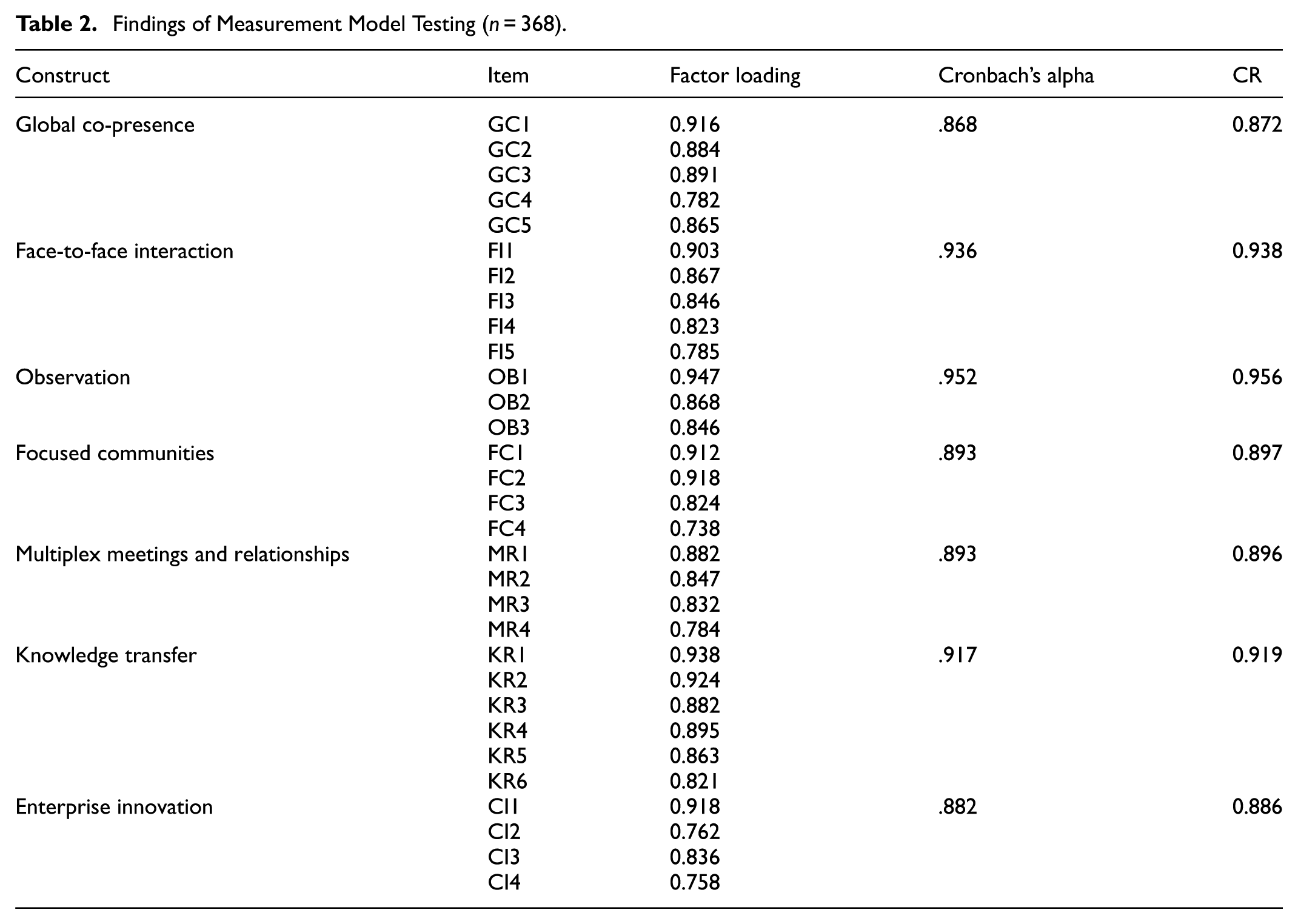
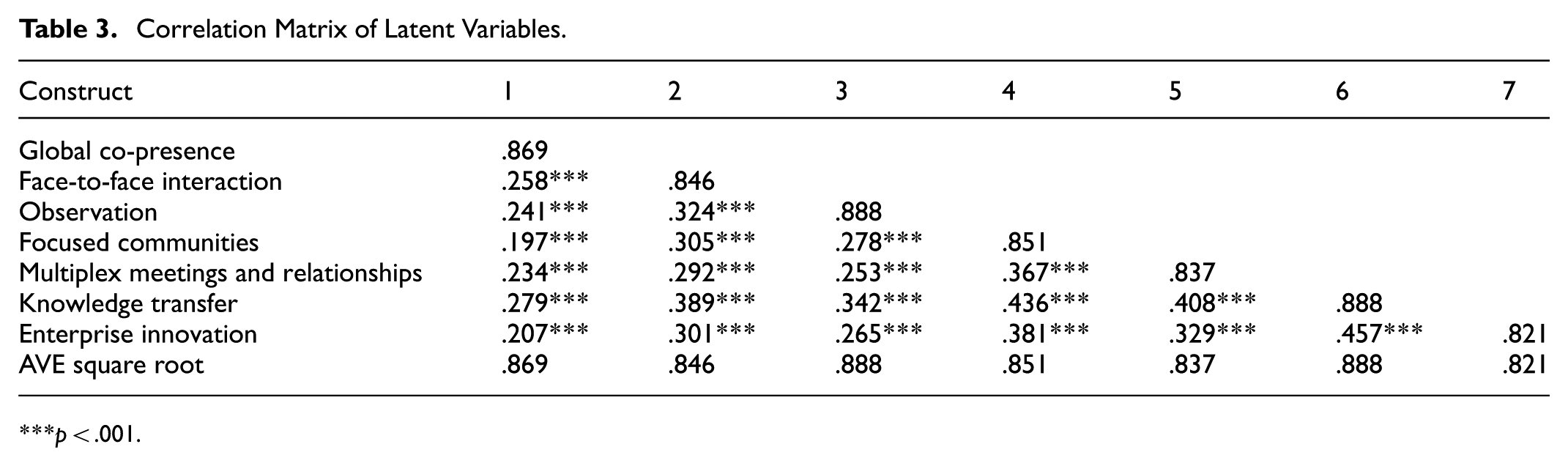
This study conducted a Confirmatory Factor Analysis (CFA) to test convergent and discriminant validity. AMOS28 software was used to perform the CFA on global co-presence, face-to-face interaction, observation, focused communities, multiplex meetings and relationships, knowledge transfer, and enterprise innovation. The measurement results indicate that the factor loadings of all construct items are greater than 0.7 (Table 2), demonstrating that the model shows a good degree of fit. The average variance extracted (AVE) of each construct ranges from 0.67 to 0.79, all exceeding the threshold of 0.50, indicating that all constructs had good convergence validity. Simultaneously, this study compared the square root of the AVE of each construct with the correlation coefficients between each construct and other constructs and found that the square root of the AVE value of each construct was greater than the correlation coefficients between the construct and other constructs. This indicates that the constructs have good discriminative validity (Table 3). Based on the above analysis, the scale used in this study has good convergence validity and discriminative validity.
Findings of Measurement Model Testing (n = 368).
Correlation Matrix of Latent Variables.
p < .001.
Reliability testing was used to assess the consistency of results, measured by Cronbach’s alpha coefficients and composite reliability. We used the SPSS Version 27 to test the reliability of the scale. The results show that the Cronbach’s alphas of global co-presence, face-to-face interactions, observation, focused communities, multiplex meetings and relationships, knowledge transfer, and enterprise innovation are all between .868 and .952 (Table 2), indicating that there is good agreement between the measurement indicators. The composite reliability (CR) value of all variables is greater than 0.87 (Table 2), which shows that the reliability of the internal combination of each variable is good, so the measurement model meets the reliability requirements.
The data were then tested for common method bias. First, the correlation coefficient between variables is tested. The correlation coefficient between all variables is less than the standard of 0.9; Secondly, Harman’s single factor test was used to test the common method deviation of all items. The results are shown in Table 4. The fitting effect of the single-factor model is very poor. χ2/df changes from 2.89 of the original model to 16.27, RMSEA changes from 0.072 to 0.205, NFI decreases from 0.928 to 0.504, and CFI decreases from 0.965 to 0.518. To sum up, there is no serious problem of common method deviation in the data, which is suitable for further analysis and hypothesis testing.
Overall Fitting Coefficient Table (Common Method Deviation Test).

Hypotheses Testing
The hypothesis test results are shown in Table 5. The standardized coefficient of global co-presence on knowledge transfer was 0.312 (p < .001), indicating that the path had a significant positive relationship, supporting H1. The standardized coefficient of face-to-face interaction on knowledge transfer was 0.425 (p < .001), indicating that the path had a significant positive relationship, supporting H2. The standardized coefficient of observation on knowledge transfer was 0.387 (p < .001), indicating that the path had a significant positive relationship, supporting H3. The standardized coefficient of focused communities on knowledge transfer was 0.483 (p < 0.001), indicating that the path had a significant positive relationship, supporting H4. The standardized coefficient of multiplex meetings and relationships on knowledge transfer was 0.394 (p < .001), indicating that the path had a significant positive relationship, supporting H5. The standardized coefficient of knowledge transfer on enterprise innovation was 0.523 (p < .001), indicating that the path had a significant positive relationship, supporting H6.
The Results of Hypotheses Testing.

p < .001.
Bootstrap Mediation Analysis
To examine the mediating role of knowledge transfer, this study employed bootstrap analysis with bias-corrected confidence intervals following Preacher and Hayes (2008). The analysis used 5,000 bootstrap resamples to generate robust estimates of indirect effects with 95% confidence intervals.
The bootstrap analysis revealed significant mediation effects across all relationships (Table 6). All indirect effects were statistically significant with confidence intervals not containing zero. The results demonstrate two distinct mediation patterns: two relationships showed full mediation where knowledge transfer completely mediates the effects of global co-presence (β = .163, 95% CI [0.118, 0.221]) and observation (β = .202, 95% CI [0.149, 0.267]) on enterprise innovation, as their direct effects became non-significant when controlling for the mediator. Three relationships exhibited partial mediation where both direct and indirect effects remained significant for face-to-face interaction (β = .222, 95% CI [0.167, 0.289]), focused communities (β = .253, 95% CI [0.196, 0.318]), and multiplex meetings and relationships (β = .206, 95% CI [0.152, 0.271]). Notably, focused communities demonstrated the strongest mediation effect (β = .253), highlighting the critical role of professional communities in facilitating knowledge transfer and innovation.
Bootstrap Analysis Results for Mediation Effects (n = 368).

Note. Bootstrap samples = 5,000; ***p < .001, *p < .05.
The findings provide robust evidence that knowledge transfer serves as a crucial mechanism through which temporary clusters translate into innovation outcomes, with the mediation being complete for some antecedents (global co-presence and observation) and partial for others (face-to-face interaction, focused communities, and multiplex meetings and relationships).
Discussion
Summary of Findings
This study found that temporary industry clusters create a “global buzz” information exchange ecosystem for participating enterprises and other exhibitors. This is composed of elements such as global co-presence, intensive face-to-face interaction, observation of multiple possibilities, focused communities, and multiplex meetings and relationships (Bathelt & Schuldt, 2010), collectively promoting knowledge transfer between participating enterprises and other knowledge entities. Specifically, firstly, global co-presence can create conditions for deep communication. Entities coexisting in this specific space achieve temporary geographical proximity, reducing the cost of communication. Moreover, the communication atmosphere in such an environment is more relaxed, emotionally focused. Therefore, global co-presence benefits inter-enterprise knowledge exchange and transfer, exerting a significant positive impact on knowledge transfer between enterprises. Secondly, intensive face-to-face interaction during the exhibition plays a crucial role in the process of knowledge transfer. Face-to-face communication includes essential non-verbal cues and allows for immediate feedback, making the transfer of complex information and knowledge possible. It exerts a significant positive impact on knowledge transfer. Thirdly, exhibitions provide exhibitors with abundant opportunities for observational learning. Participating enterprises can carefully observe other exhibits, engage in peer observations, and “become part of the crowd” to observe the reactions of other visitors. This offers them excellent opportunities to collect various ideas and knowledge, exerting a significant positive impact on knowledge transfer. Fourthly, exhibitions feature various practice communities and cognitive communities, reflecting the richness and heterogeneity of knowledge, as well as a certain degree of shared knowledge base or cognitive proximity among participants (Nooteboom, 2000). This stimulates important learning processes, exerting a significant positive impact on knowledge transfer. Fifthly, the multiplex meetings and relationships at exhibitions provide participating enterprises with diverse channels and multiple opportunities for knowledge transfer, accelerating the transfer of knowledge and exerting a significant positive impact on knowledge transfer. Overall, the mechanism through which temporary industry clusters promote knowledge transfer for participating enterprises can be specifically characterized as follows: Temporary industry clusters create a “global buzz” information exchange ecosystem for participating enterprises and other exhibitors. The enterprises and other participants involved share the conditions of geographical proximity and emotional focus through their physical and emotional co-presence. Based on cognitive proximity and moderate knowledge heterogeneity, knowledge exchange interactions are carried out through intensive face-to-face communication, observation, and multiplex meetings and relationships. This fosters mutual trust and facilitates the transfer of knowledge in various aspects such as products, markets, and management among upstream and downstream enterprises and other exhibitors from around the world at international trade fairs.
Furthermore, the knowledge transfer between participating enterprises and other entities during exhibitions has a significant positive impact on enterprise innovation. Knowledge is the source of organizational innovation, and the renewal of organizational knowledge plays a crucial role in driving product or process innovation within companies. After the exhibition, participating enterprises can apply the information and knowledge obtained at the exhibition about products, customer needs, market trends, etc., to their business development practices. This aids in product or service innovation, process innovation in production, marketing innovation, and organizational management innovation.
In summary, temporary industry clusters promote knowledge transfer between participating enterprises and other knowledge entities by creating a “global buzz” information exchange ecosystem. Subsequently, participating enterprises further apply the acquired knowledge to their business development practices, thereby stimulating enterprise innovation. In other words, temporary industry clusters promote enterprise innovation by facilitating knowledge transfer among participating enterprises.
Theoretical Implications
This study employs a structural equation model to investigate the relationship between temporary industry clusters, knowledge transfer, and enterprise innovation from the perspective of “global buzz.” Although Chinese sports exhibitions feature fewer new product and technology launches and a notable scarcity of knowledge forums compared to international sports exhibitions or China’s technology-intensive exhibitions, this study nevertheless confirms that Chinese sports exhibitions, functioning as temporary industrial clusters, can facilitate knowledge transfer and subsequently drive enterprise innovation. This finding is consistent with related research conclusions both domestically and internationally (Bathelt & Schuldt, 2008a; Zhang & Gu, 2023). Furthermore, this study focuses specifically on the sports industry and provides a detailed deconstruction of “global buzz,” thereby offering a valuable complement to existing research.
In terms of research content, firstly, regarding the antecedent factors of knowledge transfer, compared to previous studies, this paper specifically explores the influence of various dimensions of “global buzz” on knowledge transfer. This includes the impact of global co-presence, face-to-face interaction, observation, focused communities, and multiplex meetings and relationships on knowledge transfer. The deconstruction of the global buzz information ecosystem of temporary industry clusters is more detailed and systematic. However, previous studies only focused on certain aspects of “global buzz.”Shan et al. (2014) concentrating solely on the impact of the observation dimension on knowledge transfer. Zhu and Zeng (2017) focused only on the dimensions of direct conversation and indirect observation. Therefore, this paper provides a detailed deconstruction and analysis of “global buzz,” serving as a valuable supplement to existing research. Secondly, in terms of the dimension of knowledge transfer, Zhu et al. (2018) and Zhu and Zeng (2017) focused only on the acquisition of knowledge. This paper, however, not only focuses on knowledge acquisition but also on its application. Thirdly, in terms of the dimension of enterprise innovation, this paper distinguishes between different types of innovation. However, previous studies mostly focused only on the dimension of product innovation (Shan et al., 2014; Zhu & Zeng, 2017).
In terms of research cases, previous studies mostly focused on industries that are knowledge and creativity-intensive (Shan et al., 2014; Zhu & Zeng, 2017; H. Zhu et al., 2018; Y. Zhu et al., 2020). This paper validates the value of temporary industry clusters for knowledge transfer and enterprise innovation starting from the sports industry, providing evidence from the Chinese sports industry. Furthermore, sports international trade fairs possess distinctive characteristics of the sports industry. Firstly, they showcase both sporting goods and sports services. Secondly, their presentation methods emphasize strong physical and experiential engagement. Thirdly, they utilize sports events as a means of drawing in attendees. Therefore, using sports international trade fairs as a case study allows for examination of both manufacturing and service sectors. Moreover, it can demonstrate the impact of embodied experiential displays and event-driven crowd attraction on knowledge transfer. This offers a beneficial supplement to existing research.
Furthermore, this study confirms that temporary industry clusters provide an important organizational form and implementation pathway for open innovation (Bertello et al., 2024; Sá et al., 2025). This finding extends the theoretical boundaries of open innovation by revealing the unique role of temporary clusters as an emerging organizational mode in facilitating external knowledge acquisition and innovation network construction, beyond traditional forms such as technology alliances and industry-university-research collaboration. The research demonstrates that temporary clusters, with their flexibility and low-risk characteristics, offer enterprises a more convenient platform for open innovation practices, effectively reducing the barriers and costs of inter-organizational cooperation. This theoretical contribution not only enriches the organizational form spectrum of open innovation but also provides a new perspective for understanding the spatial-temporal organizational logic of modern innovation activities, holding significant importance for advancing the development of open innovation theory.
Practical Implications
This paper uses data from the sports industry to confirm the role of temporary industry clusters in knowledge transfer and enterprise innovation. It helps stakeholders continually increase their attention to temporary industry clusters and strengthen the development of their knowledge transfer functions. Based on the research of this paper, the development of knowledge transfer functions at international trade fairs can be promoted in the following aspects: Firstly, continuously enhance the level of internationalization to enrich the depth of knowledge; Secondly, establish diverse communication platforms to increase opportunities for face-to-face interactions among enterprises; Thirdly, strengthen the observation awareness of exhibition participants and organize detailed observations; Fourthly, establish interest-oriented practice communities to enhance trust between enterprises; Fifthly, organize a variety of social events to foster closer relationships among knowledge transfer entities.
Additionally, this paper provides a reference path for innovation development for sports enterprises and companies in other industries through temporary industry clusters. Companies should actively participate in the temporary industry cluster activities of their respective industries. During these activities, they should strengthen communication with vertical suppliers, customers, and horizontal competitors to understand the latest information on raw materials, customer demands, new products and services, market trends, as well as management experiences and marketing strategies from leading companies. By integrating this information with practical experience, companies can digest, absorb, and apply the knowledge, thereby continuously promoting innovation in products or services, production processes, organizational management, and marketing strategies. Additionally, companies should integrate practical development to digest, absorb, and apply the information and knowledge, thereby continuously promoting innovation in products or services, production processes, organizational management, and marketing strategies.
Limitations and Avenues for Future Research
This paper explores the impact of the international sports trade fair on knowledge transfer and enterprise innovation but lacks a comparative analysis of different types of international sports trade fairs. The international sports trade fair is divided into sports equipment trade fairs and sports services trade fairs. In the future, there is potential to expand the selection range of research cases, analyze the differences between different types of international sports trade fairs. Additionally, the differences in knowledge transfer and enterprise innovation value across different industry international trade fairs can be analyzed to continuously enrich related research.
Beyond the scope limitations, this study has several methodological constraints. First, the cross-sectional design limits our ability to establish causal relationships, providing only a snapshot of dynamic processes at a single point in time, and future longitudinal studies would help track the temporal evolution of knowledge transfer mechanisms. Second, reliance on self-reported data may introduce social desirability bias, subjective interpretation variations, and recall bias. Furthermore, using perceptual measures rather than objective indicators (such as patent counts and R&D investment data) limits the ability to verify actual innovation outcomes. Future research could enhance the robustness of findings through longitudinal designs, objective measurements, and external validation.
Footnotes

Consent to Paricipate
All the human participants gave the written informed consent prior to the enrollment.
Author Contributions
Wenyu Yi: Data collection, analysis, writing original draft preparation, visualization, funding acquisition. Xiaowei Jiang: Conceptualization, methodology, supervision.
Funding
The authors disclosed receipt of the following financial support for the research, authorship, and/or publication of this article: This research was supported by (1) Fujian Provincial Social Science Foundation [Grant No. FJ2025BF041]. (2) The Research Startup Fund of Jimei University [Grant No. CX258147].
Declaration of Conflicting Interests
The authors declared no potential conflicts of interest with respect to the research, authorship, and/or publication of this article.
Data Availability Statement
All data generated and analyzed during the current study are included in this manuscript. The current study’s data are available from the corresponding authors upon reasonable request.