



Abstract
The development of zero-waste cities requires a comprehensive examination of the role of social responsibility within the solid waste management (SWM) sector and its influence on eco-innovation (EI), as well as the impact of eco-innovation on environmental performance. Despite the existence of various economic theoretical frameworks for understanding eco-innovation, a detailed examination of innovation within SWM remains absent in the current literature. Therefore, this study examines the influencing factors of corporate social responsibility (CSR) and the relationship between CSR, EI, and environmental performance (EP) to address challenges encountered in the progression towards zero waste cities. Utilizing a Partial Least Squares Structural Equation Modeling (PLS-SEM) multiple regression framework, this paper analyzed responses from 408 individuals through a structured survey. SmartPLS4 facilitated the data analysis process. Findings indicate that among the two internal factors affecting CSR, the green human resource management (GHRM) was more significant than green culture (GC). With regard to the two external factors, it can be seen that green relational capital (GRC) has a significant effect on CSR, whereas green environmental regulatory policies (GERP) do not. Further, there is a positive correlation between CSR and EI, CSR and EP, and between EI and EP. Moreover, EI emerges as a mediating factor between CSR and EP. The paper contends that companies should leverage their CSR in Zero Waste City initiatives to foster EI, thereby propelling sustainable development and bolstering EP by introducing environmentally friendly products and services, paving the way for sustainable corporate growth.
Introduction
On December 15, 2021, the Chinese Ministry of Ecology and Environment, in collaboration with 17 other agencies, launched the “Zero Waste City” initiative as a part of the 14th 5-Year Plan. This initiative mandates the acceleration of technology for reducing, reusing, and safely disposing of solid waste, emphasizing green and low-carbon technologies. Guided by this initiative, pilot programs have been initiated in some cities. For example, as a zero-waste pilot city, Foshan is recognized as a significant manufacturing hub, an economic and trade nexus, and a vital transport junction in China’s Pearl River Delta’s western region. By 2023, GDP of this city has soared to 1,327.6 billion RMB, with a per capita GDP of 139,000 RMB. Local government policies have incentivized eligible businesses and research organizations to establish engineering technology research centers and key laboratories at the provincial and municipal levels. These policies aim to foster platforms for translating local scientific achievements into practical applications and to create experimental zones for solid waste resource technology. This effort is emphasized as part of a unique pilot program for comprehensive reform in manufacturing transformation and upgrading.
Constructing a zero-waste city is an exhaustive task that involves the government, businesses, and the public as key stakeholders. Each entity within the city functions as a “cell” contributing to the zero-waste objective, upholding its social responsibility. Within this framework, environmental responsibility is crucial for a corporation’s social responsibilities. In zero-waste city development, companies in the waste management sector play a pivotal role in handling municipal solid waste. Their commitment to social responsibility and technological advancements are vital to the success of zero-waste initiatives.
The implementation of environmental management practices by companies is indicative of a commitment to sustainable development, which is increasingly regarded as an indispensable component of CSR (González-Ordóñez, 2023). Concurrently, efficacious environmental management not only mitigates adverse effects but also enhances a company’s social image and improves relationships with stakeholders (Angela Salogub & Arselgova, 2024). In other words, firms that prioritize environmental responsibility can gain significant competitive advantages and promote a positive organizational reputation (Rakhova, 2023) because they operate in line with societal expectations and government regulation (González-Ordóñez, 2023). Furthermore, in addition to the social responsibility of the participating entities, innovation in environmental management is also of paramount importance for the practice of zero-waste cities. This is because technological and management innovations are required, whether it is the reduction of solid waste at source or the resourceful utilization and harmless disposal of solid waste. Albitar et al. (2024) found that EI significantly reduces the total amount of waste generated by enterprises and enhances recycling efforts by firms. In Brazil, the implementation of innovative practices in municipal solid waste management (MSWM) resulted in a 90% reduction in greenhouse gas emissions (Paes et al., 2024).
Given the pivotal role of CSR and technological innovation in enhancing the effectiveness of zero-waste cities, it is imperative to investigate the potential interactions between CSR and corporate technological innovation, the impact of social responsibility on EI, and the influence of EI on EP. At the same time, since there are many factors that affect CSR, it is especially important to figure out which of these factors may affect corporate environmental responsibility. Research literature on the factors influencing CSR and their relationships between CSR, EI, and EP is presented in the Table 1 below.
Factors Influencing CSR and Relationships Between CSR, EI, and EP.

Based on the literature analysis, we have identified the following research gaps. Firstly, while there is a greater body of literature examining the factors influencing CSR, there is a paucity of research that explores the influences on environmental responsibility from the perspective of both internal and external factors. Secondly, the existing literature mainly focuses on the manufacturing sector, there is a notable absence of studies that focus on the practice of solid waste management industry within the context of zero-waste cities initiative. Finally, current study focuses on industry classification for sample selection, with fewer studies specifically targeting industries within particular pilot cities.
The contribution of this study is demonstrated by focusing on environmental responsibility within CSR, selecting industry survey data from specific pilot cities, examined the internal and external factors influencing CSR, the causal relationships between CSR, EI, and EP, as well as the mediating effect of EI between CSR and EP. The structure of this study is organized as follows: the second section provides a literature review and proposes hypotheses. The third section outlines the research methods and conceptual framework. The fourth section conducts confirmatory factor analysis, while the fifth section performs goodness-of-fit and path analysis. The sixth section presents the research conclusions and reflections, followed by future research prospects.
Literature Review and Hypothesis Development
CSR and Its Influencing Factors
The term “CSR” is generally understood to refer to a company’s obligation to contribute in an appropriate manner to the well-being of society (Kahreh et al., 2014). Dahlsrud (2008) classified CSR into the following dimensions: environmental, social, economic, stakeholder, and voluntary. This classification was derived from different motivations behind CSR and the occurrence frequency of different types of CSR. Bataillard (2022) argues that a lack of clarity regarding the objectives of CSR may prevent firms from engaging in CSR activities. This study divides factors affecting CSR into internal and external factors.
Internally, factors such as board size and independence (Handari et al., 2023), firm size and leverage (Behal et al., 2023), human resource management (Becker, 2011) and corporate culture (Siyal et al., 2022) can influence a company’s CSR practices. However, among these internal factors, company size, leverage, and board independence do not have a direct impact on EI and EP. On the other hand, human resource management and culture are crucial for a company’s environmental responsibility. For example, Freitas et al. (2020) found that green human resource management practices had a positive impact on CSR, with performance appraisal, teamwork, and recruitment being the most influential factors. With regard to the relationship between green organizational culture and CSR, Chang (2015) argued that GC positively influences proactive CSR.
For the external factors, external stakeholders include suppliers and customers with whom the enterprise has direct business dealings, as well as government departments, non-governmental organizations (NGOs), universities and so on. In general, the external reasons for taking environmental responsibility mainly stem from the fact that enterprises proactively strengthen their relational capital, as well as passively accept the control and supervision of the government and the public. GRC focuses on firms’ handling and solving environmental protection issues in external relationships. Liao et al. (2021) argued that GRC, which they defined as a component of green intellectual capital, is positively correlated with employees’ perceptions of CSR and their pro-environmental behaviors. Silva and Verschoore (2021) found that relational diversity in small firms affects their collective CSR decisions. With regard to external regulation, research indicates that mandatory regulations significantly enhance CSR engagement, while financial incentives encourage voluntary efforts (Usmany, 2024). However, this does not necessarily imply a direct correlation with tangible environmental actions, stringent environmental regulations can lead to a “check-the-box” mentality, where companies fulfill the minimum requirements without embracing broader CSR practices (Zhang et al., 2024). Zhang and Zhao (2022) discovered that state-owned enterprises (SOEs) are more prone to engage in CSR activities due to their political connections and government subsidies than non-state-owned enterprises.
In light of the aforementioned studies, this article puts forth the proposition that two internal factors, namely GHRM and GC, in conjunction with two external factors, namely GRC and environmental regulation, exert a positive influence on CSR. The following basic hypotheses are thus posited:
H1: Green human resource management has a positive effect on CSR.
H2: Green culture has a positive effect on CSR.
H3: Green relationship capital has a positive impact on CSR.
H4: Government environmental regulation policies have a positive effect on CSR.
CSR and Eco-Innovation
Eco-innovation can be defined as the creation of novel, competitively priced goods, processes, systems, services, and procedures designed to meet human needs and provide a better quality of life for all, with minimal use of natural resources (including materials, energy, and surface area) and minimal release of toxic substances per unit of output throughout the entire life cycle (Reid & Miedzinski, 2008). The driving factors of enterprise EI come from external regulations such as environmental regulations and environmental policies on the one hand (Wang, Nie, et al., 2017; Wang, Li, et al., 2019), and from stakeholders’ concerns about the enterprise on the other.
As a production unit with social attributes, the daily production and operational behaviors of enterprises exert a significant influence on stakeholders. Consequently, their EI behaviors represent a crucial aspect of stakeholder concerns. The implementation of effective CSR strategies facilitates the establishment of a robust connection between enterprises and their stakeholders, thereby enhancing the recognition and support that enterprises receive from their stakeholders. In the context of contemporary discourse surrounding environmental concerns, enterprises that demonstrate a commitment to CSR are less likely to neglect their environmental responsibilities and are more likely to proactively pursue environmental goals through technological innovation. Furthermore, from the perspective of strategic CSR theory, in order to gain a sustainable competitive advantage, enterprises must integrate social responsibility into the strategic competition framework and integrate it with the enterprise’s innovation system and operational management system (Porter & Kramer, 2006, 2011). Consequently, the relationship between CSR and EI is should be positive.
For instance, in China’s manufacturing sector, CSR practices have been shown to significantly promote green innovation (Abro et al., 2024). Similarly, in the context of Indonesian companies, CSR has been found to influence green technology innovation, with internal control acting as an intervening variable (Hardian & Suryaningrum, 2024). The positive impact of CSR on EI is further evident in studies from Ghana, where CSR initiatives have been linked to sustainable environmental practices, which in turn advance green innovation (Dzage et al., 2024). Other scholars who came to similar research conclusions were Yoon and Tello (2009), Reverte (2016) and Novitasari (2022). Nevertheless, the impact of CSR on EI may not always be consistently positive across diverse contexts. In a study of listed companies in China, Yang et al. (2022) found that internal CSR had a positive impact on green technology innovation, while external CSR had a negative impact on green technology innovation. As the research object of this article is solid waste treatment enterprises, whose social responsibility is primarily manifested in environmental responsibility. Enterprise technological innovation can be considered a form of eco-innovation in itself. Therefore, the following hypothesis is proposed:
H5: Corporate social responsibility has a positive influence on eco-innovation.
Eco-Innovation and Environmental Performance
The concept of EP, as defined by Judge and Douglas (1998), can be described as “the effectiveness of a company in meeting and exceeding society’s expectations regarding its stewardship of the natural environment.”Wood (1991) defined environmental performance as a construct that reflects a firm’s ability to minimize its environmental footprint while meeting stakeholders’ environmental demands. Both of these most classic definitions involve stakeholder. Alternatively, EP may be interpreted as the extent to which a firm aligns with the environmental expectations of its stakeholders. These expectations include reduction of environmental externalities, compliance with regulations, avoidance of negative health and safety impacts, products that reduce subsequent costs related to the environment, reduction of environmental risks, increased environmental reputation, and increased transparency and credibility (Schultze & Trommer, 2012).
With regard to the impact of EI on EP, it can be stated that EI facilitates the reduction of environmental costs and impacts (Cai & Li, 2018), and offers customers and firms the opportunity to enhance their value proposition while simultaneously promoting sustainable development. Various scholars have studied the topic from different perspectives and all concluded that EI has a positive impact on EP (Aftab et al., 2023; Al Doghan et al., 2022; Imran et al., 2021; Khan et al., 2022). However, some researchers have reached different conclusions, suggesting that EI does not significantly affect EP. That is to say, the effectiveness of green innovation in improving EP often depends on the specific context in which it is implemented. For example, a study examining Italian provinces found that green technological change, measured by the stock of green patents, did not significantly reduce CO2 emissions, although it improved environmental productivity (Weina et al., 2016). Similarly, research on Pakistani manufacturing firms revealed that green innovation did not have a significant direct effect on EP, suggesting that other factors may play a more critical role (Tan et al., 2024).
This study argues that the combined effect of government environmental regulation and consumer green consumption trends will make it more costly for firms not to engage in eco-innovation, which is reflected in the cost of environmental taxation for firms as a result of government regulation on the one hand, and the loss of the green market on the other hand. Therefore, based on the above analyses, we propose the following hypothesis:
H6: Eco-innovation in firms has a positive effect on environmental performance.
Corporate Social Responsibility and Environmental Performance
In addition to stakeholder theory, the theoretical basis for CSR affecting EP is rooted in the Resource-Based View (Bhat et al., 2024). Studies suggest that CSR can positively influence EP through various mediating factors. Core resources such as innovation capability, strategy capability, and green transformational leadership have been identified as significant mediators in this relationship (Bhat et al., 2024; Kraus et al., 2020). In addition, the proactive corporate social responsibility behavior reinforces a company’s green credentials, further enhancing pro-environmental behaviors within organizations, resulting in improved EP (Cai et al., 2024).
Some studies revealed the positive relationship between CSR and EP. Marco-Lajara et al. (2023) conducted an analysis to determine how a range of green intangibles (i.e., green intellectual capital) owned by wineries and their members affects green innovation performance (GIP). Their findings indicated that there is a positive correlation between CSR and GIP. Similarly, in examining the influence of CSR and green finance on EP of banking organizations in emerging markets, such as Bangladesh, Dai et al. (2022) found that CSR also has a positive impact on EP. As a part of CSR, Lee et al. (2016) and Camilleri (2017) both found that environmental responsibility positively impacts financial performance. Cetindamar (2007) further supports this conclusion, found that companies participating in the UN Global Compact, a CSR mechanism, reported improved corporate image, and market performance.
However, it has also been argued that while CSR initiatives are intended to improve environmental performance, they do not always translate into measurable outcomes, particularly in emerging economies where regulatory frameworks may be less stringent (Singhal et al., 2024). For solid waste treatment companies in China, environmental performance itself is the main goal to be pursued, so we propose the following hypothesis:
H7: Corporate social responsibility has a positive impact on environmental performance.
The Mediating Role of Eco-Innovation
Kraus et al. (2020) empirically analyzed Malaysian manufacturing firms and found that CSR positively drives green innovation, which subsequently improves EP, though no direct CSR-EP linkage was identified. Simmou et al. (2023) employed Farooq et al.’s (2014) four-dimensional CSR framework, revealed that the environmental responsibility dimension of service firms influences EP through green innovation mediation. Similarly, Bonsu et al. (2024) validated in African emerging-market manufacturing sectors that CSR indirectly enhances EP by fostering green innovation. Collectively, these studies establish a consistent “CSR → green innovation → EP” transmission pathway, highlighting green innovation’s strategic intermediary value in achieving sustainable development. Summarizing the findings of the above literature, the eighth hypothesis of this study is:
H8: Eco-innovation serves as a mediator in the relationship between CSR and environmental performance.
Method
Since the performance assessment indicators for the practice of a zero-waste city mainly focus on solid waste treatment, we focus here on the current situation of the solid waste treatment industry. At present, in order to deal with solid wastes generated from industry, construction and life, each city has constructed solid waste treatment industrial parks, and many solid waste disposal companies have been established. Like other cities, the Nanhai Solid Waste Treatment Industrial Park in Foshan serves two distinct purposes: it is both a solid waste treatment park and China’s seventh national eco-environmental science education base. Meanwhile, the municipal government has introduced policies designed to encourage the establishment of provincial and municipal engineering and technology research centers and key laboratories by qualified enterprises and scientific research institutions. The objective is to facilitate the construction of local scientific and technological achievements transformation platforms and to develop a solid waste resource utilization technology in line with the nation’s “Comprehensive Reform Pilot for the Transformation and Upgrading of the Manufacturing Industry.” So, this study employs pilot city as a case study to examine the factors influencing CSR in the solid waste treatment industry, as well as the interrelationship between CSR, EI, and EP.
Measurement
In order to obtain the most accurate survey data, a questionnaire was developed using a 5-point Likert scale, with responses ranging from “Strongly Disagree” to “Strongly Agree.” (Appendix). The questionnaire was structured into three distinct sections. The initial section pertains to the organizational and demographic profile of the respondents. The organizational profile encompasses the industry in which the company operates, its age, and the type of organization. The demographic profile encompasses the educational background and occupational status of the respondent. The second part of the questionnaire was designed to assess the structure of the variables, which included seven dimensions: green human resource management, green culture, green relational capital, government environmental regulatory policies, corporate environmental responsibility, EI, and EP. The questionnaire was constructed using the online questionnaire platform and offline survey, the survey commenced on September 28, 2024 and concluded on November 20, 2024. The questionnaire was distributed to respondents via a QR code. On October 10, 2024, a database query on the China SkyEye platform revealed that there were 274 solid waste disposal enterprises currently operating in a pilot city. Of the total number of enterprises, 20 were established less than 1 year, 142 were established between 1 and 3 years, and 112 were established more than 3 years. Questionnaires were commissioned and distributed to the employees of the corresponding enterprises in the park through stratified and seldom sampling method. A total of 418 completed questionnaires were collected, of which 10 were deemed invalid. The final sample size comprised 408 valid questionnaires, with 28 from enterprises established within the past year, 210 from those established between 1 and 3 years, and 170 from those established over 3 years, and the distribution ratio of the questionnaires basically complied with the requirements of stratified sampling. In addition, it was found by Harman’s Single-Factor Test that the first extracted factor explains 42.5% of the variance, and the questionnaire does not have a serious problem of common method bias (Aguirre-Urreta & Hu, 2019).
The scales for the green human resource management variable were derived from the works of Ogiemwonyi et al. (2023) and Bahmani et al. (2023). The scales for the green culture of the company variable were derived from the works of Fraj et al. (2011) and García-Machado et al. (2019). The scales for the GRC variable were derived from the works of Wang et al. (2021), and the scale for the environmental regulatory policy variable originated from the works of Cai et al. (2018). CSR encompasses economic, environmental and social responsibility, and as the research topic of this paper is primarily focused on environmental responsibility, in accordance with the methodology proposed by Le (2022), six items were selected from the environmental responsibility section of the CSR scale. The scale for the EI variable was derived from the study of Cai et al. (2018) and comprises five items. The scale for the EP variable was derived from the study of Singh et al. (2024), which also included five items, which encompass the economic (cost and quality), social (reputation), and environmental (waste reduction) dimensions of environmental activities. In the corresponding research framework, GHRM and GC represent the internal influences on CSR, whereas GRC and GERP represent the external influences on CSR. CSR is the independent variable, EI is the mediator variable, and EP is the dependent variable (Figure 1).

Research framework.
Data Analysis
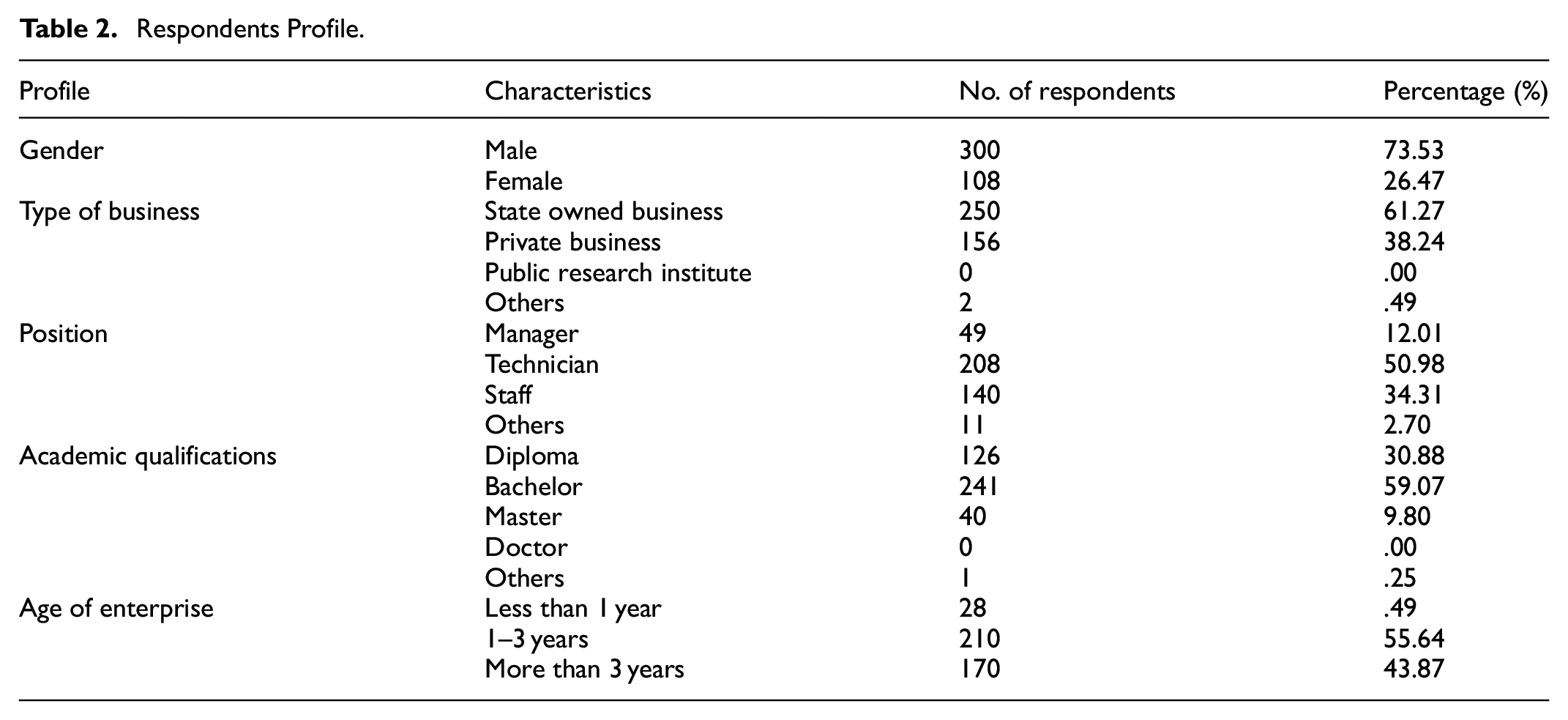
The minimum sample size for a PLS-SEM test can be satisfied by following the principle of the number of 10s, as outlined by Barclay et al. (1995). This involves taking the latent variable with the largest number of observed variables in a single construct and calculating the sample size as 10 times the number of items in that latent variable. In the model designed in this article, the number of items in the latent variable GC is 7, which is the highest number. Therefore, 70 questionnaires can satisfy the minimum requirement, and the number of questionnaires in this study (408) satisfies this requirement. The results of the demographic questionnaire are presented in Table 2. The proportion of male respondents was higher than that of female respondents, with 73.53% of respondents being male. In terms of enterprise type, the majority (61.27%) of respondents are employed in state-owned enterprises. This suggests that the proportion of employees in state-owned enterprises is relatively high in China’s solid waste treatment industry. In terms of position, the majority of respondents (50.98%) identified as technicians, while 12.01% were managers and 34.31% were classified as ordinary employees. This distribution provides a comprehensive representation of the respondents. With regard to the respondents’ educational background, 59.07% have obtained a Bachelor’s degree, while 30.88% have a Diploma. This indicates that the respondents are, on the whole, well-educated. In terms of the age of the enterprise, 55.64% of the respondents indicated that their enterprise had been established between 1 and 3 years prior, while 43.87% stated that their enterprise had been established for a period exceeding 3 years.
Respondents Profile.
Confirmatory Factor Analysis (CFA)
In Partial Least Squares Structural Equation Modelling (PLS-SEM), Confirmatory Factor Analysis (CFA) is a process of validating the existing structural model, which concerns the correspondence between scale items and latent variables, as well as the relationships between latent variables, using sample data. The aim is to ascertain whether the model is consistent with the actual data situation. The main focus is on testing the convergent and discriminant validity (Hair, Howard, & Nitzl, 2020). The PLS-SEM algorithm analysis was initially conducted using Smartpls 4.0 software, employing the PLS structural equation modelling approach proposed by Lohmöller (1989). The resulting model estimation is illustrated in Figure 2. As illustrated in the model, the indicator loadings for all latent variables within the seven reflective multi-indicator constructs exceeded the recommended criteria (loadings ≥ .708; p < .05).

Model estimation.
Convergent Validity
Convergent validity, or reliability, represents internal consistency, stability, and aggregation. In the analysis of scale-type questionnaires, reliability indicates the correlation (aggregation) of measured variables under the same latent variable. According Hair, Black, et al. (2010), a standardized factor loading of .708 or above is deemed acceptable, standardized moment coefficient (SMC) of load of .5 or above is suitable, a variance inflation factor (VIF) value of less than 3 indicates that there is no multi-collinearity. Similarly, a Cronbach’s alpha with composite reliability (CR) of between .7 and .95 is considered appropriate (Hair, Black, et al., 2010). Fornell and Larcker (1981) suggested an AVE (Average Variance Extracted) of .6 or above for each construct.
The analysis of convergent validity is initially presented here. As can be observed in Table 3, the factor loadings of items pertaining to the seven latent variables are all greater than .777, SMC are all above .5. The Cronbach’s alpha and CR of all latent variables are situated between .7 and .95. The AVE of the seven constructs is greater than .6. The aggregation validity test was passed for the questionnaire questions. In addition, there is no multi-collinearity because all VIFs are less than 3.
Aggregate Validity Test.

Discriminant Validity
In the context of latent variable analysis, distinguishing validity refers to the extent to which a given latent variable can be differentiated from other latent variables (Farrell & Rudd, 2009). The distinguishing validity of a construct is evaluated through three analytical methods: the Average Variance Extracted (AVE) method, the Cross Loading method, and the Heterotrait–Monotrait ratio (HTMT) method. These three methods are employed in the present analysis.
In regard to the AVE method, Fornell and Lacker (1981) proposed that discriminant validity should be considered in conjunction with the relationship between convergent validity and construct correlation. They further suggested that a research model is deemed to possess discriminant validity when the square root of the AVE for each latent variable exceeds the correlation coefficients between that latent variable and the other latent variables. As demonstrated in Table 4, the square root of the AVE for each of the seven latent variables is greater than the correlation coefficient between that latent variable and the other latent variables, thereby indicating that the model exhibits discriminant validity.
Discriminant Validity.

Note. The bold numbers in the table represent the square root of the AVE.
In the context of the cross-loading method, the term denotes that if the factor loadings of an indicator corresponding to a latent variable exceed the loadings of the indicator corresponding to other latent variables (i.e., it is a cross-loading; Hair, Ringle, & Sarstedt, 2011), it signifies the presence of differential validity. As illustrated in Table 5, the factor loadings for each of the six items pertaining to CSR exceed .79, exceeding the loadings for the other latent variables corresponding to each item. Similarly, the factor loadings of the items corresponding to the other six latent variables are also greater than the loadings of their corresponding other latent variables, thereby satisfying the requirement of differential validity.
Discriminant Validity.

In the Heterotrait–monotrait ratio (HTMT) method, for conceptually similar constructs, if HTMT < .90 (Hair, Risher, Sarstedt, & Ringle, 2019), and for all combinations of latent variables the bootstrap confidence interval for HTMT does not contain 1, then discriminant validity is met (Hair, Hult, Ringle, & Sarstedt, 2017). As demonstrated in Table 6, the HTMT associated with the correlation between any two latent variables is less than .9, and none of the corresponding confidence intervals contain 1. Therefore, the test of the differential validity of this method is also successful.
Discriminant Validity.

Goodness-of-Fit and Path Analysis
Goodness-of-Fit (GoF)
Goodness-of-fit is the geometric mean of AVE and the model’s average coefficients of determination (R2) value (Hair, Ringle, & Sarstedt, 2011). The formula is:

Goodness of Fit (GoF) is a measure of the overall fit of the model, with a value of GoF equal to .1 the fit is weak, .25 is moderate and .36 is strong (Vinzi et al., 2010). According to the calculations shown in Table 7 below, the fit GoF = .577, the fit is relatively strong.
Calculation of GoF.

Path Analysis
Direct Effects
In the process of evaluating the structural equation modelling and research hypotheses, we obtained the results of the path analysis using the bootstrapping method, as shown in Table 8 below. VIF of every regression path is less than 3, there is no multi-collinearity. For the four influencing factors of CSR, the path coefficient of GHRM on CSR is .366 (T-value 2.943, p-value .003 < .05), GHRM has a significant effect on CSR, and H1 is accepted. The path coefficient of GC on CSR is .147 (T-value 1.663, p-value .096 > .05), and GC does not have a significant effect on CSR at .05 significant level, but have positive effect at .1 level, H2 is accepted. The path coefficient of GRC on CSR was .285 (T-value 2.495, p-value .0013 < .05), GRC had a significant effect on CSR, H3 was accepted. The path coefficient of GERP on CSR was .097 (T-value 1, p-value .317 > .05), GERP had no significant effect on CSR, H4 was rejected.
Bootstrapping Results.
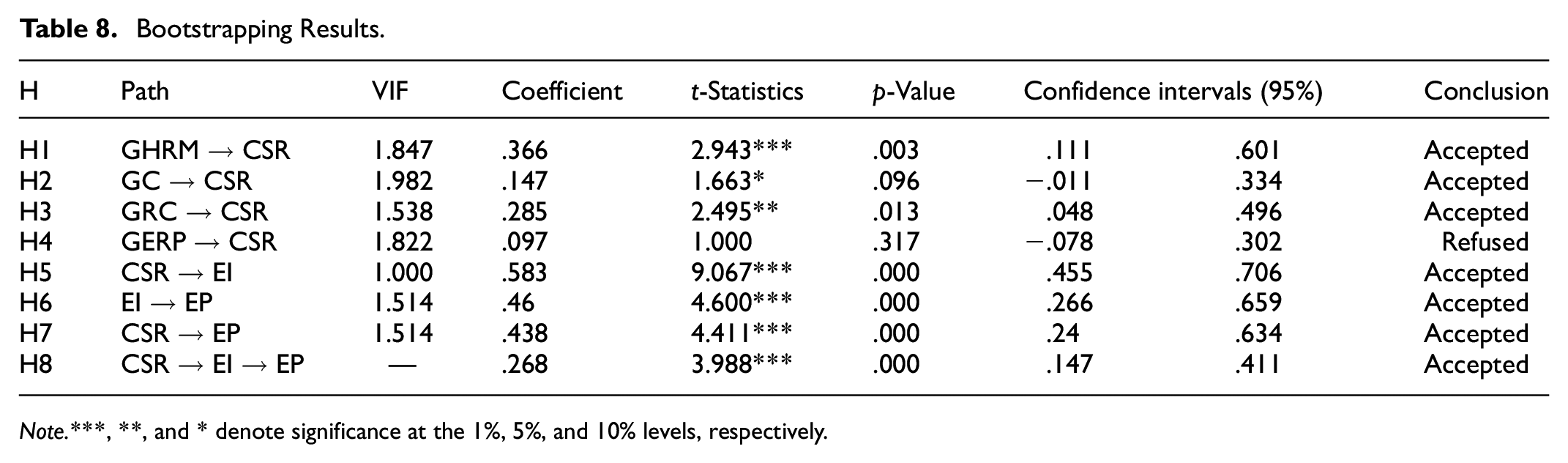
Note.***, **, and * denote significance at the 1%, 5%, and 10% levels, respectively.
Path coefficient of CSR on EI is .583 (T-value 9.067, p-value .000 < .05), hence CSR has significant effect on EI and H5 is accepted. Path coefficient of EI on EP is .46 (T-value 4.6, p-value .000 < .05), hence EI has significant effect on EP and H6 is accepted. Path coefficient of CSR on EP is .438 (T-value 4.411, p-value .000 < .05), therefore CSR has significant effect on EP and H7 is accepted.
Mediation Effects
For mediation effect analysis, the common mediation effect measures are Sobel’s z-test method (Sobel, 1982) and bootstrap method. Sobel’s z-test method is a test using the product of coefficients that are to be applied, and is not an ideal test (MacKinnon et al., 2002). Hayes (2009) suggests the use of a statistical technique developed based on the development of computers, the self-help method (bootstrap; MacKinnon, 2009), to calculate the standard error of the indirect effect and the estimate, which avoids the drawbacks of an asymmetric distribution of the indirect effect, and becomes the Sobel’s z-test method an important complement to the bootstrapping method used here (Sobel, 1982). In evaluating the mediating mechanism of EI in the link between CSR and EP, the corresponding results were obtained by bootstrapping analysis, which showed that EI played a mediating role in the effect of CSR on EP (t = 3.988, p-value = .000 < .05), H8 was accepted. In addition, since the direct effect of CSR on EP was also significant, EI only played a partial mediating effect.
Conclusion and Recommendations
The analysis illustrates that among the internal factors influencing CSR in organizations, GHRM exerts a more pronounced influence on CSR than GC. Among the external factors affecting corporate CSR, GRC has a significant positive effect on CSR, whereas the effect of GERP is not significant. The research conclusions on the impact of GHRM, GRC, and GC on CSR align with those of Freitas et al. (2020), Chang (2015), and Liao et al. (2021). However, the research conclusions on the impact of GERP on CSR are inconsistent with those of Usmany (2024). The results of the study demonstrated that CSR has a positive and significant impact on EI. Additionally, EI has a positive effect on EP, indicating that the introduction of new green products and services by enterprises results in favorable economic and social outcomes. Furthermore, the analysis of the mediated effects revealed that CSR has an indirect effect on EPs through EI, in addition to its direct effect on EPs. These research findings align with those of Dzage et al. (2024), Aftab et al. (2023), Marco-Lajara et al. (2023), and Simmou et al. (2023), supporting the research hypothesis.
In order to encourage enhanced environmental performance in business, it is essential that business managers adopt a dual approach. Firstly, it is recommended that companies assume greater social responsibility. A commitment to CSR encourages companies to integrate sustainable practices into their core business strategies, which in turn results in reduced waste, lower energy consumption, and lower carbon emissions. These factors contribute to more favorable environmental outcomes. Concurrently, socially responsible companies typically engage with stakeholders, including employees, customers, communities, and universities with the objective of enhancing the impact of CSR initiatives. By way of illustration, through collaboration with universities, students are afforded opportunities to engage in field trips, thereby acquiring knowledge regarding the present status of CSR and facilitating the dissemination of information pertaining to social responsibility on a broader scale (Phan & Ninh, 2024). Moreover, by forming alliances with non-governmental organizations and government entities, companies can enhance their capacity to implement environmentally friendly measures.
Secondly, companies should utilize EI as a means of promoting sustainable development and enhancing their environmental performance through the development of green products and services. EI has emerged as a pivotal strategy for companies seeking to enhance environmental performance. The term “eco-innovation” encompasses a range of practices, including the development of new products, processes, and business models. With respect to new product development, for instance, companies may address consumer demand for environmentally friendly choices by investing in the creation of sustainable packaging solutions that can markedly reduce plastic waste. This not only mitigates environmental impact but also expands market opportunities focused on sustainability. With regard to process innovation, companies may enhance their production processes to improve resource efficiency. As an illustration, the implementation of lean manufacturing, energy-efficient machinery, and closed-loop systems can effectively diminish waste generation and energy consumption. Moreover, enterprises can facilitate the dissemination of knowledge and encourage technological advancement by collaborating with academic institutions and non-governmental organizations (NGOs). This approach enables them to maintain a competitive edge in sustainable development practices.
The discovery that EI serves as a mediator between CSR and EP indicates that, in addition to exerting a direct influence on EP, CSR also exerts an indirect impact through the implementation of EI. This finding underscores the necessity of EI as a fundamental element of corporate sustainability strategies. It would be beneficial to encourage companies to view CSR not only as a compliance or public relations tool, but also as a strategic method for driving technological and process innovation, with the aim of improving environmental performance. In particular, it is recommended that EI be integrated into CSR strategies and established as a fundamental component of CSR initiatives. At the same time, it is imperative to cultivate a culture of innovation and encourage creativity in sustainable development practices. Further, it is imperative that stakeholders be engaged in order to facilitate open innovation. Finally, the impact of EI should be subject to periodic assessment, and corporate credibility should be enhanced through transparent publicity in order to increase stakeholders’ trust in the company’s commitment to sustainable development.
In the practice of China’s Zero-Waste City, the social responsibility and EI of solid waste treatment companies constituted a significant factor in the advancement of the Zero-Waste City initiative. Firstly, it is imperative that the government prioritizes the role of solid waste treatment companies and promotes their increased investment in eco-innovation R&D, thereby facilitating improved innovation performance. Secondly, the solid waste treatment industry is characterized by a multitude of stakeholders. Consequently, EI should facilitate the involvement of a diverse range of stakeholders and the establishment of urban eco-innovation hubs. This will facilitate the integration of zero-waste city practices with the urban eco-innovation ecosystem, thereby promoting the sustainable development of zero-waste cities. In addition to its indirect impact, CSR has a direct impact on EP. This necessitates that government departments encourage corporations to assume greater social responsibility. For instance, in the context of zero-waste cities, it would be beneficial for enterprises to proactively establish “green cell” organizations, with the objective of contributing to the sustainable development of the city as a whole.
Discussion and Future Directions
The findings of this empirical study offer valuable insights into the dynamics of CSR by underscoring the distinct influences of internal and external factors. It is noteworthy that the findings indicate that, among the internal influences, GHRM exerts a more pronounced impact on CSR than GC. This indicates that organizations that prioritize the integration of sustainability principles into their human resources practices are more likely to enhance their CSR outcomes. GHRM encompasses a range of practices, including recruitment, training, performance appraisal, and reward systems, which are designed to align employee behavior with environmental goals. In contrast, the influence of GC was found to be less pronounced, suggesting that while fostering an environmentally conscious workplace ethos is important, it may not be as effective in promoting CSR as compared to the actual practices implemented through GHRM.
From an external perspective, the considerable influence of GRC on CSR underscores the vital importance of cultivating robust relationships with key stakeholders, including customers, suppliers, and communities. Such relationships can facilitate the exchange of information and collaborative efforts on sustainable development, thereby enabling organizations to become leaders in CSR. It is noteworthy that GERP policies did not have a significant impact on CSR. This finding is consistent with Zhang et al. (2024), indicates that regulatory compliance is an insufficient driver of CSR initiatives. It is possible that firms view regulatory requirements as a mere formality, rather than as a genuine motivation to engage in sustainable practices in a meaningful and comprehensive manner. On the other hand, this perhaps indicates that mandatory environmental regulation does not inherently encourage enhanced CSR, whereas proactive corporate green relational behaviors may facilitate the advancement of such responsibility.
The findings on the relationship between CSR, EI, and EP further support the studies of Abro et al. (2024), Cai and Li (2018) and Dai et al. (2022) on developing countries such as China. However, these results are based on the results of a survey of data from one city in the Chinese context and are not necessarily applicable to other countries and regions. In addition, in practice, the successful integration of CSR and EI requires strategic direction and commitment from senior management. Companies need to overcome potential barriers such as resource limitations, regulatory constraints and stakeholder support. Therefore, a multidimensional approach that includes investment in research and development, stakeholder engagement, and a clear vision of sustainability is essential for companies that want to effectively use CSR and EI to drive EP.
The following three areas represent the focus of future research: Given that the practice of zero-waste cities in China necessitates collective action across all industries to reduce solid waste, in order to optimize resource utilization and ensure environmentally harmless disposal, in addition to focus on the waste management industry, future research should prioritize investigating the nexus between CSR, EI, and EP in other sectors, including manufacturing, construction and domestic service industries. Secondly, as this article is based on a single case study, its findings may not be universally applicable to other cities. Therefore, future research should be conducted in non-pilot cities and in cities in different regions to develop more generalizable conclusions. Finally, as numerous factors influence corporate EI, in addition to CSR, it is essential to further examine the impact of factors such as dynamic capabilities on EI. This will facilitate the formulation of more comprehensive countermeasure suggestions for corporate EI practices.
Footnotes
Appendix: Questionnaire

| Green human resource management (GHRM) | ||
|---|---|---|
| GHRM 1 | Our company has set environmental goals for our employees | |
| GHRM 2 | Our company provides green training for employees and promotes green values | |
| GHRM 3 | Our company provides green training to our employees to develop the knowledge and skills required for green management | |
| GHRM 4 | Our company considers employees’ green behaviors in the workplace in their performance appraisals | |
| GHRM 5 | Our company links employees’ green behavior in the workplace to rewards or compensation | |
| GHRM 6 | Our company is looking for green-conscious people | |
| Green culture (GC) | ||
| GC1 | Environmental issues are closely related to the main functions of our company | |
| GC2 | We make every employee understand the importance of environmental protection | |
| GC3 | We strive to advance environmental protection as a primary goal | |
| GC4 | Our company has a clear policy statement requiring environmental awareness | |
| GC5 | Environmental protection is a priority activity for our company | |
| GC6 | Protecting the environment is reflected in our company’s core values | |
| GC7 | Our company mission includes elements of environmental protection | |
| Green relational capital (GRC) | ||
| GRC 1 | Our company has a stable environmental cooperation relationship with suppliers | |
| GRC 2 | Our company has a stable environmental cooperation relationship with downstream customers or channels | |
| GRC 3 | Our company has a good environmental cooperation relationship with its strategic partners | |
| Government environmental regulation policies (GERP) | ||
| GERP 1 | Our products or services should comply with the requirements of national environmental regulations | |
| GERP 2 | Our products or services should comply with the requirements of international environmental regulations | |
| GERP 3 | Our production or service processes should comply with the requirements of international environmental protection regulations | |
| GERP 4 | The government provides preferential tax policies for corporate ecological innovation | |
| GERP 5 | The government often promotes environmental protection policies | |
| GERP 6 | The government provides preferential subsidies for ecological innovation | |
| Corporate social responsibility (CSR) | ||
| CSR1 | We are increasing the research and development activities of environmentally friendly products | |
| CSR2 | We are committed to not using toxic ingredients in our products | |
| CSR3 | We pay special attention to energy saving during operation and production | |
| CSR4 | We are committed to not using natural resources that are in danger of depletion | |
| CSR5 | We are transparent and consistent in our corporate environmental reports | |
| CSR6 | We are committed to developing our employees in the direction of improving comprehensive capacity and increasing awareness of environmental protection | |
| Eco-innovation (EI) | ||
| EI1 | Our firm have achieved low energy consumption such as water, electricity, gas, and petrol during production/use/disposal | |
| EI2 | Our firm uses recycling, reuse, and remanufacture material | |
| EI3 | Our firm uses cleaner technology to create savings and prevent pollution | |
| EI4 | The manufacturing process in our firm effectively reduces the emissions of hazardous substances and waste | |
| EI5 | The manufacturing process in our firm reduces the use of raw material | |
| Environmental performance (EP) | ||
| EP1 | Environmental activities in our firm significantly reduced overall costs | |
| EP2 | Environmental activities in our firm significantly reduced the lead times | |
| EP3 | Environmental activities in our firm significantly improved product/process quality | |
| EP4 | Environmental activities in our firm significantly improved the reputation of my company | |
| EP5 | Environmental activities in our firm significantly reduced waste within the entire value chain process | |

Funding
The author(s) received no financial support for the research, authorship, and/or publication of this article.
Declaration of Conflicting Interests
The author(s) declared no potential conflicts of interest with respect to the research, authorship, and/or publication of this article.
Data Availability Statement
The datasets generated /or analysed during the current study are available from the corresponding author upon reasonable request.