



Abstract
The knowledge transfer program (KTP) in Malaysia was instituted to facilitate knowledge transfer, collaboration, and interaction between academics in public higher institutions and other stakeholders. These programs are divided into community or industry programs. Under the community program, academics collaborate with a community partner to utilize their research findings in the community environment. This quantitative study attempts to assess KTP based on academics’ postproject responses to online questionnaires. The participants in this study consist of 132 academics of Malaysian public universities of Rolling 1 to Rolling 4 projects between 2011 and 2016. Of 132 individuals invited to participate, 84 of them (64%) took part in the online survey. These data were analyzed using analysis of variance (ANOVA) and Duncan’s range test. The findings indicate that the KTP has enabled academics, irrespective of position, to deploy their ideas and knowledge in a real-world community setting. The relationship between academic position and learning experience in transferring knowledge, however, is inverse: the higher the level of an academic position, the lower the learning experience. The findings also exhibit the experience and challenges that one would expect from the involvement of academics in a community KTP.
Introduction
Collaborative relationships in the form of knowledge transfers between higher education institutions and communities are highly beneficial. The knowledge transfer program (KTP) is a scheme designed by the Ministry of Education, Malaysia, to enable universities in Malaysia to apply their wealth of expertise and scientific knowledge to the community at large. For universities, knowledge transfer provides a platform for academics to optimize their innovative research results and outputs, as well as useful inputs for further development of innovative knowledge, while for communities, the transfer of innovative knowledge and products leads to improved living standards (A. R. Ahmad et al., 2016). A close relationship between universities and their stakeholders is deemed vital in reducing the lag between the discovery of new knowledge and its use in communities.
Research on knowledge transfer has developed from studies focused on how organizations could best accomplish international technology transfer to facilitate the pursuit of an optimal product life cycle, as suggested by Vernon (1966). Research on knowledge transfer has also focused on interfirm governance modes as well, including transfers in alliance settings and from acquired units (van Wijk et al., 2008). The importance of university as a source of knowledge that could transform an organization’s competitive advantage and boost the economy has since attracted the attention of policymakers.
According to Marshall (1985), the long lag between the discovery of new knowledge at the university and its use by organizations could seriously impair the competitiveness of organizations and communities at large. To address this, the Bayh–Dole Act in the United States, for example, has brought research universities closer to practitioners seeking to commercialize university-based technology (Loise & Stevens, 2010; Siegel et al., 2003). Similarly, the drive to encourage the university’s role in technology and knowledge transfer has spread across Europe. Many reforms and policy initiatives have been introduced to facilitate knowledge transfer among universities, industries, or communities (Anatan, 2015; Cruz et al., 2019; European Commission, 2007).
Numerous barriers to effective university–organization technology transfer have been identified, including culture clashes, bureaucratic inflexibility, poorly designed reward systems, and ineffective management of technology transfer offices (Grimaldi et al., 2011; Siegel et al., 2003). According to Reagans and McEvily (2003, p. 242), “knowledge transfer represents a cost to the source of knowledge, in terms of time and effort spent helping others to understand the source’s knowledge.” Nevertheless, the mutual relationship between universities and communities through the exchange of knowledge has become a global trend (Cruz et al., 2019; Hemel & Ouellette, 2017). This comes as no surprise as knowledge transfer represents a critical foundation for any nation’s development in the imminent Industry 4.0 era (Samsinar & Firdaus, 2019).
In the context of Malaysia, the 11th Malaysia Plan (2016–2020) has outlined the country’s aspiration in becoming a developed nation in every aspect by 2020, in which the key theme in the plan is “growth with inclusiveness.” To ensure the success of this aspiration, the 11th Malaysia Plan emphasizes the importance of enhancing productivity; creating wealth via innovation; empowering educational, technical, and vocational training spearheaded by industry; and raising the level of the bottom 40% (B40) household to the middle-class category (Economic Planning Unit, 2015).
In line with these needs, the KTP is envisaged as the catalyst to achieve Malaysia’s aspiration to become a developed nation by 2020. The KTP is one of the Critical Agenda Projects under the National Higher Education Strategic Plan (NHESP). This provides a platform to enable academics to optimize their tangible and intangible intellectual property to improve the living standard of the communities and elevate industry income (KTP Policy, 2011). Under the community projects, academics are expected to impart their knowledge to the community. The implementation of the KTP has enabled the sharing of knowledge and skills, which has benefited both the academics and the community.
From 2011 to 2016, a total of 352 projects were awarded to academics and executed in four rollings (phases): Rolling 1: from 2011 to 2013, Rolling 2: from 2012 to 2014, Rolling 3: from 2013 to 2015, and Rolling 4: from 2014 to 2016. Of the 352 projects, 220 projects were selected under the Industry category and 132 projects under the Community category. Some of the community projects included projects to enhance the quality of life of the coastal community through ecotourism, empower the elderly through the knowledge transfer on information and communications technology, and enhance the achievement in science and decision-making skills of secondary school students through an informal science learning program.
The ultimate aim of all the projects under the KTP program is tailored to encourage and recognize engagement between community and academics to realize the aspiration of Malaysia’s New Economic Model (NEM) in creating a knowledgeable and high-income nation (KTP Policy, 2011). In addition, the program aims to offer a meaningful platform of exchange that facilitates the identification and matching of appropriate expertise in public universities to address community needs. It also seeks to optimize public universities’ expertise through coordinated and nurtured interactions with stakeholders for sustainable and productive partnerships.
Prior to the establishment of the KTP, many universities and higher learning institutions in Malaysia showed a strong commitment to a program involving university–community engagement (J. Ahmad, 2012). For instance, Universiti Sains Malaysia, which was granted the Accelerated Program for Excellence (APEX) status in 2009, has shifted its paradigm and now focuses on reaching out to the “bottom billion” (Wan et al., 2015). Nonetheless, unlike knowledge transfer among universities, communities, and industries in the Western context, which has concentrated on formal activities based on intellectual property rights as the primary outcomes (Cruz et al., 2019), such as patents, licenses, and the formation of spin-offs, the introduction of KTP in Malaysia takes a less formal approach in terms of its activities and agreements. Regardless of the setting, the objective of any knowledge transfer project is to ensure that knowledge is transferred successfully to a recipient.
Evaluation of Effectiveness
There are various key indicators that point to the effectiveness of a program. In essence, any key indicator will depend on various aspects of the assessment and evaluation, such as the objectives of the program and the aims of the evaluation (World Health Organization, 2007). Contextually, a successful knowledge transfer is one that is considered to be efficiently on time and budget, and that produces satisfied stakeholders. You et al. (2006) have specifically suggested several factors that contribute to success in knowledge transfer that spans from the first stakeholders (i.e., the academics) to the recipients (i.e., the communities and industries). From the perspectives of the first stakeholders, specific focus is given on the intention of the transfer, transparency, self-knowledge, and articulacy of the academics.
Generally, to evaluate the effectiveness of KTPs in Malaysia, several models of evaluations need to be considered. Models of evaluation available from past studies can be categorized into results, economic, actor, and program theory model (H. F. Hansen, 2005). Depending on the category, each model will gain the insight of a program’s effectiveness from different sources. For example, a results model of evaluation explores the end impact of a program, while an actor model of evaluation looks into the impact of the program based on the criteria set by the stakeholders.
One of the models of evaluation, the Kirkpatrick (1959) model, was one of the earliest models of evaluation suggested in the area. The Kirkpatrick (1976, 1998) model consists of four levels of evaluation: reaction, learning, behavior, and results. At the reaction level, the evaluation process focuses on how the recipients react to the programs, while at the learning level, the evaluation looks into how much the recipients have genuinely understood the content delivered in the program. At the behavior level, the changes of behavior become the focus of the evaluation, while the results focus on the specific impacts on the organization.
Another model of the evaluation was proposed by Holton (1996), who first criticized Kirkpatrick’s model for the lack of coverage of all constructs underlying what is deemed as “effective.” Furthermore, he claimed that there was a dearth of research supporting the four-level model. In Holton’s model, Holton III omitted the element of reaction, changed “behaviour” to “performance,” and introduced two types of influences of outcomes—primary and secondary. Holton (2005) insists that his model comprehensively captures the causal relationships and outcomes of human resources development interventions.
While Holton III criticized the lack of relationship between “reactions” and learning (which is one of the critical differences between Holton’s and Kirkpatrick’s models), recent studies have shown that reactions are essential in indicating willingness and motivations, which are crucial elements of learning (e.g., Horwitz, 1995; Tan et al., 2003). Furthermore, in Tan et al.’s study, for example, they argued that differentiating between the cognitive and affective reactions can be the key to understanding how reactions are an essential element in evaluation.
Objective of the Current Study
Based on the discussions presented above, investigating the effectiveness of KTP organized in Malaysia is an essential effort for future improvements and refinement. In a policymaking process, integrating the voice from the stakeholders is essential into any assessment or evaluation of a policy (Dorey, 2005)—and this agrees with the reaction level in Kirkpatrick’s model of evaluation which perceives reactions such as satisfaction and perception as the key elements of assessment of effectiveness. Therefore, the main research question of this study is as follows:
Based on the research question, the objective of the study is to assess the impact of community projects from the perspectives of the first participating stakeholders (i.e., the academics) in KTP. The study focuses on the experience gained and the challenges faced by academics in implementing KTP community projects.
Method
The design of this study is quantitative evaluation where the KTPs were evaluated using a quantitative measurement built specifically for this study. The Kirkpatrick model (four-level evaluation) is a widely used model for evaluating program outcomes. According to Kirkpatrick (1998), the process of program evaluation involves four levels: reaction, learning, behavior, and results. This study adopts the Kirkpatrick model in designing the questionnaire. However, in the questionnaire, these levels have been rearranged according to the three phases of the project (preimplementation, implementation, and postimplementation). The model was helpful in identifying program outcomes, but it was not fully adopted to provide established procedures and parameters in this study. This study also used H. F. Hansen’s (2005) typology of evaluation oriented toward the actor model of evaluation as an actor model is more immediate and can be done right after the program was completed (unlike results and economic models that require the completion of the projects which in this case can take years as it involves long-term projects). Combined with Kirkpatrick’s reaction level, this justifies using the first stakeholders (i.e., academics) to see whether KTP has achieved its objectives and the barriers that face the process. Twenty-three Likert-type statements were developed based on the model. Two additional questions in the preimplementation section were designed to solicit the academics’ views on the level of complexity of the transferred knowledge and the changes that need to be made (Figures 1 and 2).

Level of complexity of the knowledge to be transferred.

Changes made to the initial idea/plan.
The survey inventory built for this study comprised three main themes: Barriers to Adoption and Implementation (operationalized as perceived barriers in the preimplementation stage); Behavior of Community Partners in Terms of Self-Readiness and Contextual Factors Provided (operationalized as perceived behavior of the community members during the implementation stage); and Learning Experience as well as Impact on Academics at a Personal Level in Transferring knowledge (operationalized as experience gained in the postimplementation stage). A Likert-type was used with 5 points ranging from a “1” representing “very minimal” and “strongly disagree” to a “5” representing “very substantial” and “strongly agree.” All these themes are reflective of the system of evaluation by Knowledge Transfer Centre (KTC), a secretariat for KTP, a program initiated and funded by the Ministry of Education, Malaysia. KTC has a system of evaluation which spans from the stage of preimplementation, implementation, and postimplementation. At each stage, every project had its unique characteristics, approach, process, milestone, and progress at a different pace too. Despite these, there are some resemblances between each project that we managed to deduce and include in our questionnaire with the help of experts. Hence, the questionnaire was built using the system and further validated by relevant experts. The validation process was conducted through a 1-day workshop involving two KTP secretariats, two knowledge transfer experts, and three respected academics.
This is a population study where everyone in the population is recruited as a respondent. The participating respondents covered in this study are project implementers (i.e., academics) of the KTP—community program during Rolling 1 to Rolling 4 projects, which were implemented from 2011 to 2016. An online survey was distributed to all the project implementers (a total of 132 potential respondents in the population) via Google Forms. Even though all project implementers were invited, only 84 respondents participated from 20 public universities in Malaysia, as shown in Table 1. All project leaders, who were academics, were invited to participate in the online survey via an email comprising a brief description of the study, a link to the online survey, and a cover letter.
Number of Respondents for 20 Public Universities in Malaysia.

In this study, the quantitative methodology was adopted, and the data were analyzed using descriptive and inferential statistics. Because it is a population study, the inferential analyses selected were ANOVA as the analysis involved comparing the means of the scores between more than three groups. Besides, Duncan’s range test was chosen because it allows for multiple comparisons across groups whereby ANOVA only provides the information of significance, but it is not able to point out which of the groups are significantly different. In this study, groups are academic positions, which were classified into three categories: Senior Lecturer (G1), Associate Professor (G2), and Professor (G3). From 84 respondents, 28 of them were senior lecturers, 35 were associate professors, and 21 were professors. The choice of analysis based on the academic position was made, given that the position would reflect the experience and maturity of a respondent in executing the project. It also attempted to observe whether academic experience plays an essential factor in the process of knowledge transfer. All statistical analyses were conducted using the Statistical Package for Social Sciences (SPSS Version 24).
Findings
Knowledge transfer is not merely about how organizations are able to produce positive impacts on the recipients (community), but also how the process is able to improve and enhance the current levels of knowledge of the organizations, which in this case refers to academics. In this study, academics’ responses about their experience in knowledge transfer were inferred with regard to barriers to adoption and implementation; behavior of recipients in terms of self-readiness and contextual factors; academics’ learning experience in transferring knowledge; and impact on academics at a personal level.
Barriers to Adoption and Implementation
Knowledge barriers would occur when the perceptual system in a specific human or group of humans does not fit incoming information to utilize and convert the information to knowledge (Paulin & Suneson, 2012). To avoid such circumstances, under this community program, these projects begin by explaining the purpose and objectives of the community. To some extent, some of the projects required the academics to provide a preexecution training to the supporting members of their community partner.
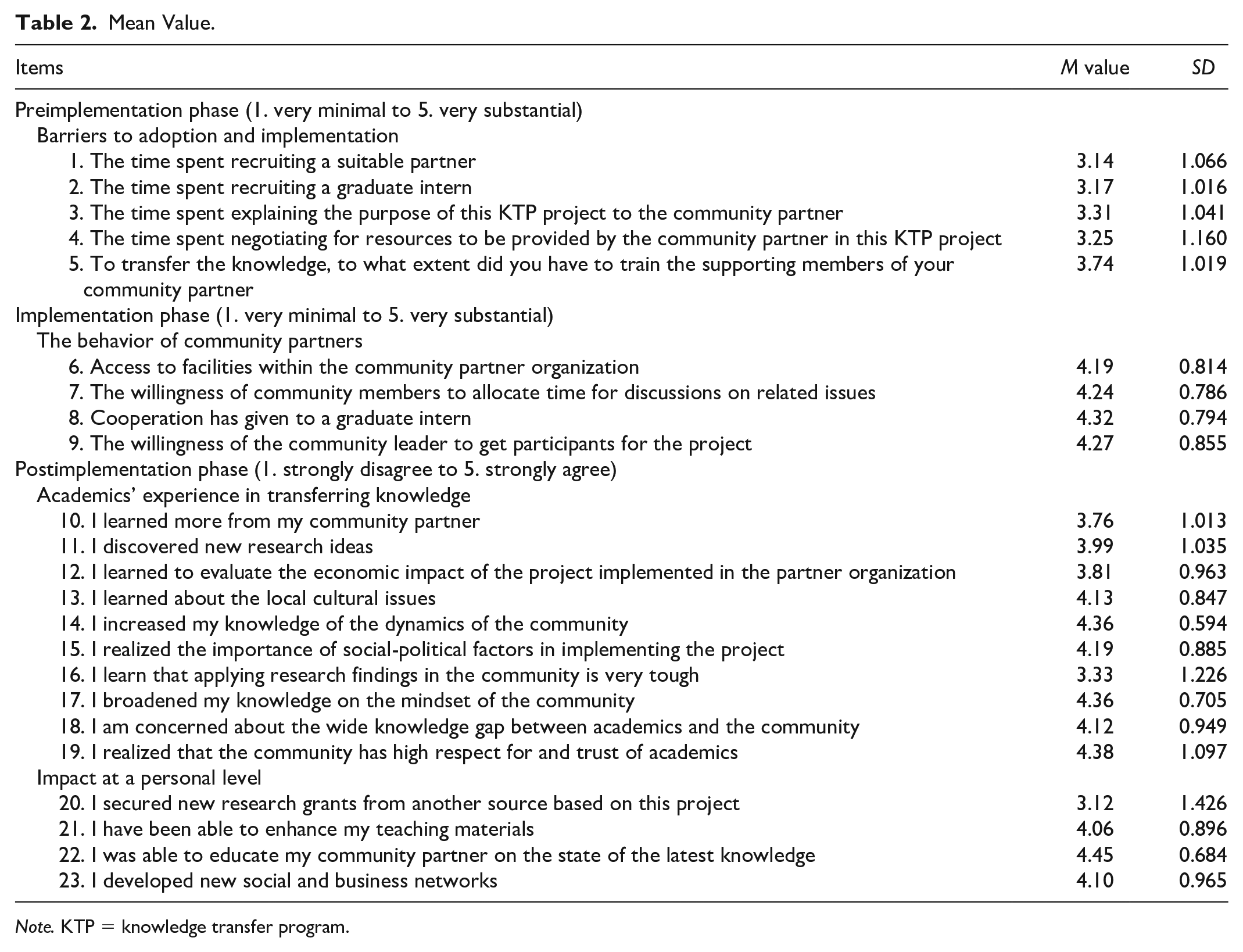
As shown in Table 2, the pattern of mean values indicates that most of the projects have spent a moderate amount of time explaining the purpose of KTP community project to the community partner. During the preimplementation phase, they devoted most of their time in training the selected supporting members from the community. Training the supporting members is crucial because they act as intermediates during the process of knowledge transfer. Without proper training, they might not be able to bridge the technical and communication gaps that might exist between academics and the community.
Mean Value.
Note. KTP = knowledge transfer program.
It is important to note that under the KTP community program, the graduate interns are among the stakeholders (apart from academics and community) involved in this strategic partnership. In KTP, the roles of graduate interns are mainly designed to equip them with practical skills and knowledge for their future careers. The appointment of a graduate intern under this program is mainly to assist academics in various aspects throughout the program. It also aims to provide an opportunity for the graduate intern to enhance, improve, and develop their personal and professional skills throughout the project. Overall, there is not much difference in terms of time spent on recruiting graduate interns and community partners. Both processes demanded the least time from academics during the preimplementation phase.
The level and the complexity of the knowledge to be transferred are critical factors. According to M. T. Hansen (1999), among partners with weak ties, knowledge transfer is facilitated if the exchange involves knowledge of low levels of complexity and vice versa. Nonetheless, the level of absorptive capacity to adopt new knowledge within the community might be below or beyond the expectation of the academics. This is also implied by Chen and McQueen (2010), who stated that the recipient’s absorptive and retentive capacities are other obstacles to knowledge transfer. From this perspective, under the section on preimplementation, two additional questions were included. The two questions sought to understand are the level of complexity of the knowledge to be transferred, and the required changes needed to be made from the initial proposal, as shown in Figures 1 and 2, respectively.
Figure 1 indicates that 60% of the respondents stated that the complexity of the transferred knowledge was rather average. Meanwhile, almost 30% of the respondents reported that the knowledge transferred was complex. This implies that the process of transferring knowledge is facilitated when there are strong ties between the stakeholders, as argued by M. T. Hansen (1999). As shown in Figure 2, approximately 26% of the projects required academics to scale up, and 29% required the academics to scale down from the initial idea or plan. It can be hypothesized that the scaling down was probably due to the relatively low absorptive capacity of the recipients. Overall, more academics have taken initiatives to make some adjustments considering the other parties’ (the community) knowledge and other factors necessary to facilitate knowledge transfer which signified the importance of preimplementation stage of knowledge transfer. This is pertinent in an effort to reduce the knowledge barriers.
The Behavior of Community Partners in Terms of Self-Readiness and Contextual Factors Provided
Contextual factors are somehow interrelated to readiness (Dreisinger et al., 2012). In this study, contextual factors were measured based on the facilities made available and the cooperation given by the community partner. It is important to note that some community projects might receive different degrees of attention and/or resources. Notwithstanding, a thriving community engagement requires continuous support and participation from the stakeholders. Strong support from the community partner is essential right from the beginning of the program until it reaches the empowerment phase (Ramachandra et al., 2014).
As shown in Table 2, the mean values with regard to the contextual factors fall within the range of 4.19 to 4.32. This demonstrates that the majority of the academics were satisfied with the readiness of community partners and the contextual factors comprising the facilities and time dedicated by the community partner. Most of them “strongly agreed” that their industry partners have provided substantial cooperation to the graduate intern involved in this strategic partnership. This is important in ensuring personal and professional self-development for the intern throughout the project. In addition, community partners were also willing to engage in and allocate sufficient time for project-related discussions during the implementation phase.
In terms of tangible resources, the academics believed that they had been given access to facilities within their community partners’ organization. This included the use of halls and appliances. In terms of human resources, the community partners were also willing to help recruit people to participate in the community project. In general, the community partners have offered adequate contextual factors to academics. This shows that their partners were ready, and it had helped academics to be better prepared at the execution phase.
Academics’ Learning Experience in Transferring Knowledge
Experiences in transferring knowledge to the community were measured using 10 questions. All these questions captured the element of “experiences” relating to academic knowledge as well as socio-cultural and political experiences. Such knowledge and experiences could only be obtained when academics are involved in real-world contexts and practices.
The academics agreed that their involvement in a community project had enabled them to experience various aspects of new knowledge and experiences. This program has offered a unique opportunity for them to explore the issue of political and socio-cultural appropriateness of knowledge transfer within the contexts of community. A KTP provides an avenue for both parties to learn from each other. The findings from Table 2 indicate that academics slightly agreed they were the ones who have gained the most knowledge from this collaboration (M = 3.76).
A majority of the academics strongly agreed (M = 4.36) that the project has also led them to a better understanding of community dynamics and broadened their knowledge on the mindset of the community. In addition, through this program, academics have learnt to realize the importance of social-political factors in implementing a community project, and they have also experienced some unique local cultural issues that were new to them, where the mean values are 4.19 and 4.13, respectively. Even more importantly, a good learning experience has allowed academics to discover new research ideas (M = 3.99).
However, the results show that the academics were less agreeable (M = 3.81) to the statement that they managed to learn to evaluate the economic impact of a community project, as compared with the other items. This might be because assessing the economic impacts of a project involves a specific method, in which certain data are required.
It is also interesting to note that the academics held a neutral opinion (M = 3.33; an average score is 3) to the statement that applying research findings in the community is very tough. This indicates that even though applying classroom-taught theory, concept, and approach in community settings is not too difficult, it is still not an easy task. This might be partly due to the knowledge gap that exists between academics and the community.
The survey results revealed (M = 4.12) that the respondents are concerned about the considerable knowledge gap in transferring knowledge. Even though the gap between academics and community is wide, the respondents strongly believed that the communities have always held high respect and trust toward academics (Item 19). Trustworthiness would undoubtedly build confidence in their performances and eventually foster seamless collaboration and cohesive partnership (Usoro et al., 2007).
Impact on Academics at a Personal Level
This program has enabled academics to educate their community partner on the latest knowledge. The involvement in community programs has also benefited the academics in the form of “case study,” which allows them to incorporate the experiences in their teaching materials. More importantly, the program has helped them to broaden their social and business networking. A study by Ismail and Rasdi (2007) found that networking is a crucial component of academics’ career progress. However, the impact of this program on research continuity (operationalized as “new grants”) has received moderate reactions from the academics, as they held a neutral opinion in relation to this matter.
Furthermore, a one-way ANOVA test was used to deduce the findings based on the academic’s working position of the respondents. The results are presented in Table 3. Overall, there was a significant difference in terms of time spent on recruiting (Item 1) a suitable partner as well as a learning experience on some local cultural issues (Item 13), knowledge on the dynamics of the community (Item 14), social-political factors in implementing the project (Item 15), and knowledge on the mindset of the community (Item 17).
One-Way ANOVA and Duncan’s Range Test.

Note. F ratios are the result of a one-way ANOVA test, where * and ** represent statistical significance at .05 and .01, respectively. ANOVA = analysis of variance; KTP = knowledge transfer program.
The F value for the time spent on recruiting a suitable partner is 3.275. Based on Duncan’s range test, there are significant differences among Group 1 (2.89), Group 2 (3.49), and Group 3 (2.90). The F value for the learning of some local cultural issues is 6.065, and there are significant differences among Group 1 (4.39), Group 2 (4.23), and Group 3 (3.62). The F value for knowledge gained on the dynamics of the community is 5.948, and there are significant differences among Group 1 (4.54), Group 2 (4.43), and Group 3 (4.00). The F value for recognizing the importance of social-political factors is 4.390, and there are significant differences among Group 1 (4.36), Group 2 (4.34), and Group 3 (3.71). The F value for broadened knowledge on the mindset of the community is 6.797, and there are significant differences among Group 1 (4.57), Group 2 (4.46), and Group 3 (3.90).
The data, however, found that there were no significant differences with other statements based on the results of Duncan’s range test. Respondents’ learning experience in transferring knowledge (Items 13–17) decreases as their position level increases. In Item 14, for instance, professors showed a lower learning experience than associate professors and senior lecturers (4.00, 4.43, and 4.54, respectively). For professors, this could be due to their vast experience in executing both research and community projects. As such, the learning experience from this program might not bring significant impact to them. Likewise, a study by Lee and Jung (2018) also revealed that academic experience has a significant influence on knowledge transfer among Korean academics.
Discussion
The study sought to evaluate, using Kirkpatrick’s (1998) and H. F. Hansen’s (2005) elements of evaluative studies, the KTPs as initiated by the Ministry of Education, Malaysia. The findings from this study are useful to provide preliminary findings that inform future initiatives on KTPs funded by the Ministry of Education, Malaysia. This study aims to inform industries, scientists, academics, and other collaborators who intend to cooperate in a KTP in the future, particularly the sort of experience, challenges, and obstacles that one would anticipate. A systematic planning demands a planner to anticipate the type of outcomes, challenges, and obstacles that he or she would face. In general, using the actor model of evaluation (H. F. Hansen, 2005) which was the implementers of the project comprising academics in universities all across Malaysia, the general findings indicate that junior academics (or called as G1 in this study) benefited more from the programs than their counterparts. In this study, the junior and senior status was not determined by age, but rather by academic performance and merit.
From a practical perspective, this study has shown that a KTP should begin with the explanation of the purpose and objectives of the program at the very early stage. As the partners are able to grasp the ultimate aim of the program, preexecution training must be conducted to ensure that some of the important members of the partners understand the fundamental aspects of the knowledge. To bridge the knowledge gap that might exist between the collaborator and the partners, the involvement of a graduate intern would be helpful, particularly when the collaborator is also tied with other commitments and responsibilities. Their roles would represent a conduit in the knowledge transfer activities, in which they act as a knowledge diffuser between collaborator and its partners. Technically, graduate interns are the ones who would spend most of the time working with the community. In KTP projects, their involvement has allowed ideas, information, and feedback to be smoothly and successfully transmitted.
Partners’ or knowledge recipients’ absorptive capacities are other aspects that must be critically considered in a KTP. Thus, it is pivotal for the collaborator to make some adjustments to scale up or scale down parts of the project from the initial idea or plan to match the capacity of the recipients to absorb the knowledge. In addition, a successful knowledge transfer process also requires continuous support from the partners. Support in the form of contextual factors from the partners is highly needed right from the beginning of the program until it reaches the empowerment phase. To some extent, contextual factors are interrelated with readiness. The readiness of partners would then create greater synergy throughout the subsequent process.
A successful knowledge transfer process would allow a collaborator to learn, experience, and appreciate many aspects of new knowledge. However, a successful knowledge transfer process depends on various factors. In this study, trust and respect are examples of the vital factors for knowledge transfer to be successful. Given such a positive and encouraging environment, one would not find any difficulty applying a textbook-taught theory, concept, and approach to real-world settings. Trust and respect would undoubtedly build confidence in actions, which eventually drive to significant levels of collaboration.
Furthermore, this study shows that knowledge transfer is affected by academics’ work experience. Some support for this notion can be found in the literature. Lee and Jung (2018) reported that knowledge transfer is correlated with academic work experiences. In the case of knowledge transfer involving academics in public universities in Malaysia, their learning experience in knowledge transfer decreases as they hold higher levels of academic positions. The higher the level of an academic position, the greater the experience in executing research, consultation, or community projects. Therefore, the learning experience from the KTP might not bring significant impact on professors compared with associate professors and senior lecturers.
From a theoretical perspective, this study has enhanced the relevance of Kirkpatrick’s model of evaluation in the contemporary area of evaluation. Even though Kirkpatrick’s model received several criticisms, this study has demonstrated the importance and relevance of using an actor model as proposed by H. F. Hansen (2005), by looking into Kirkpatrick’s element of reactions. Without integrating the voices of the stakeholders (i.e., Kirkpatrick’s element of reaction and Hansen’s actor model), a policymaking or policy improvement is incomplete. As such, this study has gained several essential points as reported by the primary stakeholders of KTP community projects, that is, the academics.
Conclusion
In conclusion, the academics have experienced various aspects of new knowledge in which KTP has allowed them to encounter firsthand, the testing of their research outputs in a real-world setting. This program has also enabled academics to appreciate the problems on the ground and the reality in terms of regulatory requirements and constraints encountered by participating communities in implementing new ideas and introducing innovation to the communities at large. Their involvement in community projects has led to better understanding of social and cultural factors, the dynamics of the community, and the knowledge gap between the academia and the community.
Furthermore, the analysis has also shown that this program has enabled academics, irrespective of position, to deploy their classroom-taught theory, concept, and approach in community settings. Nonetheless, the relationship between academic position and learning experience in transferring knowledge is inverse: the higher the level of an academic position, the lower the learning experience. In this study, professors have shown a lower learning experience, whereas senior lecturers implied that they learned more.
One limitation of this study was that the relationship between academic positions or seniority and learning experience in transferring knowledge was not observed and examined in this study. To address this limitation, further research is required to fully understand a reciprocal relationship between academic positions or seniority and learning experience in transferring knowledge as the current study provided the preliminary findings that academic positions do influence experience in KTPs. Besides, this study was more interested in doing a general evaluation of KTPs by adopting two renowned models in evaluation, that is, Kirkpatrick’s and Hansen’s models.
Another limitation of the study was the use of the actor model by H. F. Hansen (2005) to gauge the effectiveness of the program. This perhaps invited a biased response that originated from human factors. Future studies on the KTPs should use the result of economic models by H. F. Hansen (2005) to switch the angle of effectiveness away from the human factors to the outputs of the program.
Footnotes
Declaration of Conflicting Interests
The author(s) declared no potential conflicts of interest with respect to the research, authorship, and/or publication of this article.
Funding
The author(s) disclosed receipt of the following financial support for the research, authorship, and/or publication of this article: This research was supported by the Ministry of Education (MOE) and Universiti Sains Malaysia (USM) under the knowledge transfer program (KTP). The main author was supported by the Ministry of Higher Education, Malaysia, under the Fundamental Grant Scheme (203/PSOSIAL/6711692).
