



Abstract
This paper aims to provide new evidence on the relationship between the technological expertise of directors and corporate resilience. Using detailed data from Chinese high-tech listed firms spanning years 2017 to 2021, this study develops an integrated model and applies ordinary least squares, fixed-effects panel regressions, and two-stage least-squares regressions to empirically assess the interplay among directors’ technological expertise, technological innovation, and corporate resilience. The findings reveal that directors’ technological expertise positively influences corporate resilience, with R&D investment and exploratory innovation serving as statistically significant mediators in this causal pathway. In contrast, exploitative innovation plays a masking rather than mediating role between directors’ technological expertise and corporate resilience. Heterogeneity analysis suggests that the positive effects of directors’ technological expertise are more salient in firms at the growth stage, in highly competitive industries, and in cities with a nascent digital economy. Further analysis indicates that executive technology directors have a more pronounced impact on corporate resilience than non-executive ones. The intermittent balance-innovation model, characterized by a conspicuous difference in investment between exploitative and exploratory innovation, partially mediates the relationship between directors’ technological expertise and resilience. Our findings provide a new perspective for understanding corporate resilience and offer significant policy implications for realizing the innovation-driven effect of technology directors.
Plain language summary
Under the changing international situation, some companies experience financial losses or even collapse, while others survive and continue to thrive. This corporate resilience is a crucial factor in explaining the observed differences in business performance. Nevertheless, in China, a dearth of awareness concerning the internal factors that shape resilience may contribute to the challenges faced by some firms in maintaining their viability. The research team collected background information on directors, R&D data and financial data from Chinese high-tech listed companies over a 5-year period from 2017 to 2021 to better understand whether directors’ technical expertise helps companies become more resilient. If so, through what mechanisms does it do so? By analyzing these issues, we can help companies to shape their resilience. The total number of sample companies studied was 1,208. The study found that companies with directors who own technological expertise demonstrate enhanced corporate resilience. Director’s technological expertise influences corporate resilience by driving companies’ technological innovation decisions. Different modes of innovation exert disparate effects. Exploratory innovation serves as a crucial channel for improving corporate resilience, whereas exploitative innovation is perceived as a stumbling block to resilience. The study identified a way to achieve resilience within companies, namely that directors’ technological expertise could be a focus for companies to achieve resilience in the future. At the same time, companies are reminded that technological innovation in the development process should focus on exploratory rather than exploitative innovation in order to better safeguard the sustainability of the company.
Keywords
Introduction
Global economic development has become increasingly uncertain and unpredictable, presenting both strategic opportunities and challenges. Specifically, the outbreak of the COVID-19 pandemic in early 2020 has profoundly impacted the global economy, evidenced by decreased economic growth and supply chain disruptions. Many firms have faced severe difficulties, with a substantial risk of bankruptcy due to these adverse external events, compounded by economic recession and employment pressures.
Resilience is crucial for business survival and future development, as it allows organizations to detect changes in the external environment, integrate internal and external resources, and respond promptly to adverse shocks (Meyer, 1982). From a micro perspective, resilience acts as a buffer against crises, effectively mitigating the impacts of uncertain events and ensuring organizational survival. From a macro perspective, the success or failure of enterprises significantly influences the stability and strength of the regional economy, thus positioning resilience as a key foundation for promoting economic growth and mitigating external risks. Integrally, an enterprise’s ability to withstand crises depends on its interaction and integration with the external environment, rather than solely on its internal capabilities (McCarthy et al., 2017). This approach to resilience is more aligned with the requirements for enterprises to thrive in the current unpredictable external environment.
Research on the factors influencing corporate resilience primarily examines three dimensions: the external environment, corporate attributes, and team characteristics. Regarding the external environment, studies have explored the impacts of factors such as social networks, social responsibility, ESG behavior, the institutional environment, and geographical location on corporate resilience (Desjardine et al., 2019; Tsiapa & Batsiolas, 2019; Van Der Vegt et al., 2015; C. C. Yang & Hsu, 2018). From the corporate perspective, the focus has been on strategic deployment capabilities, management levels, digital transformation, and technological orientation (Carmeli & Markman, 2011; Forliano et al., 2023; Z. He et al., 2023). Recently, a segment of the literature has also examined team characteristics, analyzing the effects of managerial competencies, CEO confidence, and greed on corporate resilience (Sajko et al., 2021; Williams et al., 2017). Existing studies indicate that firms typically find it challenging to swiftly acquire new resources or capabilities to mitigate risks (Pettus et al., 2009), and the development of corporate resilience relies on support from the external environment and sustained efforts. While there is ample research on external conditions and corporate attributes, there is limited understanding of the impact of team characteristics, such as the personal traits and skills of members of the board of directors.
Economic growth and the attainment of high-quality development in China are intricately linked to technological innovation and corporate resilience. Despite its importance, the literature has scarcely addressed the effect of technological expertise of directors on resilience, underlining the need for further exploration of these aspects. The efficacy of corporate governance is significantly influenced by the composition of the board (Salancik & Pfeffer, 1978), as the appropriate combination of talents can confer competitive advantages to the firm. When technical directors, who are pivotal members of the senior management team, also participate in institutional arrangements and manage the allocation of corporate technological resources, their impact extends across multiple dimensions including technology, human resources, and organizational systems. This breadth of influence can significantly affect corporate technological resource management and growth capabilities. To address existing research gaps, this paper investigates the influence of directors’ technological expertise on corporate resilience.
The specificity of directors’ technological expertise implies that it is not universally applicable to all enterprises. Specifically, directors with a technical background are better aligned with the long-term development strategies of high-tech enterprises. On the one hand, high-tech firms typically situated in the middle and lower segments of the industrial chain, produce goods that showcase the national technology level and export competitiveness. Consequently, these firms’ resilience forms a critical micro-foundation for China’s economic recovery. On the other hand, the technical background of directors complements the long-term development trajectories of high-tech firms more than in other sectors. This study focuses on high-tech listed enterprises, systematically examining the impact of directors’ technological expertise on corporate resilience and its underlying mechanisms. Understanding how to build corporate resilience is of significant practical importance, promoting sustainable development and ensuring the high-quality growth of China’s economy. This topic represents a crucial issue that demands immediate attention across various sectors of society.
This study contributes significantly to the literature on the relationship between directors’ technological expertise and corporate resilience. First, it posits that directors’ technological expertise is a vital source of enterprise technology and industry foresight, playing a crucial role in the allocation of innovation resources within enterprises. We examine the impact of such expertise on corporate resilience, thereby broadening the scope of research in this area. Second, by focusing on listed high-tech firms and adopting a capabilities perspective, this research measures corporate resilience across both short-term and long-term dimensions, thus enhancing the resilience evaluation index system. Third, the study deepens the understanding of the internal mechanisms that establish resilience. It offers a theoretical foundation for advancing R&D investment at the strategic decision-making level to bolster corporate resilience. Additionally, it provides practical insights for strategic top-level teams in the post-pandemic era to effectively guide enterprise innovation and foster innovation-driven, high-quality, and robust development.
The remainder of this paper proceeds as follows. Section 2 provides a literature review. Section 3 outlines the theoretical background and hypothesis development. Section 4 explains the research design. Section 5 presents baseline empirical results, including robustness checks and heterogeneity analysis, and explores the underlying channels. Section 6 further analyzes the classification of technology directors and the technological innovation model. Section 7 discusses the results. Finally, Section 8 concludes and offers policy implications.
Literature Review
Directors’ Technological Expertise and Corporate Resilience
Corporate resilience is defined as the capacity of a firm to respond to changes in the external environment, characterized by the ability to endure adversity and to restore and maintain structure after a shock (Sajko et al., 2021). The paramount value of resilience lies in its ability to prepare for impending crises, to enable turnarounds, and to foster revitalization. However, the ability to manage crises effectively is rooted in the development of the inherent capabilities of an enterprise, which are significantly influenced by both strategy and management. The board of directors, as the core team responsible for setting strategy, making decisions, and mitigating risks, plays a critical role in this context. Expertise and knowledge among board members are crucial for enterprise survival and resilience.
Technology directors refer to board members who assume dual roles as both technical leaders and strategic decision-makers. They leverage their professional technological expertise to provide guidance and support for the enterprise’s research and development (R&D) activities, while also engaging deeply in formulating technical roadmaps at the strategic level. By drawing on their industry insights, they balance efficiency and precision in critical decision-making processes (Adler & Ferdows, 1990).
Specifically, integrating directors’ technological expertise with first-hand knowledge of industry opportunities, threats, or regulations significantly benefits corporate operations and management. It ensures compliance with industry standards, enhances competitiveness, and bolsters sustainability (Almandoz & Tilcsik, 2016).
Some scholars, such as Levit (2012), have suggested that directors’ professional knowledge may impede the CEO’s ability to access information, thereby potentially diminishing the value of the enterprise. The presence of technical experts in the board of directors of high-tech companies may magnify precautionary motivation to maintain higher cash reserves, which mitigates capital shortages during crises (Iyer et al., 2020). Nevertheless, shown by numerous studies, directors with industry expertise can help firms acquire industry-specific information and increase corporate R&D investment, patent activities and performance (Balsmeier et al., 2014; Dass et al., 2014; Faleye et al., 2014). Yuan et al. (2024) demonstrate that directors’ information technology expertise influences corporate total factor productivity.
The technological expertise of directors has positive effects on corporate growth and development: their specialized knowledge significantly enhances corporate value and performance, strengthens the ability of the company to navigate negative industry shocks, and reduces information gaps. Building on this theoretical framework, how the technological expertise of directors influences corporate resilience through specific action pathways emerges as a core issue that urgently requires exploration.
Directors’ Technological Expertise, Technological Innovation and Corporate Resilience
From a functional perspective, technological innovation not only enables enterprises to maintain competitiveness and secure survival opportunities at crisis onset through new product and service development, but also creates new profit spaces in the long term via reconfiguration of production factors (Williams et al., 2017). Directors with high-technology industry expertise enhance R&D intensity in low-technology firms (Reguera-Alvarado & Bravo, 2018). Empirical evidence from Y. Li et al. (2019) confirms that technology-savvy directors positively influence corporate innovation activities by increasing investments in technological innovation. These findings align with Ran et al. (2024) on the mechanism by which technological diversity strengthens resilience and with the conclusions by Ferreira et al. (2021) regarding enhancement of innovation resilience. More fundamentally, technological innovation improves prediction accuracy of environmental fluctuations, sensitivity in risk identification, shock resistance, and capacity for iterative growth through two channels, resource endowment accumulation and dynamic capability building, thereby achieving strategic equilibrium between short-term recovery and long-term development.
Innovation inputs, such as research and development (R&D) investment, serve as a critical internal pathway for enterprises to achieve technological breakthroughs. Some perspectives argue that robust reserves of liquid corporate resources, for example monetary assets and financial instruments, together with resource redundancy, may strengthen organizational resilience, while the crowding-out of resources could compromise innovation effectiveness (Fahlenbrach et al., 2021). Nevertheless, the prevailing academic consensus supports the reinforcing impact of technological innovation on organizational resilience (Forliano et al., 2023; Gemici et al., 2024; Nosike et al., 2024).
Different innovation activities have distinct impacts on enterprises (Su & Yang, 2018). Typically, such activities are categorized into two types: exploratory innovation and exploitative innovation. Exploratory innovation denotes radical innovative behavior, emphasizing the breaking of conventions and the development of new domains and technologies to help enterprises break free from inertial thinking and path dependence. In contrast, exploitative innovation denotes incremental innovative behavior, focusing on building upon existing achievements to improve and deepen current domains and technologies (Liu et al., 2025), thereby enabling enterprises to utilize existing resources more effectively and to gain a more comprehensive understanding of industry dynamics.
As a central driver in strategic decision-making, the technical expertise of directors enables enterprises to steer corporate resource allocation toward the technological frontiers of the industry. By intensifying R&D investments, influencing innovation activities, and elevating innovation performance, the technical expertise of directors establishes a critical pathway to enhance organizational resilience.
Theoretical Background and Hypothesis Development
In accordance with the theory of status characteristics, intra-group influence is driven by status attribution (Berger et al., 1972). Intra-group status disparities shape participation and obedience patterns within the group, allowing high-status members to dominate decision-making while limiting the influence of others (Magee & Galinsky, 2008). As the cornerstone of the decision control system, the board serves as a strategic anchor, facilitating decision-making and risk mitigation in corporate governance (Fama & Jensen, 1983). Directors with technological expertise tend to steer decision-making toward the technical aspects of the industry and adopt a more forward-looking approach.
Technical information, to some extent, is a scarce resource, is more accessible to directors with technological expertise due to their unique social resources and network connections from the resource-based view (Barney, 1991). This access helps enterprises narrow the information gap, improve strategic decision-making, enhance the feasibility of strategies, and gradually realize potential strategic initiatives. Consequently, this improves the firm’s ability to cope with negative industry shocks. Technology expertise also potentially decreases the response time required to address external shocks, predicts industry conditions and trends, and alleviates imbalances in the product market supply and demand. Consequently, the following hypothesis is proposed:
Resilience stems from the ability of an enterprise to maintain competitiveness and sustain daily operations during crises, while gaining competitive advantage relies fundamentally on technological innovation. R&D investment strengthens the corporate technology foundation, enhances unique core competitiveness, and boosts defensive capabilities to withstand external shocks.
Drawing on the upper echelons theory (Hambrick & Mason, 1984), director characteristics and backgrounds shape investment decisions, thereby influencing corporate survival and development. Technology directors can affect corporate innovation by providing firms with advanced knowledge and diversified opinions regarding specific technologies, helping firms tap technological frontiers, and predicting market demand for innovative products (Faleye et al., 2014). Therefore, directors with technological expertise have a thorough understanding of the importance of technological innovation for corporate survival and development, and are more motivated to support and oversee R&D investment by management in innovation.
Overall, the technological expertise of directors guide enterprise resource allocation through R&D investment, playing a pivotal role in enhancing corporate resilience. Consequently, the following hypothesis is proposed:
Technological innovation activities serve as the implementation of strategic decisions, while strategic decisions and corporate actions are typically determined by the board of directors. According to principal-agent theory, conflicting interests and asymmetric information exist between the board and management. Directors with technological expertise are in a better position to address the agency problem by monitoring firm innovation activities.
Technological innovation activities encompass both exploratory innovation and exploitative innovation. As a disruptive mechanism, exploratory innovation enables enterprises to restructure internal and external resources and deepen their understanding of industry frontiers. Consequently, this enhances the efficiency of technological innovation and the capability to generate resources (Jansen et al., 2006). On the one hand, exploratory innovation, characterized as a radical form of innovation, involves lengthy entrepreneurial cycles and substantial resource investments. It often necessitates venturesome experiments, such as deviating from established technological trajectories and production modes, and inherently carries a high risk of failure (T. Yang et al., 2023). Because the short-term benefits that enterprises gain from exploratory innovation are far outweighed by the costs incurred in R&D and production, and because enterprises face failure risks stemming from significant disparities between new and existing technologies, the flexibility of enterprises in responding to risks is thoroughly honed. On the other hand, path lock-in is a principal cause of diminished organizational resilience. An over-reliance on a single technology or product escalates the costs associated with strategic shifts and diminishes the ability of an enterprise to withstand risks (Martin & Sunley, 2015).
Exploratory innovation helps enterprises break free from inertial thinking and path lock-in, enabling enterprises to access technologies that differ significantly from existing ones when addressing uncertainties. Enterprises that focus on exploratory innovation tend to prioritize strengthening long-term competitiveness over pursuing short-term benefits. Moreover, they cultivate robust capabilities to handle sudden disruptions in daily R&D processes, facilitating the process of reconstructing after disruption. Based on these observations, the following hypothesis is proposed:
Exploitative innovation aims to enhance the market position of existing products by leveraging current resources and knowledge bases to refine established technologies in response to market dynamics, thereby better satisfying customer demands (Wu & Peng, 2022). A comprehensive understanding of existing markets enables enterprises to anticipate industry trends effectively and improve operational flexibility in addressing sector-specific contingencies. Furthermore, exploitative innovation integrates internal resources in the long term to maximize short-term economic returns. This strategic approach facilitates optimal resource allocation and mitigates external shocks resulting from resource misallocation. Through incremental technological improvements and market adaptation, organizations sustain competitive advantages while maintaining alignment between resource configurations and evolving market requirements.
Exploitative innovation helps enterprises enhance control of existing markets and resources while strengthening their capabilities to integrate these resources, enabling them to sustain daily operations in the face of adversity. Based on these considerations, the following hypothesis is proposed:
In summary, the theoretical model is shown in Figure 1.
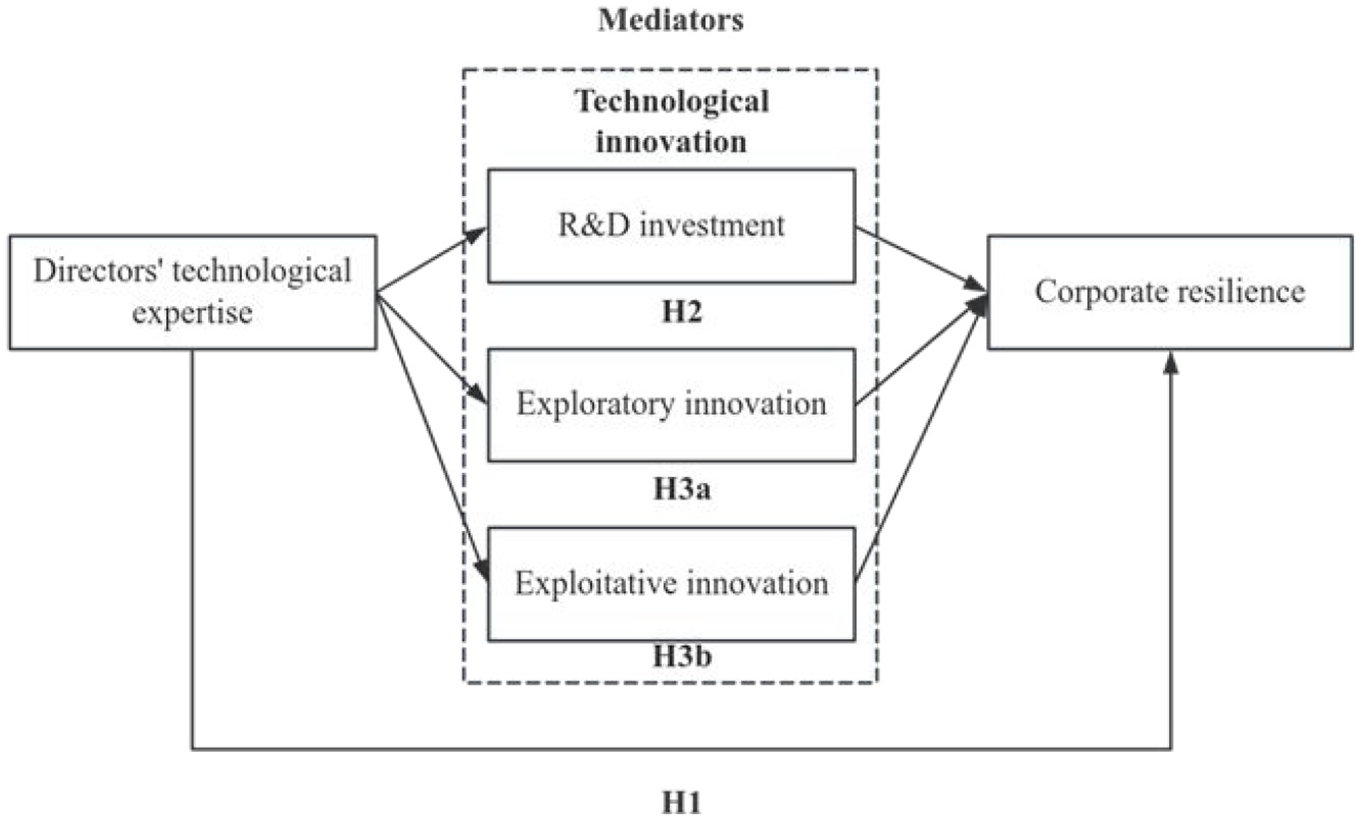
Conceptual model.
Research and Design
Sample Selection and Data Sources
Our study examines A-share listed companies in the technology sector over a 5-year period (2017–2021). We selected the technology sector due to its emphasis on technological advancement and product diversity. This period was chosen because of the turbulent environment created by global conflicts and the emergence of COVID-19, which underscores the interplay between turbulence and resilience.
Building on previous related research (Hu & Ji, 2017; N. Wang & Cui, 2023), our primary data sources are as follows: (a) Directors’ technological expertise data were manually sorted by our research team. (b) Corporate resilience data, including metrics on employee mobility, were sourced from the WIND database, while all financial data were obtained from the CSMAR database.
Our screening process involved several steps: (a) We excluded ST and *ST companies, which are at risk of delisting, due to their potential to destabilize the results. (b) Companies with outliers or missing data from 2017 to 2021 were removed. (c) To mitigate the effect of extreme outliers, all continuous variables were winsorized at the 1% and 99% levels. Ultimately, 1,208 companies were selected from an initial pool of 6,040 sample observations. Data analysis was conducted using the statistical software Stata 18.0.
Variable Construction
Explained Variable
Corporate resilience is measured using two primary approaches: questionnaire-based methods and analysis of secondary data. For questionnaire-based methods, scales are developed to assess aspects such as resource reservation, employee advantages, and other dimensions reflective of resilience complexity (Akguen & Keskin, 2014; Bustinza et al., 2016; Chi et al., 2023; Girish et al., 2018; R. Lu et al., 2021; X. Wang & Gao, 2021). In the realm of secondary data approaches, methods are categorized into three types. The first involves using stock market data, such as the decline in stock price following a crisis and the time required for recovery, to gauge resilience in terms of an organization’s capacity to manage and recover from crises (Desjardine et al., 2019; Markman & Venzin, 2014). The other two methods involve measuring resilience through changes in financial indicators during environmental shifts or using a comprehensive index system that provides a broader perspective (Feng & Zhu, 2023; Ortiz-De-Mandojana & Bansal, 2016; N. Wang & Cui, 2023; Q. Zhang & Deng, 2023). A detailed summary of the resilience measurement methods is presented in Table 1.
Methods for Measuring Corporate Resilience.
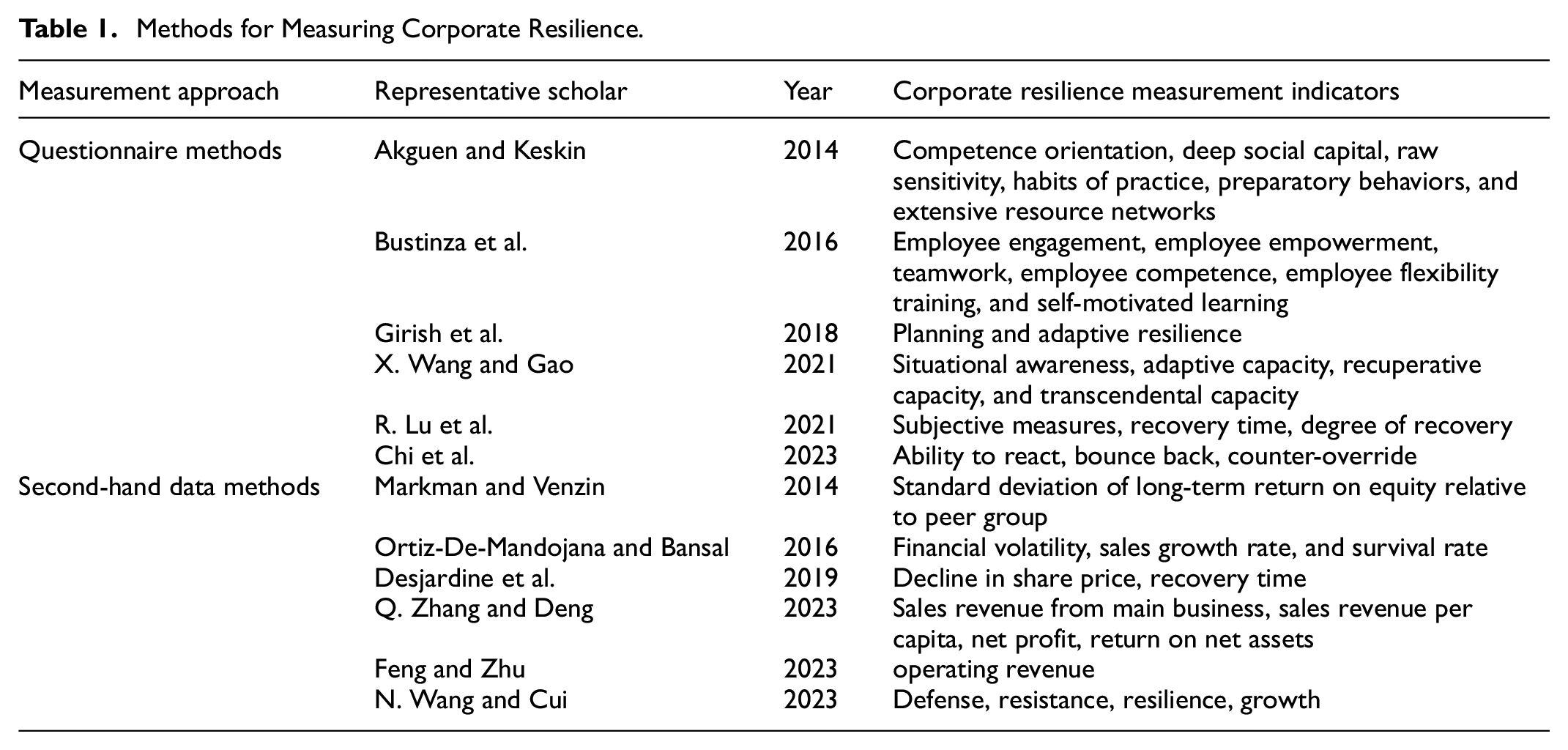
The diversification of methods not only enriches the methodology and findings in the field of corporate resilience but also introduces challenges in developing a systematic research framework. The questionnaire approach has inherent limitations due to its potential irreproducibility, and relying solely on stock market data may neglect critical aspects of daily operations, such as financial health. Therefore, a more comprehensive method is necessary to evaluate resilience accurately. Building on prior studies, we have employed a secondary data measurement approach, focusing on the capability perspective. This method assesses resilience in terms of prevention, resistance, recovery, and growth capabilities, considering both short-term and long-term dimensions.
In the resource-based view, financial resources constitute a fundamental element underpinning the strategic adjustments of firms, and the efficiency of their dynamic allocation systematically reflects the evolutionary trajectory of corporate resilience. By integrating dual perspectives of short-term crisis defense–recovery and long-term sustainable growth, this study establishes the following financial indicator system:
Short-term corporate resilience addresses crisis-response capability. Indicators include the interest coverage ratio, which measures debt-servicing ability and maintenance of creditworthiness; cash holdings, indicating buffering capacity against liquidity risk and potential to seize strategic opportunities; the net operating cycle, reflecting supply-chain coordination efficiency in maintaining capital-chain stability; and stock price volatility along with decline magnitude, which respectively reflect resistance to routine market fluctuations and extreme shocks.
Long-term corporate resilience evaluates potential for sustainable development. Key indicators include employee turnover, which assesses the stability of human capital as a foundation for organizational resilience; compound growth rate of return on equity (ROE), which gauges the quality of endogenous profitability; number of granted invention patents, which reflects the impact of innovation-to-outcome transformation on high-value-added growth; and compound growth rate of core operating revenue, which indicates consolidation of core market position and sustained operational cash-flow supply capacity. By examining the time-series configuration of these financial resources, the framework reveals the transition path from crisis resistance to long-term growth, illustrating how financial resource allocation bridges short-term survival needs and long-term value creation.
We have established an evaluation system using the entropy method, as detailed in Table 2.
Corporate Resilience Evaluation Index System and Weights.

Explanatory Variable
Building on prior research (Hu & Ji, 2017; B. Zhang et al., 2022), directors’ technological expertise (Td) is quantified as the proportion of directors with technical backgrounds to the total number of board members. A director is considered to have technological expertise if they meet any of the following four criteria: first, holding a degree in a technical field such as engineering or pharmaceuticals; second, possessing experience in research or key technical positions, or having served as the head of an industry technology association; third, holding professional technological titles, such as professor level engineer, engineer, or researcher; fourth, owning an invention patent or having received invention awards at the provincial level or higher.
Mediator Variables
R&D Investment (RD)
We measure R&D investment as the proportion of R&D expenditure to total assets. This ratio reflects the extent to which enterprises prioritize innovation within their strategic frameworks.
Technological Innovation Activities (R or D)
Exploratory innovation refers to experimentation with emerging opportunities, often involving high risk and novel markets. A representative example is Amazon Web Services (AWS): launched in 2006, this radical cloud computing business model became a new revenue pillar, contributing 16% of Amazon’s total revenue by 2023. Following the methodology outlined by Jia et al. (2023), we assess a firm’s exploratory innovation (R) using the ratio of expensed R&D expenditure included in the R&D expense account to total assets at the beginning of the year.
Exploitative innovation focuses on refining existing capabilities through incremental improvements. For instance, Amazon implemented robotics and AI-driven route algorithms in logistics optimization, reducing average U.S. delivery time by 34% from 2019 to 2023. These examples align with theoretical frameworks proposed by Dewar & Dutton (1986) and Tushman (1997), clearly demarcating the operational boundaries of both constructs. Similarly, we measure a firm’s exploitative innovation (D) by the ratio of capitalized R&D expenditure to total assets at the start of the year.
Control Variables
We have accounted for additional factors that may influence corporate resilience. Following the methodologies outlined by Chen et al. (2022), Q. Zhang and Deng (2023) and Cao and Zhang (2012), we controlled for the proportion of shares held by the largest shareholder (Top1), the degree of separation between control and management (Div), and the integration of dual roles (Dual), and the sum salary of directors (Dss). The literature suggests that board characteristics significantly affect corporate resilience, and the separation between control and management is closely linked to corporate operations. Furthermore, we accounted for the proportion of intangible assets (Cqr) and the government subsidies (GS), as they are closely related to the degree of resource utilization within enterprises and the lever of support for enterprises from government. In order to recognize the impact of external environment on resilience, as indicated by Tsiapa and Batsiolas (2019), we also included controls for intelligent city infrastructure (IC). Definitions of all variables used in our study are detailed in Table 3.
Variable Definition and Measurement.

Model Setting
We adopted a panel data model spanning 2017 to 2021, effectively mitigating issues such as serial correlation and heteroscedasticity inherent in cross-sectional or time-series data. Additionally, this approach circumvents endogeneity issues arising from omitted variables, thus enhancing the reliability of our empirical findings. Following the methodology outlined by Chen et al. (2022), we constructed our model.
To verify Hypothesis 1 and investigate the impact of directors’ technological expertise on corporate resilience, we constructed Model (1) for empirical testing:

In Equation 1, the dependent variable
To verify Hypothesis 2 and study the mediating role of R&D investment, we constructed Models (2) and (3) for empirical testing:


In Equation 2,
To verify hypothesis 3a and investigate the mediating role of exploratory innovation, we constructed Models (4) and (5) for empirical testing:


In Equation 4,
To verify hypothesis 3b and investigate the mediating role of exploitative innovation, we constructed Models (6) and (7) for empirical testing:


In Equation 6,
To control for unobservable factors that don’t change over time or industry conditions, we controlled for fixed effects in years and industries.
Empirical Analysis
Descriptive Statistics and Correlation Analysis
Table 4 presents descriptive statistics for the primary variables utilized to assess corporate resilience, offering an initial insight into the relationship between directors’ technological expertise (Td) and corporate resilience (Res). The results show a mean Res of 0.122, a median of 0.073, and a standard deviation of 0.176, with minimum and maximum values of 0.005 and 0.814, respectively. These figures indicate significant variability in the resilience levels among the sampled firms, with some firms demonstrating insufficient resilience to support short-term recovery and subsequent development. The standard deviation for Td stands at 0.184, with values ranging from 0 to 0.875, reflecting substantial disparities in the technological expertise of directors across firms. The percentage of technical directors on boards varied from 0% to 87.5%. The mean value for R&D investment (RD) is 0.065, with a maximum of 0.728 and a minimum of 0, highlighting significant differences in technological investments among firms. Additionally, the mean values for R and D are 0.033 and 0.003, respectively, suggesting substantial investments in both types of innovation activities by a large number of firms.
Results for Descriptive Statistical.

Table 5 provides a correlation analysis of all variables employed in assessing corporate resilience to ascertain the presence of multicollinearity within the research model. The findings reveal a positive correlation between Td and Res, suggesting that directors’ technological expertise contributes positively to corporate resilience in a way. Consequently, Hypothesis 1 is preliminarily validated. Moreover, R&D investments (RD) show positive correlations with both Td and Res, necessitating further investigation for Hypothesis 2. A similar requirement applies to exploratory innovation (R) for Hypothesis 3a.
Correlation Analysis Results.

, **, and * respectively indicate significance at the 1%, 5%, and 10% levels.
Conversely, while there is a positive correlation between exploitative innovation (D) and Td, a negative correlation exists with Res, which may suggest a contradiction to Hypothesis 3b, and thus warrants additional analysis. Furthermore, the average Variance Inflation Factor (VIF) values for Equations 1 to 7 are 1.26, 1.29, 1.28, 1.26, 1.25, 1.26, and 1.25, respectively, all well below the threshold of 5, thereby excluding any issues of auto-correlation among variables and affirming the absence of multicollinearity concerns.
Baseline Regression Results
Model (1) is firstly tested by ordinary least squares (OLS) regression. The results showed that the coefficient on Td in column (1) of Table 6 is .040 and significant at the 1% level. This means that for high-tech enterprises, the increasing proportion of technology directors positively influence corporate resilience. The hypothesis H1 proposed has been confirmed, providing a possibility for further analysis of the mechanism of their interaction.
Baseline Regression Results.

Note. t Values are in parentheses.
, **, and * respectively indicate significance at the 1%, 5%, and 10% levels.
Tests of the mediating effect of R&D investment are presented in columns (2) and (3) of Table 6. Model (2) examines the effect of directors’ technological expertise on R&D investment by controlling for the principal variables influencing innovation inputs. The empirical findings demonstrate a significant positive correlation, with a regression coefficient of .055, significant at the 1% level. By incorporating these inputs into Model (1), the regression results from Model (3) robustly support the validation of the mediating effect of technological innovation inputs, owe to the regression coefficients of Td and RD to Res are positively significant at not more than 5% level. Moreover, the inclusion of R&D reduces the positive effect of directors’ technological expertise on corporate resilience; the regression coefficient decreases from .040 to .029. This reduction indicates that technological innovation inputs effectively mediate between directors’ technological expertise and corporate resilience, thus supporting Hypothesis H2.
We further refine technological innovation activities into exploratory and exploitative innovations. The mediation effect test results for exploratory innovation (R) are displayed in columns (4) and (5), while those for exploitative innovation (D) appear in columns (6) and (7) of Table 6. Model (4) assesses the impact of directors’ technological expertise on exploratory innovation, controlling for the main variables that influence this type of innovation activity. The empirical findings denote a significant positive correlation between Td and R, with a regression coefficient of .023, significant at the 1% level. Model (5) incorporates exploratory innovation into Model (1); here, the coefficient on Td is 0.035, significant at the 1% level, and on R, it is 0.206, significant at the 5% level. The decrease in Td’s coefficient upon the addition of R supports the notion that exploratory innovation serves a partial mediating role between directors’ technological expertise and corporate resilience. Consequently, Hypothesis H3a proposed in this study is validated.
Model (6) examines the influence of directors’ technological expertise on exploitative innovation (D). The empirical results demonstrate that Td is positively associated with D, with a regression coefficient of .004, significant at the 1% level. However, the effect of directors’ technological expertise on exploitative innovation is less pronounced compared to its effect on exploratory innovation. In Model (7), when exploitative innovation is added to Model (1), the regression coefficient of Td to Res is .045, significant at the 1% level, and the coefficient of D to Res is −1.390, also significant at the 1% level. Moreover, controlling for exploitative innovation, the positive impact of technological expertise on corporate resilience intensifies, as indicated by the larger regression coefficient of Td to Res in Model (7) compared to Model (1). These findings indicate that exploitative innovation negatively mediates the relationship between the technological expertise of directors and corporate resilience, producing a masking effect that contradicts Hypothesis H3b. Exploitative innovation prioritizes intensive utilization of existing technologies, knowledge, and markets, potentially leading firms into a competency trap. The technological expertise of directors can foster exploitative innovation via specialized decision making, thereby optimizing short-term resource-allocation efficiency; however, this focus fixes the long-term trajectory of technological development, reduces flexibility in exploring new opportunities, fosters core rigidity and organizational inertia, and ultimately diminishes resilience.
Robustness Check
Endogenous Problems
The issue of endogeneity typically arises due to measurement errors in explanatory variables, omitted variables, mutual causation, and sample selection biases. Firstly, to address the measurement error in explanatory variables, this study employs the entropy value method to develop a comprehensive indicator system that more effectively measures corporate resilience. The financial data utilized within this system are sourced from the annual reports of publicly listed companies, employee-related data from the WIND database, and stock price-related data from securities market disclosures, ensuring that the variable “corporate toughness” is minimally affected by measurement errors. Secondly, to mitigate the omission of key explanatory variables, the study incorporates a broad range of control variables reflecting equity structure and significant firm characteristics, alongside industry and year fixed effects. This approach comprehensively controls for factors influencing corporate resilience, effectively circumventing significant omissions. Additionally, to address potential issues like omitted variables and measurement errors, this study uses the lagged period of Td (New_Td) and the proportion of technical personnel (New_Td2) as instrumental variables. Generally speaking, the higher the ratio of technical expert directors, the firms are increasingly likely to attach importance to technical personnel. Meanwhile, the proportion of technical personnel is not directly related to RES. Employing a 2SLS two-stage regression model to resolve endogeneity concerns.
In support of our IVs, we perform an F-test and a Sargan overidentification test to confirm the relevance and overidentification restrictions of the IVs. The findings, presented in Table 7 with a sample observation of 4,832 after accounting for missing values in the IVs, column (1) respects that the F-statistic of 9,618.461 from the first-stage regression is far greater than 10 and significant at 1%, column (2) confirms that the coefficient of Td remains significantly positive in the second-stage regression with the Sargan overidentification test statistic of 8,548.407 in the second stage, suggesting that these two IVs are appropriate and jointly valid, thus weak instrument hypothesis has been rejected, validating the robustness of the initial results against endogeneity.
Estimation Results of Instrumental Variables.

Note. t Values are in parentheses.
, **, and * respectively indicate significance at the 1%, 5%, and 10% levels.
Changing the Explanatory Variables
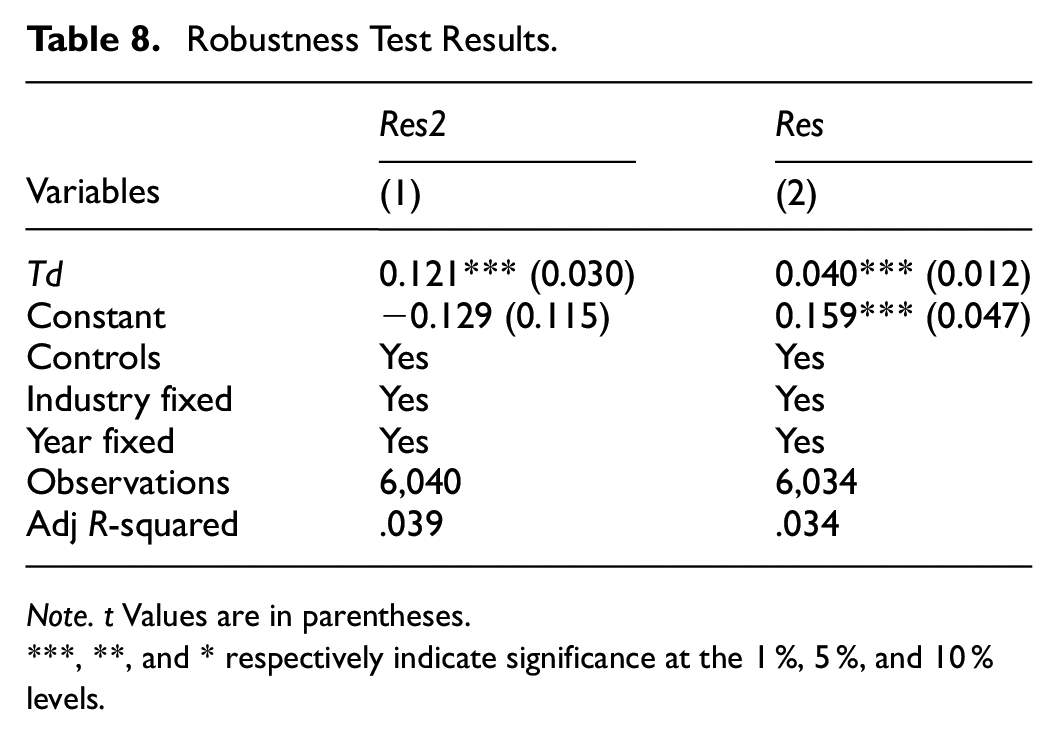
In order to avoid the impact of the results due to the way the explanatory variables are measured, the year-on-year growth rate of sales revenue (Res2) is used to measure corporate resilience, drawing on Ortiz-de-Mandojana and Bansal’s (2016) research to measure corporate resilience. As shown in column (1) of Table 8, the main findings continue to hold after replacing the explanatory variable measure.
Robustness Test Results.
Note. t Values are in parentheses.
, **, and * respectively indicate significance at the 1%, 5%, and 10% levels.
Excluding Special Samples
In order to enhance the stability of the results, the regression is conducted again after excluding the special sample with zero innovation input, and the regression results are consistent with the main findings. As shown in column (2) of Table 8, the regression results remain significant after the above robustness test examination, which can prove the overall robustness of the research conclusions.
Heterogeneity Analysis
Age Attributes of Firms
To investigate the relationship between directors’ technological expertise and corporate resilience across different stages of firm age, this study categorizes the sample firms into two groups: growth and maturity, based on a 15-year threshold. The regression results presented in columns (1) and (2) of Table 9 detail the influence of directors’ technological expertise at the different stages. At the growth stage, the coefficient of Td on Res is positively significant at 1%. In contrast, at the maturity stage, directors’ technological expertise is negatively associated with corporate resilience, but not conspicuously.
Heterogeneity Analysis Results.

Note. t Values are in parentheses.
, **, and * respectively indicate significance at the 1%, 5%, and 10% levels.
The resource reserves and operational dynamics of firms vary markedly between these stages. During the growth period, where products and services are less stable, the strategic direction is uncertain, and brand reputation is still developing, directors’ technological expertise is crucial in securing a competitive edge. It ensures that strategies align with the industry’s healthy development, stabilizes daily operations, minimizes investment failures, and opens up further growth opportunities for the firm. In the maturity stage, however, as the firm’s technology and products have stabilized and the strategic and development trajectories are firmly established, the influence of directors’ technological expertise is less pronounced.
Although empirical results indicate that the impact of technological expertise of directors on corporate resilience during the maturity stage is statistically insignificant, this phenomenon reflects the distinctive resource-allocation logic of mature firms. Enterprises in phases of technological and operational stability primarily depend on established process controls, market barriers, and supply-chain stability to sustain resilience, where marginal contributions of technical expertise may be diluted or offset by alternative mechanisms. For example, iFLYTEK, a Chinese high-tech firm specializing in AI research, achieved a compound annual growth rate of net profit exceeding 25% during its growth phase through directors leading R&D for intelligent speech and AI technologies, effectively enhancing organizational resilience. However, upon entering the maturity stage (2022–2024), the company experienced net profit fluctuations, including a 63.94% year-on-year decline in 2022, and showed diminished resilience gains. This pattern supports the view that, for mature firms with stabilized technological trajectories and market shares, resilience derives more from factors such as process governance and brand barriers, while the marginal value of technical expertise proportionally declines.
According to the dynamic capability theory, although the direct effect of directors’ technological expertise in mature enterprises may not be statistically significant, the judgment of directors regarding industry technology cycles enables firms to engage in emerging fields as risk-averse actors rather than innovation leaders. By identifying external collaboration targets with low trial-and-error costs through technological discernment capabilities, the technological expertise of directors in mature enterprises mitigates innovation rigidity caused by internal technological path dependence. Although this approach cannot directly enhance corporate resilience, it indirectly safeguards firm development by reducing risks from disruptive technological shocks.
The Degree of Competition in the Firm’s Industry
The importance of directors’ technological expertise is closely associated with the level of industry competition. To assess the effect of directors’ technological expertise on corporate resilience within industries characterized by varying levels of competition, this study utilizes the Herfindahl-Hirschman Index (HHI) of operating income to categorize the sample’s industries into two groups: those with a low degree of competition and those with a high degree of competition, using the mean HHI value as the dividing line. The regression results for Td under different competition levels are presented in columns (3) and (4) of Table 9. In industries with low competition, the coefficients of Td on Res are not statistically significant. Conversely, in industries with high competition, these coefficients are significant at 1%. In sectors with minimal competition, some firms may leverage their existing market position and inherent technological advantages for survival and growth, rendering the impact of directors’ technological expertise less critical. However, in highly competitive sectors, firms must depend on industry foresight and core technological competence to secure survival and growth opportunities, amplifying the significance of directors’ technological expertise on corporate resilience.
In industries with low competitive intensity, although empirical findings suggest that the impact of directors’ technological expertise on corporate resilience is statistically insignificant, their latent practical value warrants deeper exploration. Such industries often exhibit monopolistic or oligopolistic characteristics, where firms rely on market barriers and existing technological advantages to maintain stable survival spaces, resulting in relatively subdued short-term demand for externally-driven resilience. However, according to the dynamic capability theory and the concept of “creative destruction” proposed by Joseph Schumpeter, firms in low-competitive industries that secure short-term stability through market dominance face more latent “innovation inertia traps,” wherein monopoly rents crowd out incentives for technological iteration. The value of technological expertise lies precisely in disrupting such “monopoly inertia” by converting market power into technological control. For instance, technology directors in monopolistic telecommunications firms could prioritize frontier 6G R&D or satellite communication technologies, thereby transforming monopoly positions into first-mover advantages in emerging technological domains, rather than confining optimization efforts to existing operations.
The Level of Digital Economy in the City Where the Firms Are Located
Following the methodology of X. Li et al. (2022), we employed the R language to extract the frequency of terms such as “digital economy” and “digitalization” from the Baidu index for each province from 2017 to 2022. Then the entropy weight method was applied to compute a digital economy composite index to assess the digital economy level in each city. The regression results presented in columns (5) and (6) of Table 9 analyze directors’ technological expertise across cities with varying levels of digital economy. The findings indicate that the regression coefficient of Td on Res is not statistically significant in cities with a high digital economy level. Conversely, in cities with a low digital economy level, this coefficient is significant at 1%. This pattern suggests that in cities with advanced digital economies, the comprehensive hardware and software infrastructure for innovation sufficiently supports enterprises in overcoming challenges, thus diminishing the distinct advantage provided by directors’ technological expertise. However, in cities with less developed digital economies, the need for technical directors to drive technological innovation and information processing is crucial for securing a competitive edge.
Further Analysis
Classification of Technology Directors
Building on prior theoretical research, we categorize technology directors into executive and non-executive technology directors. Executive technology directors, who serve in the managerial layer of the company and participate in corporate governance and strategic decision-making (Z. Lu & Hu, 2015), are quantified by the ratio of executive technology directors to the total number of directors. By contrast, non-executive technology directors hold no additional positions within the firm and focus exclusively on technology-related functions. They are tasked with executing the board’s directives. In contrast, non-executive directors, often appointed by major shareholders, higher-level organizations, or influential shareholders, maintain a degree of independence from the company’s management and primarily offer objective advice and oversight. This distinction allows technical executive directors to blend governance with management functions, whereas technical non-executive directors tend to uphold greater independence. The current analysis aims to ascertain whether differences exist in the impact of the proportion of executive technology directors (Td_e) versus non-executive technology directors (Td_ne) on corporate resilience.
As illustrated in column (1) of Table 10, executive technology directors are significantly and positively correlated with Res at the 1% significance level. In contrast, as depicted in column (2), the regression coefficients for non-executive technology directors on Res are not statistically significant. Executive directors, who are deeply engaged in daily operations and implementation, possess extensive internal information and a thorough understanding of corporate operational conditions.
Further Analysis Results.

Note. t-Value in parentheses.
, **, and * respectively indicate significance at the 1%, 5%, and 10% levels.
Such an understanding enables firms to make detailed, evidence-based decisions, thereby strengthening their resilience against risks. Executive technology directors, endowed with decision-making authority within the managerial hierarchy, can respond promptly and effectively to innovation opportunities. In contrast, non-executive technology directors, owing to their independence from governance structures, may impose excessive oversight on executives and foster risk-averse innovation strategies (Y. Li et al., 2019), which explains their negligible effect on corporate resilience.
Technological Innovation Model
The classification of technological innovation activities can be divided into the dual innovation model and the intermittent balance model. The dual innovation model involves simultaneous utilization of both exploratory and exploitative innovations, whereas the intermittent balance model entails alternating between different types of innovation activities over time. It is clear that the relationship between exploratory and exploitative innovation is both synergistic and competitive, and harmonizing these approaches is essential for firms aiming to secure long-term development and maintain robust resilience. Currently, scholarly perspectives diverge regarding the impact of these models on firms. One perspective posits that the two types of innovation activities mutually reinforce each other, with the dual innovation model facilitating higher sales growth rates through their synergistic effects (Z. L. He & Wong, 2004). Conversely, another viewpoint suggests that firms should tailor their innovation strategies to specific circumstances, with the intermittent balance model being more advantageous for sustaining long-term performance.
The innovation process features a complex interplay of competitive and synergistic relationships between utilitarian and exploratory innovations. The coordinated interaction between these two types of innovation enhances the comprehension and application of existing knowledge. Utilitarian innovation expands the possibilities for exploratory innovation, while exploratory innovation opens new research avenues and opportunities for enterprises. However, limited resources exacerbate the rivalry between them, often resulting in a dominance contest where one type of innovation may overshadow the other, either “east wind overrides west wind” or “west wind overrides east wind.” The selection of a technological innovation mode is intricately linked to the distribution of corporate resources and the effectiveness of innovation, and it plays a crucial role in leveraging directors’ technological expertise to increase corporate resilience. This study aims to further examine whether directors’ technological expertise enhances corporate resilience through specific technological innovation modes. The variables for technological innovation modes are defined as follows:

Mod is defined as the innovation balance index in this study, representing the mode of technological innovation. The Mod value ranges from 0 to 1. A Mod value closer to 1 indicates that the investment into exploratory and exploitative innovations are more balanced, suggesting the adoption of the dual innovation mode by the enterprise. Conversely, a Mod value closer to 0 indicates a significant disparity between the inputs into these two modes of innovation, suggesting that firm technological innovation adopts the intermittent balance mode.
According to the data presented in column (3) of Table 10, Td is significantly and negatively correlated with Mod at the 1% level, implying that the more directors’ technological expertise is, the more likely a company adopts an intermittent balance mode. From column (4), the Mod is shown to be negatively correlated with Res and significant at 1%. Additionally, the regression coefficient of Td remains positive, although it decreases compared to the results in Table 6 column (1). This indicates that the technological innovation mode serves as a partial intermediary. Given the scarcity of resources, firms with powerful directors’ technological expertise are more inclined to adopt the intermittent equilibrium mode, allowing them to strategically allocate technological resources to manage risks and challenges effectively.
Discussion
This study investigates the influence of technological expertise of directors on corporate resilience and the mechanisms through which technological innovation is transmitted within Chinese high-tech firms. The results confirm Hypotheses H1, H2, and H3a, whereas Hypothesis H3b remains unsupported (see Table 11). Compared with previous research, these findings provide new insights into the contribution of technology directors to corporate resilience.
Path Estimates and Hypotheses Testing.

Note.***, **, and * respectively indicate significance at the 1 %, 5 %, and 10 % levels.
Prior studies have demonstrated that directors’ technological expertise positively influences cash reserves, innovation activities and total factor productivity (Balsmeier et al., 2014; Iyer et al., 2020; Yuan et al., 2024). Furthermore, research on family firms reports a positive association between social capital and corporate resilience (Hurtado & Herrero, 2024; Mihotić et al., 2023), and board expertise has been shown to enhance firm performance (Dass et al., 2014). Consistent with these findings, the present study reveals a significant relationship between directors’ technological expertise and corporate resilience, thereby extending the literature on the role of technological leadership and board resources.
Second, prior literature demonstrates that technological innovation enhances firm resilience (Forliano et al., 2023; Gemici et al., 2024; Nosike et al., 2024). Empirical evidence from Chinese listed manufacturing firms indicates that directors’ technological expertise positively influences innovation activities, including R&D investment and patent applications and grants (Y. Li et al., 2019). Yuan et al. (2024) report that directors information technology expertise significantly improves total factor productivity among Chinese A-share non-financial listed companies by increasing IT investments and enhancing operational efficiency. From the perspective that directors’ technical expertise serves as a key source of firm technology and guides the allocation of innovation resources, this study finds that R&D investment mediates the relationship between directors’ technological expertise and corporate resilience.
Although prior research treats technological innovation as a single construct, this study distinguishes between exploratory and exploitative innovation. Hypotheses H3a and H3b posit that different types of innovation activities mediate the effect of directors’ technological expertise on corporate resilience. The results show that exploratory innovation and intermittent balance innovation mediate the relationship between directors’ technological expertise and corporate resilience.
It is worth noting that the H3b is not confirmed. This outcome indicates that exploitative innovation may obscure the positive relationship between directors’ technological expertise and corporate resilience, ultimately exerting a negative influence on resilience. The reasons for the masking effect of exploitative innovation stem from the following two aspects. On the one hand, hypothesis H3b is based on the resource-based view, which emphasizes resource fitness, that is, the value of a resource depends on environmental dynamism. Manso (2011) points out that the advantage of exploitative innovation in reducing risks and costs depends on an environment characterized by technological maturity and market stability. However, when operating in a highly uncertain environment, the marginal contribution of exploitative innovation decreases (Katila & Ahuja, 2002) and may even have a masking effect by inhibiting exploratory innovation. On the other hand, based on dynamic capability theory, corporate resilience requires the support of dynamic capabilities, that is, the ability to perceive environmental changes, integrate resources, and reconfigure strategies. However, exploitative innovation overemphasizes the optimization of existing capabilities and inhibits firms from sensing discontinuous changes, such as technological disruptions or sudden shifts in market demand. Focusing only on the iteration of legacy technologies can lead to missed opportunities to innovate under the new paradigm, all of which negatively influence corporate resilience.
This seems to indicate that exploitative innovation may not be a favorable strategy for long-term firm growth. Excessive focus on exploitative innovation can constrain the evolution of a firm’s technological trajectory and hinder effective adaptation to external environmental changes. However, the empirical results of this study also suggest that technology directors prefer to adopt the intermittent balancing innovation model (the investment in exploratory and exploitative innovations is apparently unbalanced) to enhance corporate resilience. Specifically, firms engage in alternating choices of exploratory and exploitative activities over time. Valuable, rare, and undeniably exploratory innovations can form a core competitive advantage for enterprises. However, successful exploratory innovation entails substantial investments and risks associated with environmental uncertainties, imposing significant financial burdens on organizations. Consequently, decisions regarding whether to implement an exploratory innovation strategy and the extent of support allocated to such initiatives ultimately depend on governance bodies and management’s strategic evaluation of R&D costs versus potential returns. To survive in dynamic markets, firms must maintain a balance between exploratory and exploitative innovation activities (Tushman, 1997). Therefore, our study may provide some insights for further research on the different roles of exploratory and exploitative innovations on corporate resilience.
Finally, further analysis indicates that executive technology directors significantly increase corporate resilience compared to non-executive technology directors. Whereas existing literature emphasizes the monitoring and strategic guidance roles of non-executive technology directors (Zhao et al., 2018), our study reveals the unique advantages of executive technology directors in technology implementation and resource integration. One possible explanation is that executive technology directors are more directly involved in business operations and can translate technological expertise into concrete innovation practices, whereas the influence of non-executive technology directors may be constrained by the corporate governance structure.
Conclusions and Implications
Findings
As a critical factor enabling high-tech enterprises to mitigate external negative shocks and promote high-quality development, strong resilience with ample potential is essential for safeguarding current operations and future growth. It represents a vital capability for transforming crises into opportunities, leveraging those opportunities to create momentum, and sustaining the resilience of China’s economy. This paper investigates the influence and enhancement mechanisms of directors’ technological expertise on corporate resilience, utilizing public data from China’s A-share high-tech listed companies during the 2017 to 2021 period, which experienced significant disruptions due to the COVID-19 pandemic. The analysis focuses on the roles of board characteristics and technological innovation. Our study contributes to existing research in several ways.
Initially, our study enriches corporate resilience evaluation index system by measuring both short-term and long-term capabilities. This multi-dimensional framework addresses gaps in existing literature. Second, contribute to the literature on corporate resilience by finding that directors’ technological expertise enhances corporate resilience. Prior research primarily focuses on financial and operational determinants of resilience, while our study reveals the distinct role of technological expertise in resource allocation decisions and the ability to anticipate, adapt to, and recover from disruptions. Finally, our findings deepen the understanding of the internal mechanisms through which technological expertise enhances corporate resilience. The empirical results show that directors with technological expertise facilitate strategic investments in innovation, particularly exploratory innovation, which in turn strengthens corporate resilience. By integrating insights from innovation management and strategic leadership, our study provides a theoretical foundation for promoting R&D investment at the level of strategic decision-making to enhance corporate resilience.
Implications
Several important managerial practices and policy implications could be carried by our findings. First, high-tech firms should recruit directors with technical expertise to enhance corporate resilience. Introducing high-level and technical directors helps to consolidate the industry information foundation for strategic decision-making. The development and recruitment of professional and technical talent should be prioritized to build resources capable of enhancing risk prediction, defense, and absorption, thereby strengthening strategic decision-making and resilience in firms. Firms should tailor the composition of their boards of directors to local conditions. In the growth phase, where the resource base is limited and strategic direction is unclear, it is essential for companies to have technical directors who can define the strategic trajectory and foster opportunities for growth. Furthermore, the more competitive the industry, the greater the pressure to survive and excel, thus increasing the demand for technological expertise. In cities with a low level of digital economy, where external support is scarce, the importance of technologically skilled directors becomes even more critical. Such directors can provide expert insights and oversight for innovative activities, thereby aiding enterprises in achieving high-quality development.
Second, R&D investment is crucial for enhancing corporate resilience, which creates a linkage between directors’ technological expertise and corporate resilience, meriting significant attention. Exploratory innovation enables firms to achieve “0 to 1” breakthroughs and enhances corporate resilience, whereas exploitative innovation tends to make firms overly focused on existing products and services, lacking foresight and ultimately diminishing resilience. Prioritizing R&D investment in exploratory activities is more effective in leveraging the advantages of enterprise innovation resource allocation. Moreover, maintaining reasonable control over exploitative innovation can mitigate its negative impacts on resilience. Enterprises must thoroughly comprehend the effects of the initiative innovation on survival and development. This approach ensures profitability and survival in the face of demand contraction due to external shocks. High-tech enterprises can collaborate with research institutions, universities, and startups associated with directors who have technological expertise to jointly undertake innovative projects and technology R&D. This collaboration can alleviate the burdens of independent R&D and enhance innovation capabilities.
Finally, governments should adopt differentiated incentives to maximize innovation outcomes. For instance, providing industrial fund support to high-tech enterprises in their growth stage. Firms with strong innovation capabilities should be incentivized with more subsidies to foster technological autonomy and the generation of exploratory innovation.
Research Limitations and Perspectives
This study has some limitations that future research could address. Our analysis is confined to data from Chinese A-share high-tech listed companies. Although the sample data largely satisfies the requirements of this study, it only explores the influence of directors’ technological expertise on corporate resilience, omitting the effects of directors’ other backgrounds. Scholars like Datta and Rajagopalan (1998) have suggested that individuals’ education levels influence their knowledge structure, skill level, and ability to analyze information swiftly and respond effectively, which in turn impacts corporate resilience. Future studies might therefore consider examining whether significant differences exist in the impact of directors’ educational levels and characteristics on the resilience of high-tech firms.
Footnotes
Acknowledgements
This research was supported by the National Natural Science Foundation of China (grant numbers 72162016, 7216302); the Social Science Foundation Youth Program of Jiangxi Province (grant number 23YJ30). The authors are grateful for these funding opportunities.
Author Note
This manuscript has not been published or presented elsewhere in part or in entirety and is not under consideration by another journal. Its publication is approved by all authors and tacitly by the responsible authorities where the work was carried out. If accepted by your journal, it will not be published elsewhere in the same form, in English or any other language, including electronically without the written consent of the copyright-holder.

Author Contributions
The individual contributions and responsibilities of all authors are as follows: G.W. collected the data, Y.W. and X.D. proposed and designed the research, and wrote original scripts; G.W. reviewed the logic of the article and carried out regression analysis. Y.W. put forward suggestions for revision; and G.W. and X.D. reviewed and edited the manuscript. All authors reviewed and approved the final manuscript.
Funding
The author(s) disclosed receipt of the following financial support for the research, authorship, and/or publication of this article: National Natural Science Foundation of China, Grant/Award Number: 72162016/ 72163021; Social Science Foundation Youth Program of Jiangxi Province, China, Grant/Award Number: 23YJ30.
Declaration of Conflicting Interests
The author(s) declared no potential conflicts of interest with respect to the research, authorship, and/or publication of this article.
Data Availability Statement
The data used to support this study is available from the corresponding author upon request.