




Abstract
Dynamic internationalization capability plays a significant role in the performance of Taiwanese small and medium-sized enterprises (SMEs) in the process of internationalization. According to the concept of dynamic capability, businesses need to develop and maintain capabilities by obtaining valuable knowledge from different sources, such as market environments and social networks. However, previous studies have tended to only discuss the development of dynamic internationalization capabilities from a single perspective and have failed to explore more comprehensive knowledge sources. This study investigates whether social network relationships and overseas market orientation (OMO) improve dynamic internationalization capabilities. Participants were collected from internationalized SMEs in Taiwan via purposive sampling, yielding 211 valid samples. Results show that trust and commitment have a positive impact on international exploration capabilities, OMO has a positive impact on both international exploration and international exploitation capabilities, and international exploration has a positive impact on international performance. According to the findings, this study has several managerial and theoretical implications. In addition, it shows that the classification of SMEs’ capabilities enables them to focus on resources, thus contributing to resource concentration and the reduction of unnecessary waste.
Keywords
Introduction
Small and medium-sized enterprises (SMEs) are increasingly expanding in size to improve market performance. In Taiwan, according to statistics from 2019, 97.65% of enterprises are SMEs from a wide range of industries. Due to the country’s small market size and insufficient resources, SMEs have had to internationalize. Therefore, many firms target the international market when they start doing business, especially those in the manufacturing industry. Although it is often difficult to collect and objectively disclose the international performance of SMEs, this subject has become a primary focus of business-related research. To adapt to changing business environments, the variety of SME products and capabilities must frequently change over time (Helfat & Raubitschek, 2018); in addition, SME development should specifically focus on business models of foreign direct investment (FDI). These models may lead to possible changes in an SME’s domestic, industrial, and overseas networks, but they will also enable firms to gain abundant information and resources. According to Malagueño et al. (2018), SMEs need to make more effort during market expansion and organizational growth due to a lack of resources and customer trust and because they could experience difficulties related to formal compensation systems and employee performance appraisals. According to some research findings, many SMEs are being rapidly internationalized, acquiring the knowledge, technology, and resources needed to stimulate development and growth through international connections (Fernhaber & Li, 2013; Salvato & Vassolo, 2018). In other words, firms with strong global networks have a higher degree of internationalization. Through such networks, they can exchange information with one another, integrate resources, address needs in the international market, and sustain their internationalization (Johanson & Vahlne, 2009). Emerging global firms need to connect through strong internal networks and disseminate, share, and use information gained from external networks to increase international sales. For SMEs, these initiatives result in more resources and capabilities (Teece et al., 1997) that accelerate internationalization and enhance the benefits of globalization. Thus, this study aims to explore the relationship between key antecedents and international performance within the SME internationalization process.
Previous studies have indicated that dynamic capabilities can contribute to performance (Lin & Wu, 2014). If SMEs have internationalization experience and capabilities, they can better manage the uncertainties of foreign operations and integrate resources through network relations to implement internationalization more efficiently. However, current studies on dynamic capabilities have mainly focused on their conceptualization and developmental processes, while the empirical evidence remains unclear. Few studies have examined the correlation between performance and dynamic internationalization capabilities; however, several have indicated that the relationship between dynamic capabilities and performance leads to different outcomes (Schilke, 2014). According to Pinho and Prange (2016), dynamic internationalization capability refers to the way enterprises expand their scale through an internationalization process and accumulate more experience to cope with rapid changes in overseas markets with continuous development, consolidation, and reallocation of resources. The authors also claimed that previous studies on dynamic capabilities have mainly focused on large enterprises, but few have focused on SMEs’ capability development and application; as a result, this has led to a failure in thoroughly exploring SME performance considering dynamic internationalization capabilities with context dependence (Winter, 2003). The current study uses Pinho and Prange’s (2016) work exploring the relevance between dynamic internationalization capabilities and international performance as its theoretical foundation; however, the participants in that study consisted only of Portuguese SMEs doing business in Western countries. Whether the same results occur by sampling Taiwanese SMEs working in Asian countries has, until now, remained unverified. Furthermore, unlike Pinho and Prange’s (2016) study, the current one discusses the development of dynamic capabilities caused by differences in knowledge and information sources. As indicated in Peng and Lin’s (2021a) study, differences in knowledge sources will lead to changes in the knowledge base required for use of dynamic capabilities, such as tacit knowledge, explicit knowledge, and strong ties and weak ties. Therefore, this study explores past examples of different knowledge sources to explore the relationship between dynamic internationalization capabilities and international performance, while also exploring and verifying research models found in Asian regions.
Although attempts are made to explore the impact of dynamic internationalization capabilities on international performance, the specific goal of this research is to better understand the development process and effective capabilities. Most studies have indicated that VRIN-compliant resources and knowledge are primary components of dynamic capabilities (Zollo & Winter, 2002). However, to access these developmental resources, a social network relationship is important for firms in acquiring internal and external resources (Lew et al., 2013; Salvato & Vassolo, 2018). A social network relationship can be defined as the relationship between firms and members of networks established through the accumulation of long-term interactions. Working together within these networks, participants can share and develop norms, trust, values, and mutual recognition (Moran, 2005; Peng & Lin, 2021a). Considering the dynamic path-dependent nature of dynamic internationalization capabilities (Wang & Ahmed, 2007), Baker and Sinkula (1999) argued that firms should have both internal and external capacity-fostering mechanisms. The external social network relationship should be characterized by market-oriented behaviors inside the firm (Ho & Tsai, 2006). However, other researchers have stated that market orientation is similar to dynamic capabilities and exhibits the characteristics of context dependence (Acosta et al., 2018). If the internationalization context is only explored through local market orientation, the results might be different (Cadogan et al., 2001; Cadogan, Kuivalainen, & Sundqvist, 2009; Cadogan, Lee, et al., 2009). Therefore, using the opinions of various researchers on the subject, this study attempts to explore the relationship between overseas market orientation (OMO), social network relationships, and dynamic internationalization capabilities.
This study also aims to explore the development of the dynamic internationalization capability of SMEs using the concepts of dynamic capabilities and the organizational learning theory by focusing on two key questions. The first is whether SMEs’ social network relations and OMO can contribute to the knowledge, technology, and resources needed to develop internationalization, thus forming the dynamic internationalization capabilities needed in a competitive, foreign business environment. The second is whether these dynamic internationalization capabilities can enhance the international competitiveness and performance of such enterprises. Thus, this study contributes to the research because it uses the concepts of organizational learning and dynamic capability to look at the relationship between external antecedents, dynamic internationalization capability, and international performance in the context of SMEs. In addition to verifying the impact of different knowledge sources on dynamic internationalization capabilities, this research also makes worthwhile contributions to the theoretical development of dynamic internationalization capability by discussing knowledge sources from two different properties and examining the importance of the development of dynamic internationalization capability and its impact on subsequent international performance.
Literature Review
Internationalization Background of Taiwanese SMEs
In recent years, Taiwanese enterprises have shifted their focus from investing in exports to deeply internationalized FDI in an attempt to expand the scale of their international business by forming global networks. For these firms, several factors needed to first be taken into account, such as domestic economic conditions and the strength of their current business, as well as international economic conditions and the local market space required for further development. Internationalization has been a growing trend in Taiwan, and many foreign firms benefit from Taiwanese enterprises’ effectiveness and the nation’s island-type economic environment. According to the Ministry of Finance, Taiwan’s exports in 2021 totaled $446.45 billion US dollars, which is an increase of 29.4% from the previous year. Research on strategies, marketing, finance, and accounting is required for companies because they can then enhance their business performance using varied international strategies, international marketing, and investment in various international markets (Monteiro et al., 2017). Taiwan, with its export-oriented economy, specifically relies on the quality of its exports to be internationally competitive. According to the 2021 IMD World Competitiveness Yearbook, issued by the IMD World Competitiveness Center, Taiwan is eighth in the world in total exports. The country experienced a downturn in terms of its competitive economic edge despite a favorable economic performance, which was contrary to the rapid development of neighboring countries such as Japan, South Korea, mainland China, and Vietnam. The reason for this downturn was the fact that neighboring countries were bigger in size and had much larger populations than Taiwan. Because they were initially limited to the domestic market, Taiwanese enterprises have had to stop only operating domestically and enter the international market. Hessels and Parker (2013) believe that an increase in business within a small domestic market has caused economic congestion and forced enterprises in Taiwan to engage in international expansion. Therefore, SMEs in the country were in extensive need of internationalization and required more expansion in international markets.
International Performance
When a firm begins to shift toward internationalization, the totality of its behavioral outcomes upon and after entering an international market is referred to as international performance. According to the internationalization theory, the higher the degree of internationalization, the more resources companies can direct toward internationalization in response to changes in the market so that the international performance of these enterprises can be consolidated in the international market (Bello et al., 2016). External factors such as the economic, social, cultural, and political changes that could influence the international performance of an enterprise depend on the system and competitive environment within that particular enterprise’s home country. If a firm develops in a foreign market in a similar way that it does in its domestic market, it will be properly operated and managed; however, being far removed from the national or domestic context can make international performance more difficult (Gatignon et al., 2010).
To cope with the rapidly increasing risks and costs typically found in complex international environments, firms need to know their external environment well and develop internal resources and technologies that can increase their international performance; they can do this by improving their ability to learn from the external environment (Acosta et al., 2018) and by possessing a well-established core competency enabling them to enter new markets.
Previous studies have made use of companies’ subjective outcomes to evaluate performance (Dess & Robinson, 1984), while others have used economic tools such as performance indicators. Teece (2007) argued that a firm’s survival is based on whether it can adapt to the external market environment; if the business grows over time, the firm can measure and increase its performance by separating sales growth and financial capabilities (cash flow). In addition, according to Cadogan et al. (2002, 2003; Cadogan, Kuivalainen, & Sundqvist, 2009; Cadogan, Lee, et al., 2009), multi-dimensional measurements, such as economic, strategic, and competitive indicators, can be used to measure international performance. Therefore, the current study measures the return on sales, profit growth, and market share of several Taiwanese enterprises in foreign markets as indicators of international performance.
Dynamic Internationalization Capability
Teece et al. (1997) expanded the resource-based view by including the study of the dynamic environment, suggesting that firms can create higher value by developing new knowledge and resources (Eisenhardt & Martin, 2000) and constantly updating and reconfiguring their resources and capabilities to address environmental changes. The development of dynamic capabilities enables firms to consolidate, learn, and reconfigure their internal and external resources in response to dynamic environmental changes in their domestic markets (Helfat et al., 2009). Enterprises begin the internationalization process through large-scale expansion, but the international context is often much more complex than the domestic one. To adapt to changes in international environments, enterprises need to adopt different operational strategies according to their respective needs to increase their ability to learn and reconfigure (Day, 2011). Therefore, they must be properly equipped to create greater efficiency. Malagueño et al. (2018) indicated that efficiency and flexibility are two important managerial practices often pursued by SMEs. Their study shows that exploitative innovation and exploratory innovation play a vital role in the different developmental stages of SMEs. Limaj and Bernroider (2019) asserted that firms must be equipped with external capabilities to track, manage, and learn from changes in external environments to better operate. In addition, internal tools are also required to centralize resources and capabilities for improved business performance. Both the ability to adapt to a particular environment and learn one’s capability are prerequisites for the long-term survival of a firm, along with up-to-date knowledge and the acquisition of new knowledge to capture new markets (Limaj & Bernroider, 2019). Many previous studies have also shown that dynamic internationalization capabilities can have a positive effect on the business performance of companies by improving their capabilities and enabling the development of new resources (Helfat & Raubitschek, 2018).
Combining the dynamic capabilities theory with related research, Fainshmidt et al. (2016) maintained that higher-order dynamic capabilities have a higher correlation with organizational performance compared to lower-order dynamic capabilities. This relationship indicates that dynamic capabilities are measured by a variety of variables. According to several previous studies (Andriopoulos & Lewis, 2009; Cao et al., 2009; Gibson & Birkenshaw, 2004; Pinho & Prange, 2016; Peng & Lin, 2021b), dynamic capability is regarded as a high-order construct, but most studies focus on exploitation and exploration (Peng & Lin, 2021b; Van de Vrande et al., 2009). Limaj and Bernroider (2019) argued that firms differ somewhat when they increase exploration and exploitation. In the past, scholars focused on the dual study of exploration and exploitation, and this information enabled enterprises to simultaneously implement new capabilities and perform in different competitive ways based on their existing capabilities (Easterby-Smith et al., 2009). The chances of success in new markets can be increased by updating and integrating existing capabilities while, at the same time, developing new ones.
In addition to the content and quantity of the knowledge acquired by a company, the time it spends using new or exploratory information and resources for its competitive advantage and enhanced performance is a key factor to success (Limaj & Bernroider, 2019). Exploration mainly deals with how to promote internationalization by adjusting allocation resources and learning from locally available information (Lima & Bernroider, 2019), while exploitation involves discovery, flexibility, and innovation (Limaj & Bernroider, 2019). As new markets open up because of internationalization, a firm can gain new capabilities from newly-acquired knowledge and resources while cooperating with local partners, leading to a potential competitive edge, better long-term performance (Vrontis et al., 2017), and enhanced adaptability to market changes. From the perspective of market exploration and exploitation, this study aims to find the differences between internationalization and dynamic capabilities brought on by international expansion (Prange & Verdier, 2011).
Firms can greatly improve their performance with internal resource replacement and management knowledge (Jiang et al., 2010). While some scholars believe that dynamic internationalization capabilities have a positive correlation with performance (Stadler et al., 2013), others have found negative or no significant correlations (Schilke, 2014). However, the empirical evidence remains unclear. Different internationalization strategies can lead to diverse dynamic internationalization capabilities, and which competencies best facilitate internationalization is still unknown (Gassmann & Keupp, 2007).
According to Teece et al. (1997), a firm can develop new capabilities and resources, reorganize internal resources for enhanced business efficiency, and tap into new markets by developing its existing capabilities. International exploration plays a key role in the process of creating a firm’s value. The main goal of international exploration is to acquire external knowledge and transform it into internally recognized knowledge (Limaj & Bernroider, 2019; Pinho & Prange, 2016). Therefore, internationalized SMEs with strong international exploration abilities are better able to integrate new knowledge and technology and facilitate new product development to address foreign customer needs. Through the integration of newly-acquired knowledge, a firm can create a newer knowledge base that has more value than that of its competitors (Prange & Verdier, 2011), thereby enhancing its market growth and profitability (Peng & Lin, 2021b). As stated by N. A. Morgan et al. (2009), if the existing capabilities of a firm improve through exploration, the company will be better able to satisfy customer demands and have a competitive edge in new markets; concurrently, the firm will develop its resource integration abilities and create the required market value, leading to better business performance (Hunt & Madhavaram, 2020). Therefore, the following hypothesis is proposed:
H1a: International exploration has a positive effect on international performance.
Businesses must learn how to apply new capabilities and create new values for better integration after entering a new overseas market (Leonard-Barton, 1992). The internationalization process of firms is a type of organizational learning. Therefore, knowledge gained from the international market needs to be integrated with international exploitation to enable internationalized SMEs to present a clear strategic position and meet the needs of global customers, thereby strengthening market share and profitability (Eisenhardt & Martin, 2000; Peng & Lin, 2021b; Rothaermel & Alexandre, 2009). This combination allows firms to acquire new capabilities, strengthen business resilience, develop new technologies, improve managerial capabilities, and gain a mix of external and internal resources (Mikalef & Pateli, 2017). As a result, companies will be better able to broaden their current knowledge and increase their value (Chesbrough, 2007; Limaj & Bernroider, 2019), which will help maintain a long-term competitive advantage in response to market conditions. Y. Li et al. (2018) indicated that firms can obtain new knowledge by exploiting new markets to enhance their internal capabilities and thus their business performance. Furthermore, exploitation can lead to the creation of disruptive innovation (Vrontis et al., 2017), giving firms greater flexibility and innovative energy to sustain their long-term performance. As a result, internationalized SMEs applying a high degree of international exploitation are more capable of adapting internal knowledge to changes in external environments and are better able to obtain dominant strategic positions due to specific strategic behaviors. Furthermore, as indicated in previous studies, international exploitation can advance the innovative behaviors of firms and speed up the process of knowledge creation (Peng & Lin, 2021b), resulting in competitive advantages (Limaj & Bernroider, 2019). Limaj and Bernroider (2019) showed that a positive correlation exists between exploitation and performance. Yalcinkaya et al. (2007) found a positive and significant relationship between exploitation and performance. Based on the above findings, the following hypothesis is proposed:
H1b: International exploitation has a positive effect on international performance.
Social Network Relationships
Pinho and Prange (2016) found that social groups are likely to be connected by the same values or beliefs, and, in doing so, can unite to obtain relevant market information. The main function of the network is to provide enterprises with relevant market information from a larger environment and enable them to capitalize on network relations to increase their environmental adaptability (Burt & Burzynska, 2017). Through cooperation, they can mitigate the risk of failure when entering overseas markets (Pinho & Prange, 2016) by gathering more diverse knowledge and information (Burt & Burzynska, 2017) and sharing resources to adapt to changes in the business environment. Moreover, companies can continue to gain, internalize, and absorb this information while developing more valuable internal capabilities; as a result, they may better understand how to take advantage of the market. Partnerships and other types of relations can quickly be formed through social networking to assess opportunities and threats in relevant markets for enhanced performance, thus allowing firms to evaluate and then address external threats through deep, two-way communication based on mutual trust and knowledge, as well as on organizational learning (Uzzi, 1997).
This study briefly explores and subsequently uses the following relationship attributes found in social networks: commitment, trust, (Cadogan et al., 2001; R. M. Morgan & Hunt, 1994), and sharing (Tsai & Ghoshal, 1998). Commitment refers to the degree to which partners identify and maintain a long-term relationship and is an assessment of the value of fostered relations with a partner organization (R. M. Morgan & Hunt, 1994). While organizations may struggle to maintain a network relationship and enhance emotional attachment, the higher the commitment among networks, the more willing firms are to share information. Trust is the belief held in a network about what one expects others to do or not to do in certain situations (Uzzi, 1997). Sharing serves as a kind of cohesion in network relations (Dhanaraj et al., 2004) and necessitates that members uphold the same vision, values, and goals. In social networks, firms can also discuss ideas and opinions and develop sound relations in terms of communication, coordination, and knowledge sharing (Nahapiet & Ghoshal, 1998). Therefore, this study measures the importance of the network relationship considering the above three attributes.
In the process of internationalization, firms exchange information and technologies with each other through international network relations, sharing their resources, accumulating knowledge of the local market, and enhancing their existing capabilities (Eisenhardt & Martin, 2000; Mikalef & Pateli, 2017; Teece et al., 1997). Salvato and Vassolo (2018) argued that social network relations among firms can also promote the development of new capabilities and help firms obtain various external resources. Commitment is the most direct and strongest factor in maintaining the network relationship. By evaluating this synergy, partners can identify with each other and continue to maintain the value of their relationship, accepting or insisting upon the specific requirements of the other party (R. M. Morgan & Hunt, 1994). Firms with high levels of commitment demonstrate a greater willingness to continue to invest resources in network relations (Uzzi, 1997), and this enables them to integrate information, develop internal capabilities, and apply these attributes to overseas markets (Elg, 2007). Therefore, this study proposes the following hypothesis:
H2: Commitment has a positive effect on (a) international exploration and (b) international exploitation.
As previously mentioned, Uzzi (1997) argued that trust is the belief held in network relations about what one expects the other to do and not to do in certain situations. According to the social exchange theory, network relations are established based on reciprocity, exchange of resources, coordination, and cooperative problem solving (Tajeddini & Ratten, 2020). Therefore, trust helps maintain a good relationship within the network and reinforces the strength of network relations. International network relations with a high level of trust will facilitate the transfer of resources among firms, especially non-public information, and lead to organizational learning (Inkpen & Tsang, 2005).
In the process of internationalization and external network interaction, trust needs to be established and maintained first. At the same time, trust affects the acquisition and integration of resources, and, combined with its ability to develop, an enterprise can produce more innovative ideas (Eisenhardt & Tabrizi, 1995). By sharing information, firms can use more of their capacity for information absorption and application (Yli-Renko et al., 2001), establish dynamic internationalization capabilities, and take effective action in response to changes in international markets. Therefore, this study puts forward the following hypothesis:
H3: Trust has a positive effect on (a) international exploration and (b) international exploitation.
Through exchanges and consensus, businesses can promote knowledge sharing, coordination, and partnership, and these actions can facilitate the creation of new ideas within enterprises. Sharing encourages enterprises to learn, evaluate internal information, and obtain external information; later, they can integrate common ideas to establish long-term and mutually beneficial relations. Network relations help establish mutual trust, create information exchange, and reduce the cost of access to information because the information is now shared, thus enabling firms to learn about and develop their internal capabilities (Dyer & Nobeoka, 2000). When companies with good network relations have shared values and beliefs, they can obtain more information that can help them respond to environmental changes and improve their problem-solving skills in the marketplace (Schilling & Phelps, 2007); in this way, firms can internalize knowledge and information within their internal capacity. Zaheer and Bell (2005) found that when enterprises have favorable network relations, participants in the relationship better perform because of a shared value, and this dynamic establishes long-term relations and allows them to acquire more knowledge and information. Therefore, this study proposes the following hypothesis:
H4: Sharing has a positive effect on (a) international exploration and (b) international exploitation.
Overseas Market Orientation
OMO is the embodiment of a firm’s international behavior. Monferrer et al. (2012) defined OMO as an approach characterized by the continuous monitoring of customer data, competitors, and market conditions so that companies can provide good products and services to their customers (Y. Li et al., 2018). OMO emphasizes current and future customer needs in the international market, competitor information, and market behavior, as well as international market trends (including relevant foreign regulations and required technologies). A high degree of OMO allows firms to obtain more information about overseas markets (Cadogan et al., 2002, 2003), and this knowledge enables them to closely track the latest market trends and demands; a high level of OMO is also conducive to stable performance in the international market.
The abundant environments and markets found overseas can differ from a country’s domestic market. International market trends and business models do not always resemble domestic ones. As international business environments are very dynamic and complex, firms striving to internationalize should first gain more information to establish a strong position in the international market using OMO (Kahiya, 2018). Even in a rapidly changing market, firms are able to differentiate between OMO and domestic market orientation (Acosta et al., 2018; Cadogan et al., 2002). However, many scholars have argued that companies with higher domestic market orientation do not use this knowledge well when implementing OMO during internationalization (Cadogan et al., 2001). Multinational enterprises should produce innovative products by better understanding consumer needs and developing over time to enhance international performance (Cadogan, Lee, et al., 2009). Thus, the most important concern for firms should be how to stay ahead of dynamic developments in the international market.
Kohli and Jaworski (1990) divided market orientation into organizational-wide market intelligence generation, market intelligence dissemination, and responsiveness, all of which enable firms to implement effective decision-making. In this study, we follow Monferrer et al.’s (2012) measurement of three variables related to OMO: overseas intelligence generation (OIG), overseas intelligence dissemination (OID), and overseas intelligence responsiveness (OIR).
OIG refers to activities concerning the acquisition of information about overseas markets; examples include international market research, export data, and activities affecting the context-specific changes of competitors and customers (Cadogan et al., 1999). OID is the sharing of information about overseas markets and market information obtained from experience in international markets. OIR is defined as the process of responding to market information (Cadogan et al., 1999) that can affect decisions made while doing business overseas.
By promoting the generation and dissemination of market intelligence through OMO, gaining more information (Eisenhardt & Martin, 2000) to increase the perception of the market, and using this data in the enterprise, a firm can reconfigure and develop new resources to create and expand its abilities. Firms with a higher level of OMO have a better understanding of overseas markets and international customer demands; therefore, they can maintain a firm foothold in the international market and accelerate the development of new technologies and information.
Mikalef and Pateli (2017) found that firms acquire knowledge by gathering and sharing information in the marketplace they want to enter to cope with environmental changes, satisfy customer demands, and achieve strong performance. However, transnational enterprises often need to achieve higher performance in the international market by addressing customer demands and launching new products and resources (Cadogan, Kuivalainen, & Sundqvist, 2009). Thus, the following hypothesis is given:
H5: OMO affects (a) international exploration and (b) international exploitation.
Based on the abovementioned hypotheses, this study proposes a research framework, presented in Figure 1:

Research framework.
Methodology
Sampling
We conducted a survey using purposive sampling. The purposive sampling technique can be implemented based on an individual’s subjective judgment, and it allowed us to select the most suitable samples for the study. As the research setting adopted in Pinho and Prange’s (2016) study consisted only of Portuguese SMEs— the proportion of SMEs being similar to that of Taiwan—Taiwanese SMEs were used in this study to better understand the verification for similar models in different cultural contexts, namely, business environments in Asia. According to the Ministry of Economic Affairs of Taiwan, enterprises with less than 200 employees are classified as SMEs. The managers of foreign-funded SMEs in Taiwan were also used as subjects with the expectation that they could provide relevant capabilities, experience, and data about the internal scale of production activities. In total, we sent out 1,000 questionnaires, and, after invalid forms were found and eliminated, the remaining 223 were determined to have shown an adequate response rate of 22.3%. Table 1 summarizes the respondents’ demographic characteristics.
Demographic Characteristics of Respondents.

Measurement
Consistent with the previous research on international marketing (Prange & Verdier, 2011), this study operationalized dynamic internationalization capability as a higher-order construct of international exploitation (threshold and consolidation capability) and international exploration (value-adding and disruption capability). This measure consists of 19 items: threshold capability (5 items), consolidation capability (4 items), value-adding capability (6 items), and disruption capability (4 items).
The social network relationship is a special type of social relation defined by the sharing of similar values or beliefs and the establishment of long-term trust relations. Through company interaction and the initiation of franchise relations, relevant market information and interests are obtained to both increase the adaptability of enterprises when entering a new market and share market risks and resources through cooperation. Based on the research of R. M. Morgan and Hunt (1994), Uzzi (1997), and Dhanaraj et al. (2004), this study explores the important combination of commitment (three items), trust (six items), and sharing (three items).
As previously mentioned, OMO is an approach firms use to continuously monitor international markets, current and future customer needs, competitor information, and market-specific events and data; therefore, using OMO enables enterprises functioning in foreign markets to create value in the goods and services they provide to customers. Following Monferrer et al. (2012), we used the authors’ proposed OMO measures in the survey: OIG (five items), OID (five items), and OIR (eight items).
The items related to international performance were developed and based on the theoretical discussion in Cadogan et al.’s (2002, 2003; Cadogan, Kuivalainen, & Sundqvist, 2009) work. This study adopted the following multi-dimensional methods to measure international performance: sales growth/market share (two items) and profitability (three items). All of the above scales were measured with the 5-point Likert scale, as shown in Table 2.
Measurement of Scale.

R: reverse question.
Analysis Results
Reliability and Validity
All scales used in this study were reliable, with Cronbach’s α ranging from .85 to .91 (Table 3). To gauge reliability and scale validity, we used confirmatory factor analysis (AMOS 23.0) to verify both convergent and discriminant validity. In terms of convergent validity, Table 3 shows that the AVE for all dimensions is above the threshold of .5, according to the criteria proposed by Hair et al. (2010). The CR values of all dimensions are higher than .7. Thus, the scale showed a certain convergent validity. Discriminant validity depends on whether the square root of AVE for one dimension is greater than its correlation coefficient with any other dimension(s). The information in Table 3 shows that the correlation coefficients for all dimensions are less than the square root of AVE, which means the measurement model behaved well in terms of discriminant validity.
Measurement Model.

Bold and italic entries indicates mean square root of AVE values.
Social network relationships, OMO, dynamic internationalization capability, and international performance are higher-order constructs by nature. The social network relationship is often conceptualized as a three-dimensional construct, OMO orientation as a three-dimensional one, dynamic internationalization capability as two-dimensional, and international performance as two-dimensional. In this study, reflective higher-order variables, rather than formative ones, were used. According to Cadogan and Lee (2013), a model that contains a direct connection between the antecedent variable and the aggregate endogenous variable should not be developed and evaluated in research. Based on the views of Özturan et al. (2014), we chose parcels as a means of measurement validation to compare scales and maintain consistency with previous research. Parcels are the mean values of items coded with uneven and even numbers in a scale. As there are research issues extended by the hypothesis development and literature discussion, the social network relationship and dynamic internationalization capability were measured by second-order level construct, while OMO and international performance were measured by first-order level construct. The results of the first-order level model show that the model fit index is χ2/df = 2.88, RMSEA = 0.054, NFI = 0.97, CFI = 0.98, and GFI = 0.94, which are more positive than the results for second-order level model (χ2/df = 3.34, RMSEA = 0.075, NFI = 0.94, CFI = 0.95, GFI = 0.88). In addition, to reconfirm that international performance could be used as a first-order level construct, we ran the regression separately between international exploration and international exploitation on sales growth/market share and profitability. The results show that international exploration has a positive effect on sales growth/market share (β = .277, p < .01) and profitability (β = .231, p < .01), while international exploitation has no significant effect on sales growth/market share (β = .130, p > .1) and profitability (β = .121, p > .1). Based on the above results, this study adopted first-order level constructs on OMO and international performance as a structural model.
Examination of Structural Model
To test our hypotheses, we employed structural equation modeling (SEM) using AMOS 23.0 as there were many items to consider in terms of certain facet scales. First, to verify the main effect, SEMs were used to analyze the causality between the dimensions in H1 to H5. Second, multiple regression models further explored the mediated effect of dynamic internationalization capabilities on the relation between network relations and international performance. Third, the sample size of this study is 211, which is in line with the general criteria of SEM implementation.
In this study, we verified the direct relationships among the variables of trust, commitment, sharing, OMO, international exploration capability, international exploitation capability, and international performance. As shown in Figure 2, international exploration capability (β = .564, p < .01) has a significant effect on international performance, and the standardized path coefficient is positively correlated, thus supporting hypothesis H1a; international exploitation ability (β = −.033, p > .1) has no significant effect on international performance, so hypothesis H1b is not supported. Trust (β = .156, p < .05) has a significant effect on international exploration capability, and the standardized path coefficients are positive; however, trust (β = .072, p > .1) does not have a significant effect on international exploitation capability, so H2 is only partially supported. Commitment (β = .175, p < .05) has a significant effect on international exploration, and the standardized path coefficients are positively correlated, but commitment (β = .009, p > .1) does not significantly affect international exploitation, so H3 is only partially supported. While sharing (β = −.192, p < .01) has a significant effect on international exploration ability, the standardized path coefficients are negatively correlated and shared. Sharing (β = −.004, p > .1) does not significantly affect international exploitation, so H4 is not supported. OMO has a significant effect on both international exploration ability and international exploitation ability and is positively correlated (β = .871, p < .01; β = .711, p < .01), thus supporting H5.

Standardized path coefficients.
Analysis of Mediated Effect
Based on the guidelines of Hair et al. (2017), we used the parameter estimates from the bootstrapping procedure. We then calculated the t-statistic for each mediation path by dividing the effect of the indirect path, by the standard error of mediation effects. Table 4 shows the indirect effects of international exploration and exploitation on international performance. The results show that mediating effects of international exploration are found to be significant, we can conclude that international exploration mediate the effects of trust, commitment, sharing and OMO on international performance. However, mediating effects of international exploitation are found to be nonsignificant. International exploitation does not satisfy the verification conditions provided by Hair et al. (2017) for the mediated role among network relations, OMO and international performance.
Indirect Effects.
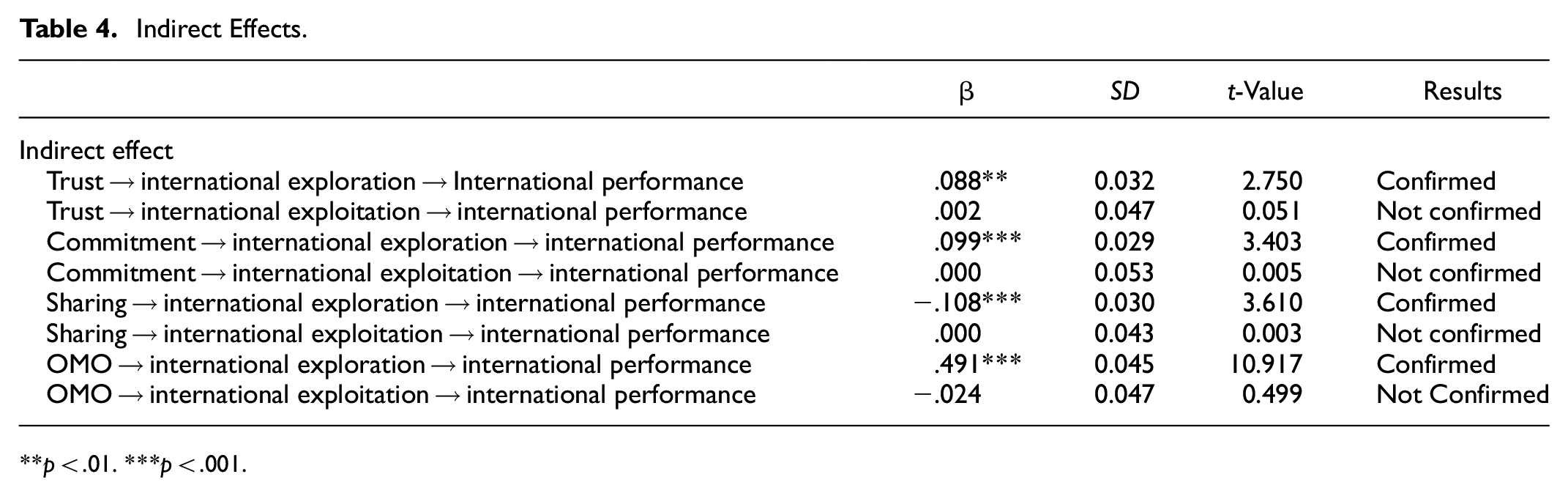
p < .01. ***p < .001.
Conclusions and Suggestions
Discussion
Businesses can build mutual trust and commit to learning and accumulating knowledge about the international market to enhance their existing capabilities (Eisenhardt & Martin, 2000) through network relations. Although there is a greater willingness between businesses to continue collaborating and sharing internal information to develop internal capacity (Elg, 2007), there is no significant correlation between international exploitation capabilities and resources resulting from networked relations established among them. Moreover, information does not help companies enter the international market, develop new values, and learn innovatively—nor does it facilitate further exploration. The larger the network of enterprises, the more similar the values will be that are received by participating firms in the long term. Established relations may lead to inertia (Limaj & Bernroider, 2019), while innovations hindering the capacity of international exploitation do not help firms effectively develop international exploitation capabilities.
According to the analysis results, the ability to share has a negative effect on international exploration. That is, network relations enable firms to establish common values to effectively communicate and coordinate, but this has an opposite effect on internal development and integration of existing information. Regardless of the cohesion formed by the establishment of network relations (Hansen, 1999), if the market information transmitted is incorrect or simply hearsay, the unwritten rules of the industry do not help enterprises to develop international market procedures or give them the ability to develop and integrate existing information.
The external information that an enterprise obtains through OMO can benefit a business in the development and integration of available internal information; it also increases its ability to create value and learn. In line with past studies, OMO has an impact on the exploration of related products in the international market through exploitation (Rauch et al., 2009). In the area of international exploration capabilities, companies integrate market information with knowledge based on received external information, thus effectively developing internal exploration to increase their competitive advantage over local competitors (Samiee & Walters, 2006). By doing this, enterprises can successfully enter the international market. In terms of international exploitation capabilities, after receiving the market information needing to be processed, enterprises should be able to increase creativity and be open to new ideas about how to change their business. It is also believed that market information could help companies acquire new knowledge and technology, better understand the international market and needs of customers, and change products and values through innovation, all of which would be more conducive to the exploitation of enterprises in the exploration and update of self-integration (Yalcinkaya et al., 2007). Therefore, the information needed to augment OMO is conducive to generating dynamic internationalization capabilities during internationalization.
In terms of international exploration capabilities, an enterprise’s ability to develop and integrate existing information contributes to its success in the international market. In line with previous research, developing the ability of enterprises to integrate resources and capabilities can lead to more noticeable and impressive performance in the international market (Hunt & Madhavaram, 2020). As for international exploitation, although previous researchers believe that expanding in the international market can enhance the creation of new values, it can also help firms maintain a long-term competitive advantage and boost performance (Chesbrough, 2007). However, some scholars still think that international expansion may not necessarily increase international performance. Limaj and Bernroider (2019) suggested that innovation and radical learning capabilities cannot always be transformed into an advantage. The complex and changing environment of internationalization can affect the measurement of international performance and the generation of internal capabilities. D. Y. Li and Liu (2014) argued that the development of capabilities during the internationalization process does not necessarily increase the competitive edge of an enterprise and may lead to other effects. Furthermore, they explored how the creation of capacity creates internal innovation value and learning within an enterprise; however, these advantages take time to eventually make an impact on international performance. The authors also stated that profitability resulting from performance can be reflected in a short period. However, the sales growth rate needs to be determined by the long-term condition of the market and against the actions of competitors. This study does not look into the length of time needed for the establishment of exploitation and, thus, the impact of the time required to establish exploitation on international performance. International exploitation is not reflected in overall international performance; therefore, it has no significant effect on the international performance of a firm.
Finally, verification of the mediating effect indicates that international exploration and exploitation do not show any mediating effects between social network relationships and OMO and international performance. This finding is different from the research results presented by Lu et al. (2010) and Pinho and Prange (2016). In other words, the conceptual model proposed in this study does not conform to resource, capability, and performance linkages; the possible reason can be explained by considering aspects of the research sample and model design. Firstly, the research samples collected are mainly from the electronic manufacturing sector, the industrial characteristics of which are quite different from the textile, clothing, leather, and footwear sectors surveyed by Pinho and Prange (2016). For internationalized SMEs in the electronics industry, capability and performance growth can be viewed as the same output, and more emphasis is placed on the cultivation of international exploration. Secondly, dynamic internationalization capability is divided into international exploration and exploitation based on the duality in this model; however, it is different from the further subdivisions of threshold, consolidation, value-adding, and disruption capability studied by Pinho and Prange (2016) as these categories may offset the effect on international exploitation during examination of the structural model and position the mediating effect outside of statistical significance. Moreover, the relationship between international exploration and exploitation in this study’s structural model may be similar to the trade-off relationship proposed by Andriopoulos and Lewis (2009), Cao et al. (2009), Gibson and Birkenshaw (2004), Malagueño et al. (2018), and Peng and Lin (2021b) showing that the development of diversified capabilities may differ in the presence of limited resources and when more emphasis is placed on the importance of ambidexterity.
Managerial Implications
This study empirically tests the comprehensive, interrelated effects of social network relations, OMO, dynamic internationalization capabilities, and international performance on Taiwanese SMEs. From the findings, we propose the following concrete and practical implications for SME owners or managers: First of all, the international market needs far more consideration than the domestic one; the international environment is more complex, and, because SMEs considering foreign investment may have little to no experience in the international market, they will face a new business environment with its relevant laws, regulations, and access restrictions. OMO was found to contribute to the improvement of dynamic internationalization capabilities. Therefore, this study suggests that SMEs attempt to understand the context of the global market from their international partners (including customers and suppliers) before working internationally; by doing this, they can gain access to valuable market information in the foreign locales they plan to work in, such as data on local laws and regulations, political and economic conditions, population characteristics, and other business projects similar to their own. For an SME considering international expansion, accumulation and validation of the information needed to understand its dynamic internationalization capabilities and future development reduce the possibility of failure, thereby improving its international performance.
The establishment of dynamic internationalization capabilities takes time and requires that an SME accumulate experience in internationalization because it may find it difficult to develop and become productive without it. This study has found that social network relations help strengthen the international exploration capabilities of SMEs; that is, SMEs can obtain the information, knowledge, and resources they need by working in tandem with their partners, thus reducing the costs of developing new markets, customers, and products and minimizing uncertainty and risk of failure (Pinho & Prange, 2016). Therefore, this study suggests that SME managers shoulder these risks and uncertainties through strategic alliances, such as joint product development and joint marketing and problem solving, which will, in turn, strengthen connections.
International exploration in dynamic internationalization capabilities has a significant effect on international performance and can lead to the continuous improvement and stability of SMEs in the international market. Only by continuously innovating and developing new markets can SMEs enhance their chances of survival. Therefore, the present study suggests that internationalized SMEs focus on the improvement of disruption and value-added capabilities. In addition, classifying and prioritizing their capabilities will enable SME managers to better focus on resources, which can help to concentrate resources in better ways and reduce unnecessary waste.
Limitations and Suggestions for Future Studies
Although SMEs were used as subjects in this research to explore the role of dynamic internationalization capabilities and provide several theoretical and practical implications, some research limitations should be taken into account. First, different levels of internationalization, such as how to set up an office for business overseas or how to manufacture in a foreign factory, may affect how SMEs use their information and capabilities. This study did not explore the different levels of outward investment development (Malagueño et al., 2018). Rather, it incorporated variables of varying degrees to more effectively assist SMEs to develop internationally. However, the countries in which SMEs initiate their internationalization process may impose various legal and cultural entry restrictions that could affect external resource management and internal dynamic internationalization capabilities. This study does not discuss these types of conditions. The impact of the dynamic internationalization capabilities that firms implement in the countries they operate in can be the subject of future research. In addition, exploration of future business-related changes in different countries can provide insight into the degree of capacity-building in various international contexts.
International performance was only measured with the Likert five-point scale in this study. Subjective judgments on the performance of managers using subjective measures are likely to result in subjective bias. Therefore, future research should include the collection of financial information to effectively measure the extent to which dynamic internationalization capabilities and performance are developed.
Finally, the amount of time a social network has been active may affect the development of its abilities; after a certain amount of time, inertia may hinder the innovative ability of international exploitation (Limaj & Bernroider, 2019). The total time a network relation is active is only based on cross-sectional data analysis. Future researchers could make use of profile data analysis to observe how the relationship between business and network partners influences the development of dynamic internationalization capabilities, and thus explore whether the existence of inertia over time affects the generation of dynamic internationalization capabilities. Furthermore, the social network relationship was adopted as a construct in this study to verify the effect of the measurement variables on international exploration and exploitation. However, in studies on social network relationships, social networks are differentiated into different types based on attributes, such as those concerning relational versus structural embeddedness or strong ties versus weak ties. Thus, future researchers could create classifications according to attribute type and discuss the effects of diversified types of social networks on dynamic internationalization capability. OMO was found to be a key component of dynamic internationalization capability in this study. According to the organizational learning theory, market information processing behavior can enhance knowledge acquisition derived from social network relationships. Therefore, researchers should consider OMO as a resource acquisition tool, which will lead to new insight into organizational learning.
Footnotes
Acknowledgements
Yong-Sheng Chang (Department of Business Administration, Tamkang University, New Taipei City, Taiwan; ebawu@yahoo.com) is co-author in this manuscript. He paid lots of attentions to revise the manuscript, including update literature review, solve method problem and provide insights in the conclusion.
Declaration of Conflicting Interests
The author declared no potential conflicts of interest with respect to the research, authorship, and/or publication of this article.
Funding
The author received no financial support for the research, authorship, and/or publication of this article.
