




Abstract
Learning burnout is an important factor affecting the quality of learning. Current research indicates that learning burnout is closely related to metacognitive ability and learning engagement, yet the influencing mechanisms among the three remain unclear. About 431 college students participate in the study. According to self-regulated learning theory and social cognitive theory, this study explores the chain mediating role of learning engagement between metacognitive ability and learning burnout. The results show that: Metacognitive ability and learning engagement negatively correlate with learning burnout, while metacognitive ability positively correlates with learning engagement. Metacognitive ability negatively predicts learning burnout through the chain mediating role of learning engagement. The findings provide theoretical support and practical guidance for reducing learning burnout among college students.
Introduction
Learning burnout is an important factor affecting the quality of learning and mental health among college students. It refers to a persistent negative psychological state caused by excessive learning pressure or a lack of interest in studying (K. Wang et al., 2023). Learning burnout is mainly reflected in three dimensions: emotional depletion, inappropriate behavior, and a low sense of achievement. Emotional depletion, also known as emotional exhaustion, refers to the excessive depletion of an individual’s emotional resources, leading to fatigue and loss of energy (Y. Li et al., 2021). Inappropriate behavior refers to an individual’s negative and indifferent attitude toward others. In the context of learning activities, it manifests as a lack of engagement or persistence in academic tasks (Bask & Salmela-Aro, 2013). A low sense of achievement indicates a tendency to hold negative evaluations of oneself, leading to decreased feelings of competence and achievement in learning (S. Wang et al., 2022). Overall, students experiencing learning burnout often show signs of physical fatigue, frustration, anxiety, depression, indifference, irritability, and confusion (Heo & Han, 2018). Studies have shown that students with higher levels of burnout are more likely to drop out, have lower subjective well-being, poorer physical and mental health, and worse academic performance (Aguayo et al., 2019; Capri et al., 2012; Khan, 2024; S. Li et al., 2023). Therefore, it is crucial to study the influencing mechanisms and factors of learning burnout in order to develop effective interventions to prevent and reduce learning burnout.
The formation of learning burnout is a continuous and gradual process (Allen, 1984), Metacognitive ability plays an important role in the formation and development of learning burnout. Metacognitive ability is cognition about cognition (Flavell, 1979), which consists of three components: metacognitive knowledge, metacognitive experience, and metacognitive monitoring (M. Jin & Ji, 2021). Metacognitive knowledge refers to knowledge about cognition, closely linked to an individual’s cognitive tasks, goals, behaviors, and experiences. Metacognitive experience affects the quality of cognitive activities, which includes cognitive or emotional experience that accompanies cognitive activities (Efklides, 2006). Metacognitive monitoring refers to the process in which individuals continuously monitor, control, and regulate their cognitive activities throughout the cognitive process (Wu & Was, 2023). As a higher-order ability, metacognitive ability is crucial for learners to manage their learning, often accompanying meaningful and deep learning (Prins et al., 2006). It enables learners to achieve better academic performance and reduces learning burnout. Current research suggests that students’ metacognitive ability influences learning burnout (Guo et al., 2022; Mann et al., 2022; Sapanci, 2023). However, how metacognitive ability influences learning burnout remains unclear. Therefore, it is necessary to further explore the mechanisms underlying the association between metacognitive ability and learning burnout.
Learning engagement may play an mediating role in the influence of metacognitive ability on learning burnout. Learning engagement refers to a persistent and positive emotional state that students maintain while engaging in learning behaviors (Schaufeli et al., 2002). It is reflected in three dimensions: cognitive, emotional, and behavioral engagement (Fredricks et al., 2004). Cognitive engagement refers to the use of cognitive strategies when students participate in learning activities. Emotional engagement refers to the sense of belonging and identification that students experience within the learning environment. Behavioral engagement refers to the degree of students’ involvement in learning behaviors, such as paying attention in class, actively answering questions, and completing assignments on time. Research shows that metacognitive ability is correlated with learning engagement (Acosta-Gonzaga & Ramirez-Arellano, 2022; Fidan & Koçak Usluel, 2024; M. T. Wang et al., 2021). Moreover, students with higher learning engagement tend to perform better and have better psychological adaptation (Y. Li & Lerner, 2011), thus their learning burnout is lower (Liu et al., 2020).
Current studies suggest that metacognitive ability, learning engagement, and learning burnout are interrelated. However, how metacognitive ability influences learning burnout and the role of learning engagement in this process remain unclear. This study aims to explore the associations among metacognitive ability, learning engagement, and learning burnout through the construction of a theoretical model and the testing of a chain mediation effect. The contribution of this study lies in both theoretical and practical aspects. Theoretically, this study delves into the mediating role of learning engagement between metacognitive ability and learning burnout, revealing the mechanism on how metacognitive ability influences learning burnout. Practically, the study identifies the factors influencing learning burnout, providing empirical evidence to reduce learning burnout among college students.
Literature Review and Theoretical Model
The Relationship Between Metacognitive Ability and Learning Burnout
According to self-regulated learning theory, self-regulated learning is defined as the process by which learners activate and maintain cognitive, emotional, and behavioral activities that are intentionally aimed at achieving their personal learning goals (Artino et al., 2011; Strachan, 2015). The self-regulated learning framework outlines three core strategies that learners use to effectively manage their learning process: cognitive strategies, metacognitive strategies, and motivational strategies (Panadero, 2017). Cognitive strategies involve specific learning activities such as memory techniques, organizing information, and applying knowledge to enhance learning outcomes. Metacognitive strategies guide learners in using cognitive strategies to achieve their goals, including setting clear learning goals, continuously monitoring their learning progress and understanding, seeking help when needed, adjusting their learning state, and reflecting on the effectiveness of strategies used after completing the learning task (S. Jin et al., 2023). Motivational strategies focus on the management of learners’ emotions and motivation, such as enhancing learning interest and maintaining learning drive. Based on self-regulated learning theory, students can flexibly adjust the levels of cognitive, emotional, and behavioral engagement using metacognitive ability, which further influences their learning goals and state. Specifically, strong metacognitive ability enables students to identify and analyze difficulties in the learning process and promptly adjust their strategies, thereby improving learning outcomes. Additionally, self-assessment during the reflection phase helps students gain a deeper understanding of their learning behaviors and strengthens their sense of control over the learning process. Therefore, fostering students’ metacognitive ability, especially in the use of metacognitive strategies, plays a crucial role in enhancing their learning motivation and reducing learning burnout.
Previous studies have found that higher metacognitive ability predicts lower levels of learning burnout among college students (Guo et al., 2022; Sapanci, 2023). Cultivating metacognitive ability helps students perceive, understand, and adjust their negative emotions in real-time (Seibert et al., 2017), effectively reducing burnout during the learning process (Pennequin et al., 2020). Some studies have found that metacognitive ability is directly related to homework completion rates; higher metacognitive ability reduces students’ feelings of burnout when doing homework, helping them to complete their tasks more smoothly (García-Ros et al., 2018). Students with weaker executive functions are more likely to experience learning burnout due to deficits in cognitive control (Pihlaja et al., 2022). Metacognitive ability helps students accurately assess anxiety and cope with current or anticipated negative and challenging events, thereby reducing learning burnout (Iacolino et al., 2020; Spada & Moneta, 2012). Additionally, metacognitive ability is closely related to students’ emotional regulation abilities. Students with high metacognitive ability usually exhibit stronger emotional regulation skills, allowing them to remain calm and rational in the face of complex emotional experiences and to adopt positive regulation strategies (Yeoh et al., 2022).
The Chain Mediating Role of Learning Engagement
According to social cognitive theory (Bandura, 1986), individual behavior is shaped by the dynamic interaction of cognitive, emotional, and behavioral factors. This perspective aligns with the engagement theory proposed by Fredricks et al. (2004), which conceptualizes student engagement as consisting of three interconnected dimensions: cognitive, emotional, and behavioral engagement. Specifically, students develop cognitive understanding of learning content, which fosters emotional responses such as interest and satisfaction. These emotional experiences then stimulate behavioral engagement, such as active participation and persistence (Gao et al., 2024). Based on this view, students’ cognitive engagement may influence both emotional and behavioral engagement, while emotional engagement may further enhance behavioral engagement. When students gain a deeper understanding of the learning material, they are more likely to feel a sense of accomplishment and interest, which in turn motivates them to take proactive actions in the learning process. Moreover, high levels of emotional engagement help students maintain a positive attitude when encountering learning challenges, thereby reducing learning burnout. In combination with self-regulated learning theory, the process through which students use metacognitive strategies to monitor and regulate their cognitive, emotional, and behavioral engagement supports the assumption that learning engagement functions as a chain mediation mechanism between metacognitive ability and learning burnout.
Previous studies have shown that metacognitive ability is positively correlated with students’ learning engagement (Pellas, 2014). Metacognitive ability not only has a significant positive effect on learning engagement (Fidan & Koçak Usluel, 2024; M. T. Wang), but also influences the various dimensions of learning engagement (Acosta-Gonzaga & Ramirez-Arellano, 2022). High metacognitive ability enhances students’ cognitive engagement (Malik et al., 2022), which in turn influences their overall learning engagement. Metacognitive ability enables students to self-regulate and adjust their behavioral and emotional engagement during learning, preparing them for better academic performance (Fredricks et al., 2004; González & Paoloni, 2015). Moreover, studies have found a significant negative correlation between learning engagement and learning burnout (Maricuţoiu & Sulea, 2019; Taheri et al., 2023). Students with higher learning engagement exhibit lower levels of learning burnout (Reyes-de-Cózar et al., 2023). Learning engagement is considered the opposite of learning burnout, with the two representing opposite ends of the spectrum of individual learning states (Cazan, 2015). High levels of learning engagement can ignite students’ enthusiasm for learning, help them achieve ideal learning outcomes, and thereby reduce learning burnout (Liu et al., 2018).
Theoretical Model
This study explores the relationships among metacognitive ability, learning engagement, and learning burnout. Based on existing studies, metacognitive ability is divided into three structural dimensions: metacognitive knowledge (MK), metacognitive experience (ME), and metacognitive monitoring (MM). Learning engagement is divided into three structural dimensions: cognitive, emotional, and behavioral engagement. To investigate the influencing factors of learning burnout, this study considers learning burnout as the dependent variable. Based on self-regulated learning theory and prior research (Guo et al., 2022; Sapanci, 2023), metacognitive ability is found to be associated with learning burnout; therefore, it is included as an independent variable. According to social cognitive theory, engagement theory, and empirical studies (Fidan & Koçak Usluel, 2024; Taheri et al., 2023), learning engagement is related to both metacognitive ability and learning burnout. Furthermore, individual behavior is shaped by the interaction among cognition, emotion, and action. Thus, learning engagement is introduced as a chain mediating variable. Accordingly, a chain mediation effect model was constructed (Figure 1).
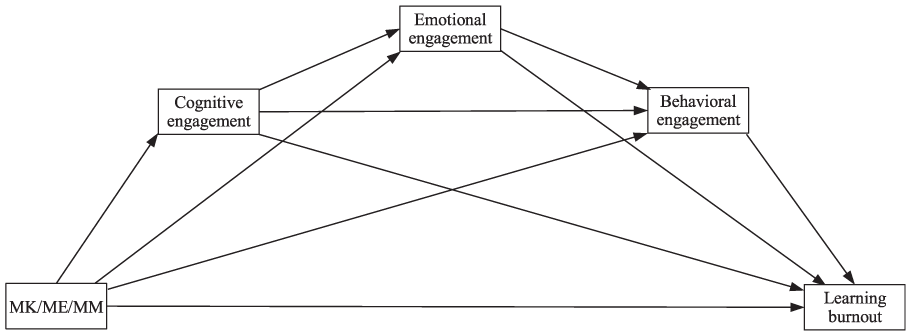
Theoretical model.
Based on this, the following research hypotheses are proposed:
Methodology
Participants
This study adopted a convenience sampling method. Distributing questionnaires allows data to be gathered quickly and efficiently while minimizing classroom disruption (Bećirović et al., 2025; Maričić et al., 2024). The researchers distributed questionnaires to college students enrolled at a public university in central China. A total of 484 students participated in the study. The questionnaire has a total of 32 items (4 demographic information items; 27 scale items; and 1 attention check item). According to the research of Huang et al. (2012) and Meade and Craig (2012), if the response time of participants is less than 64 s (32 × 2 s) or more than 640 s (32 × 20 s), their responses will be deleted. After data cleaning (questionnaires with response times that were either too short or too long, as well as those that failed the attention check item, were excluded), 431 valid questionnaires were obtained, with an effective response rate of 89.05%. Regarding gender distribution, there were 131 male students (30.39%) and 300 female students (69.61%). In terms of grade distribution, there were 105 freshmen (24.36%), 101 sophomores (23.43%), 189 juniors (43.85%), and 36 seniors (8.35%). The age range was 18 to 24 years, with an average age of 19.61 and a standard deviation of 1.10. The distribution of students by major is as follows: 95 students (22.04%) in mathematics and applied mathematics, 93 students (21.58%) in fine arts, 71 students (16.47%) in educational technology, 70 students (16.24%) in early childhood education, 29 students (6.73%) in special education, 21 students (4.87%) in inclusive education, 21 students (4.87%) in English, 20 students (4.64%) in Chinese language and literature, and 11 students (2.55%) in biological science. All students participated in the survey voluntarily. The study was performed in accordance with the Declaration of Helsinki. Informed consent was obtained from all participants.
Measurements
Metacognitive Ability Scale
The metacognitive ability scale was adapted from State Metacognitive Inventory (O’Neil & Abedi, 1996) and Metacognitive Awareness Inventory (Schraw & Dennison, 1994). After pilot testing and revision, the scale contained three dimensions: metacognitive knowledge (3 items), metacognitive experience (3 items), and metacognitive monitoring (3 items), with a total of 9 items. All items used a 5-point Likert scale (1 = strongly disagree, 5 = strongly agree). The items of the scales are presented in Appendix 1. The validation of the structure of the metacognitive ability scale is shown in Table 1.
The Validation of the Structure of the Metacognitive Ability Scale (N = 431).

The Cronbach’s α values for metacognitive knowledge, metacognitive experience, and metacognitive monitoring were .748, .765, and .766, respectively; the AVE values were 0.504, 0.526, and 0.529; the CR values were 0.753, 0.769, and 0.771. The Cronbach’s α for the overall metacognitive ability scale was .842. The model fit indices were χ2/df = 2.746, GFI = 0.967, CFI = 0.967, NFI = 0.950, NNFI = 0.951, TLI = 0.951, IFI = 0.967, RMSEA = 0.064, and SRMR = 0.041. The factor loadings for the items ranged from 0.679 to 0.760.
Learning Engagement Scale
The learning engagement scale was adapted from learning engagement scale (Fredricks et al., 2004). After pilot testing and revision, the scale contained three dimensions: behavioral engagement (BE, 3 items), cognitive engagement (CE, 3 items), and emotional engagement (EE, 3 items), with a total of 9 items. All items used a 5-point Likert scale (1 = strongly disagree, 5 = strongly agree). The items of the scales are presented in Appendix 1. The validation of the structure of the learning engagement scale is shown in Table 2.
The Validation of the Structure of the Learning Engagement Scale (N = 431).

The Cronbach’s α values for cognitive, emotional, and behavioral engagement were .718, .884, and .843, respectively; the AVE values were 0.460, 0.739, and 0.653; the CR values were 0.718, 0.894, and 0.849. The Cronbach’s α for the overall learning engagement scale was 0.864. The model fit indices were χ2/df = 2.135, GFI = 0.975, CFI = 0.986, NFI = 0.974, NNFI = 0.979, TLI = 0.979, IFI = 0.986, RMSEA = 0.051, and SRMR = 0.033. The factor loadings for the items ranged from 0.665 to 0.918.
Learning Burnout Scale
The learning burnout scale was adapted from the scale developed by Schaufeli et al. (2002). After pilot testing and revision, the scale contained three dimensions: emotional depletion (ED, 3 items), inappropriate behavior (IB, 3 items), and low sense of achievement (LSA, 3 items), with a total of 9 items. All items used a 5-point Likert scale (1 = strongly disagree, 5 = strongly agree), with the low sense of achievement dimension being reverse scored. The items of the scales are presented in Appendix 1. The validation of the structure of the learning engagement scale is shown in Table 3.
The Validation of the Structure of the Learning Burnout Scale (N = 431).
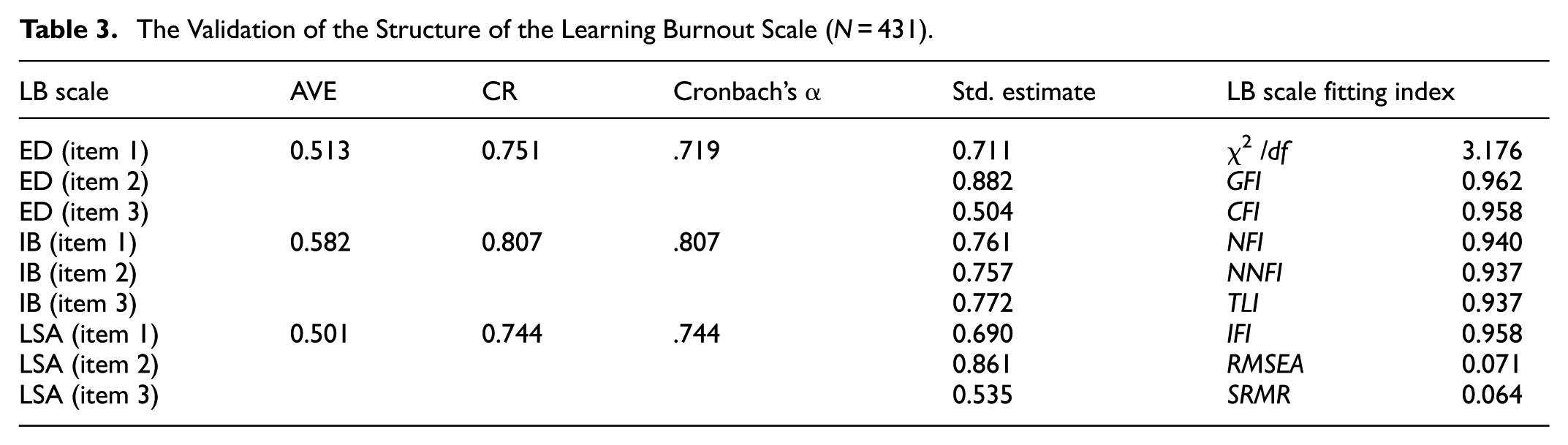
The Cronbach’s α values for emotional depletion, inappropriate behavior, and low sense of achievement were .719, .806, and .716, respectively; the AVE values were 0.513, 0.582, and 0.501; the CR values were 0.751, 0.807, and 0.744. The Cronbach’s α for the overall learning burnout scale was 0.800. The model fit indices were χ2/df = 3.176, GFI = 0.962, CFI = 0.958, NFI = 0.940, NNFI = 0.937, TLI = 0.937, IFI = 0.958, RMSEA = 0.071, and SRMR = 0.064. The factor loadings for the items ranged from 0.504 to 0.882.
Data Analysis
This study used SPSS 27 to conduct the common method bias test and normality test and AMOS 28 for confirmatory factor analysis. Because the data for the three scales in this study came from the same participants, Harman’s single-factor test was used to check for common method bias (Malhotra et al., 2017). The results showed that there were seven factors with eigenvalues greater than 1, and the first factor explained 32.263% of the variance, which is below the critical threshold of 40%, indicating that there was no significant common method bias in the data. The normality test showed that the absolute values of both kurtosis and skewness were far below the thresholds of 10 and 3, respectively, indicating that the data were approximately normally distributed.
This study used SPSS 27 for descriptive analysis, correlation analysis, and regression analysis to examine the association between metacognitive ability and college students’ learning burnout. Based on these results, a chain mediation effect analysis was further conducted to investigate the mediating role of learning engagement. Descriptive analysis was used to quantify seven variables: metacognitive knowledge, metacognitive experience, metacognitive monitoring, cognitive engagement, emotional engagement, behavioral engagement, and learning burnout. Correlation analysis was conducted to test whether there were significant relationships among the seven variables. Based on the correlation analysis, regression analyses were conducted with metacognitive knowledge, metacognitive experience, and metacognitive monitoring as independent variables, and learning burnout as the dependent variable, to explore their direct effects on learning burnout. Following the regression analysis, a chain mediation model was constructed with cognitive, emotional, and behavioral engagement as mediating variables, using Model 6 (3 mediators) in the PROCESS macro. The bootstrap sampling method (5,000 iterations) was used, with the confidence level set to 95%.
Results
Descriptive Analysis and Correlation Analysis of Variables
As shown in the correlation analysis results (Table 4), regarding metacognitive ability, metacognitive knowledge, metacognitive experience, and metacognitive monitoring are negatively correlated with learning burnout (r = −.345, −.403, −.360, p < .001). Regarding learning engagement, cognitive, emotional, and behavioral engagement are negatively correlated with learning burnout (r = −.500, −0.382, −0.395, p < .001). Additionally, metacognitive ability is positively correlated with learning engagement.
Descriptive and Correlation Analysis (N = 431).

p < .05. **p < .01. ***p < .001.
Direct Association Between Metacognitive Ability and Learning Burnout
Linear Regression (N = 431).

p < .001.
The Chain Mediating Role of Learning Engagement
The Chain Mediating Role of Learning Engagement Between Metacognitive Knowledge and Learning Burnout
Test of the Chain Mediating Role of Learning Engagement between Metacognitive Knowledge and Learning Burnout (N = 431).
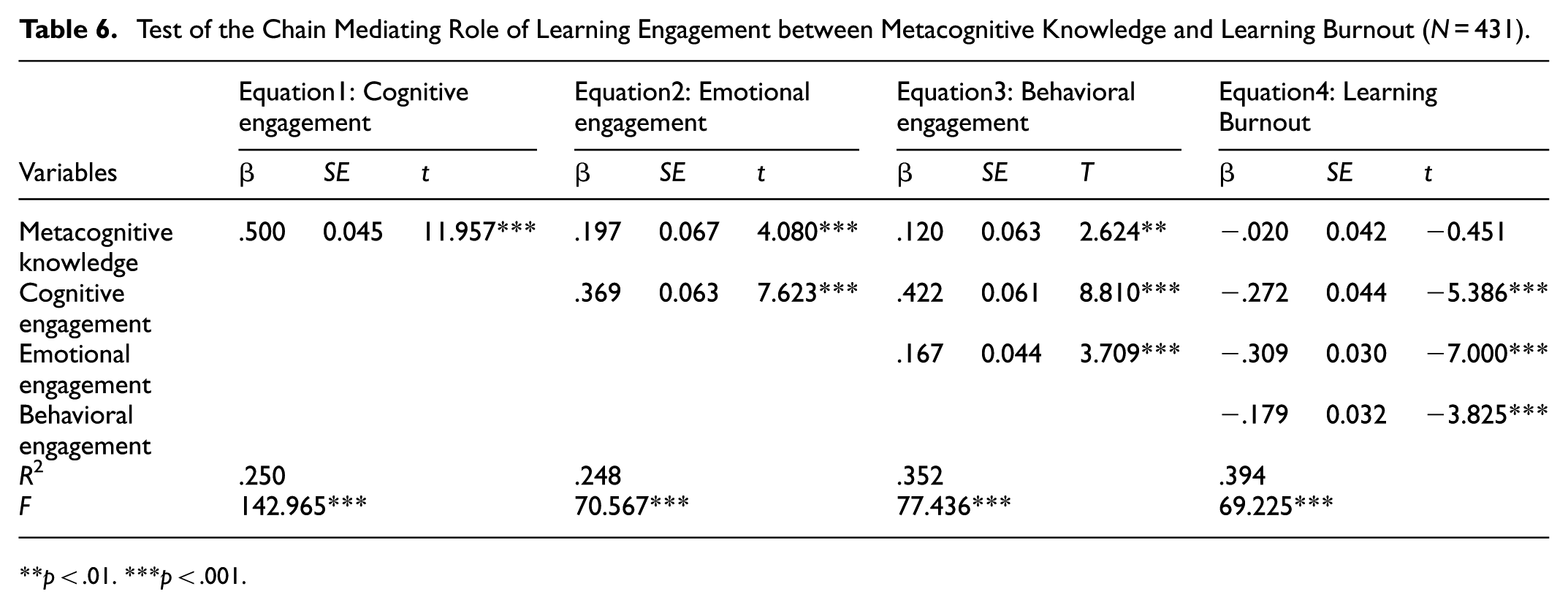
p < .01. ***p < .001.
Chain Mediation Effects of Learning Engagement between Metacognitive Knowledge and Learning Burnout (95% Confidence Intervals) (N = 431).

It can be seen that metacognitive knowledge has a significant negative predictive effect on learning burnout (Table 5). When cognitive engagement was used as a mediating variable, metacognitive knowledge positively predicted cognitive engagement (β = .500, p < .001), and cognitive engagement negatively predicted learning burnout (β = −.272, p < .001). The mediation effect value was −0.126 (Boot SE = 0.029, 95% CI [−0.191, −0.078]). When emotional engagement was used as a mediating variable, metacognitive knowledge positively predicted emotional engagement (β = .197, p < .001), and emotional engagement negatively predicted learning burnout (β = −.309, p < .001). The mediation effect value was −0.057 (Boot SE = 0.017, 95% CI [−0.095, −0.030]). When behavioral engagement was used as a mediating variable, metacognitive knowledge positively predicted behavioral engagement (β = .120, p < .01), and behavioral engagement negatively predicted learning burnout (β = −.179, p < .001). The mediation effect value was −0.020 (Boot SE = 0.012, 95% CI [−0.048, −0.003]).
The model path coefficients are shown in Figure 2. When cognitive engagement and emotional engagement were used as chain mediating variables, cognitive engagement positively predicted emotional engagement (β = .369, p < .001). The mediation effect value was −0.053 (Boot SE = 0.012, 95% CI [−0.082, −0.035]). When cognitive engagement and behavioral engagement were used as chain mediating variables, cognitive engagement positively predicted behavioral engagement (β = .422, p < .001). The mediation effect value was −0.035 (Boot SE = 0.013, 95% CI [−0.066, −0.014]). When emotional engagement and behavioral engagement were used as chain mediating variables, emotional engagement positively predicted behavioral engagement (β = .167, p < .001). The mediation effect value was −0.005 (Boot SE = 0.003, 95% CI [−0.013, −0.001]). When cognitive engagement, emotional engagement, and behavioral engagement were used as chain mediating variables, the mediation effect value was −0.005 (Boot SE = 0.003, 95% CI [−0.012, −0.001]). In summary,

Chain mediation effect model of learning engagement between metacognitive knowledge and learning burnout (N = 431).
The Chain Mediating Role of Learning Engagement Between Metacognitive Experience and Learning Burnout
Test of the Chain Mediating Role of Learning Engagement between Metacognitive Experience and Learning Burnout (N = 431).

p < .01. ***p < .001.
Chain Mediation Effects of Learning Engagement between Metacognitive Experience and Learning Burnout (95% Confidence Intervals) (N = 431).

It can be seen that metacognitive experience has a significant negative predictive effect on learning burnout (Table 5). When cognitive engagement was used as a mediating variable, metacognitive experience positively predicted cognitive engagement (β = .530, p < .001), and cognitive engagement negatively predicted learning burnout (β = −.270, p < .001). The mediation effect value was −0.126 (Boot SE = 0.030, 95% CI [−0.203, −0.083]). When emotional engagement was used as a mediating variable, metacognitive experience positively predicted emotional engagement (β = .362, p < .001), and emotional engagement negatively predicted learning burnout (β = −.304, p < .001). The mediation effect value was −0.097 (Boot SE = 0.023, 95% CI [−0.158, −0.069]). When behavioral engagement was used as a mediating variable, metacognitive experience positively predicted behavioral engagement (β = .140, p < .01), and behavioral engagement negatively predicted learning burnout (β = −.178, p < .001). The mediation effect value was −0.022 (Boot SE = 0.012, 95% CI [−0.051, −0.006]).
The model path coefficients are shown in Figure 3. When cognitive engagement and emotional engagement were used as chain mediating variables, cognitive engagement positively predicted emotional engagement (β = .276, p < .001). The mediation effect value was −0.039 (Boot SE = 0.011, 95% CI [−0.068, −0.024]). When cognitive engagement and behavioral engagement were used as chain mediating variables, cognitive engagement positively predicted behavioral engagement (β = .419, p < .001). The mediation effect value was −0.035 (Boot SE = 0.014, 95% CI [−0.070, −0.014]). When emotional engagement and behavioral engagement were used as chain mediating variables, emotional engagement positively predicted behavioral engagement (β = .143, p < .01). The mediation effect value was −0.008 (Boot SE = 0.005, 95% CI [−0.020, −0.002]). When cognitive engagement, emotional engagement, and behavioral engagement were used as chain mediating variables, the mediation effect value was −0.003 (Boot SE = 0.002, 95% CI [−0.008, −0.001]). In summary,

Chain mediation effect model of learning engagement between metacognitive experience and learning burnout (N = 431).
The Chain Mediating Role of Learning Engagement Between Metacognitive Monitoring and Learning Burnout
Test of the Chain Mediating Role of Learning Engagement between Metacognitive Monitoring and Learning Burnout (N = 431).

p < .05. ***p < .001.
Chain Mediation Effects of Learning Engagement between Metacognitive Monitoring and Learning Burnout (95% Confidence Intervals) (N = 431).
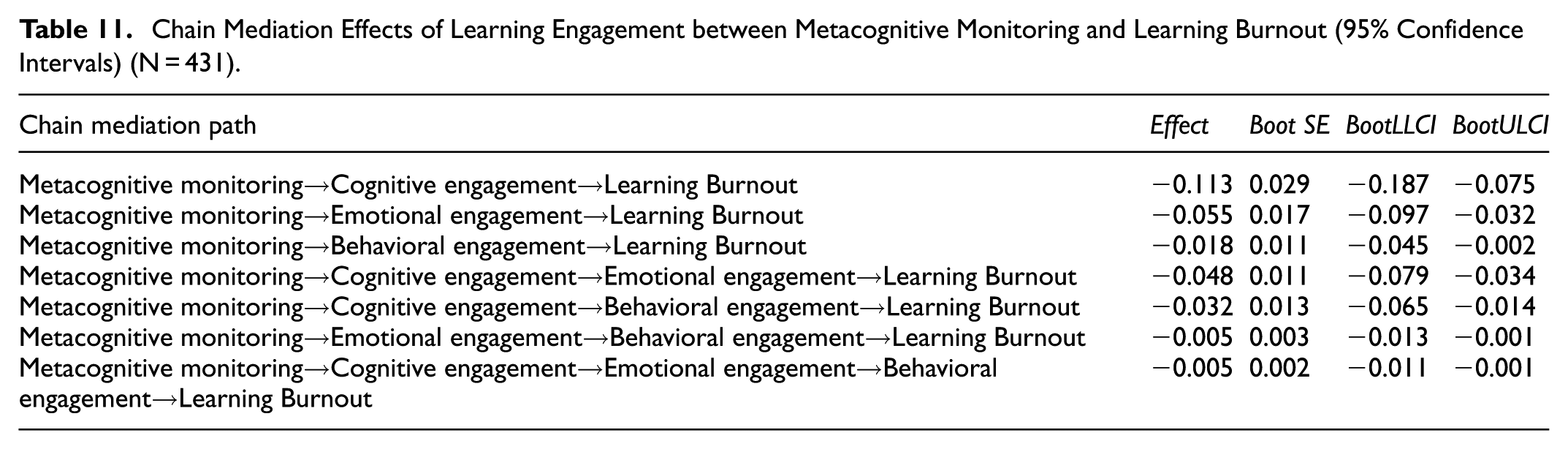
It can be seen that metacognitive monitoring has a significant negative predictive effect on learning burnout (Table 5). When cognitive engagement was used as a mediating variable, metacognitive monitoring positively predicted cognitive engagement (β = .493, p < .001), and cognitive engagement negatively predicted learning burnout (β = −.264, p < .001). The mediation effect value was −0.113 (Boot SE = 0.029, 95% CI [−0.187, −0.075]). When emotional engagement was used as a mediating variable, metacognitive monitoring positively predicted emotional engagement (β = .206, p < .001), and emotional engagement negatively predicted learning burnout (β = −.305, p < .001). The mediation effect value was −0.055 (Boot SE = 0.017, 95% CI [−0.097, −0.032]). When behavioral engagement was used as a mediating variable, metacognitive monitoring positively predicted behavioral engagement (β = .114, p < .05), and behavioral engagement negatively predicted learning burnout (β = −.176, p < .001). The mediation effect value was −0.018 (Boot SE = 0.011, 95% CI [−0.045, −0.002]).
The model path coefficients are shown in Figure 4. When cognitive engagement and emotional engagement were used as chain mediating variables, cognitive engagement positively predicted emotional engagement (β = .366, p < .001). The mediation effect value was −0.048 (Boot SE = 0.011, 95% CI [−0.045, −0.002]). When cognitive engagement and behavioral engagement were used as chain mediating variables, cognitive engagement positively predicted behavioral engagement (β = .426, p < .001). The mediation effect value was −0.032 (Boot SE = 0.013, 95% CI [−0.065, −0.014]). When emotional engagement and behavioral engagement were used as chain mediating variables, emotional engagement positively predicted behavioral engagement (β = .167, p < .001). The mediation effect value was −0.005 (Boot SE = 0.003, 95% CI [−0.013, −0.001]). When cognitive engagement, emotional engagement, and behavioral engagement were used as chain mediating variables, the mediation effect value was −0.005 (Boot SE = 0.002, 95% CI [−0.011, −0.001]). In summary,

Chain mediation effect model of learning engagement between metacognitive monitoring and learning burnout (N = 431).
Discussion
Metacognitive Ability Negatively Predicts Learning Burnout
Metacognitive Knowledge Negatively Predicts Learning Burnout
The results indicate that metacognitive knowledge is negatively correlated with learning burnout, and metacognitive knowledge negatively predicts learning burnout, confirming
Metacognitive Experience Negatively Predicts Learning Burnout
The results show that metacognitive experience is negatively correlated with learning burnout, and metacognitive experience negatively predicts learning burnout, confirming
Metacognitive Monitoring Negatively Predicts Learning Burnout
The results reveal that metacognitive monitoring is negatively correlated with learning burnout, and metacognitive monitoring negatively predicts learning burnout, confirming
Mediating Role of Learning Engagement in Predicting Learning Burnout
Metacognitive Knowledge Negatively Predicts Learning Burnout Through the Chain Mediation of Cognitive, Emotional, and Behavioral Engagement
The study found that metacognitive knowledge is negatively correlated with cognitive engagement, emotional engagement, behavioral engagement, and learning burnout. Moreover, metacognitive knowledge negatively predicts learning burnout through the chain mediation of cognitive, emotional, and behavioral engagement, confirming
Metacognitive Experience Negatively Predicts Learning Burnout Through the Chain Mediation of Cognitive, Emotional, and Behavioral Engagement
The study found that metacognitive experience is negatively correlated with cognitive engagement, emotional engagement, behavioral engagement, and learning burnout. Furthermore, metacognitive experience negatively predicts learning burnout through the chain mediation of cognitive, emotional, and behavioral engagement, confirming
Metacognitive Monitoring Negatively Predicts Learning Burnout Through the Chain Mediation of Cognitive, Emotional, and Behavioral Engagement
The study found that metacognitive monitoring is negatively correlated with cognitive engagement, emotional engagement, behavioral engagement, and learning burnout. Moreover, metacognitive monitoring negatively predicts learning burnout through the chain mediation of cognitive, emotional, and behavioral engagement, confirming
Conclusion and Implications
This study constructed a theoretical model and tested a chain mediation effect to examine the association between metacognitive ability and college students’ learning burnout, and further investigated the mediating role of learning engagement in this relationship. The results showed that metacognitive knowledge, metacognitive experience, and metacognitive monitoring are negatively correlated with learning burnout, and all three negatively predict learning burnout. Metacognitive knowledge negatively predicts learning burnout through the chain mediation of cognitive, emotional, and behavioral engagement; metacognitive experience negatively predicts learning burnout through the chain mediation of cognitive, emotional, and behavioral engagement; metacognitive monitoring also negatively predicts learning burnout through the chain mediation of cognitive, emotional, and behavioral engagement.
The implications of this study are as follows: Enhancing students’ metacognitive knowledge, metacognitive experience, and metacognitive monitoring can effectively reduce learning burnout. Additionally, metacognitive ability negatively predicts learning burnout through the chain mediation of cognitive, emotional, and behavioral engagement, indicating that promoting students’ cognitive, emotional, and behavioral engagement during the learning process is equally crucial. Educators should focus on cultivating metacognitive ability and stimulating learning engagement by designing interesting and challenging learning activities that help students improve their learning experience and engagement levels, thereby alleviating learning burnout. According to our research findings, the following practical measures are beneficial in reducing learning burnout:
In terms of enhancing metacognitive ability: First, write reflective journals. Students can record their thoughts, feelings, strategies, and outcomes during the learning process, which helps them gradually discover their learning patterns and areas for improvement. By reflecting on their learning habits and the effectiveness of the strategies they use, students can develop awareness of their learning process, thereby enhancing their metacognitive knowledge. Second, set short-term challenge tasks. In the execution of course tasks, set phased milestones and provide timely feedback, allowing students to share the challenges and achievements they encounter during the learning process. Recognizing students’ efforts can increase their sense of accomplishment and stimulate metacognitive experiences. Third, create a study plan. Guide students to set specific, measurable, achievable, and time-bound learning goals, including the arrangement of learning content, time allocation, learning methods, and the use of resources. This helps students clearly understand their learning direction and expected outcomes, allowing them to more effectively monitor their learning process in real time and enhance their metacognitive monitoring abilities.
In terms of promoting learning engagement: First, provide diverse learning resources. Encourage students to use learning materials and methods that suit their needs, promoting “small-step learning” and “self-paced learning.” This helps prevent or reduce cognitive overload or confusion during the learning process, thereby increasing students’ cognitive engagement. Second, create a multi-sensory learning environment. In such an environment, students can adjust and optimize their learning based on their own experiences and feedback, which helps alleviate confusion and negative emotions in learning, enhancing their immersion and emotional engagement. Third, emphasize the students’ active role. Especially in online learning, participation does not necessarily indicate engagement. In the teaching process, educators should focus on the active role of students, encouraging them to actively participate in classroom activities and express their opinions and insights. This helps boost students’ confidence and autonomous learning abilities, enhancing their behavioral engagement. In summary, improving students’ metacognitive ability and learning engagement is key to preventing and reducing learning burnout, requiring joint efforts from both educators and learners.
This study has some limitations. First, the use of convenience sampling inevitably constrains the generalizability of the findings. Future research should employ more representative probability-based sampling methods, such as stratified sampling, and expand the sample to include students from diverse backgrounds. Second, the study primarily employed a questionnaire survey method, which may be subject to self-report bias, where participants’ subjectivity affects the accuracy of the data. Future studies could combine experimental research, interviews, and observations to collect data more comprehensively. Third, this study used a cross-sectional design, and future research could conduct longitudinal studies to verify the causal relationships among metacognitive ability, learning engagement, and learning burnout. Fourth, future research should consider more potential influencing factors, such as social support, learning environment, and personality traits, to construct a more comprehensive theoretical model and further reveal the complex mechanisms influencing learning burnout, providing scientific evidence for mitigating learning burnout. Fifth, future research could apply the strategies proposed in this study to real-world contexts, testing the effectiveness of these strategies through practical implementation. These improvements would provide more in-depth perspectives on understanding and addressing learning burnout in future research.
Footnotes
Appendix 1

Ethical Considerations
Approval was obtained from the Ethics Committee of Central China Normal University.
Funding
The authors disclosed receipt of the following financial support for the research, authorship, and/or publication of this article: This study was supported by the National Natural Science Foundation of China (Grant Number: 62307016); the Central China Normal University 2025 Special Research Project on Teacher Education (Grant Number: CCNUTEI2025-02); and the China Postdoctoral Science Foundation (Grant Number: 2025T180457).
Declaration of Conflicting Interests
The authors declared no potential conflicts of interest with respect to the research, authorship, and/or publication of this article.
Data Availability Statement
Data will be made available on request.