



Abstract
Social support is a significant environmental factor predicting academic burnout, but the underlying mechanism of structural relationship between these two variables needs further verification. Students’ perceived social support in the higher education environment is mainly from their teachers and peers. Taking 352 non-English undergraduates as respondents, this article explored the relationship between EFL learners’ perceived support from their teachers and peers, interaction engagement and academic burnout. Correlation analysis and structural equation modeling were employed to analyze the data collected through an online questionnaire survey. The research results showed that (1) Social support is negatively correlated with academic burnout; (2) Interaction engagement has a negative association with burnout; (3) Social support has a direct positive effect on interaction engagement; (4) Social support, mediated by interaction engagement, has an indirect effect on academic burnout. Understanding the above-mentioned mechanism that learners’ perceived support and interaction engagement influence academic burnout may be helpful for lessening academic burnout and improving performance in EFL leaning.
Introduction
Education is mainly oriented to students’ academic achievement and subjective wellbeing. In the case of EFL (English as a foreign language) teaching, the learners’ wellbeing as well as linguistic and intercultural competence should be developed and enhanced (Xu & Long, 2021, p. 17; Li, 2021). Student engagement and academic burnout function as positive and negative aspects of wellbeing which are associated with school activities (Paloş et al., 2019); the former weighs heavily in facilitating positive educational outcomes (Appleton et al., 2008) and the latter influences academic achievement negatively (Yang, 2004).
In higher education context, student engagement with college life has a major impact upon students’ cognitive growth and knowledge acquisition and it enhances the academic and personal development of students (Clynes et al., 2020; Kahu & Nelson, 2018). Student engagement and academic burnout closely associate with each other (Barratt & Duran, 2021). Student engagement is a negative predictor of academic burnout in university context (J. Wang et al., 2021). Engagement is taken as opposite construct of burnout; research on the relationship between burnout and such related variables as engagement and performance might help to prevent academic burnout in the foreign language learning context (Li, Zhang & Jiang, 2021). Academic burnout may occur among college students because of learning conditions where too much effort is needed and no mechanism facilitating helping coping is available (Neumann et al., 1990). EFL education is strongly exam oriented in China, and learners have fewer chances to interact directly with the native speakers of English (Jiang & Dewaele, 2019). Moreover, EFL learning in China is compulsory for college students who will take standardized tests like the nation-wide College English Test. Students’ scores on the tests are closely related to their further education and future employment. Because of the specific nature of language learning and the demanding learning environment, Chinese college EFL learners tend to be influenced by the academic burnout (Fu, 2023; Karimi & Fallah, 2021). Therefore, to help EFL learners overcome burnout and enhance engagement, it is important to examine their relationship and the corresponding influencing factors.
Social support plays a significant role in the success of higher education (Mishra, 2020). It is one of the antecedent variables of the burnout (Jackson et al., 1986) and it is a negative predictor of academic burnout (Y. Wang & Li, 2021). The stronger the social support is, the lower the burnout will get, and the higher the academic achievement will be (Yang, 2004). Having difficulties handling tasks individually in the college classrooms, foreign language learners resort to social guidance and support (Sulis, 2022). In the college EFL learning and teaching context, learners’ perceived social support mainly comes from their teachers and peer (X. Liu et al., 2020). Support from teachers and peers positively influences academic engagement (Luan et al., 2023; Shin & Chang, 2022).
Therefore, based on the above studies, enhancing teacher-peer support and academic engagement and reducing academic burnout may improve college EFL learners’ academic achievement and wellbeing. In addition, it is obvious that the three variables, teacher-peer support, student engagement and academic burnout, are correlated directly or indirectly and it is clear now that social support predicts academic engagement and student burnout. However, the specific relationship between academic engagement and student burnout has not sufficiently investigated, and in particular, the underlying relationship and influencing mechanism among these three constructs remain underexplored when they are taken into account together. In order to solve the above problem and narrow the gap, this study, employing equation modeling, will examine the relationship among social support, student engagement and academic burnout in EFL learning.
Literature Review
Interaction Engagement
The development of students’ engagement with school contributes to their future academic success and wellbeing (Upadyaya & Salmela-Aro, 2013). Student engagement is defined as students’ active participation in academic and co-curricular or school-related activities and commitment to educational goals and learning (Christenson et al., 2012). The concept of student engagement, at present, is comparatively prevalent, but researchers have also used some other terms to refer to the similar meaning: academic engagement (Furrer & Skinner, 2003), school engagement (Fredricks et al., 2004) and even engagement in schoolwork (Assor et al., 2002). Although these researchers used different terminologies to describe the concepts of student engagement, their views were based on the simple but powerful premise that students learn from what they do in school (Pike & Kuh, 2005). Interaction engagement is one of the dimensions of student engagement with a specific course; it functions through participation in class and interactions with teachers and other students (Handelsman et al., 2005). Engagement is perhaps one of the most crucial steps in predicting how successful leaners are in language learning in the formal education context (Oga-Baldwin, 2019). Interaction is one of the fundamental elements in the process of language acquisition (C. Wang, 2017. The social dimension to interaction plays a foregrounding role as a dimension of engagement in the instructed-language-learning context, (Svalberg, 2009; Philp & Duchesne, 2016) and the interaction engagement is initiated and maintained by learners (Carver et al., 2021; Svalberg, 2009).
Student engagement, existing in the interaction of the individual and the context, can result from various antecedents in the context (Fredricks et al., 2004). It is influenced by two categories of factors: individual factors, including demographic variables and individual features; environmental factors involving students’ families, culture, and schools. Social support at schools is a major environmental factor predicting student engagement.
Social Support
Perceiving the social support, an individual tends to believe that he is cared for and loved, esteemed, and a member of a network of mutual obligations (Cobb, 1976) . In the school context, good social support is helpful in reducing students’ psychological pressure, improve their learning motivation (Wentzel et al., 2010) and reduce academic burnout (X. Liu et al., 2020). EFL learners’ perceived social support at school comprises teacher emotional support, teacher academic support, peer emotional support and peer academic support (X. Liu et al., 2020). Perceiving support from their teachers, students will not only invest more time and enthusiasm, and use more autonomous learning (Ryan & Patrick, 2001), but tend to strengthen their sense of school belonging (Hallinan, 2008) and reduce learning anxiety (Horwitz, 2008). Peer support is a positive facilitator of academic performance (Fortuin et al., 2016). It is associated positively with positive and negative achievement emotions (Lee et al., 2021). Furthermore, peer support plays a significant part in overcoming burnout and encouraging interactions among peers may be a good way to lessen academic burnout (Zhao et al., 2022).
Academic Burnout
Burnout initially was defined as a state of emotional exhaustion, a tendency toward depersonalization, and a feeling of low personal accomplishment among human service employees (Yang, 2004). It was extended to other professions later and now also involves academic life. Academic burnout is typically defined as emotional exhaustion, cynicism, and academic inefficacy (Schaufeli et al., 2002). Students’ academic burnout is influenced by such individual and environmental factors as self-efficacy (Yang, 2004), academic engagement (J. Wang et al., 2021), and social support (Kim et al., 2018). Students’ academic performance was influenced negatively by student burnout, and student burnout must be kept under control to improve their overall wellbeing and academic achievement (Fiorilli et al., 2017). Academic burnout has negative and harmful effects on student development, so exploring its antecedents may be beneficial for the following intervention programs (H. Liu et al., 2020). According to Schaufeli et al. (2002) and Li, Zhang, and Jiang (2021), as one of negative emotions, academic burnout in foreign language learning refers to learner’s feeling of emotional exhaustion, reduced efficacy and cynicism. EFL learners suffering burnout are not interested in or even bored with learning and treat learning activities negatively, which usually lead to low learning efficiency and low subjective well-being. Few studies on EFL learners’ academic burnout in universities have been conducted. For example, Jahedizadeh et al. (2016) found that demotivation explained academic burnout positively and significantly and learner burnout had significant and negative influence on mastery goal orientation and positive perception of classroom activities. Karimi and Fallah (2021) found teacher emotional support, learners’ intrinsic motivation and shame had direct impact on academic burnout and teacher affective support, mediated by intrinsic motivation and shame, affected academic burnout indirectly. X. Liu et al. (2020) found that teacher-and-peer support (the social support on campus) negatively predicted college EFL learners’ academic support.
Mediating Role of Student Engagement
Student engagement is the central mediator between the external world experienced by learners and their internal processes, and their achievement degree (Oga-Baldwin, 2019). Social support is one of the situational factor influencing burnout (Greenglass et al., 1994; Karimi & Fallah, 2021). Regarding the mediating role played by student engagement, some researchers hold that engagement is a mediator between contextual influences and learning outcomes (Appleton et al., 2006; Fredricks et al., 2004). Virtanen et al. (2014) found that student behavioral engagement mediated the relationship between teacher, family, peer support, and school truancy. The relationship between academic burnout and psychological capital is mediated by academic engagement (J. Wang et al., 2021). Classroom engagement mediates the effect of teacher-student support on elementary students’ peer acceptance (Hughes & Kwok, 2006). Xiang et al. (2022) examined the mediating effect of academic engagement on the relationship between learning motivation on academic burnout and found that academic engagement functions as a complete mediator between learning motivation and academic burnout.
Based on the control-value theory (Pekrun, 2006; Pekrun & Linnenbrink-Garcia, 2012), reciprocal linkages occurs among students’ achievement emotions, antecedents and effects; student engagement also predicts their academic emotions. According to the above studies (H. Liu et al., 2020; X. Liu et al., 2020; Shin & Chang, 2022; J. Wang et al., 2021) and analysis, social support significantly predicts students’ engagement and academic burnout, and student engagement is a negative predictor of academic burnout. Moreover, Interaction engagement is one of dimensions of student engagement with a particular course (Handelsman et al., 2005). Therefore, it is reasonable to hypothesize that EFL learner’s interaction engagement plays a mediating role between the relationship of social support and academic burnout. The relationships among these three constructs are presented in following hypothesized model and the specific hypotheses are as follows:
(1) Social support is positively correlated with interaction engagement and negatively with academic burnout;
(2) Interaction engagement has a negative association with academic burnout;
(3) Social support has a direct positive impact on interaction engagement;
(4) Social support, mediated by interaction engagement, also indirectly affects academic burnout.
Methodology
Participants
Using a questionnaire is one of the most common data-collecting methods in second language research and it can help researchers gather a large amount of information quickly (Dörnyei, 2003, p. 1). The data for this study were collected by using a questionnaire survey. 352 EFL learners were invited from various universities in China by convenience sampling. Three hundred thirty-five subjects’ questionnaires were employed for data analysis, for 17 subjects’ questionnaires were identified as invalid. The 335 subjects (135 males, 200 females) who participated in this study were undergraduate students from four grades (72 first-year students, 143 second-year students, 65 third-year students, and 55 fourth-year students).The participants of this study were from such non-English majors as computer science, economics, management, history and mechanics and their ages ranged from 18.00 to 25.00 years (Mean = 20.67, SD = 1.61). Vast majority of Chinese college students are non-majors of English as a foreign language. They learn English as a course rather than a major. The number, level of difficulty and contents of EFL courses they take and the career choices differ a lot from those of EFL majors’. Therefore, the investigation of their EFL learning and the influencing factors may be of much more universal significance.
Research Instruments
The instrument for this study was a questionnaire mainly consisting of three 6-point Likert scales (ranging from 1 = completely not true of me to 6 = completely true of me) used to measure social support, academic burnout and interaction engagement in the higher education context. The social support was assessed with a corresponding scale (X. Liu et al., 2020). It is composed of 18 items with four sub-scales measuring college EFL learners’ perceived social support: teacher emotional support (e.g., My EFL teacher encourages me to learn English well), five items; teacher academic support (e.g., My EFL teacher helps me solve learning problems), five items; peer emotional support (e.g., My classmates motivate me to work hard), three items; peer academic support (e.g., My classmates give me suggestions on how to learn English), five items.
The learners’ academic burnout was measured with the scale of academic burnout in college EFL learning developed by X. Liu et al. (2020). It includes 13 items constituting three sub-scales: emotional exhaustion (e.g., I feel very tired after English class), five items; reduced efficacy (e.g., I have no confidence in learning English), three items; cynicism (e.g., I don’t think it is necessary to learn English), five items.
To measure students’ interaction engagement in foreign language learning, a five-item scale was used. The items were taken from two studies (Handelsman et al., 2005; X. Liu & Guo, 2021) and involve participating in group discussions, responding to teacher’s questions, communicating with teachers and peers, making suggestions to teachers, asking for help from teachers or peers.
Data Collection and Analysis
The data for this study were collected through an online questionnaire survey. The questionnaires were distributed to college students in China by providing them a link to the Questionnaire Star, a free online questionnaire survey platform, via social media tools (Wechat and QQ). When the students opened the link, they would see the survey introduction in which the research purpose, the mere academic use of collected data and privacy protection were mentioned. The participants agreed to participate in the research once they filled in and submitted the questionnaire.
When all the questionnaires were collected, the statistical soft wares SPSS Version 23 and AMOS Version 23 were used to process and analyze the data. Four items of the scales were recoded because they were designed in the reverse direction. Preliminary analysis was conducted to examine the normality, linearity and outliers of the items and no violations were found. Item-total correlation analysis showed there existed significant inter-correlations between items in each scale, and between each item and the total scale. Descriptive analysis of all items in each scale indicated that the kurtosis and skewness values of all items were between −2 and +2, suggesting the data were in normal distributions. Cronbach’s alpha was employed to examine the internal consistency of the items in the questionnaire. The alpha value for the social support scale was .953 and the alpha values for its subscales, teacher academic support, teacher emotional support, peer emotional support and peer academic support, were .926, .910, .810, and .947 respectively. The total internal consistency of the participants’ responses to the academic burnout scale was 0.926 and the alpha values for its subscales, emotional exhaustion, reduced efficacy and cynicism, were .919, .888, and .903 respectively. The alpha value for the interaction engagement scale was .924. Therefore, all the items in the sales had good internal consistency and the scales were reliable.
The construct validity of the three scales were tested by performing a series of confirmatory factor analyses (CFA). The CFA results indicated that three scales had good validity (Social support scale: χ2/df = 1.699, GFI = 0.940, CFI = 0.984, NFI = 0.962, IFI = 0.984, TLI = 0.979, and RMSEA = 0.046; Academic burnout scale: χ2/df = 1.985, GFI = 0.957, CFI = 0.985, NFI = 0.971, IFI = 0.984, TLI = 0.977, and RMSEA = 0.054; Interaction engagement scale: χ2/df = 1.350, GFI = 0.994, CFI = 0.999, NFI = 0.996, IFI = 0.999, TLI = 0.997, and RMSEA = 0.032).
Next, means, standard deviations, skewness and kurtosis of teacher-and-peer-support, academic burnout, interaction engagement, and their dimensions were assessed with descriptive analysis. The correlations among these variables were calculated by using Pearson correlation analysis. Then a structural equation model was established and tested to explore the structural relationships among the above constructs by using AMOS Version 23. According to the specifications suggested by Wu (2016, p. 24), for model goodness-of-fit, we used chi-square to degrees of freedom ratio (χ2/df, values below 3.00 indicate good fit), root mean square residual (RMR, values below 0.05 mean good fit), mean square error of approximation (RMSEA, values below 0.08 show good fit), comparative fit index (CFI, values above 0.95 mean good fit), goodness of fit index (GFI, values above 0.90 indicate good fit), normed fit index (NFI, values above 0.95 show good fit), incremental fit index (IFI, values above 0.95 indicate good fit), and Tucker-Lewis index (TLI, values above 0.95 demonstrate good fit).
Results
Descriptive and Correlation Analysis
To examine the overall distributions of the variables and how they are correlated with one another, descriptive analysis and correlation analysis were performed and the results are presented in Table 1. As can be seen in the table, skewness and kurtosis values of all the variables fall within the acceptable range of ±2.0, indicating they are in the normal distributions and are excellent for further parametric analysis. Results of the correlation analysis demonstrate that social support and its components had very significant negative correlations with academic burnout and its dimensions and very significant positive correlations with interaction engagement. Furthermore, interaction engagement is significantly negatively correlated with all the dimensions of academic burnout. Therefore, these findings support hypothesis 1 and hypothesis 2.
Descriptive Statistics and Correlations.

Note. SS = social support; AB = academic burnout; IE = interaction engagement; TES = teacher emotional support; TAS = teacher academic support; PES = peer emotional support; PAS = peer academic support; EE = emotional exhaustion; CY = cynicism; RE = reduced efficacy.
Correlation is significant at the .01 level (two-tailed).
Structural Equation Modeling
In order to verify whether interaction engagement meditates the relationship between social support and academic burnout, structural equation modeling was conducted based on the existing literature and descriptive and correlation analysis results. The maximum likelihood method was adopted to estimate the model’s parameters. According to the modification indices available in the AMOS system, we modified the model several times and got the final one (Figure 1). The fit indices of this modified model are all acceptable: χ2/df = 1.787, RMR = 0.048, GFI = 0.960, CFI = 0.987, NFI = 0.971, IFI = 0.987, TLI = 0.981, and RMSEA = 0.049, which show the model has good fit and reflects the sample data.
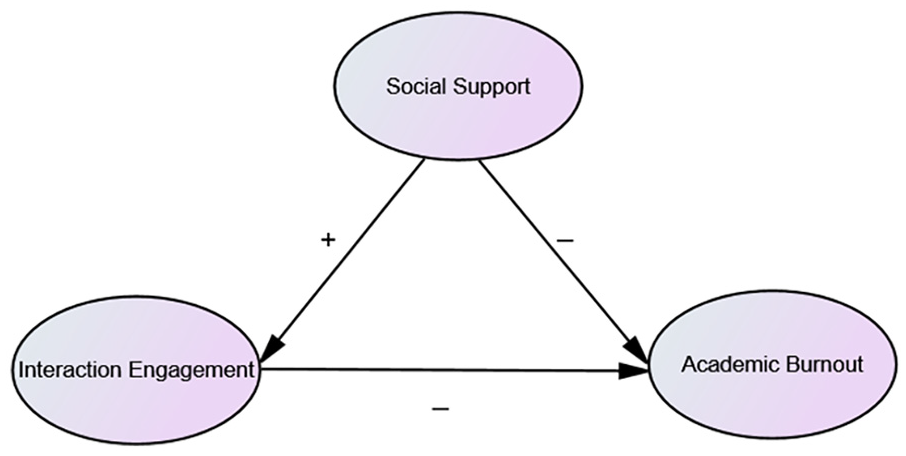
Hypothesized relationship model.
Figure 2 presents the standardized regression coefficients for the relationship model of social support (SS), interaction engagement (IE) and academic burnout (AB). Figure 2 shows that social support has is correlated with interaction engagement very significantly and positively predicts interaction engagement (β = .74, p < .001). Thus, Hypothesis 3 is supported. Social support has a significant association with academic burnout and predicts it negatively (β = −.23, p < .001). Moreover, social support is also indirectly associated with academic burnout through the mediating role of interaction engagement (β = .74 × −.52 = −.38, p < .001). Therefore, Hypothesis 4 is supported.

Structural model of SS, AB, and IE.
Discussion
This research aimed at examining the relationships among EFL learners’ perceived social support, interaction engagement and academic burnout, particularly the influencing mechanism of social support on academic burnout. The major findings of this study supported our hypotheses that EFL learners’ perceived social support and interaction engagement are positively correlated with each other and these two variables both have significant negative associations with academic burnout. In addition, interaction engagement functions as a mediator the relationship between social support and academic burnout. It is important to note that EFL learners perceived social support from their teachers and peer and interaction engagement explained 50% of the variability of academic burnout in this study. Besides, Figure 2 shows the factor loading of TES is 0.80 larger those of other three factors in SS, implying TES, of 4 SS factors, has greatest effect on AB and IE.
First, this research verified that social support from teachers and peers influenced Chinese EFL learners’ academic burnout directly and negatively and that social support positively predicted their interaction engagement. This finding is generally consistent with the some studies. Karimi and Fallah (2021) reported that teacher emotional support had a negative effect on EFL learners’ academic burnout. Fu (2023) found that social support played a protecting role against the EFL learners’ burnout. Luan et al. (2023) conducted a study on the relationship between student engagement and Chinese EFL learners’ perceived support for teachers and peers. They found the former was positively explained by the latter. Social support is facilitator of school participation and students feeling supported by their teachers have the tendency to meet their expectations to a greater degree, which, in turn, reduces distraction and deviant behavior (Gutiérrez et al., 2017). Students are likely to demonstrate positive aspects of social and academic motivation when they perceive that their teachers and peers provide them with clear expectations for social and academic outcomes, help, advice, instruction and emotional support, and prepare a safe and threat-free classroom environment (Wentzel et al., 2010). The joint effect of teacher and peers positively predict student engagement (Vollet et al., 2017). Teachers’ emotional support can improve students’ learning motivation and learning engagement (Mercer et al., 2011; Skinner et al., 2008), reduce students’ anxiety (Fraser & Fisher, 1982) and improve students’ self-efficacy (Patrick et al., 2007). Academic support from teachers helps students learn more effectively and efficiently. Peer support perceived by students has a positive predictive impact on their academic achievement (Fortuin et al., 2016). Good peer academic support is likely to create a pleasant learning environment, which helps students learn from each other and cultivate the spirit of cooperation. Peer emotional support is reflected in mutual trust and respect between students. Peer emotional support can help students get out of emotional depression, regain confidence, and face study and life more positively and enthusiastically (X. Liu et al., 2020). Hence, the more teacher-and-peer support the EFL learners perceive, the more engaged they will get, and such negative emotions as academic burnout will be reduced or even prevented. Therefore, teacher-and-peer support predicts interaction engagement positively and explains academic burnout negatively.
Second, this study confirmed the theoretical assertion that student engagement also influences academic emotions. As a matter of fact, reciprocal causation occurs among academic emotions and student engagement, and not only does the former affect the latter but the latter impacts the former (Pekrun & Linnenbrink-Garcia, 2012, p. 277). However, most related studies focused on how academic emotion predict student engagement. Few studies (J. Wang et al., 2021; Xiang et al., 2022) investigated the effect of students engagement in general on academic emotions, particularly burnout, let alone the impact of interaction engagement, a specific one, on it in the EFL learning context.
Interaction engagement is one of the dimensions of student engagement with a specific course and student engagement is a negative predictor of academic burnout (Zucoloto et al., 2016), thus it is understandable that interaction engagement predicts academic burnout negatively. Moreover, interaction engagement of EFL learners involves various interactions with teachers and peers in EFL class contexts. Interacting with teachers and peers is an important learning strategy and a demonstration of learners’ learning outcomes, which can improve such academic emotions as satisfaction and joy (Philp & Duchesne, 2016; Xie & Guo, 2023). Correspondingly, emotions like academic burnout and anxiety can be prevented or lessened. In this regard, interaction engagement may also explain academic burnout.
Since social support is one of direct antecedents of both interaction engagement and academic burnout and interaction engagement predicts academic burnout, it is acceptable that social support also has an indirect effect on academic burnout through mediation of interaction engagement.
Students experience more or less burnout. They show a state of emotional exhaustion, a tendency to depersonalize, and a feeling of low personal accomplishment (Yang, 2004). The results and the model in this study about the influence of social support from teachers and peers and interaction engagement on academic burnout, especially the explained 50% of the variability confirmed the joint effect of these two variables in preventing and treating academic burnout, particularly in EFL learning.
Conclusion
The research results of this study display the underlying mechanism of social support’s effects on academic emotions in EFL learning. Social support from students’ teachers not only influences academic burnout directly but predicts it indirectly through the mediating role of interaction engagement.
Students’ perceptions of competence and control over academic activities and outcomes and their appraisals of the values of these activities and outcomes influence their emotions (Pekrun, 2006). When it comes to the findings of the present study, optimizing the perceived social support and enhancing the learners’ perception of EFL interaction values are good choices to improve their academic performance and lessen their learning burnout. Therefore, the findings and proposed model in study may be beneficial for the burnout prevention and intervention programs in higher education, particularly in the context of college foreign language teaching and learning.
The limitations of this study lie in the cross-sectional research design, and the research instruments. In this study, all the variables were measured almost simultaneously and the data were collected through self-report questionnaires. The findings of such a study will be more convincing if the variables are assessed at more points of time and more objective instruments are utilized. Therefore, longitudinal research, and some qualitative research methods are recommended for further studies.
Footnotes
Declaration of Conflicting Interests
The author(s) declared no potential conflicts of interest with respect to the research, authorship, and/or publication of this article.
Funding
The author(s) disclosed receipt of the following financial support for the research, authorship, and/or publication of this article: This work was supported by the 11th Chinese Foreign Language Education Fund [Grant Number: ZGWYJYJJ11Z010].
Ethics Statement
This study was approved by Academic Committee of School of Foreign Languages, Hangzhou Dianzi University.
