




Abstract
Previous studies suggest that learning experience influences students’ academic engagement and self-efficacy mediates the association between them, and the sub-types of self-efficacy are distinct and play different roles. However, the different roles of self-efficacy sub-types, especially in blended learning environments, have yet to be explored. The present study investigated the potential mechanism of sub-types of self-efficacy on the relationship between the learning experience and academic engagement in a smart classroom environment in the background of COVID-19. Three hundred-eight participants volunteered in this study and finished the survey, including the learning experience, self-efficacy, and academic engagement questionnaire. The results showed that learning experience significantly influences academic engagement, and sub-types of self-efficacy play different roles in the relationship between learning experience and academic engagement. Furthermore, only academic and behavioral self-efficacy mediated the relationship between them. The results of this study have specific implications for creating a sustainable blended learning environment and promoting students’ academic engagement.
Introduction
With the advancement of technology, various digital technologies, such as MOOCs and smart classrooms, have been applied extensively in higher education (e.g., Heidari et al., 2023; Murphy, 2020; Pacheco et al., 2018). Especially with the advent of the COVID-19 pandemic, digital technologies are receiving more attention in higher education than in the past (e.g., Burns, 2020; Toquero, 2020). Faced with such a large number of applications of digital technology, more scholars have been considering whether they can improve students’ academic engagement (Villela et al., 2020). Some researchers have pointed out that because the digital technology environment encourages students to learn independently, they are more motivated and, therefore, more engaged (McGuinness & Fulton, 2019). However, academic engagement is a multifaceted concept (Payne, 2019) and embedded in context; more research should be conducted in a digital technology environment to explore the influencing factors and mechanisms of academic engagement in the environment of digital technology. This study addresses this issue by focusing on two critical predictors: learning experience in an intelligent environment and sub-types of academic self-efficacy.
Learning engagement has always been the focus of educators’ research. It has been found that students’ learning engagement is significantly related to the learning effect (Chen, 2021). Therefore, learning engagement is often used as the basis for Evaluation of the learning effect, and it is usually used as an essential index to observe students’ efforts (Leng & Yi, 2020). Learning engagement is affected by the external environment and is closely reis related to the learner’s environmental experience (Zhang et al., 2019). A good sense of learning experience can make learners show higher enthusiasm and better learning results(Guo & Ji, 2019). As a technology-enhanced educational application, smart classroom enriches the teaching form in five aspects: content presentation, environmental management, resource acquisition, timely interaction, and situational awareness.
On the one hand, improving learners’ learning enthusiasm and quality is considered helpful (Huang et al., 2012). However, on the other hand, in the process of learning activities, there are also non-input behaviors, such as teaching-independent activities and separation from learning objectives (Pardos et al., 2014). Therefore, exploring the impact of the learning experience brought by the technical environment on students’ learning engagement in the bright classroom environment will be conducive to the better development of learning activities and reduce the occurrence of students’ non-engagement behavior.
Literature Review
Academic engagement is defined as the cognitive and emotional energy that students participate in completing learning tasks (Schunk & Mullen, 2012) and is associated with some essential educational outcomes, such as academic achievement and satisfaction (e.g., Bolliger & Halupa, 2018; Jdaitawi, 2019; Lei et al., 2018; Navarro et al., 2019; Z. Wu, 2019). Thus, academic engagement is regarded as the basis for the Evaluation of learning effects and an effective predictor of the quality of student learning outcomes (Redmond et al., 2018). Educators hope to find ways to improve students’ learner engagement. Some scholars point out that blended learning can engage students to learn (Aspden & Helm, 2004; Graham & Robinson, 2007).
Blended learning refers to the blending of traditional classroom learning and online learning methods to create a student-centered, autonomous, and flexible learning approach. In China, since COVID-19, many universities have used smart classrooms as the primary way to implement blended learning (Siripongdee et al., 2020). In 1988, Ronald Recino proposed the concept of “Smart Classroom.” He proposed that an intelligent classroom is one in which devices such as personal computers, interactive video programs, closed-circuit television, VHS, programs, satellite links, local area networks, and telephone modems are embedded in the traditional classroom. As a technology-intensive education application, the intelligent classroom enriches teaching forms in five aspects: content presentation, environmental management, resource acquisition, instant interaction, and situational awareness. Therefore, it is considered to be helpful to improve learners’ learning enthusiasm and quality (Huang et al., 2012). However, in the learning process, there are also non-engagement behaviors, such as non-teaching activities and separation from learning objectives (Pardos et al., 2014). As a growing body of research concerns whether blended learning improves the academic engagement of students (e.g., Green et al., 2018; Sahni, 2019), more studies are needed to examine what factors may influence academic engagement in the blended learning environment (e.g., Fisher et al., 2021; Nortvig et al., 2018). This issue is urgent because identifying the determinants of academic engagement in the context of blended learning is a key step towards a more effective implementation of blended learning.
As an important factor in the learning process, learning experience may affect students’ academic engagement. It has been suggested that learners’ learning experience is closely related to academic engagement (Hiver et al., 2020), and a good perception of the learning environment can motivate learners to learn and engage more (Awidi et al., 2019). Learning experience refers to students’ experience of courses, teaching activities, teaching interaction, and learning environment during the learning process (Nellie Mae Education Foundation, 2016). The self-determination theory points out that individuals seek experience that can satisfy their basic needs, such as ability and autonomy, through interaction with the environment (Deci & Ryan, 1985, Ryan & Deci, 2000). The extent to which the learning environment meets these psychological needs determines how engaged students are in school. In addition, the self-system approach also indicates that academic engagement is hypothesized to be malleable and to respond to the interaction between the individual and the learning environment (Connell, 2020; Skinner and Belmont, 1993). Owing to its importance, improving students’ learning experience has received policy attention since the early 2000s. In 2004, the Higher Education Institute stated, “Our vision is for students in UK higher education to enjoy the highest quality learning experience in the world” (Higher Education Academy [HEA], 2011). In his three-stage model, Biggs (1985) describes student learning as a process including presage, process, and product. These three processes correspond to the learning environment and the characteristics of students, the learning methods, and the results of learning, respectively. This model proposes that students’ personality traits and learning environment will affect the learning methods they may adopt and thus affect the learning outcomes. Additionally, a series of studies have pointed out that students’ perception of the learning environment affects their academic engagement and achievement (e.g., Eccles et al., 1998; Patrick et al., 2007; Ryan & Patrick, 2001). Thus, the student’s learning experience may influence their academic engagement.
However, learning experiences derived from the external environment may intertwine with other internal factors and together influence academic engagement (Helgeson & Lopez, 2010). Therefore, it is very important to investigate the influence mechanism of learning experience on academic engagement. Previous studies established that self-efficacy may mediate the relationship between learning experience and academic engagement. Self-efficacy is defined as “belief in self to successfully accomplish a task in a given context” (Zimmerman et al., 1994) and is regarded as an important psychological construction in the learning process (Alt, 2015). Social cognitive theory points out that an individual’s judgment of his own ability is an important determinant of his behavior style, how long he will persist and how much effort he will make (Bandura, 1986). According to Bandura’s social cognitive theory, self-efficacy is a key factor affecting academic engagement. Learners with high levels of self-efficacy tend to have greater engagement in behavioral, motivational, and cognitive aspects than other learners (Linnenbrink & Pintrich, 2003). A series of studies have also shown that self-efficacy has significant contributions to motivating students (Tschannen-Moron & Hoy, 2001; Zimmerman, 2000), leading to greater engagement (e.g., Kuo et al., 2021; H. Wu et al., 2020). Specifically, individuals with high levels of self-efficacy are more engaged in learning than those with low levels of self-efficacy (e.g., Lu et al., 2022; Sökmen, 2021). In addition, some studies demonstrated that the positive experience of learning provides a source of information for individuals to establish and measure their own abilities, thus enhance their self-efficacy (Phan, 2011). Riches of studies indicated that student’s perceptions of the learning environment are significantly associated with academic self-efficacy (e.g., Dorman, 2001; Kingir et al., 2013). For example, the study conducted by Dorman (2001) showed that if students are satisfied with their learning environment, they will experience stronger academic self-efficacy.
Furthermore, based on previous studies, academic self-efficacy includes two dimensions: academic ability and behavioral self-efficacy (Schunk, & DiBenedetto, 2022). Academic ability self-efficacy refers to an individual’s judgment and confidence about whether he or she has the learning ability to have good academic performance and avoid academic failure. Academic, behavioral self-efficacy refers to the individual’s judgment and confidence on whether he can adopt certain learning methods to achieve learning goals. Previous studies indicated that the sub-types of self-efficacy are conceptually distinct and have different effects on individual behavior (Liang, 2000). Up until now, no studies have investigated the role of different sub-types of self-efficacy on the relationship between learning experience and academic engagement. So, do academic ability self-efficacy and academic, behavioral self-efficacy play different roles in the relationship between the learning experience and academic engagement in the smart classroom environment?
The present study examined whether the relationship between learning experience and academic engagement in the smart classroom environment is influenced by self-efficacy among college students. Furthermore, the present study investigates whether the sub-types of self-efficacy play different roles in the relationship between learning experience and academic engagement. Based on previous studies, the present study hypotheses that self-efficacy mediates the relationship between learning experience and academic engagement, and academic ability self-efficacy and academic behavioral self-efficacy play different roles in the relationship between the associations.
According to existing research, it is assumed that learning experience can predict and affect learners’ learning engagement and self-efficacy. Therefore, this study believes that learners’ self-efficacy has a partial mediating effect between learning experience and learning engagement. The learning experience can predict and significantly affect learning engagement. The specific assumptions are as follows:
Hypothesis H1: In the smart classroom environment, learners’ learning experience has a significant positive impact on learning engagement.
Hypothesis H2: In the smart classroom environment, learners’ learning experience has a significant positive impact on self-efficacy.
Hypothesis H3: In the smart classroom environment, learners’ self-efficacy has a significant positive impact on learning engagement.
Hypothesis H4: In the smart classroom environment, learners’ self-efficacy plays a mediating role between learning experience and learning engagement.
Materials and Methods
Participants
This study takes college students from a university in western China as the research object and adopts a stratified sampling method according to grade. Any college students who were taught in a smart classroom environment during the spring semester of the 2021 to 2022 academic year could volunteer to participate. After excluding 58 incomplete questionnaires, data from a total of 308 participants were used. Before participants filled out the questionnaire, their informed consent was collected. Participants were rewarded with a pen after completing the questionnaire.
The mean age was 19.5 years (SD = 1.087). There are 75 freshmen (24.4%), 84 sophomores (27.3%), 81 juniors (26.3%), 68 seniors (22.1%), 230 female students (74.7%), and 78 male students (25.3%).
Academic Satisfaction Scale
The present study adopted the scale of academic self-efficacy developed by Liang (2000), which includes two dimensions: academic ability self-efficacy and academic behavior self-efficacy. The present study opted to utilize the academic self-efficacy scale developed by Liang (2000) due to its comprehensive coverage of two critical dimensions: academic ability self-efficacy and academic behavior self-efficacy. This scale, revised by Liang Yusong in the context of Chinese culture, offers a more nuanced understanding of self-efficacy among the Chinese population. Its cultural sensitivity ensures a more accurate reflection of individuals’ self-perceptions within this specific cultural framework. The reliability and validity of this scale have been rigorously tested across diverse groups in China, demonstrating its stability in measuring self-efficacy consistently. The measurement outcomes align well with theoretical expectations and correlate strongly with other relevant variables, further affirming its psychometric robustness. Moreover, the widespread adoption of this scale in the field of psychology in China attests to its recognized value and applicability. Numerous studies have employed this scale as a key measurement tool, providing a rich corpus of data and literature support for its continued use. The scale’s design is versatile, accommodating individuals of varying ages and backgrounds, making it a valuable asset in diverse fields such as education, psychotherapy, and career guidance. Its application in these domains promises to yield deeper insights into the complexities of academic self-efficacy and its impact on individual outcomes.
The questionnaire items were scored using a five-point scale, with one representing “completely inconsistent” and five representing “completely consistent.” The higher score indicates a higher level of academic self-efficacy. In the present study, the reliability coefficient is .96. Academic ability Self-efficacy consists of 11 questions, and the reliability coefficient is .939, such as I believe in my ability to do well in school. The self-efficacy of academic behavior includes 11 questions. The reliability coefficient is .925. For example, when I study, I always like to check whether I have mastered what I have learned by asking myself and answering by myself.
Learning Experience Scale
The learning experience was measured using the scale developed by Hu and Huang (2016) at Beijing Normal University. It includes five dimensions: learning activities, physical environment, resource acquisition, vitality interaction, and content presentation. As experts in the field of education, Hu Yongbin and Huang Ronghuai’s research results have high academic value and credibility. Their work is based on in-depth theoretical research and empirical analysis, so the scale they developed may be more recognized in academia. This scale comprehensively considers multiple dimensions of learning experience and can comprehensively evaluate learners’ learning process and feelings. At the same time, the scale is localized according to the background and characteristics of Chinese education, which is more in line with the actual situation of Chinese learners, so it has better applicability in Chinese education environment. The scale may have undergone strict reliability and validity tests during the preparation process to ensure the reliability and validity of the measurement tools. The scale has been cited and verified by many academic literatures, and its scientificity and practicability have been recognized by peers.
The questionnaire items were scored using a five-point scale, with 1 to 5 representing “never,”“rarely,”“occasionally,”“often,” and “always,” respectively. The higher score indicates a higher level of learning experience. In the present study, the reliability coefficient is .96. The learning activity consists of 13 questions, and the reliability coefficient is .899. For example, when I ask questions, the teacher often gives me detailed answers. The physical environment includes nine questions, the reliability coefficient is .895, such as I feel the classroom has enough light for reading. Resource acquisition includes nine questions, and the reliability coefficient is .893. For example, I can easily use learning resources in different formats in class. The vitality interaction consists of eight questions, and the reliability coefficient is .884; for example, the teacher can use the device to correct the classroom exercises I submit in real-time. The content presentation consisted of six questions, and the reliability coefficient is .854. For example, I could clearly see the projected text and pictures from my seat.
Learning Engagement Scale
The present study adopted the learning engagement scale compiled by Awang-Hashim and Murad Sani (2008), which includes three dimensions: behavioral, cognitive, and emotional engagement. Awang et al.’s scale is based on a comprehensive theoretical framework that captures the multi-dimensional characteristics of learning engagement, such as emotional engagement, behavioral engagement, and cognitive engagement. The scale may have shown good psychometric properties in the original study, including reliability and validity, which means that it can reliably and effectively measure learning engagement. The scale has been widely used and recognized in the field of international education, increasing its credibility on a global scale. Although the scale may not be initially designed for Chinese students, it may be flexible enough to adapt to student groups in different cultural backgrounds. The scale has been cited by many academic literatures, which shows that it has a wide range of influence and recognition in academia. The scale provides clear and easy-to-understand instructions and entries, which is essential to ensure that students correctly understand and respond to problems.
The questionnaire items were scored using a five-point scale, with 1 representing “completely inconsistent” and 5 representing “completely consistent.” The higher score indicates a higher level of learning experience. In the present study, the reliability coefficient is .92. Behavioral engagement included eight questions, and the reliability coefficient is .941, such as forgetting a pen and paper in class. Cognitive engagement consisted of 10 questions, and the reliability coefficient is .923, such as looking at a course with questions to keep my attention. Emotional involvement included 11 questions, the reliability coefficient is .871, such as: I feel a part of the school.
Results
Correlation Analysis of College Students’ Learning Experience, Self-Efficacy, and Learning Engagement
Descriptive statistics and correlation results are shown in Table 1. There were positive correlations between learning experience, academic ability self-efficacy, academic, behavioral self-efficacy, and academic engagement. Therefore, the hypotheses H1, H2, and H3 are proved to be true, and the basis for the subsequent verification of the structural equation is provided.
Descriptive Statistics and Correlations Among Variables.
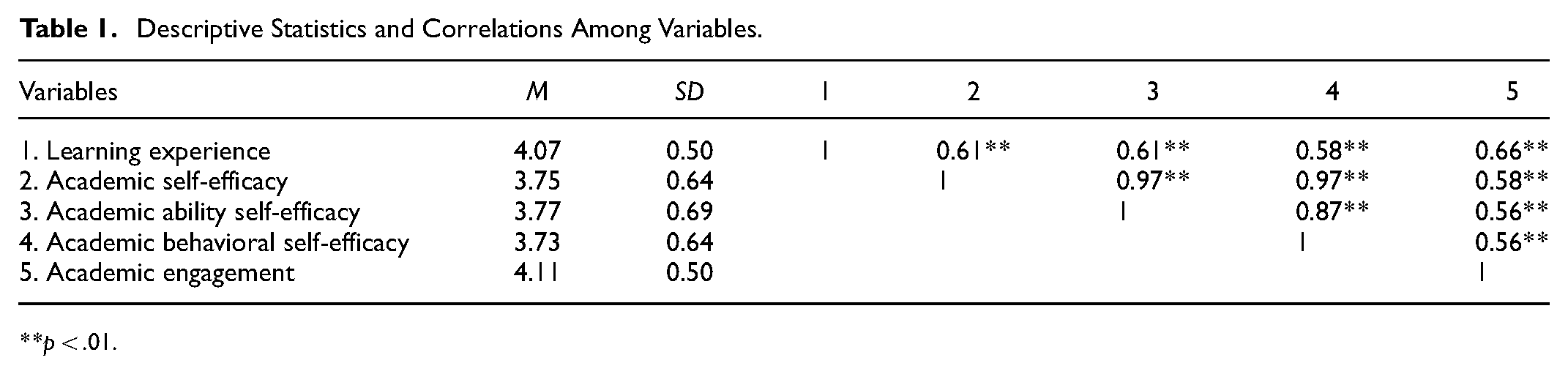
p < .01.
The Mediating Effect of Sub-Types of Self-Efficacy on the Relationship Between the Learning Experience and Academic Engagement
SPSS PROCESS (Model 4) was conducted to examine the mediation role of sub-types of self-efficacy on the relationship between learning experience and academic engagement.
The mediation results for sub-types of self-efficacy are shown in Tables 2–4. As shown in Table 2, 28% of the variance in academic engagement was because of the learning experience, 37% of the variance in academic ability self-efficacy was because of the learning experience, and 34% of the variance in behavioral was because of the learning experience. Furthermore, 48% of the variance in academic engagement was because of the learning experience, academic ability self-efficacy and academic, behavioral self-efficacy.
Model Summary.

Coefficients.

Bootstrap Analysis of the Significance Test of Mediation Effect.

As shown in Table 3, there was a significant effect of learning experience on academic engagement (β = .49, p = .0000), there was a significant effect of learning experience on academic ability self-efficacy (β = .83, p = .0000) and on academic, behavioral self-efficacy (β = .73, p = .0000). However, there was not a significant effect of academic ability self-efficacy on academic engagement (β = .06, p = .35), only a significant effect of academic, behavioral self-efficacy on academic engagement was found (β = 0.16, p = .018). The results indicate that only academic, behavioral self-efficacy mediates the relationship between the learning experience and academic engagement. Therefore, the verification hypothesis H4 is established.
Bias correction non-parametric percentage bootstrapping was used to test the mediating effect further. As shown in Table 4, the relationship between the learning experience and academic engagement is partially mediated by academic, behavioral self-efficacy. A model of the relationship between these variables is shown in Figure 1. The indirect mediating effect was 0.17, the direct effect was 0.49, and the total effect was 0.66. The mediating effect rate was 0.17/0.66 = 25.8%.

The relationship between learning experience, academic behavioral self-efficacy and academic engagement.
Research Conclusions
The present study explored the relationship between learning experience, self-efficacy, and learning engagement. Furthermore, the different role of sub-types of self-efficacy in the relationship between learning experience and learning engagement was investigated in the smart classroom environment.
The Learning Experience has a Predictive and Significant Impact on Students’ Self-Efficacy
This conclusion verifies Hypothesis 2. The result is consistent with previous studies (e.g., Konold et al., 2018; Lombardi et al., 2021), which indicated that the higher level of learning environment experience promotes students to engage more in their learning. The results can be explained by previous theories and studies. According to SDT theory, the best learning results occur when individuals’ learning environment can satisfy their sense of autonomy and self-improvement. The higher the degree to which students can experience the satisfaction of these psychological needs, the stronger their academic engagement will be. Individuals who are satisfied with their learning enthronement are more engaged in learning than those who are not satisfied.
Teachers can design a series of teaching activities to help students experience success. For example, through stratified teaching, it is ensured that every student can make progress at the level of difficulty that suits them. The use of scaffolding instruction gradually increases the complexity of the task, allowing students to gradually complete the task under the guidance of the teacher, thereby enhancing their self-confidence. According to the students’ interest, ability and learning style, provide them with personalized learning opportunities. This personalized approach can help students find areas they are good at and succeed in these areas. Encourage cooperation and mutual assistance among students to complete tasks together in groups. Peer support can improve students’ self-efficacy because they can learn and encourage each other. Set short-term and long-term learning goals with students and provide feedback regularly. When students can see their progress and achieve their goals, their self-efficacy will be enhanced.
Teachers should provide a supportive learning environment, encourage students to face challenges and praise their efforts and progress. This kind of emotional support is essential to build and maintain students’ self-efficacy. Teaching students effective learning strategies and self-regulation skills, such as time management, note-taking skills and test preparation. Mastering these skills can enhance students’ self-efficacy because they have the tools to control their own learning. Teachers can set an example for students through their own behavior, showing how to face challenges and overcome difficulties. Teachers’ positive attitude and behavior can significantly affect students’ self-efficacy. Encourage students to reflect on their learning experience and process. Through reflection, students can better understand their own learning style, identify their own strengths and areas for improvement. Use learning analytics tools to collect student learning data, such as engagement, achievement, and progress. These data can help teachers understand which learning experiences have a positive impact on students’ self-efficacy, and adjust teaching strategies accordingly.
Self-Efficacy Can Predict and Have a Significant Impact on Students’ Learning Engagement
This conclusion verifies Hypothesis 3. Previous studies have found that the stronger the students’ self-efficacy, the higher the investment in learning, and the final academic performance will also be improved (He et al., 2021). Students with higher self-efficacy tend to have stronger problem-solving and knowledge-reprocessing abilities in the process of learning activities, and their learning effect is often the best (Lan et al., 2020). Classroom teaching activities in the smart classroom environment can significantly improve students’ Internet self-efficacy and thus enhance students’ learning engagement (Peng et al., 2021).
Students’ self-efficacy is regularly assessed using questionnaires, interviews or self-reporting tools. These assessment results can be used as a basis for predicting students’ subsequent learning engagement and performance. For students with low self-efficacy, additional support and resources, such as counseling, psychological counseling, or learning strategy training, are provided to help them improve their self-efficacy and thus increase their learning engagement. By designing a series of progressive challenges, ensure that students can experience success. Successful experience can enhance self-efficacy and improve learning engagement. Tutor teaches students how to set SMART (specific, measurable, achievable, relevant, time-bound) goals and monitor their progress. Achieving these goals can enhance students’ self-efficacy and motivate them to be more engaged in learning. Encourage students to participate in peer support and cooperative learning activities, which can improve students’ social skills, enhance their self-efficacy, and promote deeper learning engagement. Provide timely, specific and constructive feedback to help students understand their strengths and areas for improvement. Effective feedback can enhance students’ self-efficacy and guide their learning engagement.
Create a supportive learning environment that encourages students to express their feelings and provides emotional support. When students feel understood and supported, their self-efficacy will increase and they will be more engaged in learning. Teach students effective learning strategies, such as time management, note-taking skills and test preparation. Mastering these strategies can enhance students’ self-efficacy because they have the tools to control their own learning. Teachers and parents can set an example for students through their own behavior, showing how to face challenges and overcome difficulties. The positive attitude and behavior of the example can significantly affect the students’ self-efficacy. Encourage students to reflect on their learning experience and process. Through reflection, students can better understand their own learning styles, identify their own strengths and areas for improvement, thereby enhancing self-efficacy.
Subtypes of Self-Efficacy Play Different Roles in the Relationship Between Learning Experience and Academic Engagement
This conclusion validates hypothesis 1 and hypothesis 4. To be specific, academic ability self-efficacy did not mediate the relationship between the learning experience and academic engagement; only academic and behavioral self-efficacy mediates the relationship between the learning experience and academic engagement. The results indicate that for college students who have been learning in smart classrooms, the effect of learning experience on academic engagement was actualized through academic, behavioral self-efficacy. The results can be explained by previous studies. Some researchers have confirmed that self-efficacy is not only affected by individual’s perception of the learning environment but also can affect students’ academic engagement (Alt, 2015; Wei & Chou, 2020). In addition, It has been found that self-efficacy plays a mediating role between an individual’s perception of the learning environment and the learning effect (Ma et al., 2018; Wei & Chou, 2020). However, the mediation effect of the sub-types of self-efficacy in the associations between learning experience and academic engagement has rarely been tested. Previous studies indicated that academic ability self-efficacy and academic behavioral self-efficacy are conceptually distinct and have different effects on individual behavior (Liang, 2000). Academic ability self-efficacy is an affirmation of one’s learning ability and academic behavior self-efficacy is an affirmation of one’s learning behavior. Learning ability is an uncontrollable and relatively stable factor, while behavior is a controllable and easily changed factor. Thus, compared with academic ability self-efficacy, when the learning environment can meet the psychological needs of students, students will have a higher sense of academic and behavioral self-efficacy that can improve their learning effect and thus become more engaged in learning.
The present study extends our understanding of the nature of learning experience and academic engagement in the blended learning environment. Specifically, it is the first attempt to explore the role of sub-types of academic self-efficacy in the association between the learning experience and academic engagement and provides evidence that the two dimensions of academic self-efficacy are distinct and have different effects on individuals. Most previous studies did not distinguish the different dimensions of self-efficacy. Therefore, the strategies proposed to improve the academic self-efficacy of students may lack pertinence. This study provides a new perspective for effectively improving individual self-efficacy.
Teachers can adjust teaching strategies according to the level of students’ self-efficacy. For students with higher self-efficacy, more challenges and autonomous learning space can be provided; for students with low self-efficacy, more support and guidance may be needed. Through various activities and strategies, such as the creation of successful experience, goal setting guidance, positive feedback, and encouragement, to cultivate students’ self-efficacy. This can enhance students’ confidence and input in the face of learning challenges. Teach students effective learning strategies, such as time management, note-taking skills and test preparation. Mastering these strategies can enhance students’ self-efficacy because they have the tools to control their own learning. Provide emotional support and encourage students to face challenges and difficulties. When students feel understood and supported, their self-efficacy will increase and they will be more engaged in learning.
Encourage students to reflect on their learning experience and process. Through reflection, students can better understand their own learning styles, identify their own strengths and areas for improvement, thereby enhancing self-efficacy. Encourage students to participate in peer support and cooperative learning activities. These activities can improve students’ social skills, enhance their self-efficacy, and promote deeper learning engagement. Use learning analytics tools to collect student learning data, such as engagement, achievement, and progress. These data can help teachers understand the relationship between self-efficacy and learning engagement, and adjust teaching strategies accordingly. Teachers and parents can set an example for students through their own behavior, showing how to face challenges and overcome difficulties. The positive attitude and behavior of the example can significantly affect the students’ self-efficacy.
Research Discussions
Enrich the Diversified Design of Smart Classroom Teaching Activities and Enhance Learners’ Sense of Learning Experience
In the smart classroom, teachers and students will no longer be limited to traditional classrooms, multimedia classrooms, and online classrooms but can carry out diversified communication and interaction with natural means and methods (Wang et al., 2022). It can increase students’ availability of the required resources and their ability to get feedback at any time, which greatly satisfies students’ autonomy needs and thus improves their academic engagement. Enrich the diversified design of smart classroom teaching activities and enhance learners’ learning experience. Establish high-quality teaching examples designed by the same school or professional teachers so as to enrich the types of smart classroom activities. At the same time, according to the teaching needs of teachers, teachers are provided with a variety of teaching tools to facilitate the development of education and teaching activities so that the content of education and teaching is diversified in form and flexible in teaching methods, so as to stimulate students’ learning interest and motivation in the learning process and promote students’ learning experience (Wong, 2008).
Design online discussion and group cooperation tasks to allow students to communicate on the platform; students’ immediate feedback was collected by online voting, questionnaire survey and so on. The implementation of the flipped classroom model allows students to self-study through online resources before class, and focus on discussion and practice in the classroom. Provide learning materials and exercises at different levels of difficulty to meet the learning needs of different students; use learning analysis technology to track students’ learning progress and performance, and provide students with personalized learning suggestions. Integrate game elements into teaching activities, such as points, badges, rankings, etc., to improve students’ learning motivation; design teaching games or challenge tasks so that students can learn in fun. Using augmented reality (AR) and virtual reality (VR) technology to provide students with an immersive learning experience; design related AR/VR teaching resources, so that students can explore and learn in a virtual environment. Develop or use intelligent tutoring systems to provide students with learning support and answering questions; use artificial intelligence technology, such as chat robots, for automated tutoring and feedback. Design interdisciplinary projects or themes to encourage students to integrate the knowledge of different disciplines; through interdisciplinary learning activities, students’ innovative thinking and problem-solving ability are cultivated.
Create situation simulation, so that students can learn knowledge and skills in the actual situation of simulation; use case analysis to enable students to analyze and solve practical problems and enhance the application of learning. Using the online platform for real-time testing and evaluation, so that students can quickly understand their learning effect; provide opportunities for peer evaluation and self-evaluation, and cultivate students’ self-reflection ability. Regularly provide teachers with training in information technology and intelligent teaching to improve their information literacy and teaching design ability; encourage teachers to share teaching experience and innovative practice, and promote the continuous improvement of teaching methods. Use the smart classroom platform to communicate with parents, so that parents can understand the students’ learning progress; encourage parents to participate in students’ online learning activities and form a good atmosphere for home-school co-education. Through the above methods, the teaching activities of the smart classroom can be more diversified, and the students’ learning experience will also be significantly improved.
Increase the Development and Support of Teaching Resources in Smart Classrooms and Enhance Learners’ Self-Efficacy
The teaching resources in the smart classroom include not only the teaching resources under the previous multimedia classroom or network classroom but also the application of teaching resources supported by virtual reality and augmented reality technology (Dong et al., 2010). The creation and selection of feedback, teaching practice and personalized tasks provided by virtual reality technology make the interaction of learning activities more prominent, which is more conducive to improving learners’ learning experience so as to improve learners’ learning efficacy (Kalyuga, 2007). Therefore, teachers should develop and provide different teaching resources according to different teaching activities and contents; the technical support personnel of the smart classroom should also apply the corresponding technology to develop teaching auxiliary facilities that meet the needs of schools and disciplines according to the needs of different schools and disciplines.
Use learning analysis technology to recommend learning resources suitable for students according to their learning history, interest and performance. Provide different types of learning materials, such as video, animation, interactive simulation, etc., to meet the needs of students with different learning styles. Make use of and integrate high-quality open education resources to provide students with more diversified learning content; encourage teachers to participate in the creation and sharing of OER to enrich the teaching resource library of smart classrooms. Provide online collaboration tools such as shared documents, whiteboards and project management tools to promote students’ teamwork and project management skills; develop an interactive learning platform so that students can participate in discussions, ask questions and share ideas, and enhance their sense of participation and belonging. Develop or adopt intelligent tutoring systems to provide students with personalized learning support and instant feedback; using artificial intelligence technology, such as natural language processing, to help students solve problems encountered in learning. Design project-based learning activities to enable students to apply what they have learned by solving practical problems; it provides practical opportunities such as laboratory simulation and virtual experiment to enhance students’ practical ability and innovative thinking.
Provide career planning and skills development resources to help students understand the future career path and learning goals; in cooperation with enterprises and industries, practical case studies and internship opportunities are introduced to enable students to apply what they have learned. Teaching students effective learning strategies and meta-cognitive skills, such as time management, goal setting, and self-monitoring; provide online workshops and guidance to help students become autonomous and self-driven learners. Create a supportive and inclusive learning environment to encourage students to share ideas and feelings; to set up online forums and study groups so that students can support and learn from each other. Provide regular training for teachers to improve their ability to design and implement teaching activities in smart classrooms; teachers are encouraged to participate in academic conferences and seminars to obtain the latest educational technology and teaching methods. Provide students with opportunities to showcase their learning outcomes, such as online exhibitions, competitions and public speaking; recognize and reward students’ efforts and achievements in the form of badges, certificates, and letters of praise. Through these strategies, the teaching resources of smart classrooms can be effectively developed and fully supported, and students’ learning motivation, self-efficacy, and learning effectiveness can also be significantly improved.
Improve the Construction and Application of the Evaluation System of Smart Classrooms and Promote Learners’ Learning Engagement
The self-efficacy of learning behavior has the highest degree of influence on cognitive engagement, and cognitive engagement is often the core indicator of learning engagement. Smart classrooms can provide teachers and students with a variety of learning processes and result data information. These data include not only students’ classroom data but also students’ after-school online data. Teachers can adjust teaching methods in time according to this information, accurately help students find and solve problems in time, and accurately push corresponding learning resources according to students’ state and personal needs. Students can compare the gap between themselves and the overall level, adjust and supplement their own shortcomings in a timely manner, and systematically learn and supplement according to specific problems so as to effectively promote the self-efficacy of learning behavior in the teaching process (Wen, 2020). Therefore, the establishment and easy use of multidimensional evaluation methods are conducive to improving students’ learning efficiency and promoting students’ learning engagement (Leng & Yi, 2020).
Combining formative evaluation and summative evaluation, it not only pays attention to the learning results, but also pays attention to the learning process; use self-assessment, peer assessment, teacher assessment and other evaluation methods to obtain feedback from different angles. Use the learning management system (LMS) and learning analysis tools to collect students’ learning data, such as attendance rate, online interaction times, and homework completion. Analyze data to understand learners’ behavior patterns and adjust teaching strategies and evaluation methods. According to the students’ ability and progress to set personalized evaluation criteria, to ensure the fairness and effectiveness of the evaluation; design layered tasks and projects so that students of different levels can be challenged and grown at a level that suits them. Provide instant feedback through online platforms to help students understand their learning status and progress in a timely manner; by using the automatic scoring system to quickly score the objective questions, the teacher’s time is released, so that they can pay more attention to the individual needs of students. Establish students’ electronic portfolio, record their learning process and results; let students participate in the selection and reflection of portfolio content, enhance their self-awareness and self-evaluation ability.
The evaluation system includes not only knowledge and academic skills, but also 21st century skills, such as collaboration, communication, creativity, and critical thinking; evaluate students’ attitudes and efforts, such as participation, persistence, and self-management ability. Regularly communicate with parents to share students’ learning progress and evaluation results; parents and members of the community are invited to participate in the evaluation process, such as as observers or reviewers, to provide an external perspective. Establish a continuous improvement mechanism to regularly evaluate the effectiveness and fairness of the evaluation system; according to the feedback, the evaluation method is adjusted to ensure that the evaluation system can adapt to the changes of students and teaching environment. Provide teachers with professional development and training of evaluation methods to ensure that they can effectively use evaluation tools and techniques; encourage teachers to participate in the community of evaluation research and share best practices and experiences. To ensure that the evaluation criteria and process are transparent and fair to all students; provide ways of appeal and reconsideration to ensure that every student’s voice can be heard. Through these methods, the evaluation system of smart classroom can be more comprehensive and detailed, so as to better promote learners’ learning engagement and academic achievement.
Research Significance and Shortcomings
The present study carries significant practical implications, particularly for educators seeking to enhance the learning environment and foster students’ academic self-efficacy. Specifically, our findings offer valuable insights into how teachers can devise practical strategies to enrich students’ learning experiences and promote their sustainable academic growth. One notable finding is the mediating role of academic behavior self-efficacy in the relationship between the learning experience and academic engagement in smart classrooms. This suggests that bolstering learners’ confidence in their academic behaviors can effectively elevate their level of engagement. Practical measures to this end include guiding students in the effective use of online and offline learning tools, navigating the procurement of learning materials, enhancing classroom interaction, encouraging peer-to-peer collaboration and feedback, and other strategies aimed at refining their learning behaviors and, ultimately, boosting their academic self-efficacy.
Despite its contributions, this study has some limitations. Firstly, the participant pool was restricted to college students from a single university in Western China, potentially limiting the generalizability of our findings. Future research should aim for a more diverse sample, encompassing students from multiple universities across various cities, to enhance the broader applicability of the results. Secondly, the study employed a cross-sectional design, which precludes the determination of causal relationships. To address this, future studies should adopt experimental designs that allow for a more rigorous investigation of causality.
Supplemental Material
sj-docx-1-sgo-10.1177_21582440241285082 – Supplemental material for College Students’ Learning Experience and Engagement in the Smart Classroom: The Mediating Role of Self-Efficacy in the Background of COVID-19
Supplemental material, sj-docx-1-sgo-10.1177_21582440241285082 for College Students’ Learning Experience and Engagement in the Smart Classroom: The Mediating Role of Self-Efficacy in the Background of COVID-19 by Yanli Wang, Sijia Liu, Linjie Pu, Xiaolong Mao and Sha Shen in SAGE Open
Footnotes
Acknowledgements
This research is completed under the kind care and careful guidance of my supervisor Professor Wang. First of all, I would like to thank my mentor for her care, guidance, and even encouragement, which is the motivation and support for me to complete this research. Every communication with my teacher has increased my courage to overcome difficulties and enhanced my motivation to study hard. In my study, I have been deeply impressed by my teacher’s rigorous learning attitude, rich knowledge, and excellent working attitude. They are my learning example and I have gained a lot from them. Here, I would like to extend my heartfelt thanks and high respect to my teachers!
I would also like to thank the students who helped to fill out the questionnaire. It was their active participation that made my research more thorough. At the same time, I would like to thank the students in the experimental group. Thanks to your help and support, I was able to overcome difficulties and doubts one after another until the successful completion of the research. Here, to express my sincere thanks to you!
Author’s Note
This manuscript has not been published or presented elsewhere in part or in entirety, and is not under consideration by another journal. All study participants provided informed consent, and the study design was approved by the appropriate ethics review boards. All the authors have approved the manuscript and agree with submission to your esteemed journal. Thank you for your consideration.
Author Contributions
Declaration of Conflicting Interests
The author(s) declared no potential conflicts of interest with respect to the research, authorship, and/or publication of this article.
Funding
The author(s) disclosed receipt of the following financial support for the research, authorship, and/or publication of this article: Ministry of Education Humanities and Social Sciences Planning Fund Project “Research on the Cognitive Generation Path and Optimization Mechanism of College Students’ Groups Based on Shared Regulation” (no.: 23YJA880053); Undergraduate Teaching Quality Improvement Project of Northwest Minzu University “Ideological and Political Demonstration Specialty of Educational Technology” Course (no.: 2021KCSZSFZY-03); This report is the phased research achievement of the 2023 Gansu Provincial Philosophy and Social Science Planning Project “Research on School Education for Consolidating the Sense of Community of the Chinese Nation” (2023YB068); The 14th five-year planning project of Education science in Gansu Province “A study on the core behavior of patriotism of children in the new era” (no.: GS[2021]GHB1836).

Data Availability Statement
Data sharing not applicable to this article as no datasets were generated or analyzed during the current study.
Supplemental Material
Supplemental material for this article is available online.
References
Supplementary Material
Please find the following supplemental material available below.
For Open Access articles published under a Creative Commons License, all supplemental material carries the same license as the article it is associated with.
For non-Open Access articles published, all supplemental material carries a non-exclusive license, and permission requests for re-use of supplemental material or any part of supplemental material shall be sent directly to the copyright owner as specified in the copyright notice associated with the article.
