




Abstract
This study sets out to quantitatively evaluate the perceptions of pre-service teachers who work with children with LDs in kindergartens, in relation to engagement, burnout, relationships and prediction. The study participants are made up of 103 pre-service teachers working with kindergarten pupils with LDs. All the teachers were students from two Saudi universities, where both universities offer bachelor’s degrees in early childhood education. The current study used both the Engagement Teachers Scale (ETS) and the Malach Burnout Inventory-Arabic Version (MBI-AV). Our study findings demonstrate that pre-service teachers who work with kindergarten students with LDs have high levels of engagement and low levels of burnout. However, several major differences were identified between their perceptions of their ETS and its belonging domains- teachers’ cognitive engagement and teachers’ social engagements regarding workshops. The results did not find a major difference between pre-service teachers’ burnout and their GPA (grade point average) and attending workshops, nor did they discover a link between ETS and GPA. In contrast, a strong negative relationship was established between emotional exhaustion and ETS, and emotional exhaustion and ETS. It was determined that depersonalization has a major negative correlation with teachers’ social engagement with students, teachers’ cognitive engagement and ETS. The study found a strong negative link between MBI-AV and ETS and with ETS-four belonging domains. In addition, the study found that MBI-AV and its domain reduce personal achievement and can predict levels of engagement among teachers.
Keywords
Introduction
The term ‘burnout’ has been used to describe professionals whose roles and interactions with others place them under continual stress. Teacher burnout is considered to be a major issue for teachers due to the intricate nature of the working environment, which requires many social contacts that impair teachers’ occupational well-being (Maslach et al., 2001). Teachers who work at all educational levels become burned out (Zhao et al., 2022). According to Gainey (2020) 76% of new teachers need additional personal development if they are to meet the academic needs of students with LDs. The term ‘teacher’s engagement’ refers to the interaction between teachers and their schools that outlines their roles and the efficacy of teachers’ practises. It has also been found to be related to school life, which made teachers more enthusiastic, engaged and focussed on work (Schaufeli & Bakker, 2010). Pre-service teachers’ interactions with students with learning difficulties LDs demonstrate the ability of the academic environment to help students who might otherwise struggle in school to succeed because an engaged teacher can effectively implement the self-determination to assist them in making decisions and establishing (and achieving) goals (Fletcher et al., 2019).
Abeed (2017) states that pre-service teachers’ training has long been viewed as an essential step in the educational process across the globe. Wolf (2018) argues that offering pre-service training to teachers, both through mentorship and in the classroom, improves their knowledge, skills and ability to instruct young children attending kindergarten, both when they are student teachers and when they become fully qualified. Children attending kindergarten (particularly those with LDs) have specific needs and teachers must be given access to the preparation and training which will enable them to modify the curricula and learn which approaches are most effective for teaching a range of subjects to young children, in a stimulating and engaging way (Massari and Petrovici, 2014).
Literature Review
Burnout involves three domains (emotional exhaustion, depersonalization and personal accomplishment) have been addressed in multiple validation studies carried out since 1980 (Belcastro et al., 1983; Maslach & Jackson, 1981; Pierce & Molloy, 1989). According to Rodríguez-Mantilla & Fernández-Díaz (2017) the teacher-student relationship has a considerable impact on the three dimensions of burnout, while the interactions between teachers and their superiors and coworkers have a more minor effect. When considering the aforementioned factors, burnout is undoubtedly a major concern for kindergarten teachers, particularly given the relationship between burnout and work management (Ishibashi et al., 2022). According to several reliable studies, teacher engagement includes social interaction with students and other staff members as well as emotional and cognitive engagement at work (Kristiana & Simanjuntak, 2021; R. Klassen et al., 2012; Ritoša et al., 2020). Teachers’ engagement can fall into four categories: teachers’ emotional engagement, teachers’ cognitive engagement, teachers’ social engagement with students and teachers’ social engagements with colleges.
Yilong et al. (2022) point out that, when starting their new roles, pre-service teachers experience more positive emotions than negative ones. Nonetheless, over time, these teachers often experience more negative emotions. Research has indicated that academic achievement and motivation among students increase as a result of teachers’ cognitive engagement (Perera & John, 2020; Wang et al., 2022). Teachers’ social engagement with students was facilitated by interacting with them, which includes providing feedback, assisting students with tasks, communicating with them and asking pertinent questions during lessons (Cents-Boonstra et al., 2022; Waber et al., 2021). Studies have found that pre-service teachers’ grade point average GPA do not impact engagement levels (Kim & Corcoran, 2017). Meanwhile, Other researchers have suggested that the GPA of pre-service teachers serve as a key predictor of their school engagement and performance (Corcoran & O’Flaherty, 2018). Moreover, according to Young (2018) pre-service teachers should take more courses that include resources, assessment and technology for effective engagement if they want to deal with students with LDs. According to Koltonski and Xu (2023) attending applied behaviour analysis (ABA) classes helps participants learn more about ABA and classroom management, and it also gives them the confidence they need to use ABA techniques.
The current study is based on self-determination theory (SDT) by E. Deci and Ryan (1985) who state that individuals are driven by the desire to understand themselves by interacting with new situations and the social environment as a whole – and thereby developing their personal needs. If, however, individuals cannot meet their basic psychological needs – namely autonomy, competence and relatedness- in this process, they become both alienated from society and controlled. Competence refers to how individuals master their skills by interacting with the environment, while relatedness means individuals need to relate to others, to feel they are respected and valued (Ryan and Deci, 2000). Ryan and Deci (2017) state that environments which are supportive of individuals’ basic psychological needs enable them to gain a high degree of motivation and this, in turn, boosts engagement and minimizes the risks of burnout.
Sokmen and Kilic (2019) maintain that teachers’ autonomy is an accurate predictor of their positive engagement. Ornaghi et al. (2023) point out that teachers need competence if they are to minimize burnout by increasing their level of engagement in school. Ariani (2019) notes that there is a positive link between competence and autonomy and engagement, as well as a lower risk of burnout. Finally, individuals who find it difficult to interact positively with their colleagues are more likely to experience burnout at a late stage in their careers, but if their communication with a supervisor is poor, then burnout will be experienced at an early point in their teaching careers (Fiorilli et al., 2019).
Previous Studies
Corcoran and O’Flaherty’s (2018) study examined the performance rankings of 400 pre-school teachers, based on classroom observations, and investigated factors which impacted on teacher performance. Their findings demonstrated that previous teaching experience, personality traits and GPA were all accurate predictors of pre-service teachers’ performance. Moreover, the study concluded that there is no significant link between personality characteristics and teaching performance, whereas previous teaching experience and GPA are accurate predictors of how pre-school teachers will perform.
Kang and Martin (2018) use a range of tools, from pre-post observations, surveys, interviews and autobiographical reflections to examine how 11 pre-service teachers- trained through experiential learning in an informal environment- can be educated to effectively teach students with special educational needs (SENs). The study set out to investigate how pre-service teachers’ experiences of engaging in an informal teaching setting impacted on their views of SEN students, as well as their beliefs about the responsibilities and value of teaching SEN students. The researchers found that pre-service teachers who went through a training programme were better equipped to teach SEN students.
Faskhodi and Siyyari (2018) used quantitative methodology in their study, and distributed 2 questionnaires to 117 Iranian teachers, in order to analyze the relationship between teachers’ burnout and their work engagement. The data they gathered was analyzed using Pearson Product Moment correlation and ANOVA. The researchers found that there is a significant, negative, relationship between burnout and work engagement, as well as burnout and the number of teachers’ years of experience.
Weber and Greiner (2019) used a quantitative approach and 4 questionnaires in their study of 179 German pre-service teachers’ self-efficacy beliefs, and attitudes towards inclusive education. The data generated by the sample was analyzed using T-tests, correlational analysis and multiple regression analyses. The study also examined burnout related variables, namely job-related satisfaction, exhaustion and perceived competence support. The study results showed major increases in pre-service self-efficacy and a shift in views on inclusive education. In the beginning, pre-service teachers had positive to neutral experiences with inclusive teaching during their practical, and there was a small but nonetheless significant positive link between positive experiences, and self-efficacy and attitudes. Furthermore, positive experiences in inclusive classrooms were shown to be predictors of self-efficacy, while perceived competence support from university supervisors significantly positively affected attitudes towards the effects of inclusive education. There was a strong link between self-efficacy and career choice satisfaction, while exhaustion had a major negative impact on the pre-service teachers’ attitudes.
The study conducted by Abós et al. (2019), focussed on 584 randomly chosen Spanish high school teachers, and distributed 4 questionnaires to answer the research questions. The researchers’ approach was person-centred and used multivariate analysis of variance to assess the configurations of the three Farber burnout subtypes, namely frenetic, underchallenged and worn-out, alongside the degree of school engagement. They found that both the levels of engagement and the levels of frenetic burnout were moderate, and there was no correlation between the frenetic and underchallenged, and moderate among the frenetic and worn-out. In addition, frenetic burnout was found to have a moderate positive relationship to engagement, whereas underchallenged and worn-out demonstrated both high and moderate negative relationships to engagement, respectively.
Engin (2019) used two surveys to establish pre-service teachers’ burnout levels and determine how these variables related to each other. T-test and analysis of variance were used to analyze the data, which was collected from 265 Turkish pre-service teachers, studying in their senior years between 2017 and 2018. The results found that pre-service teachers have moderate burnout levels, while their emotional burnout levels are high, and their depersonalization and cynicism levels are average. Pré-service teachers who freely choose their department had lower rates of burnout than their peers who did not choose their department willingly. In addition, the researcher found a moderate negative correlation between the pre-service teachers’ GPA and their total of burnout points.
Küçük (2023) chose a mixed methods interpretive approach and used a questionnaire, an inventory and a structured interview to examine the motivations 466 Turkish pre-service teachers, from 2 universities, had for choosing a teaching career, as well as their level of burnout. Descriptive, correlation and content analyses were used to investigate the data. The study findings revealed that participants have intrinsic motivations for choosing to build a teaching career, as well as high burnout levels. The study also found a negative correlation between the pre-service intrinsic career motivations and burnout levels.
Vural and Eskici (2020) conducted a study which examined the personality traits and engagement levels of 372 pre-service teachers studying at university in Turkey by handing out 2 questionnaires. The data was subsequently analyzed using single and relational screening models. The study results determined that pre-service teachers had highest ‘Agreeableness’ traits and lowest ‘Neuroticism’ personality traits. Overall, the pre-service teachers in the class had high engagement levels, which varied according to whether or not they had willingly studied in the department. Previous teaching performance and GPA were strong predictors of their performance. The researchers did not find a link between personality traits and engagement levels.
Ansari et al. (2022) harnessed classroom observations and surveys to gather data from 117 preschool teachers in a mid-Atlantic state in the USA. The data was then analyzed through descriptive statistics and correlation matrix. The aim of this study was to evaluate the association between preschool teachers’ self-reported emotional exhaustion and its links with their classroom interactions, workload and the demands of their instruction. The results showed that preschool teachers’ experience of emotional fatigue is not connected to the demands and workload of instruction. Teachers with higher levels of emotional exhaustion were found to have poorer interactions with their students in class. Additionally, this link between emotional exhaustion and preschool teachers’ interactions in the classroom was dependent on their academic qualifications. Finally, teachers’ academic qualifications and their interaction with students decreased if they considered themselves emotionally exhausted.
Ishibashi et al. (2022), carried out a cross-sectional series of surveys on burnout and related factors among a sample of 442 Japanese female kindergarten teachers. Multiple regression analysis was used to analyze the data. The results showed all three burnout subscales were positively associated with ‘understanding of how to handle children’ but negatively associated with ‘superiors’. There was a significant link between ‘emotional exhaustion’ and ‘interpersonal relations at work’, ‘lack of time’ and ‘avoidance and suppression’. ‘Depersonalization’ was linked to ‘age’‘disconnect in working conditions’, ‘proactive problem solving’ and ‘venting emotions to others’. Finally, the researchers highlighted a link between age, ‘lack of time’, ‘proactive problem solving’, ‘change in perspective’ and ‘diminished professional accomplishment’.
Koltonski and Xu (2023) carried out a pre-post project survey involving 22 teachers, and used the Wilcoxon Signed Rank Test to analyze the data they gathered. The study was designed to determine the effectiveness of training programmes, including applied behaviour analysis (ABA) knowledge and skills. The pre and post survey findings showed an increase in pre-service teachers’ ABA as a result of taking part in the course, as well as upgraded classroom management approaches and a fuller understanding of ABA. In addition, pre-service teachers gained the confidence to implement ABA strategies and design data collection models, while concurrently expanding their professional skills.
Yildiz’s (2023) study harnessed the machine learning approach to determine whether pre-teachers’ belief that academic engagement, student burnout and proactive strategies can be accurate predictors of academic self-efficacy. The sample was made up of 446 Turkish pre-service teachers, and 4 scales were used to collect data, which was subsequently analyzed through linear regression and artificial neural networks (ANNs). The study found a positive and important relationship between the academic self-efficacy of the pre-service teachers, their degree of academic engagement and proactive strategies. Conversely, the study also found a significant negative relationship between the self-efficacy of pre-service teachers and academic burnout. Academic engagement, academic burnout and proactive strategy can therefore predict academic self-efficacy.
Research Questions
The following research questions will be addressed in this work:
What levels of burnout and teachers’ engagement and their dimensions do pre-service teachers experience?
Are there any differences between the two concepts regarding Grade Point Average GPA and workshop attendance?
What is the relationship between burnout and teachers’ engagement and their dimensions between pre-service teachers working with students with LDs in kindergarten?
Can burnout predict teachers’ engagement and its related dimensions in pre-service teachers working with students with LDs in kindergarten?
Methodology
Sampling Process and Participants
In the current research, 103 participants were female pre-service teachers from two universities that offer early childhood programmes in Saudi Arabia. All pre-service teachers are scheduled to work with students with LDs in kindergarten during the 2023 academic year. Due to the researcher interest in working with students with LDs, their specialization, and the large quantity of pre-service teachers in this field (Early childhood), these pre-service teachers were chosen especially. Additionally, for the last 2 years, special education departments have been without pre-service instructors as a result of Saudi Arabia’s Minister of Education Dr. Ahmad Alesa’s decision to halt student admissions across all education departments in 2018 (Al-Zhrani, 2018). Thus, all participants are expected to graduate soon. In order to explain the study and arrange for the distribution of the scales among them, the researcher gets in touch with the heads of the early childhood departments of these pre-service teachers. The survey included a cover page outlining the research objectives, demographic data such as GPA and attendance at workshops for students with LDs, the Maslach Burnout Inventory (Arabic version) MBI-AV and finally the Engaged Teachers Scale (ETS). In order to ensure that participants in the survey are not harmed, the researcher took a number of steps to minimize the risk when designing the research. Firstly, before being accepted onto the study, participants were given a document which set out the aims of the study, a description of what it involved, the potential risks and benefits and how confidentiality would be assured. In addition, it was made clear that taking part was voluntary.
As a result, participants had the information they needed to give informed consent for taking part in the current study. Secondly, the study proposal was reviewed and approved by an ethics committee which confirms that the design of the study adequately safeguarded participants. The potential benefits of undertaking this study – both to society and the participants – significantly outweigh any risk of harm to the participants. In addition, the latter will gain satisfaction from making a contribution to the community and the research and will have an opportunity to communicate their experience. Moreover, they will gain greater self-knowledge and help others to know more about pre-service teachers who are working with students with learning difficulties. This, in turn, could help students’ parents and the school staff to work more closely and effectively with pre-service teachers.
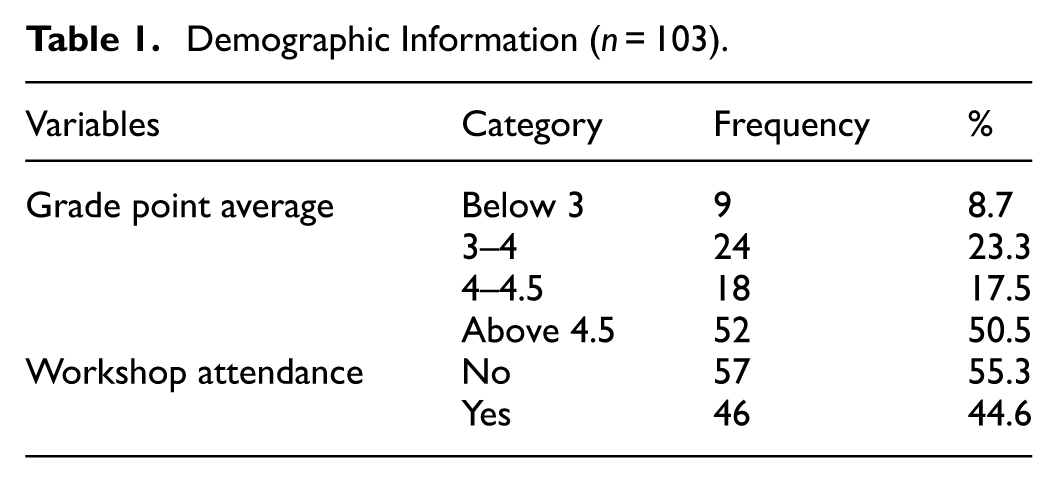
A total of 163 female pre-service teachers were contacted and 117 replied. Moreover, of these 117 replies, 103 (response rate of 63%) were used in the data analysis. It was critical that duplicate answers and outliers were removed and thus the data were subjected to review. Furthermore, responses were eliminated from the study if the participants selected one answer for all scale items and if they failed to provide demographic information. In total, 14 replies were removed, which left 103 complete responses that could be analyzed. Table 1 presents the demographic details of the participants.
Demographic Information (n = 103).
Translation of Instruments
When using the Maslach Burnout Inventory (Arabic version) MBI-AV, the researcher employed the 22 items exactly as they appeared in the article once they had been translated into Arabic and subsequently validated (Nesraoui & Zeroual, 2017). A pilot study was then carried out to determine the reliability of the Maslach Burnout Inventory. Furthermore, the researcher sought permission from Robert Klassen to use the Engaged Teachers Scale in this work. The scale was subsequently translated from English to Arabic. This process involved multiple steps. At a Saudi university, bilingual professionals translated the scale from English to Arabic. To verify the accuracy of the scale, a second expert was employed to translate the scale back into English without viewing the original translation. The usefulness of the Engaged Teachers Scale, as well as its appropriate language and dependability, were then evaluated in the pilot study. In order to validate the study instruments and check that survey items have been correctly translated into Arabic a pilot study was carried out with a similar group of respondents. Thus, 47 pre-service teachers took part in the instruments for the pilot study, and none of the participants went on to take part in the main study, in order to maintain objectivity. The pre-service teachers who took part in the pilot study did not provide demographic information, were questioned face to face in order to eliminate duplicate answers and had to give one answer for all the scale items. The MBI scale alpha coefficient for the pilot study was .805 and the ETS scale’s alpha coefficient was .915. A number of the participants in the pilot study found Item 8 in MBI ambiguous and unclear. The researcher subsequently took their views into account and added an explanation of the terminology. All the EST items were easy for the participants to understand, and both the grammar and clarity were acceptable to the participants. The Saudi pre-service teachers were then able to use the final Arabic version of both instruments. This process enabled participants to complete the survey and improved the quality of MBI and EST. The Saudi pre-service teachers were then able to start using the final Arabic version of both instruments.
Research Instruments
First Instrument
The Maslach Burnout Inventory (22 items) was designed specifically to examine teacher burnout. The inventory focuses on 3 key areas, namely Depersonalization (5 items, maximum score 30), Personal accomplishment (8 items, maximum score 48) and Emotional exhaustion (9 items, maximum score 54). The scoring is on a 7-point Likert scale with 0 being ‘never’, 1 being ‘seldom’, 2 being ‘now and then’, 3 being ‘regular’, 4 being ‘often’, 5 being ‘very often’, and 6 being ‘always’. Low scores on the depersonalization and emotional exhaustion aspects indicate reduced burnout, whereas low scores on the personal accomplishment dimension are indicative of high burnout levels (Maslach & Jackson, 1981; Maslach et al., 1996). In this work, the validated Maslach Burnout Inventory (Arabic-version) MBI-AV was employed to guarantee that Saudi participants understood the scale phrasing (Abu-Hilal & Salameh, 1992; Nesraoui & Zeroual, 2017). The items pertaining to personal achievement in the Arabic version were negatively worded and re-named reduced personal accomplishment, indicating the lowest score in all three dimensions of MBI-AV demonstrate a low level of teacher burnout.
Second Instrument
Engaged Teachers Scale ETS was employed and validated to investigate teachers’ engagement. The scale consists of 16 items in 4 categories: teachers’ social engagement with colleagues, teachers’ social engagement with students, teachers’ cognitive engagement and teachers’ emotional engagement. There are four items per dimension, with a possible score of 24. The scoring is on a 7-point Likert scale, with 0 representing never, 1 representing rarely, 2 representing on occasion, 3 representing sometimes, 4 representing often, 5 representing frequently and 6 representing always. The highest score indicates high teachers’ engagement, whereas a low number indicates low teachers’ engagement. To evaluate teachers’ engagement, this scale has been validated (Perera et al., 2018; R. M. Klassen et al., 2013).
Data Analysis
To address the research questions, IBM® SPSS® v. 23.0 (International Business Machines Corporation) was employed. There were 103 complete responses that could be analyzed using statistical analytical approaches. Firstly, descriptive statistics pertaining to the research sample in the form of frequencies and percentages will be presented. The means and standard deviations were calculated in order to assess pre-service teachers’ levels of burnout and engagement in order to respond to the research objectives. The Kruskal-Wallis’s test was performed to address the differences among burnout and teachers’ engagement levels based on GPA. Meanwhile, a Mann-Whitney test was performed to address the differences among burnout and engagement based on workshop attendance. The performance of a Pearson correlation test served to evaluate the relationship between burnout and engagement. In order to determine whether teachers’ engagement can be predicted through burnout, the prediction of ETS through burnout and its three domains was determined through multiple linear regression analysis. Meanwhile, a simple regression was conducted to address the prediction of teachers’ engagement through burnout MBI-AV.
Results
The ultimate objective of this work is to better understand the relationship and prediction between burnout and engagement among pre-service teachers working with students with LDs in kindergarten settings. The findings will be presented in the following order in the present section: burnout and teacher engagement levels, distinctions between the two concepts in terms of GPA and workshop attendance, the relationship between burnout and teachers’ engagement and the extent to which teachers’ engagement can be predicted through burnout within the target sample.
Burnout Levels, Teachers’ Engagement and Relevant Dimensions
The following average scores were identified for the average MBI-AV score (M = 37.86, SD = 16.341) and its associated domains: emotional exhaustion (M = 17.26, SD = 7.721), reduced personal accomplishment (M= 14.29, SD = 7.255) and depersonalization (M = 6.31, SD = 4.117). In turn, this highlights a low level of burnout among target pre-service teachers and the associated domains. In terms of the average scores for ETS (M = 78.16, SD = 15.661) and associated domains, the following average scores were revealed: teachers’ cognitive engagement (M = 21.05, SD = 3.792), teachers’ emotional engagement (M = 17.78, SD = 6.895), teachers’ social engagement with students (M = 20.32, SD = 4.052), teachers’ social engagement with colleagues (M = 19.12, SD = 4.364). In turn, this indicates that teachers’ engagement (and its associated dimensions) in the target population is high.
Differences Between Both Concepts Regarding GPA and Workshop Attendance
In order to compare the differences between MBI-AV and its dimensions in relation to GPA, a Kruskall-Wallis test was carried out. With significant p-values of (.554), (.336), (.352) and (.341), respectively, the chi-square values were as follows: emotional weariness (2.088), depersonalization (3.388), reduced performance achievement (3.351) and for MBI-AV (3.345). This shows that there are no statistically significant differences between the mean sample responses for emotional exhaustion, depersonalization, reduced personal achievement and MBI-AV with respect to the variation in their GPA (see Table 2).
Differences in Sample Responses Relating to MBI-AV and GPA.

Mann-Whitney was also carried out to identify dif-ferences in MBI-AV and its dimensions with reference to workshop attendance. According to the findings, emotional exhaustion (z = −1.614, p = .0106), depersonalization (z = −0.623, p = .533), reduce personal achievement (z = −1.209, p = .227) and MBI-AV (z = −1.427, p = .154). According to the mean sample responses of pre-service teachers who attended or did not attend workshops relating to students with LD, there was no statistically significant difference in their levels of emotional exhaustion, depersonalization, reduced personal achievement and MBI-AV (presented in Table 3).
The Mean Differences Between the Sample Responses on MBI-AV Relating to Workshop Attendance.

To identify differences in ETS and its dimensions in relation to the GPA, Kruskall-Wallis was used. The significant p values for the chi-square for teachers’ cognitive engagement (1.579), teachers’ emotional engagement (7.317), teachers’ social engagement with students (1.869), teachers’ social engagement with colleagues (1.576) and ETS (2.389) are (.664, .062, .600, .6665 and .496), respectively. In relation to the difference in their GPA, there were no statistically significant variations between the mean sample responses for teachers’ cognitive engagement, teachers’ emotional engagement, teachers’ social engagement with students, teachers’ social engagement with colleagues and ETS (see Table 4).
The Differences in the Sample Responses for ETS Based on to GPA.

A Mann-Whitney test was used (see Table 5) was also carried out to compare the differences in ETS and its associated dimensions with reference to workshop attendance. The findings demonstrate that there is no statistically significant difference between the mean sample responses of pre-service teachers who attend or do not attend workshops related to students with LD in teachers’ emotional engagement and teachers’ social engagement with colleagues (z = −1.808, p = .071) and (z = −1.162, p = .245). However, the mean sample responses of pre-service teachers who attend and do not attend workshops related to students with LDs highlight a significant statistical difference, with pre-service teachers who attend workshops to help them teach students with LDs receiving better scores in the areas of teachers’ cognitive engagement (z = −2.595 with p = .009** at .01), teachers’ social engagement with students (z = −2.381 with p = .017* at .05) and ETS (z = −2.503 with p = .012* at .05).
The Mean Differences Between Sample Responses on ETS Based on Workshop Attendance.

Relationship Between Teachers’ Engagement and Burnout
The relationship between burnout and teachers’ engagement, as well as their related dimensions, is calculated using Pearson correlation. The p value between emotional exhaustion and teachers’ emotional engagement is (p > .01), and the p value between emotional exhaustion and the Engagement Teachers Scale (ETS) is (p > .05), both of which have been found to have significant negative relationships, with correlation coefficients at .01 and .05 between emotional exhaustion with teachers’ emotional engagement and ETS, respectively. The p-value between emotional exhaustion and teachers’ cognitive engagement, teachers’ social engagement with students and teachers’ social engagement with colleagues are (p < .05), highlighting that there is no correlation between emotional exhaustion and these three dimensions.
The correlation coefficient between depersonalization and teachers’ social engagement with students is .01 and the p values between depersonalization with teachers’ cognitive engagement and with ETS are (p > .05). This suggests that there are significant negative correlations between depersonalization and teachers’ social engagement with students at .01. The correlation coefficient between depersonalization with teachers’ cognitive engagement and ETS also appears to have a significant negative relationship with a p-value of .05. Meanwhile, the p-value for the relationship between depersonalization with teachers’ emotional engagement and with teachers’ social engagement with colleagues is (p < .05), indicating that there is no correlation between depersonalization with teachers’ emotional engagement and with teachers’ social engagement with colleagues.
The p-value between reduced personal achievement and the following domains (teachers’ cognitive engagement, teachers’ emotional engagement, teachers’ social engagement with colleagues, teachers’ social engagement with students and ETS) is (p > .01), indicating a significant negative correlation with a correlation coefficient at .01. Finally, the correlation coefficient between MBI-AV and the following domains: teachers’ emotional engagement, and teachers’ social engagement with students is .01 and the p value between MBI-AV and these dimensions: teachers’ emotional engagement, and teachers’ social engagement with students is (p > .01). Nonetheless, the p-value for the relationship between MBI-AV and the following dimensions is (p > .05), which indicates a significant negative relationship with a correlation coefficient of .05 for the association between MBI-AV and the following: teachers’ cognitive engagement, teachers’ social engagement with colleagues and ETS (see Table 6).
Pearson Correlation Between Burnout and Teachers’ Engagement.

Note. CC = correlation coefficient; p = significant; TCE = teachers’ cognitive engagement; TEE = teachers’ emotional engagement; TSES = teachers’ social engagement with students; TSEC = teachers’ social engagement with colleagues; ETS = Engagement Teachers Scale. **Significance at the level of (.01), *Significance at the level of (.05).
Can Burnout Predict Teachers’ Engagement and Its Related Dimensions
To ascertain the likelihood of predicting teacher engagement through burnout, Table 7 presents a multiple linear regression analysis. The relationship between teachers’ engagement and burnout three-dimensional is highlighted with a correlation coefficient of (.622). The F-value is 20.838, which is significant at .000, while the R2 value is .387. This suggests that the three components of burnout explain for 38.7% of the variance in the dependent variable (teachers’ engagement). Additionally, the T values for emotional exhaustion (1.196), depersonalization (.844), reduced personal achievement (−7.162) and had significant values of (.235), (.401) and (.000), respectively. This suggests that emotional exhaustion and depersonalization domains are unable to predict teachers’ engagement ETS. In fact, only the reduced personal accomplishment can achieve this.
The Ability to Predict Teachers’ Engagement Using Components of Burnout.

Note. R2 = goodness of fit measure; F = value of the distribution; F sig = statistical significant; B = coefficient regression; T value = the size of the difference; T sig = statistical significance; EEX = emotional exhaustion; RPA = reduce personal achievement. **Significance at the level of (.01).
In Table 8, a simple linear regression analysis can be seen. This was performed to evaluate the extent to which burnout MBI-AV predict teachers’ engagement ETS. The correlation between teachers’ engagement ETS and burnout is shown by the correlation coefficient of (0.441). Burnout has been found to explain for 19.5% of the variance in the dependent variable (teachers’ engagement) with an F-value of (24.418), which is significant at (.000) and an R2 of (.195). The T-value (−4.941) is also significant at .000. In turn, this suggests that burnout can be used to predict teachers’ engagement ETS.
The Possibility of Predicting Teachers’ Engagement Through Burnout.

Note. R2 = goodness of fit measure; F = value of the distribution; F sig = statistically significant; B = coefficient regression; T value = the size of the difference; T sig = statistical significance. **Significance at the level of (.01).
Discussion
The key purpose of this work is to examine the perspectives of pre-service teachers working with students with LDs in kindergarten settings regarding burnout and teachers’ engagement. Moreover, this study intends to identify the differences in burnout and teachers’ engagement based on GPA, and workshop attendance. Finally, this work examines the relationship between these two variables and the extent to which burnout serves as a predictor for teachers’ engagement.
The MBI-AV results in this study show low average scores for burnout and its related dimensions among the targeted pre-service teachers, including emotional exhaustion, depersonalization and reduce personal accomplishment. This result contradicts the findings of (Abós et al., 2019; Engin, 2019), who assert that pre-service teachers have moderate levels of burnout, while Küçük (2023) concludes that their level of burnout is high. Additionally, this study results show that among the targeted pre-service teachers, ETS and its related domains (teachers’ cognitive engagement, teachers’ emotional engagement, teachers’ social engagement with students and teachers’ social engagement with colleagues) were found to have high average scores for teachers’ engagement and its associated dimensions. These findings concur with the findings of Vural and Eskici (2020) but nor Abós et al. (2019) who found moderate levels of engagement in the target sample. The current study’s findings of low levels of burnout and high levels of engagement among pre-service teachers could be due to the fact that they benefit from peer, mentor, school principals’ and college supervisor support at their school.
Moreover, the findings failed to highlight any statistical differences in mean sample responses pertaining to MBI-AV and its related dimensions (emotional exhaustion, depersonalization and reduced personal achievement) according to GPA. This finding differs from that of Engin (2019), who found a moderate, negative link between burnout and GPA.
The same findings pertaining to the difference between the mean sample responses of pre-service teachers based on GPA were unable to highlight any statistical differences between ETS and its components of teachers’ cognitive engagement, teachers’ emotional engagement, teachers’ social engagement with students and teachers’ social engagement with colleagues. This result contradicts Corcoran and O’Flaherty’s (2018) conclusion that pre-service teachers’ prior teaching performance, personality traits and GPA are all predictors of how the teachers will perform.
This study found that there is no statistically significant difference between the mean sample responses of pre-service teachers who attended or did not attend workshops related to students with LDs on the MBI-AV (and its three associated dimensions), as well as on the ETS following dimensions, teachers’ emotional engagement and teachers’ social engagement with colleagues. This result concurs with the findings of Hildenbrand and Schultz’s (2015) study, which stated that most of the workshops helped pre-service teachers to engage with children from a variety of cultural and intellectual backgrounds. In addition, workshops support pre-service teachers’ interactions with students by providing them with a range of teaching strategies, improving their understanding of different LD contexts and honing their lesson-planning skills (Greenfield et al., 2016) while concurrently showing them how to evaluate students with LDs (Young,2018).
Therefore, a significant statistical difference was identified between the mean sample responses of pre-service teachers in the EST and its subsequent dimensions of teachers’ social engagement with students and teachers’ cognitive engagement, favouring pre-service teachers who attend workshops pertaining to students with LDs. This result mirrors the findings of (Kang and Martin, 2018; Koltonski and Xu, 2023), who argue that training workshops upgrade pre-service teachers’ learning and professional skills, which improves their competencies when teaching SEN students.
This research identifies a strong negative association between emotional exhaustion with ETS and its domain teacher’s emotional engagement This study highlights a strong negative link between emotional exhaustion with ETS and the emotional engagement of the domain teacher – a finding which mirrors that of Weber and Greiner (2019). Abós et al. (2019) agree, and state that teachers who are worn-out and underchallenged show moderate and high negative correlation to engagement, respectively.
Additionally, the finding in the current show that there is a strong negative association between depersonalization with ETS, teachers’ cognitive engagement and teachers’ social engagement with students. This concurs with Ansari et al. (2022), whose study found a link between high levels of emotional exhaustion and poorer interaction with students. Ishibashi et al. (2022) agree, noting that emotional exhaustion is closely linked to the quality of interpersonal relationships at school, limited time, avoidance and suppression. Depersonalization was significantly associated with disconnect to school conditions, proactive problem solving and expressing emotions to others. A reduction in professional achievement was significantly linked to proactive problem solving and changing perspectives. The current study concurs with García-Martínez et al.’s (2021) study, which concluded that controlling their emotions enables pre-service teachers to forge better relationships with students and their colleagues. In addition, the findings of Daniels et al. (2017) and the current study are consistent in that a significant negative relationship is revealed between lower levels of reduce personal accomplishment and ETS and its four dimensions. A significant negative correlation was also identified between MBI-AV and ETS and its four dimensions, which is align with (Faskhodi & Siyyari, 2018). According to Fiorilli et al. (2019) pre-service teachers who lack supervisor support are more likely to experience burnout at the beginning of their careers. The results of the current study suggest that MBI-AV, can be used to predict teachers’ engagement. This supports Vural and Eskici’s (2020) findings, that previous teaching performance and GPA are accurate predictors of future performance.
Limitations
The sample used in this study was drawn from two Saudi universities, which do not reflect all the universities in Saudi Arabia. This is just one of the study’s shortcomings. Female pre-service teachers who work with pupils with LDs in kindergarten are the intended participants; male pre-service teachers are not among them. However, all early childhood programmes in Saudi Arabia are only available to female students and do not admit male students to this major. The type of learning difficulties (LDs; math, reading and writing) and whether or not these students have LDs in combination with attention deficit hyperactivity disorder (ADHD) are not included in this study. The type of kindergarten (private or public) and the pupils’ socioeconomic status are two other crucial variables that were omitted from this study but may have contributed to the findings. Moreover, although GPA and workshop attendance could provide new and different insights, there was no investigation into the relationship and prediction between burnout dimensions and teachers’ engagement dimensions.
Implications
Low levels of burnout and high levels of engagement among Saudi female pre-service teachers who work with students with LDs are signs that the early childhood programme includes high-quality training courses and support. This study highlights the importance of preparation programmes and providing pre-service teachers with the same support that they have received from peers, principal direction, fellow schoolteachers and university advisers (Jacobs & Dodd, 2003). Higher teachers’ engagement in ETS and its components of teachers’ cognitive engagement and teachers’ social engagement with students is demonstrated by pre-service teachers who attend workshops pertaining to children with LDs. This shows the significance of attending such workshops. Before commencing their practicum, pre-service teachers are advised by this study to attend training on teaching kids with LDs (Kang and Martin, 2018; Weber and Greiner, 2019). Moreover, to lessen these students’ burnout before and during their practicum, workshops or lectures can be provided (Koltonski and Xu, 2023).
In this study, pre-service teachers did not exhibit major differences in burnout depending on whether or not they attended workshops, but the latter made a significant difference in relation to levels of engagement. This could suggest that the workshops they attended focussed on teaching strategies or lesson plans (Young, 2018) or on how to introduce classroom management strategies (Koltonski and Xu, 2023). Brown et al. (2021) also found that educating pre-service teachers makes them both more efficient and raises their confidence in their ability to undertake coursework. It is therefore important for schools, universities and organizations to collaborate and spread information on the importance of offering pre-service teachers psychological, social and environmental support and not just academic training, in order to enable them to have a positive training experience (Weber and Greiner, 2019). There is a negative relationship between MBI-AV and ETS, and the MBI-AV and its domains which predict ETS. This study’s findings lead us to recommend that school staff and university supervisors should concentrate on addressing the factors which impact on pre-service teachers’ burnout and engagement, so that they can benefit from a positive training period. This will necessitate upgrading and improving materials and offering personnel support services.
Future Research
Very few studies have examined the topics of engagement and burnout among pre-service teachers working with students with LDs, particularly in the Saudi Arabian context. Future studies may thus wish to investigate these topics at other universities. Additionally, the engagement and burnout levels of future teachers who work with different difficulties might be studied. According to their university, additional research could also examine the disparities between burnout and engagement among pre-service teachers. Future studies may use interviews to investigate the connection between burnout and engagement. In addition, they could use different research methodologies (such as a quasi-experimental approach) to the effectiveness of burnout programmes in boosting pre-service teachers’ engagement. Future research studies should compare the engagement and burnout between pre-service classroom and subject teachers. In addition, they could examine both concepts among pre-service teachers who teach unscientific and scientific subjects, and those who teach second languages among students with or without LDs. Training programmes could be introduced to increase the knowledge of principals, colleagues and supervisors regarding the various types of support pre-service teachers need to raise their engagement and minimize their burnout during training. Finally, it would be useful to dedicate a study to comparing the burnout and engagement of pre-service teachers, considering a range of variables, such as gender, school types – public or private – and education level- elementary, intermediate and secondary schools).
Conclusion
This study has examined burnout and engagement levels among pre-service teachers working with students with LDs in kindergarten settings in order to examine differences for both constructs based on GPA and workshop attendance. Moreover, this study investigated the relationship between the two concepts and examined whether burnout could serve to predict teachers’ engagement. The research findings show that the target sample has a low level of MBI-AV (and its dimensions) and a high level of ETS (and its dimensions). The results show that there is no difference in MBI-AV level according to GPA or workshop attendance, although differences were evident in the ETS level based on workshop attendance (but not for GPA). The relationship between MBI-AV and ETS is significantly negative, and MBI-AV can be used to predict ETS. Finally, the researcher highlights the importance of educating future teachers about reducing burnout in order to improve their engagement. It is important that they attend workshops relating to classroom management, teacher conduct and other topics that will help them during their practicum.
Supplemental Material
sj-docx-1-sgo-10.1177_21582440251384458 – Supplemental material for Burnout and Teachers’ Engagement: The Perspective of Pre-Service Teachers Who Works with Students with Learning Difficulties in Kindergarten
Supplemental material, sj-docx-1-sgo-10.1177_21582440251384458 for Burnout and Teachers’ Engagement: The Perspective of Pre-Service Teachers Who Works with Students with Learning Difficulties in Kindergarten by Afrah Bagazi in SAGE Open
Footnotes
Acknowledgements
The researcher offers her sincerest thanks to the head of early childhood programmes of Prince Sattam bin Abdulaziz University and King Saud University for their permission and collaboration. Additionally, I am truly grateful to the supervisors of pre-service teachers for enabling the dissemination of electronic scales to the target sample, which helped significantly with data collection in the present study.

Ethical Considerations
The Standing Committee of Bioethics Research at Prince Sattam bin Abdulaziz University approved our survey (approval: 272/2023) on 27 February 2023. Respondents gave written consent for review and signature before starting the survey.
Funding
The author disclosed receipt of the following financial support for the research, authorship, and/or publication of this article: This project is sponsored by Prince Sattam Bin Abdulaziz University (PSAU) as part of funding for its SDG Roadmap Research Funding Programme project number PSAU-2023-SDG-98.
Declaration of Conflicting Interests
The author declared no potential conflicts of interest with respect to the research, authorship, and/or publication of this article.
Data Availability Statement
The datasets used and/or analyzed during the current study are available from the corresponding author on reasonable request.
Supplemental Material
Supplemental material for this article is available online.
References
Supplementary Material
Please find the following supplemental material available below.
For Open Access articles published under a Creative Commons License, all supplemental material carries the same license as the article it is associated with.
For non-Open Access articles published, all supplemental material carries a non-exclusive license, and permission requests for re-use of supplemental material or any part of supplemental material shall be sent directly to the copyright owner as specified in the copyright notice associated with the article.
