




Abstract
Digital transformation introduces both significant opportunities and profound challenges for the labor market. Drawing on a panel of Chinese A-share listed companies from 2011 to 2021, this study systematically examines the impact and underlying mechanisms of enterprise digital transformation (EDT) on employment scale and structure. The results reveal that EDT generally fosters employment creation, evidenced by an expansion in overall employment and a rising share of high-skilled employees, accompanied by a relative decline in low-skilled employees. Mechanism analyses demonstrate that technological innovation serves as a key channel through which EDT reshapes employment outcomes. Further heterogeneity tests show that firms with greater reliance on high-skilled employees experience a more pronounced employment creation effect. Taken together, this study enriches the literature on the economic consequences of EDT by offering robust evidence on its role in shaping employment decisions, thereby providing valuable insights for policies aimed at leveraging digital transformation to expand employment and optimize labor structure.
Plain language summary
This study looks at how digital transformation is changing jobs in Chinese companies. Using data from listed firms between 2011 and 2021, we find that digital transformation generally creates more jobs, especially for high-skilled employees, while reducing demand for low-skilled workers. The reason is that digital tools and processes encourage technological innovation, which drives new products and services and increases the need for skilled talent. Companies that rely more on high-skilled workers see stronger job growth effects. These findings suggest that digital transformation can help expand employment and improve the structure of the workforce, offering useful guidance for policies that aim to support job creation and skills upgrading in the digital economy.
Keywords
Introduction
Information technologies such as big data, cloud computing, and AI have developed at an unprecedented pace, rendering digital knowledge and information critical production factors in the real economy. According to the White Paper on China’s Digital Economy Development (2021), the added value of China’s digital economy accounted for 38.6% of GDP in 2020, expanding at 3.2 times the rate of GDP growth. Propelled by both technological advances and policy support, digital transformation has emerged as a pivotal driver of China’s economic restructuring, progressively reshaping the production and operational behaviors of firms (J. Zhang & Chen, 2023). Within enterprises, business processes, information systems, and internal control mechanisms are becoming increasingly digitalized (Bhimani & Willcocks, 2014). Broadly defined, digital transformation refers to the application of digital technologies to fundamentally reconfigure business operations, organizational structures, and value creation processes. At the enterprise level, it involves the strategic adoption and integration of technologies to enhance operational efficiency, optimize resource allocation, and foster innovation (Bharadwaj et al., 2013). Enterprise digital transformation (EDT) is a multidimensional process involving technological adoption, strategic leadership, and adaptation to institutional environments (Ostmeier & Strobel, 2022; Verhoef et al., 2021). It fundamentally reshapes firm productivity, competitiveness, and employment patterns (Li et al., 2023).
In recent years, the erosion of the demographic dividend and mounting economic pressures have posed substantial challenges to China’s labor market (J. Zhang & Chen, 2023). According to the National Bureau of Statistics of China, the number of unemployed individuals rose steadily between 2011 and 2016, with the unemployed population reaching approximately 30 million in 2017 and 2018. These figures underscore the dual challenge of overall employment stress and structural mismatches. Promoting employment has become a top policy priority for Chinese authorities to safeguard livelihoods and ensure the stable functioning of the broader socio-economic system. These challenges raise a pressing academic question: how does EDT reshape employment dynamics?
Enterprises, as the primary absorbers of labor, play a central role in promoting employment. EDT introduces both opportunities and challenges to this process. On the one hand, advances in digital technologies substitute for low-skilled employees, generating employment substitution effect (Frey & Osborne, 2017). On the other hand, digital technologies create new occupations, increase the demand for high-skilled employees, and foster employment creation effect (Acemoglu & Restrepo, 2018). Prior studies have predominantly focused on the labor market effects of specific technologies such as robotics and AI (D. Autor & Salomons, 2017; Dauth et al., 2018; Graetz & Michaels, 2018) or examined the consequences of EDT for manufacturing employment (Acemoglu & Restrepo, 2019) and the structure of human capital (Frey et al., 2017; Kolade & Owoseni, 2022). The overall impact of EDT on employment thus emerges from the interplay between substitution and creation effects. Nevertheless, empirical evidence on how EDT shapes employment outcomes remains limited. Against this backdrop, this study addresses three interrelated questions: How does EDT affect the scale and structure of employment? Through which channels are these effects realized? Do these effects vary across different types of enterprises? By answering these questions, the study extends existing research on digital transformation and employment.
Using a panel of Chinese A-share listed companies from 2011 to 2021, we empirically investigate the effects and underlying mechanisms of EDT on both employment scale and structure. Specifically, we examine the direct effects and mediating channels. The empirical analysis reveals that EDT generally exerts an employment creation effect, influencing both the scale and structure of employment. Specifically, it is associated with an expansion in overall employment and a higher proportion of high-skilled employees, accompanied by a decline in the share of low-skilled employees. These findings remain robust after a series of validation tests. Further analysis demonstrates that technological innovation serves as the primary channel through which EDT shapes employment outcomes. By enhancing technological input, output, and efficiency, EDT expands employment opportunities and raises the demand for high-skilled employees, while reducing reliance on low-skilled employees. Moreover, heterogeneity tests indicate that the employment creation effect of EDT is more pronounced in firms with a greater dependence on high-skilled employees.
This study makes three primary contributions to the literature. First, it provides a comprehensive examination of the dual impact of EDT on employment. Whereas prior studies have typically analyzed either employment scale (D. H. Autor et al., 2003) or employment structure (Coelli & Borland, 2016) in isolation, this paper integrates both dimensions within a unified analytical framework. By incorporating the substitution and creation effects of employment in the context of EDT, the analysis offers a more holistic understanding of how digital transformation reshapes labor demand. This approach not only deepens theoretical discussions on EDT and employment dynamics but also bridges the gap between employment quantity and quality. Second, this paper unravels the mechanisms linking EDT and employment through the lens of Diffusion of Innovations theory (DOI), emphasizing the critical role of technological innovation. While prior studies have highlighted channels such as operational expansion (Zhu & Kraemer, 2005), productivity enhancement (Bloom et al., 2014), and the easing of financing constraints (Fuster et al., 2019), they have largely overlooked how the depth of technological innovation diffusion conditions these effects. By distinguishing between limited diffusion and effective diffusion, this study systematically examines how innovation input, output, and efficiency shape both the scale and structure of employment. In doing so, it advances the understanding of employment dynamics in the digital era. Finally, the paper uncovers significant heterogeneity in the employment impacts of EDT. The employment creation effect is strongest in technology-intensive and digital industries, where high-skilled demand rises and low-skilled reliance falls. These findings highlight that the employment consequences of EDT are contingent upon industry and firm characteristics, and are further shaped by the depth and quality of technological innovation diffusion, offering more nuanced evidence beyond aggregate effects.
Literature Review, Theoretical Analysis, and Hypothesis Development
Literature Review
EDT emphasizes the application of advanced digital technologies to enhance production and operational systems, core business processes, and business models (Bharadwaj et al., 2013; Jafari-Sadeghi et al., 2023). On the one hand, EDT leverages AI, big data, and cloud computing to reshape value creation processes (Mikalef & Pateli, 2017). Driven by these technological advances, EDT has become a strategic imperative for enterprises seeking to strengthen competitiveness and achieve sustainable growth, and it has emerged as a significant field of inquiry in management research. Prior studies predominantly highlight its positive effects on production, corporate performance, and governance (Coelli & Borland, 2016; Verhoef et al., 2021). Nonetheless, concerns over the “digital paradox” remain, since digital investment does not always generate proportional economic returns (Matt et al., 2015; Ragesh & Baskaran, 2016; Yeow et al., 2018). This paradox underscores the need to examine not only productivity outcomes but also broader consequences such as employment. Cross-national research further shows that institutional and ethical contexts critically shape employment outcomes of digital adoption (Koronios et al., 2017, 2019), underscoring the necessity of situating analyses within specific socio-economic settings. In China, where demographic pressures and structural mismatches exacerbate employment challenges, clarifying the employment implications of EDT carries both academic and policy relevance.
Labor, however, remains the most fundamental production factor for enterprises. Research on employment determinants spans both macroeconomic and firm-level perspectives (Bloom et al., 2017; Neumark & Wascher, 2008). Within this literature, technological progress plays a dual role: it may substitute for labor, thereby reducing employment (D. H. Autor et al., 2003; Brynjolfsson & McAfee, 2014), but it may also stimulate employment creation by generating new tasks (Acemoglu & Restrepo, 2018). Whether substitution or complementarity dominates depends critically on workers’ skill levels, meaning that technological change shapes both employment scale and structure. EDT, as a development model rooted in technological change, thus warrants systematic investigation to clarify its implications for labor demand. Recent breakthroughs in AI, machine learning, and robotic automation have further complicated this landscape. On the one hand, AI-driven automation increasingly substitutes for routine tasks, especially in manufacturing and service industries, raising concerns about employment substitution (Arntz et al., 2016). On the other hand, these technologies have fostered new occupations in high-skill domains such as data science, cybersecurity, and AI development (Goos et al., 2014). Some emphasize employment polarization, where high-skill jobs expand while routine middle-skill employment contracts (Acemoglu & Restrepo, 2020), while others highlight the complementarity between digital technologies and skilled employees in knowledge-intensive sectors, where digital adoption can enhance productivity and stimulate employment growth (Autor & Salomons, 2017). These debates demonstrate that the overall employment effects of technological progress remain unsettled, calling for more empirical evidence on when employment creation outweighs employment substitution.
Taken together, existing research reveals three key limitations that motivate this study. First, prior studies often examine employment scale and structure in isolation, overlooking their interdependence in shaping overall labor demand. Second, the mechanisms through which EDT influences employment, particularly via technological innovation, remain underexplored despite innovation being a central pathway for restructuring firms’ labor needs. Third, empirical evidence from emerging economies, especially China, remains limited, even though the country’s rapid digital transformation and distinctive institutional environment make it a crucial case for study. Building on these gaps, this paper investigates how EDT affects employment scale and structure, through which mechanisms these effects are realized, and how they vary across heterogeneous firms.
Theoretical Analysis and Hypothesis Development
Building on Diffusion of Innovations theory (DOI), the employment effects of EDT depend on the depth of technological innovation diffusion. When new technologies are effectively embedded into business processes, they foster innovation-driven growth, create new jobs, and upgrade the skill composition of the workforce. By contrast, when diffusion remains superficial, digital tools are used mainly for cost reduction and automation, leading to employment substitution and a decline in low-skilled employees. In this process, technological innovation acts as a key mediating channel, as digital transformation promotes R&D inputs, outputs, and efficiency, thereby shaping both the overall scale of employment and its structural upgrading. The theoretical framework of this study is presented in Figure 1, with the detailed analysis elaborated below.

Theoretical framework.
Impact of EDT on Employment Scale
Building on DOI, the scale effects of EDT can be understood as the outcome of how new technologies diffuse within firms and industries. DOI posits that the adoption of new technologies typically follows a gradual diffusion trajectory, with heterogeneous effects across firms (Rogers, 2003). Within this logic, the effectiveness of EDT depends on the depth and quality of technological innovation diffusion, which in turn is shaped by factors such as firm capabilities, institutional environments, and workforce adaptability. These factors ultimately influence organizational behavior and labor demand (Rogers, 2003). Building on this, the impact of EDT on employment scale depends on the depth of technological innovation diffusion: when diffusion is effective, it may generate employment creation; when diffusion is limited, it is more likely to result in job substitution.
Specifically, effective diffusion refers to the scenario in which new technologies are not only “adopted” but also deeply integrated into firms’ core business processes, R&D systems, and organizational structures. Such embedded application facilitates knowledge recombination, enhances R&D efficiency, and fosters the emergence of new products, processes, and business models, thereby achieving innovation-driven growth, expanding employment, and optimizing labor structures. By contrast, limited diffusion remains at the stage of “superficial adoption.” While firms may purchase digital tools, the absence of complementary institutions and capacity support prevents technologies from being fully embedded into production and operations. In this case, technologies often fail to yield substantive innovation outcomes, and firms may only partially use them to reduce costs or substitute for low-skilled employees. As a result, some positions are eliminated without corresponding innovation-driven outputs to offset these losses. Consequently, substitution effects dominate, and overall employment levels are unlikely to improve.
On the substitution side, EDT reduces labor demand by automating tasks that were traditionally performed by humans. This effect is particularly pronounced in industries characterized by routine and repetitive tasks, such as manufacturing and administrative services (Brynjolfsson & McAfee, 2014). Empirical studies show that industrial robots substantially reduced employment and wages in affected U.S. industries (Acemoglu & Restrepo, 2020), and nearly 47% of U.S. jobs face a high risk of automation (Frey & Osborne, 2017). Moreover, the introduction of new technologies has lowered the relative cost of capital, and under conditions of limited diffusion, where innovation-driven growth has not yet fully materialized, firms are more inclined to rely on such cost-efficiency-oriented automation substitution (Karabarbounis & Neiman, 2014).
On the creation side, EDT fosters job growth by generating new tasks and occupations that require advanced skills, thereby expanding employment. Firms increasingly demand roles such as cloud computing specialists, AI engineers, cybersecurity analysts, and data scientists (Acemoglu & Restrepo, 2018; Nedelkoska & Quintini, 2018). Rather than merely substituting human effort, these technologies complement labor by augmenting productivity, especially in knowledge-intensive sectors like finance and healthcare (D. H. Autor et al., 2003; Rudskaya & Konnikov, 2020). As DOI emphasizes the role of social systems in shaping diffusion, industries with strong digital ecosystems and institutional support experience broader employment expansion through innovation-driven growth (J. Zhang & Chen, 2023). Additionally, consistent with the Capital-Skill Complementarity Hypothesis, EDT disproportionately benefits high-skilled employees, exacerbating labor market polarization by fostering employment at the high end while substituting for low-skilled, routine-based jobs.
Taken together, the scale impact of EDT depends on whether the creation effects of technological innovation diffusion outweigh the substitution effects. When firms with strong absorptive capacity adopt and diffuse digital technologies, they are more likely to expand employment through innovation-driven growth. Conversely, when adoption primarily emphasizes cost efficiency, automation may dominate, leading to labor substitution and widening skill-based inequalities. Based on this theoretical reasoning, we propose the following hypotheses.
Impact of EDT on Employment Structure
From the perspective of DOI, the structural impact of enterprise EDT on employment can be explained by the uneven compatibility of digital technologies with different categories of labor. As digital innovations diffuse within firms, they do not affect all workers equally. Routine and easily codifiable tasks are most susceptible to automation, while non-routine, analytical, and creative tasks are complemented and expanded by digital tools (D. H. Autor et al., 2003; Rogers, 2003). Hence, when diffusion is limited, the substitution effect on routine tasks becomes more pronounced, whereas when diffusion is effective, non-routine and creative tasks are better able to realize the creation effects brought about by technological innovation.
On the substitution side, the diffusion of EDT reduces demand for low-skilled employees. Automated machinery and AI systems can efficiently perform predictable and repetitive tasks traditionally carried out by low-skilled employees, particularly in manufacturing, retail, and administrative services (D. H. Autor et al., 2003). Arntz et al. (2016) further highlight that workers with lower educational attainment are often concentrated in routine manual occupations, and are therefore more vulnerable to the impact of EDT. This mechanism is consistent with the Routine-Biased Technological Change (RBTC) framework, which highlights that EDT disproportionately substitutes routine cognitive and manual jobs (Goos et al., 2014), while also aligning with the Skill-Biased Technological Change (SBTC) theory that stresses how technological progress primarily benefits skilled employees (Goldin & Katz, 1998). Together, these perspectives reveal that automation drives labor market polarization by reducing routine-intensive, low-skill positions.
On the creation side, EDT diffusion expands demand for high-skilled employees. As firms adopt and embed technologies such as AI, cloud computing, and big data, they require expertise in data science, cybersecurity, software engineering, and digital project management (Acemoglu & Restrepo, 2018). These roles demand problem-solving, adaptability, and digital literacy, placing employees in high-skill occupations or with higher educational attainment at a significant advantage (Nedelkoska & Quintini, 2018). This dynamic reflects the Capital–Skill Complementarity Hypothesis, which posits that advanced technologies enhance the productivity of skilled employees and make them increasingly valuable (Goldin & Katz, 1998). As enterprises restructure their workforce to integrate these innovations, high-skilled employees expands, especially in knowledge-intensive sectors such as finance, healthcare, and technology-driven industries, creating spillover effects across related fields (Rudskaya & Konnikov, 2020).
Taken together, the structural impact of EDT is therefore a reallocation of labor from low-skilled to high-skilled roles. DOI emphasizes that as innovations diffuse, organizations adapt their structures to align with the demands of new technologies. In the case of EDT, this adaptation manifests as skill upgrading and employment polarization: low-skilled positions decline due to automation, while high-skilled roles expand to accommodate new tasks generated by EDT. This study extends prior research by situating these opposing mechanisms within the DOI framework and highlighting how RBTC, SBTC, and capital–skill complementarities jointly explain the observed restructuring of labor markets under EDT. Based on this theoretical reasoning, we propose the following hypotheses.
Mechanisms of EDT on Employment
Digital transformation refers to the strategic introduction and integration of emerging digital technologies such as big data, cloud computing, and AI to reshape production methods, organizational structures, and business models, with an emphasis on technology adoption and embedding. The implementation of digital transformation is not simply a combination or application of digital tools; rather, it entails incorporating data as a new production factor into enterprise operations, encompassing the digital penetration of production resources, the digital reconstruction of production relations, and the digital innovation of business activities. From the perspective of DOI, technological innovation should be understood as the substantive outcome of effective diffusion, where technologies are not only adopted but also widely and deeply integrated into organizational processes and supported by complementary resources. Such diffusion quality determines whether digital transformation merely substitutes labor through automation or generates sustainable innovation-driven growth. Accordingly, technological innovation represents the outcomes derived from the effective diffusion of digital technologies, including improvements in R&D input, output, and efficiency. In this framework, the employment effects of EDT are not only determined by the attributes of innovations but also by the firm’s absorptive capacity to internalize diffusion and translate it into innovation. DOI emphasizes that adoption generates sustainable value only when organizations develop capabilities to recombine and exploit new knowledge (Rogers, 2003). Thus, EDT influences employment primarily by shaping firms’ technological innovation through diffusion, which then affects both the scale and structure of labor demand.
First, EDT promotes innovation inputs. By embedding digital systems into management and production, firms can allocate resources to research and development more effectively, improve collaboration, and reduce transaction costs. When diffusion reaches sufficient breadth and depth, digital tools are not confined to isolated departments but permeate cross-functional processes, lowering the marginal cost of experimentation and enabling sustained increases in R&D activities. Greater R&D activity, as highlighted in innovation economics, tends to increase labor demand, particularly for highly skilled researchers and engineers who drive innovation (Bharadwaj et al., 2013). Externally, EDT also improves firms’ access to innovation capital. Research shows that enhanced analyst coverage and media visibility can reduce information asymmetry, monitor managerial decision-making, and attract external R&D investments (Blankespoor et al., 2014; Wu et al., 2021; P. Zhang & Wang, 2023). These external diffusion channels extend the reach of EDT, amplifying its capacity to promote innovation and further increasing demand for high-skilled employees.
Second, EDT enhances innovation outputs. The adoption of digital technologies accelerates product development cycles, facilitates business model innovation, and expands firms’ capacity for knowledge creation (Verhoef et al., 2021). When diffusion is effective, with technologies fully embedded and routines adapted, firms recombine knowledge more efficiently, generating patents, new products, and improved processes. For instance, the adoption of cloud computing platforms has revolutionized the commercialization of new ideas by shortening product development timelines and improving the efficiency of R&D investment. According to Schumpeterian Growth Theory, innovation-driven technological progress strengthens competitive advantage and stimulates demand for skilled employees. As digital innovations diffuse across industries and ecosystems, they generate new occupations and tasks, particularly in digital-intensive industries, thereby expanding the employment of high-skilled employees.
Third, EDT improves innovation efficiency. EDT enhances information flows, reduces coordination frictions, and raises the productivity of innovation activities. Effective diffusion ensures that efficiency gains are not limited to local automation but instead permeate organizational networks, allowing firms to achieve more innovation outcomes with fewer resources. This efficiency gain reshapes labor demand toward knowledge-intensive functions. Yet the employment implications remain complex: while innovation strengthens the employment creation effect for high-skilled employees, it may simultaneously reduce the reliance on low-skilled employees. This tension reflects the dual role of technological change, which can be capital-biased, substituting human labor with machines (Bentolila & Saint-Paul, 2003; Karabarbounis & Neiman, 2014), or skill-biased, favoring high-skilled over low-skilled employees (D. H. Autor et al., 2003; Goldin & Katz, 1998). The Capital–Skill Complementarity Hypothesis further highlights that investments in digital technologies disproportionately enhance the productivity of skilled employees, thereby accelerating labor market polarization (Acemoglu & Restrepo, 2018).
Overall, EDT shapes employment by influencing technological innovation through the quality of diffusion across the three channels of input, output, and efficiency. When diffusion is deep and well-coupled with organizational complements, EDT stimulates sustainable innovation, expands employment, and upgrades workforce skills. Conversely, when diffusion remains superficial, automation-driven substitution dominates, and employment benefits are less likely to materialize. This underscores the need to empirically assess how diffusion quality conditions the net employment effects of EDT. Based on this theoretical reasoning, we propose the following hypotheses.
Data and Method
Data
This study selects A-share listed companies from 2011 to 2021 as the research sample. To ensure data quality and comparability, several exclusion criteria are applied. First, financial firms are excluded due to their distinct financial structures, regulatory environments, and operational models, which differ substantially from those of non-financial firms and may compromise the comparability of results. Second, firms listed for less than 1 year are removed, as newly listed companies often undergo an adjustment period characterized by volatile stock performance and financial indicators, potentially biasing the analysis. Third, ST and delisted ST firms are excluded because they are typically subject to severe financial distress, which may generate extreme values that distort statistical estimates and undermine robustness. Finally, firms lacking sufficient data on key research or control variables are eliminated to preserve data integrity and avoid estimation bias. To further mitigate the influence of outliers, all continuous variables are winsorized at the 1% and 99% levels. After applying these filters, the final dataset comprises an unbalanced panel of 13,056 firm-year observations. To address potential concerns regarding sample selection bias, additional robustness checks are performed, including placebo tests and instrumental variable (IV) approaches, as detailed in the endogeneity tests section. These measures strengthen the credibility of the results and ensure that the findings are not artifacts of data filtering. The research data are primarily drawn from the Wind Financial Database (Wind DB) and the China Stock Market and Accounting Research (CSMAR) database. All empirical analyses are conducted using Stata 17.0.
Variables Definition and Measurement
EDA
At present, there is no universally accepted definition of EDT for Chinese firms within the academic community. Existing studies have adopted different approaches to capture the degree of EDT. One stream of research relies on text analysis of annual reports, particularly the “management discussion and analysis” section, using the frequency of digital-related terms as a proxy. This method primarily reflects managerial cognition and awareness of EDT. Another approach employs financial statement data, measuring EDT by the ratio of digital intangible assets to total intangible assets disclosed in firms’ year-end reports. This method emphasizes the tangible actions undertaken to advance EDT. To address the limitations of these single-dimensional measures, the CSMAR database constructs a comprehensive Digital Transformation Index that captures EDT across six dimensions: strategic leadership, technological impetus, organizational empowerment, digital achievements, digital applications, and macro-environmental support. This multidimensional index integrates both managerial awareness and concrete practices, enabling a more holistic assessment of the extent of EDT. Accordingly, this study adopts the CSMAR Digital Transformation Index as the primary measurement indicator (DT).
Employment
This study characterizes enterprise employment along two dimensions: scale and structure. Employment scale (Labor) is proxied by the natural logarithm of the total number of employees. Employment structure is further examined from the perspectives of education level and job type.
Based on educational background, employees are classified into six categories: doctoral degree, master’s degree, bachelor’s degree, associate degree, high school and below, and other degrees. We define employees with a master’s degree or above as high-skilled and measure their share of total employment as the proportion of high-skilled employees (HSLabor1). Conversely, employees with a bachelor’s degree or below, including those with other degrees, are defined as low-skilled, with their share representing the proportion of low-skilled employees (LSLabor1). Based on job position, employees are divided into 11 categories: comprehensive management, technical, financial, sales, risk control and audit, procurement and warehousing, production, customer service, personnel, administrative, and other professional employees. Among these, comprehensive management, technical, financial, sales, and risk control and audit employees are defined as high-skilled, with their proportion denoted as HSLabor2. Procurement and warehousing, production, customer service, personnel, administrative, and other professional employees are classified as low-skilled, with their proportion denoted as LSLabor2. The use of alternative measures of employment structure across both educational and occupational dimensions enhances the robustness and credibility of the empirical findings.
Control Variables
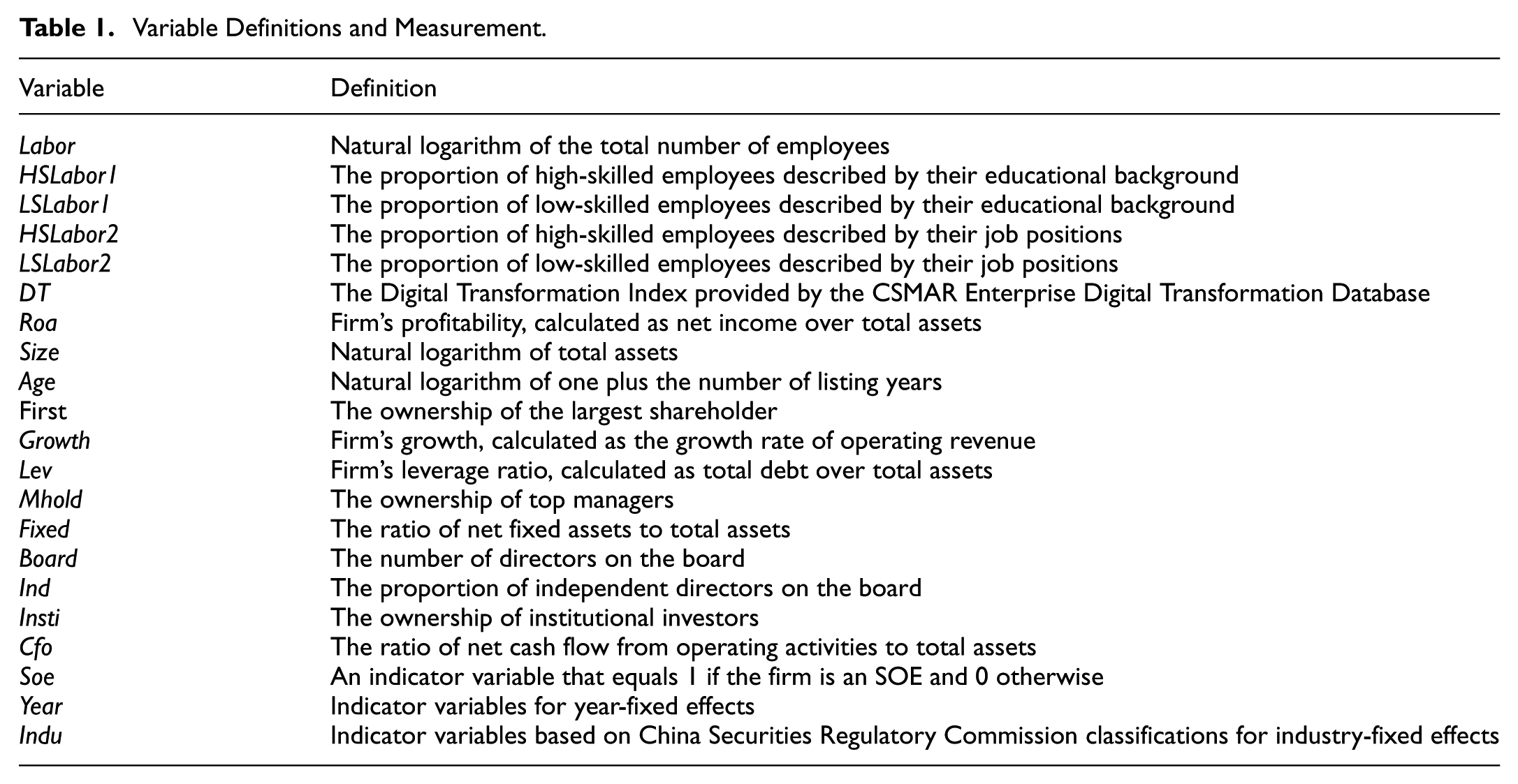
This study incorporates a set of firm-level control variables commonly used in the literature. Specifically, we include the net margin of assets (Roa), the natural logarithm of total assets (Size), the natural logarithm of one plus listing years (Age), ownership concentration of the largest shareholder (First), growth rate of operating revenue (Growth), leverage ratio (Lev), managerial ownership (Mhold), the ratio of net fixed assets to total assets (Fixed), board size (Board), proportion of independent directors (Ind), institutional ownership (Insti), and the ratio of net operating cash flow to total assets (Cfo). In addition, a dummy variable indicating whether a firm is state-owned (Soe) is included. To capture macro and sectoral heterogeneity, the models further control for year-fixed effects (Year) and industry-fixed effects (Indu). Industry classification follows the 2012 China Securities Regulatory Commission (CSRC) standard. For manufacturing firms, the secondary classification is adopted, while all other industries are categorized at the primary classification level. Detailed definitions and measurement methods of all variables are provided in Table 1.
Variable Definitions and Measurement.
Empirical Models
To examine the impact of EDT on employment, this paper constructs the following empirical econometric model:

In model (1), the subscript i represents the company, and t represents the year. To mitigate endogeneity effects, both explanatory and control variables are lagged by one period. Labori,t+1 is the scale of employment for firm i in year t + 1, HSLabor1i,t+1, and HSLabor2i,t+1 are the proportion of high-skilled employees in firm i in year t + 1. LSLabor1i,t+1 and LSLabor2i,t+1 are the proportion of low-skilled employees in firm i in year t + 1, DTi,t represents the level of digital transformation for firm i in year t. Controli,t are the control variables in our study and, Year and Indu are the year-fixedeffects and industry-fixed effects, respectively, εi,t is the random error term.
Empirical Results
Descriptive Statistics
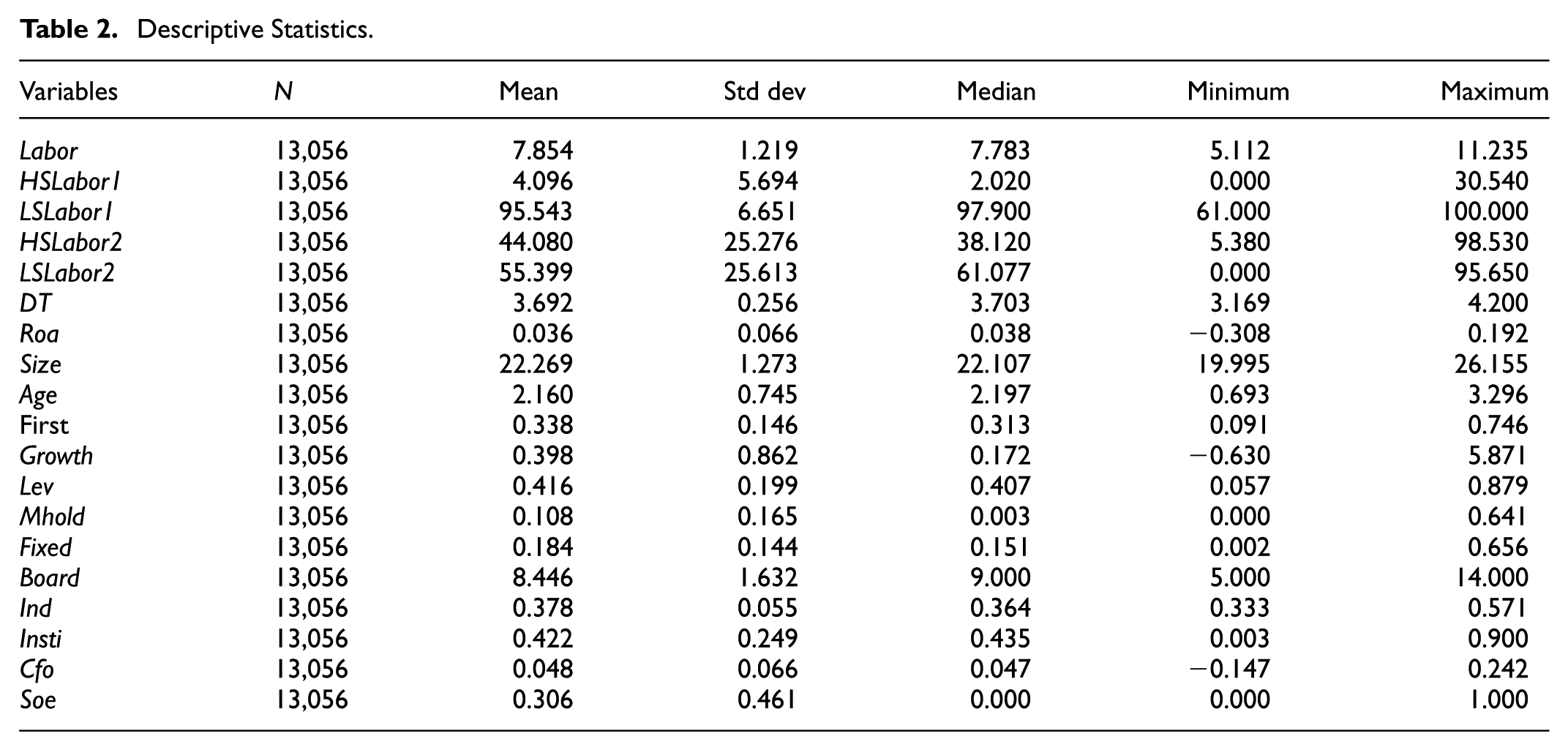
Table 2 presents the descriptive statistics for the variables employed in this study. The measure of employment scale (Labor) has a mean of 7.854, a median of 7.783, a maximum of 11.235, a minimum of 5.112, and a standard deviation of 1.219, indicating substantial heterogeneity in firm-level employment size. Regarding employment structure by educational background, the proportion of high-skilled employees (HSLabor1) averages 4.096, with a median of 2.020, a maximum of 30.540, and a minimum of 0.000 (standard deviation 5.694). In contrast, the proportion of low-skilled employees (LSLabor1) averages 95.543, with a median of 97.900, a maximum of 100.000, and a minimum of 61.000 (standard deviation 6.651). These figures suggest that employees with a bachelor’s degree or below account for the overwhelming majority, while those with a master’s or doctoral degree represent only a small fraction. When classified by job type, the proportion of high-skilled employees (HSLabor2) has a mean of 44.080, a median of 38.120, a maximum of 98.530, and a minimum of 5.380 (standard deviation 25.276). The proportion of low-skilled employees (LSLabor2) averages 55.399, with a median of 61.077, a maximum of 95.650, and a minimum of 0.000 (standard deviation 25.613). Compared with the education-based classification, the job-type classification reveals a more balanced distribution between high- and low-skilled employees. Finally, the degree of digital transformation (DT) has a mean of 3.692, with values ranging from 3.169 to 4.200 (standard deviation 0.256), reflecting considerable variation in firms’ digital transformation levels, with some achieving relatively advanced transformation. The descriptive statistics of the control variables align with prior research and are not elaborated further.
Descriptive Statistics.
Baseline Regression Model
Table 3 reports the estimated effects of EDT on employment scale and structure. In column (1), where the dependent variable is employment scale (Labor), the coefficient of DT is 0.413 and statistically significant at the 1% level, suggesting that greater EDT is associated with a larger workforce. In columns (2) and (4), where the dependent variables are the proportion of high-skilled employees measured by educational background (HSLabor1) and job type (HSLabor2), the coefficients of DT are 2.525 and 19.000, respectively, both significant at the 1% level. These results indicate that higher levels of EDT substantially increase the share of high-skilled employees. In contrast, columns (3) and (5) show that the coefficients of DT for the proportions of low-skilled employees (LSLabor1 and LSLabor2) are −1.986 and −18.275, respectively, again significant at the 1% level, implying that EDT reduces the reliance on low-skilled employees. Taken together, these results suggest that the employment creation effect of EDT outweighs its substitution effect, thereby exerting a significant positive impact on overall employment scale. Furthermore, EDT reshapes employment structure by increasing the proportion of high-skilled employees and reducing the proportion of low-skilled employees, lending strong support to hypotheses
Regression Results on the Impact of EDT on Employment Scale and Structure.

Note. The superscripts ***, **, and * indicate statistical significance at the 1%, 5%, and 10% levels, respectively.
Robustness Tests
Alternative Measurement of the Explanatory Variable
To validate the robustness of our findings, we remeasure EDT using a text analysis approach. Specifically, vocabulary related to the digital economy, digital transformation policies, and relevant research reports is employed to construct a dictionary of digital terms. The frequency of these terms appearing in firms’ annual reports is then used to quantify the degree of digital transformation (DCG). The regression results using DCG as the explanatory variable are reported in Table 4. Consistent with the baseline results, the coefficients show that EDT significantly increases employment scale and the proportion of high-skilled employees, while significantly reducing the proportion of low-skilled employees. These findings confirm that the main conclusions remain robust to alternative measurement of the explanatory variable.
Robustness checks: alternative measurement of the explanatory variable.

Note. The superscript *** indicate statistical significance at the 1% level, respectively.
Extending the Observation Window
Given that the effects of EDT on employment may persist over time, we further extend the observation window to examine its impact on employment scale and structure in subsequent periods. The results, reported in Table 5, show that the extended horizon does not alter the baseline findings: EDT continues to expand employment scale while reshaping employment structure.
Robustness checks: extending the observation window.

Note. The superscript *** indicate statistical significance at the 1% level, respectively.
Endogeneity
The research findings may be subject to endogeneity concerns, including reverse causality, omitted variables, and sample selection bias. In the baseline regressions, we mitigate potential reverse causality by lagging both the explanatory and control variables by one period. In addition, we conduct placebo tests and employ instrumental variable approaches to further address endogeneity.
Placebo Test
To examine whether omitted variables drive the results, we conduct a placebo test following Cornaggia and Li (2019). Specifically, we extract all observed values of the digital transformation (DT) variable and randomly reassign them across the firm-year panel using a randomization algorithm. The baseline regression is then re-estimated with these pseudo-random DT values. The results, presented in Table 6, show that the coefficients of DT are statistically insignificant for both employment scale and structure. This finding indicates that once random allocation is imposed, EDT no longer exhibits a significant effect, suggesting that the baseline results are unlikely to be driven by unobserved factors. The placebo test thus reinforces the reliability of our conclusions.
Endogeneity Test: Placebo Test.

Instrumental Variable Method
We further address potential endogeneity by employing a two-stage least squares (2SLS) regression, using the average level of digital transformation of other listed firms within the same industry and region (M_DT) as the instrumental variable. This choice is motivated by two considerations. First, synchronicity in EDT is common within industries, yet substantial heterogeneity exists across sectors. Second, regional disparities in EDT are evident, with provinces such as Guangdong and Zhejiang taking the lead nationwide. Consequently, a firm’s EDT level is likely influenced by that of peer firms in the same industry and region, while it is implausible that peers’ EDT directly affects the firm’s employment scale or structure. Table 7 reports the 2SLS regression results. In the first stage (column 1), the coefficient of M_DT is 0.189 and significant at the 1% level, confirming that the EDT level of peer firms strongly predicts a firm’s own EDT In the second stage, the coefficient of DT remains significant: in column (2), DT positively affects employment scale at the 5% level; in columns (3)–(6), DT significantly increases the proportion of high-skilled employees (HSLabor1 and HSLabor2) and significantly decreases the proportion of low-skilled employees (LSLabor1 and LSLabor2), all at the 1% level. Instrument validity tests further confirm the strength of the chosen instrument. The Anderson canon LM statistic is 63.378, rejecting the null of under-identification, while the Cragg–Donald Wald F statistic is 63.350, exceeding the Stock–Yogo critical values, thereby ruling out weak instrument concerns. Taken together, these results indicate that after accounting for potential endogeneity through instrumental variables, the positive effects of EDT on employment scale and structure remain robust, further reinforcing the validity of our conclusions.
Endogeneity Test: Instrumental Variables.

Note. The superscripts ***, ** indicate statistical significance at the 1% and 5% levels, respectively.
Channel Testing
Referring to the study by Baron and Kenny (1986), this paper constructs the following mediation effect model to test the channels through which EDT influences employment scale and structure:


Similarly, this paper lags the explanatory variables, mediating variables, and control variables by one period. Labori,t+1 is the employment scale of firm i in year t + 1, HSLabor1i,t+1, and HSLabor2i,t+1 are the proportion of high-skilled employees in firm i in year t + 1. LSLabor1i,t+1 and LSLabor2i,t+1 are the proportion of low-skilled employees in firm i in year t + 1, DTi,t represents the level of digital transformation for firm i in year t, Mediatori,t represents the mediating variable, measured by firm i’s innovation investment, innovation output, and innovation efficiency in year t. Controli,t are the control variables in our study and, Year and Indu are the year-fixed effects and industry-fixed effects, respectively, εi,t is the random error term.
Innovation Investment
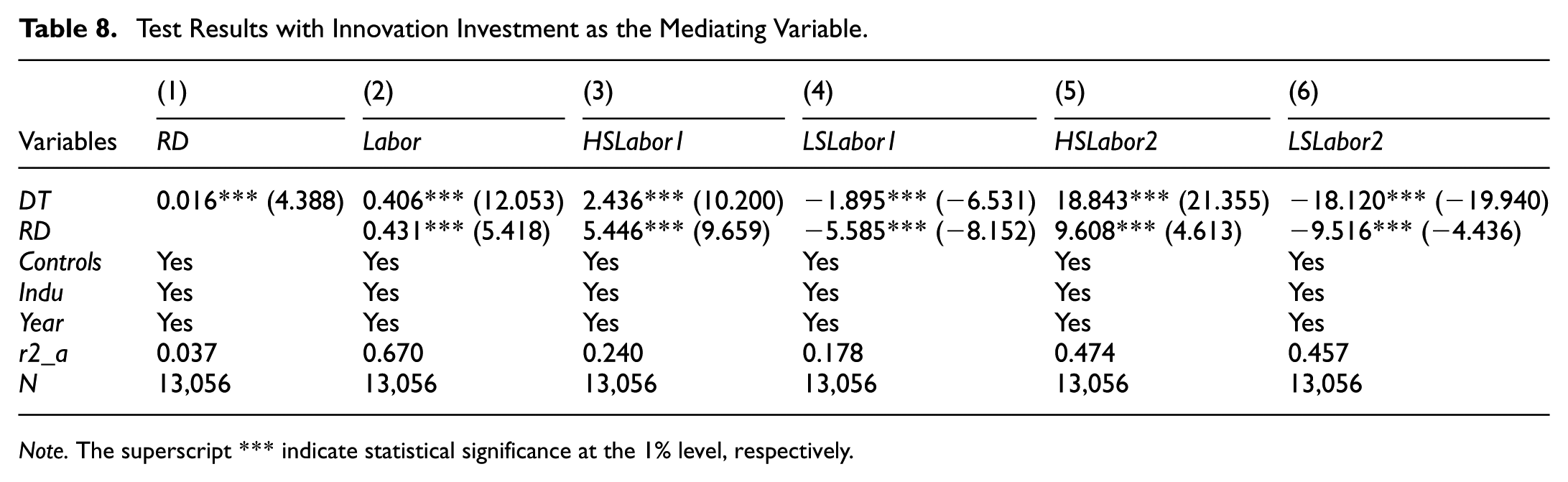
We use the ratio of R&D investment to total assets to measure innovation investment (RD), and Table 8 reports the mediation analysis results. In column (1), the coefficient of DT on RD is 0.016 and significant at the 1% level, indicating that EDT enhances firms’ innovation investment. In column (2), both DT and RD exhibit significantly positive coefficients at the 1% level when Labor is the dependent variable, suggesting that EDT expands employment scale by fostering innovation investment. Similarly, in columns (3) and (5), the coefficients of DT and RD on HSLabor1 and HSLabor2 are significantly positive at the 1% level, showing that EDT raises the proportion of high-skilled employees through greater innovation investment. In columns (4) and (6), where LSLabor1 and LSLabor2 are the dependent variables, the coefficients of DT and RD are both significantly negative at the 1% level, implying that EDT reduces the share of low-skilled employees by promoting innovation investment. Overall, these results demonstrate that EDT not only increases employment scale but also shifts employment structure toward higher skill intensity via innovation investment. Innovation investment thus constitutes an important transmission channel through which EDT affects both employment scale and structure, providing strong support for Hypothesis H3.
Test Results with Innovation Investment as the Mediating Variable.
Note. The superscript *** indicate statistical significance at the 1% level, respectively.
Innovation Output
We measure innovation output (Patent) as the natural logarithm of one plus the number of invention patents, and Table 9 reports the results with Patent as the mediating variable. In column (1), the coefficient of DT on Patent is significantly positive at the 1% level, indicating that EDT enhances innovation output. In column (2), both DT and Patent are significantly positive when Labor is the dependent variable, suggesting that EDT expands employment scale partly by stimulating innovation output. In columns (3) and (5), where HSLabor1 and HSLabor2 are the dependent variables, the coefficients of DT and Patent are both significantly positive, implying that EDT increases the proportion of high-skilled employees through greater innovation output. Conversely, in columns (4) and (6), where LSLabor1 and LSLabor2 are the dependent variables, the coefficients of DT and Patent are significantly negative, indicating that both EDT and innovation output reduce the share of low-skilled employees. Taken together, these results demonstrate that innovation output constitutes a key transmission channel through which EDT shapes employment outcomes. By enhancing innovation output, EDT raises the proportion of high-skilled employees, reduces the proportion of low-skilled employees, and collectively contributes to the expansion of employment scale. These findings provide further support for Hypothesis
Test Results with Innovation Output as the Mediating Variable.

Note. The superscript *** indicate statistical significance at the 1% level, respectively.
Innovation Efficiency
We measure innovation efficiency (Peffi) as the ratio of invention patents to the natural logarithm of R&D investment, and Table 10 reports the results with Peffi as the mediating variable. In column (1), the coefficient of DT on Peffi is 2.173 and significant at the 1% level, indicating that EDT improves innovation efficiency. In column (2), when both DT and Peffi are included, their coefficients on Labor are significantly positive, suggesting that EDT expands employment scale by enhancing innovation efficiency. Similarly, in columns (3) and (5), where HSLabor1 and HSLabor2 are the dependent variables, both DT and Peffi exhibit significantly positive coefficients, showing that EDT increases the proportion of high-skilled employees through higher innovation efficiency. By contrast, in columns (4) and (6), the coefficients of DT and Peffi on LSLabor1 and LSLabor2 are significantly negative, indicating that greater EDT and improved innovation efficiency reduce the proportion of low-skilled employees. Overall, these findings demonstrate that innovation efficiency serves as an additional transmission channel through which EDT influences employment outcomes. By improving innovation efficiency, EDT not only enlarges employment scale but also shifts employment structure toward a higher skill intensity, providing further empirical support for Hypothesis
Test Results with Innovation Efficiency as the Mediating Variable.

Note. The superscripts ***, ** indicate statistical significance at the 1% and 5% levels, respectively.
Heterogeneity Test: Dependence on High-Skilled Employees
Factor Intensity
Industries can be broadly categorized into three groups based on factor intensity: labor-intensive, capital-intensive, and technology-intensive. Labor-intensive sectors, such as agriculture, forestry, fisheries, food and beverage, and cultural entertainment, rely heavily on labor input, with employees typically trained to follow standardized production or service procedures. Capital-intensive sectors, including real estate, paper printing, and environmental industries, depend primarily on substantial capital investment. In contrast, technology-intensive industries, such as electronics, telecommunications, software, and computing, derive their competitive advantage from continuous R&D and innovation, making technological advancement their core business activity. Relative to labor- and capital-intensive industries, technology-intensive industries demonstrate greater willingness and capacity to pursue EDT. This intensifies demand for high-skilled employees while reducing reliance on low-skilled employees, thereby amplifying both the employment creation and substitution effects of EDT.
To empirically examine this heterogeneity, we define Tech as a binary variable equal to 1 for technology-intensive industries and 0 otherwise. An interaction term, DT × Tech, is introduced into the baseline specification. As reported in Table 11, the coefficient of DT × Tech in column (1) is 0.216 and significant at the 1% level, indicating that EDT exerts a stronger positive effect on employment scale in technology-intensive industries. Further evidence on employment structure shows that in columns (2) and (4), where the dependent variable is the proportion of high-skilled employees, DT × Tech is significantly positive at the 1% level. By contrast, in columns (3) and (5), where the dependent variable is the proportion of low-skilled employees, DT × Tech is significantly negative at the 1% level. Taken together, these findings indicate that, compared with labor- and capital-intensive industries, EDT in technology-intensive sectors not only more strongly expands overall employment and the share of high-skilled employees but also exerts a more pronounced negative impact on the share of low-skilled employees.
Heterogeneity Test Results Based on Factor Intensity.

Note. The superscripts *** and ** indicate statistical significance at the 1% and 5% levels, respectively.
Industry Attributes
The digital industry represents a cornerstone of the digital economy, characterized by its knowledge-intensive nature and high entry barriers. In recent years, supported by both macro- and micro-level policies, the industry has grown rapidly and is heavily shaped by advances in emerging digital technologies. Relative to other sectors, the digital industry exhibits a stronger demand for high-skilled employees and a weaker reliance on low-skilled employees. Accordingly, EDT in digital industry firms is expected to exert a more pronounced effect on employment structure, particularly in raising the share of high-skilled employees. Moreover, given the already low proportion of low-skilled employees, EDT is also likely to exert a stronger positive effect on overall employment scale in this sector.
To empirically test this hypothesis, we define DI as a binary variable equal to 1 if a firm operates in computer, telecommunications, and other electronic equipment manufacturing, or in information transmission, software, and information technology services, and 0 otherwise. An interaction term, DT × DI, is then introduced into the baseline specification. The results, reported in Table 12, show that in column (1), the coefficient of DT × DI on Labor is 0.456 and significant at the 1% level, suggesting that EDT has a stronger positive effect on employment scale within the digital industry. In columns (2) and (4), where the dependent variables are the proportions of high-skilled employees, the coefficients of DT × DI are 4.475 and 17.065, respectively, both significant at the 1% level. This indicates that, relative to other sectors, EDT is more conducive to increasing the share of high-skilled employees in digital industry firms. By contrast, in columns (3) and (5), where the dependent variables are the proportions of low-skilled employees, the coefficients of DT × DI are −5.260 and −16.803, respectively, both significant at the 1% level. These results imply that EDT reduces the share of low-skilled employees more strongly in digital industry firms than in other industries. Taken together, the findings suggest that within the digital industry, EDT exerts a disproportionately large impact on both employment scale and structure, reinforcing the view that this sector is at the forefront of labor market restructuring in the digital age.
Heterogeneity Test Results Based on Industry Attributes.

Note. The superscripts *** and * indicate statistical significance at the 1% and 10% levels, respectively.
Technological Attributes
From the perspective of technological attributes, high-tech enterprises differ markedly from general firms in their production and business operations. High-tech firms focus on the research, development, application, and diffusion of advanced technologies, playing a pivotal role in driving innovation and serving as industry benchmarks. Compared with general enterprises, they exhibit higher R&D intensity, greater innovation investment, and a larger share of high-skilled employees. Accordingly, in the digital economy era, EDT in high-tech enterprises is expected to exert stronger substitution effects on low-skilled employees while having more pronounced complementary effects on high-skilled employees. This implies that the employment impact of EDT may vary significantly across firms with different technological attributes.
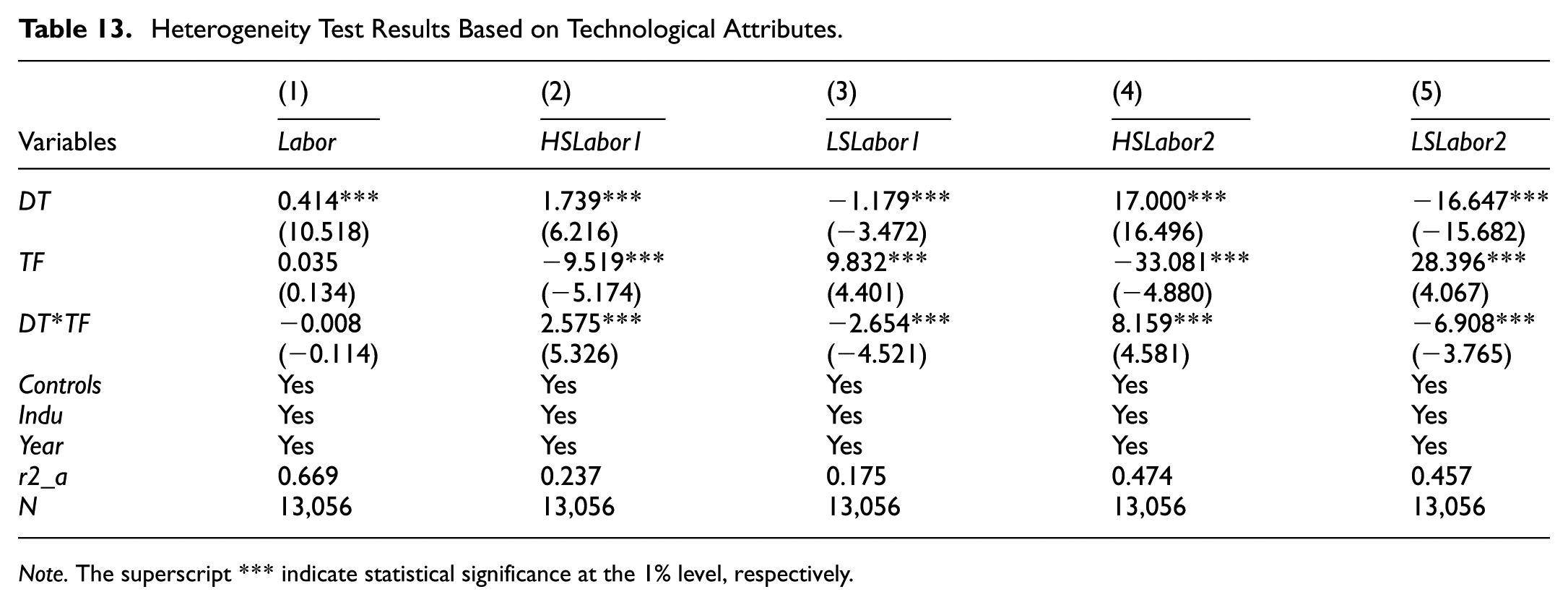
To test this heterogeneity, we define a technological attribute variable (TF) equal to 1 for high-tech enterprises and 0 otherwise and introduce the interaction term DT × TF into the baseline specification. The regression results, reported in Table 13, show that in column (1), the coefficient of DT × TF on Labor is negative but statistically insignificant, indicating no systematic difference between high-tech and general enterprises in terms of employment scale. However, in columns (2) and (4), where the dependent variables are the proportions of high-skilled employees, DT × TF is significantly positive at the 1% level, suggesting that EDT in high-tech enterprises has a stronger positive effect on the share of high-skilled employees. Conversely, in columns (3) and (5), where the dependent variables are the proportions of low-skilled employees, DT × TF is significantly negative at the 1% level, implying that EDT more strongly reduces the share of low-skilled employees in high-tech enterprises compared with general firms. Overall, these findings indicate that while EDT does not significantly differentiate employment scale between high-tech and general enterprises, it has a more substantial impact on employment structure in high-tech enterprises.
Heterogeneity Test Results Based on Technological Attributes.
Note. The superscript *** indicate statistical significance at the 1% level, respectively.
Discussion and Conclusion
Discussion of Results
In the era of the digital economy, EDT has emerged as a pivotal driver of enterprise development, fundamentally reshaping employment patterns (Bharadwaj et al., 2013; Verhoef et al., 2021). Leveraging a comprehensive dataset of Chinese A-share listed firms from 2011 to 2021, this study systematically examines the impact of EDT on both the scale and structure of employment. Our findings provide compelling insights into the dynamic interplay between EDT and labor market outcomes. First, our results demonstrate that EDT not only fosters employment expansion but also significantly alters workforce composition. Specifically, firms undergoing EDT exhibit a pronounced tendency to increase overall employment, particularly by expanding the proportion of high-skilled employees while concurrently reducing the share of low-skilled employees. This pattern suggests that EDT, rather than leading to widespread employment substitution, primarily drives structural changes in employment by creating demand for technologically proficient labor (Acemoglu & Restrepo, 2018; Nedelkoska & Quintini, 2018). These findings align with the broader literature on labor market polarization in the digital economy, which posits that EDT disproportionately benefits high-skilled occupations while diminishing opportunities for routine-based, low-skill employment (D. H. Autor et al., 2003; Frey & Osborne, 2017). Second, our analysis establishes technological innovation as a key mechanism through which EDT influences employment outcomes. We find that EDT enhances firms’ technological investment, innovation output, and innovation efficiency, collectively generating new employment opportunities, particularly in knowledge-intensive roles (Acemoglu & Restrepo, 2020; Bharadwaj et al., 2013). By fostering R&D capabilities, streamlining production processes, and accelerating business model innovation, EDT not only elevates firms’ overall labor demand but also shifts employment structures toward occupations requiring advanced cognitive skills, problem-solving abilities, and digital literacy (Bloom et al., 2014; Mikalef & Pateli, 2017). These findings lend empirical support to the Capital-Skill Complementarity Hypothesis. Third, our heterogeneity analysis reveals significant variation in the employment effects of EDT across industries and technological contexts. The employment expansion effect is more pronounced in technology-intensive and digital industries, where firms with higher levels of digital maturity exhibit stronger demand for high-skilled employees, resulting in a more substantial shift in workforce composition (Dauth et al., 2018; Graetz & Michaels, 2018). In contrast, labor-intensive and capital-intensive enterprises, as well as firms with limited digital adoption capabilities, exhibit weaker employment effects, with EDT primarily serving as a tool for operational optimization rather than labor expansion (Acemoglu & Restrepo, 2019). Moreover, in high-tech enterprises, EDT amplifies skill-based disparities by intensifying the demand for specialized expertise while reducing reliance on low-skilled employees. These findings highlight that the impact of EDT on employment outcomes is inherently shaped by the industry characteristics of the enterprises in which they operate.
From a policy perspective, a balanced and structured approach to EDT is essential. While EDT drives economic growth and employment creation, proactive measures are needed to mitigate employment substitution and ensure inclusive development. Governments should adopt a multi-faceted strategy to enhance workforce adaptability. This includes expanding digital literacy programs, aligning vocational training with industry needs, and incentivizing businesses to offer continuous on-the-job training. Strengthening public-private partnerships can further bridge skill gaps by integrating industry demands into education. Enterprises should invest in both technological innovation and human capital development, implementing workforce transition strategies such as internal mobility programs and phased automation. Leveraging government incentives can help businesses adopt worker-friendly EDT policies, promoting sustainable employment growth. Beyond workforce policies, governments must foster a supportive digital ecosystem by enhancing data governance, cybersecurity, and digital infrastructure, particularly in underserved regions. A comprehensive policy framework will enable governments and enterprises to harness the benefits of EDT while mitigating its challenges.
Contributions
Our findings highlight the critical role of EDT in shaping employment dynamics within Chinese firms. Departing from prior research that primarily emphasizes automation and specific technologies such as AI and robotics (D. Autor & Salomons, 2017; Dauth et al., 2018; Graetz & Michaels, 2018), this study provides comprehensive empirical evidence that enterprise-wide EDT exerts a net positive effect on employment. Specifically, EDT not only expands overall employment but also fundamentally reshapes employment structures by increasing the proportion of high-skilled employees while reducing reliance on low-skilled employees. These findings align with existing research suggesting that EDT fosters labor demand in knowledge-intensive sectors while displacing routine, low-skilled tasks (Acemoglu & Restrepo, 2018). However, in contrast to studies emphasizing the disruptive employment substitution effects of digital technologies (Frey & Osborne, 2017), our empirical evidence suggests that, within the Chinese economic and institutional context, the employment substitution effect is outweighed by the employment creation effect, primarily due to the complementary role of technological innovation.
Beyond affirming the employment-enhancing effects of EDT, this study identifies technological innovation as a key transmission mechanism driving these outcomes. While prior literature has acknowledged the role of EDT in fostering innovation (Bloom et al., 2014; Mikalef & Pateli, 2017), its implications for employment structures remain underexplored. Our results demonstrate that EDT facilitates technological advancements that, in turn, stimulate employment growth and reallocate labor toward higher-skilled positions. Firms that actively invest in digital capabilities are more likely to develop and implement innovative processes, thereby generating new employment opportunities that demand advanced expertise.
From a broader economic perspective, our findings carry significant implications for corporate strategy and public policy. Given the demonstrated employment creation effect of EDT, policymakers should prioritize initiatives that support digital adoption not only to enhance enterprise productivity but also to foster sustainable employment growth. However, as EDT disproportionately benefits high-skilled employees while reducing demand for low-skilled roles, targeted workforce development programs, including vocational training and reskilling initiatives, are essential to mitigate potential labor market disruptions. These insights not only extend the discourse on EDT beyond firm-level productivity gains but also illuminate its broader labor market implications. By situating the analysis within China’s distinctive economic and policy context, this study offers a nuanced perspective on how EDT can be harnessed to enhance both economic efficiency and employment sustainability. The findings suggest that a carefully executed EDT strategy can enable firms and economies to achieve long-term, inclusive growth while adapting to the evolving demands of the labor market.
Limitations and Future Research
While this study sheds light on the relationship between EDT and employment, several avenues for future research remain. First, cross-national comparisons could clarify how institutional contexts such as labor market regulations, economic development, and digital infrastructure shape the employment effects of EDT. Comparative analyses between China and other economies in digital transition would deepen our understanding of these variations and enrich the global discourse on digital transformation. Second, future studies could examine complementary factors including corporate culture, leadership, and government incentives, which may mediate or amplify the employment effects of EDT. Exploring these elements would provide valuable insights for business leaders and policymakers in addressing workforce challenges and opportunities in the digital era.
Footnotes

Ethical Considerations
Not applicable.
Funding
The authors disclosed receipt of the following financial support for the research, authorship, and/or publication of this article: This work was supported by the Shandong Natural Science Foundation Project [grant number ZR2023QG085], the Shandong Natural Science Foundation Project [grant number ZR2024QG031], the Shandong Provincial Social Science Planning Research Project “Infrastructure Publicly Offered REITs Empowering Corporate High-Quality Development: Mechanisms, Effects, and Policy Optimization Research” [grant number 24DGLJ05], the Qingdao Municipal Social Science Planning Research Project “Qingdao Pilot Free Trade Zone Empowering Corporate Green Innovation: Effects, Mechanisms, and Policy Optimization Research” [grant number QDSKL2401076].
Declaration of Conflicting Interests
The authors declared no potential conflicts of interest with respect to the research, authorship, and/or publication of this article.
Data Availability Statement
The datasets generated and/or analyzed during the current study are available from the corresponding author upon reasonable request.
Patient Consent Statement
Not applicable.
Permission to Reproduce Material from Other Sources
Not applicable.
Clinical Trial Registration
Not applicable.