




Abstract
This study measures common prosperity of China from three dimensions: affluence, shareability, and sustainability. Based on a matched sample of data covering 31 provincial-level regions in mainland China and 3,741 A-share listed firms, it uses higher education human capital expansion (HEHCE) caused by the 1999 university expansion policy (UEP) as an exogenous policy shock. Using a difference-in-differences (DID) method, this paper studies the impact of HEHCE on China’s common prosperity. The findings show that HEHCE substantially contributes to common prosperity. This conclusion remains robust after a series of robustness tests and endogeneity treatments. The heterogeneity test shows that the impact of the HEHCE on common prosperity varies by regions, education and technology expenditures and enterprises’ digital transformation. The four-stage mediating effect test shows that corporate technological innovation and industrial structure upgrading are the transmission channels for EHCE to promote common prosperity. This study provides empirical evidence and policy implications to fully leverage the role of HEHCE in promoting economic and social development.
Keywords
Introduction
Equalizing investment in human capital is a vital pathway to achieving common prosperity (Luo & Hu, 2023). The UEP has increased the stock and quality of higher education human capital (higher education human capital), providing an endogenous driving force for sustained economic growth and the realization of common prosperity. The Chinese “14th Five-Year Plan” (2020–2025) emphasizes the need to “solidly promote common prosperity,” aiming for “greater substantial progress in achieving common prosperity for all by 2035” (Su et al., 2023). Common prosperity fundamentally relies on affluence, with a focus on shareability and narrowing disparities (N. Lee, 2019). Despite China’s steady economic growth over the past 40 years, with a 2024 GDP of $18.94 trillion and a per capita GDP reached $13,400, significant income disparities between urban and rural residents persist (M. Zhang et al., 2022; Zhong et al., 2022). The driving force of factor input scale is gradually diminishing, shifting toward an innovation-driven growth model, where wealth creation capability becomes crucial. The World Bank notes that over 60% of societal wealth in most countries originates from human capital. Particularly, higher education human capital is a vital source of endogenous economic growth (Amendola et al., 2020). Accumulation of human capital, centered around higher education, is expected to transition the “demographic dividend” to a “human capital dividend,” becoming a fundamental force in achieving common prosperity.
Since the 21st century, with the implementation of China’s UEP, the scale of higher education has steadily increased (Dai et al., 2022; Kang & Mok, 2022; Ou & Hou, 2019). China has currently established the world’s largest higher education system, with a total enrollment exceeding 44.3 million students. The gross enrollment ratio in higher education increased from 30% in 2012 to approximately 60% in 2023. Higher education has entered a globally recognized stage of universalization. Consequently, there has been a significant transformation in the quality and structure of the labor force. The policy focus on expanding the scale of higher education has sparked academic contemplation on the economic effects of university expansion (Huang et al., 2023; Yue, 2022, 2023b). Although there is abundant research on the impact of human capital and university expansion on economic development, few studies have explored the effects of HEHCE on common prosperity from the perspective of the UEP. As China’s economic growth shifts toward an innovation-driven model, higher education human capital has become a core force in promoting economic development and reducing social disparities (Fang & Mao, 2021; Luo & Hu, 2023). However, educational resources remain unevenly distributed across urban and rural areas and regions, and income gaps are still significant (Y. Zhang & Wang, 2024). This makes it imperative to systematically assess the impact of higher education human capital on common prosperity. Investigating this mechanism can not only help optimize education policies and resource allocation but also provide scientific guidance for achieving the 2035 common prosperity goal. Therefore, it is worth conducting in-depth research on the economic effects generated by HEHCE in pursuit of common prosperity. Based on this, the current study utilizes the 1999 UEP as a quasi-natural experiment, employing a difference-in-differences (DID) analysis to investigate the effects and mechanisms of HEHCE on common prosperity and offers relevant policy recommendations.
Compared to previous studies, this study’s marginal contributions are as follows: First, in terms of research perspective, while few literatures have focused on HEHCE and common prosperity, this study constructs a common prosperity evaluation index system from 3 dimensions and 21 indicators: affluence, shareability, and sustainability. It also measures higher education human capital based on input and output indicators using a dynamic entropy-weighted TOPSIS method, thus systematically and deeply exploring the impact of HEHCE on common prosperity and enriching the research on determinants of common prosperity in China. Second, in terms of research methodology, this study adopts the Double/Debiased Machine Learning (DDML) model, which has unique advantages in variable selection and model estimation, for extension analysis and robust causal inference on the impact of HEHCE on common prosperity. Additionally, it uses a four-stage mediation effect analysis that overcomes endogeneity issues of traditional mediation effects to explore the impact mechanisms. Third, in terms of research perspective, this study posits the existence of two different macro and micro mechanisms of action between HEHCE and common prosperity: corporate technological innovation and industrial structure upgrading, working together to balance efficiency and equity for a win-win situation. The summary chart of distinct stages is shown in Figure 1.

Summary chart of distinct stages.
Literature Review and Research Hypotheses
University Expansion and Higher Education Human Capital
In the 1960s, American economists Schultz and Becker pioneered human capital theory. Schultz (1961) first introduced the concept of human capital, identifying it as a type of capital embodied in workers and a significant factor in economic growth. Becker and Tomes (1979) were the first to analyze the impact of education at different stages on income inequality. Although signaling theory, positional goods theory, and the post-development critiques of educational expansion focus more on the relative nature of education, its screening function, social competition, and potential negative effects, emphasizing that education does not necessarily improve productivity or social equity, the importance of educational human capital has increasingly become a focal point of scholarly research. Education is not only a means to drive economic growth, but the accumulation of human capital and enhancement of human qualities through educational investment can also spur economic development (Widarni & Bawono, 2021); education, as a crucial component of human capital, is key to economic growth (Pink-Harper, 2015); the human capital of workers with higher education significantly impacts income and wages, while the human capital of workers without higher education has almost no effect on population income (Avdeev et al., 2020). Since 1999, Chinese universities have lowered admission thresholds and rapidly expanded enrollment, making higher education more accessible. This sudden policy shift, led by the government, provided a natural experimental opportunity for academia to study the relationship between university expansion and human capital. The university expansion at the core of higher education reform brought about an expansion in the scale of human capital (Yue, 2023c); the UEP by providing high-quality human capital, maintained rapid economic growth (Feng et al., 2022).
Higher Education Human Capital and Common Prosperity
From the perspective of wealth creation, education investment has a significant effect on social material production and economic growth. Classical human capital theory posits that education, training, and health are forms of investment in labor, which enhance individual productivity and aggregate economic output. This not only raises income but also lays the foundation for social equity and long-term development. Subsequent studies have reached similar conclusions. Marginson (2019) notes that human capital theory suggests education determines the marginal productivity of labor, which in turn determines income. In terms of primary income distribution, individuals can achieve stable employment and higher income through the accumulation of education-based human capital (Somani, 2021), thereby making initial income distribution more equitable. In terms of intergenerational distribution, inclusive education allows more people to gain opportunities and capabilities to improve their family’s economic status, breaking the gaps caused by innate factors (Z. Li & Zhong, 2017), and improving the structure of intergenerational income distribution.
Human capital is the core and key to poverty alleviation, relying on endogenous forces to promote income increase in rural families in impoverished areas and regional economic growth, and shifting poverty alleviation from external aid to internal source-driven. Relevant literature on higher education human capital and common prosperity includes: Investment by governments should extend from physical to human capital, and national investment in human capital is an important means to reduce poverty (Ou & Zhao, 2022; X. Zhang & Wang, 2021); developing higher education is conducive to narrowing income gaps (J. W. Lee & Lee, 2018; Sehrawat & Singh, 2019), enhancing social class mobility. Some scholars have directly studied the relationship between higher education human capital and common prosperity. Equalization of public services, especially in education sharing and equal opportunities (Chu & Wen, 2019; Guo & Chen, 2023; Wu et al., 2020), helps to facilitate upward mobility channels, offering more people the possibility of becoming prosperous; expanding human capital through higher education, optimizing the traditional human capital structure, successfully transitioning from a country with a large population to a country with a great human resource, provides a powerful driving force for achieving common prosperity. Therefore, based on the above analysis, this study proposes:
The Influencing Mechanism of Higher Education Human Capital on Common Prosperity
There is limited research on the mechanisms by which higher education human capital influences common prosperity, while extensive studies exist on how human capital impact industrial structure and technological innovation and how these in turn affect income disparity and economic growth. (1) Technological innovation. Human capital is the carrier of innovation capability (R. Zhang, 2023), and past regional human capital is a key factor in explaining current regional innovation and economic development differences (Diebolt & Hippe, 2019). Advanced human capital, with its scarce innovation capability, is the intrinsic driving force for the development of technology-intensive industries. Therefore, the higher the level of human capital, the more technological achievements (Che & Zhang, 2018; Shu & Wang, 2023), the faster the pace of industrial structure optimization, and the greater its role in improving economic efficiency. The improvement of human capital levels has significant spatial spillover effects, providing strong support for the development of local innovative industries and contributing to the improvement and diffusion of local technological innovation levels (Wen et al., 2023), thereby driving economic development in other regions. (2) Industrial structure upgrading: New structural economics theory suggests that human capital can aid in upgrading industrial structure (M. Wang et al., 2021; Zhou, 2018). On the one hand, the upgrading of human capital structure serves as a catalyst for industrial structure optimization. It provides high-quality talent and other driving forces for industrial upgrading. It determines the pace of technological renewal and facilitates the advancement of the industrial structure. On the other hand, industrial structure upgrading, by generating demand effects on human capital, prompts the adjustment of the human capital structure, which, when matched with industrial structure upgrading, can maintain sustained and steady economic growth. Based on this, the study proposes:

The mechanism of the UEP in promoting common prosperity.
Empirical Design
Model Specification
This paper exploits the exogenous policy shock of the 1999 university enrollment expansion to construct a quasi-natural experiment and evaluate the causal effect of higher-education human capital expansion on common prosperity in China. Since the students admitted in 1999 could only increase the labor supply after graduation (3 or 4 years later), the substantial rise in human capital occurred around 2003. Therefore, we identify 2003 as the actual policy shock year (Che & Zhang, 2018; Shu & Wang, 2023). The implementation of this policy directly provided a large amount of high-quality human capital, offering a valuable opportunity to examine the impact of HEHCE on common prosperity. This paper treats the UEP as a quasi-natural experiment and employs a DID approach for empirical estimation. Meanwhile, the human capital expansion brought by the higher education expansion affected different regions to varying degrees, which forms the basis for identifying the effects of human capital expansion at the regional level. Therefore, by comparing changes in the gap in common prosperity between regions with higher levels of higher education human capital (the treatment group) and regions with lower levels (the control group) before and after 2003, we can identify the effect of UEP on regional common prosperity. The empirical model of this paper is specified as follows:

where, the dependent variable is the level of common prosperity(compro). “human” represents higher education human capital. Beijing, Shanghai, Jiangsu, Zhejiang, Shandong, Guangdong, Hebei, Liaoning, Heilongjiang, Anhui, Jiangxi, Henan, Hubei, Hunan, Sichuan and Shangxi with higher level of human capital in higher education are the treatment group. Xinjiang, Qinghai, Gansu, Ningxia, Yunnan, Guizhou, Chongqing, Hainan, Inner Mongolia, Tibet, Guangxi, Jilin, Shanxi, Tianjin and Fujian with low level of higher education human capital are the control group. “after03” is a time dummy variable, where years including and following 2003 are coded as after03 = 1; otherwise, after03 = 0. The interaction term “human*after03” is the core explanatory variable. Its estimated coefficient measures the average difference in common prosperity among regions with varying levels of higher education human capital before and after the UEP. “Controls” represents a set of control variables, including those at the city and enterprise levels. The study also considers individual and time effects,
Variable Definition
Dependent Variable: Common Prosperity
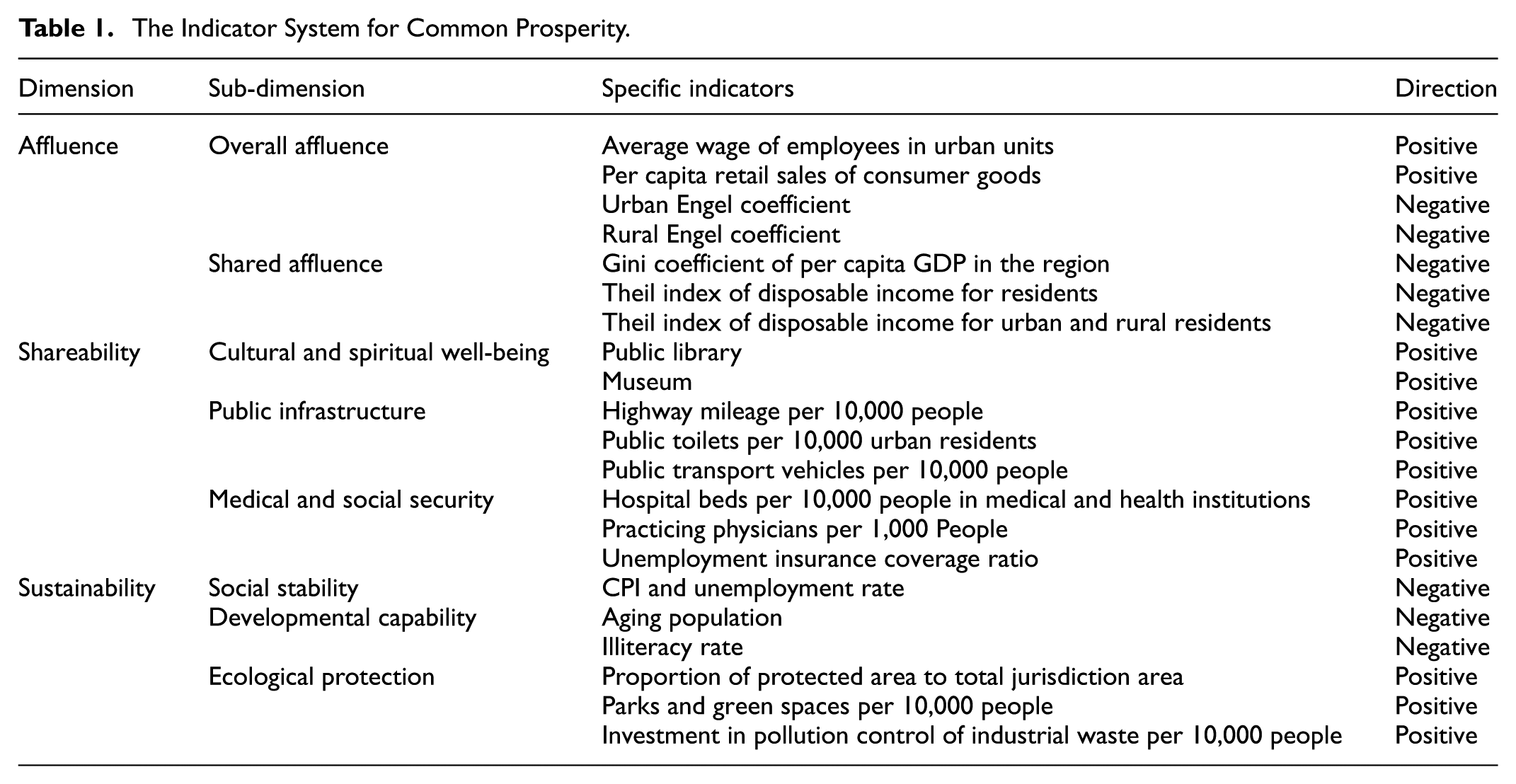
In constructing an indicator system for common prosperity, according to Chen et al. (2023), Dong et al. (2023), and Kakwani et al. (2022), and Wang and Feng (2023) this study constructs a comprehensive evaluation system for common prosperity. This system is structured across three primary dimensions (first-level indicators): affluence, shareability, and sustainability. It encompasses 8 sub-dimensions (second-level indicators) and a total of 21 tertiary indicators, as detailed in Table 1. Affluence mainly examines overall and shared prosperity. It reflects the growth of social wealth and household income, and measures the income gap between urban and rural areas as well as across regions. Shareability mainly examines whether the benefits of reform and development are fairly shared by all people. It measures the gap between people’s aspirations for a better life and their actual living conditions, from dimensions such as culture, public infrastructure, healthcare, and social security. Sustainability mainly examines the long-term capacity for common prosperity. It reflects the degree to which economic and social development matches population, resources, and environmental carrying capacity, and it measures the long-term development potential of the economy, society, and ecological environment. Referring to X. F. Ma et al. (2022), this study employs the coefficient of variation method to determine the specific weight of each indicator, indicating its relative importance within the index system. The study then uses a weighted average approach to calculate the degree of common prosperity achieved in various regions of China.
The Indicator System for Common Prosperity.
Core Explanatory Variable: Higher Education Human Capital
According to He et al. (2021), this study assesses higher education human capital using a dynamic entropy-weighted TOPSIS method (DEW-TOPSIS; E. Zhang et al., 2023). The evaluation is based on five input indicators and four output indicators of higher education, as illustrated in Table 2. Additionally, referring to C. Wang et al. (2020), the study measures the level of higher education human capital using the ratio of the labor force possessing an associate degree or higher to the number of employed individuals. This measure is employed for subsequent robustness tests.
Measurement of Human Capital in Higher Education.

Control Variables
In line with the studies by X. Li et al. (2023) and Y. Wang and Feng (2023), this study selects control variables at both regional and corporate levels. For the regional level, the control variables include government intervention (government), urbanization rate (urban), financial development (finance), fixed asset investment (fixed), and network infrastructure (infrastructure). For the corporate level, the control variables encompass: company size (Size), debt-to-asset ratio (Lev), net profit margin on assets (ROA), duality of general manager and chairman roles (Dual), proportion of independent directors (Indep), cash flow ratio (Cashflow), and years since listing (ListAge).
Data Sources
The regional-level data for this study primarily comes from the “China Statistical Yearbook,”“China Education Statistical Yearbook,” and the Wind database. Data on publicly listed companies is chiefly sourced from annual reports, the China Research Data Service Platform (CNRDS), and the China Financial and Economic Research Database (CSMAR). The study matches enterprise data with regional-level data to form a new dataset, on which empirical analysis is conducted. The final sample comprises data from the 31 provinces, autonomous regions, and municipalities of mainland China and 3,741 companies listed on the Shanghai and Shenzhen A-shares market from 2000 to 2021. Companies with abnormal trading statuses (ST, *ST, PT) during the sample period and those with significant missing values are excluded. Moreover, tail trimming of 1% from both upper and lower ends is applied to all continuous variables to alleviate the impact of extreme values. Table 3 provides descriptive statistics for the main variables.
Descriptive Statistics.

In January 1999, the State Council of China forwarded and officially implemented the “Education Revitalization Action Plan for the 21st Century” published by the Ministry of Education, which marked the formal implementation of the UEP. This policy led to the rapid expansion phase of higher education in China, as depicted in Figures 3 and 4.

Input of higher education human capital.

Output of higher education human capital.
Figure 3 illustrates that in the input of higher education human capital, the number of general higher education institutions (denoted as “school”) and the proportion of full-time faculty to total staff in higher education institutions (denoted as “teacher”) have expanded rapidly. In contrast, the total number of staff in higher education institutions (denoted as “staff”), the proportion of higher education funding to GDP (denoted as “expenditure”), and the per-student educational funding in higher education institutions (abbreviated as “pef”) have experienced relatively gradual growth.
Figure 4 shows that in terms of the output of higher education human capital, the most significant expansion is seen in the number of students enrolled in higher education institutions (denoted as “student”). Meanwhile, the number of graduates from higher education institutions (denoted as “graduate”), the number of enrollments in higher education institutions (denoted as “enrollment”), and the ratio of individuals with education beyond junior college level to the total population (denoted as “college”) have shown relatively slower growth.
In Figure 5, higher education human capital is represented by the ratio of the labor force with college education or higher as a ratio of employed population. Common prosperity is depicted using a composite index derived through the coefficient of variation method. It is evident that, starting from 2003, as the level of higher education human capital has increased, the overall degree of common prosperity has also shown an upward trend. This correlation suggests that advancements in higher education are positively associated with the enhancement of common prosperity.

Higher education human capital and common prosperity.
Results and Discussion
Baseline Regression
Table 4 shows the baseline regression results, indicating that the estimated coefficients for the interaction terms are significantly positive. This suggests that regions with higher levels of higher education human capital have experienced a notable increase in the level of common prosperity compared to regions with lower levels, following the implementation of the UEP, thereby validating H1. X. Zhang and Wang (2021) noted that economic convergence is significantly dependent on human capital. The positive “advantage of backwardness” due to lower initial income levels is almost offset by the negative impact of low levels of human capital in the poorest regions. The study by Y. Zhang and Wang (2024) showed that increasing the proportion of higher education had a significant positive impact on common prosperity at the provincial, municipal, and county levels.
Baseline Regression Results.

Note.*, **, *** indicate significant at 10%, 5%, and 1% levels, respectively. Standard errors in parentheses.
Endogeneity Treatment
Identifying Assumption Test
Parallel Trend Test
A crucial prerequisite or employing the DID method is the parallel trends assumption. This is essential to ensure that the control group’s performance after the shock can serve as a counterfactual for the experimental group. In column (1) of Table 5, interaction terms of higher education human capital with the time dummy variables for the years 2000 (humanyear00), 2001 (year01), and 2002 (year02) are included. It is observed that the estimated coefficients for these interaction terms are not significant, thereby confirming the parallel trends assumption of the DID.
Endogeneity Treatment.

Note.*, **, *** indicate significant at 10%, 5%, and 1% levels, respectively. Standard errors in parentheses.
Placebo Test
To rule out the influence of random factors, this study conducted a placebo test with 1,000 random samples. The estimated coefficients were mainly concentrated around zero (Figure 6), indicating that the baseline regression results are very unlikely to be driven by unobserved factors.

Parallel trend test.
Instrumental Variable
Given the many factors affecting common prosperity, and considering unobservable omitted variables and potential reverse causality, this study further uses the one-period lag of the explanatory variable (L.humanafter03) as an instrumental variable for 2SLS regression. The results in column (2) of Table 5 show that the coefficient of humanafter03 is positive and significant at the 1% level. Meanwhile, the F-statistic for the weak instrument test (12,274.8) exceeds the critical value of 16.38, indicating that the selected instrument is valid. This further confirms the robustness of the study’s conclusions.
Heckman Two-Step
The Heckman two-step method is employed here to address potential sample selection bias. In the first step, L.human*after03 is used as the selection variable, and a Probit model is applied to estimate the selection equation. In the second step, the Inverse Mills Ratio (IMR) is included to correct for sample selection bias. After accounting for sample selection, the effect of higher education human capital expansion on common prosperity is tested. Column (3) of Table 5 shows that, after controlling for selection bias and partially addressing endogeneity, the initial conclusion still holds.
Robustness Test
Discrete DID
The previous sections used a continuous variable DID method to identify the common prosperity effect of higher education human capital. Here, the continuous variable after03 is replaced with a general sense, group dummy variable treated. The median value of higher education human capital is used as the threshold; regions with higher education human capital above this threshold are assigned a treated value of 1; those below are assigned a 0. The results in column (1) of Table 6 indicate that the coefficient of the interaction term human*treated is significantly positive, suggesting that the study’s initial conclusions are not affected by the method of setting up the DID method.
Robustness Test.

Note.*, **, *** indicate significant at 10%, 5%, and 1% levels, respectively. Standard errors in parentheses.
Replace the Explanatory Variable
In this section, the ratio of the labor force possessing an associate degree or higher to the number of employed individuals is used as a proxy for higher education human capital. Column (2) of Table 6 shows that the estimated coefficient for the interaction term “human2after03” remains significantly positive. This indicates that the conclusion remains consistent regardless of the measurement method used for the explanatory variable.
Replace the Explained Variable
For robustness, this study further adopts the approach of Chen et al. (2021), using the Analytic Hierarchy Process (AHP) to calculate the composite index of common prosperity (CP). Column (3) of Table 6 reports the empirical results using this new method, with the dependent variable being common prosperity. It is evident that the estimation results are consistent with those of the baseline model.
Extension Analysis
This study employs the traditional DID to assess the common prosperity effects of the UEP. However, due to the influence of other factors in the economic system, it is crucial to eliminate the interference of confounding factors to ensure the accuracy of the estimates. Nevertheless, in the context of non-linear and high-dimensional variables, the accuracy of estimators in traditional regression models can be adversely affected. The Double/Debiased Machine Learning model (DDML) offers a more precise estimation of causal relationships (Chernozhukov et al., 2018).
In Table 7, Columns (1) and (2), (3) and (4), and (5) and (6) employ machine learning algorithms of neural networks (nnet), lasso regression (lassocv), and gradient boosting (gradboost), respectively. The sample split ratios for Columns (1), (3), and (5) versus Columns (2), (4), and (6) are uniformly 1:4 and 1:2. The regression coefficients of HEHCE on common prosperity are significantly positive at the 1% level, indicating that HEHCE contributes to the realization of common prosperity. This validates the robustness of the fundamental conclusion.
DDML Estimation Results Based on PLR.

Note.*, **, *** indicate significant at 10%, 5%, and 1% levels, respectively. Standard errors in parentheses.
Heterogeneity and Mechanism Tests
Heterogeneity Analysis
From a regional perspective, Columns (1) and (2) of Table 8 show that HEHCE in the eastern regions plays a significant role in promoting common prosperity. The coefficient significance, as evidenced by a negative value through the Fisher’s Combined Test (1,000 iterations) based on Bootstrap, also corroborates the existence of inter-group difference. A possible explanation is that the eastern region not only has a higher level of higher education human capital but also a higher per capita GDP, a decisive factor in promoting common prosperity (Xie et al., 2024). Additionally, better trade and financial conditions, as well as more developed infrastructure in these regions, facilitate the positive impact of higher education human capital, exemplifying a more pronounced effect of the educational dividend in the east.
Regional-Level Heterogeneity Analysis.

Note.*, **, *** indicate significant at 10%, 5%, and 1% levels, respectively. Standard errors in parentheses.
From the perspective of fiscal education expenditure, Columns (3) and (4) of Table 8 indicate that the propelling effect of HEHCE on common prosperity is present only in regions with relatively ample educational spending. The negative coefficient significance in the Fisher combination test based on Bootstrap, passing the 1% significance level, reinforces this inter-group difference. This can be attributed to the role of fiscal education spending in providing crucial funding for educational development and human capital accumulation, effectively coordinating educational resource allocation and socio-economic interests. Özdoğan Özbal (2021) assessed the long-term dynamic impact of OECD higher education spending and enrollment rates on human capital and per capita income, suggesting that increased higher education spending and enrollment rates contribute to higher per capita income and economic growth. Hu et al. (2020) used an endogenous pre-college human capital investment search-match model to conclude that, educational subsidies and scholarships can increase pre-college human capital investment and reduce unemployment rates among college graduates.
From the perspective of fiscal science and technology expenditure, Columns (5) and (6) of Table 8 demonstrate that HEHCE in regions with more abundant science and technology spending effectively foster common prosperity. The significant negative coefficient at the 1% level in the Fisher combination test based on Bootstrap further substantiates the effectiveness of this grouping. This could be due to the impact of local government science and technology spending on the level of human capital and knowledge innovation incentives in society, thereby influencing overall innovation and providing momentum for achieving common prosperity. Gruzina et al. (2022) noted the significant and positive link between secondary and higher education enrollment rates and human capital, and that R&D spending appears to positively affect human capital.
From the perspective of corporate digital transformation, digitalization imposes higher demands on the knowledge and skill levels of workers. The UEP has facilitated the accumulation of human capital, creating conditions for businesses to enhance research and development investments and personnel training. Consequently, the greater the degree of corporate digital transformation, the more it contributes to the enhancement of enterprise production efficiency through higher education human capital. Simultaneously, optimizing the structure of human capital strengthens the assimilation and application of various technologies, promoting technological innovation and the upgrading of technological structures, optimizing the economic structure, and aiding in achieving common prosperity. Referring to Tang et al. (2023), this study employs text analysis to measure corporate digital transformation. This measurement is based on the frequency of 76 digitalization-related keywords across five dimensions: artificial intelligence technology, big data technology, cloud computing, blockchain technology, and digital technology application (denoted as digital1). Additionally, the study measures digital transformation through 99 digitalization-related keywords across four dimensions: digital technology application, internet business models, smart manufacturing, and modern information systems (denoted as digital2). Table 9 reveals that HEHCE has a more pronounced effect on promoting common prosperity in enterprises with a higher level of digital transformation. The significant negative coefficients in the Fisher combination test based on Bootstrap also underscore this inter-group difference. Luo and Hu (2023) contended that the digital economy positively modulated the U-shaped relationship between human capital and the urban-rural income gap.
Enterprise Level Heterogeneity.

Note.*, **, *** indicate significant at 10%, 5%, and 1% levels, respectively. Standard errors in parentheses.
Mechanism Tests
Previous research has demonstrated that HEHCE triggered by the UEP significantly propels common prosperity. However, the internal mechanism still requires further exploration. Recent studies increasingly indicate that the traditional three-stage mediation effect test may have notable deficiencies (Aguinis et al., 2017; Pieters, 2017). Therefore, this study adopts the four-stage mediation effect model (Zeng et al., 2023), to enhance the completeness and credibility of the mechanism tests.
Corporate Technological Innovation
This study uses the number of invention patents (inv) and utility model patents (uti) as proxy variables for corporate technological innovation (Hu et al., 2020). Columns (1) and (4) of Table 10 demonstrate that HEHCE significantly fosters corporate technological innovation. Columns (2) and (5) indicate that corporate technological innovation advances common prosperity. Columns (3) and (6) present regression results that consider both HEHCE and corporate technological innovation within the same equation. Further, the Sobel Z-values are significant at the 1% level, and the Bootstrap (1,000 samples) confidence intervals do not include 0. A possible explanation is that HEHCE helps increase the share of advanced human capital in the total human capital stock. During the gradual evolution of firms’ technologies from basic to advanced, the upgrading of human capital structure promotes technological innovation, which in turn contributes to common prosperity. López-Pueyo et al. (2018) highlighted that the human capital variable, considering both the quantity and quality of education, is a crucial driver for innovation and diffusion. Yue (2023a) found that the expansion of human capital significantly improves corporate innovation performance, with a greater impact on fostering applications for invention patents than for industrial design and utility model patents.
Mechanism Test I: Corporate Technological Innovation.

Note.*, **, *** indicate significant at 10%, 5%, and 1% levels, respectively. Standard errors in parentheses.
Industrial Structure Upgrading
The industrial structure upgrading refers to the process of rationalization (ris) and advancement industrial structure (ais). This paper uses the ratio of the third and second industries to indicate the ais. Meanwhile, according to Zhao et al. (2022), this study employs the Theil Index to reflect ris. Columns (1) and (6) of Table 11, presents the mediation impact regression results of humanafter03, ris, ais on compro. Although the coefficient of ris on compro in Column (3) is negative, HEHCE significantly promotes ris, which in turn significantly fosters common prosperity. Despite the negative coefficient of humanafter03 on ais in Column (4), ais significantly promotes common prosperity. Column (6), incorporating both explanatory and mediating variables into the equation, shows that human*after03 and ais significantly promote compro at the 1% significance level. Concurrently, the Sobel Z-values are significant at the 1% level, and the 95% confidence intervals of the Bootstrap (1,000 samples) test do not include 0. On the one hand, HEHCE matches the demand of ris, so that the marginal productivity of higher education human capital can be improved and its economic benefits can be maximized, so as to promote the realization of common prosperity. On the other hand, HEHCE can provide the corresponding high-quality talents support for the application of various technologies, so as to promote the transformation of industry from labor-intensive industry to knowledge-intensive industry, that is, to promote ais. Yian (2019) showed that industrial structure upgrading and technological innovation are important channels for human capital to affect productivity. In summary, H2 is verified.
Mechanism Test II: Industrial Structure.

Note.*, **, *** indicate significant at 10%, 5%, and 1% levels, respectively. Standard errors in parentheses.
Conclusions
Main Conclusions
This study first constructs a composite index of common prosperity based on the dimensions of affluence, shareability, and sustainability, obtained through the coefficient of variation method. It also evaluates the level of higher education human capital from the perspective of input and output, using dynamic entropy-weighted Topsis. Using matched data from 31 provinces, autonomous regions, and municipalities of Mainland China, and 3,741 companies listed on the Shanghai and Shenzhen A-shares from 2000 to 2021, this study examines the impact of the 1999 UEP, a quasi-natural experiment, on China’s common prosperity using the DID method. The main conclusions are as follows: The UEP, as a core part of higher education reform, has significantly promoted common prosperity through HEHCE. The findings show that HEHCE significantly fosters common prosperity. This conclusion is still valid after a series of robustness tests and DDML extension analysis. Heterogeneity tests reveal that the HEHCE in the eastern regions significantly boosts common prosperity. This effect is more pronounced in regions with higher education, science and technology expenditure and in areas where enterprises are highly engaged in digital transformation. A four-stage mediation effect test, wherein the mediating variable is individually regressed against the explained variable and combined with Sobel and Bootstrap tests, shows that HEHCE helps promote corporate technological innovation (invention and utility model patents) and industrial structure upgrading (rationalization and advancement), achieving economic growth and narrowing income disparities, ultimately fostering common prosperity.
Policy Implications
Based on the above research conclusions, the policy implications of this paper are as follows: First, the Chinese government should continue to emphasize and promote the development of higher education. It should optimize the entire higher education system, highlight the cultivation of innovative talents, and comprehensively enhance the level of higher education human capital across regions. In this way, a long-term mechanism can be established for higher education human capital to drive economic development and common prosperity. Second, the government should focus on optimizing the differentiated upgrading paths of university expansion in different regions to achieve a rational distribution of higher education resources. Specifically, efforts should be made to increase the share of higher-educated human capital in the central and western regions, promote the revitalization of higher education in these regions, and narrow the unequal distribution of educational resources. At the same time, financial support for science, technology, and education should be strengthened in relatively underdeveloped regions, improving the educational and technological environment in areas with weak human capital. Coordinated regional development should be promoted to promote common prosperity. Furthermore, government departments should continuously improve top-level design, promote the construction of talent cultivation systems for the digital economy, and innovate training models for digital talents. These measures will enhance the positive moderating role of digital transformation in enabling higher education to contribute to common prosperity. Third, it is necessary to strengthen the role of HEHCE in stimulating corporate technological innovation and its dynamic alignment with industrial structure upgrading. This will further reinforce the instrumental role of industrial upgrading and technological innovation in achieving common prosperity. With respect to industrial upgrading, the government should promote the development of knowledge-intensive and technology-intensive industries, enabling a synergistic match between high-level innovative talents and regional industrial upgrading. Regarding corporate technological innovation, the government should implement innovation-driven strategies, enhance firms’s innovation capacity, and improve the ability of higher education to serve regional economic and social development, thereby promoting a balanced and high-level economy.
Research Limitations
This paper used the 1999 UEP as an exogenous shock to identify the effects of HEHCE. However, relying on a single policy shock may not fully capture the complexity and multidimensional nature of higher education development in China. Future research could incorporate additional institutional or policy changes to build a more comprehensive identification framework, thereby enhancing the generalizability and explanatory power of the conclusions. The sample data in this paper were mainly drawn from 31 regions and A-share listed firms in Shanghai and Shenzhen. Due to data availability constraints, non-listed firms, rural areas, and individual-level heterogeneity were not covered. Future research could employ more fine-grained micro data, such as individual-level education and income information, or survey data from small and medium-sized enterprises and rural areas, to more fully uncover the mechanisms through which human capital expansion promotes common prosperity.
Footnotes

Authors Contributions
Rongrong Wei: Conceptualization, Methodology, Software, Formal analysis, Investigation, Writing – original draft, Writing – review & editing.
Zhaopeng Yu: Conceptualization, Supervision, Validation.
Yuan Mo : Data curation, Visualization.
Funding
The authors disclosed receipt of the following financial support for the research, authorship, and/or publication of this article: This study is funded by Youth Project of Jiangsu Provincial Social Science Fund.
Declaration of Conflicting Interests
The authors declared no potential conflicts of interest with respect to the research, authorship, and/or publication of this article.
Data Availability Statement
Data sharing not applicable to this article as no datasets were generated or analyzed during the current study.