



Abstract
The investigation delves into the impact of implementing STEAM education models, specifically tailored for educators, on their comprehension and conceptualization of STEAM principles and inquiry-based teaching. Qualitative data was gathered through responses to metaphorical inquiries within the study framework. The participant group comprised 43 teachers. Analysis of teachers’ metaphorical perceptions of pre- and post-STEAM education revealed the formation of eight categories from 34 STEAM-related metaphors and six categories from 36 inquiry-based teaching-related metaphors initially. Following the training, the number of categories expanded to eight for STEAM, encompassing 42 metaphors, while the inquiry-based teaching -related categories remained at six, derived from 36 metaphors. The findings suggest that STEAM encompasses orientation, algorithm, and renewal categories, embodying a multidisciplinary and interdisciplinary approach. It entails generating products that harmonize multiple disciplines, fostering active participation, and supporting mutual reinforcement, necessitating skill development and problem-based learning. On the other hand, inquiry-based learning involves perpetually posing questions akin to children, engaging in investigative exploration akin to detective work, and results-oriented inquiry. This educational approach encourages inquiry, critical thinking, and experimentation with diverse problem-solving methodologies, fostering adaptability, providing novel perspectives, empowering individuals, and serving as the foundation for synthesizing varied ideas.
Plain Language Summary
The research investigates the impact of STEAM education interventions tailored for educators on their comprehension and conceptualization of STEAM principles and inquiry-based teaching (IBT). Qualitative data collection within the study's scope was achieved through responses to metaphorical inquiries. The experimental cohort comprised 43 teachers. Analysis of teachers' metaphorical perceptions before and after STEAM education revealed the formation of eight categories from 34 STEAM-related metaphors and six categories from 36 IBT-related metaphors
Keywords
Introduction
As a result of the revolutions and experiences that humanity has undergone throughout history, it has undergone several changes and innovations in its lives. Changes such as the agricultural and industrial revolutions have caused many radical changes in people’s lives. The process from the 1990s to the present is named the information age or informatics age. Today’s world has become a place where borders have lost their importance, globalization has gradually increased, and competition has increased in this direction. As in the Industrial Revolution, a process radically changes today’s information age conditions. In today’s conditions, the world has changed quite radically towards the end of the 21st century, and the concept of knowledge has gained value as an essential factor in this change (Brown, 2000; İçyer, 2010). Competition in producing information and technology internationally has been reflected in all areas. Many studies assume that the information revolution will radically change economics, society, politics, and culture (Balay, 2004; Knell, 2021). Therefore, innovation and change have been made in education (Business Roundtable, 2005). It has been observed that education should continue with equipment to meet the age requirements, and it should continue with its education systems to meet the conditions brought by age. Educational systems that address disciplines such as science, technology, mathematics, and engineering with a secondary approach have been implemented following the competitive environment of this rapid progress in science and technology. The production and development of science and technology in many countries such as Europe and Asia, as well as developed countries such as the United States, Japan, and China, emphasizes that the fields of Science, Mathematics, Technology, and Engineering should be transferred with a holistic approach (Akgündüz et al., 2015; Dare et al., 2019; Kosaka et al., 2020).
Although the Industrial Revolution’s effects were seen in the 20th century, after the world wars were experienced, fields such as mechanical engineering, industrial engineering, and electronics engineering gained importance. The internet, which became an international situation in the early 1990s, and the computer became increasingly common in the 1980s, began the information age or informatics age. With the innovations brought about by the information age, fields such as software engineering, computer engineering, mechatronics engineering, and system engineering have emerged, and countries that can train students in these fields have become prominent in international competition (Fan & Ritz, 2014). Providing STEAM education to students of all grade levels is necessary to compete in these areas today (Williams, 2011). It is a misconception that providing STEAM activities at higher grade levels, such as secondary education and higher education, will increase STEAM efficiency because it is known that giving education that starts from early childhood is more effective in creating targeted skills and attitudes in students (Banks & Barlex, 2014). At the same time, it is accepted that STEAM education includes educational activities at all grade levels, from preschool to higher education (Gonzalez & Kuenzi, 2012). STEAM education allows students to use the Science, Technology, Mathematics, and Engineering disciplines as applications of knowledge beyond the theoretical transfer and beyond the production and development of knowledge. STEAM education aims to use learning effectively by producing an effective teaching method beyond doing-living learning. One of the essential aspects of STEAM education is that it integrates the disciplines of Science, Technology, Engineering, and Mathematics and provides a foundation for students who will specialize in these fields. STEAM education is considered an approach to developing knowledge, abilities, and perspectives related to STEAM by holistically addressing science, technology, mathematics, and engineering disciplines (Aşık et al., 2017; Corlu et al., 2014; Jones et al., 2020; Wang, 2013).
STEAM Education
STEAM education holistically addresses the four main disciplines, leading students to practice and gain experience. Students also gain experiences with what they produce, such as creative and innovative thinking, questioning, conducting research, and collaborating with other students. In STEAM education, Mathematics, Engineering, Technology, and Science are discussed together as a whole and for students; it is an educational approach aimed at gaining various skills such as communicating with each other, cooperation, research learning, learning by the question, developing creative solutions, producing, and using knowledge, and being able to find solutions to real-life problems (Tezel & Yaman, 2017; Thiry et al., 2011). STEAM education also allows students to explore themselves and their abilities, emphasizing practice (Bybee, 2013). The application to be carried out in STEAM education can be a small mill or a small rotating cabinet, or students may be asked to solve various problems encountered with nature. By making these applications, students can more easily discover what areas they are talented in and what field they want to specialize in. Students have been studying at various class levels; STEAM education aims to identify researchers and questioners with various skills and direct these students to areas that provide STEAM-aimed education in universities (Daşdemir et al., 2018).
Although various private schools implemented STEAM education in Turkey before 2015, the Ministry of Education schools prepared no action plan for STEAM education. However, after 2015, Turkey started to include activities with STEAM education and training programs as it did not achieve the desired success in various exams, such as PISA, which is organized internationally. In its 2015 to 2019 strategic plan, the Ministry of Education mentioned that importance should be given to STEAM education to educate creative, innovative, and entrepreneurial people in Turkey (MoNE, 2015). In addition, it is stated that STEAM education should be given the necessary importance to achieve the desired results in international exams (MoNE, 2016). In Turkey, the Ministry of Education mentioned the importance of STEAM in different places and pointed out that it will participate in teaching programs. The directorate general has prepared a report on STEAM education for innovation and education (DGIE), creating a beginning of what the STEAM approach covers. The report makes several recommendations, such as establishing STEAM centers and increasing the studies carried out to merge STEAM education with the education system being implemented in Turkey, training teachers who can provide education following the STEAM education, renewing training programs, and supplying tools and materials suitable for the STEAM education (MoNE, 2016). However, in the following years, STEAM education could only find a place in the science courses at primary education levels.
While STEAM education provides excellent advantages to a country in meeting the information age requirements, international competition, and productive individuals, there are also several disadvantages when training is employed. Differences in the socio-economic level in developing countries, such as the cost that STEAM education imposes on the student and the establishment of STEAM workshops, lead to problems in implementing STEAM education. According to the comments made by teachers, it was mentioned that while applying STEAM education, it is challenging to give STEAM education to students due to reasons such as not having enough information, not sparing enough time, lack of in-service training, and the cost of STEAM education (Uğraş, 2017). For this reason, it is believed that STEAM education cannot be fully included in the Ministry of Education’s training programs. When STEAM education is examined, it will be seen that the idea it is based on is research-inquiry-based teaching. In inquiry-based teaching, students are expected to take responsibility for learning and conduct research, experiments, and observations. In this process, the teacher acts as a guide for the students, and it is based on the constructivist approach and the idea of learning by making a living. Research and inquiry-based teaching focus on the learning process and how scientific studies are conducted. According to the approach, students’ intrinsic motives, such as curiosity, desire to learn, and asking questions based on these, are the basis for access to information. According to this teaching model, it is thought that learning cannot take place if curiosity, desire to learn, and questioning situations do not occur from these internal motives in question (Martin, 2009).
The Inquiry-Based Teaching
Inquiry-based teaching (IBT) can be adapted to all courses, and studies can be done, but due to its nature, it is preferred in science courses because it involves experiments and research studies. It is necessary to have individuals who produce information by living and learning based on science to meet the needs of the information age. The information age has influenced approaches in education and changes in the learning-teaching process and teacher-student relationships. Different and innovative approaches are used today in science courses compared to the past, and expectations such as research, questioning, taking responsibility for the learning process, and self-learning have been formed in students. Because new approaches it is aimed at students learning how they can learn today (Juntunen & Aksela, 2013; Vorholzer & von Aufschnaiter, 2019). STEAM activities can also be said to implement an inquiry-based teaching approach because the combination of four primary disciplines and the production of knowledge is based on an approach to teaching based on inquiry. STEAM education aims to have the interaction of four primary disciplines participate in the educational process. Inquiry and problem-based teaching approaches are also at the heart of STEAM education (Wang et al., 2011). It has also been observed that perceptions, attitudes, and thoughts towards the four main areas of STEAM have developed among students studying with an inquiry-based teaching (Antonio & Prudente, 2021) approach and STEAM activities. Because the constructivist and questioning-based approaches are based on living teaching by doing, students get more effective and lasting learning than other educational approaches for reasons such as being involved in the process, learning independently, and conducting research and questioning. The approach to research and inquiry-based teaching, which originated with the principles of Constructivist theory, is practical in learning how students learn and develop their high-level cognitive skills (Antonio & Prudente, 2021; Lu et al., 2021; Minner et al., 2009).
In the research and inquiry-based teaching approach, the emphasis is placed on the student’s engagement with the research process rather than solely on the final product. This pedagogical model centers on how students respond to a given problem or situation—what solutions they generate and how they navigate the decision-making and implementation phases. The approach is grounded in questioning and critical thinking, encouraging students to reflect on their strategies and reasoning. In this context, the teacher assumes the role of a facilitator or guide, supporting students in becoming conscious of their learning processes and equipping them with strategies to manage their learning effectively.
Rather than aiming for a tangible product, research and inquiry-based instruction prioritizes the development of students’ investigative abilities and questioning competencies. Student-centered activity lies at the core of this approach, yet the teacher plays a crucial role in fostering a learning environment that promotes inquiry. Teachers observe how students engage with the research process—exploring problems, participating in activities, expressing motivation and willingness, and articulating their perspectives freely. When teachers effectively monitor and support these dimensions, the inquiry-based model can be fully realized. Casotti et al. (2008) noted that teachers must guide, motivate, and encourage students while helping them organize their knowledge by examining their thinking processes and strategies during problem-solving.
In this context, this study examines the effects of STEAM education applications on teachers’ STEAM and inquiry-based teaching awareness and conceptual perceptions. Within the scope of this purpose, answers to the following questions were sought:
What are the teachers’ metaphoric perceptions of STEAM?
What are the metaphoric perceptions of teachers regarding the concept of IBT?
What are the metaphoric perceptions of STEAM education for teachers about the concept of STEAM?
What are the metaphoric perceptions of teachers who have received STEAM education regarding inquiry-based teaching?
Has STEAM education for teachers changed teachers’ perceptions of the STEAM concept?
Has STEAM education for teachers led to a change in teachers’ perception of inquiry-based teaching?
In this study, a training examination of the effects of STEAM education on teachers in two different provinces in Turkey and the inquiry-based teaching that forms the basis of STEAM reveals the importance of the study.
Research Methodology
General Background
The study was conducted qualitatively, but it resembles a training-based qualitative study with data collection before and after training. Within the scope of the study, qualitative data were collected with answers to research questions (collecting data through metaphor). The perceptions of the teachers participating in the research regarding STEAM and inquiry-based teaching concepts are intended to be revealed through metaphors. The phenomenology (fact science) pattern examined how participants perceive a particular concept. Fact science patterns are to produce knowledge and reveal ideas and perceptions of a phenomenon (Creswell, 2015; Patton, 2014). In the pattern of fact science, the personal experiences of individuals are essential, and it is tried to understand the inner world of people towards a fact and their subconscious thinking structures and used in scientific studies, as it helps better to understand a phenomenon (Yıldırım & Şimşek 2018).
Participants
Data were collected from studies conducted at different times in two provinces, financed by the development agency and the scientific research projects unit, and allowed a limited number of participants. The research participants applied to the development agency training call, and the people selected within the call’s scope attended the training. The study participants comprised 43 teachers, 22 from Gaziantep and 21 from Yalova, working in public schools affiliated with the National Education in Gaziantep and Yalova provinces in the 2017 to 2018 academic year. Of the 43 teachers participating in the study, 62.8% (27 people) were female, and 37.2% (16 people) were male. 58.1% (25 people) of these teachers have 1 to 5 years of professional experience, while 41.9% (18 people) have 6 years of professional experience or more. In addition, 41.9% (18 people) of teachers are in Mathematics, 39.5% (17 people) are in science, and 18.6% (eight people) are in Computer and Teaching Technologies. The study collected data in two different processes: pre-training and post-training. Three people who had not collected data before the training participated in the data collection process after the training. Pre-education data were collected from 40 teachers and 43 teachers after training, as shown in Table 1.
Demographic and Professional Characteristics of the Experimental Group.

During the reporting process, the names and personal information of the research participants were analyzed by coding and considering the confidentiality of personal data. The collected data were stored based on confidentiality after the research process. Moreover, necessary precautions were taken, considering the participants were not physically and emotionally affected by the training process and environment.
Instrument and Procedures
The data were collected using metaphors at the beginning and end of the study after training. Using metaphors as a data collection tool reveals the metaphoric perceptions of the participants in STEAM and IBT concepts and finds out how the training process affects these perceptions. Therefore, the two-part form was used in this study. The first part of the survey collected the participants’ demographic information. The second part used a metaphor form to determine STEAM and IBT perceptions. Accordingly, in the second part of the survey, “STEAM …….. like/similar, because ……..” and “Inquiry-based teaching ……… like/similar, because ………” sentences are asked to complete. Each teacher who participated in the study was asked to liken STEAM and IBT to something because ….. in the form of space, they are expected to explain what they liken. In this way, teachers’ perceptions about STEAM and IBT were reached. Metaphor research uses “like/similar” to express the link more clearly between metaphor and justification of metaphor (Akin & Minaz, 2018; Saban, 2009). The justification for the metaphor explains the concept of “because” (Ekici, 2016). In this regard, Yıldırım and Şimşek (2018) stated the reason for which the metaphor was specified because it was included in the answers to the section.
Data Collection Process
The data were collected at two different times. The first data were collected before the training to reveal STEAM and IBT perceptions before the STEAM education teachers who will participate in STEAM education. After the training, the second data set was collected to reveal STEAM and IBT perceptions of teachers after STEAM education. The data were collected before and after the training within the scope of the projects to improve teachers’ STEAM and inquiry-based teaching skills in two provinces. Participants were asked and recorded their thoughts on STEAM and inquiry-based teaching using the metaphor form before the training began. The teachers then attended the STEAM and inquiry-based skills development training for 5 days, and the same participants were asked the same questions again at the end of the process. Two of the authors worked as educators on projects carried out within the scope of the research.
The same educators conducted the training process of the study in two different provinces at separate times and using the same curriculum. The training carried out in Gaziantep province was supported by Gaziantep University Scientific Research Projects Unit. The training carried out in Yalova province was funded by the development agency serving the region and supported within the scope of the STEAM trainer training project. Six different STEAM expert educators took part in the training. The training carried out in both provinces lasted a total of 5 days. The first 2 days were spent on STEAM theoretical infrastructure, application areas, and STEAM activities application areas. In STEAM education applications carried out, studies were carried out on the following topics:
STEAM Theoretical Infrastructure
Integrated Education Approach
STEAM Lesson Plan Preparation
Alternative Measurement Methods Used in STEAM Education
STEAM Activity [Device Making That Calculates the Volume of The Room Contained in It with Sound Waves]
STEAM Activity [Calculation of Geographic Angle of Inclination with the Help of Solar Panels and K’nex]
STEAM Activity [Solar Watch]
STEAM Activity [Catapult Making]
Teachers carried out practical activities within STEAM activities and learned about the integrated education approach. In the STEAM event called device construction, which calculates the volume of the room they are in with sound waves, teachers learned about the sound from science subjects and used this information to calculate the volume of the classroom environment they were trained in. In calculating the volume of the classroom environment in which they were trained, they were also trained in the Arduino programming language. They produced a device that calculates the volume of the classroom environment in which they are trained by combining Arduino programming information from volume calculation, Science, and Science, one of the mathematics subjects. In this way, they have experienced the understanding of learning practically by producing (Figure 1).

Pictures from the training.
Similarly, teachers had the chance to experience STEAM activities practically with the help of solar panels and K’nex to calculate the geographical angle of inclination, solar-energy car construction, and catapult construction activities. Teachers have acted together following group work dynamics throughout the STEAM activities. In addition, teachers presented their desired products after STEAM activities to get the opinions of other participants in the class and determine their missing points. In this way, it is thought that all the teachers’ presentations, teamwork, and cognitive process skills are addressed simultaneously. The STEAM activities experienced by teachers in training are patterned according to the learning approach based on questioning. In this context, the teachers were constantly asked questions during the implementation stages of STEAM activities and asked to find the answers with their other friends in the group.
Data Analysis
Qualitative data included in the study were collected from the participant group through metaphors at the beginning and end of the study. Before and after training, teachers were asked what they likened the concepts of “STEAM” and “Inquiry-Based Teaching” to and the underlying reasons for these analogies. The candidates’ answers were checked to determine their suitability for research. Six out of 40 responses in pre-STEAM education metaphor forms were not evaluated because they could not produce the appropriate STEAM metaphor. Only 1 out of 43 responses in metaphor forms after STEAM education did not produce the appropriate STEAM metaphor. In the metaphor forms of the “Inquiry-Based Teaching” concept before education, 4 out of 40 answers were not evaluated because they could not produce appropriate metaphors. After the training, 7 out of 43 answers could not produce the appropriate metaphor.
In this study, the analysis process of metaphors is as follows: 1. Review of data, 2. Elimination of inappropriate data, 3. Review and evaluation of data, 4. Determination of metaphors, 5. Determination of categories, 6. Ensuring validity and reliability, 7. Examination of the obtained codes, 8. Stages of interpretation of data.
After the data is collected, it is sorted alphabetically on the Excel page. After that, it was examined whether the answers given by the teachers produced a clear metaphor. Sentences that do not produce metaphors have been deleted from the list. The justifications for the metaphors produced are also written in another cell. Content analysis was performed by encoding the metaphors and justifications produced. Categories have been put forward considering the communal aspects of the specified codes. When creating categories from data, metaphors and the justifications of the metaphor were considered. Sometimes, the justifications of the same metaphor produced by different people have different meanings. Although some metaphors are different, their justifications may be similar to others. The main reason for using content analysis is that there are no predetermined categories in the data analysis; the appropriate categories obtained from the encoded data are analyzed below. The data obtained are reported in the findings section.
Reliability and Validity
As in any study, the metaphorical analysis must ensure reliability and validity to increase credibility. The processes of obtaining, encoding, and analyzing data are explained in detail to ensure credibility in qualitative research. The categories obtained in the study were selected from the metaphors indicated by the teachers and included in the findings section. In addition, direct quotations, shown in the findings section of the study, were made from the teachers’ opinions to show which sentences the codes came from.
In the research, sample selection was made to increase external usability. In addition, to ensure reliability, the data was encoded by two different researchers and field experts and calculated using Miles and Huberman’s (1994)“Reliability = (Consensus) / (Consensus + Difference of Opinion) * 100” formula for consensus or determination of differences. As a result of the calculation, the coding compatibility between the researcher and the expert was 0.89. Most of these incompatibilities between codes have been discussed and resolved at a common point. There is consistency between the findings of our study, and the results are reliable.
Research Results
Metaphoric perceptions of STEAM and Inquiry-Based Teaching concepts of teachers participating in the training are presented in Tables 2 and 5 at the beginning and end stages. At the beginning of the training process, 34 STEAM-related and 36 IBT-related metaphors were produced. Metaphor justification was taken into consideration when creating categories. According to the reasons for these metaphors, eight STEAM-related categories were formed in the content analysis. There are six categories related to Inquiry-Based Teaching. Although some teachers who participated in the study used the same STEAM-related metaphor, they used different expressions in their justifications as meaning. Therefore, although it is the same metaphor sentence, codes are categorized under different categories. The other STEAM-related category consists of five metaphors that do not relate to them, and the other category related to Inquiry-Based Teaching consists of seven metaphors that are not related to them. The number of metaphors in the other category means that the teachers who participated in STEAM and Inquiry-Based Teaching have different senses of metaphor.
Pre-Training Metaphoric Perceptions.

STEAM has been likened to two metaphors: “project-based training” and “game learning and problem-based fiction” to educational models. When we look at the reason for being likened to the educational model, STEAM also shows that the student actively participates in learning and trying to solve problems and is likened to these two educational models.
There were two metaphors for two machines and three human bodies as repetitive metaphors when the answers were obtained. However, the metaphors were examined. The metaphors’ meanings were different and, therefore, were encoded under different categories.
If the concept of STEAM through metaphors were interpreted in Table 2: STEAM is made up of categories of routing, algorithm, and regeneration, which include skill-intensive, problem-based learning, which produces multidisciplinary, undisciplined products, is in harmony with each other, complexly structured, production-based that requires active participation, does more than one job at a time and peer support. When the frequencies of the categories were examined, metaphors for the most interdisciplinary, multidisciplinary structure emerged. That reveals the teachers’ perceptions that STEAM combines Science, Technology, Engineering, and Mathematics. Product, compliance, and active participation categories are the second most metaphorical concepts. That may mean that students actively participated in the educational process in STEAM education and produced various products at the end of the educational process. If we give an example of the metaphors used in categories, we can look at Table 3:
Examples of STEAM-Related Metaphors Before STEAM Education.

One may consider its implications for pedagogical practice when interpreting the concept of questioning-based teaching through the metaphors presented in Table 2. In that case, it means constantly asking questions like children, questioning them, researching, and reaching conclusions like detectives, researching, questioning, thinking, navigating the maze (solving complex problems), trying different ways and bringing out products, providing a different perspective, empowering people, providing a clear view of everything, collating thoughts. When the categories were examined, metaphors about constantly asking questions, such as children, emerged most. In addition, when the metaphors that make up the categories of research, detectives, training, and labyrinths are examined, the metaphor’s justification shows statements about questioning, researching, or revealing something new. That shows that the participants’ perceptions about IBT are research, asking questions, finding new things, and learning by doing new things. Excerpts of metaphors used in IBT-related categories are given below in Table 4.
Examples of Metaphors Related to Inquiry-Based Teaching before STEAM Education.

If the metaphors and categories obtained before STEAM education were examined, eight categories related to STEAM and six IBT-related categories emerged. There are five metaphors in the other category of STEAM and seven in the other category of IBT. The appearance of too many metaphors under the other category means that the research participants have different opinions and perceptions about these two concepts.
After STEAM education was given to the participants, their opinions and perceptions about STEAM and IBT were examined again. At the end of the teachers’ training process, the data in Table 5 were obtained when looking at STEAM and IBT perceptions. 42 STEAM-related metaphors were produced, and 36 IBT-related metaphors were produced. Although some metaphors are the same when encoded, they are encoded under different categories. The metaphor is the same as the justification in different categories. In addition, some metaphors are encoded under multiple categories. That is because the reason for the metaphor fits into different categories. As a result of encoding the same metaphor under multiple categories, 49 codes were formed in STEAM, and 48 were formed in the IBT. In the content analysis of these metaphors, eight STEAM-related categories and six IBT-related categories were formed. While there are only two metaphors in the other STEAM-related category, eight metaphors in the other category are related to the IBT. Teachers have problems forming a common metaphor perception of IBT after education.
Metaphoric Perceptions After STEAM Education.
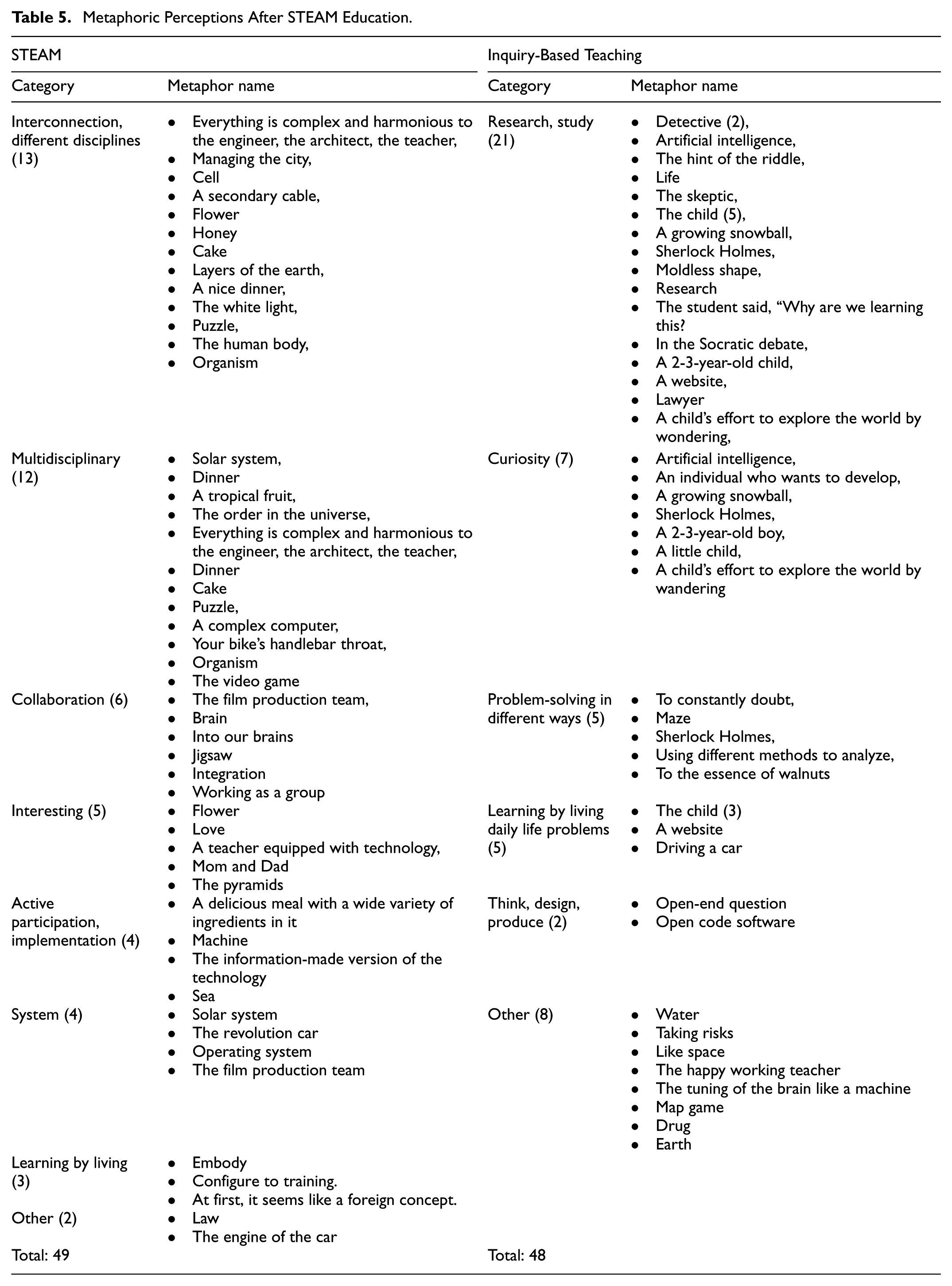
When the categories related to STEAM metaphoric perceptions after training were examined, it was seen that most metaphors are interrelated in different disciplines and multidisciplinary categories. These two categories contain more than half of all metaphors. The general opinion of post-education teachers about STEAM is that it has a multidisciplinary structure and that different disciplines come together to form STEAM. Then, the most common metaphors are collaboration, engaging, active participation, application, and system categories. According to these categories, STEAM has a multidisciplinary structure of different disciplines. Also, it attaches importance to cooperation, active participation, learning by living, and structuring principles. Sample metaphors for these categories are given in Table 6.
Examples of STEAM-Related Metaphors After STEAM Education.

When the metaphor concepts that occurred with STEAM after STEAM education were examined, it was seen that ten living beings, eight human devices or structures, six meals, three abstract concept metaphors related to the universe were formed, and one configuration training and one love metaphor. Four metaphor phrases about living beings are related to the profession, while six are likened to human organs. When we look at the reasons for the metaphor, the multidisciplinary and interdisciplinary structure of STEAM is emphasized. For example, “STEAM is like mom and dad; when you want children, they can be everything and do excellent work,” or “STEAM is like a cell because the cell can be whole and solid with parts in another.”
When Table 5 is examined, the category of research and review contains most of the resulting metaphors. The second category, which has the most metaphors in the sense of curiosity and research, contains more than half of the metaphors produced related to the IBT and the review category. That means these two categories reflect more than half of the perceptions of those who participated in the IBT-related research. According to these categories, the IBT means curiosity, conducting research, problem-solving in different ways, learning by doing, thinking, designing, and producing. Sample metaphors for these categories are given in Table 7.
Examples of IBT-Related Metaphors After STEAM Education.

After the training, when the metaphors about the IBT are examined in Table 5, there are eight metaphors about children and six human investigative metaphors. Examples of these metaphors include “Inquiry-based education is like a child because it always learns by asking everything by researching and living,” or “Inquiry-based education is like detective work because it is resolved by asking, researching and in-depth examination with examination observation.” After training, the common feature in all human metaphors is that they are researchers. Twelve object metaphors are produced as inanimate beings. No communal point was found when the reasons for these metaphors were examined. Each object is encoded under a different category. That means participants in the research do not have a shared sense of metaphor when using object metaphors. Examples of these metaphors include “Inquiry-based training is like water because water is life!” or “Inquiry-based training is like the essence of walnuts because breaking the shell and reaching the essence requires different methods.”
When the categories consisting of STEAM metaphors before and after training were examined, it was seen that the multidisciplinary and active participation categories of teachers related to STEAM have not changed. Instead of the STEAM-related product, integrity between parts, complexity, multiple jobs, and support categories of pre-education teachers, different disciplines, collaboration, engaging, system, and learning by living categories have been formed. Its other category fell from five metaphors to two metaphors.
When the categories consisting of IBT metaphors before and after training were examined, the pre-training categories changed “to ask constant questions like children, to investigate by a question, to find ways, to research and reach conclusions like detectives, to research, question, think, move through the labyrinth and try different ways as in the training process,” and were replaced by “researching, examining, curiosity, learning by living, daily life problems, thinking, designing, producing, solving problems in different ways.” Its other category went from seven metaphors to eight metaphors.
Discussion
This study used a metaphoric research method to examine the effects of STEAM education on inquiry-based teaching and STEAM awareness and conceptual perceptions of teachers.
When teachers examined the metaphoric perceptions of teachers before and after STEAM education, eight categories were formed from 34 STEAM-related metaphors before training. There were six categories of 36 metaphors related to inquiry-based teaching. After the training, eight categories were formed from 42 STEAM-related metaphors, while six were formed from 36 IBT-related metaphors.
When we look at the metaphors related to STEAM before education, the concept of STEAM is associated with various jobs done by the human organ or associated with various professions that human beings do. In STEAM, which is likened to various objects as inanimate beings, an association has been made between the functions of objects in everyday life. A relationship has been established between the structure of some objects and STEAM. When examining the study of Acar et al. (2020), it is seen that pre-service teachers’ perceptions of STEAM are associated with the organs or skills of human beings. That supports the findings of the study.
The STEAM concept has also been likened to learning and problem-based teaching with project-based training. In STEAM, where the student actively participates in both educational models, the student must participate in the learning process. In the research conducted by Yıldırım and Türk (2018), STEAM education was also conducted on children: problem-solving, critical thinking, creative thinking, and increased motivation. In addition, it can be said to create effects such as co-working awareness and design-oriented thinking. In addition, the “mud kitchen” event developed by Turner and Williams (2020) also serves as an example of the simulation of play learning and creating a learning space for children through play.
Suppose the STEAM concept is interpreted through metaphors. In that case, STEAM is made up of categories of guidance, algorithm, and regeneration, which include multidisciplinary, interdisciplinary, resulting products in harmony with each other, complex structure, a production that requires active participation, doing more than one job at a time and supporting each other, requiring skills, problem-based teaching. These STEAM features are essential in raising future generations, especially in preschool and primary education. Yıldırım and Türk (2018) mentioned the importance of using STEAM education in primary and preschool education. Acar et al. (2020) have defined STEAM as integrating education disciplines and creating a product. In the research conducted by Karakaya et al. (2019), STEAM activities have been positively affected by the courses of primary school students due to situations such as developing solutions to the problems encountered by applying the information learned.
In pre-education, IBT-related metaphors about human traits were used the most, and after that, metaphors were produced about the ability of children to be curious. That shows questioning-based teaching improves the child’s curiosity and reveals curious people. IBT metaphors mean conducting research, exploring, and reaching the research results on a specific subject. Because of their explanations by wondering and researching the facts they do not know, students’ studies are related to questioning-based teaching (Novak, 1964).
IBT-related inanimate entity metaphors are often concrete objects. The IBT has tried to identify these substantial inanimate assets through their properties. These inanimate beings are generally defined as making the person more alive and powerful and strengthening the view. In this sense, the IBT has been defined as an entity that strengthens the individual’s view of the individual.
If we define the IBT through metaphors, it means constantly asking questions like children, questioning them, researching, and reaching conclusions like detectives, researching, questioning, thinking, solving complex problems as in the educational process, trying different ways, and bringing out products, providing a different perspective, empowering people, providing a clear view of the basis of everything, blending thoughts. It is also stated that it is essential for teachers to be encouraged in preschool education to organize, discuss, and produce children’s research, questioning planning practices and learning processes (MoNE, 2013).
It has been observed that pre-education teachers have perceptions about the IBT, research, asking questions, finding new things, and learning by doing new things. After the training, the STEAM concept of teachers has a multidisciplinary structure consisting of different disciplines, attaching importance to cooperation, active participation, learning by living, and structuring principles. Teachers’ general opinion about STEAM is that it has a multidisciplinary structure and that different disciplines come together to form STEAM. According to the results of the research conducted by Yıldırım and Türk (2018), teachers form the concept; science-mathematics disciplines constitute the concept of engineering, and science-mathematics-engineering disciplines constitute the concept of technology. Çalisici and Sümen (2018) expressed STEAM education as an approach consisting of disciplines that complement each other. In addition, the candidates indicated that these disciplines complement each other and form STEAM. Other STEAM-related categories are collaboration, engagement, active participation, learning by living, implementation, and system. That reflects the characteristics in which the STEAM concept is housed. Through these categories, STEAM activities reflect that students actively participate in exciting topics in cooperation and practice their application processes to understand the system and learn through activities according to the philosophy of configured learning. Because of these properties, Acar et al. (2020) stated that STEAM education should be given to students studying at education faculties, especially from the first grade of education faculties, starting from the first, second, and third grades, and STEAM education is given only in the last year will be insufficient.
After the training, it was seen that teachers’ perceptions of inquiry-based teaching are generally shaped by research and examination. In general, teachers perceive IBT as researching, examining, and solving problems in different ways, learning, thinking, designing, and producing by living daily life problems. When we look at the metaphor sentences related to the IBT after training, the metaphors used were tried to be defined more through the character, such as the child or investigative detective interested in research.
STEAM education reinforced teachers’ ideas of multidisciplinary and active participation in STEAM. Before STEAM education, teachers supported each other; multiple categories of work, products, and integrity between parts have changed to post-education collaboration, learning by living, engaging, and system. STEAM’s category for combining different disciplines is the most significant change after education. No such category has occurred before STEAM education. In the study of Ergün and Kıyıcı (2019), the category with the highest frequency among the categories obtained for STEAM education was “STEAM education as an interdisciplinary approach.” In the study conducted by Özbilen (2018), teachers also indicated that STEAM was an effective educational model in embodying abstract subjects and associating subjects with daily life. After the training, teachers’ perceptions of STEAM improved, so the number of metaphor codes in the other category decreased from five to two.
STEAM education has caused various changes in teachers’ perceptions of the IBT concept. In particular, the category of “constantly asking questions like children” and “investigating like a detective and reaching a conclusion” is the category of “conducting research, examining”; the category “research, questioning, thinking as in the training process” category is “thinking, designing, producing”; The category of “navigate the maze, trying different paths” has also become the category of “problem-solving in different ways.” The “research by questioning, finding a way” category that occurred before the training was replaced by the categories of “sense of curiosity” and “learning by living, daily life problems.” That shows that STEAM education also affects teachers’ IBT-facing perceptions. It has been observed that pre-education teachers’ perceptions of IBT are concepts for daily life, while post-education perceptions are transformed into academic concepts. In the study conducted by Bozkurt Altan et al. (2016), it can be said that because of STEAM activities with teacher candidates, they express similar changes against the IBT and learning by living by doing. The lack of a reduction in the other category may mean that teachers contradict concepts related to the IBT.
Conclusions
As a result, activity-based STEAM education was provided in two different schools. Teachers’ perceptions about STEAM and IBT were examined before and after STEAM education. It was observed that STEAM education prepared on an activity basis positively affected teachers’ perceptions of STEAM and IBT, and especially the concepts they used changed from daily life to academic concepts. After STEAM education, the teachers defined STEAM as an exciting system that requires multidisciplinary and active participation, collaboration, learning by doing, and experiencing. The teachers produced concepts such as researching, analyzing, wondering, and solving daily life problems in different ways following the actual definition. That demonstrated that activity-based STEAM education has been positively effective in teaching STEAM and IBT concepts. In addition, it is natural that STEAM education is expected to improve students’ perceptions of IBT due to providing education to students with an inquiry-based approach. This study supported this.
Footnotes
Acknowledgements
The authors would like to thank Gaziantep University BAP and Silkroad Development Agency for the funding they provided.

Ethical Considerations
Minimal risk: Since the research does not involve any physical or psychological risks to participants, ethical clearance is not necessary. The data collection process is non-intrusive and respects participants’ autonomy and privacy. Educational improvement focus: The study aims to enhance educators’ understanding of STEAM principles and inquiry-based teaching, ultimately contributing to the improvement of teaching practices. Such endeavors are in line with the ethical principles of professional development and educational enhancement. Voluntary participation: Participation in the study is voluntary, and participants’ identities are kept confidential through anonymization measures. This ensures that individuals have the freedom to participate without fear of repercussion or loss of privacy. Adherence to guidelines: The research design adheres to established ethical guidelines and standards for educational research. By following these guidelines and ensuring transparency and integrity in the research process, ethical clearance is deemed unnecessary. Informed written consent has been obtained from all participants.
Author Contributions
Mehmet Başaran contributed to data analysis and interpretation, revised the manuscript, taught STEM activities, and helped with the study’s conception and design. Ömer Faruk Vural contributed to the study’s design, data collection and interpretation, and manuscript revision. All authors read and approved the final manuscript.
Funding
The authors disclosed receipt of the following financial support for the research, authorship, and/or publication of this article: This research was financed by Gaziantep University BAP RM.01 coded project and Silkroad Development Agency.
Declaration of Conflicting Interests
The authors declared no potential conflicts of interest with respect to the research, authorship, and/or publication of this article.
Data Availability Statement
The datasets analysed during the current study are not publicly available due to the request made in the consent forms issued to participants.