




Abstract
This study focuses on whether the metaphors of visual perception are really as universal as has been argued in the literature as research in non-Western languages has demonstrated that the metaphors are not universal. Thus, this study aims at unraveling the conceptual metaphors underlying the linguistic expressions of the Arabic verb of visual perception ىأر (ra’a) in fiction writing. This study adopts a qualitative approach and is situated within the field of cognitive semantics. A corpus of Arabic fiction writing, comprising 1 million words, between the period of 2010 and 2017 was compiled from different sources. Specifically, a sample consisting of 1,000 examples of the Arabic verb of visual perception ىأر was randomly extracted from the corpus using Ghawwas_V4.6 concordancer. The metaphor identification procedures (MIPs) were used to identify the metaphorical linguistic expressions in the corpus, and Lakoff and Johnson’s and Sweetser’s analytical frameworks were adopted for data analysis. The data analysis revealed many conceptual metaphors of knowledge and understanding underlying the metaphorical linguistic expression of the verb ىأر in Arabic. The findings of this study support Sweetser’s claim regarding the universality of conceptual metaphors related to the verbs of visual perception in motivating metaphors of knowledge and intellection. Thus, this study contributes to the literature on verbs of perception, particularly verbs of visual perception, as it is the first to address the conceptual metaphors underlying the verb ىأر in Arabic using real authentic corpus of fiction writing.
Introduction
Verbs of perception, which have been defined in the literature as a class of verbs to “express verbal expressions related to human sensory cognition, sight (visual), smell (olfactory), hearing (auditory), touch (tactile) and taste (gustatory),” have received the attention of various scholars in the area of cognitive semantics (Ibarretxe-Antuñano, 2013a, 2013b, 2019; Al-Asmer, 2007). Among these verbs of perception, verbs related to vision, which are referred to as verbs of visual perception in this study, have gained a particular interest of scholars in the field as they are connected to the primary sensory organ of vision that is used in gathering information about the external world (Lakoff & Johnson, 1999). For instance, according to Sweetser (1990), the information gathered by the sense of vision is considered more reliable and accurate compared with other senses, such as hearing, taste, and smell. In this regard, some studies have shown that the primacy of vision over the other senses is attributed to human biological construction (Blendea, 2015).
Another reason why the verbs of visual perception gained the interest of scholars is because studies on those verbs have shown that the verbs of visual perception motivate the highest number of extended meanings compared with the other verbs of perception (Siregar, 2016; Zade & Esfahani, 2015). The Arabic verbs of visual perception رأى (ra’a) denote a variety of metaphorical meanings connected with knowledge and intellection, such as “أرى ماذا تعني” (lit. I see what you mean) in which the verb أرى (a’ra) (lit. I see) denotes the meanings of knowing and understanding. In fact, verbs of visual perception, in particular, and the sense of vision, in general, have received special attention by cognitive linguists such as Sweetser (1990) in which she postulated that the sense of sight motivates metaphors of higher intellection, such as “to know” and “to understand,” and that these metaphors are universal in human thought and speech.
In addition, there are various meanings and associations linked to the sensory modality of vision in different languages. Whereas vision may be associated with reason or witchcraft in Austronesian society (Breton, 2017), it is connected with affection in Chinese (Li, 2013). Generally, these sensory associations constitute the sensory model used by a community. Members of the community make sense of their world by translating sensory perceptions and concepts into a certain worldview. Although some groups within the community may challenge this sensory model because they have different “sensory values, this model provides the foundation of a perceptual paradigm to be followed or resisted” (Breton, 2017). In this light, verbs of perception, in general, and verbs of visual perception, in particular, display an intricate structure of metaphorical meanings that may be motivated by human bodily basis and some cultural values intrinsic in each society. With this in mind, this study focuses on one verb of visual perception, namely, the Arabic verbرأى (ra’a); the conceptualization and the metaphoric uses of this verb in fiction writing; and whether or not Sweetser’s hypothesis of the universality of vision metaphor also applies to the Arabic language. It worth mentioning here that other Arabic verbs of perception such as سمع (sami’a) “to hear,” لمس (lamasa) “to touch,” ذاق (dhāqa) “to taste,” and شعر (sha’ara) “to feel” are not within the scope of this study. This study focuses only on the verb of visual perception رأى (ra’a) as it is linked to Sweetser’s (1990) hypothesis of the universality of the conceptual metaphors of vision.
Statement of the Problem
One of the major topics that have received the attention in cognitive semantics is sense perception, which has been a focus not only in linguistics but also in other disciplines, such as psychology (Goldstein & Brockmole, 2016; Sekuler & Blake, 2005) and anthropology (Pink, 2015; Serres, 2016). In cognitive linguistics, sense perception and its conceptual structure have sparked interest of many scholars because its conceptual domain is very productive, and it motivates various conceptual metaphors. In this respect, Ibarretxe-Antuñano (2013a) states that conceptual motivation is the outcome of “our physical, sensory-motor universal experiences shifted through the complex and socially acquired particular beliefs, knowledge and worldview(s) intrinsic to . . . cultures” (p. 110).
The relationship between perception and other conceptual domains such as cognition has been established first by Lakoff and Johnson (1980) who proposed a general metaphor “THINKING IS PERCEIVING,” but emphasized the significance of vision for cognition over other senses. Based on this conceptual metaphor, Sweetser (1990) further proposed the conceptual metaphor MIND-AS-BODY and posited that there is a systematic metaphorical connection “between the physical visual perception and the abstract domain of the mind.” Accordingly, she stressed that these correspondences are not random but highly motivated associations between comparable areas of physical and internal sensation. Moreover, Sweetser (1990) argues that vision is the prime sense organ that motivates metaphors of higher intellect, such as “knowing,” “understanding,” and “thinking,” and further hypothesizes that the metaphors of verbs of perception are cross-cultural and universal in human thought and speech.
Studies on Western languages such as English and Spanish (Littlemore et al., 2015; San Roque et al., 2015) seem to support Sweetser’s (1990) hypothesis regarding the systematic mappings between the physical domain of perception and the abstract domain of the mind and the notion of universality of visual perception as the main sensory organ in motivating metaphors of knowledge and intellection. However, some studies on non-Western languages have shown otherwise. For instance, Oanch (2016) tested Sweetser’s hypothesis by carrying out a cross-linguistic study of English and Vietnamese. The study was based on large data extracted from English and Vietnamese dictionaries and thesaurus. The findings of this study indicate that visual perception in Vietnamese is more linked to affection and sentiment rather than to knowledge and intellection.
Thus far, although the literature has reported studies of verbs of perception within the Indo-European languages, verbs of perception in Arabic have received the least attention. In Arabic, the issue whether vision plays a salient role or not in the conceptualization of the intellect has been a topic discussed by many Arab philosophers. Studies have argued that both vision and hearing are the most important senses in learning (Sawaluddin et al., 2018). According to Sempo et al. (2017), Arab people have derived from the sense of vision many expressions signifying intellection and understanding. Moreover, senses of vision and hearing are claimed to be partners in achieving full awareness of attaining knowledge and are supposedly the true instruments of knowledge and reason (Sawaluddin et al., 2018).
In relation to this, some studies have dealt with the Arabic verbs of perception in the Holy Quran, such as those by Zade and Esfahani (2015), Kadhim and Hassan (2016), and Siregar (2016), which focused on the semantic aspects of these verbs and their various meanings in the Holy Quran. These studies have shown that there exist many extended meanings connected with the Arabic verbs of visual perception, such as “to know,” “to recognize,” “to wait,” “to give time,” “to contemplate,” “to show mercy,” “to delay,” “to tell,” “to consult,” “to assume,” “to meet,” and “to dream.” However, none of these studies have examined the Arabic verbs of perception from a cognitive-semantic perspective using naturally occurring data.
To date, the review of the literature shows that there are no previous studies that have examined the conceptual metaphors related to the use of the Arabic verbs of visual perception. As discussed earlier, the reviewed studies on the verbs of visual perception seem to have a lack of systematic research in Arabic that focused on Sweetser’s hypothesis regarding the MIND-AS-BODY conceptual metaphor and the universality of visual perception in motivating metaphors of knowledge and thought. In addition, the reviewed studies (Ibarretxe-Antuñano, 2019) stress the need for systematic studies that investigate the motivation of the conceptual metaphors underlying verbs of visual perception.
Bearing in mind the inadequacies of the aforementioned studies, such as basing their evidence on intuitively made-up examples by the researchers themselves and from dictionaries, the present cross-linguistic study is aimed to fill the gap in the literature by focusing on the conceptual metaphors underlying the Arabic verb of visual perception رأى, using authentic naturally occurring data produced by a variety of writers in fiction writing.
Research Questions
The study has two specific questions as follows:
1. What are the conceptual metaphors underlying the metaphorical expressions related to the Arabic verb of visual perception رأى (ra’a) in fiction writing.
2. What is the theoretical implications of the findings related to the MIND-AS-BODY theory as posited by Sweetser.
Verbs of Visual Perception in Fiction Writing
The uses of verbs of perception appear significantly in fiction writing. A lot of books which are dedicated to narrative literature indicate that verbs of perception are employed in fiction for the sake of achieving depth and establishing a realistic atmosphere in the literary work. Sensory perception such as sight, hearing, smell, taste, and touch creates an internal viewpoint that reflects multiple levels of the character’s psyche. To make it apparent that not only the narrator but also the character perceives the object, the narrator uses verbs connected with the senses: see, hear, feel, and so on. He may as well make an associative connection between the object of perception and the perceiver (Farner, 2015).
Moreover, Klaassen (2015) stated that sensation is the fiction-writing mode that makes it possible for a reader to experience and live the events in such a way that he can see, hear, feel, smell, and taste the world of the story. Sensation creates vivid details that bring action to life, reflecting credibility and realism such as the taste and smell of blood during a battle scene. Sensation can work as a stimulator for memory recollection, which may be helpful in delivering backstory. For example, the smell of perfume may trigger a character to remember pleasant memories of a lover. Indeed, sensation can be an effective instrument for developing a character, particularly developing internal emotional responses to certain stimuli.
In addition, a recent theoretical article by Van Krieken et al. (2017) revealed that fiction is a fertile ground to explore and discover something new about the metaphorical nature of verbs of perception. Such verbs are employed not only to create new worlds and new experiences but also to make readers see through the character’s perspective in the story. Literary texts reflect bodily and cultural experiences which are possibly laden with images and conceptual metaphors that make them satisfactory to achieve the objectives of this research.
Theoretical Framework
The study adopts the framework of cognitive semantics, specifically the conceptual metaphor theory (CMT), which is a theory subsumed under cognitive linguistics, as the foundation for data analysis, (Lakoff & Johnson, 2003). The most basic definition of a conceptual metaphor can be stated as “understanding and experiencing one kind of thing in terms of another” (Lakoff & Johnson, 2003, p. 5). Specifically, conceptual metaphors involve mappings of certain elements from a source domain to a target domain: TARGET IS SOURCE. Usually, the source domain is more concrete, and the metaphorical expressions are drawn from it to understand the target domain. In contrast, “the target domain is usually more abstract, and it is understood through the metaphor” (Kövecses, 2015).
In essence, a metaphor is a basic imaginative cognitive mechanism. It is the “means by which it is possible to ground our conceptual systems experientially and to reason in a constrained but creative fashion” (Johnson, 1992, p. 351). As Kövecses (2015) puts it, this mechanism is a “complex mental mapping of our knowledge of one domain of experience (the source domain) to structure our knowledge of a different domain of experience (the target domain)” (p. 12). In brief, conceptual metaphor is perceived as an association between two conceptual domains by which the abstract is understood in terms of the familiar knowledge of the concrete and easy one (Al-Shunnag, 2016; Kövecses, 2015).
The CMT has been used by Sweetser (1990) to examine the metaphorical and polysemic meanings of verbs of perception in Indo-European languages from a diachronic and cognitive perspective. She argues that there are systematic metaphorical relations between verbs of perception and meanings associated with internal sensations. In fact, Sweetser (1990) takes up the interface between perception and other conceptual domains and expands it further into the so-called “MIND-AS-BODY” metaphor (p. 28). She applied this metaphor to English verbs of perception and demonstrated that the relation between the body and the mind is not limited to just one sole metaphor such as UNDERSTANDING/KNOWING IS SEEING. In fact, there is an entire organized and consistent group of metaphoric mappings that utilizes the body as the source domain and the mind as the target domain.
The two aforementioned theories, the CMT and MIND-AS-BODY theory (Lakoff & Johnson, 2003; Sweetser, 1990), are incorporated in this study because they closely relate to answering its questions for unraveling the conceptual metaphors underlying the Arabic verb of visual perception رأى as Figure 1 illustrates.

Theoretical framework.
As Figure 1 shows, the mapping of the conceptual metaphors underlying the verbs of visual perception occurs between the physical source domain of sight and the abstract target domain of the mind.
Literature Review
Most of the previous Arabic studies on verbs of perception have focused on their use in the Holy Quran due to their pervasiveness in this religious discourse. In this regard, the most comprehensive studies in this area were conducted by Zade and Esfahani (2015), Sempo et al. (2017), and Siregar (2016) who focused on the semantic aspects of the five human senses in the Holy Quran. The findings of these studies have shown that the Arabic verb of visual perception رأى (ra’a) has the following extended meanings: (a) to know, to contemplate; (b) to think, to consult; and (c) to dream as shown in Examples (1), (2), and (3) consecutively:

Moreover, the findings of Siregar’s (2016) study revealed that the verbs of perception have an educational implication in the Holy Quran whereby the Quran plays an important role in developing the senses and building a well-unified sensory system that integrates both the five senses and the mind to acquire knowledge and apply it in different settings and situations.
Using a different approach that depends on a discourse of conversational data, Grigore (2014), in his article, analyzed the polysemy of the verb of perception شاف (shāf’) “to see” in colloquial Baghdadi Arabic by testing two universal hypotheses regarding verbs of perception. The first is Viberg’s (1983) universal hierarchy of the senses within the sense modality (i.e., intra-field extensions, like “to see” > “to hear”) and the second by Sweetser (1990), which dealt with the cognitive semantic extension of verbs of perception to domains of intellection and knowledge (i.e., trans-field extensions, like “to see” > “to know”).
The corpus employed for Grigore’s (2014) study comprises recordings of Baghdad dialect as well as several sentences taken from dictionaries of Iraqi Arabic. The results of his study showed that both hypotheses are evident in the verb شاف (shāf’) “to see” in Baghdadi Arabic. The findings of the study support Viberg’s (1983) hypothesis of the hierarchy of the senses which states that the sense of sight is on the top of this hierarchy. Moreover, the study supports Sweetser’s (1990) theory of the universality of vision metaphor and the connection between vision and intellection. This theory stated that many terms which belong to the visual field can be used to express some cognitive-intellectual processes, and it is true in all languages.
Grigore’s study analyzed the colloquial verb شاف (shāf’) “to see” which is different from the verb رأى (ra’a) “to see” that is used in Modern Standard Arabic. A key strength of the study lies in using real corpus data rather than dictionary entries. However, the study has certain points of weakness in that it does not contain any description of the corpus data. No account has been given about the size or the time span of the corpus.
In the same vein, another more recent comparative study which dealt with the semantic extensions of verbs of perception was that of Al-Ameedi and Mayuuf (2016). The study focused on the semantic extensions of the verbs of touch in English and Arabic. This study attempted to provide a semantic classification of the English and Arabic verbs of touch based on entries from dictionaries. Although there was no mention of a theoretical framework in their study, it seemed that the study followed a lexical semantic approach in providing the semantic classification of verbs of touch.
This study concluded that there are two kinds of verbs of touch in English and Arabic: major ones and minor. The major verbs are those which are used commonly: touch, feel in English and مس (massa) and لمس (lamasa) (both means “to touch”) in Arabic, whereas the other verbs of touch are less commonly used in both languages. English and Arabic verbs of touch can cover a variety of extended meanings, which can be taken as examples of metaphor and polysemy. The number of extended meanings of the verbs of touch in English exceeded those of Arabic.
Previous studies on the Arabic verbs of perception show that the area is still new and not trodden and in desperate need for more studies especially in the area of usage-based studies as traditional ways proved to be insufficient to reach conclusive results. Ibarretxe-Antuñano (2019) has stressed the need for a serious corpus study on the usage of perception metaphors from an inter- and intralinguistic perspective. Any usage-based approach needs, by definition, real data to confirm its arguments in addition to extract usage patterns. The methodology and toolkit of corpus studies could be a good candidate to achieve this goal. As previous studies have shown, the abundance and richness of perception metaphors are unquestionable; now is the need to move further and see whether some differences exist in the usages of these metaphors.
So far, the review of the studies on Arabic verbs of perception has shown that these studies have focused mainly on the Holy Quran and dictionaries. These types of data, however, are not sufficient to fully account for the complicated nature of verbs of perception. There is a serious need for a study based on a large corpus for the Arabic verbs of perception to fully grasp the universal phenomena of the primacy of vision. Moreover, the Arabic verbs of perception have been investigated within the framework of lexical semantics, which falls short in explaining the metaphorical nature of the verb رأى (ra’a). Thus, this study claims to offer insights about the Arabic verbs of visual perception رأى (ra’a) in fiction writing, which have never been studied before. Focusing solely on the employment of verb of visual perception رأى (ra’a) in fiction writing using large corpora will add new insights about the metaphorical nature of the verb.
Method
This study is a nonexperimental descriptive study. It focuses on unraveling the conceptual metaphors underlying the metaphorical linguistic expressions of the Arabic verbs of visual perception رأى (ra’a), which necessitates the use of an interpretive qualitative approach that provides a description of the cognitive phenomena of the conceptual mapping from the physical domain of vision into the different domains of human experience.
This study depends on a corpus of Arabic fiction writings. One of the advantages of using corpora as data sources is that large numbers of computerized corpora enable the researcher to identify patterns of uses more quickly than relying on individual texts or intuition. Moreover, using the tool of a concordancing offers a more objective analysis of language because the researcher approaches his or her data without having any preconceived judgments about their semantic/pragmatic content (Deignan, 2017).
This study depended on a corpus designed for the purpose of the study. The size of the corpus is 1 million words, which includes samples of fiction novels and short stories of the five major fiction categories, namely, fantasy, romance, mystery, thriller, and science fiction (Peterson, 2016). Every effort was exerted to compile fiction writing from balanced categories of fiction. Notably, the present corpora contain 60% of novels and 40% of short stories. Romantic fiction novels constitute the largest part of the Arabic corpus with 40% due to their availability in electronic form and popularity within the Arab reading community.
Data Collection Procedures
The data collection procedures involved three steps. The first step was to retrieve the files of the corpus of Arabic fiction writing using a concordancing program. The use of concordancing enabled the examination of the verb رأى (ra’a) by studying its numerous occurrences in their contextual environment (Weisser, 2016). The Arabic corpus of fiction writing was processed using Ghawwas_V4.6 as it is considered an excellent tool for analyzing Arabic corpora (Alfaifi & Atwell, 2016). After data retrieval, the second step was to search for the keywords in the concordancing software. The search process of the Arabic keyword رأى (ra’a) and its different morphological forms resulted in 2,023 occurrences.
Finally, the third process involved extracting a sample from the total number of occurrences of the keywords رأى (ra’a). A sample of 1,000 examples of the keyword رأى (ra’a) was extracted from the corpus of Arabic fiction writing. The sample was extracted randomly using a research randomizer (https://www.randomizer.org/) which generated random numbers after the required information was entered. A set of 1,000 sorted numbers with a range from 1 to 2,023 was generated for the verb رأى (ra’a). The 1,000 examples identified were saved in a Microsoft word file to be prepared for analysis. The number of 1,000 examples was proposed by Deignan (2017) who stated that a large sample of 1,000 examples is considered sufficient and satisfactory to examine the different senses of any lexical item.
Data Analysis
The data analysis of this study requires the use of the metaphor identification procedures (MIPs) (Pragglejaz, 2007) to identify the metaphorical linguistic expressions of the Arabic verb رأى (ra’a). The entire procedure comprised four steps which include the following points: (a) reading the entire text, (b) determining the contextual meaning of each verb in the text, (c) finding out whether the verb has a basic meaning in other context, and (d) if there is contrast between the contextual meaning and the basic meaning of the verb, then it is a metaphor. To achieve accuracy in the identification of the metaphorical meaning, Arabic dictionaries were used to decipher the basic meaning of the verb رأى (ra’a) such as Lexicon of the Modern Arabic Language (Omar, 2008), Lisan Al-Arab (Ibn Munzur, 1883), and Al-Mu’jam Al-Waseet (Ibraheem et al., 1987).
After the stage of identifying the metaphorical linguistic expression of the verb رأى, the next step is inferring an underlying conceptual structure from the linguistic expressions using the CMT (Lakoff & Johnson, 2003) as the framework of analysis. It has already been established in the theoretical framework Section that a conceptual shift is stimulated by conceptual similarities between two domains: source domain and target domain, in a way that certain elements of the former are mapped into the latter. In this case, the two domains must be interpreted properly and then categorized.
Trustworthiness and Credibility
To ensure trustworthiness and credibility of the research, one procedure was undertaken: an expert review (Baily, 2017).
Expert Review/Verification
Establishing a match between responses from an expert is a credibility criterion which is similar to internal validity (Simon & Goes, 2018; Bailey, 2017). In this study, this is accomplished by the review and verification procedures involving an expert checking and verifying the accuracy of one set of analyzed data in terms of their metaphorical meanings. The one set of data comprises 40 expressions containing verbs of visual perception رأى (ra’a) in Arabic. The expert reviewer, a professor in the field of Arabic language and linguistics, and familiar with research in metaphor, participated in the verification procedure using the cognitive semantic approach. The verification process was completed within 2 weeks. After receiving the verified data from the expert, these data were subjected to analysis in terms of the agreement in the identification of the metaphorical meaning between the researcher and the expert. It is revealed that the percentage of agreement between the expert and the researcher is very high (90%).
Besides the procedure of validation of the two sets of analyzed data, the accuracy of the translation of the Arabic data into English is also another important aspect concerned with trustworthiness and credibility. The data were translated by the researcher herself first and later verified by an expert in the field of translation. The expert is a retired Associate Professor in English language and translation with more than 25 years of teaching experience at the University of Baghdad.
Results and Discussion
This section answers Research Questions 1 and 2 regarding the conceptual metaphors underlying the Arabic verb of visual perception رأى (ra’a) and the theoretical implications of the MIND-AS-BODY theory proposed by Sweetser (1990) with regard to the universality of the metaphors of visual perception in Indo-European languages.
The Conceptual Metaphors Underlying the Arabic Verb of Visual Perception ىأر
This section discusses the results of Research Question 1. It will first report the frequency of the conceptual metaphors of the Arabic verb رأى (ra’a), followed by subsections that discuss each conceptual metaphor. The MIP (Pragglejaz, 2007) revealed that the verb رأى conveys a vast number of metaphorical meanings comprising 367 metaphorical linguistic expressions out of the total sample of 1,000 examples as shown in Table 1.
Number of Metaphorical and Literal Expressions of the Verb ىأر (ra’a) in the Data.

The analysis in this section includes the most salient conceptual metaphors manifested by the verb رأى (ra’a) as shown in Table 2. Table 2 presents the most frequent conceptual metaphors that underlie the identified metaphorical linguistic expressions for the Arabic verb رأى (ra’a).
Frequency and Percentage of Conceptual Metaphors Underlying the Verb رأى (ra’a) in Arabic.
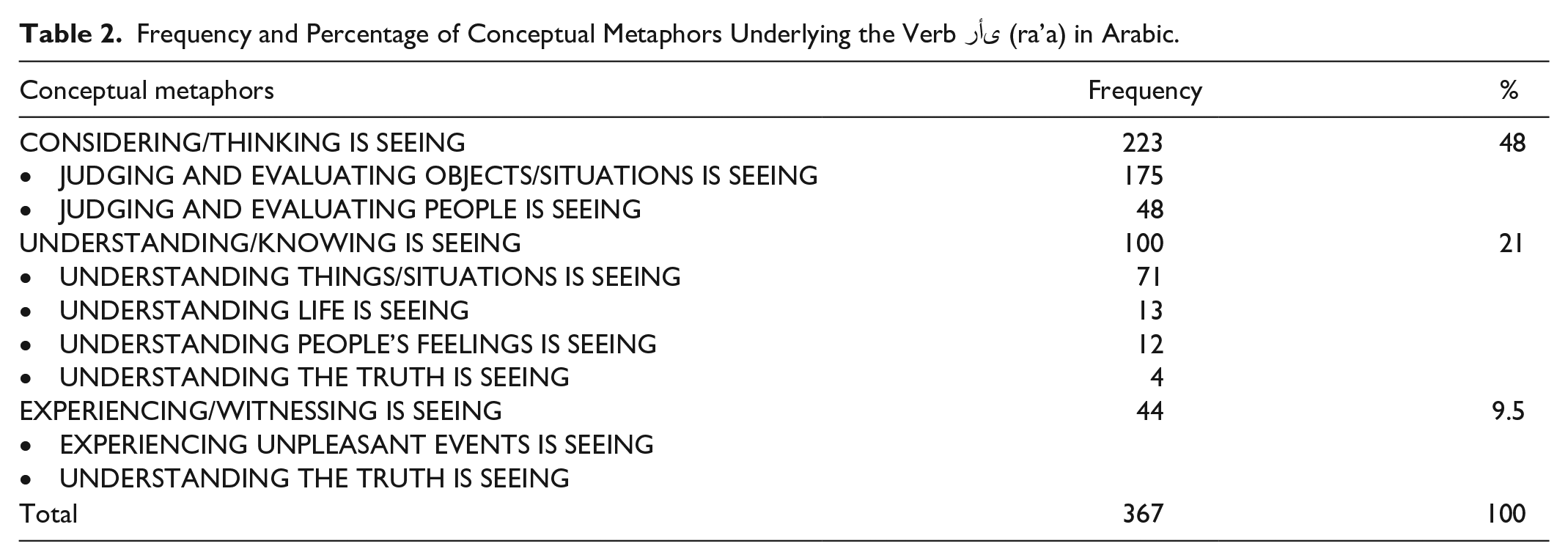
Table 2 shows that the most frequent conceptual metaphor in Arabic corpus is CONSIDERING/THINKING IS SEEING, which constitutes 48% of the corpus. The fact that the most pervasive conceptual metaphors in the data are those that show connection between the physical domain of sight and the abstract domain of cognition agrees with Sweetser’s (1990) hypothesis which postulated that the conceptual metaphors underlying verbs of visual perception are cross-cultural, universal phenomena in human thought and speech. Moreover, these findings are in agreement with Sweetser’s (1990) MIND-AS-BODY theory which considered vision as the prime sense organ that motivates metaphors of higher intellect, such as “knowing,” “understanding,” and “thinking.” The conceptual metaphors shown in Table 2 are explained in detail in the upcoming subsections.
CONSIDERING/THINKING IS SEEING
The conceptual metaphor CONSIDERING/THINKING IS SEEING is the first most frequent conceptual metaphor (48%) in the Arabic corpus. The fact that this conceptual metaphor is the most frequent one in the Arabic corpus is in line with Siregar’s (2016) and Sempo et al.’s (2017) studies on the Arabic verbs of perception in the Holy Quran. These studies revealed that the most repetitive expressions in the Quran are those that manifest the connection between sight and thinking or intellection.
Siregar’s (2016) and Sempo et al.’s (2017) observation is in conformity with this study which revealed that the conceptual metaphor CONSIDERING/THINKING IS SEEING is related to the intellectual and mental activity and the ability to make judgments and form opinions about people or things (Ibarretxe-Antuñano, 2002). Usually, these opinions are subjective, in contrast with the objective nature of the sense of sight. The conceptual metaphor involves a mapping of the physical domain of vision and the mental process of thinking which can be illustrated by the following example.
The conceptual metaphor CONSIDERING/THINKING IS SEEING in the English and Arabic corpora seems to be realized in specific metaphors that signify different but related meanings such as JUDGING AND EVALUATING PEOPLE IS SEEING and JUDGING AND EVALUATING SITUATIONS/EVENTS IS SEEING
The first specific metaphor is JUDGING AND EVALUATING PEOPLE IS SEEING, which is instantiated by the linguistic expression Arabic corpus which is “رأى فلان +كاف التشبية” which means “see somebody as” as seen in the following examples:
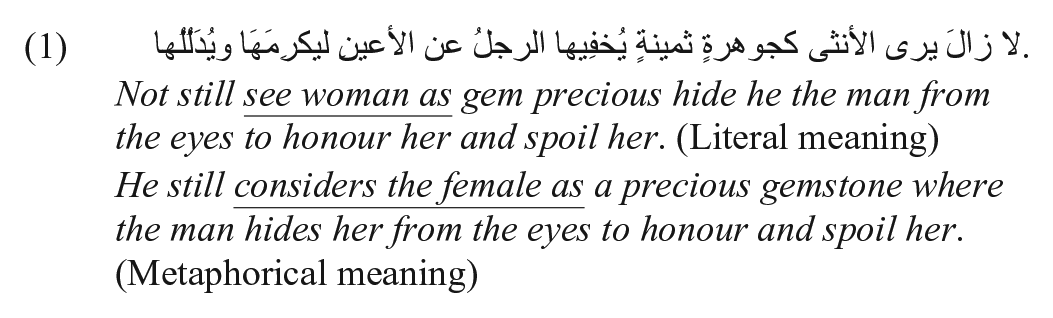
In Example (1), the verb يرى (yara) means “to consider” in which the phrase “يرى الأنثى كجوهرة” (lit. see the female as a gemstone) does not indicate a direct act of perception. Rather, the perceiver is providing a subjective descriptive opinion based on what he thinks—a comparison between the female and gemstone as both of them share similar qualities such as being precious and valuable and thus the need to hide them from people’s eyes so as not to be stolen. The expression is actually an evaluative opinion about the things (stimulus of perception) that presuppose some mental activity on the part of the perceiver. In this case, the verb يرى (yara) is used to describe mental perception, and the given cases of perception cannot be immediate and direct, for they are not based on the functions of the individual’s physical senses. The verb يرى (yara) in Example (1) is meant to convey a perception that is more inferential or intellectual rather than sensory and can have a similar meaning to the verbs of cognition such as consider (Ibarretxe-Antuñano, 2019).
Furthermore, besides judging and evaluating people as shown in the previous example, the specific metaphor JUDGING AND EVALUATING OBJECTS/SITUATIONS IS SEEING is manifested in certain examples which suggest the meaning “to judge and evaluate objects, situations and events in a particular way” (Deignan & Cameron, 2009) as in the following example:

In Example (2), the verb يرى means “to consider” whereby the perceiver had a negative experience with love and decides that love is violent like a ferocious war. This decision made by the perceiver in Example (2) cannot be achieved only by a physical act of seeing; there must be some prethinking and precontemplation that forced the perceivers to think the way they do. Through the mental process of thinking, people are able to manipulate information to form concepts, to solve problems, to reason, and to make decisions. The act of thinking produces thought, which could be an idea, a sound, an image, or even an emotional feeling that originates from the brain. As a result, the verb يرى (yara) in Example (2) cannot possibly refer to a physical act of seeing; rather, it refers to the metaphorical meaning of “to think” or “to consider.”
UNDERSTANDING/KNOWING IS SEEING
The conceptual metaphor UNDERSTANDING/KNOWING IS SEEING is realized in the Arabic corpus comprising 21%. The conceptual metaphor UNDERSTANDING/KNOWING IS SEEING involves a mapping between several elements of the source domain of physical vision and the target domain of the mental process of understanding and knowing. Specifically, the conceptual metaphor UNDERSTANDING/KNOWING IS SEEING involves a group of specific metaphors in Arabic that elaborate the general concept in one way or another such as UNDERSTANDING THINGS/SITUATIONS IS SEEING, UNDERSTANDING PEOPLE’S FEELINGS IS SEEING, and UNDERSTANDING THE TRUTH IS SEEING.
The first specific metaphor subsumed under UNDERSTANDING/KNOWING IS SEEING is UNDERSTANDING THINGS/SITUATIONS IS SEEING manifested in certain linguistic expressions, such as “لا أرى مغزى” (lit. I see no point). This expression means “to realise that there is no use or no benefit in doing something” as in Example (3):

The linguistic expression “لا أرى مغزى” (lit. see no point) in the example above is regarded as metaphorical because it refers to an abstract concept rather than concrete. According to the Lexicon of the Modern Arabic Language, the word “مغزى” means “a detail, aspect, or quality of something or someone.” Generally, any details or aspects denote abstract and immaterialistic concepts that are not perceived directly by the physical eye but perceived by the mind.
The conceptual metaphor UNDERSTANDING THINGS/SITUATION IS SEEING is also realized in the linguistic expressions “لاأرى ضيرا.” This linguistic expression is illustrated in the following example:

The linguistic expression “لست أرى ضيرا” in Example (4) means “understanding or realizing that there is no harm in doing a certain action.” The word “ضير” in the expression “see nothing wrong” represents an abstract idea or thought that cannot be detected directly by the eye but perceived and identified by the mind. It means something that is incorrect and not in accordance with the facts. For this reason, the linguistic expression “see something/anything wrong” is regarded as metaphorical.
In another metaphor UNDERSTANDING PEOPLE’S FEELINGS IS SEEING, the eyes are considered as a means to penetrate the human mind. They are regarded as a window into people’s real thoughts and souls, which are illustrated by the following example from the Arabic corpus:

In Example (5), the verb of visual perception رأى (ra’a) does not refer to a physical act of seeing because abstract concepts such as remorse, love, and fear cannot be seen by the physical eye; rather, they are realized by the mind based on certain clues in the physical environment. In Example (5), the verb رأى (ra’a) is used metaphorically, denoting the meaning “to realise or understand.” In this case, the speaker realized that the woman described was in a state of love and fear as reflected by her eyes. Generally, the eyes are regarded as a window into the human soul and mind. In the mind, there are specific areas which are occupied by feelings, emotions, and thoughts. This mental aspect is subtler than the physical body and concerns people’s awareness of inner feelings and the ability to relate to events from the outside world. At this level, the eyes could transmit the reaction of the soul, whether showing discontent, rebelliousness, happiness, love, as well as enmity and sorrow.
Moreover, understanding people’s feelings can also be achieved by looking at people’s facial features. This meaning is realized in the Arabic corpus through the following phrases: “ِعلى وجهه َرَأى التساؤل” (see wondering on his face), “رَأى الاستفهامَ على وجههِ ” (see questions on his face), and “علاماتِ الضيقِ على وجهه رَأىِ” (see signs of discomfort on his face). These expressions mean “to realise or know people’s feelings by looking at their faces” because the face is indicative of people’s thoughts and inner feelings as manifested in the following example:

In Example (6), the verb أرى (‘ara) means “to realise, to notice or to know” whereby the perceiver knew that those people described in the sentence were puzzled and confused based on signs shown on their facial features. Facial features usually reflect internal feelings which are not produced in a speech form. This process of inferring is not entirely performed by the eyes. In this case, the eyes’ functions are receptors of information which is then transmitted to the mind for interpretations.
Besides the link between the eyes and the mind in Example (6), another link can be identified between the lens of the eye and the ability to see the truth which is manifested in the specific metaphor UNDERSTANDING THE TRUTH IS SEEING as in Example (7). Accordingly, the eye lens must be transparent and not opaque for humans to see accurately. Lack of transparency or opacity in the lens is called “cataracts” which is a medical condition in which “the lens of the eye becomes progressively opaque, resulting in blurred vision” (Sekuler & Blake, 2005, p. 102). In Arabic corpus, there is a similar analogy between the cataract that damages the lens which causes blindness and people who are unable to see the truth as shown in Examples (7) and (8):
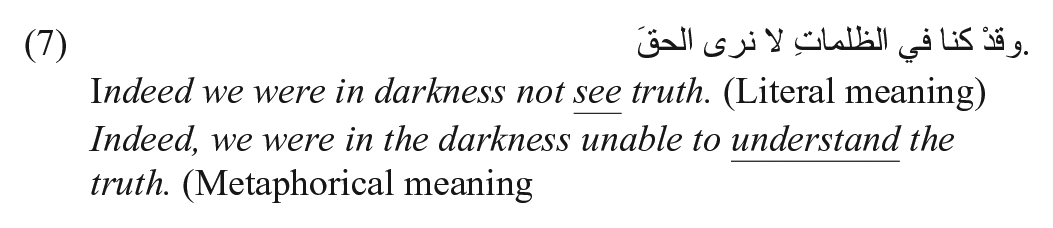
In the light of the above explanation, thus, in Example (7), there are correspondences between the damaged lenses of the eyes and the quality of darkness which blurs the vision of “we” and prevents them from seeing the truth.
EXPERIENCING/WITNESSING IS SEEING
EXPERIENCING/WITNESSING IS SEEING is the third most frequent in Arabic (9.5%). This metaphor places emphasis on the person who is considered a passive observant of the events and does not get involved physically with what is going on (Ibarretxe-Antuñano, 2013a). The data analysis also revealed some specific metaphors subsumed under the conceptual metaphor EXPERIENCING/WITNESSING IS SEEING for Arabic such as EXPERIENCING/WITNESSING UNPLEASANT EVENTS IS SEEING, EXPERIENCING/WITNESSING PLEASANT EVENTS IS SEEING.
The specific metaphor EXPERIENCING/WITNESSING UNPLEASANT EVENTS IS SEEING is instantiated by the following linguistic expressions in the Arabic corpus, which express negative pessimistic meanings such as “رأى المعاناة” (lit. see suffering), “رأى الحصار” (lit. see siege), “رأى الطقس الكئيب” (lit. see a dismal weather), “رأى الغش وعدم الامانة” (lit. see cheating and dishonesty), “رأى الانتهكات” (lit. see violation), “رأى المصائب والاهوال” (lit. see terror and disaster), “رأى’ حادث مهول” (lit. see a terrible accident), “رأى الشر” (lit. see evil), “رأى الحزن” (lit. see sadness), “رأى خسائر”(lit. see loses), “ رأى تعاسة” (lit. see misery), “رأى جريمة قتل” (lit. see a murder), “رأى احداث سيئة” (lit. see terrible things), “رأى الالم الانساني” (lit. see human pain), “ رأى كابوس” (lit. see a nightmare), “ رأى جهنم” (lit. see hell), and “رأى الموت” (lit. see the moment of death). Example (8) is provided to illustrate the point under discussion:
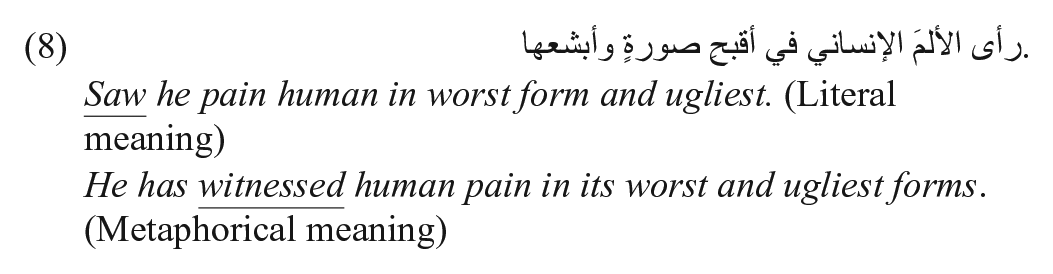
The verb رأى (ra’a) is metaphorical in Example (8); it refers to experiencing human pain. Usually, pain can be defined as “an unpleasant sensory and emotional experience associated with actual or potential tissue damage, or described in terms of such damage” (Kunzendorf, 2016, p. 247). However, human pain is more general and more complex, which cannot be perceived by the physical eye. One can realize the magnitude of the pain that humans suffer by witnessing the events unfolding in their lives and how they face difficulties, challenges, and miseries that cause their pain and suffering.
Moreover, the Arabic corpus has other examples that instantiate the specific metaphor EXPERIENCING/WITNESSING PLEASANT EVENTS IS SEEING whereby the verb رأى is followed by words that have good and positive connotations, such as “تقدم”(progress), “إنسجام” (harmony), “سعادة” (happiness), “المعجرة” (miracle), “النجاح” (success), “التحول” (change), “عظمة” (greatness), and “عدالة” (justice) as illustrated by Example (9):

In Example (9), the verb رأت (ra’at) (lit. she saw) means “to witness” whereby the perceiver witnesses a pleasant event of witnessing justice being served. In this case, the verb رأت (ra’at) cannot denote a literal physical meaning because justice is an abstract concept which involves the appropriate determination of rights and the assignment of rewards and punishments.
The Theoretical Implications of the MIND-AS-BODY Theory Regarding the Conceptual Metaphor Underlying the Arabic Verb of Visual Perception ىأر
Findings of Research Question 1 show that the most salient conceptual metaphors underlying the verb of visual perception رأى are those that show the connection between the domain of sight and the abstract domain of the mind such as CONSIDERING/THINKING IS SEEING and KNOWING/UNDERSTANDING IS SEEING. These findings are in agreement with Sweetser’s (1990) claim of the universality of the connection between the physical domain of vision and the abstract domain of knowledge and understanding. Sweetser (1990) postulates that the conceptual metaphors of visual perception are universal as they are motivated by the physiology of the body which is the same in all human beings.
The data analysis shows that the most frequent conceptual metaphors underlying the Arabic verb of visual perception are those that reflect the connection between the sense of sight and knowledge which supports Sweetser’s (1990) claim of the importance of the sense of vision in the motivation of the basic metaphor of understanding and intellectual activities. Sweetser stated that this correspondence between vision and intellection is attributed to the fact that vision is the prime channel of collecting objective data about the world. It is the major source in providing humans with the largest amount of data than any of the other senses. Moreover, the sense of vision gives humans the ability to focus on minute details in the immediate environment as well as concentrate on one single object at a time. Also, different people can have the same point of view depending on the sense of sight. As a result, it appears to furnish a foundation for mutual public knowledge.
Findings of this study support two major aspects of Sweetser’s (1990) MIND-AS-BODY hypothesis. First, the study revealed that all the conceptual metaphors unraveled in this study show systematic correspondences between the physical domain of vision and the abstract domain of the mind. In this light, these conceptual metaphors are regarded a subpart of the general MIND-AS-BODY conceptual metaphors proposed by Sweetser. Second, this study supports Sweetser’s (1990) hypothesis regarding the universality of the primacy of vision in motivating metaphors of knowledge, understanding, and cognition. These findings provide further evidence for claim of the primacy of sight for motivating metaphors of intellection and knowledge within the field of cognitive semantics. Currently, in the literature, there are opposing views about the claims of the primacy of sight in motivating metaphors of higher intellect. On one hand, scholars such as Sweetser (1990) and San Roque et al. (2015) emphasize the universality of the primacy of vision as the sensory modality used for metaphors of knowledge and thought. On the other hand, typological studies by Evans and Wilkins (2000) and Vanhove (2008) propose the verb hear as the prime verb in motivating metaphors of cognition. The findings of this study are in agreement with the views of the scholars who propose that the verbs of visual perception hold the premium position in motivating conceptual metaphors of knowledge and that these metaphors are universal not only in Indo-European languages such as English but also in Semitic languages such as Arabic.
Conclusion
The study has provided support for Sweetser’s hypothesis regarding the universality of metaphors of visual perception in all human thoughts and speech. It is revealed that in addition to English and other Indo-European languages, Arabic, as a Semitic language, also shares the same tendency in regarding vision as the prime sense in motivating metaphors of knowledge and intellect. Thus, this study contributes to the literature on verbs of perception, particularly verbs of visual perception, as it is the first to address the conceptual metaphors underlying the verb رأى (ra’a) in Arabic using corpus data. It has paved the way for further studies on this fertile area of academic research by focusing on the metaphoric uses of verbs of visual perception in real authentic corpus of fiction writing. The usefulness of adopting authentic corpus as data source is the possibility of identifying new metaphoric uses not discovered by previous studies which depended on frozen data such as dictionaries.
As the case with any research, this study suggests some topics for future research. First, other verbs of perception such as سمع (sami’a) “to hear,” لمس (lamasa) “to touch,”ذاق (dhāqa) “to taste,” and شعر (sha’ara) “to feel” were not covered in this study. This study only focused on the Arabic verb رأى (ra’a). This restriction is justified by the fact that each of these verbs of perception motivates a great deal of different conceptual metaphors, which requires conducting new separate studies. Thus, carrying out other systematic studies that analyze the conceptual metaphors underlying other Arabic verbs of perception mentioned above would give an idea of the different types of conceptual metaphors motivated by each sense modality. Second, the study has focused on the analysis of the conceptual metaphors of Arabic verbs of visual perception within the domain of cognitive semantics using the framework of the CMT (Lakoff & Johnson, 2003). It would be insightful to analyze the polysemous uses of the Arabic verbs of perception that focuses on the extended physical meanings of these verbs rather than their conceptual metaphorical meaning such as “سأراك غداً في الاجتماع” (I will see you tomorrow at the meeting) in which the verb “أراك” (‘araka) is a polysemy denoting the meaning “to visit.”
Footnotes
Authors’ Consent
The authors had a unanimous consensus to all processes undertaken toward the paper.
Compliance With Ethical Standards
This paper complied with the ethical standards of the journal.
Declaration of Conflicting Interests
The author(s) declared no potential conflicts of interest with respect to the research, authorship, and/or publication of this article.
Funding
The author(s) received no financial support for the research, authorship, and/or publication of this article.
