




Abstract
Recent literature has shown the low levels of reflexivity student teachers exhibit when doing reflective writing and the lack of a training program in their initial training to help them. A training program that was developed to support future teachers’ reflective writing was implemented and the program’s results were evaluated. The program was based on a combination of theories from the fields of teacher training and writing instruction. The training program was offered to a class of 16 future primary school teachers in French-speaking Belgium (three males and 13 females, averaging 20 years old) who were in their final year of training. They rewrote a reflective text several times and the 64 texts produced were analyzed quantitatively. The results showed that the training program enabled participants to make major progress from one draft to another and thus improve their reflective writing skills. In addition, a qualitative single case study showed how one student’s writing evolved during the training program. Among the practical implications that emerged from this study were the recommendations to include time in the training curricula dedicated to the teaching of reflective writing and to train trainers to support the writing of reflective texts.
Keywords
Introduction
Researchers studying the field of initial teacher training consider reflexivity to be the core of teacher professionalism, in the sense that it underpins the regulation of teaching practices and thus contributes to teacher professional development (Kelchtermans, 2001). Reflexivity has an important place in the competence frameworks for (future) teachers (see, for example, Council of Chief State School Officers, 2013; European Parliament and Council, 2008). Being reflective means being able to observe situations from different angles to understand what happened and, ultimately, identify positive aspects or solutions and actions for improvement (Chaubet et al., 2019). In the field of teacher training, encouraging reflexivity is an important element in many training activities, particularly those related to practical situations coming from alternative forms of training (Balslev et al., 2017): internships, on-the-spot interviews, co-evaluations (Maes et al., 2019a, 2019b), and the like.
In teacher training, reflexivity is often encouraged (and assessed) through reflective writing tasks. However, research has shown that when students are asked to produce texts of a reflective nature, they only demonstrate low levels of reflexivity (Colognesi et al., 2019; Derobertmasure et al., 2010). This is because, although reflective writing is widely used in teacher training practices, it is not necessarily the subject of a dedicated teaching/learning process sustained by specific support (Bocquillon & Derobertmasure, 2018). In other words, future teachers are implicitly (or insufficiently) trained for reflective writing. Without learning and guidance, students have a poor command of this type of writing (Clerc-Georgy, 2019).
Moreover, the development of a reflective stance on the part of future teachers is essential, because it is a means for solving a major problem in initial teacher training: the gap between theory (the knowledge resulting from teacher training) and classroom practices (Altet et al., 2013). Several studies have illustrated that student teachers do not really consider what is taught to them in training to be useful (Altet et al., 2013; Caron & Portelance, 2017) and tend to consider what is described in training as an excellent practice to be too far removed from workplace realities (Perez-Roux, 2016).
Thus, one of the challenges of initial teacher training is to support future teachers in developing high-level reflective practices (Derobertmasure, 2012) and therefore to set up teaching/learning strategies dedicated to this. In this article, we present a training program that we developed and implemented, intended to support future teachers’ reflective writing. This training was developed as part of a course called “study of main pedagogical trends” in the initial training of primary school teachers and was based on a combination of theories from the fields of teacher training and writing instruction. This is a contribution/innovation of this program: the fact that we combined two fields. The combination of these two fields provides a better understanding of the process of teacher reflexivity, insofar as it enabled us to bring to bear knowledge about how (future) teachers learn, together with access to the tools to enable them to write, and more specifically, to write a text that discusses their own practices in a reflective way.
The research question that concerns us here is:
Theoretical Foundations of the Training Program
The theoretical foundations mobilized to design the training program address: (a) aspects of developing a reflective posture in initial teacher education and (b) guidelines to support the production of reflective writing.
Developing a Reflective Posture in Initial Teacher Training
Training the teacher to be a reflective learner is one way to enable them to reach their full potential (Ghaye, 2010). Altet (2004) explained that reflexivity involves a know-how analysis that contributes to professional development. To be reflective, “it is necessary to learn to observe situations from new angles, to document it in order to understand their multiple facets and to identify, through progressive analysis, possible solutions and actions” (Chaubet et al., 2019, p. 3).
Hamilton (2020) highlighted the importance of reflective and collaborative practices to improve the quality of teaching and contribute to teacher professional development. More specifically, reflexivity makes it possible to improve the “professional self” (Kelchtermans, 2001), by playing a transformative role leading to the questioning and regulation of practices. It is this look at oneself, this examination of one’s professional actions that makes it possible to improve one’s understanding of the profession, of one’s own skills, and knowledge (Bolton, 1999).
A reflective stance (Schön, 1994; Wittorski, 2007) encourages the individual to reformulate and adapt the knowledge acquired during training into knowledge that can be used in practice, to formalize their experience-based knowledge, and to develop their a priori knowledge and beliefs. This raises the question of ways to encourage the development of a reflective posture among future teachers. Previous studies show a consensus around two ways: on one hand, setting up a professional learning community (PLC), which encourages collective reflexivity around situations encountered in practice and a collective search for solutions (Darling-Hammond & Richardson, 2009) and, on the other hand, connecting between theoretical and practical knowledge (Waege & Haugalokken, 2013). Specifically, as part of this intervention, we did create a PLC among students; the current study focused on this second means, and, more specifically, on promoting the theory-practice connection through doing reflective writing. Indeed, one aspect of reflective writing is that it allows one to distance oneself from one’s practices by using theoretical frameworks. These are used to justify, argue and evaluate practices. Writing, unlike speaking, also allows for going back over what has been written to improve it (Colognesi & Dolz, 2017). Theoretical frameworks provide an important way of documenting practices, and thus of pushing the reflective process further. In particular, writing can be seen as a “privileged medium for personal reflection” (Paquay et al., 2004, p. 24), which makes it possible to speak about the professional occupation (Collins & Clarke, 2008; Mena-Marcos et al., 2013).
The practice of creating a portfolio (Bélair & Van Nieuwenhoven, 2010) allows this connection. It is a personalized construction that combines a collection of traces of one’s activities with reflective writing, in order, among other things, to enable the writer to “give meaning to his current and future actions in relation to his professional knowledge” (Buysse & Vanhulle, 2010, p. 88). Thus, the process of developing a portfolio requires in-depth reflection on oneself to highlight one’s own practice (De Rijdt et al., 2006). By this very principle, the writer will have to put themself in a position of observing their own functioning in their own practice and make “an effort at formulation that requires structuring and clarifying thoughts and behaviours” (Gélinas Proulx et al., 2012, p. 4). Getting distance from their actions will enable teachers to develop a more objective perception of their own practical experiences (Bucheton, 2003).
Besides these various contributions of creating a portfolio, Vanhulle (2005) explained that the making of a portfolio is a positive experience for both student–teacher and their supervisors, which should encourage everyone to invest in this training activity. Klenowski et al. (2006) added that the portfolio is a tool for teaching, development, and learning. Moreover, a major advantage of this type of writing is that it plays a knowledge-weaving role (Hamilton, 2020), precisely to enable students to grasp the content of their training and mobilize it when seeking solutions to the concrete problems they encounter in the field.
Guidelines to Support the Production of Reflective Writing
The practice of reflective writing is not innate; it requires learning that must accompany the writing activity (Champy-Remoussenard, 2009). Thus, if the purpose is to develop reflective practice through creating a portfolio, then, it is necessary to aim at developing students’ skills for writing this type of text.
Oudart and Leclercq (2011) identified three logics that the supervisor of reflective writing can consider either individually or as complementary: normative, dialogical, and speculative. The normative logic aims to reassure the writer, to enable them to progress by giving them benchmarks, tools, frameworks, and the like. The objective is also to highlight the qualities expected from the final product. Dialogical logic means that the supervisor creates a climate conducive to share ideas and reflective discussion, to support writing. Speculative logic requires the supervisor to identify the writer’s objectives and capacities (what they can do and how far they can go) to best support the writer. Colognesi et al. (2017) have linked these logics to the issues they raise, the framework that is established, the privileged way of communication and the supportive postures that they invoke.
More broadly, in their meta-analysis, Koster et al. (2015) highlighted that effective writing instruction involves, in order of importance: goal setting, strategy instruction, text structure instruction, feedback, and peer assistance. These principles are reflected in the Itineraries training program (Colognesi, 2015; Colognesi & Lucchini, 2018) that was used in this study. This training program is based on the idea that the production of several drafts is necessary to achieve good quality writing and it includes four important foundations.
First, it is based on the principle of rewriting (Lee, 2011), understood as “any operation that returns to the already written” (Grésillon, 1994, p. 245). The objective is therefore to encourage any writer to improve their text while developing a reflective attitude toward the writing (Falardeau & Grégoire, 2006). Previous studies on rewriting have shown the relevance of revisiting and revising a text several times (Colognesi & Lucchini, 2018). In addition, according to Loughran (2014) and Hamilton (2017), the production of a portfolio based on the principle of rewriting allows future teachers to thoroughly conceptualize their practice through iterative cycles of reflection.
Second, in the Itineraries program, support for the writing process is provided by the supervisor in the form of underpinnings that are necessary to produce the intended message.
Third, we included moments of peer-to-peer evaluation of texts, in the form of collaborative proofreading (Hamilton, 2020). Peers (here, other student teachers) are first invited to review the work of others, identify positive aspects, and make suggestions. The dialogue thus generated between students is a facilitator of reflective practice (Bolton, 1999).
Fourth, metacognitive questions (Colognesi et al., 2019, 2020; Efklides, 2008) are posed throughout the process. These are questions that can be asked before, during, and after writing, which allow writers to question how they are working, to identify their progress, the strategies they mobilize, and so forth.
Method
Present Study
The objective of this study is to report on the effects of reflective writing training implemented in the last year of the primary school teacher baccalaureate program. This study aims to contribute to recent literature that has shown the low levels of reflexivity student teachers exhibit in their reflective writing and the lack of training programs in their initial training to help them (Bocquillon & Derobertmasure, 2018). The development of reflective analysis is supported here through the use of a portfolio creation activity (Bélair & Van Nieuwenhoven, 2010) and support for the development of writing skills (Colognesi & Lucchini, 2018). The goal of the training program is thus to implement a program to develop the student teachers’ reflexivity through writing.
The Training Program
The training program (i.e., intervention) was tested in a class of future primary school teachers in French-speaking Belgium. Six sessions, corresponding to 24 hr of class time, were dedicated to this training activity. The course program was organized as follows (Figure 1).
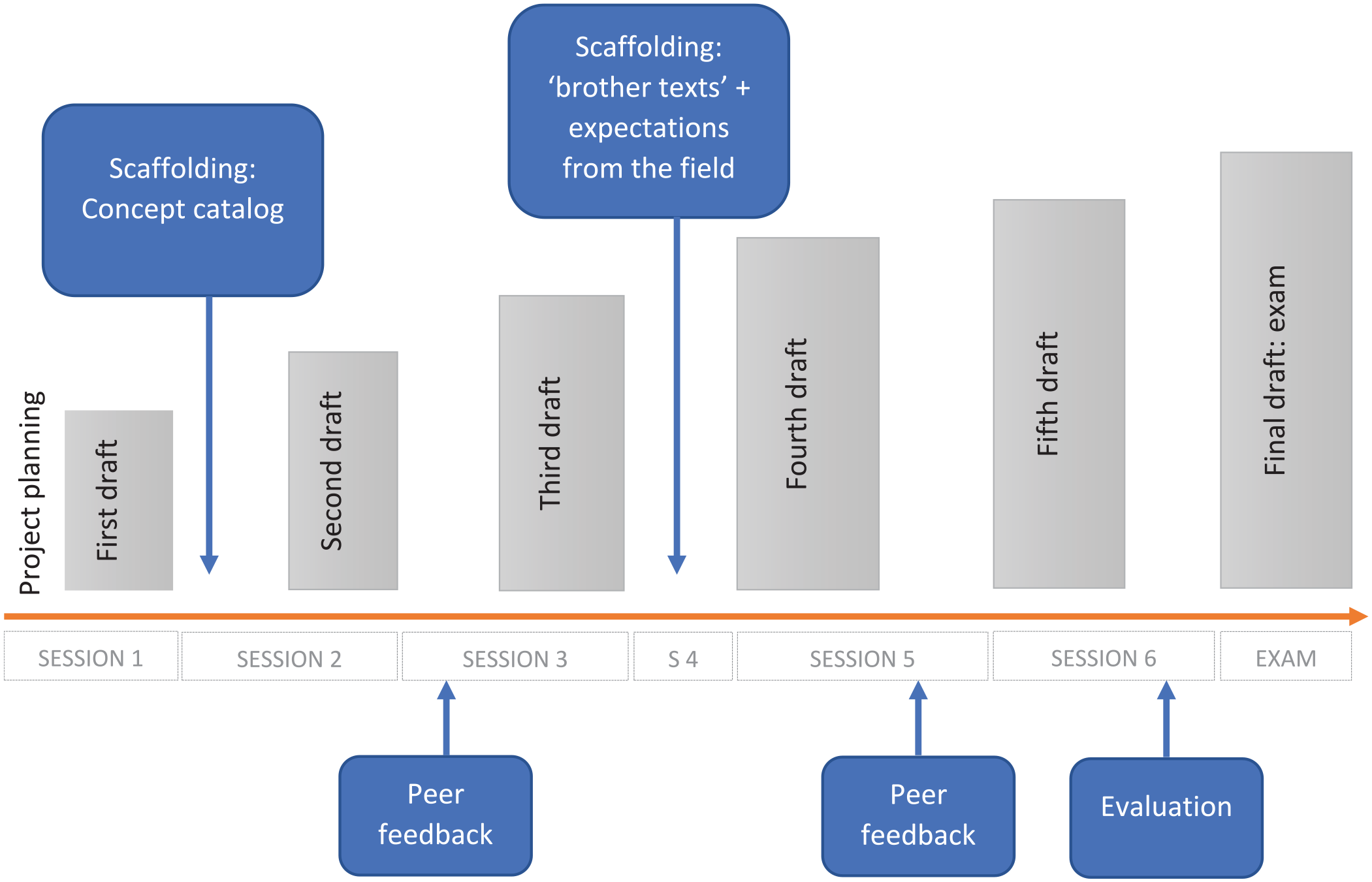
Training program sequence.
The first session (3 hr) aimed to give students a project around a question that is of particular interest as they prepare for their first job interviews: “How do I plan to guide my students” learning next year when I will be a teacher in my own class?. To answer this question and determine what characterizes them as teachers, they had to go back to three lesson plans they made during the 3 years of their training (1 per year). The writing task was announced and the students then produced a first draft: a text describing their professional development from the first to the third year of training and highlighting the pedagogical aspects on which they intend to rely to carry out the learning of the students.
The second session (5 hr) began with scaffolding to reactivate the pedagogical concepts discussed during the 3 years of training. In subgroups of four students, they created a mind map that included the key ideas of a type of pedagogy they have gained during their training program. After sharing their mind maps and refining the concepts, students improved their written product (Draft 2). In this way, they can improve their text by introducing concepts from the scaffolding. A minimum of four concepts is required. They were also invited to include in their writing extracts from their prepared course plans that illustrated the progress they have made (which, combined with the reflective writing, will compile the expected portfolio). The aim of this approach is both to visualize the expertise of the future teacher as they develop and to enhance their professional planning work (Clerc & Martin, 2011).
The third session (4 hr) engaged students in collaborative proofreading. In subgroups of four students (the same subgroups as in Session 2), they reviewed and commented on three texts from their peers. This activity was supported by a single evaluation grid with specific criteria, co-constructed during the session, which made it possible to assess a written portfolio. At the end of the peer text analysis, a reader–writer exchange was organized so that feedback could be exchanged and clarified. This was followed by the production of the third draft (Draft 3).
The fourth session (4 hr) was devoted to a double scaffolding, more normative than the precedent: the consideration of a “brother text” and a meeting with a primary school principal. The “brother text” was a reflective portfolio text written individually by a student from a previous year. This text was observed, deconstructed, dissected, and analyzed in the same subgroups of four students to identify the structure of the whole portfolio type, the arrangement of its different parts, and the way in which reflective links between theory and practice were created. The school principal, for his part, comes to explain how he conducts job interviews and shares the questions he asks future teachers. The session ended with the readjustment of the criteria grid according to the points of attention that emerged from the underpinning that was developed.
The fifth session (4 hr) began with a rewriting activity (Draft 4). Students were instructed to focus on an extract from their text and to attend to how they discussed their practice in relation to theory. Subsequently, a second collaborative review was carried out, with a focus on theory-practice links; the texts were again commented on by peers, followed by oral feedback. The criteria grid was considered one last time to validate it at this stage. Based on the results of the previous activities, they are instructed to improve their production for the next session.
At the sixth session, they arrived with their final production (Draft 5—the “masterpiece”). This session (4 hr) was structured into two steps: an exhibition time and an evaluation time. During the half-hour exhibition, everyone was invited to walk around the classroom to admire and leaf through each other’s texts. The rest of the time was allocated for evaluation. On one hand, the same groups of four took the time to evaluate their respective writings on the basis of the criteria gird co-constructed by the members of the class. On the other hand, a period for collective feedback on the whole experience was organized. At this point, the trainer presented the Itinerary method (Colognesi & Lucchini, 2018) designed for elementary school pupils. It was then that the future teachers noticed that the six sessions they had just lived through were the transposition of it. At the end of this last session, the future teachers again reworked their reflective portfolio, (final draft), which was the final exam.
Participants
The writing skills training was offered to a class of 16 future primary school teachers in French-speaking Belgium (three boys and 13 girls, with an average age of 20). They were in their final year of teacher training. One of the authors of this article was the instructor during the training.
To ensure the ecological validity of our study (Field, 2013; Willig, 2013), the data were collected within the training institution. This institution had only one class of students in their final year of training (N = 16). We, therefore, worked with the accessible sample, under natural conditions. The strength of this research lies, among other things, in its mixed approach. In addition to this, post hoc testing using Gpower software to evaluate the power of the statistical test (Faul et al., 2009) indicated a power greater than .95, despite the sample size, thus exceeding the threshold of .80 generally considered to indicate a statistically powerful test (Sink & Mvududu, 2010).
Data Collection and Analysis
A mixed-methods design (Creswell, 2014) was used, combining quantitative and qualitative approaches to addressing the research question.
At the quantitative level, four written products per student were collected and analyzed: Drafts 1, 2, 5, and 6 (final), for a total of 64 pieces of writing. Drafts 1, 2, and 5 were produced during the training process. They were the subject of formative evaluation for students. Draft 1 provided the status of students’ writing skills at the beginning of the process. Draft 2 was taken into account because it followed the theoretical scaffolding concerning the concepts. Draft 5 allowed us to see the effects of the entire intervention before the work was submitted for evaluation for course certification. We also analyzed the final draft, which was also evaluated by the instructor for course certification. We wanted to see if there were any significant changes between Draft 5 and the final draft (and therefore between formative and summative evaluation). The assessment was done by several independent reviewers who then agreed on the items that needed to be assessed.
Four criteria (Table 1) were used to measure the development of students’ general writing skills (Colognesi & Lucchini, 2018):
Criteria Used to Evaluate Students’ Writing Skills.

Four criteria (Table 2) were used to measure the development of students’ reflective competence, with reference to the aspects of reflective analysis (Chaubet et al., 2019): observe situations (Criterion 1: describe one’s practices) from new angles, document them to understand their multiple facets (Criteria 2 and 3: make theory-practice links to give meaning and master concepts used) and identify, through progressive analysis, possible solutions and actions (Criterion 4: development over time).
Criteria Used to Evaluate Students’ Reflective Competence.

In addition, for every draft, we measured compliance with instructions to verify whether students followed the directions, with an aggregate score (which was standardized because of the different metrics involved) including the presence of a review of 3 years of training (yes/no), presence of a projection into the future (yes/no), presence of at least four concepts (scale from 1 to 4) and length of the text (counting the number of words).
Repeated-measures ANOVAs were conducted to investigate the development of each of the components of written competence and reflective competence during the different drafts, to which multiple comparison (Bonferroni post hoc) tests were added.
At the qualitative level, we chose to conduct a case study (Yin, 2003) to illustrate the quantitative data. The case was chosen because it is emblematic. That is, the work done by the selected student is representative of the whole group. Its results are in line with the averages for the group as a whole. Her work shows the different dimensions of reflective analysis. It also shows the progress made from one draft to another. We analyzed the student’s different drafts, using, in particular, the tools of textual genetics (Bourdaillet et al., 2008).
Results
Quantitative Approach
The descriptive analysis (Table 3) highlights the substantial development of each of the components of written competence and reflective competence over the course of the training process. The values of each of the indicators increase, sometimes substantially, from first to second to fifth drafts (and to final draft in some cases).
Descriptive Statistics (n = 16).

As the components were measured using different metrics, each one was standardized through Z-transformations before being entered into the ANOVA analysis. The descriptive findings are statistically corroborated by the variance analyses performed (Tables 4 and 5). Beyond the significant results, the effect sizes are important (Levine & Hullett, 2002). This reinforces the idea that the training had a positive impact.
Repeated-Measures ANOVA for Writing Skills and for Following Directions.
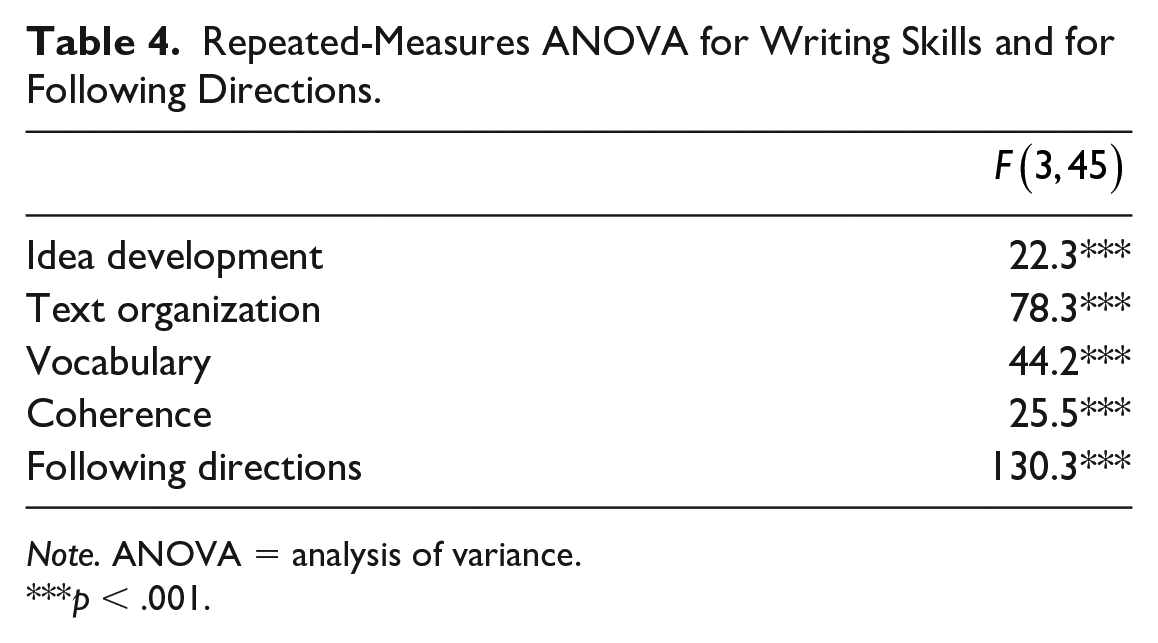
Note. ANOVA = analysis of variance.
p < .001.
Repeated-Measures ANOVA for Reflective Competence.
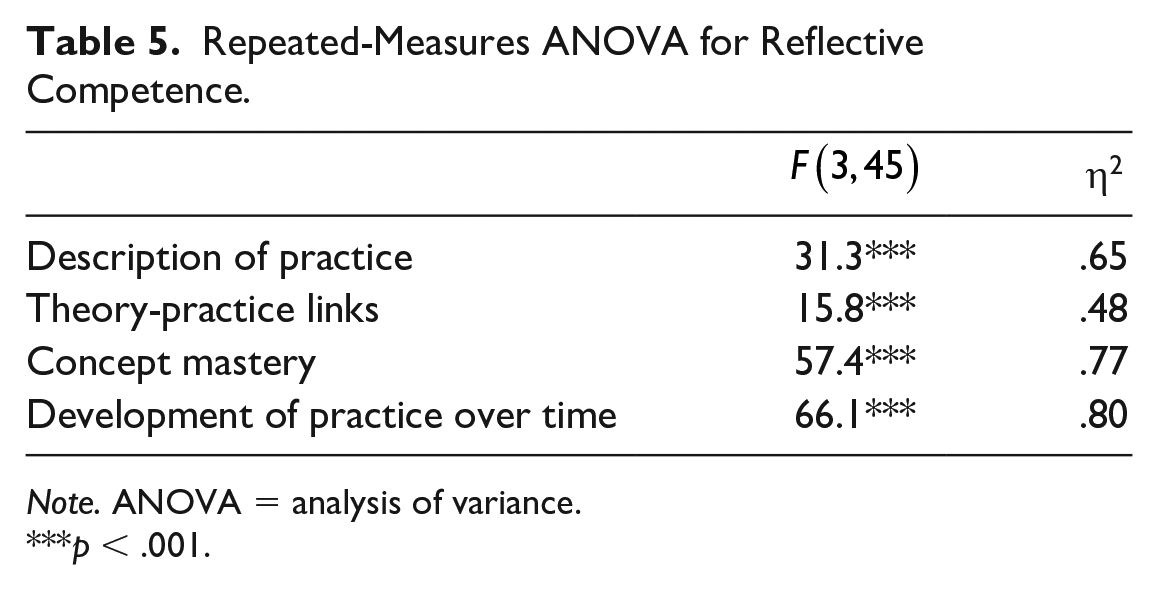
Note. ANOVA = analysis of variance.
p < .001.
Multiple comparisons (see Table 6) were done to refine these initial findings. The first observation is the significant progress on Draft 2 for all aspects of written competence. With respect to reflective competence, significant changes for all indicators appeared only from comparisons with the fifth draft. This may be explained by the fact that, on one hand, this type of writing is a new skill for the students, very poorly developed in initial teacher training (Bocquillon & Derobertmasure, 2018) and on the other hand, the acquisition of this skill requires a lot of practice and support (Altet et al., 2013). A final observation is the absence of any significant improvement between Drafts 5 and 6 (the final draft used for course evaluation). In other words, the text produced after the last peer feedback and its amended draft, produced by the student for course evaluation, are comparable. This result underlines the effectiveness of the proposed training mechanism, in terms of both written and reflective components, already evident in the observed substantial effect sizes for comparisons of the earlier drafts and Draft 5.
Mean Differences Results With Bonferroni Post Hoc Procedure.

p < .05. **p < .01. ***p < .001.
Qualitative Approach
To understand the development of the reflective texts in detail and to identify what marks the writers’ progress, we have carried out a case study on a set of texts that are representative of the work of all students: Mary’s written products. Thus, we investigate how Mary’s drafts showed development, first from the point of view of the thickening (lengthening and enrichment) of the text as a whole and then by explaining its reflective analysis. All quotes and excerpts from Mary’s texts have been translated into English.
Progressive thickening of the text
The intention of this communication, that is, writing the text within the framework of a reflective writing of the portfolio type, shifted mainly between the first and second drafts. Mary moved from a shortlist of the progressive changes she observed in her course plans to a text that was organized around four concepts that she justified and illustrated with extracts from her practice, and this was based on the scaffolding and additional task instructions that were given in the second session.
Her text got longer from one draft to the next: she wrote 184 words in the first draft, 1,001 words in draft 2, 2,028 words in draft 5, and the text was further expanded to 2,078 words in the final draft. Just because there are more words does not mean the text is richer. But it shows an ability to write more and to dare to put ideas on paper. Along with this, the organization of the subject also changed, especially after the theoretical scaffolding in the second session. Indeed, the catalog of concepts produced allowed her to identify four concepts that corresponded with her ideas. As a result, the text increased by four new parts, one for each concept.
The organization of the portfolio also increased in scope as the rewriting process progressed, in particular by the addition of traces of the practice which are commented on. The grammar of the text was also evolving. Although Mary began by organizing her ideas around three parts and bullets that led to an enumeration of facts without construction of thoughts, when she rewrote her text for the first time, the organizational markers become more refined. She grouped her reflections into paragraphs and added some links, such as “here, a first adjustment, indeed, in this case, since it is . . .”, mainly to connect her ideas (Figure 2).

Excerpts from Mary’s Drafts 1 and 2 illustrating the development of the grammar of the text.
However, the entire text remained a succession of juxtaposed ideas, without any real support for the reader and the coherence of the text, up to the fifth draft. It was at this point that a significant number of text organizers were added and the internal coherence of the text was supported by the addition of an introduction, links between the parts and a conclusion: Before starting the reflective analysis of my practices, I wanted to present to you the different lessons I have been working on [. . .]. My reflective writing has been designed around the different elements of our preparations at the Teacher Training Institute. You will therefore find various paragraphs [. . .] I will conclude my work on my vision of my future teaching.
(Excerpt from the introduction, draft 5)It is obvious that the different internships I have done as part of my studies have influenced my vision of teaching. [. . .] In my future class, I would like to set up times of differentiation and cooperation [. . .] I will really try to make each student develop at his own pace. I also particularly like Freinet’s pedagogy, which is in line with this idea. (Excerpt from the conclusion, draft 5)
Development of the reflective analysis
From draft to draft, the content related to reflective aspects also evolved, as Mary became more and more confident in the way she took a step back and wrote it. To account for this, the parts where she mobilized the concept of metacognition are proposed here as an example of her improvement. Thus, in her first essay, Mary wrote a single sentence that indicated identification of a process she had put in place for each lesson plan, but her statement remained vague: I always planned a structure: a starting activity—a time for peer dialogue.
When she rewrote her text, in Draft 2, she managed to name the concept, for which she proposed a personal definition:
I invited the students to reflect on their learning, on the subjects that were easy or difficult for them. So I proposed a metacognition step.
She also justified this personal reflection by explaining why this practice seemed to her interesting and useful for the learners:
Students can thus situate themselves in their learning and I can target the personal needs of students.
She also added an illustration, by presenting a concrete example:
I suggested to the students to create a list focused on their own individual difficulties in order to review and improve their writing.
Gradually, her reflective analysis became clearer thanks to the different types of support received. Thus, as of Draft 3, her writing no longer contained any trace of lists and her progress during the 3 years of training became more visible. In this sense, she followed the advice noted by the peer reviewers of her product: “Write a continuous text to clearly see the development.”
In Draft 4 and even more in Draft 5, the improvement of the text concerned the theory-practice links that were reinforced and discussed on the basis of summoned authors. She used citations and references. This shows the impact of the “brother text” scaffolding (in the fourth session), which addressed how to establish these links. At this stage, the portfolio took on a major dimension through the coherence it proposed between the cumulative traces and the theories invoked (Bélair & Van Nieuwenhoven, 2010). Mary then added this passage: According to Flavell, metacognition refers to the knowledge of one’s own cognitive processes, their products and everything related to them.
She also succeeded in writing explicit links between what she did in class and the concept under consideration, while considering ways of understanding: I asked the students individually about their work processes and thanks to their answers, I was able to regulate my own practice and build a lesson and exercises adapted to each student.
Finally, thanks to her reflective process, she clarified what was not yet clear, such as the first sentence written in her initial draft, which was now clearly linked to her subject: Since my first year of studies I have been offering students many opportunities for conversation in pairs, also allowing this metacognition. I have always kept this moment of peer dialogue.
It should be noted that the second peer review still helped her to improve her writing. Following the advice she received, she added a title, a bibliography, and new excerpts to build up the last part of her writing that she had left out until then. There is little change between Mary’s Drafts 5 and 6. Her cycle of rewriting ended with the final draft (6) with labels that she submitted for the exam and that completed her text.
Discussion
By developing the training presented here, we took the challenge of supporting future teachers in the production of a reflective written document that is intended to improve their “professional self” (Kelchtermans, 2001). The results presented above support the utility of the portfolio and the associated writing activities (Hamilton, 2017; Loughran, 2014) in this context. They show that the training program combining two types of theories (teacher learning and writing instruction) enabled participants to make major progress from one draft to another and thus improve their reflective writing skills. The study also shows that the itinerary method (Colognesi & Lucchini, 2018), initially designed to develop the writing skills of primary school students, was transferred to writing training for adults.
First of all, the students’ results on the first version of their text were very low, both for items related to writing skills (idea development, text organization, vocabulary, coherence) and for reflective skills (description of practice, theory-practice links, concept mastery). They were, however, students at the end of their training. Therefore, they had already had two full years in which they had to write reflective texts. This indicates, as Clerc-Georgy (2019) mentioned, that students have a low level of mastery of this type of writing. However, it is not necessarily easy for trainers to be supportive of this type of product and to know what relevant feedback to give.
On the other hand, we have also shown that the students’ results improved as the program advanced. It is, therefore, necessary to offer them support so that they can improve in writing reflective texts (Bocquillon & Derobertmasure, 2018). These improvements were observable by analyzing the different versions of the text. This means that the different rewritings were beneficial for the students (Colognesi & Lucchini, 2016; Lee, 2011). In addition, we showed that these portfolio rewrites allowed participants to document and conceptualize their practices (Hamilton, 2017; Loughran, 2014), make better connections between theory and practice (Altet et al., 2013), and find ways to improve their teaching practices (Chaubet et al., 2019; Waege & Haugalokken, 2013). In this sense, the writing of the portfolio indeed had a knowledge-weaving role (Hamilton, 2020).
Three aspects can be discussed to explain these results, which we identify as the main lines of action for setting up support strategies for encouraging the development of a reflective stance in initial teacher training.
First, as we know that students sometimes perceive reflective analysis as a constraint of training (Altet et al., 2013), the fact of creating a training program detached from everyday contingencies and dedicated to reflective analysis, with the support of the supervisor, allowed students to take the time for this exercise. Indeed, these reflective analyses were not requested during their internships, but only at a decontextualized moment. Students often express that they do the reflective writing that is required of them in an internship after the internship (and not during as desired by the training), because they do not see the interest (Altet et al., 2013) and especially because they have the urgent need to teach the class (Derobertmasure et al., 2010).
Second, the foundations present in the Itineraries method (Colognesi, 2015), the provision of support and social interactions, were important forms of assistance. These aspects seem to have allowed students to progress in the production of their text from draft to draft. For this, scaffolding was a key for producing qualitative leaps. The first form of scaffolding highlighted a list of possible concepts on which they could focus their attention, through a catalog of concepts. It was therefore a way of taking stock of the learning resulting from the training and making it operational within a written document that encourages such taking stock, to explain its usefulness (Perez-Roux, 2016). The second form of scaffolding made it possible to collectively analyze a reflective text and highlight its strengths, to see how the author went about making theoretical-practical links (Altet et al., 2013; Waege & Haugalokken, 2013), building his argument, and so forth, and clearly allowed the writers to move in this direction. Then, the strength of the group, in a collaborative perspective, led the writers to review each other and negotiate feedback for others together. This collaborative proofreading work (Colognesi & Deschepper, 2018) gives the opportunity not only to see other productions than one’s own but also to discuss together the quality-related criteria for the texts.
Third, the absence of significant change between Draft 5 and the final draft suggests good alignment between the training process and the examination task (Biggs, 1996). Indeed, the status of the final product as a common thread throughout the training system as well as its consolidation as the scaffolding was built up made it possible to ease the stress related to the certification evaluation, both from the point of view of the student, who was reassured from one session to the next, and from the point of view of the supervisor, who we freed from this tension between accompanying/training and evaluating/certifying (Maes et al., 2018). It can be hypothesized that the articulation of the three logics for supporting reflective writing proposed by Oudart and Leclercq (2011) played a significant role in the progress observed and the transition to high-quality reflective writing.
Conclusion and Implications
Probably, the most important contribution that the study has for the field concerns the training program. For readers who intend to develop and try out similar training programs in their own context, several aspects seem worth noting.
First of all, it is important to have a time dedicated to supporting the writing of reflective texts. This time should be removed the contingencies of internships, which place students in a situation of stress and survival, and it should be devoted only to reflective writing.
Second, an important aspect to consider during this coaching time is allowing participants to be able to write several versions of their text. These different products will allow them to go back over their writing and improve it. Some activities can help students to improve their writing. Scaffolding can include observation of reflective texts, to understand how they work, and working on theory-practice links. Peer evaluation, on a cooperative basis, is also important. It involves asking readers to give the positive points of the texts and to give comments that suggest improvements.
Limitations and Suggestions for Future Research
Several limitations should be highlighted. First, the conclusions drawn from this study are based on small sample size and limited contextual representativeness. It would, therefore, be interesting to replicate this study with a larger number of participants from various training institutions. At the qualitative level, this could lead to the conduct of multicase studies that would allow us to confirm and refine our observations. At the quantitative level, such a study would make it possible to validate the effectiveness of the Itineraries method for the development of reflective analysis, with a focus on articulating the theory-practice connection, among an audience of future teachers.
Second, and in line with the above, comparison with a control group would provide additional objective evidence of the effectiveness of this training compared with what is traditionally done. However, the groups would have to be comparable. It seems appropriate to compare two groups of graduating students 1 year apart. This would help to keep the curriculum and the teaching team stable.
Third, it would be interesting to study more closely the process of developing a reflective posture by questioning, for example, the levels and processes of reflexivity in the different drafts (Derobertmasure, 2012), which could refine the interpretation beyond the significant effect and the effect size. In particular, this could help to identify the respective contribution of the different forms of scaffolding proposed and thus be able to offer effective support for the development of a reflective posture (Bocquillon & Derobertmasure, 2018).
Finally, despite the results presented here, it is necessary to remain cautious. Indeed, while writing is an important strategy for promoting student–teacher reflexivity, whether writing can adequately capture an individual teacher’s reflexivity remains open for question. Indeed, writing may not be a way for all people to show their level of reflexivity. Thus, a highly reflective person could be constrained by the compulsion imposed upon them by the writing and thereby could appear to be less reflective than they actually are. This is all the more the case because the student must still be fully engaged in the writing task proposed to them. But in any case, reflective writing is an important cognitive transformer for everyone. As a certification assessment, it can take into account individual differences. It, therefore, seems interesting for our future research to see how the students experienced this writing instructional program, and how they engaged in the different activities. In addition, it is probably now necessary to explore other means to encourage student teachers to reflect on their practice as well, such as multimodal presentations or oral recording.
Practical Implications
This research feeds the discussion on how to support students in producing reflective texts. The results of the study show that when support is provided, students are able to produce high-quality reflective texts. Thus, several implications are suggested for initial teacher training.
First of all, it seems necessary to include time dedicated to the teaching of reflective writing in the training curricula. This should be done from the first year of training. Support for such a project to train a reflective practitioner should be one of the foundations of the programmatic approach that underpins the curriculum. In this context, it would be a training project shared by all trainers and considered a cornerstone of the program (Prégent et al., 2009; Scott, 2017). Students would be involved in a writing process from the very beginning of the training and they would be encouraged to continue it when they enter the trade, to support their professional integration.
This would involve setting aside time for students to write during the sessions to quickly improve their written products and help them distinguish between different types of writing (descriptive, argumentative, reflective, etc.). The targeted involvement of language teachers is a real asset, given the very fragile level of language proficiency of a large part of the student population. Without this intensive assistance, the transition to the written word remains a major obstacle to the development of reflexivity and does not allow students to summon in a relevant way the theoretical concepts necessary for them to take a step back. In the end, the training program described below creates a privileged place for the construction of reflective skills and constitutes a bridge toward the entry into the profession.
Trainers can also work on the common characteristics of reflective texts, and show how professional situations can be described, how the links between theory and practice are formalized, based on authentic texts. The objective is therefore twofold: Those students can learn what these texts are used for and how to write them. This recommendation is important because it seems that students do not seem to perceive the usefulness of reflective texts for them (Driessen, 2017; Fischer et al., 2020). In addition, collaborative work between peers can be included in the training program for writing reflective texts. In this way, students can see how their peers produce their text. They can also help each other in understanding the quality criteria for this type of writing, from a collaborative perspective. Finally, while the reflective writing is built during the work sessions, with the support of a trainer, the final version can be used as a certification assessment. Under these conditions, students will be reassured about the quality of the product they submit.
The portfolio is certainly a privileged tool to support students’ emerging reflexivity and to record their learning in this area throughout the curriculum (Bélair & Van Nieuwenhoven, 2010). It can be fed by different courses or field experiences and thus serve as a real witness to the path taken and the skills built. In this sense, this work could reflect the common thread of their training and constitute their end-of-study work.
The need to develop students’ writing skills to give them access to reflective writing has been widely demonstrated, but we also need to address the skills of trainers to support them in this process and to contribute to improving teacher training. Teachers do not necessarily have a positive relationship with the written word and they do not have the tools to provide effective feedback to students to improve their products (Hattie & Timperley, 2007; Rodet, 2004). They should therefore be supported in their coaching by inviting them to discover the different postures they can assume depending on the context (Jorro, 2004; Oudart & Leclercq, 2011). Engaging them in reflective writing themselves about their own practices would also constitute a lever for improving the quality of their coaching and could be an incentive for sharing practices in higher education.
Ultimately, throughout their curriculum, student teachers will be required to produce such texts. Including time to teach the writing of reflective texts in the training will therefore have an impact on the entire program and may, we postulate, following others, help to improve teacher training. In this sense, training future teachers in the practice of reflexivity and getting them to consider it as an epistemic virtue can help them to train it in their own students, thus promoting learning processes down the line (Feucht et al., 2017; Lunn Brownlee et al., 2017).
