



Abstract
English learning plays a critical role in the academic development and career preparation of undergraduate non-English majors in China. However, English achievement is often shaped by a range of psychological factors. While prior studies have separately examined the effects of learning motivation, self-efficacy, and learning strategies on academic performance, few have systematically explored how these variables interact to influence English achievement. This study investigated the relationships among learning motivation, self-efficacy, and learning strategies, as well as their mediating effects on English achievement among undergraduate non-English majors in Chinese universities. We collected 432 valid questionnaires and conducted structural equation modeling (SEM) to analyze the data. Results showed that learning motivation, self-efficacy, and learning strategies all positively predicted English achievement. Both self-efficacy and learning strategies served as mediators in the relationship between learning motivation and English achievement. Moreover, a chain mediation pathway from learning motivation to self-efficacy to learning strategies further enhanced the indirect effect of motivation on achievement. These findings suggest that, for undergraduate non-English majors, fostering learning motivation, strengthening self-efficacy, and adopting effective learning strategies may collectively support better outcomes in English learning.
Introduction
In the context of deepening globalization, English proficiency has become a vital asset for higher education and career development. Strong English skills not only enhance cross-cultural communication but also enable individuals to access international academic resources, participate in global conferences, and build transnational networks (Wolf et al., 2024). In Chinese universities, English serves not only as a core component of general education but also as a fundamental tool for non-English majors to acquire knowledge and develop academic literacy (Hu, 2023). Moreover, as more companies operate in global markets, English proficiency has become a key indicator of employability and workplace competitiveness (Tenzer et al., 2017). Against this backdrop, English achievement (EA) is often used as a practical and representative measure of students’ English proficiency, particularly in large-scale survey research. Although test scores may not fully capture actual language ability, they offer a reasonable approximation of students’ learning outcomes and academic performance in English (Chan et al., 2022). This study focuses on undergraduate non-English majors. In Chinese universities, these students typically take foundational English courses during their first year, while English instruction in later years varies depending on program requirements (M. Li, 2012). Therefore, the current sample consists mainly of first-year students, which aligns with the general structure of English curricula in Chinese higher education and helps ensure consistency in measurement by minimizing variation in English learning exposure across academic years. Based on this rationale, the present study examines the key factors associated with EA among undergraduate non-English majors, providing empirical insights into their academic performance.
In recent years, researchers have focused on identifying various factors that influence students’ EA, particularly the role of psychological factors. Existing studies have identified three key psychological variables: learning motivation (LM), self-efficacy (SE), and learning strategies (LS), all of which significantly impact students’ EA (Huang & Wang, 2023; Tan et al., 2021; Teng & Zhan, 2023). According to Bandura’s Social Cognitive Theory (SCT; Bandura, 1986), SE refers to an individual’s confidence in completing learning tasks, and this belief can significantly influence the use of LM and LS. LM, as an intrinsic drive, determines students’ engagement and persistence in their studies (Shen et al., 2024; T. Zhang, 2024). LS, particularly self-regulated learning strategies (SRL), refer to students’ ability to actively monitor, regulate, and optimize their learning behaviors (H. Chen & Shu, 2024; Kang & Wu, 2022). SRL is further divided into cognitive strategies and metacognitive strategies (Hands & Limniou, 2023). Cognitive strategies include techniques such as rereading, concept linking, and inductive summarization, which directly aid in information processing and help students effectively absorb and integrate learning materials. Metacognitive strategies, on the other hand, involve planning, monitoring, and reflecting on the learning process, such as setting learning goals, assessing progress, and adjusting methods. These strategies not only enhance learning efficiency but also increase students’ autonomy and coping abilities in their learning (Pawlak, 2021).
Although prior studies have separately examined the effects of LM, SE, and LS on EA, and some have tested simple mediation relationships among these variables, few have systematically investigated how these core psychological constructs interact sequentially to influence EA. In particular, limited research has provided a robust theoretical explanation for the chain mediation pathway from LM to SE to LS, and ultimately to EA (LM → SE → LS → EA). To address this gap, the present study integrates SCT and Self-Determination Theory (SDT) to construct a theoretically grounded model. SCT emphasizes the role of cognitive beliefs and expectations in transforming motivation into behavior and outcomes (Bandura, 1986), while SDT highlights the quality of motivation in fostering autonomous learning and sustained engagement (Ryan & Deci, 2020). Drawing on these frameworks, we posit that LM enhances SE, which subsequently promotes the effective use of LS, thereby improving EA. By elucidating this continuous process from intention (LM) to belief (SE), action (LS), and outcome (EA), the study not only advances methodological testing of a chain mediation model but also deepens the conceptual understanding of the psychological mechanisms underlying English learning among undergraduate non-English majors.
Theory and Hypotheses
Theoretical Framework
SDT proposed by Deci and Ryan (1988), posits that individual motivation exists along a continuum ranging from fully intrinsic to fully extrinsic. This continuum reflects the degree of autonomy and volition behind human behavior. Within this framework, LM is categorized from externally regulated forms—such as studying for rewards or to avoid punishment—to intrinsically driven forms, such as learning out of interest, curiosity, or a sense of personal accomplishment (Pan, 2023). SDT has been widely applied across domains including education, work, sports, and health behavior (Henderson & Jeong, 2024; Y. Wang et al., 2025; Z. Zhang et al., 2024). In second language acquisition research, SDT is frequently used to examine the types of English LM and their associations with learning behaviors and outcomes (H. Wang et al., 2024; R. Xu et al., 2021; Zhao et al., 2022). Learners with stronger intrinsic motivation tend to engage more actively in classroom activities, persist in language practice, and achieve better academic outcomes (Hasanzadeh et al., 2024). In this study, SDT serves as a foundational framework for understanding the underlying structure of English LM among college students and for exploring its potential link to academic achievement.
SCT developed by Bandura (1986), emphasizes the dynamic interaction among personal, behavioral, and environmental factors, a concept known as reciprocal determinism. SCT highlights learners’ cognitive processing of information, their expectations regarding goal-related behaviors, and their ability to regulate actions in complex environments. The theory has been extensively applied in education, career development, and health promotion (Cheng et al., 2024; Guo & Tian, 2025). In the field of language learning, researchers often use SCT to explain how learners form positive academic beliefs and adopt effective strategies to enhance performance (S. Wang et al., 2024). Empirical evidence suggests that students with higher learning-related beliefs are more likely to employ proactive strategies, demonstrate persistence in the face of challenges, and ultimately achieve better academic results (Shang & Ma, 2024). Grounded in SCT, this study focuses on how learners regulate their behavior and strategies in English learning, thereby transforming motivation into measurable academic outcomes.
SDT and SCT are complementary in this study. SDT emphasizes the origin and quality of LM, focusing on how motivation stimulates learner initiative. In contrast, SCT focuses on how motivation influences learning behavior through cognitive regulation. Together, they illuminate distinct but interconnected mechanisms through which motivation drives learning. Within this framework, LS is conceptualized as both behavioral expressions of motivation and outcomes of cognitive self-regulation. By integrating SDT and SCT, this study proposes a pathway model in which LM leads to EA through the mediating roles of SE and LS. This integrative approach aims to provide a more comprehensive understanding of the psychological mechanisms underlying English learning among college students.
Learning Motivation and English Achievement
LM is a central factor that drives students to actively engage in learning and strive to achieve academic goals (Ryan & Deci, 2020). With the advancement of SDT, motivation has been further categorized into intrinsic and extrinsic forms. In the context of English as a Foreign Language, motivation not only determines students’ persistence and effort when facing challenges but is also directly associated with their EA (Mendoza & Phung, 2019). For undergraduate non-English majors in Chinese universities, motivation becomes a particularly critical psychological factor due to limited access to English learning resources and time constraints. M. Liu and Du (2024) investigated how second language motivation predicts EA among university students and found that English LM significantly and positively predicted students’ academic performance. Similarly, Shang and Ma (2024) identified LM as a key positive predictor of EA. Conversely, Reyes-Lorilla (2021) conducted a reverse-path analysis and found that students with low motivation often performed poorly in English. These findings underscore the universal importance of motivation in EFL learning. However, research examining the specific pathways or mechanisms through which motivation influences EA—particularly among undergraduate non-English majors in China—remains limited. Further investigation into how motivation functions within this population may offer more targeted guidance for instructional practices.
The Mediating Role of Self-Efficacy
SE, a core concept in Bandura’s SCT, refers to an individual’s belief in their ability to successfully accomplish specific tasks, significantly influencing task performance and outcomes (Lange & Kayser, 2022; Saks, 2024). In the field of education, SE is regarded as one of the critical factors for academic success, particularly in foreign language learning, where students’ SE largely determines their learning engagement and performance (R. Chen et al., 2022; H.-I. Kim, 2024; B. Xu, 2024; Yang & Gan, 2024). R. Chen et al. (2022) discovered that students with high SE typically maintain a positive attitude and strong coping ability when facing challenges in English learning, which helps them demonstrate higher focus and learning efficiency. Additionally, B. Xu (2024) discovered that students with high SE are less likely to give up when encountering difficulties in English learning, and they continuously improve their academic performance through persistent effort. Such tenacity leads to marked improvements in their performance in English courses (Geraci et al., 2023; J. Xu et al., 2024). SE not only enhances students’ LM but also helps them manage time more effectively and choose appropriate LS, thereby improving their EA (H.-I. Kim, 2024).
More importantly, existing research has preliminarily established the mediating role of SE in the relationship between LM and academic achievement. (J. Li et al., 2024; Y. Liu et al., 2024; Supervía et al., 2022). As the intrinsic driving force of students’ learning, LM directly affects whether students are willing to exert effort to achieve their goals (Ma, 2024). Y. Liu et al. (2024) found that LM indirectly impacts academic performance by enhancing SE, thereby boosting students’ confidence in coping with challenges. When LM is strong, SE increases, which in turn enhances students’ confidence and persistence, helping them overcome difficulties in learning and improve academic performance (Cai & Zhao, 2023; Teng & Yang, 2023; Y. Wang et al., 2021). Therefore, the enhancement of SE not only transforms LM into actual learning behaviors but also continuously drives academic performance (Graham, 2022). However, although this mediation effect is widely supported, the specific mechanism through which LM influences EA via SE—particularly among undergraduate non-English majors—remains unclear. This ambiguity is especially pronounced given the current constraints in college English instruction, such as limited resources and variations in course structure. Therefore, this study seeks to further clarify the mediating function of SE in the English learning process of non-English majors, with an emphasis on its psychological mechanism and potential value for targeted interventions.
The Mediating Role of Learning Strategies
LS refers to the specific methods that students use during the learning process to improve efficiency and academic performance. These strategies greatly influence academic performance, especially in the context of English learning, where they are essential in improving language skills and addressing learning challenges (Hands & Limniou, 2023; Kikas et al., 2024; M. Liu & Chen, 2024; J. Xu et al., 2024). According to M. Liu and Chen (2024), students who employ a variety of LS typically achieve better EA because these strategies help them master language knowledge and improve exam performance. Specifically, SRL plays a crucial role in academic achievement (Hands & Limniou, 2023). Among the most effective strategies are cognitive strategies and metacognitive strategies. The former includes learning planning, monitoring, and adjustment, while the latter involves memory and application of information (Pawlak, 2021). Effective LS significantly improve students’ EA, especially when strategies such as time management and self-monitoring are employed, allowing students to manage their learning process more efficiently and overcome difficulties (Gan et al., 2023; Öztürk & Çakıroğlu, 2021). Therefore, the adoption of appropriate LS is a key factor in enhancing students’ English academic achievement (Chansri et al., 2024; Hayat & Shateri, 2019; Sun & Huang, 2023).
LS not only have a direct impact on EA but also mediate the relationship between LM and EA (Almoslamani, 2022; Eteng-uket & Effiom, 2024; Gan et al., 2023). LM, as an intrinsic driving force, encourages students to invest more time and effort. However, without effective LS, LM may struggle to be transformed into tangible academic outcomes (Biwer et al., 2020). Almoslamani (2022) shows that students with high LM who apply LS such as time management, self-testing, and rehearsal are more likely to convert their LM into concrete actions, thereby enhancing their academic achievement. For example, highly LM students can complete English learning tasks more efficiently through systematic LS, leading to better results (Eteng-uket & Effiom, 2024; Gan et al., 2023). Conversely, students lacking effective LS may struggle to meet learning challenges, resulting in underperformance and poor grades (Alamer, 2021). Although prior studies have preliminarily confirmed the mediating role of LS, most of this research has been conducted among general student populations. Few studies have specifically focused on undergraduate non-English majors in Chinese universities—a group characterized by limited resources and reduced exposure to English learning opportunities. It is therefore necessary to conduct more representative and methodologically precise quantitative research within this specific population. Such research can help uncover how LS function as a bridge in the relationship between LM and EA, while also offering both theoretical support and practical guidance for improving students’ learning outcomes.
The Chain Mediating Role of Self-Efficacy and Learning Strategies
Previous studies have found a significant positive correlation between SE and LS (Hayat & Shateri, 2019; J. Xu et al., 2024). Students who possess high SE tend to have greater confidence in their learning capabilities, which makes them more inclined to select and utilize effective LS, including systematic planning, reflective learning, and multiple revisions (J. Xu et al., 2024). SE not only boosts students’ confidence in their learning capabilities but also encourages them to actively adopt effective strategies during the learning process, such as deep processing of information, reflecting on their learning process, and self-assessment (Raoofi et al., 2012), thereby improving learning efficiency and academic achievement.
SE influences EA by shaping students’ use of LS (Hayat et al., 2020). Students with high SE are more likely to adopt effective LS, such as outlining, segmented writing, and multiple revisions, to tackle challenges in English learning (Cai & Zhao, 2023). The use of these strategies not only helps students in overcoming learning challenges but also plays a crucial role in significantly improving their EA (Teng et al., 2023). Therefore, LS serves as a critical bridge between SE and EA, facilitating students in translating their SE into actual learning behaviors, which ultimately results in enhanced academic performance.
Students with strong LM are more likely to demonstrate sustained effort and persistence during the learning process. However, their ultimate learning outcomes depend not only on motivation but also on the synergistic effects of SE and LS (Al-khresheh & Alkursheh, 2024; Derakhshan & Fathi, 2024). The study by Derakhshan and Fathi (2024) demonstrates that students with high SE not only face learning challenges with greater confidence but also actively choose and apply appropriate LS, such as self-testing and association, to further improve their EA. Thus, SE and LS form a chain mediating effect between LM and EA, enhancing the positive influence of motivation on academic performance. Based on this analysis, although existing studies offer preliminary support for the mediating roles of SE and LS, empirical research systematically testing the full pathway—“LM → SE → LS → EA”—remains limited. This is particularly true for undergraduate non-English majors in Chinese universities, where prior studies often focus on single mediators rather than integrated mechanisms. Few studies have employed structural equation modeling (SEM) to examine the complete pathway and the relative strength of each link. Therefore, this study aims to quantitatively test the proposed chain mediation model and further clarify the psychological mechanisms through which LM influences EA in this specific population.
The Current Study
This study, based on SDT and SCT, aiming to explore the direct and indirect effects of college students’ English LM on EA, with a focus on analyzing the mediating roles of SE and LS in this process, this study proposes the research model illustrated in Figure 1, and verify the following hypotheses: (1) LM has a significant positive impact on EA; (2) SE has a significant positive effect on EA; (3) SE mediates the relationship between LM and EA; (4) LS has a significant positive effect on EA; (5) LS mediates the relationship between LM and EA; (6) SE and LS play a chain mediating role between LM and EA.
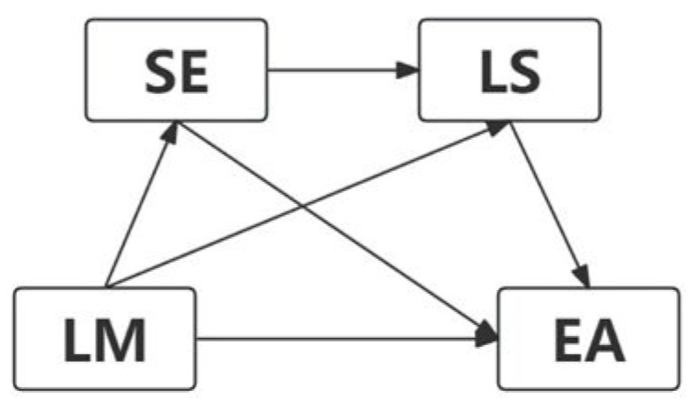
Research model.
Material and Methods
Sample and Data Collection
The research covered multiple universities in China and encompassed the full process of participant recruitment, data collection, and statistical analysis. All procedures strictly adhered to the ethical guidelines outlined in the Declaration of Helsinki. Data were collected between May and October 2024 through the professional online survey platform “Wenjuanxing.” With the assistance of faculty members at the participating institutions, we distributed the questionnaire to students. To ensure the representativeness of the sample, we used simple random sampling. Specifically, we generated computer-based random numbers to select participants from class rosters. Participants were provided with the survey link, and we emphasized the voluntary nature of participation and the strict protection of participant confidentiality. A total of 539 responses were collected through the online questionnaire. After excluding invalid responses and students majoring in English, 432 valid questionnaires were retained for analysis (S. Liu, 2025). Demographic characteristics of the sample are presented in Table 1. Among the participants, 207 were male (47.92%) and 225 were female (52.08%). Most were aged between 18 and 20 years (71.76%), and the majority were first-year students (n = 327, 75.69%). Regarding parental education, 205 participants (47.45%) reported that their parents had completed junior high school, followed by 107 (24.77%) whose parents had completed high school. Analysis of variance showed that both year in school (F = 4.633, p < .01) and parental education level (F = 7.606, p < .001) had significant effects on EA among undergraduate non-English majors.
Profile of the Sample Population.

Measurement Tools
Learning Motivation Scale
In this research, we utilized the Learning Motivation Scale created by H. Xu and Gao (2014) to evaluate students’ English LM. The scale is composed of two major dimensions: intrinsic motivation and extrinsic motivation, with a total of 12 items. It was scored using a 5-point Likert scale, where “1” stands for “strongly disagree” and “5” for “strongly agree.” The Cronbach’s alpha coefficient for this scale was .898, demonstrating excellent internal consistency and reliability. This approach enabled an accurate evaluation of college students’ English LM.
Self-Efficacy Scale
This study utilized the Self-Efficacy Scale assessment tool developed by Pikirang et al. (2021) to measure the level of SE among students. The instrument consists of 10 questions, for example, “I am able to comprehend the written content in English texts or articles.” The scale demonstrated a high degree of reliability, with a Cronbach’s alpha of .935. Responses were recorded on a 5-point Likert scale, where “1” stands for “strongly disagree” and “5” for “strongly agree.” A higher score reflects a greater sense of SE in college students.
Learning Strategies Scale
This investigation employed the Learning Strategies Scale, crafted by Kunasaraphan (2015), to gage students’ abilities in utilizing LS. The scale encompasses six sections: memory, cognition, compensation, metacognition, affective aspects, and social elements. Each section contains five items, leading to a total of 30, which comprehensively evaluate different aspects of LS. Students assessed themselves on a 5-point Likert scale, ranging from “strongly disagree (1)” to “strongly agree (5),” based on their real-life experiences. The internal reliability of the scale, confirmed by a Cronbach’s alpha of .862, ensures consistency and accuracy. This evaluation system enables precise measurement of students’ use of LS, establishing a scientific basis for targeted educational interventions.
English Achievement Scale
This investigation applied the English Achievement Scale introduced by Lu et al. (2022) to gage the English proficiency of college students. This tool comprises eight elements designed to assess participants’ perceptions of their own English abilities, acting as an indicator of their performance in English courses at the university level. It measures skills across several domains: listening, speaking, reading, and writing, alongside general language proficiency. Moreover, students provided their latest English test results, classified into five bands: 0 to 59, 60 to 69, 70 to 79, 80 to 89, and 90 to 100. The EAS has demonstrated solid internal consistency, reflected by a Cronbach’s alpha of .935. Responses were gathered on a 5-point Likert scale, where higher values signify greater proficiency in English.
Statistical Processing
In this investigation, the Partial Least Squares Structural Equation Modeling (PLS-SEM) technique was applied to analyze the structural and measurement components. The PLS-SEM methodology presents three notable strengths: Primarily, it is used for its focus on prediction as a primary analytical framework (Hair et al., 2022). Additionally, PLS-SEM serves as a “predictive-causal” methodology, which assumes that the model should provide both strong predictive power and a clear understanding of causal relationships (Shmueli et al., 2019).
Results
Common Method Bias
We tested for common method bias using Harman’s single-factor test. The results of the exploratory factor analysis indicated that six factors with eigenvalues greater than 1 were extracted, and the first factor accounted for 33.775% of the total variance—below the critical threshold of 40% (Podsakoff & Organ, 1986). These results suggest that common method bias is not a serious concern in this study.
Descriptive Statistics and Correlation Analysis
According to H.-Y. Kim (2013), data are considered approximately normally distributed when absolute skewness is less than 2 and absolute kurtosis is less than 7. As shown in Table 2, the skewness and kurtosis values for all variables met these criteria; therefore, we used Pearson correlation analysis. The descriptive statistics and correlation coefficients presented in Table 2 indicate that LM is significantly positively correlated with SE (r = .571, p < .001), LS (r = .677, p < .001), and EA (r = .564, p < .001). SE is also significantly positively correlated with LS (r = .765, p < .001) and EA (r = .679, p < .001). In addition, LS showed a significant positive correlation with EA (r = .703, p < .001). These results suggest that the data are suitable for further model testing and analysis.
Descriptive Statistics and Correlation Coefficients for LM, SE, LS, and EA.

Note. LM = learning motivation; SE = self-efficacy; LS = learning strategies; EA = English achievement; M ± SD = mean ± standard deviation.
p < .001.
Measurement Model
To evaluate the model used for measurement, a comprehensive investigation of the reliability and validity of the questionnaire responses is essential (see Table 3). Reliability is first confirmed by examining the factor loadings, which should surpass the threshold of 0.70 (Hair et al., 2022). Internal consistency is also evaluated through composite reliability, and this must meet the minimum benchmark of 0.70 to be considered acceptable (Hair et al., 2022). In this analysis, every variable demonstrated reliability by having both factor loadings and composite reliability scores that met or exceeded these criteria.
Construct Validity and Reliability Analysis.
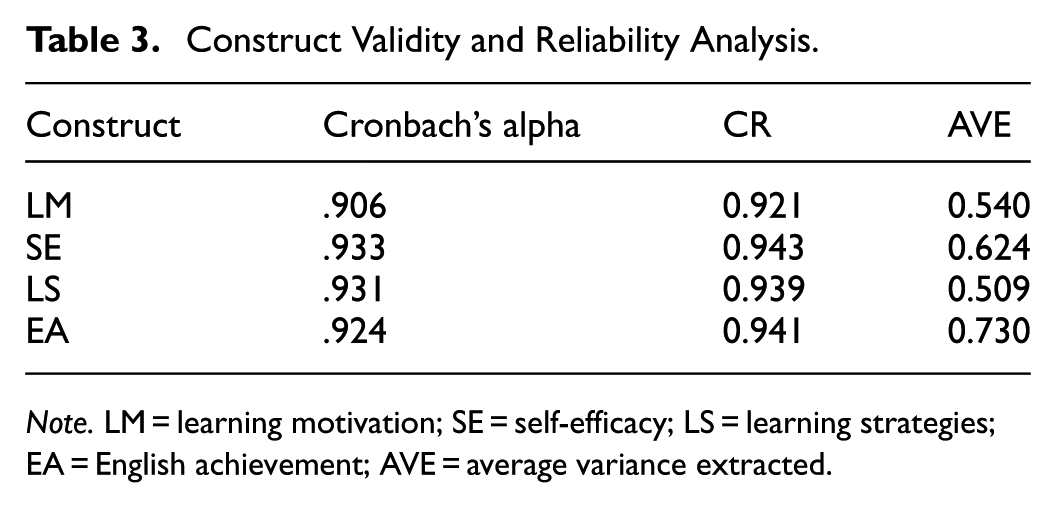
Note. LM = learning motivation; SE = self-efficacy; LS = learning strategies; EA = English achievement; AVE = average variance extracted.
Further reliability assessment comes from checking both Cronbach’s alpha and composite reliability. Here, Cronbach’s alpha scores ranged from .906 to .933, which comfortably exceed the minimum benchmark of .7 (Hair et al., 2022). Hair et al. (2022) propose that composite reliability between 0.60 and 0.70 can be accepted, while anything between 0.70 and 0.90 is regarded as highly reliable. The current study showed composite reliability values spanning from 0.921 to 0.943, thus conforming to these reliability benchmarks.
To measure convergent validity, the study employed the Average Variance Extracted (AVE). As shown in Table 3, the AVE values in this analysis ranged between 0.509 and 0.730, consistently above the critical threshold of 0.5. As indicated by Henseler et al. (2015), such values are considered adequate, confirming that the study results successfully meet convergent validity standards.
Discriminant validity refers to the differentiation between constructs (Zait & Bertea, 2011). One popular method for assessing discriminant validity is the Fornell-Larcker criterion (Fornell & Larcker, 1981). This approach establishes discriminant validity when the square root of a construct’s AVE is larger than the correlations between it and any other constructs (Henseler et al., 2015). As shown in Table 4, the square root of the AVE for every construct exceeds its correlations with other constructs, confirming the achievement of discriminant validity.
Fornell-Larcker Discriminant Validity Results.

Note. As per the Fornell-Larcker guideline for verifying discriminant validity, one must ensure that the square root of the AVE surpasses the correlation values between the constructs. The relevant figures, indicated in italicized bold text, can be found along the diagonal within the table. LM = learning motivation; SE = self-efficacy; LS = learning strategies; EA = English achievement; AVE = average variance extracted.
The Heterotrait-Monotrait Ratio (HTMT), a crucial measure for examining the distinctiveness between constructs, was introduced by Henseler et al. (2015). Gefen et al. (2011) observed that if two constructs exhibit an HTMT value greater than 0.85, it could indicate insufficient discriminant validity. However, in this analysis, all HTMT values calculated between constructs remained well below the upper boundary of 0.90 (Table 5), confirming that the measurement model shows satisfactory discriminant validity between constructs.
HTMT Discriminant Validity Results.

Note. To ensure discriminant validity is achieved, HTMT values must fall below 0.85 according to the HTMT measure. LM = learning motivation; SE = self-efficacy; LS = learning strategies; EA = English achievement; HTMT = Heterotrait-Monotrait ratio of correlations.
Confirmatory Factor Analysis
We conducted confirmatory factor analysis (CFA) to evaluate the quality of the measurement model. Specifically, CFA was used to test whether the factor structure of the questionnaire was consistent with theoretical expectations, thereby assessing the extent to which the instrument appropriately measures the intended latent variables. As shown in Table 6, although the values of the GFI and the AGFI were slightly below 0.90, the overall model proposed in this study demonstrated an acceptable fit to the data (Ji et al., 2024).
Model Fit Indices.

Note. CMIN = chi-square value; DF = degrees of freedom; RMSEA = root mean square error of approximation; GFI = goodness-of-fit index; NFI = normed fit index; CFI = comparative fit index; IFI = incremental fit index; TLI = Tucker-Lewis index.
Structural Model
This study employed several statistical measures for evaluating the structural equation model, including an assessment of multicollinearity, analysis of path coefficient significance, and calculation of the determination coefficient (R2). These tools ensure a comprehensive verification of the model’s reliability and its ability to explain the observed data.
Multicollinearity Analysis
To assess the multicollinearity within the model, the variance inflation factor (VIF) was calculated for each variable. All recorded VIF values stayed well under the 3.3 cutoff, which indicates no multicollinearity issues exist in the data (Hair et al., 2022). The results presented in Table 7 further support the conclusion that multicollinearity does not compromise the outcomes of this research.
Collinearity Test of the Structural Model.

Note. LM = learning motivation; SE = self-efficacy; LS = learning strategies; EA = English achievement.
Path Hypothesis Testing
In the structural model, the significance test aims to assess the impact of exogenous variables on endogenous variables (Hair et al., 2022). Table 8 presents the results of the hypothesis tests, confirming that all proposed hypotheses are valid. Among the factors influencing EA, LS had the strongest effect on EA (β = .327, t = 5.067, p = .000), followed by SE (β = .307, t = 5.815, p = .000) and LM (β = .185, t = 3.761, p = .000). Similarly, for the significant predictors of LS, SE (β = .558, t = 16.617, p = .000) was the strongest determinant, followed by LM (β = .363, t = 10.232, p = .000). Finally, LM significantly predicted SE (β = .580, t = 17.580, p = .000).
Hypothesis Testing Results.

Note.β = beta coefficient; t = represents the two-tailed t-test value; p = represents the significance level; LM = learning motivation; SE = self-efficacy; LS = learning strategies; EA = English achievement.
Explanatory Power and Predictive Relevance
The assessment of the dependent variables’R2 and Q2 values was conducted to determine both the model’s ability to explain the data and its forecast reliability (Hair et al., 2022). The R2 values, as presented in Table 9, offer a measure of how well the model explains the data. According to Chin (1998), R2 scores can be classified into strong (0.67), medium (0.33), or weak (0.19) categories. As reflected in Table 9, the R2 for LS and EA are 0.678 and 0.552, respectively, signaling a high level of explanatory power, with predictors accounting for 67.8% of the variability in LS and 55.2% in EA. Similarly, the R2 for SE is 0.336, placing it in the moderate range, meaning that the predictors explain 33.6% of the variance in SE. Additionally, all Q2 values were greater than zero (Table 9), providing further confirmation of the model’s strong predictive capacity, thus highlighting its robust forecasting ability.
Predictive Validity and Relevance.

Note. R2 = coefficient of determination; R2Adjusted = adjusted coefficient of determination; Q2 = predictive relevance; LS = learning strategies; SE = self-efficacy; EA = English achievement.
Mediation Analysis
In order to examine how English LM, SE, and LS influence academic results, and to assess the mediating roles of SE and LS between LM and academic success, a bootstrapping method rooted in PLS-SEM was used for mediation evaluation (Nitzl et al., 2016). This approach was utilized to gage both direct and indirect influences, as well as to determine the type and intensity of the mediation by analyzing the effect directions. The findings, detailed in Table 10, illustrate that SE and LS significantly mediate the link between LM and EA. Moreover, SE and LS operate jointly as a mediation chain affecting how LM impacts EA.
Mediation Analysis.

Note.t = represents the two-tailed t-test value; p = represents the significance level; LM = learning motivation; SE = self-efficacy; LS = learning strategies; EA = English achievement; CPM = complementary partial mediation.
Discussion
LM, SE, and LS were all positively associated with perceived EA among first-year non-English majors, aligning with prior studies (Al-Hoorie & MacIntyre, 2019; H.-I. Kim, 2024; J. Xu et al., 2024). This result is contextually grounded, as Chinese universities typically offer intensive English instruction during the first year, with clear expectations and frequent assessments. During this foundational phase, students’ awareness of academic demands heightens the impact of internal factors. Motivation drives engagement and persistence, SE fosters confidence to tackle challenges (Yang & Gan, 2024), and strategies help optimize study processes (M. Liu & Chen, 2024). Together, these variables enhance academic outcomes. Future studies could examine how these relationships evolve across academic stages and student backgrounds using longitudinal designs.
LM was positively associated with both SE and LS, and SE predicted LS, aligning with prior studies (Alemayehu & Chen, 2023; Park & Lim, 2024; Song et al., 2022), and supporting SCT’s idea that beliefs guide behavior. For first-year non-English majors with limited prior language experience, SE is crucial for activating strategic behavior. Higher SE increases students’ willingness to engage in goal setting, monitoring, and resource management. From the SDT perspective, SE fulfills the need for competence and fosters autonomy in applying strategies. This may explain the strong effect of the SE-to-strategy path. Future research could explore how this relationship varies across strategy types (e.g., cognitive vs. metacognitive) and whether it is moderated by factors like anxiety or task difficulty.
SE mediated the relationship between LM and perceived EA, consistent with Shang and Ma (2024). SCT emphasizes that beliefs influence behavioral choices and effort (Bandura, 1986). While motivation may spark initial action, confidence in one’s abilities sustains engagement. For non-English majors without immersive environments, SE is a key psychological resource, promoting persistence in language learning (Cai & Zhao, 2023). From a SDT lens, SE also supports the need for competence, shifting learners from externally regulated to autonomous engagement. Future research could examine how this mediating effect varies by types of motivation, such as intrinsic versus extrinsic. Future research may further investigate whether the mediating role of SE differs across various types of LM, such as intrinsic versus externally regulated motivation.
LS mediated the link between motivation and achievement, echoing Almoslamani (2022). According to SCT, strategies are behavioral tools that translate motivation into academic outcomes (Bandura, 1986). In this sample of non-English majors with limited language training, strategy use helps compensate for deficits and improve efficiency. Motivated students are more likely to use goal setting, planning, and monitoring to enhance organization and outcomes. SDT suggests that selecting and applying strategies fosters autonomy and control, reinforcing effort and persistence (Ryan & Deci, 2020). However, the present study did not distinguish between different types of strategies, which limits the extent to which the specific mechanisms of strategic behavior can be examined. Future research should further differentiate among cognitive, metacognitive, and resource management strategies to explore how each type functions within the motivation–achievement process.
This study examined the chain mediating roles of SE and LS in the relationship between LM and perceived EA. The proposed chain mediation model provides empirical support for the central mechanism of SCT, which posits that motivation influences learning outcomes through the interplay of beliefs and behavior. Motivation fosters efficacy beliefs, which then encourage persistent and strategic learning behaviors. Strategy use optimizes the learning process and improves academic performance. This aligns with Derakhshan and Fathi (2024), who found that motivation enhances achievement through combined psychological and behavioral factors. Students with high SE also show greater interest and willingness to engage in learning (Al-khresheh & Alkursheh, 2024). These findings highlight the importance of fostering SE and strategy use to improve learning outcomes. Future research may investigate the model’s applicability across educational contexts.
Implications
This study, grounded in SDT and SCT, constructs a chain mediation model to explore the relationship between college students’ LM and EA, with a focus on the mediating roles of SE and LS. The findings reveal that LM, SE, and LS all have significant positive effects on EA. Furthermore, SE and LS serve as partial mediators and form a chain mediation pathway, providing valuable insights for both theoretical development and educational practice.
Theoretical Contributions
This study contributes theoretically by constructing and validating a chain mediation model—“LM → SE → LS → EA”—within an integrated framework of SCT and SDT. It reveals the underlying pathways through which key psychological variables function in English learning among undergraduate non-English majors. The findings highlight that LM, as the initiating variable, not only directly relates to academic achievement but also indirectly enhances learning outcomes through the combined effects of SE and LS. This deepens the understanding of the “motivation–belief–behavior–outcome” mechanism. By empirically testing the structural relationships and mediating pathways among core variables, the study supports the belief–behavior linkage proposed in SCT and demonstrates the explanatory power of SDT in the development of learning motivation. It provides a theoretical reference and model basis for future research on motivation and efficacy in the context of language learning.
Practical Implications
This study sheds light on the underlying mechanisms linking college students’ English LM, SE, LS, and EA. It proposes a three-level intervention framework to provide systematic guidance for educational practice.
First, it is essential to prioritize the activation and maintenance of LM. Teachers can enhance students’ intrinsic motivation by guiding them in setting clear and attainable English learning goals, incorporating situational teaching methods (e.g., real-life communication scenarios or cross-cultural case studies), and designing task-driven activities (such as project-based writing assignments or group discussions). These approaches may help students find greater meaning and engagement in English learning.
Second, given the mediating role of SE, instructional efforts should emphasize the construction and reinforcement of “success experiences.” Teachers may design tiered tasks that allow students at different proficiency levels to experience success. In addition, modeling (e.g., showcasing peer improvement through effort) and timely positive feedback can help students build the belief that “I am capable of learning English.”
Third, as LS serve as a key link in translating motivation into academic outcomes, explicit instruction in strategic learning should be systematically integrated into classroom teaching. For instance, educators can teach students how to break down tasks, build lexical networks, apply skimming and scanning techniques in reading, and practice prediction and information extraction in listening. These practices can be further reinforced through self-reflection and peer evaluation after task completion to foster strategy awareness and transferability.
Taken together, this study supports an intervention model grounded in the “motivation–belief–behavior–outcome” sequence. Educators should aim to simultaneously foster students’ LM, strengthen their SE, and provide explicit instruction in transferable LS to promote sustained engagement and enhanced effectiveness in English learning.
Limitations and Future Research
First, EA in this study was measured using a self-reported scale based on broad grade categories, which may be subject to common method bias and social desirability bias. This measure likely reflects subjective perceptions rather than objective performance. Future research should adopt triangulation strategies by incorporating standardized English test scores, teacher evaluations, or behavioral data from online platforms to enhance measurement validity. Second, the cross-sectional design limits causal inference. Future studies could adopt longitudinal designs to track changes in LM, SE, and LS over time, as well as their long-term associations with academic achievement. Experimental or quasi-experimental studies are also recommended to test interventions targeting SE (e.g., phased goals, feedback, modeling) and examine whether these interventions improve strategy use and objective English performance, thus providing stronger evidence for the chain mediation model. Third, the sample mainly included first-year non-English majors, which limits generalizability. Future studies should test the model across different academic years and majors, and use subgroup analysis to explore potential differences in path effects. Finally, future research should include external variables such as family environment, school resources, and socioeconomic status, and apply multilevel modeling to build more comprehensive academic achievement prediction models.
Conclusion
This study thoroughly examined the influence of college students’ English LM, SE, and LS on their perceived EA, while also exploring the mediating roles of SE and LS. The findings revealed that LM significantly enhances students’ perceived EA by boosting SE and improving LS. SE partially mediated the relationship between LM and perceived EA, suggesting that high LM not only directly improves English performance but also has an indirect effect by enhancing SE. Additionally, LS played a mediating role between LM and perceived EA, suggesting that the appropriate use of LS further improves English performance. LM, as the core driver of students’ active engagement in learning, significantly impacts perceived EA through the chain mediation of SE and LS. This study provides valuable insights into the psychological mechanisms underlying college students’ English learning and provides a theoretical foundation for practical interventions aimed at improving students’ perceived EA. Future research could further explore the mechanisms through which SE and LS function in different contexts, as well as other social and psychological factors that may influence students’ learning performance, to develop more targeted educational interventions.
Footnotes

Ethical Considerations
The researchers confirms that all research was performed in accordance with relevant guidelines/regulations applicable when human participants are involved (e.g., Declaration of Helsinki or similar). This study was approved by the Ethics Committee of Shanghai Ocean University (Approval Number: 2024-0040).
Consent to Participate
The participants received oral and written information and provided written informed consent before participating in the study.
Author Contributions
Conceptualization: Shuyan Liu; Methodology: Shuyan Liu; Formal analysis and investigation: Shuyan Liu, Haiying Sun; Writing - original draft preparation: Shuyan Liu; Writing - review and editing: Shuyan Liu; Supervision: Shuyan Liu. All the authors have read and agreed to the published version of the manuscript.
Funding
The authors received no financial support for the research, authorship, and/or publication of this article.
Declaration of Conflicting Interests
The authors declared no potential conflicts of interest with respect to the research, authorship, and/or publication of this article.