



Abstract
This research was a quasi-experiment that examined the effects of CLIL in an educational context in Taiwan’s higher education. Two groups of first-year undergraduate students were involved. One (65 students) was taught with CLIL; the other (59), the conventional approach. Their knowledge of the content and learning attitudes (self-efficacy and motivation) were quantitatively compared through achievement tests and a questionnaire. A qualitative semi-structured survey asked both groups for their perspectives on and perceptions of the treatments. The quantitative results show that both approaches were significantly effective for improving students’ knowledge of the content of the target subject (literary text), but the EG outperformed the CG. Likewise, both groups had positive learning attitudes to their treatments, but the EG also outweighed the CG. Furthermore, the qualitative accounts generated diverse results, reflecting the underlying difference between the approaches but showing that both approaches were welcomed. However, the conventional method was more favored than CLIL, mostly because of the participants’ learning preferences or because of the learning patterns which they had formed over years of studying in the specific cultural-education system (i.e., that of Taiwan) chosen for the study.
Keywords
Introduction
The first two decades of the 21st century have witnessed the rapid rise of Content and Language Integrated Learning (henceforth, CLIL) in the education field. The term CLIL was first coined by Marsh (1994), referring to a teaching approach where both the teaching and learning of a subject come through an additional language as the main medium of instruction. This practice takes advantage of authentic, meaningful input from the literary content (Dalton-Puffer, 2007, 2011; Dalton-Puffer et al., 2010), enabling learners to acquire the target foreign language as a natural by-product (Coyle et al., 2010). The pedagogical effects of CLIL may be ascribed to the support from foreign language learning theories and approaches, such as content-driven instruction (Arnó-Macià & Mancho-Barés, 2015; Ruiz de Zarobe et al., 2011) and task-based language teaching (Banegas, 2012; Lasagabaster & Sierra, 2009; Mayo & Ibarrola, 2015). Growing empirical reports also endorse CLIL implementation in educational settings, recommending its effectiveness in learning a subject and a foreign language simultaneously (e.g., Agustín-Llach & Canga Alonso, 2016; Catalán & Llach, 2017; Forey & Cheung, 2019). The various endorsements for CLIL may explain why it is predicted to be one of the most feasible methods of tackling the persistent difficulties in any foreign language classroom (Mayo & de los Angeles Hidalgo, 2017).
However, despite the great favor in which it is held, scholars continue to ask for more investigation (Cenoz et al., 2014; Gené-Gil et al., 2015; Llinares et al., 2012) before CLIL can be safely embraced in all educational contexts (cf. Martinez Agudo, 2022). An interesting area that might shed different light on the effects of CLIL is the learning attitudes and performance of students in higher education. This group of students, unlike the great majority of the subjects examined in prior studies, is scarcely ever investigated in the field. The present study thus has the aim of conducting an experiment to examine Asian undergraduate students’ learning attitudes to CLIL and their learning performance. Comparing these outcomes with those of non-CLIL students could yield especially meaningful and objective outcomes.
Theoretical Support of CLIL
CLIL essentially embraces several important theoretical elements and pedagogical practices in foreign language education. For example, CLIL is by nature a content-driven approach (Coyle et al., 2010; De Graaff et al., 2007), distinguishing itself “from other language-driven approaches that may use content in language teaching but aim solely towards language gains” (Ioannou Georgiou, 2012, p. 498). While this essence ensures that CLIL is implemented in ways that partially reflect the content-based instruction (Arnó-Macià & Mancho-Barés, 2015; De Graaff et al., 2007; Ruiz de Zarobe et al., 2011), practitioners should further seek a balance between the teaching of the content subject and language matters. In addition, many CLIL practices follow the task-based language teaching model (Banegas, 2012; Lasagabaster & Sierra, 2009; Mayo & Ibarrola, 2015), which requires authentic contexts or opportunities for students to interact using the target foreign language (Skehan, 1996; J. Willis, 1996; D. Willis & Willis, 2007, 2009). Vygotsky’s (1978, 1987) scaffolding is also indispensable in CLIL, since it supports the language of learning, language for learning, and language through learning (cf. Coyle, 2007; De Graaff et al., 2007). These inherently varied theoretical and pedagogical elements may explain why Ioannou Georgiou (2012, p. 495) advocates CLIL as “the most recent developmental stage of the communicative language teaching (CLT) approach.”
In addition to being a fusion of different theories and approaches (Ioannou Georgiou, 2012), CLIL itself capitalizes on the 4Cs (content, communication, cognition, and culture), a conceptual framework that Coyle (1999) first proposed and has thus been widely accepted by scholars and practitioners (e.g., Coyle, 2007; Coyle et al., 2010; Ioannou Georgiou, 2012; Kao, 2022). Specifically, the model is performed with content at the heart of the learning process, an additional language serving as the conduit for communication, learners engaged in higher levels of cognition, and culture referring to understanding the pluricultural and plurilingual world of its origin (Coyle et al., 2010). The 4Cs provides transparent and holistic conceptual guidance for effective CLIL lessons (Coyle, 2007; Coyle et al., 2010; Ioannou Georgiou, 2012).
Empirical Reports About CLIL
CLIL also finds empirical support for its pedagogical effects. To begin with, Aguilar and Rodríguez (2012) found their CLIL students of English as a foreign language (EFL) significantly improving in listening, speaking, and vocabulary. CLIL also have similar effects on the sexes. Heras and Lasagabaster (2015) reported that it diminished the gender difference in the motivation to learn a foreign language, a finding also reported later by Lahuerta (2020) and Agustín-Llach and Canga Alonso (2016). Catalán and Llach (2017) compared CLIL and non-CLIL treatments and found that the former had a significantly greater impact on EFL students’ learning achievement. By comparison, also, Ruiz de Zarobe and Zenotz (2015) point out that CLIL helps students to apply metacognitive strategies better than non-CLIL students can and has better learning outcomes. Likewise, Yang (2017a), who also introduced CLIL into a lesson about learning strategies, found CLIL effective in empowering college students to apply more strategies and learn more successfully. Later, Yang (2017b) investigated the potential of CLIL to enhance college students’ mobility and employability. His students positively acknowledged the effects of CLIL on these areas. Even with younger EFL learners, CLIL was found helpful; it contributed to the development of writing skills among eighth graders (Lo & Jeong, 2018). Recent studies continue to maintain the effects of CLIL on physical education (Forey & Cheung, 2019), general secondary school English (Artieda et al., 2020), English writing skills (Lahuerta, 2020), and motivation and attitudes to language learning (De Smet et al., 2023). In addition to positive pedagogical effects, the great majority of stakeholders, such as CLIL students themselves, their parents, CLIL teachers, and school administrators, also favored the CLIL approach (Barrios & Milla Lara, 2020; Mehisto & Asser, 2007; Oxbrow, 2020; Pladevall-Ballester, 2015). These stakeholders had a positive attitude to the implementation of CLIL in educational contexts, convinced that it can enhance students’ attitudes to learning, interest, motivation, and even learning achievements. Despite overwhelming approval, however, CLIL, as a relatively new approach, continues to invite further investigation of its various dimensions and its wider contexts (cf. Cenoz et al., 2014; Gené-Gil et al., 2015; Llinares et al., 2012; Martinez Agudo, 2022). An area that urgently calls for attention is teaching CLIL to college students in Asia, a group of learners rarely empirically investigated in the field (Arnó-Macià & Mancho-Barés, 2015; Coyle et al., 2010; Dalton-Puffer et al., 2010; Pladevall-Ballester, 2015).
The Study
Participants
This study was a quasi-experiment that took place in a private university in Taiwan. A convenience sample of two classes attending the same course (Introduction to Western Literature) agreed to take part; the course aimed to equip students with a general knowledge of some of the major themes and characters of medieval and renaissance literature.
The classes were randomly assigned to an experimental group (EG), learning with CLIL, or a contrast group (CG) taught with the conventional deductive approach. The EG had 65 students (20 males, 45 females). The CG had 59 (15 males, 44 females). The students were mostly 18 years old (a few were 17 or 19) and had studied general English in the formal educational system for about 10 years. Before the experiment, none had been taught using CLIL and they had never attended formal literature classes.
Treatment
The experiment took four consecutive weeks (2 hr each), during which both groups had the same schedule and textbook, focusing on The Adventures of Odysseus, an ancient epic poem by Homer that tells the story of Odysseus’ 10-year struggle to return home to Ithaca after fighting in the Trojan War (Hamilton, 1942, 2017). Both groups also had the same teacher, who was not the researcher herself; this was to avoid possible researcher bias or endeavors biased toward either group. English was the only medium of instruction for both groups. The only difference was the teaching approach that they were taught with.
EG Treatment
To the EG, the teacher delivered the lessons using different practices and strategies to form a CLIL lesson. The lessons were mostly content-based and task-based, with old and new knowledge scaffolded together, cooperative interaction with peers frequently demanded, and subject competences developed through language (cf. Ball and Kelly, 2016; Mehisto, 2017). This could be seen in the CLIL treatment described below, using several pair-group activities that helped students to communicate about the content of the theme, develop their cognition about it, and discuss possible cultural elements.
For example, in the beginning of the CLIL class, a warm-up activity was used to prepare students for the lesson, pairing them up to think about and share their own understanding of the word adventures and any journey/adventures they might have had or dreamed about. They were also asked to write down any words that might be associated or collocated with the idea of adventures/journeys. They then pair-guessed what Odysseus’ adventures might be like. Next, a short video clip about Odysseus’ adventures was played, to catch their interest and guide them into the main topic of the lesson. Then the students were again paired to reflect on what they had watched and to share the first three main ideas that came to mind about Odysseus or his adventures.
After their warm-up, the class began to learn about the characteristics of the important characters in the story before moving to the series of adventures. However, instead of the teacher giving lectures and didactic explanations, the students were divided into groups for cooperative learning. Each group first matched descriptions of characteristics with the characters in the story using several sets of character descriptions (printed on scraps of colored paper) that the teacher had prepared by adopting suitable texts from the textbook. Visual aids (cf. De Graaff et al., 2007; Lin, 2016; Zhyrun, 2016) showing portraits and the main settings of the characters were shown on PPT to help the group tasks. After matching these, open discussion between groups was initiated with the teacher’s help. Next, a jigsaw reading task (Ball and Kelly, 2016) was set up to help students gain further understanding of the main idea of each episode of Odysseus’ adventure. To be precise, each group was assigned to team-discuss an episode. After they had built up some knowledge of their own episode, they were regrouped in a “jigsaw” maneuver, to form expert groups which shared with new members their understanding of their assigned episode. The teacher walked around monitoring the group discussions. Whenever a student needed help with expressions or difficult ideas, s/he could ask team members or the teacher for it, whether linguistic or concerned with content. Following the open discussion part of the jigsaw was a short period for sharing the cultural concepts they might have noticed in the story. Students first brainstormed their ideas and then reported them to the class. Some compared the heroism in Odysseus’ adventures with that of characters in Taiwanese writings; some compared the concepts of kindness and hospitality described in the story (e.g., the welcome that Odysseus was given on the islands of the Phaeacians, Calypso, Aeolus, Alcinous, and Penelope) with those in the aboriginal cultures of Taiwan.
Finally, the lesson was reviewed with the aid of an online application called Kahoot (https://kahoot.com/), an educational, game-based learning platform (cf. Pérez & Malagón, 2017; Wewer, 2017) where students could team-work on questions via their mobile phones. Specifically, the teacher prepared several true-false and multiple-choice questions on Kahoot, through which students had to team-check their overall knowledge of Odysseus’ adventures. Brief explanations were given at this stage if any group got a question wrong.
CG Treatment
In contrast, the CG students were taught by means of lectures, a conventional way of teaching literature courses. Primarily, it was teacher-centered. The teacher used the textbook to discuss all the main ideas of Odysseus’ landfalls. Rather than getting the students to discuss them, he also described each major character in the journey. From time to time, the teacher asked the class questions, but used a non-CLIL model. For example, at the beginning of the lesson, the students were asked for definitions instead of sharing their own ideas about journeys/adventures. Occasionally, the class was asked to read aloud a certain section/passage; they were asked to give their opinions about it, without being given any preparatory discussion. Afterward, the teacher commented on their answers and elaborated on them where appropriate. Additionally, the class was taught to highlight certain passages that were considered famous lines of the work or could best represent some quality of a character in the story. The class was also asked to give their opinions about them. The teacher took the initiative in mentioning certain cultural concepts and compared them with those described in Taiwanese writings and culture. Finally, in an oral review he concluded the lesson by briefly summarizing the main ideas of Odysseus’ adventures.
Instruments
Achievement Tests
A pre-test and a post-test were used to assess both groups’ knowledge of the lesson (i.e., The Adventures of Odysseus) and their language skill of writing. The tests were designed by the researcher herself. Expert validity was established by seeking judgments from three other experienced teachers of the same subject. The pre- and post-tests had the same 30 multiple-choice questions (2 points each) examining the students’ content knowledge, and two short essay questions (20 points each) evaluating their writing skills in discussion. The only difference between the tests was the order of the multiple-choice questions and the options, which were arranged differently each time. The multiple-choice items assessed students’ literal, inferential, and evaluative comprehension of the lesson. The essay section then focused on examining students’ writing skills in showing their understanding of and perspectives on the content of the work. The essays asked “Do you consider Odysseus heroic? Why or Why not?” and “What lesson may be learned from the journey of Odysseus?” Three raters (the teacher, the researcher, and a third experienced literature instructor) then assigned holistic scores to the essays by judging their overall ideas and the quality of the writing. An inter-rater reliability test was later conducted. The result showed a high Cronbach’s α at .85 (cf. Wu & Tu, 2005, 2009), suggesting that the raters reached a high level of agreement on the participants’ essay quality. The raters’ scores were then averaged for data analysis.
Learning Attitudes Questionnaire
This questionnaire is an adaption of Lin’s (2016) 5-point Likert-scale questionnaire, which examined the learning motivation and self-efficacy of college students in Taiwan. The revision retained all Lin’s items intact, including their wording and sentence structures. The only change made in the revision was to replace the target aspects examined in Lin’s questions with those of the current study. After making the revisions, the final version was pilot-studied using another sample of 80 other undergraduate students. A confirmative factor analysis was thus conducted. Its results presented the final questionnaire with 12 quality items in total that had overall strong reliability (Cronbach’s α = .891) and construct validity (79.38% variance explained). The analysis also identified three factors that had good reliability and validity: Factor 1: self-efficacy in analyzing literature texts (five items; Cronbach’s α = .907; 30.88% variance explained); Factor 2: activity in class (three items; Cronbach’s α = .926; 26.66% variance explained); and Factor 3: motivation to learn about literature (four items; Cronbach’s α = .908; 21.84% variance explained). Finally, the questionnaire was administered after the experimental treatment to check whether the groups developed different learning attitudes after the experiment.
It should be explained that no entry questionnaire was implemented. This is because no member of either group had ever attended a formal course on Western literature of any kind. It would not be realistic to expect students to respond to an entry survey that so explicitly required them to judge their specific affective learning attitude to a subject outside their experience.
Qualitative Survey
A semi-structured survey was administered when the experiment ended, to collect qualitative accounts of both groups’ learning experience. It asked both groups the same six open-ended questions, avoiding any suggestive words, such as new/innovative, different, or traditional/conventional to maintain objectivity. Primarily, the survey asked the participants to (1) describe their general learning experience in the experiment; (2) give reasons why they liked or disliked the delivery of the course; (3) name difficulties or challenges, if any, when attending the course; (4) name learning preferences within the treatment; (5) judge the value of letting English serve as the medium of instruction; and (6) estimate their willingness to attend similar literature courses in future.
Data Analyses
The quantitative data collected were analyzed using t tests run in SPSS. First, independent t tests compared differences between the groups in terms of the achievement tests, the attitude questionnaire, and the pedagogical evaluative survey. Second, dependent t tests examined whether the groups changed significantly in their achievement tests after the experiment. Note that before performing the t tests, their assumptions were all found tenable, including the sample size, an acceptable normal distribution of the data collected, and homogeneity of variance (cf. Field, 2013).
The qualitative data collected from the groups went through the same set of analytical steps in their turn. First, the descriptive accounts were coded by the researcher and two of her colleagues. The coding focused on the participants’ specific comments and feedback on the target treatment that they received. Any descriptions of their learning perceptions and/or preferences, regardless of positivity or negativity, were marked. Next, the coders discussed and justified their codes. The inter-rater agreement between the coders in the final coding was 87.95%. Lastly, coding that was shared in the common features of separate groups was synthesized to represent and compare the learning experience of the groups.
Results
Achievement Test Results
First, a set of independent t tests examined the results of the achievement pre-test scores, yielding no statistically significant differences between the groups in terms of the multiple-choice section (t = 1.31, p = .19), the essay (t = .55, p = .58), or total scores (t = 1.11, p = .27). This means that before the experiment started, the groups had similar entry knowledge of the content subject and similar language skills in addressing it.
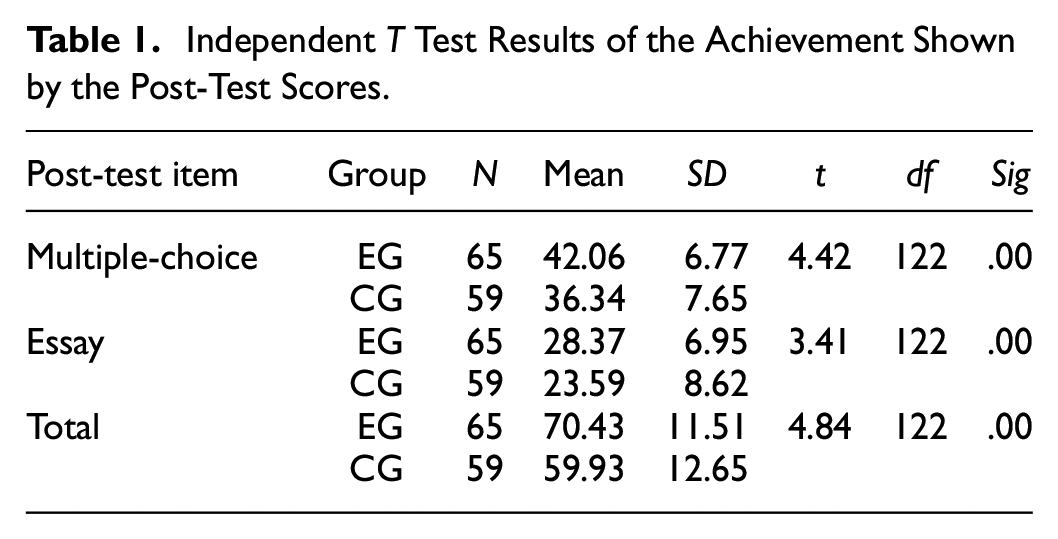
Next, Table 1 shows the results of the independent t tests where the groups’ achievement in their post-test scores were compared, and Table 2 shows whether they each improved their performance after the experiment. As Table 2 shows, the EG outperformed the CG statistically significantly in all the post-test items: the multiple choice section (t = 4.42, p = .79), the essay (t = 3.41, p = .00), and its overall scores (t = 4.84, p = .00). This suggests that CLIL was more effective than the conventional method in enabling the participants to acquire knowledge of the literary content and use the language to discuss it, despite Table 2 revealing that both treatments were effective since both groups made statistically significant gains in all aspects of the post-tests.
Independent T Test Results of the Achievement Shown by the Post-Test Scores.
Paired-Sample T Tests of the Groups’ Pre- and Post-Tests.

Attitude Questionnaire Results
Table 3 shows the overall results of the groups’ motivation and self-efficacy questionnaires. First, the average scores assigned by both groups were all a good deal higher than 4.00 (indicating agree on the 5-point scale), with the overall average reaching 4.79 for the EG and 4.48 for the CG. This means that both groups showed rather positive learning attitudes following the experiment. However, the independent t test results also uncover statistical differences between the groups’ scores, suggesting that the members of the EG significantly outdid their counterparts in the overall questionnaire scores (t = 2.55, p = .01), Factor 1 (t = 2.49, p = .01), and Factor 2 (t = 2.71, p = .01). The exception was with Factor 3 where no statistical difference was found (t = 1.40, p = .16). The results suggest that CLIL may significantly improve students’ overall learning attitude to a literature course more than conventional lectures do, especially in terms of their confidence in learning to analyze literature texts (Factor 1) and participating in class (Factor 2). However, the groups developed similar motivation to learn from their treatments (Factor 3).
Independent T Tests Comparing the Groups’ Motivation and Self-Efficacy Scores.

All t test calculation is based on mean scores. The full marks and points are presented to facilitate discussion.
Qualitative Results
For reasons of space, only the three major thematic categories that best represent and compare the groups’ learning experiences are presented below.
Commending the Treatments From Different Perspectives
Almost all the participants of both groups had a positive attitude to their learning experience and their treatment, but not entirely for the same reasons. To be precise, both groups contained many students who wrote that they “liked the teacher,”“appreciated his effort and teaching,” and “enjoyed the class.” Interestingly, however, the EG’s other comments were focused more on the treatment whereas the CG commented more on the teacher. For example, most EG students said they enjoyed CLIL because it was “fresh,”“new,”“innovative,”“fun,”“interesting,”“interactive,”“well-designed,”“special,” and “game-based.” In contrast, the great majority of the CG approved of the treatment because to them, the teacher “taught well,”“had clear analysis of the story and text,”“spoke English clearly,” and “was knowledgeable.”
Different Treatments Bringing Forth Different Challenges
Although most EG and CG students reported no particular challenges in learning with either treatment, some in both groups brought up some issues specific to their own group, which highlight the diverse natures of the two approaches. For example, 11 students in the CG complained mostly about their listening ability or vocabulary. Some comments include “I don’t understand what the teacher was talking about … my listening is poor”; “my listening is not good, I have to listen very carefully”; “my English listening is bad, couldn’t really understand what he (the teacher) said”; and “… I didn’t know the meanings of some vocabulary.” In contrast, only four EG students found their listening ability a problem, while eight others described specific weaknesses in associating communicating skills with analytic skills. Below are some excerpts: “Discussion is challenging … I have to first understand the text and then share it”; “speaking is a challenge to me, especially when I have to analyze the text”; “the greatest challenge to me is to absorb the text, articulate the message in my own words, and then express it to my group members,” and “the CLIL task is difficult if a person is bad at story-telling or analyzing.”
Conventional Approach Fitting More Students Than CLIL
Despite their awareness of some challenges, most people in both groups still approved their learning experience in the experiment. However, when addressing learning preferences, conventional lectures were much more favored than CLIL. To be precise, 88.14% of the CG students (i.e., 52 out of 59 students) said that the treatment fit their preferences, whereas only 58.46% of the EG (i.e., 38 out of 65) said the same. This is also one of the main reasons why eventually the great majority of the CG (i.e., 56 out of 59) hoped to continue learning the same way while only two thirds (i.e., 43) of the EG students did. Still, the reasons given, positive or negative, are different between the groups, as can be seen below.
Specifically, most CG students openly explained that they were “used to lectures” and “the teacher gave clear lectures,” which were “professional” and “easy to follow.” Many added that they “learned a lot from the lectures.” Some also agreed that the teaching method fit their preference, but noted that “the teaching style was no different from other courses” that they used to attend.
Most of those inclined to CLIL submitted reasons similar to each others’, favoring the nature of CLIL as communicative and task-based: “I really like the frequent (group) discussion and interaction between us (the students themselves)”; “the (discussion) questions and tasks made the learning more meaningful and interesting”; “CLIL made the class active”; and “those CLIL activities engaged me and helped me to think, not just to listen.”
Conversely, those who felt CLIL was not for them mostly preferred lectures to CLIL. Examples include “I prefer attending lectures”; “I like lectures because I can take more notes, which helps me to memorize things”; and “I like the teacher to explain the text for me, but not my classmates.” A few others explained that they liked lectures because of past learning experience or learning styles: “I like to read alone and think by myself”; “I’m not used to discussing with classmates. I like to think alone”; “I always feel awkward in group discussion. Speaking up in group or class is embarrassing”; and “if CLIL requires frequent discussion in groups, I’d rather choose lectures. I don’t like classes where the attention is on me.”
Discussion and Conclusion
This study took a mixed approach to examining the effects of CLIL on freshman undergraduates who had attended a Western literature class. The quantitative results show that both CLIL and non-CLIL participants significantly improved their understanding of the content of the target subject, but the CLIL group outperformed their counterparts. Similarly, both groups developed positive learning attitudes toward their treatments, but the CLIL group outweighed the non-CLIL group. Qualitatively, diverse results were found, reflecting important difference between the approaches but also showing that both approaches were welcomed. The mixed findings merit discussion.
To begin with, both the EG and the CG made significant gains, but former outperformed the latter. While this means that both methods were pedagogically effective, it also indicates that CLIL had a greater impact on enhancing students’ knowledge of content and their use of written English to improve it. These findings resonate with the previous studies that reported how CLIL students improved, more effectively than non-CLIL students did, the range of their foreign language skills (e.g., Aguilar & Rodríguez, 2012; Lahuerta, 2020) and acquired content knowledge (e.g., Agustín-Llach & Canga Alonso, 2016; Catalán & Llach, 2017; Ruiz de Zarobe & Zenotz, 2015). Taken together, these positive findings may explain why many other researchers recommend CLIL (e.g., Agustín-Llach & Canga Alonso, 2016; Catalán & Llach, 2017; Forey & Cheung, 2019).
Additionally, similar findings applied to both groups’ performance in learning attitudes. Specifically, although participants from either treatment self-reported enhanced learning attitudes toward their treatment, the EG showed significantly more enhanced attitudes than the CG. While the former result is an indication that both approaches were instructionally suitable for developing college students’ learning attitudes to literature courses, the latter again revealed that the effects of CLIL were superior. This corresponds to several previous studies that reported CLIL to be capable of enhancing students’ general attitudes and learning motivation (e.g., De Smet et al., 2023; Doiz et al., 2014; Lasagabaster, 2011), self-efficacy (Jaekel, 2020; Ohlberger & Wegner, 2019), and in-class engagement (Nikula, 2015). The present outcomes about attitude also complemented the achievement test results, serving as further evidence to justify the feasibility of teaching CLIL even in a new and unfamiliar socio-cultural context such as Taiwan.
Additionally, it is important to address the differences and similarities between the groups in terms of specific attitude factors. To be precise, the EG felt more empowered than the CG to analyze texts (Factor 1) and more engaged in the treatment (Factor 2). Such perceptions imply that the former were more positively subject to CLIL’s pedagogical nature, which capitalizes on certain carefully designed pair-group tasks and discussions. The differences between the groups’ attitudes also reflect the different practices of the approaches used in this study: CLIL practices were designed to be learner-centered, giving students hands-on team tasks and were structured so that teams themselves discussed the content of texts. Conversely, the CG learning mostly depended on teacher-centered lectures. However, unlike Factors 1 and 2, the CLIL students stopped showing greater favor toward their treatment than did the CG when they reported their self-perceived motivation to learn literature (Factor 3). This may suggest that, with regard to motivation, both approaches had the same effects.
The qualitative accounts enrich the discussion by presenting the mixed learning experiences of both groups. First, most of the members of both groups generally reported favoring the treatments. This supplements their positive quantitative pedagogical judgments cited above, increasing the legitimacy of practicing CLIL in different programs and regions from those in the present study. Furthermore, the groups gave different reasons for approving their treatments. This not only reflects the very dissimilar natures of the approaches, but justifies the CLIL design of the present study, since it managed to allow the members of the EG to develop a new and different learning experience from the CG’s and from their own past. This is endorsed by the fact that the EG focused on liking the features of the method itself for being innovative and fun to use, affording opportunities for them to think about and team-discuss the content of the text, whereas the CG mostly endorsed the qualities of the teacher and his good and professional lectures. The differences identified here may also corroborate the theoretical value of CLIL: it is a communicative (Ioannou Georgiou, 2012), learner-centered approach (Mehisto et al., 2008), with its practices centered on content-based and task-based instruction (Arnó-Macià & Mancho-Barés, 2015; Banegas, 2012; De Graaff et al., 2007; Mayo & Ibarrola, 2015; Ruiz de Zarobe et al., 2011). The fact that the EG so clearly experienced the differences between CLIL and conventional teaching may further explain why the EG developed greater self-efficacy in analyzing the material and reported more engagement in class. On a related note, the differences may also validly account for CLIL’s greater capacity than that of a lecture to improve students’ learning.
However, despite seemingly greater pedagogical effects, most of the EG participants said that they were not accustomed to the changes entailed by CLIL and hence preferred the traditional habits of sitting together, taking notes, thinking alone, and listening to the teacher. Perhaps this verdict from the EG group is no surprise, since they had long been studying in the particular cultural-education system of Taiwan where passive learning or teacher-centered didactic teaching still seems to dominate. This assumption finds support in the EG students’ own accounts, where many of them admitted liking CLIL because it was not the same as their traditional lectures, while those who disliked it also said the same.
Nonetheless, it may still not seem too optimistic to recommend CLIL for students in Taiwan’s higher education or Asia’s general higher education system since most EG students could still react so quickly and favorably to new pedagogical practices and highly approved of this apparently abrupt transition. However, it would appear to be an over-interpretation at this point to say that perhaps, given more CLIL time, the sample EG students would also adapt themselves to the new teaching model. Future researchers may like to test this by a longitudinal experiment. It would shed especially clear light if researchers could consider also a specialized analysis of learner profiles using, for example, Kolb’s (2007) Learning Style Inventory, or other similar surveys in the field.
Finally, although the design of this study is valid itself, it has some limitations that call for caution and further investigation. First, this study focuses wholly on CLIL students’ learning experience, and does not go into the perspectives and perceptions of CLIL teachers, which are equally important in assessing a pedagogy. Investigating the opinions of Taiwanese CLIL teachers, or equally those from other Asian countries, may seem especially important with regard to the long-lasting cultural-educational preferences or phenomena that have been addressed above. This is particularly critical given that while this study found Taiwanese students in favor of CLIL as a new, fun, interesting approach, an early study by Kung (2018) showed that most of the Taiwanese tertiary teachers whom he investigated cast doubt on CLIL’s pedagogical feasibility and said their CLIL lessons were “dry,”“hard,” and “fixed” (p. 103). Such great variation between the perceptions of the Taiwanese students and their teachers calls for urgent investigation. In addition, the sample for study may seem adequate in size but came from a single site in Taiwan. The results may thus not be representative of the wider population. Future CLIL studies may consider recruiting different samples from several areas of Taiwan or other Asian settings to make a more comprehensive assessment of the effects of CLIL in Asia’s higher education.
Footnotes
Declaration of Conflicting Interests
The author declared no potential conflicts of interest with respect to the research, authorship, and/or publication of this article.
Funding
The author disclosed receipt of the following financial support for the research, authorship, and/or publication of this article: This article was written with funding support from Taiwan’s National Science and Technology Council (108-2410-H-032-030; 112-2410-H-032-014).

Data Availability Statement
Data sharing not applicable to this article as no datasets were generated or analyzed during the current study.